

U.S. competition policy is generally portrayed as exceptional and idiosyncratic, resulting from open-ended legislative acts and strict judicial enforcement, especially when compared to other developed countries, which lacked such laws until the second half of the twentieth century.Footnote 1 It reflects, we are told, Americans’ deep-seated hostility to monopoly power, which was codified in federal policy with the Sherman Antitrust Act of 1890.Footnote 2 The courts then enshrined a faith in marketplace competition and reinforced the fear of monopoly power that became a hallmark of U.S. attitudes and regulatory impulses.Footnote 3 This story, however, belies the unsettled and contingent history of U.S. competition policy and neglects the variety of approaches used to regulate competitive markets.Footnote 4 Recent revisionist accounts in business and legal history have begun to reframe U.S. competition policy as a contested terrain of compromise and accommodation between open market competition and efforts to manage competitive practices.Footnote 5
The creation of the legal category of “unfair competition” in the early twentieth century challenged the idea that the public good was best protected by market competition. Historically, rather than U.S. competition policy exclusively protecting market competition to achieve efficiency and low prices, state and federal policies often protected competitors as a means to preserve competition while producing more equitable outcomes through the democratic process. Louis Brandeis—the renowned “people's lawyer,” crusader against “bigness,” and Supreme Court Justice—helped coin the term “fair trade” to rebrand Resale Price Maintenance (RPM) contracts, a much less palatable term.Footnote 6 Fair trade allowed manufacturers to set retail price floors and require particular services for brand-name goods.Footnote 7 For Brandeis, fair trade meant protecting proprietary associations, which in his view were little different than labor unions or agricultural cooperatives.Footnote 8 The Supreme Court, however, disagreed. In 1911, it held that those arrangements fostered horizontal combinations of retailers and facilitated price-fixing—practices deemed anathema to American antitrust policy.Footnote 9 Historian Thomas K. McCraw sided with the Court, famously dismissing Brandeis's support for RPM contracts as naïveté generated by ignorance of basic economics.Footnote 10 Brandeis and proponents of fair trade, however, were concerned with more than economic efficiency. Their fight to overcome the Court's per se prohibition of RPM agreements shows how businesspeople acted both as organizational entrepreneurs and as conduits to disseminate new ideas about competition policy. Ultimately, proponents of fair trade pushed trade associations into a new role as intermediaries between citizens and the state, giving them a public regulatory purpose while also expanding the state's regulatory powers.
Historicizing the arguments for resale price-fixing does not, of course, resolve the debate over the merits of these arrangements, but rather demonstrates the historical contingency of U.S. antitrust law and its dependence on economic thought as mediated by businesspeople. Rather than being “settled” in the early twentieth century, or reflecting some timeless preference for free market competition, American competition policy has responded both to shifts in economic thought and to political activism.Footnote 11 Determining the competitive effects of various types of business arrangements could not be determined by an intrinsic American preference for a particular type of economic organization. Those determinations required economic reasoning and calculation by some impartial body, replacing fixed categories of market competition or regulated monopoly with new understandings of imperfect market competition. Fair trade reforms to antitrust law required the development and adoption of a new economic logic by a heterodox group of economists, known as the institutionalists, as well as on-the-ground coordination of trade associations that leveraged their political power along with the ideas of the institutionalists. Those twin developments altered the trajectory of American regulatory structure, expanding the reach of the “rule of reason” in antitrust law, which allowed greater flexibility in business organizations and regulatory frameworks. The crisis of the Great Depression precipitated a rush of experimentation in economic regulation, bringing into sharp focus competing interpretations of free versus fair competition.Footnote 12
The origins of the California Fair Trade Act of 1931—later referred to as the “Little NRA” in reference to the New Deal's National Recovery Administration (NRA)—represented the culmination of fair trade activism dating back to the 1910s. Yet California was unique: its competition law and policy openly fostered cooperative practices that the U.S. Supreme Court had declared illegal in interstate trade. The problem of federalism thus created the opportunity for organizational entrepreneurship, a task that the unlikely business leader and independent pharmacist Edna Gleason embraced. This article emphasizes the instrumental role that Gleason and her colleagues played in the passage of the California law. The first section examines the small-town origins of the California fair trade movement.Footnote 13 The following section demonstrates how Gleason and her colleagues transformed a populist movement into a sophisticated statewide price stabilization plan carried out by private associations, public regulators, and economic experts. The final section explores how through the 1930s nearly every state passed similar acts—even duplicating a typo in California's original law—and those statutes survived both the Supreme Court's evisceration of the First New Deal and President Franklin Roosevelt's reversal of cartelization policies in the later 1930s.Footnote 14 Fair trade products and networks faltered under the postwar onslaught of low-cost consumerism and inflation, having thrived under conditions of scarcity and deflation. Nevertheless, the fair trade story demonstrates how the breakdown of legal and economic consensus regarding what constituted unfair competition allowed well-organized interest groups to facilitate greater experimentation in policy and law. Ultimately, these businesspeople acted as intermediaries between heterodox economic thought and contested antitrust law, creating a more tailored approach to industrial organization and regulation.
Origins of California Fair Trade
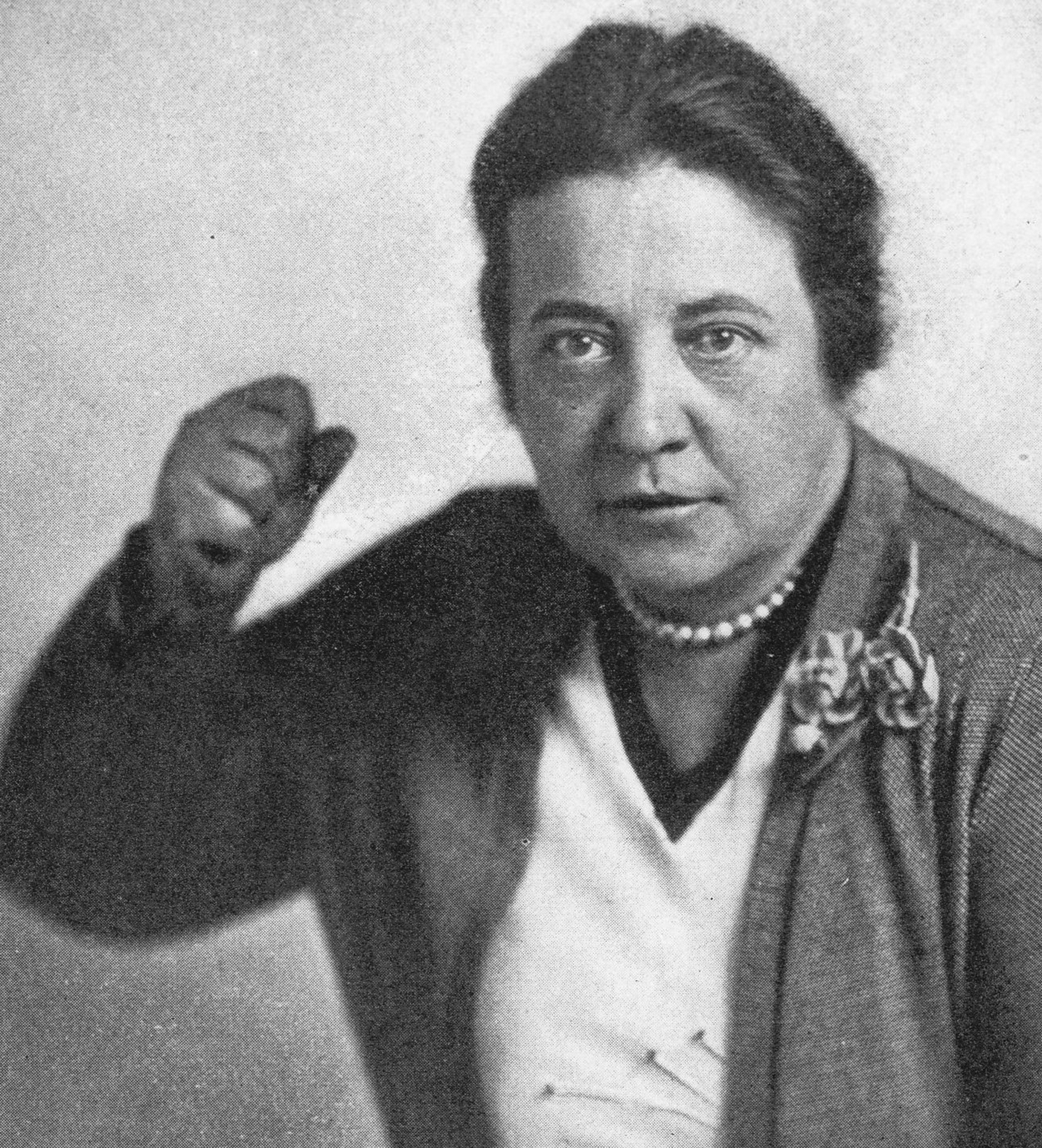
The California fair trade movement really began with Edna Gleason, a self-trained and state-certified pharmacist, who in the late 1920s became known as the “mother of fair trade” (Figure 1). She owned and operated three drugstores in Stockton, California, the first of which she and her husband had opened in 1915. His death left her as the sole proprietor and manager, a task she embraced with aplomb. In a rapidly changing retail market, Gleason confronted new types of competition from chain stores and what were then known as pineboards: discount outlets that often sold overstocked brands at bargain prices. Neither of the new competitors sold prescription compounds or offered medical advice; however, the brand-name goods that they advertised at cut-rate prices presented a major threat to the traditional pharmacist's bottom line.Footnote 15 This section introduces Gleason and her early efforts to organize local businesspeople in response to the retailing revolution.
Edna Gleason. Photo courtesy of the University of Wisconsin Institute for the History of Pharmacy, Madison, Wisc., c. 1929.

In a town of roughly forty thousand inhabitants, Gleason focused on advertising her pharmacy as locally owned, community oriented, and most of all, not a chain store.Footnote 16 After her husband's death she renamed her store “Tom Gleason's” to “avoid giving out the big-chain impression.”Footnote 17 She also offered medical advice, delivery services, and prescription compounding—services not offered by department stores. Gleason also cultivated a reputation for providing indigent community members with medical advice and services.Footnote 18
In the 1920s, she identified three threats to the longevity of her business: chain store price competition, rising rent costs, and downtown parking problems. The latter two she countered by opening two additional stores in newer neighborhoods close to the trolley line. Price competition, however, became the centerpiece of her decades-long activism for fair trade. Already, national and regional trade associations of retail druggists published prescription formulas and recommended retail prices. In an authoritative study of U.S. drug regulation, economic historian Peter Temin has shown that very little price variance existed in compounding.Footnote 19 Fair trade sought to extend price controls to brand-name medicines and toiletries.
While pharmacists offered customers advice and expert prescription compounding, chain and department stores began carrying similar brand-name toiletries.Footnote 20 In the 1920s, the retailing revolution came of age when chains and department stores spread across America, offering lower prices on a wide range of goods.Footnote 21 East Coast chain stores, like the Great Atlantic & Pacific Tea Co. (A&P), and department stores, like R. H. Macy's, pioneered a business model that captured profits by combining high-volume sales with lower profit margins. Most of these retailers purchased goods from a variety of manufacturers. High-throughput manufacturing revolutionized consumer products from processed foods (e.g., Campbell's Soup) to cigarettes (e.g., American Tobacco).Footnote 22 Taking advantage of manufacturers’ economies of scale, these new retailers uprooted the existing distribution system, tilting economic power toward large-scale retailers and away from the networks of regional manufacturers, wholesalers, and local retailers.Footnote 23 Many manufacturers also complained that they had lost control of their brands.
Chain stores, such as Owl Drug or Walgreens, pursued retailing tactics similar to the variety grocery chains, like A&P and Ralph's Grocery Company. These firms relied on bulk wholesale purchases from either a producer or a jobber, though the latter was increasingly becoming displaced by direct sales. Historians have emphasized how the retailing revolution created consumer demand through extensive brand advertising campaigns and grand openings of new stores.Footnote 24 Certainly, chain stores captured consumers’ attention, offering reduced prices on brand-name goods by increasing their volume of sales. Manufacturers and independent retailers, however, did not back down from the challenge; they contested the rise of chain stores and their discount counterparts.
For Gleason, however, chain stores were not exactly the problem. In fact, many chain stores joined the fair trade movement. Instead, she and her fellow independent retailers identified pineboards, as they were known on the West Coast, as the major threat to their livelihood. These discount outlets were sometimes chains, but not all chains were pineboards. The distinctive feature of the pineboard was its ability to offer brand-name products at prices below the manufacturers’ retail network, undercutting even the chain stores. Typically, outlet stores lowered their fixed costs by occupying low-rent commercial space on a temporary basis to test competitive waters. Outlets could also lower variable costs of labor by employing unskilled, low-wage laborers rather than trained pharmacists. Costs were further reduced as these stores required cash payments and did not offer delivery services.Footnote 25 Rather than offering prescription drugs requiring a registered pharmacist, these drug outlets sold more basic consumer goods. Pineboards were alleged to practice predatory pricing, or sales below cost, in an effort to force traditional retailers out of business.Footnote 26
Gleason's arguments against pineboards emanated from her appeal to local control, economic independence, and self-regulation of competitive markets. In 1927, Gleason entered into her first contest with a so-called pineboard. In response to R. L. McMaster opening Kut-Price drug outlets in Fresno, Stockton, and Modesto, California, Gleason launched a campaign to coordinate Stockton's Independent Merchants’ Association to open the town's first cooperatively owned discount drugstore, aptly named Bed Rock Drug Store.
By pooling local resources, Bed Rock advertised aggressively and mimicked the no-frills sales approach of Kut-Price.Footnote 27 The major difference, of course, was the reputation of the Independent Merchants’ Association. By October, Gleason had bought out the Kut-Price store and liquidated its merchandise.Footnote 28 The “Stockton Plan” demonstrated the feasibility of competitors forming a market-based collaboration while preserving service competition and minimizing direct price competition.
By the end of the decade, the limits of cooperation and control through an independent cooperative had been reached in Stockton. Gleason then turned to the state association to rally retailers behind the banner of fair trade. Her activism elevated her through the ranks of the state trade association toward a new position advocating for state regulation.
From Populist Organization to Progressive Regulation
As early as the 1910s, the high-volume, low-margin business model came under attack by people like Edna Gleason and her allies; their fair trade movement rendered the retailing revolution more contingent than was conventionally thought.Footnote 29 Over two-thirds of retail services continued to be provided by independent proprietors with low capitalization.Footnote 30 These independents were well coordinated, connected, and active. Despite collective action challenges to such a dispersed and diffuse group of businesspeople, and federal antitrust prohibition of price-fixing, the retail druggists—first in California—launched one of the most formidable campaigns of the early twentieth century to regulate consumer prices of ordinary goods.
Advocates of fair trade envisioned a strong state association that would publicize standardized price lists and monitor member compliance. The publication of monthly price lists would, they argued, allow businesspeople and regulators alike to monitor price changes. This approach was modeled after the U.S. National Formulary, established in 1888 by the American Pharmaceutical Association to standardize compounding formulas and their input prices.Footnote 31 As representatives of a profession, the pharmaceutical associations endorsed tougher regulations on prescription compounding, licensure exams, standardization of colleges of pharmacy, and ownership rules for pharmacies. As business owners, the pharmacists pushed for price schedules to create transparency in retailers’ buying, marketing, and sales.
The success of the Stockton Plan brought Gleason into contact with a well-known San Francisco pharmacist and lawyer, W. Bruce Philip, who proved a natural ally. Through the 1920s, Philip led efforts by the American Pharmaceutical Association (APhA) to modernize retail management. As a professor of pharmacy at the University of California, he advocated revising curricula to better educate students on modern merchandising and cost accounting, a first step toward price transparency and standardization.Footnote 32 Under Philip's guidance, the APhA endorsed the federal fair trade bill, which had been stalled before the U.S. Congress for decades.Footnote 33
Since the late 1890s, the Supreme Court had interpreted antitrust law as prohibiting contracts that facilitated horizontal combinations of competitors.Footnote 34 Despite the development of the “rule of reason” test, which allowed the Court to weigh the competitive effects of a business arrangement, the Court in 1911 strengthened its opposition to contracts that might promote horizontal cooperation, creating the per se prohibition of such agreements.Footnote 35 The Court refused to consider the intent or competitive effects of any such networks; it did, however, remain divided on how best to protect competitive markets. Rather than a strict rule, Justice Oliver Wendell Holmes Jr. believed the “rule of reason” should be applied in cases involving the cooperative standard-setting by trade associations or small proprietors. Brandeis, the “people's lawyer” who joined the Supreme Court in 1916, formulated a similar rule, which the majority implemented in 1918.Footnote 36 The Court remained divided between strict constructionists and liberal activists.
Brandeis actively supported the fair trade movement, arguing that antitrust should allow trade associations of independent proprietors to pool their buying, marketing, and sales power to rival chain store competitors.Footnote 37 In doing so, the independents mimicked many of the cost-cutting strategies of the chains while preserving the large number of competitors. Brandeis and others also favored greater regulation of unfair trade practices, which included sales below cost, secret rebates, and advertising allowances. In other words, in the view of Brandeis and other fair trade advocates, the legislature should determine the parameters of “fair competition” and the courts must investigate the particular facts relevant to the industry and the “evils believed to exist.”Footnote 38
While federal courts embraced strict prohibitions against horizontal cooperation of businesses or laborers, California competition policy went in the opposite direction. That state fostered some of the earliest cooperative efforts of union laborers and farmers. As early as the 1860s, California labor unions and craft guilds used a union label campaign to improve their working conditions, as well as to denounce immigrant laborers, child labor, and tenement production facilities. Xenophobia animated these campaigns to a large extent.Footnote 39 Nonetheless, California courts enforced the sales provisions attached to the union labels. Registered collective marks spread beyond labor unions to include winemakers, farmers’ cooperatives, fruit growers, and butchers throughout the state.Footnote 40 Farmers in the citrus and raisin industries pioneered associational techniques to control supply and distribution, using both legal and extralegal means.Footnote 41 Raisin growers, for example, initiated standardized grading, packaging, and shipping. They established an incorporated exchange, where crops were deposited, loans could be issued, and sales were made across the country. The farmers’ “benevolent trust” also relied upon violence and intimidation to punish detractors and deter outside competitors.Footnote 42 In the United States, collective and certification trademark laws, which were popular throughout Europe, depended on state law and enforcement.Footnote 43
When California codified its competition policy in the early twentieth century, it maintained its distinctive history. California antitrust law focused on penalizing concentrations of capital, exempting combinations of laborers, farmers, and independent proprietors from prosecution.Footnote 44 Moreover, the California Supreme Court established that specialty producers’ minimum retail prices would be enforced despite contrary federal antitrust developments.Footnote 45 California courts insisted that associational product development and control was a legitimate protection of brand-name goodwill, retail networks, and consumers’ interest in quality and safety.Footnote 46 According to the federal law, if a producer wanted to affect retail policies, then he must own his own retail stores (i.e., vertically integrate); however, in California, producers could make retail-sales agreements with networks of retailers, allowing each entity to remain independently owned though cooperatively managed.Footnote 47 Other states followed California's formulation of antitrust law by exempting farmers, laborers, and independent proprietors conducting business to maintain “reasonable prices.”Footnote 48
Despite the autonomy of state laws within intrastate commerce, federal antitrust jurisprudence still loomed over private actions as well as state law.Footnote 49 The Federal Trade Commission (FTC), for example, went after San Francisco–based Hills Brothers for price-fixing its fair trade coffee.Footnote 50 Hills had maintained a nationwide retailer network for its high-end vacuum-packed coffee since the early 1920s.Footnote 51 Trouble arose when the discount grocer Piggly Wiggly advertised Hills coffee as a loss leader, flouting its wholesale and retail contracts to maintain “reasonable prices.” The FTC found that Hills's systematized record-keeping coupled with its refusal to deal with noncompliant retailers had the intended effect of fixing prices.Footnote 52 Moreover, the U.S. Supreme Court retained the power to invalidate all or part of the California codes, as they did in Colorado.Footnote 53 Thus, the problem of federal antitrust prosecutions presented a major hurdle to the expansion of associational business activity in California.
In February 1929, Gleason and Philip led efforts to coordinate a unified, statewide initiative for legislation to strengthen the “reasonable price” provisions of California law. First, they reorganized the California Pharmaceutical Association, consolidating two regional associations into a more formidable single entity.Footnote 54 Association dues supported monthly price bulletins and lobbying in Sacramento. The bulletins included standardized prescription compounding and pricing, uniform cost-accounting methods, and manufacturer-set fair trade price schedules.Footnote 55 A system of open bidding would allow firms to compare costs, prices, bids, and contracts on medicines and consumer brands. The state journal also advertised fair trade products, price lists, and locally owned retailers who agreed to abide by the standardized service policies.Footnote 56 In the summer, the association announced a system of monitoring to be launched.Footnote 57
Initially, enforcement of the voluntary price plan operated through the pharmaceutical associations, but these efforts at partial planning required state complicity. Pharmacists pressured manufacturers to advertise and enforce fair trade sales contracts that set price schedules and service guarantees. Retailers then policed one another, to maintain price levels and service agreements, and reported detractors to their local association and the manufacturer. Manufacturers were then to pressure pineboards and department stores to abide by those same sales contracts or they would be blacklisted, though keeping or publishing such a list was against federal law.Footnote 58 Lacking much enforcement power, the committee needed state enforcement, which was uncertain given that most drugs and toiletries traveled across states lines into California.
The California Pharmaceutical Association's 1930 meeting demonstrated the limitations to self-regulatory price stabilization plans. Edna Gleason took center stage.Footnote 59 L. N. Brunswig, president of Brunswig Drugs, allegedly dumped unsold products to cut-rate retail outlets. He acknowledged that his wholesale company sold items to cut-rate dealers in Stockton and Fresno. Gleason, who “apparently [came] to the convention determined to open up this question and have it thoroughly discussed,” accused Brunswig of misrepresentation and predatory practices. Brunswig denied the accusation, but Gleason's fellow Fair Trade Committee members defended her allegations.Footnote 60 It was men like Brunswig, they believed, who threatened the network and had caused recent falling prices. Heated discussion revealed that discount pineboard chain stores in southern California had traveled to Chicago and New York to circumvent jobbers and wholesalers who required fair trade contracts.Footnote 61
As a result of both continued price deflation and the “most vitriolic [meeting] on record,” the California Fair Trade Committee focused on legislation to make mandatory its codes of fair competition.Footnote 62 The association also began to address ways in which the FTC's trade-practice conferences and ongoing chain-store investigation might aid their cause.Footnote 63 With the onset of the Great Depression and the momentum against big businesses, a number of chain drugstores and out-of-state producers began publicly advocating for codes of fair competition.Footnote 64 (An effective countermobilization had yet to arise, excluding the federal-level lobbying by department store Macy's and litigation against RPM contracts.)
The FTC's trade-practice conferences, begun in 1926, illustrated both the possibilities and the legal limitations of association efforts to manage competition. These conferences brought together businesses within a single industry to voluntarily coordinate information on production, orders and bids, distribution costs and services, and prices.Footnote 65 FTC commissioners presided over these meetings and approved association “submittals” that circumvented Department of Justice antitrust prosecutions, but the FTC failed to reach internal consensus. In 1929, the FTC issued a report that called for greater administrative oversight of competitive practices while also questioning the stabilization effects of such rules.Footnote 66 Nevertheless, the information shared at trade-practice conferences provided a blueprint for trade associations to institute standardization guidelines and codes of fair competition, addressing sales below cost and price lists.Footnote 67
Although the Supreme Court continued to limit the FTC's authority to define unfair competition, the appointment of Harlan Fiske Stone to the bench bolstered Brandeis's cause.Footnote 68 Shortly after Stone's appointment, the Court extended Brandeis's previous “rule of reason” decision, applying it to a hardwood lumber association.Footnote 69 In both administrative procedure and legal precedent, new avenues were opening up for price stabilization plans.Footnote 70
The confluence of falling retail prices, growing associational power, and increasingly permissive competition policy attracted neophytes prominent in business, law, and economics.Footnote 71 In July 1930, for example, Lehn & Fink, manufacturers of Lysol, the first brand-name disinfectant in the U.S. market, joined the fair trade bandwagon.Footnote 72 Company president Edward Plaut announced a “comprehensive campaign designed to induce the public to trade only at those retail stores where fair retail prices prevail and to encourage the retail druggists of the country to maintain fair trade retail prices.”Footnote 73 Advertisements flooded the Saturday Evening Post and Collier's women's magazine. After traveling to Europe, Plaut believed that European competition policy might provide a model for the United States.Footnote 74 As the chairman of the New York Board of Trade, he commissioned two economists to study price maintenance policies. Professors Edwin R. A. Seligman of Columbia University and Robert Love of City College of New York released their study in 1932; they recommended strengthening the right of refusal to sell, expanding the FTC trade practice conferences, and formalizing federal oversight through legislation.Footnote 75 At the time, Columbia's economics department housed some of the most vociferous proponents of “institutional economics”—a progressive school of economics that supported managing competition through public-private partnerships. The institutionalists rejected neoclassical economists’ models of perfect competition and instead argued that market imperfections required empirical study and regulatory interventions.Footnote 76
Carl Weeks, president of the Armand Company, testified before the FTC in favor of national fair trade legislation. Weeks hired Charles Wesley Dunn, who had defended Colgate's and Beechnut Packing Company's price protection plans, to write Armand's fair trade contracts.Footnote 77 Dunn, who also served as counsel to the American Pharmaceutical Manufacturers’ Association, proposed that the FTC be given the regulatory power to determine “unfair trade practices,” using uniform pricing data collected by associations.Footnote 78 E. R. Squibb & Sons also joined the campaign.Footnote 79 Curtis Beach, the staff economist at the California Pharmaceutical Association, suggested that the printing industry's success in standardizing uniform cost-accounting methods could act as a model for pharmacists.Footnote 80 Columbia economics professor Paul Olsen instructed the association to gather the necessary cost and pricing information to demonstrate its need for legislation to permit and enforce uniform accounting standards.Footnote 81
The Fair Trade Committee, in 1931, sought a remedy to what they believed was an information problem caused by inaccurate cost accounting at the firm level and insufficient coordination statewide. The committee announced plans to partner with the Census Bureau for a drug distribution survey covering the Pacific slope states: California, Washington, Oregon, and Utah. Problems arose immediately.Footnote 82 Gleason argued that the survey failed to differentiate among types of stores or locations. Only in a handful of cities did survey participants and local administrators compare medicinal products and prices across various categories of drugstores.Footnote 83
Gleason and Philip organized their own statewide survey, which reached over 1,200 California druggists and cataloged manufacturer and retailer prices on over one hundred trademarked goods and compounded prescriptions.Footnote 84 On the latter, prices varied little among pharmacists in urban and rural areas. On trademarked goods, pharmacists were asked to identify competition they felt in their local area, namely, from department stores and pineboards. The survey cataloged falling prices, sales, and employment in independent drugstores. It also encouraged druggists to write in their complaints against special advertising allowances, quantity discounts, and rebates given to large retailers in their survey responses or to send them in a letter directly to their representatives.Footnote 85 What the druggists needed to demonstrate to the legislature was that independent proprietors were being denied the ability to earn a reasonable profit. The survey identified trade practices found to “generate and perpetuate predatory price cutting” that diminished independents’ market share.Footnote 86 It suggested that prices and the submittal process led to easier monitoring of outlet sales. Finally, the state association asked that each firm submit a written notice to both the California general assembly and the National Association of Retail Druggists (NARD) “stating the firm's position in respect to the [federal] bill” before Congress.Footnote 87 Its report argued that sales below cost, secret rebates, and advertising allowances generated price wars that exacerbated deflation and unemployment, especially for independent proprietors who were less likely to have reserve capital or to be able to switch product lines easily.Footnote 88
While the NARD continued to pursue a type of self-regulation akin to price-fixing, the Californians had done something slightly different. Gleason, Philip, and their association of pharmacists lobbied the state legislature to expand its police powers, in a time of economic emergency, over ordinary businesses trying to maintain reasonable profits. What they wanted was the setting of minimum price provisions by manufacturers, with feedback from retailers, a vertical restraint permissible by law. Moreover, the Board of Pharmacy would review and approve the codes generated through trade association deliberation. This regulatory beachhead transformed the initial self-regulation movement and led to a different trajectory in the early 1930s.
Their efforts to reorganize the state association, collect complaints, and publish price statistics and feedback proved fruitful. In the summer of 1931, the state legislature passed the Fair Trade Act.Footnote 89 Gleason later recalled her experience of conducting the survey with Philip and presenting the results to the assembly: “I left my store one day with only a toothbrush for baggage. I didn't get back for six weeks. I talked to druggists and grocers in every county in the state. And they talked to their legislators. . . . We got the law!” Footnote 90 Unfortunately, the legislature held closed sessions; still, the bill has been widely regarded as the result of the pharmacists’ lobbying.Footnote 91 The California Fair Trade Act of 1931 replicated national proposals that exempted fair trade agreements from antitrust prosecution; however, it relied on state police powers over intrastate trade.Footnote 92 “Articles which are trade-marked and which are competitive with articles of a similar nature, if manufactured in California, may be price-protected in that state through contracts between the local producer and local distributors.”Footnote 93 Further, consumer goods “in fair and open competition with commodities of the same general class” could be controlled by price contracts, stipulating that “the buyer will not resell such commodity except at the price stipulated by the vendor.”Footnote 94 The independents had secured a bill that they believed would eliminate unfair methods of competition.
The Fair Trade Act attracted businesses to California.Footnote 95 The Miles Medical Company, for example, announced that it “now has established a branch in California to test the legality of the Junior Capper-Kelly bill.”Footnote 96 Albert Beardsley, president of the Miles Medical Company, reported that his staff sent out over four thousand contracts to jobbers and retailers requesting their participation in the Miles price stabilization plan. Increasingly, companies began to advertise in trade journals and newspapers, endorsing fair trade agreements and protective legislation.Footnote 97 The Miles California Company, a new subsidiary of the Miles Co., reported overwhelming cooperation but anticipated that it would wind up in court to enforce the agreements.Footnote 98 Indeed, by the following summer, the company had sued two well-known cut-rate retailers, the Sontag Drug Co. and Thrifty drugstores, and settled out of court.Footnote 99 The constitutionality of the act was not questioned.
California Fair Trade, Unfair Practices, and the “Little NRA”
The California fair trade law expanded state police powers to regulate retail prices through private trade associations coupled with public regulatory oversight; this public-private approach to managing price competition came to exemplify Depression-era regulation. President Roosevelt, who entered office on March 4, 1933, attempted to institute similar regulation at the federal level; however, without a federal police power, the regulation of industrial and consumer prices fell under the auspices of national commerce power. The federal government had the power to regulate interstate commerce, but intrastate businesses would be untouched by Roosevelt's regulations.Footnote 100 This made state cooperation with federal code authorities imperative. The 1930s reframed what constituted reasonable regulation of prices at the state and federal levels.
Continued price deflation, business closures, and unemployment through the early 1930s had galvanized both antimonopoly sentiment against large-scale corporations and demands for managed competition.Footnote 101 By 1933, prices had fallen by 20 percent, manufacturing output had declined by a third since 1929, and unemployment had reached 25 percent. Many workers had their hours cut and wages reduced. The pharmacists were not alone in seeking aid to manage markets. Across the states in the early 1930s, legislatures created administrative boards under emergency conditions to control competitive practices, wages, and retail prices on an industry-by-industry basis.
Roosevelt's advisers were steeped in the antimonopoly tradition and institutionalist economics.Footnote 102 Attempting to maintain a certain level of fiscal conservatism, the First New Deal instituted “partnership in planning” between government and “organized private industry” under the National Industrial Recovery Act (NIRA).Footnote 103 Regulators at the NRA extended the model of the FTC trade practice conferences to set mandatory codes of fair competition, intended to cease price deflation through mitigating oversupply and controlling retail prices.Footnote 104
Several states responded, California being foremost among them. In 1933, California enacted two laws to strengthen its codes of fair competition and to extend them to other industries.Footnote 105 An amendment to the Fair Trade Act extended fixed prices beyond those parties to the original contract. It also permitted anyone, not solely the manufacturer that set the minimum resale price schedule, to bring suit against alleged price-cutters.Footnote 106 Secondly, California passed a statute incorporating the NRA codes of fair competition into state law. Where federal codes did not exist, the California law allowed code-making authority in intrastate commerce.Footnote 107 Other states suspended their antitrust laws; in each of those states, the codes of fair competition approved by the NRA carried the weight of state police powers.Footnote 108 California's codes of fair competition included maximum working hours, minimum wages, and prohibitions on secret rebates and discounts.Footnote 109 The state's Board of Pharmacy became the oversight body to approve codes; however, the courts retained adjudication power.
The NRA Code of Fair Competition for the Retail Trade did not legalize resale price-fixing per se and, ultimately, the drug trade wanted stronger codes, not their repeal.Footnote 110 The provisions were largely procedural, prohibiting loss leaders, advertisements for cut-rate goods, and sales below cost.Footnote 111 Otherwise, though, all other demands of the California druggists and their national counterparts had been met, including an exemption from antitrust regulation.Footnote 112 Charles Walgreen, owner of the chain drugstores of that name, helped establish the Drug Institute of America (DIA), which worked with the NRA to publicize and monitor codes of fair competition.Footnote 113 Carl Weeks toured major cities campaigning for local associations to join the DIA.Footnote 114 Trade association leaders, the president of the U.S. Chamber of Commerce, Henry Harriman, and former FTC chairman Nelson Gaskill praised the NRA for rationalizing and managing competition through partnership.Footnote 115
Although some members of the Supreme Court had encouraged such regulatory reforms to antitrust law, United States v. Schechter (1935) invalidated the law on two grounds.Footnote 116 The Court held that commerce powers did not extend to purely intrastate traffic and, moreover, that the delegation of legislative powers to the executive was unconstitutional. The ruling, however, did not consider the concerns of consumer welfare advocates who charged the codes with raising consumer prices; instead, the Court focused on determining the constitutional parameters under which the federal government could intervene to effect competitive practices and prices.
The Court dismantled the NIRA, yet the passage of state and federal codes of fair competition that outlawed “predatory price cutting” remained within state police powers.Footnote 117 The Court's approval of state police powers to control competitive practices and price outcomes for ordinary goods and services was nothing less than a constitutional revolution, which would also affect labor standards, wage legislation, and consumer prices.Footnote 118 The year prior to the Schechter decision, the Court had upheld a New York state law that fixed milk prices for farmers, dealers, and retailers.Footnote 119 In Nebbia v. New York, Justice Owen Roberts, writing for the majority, held that the state had exercised legitimate police powers by intervening in private markets when the regular laws of supply and demand had failed to clear markets. Oversupply had exacerbated falling prices, forcing sales below production costs. Roberts appealed to both economic and moralistic reasoning: “Unfair and destructive trade practices in the distribution of milk [led] to demoralization of prices,” and “unrestricted competition [had been] found to be an inadequate protection to consumer interest.”Footnote 120 Such “economic maladjustments” had made state intervention into private markets necessary to protect the public welfare.Footnote 121 Justice James McReynolds and the rest of the old guard dissented. They called the Milk Control Board illegitimate, because it regulated ordinary, private businesses and constituted “management control” of markets.Footnote 122
Not only was the Nebbia ruling crucial to extending police power regulations over minimum wages and maximum hours, it also proved critical to upholding the “little NRAs” of states. The Nebbia ruling has predominantly been used to demonstrate the expansion of state police powers, which influenced national efforts to expand the regulatory powers of the administrate state. However, Nebbia relied on antimonopoly jurisprudence that protected competitors rather than the competitive market. In February 1936, the California Supreme Court upheld the Fair Trade Acts, quoting extensively from the Nebbia decision.Footnote 123 In this case, a Beverly Hills retailer advertised and sold Max Factor products at prices below what the company stipulated in its sales contracts. The “chiseler,” Clarence Kunsman, threatened the distribution network between Max Factor, a Delaware corporation, and Sales Builder, its California distributor. The California Supreme Court held that the Fair Trade Acts legitimately prohibited Kunsman's business methods, which demoralized trade and diminished the goodwill established in the Max Factor brand.
Previously, judicial review had focused on whether fair trade agreements violated antitrust rules; by the mid-1930s, state laws had shifted the Supreme Court's focus to the issues of legislative power and economic reasoning.Footnote 124 The Nebbia ruling had shattered the Court's traditional distinction between “businesses affected with the public interest,” which could be subject to price regulations, and purely private business, which could not.Footnote 125 After 1934, any business could be worthy of protection from unreasonable competition. While the state fair trade laws aimed to correct price-cutting that was deemed predatory, the laws were also clearly designed to restrict the benefits of economies of scale achieved by chain and department stores—Gleason's original intent. Thus, the real end, much as in the Nebbia case, was to protect small independent dealers by ensuring a fair profit margin. As Congress considered a national fair trade law, in the mid-1930s, reports regarding consumer welfare were mixed.Footnote 126 Critically, adverse reports did not challenge the legitimacy of the state's police power to enact such laws.
What began in antitrust—protecting competitors for the sake of competitive markets—spread to other economic regulatory domains. The voluminous state laws passed to protect small and independent proprietors altered federal-level strategies for proponents of both fair trade and managed markets more generally.Footnote 127 The NARD and the National Wholesale Drug Association (NWDA) altered their lobbying strategy by seeking a federal law that would enable fair trade contracts in interstate trade between fair trade states.Footnote 128 Building on this momentum in the states, congressmen advanced bills to protect small proprietors. Despite President Roosevelt's objections to legislation that mimicked certain provisions of the unpopular and unconstitutional NIRA, two bills were passed that institutionalized the fair trade vision for competition. First, the Robinson-Patman Act (1938), commonly criticized as a convoluted law, prohibited sales below cost and secret rebates.Footnote 129 Second, the Miller-Tydings Act (1937) made fair trade contracts enforceable in interstate commerce when made between fair trade states.Footnote 130
Lacking an administrative apparatus such as the NRA, a tight social movement—to maintain publicity, monitoring, and policing through the distribution chain—became all the more important. The druggists launched national publicity campaigns against department stores, ramping up pressure on fair trade manufacturers.Footnote 131 In the post–NRA New Deal era, however, department and chain stores organized against fair trade. Macy's led lobbying and litigation efforts attacking liberalized antitrust laws and police power regulations that enabled fair trade. Only a few months after the Nebbia decision national business leaders formed the American Liberty League to oppose the New Deal.Footnote 132 But for the druggists, the National Retail Federation and the National Retail Dry Goods Association proved most formidable. Those associations published journals, such as Chain Store Age, that taught chain store buying, marketing, and retailing practices. Macy's publicized its private brands, for instance, as a cheaper alternative to fair trade goods. Advertisements decried the entire fair trade program as anti-consumer and sought to take back the meaning of market fairness.Footnote 133 Although fair trade networks persisted into the post–World War II era, they depended on private distribution networks, persuasive advertising, and consumer support. Fair trade and the economics of imperfect competition also came under attack in the academy.Footnote 134 The University of Chicago's Free Market Study Group attacked and discredited the progressive populism of the Robinson-Patman Act, arguing that such laws were anticonsumer, anti–big business, and anti–free market.Footnote 135 Consumers, through organized protest and individual purchasing choices, seemed to agree.Footnote 136
Conclusion
Despite its waning popularity in the latter half of the twentieth century, the fair trade movement significantly contributed to the changing structure of American regulation during its formative period. The California fair trade law provided one path toward regulating consumer markets, through the state's police powers, that remained consistent with the Supreme Court's “rule of reason” jurisprudence. Rather than self-regulating business associations or top-down administrative rules, a public-private system of coregulation emerged. This new regulatory system fostered standard setting, monitoring, and enforcement—multiple regulatory goals that fit within the reasonableness of the California fair trade laws.
The hallmark of U.S. competition policy has been the protection of a competitive marketplace; however, legal categories regarding what constitutes legitimate competition have not remained fixed. Antitrust law did not act as an exogenous force on business firms and organizations; instead, businesspeople demonstrated the malleability of U.S. competition policies over time. The fair trade story demonstrates how businesspeople were able to exploit the legal ambiguities of antitrust and federalism, promote the progressive economics of regulated competition, and leverage the political power of local elites to significantly alter state and national law. Ultimately, the druggists helped reorder competition policy to allow retail price-fixing—what had once been anathema to antitrust law.
Business law regarding combinations of competitors, therefore, has proved to be more unsettled and contingent than conventional history suggests. Reframing this historical understanding calls attention to the multifaceted demands placed on competition policy. On the one hand, U.S. antitrust law prohibits anticompetitive behavior and monopolization in order to protect market competition and guarantee market efficiencies derived therefrom. According to this consumer welfare argument, the means of market competition provide the ends of lowest consumer prices. On the other hand, protecting competition is also thought to require a robust number of competitors; that threshold depends not only on the industry but also on one's historical context. The goal of low or reasonable prices, thus, combines with the historically contingent economic and political goals of protecting competitors. In either scenario, protecting competition provides the means to particular goals: low prices or decentralized economic power. As policymakers and jurists try to balance these tensions within antitrust and state police powers, businesspeople often act as intermediaries of economic ideas through both litigation and lobbying. The history of capitalism too often belies the variety of organizational forms that the U.S. adversarial system not only showcases but often accommodates. The logic of regulatory strategies in this case responded to the institutional environment and operating frameworks of firms and their associations.