


1. Introduction
The COVID-19 pandemic and the economic policies taken in response have caused large fiscal pressure on the states. Many states have been seeking help from the federal government. Instead of providing more federal aid, U.S. Senator Mitch McConnell suggested letting states file for bankruptcy in a radio interview.Footnote 1 “I would certainly be in favor of allowing states to use the bankruptcy route,” said McConnell. “There’s not going to be any desire on the Republican side to bail out state pensions by borrowing money from future generations.” There was significant pushback from Democratic governors and analysts, who viewed the suggestion as politically motivated. It remains a contentious topic in policy discussions. From an economics perspective, what are the potential consequences of allowing states to declare bankruptcy? This paper develops a simple model framework to analyze these consequences.
To start discussion on state bankruptcy, the concept of corporate bankruptcy provides a useful analogy. When a company faces financial difficulties, seeking a government bailout is typically not the first course of action. Instead, they can file for bankruptcy, which grants temporary relief from their creditors. There are typically two main types of corporate bankruptcy code: Chapter 7 and Chapter 11. Under Chapter 7 of the bankruptcy code, the company’s assets are liquidated to pay off its debts, and the business is usually dissolved. On the other hand, Chapter 11 bankruptcy allows the company to continue its operations under the supervision of the bankruptcy court. This often involves creating a plan to reorganize and repay creditors over time.
Cities and municipalities have the legal authority to file for bankruptcy under Chapter 9 of the bankruptcy code, which allows them to seek protection from their creditors and develop plans to reorganize their debts. Several cities and municipalities in the United States have filed for bankruptcy in recent years. For example, Jefferson County in Alabama, filed for its bankruptcy in November 2011; Stockton and San Bernardino in California filed for bankruptcy of $1 billion and $492 million debt, respectively. The city of Detroit in Michigan, filed for bankruptcy in 2013. It is by far the largest municipal bankruptcy filing in U.S. history by debt, estimated at $18 billion. The process starts with an insolvent municipality filing for bankruptcy, leading to an automatic stay on debt collection. The municipality must then propose a plan of adjustment, detailing how it intends to reorganize its debt, which could include altering loan terms or reducing debt. The court then confirms the plan, with or without consent from all creditors. The bankruptcy process is designed to allow the municipality to continue its operations and services while adjusting its financial obligations.
States, on the other hand, are not allowed to declare bankruptcy. It is because they are considered sovereign entities under the U.S. Constitution and have quasi-sovereign immunity, which protects them from being sued without their consent. This immunity extends to bankruptcy proceedings, which are a form of legal action in which creditors can seek to recover debt from a debtor. Because states are immune from such legal action, they are not able to file for bankruptcy.
While states are not able to file for bankruptcy, they are still able to default on their debts, which has occurred in the past. In 1933, the state of Arkansas experienced a default on its bonds, totaling approximately $146 million, due to the economic challenges posed by the Great Depression. After the 1933 Arkansas default, Arkansas experienced severe austerity measures and was unable to invest in the desired infrastructure. Arkansas default also triggers financial exclusions: financial centers remained closed to Arkansas for many years.Footnote 2 The federal government did not directly bail out Arkansas due to the prevailing ideologies, constitutional considerations, and fiscal difficulties of the time. Nevertheless, the federal government provided indirect support through various New Deal programs. Programs like the Federal Emergency Relief Administration and later the Works Progress Administration allocated funds for public projects and relief efforts, indirectly aiding state finances by alleviating the burden on state budgets.
Default and bankruptcy are different concepts. Default occurs when a debtor fails to make timely payments on debt, while bankruptcy is a legal process in which creditors work with legal authorities to manage the finances of an insolvent entity and collect the debt owed to them. Default can have negative consequences for the borrower, such as damaging their credit rating and making it more expensive for them to borrow in the future. Bankruptcy can also have negative consequences, such as the sale of the entity’s assets to pay off its debt and the development of a plan to restructure its debt. However, bankruptcy can also provide a way for an entity to address financial challenges and improve its fiscal stability.
Despite states are not allowed to file for bankruptcy, discussions about the potential benefits and drawbacks of allowing states to file for bankruptcy have emerged, primarily from legal perspectives (Skeel Jr, Reference Skeel2012; Conti-Brown and Skeel, Reference Conti-Brown and Skeel2012). However, these discussions have not been grounded in a formal economics framework. In this paper, we seek to address this gap by examining the potential impacts of allowing states to file for bankruptcy through the use of a formal economics model that enables quantitative analysis. Our goal is to examine the economic benefits and costs of allowing state bankruptcy and to contribute to the ongoing debate surrounding state bankruptcy.
To this end, we develop a simple model that aims to clearly illustrate the benefits and costs of allowing state bankruptcy. In the model, we compare the current case where bankruptcy is not allowed to a scenario where bankruptcy is permitted. Before allowing bankruptcy, states must choose between repaying their debt or defaulting on it. If a state government defaults on its debt, the federal government has an exogenous probability to provide a bailout. After state bankruptcy is permitted, states have the option of declaring bankruptcy, so they choose between repayment and declaring bankruptcy.
Whether to allow state government bankruptcy is to tradeoff between ex-ante incentives for repayment and ex-post costs of default. Permitting states to declare bankruptcy offers them a less severe alternative to outright default, which may decrease their incentives to repay their debt and raise the cost of future borrowing. Conversely, the denial of bankruptcy may enhance incentives for states to repay their debt ex-ante, but may also result in significant default costs in the event of default.
To demonstrate this tradeoff, we first present a simplified two-period model with closed-form solutions that allow us to illustrate the tradeoff analytically. We then assign parameter values to an infinite-horizon model to further explore the tradeoff and to examine the impact of allowing state bankruptcy. We find that an unexpected switch in bankruptcy rules that allows for bankruptcy would decrease government debt-to-GDP ratio by 9.2 percentage points and increase consumption by 0.69 percent, but increase spread by 1.1 percentage points for an average state government.
The model framework is based on sovereign default models in which the government makes a decision to maximize its outcomes by choosing between repaying debt and defaulting, as described by Arellano (Reference Arellano2008). More recent study (Arellano et al. Reference Arellano, Mateos-Planas and Ríos-Rull2023) explores the concept of partial default, where sovereigns continue to pay some of the debt, continue to borrow, and accumulate the defaulted debt as arrears. Sovereign default triggers a macroeconomic contraction, which could motivate a bailout (Azzimonti and Quadrini, Reference Azzimonti and Quadrini2024). Expectations of future bailouts affect government debt interest rate spreads (Dovis and Kirpalani, Reference Dovis and Kirpalani2022) and fiscal rules are not always effective in reducing government debt. Dovis and Kirpalani (Reference Dovis and Kirpalani2020) find that fiscal rules exacerbate overborrowing when the central government has a low reputation, yet reduce debt when its reputation is high.
Our research is closely related to prior proposals and studies on sovereign bankruptcy rules at the country level. In the aftermath of the 1994-95 Mexican crisis, several proposals were made to create a bankruptcy procedure at the country level (Sachs, Reference Sachs1995; Chun, Reference Chun1995).Footnote 3 In 2001, the IMF First Deputy Managing Director Anne Krueger proposed a formal sovereign debt restructuring mechanism (SDRM) which was modeled on the segment of U.S. Bankruptcy Code Chapter 11. The SDRM was intensely debated but ultimately unsuccessful. One main objection during the debates is about sovereign’s incentives ex ante: SDRM could make lenders reluctant to give loans for fear that the sovereign would abuse the mechanism. Also, collective settlement process for bondholders, a feature of sovereign bankruptcy, may increase free riding on negotiation costs in high-cost complicated restructurings and so lead to increase in delay (Pitchford and Wright, Reference Pitchford and Wright2012). However, Chatterjee (Reference Chatterjee2016) argues that SDRM could facilitate timely restructurings when foreign obligations become excessive, reduce the likelihood of excessive borrowing, and eliminate bailouts. Bolton and Jeanne (Reference Bolton and Jeanne2007) points out that a bankruptcy regime for sovereigns could mitigate inefficiency by facilitating debt restructuring in a sovereign debt crisis.
A key distinction between U.S. states and sovereign nations regarding debt repayment lies in their relationship with the federal government. Sovereign nations may seek assistance from international organizations such as the International Monetary Fund or the World Bank during financial distress, which can provide loans, facilitate debt restructuring, or offer policy advice. U.S. states do not have direct access to such international financial support; they rely on federal assistance or internal measures. Thus, the possibility of federal intervention or bailout is a crucial consideration for state governments when managing their debt. The model in this paper incorporates the potential involvement of the federal government.
The remainder of the paper proceeds as follows. Section 2 presents a simple sovereign default model with the possibility of the federal government bailout. Section 3 describes a switch in state bankruptcy rules that allows states to declare bankruptcy. Using a simplified two-period model, Section 4 explains the ex-ante risks and ex-post benefits of a switch in state bankruptcy rules analytically. Section 5 assigns parameters to the model and conducts an event analysis to explore the outcomes of allowing state bankruptcy. Section 6 analyzes the role of the federal government bailout probability. Section 7 concludes.
2. The model
In this section, we present a simple sovereign default model as in Arellano (Reference Arellano2008) with the possibility of the federal government bailout. Consider a state that receives a stochastic income stream $y_t$
every period
$y_t$
every period $t$
. The state government borrows by issuing one-period bonds
$t$
. The state government borrows by issuing one-period bonds $b_t$
that are not enforceable, and the government can choose to default on its bonds. Let
$b_t$
that are not enforceable, and the government can choose to default on its bonds. Let $q_{t}$
be the price of a bond that promises to pay one unit of the consumption good next period. Lenders recognize that governments may not repay and set the bond price
$q_{t}$
be the price of a bond that promises to pay one unit of the consumption good next period. Lenders recognize that governments may not repay and set the bond price $q_{t}$
to break even in expectation. If the government defaults, it is temporarily excluded from the financial market. With probability
$q_{t}$
to break even in expectation. If the government defaults, it is temporarily excluded from the financial market. With probability $\lambda$
, the government returns to the financial market. Outright defaults also incur direct output costs that reduce income:
$\lambda$
, the government returns to the financial market. Outright defaults also incur direct output costs that reduce income: $y^d = h(y) \leq y$
. There is a probability
$y^d = h(y) \leq y$
. There is a probability $p$
of receiving bailouts from the federal government, in which case the federal government pays the lenders and the state government does not suffer financial exclusion and output loss.
$p$
of receiving bailouts from the federal government, in which case the federal government pays the lenders and the state government does not suffer financial exclusion and output loss.
We omit the time subscript $t$
to simplify the notation and use
$t$
to simplify the notation and use $x'$
to denote variable
$x'$
to denote variable $x$
in the next period. The timing of the model is as follows. At the beginning of each period, income
$x$
in the next period. The timing of the model is as follows. At the beginning of each period, income $y$
is observed. The government decides whether to repay its debt or default. If the government repays its debt, it can issue new bonds
$y$
is observed. The government decides whether to repay its debt or default. If the government repays its debt, it can issue new bonds $b'$
. If the government defaults, with probability
$b'$
. If the government defaults, with probability $p$
, the federal government provides bailouts and the debt
$p$
, the federal government provides bailouts and the debt $b$
is written off; with probability
$b$
is written off; with probability $1-p$
, the federal government does not provide bailouts and the state government enters into financial autarky.Footnote
4
With probability
$1-p$
, the federal government does not provide bailouts and the state government enters into financial autarky.Footnote
4
With probability $\lambda$
, the government returns to the financial market.
$\lambda$
, the government returns to the financial market.
The state government decides whether to default on its debt or to repay it. If it defaults, it may incur financial exclusion and output costs, but it may also have the possibility of receiving a bailout from the federal government. Formally, a government with access to financial markets chooses whether to default on its debt to maximize consumption:
 \begin{equation} V(y,b) = \max \{V^c(y,b), \ p V^d_{bailout}(y) + (1-p) V^d(y)\}, \end{equation}
where $V^c$
denotes the repayment value.
$V^c$
denotes the repayment value. $p$
is the probability of receiving federal government bailouts after default.
$p$
is the probability of receiving federal government bailouts after default. $V^d_{bailout}(y)$
denotes the default value when the federal government provides bailouts, and
$V^d_{bailout}(y)$
denotes the default value when the federal government provides bailouts, and $V^d(y)$
denotes the default value without bailouts. Thus,
$V^d(y)$
denotes the default value without bailouts. Thus, $p V^d_{bailout}(y) + (1-p) V^d(y)$
is the expected defaulting value. If
$p V^d_{bailout}(y) + (1-p) V^d(y)$
is the expected defaulting value. If $V^c(y,b) \lt p V^d_{bailout}(y) + (1-p) V^d(y)$
, the government chooses to default. Let
$V^c(y,b) \lt p V^d_{bailout}(y) + (1-p) V^d(y)$
, the government chooses to default. Let $D(y,b) = 1$
denote default.
$D(y,b) = 1$
denote default.
If the government chooses to repay, it can issue new bonds $b'$
to maximize utility:
$b'$
to maximize utility:
 \begin{equation} V^c(y,b) = \max _{\{c,b^{\prime}\}} \quad u(c) + \beta{\mathbb{E}} \left [V(y',b')\right ], \end{equation}
subject to the budget constraint:
 \begin{equation} c + b = y + q(y,b') b', \end{equation}
where $c$
is consumption,
$c$
is consumption, $b$
is debt repayment,
$b$
is debt repayment, $q(y,b')$
is the bond price which depends on income and new bonds issued.
$q(y,b')$
is the bond price which depends on income and new bonds issued. $q(y,b') b'$
are thus the proceeds from issuing new bonds.
$q(y,b') b'$
are thus the proceeds from issuing new bonds.
If the federal government provides bailouts, the default value for the state government is given by:
 \begin{equation} V^d_{bailout}(y) = \max _{\{c, b^{\prime}\}} \quad u(c) + \beta{\mathbb{E}} \left [V(y',b')\right ], \end{equation}
subject to the budget constraint:
 \begin{equation*} c = y + q(y,b') b'. \end{equation*}
If the federal government does not provide bailouts, the default value for the state government is given by:
 \begin{equation} V^d(y) = \max _{\{c\}} \quad u(c) + \beta{\mathbb{E}} \left [\lambda V(y',0) + (1-\lambda ) V^d(y')\right ], \end{equation}
subject to the budget constraint $c = y^d.$
In this equation,
$c = y^d.$
In this equation, $V^d(y)$
is the default value for the state government, and
$V^d(y)$
is the default value for the state government, and $\lambda$
is the probability of returning to the financial market after default. The state government’s budget constraint is represented by the equation
$\lambda$
is the probability of returning to the financial market after default. The state government’s budget constraint is represented by the equation $c = y^d$
, which shows that consumption must equal the output loss resulting from default
$c = y^d$
, which shows that consumption must equal the output loss resulting from default $y^d$
.
$y^d$
.
In this model, the lenders are competitive and risk neutral. They face a fixed world interest rate of $r$
and are willing to lend to the government as long as their expected value breaks even. The break-even condition implies that the bond price schedule
$r$
and are willing to lend to the government as long as their expected value breaks even. The break-even condition implies that the bond price schedule $q(y,b')$
satisfies:
$q(y,b')$
satisfies:
 \begin{equation} q(y,b') = \frac{1}{1+r}{\mathbb{E}} \left [1-D(y',b') + p D(y',b') \right ], \end{equation}
where $p$
is the probability that the federal government providing a bailout. The bond price compensates the lenders for their losses when the state government defaults (and the federal government does not bailout). The government spread on its bond is defined as
$p$
is the probability that the federal government providing a bailout. The bond price compensates the lenders for their losses when the state government defaults (and the federal government does not bailout). The government spread on its bond is defined as $sp(y,b') = 1/q(y,b') - (1+r)$
, where
$sp(y,b') = 1/q(y,b') - (1+r)$
, where $r$
is the risk-free interest rate.
$r$
is the risk-free interest rate.
The recursive equilibrium consists of policy functions for consumption $c(y,b)$
, borrowing
$c(y,b)$
, borrowing $b'(y,b))$
, default set
$b'(y,b))$
, default set $D(y,b)$
; the government value functions
$D(y,b)$
; the government value functions $V(y,b)$
,
$V(y,b)$
, $V^c(y,b)$
,
$V^c(y,b)$
, $V^d_{bailout}(y)$
and
$V^d_{bailout}(y)$
and $V^d(y)$
; and government bond price
$V^d(y)$
; and government bond price $q(y,b')$
such that: (i) Taking the bond price schedule
$q(y,b')$
such that: (i) Taking the bond price schedule $q(y,b')$
as given, the government’s choices for borrowing
$q(y,b')$
as given, the government’s choices for borrowing $b'(y,b)$
and its default set
$b'(y,b)$
and its default set $D(y,b)$
, along with its value functions
$D(y,b)$
, along with its value functions $V(y,b)$
,
$V(y,b)$
, $V^c(y,b)$
,
$V^c(y,b)$
, $V^d_{bailout}(y)$
and
$V^d_{bailout}(y)$
and $V^d(y)$
, solve the government’s problem (1), where the repayment value
$V^d(y)$
, solve the government’s problem (1), where the repayment value $V^c(y,b)$
is given by (2), the default value when the federal government provides bailouts
$V^c(y,b)$
is given by (2), the default value when the federal government provides bailouts $V^d_{bailout}(y)$
is given by (4), and the default value without bailouts
$V^d_{bailout}(y)$
is given by (4), and the default value without bailouts $V^d(y)$
is given by (5). (ii) The government bond price schedule (6) reflects the government’s default probability and federal government bailout probability, and satisfies the lenders’ break-even condition.
$V^d(y)$
is given by (5). (ii) The government bond price schedule (6) reflects the government’s default probability and federal government bailout probability, and satisfies the lenders’ break-even condition.
The probability $p$
of the federal government providing bailouts is exogenous to the state governments. Let us consider two extreme cases. The first case is
$p$
of the federal government providing bailouts is exogenous to the state governments. Let us consider two extreme cases. The first case is $p=1$
. In this case, the federal government provides bailouts with certainty. The state government will default with certainty. The bond price is a constant
$p=1$
. In this case, the federal government provides bailouts with certainty. The state government will default with certainty. The bond price is a constant $\frac{1}{1+r}$
and the federal government bears debt repayment burden. The equilibrium debt level is constrained by an exogenous bound
$\frac{1}{1+r}$
and the federal government bears debt repayment burden. The equilibrium debt level is constrained by an exogenous bound $\bar{b}$
, which could be a limit imposed by the federal government.
$\bar{b}$
, which could be a limit imposed by the federal government.
The second case is $p=0$
. In this case, the federal government has committed to not providing bailouts in the event of a state government default. Therefore, the state government must consider the consequences of default without the possibility of receiving a bailout. The state government’s decision-making process can be represented by a standard quantitative sovereign default model, similar to the one proposed by Arellano (Reference Arellano2008). The government aims to maximize its payoff, which is the maximum of either repaying its debt or defaulting on it:
$p=0$
. In this case, the federal government has committed to not providing bailouts in the event of a state government default. Therefore, the state government must consider the consequences of default without the possibility of receiving a bailout. The state government’s decision-making process can be represented by a standard quantitative sovereign default model, similar to the one proposed by Arellano (Reference Arellano2008). The government aims to maximize its payoff, which is the maximum of either repaying its debt or defaulting on it:
 \begin{equation*}V(y,b) = \max \{V^c(y,b), V^d(y)\},\end{equation*}
where
 \begin{equation*}V^c(y,b) = \max _{\{c,b^{\prime}\}} \left\{ u(c) + \beta {\mathbb {E}} \left [V(y',b')\right ] \right\}, \text {subject to } c + b = y + q(y,b') b'\end{equation*}
and
 \begin{equation*}V^d(y) = \max _{\{c\}} \left\{ u(c) + \beta {\mathbb {E}} \left [\lambda V(y',0) + (1-\lambda ) V^d(y')\right ] \right\}, \text {subject to } c = y^d.\end{equation*}
The probability that the state government defaults, denoted by ${\mathbb{E}} (D(y',b'))$
, affects the bond price. The bond price is given by:
${\mathbb{E}} (D(y',b'))$
, affects the bond price. The bond price is given by:
 \begin{equation*}q(y,b') = \frac {1}{1+r} {\mathbb {E}} \left [1-D(y',b') \right ].\end{equation*}
In the cases where $0 \lt p \lt 1$
, the probability that the state government defaults is greater than the expected probability of default in the case where
$0 \lt p \lt 1$
, the probability that the state government defaults is greater than the expected probability of default in the case where $p=0$
, but less than 1. Overall, the probability of the federal government providing bailouts affects the incentives for the state government to repay its debt. A higher probability of bailouts leads to lower incentives for repayment, while a lower probability leads to higher incentives for repayment.
$p=0$
, but less than 1. Overall, the probability of the federal government providing bailouts affects the incentives for the state government to repay its debt. A higher probability of bailouts leads to lower incentives for repayment, while a lower probability leads to higher incentives for repayment.
3. A switch in state bankruptcy rules
Suppose now that the state government is allowed to declare bankruptcy. After declaring bankruptcy, the lenders can get a recovery value $R(y,b) = \alpha y/b$
per dollar of debt, where
$R(y,b) = \alpha y/b$
per dollar of debt, where $0 \lt \alpha \lt 1$
. Following the declaration of bankruptcy, the state government retains the ability to borrow for future periods. At the beginning of each period, income
$0 \lt \alpha \lt 1$
. Following the declaration of bankruptcy, the state government retains the ability to borrow for future periods. At the beginning of each period, income $y$
is observed. The government decides whether to repay its debt or declare bankruptcy. If the government declares bankruptcy, the debt
$y$
is observed. The government decides whether to repay its debt or declare bankruptcy. If the government declares bankruptcy, the debt $b$
is written off and the lenders get the recovery value from the bankruptcy process. The government issues new bonds
$b$
is written off and the lenders get the recovery value from the bankruptcy process. The government issues new bonds $b'$
for the next period.
$b'$
for the next period.
A state government chooses whether to repay or declare bankruptcy on its debt to maximize consumption:
 \begin{equation} \hat{V}(y,b) = \max \{\hat{V}^c(y,b), \hat{V}^b(y, b)\}, \end{equation}
where $\hat{V}^c$
denotes the repayment value and
$\hat{V}^c$
denotes the repayment value and $\hat{V}^b$
denotes the bankruptcy value. If
$\hat{V}^b$
denotes the bankruptcy value. If $\hat{V}^c(y,b) \lt \hat{V}^b(y, b)$
, the government chooses to declare bankruptcy. Let
$\hat{V}^c(y,b) \lt \hat{V}^b(y, b)$
, the government chooses to declare bankruptcy. Let $B(y,b) = 1$
denote bankruptcy.
$B(y,b) = 1$
denote bankruptcy.
If the government chooses to repay, it can issue new bonds $b'$
to maximize utility:
$b'$
to maximize utility:
 \begin{equation} \hat{V}^c(y,b) = \max _{\{c,b^{\prime}\}} \quad u(c) + \beta{\mathbb{E}} \left [\hat{V}(y',b')\right ], \end{equation}
subject to the budget constraint:
 \begin{equation} c + b = y + \hat{q}(y,b') b', \end{equation}
where $c$
is consumption,
$c$
is consumption, $b$
is debt repayment,
$b$
is debt repayment, $\hat{q}(y,b')$
is the bond price under the case where the state government is allowed to declare bankruptcy, and
$\hat{q}(y,b')$
is the bond price under the case where the state government is allowed to declare bankruptcy, and $\hat{q}(y,b') b'$
are the proceeds from issuing new bonds. Note that before and after allowing for bankruptcy, the bond price schedules are different:
$\hat{q}(y,b') b'$
are the proceeds from issuing new bonds. Note that before and after allowing for bankruptcy, the bond price schedules are different: $q(y,b')$
and
$q(y,b')$
and $\hat{q}(y,b')$
. In the quantitative section, we will be comparing these two bond price schedules in order to understand how the change in bankruptcy rules affects the government borrowing cost.
$\hat{q}(y,b')$
. In the quantitative section, we will be comparing these two bond price schedules in order to understand how the change in bankruptcy rules affects the government borrowing cost.
The value of declaring bankruptcy for the state government is represented by the function $\hat{V}^b(y, b)$
:
$\hat{V}^b(y, b)$
:
 \begin{equation} \hat{V}^b(y, b) = \max _{\{c, b^{\prime}\}} \quad u(c) + \beta{\mathbb{E}} \left [\hat{V}(y',b')\right ], \end{equation}
subject to the budget constraint:
 \begin{equation*} c = (1-\alpha )y + \hat {q}(y,b') b', \end{equation*}
where $\alpha$
is the parameter in the function of recovery value
$\alpha$
is the parameter in the function of recovery value $R(y,b) = \alpha y/b$
, which is the value the lenders will receive per dollar of debt in the event of bankruptcy.
$R(y,b) = \alpha y/b$
, which is the value the lenders will receive per dollar of debt in the event of bankruptcy.
The lenders are aware that the government may declare bankruptcy and they have claims for bond holding. The break-even condition implies that the bond price schedule $\hat{q}(y,b')$
satisfies:
$\hat{q}(y,b')$
satisfies:
 \begin{equation} \hat{q}(y,b') = \frac{1}{1+r}{\mathbb{E}} \left [1-B(y',b') + B(y',b') R(y',b') \right ], \end{equation}
where $r$
is the risk-free interest rate and
$r$
is the risk-free interest rate and $B(y',b')$
is a binary function that is equal to 1 if the government declares bankruptcy and 0 if it does not.
$B(y',b')$
is a binary function that is equal to 1 if the government declares bankruptcy and 0 if it does not. $R(y',b') = \alpha y'/b'$
is the recovery value the lenders can claim during the bankruptcy process. The bond prices reflect the likelihood of future bankruptcy events and the recovery value that the lenders can expect to receive in the event of bankruptcy. The government spread on its bond is defined as
$R(y',b') = \alpha y'/b'$
is the recovery value the lenders can claim during the bankruptcy process. The bond prices reflect the likelihood of future bankruptcy events and the recovery value that the lenders can expect to receive in the event of bankruptcy. The government spread on its bond is defined as $\hat{sp}(y,b') = 1/\hat{q}(y,b') - (1+r)$
.
$\hat{sp}(y,b') = 1/\hat{q}(y,b') - (1+r)$
.
The recursive equilibrium consists of policy functions for consumption $c(y,b)$
, borrowing
$c(y,b)$
, borrowing $b'(y,b)$
, bankruptcy set
$b'(y,b)$
, bankruptcy set $B(y,b)$
; the government value functions
$B(y,b)$
; the government value functions $\hat{V}(y,b)$
,
$\hat{V}(y,b)$
, $\hat{V}^c(y,b)$
, and
$\hat{V}^c(y,b)$
, and $\hat{V}^b(y,b)$
; and government bond price
$\hat{V}^b(y,b)$
; and government bond price $\hat{q}(y,b')$
such that: (i) Taking the bond price schedule
$\hat{q}(y,b')$
such that: (i) Taking the bond price schedule $\hat{q}(y,b')$
as given, the government’s choices for borrowing
$\hat{q}(y,b')$
as given, the government’s choices for borrowing $b'(y,b)$
and its bankruptcy set
$b'(y,b)$
and its bankruptcy set $B(y,b)$
, along with its value functions
$B(y,b)$
, along with its value functions $\hat{V}(y,b)$
,
$\hat{V}(y,b)$
, $\hat{V}^c(y,b)$
and
$\hat{V}^c(y,b)$
and $\hat{V}^b(y,b)$
, solve the government’s problem (7), where the repayment value
$\hat{V}^b(y,b)$
, solve the government’s problem (7), where the repayment value $\hat{V}^c(y,b)$
is given by (8) and the bankruptcy value
$\hat{V}^c(y,b)$
is given by (8) and the bankruptcy value $\hat{V}^b(y, b)$
is given by (10). (ii) The government bond price schedule (11) reflects the government’s bankruptcy probability and recovery value during the bankruptcy process, and satisfies the lenders’ break-even condition.
$\hat{V}^b(y, b)$
is given by (10). (ii) The government bond price schedule (11) reflects the government’s bankruptcy probability and recovery value during the bankruptcy process, and satisfies the lenders’ break-even condition.
4. Ex-ante risks and ex-post benefits
In the previous section, we discussed the problems of a state government when it is not allowed to declare bankruptcy and compared them to the situation when bankruptcy is allowed. Allowing for bankruptcy increases ex-ante risks for the government not to repay its debt. Intuitively, with the existence of a bankruptcy rule, a state government obtains a less painful outcome when not repaying, thus increasing its incentives to not repay. However, bankruptcy also brings ex-post benefits to the government. Bankruptcy can prevent the government from facing large costs or austerity measures that may result from an outright default. This can allow the government to avoid financial exclusions and invest in the desired infrastructure in the future. An example of this can be seen in the Arkansas default event, where the state experienced severe austerity measures and financial exclusions for years after defaulting on its debt.
In order to illustrate the tradeoff between the risks and benefits of allowing for bankruptcy, we first use a simplified two-period model that includes both analytical and numerical solutions. Assume that the economy receives income $y_1$
and
$y_1$
and $y_2$
in periods 1 and 2, respectively. The government’s payoff is represented by the function
$y_2$
in periods 1 and 2, respectively. The government’s payoff is represented by the function $u(c_1) + \beta u(c_2)$
, where
$u(c_1) + \beta u(c_2)$
, where $c_1$
is the consumption level in period 1,
$c_1$
is the consumption level in period 1, $c_2$
is the consumption level in period 2, and
$c_2$
is the consumption level in period 2, and $\beta$
is a discount factor. The government has an initial bond holding of
$\beta$
is a discount factor. The government has an initial bond holding of $b_0$
, and at the beginning of period 1, it must decide whether to repay this debt or not. Assume that the federal government will not provide a bailout in this simplified two-period model.
$b_0$
, and at the beginning of period 1, it must decide whether to repay this debt or not. Assume that the federal government will not provide a bailout in this simplified two-period model.
Repayment value. If repays, the government can choose a non-defaultable bond $b_1$
with proceeds
$b_1$
with proceeds $\frac{b_1}{1+r}$
in period 1. The period-1 budget constraint is
$\frac{b_1}{1+r}$
in period 1. The period-1 budget constraint is $c_1 + b_0 = y_1 + \frac{b_1}{1+r}$
and the period-2 budget constraint is
$c_1 + b_0 = y_1 + \frac{b_1}{1+r}$
and the period-2 budget constraint is $c_2 + b_1 = y_2$
. Because it is a two-period model, bond holdings must be nil at the end of period 2, that is,
$c_2 + b_1 = y_2$
. Because it is a two-period model, bond holdings must be nil at the end of period 2, that is, $b_2=0$
. Combining the per-period budget constraint and the transversality condition
$b_2=0$
. Combining the per-period budget constraint and the transversality condition $b_2=0$
yields the intertemporal budget constraint:
$b_2=0$
yields the intertemporal budget constraint:
 \begin{equation*} c_1 + \frac {c_2}{1+r} = y_1 +\frac {y_2}{1+r} -b_0. \end{equation*}
Formally, the government’s problem under repayment is
 \begin{equation*} v^c = \max _{\{c_1, c_2\}} u(c_1) + \beta u(c_2), \end{equation*}
subject to
 \begin{equation*} c_1 + \frac {c_2}{1+r} = y_1 +\frac {y_2}{1+r} -b_0. \end{equation*}
The government takes as given all objects on the right-hand side of the intertemporal budget constraint. Therefore, to save notation, let’s call the right-hand side $\bar{Y}$
:
$\bar{Y}$
:
 \begin{equation*} \bar {Y} = y_1 +\frac {y_2}{1+r} -b_0. \end{equation*}
Assume that preferences are logarithmic and there is no discounting $(\beta =1)$
. Then the lifetime utility is given by
$(\beta =1)$
. Then the lifetime utility is given by $ u(c_1) + \beta u(c_2)=\ln c_{1}+\ln c_{2}.$
The intertemporal budget constraint is
$ u(c_1) + \beta u(c_2)=\ln c_{1}+\ln c_{2}.$
The intertemporal budget constraint is $ c_{1}+\frac{c_{2}}{1+r}=\bar{Y}.$
Solving the intertemporal budget constraint for
$ c_{1}+\frac{c_{2}}{1+r}=\bar{Y}.$
Solving the intertemporal budget constraint for $c_{2}$
and using the result to eliminate
$c_{2}$
and using the result to eliminate $c_{2}$
from the lifetime utility function, the government’s optimization problem reduces to choosing
$c_{2}$
from the lifetime utility function, the government’s optimization problem reduces to choosing $c_{1}$
to maximize
$c_{1}$
to maximize $ \ln \left (c_{1}\right )+\ln \left (\left (1+r\right )\left (\bar{Y}-c_{1}\right )\right )$
The first order condition associated with this problem is
$ \ln \left (c_{1}\right )+\ln \left (\left (1+r\right )\left (\bar{Y}-c_{1}\right )\right )$
The first order condition associated with this problem is $ \frac{1}{c_{1}}-\frac{1}{\bar{Y}-c_{1}}=0.$
Thus we have
$ \frac{1}{c_{1}}-\frac{1}{\bar{Y}-c_{1}}=0.$
Thus we have
 \begin{equation*} c_{1}=\frac {1}{2} \left(y_1 +\frac {y_2}{1+r} -b_0\right), \qquad c_{2}=\frac {1}{2} \left(y_1 +\frac {y_2}{1+r} -b_0\right)\left (1+r\right ), \end{equation*}
and the government payoff under repayment is
 \begin{equation*} v^c = 2 \ln \left ( y_1 +\frac {y_2}{1+r} -b_0 \right ) + \ln \left (\frac {1+r}{4} \right ). \end{equation*}
It shows that, with more outstanding debt $b_0$
, the government’s payoff
$b_0$
, the government’s payoff $v^c$
is lower. Under this case, government issues bond
$v^c$
is lower. Under this case, government issues bond $b_1 = \frac{1}{2}[b_0 - y_1 + \frac{y_2}{1+r}](1+r)$
in period 1.
$b_1 = \frac{1}{2}[b_0 - y_1 + \frac{y_2}{1+r}](1+r)$
in period 1.
Default value. At the beginning of period 1, if the state government chooses to default on its debt $b_0$
, the state government can’t borrow and suffers default cost. The state government period-1 budget constraint is
$b_0$
, the state government can’t borrow and suffers default cost. The state government period-1 budget constraint is $c_1 = y_1$
and the period-2 budget constraint is
$c_1 = y_1$
and the period-2 budget constraint is $c_2 = y_2^d$
, where
$c_2 = y_2^d$
, where $y_2^d = y_2 - \Delta$
reflects the default punishment on income when government defaults. Formally, the government’s problem is
$y_2^d = y_2 - \Delta$
reflects the default punishment on income when government defaults. Formally, the government’s problem is
 \begin{equation*} v^d = \max _{\{c_1, c_2\}} u(c_1) + \beta u(c_2), \end{equation*}
subject to the intertemporal budget constraint:
 \begin{equation*} c_1 + c_2 = y_1 + y_2 - \Delta, \end{equation*}
where $\Delta = y_2 - y_2^d \gt 0$
indicates default cost. Assume logarithmic preference and
$\Delta = y_2 - y_2^d \gt 0$
indicates default cost. Assume logarithmic preference and $\beta =1$
, the first order conditions give
$\beta =1$
, the first order conditions give
 \begin{equation*} c_{1}= \frac {1}{2} (y_1 + y_2 - \Delta ), \qquad c_{2}= \frac {1}{2} (y_1 + y_2 - \Delta ), \end{equation*}
and the government payoff under default is
 \begin{equation*} v^d = 2 \ln \left ( y_1 + y_2 - \Delta \right ) + \ln \left (\frac {1}{4} \right ). \end{equation*}
With higher default punishment, the government payoff under default $v^d$
is lower. Under this case, government does not issue bond in period 1, i.e.,
$v^d$
is lower. Under this case, government does not issue bond in period 1, i.e., $b_1 = 0$
.
$b_1 = 0$
.
Bankruptcy value. Now, suppose the state government is allowed to go bankrupt. At the beginning of period 1, the state government can choose to declare bankruptcy on its debt $b_0$
. The lenders get a fraction of state government endowment
$b_0$
. The lenders get a fraction of state government endowment $\alpha y_1$
as recovery value. After the bankruptcy process, the state government can still borrow the non-defaultable bond
$\alpha y_1$
as recovery value. After the bankruptcy process, the state government can still borrow the non-defaultable bond $b_1$
. Thus, the state government period-1 budget constraint is
$b_1$
. Thus, the state government period-1 budget constraint is $c_1 = (1-\alpha ) y_1 + \frac{b_1}{1+r}$
and the period-2 budget constraint is
$c_1 = (1-\alpha ) y_1 + \frac{b_1}{1+r}$
and the period-2 budget constraint is $c_2 + b_1 = y_2$
. Formally, the state government’s problem is
$c_2 + b_1 = y_2$
. Formally, the state government’s problem is
 \begin{equation*} v^b = \max _{\{c_1, c_2\}} u(c_1) + \beta u(c_2), \end{equation*}
subject to the intertemporal budget constraint:
 \begin{equation*} c_1 + \frac {c_2}{(1+r)} = (1-\alpha ) y_1 + \frac {y_2}{(1+r)}, \end{equation*}
Assume logarithmic preference and $\beta =1$
, the first order conditions give
$\beta =1$
, the first order conditions give
 \begin{equation*} c_{1}=\frac {1}{2} \left ((1-\alpha ) y_1 +\frac {y_2}{1+r} \right ), \qquad c_{2}=\frac {1}{2} \left ((1-\alpha ) y_1 +\frac {y_2}{1+r} \right )\left (1+r\right ), \end{equation*}
and the government payoff is
 \begin{equation*} v^b = 2 \ln \left ( (1-\alpha ) y_1 + \frac {y_2}{1+r} \right ) + \ln \left (\frac {1+r}{4} \right ). \end{equation*}
The government issues bond $b_1 = \frac{1}{2}[ \frac{y_2}{1+r}-(1-\alpha )y_1](1+r)$
in period 1.
$b_1 = \frac{1}{2}[ \frac{y_2}{1+r}-(1-\alpha )y_1](1+r)$
in period 1.
By comparing the repayment value $v^c$
, the default value
$v^c$
, the default value $v^d$
, and the bankruptcy value
$v^d$
, and the bankruptcy value $v^b$
, we can observe how different variables such as the initial bond holding, the cost of default, and the remaining fraction of income after bankruptcy affect the government’s decision to repay, default, or declare bankruptcy. If the initial bond holding
$v^b$
, we can observe how different variables such as the initial bond holding, the cost of default, and the remaining fraction of income after bankruptcy affect the government’s decision to repay, default, or declare bankruptcy. If the initial bond holding $b_0$
is high, the government is less likely to repay its debt because the value of
$b_0$
is high, the government is less likely to repay its debt because the value of $v^c$
will be low. Similarly, if the cost of default,
$v^c$
will be low. Similarly, if the cost of default, $\Delta$
, is high, the government is less likely to default because the value of
$\Delta$
, is high, the government is less likely to default because the value of $v^d$
will be low. On the other hand, if the remaining fraction of income after the bankruptcy process,
$v^d$
will be low. On the other hand, if the remaining fraction of income after the bankruptcy process, $(1-\alpha )$
, is low, the government is less likely to choose bankruptcy because the value of
$(1-\alpha )$
, is low, the government is less likely to choose bankruptcy because the value of $v^b$
will be low.
$v^b$
will be low.
Before a switch in bankruptcy rules, the government compares the repayment value $v^c$
, and the default value
$v^c$
, and the default value $v^d$
, and will refuse to repay if
$v^d$
, and will refuse to repay if $v^c \lt v^d$
, equivalently,
$v^c \lt v^d$
, equivalently, $b_0 \gt y_1 + \frac{y_2}{1+r}+\frac{\Delta - y_1 - y_2}{\sqrt{1+r}}$
. However, after allowing for bankruptcy, the government compares
$b_0 \gt y_1 + \frac{y_2}{1+r}+\frac{\Delta - y_1 - y_2}{\sqrt{1+r}}$
. However, after allowing for bankruptcy, the government compares $v^c$
and
$v^c$
and $v^b$
, and will refuse to repay (and declare bankruptcy) if
$v^b$
, and will refuse to repay (and declare bankruptcy) if $b_0 \gt \alpha y_1$
. When
$b_0 \gt \alpha y_1$
. When $\alpha y_1 \lt y_1 + \frac{y_2}{1+r}+\frac{\Delta - y_1 - y_2}{\sqrt{1+r}}$
, the government has a higher probability of refusing to repay its debt after allowing bankruptcy. To give some economic interpretation, let’s further simplify this expression under
$\alpha y_1 \lt y_1 + \frac{y_2}{1+r}+\frac{\Delta - y_1 - y_2}{\sqrt{1+r}}$
, the government has a higher probability of refusing to repay its debt after allowing bankruptcy. To give some economic interpretation, let’s further simplify this expression under $1+r \approx 1$
. When imposing
$1+r \approx 1$
. When imposing $1+r \approx 1$
, we have
$1+r \approx 1$
, we have $\alpha y_1 \lt \Delta$
. This means that the losses from the bankruptcy process are smaller than the losses from outright default.
$\alpha y_1 \lt \Delta$
. This means that the losses from the bankruptcy process are smaller than the losses from outright default.
Under the condition $\alpha y_1 \lt \Delta$
, we also have a less painful ex-post outcome with bankruptcy. Specifically,
$\alpha y_1 \lt \Delta$
, we also have a less painful ex-post outcome with bankruptcy. Specifically, $c_1^b \gt c_1^d$
and
$c_1^b \gt c_1^d$
and $c_2^b \gt c_2^d$
, where
$c_2^b \gt c_2^d$
, where $c_1^d$
and
$c_1^d$
and $c_2^d$
indicate consumption in the event of default, and
$c_2^d$
indicate consumption in the event of default, and $c_1^b$
and
$c_1^b$
and $c_2^b$
indicate consumption in the event of bankruptcy. To see this, when
$c_2^b$
indicate consumption in the event of bankruptcy. To see this, when $c_1^b \gt c_1^d$
, we have
$c_1^b \gt c_1^d$
, we have $\frac{1}{2}\left ((1-\alpha ) y_1+\frac{y_2}{1+r}\right )\gt \frac{1}{2}\left (y_1+y_2-\Delta \right )$
. Assuming
$\frac{1}{2}\left ((1-\alpha ) y_1+\frac{y_2}{1+r}\right )\gt \frac{1}{2}\left (y_1+y_2-\Delta \right )$
. Assuming $1+r \approx 1$
, we get
$1+r \approx 1$
, we get $\alpha y_1 \lt \Delta$
. Similarly, when
$\alpha y_1 \lt \Delta$
. Similarly, when $c_2^b \gt c_2^d$
, we have
$c_2^b \gt c_2^d$
, we have $\frac{1}{2}\left ((1-\alpha ) y_1+\frac{y_2}{1+r}\right )(1+r)\gt \frac{1}{2}\left (y_1+y_2-\Delta \right )$
. Assuming
$\frac{1}{2}\left ((1-\alpha ) y_1+\frac{y_2}{1+r}\right )(1+r)\gt \frac{1}{2}\left (y_1+y_2-\Delta \right )$
. Assuming $1+r \approx 1$
, we again get
$1+r \approx 1$
, we again get $\alpha y_1 \lt \Delta$
.
$\alpha y_1 \lt \Delta$
.
Using this simple two-period model, we can see that a switch in bankruptcy rule can feature a larger ex-ante probability of not repaying debt but a less painful ex-post outcome without high default punishment. In the next section, we analyze this tradeoff quantitatively in the infinite-horizon model and shed light on how a switch in bankruptcy rules affects the government borrowing and its prices.
5. Quantitative analysis
The model is at an annual frequency. Income $y$
follows an AR(1) process:
$y$
follows an AR(1) process: $\log \left (y_{t}\right )=\rho \log \left (y_{t-1}\right )+\varepsilon _{t}$
, where
$\log \left (y_{t}\right )=\rho \log \left (y_{t-1}\right )+\varepsilon _{t}$
, where $\varepsilon _{t}$
follows a normal distribution with mean zero and a standard deviation of
$\varepsilon _{t}$
follows a normal distribution with mean zero and a standard deviation of $\sigma _y$
. If the government defaults, the economy suffers an income loss:
$\sigma _y$
. If the government defaults, the economy suffers an income loss: $y^{d}=h(y)=\min \left \{y, \gamma \mathbb{E} y\right \}$
, where
$y^{d}=h(y)=\min \left \{y, \gamma \mathbb{E} y\right \}$
, where $\gamma$
is a parameter that governs the income loss, and
$\gamma$
is a parameter that governs the income loss, and $\mathbb{E}y$
is the expected value of the income process, following Arellano (Reference Arellano2008). Under this specification, if income is higher than the threshold
$\mathbb{E}y$
is the expected value of the income process, following Arellano (Reference Arellano2008). Under this specification, if income is higher than the threshold $\gamma \mathbb{E}y$
, then
$\gamma \mathbb{E}y$
, then $h(y)=\gamma \mathbb{E}y$
. Otherwise,
$h(y)=\gamma \mathbb{E}y$
. Otherwise, $h(y)=y$
. This formula of asymmetric default costs makes the value of autarky a less sensitive function of the shock and is commonly used in the literature. The utility function is
$h(y)=y$
. This formula of asymmetric default costs makes the value of autarky a less sensitive function of the shock and is commonly used in the literature. The utility function is $u(c_{t}) = \frac{c_{t}^{1-\sigma }}{1-\sigma }$
, where
$u(c_{t}) = \frac{c_{t}^{1-\sigma }}{1-\sigma }$
, where $\sigma$
is the risk aversion parameter.
$\sigma$
is the risk aversion parameter.
We parameterize the model to the average of 50 U.S. states from 2000 to 2019. There are two groups of parameters. The first group of parameters is assigned, and those in the second group are jointly chosen to match relevant empirical moments. The first group includes $\{\rho, r, \sigma, \lambda, p, \alpha \}.$
We follow Neumeyer and Perri (Reference Neumeyer and Perri2005) and set the persistence of the income process
$\{\rho, r, \sigma, \lambda, p, \alpha \}.$
We follow Neumeyer and Perri (Reference Neumeyer and Perri2005) and set the persistence of the income process $\rho$
to be 0.95. The annual risk-free rate
$\rho$
to be 0.95. The annual risk-free rate $r$
is
$r$
is $2\%$
. The risk aversion parameter
$2\%$
. The risk aversion parameter $\sigma$
is set to 2, a commonly used value in literature. The return parameter
$\sigma$
is set to 2, a commonly used value in literature. The return parameter $\lambda$
after default is
$\lambda$
after default is $0.25$
following Gelos et al. (Reference Gelos, Sahay and Sandleris2011). This implies that a defaulting government is excluded from financial markets for four years on average. The probability of the federal government providing a bailout
$0.25$
following Gelos et al. (Reference Gelos, Sahay and Sandleris2011). This implies that a defaulting government is excluded from financial markets for four years on average. The probability of the federal government providing a bailout $p$
is set to be 0 for the benchmark case.Footnote 5 The fraction of income that lenders can recover in bankruptcy
$p$
is set to be 0 for the benchmark case.Footnote 5 The fraction of income that lenders can recover in bankruptcy $\alpha$
is set to 0.072, in line with data from cases such as the Detroit bankruptcy.Footnote 6
$\alpha$
is set to 0.072, in line with data from cases such as the Detroit bankruptcy.Footnote 6
The second group of parameters is $\left \{\sigma _y, \beta, \gamma \right \}$
. We choose them to jointly target the volatility of GDP (0.024), the average spread
$\left \{\sigma _y, \beta, \gamma \right \}$
. We choose them to jointly target the volatility of GDP (0.024), the average spread $(0.86\%)$
and average debt-to-GDP ratio
$(0.86\%)$
and average debt-to-GDP ratio $(0.16)$
from 2000 to 2019 in 50 states. We use the global method to solve the model. Given the model policy functions, we perform simulations to obtain the model-implied moments. We jointly choose
$(0.16)$
from 2000 to 2019 in 50 states. We use the global method to solve the model. Given the model policy functions, we perform simulations to obtain the model-implied moments. We jointly choose $\left \{\sigma _y, \beta, \gamma \right \}$
to minimize the sum of the distance between the moments in the model and their corresponding counterparts in the data, which generates
$\left \{\sigma _y, \beta, \gamma \right \}$
to minimize the sum of the distance between the moments in the model and their corresponding counterparts in the data, which generates $\sigma _y=0.007$
,
$\sigma _y=0.007$
, $\beta =0.86$
and
$\beta =0.86$
and $\gamma =0.94$
.
$\gamma =0.94$
.
Panel (a) of Figure 1 plots the repayment probabilities for the government before and after allowing for bankruptcy. After allowing for bankruptcy, the probability of the government repaying its debt is lower than in the case of no bankruptcy allowed. This demonstrates that the ex-ante risk of the government not repaying its debt is higher after allowing for bankruptcy. Allowing bankruptcy provides ex-post benefits because the government suffers less under bankruptcy rules if debt is not repaid. This is illustrated in Panel (b), which shows the payoffs in terms of consumption equivalence when the government chooses not to repay its debt. In almost every income level, the government has higher consumption equivalence if bankruptcy is allowed.
Ex-ante risk and ex-post benefit of allowing bankruptcy.
Notes: Panel (a) plots the government repayment probabilities as a function of borrowing, given the median income. Panel (b) plots the consumption equivalence after not repaying debt. The dashed blue lines plot the case when bankruptcy is not allowed. The solid red lines plot the case where bankruptcy is allowed.

To analyze the impact of a switch in the state bankruptcy rule on government bond prices, recall that the price of government bonds before the switch to bankruptcy rule is the following:
 \begin{equation} q(y,b') = \frac{1}{1+r}{\mathbb{E}} \left [1-D(y',b') + p D(y',b') \right ],\end{equation}
and bond price after the switch is given by:
 \begin{equation} \hat{q}(y,b') = \frac{1}{1+r}{\mathbb{E}} \left [1-B(y',b') + B(y',b') R(y',b') \right ], \text{where } R(y',b')=\alpha y'/b'. \end{equation}
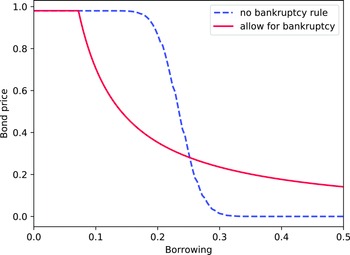
Comparing bond prices in two cases, the following elements lead to different bond prices: expected default or bankruptcy probabilities, federal government bailout probability, and bond recovery value. In terms of expected default/bankruptcy probabilities, we had implications from Figure 1 Panel (a) showing that, first, given the same borrowing level (and income level), the bankruptcy probability is higher than the default probability; second, the gap between bankruptcy and default probability is not monotonic with debt—when debt level is not high enough, the gap between bankruptcy and default probability is increasing with debt. When debt is high enough such that the government would surely declare bankruptcy, the gap between bankruptcy and default probability is decreasing with debt. With everything else equal and when the government defaults, a larger bailout probability increases bond price $q$
. With everything else equal and when the government declares bankruptcy, high income or low debt leads to a higher recovery value and therefore a higher price of bonds
$q$
. With everything else equal and when the government declares bankruptcy, high income or low debt leads to a higher recovery value and therefore a higher price of bonds $\hat{q}$
.
$\hat{q}$
.
Figure 2 plots $q$
, which represents the bond price when bankruptcy is not allowed and
$q$
, which represents the bond price when bankruptcy is not allowed and $\hat{q}$
, which represents the bond price when bankruptcy is allowed. A lower bond price indicates a higher borrowing cost for the government. Comparing the two lines, when borrowing is relatively low, allowing for bankruptcy leads to a higher borrowing cost. This is because allowing bankruptcy increases the likelihood of government not repaying debt. If a government carries a very heavy debt burden, allowing for bankruptcy can instead decrease bond spreads. This is because the potential benefits of bankruptcy, in terms of reducing the debt burden and relieving financial strain, are greater in such scenario.
$\hat{q}$
, which represents the bond price when bankruptcy is allowed. A lower bond price indicates a higher borrowing cost for the government. Comparing the two lines, when borrowing is relatively low, allowing for bankruptcy leads to a higher borrowing cost. This is because allowing bankruptcy increases the likelihood of government not repaying debt. If a government carries a very heavy debt burden, allowing for bankruptcy can instead decrease bond spreads. This is because the potential benefits of bankruptcy, in terms of reducing the debt burden and relieving financial strain, are greater in such scenario.
Bond price $q$
and
$q$
and $\hat{q}$
.
$\hat{q}$
.
Notes: This figure plots bond prices as a function of borrowing, given the median income. The dashed blue line plots $q$
, which represents the bond price when bankruptcy is not allowed. The solid red line plots
$q$
, which represents the bond price when bankruptcy is not allowed. The solid red line plots $\hat{q}$
, which represents the bond price when bankruptcy is allowed.
$\hat{q}$
, which represents the bond price when bankruptcy is allowed.

What would happen if states were suddenly allowed to declare bankruptcy in this economy? We simulate the model for 400 periods without allowing bankruptcy and then bankruptcy becomes a possibility starting in period 401. To predict government debt, spread, and related welfare following the change in bankruptcy rules, we average across 3,000 simulation paths.
Table 1 presents the predicted government debt-to-GDP ratio, welfare change in terms of consumption, and government spread over a span of five years. This includes year 0 (prior to the allowance of bankruptcy), year 1 (the year bankruptcy is introduced), and the subsequent three years. After the introduction of bankruptcy, the government’s debt-to-GDP ratio decreases by 9.2 percentage points, and consumption increases by 0.69 percent. However, the government spread increases by 1.1 percentage points.
Event analysis

Notes: This table reports predicted government debt-to-GDP ratio, consumption, changes in consumption, and government spreads after allowing bankruptcy in year 1.
6. Role of federal government bailouts
The probability of the federal government bailout, represented by $p$
, is an important parameter in the model. A high probability of a bailout may result in deviations from optimal resource allocation and overborrowing (Crivelli, Reference Crivelli2011). This problem became particularly relevant after the Great Recession, as the outbreak of the recession quickly put state governments in deep fiscal distress (Dilger, Reference Dilger2014) and their reliance on the federal fiscal relief program such as the American Recovery and Reinvestment Act raised concerns about agency problems by state governments and re-emphasized the importance of the federal government’s commitment to not bail out state governments in order to maintain efficient state government finances (Inman, Reference Inman2010).
$p$
, is an important parameter in the model. A high probability of a bailout may result in deviations from optimal resource allocation and overborrowing (Crivelli, Reference Crivelli2011). This problem became particularly relevant after the Great Recession, as the outbreak of the recession quickly put state governments in deep fiscal distress (Dilger, Reference Dilger2014) and their reliance on the federal fiscal relief program such as the American Recovery and Reinvestment Act raised concerns about agency problems by state governments and re-emphasized the importance of the federal government’s commitment to not bail out state governments in order to maintain efficient state government finances (Inman, Reference Inman2010).
Measuring the probability of federal government bailouts in the literature is often done in an ad-hoc manner in empirical studies. For example, Heppke-Falk and Wolff (Reference Heppke-Falk and Wolff2008) uses the “interest payments-to-revenue ratio” as a proxy for the probability of federal government bailouts in the case of Germany, as the Federal Constitutional Court uses that statistic as a reference to decide whether a sub-national government is eligible for federal aid. In contrast, Beck et al. (Reference Beck, Ferrucci, Hantzsche and Rau-Göhring2017) exploits institutional differences across multiple countries and interacts the level of debt with dummy variables for institutional characteristics to serve as an indirect measure for the probability of federal government bailouts.
With the use of our model, we can conduct a comparative analysis to understand the impact of the possibility of a bailout on state government decisions. A higher value of $p$
means that the government has a higher chance of receiving a bailout in the event of default, which reduces the negative consequences of default and may increase the government’s incentives to default.
$p$
means that the government has a higher chance of receiving a bailout in the event of default, which reduces the negative consequences of default and may increase the government’s incentives to default.
The bond price schedule (6) illustrates that the probability of a federal government bailout $p$
influences bond prices
$p$
influences bond prices $q$
through both direct and indirect channels. The direct effect is that as
$q$
through both direct and indirect channels. The direct effect is that as $p$
increases, the expected payment from the federal government increases, resulting in a corresponding increase in bond prices. The indirect effect is that as
$p$
increases, the expected payment from the federal government increases, resulting in a corresponding increase in bond prices. The indirect effect is that as $p$
increases, the government default risk
$p$
increases, the government default risk ${\mathbb{E}}[D(y',b')]$
increases, leading to a decrease in bond prices.
${\mathbb{E}}[D(y',b')]$
increases, leading to a decrease in bond prices.
To show the role of federal government bailouts, we resolve the model with $p\in [0,1]$
. Table 2 reports the model moments under different values for
$p\in [0,1]$
. Table 2 reports the model moments under different values for $p$
, with other parameter values fixed. As the likelihood of a federal government bailout increases, the probability of state governments repaying their debt decreases. The debt-to-GDP ratio increases as the likelihood of a bailout increases, with the exception of a slight decrease when the likelihood increases from 0% to 10%. The average spread first increases as the bailout probability increases because the government is more likely to default. However, as the bailout probability further increases, the government spread decreases because the lenders expect to receive payments from the federal bailouts. Considering the costs to the federal government, the last column of Table 2 presents the expected federal bailout amounts, calculated using the average state debt, the probability of state government default and the probability of federal government providing bailout. As the probability of a bailout increases, the corresponding amount escalates dramatically–from 406 million (with a 10% probability of bailout) to 76.5 billion (with a 50% probability of bailout), and up to 240 billion (with a 90% probability of bailout).
$p$
, with other parameter values fixed. As the likelihood of a federal government bailout increases, the probability of state governments repaying their debt decreases. The debt-to-GDP ratio increases as the likelihood of a bailout increases, with the exception of a slight decrease when the likelihood increases from 0% to 10%. The average spread first increases as the bailout probability increases because the government is more likely to default. However, as the bailout probability further increases, the government spread decreases because the lenders expect to receive payments from the federal bailouts. Considering the costs to the federal government, the last column of Table 2 presents the expected federal bailout amounts, calculated using the average state debt, the probability of state government default and the probability of federal government providing bailout. As the probability of a bailout increases, the corresponding amount escalates dramatically–from 406 million (with a 10% probability of bailout) to 76.5 billion (with a 50% probability of bailout), and up to 240 billion (with a 90% probability of bailout).
Federal government bailout probability and model moments

Notes: This table reports the generated model moments with different values for $p$
(the probability of the federal government providing bailouts to the state government). Other parameter values are fixed. The last column reports the results when assuming that the bailout probability is a function of state income, rather than being completely exogenous.
$p$
(the probability of the federal government providing bailouts to the state government). Other parameter values are fixed. The last column reports the results when assuming that the bailout probability is a function of state income, rather than being completely exogenous.
Lastly, the bailout probability may depend on the importance of a state, as in the “too big to fail” theory. To address this, I assume the bailout probability $p$
is a function of income
$p$
is a function of income $y$
. The notion of “too big to fail” suggests that
$y$
. The notion of “too big to fail” suggests that $p(y)$
is an increasing function. Assume
$p(y)$
is an increasing function. Assume $p(y)=\frac{y}{1+y}$
with income
$p(y)=\frac{y}{1+y}$
with income $y$
in the range
$y$
in the range $[0, \infty )$
. This functional form has several desirable properties. First, the range of
$[0, \infty )$
. This functional form has several desirable properties. First, the range of $p(y)$
is [0,1), ensuring that the bailout probability remains within realistic bounds. Second, this function is continuously increasing within this interval because its derivative
$p(y)$
is [0,1), ensuring that the bailout probability remains within realistic bounds. Second, this function is continuously increasing within this interval because its derivative $\frac{d}{d y}\left (\frac{y}{1+y}\right )=\frac{1}{(1+y)^2}$
is always positive. By assuming the bailout probability as a function of state income, I resolve the model and simulate the moments. The last column of Table 2 reports the probability of repayment, the debt-to-GDP ratio, the average spread and the expected bailout amounts. The results are close to those of the experiment with
$\frac{d}{d y}\left (\frac{y}{1+y}\right )=\frac{1}{(1+y)^2}$
is always positive. By assuming the bailout probability as a function of state income, I resolve the model and simulate the moments. The last column of Table 2 reports the probability of repayment, the debt-to-GDP ratio, the average spread and the expected bailout amounts. The results are close to those of the experiment with $p=50\%$
.
$p=50\%$
.
7. Conclusion
There is an active debate among legal scholars on whether US states should be allowed to file for bankruptcy protection, but an economic analysis of the problem is lacking. This paper provides a formal economics framework for analyzing the impacts of allowing state government bankruptcy. Allowing for bankruptcy increases ex-ante risks for the state government to refuse repayment, but reduces ex-post cost from outright default. Even analysis shows that an unexpected switch in bankruptcy rules that allows for bankruptcy reduces debt burden, increases welfare slightly, but increases government borrowing cost. Lastly, to highlight the key mechanism, the model is abstract from several features such as interactions between state governments and potential economic spillovers across different states. The design of the optimal bankruptcy rule would be an interesting future research revenue.
Acknowledgements
First draft: July 2022. I thank Narayana Kocherlakota for initiating this paper and his valuable comments. I thank the editor, the associate editor, and two referees for their constructive comments and valuable suggestions.




 Open access

