


1. Introduction
It is well established that the UK population is ageing. For example, the population over the age of 65 has increased by 47% since the mid-1970s and the population over the age of 75 has increased by 89% over the same period. Indeed, the latter now make up 8% of the UK population (Office for National Statistics, 2015).
With the UK population ageing so rapidly, deciding upon a satisfactory and sustainable system for the funding of people’s long-term care (LTC) needs has long been a topic of political debate. Reform of the way in which social care should be provided and funded began in the late 1990s when the Government at the time set up a Royal Commission to make recommendations for a sustainable system of funding of LTC (The Royal Commission on Long Term Care, 1999). However, not all of the Commission’s recommendations were accepted by the Government and the issue has remained unresolved ever since.
During the last 17 years there have been two independent commissions (Wanless, Reference Wanless2006; Commission on Funding of Care and Support, 2011), three separate consultations, two Green papers and three White papers (2006, 2010 and 2012) as well as numerous reports produced by think tanks, charities and other organisations. For a comprehensive summary of the recent history of social care reform in the United Kingdom, see Humphries (Reference Humphries2013).
It must be emphasised that issues around LTC provision and funding are not unique to the United Kingdom. For example, Elliott et al. (Reference Elliott, Golds, Sissons and Wilson2015) provide a summary of the funding models used for LTC in six countries including the United Kingdom. The paper discusses the different approaches that the countries have adopted to funding LTC, with particular reference to the differences in the private/public split in respect of the contributions made to secure an individual’s care.
The Commission on Funding of Care and Support (widely known as the Dilnot Commission) was established in July 2010 and tasked by Government with reviewing the funding system for care and support in England (Commission on Funding of Care and Support, 2011). Some, but not all, of the recommendations made by the Dilnot Commission in July 2011 have since come into law under “the Act”. This legislation replaced numerous pieces of existing legislation and was intended to be simpler and fairer. Reforms were being phased in with implementation of the key reforms for individuals, such as personal budgets and deferred payment agreements, coming into force in 2015 (Phase 1), while the introduction of a £72,000 cap on Local Authority care costs and a change in the means testing thresholds was scheduled to be introduced in April 2016 (Phase 2). However, in July 2015, the Government announced that the implementation of the reforms under Phase 2 will be delayed until 2020 (Jarrett, Reference Jarrett2015).
The Government has stated that it remains committed to implementing the cap in 2020 and the authors’ intention is that the analysis in this paper will help the Government to use this delay to ensure that these reforms meet the policy intention of protecting people from catastrophic care costs, whilst facilitating individual understanding of their potential care funding requirements. In particular, we review the products identified in a previous report which we produced (Kenny et al., Reference Kenny, Barnfield, Curtis, Daly, Dunn, Passey, Rickayzen and Teow2015), together with a number of non-pension products. We also provide case studies to demonstrate the complexities of the care funding system. Finally, we review the potential impact on incentives for individuals to save for care costs under the proposed new means testing thresholds and compare these with the current thresholds.
In addition to the delay of Phase 2 of “the Act”, the freedom and choice agenda for pensions has come into force. It is therefore timely that we review potential market responses to help people pay for their care within the new pensions environment.
In this paper, we have concentrated mainly on the needs of consumers who have to fund some or all of the costs of being admitted to a care home in later life. We recognise in the paper that many individuals need to pay for domiciliary care but that was not our main focus. Moreover, we have not covered the macroeconomic and demographic impacts on care funding nor the politics of whether social care should be integrated with the NHS.
In section 2, we provide a summary of the new pensions framework.
In section 3, we provide an update on products covered in the previous report (Kenny et al., Reference Kenny, Barnfield, Curtis, Daly, Dunn, Passey, Rickayzen and Teow2015) in light of the new pensions framework. In addition, as pensions are likely to be only part of the solution to meeting LTC costs, we have included non-pension products that could be used to fund care needs.
In section 4, we have set out a number of scenarios to illustrate the impact of the new system of funding for social care costs for a series of individuals before and after they reach the cap, including an example of the interaction with the universal deferred payment scheme (UDPS).
In section 5, we consider the interaction between additional savings and the impact on benefits paid under the means test to explore whether the means testing thresholds might encourage, or act as a barrier to, saving to meet potential care costs.
2. The New Pensions Framework
2.1. The Taxation of Pensions Act (2014)
The Taxation of Pensions Act (2014) introduced significantly greater flexibility in how individuals can take their defined contribution (DC) pension and removed the requirement for individuals to buy an annuity (Figure 1).
The new options available for individuals over 55 from April 2015

From 6 April 2015, the legislation allows individuals to access as little or as much as they want from their DC funds once they have reached normal minimum pension age (usually age 55). This means that individuals have the choice of
-
∙ taking their funds as an income for life, for example, by purchasing a lifetime annuity; or
-
∙ accessing their funds flexibly, crystallising as much of their DC funds as they wish, whenever they like; or
-
∙ a mixture of both.
If an individual accesses their DC funds flexibly they will be restricted in the amount of contributions payable thereafter. Flexibly accessing their funds will trigger new “money purchase annual allowance rules” with an annual allowance of £10,000 limiting the amount of tax relief they can get on future contributions made to any money purchase arrangement.
Whilst the new legislation facilitates significantly greater flexibility in the way DC funds can be accessed, a significant number of contract-based and trust-based pension schemes are not making the new flexibilities available within the scheme. The Government wants to ensure that people can access the new pension flexibilities easily and at reasonable cost by transferring their DC pot to another pension scheme. HM Treasury are currently consulting on pension transfers and early exit charges.
2.2. Market Reaction
It is still too early to understand exactly how individuals will respond to this new environment. However, in looking at the products which might complement the new pensions flexibility, it is helpful to consider the possible market reaction.
-
∙ Initially, the removal of the requirement to annuitise DC pension saving could discourage individuals from buying any alternative products which, like an annuity, involve a permanent commitment of funds.
-
∙ If consumers are reluctant to buy annuity style products, this would mean that products funding LTC would either need to retain the newly provided flexibility or significant incentives would need to be offered to overcome this additional resistance.
-
∙ Incentives to overcome any aversion to commit funds permanently are unlikely to become commercially viable for product providers; they are more likely to be achievable through tax incentives.
In the longer term, the demand for more structured products may re-emerge if people experience the difficulties and risks of managing their own funds during the decumulation phase. It may be that individuals will use annuities but, rather than buying them immediately upon retiring, the purchase may be deferred until later in retirement.
2.3. Accessing Pension Benefits
The potential opportunity to cash in existing annuities should a secondary annuity market be created, or should it become straightforward to convert defined benefit (DB) to DC arrangements, could help to facilitate the funding of LTC costs. The ability to replace a fixed level of income with a lower immediate income, together with a reserve fund that can be used flexibly to meet potential future contingencies, could allow those who have lower immediate spending requirements to prepare more easily for potential LTC costs. However, this approach gives rise to many potential issues, including
-
∙ the risk of selection by those taking the cash option;
-
∙ the assumptions on which the income stream would be valued; and
-
∙ the costs of the exercise in preparing the options for the individual.
It is likely that in order to minimise the selection risk, providers would need requests to transfer funds to be medically underwritten which would increase the cost and the time taken for the process to be completed. Annuitants would need to make the decision to sell when they are still in good health if they want to make sure that they have the necessary funds to meet their LTC costs should they need LTC. If they miss this opportunity there could be no real advantage in taking the cash option.
2.4. Deprivation of Assets in the Means Test for Care Home Provision
Deprivation of assets is where an individual has intentionally decreased their assets in order to reduce the amount they will be asked to pay towards their social care provision. In such cases, the individual must be proven to have known that they would need to provide for care and reduce their assets accordingly. The statutory guidance states that where the individual has used their assets to remove a debt, such a reduction in assets would not be considered as deprivation even if the debt is not immediately due.
Where a DC pension pot is used to buy an annuity, the annuity income could not be reduced. The Department for Work and Pensions (DWP) has confirmed that if an individual has used the new pension freedoms to take out a lump sum from their DC pot and spends, transfers or gives away the money, the DWP will consider whether they had deliberately deprived themselves of that money in order to improve their entitlement to means tested welfare benefits, including the social care means tested benefits (DWP, 2015). If it is decided that the individual has deliberately deprived themselves of assets, the individual will be treated as still having the corresponding assets as income or capital when their benefit entitlement is determined.
Conclusion 1: It is still too early to understand exactly how individuals will respond to the pensions freedom and choice agenda
It is not clear yet whether individuals will ring-fence funds to meet potential future care costs as this is not in keeping with the new flexibilities. However, there are a number of products that might complement the new flexibilities and help people make provision for care costs:
-
∙ products that are already in existence in the United Kingdom, such as income drawdown and equity release;
-
∙ products that have had success in other countries, such as protection insurance; and
-
∙ new products, such as disability-linked annuities (DLAs) and Care Individual Savings Account (ISAs).
Recommendation 1: A joint Government and industry approach to collecting data on how people are responding to the new system will help to assess whether education, the use of default retirement options or incentives for LTC products, such as tax relief and employer contributions, could be effective in helping people to use their savings to meet care costs
3. Products
In this section, we consider the new regulatory and commercial environment and what this means for product development to support LTC needs. We review the products identified in our previous report (Kenny et al., Reference Kenny, Barnfield, Curtis, Daly, Dunn, Passey, Rickayzen and Teow2015), in addition to a number of non-pension products.
3.1. Products Previously Identified
In our previous paper (Kenny et al., Reference Kenny, Barnfield, Curtis, Daly, Dunn, Passey, Rickayzen and Teow2015), we identified the following products which might prove useful in supporting particular cohorts of the population in providing for their LTC costs:
-
∙ protection insurance;
-
∙ income drawdown;
-
∙ Pension Care Fund (PCF);
-
∙ DLAs;
-
∙ immediate and deferred needs annuities; and
-
∙ variable annuities.
This section gives an update on the potential use of these products to fund LTC costs under the new pensions regime.
3.1.1. Protection insurance
Insurance protection products are designed to cover an event that is uncertain and in some cases unlikely to occur, but where the financial consequences may be challenging without insurance.
Under this product, a policy would be purchased by an individual, most likely before retirement to allow time for premium costs to be financed and also to provide cover for a benefit paid before retirement if needed. Joint life policies can also offer cover for couples. Regular premiums would be paid for life, or until a claim is made, in return for a predetermined contribution towards LTC costs if LTC is needed. It is likely that the benefit paid would be based upon some activities of daily living (ADL) measurement/cognitive impairment or an indemnity of needs up to a certain amount per week, and for a predetermined period.
The general benefits of risk insurance (pooling of risk) do apply to this product group, but they could be reduced if there is a relatively high likelihood of an individual requiring funding for LTC needs, which can be tailored to include domiciliary care needs. This means that the cost of cover can be a relatively high proportion of the eventual maximum benefit payable.
The insurance of LTC costs was a product previously marketed in the United Kingdom as a standalone pre-funded product, offering protection against uncertain costs. The standalone products are no longer marketed due to a lack of demand, possibly due to the cost of the products. However, more affordable protection products could be offered to provide cover for the care costs incurred before reaching the cap. In 2014, a small number of product providers added an LTC rider to their whole-of-life plans to provide some protection against care costs. This is discussed in more detail below in section 3.2.2.
The greater access to cash sums could promote the use of lump sum funding of this insurance. However, this is only likely to be popular once the risks of individuals managing their own funds are fully appreciated and there is an increased awareness of the probability of requiring LTC and the consequential costs.
3.1.2. Income drawdown
It is likely that many people will make use of drawdown arrangements to manage their retirement income, at least during the initial phase of retirement. Drawdown could also be used to fund care costs. If an individual has eligible care needs then it may be appropriate for them to drawdown their pension fund rapidly to meet the costs of care.
Therefore, income drawdown could clearly be very helpful in facilitating the funding of LTC costs as and when they arise. However, this will depend on the rate at which income is drawn from the invested retirement savings before the need for LTC and the investment policy adopted. Here it will be vital that individuals take appropriate advice not only at the outset, but also throughout the lifetime of these arrangements. Failure to do so could result in the exhaustion of the funds available and the individual having to rely wholly on State benefits or there being tax consequences.
3.1.3. PCF
Our previous suggestions around the establishment and operation of PCFs have been substantially overtaken by the increased flexibility now available to all DC pension savings.
In our previous paper (Kenny et al., Reference Kenny, Barnfield, Curtis, Daly, Dunn, Passey, Rickayzen and Teow2015), a PCF was essentially a DC savings fund established within the pensions environment. The PCF would be administered, invested and regulated under the existing pension fund framework, but would be separately identified and ring-fenced. In order to encourage the establishment and maintenance of such a fund, greater flexibility would need to be available for the use of the PCF and it would need to attract tax incentives at a similar (or greater) level to that offered for pensions. The PCF could be drawn on to meet regular care costs as they emerge or could be used to fund the purchase of an insurance product (presuming they exist). The PCF could be used for both the individual’s and their partner’s LTC needs and any unused balance could be passed over to the next generation exempt of inheritance tax (IHT), but still ring-fenced for meeting their LTC costs.
In the new flexible world any allocation of savings to a particular use may be perceived as a backward step. We did anticipate this problem and suggested some tax incentives to encourage the adoption of this approach. Given that pension savings can now be used for any purpose, and not just for buying an annuity, giving tax relief to savings in a PCF would only be helpful for those who have already maximised their pension saving within the Lifetime Allowance regime. Our additional suggestion of allowing the PCF to be handed down to a subsequent generation without any deduction of IHT has now been brought into the drawdown rules and so would not provide any extra incentive to invest in a PCF.
For existing pensioners we also anticipated the possibility of transferring funds from existing DB or DC savings. As announced by the Government during 2015, it is possible that pension rules could change further in future to allow the surrender of annuities in a secondary annuity market. Assuming that this is also extended to DB pensions, this would also reduce this potential incentive to move money into a PCF.
3.1.4. DLA
The DLA is a combination of a lifetime annuity (pension payable for the rest of policyholder’s life) and an LTC product. It provides standard lifetime annuity payments, whilst the policyholder is in reasonable health. However, the annuity payments increase to a much higher level (or levels) if and when the policyholder subsequently requires LTC. The trigger for the enhanced level of annuity being paid could be the policyholder failing a certain number of ADLs.
As mentioned in section 2.2 above, whilst the pension reforms are new, individuals might be reluctant to buy an annuity – including DLAs – preferring instead the freedom to use their pension assets to suit their own circumstances. However, once the reforms have been established for some time and new retirees have seen the experience of pensioners who opted not to buy an annuity, they might decide that they prefer the certainty and security that annuities provide. In addition, annuity rates are currently unattractive due to the low interest rate environment which prevails at the moment. However, if interest rates increase, then annuities may become more attractive. If annuities do come back into favour then the flexibility of a combined lifetime and LTC annuity product could appeal.
In our previous report (Kenny et al., Reference Kenny, Barnfield, Curtis, Daly, Dunn, Passey, Rickayzen and Teow2015), we acknowledged that fairly substantial funds would be required to buy a DLA. However, under the pension reforms, the ability to cash in DB as well as DC arrangements should mean that many more people will have the necessary funds to buy a DLA should they wish to do so. For some individuals, the idea of receiving a steady annuity whilst being healthy, knowing that it would increase substantially if LTC is ever required, could be very attractive. As noted in our previous paper (Kenny et al., Reference Kenny, Barnfield, Curtis, Daly, Dunn, Passey, Rickayzen and Teow2015), we estimated that such an individual would need to sacrifice around 10% of their initial annuity income in order to provide for a substantially increased level of annuity if LTC were needed (e.g. an annuity that triples once the individual requires LTC).
A second type of DLA might be even more appealing. Once again, the individual buys it when in good health at retirement. However, with this variation no benefit is paid until the individual requires LTC (i.e. no standard lifetime annuity is paid while the individual is in reasonable health). The benefit is then solely an annuity payable if and when the individual’s health has subsequently deteriorated to a point where care is required. The level of premium payable even for a substantial income from this DLA would be expected to be relatively small for three reasons:
-
∙ The annuity is not expected to commence for many years if bought whilst the member is in good health at retirement (i.e. would not commence until the individual requires LTC which may well not be for several years).
-
∙ The annuity would not be expected to be paid for a long period (e.g. typically around 3 years) since, by definition, the individual would be in a very poor state of health when it commenced.
-
∙ The fact that no income is paid to the policyholder for many years should allow the insurer to invest in a wider range of assets (e.g. equities) than just fixed interest stock before the annuity comes into payment. This then offers a higher expected investment return.
This second type of DLA is similar to the protection insurance product mentioned above.
3.1.5. Immediate needs annuity plus temporary annuity
An enhanced immediate needs annuity is a medically underwritten annuity calculated based on the life expectancy of the insured life at the time of purchasing the annuity. In return for the payment of a single premium, a guaranteed income is paid for life.
The annuity is normally purchased at or around the time of receiving care at home or going into a care home or a care home with nursing. It can be funded by cashing in any remaining pension or any other source of funds available at the time. The income provided by an annuity is fixed at outset but can increase on a predetermined escalation basis such as retail price index (RPI) or 5% per annum (p.a.). The annuity cannot be surrendered and does not offer any investment choice. A death benefit offering a partial return of premiums during the first few months of buying the annuity can also be offered.
This type of annuity could be purchased to provide income to cover any Hotel costs or top-up costs that continue even if the cap is reached. This could be purchased alongside a temporary annuity to cover the Local Authority assessed costs incurred during the period up to the point the cap is reached. A temporary annuity would stop paying income on the earlier of reaching the cap or death. The monthly benefit could initially be equal to the Local Authority costs and set to increase with RPI.
3.1.6. Variable annuity
A variable annuity is an existing pension product available in the UK market. A variable annuity is a unit-linked guaranteed product that can provide a guaranteed minimum level of pension income. The guaranteed income varies according to age at income commencement and increases periodically if fund performance leads to a growing account balance.
This product is a drawdown product with optional income and capital guarantees. It provides income flexibility with the underpin of a guaranteed minimum level of income. The product is likely to appeal to individuals wanting a flexible income in retirement. This product can potentially be offered with an LTC option where the guaranteed income increases to meet care costs on failing a specified number of ADLs.
3.2. Non-Pension Products for the New Flexible Savings Market
Alongside the opportunities now available to use accumulated DC pension savings, there are also opportunities to establish alternative saving vehicles focussed on LTC costs.
3.2.1. Care ISA
A Care ISAFootnote 2 would take the shape of a savings vehicle to encourage people, old and young, to increase their savings for the future funding of their LTC costs. It would be used specifically for funding care home fees or domiciliary care costs. An IHT incentive would be needed to allow this to pass on to the next generation free of IHT if unused before death. The recipients (i.e. the children) could then use it to help fund their own LTC needs.
3.2.1.1. Product features
The main attraction would be the tax incentives, and long-term savings prospects, where the fund would be ring-fenced for LTC costs. It could be used for the individual’s own care costs, or those of their spouse, elderly parents, siblings or children. If unused, it could be passed on to the next generation without any tax implications, within the Care ISA environment.
3.2.1.2. How would it be funded?
An annual allowance could be provided, say £10,000 p.a., up to a lifetime limit of £50,000 per person. This could be funded from regular savings contributions or re-directed pensions savings.
3.2.1.3. Product design and future development potential
It could increase the funding amounts dedicated to LTC costs and reduce the corresponding requirements of the state.
3.2.2. Accelerated whole-of-life policy for LTC
Several insurance companies have introduced a new product which adds a protection style benefit for LTC to existing whole-of-life assurance products. Such a product was proposed by Mayhew et al. (Reference Mayhew, Karlsson and Rickayzen2010). The product works by making an accelerated payment to a policyholder should they require LTC, be it receiving care at home or in a care home. The lump sum paid on death is reduced by this accelerated payment.
3.2.2.1. Product features
In return for an extra premium, the accelerated payment feature sits alongside a whole-of-life assurance policy. It pays the assured amount (or some reduced amount) in the event that LTC were required. This is likely to be linked to some ADL/cognitive impairment measure.
The level of funding available for LTC would be based on the sum assured for the whole-of-life policy, rather than actual LTC costs. Although, for large policies, the amount could be reduced in line with what was needed, with a corresponding reduction in premium.
3.2.2.2. How would it be funded?
Whole-of-life policies tend to be taken out by people already in or near retirement. They are not policies that are likely to generate increased savings, but rather facilitate a transfer of an individual’s wealth. It is unlikely that this accelerated version will encourage assets to be put aside to meet LTC needs. However, it would allow assets that otherwise would have been transferred to an individual’s descendants on death in a traditional whole-of-life policy to be used to pay for LTC instead should this be needed.
From a consumer’s point of view, it is not clear that the product will fill a need for those looking for LTC protection that do not already have the means to provide for themselves. The product could instead be regarded as a way of entering into a whole-of-life assurance policy, but with the ability to access the savings if they are needed for their LTC provision. As such, it may be attractive to individuals who are already considering a whole-of-life policy but who are concerned about unexpected costs that would mean they have a need for the cash before their death. While it is unlikely to have majority market appeal, or significantly solve the LTC funding question for most people, this development could serve a subsection of the population extremely well.
3.2.2.3. Product design and future development potential
From a provider’s point of view, such a policy could be seen as a relatively low risk way to enter the LTC protection market. The only additional risk to providers is that payments that would have been made upon death are accelerated to a greater degree than anticipated if more policyholders require LTC than expected. Since the typical time period between needing LTC and eventual death is short, the additional risk presented to an insurance provider is much smaller than the risk presented by a standalone LTC protection product. It could make an excellent foundation for insurers building up experience and data which may lead to other LTC protection policies becoming viable in the future.
3.2.3. Personal care savings bonds
Financial building blocks are needed to pay for social care that will be sustained for decades and to provide extra security for the individual. Mayhew & Smith (Reference Mayhew and Smith2014a) have proposed a new savings product called Personal Care Savings Bonds (PCSBs). The bonds are designed to encourage saving for social care by providing extra money at the time of greatest financial need. PCSBs are likely to be attractive to older people who have only a basic pension and modest savings, but also to other age groups as they not only attract interest but also pay prizes.
It is evident that Premium Bonds remain one of the most popular ways of saving with over 13 million subscribers. Based on reasonable assumptions, this paper shows how the fund could build into a substantial investment worth £70 billion with regular monthly prize pay-outs. In concept PCSBs are similar to Premium Bonds, a UK personal savings product that has been successfully operating since 1956.
Unlike Premium Bonds, the PCSB fund would pay out once care needs begin (usually linked to an assessment or benefit entitlement such as Attendance Allowance). PCSBs would attract a small rate of interest, in addition to prize money which would be paid at monthly intervals throughout the duration of the holding. This would help to incentivise their purchase throughout adult life.
The introduction of such a product could be managed and operated by National Savings & Investments and could work from the existing Premium Bonds platform.
3.3. The Use of Housing Equity
There is a sizeable group of older people on low income for whom moving house would be impractical but for whom a higher income could significantly help improve their day-to-day life and hence well-being – particularly older retirees who live alone and may have impending care needs. For this group we have set out two products, equity release and an Equity Bank product which would allow them to stay at home whilst also contributing to their LTC costs.
3.3.1. Equity release
Equity release mortgages enable a residential property owner to release part of the value of their property without having to sell the home immediately and they can continue to live there until they die or go into residential care. The released equity in the property could be used to fund LTC costs, or pay for improvements that enable people to live independently in their home for longer.
3.3.1.1. Product features
The market is mainly dominated by lifetime mortgage products. The homeowner receives a lump sum and in return transfers a charge on their property to the equity release provider. The lump sum amount then rolls up with interest and the lump sum plus interest is paid back to the provider on the sale of the home. In the meantime, the individual can still live in their property until death or entry to a care home.
Many products have a drawdown facility which gives the individual the option to take further sums out of the property. A guarantee option is available on most products, which means that the loan to be repaid cannot exceed a pre-agreed percentage of the value of the sale proceeds of the property.
3.3.1.2. How would it be funded?
Property is the most substantial asset available in retirement. The ability to release equity in the home opens up a realistic option to fund LTC. For example, it can be used early in retirement to fund home improvements to help with independent living in the home for longer.
3.3.1.3. Product design and future development potential
Currently, equity release mortgages are repayable on entering residential care of the last surviving spouse. However, if a version of the product could be available for individuals entering care then it could be used to provide funds for LTC costs. However, there would need to be conditions in place to protect the property against dilapidation risks, for example, the property must be rented out.
The drawdown facilities on equity release mortgages could be extended to allow the products to be used to provide a regular income.
3.3.2. Equity Bank
Mayhew & Smith (Reference Mayhew and Smith2014b) have set out proposals for a UK Equity Bank. This would be a State agency that would help people release income from their homes in the form of a lifelong annuity in return for selling a portion of the equity in their home to the State. The value of the annuity would be recovered on the death of the recipient.
For the Equity Bank to make a real difference to an individual’s well-being, it would be important that the financial benefits were not eroded through higher taxes or the withdrawal of benefits. The paper suggests how this could be done. The scheme is targeted at people from age 75 and above, since this is the age that care needs tend to begin and it would help keep the scheme affordable for individuals and the State, with relatively short payback periods. The report’s demographic analysis shows that there are 1.2 million people in the United Kingdom aged 75 and above, of whom around 400,000 are estimated to live alone. However, if we restrict the market to the number of individuals turning 75 each year then this could yield up to 40,000 new policies each year which compares with ~20,000 equity release sales being made in total in a year at the time of writing (Source: Equity Release Council).
3.4. Application of Products to Domiciliary Care
Domiciliary care can provide personal care, medication, meals, home security and other practical household tasks should a person become frail or require LTC. An individual may initially need some help if they become unable to perform one or two ADLs and this may increase if they become frailer. Home care costs will vary depending on need and could include nursing and night cover.
Most of the products listed above could be tailored to include provision for domiciliary care at home. The income could be used to make home modifications and disability adaptations.
-
∙ Accelerated whole-of-life policies could be tailored to make small lump sum payments as more ADLs are failed.
-
∙ Income drawdown could be used when the care need arises and varies.
-
∙ Income from immediate annuities could cover the care cost of home carers’ services.
-
∙ DLAs could meet the increasing costs as more hours of paid care were required, or if more complex medical care were needed at home.
-
∙ An equity release scheme could be drawn up to meet the specific needs of homeowners.
These products could complement other benefits such as the Attendance Allowance.
Local authorities will assess care needs and contribute towards payments to allow the individual to employ their own carers or services, taking into account means testing. The ability to pay will be determined by income, expenditure and savings and excludes the value of the home.
3.5. Consistency of State Benefit Triggers and Product Claim Triggers
For products that start making a benefit payment based on meeting a state of health criterion, such as failing a number of ADLs, it may not match the criteria used to determine whether an individual qualifies for State benefits such as Attendance Allowance or Local Authority support. It is possible to design products that have benefit payment triggers tied to State benefit eligibility criteria, but this can lead to a mismatch over time if the eligibility criteria changes.
4. Case Studies
We have developed a number of case studies to illustrate how care costs will be composed, if the cap and new means testing threshold are implemented from 2020, showing the costs before and after the cap is reached.
In the absence of further information on the likely values in 2020, we have assumed the original values of the care cap and the means testing thresholds proposed for 2016 are broadly appropriate for this paper. Other assumptions used in the case studies are as follows:
-
∙ Where applicable, all figures are inflated to 2016 using an assumed inflation rate of 3.5% p.a. in line with the previous report (Kenny et al., Reference Kenny, Barnfield, Curtis, Daly, Dunn, Passey, Rickayzen and Teow2015).
-
∙ The weekly figures are converted to yearly figures assuming 52.18 weeks/year.
-
∙ The State Pension is assumed to be £151.25/week (the current base level of the new single-tier UK State Pension effective from 6 April 2016).Footnote 3 We recognise that the individuals in the case studies will be beyond the State Pension Age in April and will not qualify for the new State Pension.
-
∙ The Attendance Allowance is assumed to be at the higher level of £85.18/ (the 2015/2016 rate of £82.30 inflated to 2016).
-
∙ The NHS-funded allowance is assumed to be £115.92/week (the 2015/2016 rate of £112.00 inflated to 2016).
-
∙ The total cost of care of £42,985 p.a. is the average care fee for care homes with nursing in England and is based on the Laing & Buisson Care of Older People UK Market Report 2013/2014 inflated for 3 years to 2016 (Laing & Buisson, 2014a). The Local Authority rate of £32,649 p.a. is based on the Laing and Buisson Annual Survey of UK Local Authority Baseline Fee rates 2013/2014 inflated for 3 years to 2016 (Laing & Buisson, 2014b).
-
∙ The daily living costs are assumed to be £12,000 p.a. as previously set by the Department of Health.
-
∙ The personal expense allowance is £25.77/week (the 2015/2016 rate of £24.90 inflated to 2016).
-
∙ The care cost cap is £72,000 and the means testing threshold and upper limit are £17,000 and £118,000, respectively, as previously set by the Department of Health.
4.1. Example 1
An example of a single older woman who enters residential care (with nursing) towards the end of her life.
Mary had a fall at the age of 80, which hindered her mobility. She could no longer manage at home and entered a care home with nursing. The care home costs of £42,985 consist of the Local Authority rate of £32,649 p.a. (including daily living costs of £12,000 p.a.) and additional care costs in excess of the Local Authority rate of £10,335 p.a. Before entering care, Mary lived on her own in a house worth £200,000 that she owned outright and had £30,000 in savings.
On entering the care home she had a total income of £21,000 p.a. which consisted of her State Pension, her own private pension, NHS-funded allowance and an Attendance Allowance benefit.
4.1.1. Case (a): no deferred payment option included
Mary is worried about the affordability of the care home given that her annual income is much less than the annual care home costs. She was informed that she would not be eligible for Local Authority financial support given that the value of her house was greater than the £118,000 upper capital limit and it would not be possible for her to enter a deferred payment arrangement given that she had more than £23,250 in non-housing assets. Note that if her non-housing assets ever fell below the £23,250 threshold, she would subsequently be eligible for the UDPS. The chart in Figure 2 illustrates the costs Mary is faced with on entering the care home as well as the costs after about 3.5 years once the care cap is reached (see Appendix B for further details of the time taken to reach the cap). By that time, Mary or her family would have paid a total of £129,276 towards her care costs; £72,000 of which would have gone towards the Local Authority rate element of the costs.
Progression of care costs for a single person owning a house valued at £200,000 and with savings of £30,000

This scenario assumes she does not enter a deferred payment arrangement at any stage. It is assumed that Mary uses her pension income and any savings to meet the cost of care and, once her savings are depleted, the shortfall in income to cover the care costs is made by a third party such as a family member (shown on the graph as a “Top-Up Payment”).Footnote 4 As shown in the chart, the “Local Authority Contribution” equal to the Local Authority rate element of the cost is met by the Local Authority only after the cap is reached.
4.1.2. Case (b): deferred payment option included
In this case, Mary decides to enter a UDPS to help meet the costs of care when she is eligible. It is assumed that Mary uses her pension income and any savings to meet the cost of care and once her savings are depleted she enters into a UDPS. Any rental income from the property is ignored and may be assumed to meet any supplementary living costs (not included in the care costs) as well as any costs of maintaining the property. It is also assumed the Local Authority charges 2.25% p.a. compound interest on any loan amounts outstanding at the end of each year under the UDPS.
As shown in the chart in Figure 3, Mary enters the UDPS in the 2nd year of care once her savings are depleted.
Progression of care costs for a single person owning a house valued at £200,000 and with savings of £30,000 using the deferred payment option

The loan amount stabilises after the cap is reached and the “Local Authority Contribution” element of the cost is met by the Local Authority. In this case this is after about 4 years in care.
This progression of the deferred payment loan and interest for the first 5 years of care is shown in the following chart (Figure 4).
Progression of deferred payment loan for a single person owning a house valued at £200,000 and with savings of £30,000

The amount Mary borrows is repayable with interest out of her estate when she dies and her house is sold.
4.2. Example 2
An example of a single woman, living in rented accommodation who enters residential care (with nursing) towards the end of her life.
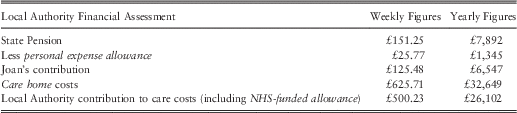
Joan has dementia and can no longer manage at home. She enters a care home with nursing costing the Local Authority rate of £32,649 p.a. (including daily living costs of £12,000 p.a.). Before entering care, Joan lived on her own in a rented flat and had £5,000 of savings.
After entering the care home she has a total income of £13,941 p.a. comprising the State Pension and an NHS-funded allowance, with no additional private pension savings.
Joan is worried about the affordability of the care home given that her annual income is much less than the annual cost of the home. She is informed that she would be eligible for Local Authority financial support (under the means test before reaching the cap) given that her savings were only £5,000 and that she did not own her own home (her savings are ignored by the Local Authority because they are less than £17,000).
Table 1 illustrates how much Joan must contribute to the cost of her care.
Breakdown of Local Authority Financial Assessment for Example 2
The chart in Figure 5 shows how Joan’s care costs are met in the 1st and 2nd year of requiring care and how the care costs are funded after the care cap is reached.
Progression of care costs for a single person living in rented accommodation with £5,000 of savings. PEA, personal expense allowance

4.3. Example 3
An example of a married woman who enters residential care (with nursing) towards the end of her life
Susan aged 82 and her husband John live in a house worth £200,000, which they jointly own and have combined savings of £50,000. Unfortunately, Susan’s recent hip replacement operation was unsuccessful and her mobility is greatly reduced. She can no longer manage at home and enters a care home with nursing costing the Local Authority rate of £32,649 p.a. (including daily living costs of £12,000 p.a.). On entering the care home she had a total income of £21,000 p.a. comprising the State Pension, her own private pension and NHS-funded allowance.
Susan is worried about the affordability of the care home and the impact that the care costs may have on her husband’s ongoing living requirements. She is informed that the house would be excluded from the financial assessment of what she would be required to pay given that it is jointly owned with her husband and he continues to live there. She is also informed that 50% of their joint savings of £50,000 would be included in the financial assessment of what she was required to pay towards the care costs. However, given that 50% of their joint savings is less than the upper capital limit of £27,000, she would qualify for some financial support towards meeting the cost of her care needs.
Table 2 sets out the financial assessment of what Susan is required to pay towards the cost of care in the 1st year. She is required to contribute all of her income (except for a minimum personal expense allowance) towards the cost of care as well as a contribution from her savings above a threshold level of £17,000. This contribution (referred to as Tariff Income) is based on a fixed formula – for every £250 in savings above the £17,000 threshold level, an individual is required to contribute an additional £1/week towards their care costs.
Breakdown of Local Authority Financial Assessment for Example 3
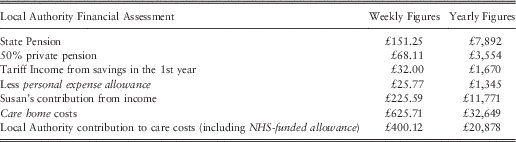
As can be seen from Table 2, Susan needs to contribute a portion of her savings, known as Tariff Income. Table 3 illustrates how the Tariff Income that Susan is required to pay reduces before the care cap being reached.
Tariff Income by Year for Example 3

The chart in Figure 6 shows how Susan’s care costs are met in the 1st and 2nd year of requiring care and how the care costs are funded after the care cap is reached.
Conclusion 2: The new care funding system is complex making it difficult for people to understand their potential care costs.
Progression of care costs for a married person owning a home valued at £200,000 with £50,000 of joint savings. PEA, personal expense allowance

We have set out three case studies that show how care costs are determined both before and after the cap is reached for a range of circumstances. The case studies highlight the large number of factors that a person will have to consider should they need to enter residential care.
For example, there is complexity in the calculation of care costs as they have three components – daily living costs, Local Authority rate costs and any top-up costs. The calculation of a person’s State support is also complex, not only because of the way the means testing thresholds work, but in taking account of the Attendance Allowance, personal expense allowance and the NHS-funded allowance. How a person’s housing and savings are counted towards the means test is also impacted by whether their partner will continue to live in the house once they enter care as well as whether they decide to remain in their own home whilst receiving care. Finally, the individual will have to work out how they will combine their State Pension, private pension and any other private savings with their housing wealth to meet their care costs.
Recommendation 2: A national awareness raising campaign that helps people to understand what their potential care costs might be, what State support is available and possible products that might protect them from having to make a decision at the point of crisis
5. Incentive to Save
5.1. Analysis of the Means Testing Thresholds
One of the aims of a reformed funding system proposed in the Dilnot Commission Report (Commission on Funding of Care and Support, 2011) was “to support everyone in making their personal contribution”. This section looks at the potential impact of the increased means testing thresholds on incentives to save, based on the assumption that the primary reason an individual might choose to save for their LTC needs is so that they have more control over the type and quality of care they receive.
Our analysis below shows that the means testing thresholds as set out in “the Act” provide a greater level of reward for savers than the existing thresholds, and may increase the level of saving for care, but they could still act as a barrier.
The analysis is based on the means test limits set out as part of Phase 2 of “the Act” and assumes that the other elements of Phase 2 are implemented, including the £72,000 cap. The analysis considers an individual entering care without nursing at age 85 incurring the average care costs for England and found that incentives to save for LTC varies according to the wealth of an individual.
It should also be noted that any disincentive to save created by means testing LTC support is a disincentive to save in general. Therefore the scope of the incentives created by LTC policy will extend to any other retirement funding policy.
The examples in this section illustrate the impact of additional savings for a person who goes on to need LTC. It is clear that any incentives or disincentives to save will likely apply long before an individual knows whether they will need LTC. As such, the illustrations given here should be considered in the context that the person would weigh up the financial impact of means testing described here against their perceived likelihood of entering LTC.
Figure 7 shows that individuals with assets of up to £110k at the point of entering care can expect their contribution to care costs to increase if they save a further £10k.Footnote 5 This is most significant for individuals who have between £20k and £40k in assets at the point of entering care. If they make additional savings of £10k before entering care, then they can expect to see their personal care costs increase by at least £5k (equivalent to 50p for every extra £1 saved) by the time they have been in care for 3 years.Footnote 6 The costs increase to up to £9k over a 10-year period.Footnote 7 Further details of the methodology can be found in Appendix C.
Increase in personal costs from saving an additional £10k towards care costs

If an individual has £20k in assets on entering care they can expect to pay £35k in personal contributions towards care costs over 3 years. If they have saved an extra £10k and therefore have £30k in assets on entering care instead of £20k then they can expect to pay ~£40k in personal contributions, that is by saving an extra £10k they have to pay an extra £5k towards their care costs – they therefore only have an extra £5k to spend on improving the type and quality of care they receive.
Figure 7 demonstrates that it is only individuals with assets above £110k where additional savings do not directly replace Local Authority funding. This is the point at which no means tested support is received even over a 10-year period. Above this level of assets the extra savings are fully available to be used for other reasons such as improving the standard of care received or leaving a larger inheritance.
A similar picture is seen for higher levels of additional savings. For example, with £50k of additional savings (rather than £10k) over 50% of the extra savings must be put towards personal care costs as a result of reduced means tested support over a 10-year period – see Figure 8.
Increase in personal costs from saving an additional £50k towards care costs

In summary, this analysis demonstrates that for individuals with assets up to £110k there is a reduced incentive to save specifically to meet eventual LTC costs. Any additional money put aside leads to an increase in the amount that the individual has to contribute to their care costs because a proportion of the additional savings replace the Local Authority funding that would otherwise have been provided under the means test arrangements.
There are several factors affecting the total personal costs of an individual receiving a given level of care at a given cost:
-
1. level of means tested support provided;
-
2. level of top-up care costs (assuming that individual opts for higher quality care than that funded by the Local Authority); and
-
3. level of contribution to care costs from the Local Authority as a result of the care cap.
For the purpose of the analysis in this section we have assumed that only point 1 varies with the level of assets that an individual has available to them. In practice, the assets available to an individual will affect their ability to fund top-up costs. For the purposes of this analysis we have assumed that the top-up costs are being funded by a third party.
For assets at the point of entering care of up to £70,000, the driver of increases in personal costs is the reduction in means tested support. Figure 9 shows how means tested support varies with different levels of assets at the point of entering care and how this level of support would change as a result of “the Act”. A greater level of means tested benefits would be provided under “the Act”, since the means testing thresholds are being increased. The means tested support under the thresholds set out in “the Act” reduces at a slower rate with increasing wealth than with the existing means test limits.
Means tested support over 10 years

To understand the impact that the means testing thresholds have on the change in personal costs as a result of additional saving and on the incentive to save, we have carried out a similar analysis for the existing means testing thresholds. The existing regime has a lower means test limit. The lower threshold is £14,250 and the upper threshold is £23,250. This creates a potential greater disincentive to save as can be seen in Figure 10. For example, an extra £10k in savings can lead to an increase in personal costs of over £10k. In other words, the individual is effectively being taxed at over 100% on these extra savings. For assets at the point of entering care of between £20k and £40k, personal contributions increase by at least £8k if an additional £10k is saved (equivalent to losing 80p in means tested benefits for every extra £1 saved). Therefore the system set out in “the Act” is a welcome improvement on current arrangements. However, they could still act as a barrier for those with initial assets of up to £110k.
Increase in personal costs from saving £10k towards care costs with current means testing thresholds

5.2. Top-Up Fees
There needs to be greater awareness among the general public of the potential benefits of having some money set aside to pay for top-up fees.
5.3. Possible Ways to Create an Incentive to Save Whilst Retaining the Means Test
It could be possible to create a greater incentive to save for potential care needs by introducing a social care branded product or category of products that allow individuals to save money for potential care costs without the money saved being included in the means test. This would address the issues raised above for the specific purpose of LTC saving, but would do nothing to address the wider disincentives presented to saving. It might also lead to greater awareness among the general public of the options if these products are marketed by product providers and potentially endorsed by the Government. There would probably need to be limits placed on the amount that can be set aside in these products in order to prevent the products being used as a mechanism for qualifying for means tested support.
5.4. Existing Ways of Saving Money for Care Costs Without Affecting Means Tested Benefits
The above analysis has assumed that all savings are invested in assets that are included in the financial assessment. However, there are existing saving products that are not included in the financial assessment. These include investment bonds and life assurance products such as whole-of-life plans. These savings and insurance products provide a vehicle for individuals to save money outside of the means test. This could lead to individuals qualifying for financial help under the means test even when they have significant assets saved in these insurance and savings products.
Conclusion 3: The current means testing system is a disincentive to saving. The new means testing thresholds provide a greater level of reward for savers than the existing thresholds, and may increase the level of saving for care, but they could still act as a barrier
Individuals with assets of up to £110k at the point of entering care can expect their contribution to care costs to increase as they save a further £10k. This is most significant for individuals with between £20k and £40k of assets at the point of entering care.Footnote 8 For these individuals, under the current system, they will lose 80p in means tested benefits for every extra £1 saved. The increase in the means testing thresholds will reduce this amount to 50p for every extra £1 saved.
This means that for individuals likely to have assets between £20k and £40k at the point of entering care there is a limited incentive to saving at any stage before going into care, should the individual consider it likely that they will need LTC. Any additional money put aside could lead to an increase in the amount that the individual has to contribute to their care costs with no change in the cost or quality of care received. This is because the additional savings replace the Local Authority funding that would have been provided under the means test.
Recommendation 3: To help incentivise people to save one solution could be to create a new product, or category of products, that allows savings to be exempt from the means test up to a specified threshold. This cost could be met by removing existing loopholes for investment bonds and life assurance products in the financial assessment, as these products can allow a person to qualify for financial help whilst having significant assets saved. New exempt products designated for LTC saving could both encourage individuals to plan for the risk of needing LTC, and fund care needs more fairly than the current rules allow
6. Conclusions and Recommendations
Conclusion 1: It is still too early to understand exactly how individuals will respond to the pensions freedom and choice agenda
It is not clear yet whether individuals will ring-fence funds to meet potential future care costs as this is not in keeping with the new flexibilities. However, there are a number of products that might complement the new flexibilities and help people make provision for care costs:
-
∙ products that are already in existence in the United Kingdom such as income drawdown and equity release;
-
∙ products that have had success in other countries, such as protection insurance; and
-
∙ new products, such as DLAs and Care ISAs.
Recommendation 1: A joint Government and industry approach to collecting data on how people are responding to the new system will help to assess whether education, the use of default retirement options or incentives for LTC products, such as tax relief and employer contributions, could be effective in helping people to use their savings to meet care costs
Conclusion 2: The new care funding system is complex making it difficult for people to understand their potential care costs
We have set out three case studies that show how care costs are determined both before and after the cap is reached for a range of circumstances. The case studies highlight the large number of factors that a person will have to consider should they need to enter residential care.
For example, there can be complexity in the calculation of an individual’s contribution to care costs. There are three components – daily living costs, Local Authority rate care costs and any top-up costs. The calculation of a person’s State support is also complex, not only because of the way the means testing thresholds work, but in taking account of the Attendance Allowance, personal expense allowance and the NHS-funded allowance. How a person’s housing and savings are counted towards the means test is also impacted by whether their partner will continue to live in the house once they enter care as well as whether they decide to remain in their own home whilst receiving care. Finally, the individual will have to work out how they will combine their State Pension, private pension and any other private savings with their housing wealth to meet their care costs.
Recommendation 2: A national awareness raising campaign that helps people to understand what their potential care costs might be, what State support is available and possible products that might protect them from having to make a decision at the point of crisis
Conclusion 3: The current means testing system is a disincentive to saving. The new means testing thresholds provide a greater level of reward for savers than the existing thresholds, and may increase the level of saving for care, but they could still act as a barrier
Individuals with assets of up to £110k at the point of entering care can expect their contribution to care costs to increase as they save a further £10k. This is most significant for individuals with between £20k and £40k of assets at the point of entering care. For these individuals, under the current system, they will lose 80p in means tested benefits for every extra £1 saved. The increase in the means testing thresholds will reduce this amount to 50p for every extra £1 saved.
This means that for individuals likely to have assets between £20k and £40k at the point of entering care there is a limited incentive to saving at any stage before going into care, should the individual consider it likely that they will need LTC. Any additional money put aside could lead to an increase in the amount that the individual has to contribute to their care costs with no change in the cost or quality of care received. This is because the additional savings replace the Local Authority funding that would have been provided under the means test.
Recommendation 3: To help incentivise people to save one solution could be to create a new product, or category of products, that allows savings to be exempt from the means test up to a specified threshold. This cost could be met by removing existing loopholes for investment bonds and life assurance products in the financial assessment, as these products can allow a person to qualify for financial help whilst having significant assets saved. New exempt products designated for LTC saving could both encourage individuals to plan for the risk of needing LTC, and fund care needs more fairly than the current rules allow
Acknowledgements
The authors thank Rebecca Deegan, Steven Graham, Alison O’Connell, Sue Elliott and anonymous reviewers for their help in putting the paper together.
Appendix A: Overview of Changes in Care Act 2014
The Care Act 2014 includes care funding reforms as recommended in the Dilnot Report (Commission on Funding of Care and Support, 2011). The second phase of implementation includes the introduction of a cap on Local Authority set care costs of £72,000 and an increase in the means testing thresholds. The Government has announced that the implementation of these reforms will be delayed until 2020.
The purpose of these reforms is to protect individuals from facing catastrophic care costs and facilitate individuals’ understanding of their potential care funding requirements. It is hoped that this will create demand for financial products that will help people to save for potential LTC needs.
Below we have set out further details on each of these four reforms.
The Introduction of a Cap on Local Authority Set Care Costs of £72,000
There are three aspects of an individual’s care costs.
Local Authority set care cost: this is the rate that the Local Authority would pay for care if the individual is eligible for State funding. This is the portion of an individual’s care costs that counts towards the cap.
Daily living costs: individuals will be expected to contribute towards their daily living costs when in care. This amount is currently set at £230/week. This sum will not count towards the cap and will still have to be paid by the individual after they reach the cap.
Top-up costs: should the individual be receiving care that is charged above the Local Authority rate, the individual will have to meet this cost. Top-up costs will not contribute towards the cap and the individual will still have to pay for them after they reach the cap.
An Increase in the Means Testing Threshold to £118,000 Where Property is Included and £27,000 Where Property is Excluded
Where a person is in a care home and the value of their property is to be taken into account, they will be eligible for Local Authority financial support if they have assets of £118,000 or less. Those in care homes where the property is not included, for example, because their spouse continues living there, will be eligible for Local Authority financial support if they have assets of £27,000 or less.
Universal Eligibility Criteria Across England
Local Authorities can no longer set local eligibility criteria, for example at, “critical” or “substantial” needs. National eligibility criteria are now in place similar to the previous substantial care needs criteria. This greater clarity around eligibility should help individuals to understand their saving needs for LTC. Consistency across England will also be helpful to companies offering financial products, where the pay-out of benefits might be linked to eligibility criteria.
The Requirement for Local Authorities to Provide Independent Personal Budgets and Care Accounts
The introduction of care accounts means that individuals will be able to track their personal expenditure and progress towards the £72,000 care cap. The independent personal budgets provide a mechanism for individuals to monitor their contributions to their care account.
We anticipate this will increase the visibility of personal contributions needed to meet care costs, thereby helping individuals understand their potential care costs and consider how they will meet them.
UDPS from April 2015
The UDPS is designed to help individuals with “eligible needs” who have been assessed to pay the full cost of their care home fees, but who cannot afford to pay the full amount immediately because their capital is tied up in their home. By agreeing to a deferred payment, the individual can delay paying the cost of their care home fees until a later date.
To qualify for a deferred payment the individual must have no more than £23,250 in savings and other capital, and the property would not be disregarded for charging purposes. The Local Authority may require a contribution from the individual’s income, savings or other assets but must leave them with up to £144/week if they wish to retain this sum. All other costs, including top-ups and extra care costs can be deferred, subject to the level of equity in the property.
The scheme uses a national maximum interest rate, which changes every 6 months on 1 January and 1 July and is determined by the market gilts rate specified in the most recently published report by the Office of Budget Responsibility; a default component (0.15% p.a.) is then added to give the final maximum interest rate. In addition to charging interest, the Local Authority may charge reasonable legal and administrative costs of setting up, maintaining and terminating the deferred payment.
Most people can use around 80%–90% of the equity available in their home under the deferred payment arrangements.
Appendix B: Probability of Individuals “Reaching” the Care Cap
The likelihood of individuals needing care provision in later life is significant. It has been estimated that there is a 25% chance of a 65-year-old male needing eligible care at some point in their life (35% for females) (Rickayzen, Reference Rickayzen2007).
This section explains how, under the new capped cost regime, individuals with assets of more than £17,000 will still need to self-fund significant levels of their care costs, albeit at a lower level than before the changes introduced by “the Act”. “Top-up” costs will continue after reaching the cap and will vary significantly by region.
Our previous report (Kenny et al., Reference Kenny, Barnfield, Curtis, Daly, Dunn, Passey, Rickayzen and Teow2015) estimated the probability of someone having eligible care needs reaching the care cap based on the age and gender of the individual and the region in England where the care home is based.
We have updated the model to accommodate changes in the average care home costs and Local Authority rates based on the more recent Laing & Buisson reports.Footnote 9 The figures are based on 2013/2014 values and therefore have been inflated to 2016/2017. We have continued to use an annual inflation rate of 3.5% in the model.
The model allows for the means test and we have illustrated a central scenario where the individual is a single homeowner with assets (including the value of their property) of £150,000, and has an income of £12,000 p.a.
The model has flexibility to allow for different genders, the age at which the individual is admitted to the care home and the region in England where the care home is based.
The model projects costs out for 10 years, allowing for the probability of survival for each year. A 10-year projection horizon was used as the data for individuals surviving in a care home for over 10 years is relatively sparse – the probability of surviving for 10 years is very low, at around 1% (Forder & Fernandez, Reference Forder and Fernandez2011).
The survival rates are based on a comprehensive survey carried out by the Personal Social Services Research Unit (PSSRU) of care home residents in England, who died from November 2008 to May 2010. The mean age at entry to the care home was 85 and around two-thirds of the residents were female.
Probability of Reaching the Cap by Age and Gender
The chart in Figure A1 shows the probability of reaching the cap depending on the gender of the individual and the age at which they are admitted to the care home.
Approximate probability of reaching the cap by age and gender

Care Costs and Probability of Reaching Cap by Region
The following charts are based on an individual entering a care home at age 85 and the potential costs incurred over the 10-year future “lifetime” period. The charts show how the probability of reaching the cap and the number of years before the cap is reached vary by the region in which the care home is located.
Separate charts show the results for care homes with and without nursing, respectively (Figures A2 and A3).
Personal funding of care costs by region in England – care home with nursing – 85 at entry into care

Personal funding of care costs by region in England – care home without nursing – 85 at entry into care

Is the Regional Variation in Care Costs Sustainable?
The regional variations in care costs result from differences in labour and property costs and the general cost of living across England. As such, from an economic approach, the variations are understandable but consumers may find the variations confusing and perceive them to be unfair. Having a universal amount across England for the daily living costs and for the Attendance Allowance, personal expense allowance and NHS-funded nursing care payments exacerbate the issue.
We doubt whether individuals with eligible care needs would want to relocate to a different region to save costs but we believe there is an argument for looking again at having more consistent care costs across England, or potentially having a care cost cap that varies across regions.
Key Assumptions in the Model
The current version of the model uses survival rates based on table 15 in the PSSRU/BUPA Report on Length of Stay in Nursing Homes in England (Forder & Fernandez, Reference Forder and Fernandez2011). The survey had a mean age of entry to a care home of 85. The survival rates for varying gender, age and type of care home have been extrapolated linearly from the survival rates shown in table 15 and figure 1 in the PSSRU/BUPA Report. This enables us to give an indication of the impact of gender, age and type of care on the probability of reaching the cap.
It should be noted that the survival rates are based on residents in care homes across England. We have not at this stage tried to accommodate regional survival rates.
The care costs are based on Laing & Buisson’s Care of Older People UK Market Survey 2012/2013 (Laing & Buisson, 2013a) average care home costs and Local Authority rates in 2012/2013 values and have been inflated to 2016/2017.
When Local Authority support reaches the maximum limit (the cap), it is assumed that individuals’ assets are depleted. When no assets are left it is assumed a top-up is provided by a third party.
In the charts shown in this report, it is also assumed that:
-
∙ the means test is re-assessed each year based on updated asset and income values;
-
∙ care costs, the care cap, the means test limits, the Attendance Allowance and the NHS-funded nursing care contribution all increase in line with inflation at a rate of 3.5% p.a.;
-
∙ assests and income increase at a rate of 3.5% p.a.;
-
∙ as the cap increases the percentage of the cap achieved remains constant; and
-
∙ individuals continue to make top-up payments after the care cap is reached.
All of these assumptions can be adjusted in the model.
Appendix C: Incentives to Save (Model)
How is Tariff Income Calculated?
The chart in Figure A4 shows how Tariff Income varies according to different levels of eligible assets. This is based on the lower threshold being £17,000 and the upper threshold being £118,000.
Annual Tariff Income (figures in £)

If the value of eligible assets is between 17,000 and 118,000 then the weekly Tariff Income is calculated equal to
 $${{{\rm Value}\,{\rm of}\,{\rm assets}\,{\minus}\,17,000} \over {250}}$$
We have multiplied the weekly Tariff Income by 52.18 to give an annual figure.
Tables A1 and A2 show the detailed breakdown of the financial assessment as modelled for initial levels of assets of £20k and £30k, respectively. It can be seen that the increase in personal contribution of £9k over 10 years by saving an extra £10k from assets of £20k is driven by the change in the contribution from the means test.
Financial Assessment with Initial Assets of £20,000

Financial Assessment with Initial Assets of £30,000

The item “Means test contribution to care costs” is calculated as the difference between:
-
∙ total care costs excluding top-up costs; and
-
∙ the sum of “personal budget” and “Local Authority Contribution to care costs as a result of the cap being reached” less “unused personal budget”.
Glossary


 Open access

