


Introduction
The spread of regulation of political finance in Europe, Canada and Australia and the opposite deregulatory trend in the United States are regularly scrutinised to shed light on the quality of representative institutions (Boatright Reference Boatright2015; Casal Bértoa et al. Reference Casal Bértoa, Molenaar, Piccio and Rashkova2014; Norris & Van Abel Es Reference Norris and Van Abel Es2016; Nwokora Reference Nwokora2014) and the relationship between parties and state in contemporary democracies (Corduwener, Reference Corduwener2019; Van Biezen Reference Van Biezen2004, Reference Van Biezen2008; Van Biezen & Kopecký Reference Van Biezen and Kopecký2007). Although the field is considered to be in its infancy (Mendilow Reference Mendilow, Mendilow and Phélippeau2018), and has been mainly approached through case studies (for exceptions, see Norris & Van Abel Es Reference Norris and Van Abel Es2016; Smirnova Reference Smirnova2018), there are considerable theoretical developments (for an overview, see Boatright Reference Boatright2015; Fisher Reference Fisher and Boatright2015; Koss Reference Koss2011; Scarrow Reference Scarrow2004). This article analyses one key type of political finance regulation: party finance transparency regulation, which ensures public surveillance of political finance.
We see regulation of party finance transparency to be a part of party finance regulation, consisting of the official rules and institutions obliging political parties to correctly and completely report and disclose all kinds of income and expenditure. Per definition, this type of regulation is designed to unveil the income sources and expenditure of political parties. There are at least four generally accepted reasons why this type of transparency is interesting for politicians, scholars and society at large. First, political parties are crucial for the functioning of democracy in Europe (Dalton et al. Reference Dalton, Farrell and McAllister2011), and the United Nations Convention against Corruption (UNCAC) considers it paramount to make their funds transparent to combat corruption. In particular, transparency regulation of party finance aims to compensate for public disengagement from established parties (Dalton Reference Dalton, Dalton and Wattenberg2002; Van Biezen et al. Reference Van Biezen, Mair and Poguntke2012) and prevent the domination of affluent and illicit donors in contemporary politics (Pinto‐Duschinsky Reference Pinto‐Duschinsky2002: 72).
Second, by obliging parties to disclose their financial data, the public can oversee parties’ compliance with the income and expenditure restrictions (Nassmacher Reference Nassmacher2009: 244; Ohman Reference Ohman, Falguera and Ballington2014: 28), in turn opening parties up for public shaming in case of delinquencies. Regulation of public disclosure is, therefore, a tool for the effective enforcement of party finance regulation (Casas‐Zamora Reference Casas‐Zamora2006: 23; Pinto‐Duschinsky Reference Pinto‐Duschinsky2002).
Third, contemporary European parties are state‐dependent (Orr Reference Orr, Mendilow and Phélippeau2018; Poguntke et al. Reference Poguntke2016), and party finance transparency regulation ensures that parties publicly disclose their activities, preventing the misuse of public finance.
Fourth, party finance transparency regulation allows voters to observe which actors support which political parties, thus making them better informed about parties’ special interests, and increasing the accountability of parties to their voters (Ewing & Issacharoff Reference Ewing and Issacharoff2006: 3; Ohman Reference Ohman, Falguera and Ballington2014: 28). Acknowledging the pivotal importance of party finance transparency regulation for democratic integrity, we wonder when and why would political parties want to change their own transparency obligations?
Previous research has explained changes in the regulation of political funding by major public scandals (Carlson Reference Carlson, Norris and van Abel Es2016; Pujas & Rhodes Reference Pujas and Rhodes1999), party competition (Nwokora Reference Nwokora2014; Scarrow Reference Scarrow2004), party competition and cooperation (Koss Reference Koss2011), the intervention of the judicial system (Koss Reference Koss2011; Scarrow Reference Scarrow2004) and international factors (Smirnova Reference Smirnova2018). This research is important and has high explanatory power for cross‐sectional and longitudinal variation.
Our contribution is twofold. First, following Fisher (Reference Fisher and Boatright2015), we examine the timing of transparency reforms and the causal mechanisms explaining their outcome separately. Second, we enrich the palette of case studies on party finance reforms with in‐depth evidence from Norway. Norway is a deviant case for the introduction of party finance transparency reforms, given that it has experienced no major political scandals, yet, paradoxically, has established comprehensive party finance transparency regulation in recent years. As our goal is to investigate which causal mechanisms – including, but not restricted to, corruption scandals – explain party finance transparency reform, a deviant case like Norway is particularly suitable.
In the following, we propose an analytical framework to study the mechanisms underlying the evolution of party finance transparency regulation, and develop testable hypotheses. We discuss case selection, our chosen method – process‐tracing – and the data used. In‐depth analysis follows, and we find that the presence of political discourse on corruption and political competition are sufficient factors to launch transparency reforms. Whether reforms are enacted depends on the interaction of several factors. While parties that predominantly rely on state funding and grassroots support push for and adopt more constraining transparency regulation, parties that are traditionally close to business oppose it. Experience with party finance transparency regulation in similar contexts and an intense discourse on corruption – stimulated by domestic or international factors – are necessary for the reforms to succeed. An analysis of Norwegian cooperation with the Group of States against Corruption (GRECO) further demonstrates that the success of party finance transparency reforms initiated by a foreign actor is a function of the existing tradition of party regulation, the policy position of the governing party and the international reputational costs of non‐compliance. We conclude the article by discussing our findings and making recommendations for future research.
Theoretical model and hypotheses
When and why would parties change party finance transparency regulation affecting their own behaviour? In the following, we develop testable hypotheses derived from normative, rational choice and historical institutionalisms traditionally used to explain changes in party finance regulation.
Normative institutionalism expects an exogenous shock – in our case, a public scandal – to be the trigger for reform (Clift & Fisher Reference Clift and Fisher2004: 681; Fisher Reference Fisher and Boatright2015: 156; Scarrow Reference Scarrow2004: 657). In this instance, policy change is an appropriate reaction to a policy failure, and is thus a crucial remedy for public distrust in political parties. Koss (Reference Koss2011: 51) suggests that we look more broadly and, alongside the real scandals, consider all public communication on corruption, including perceived corruption and the threat of corruption – together described as the ‘public discourse on corruption’. Following this argument, we consider the whole public discourse on corruption, expecting it to be particularly intense after a related public scandal. An intense discourse on corruption shapes parties’ policy goals in favour of constraining transparency regulation. In line with Koss (Reference Koss2011: 52) and Scarrow (Reference Scarrow2004: 657), we suggest differentiating between major corruption scandals that disadvantage all political parties and those that hit only some of them. We predict an overall increase in constraints on party finance transparency if the discourse disadvantages all parties. If only some political parties are damaged, we expect instead that the mechanisms theorised in hypotheses H2 and H3 will be responsible for the reform outcome.
H1: Discourse on corruption. Reform of party finance transparency regulation is likely to be initiated after a public scandal. A regulatory change happens if a decrease in trust disadvantages all political parties. If only some parties are particularly disadvantaged by the scandal, then the rationale on party competition (H2 and H3) determines the reform outcome.
Rational choice institutionalism suggests that political parties tend to initiate and support the introduction of party finance transparency reforms when it gives them a comparative electoral advantage (Koss Reference Koss2011: 29). Echoing Strøm (Reference Strøm1990), Clift and Fisher (Reference Clift and Fisher2004: 681) and Scarrow (Reference Scarrow2004), we can expect political parties to realise this advantage by maximising their vote‐, revenue‐ or office‐seeking goals. Following this logic, political parties should initiate, delay or block transparency reforms according to their own interests: to maximise either votes or revenue. Political parties whose income primarily consists of sources widely regarded as legitimate, such as state funding and membership fees, have stronger incentives to push for party finance transparency as it makes them more attractive to voters compared to parties that rely heavily on donations from corporations or affluent donors. Parties close to business groups or affluent individuals have an incentive to actively oppose transparency of party finance in order to maximise their own revenues. As transparency of party finance makes individual and group political preferences easily identifiable, it may limit donors’ freedom and willingness to express political preferences through donations. This rationale echoes underlying policy positions – economic equality secured by state regulation versus individual freedom associated with state laissez‐faire – often captured by the left and right dimensions of party competition (Heidenheimer & Langdon Reference Heidenheimer and Langdon1968: 112; Nwokora Reference Nwokora2014: 922).Footnote 1
Following Green‐Pedersen and Mortensen (Reference Green‐Pedersen and Mortensen2010), we expect political parties to put on the agenda transparency reforms that are advantageous to them and disadvantageous to their political rivals – especially while in opposition. Small parties can compromise on their policy position on transparency regulation to support their coalition partners in order to secure office or signal their loyalty. That brings us to the following set of hypotheses.
H2: Party competition. Left‐of‐centre parties tend to initiate more constraining party finance transparency regulation to maximise their votes and target the financial practices of their competitors. Reforms of party finance transparency regulation are only successful if left‐of‐centre parties are in government, and the reform exclusively disadvantages right‐of‐centre parties, and fail otherwise.
H3: Party competition. Right‐of‐centre parties tend to oppose reforms of party finance transparency to maximise their revenues and restrict governmental intervention in party regulation.
H4: Party cooperation. Small parties tend to support their coalition partners, regardless of their ideological orientation, to signal their loyalty.
The historical institutionalist approach suggests two further alternative explanations for transparency reforms, derived from its evolutionary and policy‐diffusion arguments. In terms of the evolution of regulatory regimes, we observe that contemporary European parties have become largely state‐dependent (Katz & Mair Reference Katz and Mair1995; Orr Reference Orr, Mendilow and Phélippeau2018; Poguntke et al. Reference Poguntke2016). Increased reliance on state funds arguably decreases the differences in income sources between left and right parties. To control the cartel party system and ensure that parties promote the public interest, public surveillance becomes legitimate. It helps to prevent the misuse of public finance, as well as the unauthorised use of state resources (Pinto‐Duschinsky Reference Pinto‐Duschinsky2002). Thus, to win public approval for increasing state subsidies, political parties, regardless of their ideological background, may want to introduce transparency requirements as part of a carrot‐and‐stick solution.
Once initiated, what explains successful implementation of transparency reforms? As noted, transparency of party funding, especially for right‐of‐centre parties, may lead to a decrease in corporate donations, and all parties face higher operational costs in complying with the transparency requirements. To meet the challenges of new transparency requirements, parties will first secure sufficient state support.
H5: Increase in state support. Increased state funding to political parties sparks party finance transparency reforms as demands for parties to give an account of the finance received from taxpayers rise. These reforms are more successful the less political parties are affected by a potential decrease in corporate donations and the more compliance costs the reforms cover.
Historical institutionalism also suggests that reforms can happen as a result of policy diffusion (Gilardi & Wasserfallen Reference Gilardi and Wasserfallen2019; Koss Reference Koss2011: 32). Policy diffusion is the updated knowledge on the effectivenessFootnote 2 (policy learning) and symbolic value (policy emulation) of policy decisions applied in other contexts – countries or subnational regions that follow a similar historical, cultural or geographical path. Knowledge about regulation and its effects in other contexts suggests possible solutions for similar problems and illuminates the risks of enforcement for parties with similar profiles (Gilardi & Wasserfallen Reference Gilardi and Wasserfallen2019: 7). We thus argue that policy diffusion can impact parties’ willingness to initiate and adopt party finance transparency reform.
H6: Policy diffusion. A party is more likely to initiate or adopt a party finance transparency reform if it has updated its knowledge on similar regulation implemented elsewhere, and if that regulation was a success for political parties with a similar profile; otherwise it will oppose it.
All three types of institutionalisms suggest a joint explanation for party finance transparency reform where an international organisation is involved. In line with normative institutionalism, we expect international organisations to trigger revision of party finance regulation by increasing awareness of the problems concealed in national party regulation and practices. In line with historical institutionalism, international organisations can trigger reform by providing countries with tailor‐made recommendations for best‐practice regulation and, should these align with national regulatory logic, policy change is very likely. Rational choice institutionalism (Smirnova Reference Smirnova2018) suggests that policy change is a function of reputational benefits and non‐compliance costs for the country in the international arena, as well as domestic benefits and costs. Put differently, on the one hand, compliance with international norms reflects a country's commitment to the shared international agenda (Guzman Reference Guzman2008: 69). On the other hand, compliance involves not only what is appropriate, but what is feasible. Compliance is more likely when the discrepancy between existing national rules and those proposed by an international organisation is low. Concomitantly, when there is a ‘misfit’ (Börzel & Risse Reference Börzel, Risse, Featherstone and Radaelli2003) – that is, the discrepancy between existing and proposed rules is high – the domestic costs of compliance are higher, and the likelihood of compliance is thus lower.
H7: International reputation and the domestic costs of implementation. If instigated by an international organisation, reforms of party finance transparency regulation are more likely to succeed when the discrepancy between existing national rules and international recommendations is low, and the country cares about its reputation in the policy field.
Methods
This article's primary goal is to show how a given theoretical cause (or set of causes) can explain the timing and nature of reforms in party finance transparency regulation. Cross‐sectional analyses of party finance regulation are emerging (Lipcean Reference Lipcean2019; Smirnova Reference Smirnova2018; Norris & Van Abel Es Reference Norris and Van Abel Es2016; Poguntke et al. Reference Poguntke2016; Casal Bértoa et al. Reference Casal Bértoa, Molenaar, Piccio and Rashkova2014; Nassmacher Reference Nassmacher2009; Van Biezen & Kopecký Reference Van Biezen and Kopecký2007), but considerable effort is still necessary to collect cross‐sectional and time‐series data on reforms of party finance transparency regulation. Thus, to observe the performance of the causal mechanisms theorised above – the ‘pathway or process by which the effect is produced’ (Gerring Reference Gerring2010: 1500) – and also to control for contextual variables and alternative explanations over time, we choose a single within‐case study (Rohlfing Reference Rohlfing2012: 15) of a deviant case (Gerring Reference Gerring2007) among European democracies, with process‐tracing (Collier Reference Collier2011; Beach & Pedersen Reference Beach and Pedersen2016). Tracing reforms over time enables us to control for confounders that are difficult to identify in a cross‐sectional analysis. This approach is also useful for discriminating among causal mechanisms on the basis of necessary and sufficient criteria for the affirmation of causal inference (Collier Reference Collier2011: 825; Van Evera Reference Van Evera1997: 31). It should also be noted that for every reform we differentiate between factors and mechanisms responsible for its initiation and for its outcome as separate processes.
Case selection strategy
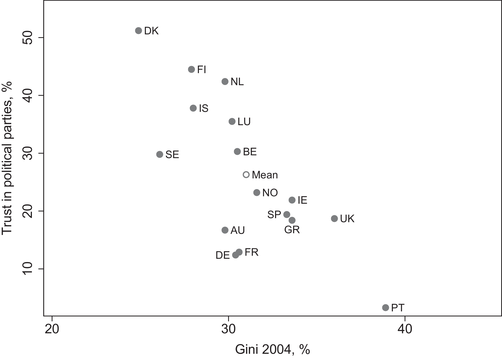
To identify causal mechanisms that systematically lead to reforms in party finance transparency and avoid a positive confirmation bias, we focus exclusively on established democracies. That is because young democracies tend to regulate political parties more intensively than old ones (Van Biezen Reference Van Biezen2008: 341; Van Biezen & Borz Reference Van Biezen and Borz2012: 343; Van Biezen & Kopecký Reference Van Biezen and Kopecký2007: 250). Moreover, the introduction of party finance regulation is related to public concerns about political corruption (Casal Bértoa et al. Reference Casal Bértoa, Molenaar, Piccio and Rashkova2014: 369; Van Biezen Reference Van Biezen2008: 338). Thus, to avoid a positive confirmation bias and to improve the external validity of our findings, we select a case with an average level of demand for policy change. Economic inequality can mediate the perception of integrity of democratic institutions, with high economic inequality often associated with disappointment with political parties (Donovan & Karp Reference Donovan and Karp2017: 480). We therefore select a case that is average on both trust in political parties and economic inequality. For the latter, we use the Gini Index,Footnote 3 reducing distortions caused by individual economic well‐being. Figure 1 presents the cross‐sectional overview of trust in political parties and Gini score across established democracies at the earliest possible time point (i.e., 2004). We pick up the closest case to the mean on both dimensions – NorwayFootnote 4 – for our in‐depth investigation.
Gini estimates and trust in political parties across established European democracies.
Notes: ‘Trust in political parties’ shows the percentage of respondents who choose to trust political parties scoring 6 or higher on the range 0–10. Gini (Index) ranges from 0 to 100 per cent, with perfect equality being 0 per cent and perfect inequality being 100 per cent.
Sources: Trust: European Social Survey (2004), post‐stratification weights applied; Gini Index (World Bank, various years).

Although Norway presents a typical democracy in terms of trust in political parties, it seems to be a deviant case (Gerring Reference Gerring2007) with regard to its development of party finance transparency regulation. Norway has not experienced any major corruption scandals, but has nevertheless established a comprehensive regulatory framework for party finance transparency. It was also one of the countries that implemented all GRECO's recommendations aimed at increasing transparency in political finance (Smirnova Reference Smirnova2018: 13). We thus expect evidence from a deviant case like Norway to be helpful in identifying new causes and causal mechanisms of party finance transparency reforms and refining the theory (Beach & Pedersen Reference Beach and Pedersen2016: 849).
Operationalisation: Party finance transparency regulation
Following Norris and Van Abel Es (Reference Norris and Van Abel Es2016: 8), we operationalise party finance transparency regulation as official rules that deal with reporting of party finance to state authorities and disclosing it to the general public, and rules that regulate the supervision of and sanctioning for violations of these rules. In line with Nassmacher (Reference Nassmacher2009: 73), we differentiate between general regulatory constraints and constraints that only apply during electoral campaign periods. As the regulatory focus on campaign and non‐campaign periods depends on the electoral and party systems, conceptually we treat these types of regulation as equally important and equally constraining. Substantively, party finance transparency regulations can be classified into four dimensions: (1) regulation on reporting and public disclosure of party income and party expenditure (i.e., thresholds, aggregation rules to differentiate between regular and occasional donations, anonymity); (2) timing of public disclosure of information on party finance; (3) supervision of compliance with regulation on reporting and disclosure; and (4) sanctions for violations of the regulations covered by (1) and (2) (Ewing & Issacharoff Reference Ewing and Issacharoff2006; Nassmacher Reference Nassmacher2009).
Operationalisation: Reforms of party finance transparency regulation
Our outcome is party finance transparency reform, which we define as a process that starts with the proposal for a reform in party finance transparency regulation (as defined above), and finishes with the subsequent handling of this proposal in parliament (rejected or approved). Studying both successful and unsuccessful reforms is key to identifying which necessary and sufficient factors explain the outcomes. A successful reform in party finance transparency legislation constitutes a bill that is introduced to and later approved by parliament. A failed reform proposal is one that does not complete the legislative process.
To analyse our hypotheses, we define a set of conditions that explain the outcomes of party finance transparency reforms. These conditions are corruption scandals (H1); closeness of political parties involved in policy formation to different donors, captured via their ideological positions (H2 and H3); constraints imposed on parties as coalitional partners (H4); proportion of direct state funding in the parties’ income structure (H5); other countries’ experience of party finance transparency regulation (H6); and, finally, the country's reputation in the policy field, captured by involvement in the international promotion of anti‐corruption regulation, as well as the level of misfit between domestic party finance regulation and international recommendations (H7).Footnote 5
Data sources
The data comprises government law proposals, official party regulation, public consultation documents, reports from specially appointed commissions, protocols of plenary and committee debates as well as six in‐depth interviews with key party representatives involved in the reforms.Footnote 6 We triangulate our findings from the official sources with evidence reported in secondary literature on the relationship between business structures and political parties, as well as with GRECO reports and newspaper articles.Footnote 7
Distinguishing features of political competition in Norway
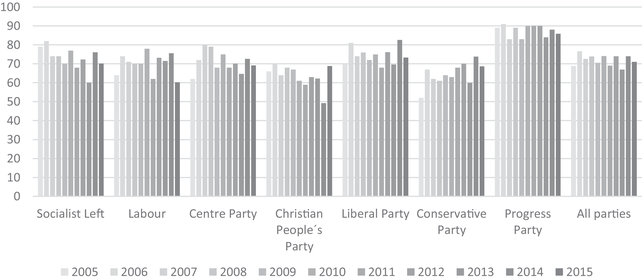
Norway is a unitary constitutional monarchy with a parliament elected by de facto closed party lists in 19 plural‐member constituencies (Bengtsson et al. Reference Bengtsson, Hansen, Hardarson, Narud and Oscarsson2014: 19). Political competition is mainly structured along the left‐right dimension, with the Labour Party and the Conservatives constituting the main players on each side. The Christian People's Party, the Centre Party (agrarian) and the Liberal Party constitute the centre of the Norwegian party system, while the Socialist Left and the Progress Party constitute the left and right fringes, respectively.Footnote 8 Even though minority cabinets have dominated Norwegian politics, three majority cabinets, two centre‐left and one centre‐right, have been in power in the past 15 years.Footnote 9 Four out of ten party members have left Norwegian parties in the past 20 years, leaving Norway with 161,811 party members – a little over 3 per cent of the total population – in 2012 (Heidar & Saglie Reference Heidar and Saglie2003: 224; Poguntke et al. Reference Poguntke2016). This reflects a well‐documented general trend of declining party membership (Van Biezen et al. Reference Van Biezen, Mair and Poguntke2012: 42), and about half of parties’ income thus stems from state funding, originally introduced in 1970 (Figure 2). Party finance transparency regulation applicable to political party organisations is only issued nationally.
Share of public subsidies in the national party accounts (%).
Source: Statistics Norway (various years).

In the 2000s, political parties in Norway, like many overseas, have typically established a broader range of contacts with interest groups, although the Labour Party and the Socialist Left are still closely linked to the trade unions, and the Conservatives and the Progress Party are linked to business groups and social movements, respectively (Allern Reference Allern2010).
Tracing the reform processFootnote 10 in Norway
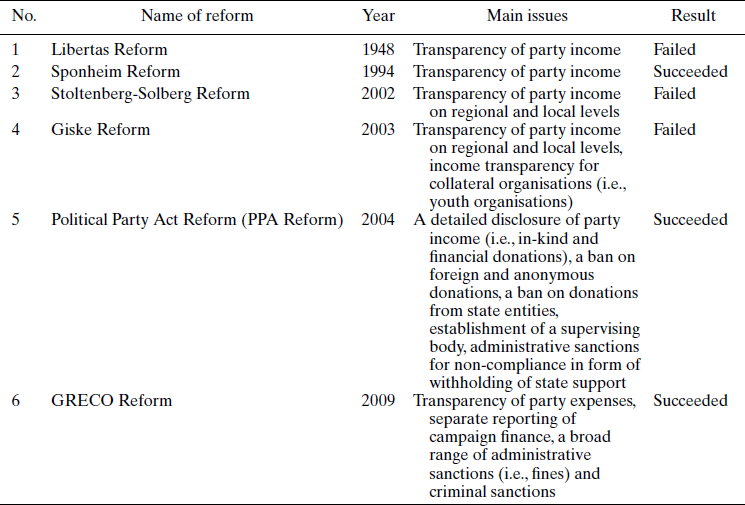
This part of the article presents the process‐tracing analysis of six reform attempts (Table 1) at party finance transparency in Norway since the 1940s. The Labour Party was the first to suggest introducing transparency regulations for corporate donations in 1948. These were aimed at preventing financially strong organisations that were not subject to control or revision from influencing political life through donations (Heidenheimer & Langdon Reference Heidenheimer and Langdon1968: 112). The reform was initiated as a direct consequence of a scandal related to the Libertas foundation, which was accused of secretly financing the Conservative Party, non‐socialist Norwegian newspapers and various public events with the goal of shifting public opinion rightwards (Heidenheimer & Langdon Reference Heidenheimer and Langdon1968: 111). Public scandals (H1) and party competition (H2) were crucial for the reform's initiation.
Overview of observations (reforms) analysed with process‐tracing

Note: The year indicates the launch of the reform process.
Following the scandal, a parliamentary committee, with a Labour majority, was appointed to scrutinise party finance regulation. The non‐socialist parties, led by the Liberal Party, surprisingly agreed that financial flows between certain foundations and parties should indeed be transparent. However, they also demanded that the finances of the labour unions become transparent as well. This made the proposal equally disadvantageous for the Labour Party, as it primarily aimed to reveal the finances of the trade union Landsorganisasjonen (LO), its main donor (Heidenheimer & Langdon Reference Heidenheimer and Langdon1968: 112). Consequently, the final version of the proposal was changed and recommended only that parties voluntarily disclosed their corporate donations (Justis‐ og politidepartementet 1952). The Labour Party's resistance in the committee indicates that its interest lay in scrutinising the relationship between the right‐of‐centre parties and their corporate donors, and not in transparency of donations in general. This is in line with H2 on party competition, which is thus confirmed.
The second attempt to reform party finance regulation was a success. In 1998, the first requirements for party income transparency were introduced, following a proposal from Liberal MP Lars Sponheim.Footnote 11 The regulation obliged the national branch of each political party to report its income, including donations above 20,000 NOK and the overall amount received from anonymous donations, to the Storting, where these accounts were available for the public to see.Footnote 12 The reform was sparked by the Liberal Party's bid for a comparative electoral advantage (Interview with Randi Øgrey, the Liberal Party, 6 September 2017). In opposition at the time, it was the only party that got its income primarily from state funding and membership fees (Interview with Hans Antonsen, the Liberal Party, 5 September 2017).
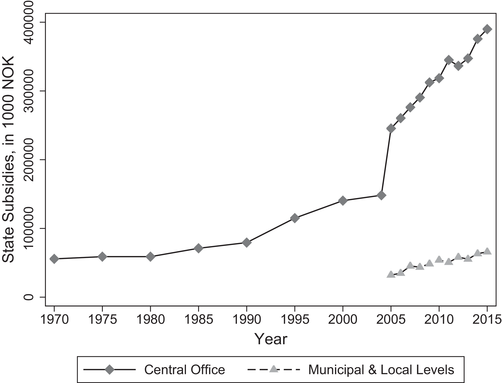
Policy diffusion was a necessary condition for the initiation of the reform. Specifically, the Liberal Party learned from press reports about the Danish experience with party finance transparency regulation, and subsequently consulted their Danish sister party and the Danish Ministry before drafting the proposal for Norway (Interview, Hans Antonsen, 5 September 2017; Interview, Randi Øgrey, 6 September 2017). Additional evidence in this case disconfirms H5 on state funding. The provision of state funding (Figure 3) did not substantively change between 1994 and 1998, and it was neither mentioned in the initial reform proposal (Dok 8:17, 1994), nor, according to interviewees, was it relevant for the initiation of the reform (Interview, Randi Øgrey, 6 September 2017).
Development of direct public subsidies for political parties on different levels.
Sources: 1970–2004: NOU (2004:25): 39; 2005–2015: Statistics Norway (various years).

The outcome of the reform indicates the importance of the policy diffusion rationale. The design of the similar Danish law of 1991, as well as the Danish experience of its implementation, was frequently referred to during the Norwegian reform process (Interview, Hans Antonsen, 5 September 2017; Interview, Randi Øgrey, 6 September 2017; Innst. S. 167, 1994–1995), thus offering support for H6 on policy diffusion. Indeed, the newly introduced 20,000 NOK threshold for reporting donations in Norway was the same as in Denmark. These clear parallels were intended to reduce uncertainty for political parties with regard to the reform's consequences. The Labour Party consistently supported transparency regulation in this reform process, while the Conservatives, benefiting from corporate donations more than any other party, opposed it (Bjørnestad Reference Bjørnestad1994; Ot. Prp. 82, 1996–1997; Statistics Norway, various years), thereby confirming H2 and H3 on party competition. A representative of the Conservative Party confirmed that the party's opposition was due to its wish to protect its donors’ privacy and thus maintain their donations (Interview with Per‐Kristian Foss, the Conservative Party, 12 September 2017). This, too, speaks to the Danish experience: donations to the Danish Conservatives dropped after the transparency regulation was introduced (Ot. Prp. 82, 1996–1997). A fall in public trust in the national government in the early 1990s (Miller & Listhaug Reference Miller and Listhaug1998: 164) concerned Norwegian politicians in this reform process as well, although no scandals were present (Dok 8:17, 1994) and discourse on corruption was only moderate.Footnote 13
In 2002 two Labour MPs – Jens Stoltenberg and Hill‐Marta Solberg – launched a third reform, aiming to extend the existing reporting obligations to regional and local party branches. They argued that political actors on subnational levels had more contact with individuals and businesses than those on the national level, which necessitated a greater focus on party finance transparency at the subnational level. The trigger for the proposal was a scandal in Oslo, in which the Conservative Party had been accused of intentionally circumventing the 1998 law by channelling large donations into local and regional branches to avoid public scrutiny (Dagens Næringsliv 2002; Plenary Debate 2002; Torvik & Bjåland Reference Torvik and Bjåland2002).Footnote 14 The motion was presented by a Labour Party in recovery after a massive electoral defeat in the 2001 parliamentary elections, and just a few weeks after reports of the scandal appeared. The process‐tracing of the reform's initiation thus yields support for the joint effects of H1 (public scandal) and H2 (political competition). The Labour motion failed because of the right‐leaning majority in the parliamentary committee at the time,Footnote 15 the outcome thus confirming H3 on party competition. In the aftermath of this reform attempt, all parties agreed to establish the Financing Democracy Commission (FDC). Its mandate was to propose revisions to the law on party finance regulation in Norway, taking into account domestic demands, the Council of Europe's Recommendation on Regulation against Corruption in the Financing of Political Parties and Electoral Campaigns’ (Rec 2003/4) and the European Convention on Human Rights (ECHR).
In October 2003, Labour MP Trond Giske launched the fourth reform attempt when he proposed to expand transparency of party income to subnational levels, and introduce income transparency for the parties’ collateral organisations, such as youth groups. This occurred immediately after regional and local elections in which the Labour Party had urged its subnational branches to disclose all information about their donations. As the Conservatives stuck to their position of secrecy, the motion clearly targeted their reputation – Trond Giske claimed that ‘the starting point of this whole issue is that the Conservative Party does not want transparency regarding their donations’ (Plenary Debate 2003). This reform initiative confirms H2 and H3 on party competition and was again, in line with H3, defeated by the parliamentary committee's right‐leaning majority.
The fifth reform attempt resulted in a new law on political parties, the Political Party Act (PPA), which came into force in 2006.Footnote 16 It was the most comprehensive reform of political parties and party finance transparency regulation in the history of Norway. The new rules included a ban on state entities donating to political parties, a ban on foreign and anonymous donations, a requirement to disclose both monetary and in‐kind donations, and formal requirements for setting up financial accounts.The PPA also extended reporting‐of‐income obligations to the subnational branches of parties and, for the first time, introduced an (independent) supervisory organ, the Political Party Act Committee. This Committee was vested with the power to withhold state support in the case of non‐compliance with the PPA.Footnote 17
In contrast to the previous reform attempts, this reform started with a proposal for a law on political parties issued by the FDC. As this had been established in the aftermath of the scandal stimulating the third reform process, we can also attribute the initiation of this reform attempt to the mechanism theorised in H1 (scandal). An additional reason was a substantial increase in state funding for political parties, at the same time as income from business donations was expected to decrease, mainly due to the Confederation of Norwegian Enterprise (a large corporate donor) deciding to terminate their political donations.Footnote 18 The parliamentary committee was concerned that changing income structures would cause democratic internal activities in the parties to decline, in turn affecting opportunities for citizens to participate in democracy (Innst. O. nr 28. 2002–2003).
The FDC concluded that more elaborate transparency regulation on party income was necessary to maintain public trust in political parties receiving significant state financial support. Figure 3 shows a rise in state funding, supporting H5 (state funds). Moreover, while acknowledging the importance of the Council of Europe's recommendations for improving transparency regulations, the FDC considered some of the Council's provisions too constraining for Norway. Echoing H7 (misfit), the FDC argued that Norway's compliance with Rec 2003/4 in all matters would ruin the country's historical and political tradition of party regulation: ‘The political tradition in Norway and Scandinavia is that the political parties and their internal doings generally are subject to little regulation’ (NOU (2004:25): 77). The FDC therefore endorsed the Council's recommendations on introducing income transparency regulation, to secure public trust in parties (NOU (2004:25)), but not those on expenditure, promoted by the Council of Europe to guarantee parties’ autonomy from the state. This was also supported by all the parties in the parliamentary committee (Innst. O. nr 129. 2004–2005).Footnote 19
Surprisingly, the Conservative Party supported transparency requirements for party income on all levels and for the parties’ youth organisations – changing its previous position. Moreover, it also proposed obliging parties to report their business deals and in‐kind donations, excluding regular voluntary work and services that were not usually paid for (Ot. Prp. 84, 2004–2005). This change of heart is explained by the fact that some affluent party donors had publicly stated that they welcomed a more transparent approach to party finance (Storvik Reference Storvik2004a,b). Consequently, transparency was no longer a risk to donations, so the Conservative Party could change its position on transparency at the same time maximising its revenue (Interview, Per‐Kristian Foss, 12 September 2017), thus supporting H3 (party competition).
In summarising the arguments for party finance transparency reform, both the government and the responsible parliamentary committee referred to the growing salience of transparency in political finance internationally, partly because of GRECO and public scandals abroad.Footnote 20 The parliamentary committee noted the lack of major corruption scandals or financial misuse in Norwegian political history, but emphasised the importance of preventative measures in order to secure high trust in political institutions (Innst. O. nr 129, 2004–2005; Interview, Per‐Kristian Foss, 12 September 2017), echoing H1 (public scandals) and H6 (policy diffusion). The importance of our argument in H1 is also reflected in the law itself. Article 1 of the PPA states that the law aims to (among other things) secure the public's right to counteract corruption and unwanted ties by keeping party finances and activities transparent (Party Political Act 2006).
Process‐tracing reveals that state funding's relevance for party accounts (H5), public discourse on corruption (H1), ideological party positions (H3), international recommendations (H7) and regulatory experience in other countries (H6) jointly contributed to the reform's success.
The sixth reform attempt was the introduction of amendments to the PPA in 2013 and 2014, resulting from GRECO's recommendations to Norway (GRECO 2009). The updated version of the PPA included disclosure requirements for party expenditures, assets and debts, separate and complete reporting of campaign and regular finances in a standardised format, as well as more comprehensive sanctions, including formal warning, partial or complete withholding of state funding, administrative and criminal sanctions – all also applicable to the party branches. GRECO was solely responsible for the initiation of this reform.
We find that the interplay between the high reputational costs of non‐compliance and the presence of a majority centre‐left governing coalition were fundamental to the success of this reform process, supporting H2 and H7. Specifically, half of GRECO's recommendations to Norway had a high level of misfit with national regulation,Footnote 21 strongly challenging the Norwegian tradition of political parties´ autonomy, so one would not expect them to be adopted. Indeed, the right‐of‐centre parties (Christian People's Party, the Conservative Party and the Progress Party) emphasised the importance of independence from state control, and stressed the negative consequences for local party branches, as the recommended reporting obligations would increase operating costs.Footnote 22 As expected from our H2 on party competition, however, the responsible parliamentary committee, now led by three centre‐left governing parties (Labour Party, Centre Party and Socialist Left), supported extending regulation in line with GRECO's recommendations.
Arguably, one of the reasons the incumbent government accepted the high degree of misfit – in line with our rationale in H7 – was the potentially high reputational costs to Norway. Specifically, the government referred to the increased salience of party finance transparency in Europe, due to the work of the United Nations, the European Union, the Organisation for Security and Cooperation in Europe, the Organisation for Economic Cooperation and Development and Transparency International. It also emphasised the importance for Norway of remaining a trustworthy partner in international cooperation on tackling corruption (Fornyings‐ og administrasjonsdepartementet 2010). The government was proud of the country's engagement in GRECO's work and the confidence international organisations had demonstrated in Norway. Finally, interviewees stressed the Norwegian commitment to implementing international recommendations (Interview, Per‐Kristian Foss, 12 September 2017). Ultimately, Norway complied with all the GRECO recommendations.
Discussion: Theoretical implications from party finance transparency reforms
This article has asked why and when political parties change party finance transparency regulation. The process‐tracing analysis in Norway showed that left‐of‐centre parties tended to launch party finance transparency reforms in the aftermath of their own political defeats or minor public scandals. This mechanism was present in the Libertas, Solberg‐Stoltenberg and Giske reforms. Echoing previous findings (Koss Reference Koss2011), we find that political discourse on corruption alone is not sufficient to start transparency reforms. We argue, rather, that an intense political discourse on corruption combined with a political party that clearly benefits from instrumentalising transparency are sufficient conditions to initiate reform. Our results indicate that such a party does not necessarily have to be either ideologically left or right, extending Nwokora's (Reference Nwokora2014) findings, and underlining how the causal mechanism is linked to parties’ income structure and their pursuit of electoral gains.
The Sponheim reform clearly illustrates this argument. Despite its centre‐right views, the Liberal Party was the only party in parliament that primarily relied on direct state funding and membership contributions. Like Nwokora (Reference Nwokora2014), we found that the Conservative Party opposed transparency, as it feared a drop in private and corporate donations. We add a further dimension to this debate by showing that the donors’ changed views on transparency turned the Conservatives in its favour, as the threat of losing donations was lifted. An intense public discourse on corruption was a necessary condition for this change. Interestingly, parties’ left/right ideological preferences matter once we examine preferences for transparency of expenditure: left‐of‐centre parties favour tighter regulation than their right‐leaning rivals. In a nutshell, party competition drives reforms increasing transparency of party finance. This can be contrasted to state funding reforms, where a consensus of relevant parties is a necessary condition for the introduction of state subsidies (Koss Reference Koss2011).
We find, too, that international organizations, like the Council of Europe and especially GRECO, do indeed contribute to initiating regulatory reform and drawing public attention to corruption, by providing countries with tailor‐made recommendations and accelerating the international discourse on corruption.
Once launched, what are the conditions responsible for the reform's outcome? We argue that the government party's policy position matters. A striking example is the failed reform of 1948, when the Labour Party initiated a regulatory change following the Libertas scandal, which concerned a foundation's secret sponsoring of right‐of‐centre parties and non‐socialist newspapers. The regulatory changes were never passed, due to possible disadvantages for the Labour Party itself. Another example was the failure to introduce transparency in expenditure in the PPA reform, due to the right‐of‐centre coalition then in government.
Interestingly, and related to our previous finding, parties’ positions on transparency are also affected by their relationship to the government. This is particularly so for junior partners in government coalitions. For example, the Progress Party and the Christian People's Party both supported Sponheim's reform proposal in 1994, but opposed that of Stoltenberg and Solberg in 2002. This shift was due to the fact that the government, which the Christian People's Party was part of in 2002, wanted to retain ownership of the issue of party finance transparency and not let the Labour Party benefit from bringing it on to the agenda (Interview with Ola T. Lånke, the Christian People's Party, 13 September 2017). Likewise, the Progress Party decided to join the right‐leaning parties and oppose Stoltenberg and Solberg's proposal because it was a supporting party of the government (Interview with Karin Woldseth, the Progress Party, 5 September 2017). The implications of being in government or in opposition for the development of party finance transparency regulation is therefore an interesting topic for future research.
We find that the policy diffusion mechanism, defined as up‐to‐date knowledge of party finance transparency regulation in other countries, in conjunction with the spread of discourse on corruption shape the type of transparency regulation introduced. As our findings further suggest, the successful regulatory experience of close neighbours is a necessary condition for a reform to succeed. This was the case when Denmark's experience contributed to the success of Norway's Sponheim reform, and when corruption scandals in Europe contributed to the success of the PPA reform. That said, having a party in government that favours a tighter regulatory regime is a necessary condition for the reform to pass. Finally, for the PPA and GRECO reforms, we observe that the outcome of party finance transparency reform is a function of the policy position of the parties in the governing coalition, domestic implementation costs and the international reputational costs of non‐compliance.
Conclusion
This article contributes to the state of the art in two significant ways. First, we theorise both when and why parties would initiate and pass party finance transparency regulation, building on and extending the theoretical advancements of previous studies (Koss Reference Koss2011; Nwokora Reference Nwokora2014; Pujas & Rhodes Reference Pujas and Rhodes1999; Scarrow Reference Scarrow2004; Smirnova Reference Smirnova2018). Second, we refine theory on party finance regulation reforms in light of the evidence from a deviant case – that of Norway, which did not experience any major corruption scandals, but nevertheless introduced an encompassing regulatory framework.
Our process‐tracing of reforms in Norway demonstrates that political competition best explains the timing of party finance transparency reforms. Discourse on corruption yields a high explanatory power for the initiation of reforms, thereby supporting existing studies, but is never a sufficient factor that determines a reform's success or failure. In Norway, we conclude that, generally, tightening up party finance transparency regulation has been used as a weapon against political rivals, and only occasionally to also secure public trust in parties. This finding adds to previous studies that have found a positive relationship between the perceived level of party corruption and the high level of constraint inherent in party finance regulation (Casal Bértoa et al. Reference Casal Bértoa, Molenaar, Piccio and Rashkova2014). Aside from domestic factors, the engagement of international organisations in party finance transparency reforms and experience of implementing party finance transparency regulation in other contexts are necessary but not sufficient conditions to explain the reforms’ success. In sum, our findings expand our knowledge on which factors – beyond corruption scandals – explain party finance transparency reform, and pinpoint how exactly they are interrelated in reform processes.
We acknowledge two limitations in this article that provide interesting avenues for future research. First, while studying the deviant case of Norway has proved fruitful, future studies should find it productive to apply our theoretical framework to countries that differ on core factors, such as experience with corruption scandals and the intervention of international actors. Second, it has been beyond our scope to elaborate on the role of independent courts (Scarrow Reference Scarrow2004) and commissions (Clark Reference Clark2017), which we invite future scholars to investigate further.
Acknowledgements
The authors would like to thank Professor Lars G. Svåsand, Professor Stefano Bartolini, participants of the Graduate Conference (GraPa) 2017 at the Heinrich Heine University Düsseldorf, members of the meeting IPSA‐R20 in Valencia, participants of the ECPR panel on ‘State Funding/Party‐State Relations’ in Oslo, participants of the EUI workshop ‘Process Tracing and Path Dependency in the Social Sciences’ 2019 in Florence and anonymous reviewers for their comments on earlier drafts of this article. Special thanks go to Anne Gelling for the language editing. This research has benefited from funding received from the scholarships from the Konrad Adenauer Foundation, the German Academic Exchange Service and the European Research Council under the European Union's Seventh Framework Programme ((FP7/2005‐13)/ERC grant agreement 335890 STATORG). This support is gratefully acknowledged.
Online Appendix
Additional supporting information may be found in the Appendix section at the end of the article:
Appendix A: The ordinary law-making procedure in Norway.
Appendix B: Details on composition of parliamentary committees.
Appendix C: Electoral strength and position of political parties during reforms of party finance transparency.
Appendix D: GRECO recommendations to Norway.
Appendix E: List of primary sources, newspaper articles and interviewees used in the process tracing analysis.
Appendix F: State dependency of parliamentary parties in Norway in 2016 and 2017.


 Open access

