

Introduction
Background
The first 10 years of the California Gold Rush (1848–1858) were one of the most important periods in US history. It spawned significant Western migration by Europeans and eastern migration by Asians and Pacific Islanders; and it stripped native peoples of their ancestral lands, killing up to 80% of their population (Bancroft, Reference Bancroft1886; Lindsay, Reference Lindsay2012; Madley, Reference Madley2016). California went from a sparsely populated outpost to US statehood, and became a key contributor to the national economy. Gold was known to occur in California far earlier (e.g. Robinson, Reference Robinson1973; Hamann, Reference Hamann1985) than the official discovery on January 24, 1848 which is credited to James Marshall at the site of a sawmill he was building for John Sutter on the American River (Kinder, Reference Kinder1998). Little remains of the original geological materials, assay ingots, coins, and other artefacts from the first decade of this crucial period of American history. The vast majority of the placer gold, ingots and gold coins from this period have long ago succumbed to the melting pot. Specimens that have survived typically have limited archaeological context, and questions remain concerning an item's provenance or historical authenticity (Holabird et al., Reference Holabird, Evans and Fitch2003). The paucity of direct archaeological evidence from the gold rush period of California was significantly lessened with the discovery of the SS Central America shipwreck site, providing scientists with a trove of material as a well-preserved time-capsule from 1857.
The SS Central America was a steam-powered side-wheel ship, 85 m (278 feet) long and 12 m (40 feet) wide (Herdendorf et al., Reference Herdendorf, Thompson and Evans1995). Passengers and cargo for the SS Central America began their eastward trip on the SS Sonora, departing from San Francisco on August 20, 1857 and arriving at Panama two weeks later (Fig. 1). Passengers and cargo from the SS Sonora crossed the isthmus by railroad and re-embarked on the SS Central America on September 8th, 1857 for a nine day journey to New York (Kinder, Reference Kinder1998). Aboard the ship was a well-documented commercial shipment of $1,219,189.43 (USD) in gold (Fig. 2; Herdendorf et al., Reference Herdendorf, Thompson and Evans1995). Pure gold at the time carried a value of $20.672 (USD) per troy ounce (31.1035 g). About 87% of the face value of the gold in the commercial shipment consisted of assayers’ ingots. These ingots are essentially raw placer gold melted and poured into bar form and stamped with the precise weight and purity determined during the process. These gold bricks, as well as the placer gold found on the site, average ~89% gold with the balance being chiefly silver. Prior to the discovery of the shipwreck, there were very few authentic assayers’ ingots known from this period. The US federal gold coins that comprise the majority of the other 13% of the commercial shipment are made of an alloy of 90% gold and 10% copper, with traces of silver substituting for copper in the alloy. Some contemporary accounts estimate that the passengers may have carried a cumulative amount of gold equal to this 2000-plus kilogram commercial shipment.

Fig. 1. Map of the route of the SS Sonora from San Francisco (1) to Panama (2), where passengers transferred to the SS Central America for Cuba (3). The ship sank on September 12th, 1857 during a hurricane off the coast of the Carolinas (4), prior to reaching its intended destination of New York.
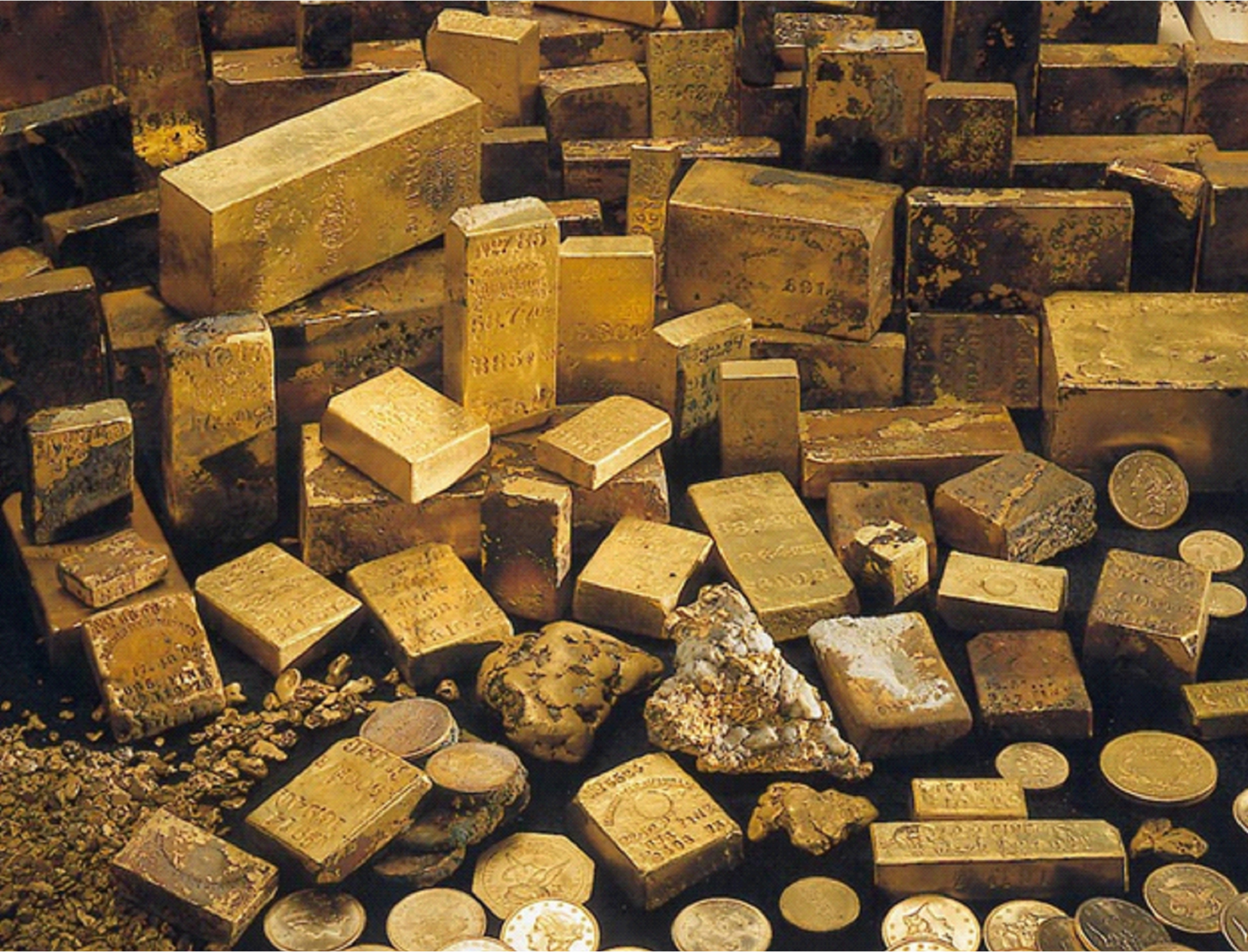
Fig. 2. Image showing the variety of gold recovered from the shipwreck of the SS Central America. This is only a small portion of the total cargo which has been recovered. Corners missing from ingots are where a chip was removed for final assay. Image courtesy of California Gold Marketing Group.
In the three days at sea following departure from Panama, the SS Central America fought increasingly rough weather; but with an experienced captain and crew manning a powerful modern steamship the conditions were not considered hazardous enough to return to port. What captain William Lewis Herndon and his crew had no way of knowing was that they were sailing on an intercept course with a category two hurricane (Landsea, Reference Landsea2003). On September 11th, 1857, with conditions worsening, a leak at one of the side-wheel shaft gaskets, and possibly other leaks, began flooding the hull with sea water, wetting the coal, shutting down the steam engines and bilge pumps and sealing the fate of the ship (Herdendorf et al., Reference Herdendorf, Thompson and Evans1995). All of the female passengers and all but one of the children were rescued by small ships in the area, while the men fought to save the sinking ship and its fortune of gold. The ship sank the next day at 8:00 pm, claiming the lives of 425 passengers and crew, and carrying an estimated 4000 kilograms of gold to the Atlantic seabed. The news of the loss of the significant, documented, commercial gold shipment plus an unknown amount of passenger wealth deepened the Financial Panic of 1857, which crippled the nation up through the start of the American civil war (Burlingame, Reference Burlingame2018).
Discovery of the shipwreck and recovery efforts
In 1983 ocean engineer Tommy Thompson conceived a project to search for the shipwreck site of the SS Central America scientifically. Utilising a complex mathematical model using historical information, Bayesian search theory, and the critical path method, a search probability map was generated to aid in finding the sunken ship. Historical data used in the model included wind speeds during the storm, the condition of the vessel, known locations from the ship and rescue ships, and accounts of the sinking provided by the survivors (Herdendorf et al., Reference Herdendorf, Thompson and Evans1995). Review of sonar records within the search areas revealed an anomaly that experts had deemed a ‘large geological feature’.
A transitional feature known as the Blake Ridge, located 150 nautical miles (280 km) off the Carolina coast on of the continental slope, was explored using the NEMO-ROV submersible on the anniversary week of the sinking, on September 11th, 1988. Upon reaching the seafloor, finding the features shown on the sonar anomaly, and viewing the large mid-ship paddle wheel, there was no doubt that this was the shipwreck of the SS Central America. The seafloor in this area was littered with gold, in an area that became known as the ‘garden of gold’. In the following four summer seasons, over 1900 kg (two tons) of the lost gold was recovered. In April of 2014, a second recovery team went to sea and retrieved an additional 3100 gold coins including hundreds recovered from within an iron safe. The surface of these gold coins and assay ingots (but rarely the placer gold) were typically coated with black to red secondary crusts of iron from the rusting ironworks of the ship (Melchiorre et al., Reference Melchiorre, Seymour and Evans2019). These crusts on the artefacts are painstakingly removed with mild solutions that do not disturb or react with the underlying gold (Fig. 3).
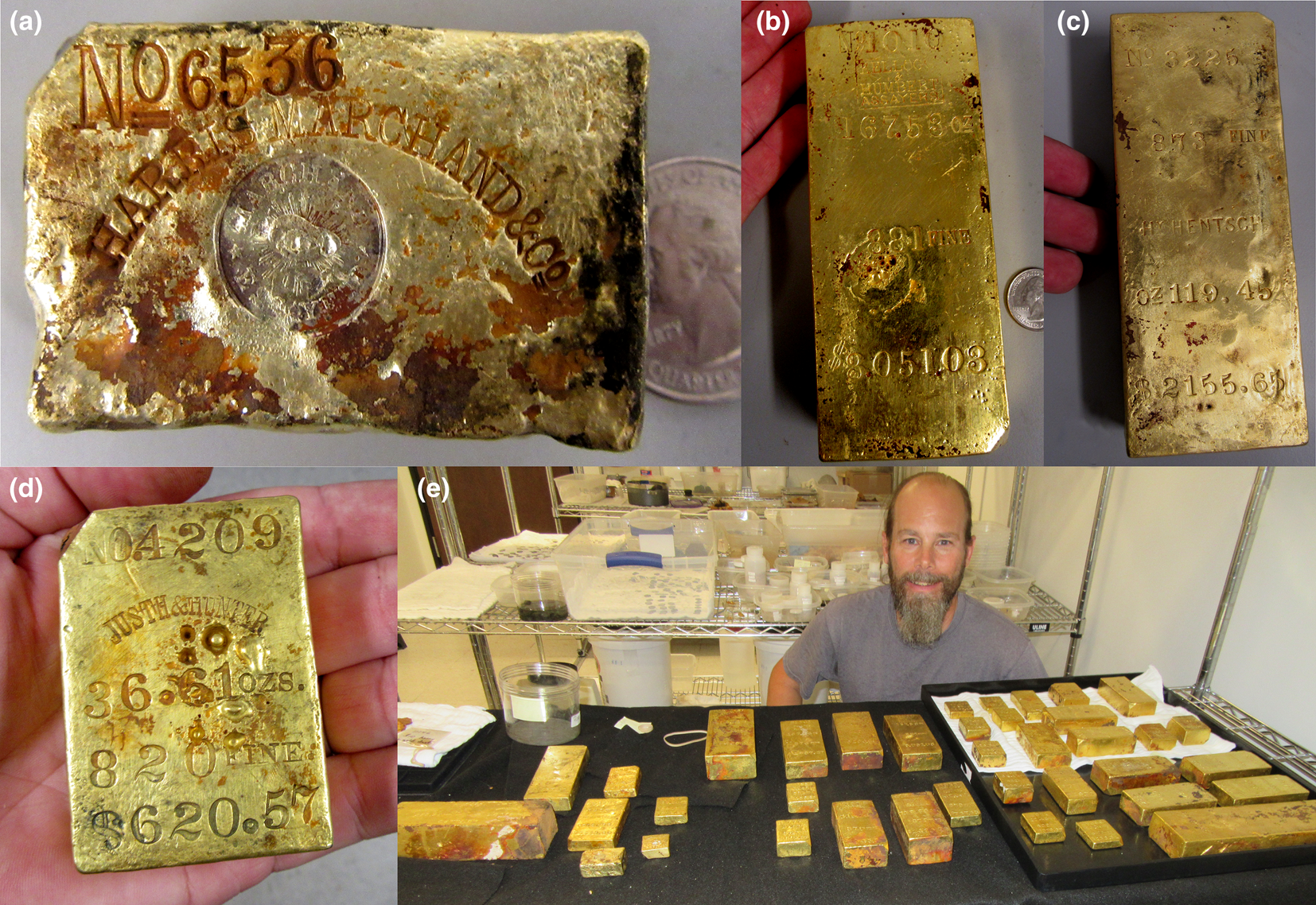
Fig. 3. Images showing the variety of gold assayer's ingots from different assay houses (Table 1) included in this study: (a) Harris, Marchand & Co. Ingot #6536, prominently displaying the French assayers’ stamp. The missing upper left corner is material removed in 1857 to generate the stamped assay value on the side edge (hidden in view). Reddish-black patches are iron coatings from the shipwreck. Coin is 24.3 mm. (b) Kellogg & Humbert Ingot #1010 with hand and 24.3 mm coin for scale. Assay chip is from lower right corner. This ingot, and the following two, show the typical format of period assayers’ ingots, with stampings on the front which denote assay house, ingot number, fineness expressed as three digits, mass in troy ounces and dollar value based on period value of USD$20.67 per troy ounce. (c) Assay Office of Henry Hentsch Ingot #3225 with hand for scale. Assay chip is from upper right corner. (d) Justh & Hunter Ingot #4209, with hand for scale. Assay chip is from the upper left corner. (e) Over 75 kg of gold in 37 assayer's ingots from the the SS Central America with lead author for scale. Photos by the authors, and with permission of California Gold Marketing Group.
Table 1. Compositions from XRF analysis of gold assayer's ingots from different assay houses.

LOD – limit of detection; toz – troy ounces.
Previous work and context
The S.S. Central America shipwreck site offers many opportunities for scientific and historical study. Scientific publication on the shipwreck is dominated by a 200-plus page monograph (Herdendorf et al., Reference Herdendorf, Thompson and Evans1995), which was followed by many articles, theses and dissertations covering a spectrum of topics from the biology of the site to costume history related to textiles and other artefacts found in passenger trunks. One previous scientific study focused specifically on the mineral crusts and nano-particulate gold found growing on portions of the SS Central America gold cargo (Melchiorre et al., Reference Melchiorre, Seymour and Evans2019).
The present study examines the purity of gold assayers’ ingots and compares these values to their historical stamped value, and was conceived as a project in March 2018 when Frank and Tina Reith visited with the lead author in southern California. What was to be a grand multi-month exploration of the gold fields of western North America turned to tragedy when Frank began having health concerns. While waiting to see if these issues would pass, and later waiting on reports from doctors, Frank and I laid out a possible ‘low-impact’ alternative to field work: We would visit the California laboratory of a friend (Robert Evans, co-author on this paper) who is the curator for the treasure recovered from the SS Central America. We outlined possibilities of examining what effects seawater might have on the gold-tolerant microbiology which might be associated with the massive cargo of placer gold, coins and ingots. Sadly, Frank never got to visit the laboratory where the treasure was housed. The day the lead author went there with two students (both co-authors on this paper), Frank and Tina had to fly home to Australia. This paper is dedicated to Frank's unquenchable interest in the power of interdisciplinary research, and the positive, mentoring impact that he has had on so many of our careers. The paper is also dedicated to Tina, who was Frank's stalwart partner in these adventures.
Materials and methods
Fourteen gold assayers’ ingots, totalling 1602.87 troy ounces (49.9 kg; $3.2M USD at $2000/oz.), that were recovered in 2014 from the SS Central America shipwreck site were used in this study (Fig. 3; Table 1). These ingots received a curatorial treatment which involved soaking in a mild sodium salt solution. This exact methodology and chemistry is proprietary, and was performed by Robert Evans at laboratory facilities in southern California. Access to these samples was provided courtesy of California Gold Marketing Group, the owner of the treasure. Details on assayers’ ingots and the specific assay houses that produced these ingots are presented in the Discussion section.
These ingots were characterised geochemically using a portable NITON XLF 950 GoldD+ X-ray fluorescence (XRF) instrument, using the same analytical parameters and techniques described in Melchiorre et al. (Reference Melchiorre, Kamenov, Sheets-Harris, Andronikov, Leatham, Yahn and Lauretta2017) and Melchiorre and Henderson (Reference Melchiorre and Henderson2019). This instrument was selected for use, specifically due to its portability and non-destructive analysis method, which were essential requirements for testing these rare and extremely valuable ingots within the secure facility where they were housed prior to sale. The Cu/Zn Mining Mode was used for each analysis, with a dwell time of 240 seconds, with auto-analyses in triplicate mode to produce an average value. Where possible, the analyses were performed on the corner from which an assay chip had been removed during the 1800s (Figs 2 and 3). Barring this, the cleanest and flattest spot adjacent to the assay corner was selected. The instrument Metals Mode was not used as our tests suggested that it had lower reproducibility, higher error and did not test for all of the trace elements anticipated in samples. The instrument was calibrated to five certified gold–silver–copper alloy reference standards (see Melchiorre et al., Reference Melchiorre, Kamenov, Sheets-Harris, Andronikov, Leatham, Yahn and Lauretta2017; Melchiorre and Henderson, Reference Melchiorre and Henderson2019) and instrument standard deviation was determined to be <2% following calibration. Detection limits certified by the manufacturer calibration were 12 mg/kg for Ag, 25 mg/kg for Au and 20 mg/kg for Cu. This XRF unit generates 50 keV X-rays. Calculation of the theoretical depth of penetration for these X-rays may be made using a modified version the Lambert–Beer Law, which suggests a maximum depth of 71 μm. However, the escape depth for the fluorescent X-ray signal (Lα and Lβ) would only be ~10 μm. These analyses should be interpreted as representing only the surface of each ingot, and do not account for any surface alteration or internal zonation, though such effects are considered minimal.
Results
The results of the XRF analyses on the 14 gold assayers’ ingots are presented in Table 1. Values of gold–silver purity (fineness) ranged from a maximum of 96.8%, to a minimum of 73.2%, with an average of 88.0%. Copper, lead and tin were present in all ingots at secondary levels. Copper was as elevated as 40,000 mg/kg and as low as 58 mg/kg, with an average value of 3800 mg/kg. Lead was generally less common, with a maximum value of 1200 mg/kg, a minimum of 330 mg/kg and an average of 710 mg/kg. Tin was as elevated as 2800 mg/kg and as low as 350 mg/kg, with an average value of 1200 mg/kg. Zinc was present at levels as high as 16,000 mg/kg, and present well above detection limits in all four ingots from Justh & Hunter, and in two other ingots. On a similar note, a uniform level of palladium averaging 124 mg/kg was measured in all Kellogg & Humbert ingots, but no others. Measurable arsenic was present at the 100s of mg/kg level in four of the ingots. Bismuth, at 300 mg/kg, and antimony at 260 mg/kg were noted in a single ingot each. No other elements were measured above detection limits in these ingots,
Discussion
Mid-1800s California assayers’ ingots
Assayers’ ingots have probably been around in some form since the earliest days of mining by humans. Accredited professionals, apprentice-graduates, and even outright fraudsters would offer services within mining regions to determine ore values, refine small batches of high-grade material, and melt precious metal grains into a single ingot to be used in commerce. Skilled assayers also produced presentation and exhibition ingots for special occasions, and industrial ingots of set fineness for use in jewellery and dentistry (Holabird et al., Reference Holabird, Evans and Fitch2003). None of these latter types were included in this study.
Prior to the re-discovery of the SS Central America there was considerable confusion regarding what authentic assayers’ ingots looked like, and which ingots were genuine. Even prominent collectors and museums fell victim to elaborate forgeries (Homren, Reference Homren2003). The discovery of the SS Central America shipwreck site presented researchers with undeniably genuine assayers’ ingots from the early days of the California Gold Rush, with these ingots sharing common features. This permitted establishment of criteria on which to judge the potential authenticity of other ingots of questionable provenance, though genuine ingots that violate the criteria are known to exist as the exception rather than the rule (Holabird et al., Reference Holabird, Evans and Fitch2003). These common characteristics stamped prominently on the front and/or sides of ingots include a stamp uniquely identifying the assay house which produced the ingot, an ingot serial number, mass expressed to hundredths of a troy ounce, purity expressed as three digit fineness, dollar value based on the US government rate of USD$20.67 per troy ounce (1834 to 1934), and assay chips which are typically cut from diagonally opposite corners of the ingot just after the pouring to determine the fineness to be stamped on the front of the ingot.
In the first decade of the California Gold Rush, prior to the start of significant lode mining, these assay offices provided a critical service to the local community. A scarcity of coinage for commerce in California had led to trade being performed through the awkward medium of gold dust. However the natural variation in purity of placer gold across the California gold fields and adulteration of gold with additives such as brass made this a proposition fraught with risk. This led to coinage of gold by jewellers and others with enough skill and access to the right equipment, but these coins (typically unauthorised by the government) were occasionally of questionable purity, mass and value; hindering trade, especially with the ‘outside world’.
The result was two-fold. The US government created a branch mint at San Francisco to create coinage, and reputable assay houses created assayers’ ingots stamped with standardised markings and weights that were backed by the recognised reputation of the firm and major banks they associated with. These assayers’ ingots were commonly produced during the first decade of the California Gold Rush by melting placer gold dust and nuggets into a single ingot. The product of lode mining could also be used to produce these ingots, but there was relatively little lode mining in these early days. What product these shallow lode mines produced was often amalgamated with mercury, retorted, and the resultant sponge gold–silver alloy melted to pour a doré bar.
Placer miners as individuals, groups and companies would present their placer gold as dust and nuggets to an assay house. The assayer would weigh the placer material and probably take notes on its origin and appearance. Next, it would be melted and cast into an ingot. This ingot would typically have diagonally opposite corners cut off for analysis to determine the fineness of the gold in the ingot. On some smaller ingots only one assay chip was removed. The ingot would then be stamped with identifying information, including mass and fineness. The assay house would collect a fee in gold for the work done, proportional to the amount of gold they processed. Typical turn-around for this service was advertised by many assayers of the period as 24 hours; an admirable feat even today. One of the advantages of this system is that the assayer did not have to concern themselves with salting or impurities in the placer material. If a dishonest miner presented placer gold mixed with brass shavings to add weight, it all was melted and the attendant low fineness and low dollar value of the gold dutifully stamped on the ingot for the whole World to see. These assayers’ ingots were accepted as a medium of trade, and the SS Central America treasure shows they were particularly popular and useful for transfer of large amounts of wealth, such as on the shipments on the mail steamers. They were often the first form of precise money that California gold became, being much more accurate and less cumbersome than the proverbial ‘pinch of gold dust’. These ingots may also provide large sample size-averaged information about the purity of gold from district-sized locations as it represents raw placer gold in an unrefined state.
Assay houses represented in this study
Four of the five main assay houses represented among the SS Central America treasure are included in this study and detailed below. All ingots from this study were recovered during the 2014 expedition. The 34 assayers’ ingots from Blake & Company are not included in this study, as all were recovered during the original expedition. Of the 574 ingots recovered from the SS Central America bearing markings from the five main assay houses, 65% were from Kellogg & Humbert, 15.5% from Justh & Hunter, 7% from Harris, Marchand & Company, 6.5% from the Assay Office of Henry Hentsch and 6% from Blake & Company.
Assay Office of Henry Hentsch
In 1856 the young Henry Hentsch established an assay office which advertised in the Alta California newspaper as ‘Assay Office of Henry Hentsch’ (Daily Alta California, 1856). Coming from a prominent banking family in Europe, the well-known family name probably instilled confidence for gold transactions intended for overseas. Hentsch was well-connected and eventually became a Swiss consular officer in California. Hentsch partnered with Francis Berton, former manager for the US Branch Mint at San Francisco, to add expertise in assaying. A total of 38 ingots bearing this assay stamp have been recovered from the SS Central America. This is the rarest type of the ingots examined for this study. The Blake & Company ingots are slightly rarer, but none of these were recovered during the 2014 expedition and thus were not available for this study.
Harris, Marchand & Company
This firm was founded October 3rd, 1855 in Sacramento by partnership of Harvey Harris, Desiré Marchand and Charles Farrington (Sacremento Union, 1855). Harris was previously employed by the US Branch Mints at New Orleans and San Francisco, while Marchand was trained at the French Mint in Paris (Owens, Reference Owens2000). A branch office was opened in Marysville, California in 1856 (Owens, Reference Owens2000). A total of 40 ingots bearing the mark of this assay firm have been recovered from the SS Central America. Three of these were recovered during the 2014 expedition, though only one of these attractive and collectable ingots was available for analysis in this study. The single ingot from this assay house which was available for analysis in this study bears a serial number in the 6000s, identifying it as originating from the Sacramento office of the firm. A distinctive feature of these ingots is a pictorial hallmark of an ‘all-seeing eye’ with rays emanating from it. This hallmark was the registered assayer's stamp which Desiré Marchand was entitled to use after studying at the Paris Mint in France (Owens, Reference Owens2000).
Justh & Hunter
Emanuel Justh, a former San Francisco US Branch Mint employee and Solomon Hunter formed an assaying partnership in San Francisco during May of 1855. The announcement of the partnership was published with letters of endorsement for Justh from Mint Superintendent Louis Birdsall and Mint Assayer Aguston Harzszthy (Daily Alta California, 1855a). Justh & Hunter reformed their firm with the opening of a Marysville office in 1856, and the addition of a new partner Charles Uznay (Owens, Reference Owens2000). A period of turmoil followed, with Uznay leaving the firm under a cloud a few months later, Justh's former boss at the US Mint (Harzszthy) undergoing a messy federal embezzlement trial, and partner Solomon Hunter leaving the firm (Owens, Reference Owens2000). This complex situation and attendant parallel affiliations with competing firms occurred during the same period that the SS Central America ingots were produced, and has been described as what “..today would be considered a gross conflict of interest” (Franklin, Reference Franklin2012). A total of 90 ingots plus two with incomplete markings, bearing the mark of this assay firm have been recovered from the SS Central America. Ingots with a serial number in the 4000s are from their San Francisco office (three ingots from this study), while ingots bearing a 9000s number are from the Marysville office (one ingot from this study). Four of the five largest ingots recovered from the SS Central America are from this firm.
Kellogg & Humbert
John Kellogg and Augustus Humbert joined forces to form a new assay house in the spring months of 1855. Both had stellar reputations from their earlier careers, with Kellogg striking a large number of private-issue gold coins between 1854 and 1855, and Humbert having held the prestigious government position as US Assayer of Gold. Humbert was described as “a man who has done more than any single person we know of for the state” (Daily Alta California, 1855b). The reputable nature of these men ensured that the new firm was highly trusted and their ingots quickly became a commercial store of wealth and were regularly shipped to New York and London (Owens, Reference Owens2000). This was the largest of the assay houses, and a total of 372 ingots from this firm have been recovered from the SS Central America.
Geochemical variation of ingots
Variations in ingot fineness
The observation of a graph of stamped ingot values vs. modern geochemical analysis (Fig. 4) reveals a remarkable correlation within the limits of detection between these values, at the 1:1 ratio for most ingots. To students of assay history, this will come as no surprise. In the hands of a skilled practitioner, the analytical techniques of 1857 were probably superior to the modern XRF analyses which we performed in this study. But it is here that we observe some interesting trends with some assay houses appearing to do better work than others. The stamped fineness values of ingots from the assay house of Kellogg & Humbert deviate from 2019 analyses by an average of just 0.14 wt.%. This deviation is well within and probably due to modern analytical error, but still demonstrates that this highly respected and high-volume assay house was assaying with high accuracy. The fact that the ingots studied from this assay house span a wide range of fineness and serial numbers implies that their work was consistent across conditions and time. These results are virtually identical to results on 56 Kellogg & Humbert ingots which were re-assayed in 2002 (Holabird et al., Reference Holabird, Evans and Fitch2003). The single ingot from Harris, Marchand & Company appears to be of similar high-quality workmanship and technique, as the value deviation is only 0.10 wt.%. The results from the ingots of the Assay House of Henry Hentsch are less consistent, with deviation of 0.22 wt.%. This larger deviation cannot be exclusively modern analytical error, and suggests that this assay house may have had standards that were more lax, or personnel that were less well trained than Kellogg & Humbert or Harris, Marchand & Company. Yet the work of the Assay House of Henry Hentsch was still exceptional, if slightly less accurate, and fell within accepted industry norms for this analytical technique. It is with the ingots from Justh & Hunter that deviation becomes a serious issue. The Justh & Hunter ingot bearing a ‘9000’ serial number was a product of their Marysville office, and deviated by 0.5 wt.%. This is significantly more than the deviations mentioned earlier, but still within the outlier range reported in Holabird et al. (Reference Holabird, Evans and Fitch2003) for Kellogg & Humbert ingots. But the variation for the ‘4000’ serial numbered ingots from the San Francisco office of Justh & Hunter averaged 6.46 wt.%. The variation measured in all three of these ingots significantly exceeds the 1% cutoff that would typically trigger an umpire assay (Holabird et al., Reference Holabird, Evans and Fitch2003).

Fig. 4. Plot of stamped gold assayer's ingot fineness (from 1857 assay) vs. 2019 geochemical analysis. The best-fit regression to all data is very close to 1:1, with the three Justh & Hunter San Francisco Office ingots as outliers.
Depletion gilding (Forty, Reference Forty1979) is a process that could explain the observed variation. If the ingot was of low purity, and placed in an environment which triggered differential removal of more mobile silver, it would produce an outer surface that is enriched in gold. It is well known that these processes can occur through biological (e.g. Reith et al., Reference Reith, Etschmann, Grosse, Moors, Benotmane, Monsieurs, Grass, Doonan, Vogt, Lai and Martinez-Criado2009, Reference Reith, Fairbrother, Nolze, Wilhelmi, Clode, Gregg, Parsons, Wakelin, Pring, Hough, Southam and Brugger2010, Reference Reith, Brugger, Zammit, Nies and Southam2013) and chemical processes (e.g. Albanese, Reference Albanese1986; Kamenov et al., Reference Kamenov, Melchiorre, Ricker and DeWitt2013). It has also been established that conditions on the shipwreck of the SS Central America are potentially conducive to both processes (Melchiorre et al., Reference Melchiorre, Seymour and Evans2019). However, it is difficult to explain how such processes might have preferentially impacted ingots from just one assay house. It remains possible that this assay house might have performed an aggressive acid wash on its ingots for some reason, leaching away silver from the outer surface which became enriched in gold. But such procedures would have been expensive and of no importance for commercial ingots with a stamped fineness and value.
Minor and trace element significance
Beyond gold, the balance of the mass of these ingots is overwhelmingly silver. This silver content is typical and expected for ingots cast from placer gold (e.g. Reith et al., Reference Reith, Lengke, Falconer, Craw and Southam2007; Reith et al., Reference Reith, Fairbrother, Nolze, Wilhelmi, Clode, Gregg, Parsons, Wakelin, Pring, Hough, Southam and Brugger2010; Melchiorre et al., Reference Melchiorre, Orwin, Reith, Rea, Yahn and Allison2018). California placer gold in the Motherlode region is an alloy which typically contains 4 to 13 wt.% silver (Hittell, Reference Hittell1869). This range is similar to many of the ingots studied, but five ingots contain levels of silver much larger (lower gold fineness) than observed in all but 4% of California placer gold localities (Hittell, Reference Hittell1869). This suggests that these ingots may have an origin in one of these small and rare districts, or represent early mining of lower purity lode gold. It may also be the result of the addition of adulterants to the gold before casting of the ingot.
Traces of other elements in the alloy of the ingots contribute additional insights on assay technique and placer gold source (Table 1). Palladium was present above detection limits in all of the Kellogg & Humbert ingots, but no others. This could occur if the placer gold originated from the Yuba River, where native platinum-group alloys are known to occur as placer grains (Sjoberg and Gomes, Reference Sjoberg and Gomes1980). Traces of this element could have remained within the placer gold itself, or as distinct palladium grains which were processed with the gold. But what is unusual is the occurrence with just one assay house, and at such uniform low levels (124 mg/kg ± 20 mg/kg). This suggests that there was a source of palladium contamination during the processing at Kellogg & Humbert. Whether this was the result of palladium contamination in a reagent or the use of high-temperature platinum-group alloy tools or crucibles is unknown, but the latter is more probable.
Bismuth, antimony and arsenic were also identified as traces at the 100s of mg/kg in several ingots. However, these do not seem to be associated with a specific assay house. It is likely that naturally occurring dense grains of ‘black sands’ recovered with the placer gold, or minerals occurring as inclusions within the placer gold itself, may have been processed with these batches. These specific elements are associated with many dense minerals (e.g. arsenopyrite, stibnite and tetrahedrite) known to occur within gold placers of California (Pemberton, Reference Pemberton2012).
Tin and lead were measured in all ingots. Both are dense elements which would be likely candidates for natural mineral contaminants in placers. Indeed, tin as the mineral cassiterite is specifically mined from placers around the World. However, cassiterite is exceedingly rare in the Motherlode country, and is only reported at two small prospects (Murdoch and Webb, Reference Murdoch and Webb1966). Lead on the other hand is much more common, and therefore more believable as a natural contaminant within a placer of the Motherlode. But it is also used extensively in assay operations for fire assay and specifically in cupellation. It is very likely that traces of lead would occur in gold ingots poured in these same facilities. The assayers of 1857 knew lead was toxic, but industrial hygiene and ventilation was less stringent in that era. The reasonably uniform levels of both lead and tin in the assay ingots of all assay houses suggest a source of contamination within the industry, perhaps in a reagent or from tools. Tin and lead levels in the ingots appear to correlate well with each other (Fig. 5) within the same ratios observed in period tin solder alloys (Oberg et al., Reference Oberg, Jones, Holbrook and Ryffel1988), though it is uncertain how solder may have been used in these assay houses. There are few recognised lead–tin minerals, and none with these same ratios that have been reported for the Motherlode country.

Fig. 5. Plot of geochemical analysis of ingots for lead and tin. The shaded field encompasses the range of common tin-lead solder alloys (Oberg et al., Reference Oberg, Jones, Holbrook and Ryffel1988).
Copper was measured in all ingots and zinc in just six. Copper is often measured in placer gold alloy at the 100s of mg/kg level, but rarely is zinc measured in the same range. Copper and zinc minerals are both relatively common in the Motherlode country of California, and would not be unexpected in placers, and could contaminate placer gold as black sands. But attention is drawn to these two elements in tandem as their most elevated levels are measured in the three ingots with the lowest measured fineness. All three of these ingots also have a fineness that is much lower than the typical placer gold from districts that were active in California in the 1850s (Hittell, Reference Hittell1869). It is possible that these ingots were produced from shallow hard-rock diggings on the deposits of the Motherlode itself, which could easily explain the lower purity of the gold through inadvertent addition of copper and zinc sulfide minerals. Yet mining of such lode deposits was relatively rare in those days, and would be expected to produce a range of copper–zinc ratios dependent upon lode deposit mineralogy. Yet all three of these ingots (Harris, Marchand & Company #6536, Justh & Hunter #4338 and Kellogg & Humbert #613) have a very uniform 60% copper and 40% zinc ratio (Fig. 6). This is the same ratio used in the manufacture of Muntz Metal (aka ‘yellow metal’); a special brass alloy which is used for maritime applications including the sheathing on ship hulls (McCarthy, Reference McCarthy2005). It is unlikely that this contamination results from exposure on the seafloor to the decaying SS Central America, as it is not observed on all ingots and only on lower fineness ingots. It is likely that the placer gold from which these three ingots were cast contained shavings of marine brass as an adulterant, driving down the purity of the ingot to below levels commonly seen in California placer gold. The three other ingots which contain measurable zinc and copper have lower levels of these elements and a uniform ratio of ~30% copper and 70% zinc. This ratio is not consistent with any known alloy used in the 1850s, though it is consistent with several oxidation zone minerals that contain both copper and zinc. It is also possible that this chemical signal results from a fortuitous combination of independent copper and zinc minerals.

Fig. 6. Plot of geochemical analysis of ingots for copper and zinc. The solid line shows the compositional ratio of Muntz metal (marine brass) alloy (McCarthy, Reference McCarthy2005).
It should be noted that other analytical techniques such as Laser Ablation Inductively Coupled Plasma Mass Spectrometry (LA–ICPMS) could be used to generate a much more robust and detailed data set for these ingots. However, this was not possible as the instrument has to be brought to the facility where the ingots were stored. Perhaps future workers will have the opportunity to have some of these ingots brought to a facility where LA–ICPMS or future technologies may be used to improve upon the present XRF data set. These studies will undoubtedly reveal the limitations of the analytical methods used in this study. However, it is impossible to imagine that the collection of ingots examined in this study will ever be present in the same place again with permission for examination, leaving the XRF data collection in the present study as a once-in-a-lifetime opportunity.
Conclusions
Remarkably, the assayers’ ingots recovered from the SS Central America have preserved a record that potentially informs us on details of life, industrial techniques and working conditions during 1857 in California near the peak of the Gold Rush. Most of the ingots have fineness values that are consistent with period placer gold values, confirming that in 1857 the vast majority of the gold production of California remained associated with placer mining. Those ingots that have lower fineness were probably ‘doctored’ by the addition of marine brass to the raw placer gold. It is notable that three of the ingots (21%), representing three different assay houses, contained elevated copper and zinc in ratios suggesting addition of brass. A plausible scenario would have unscrupulous miners shaving or filing down brass and adding the fine particles to their placer gold. Fine shavings or filings of brass would have similar colour and lustre as gold and ‘disappear’ into the mix. Muntz metal (Yellow brass) would have been the most abundant type of brass in California during this period as imports were expensive, and abandoned, rotting ships littered San Francisco Bay for over a decade after the initial rush. It is unknown who added the brass, but possibilities include a miner attempting to cheat a partner or employer. It is unlikely that a miner did this to their own gold unless they were poorly versed in how assayers’ ingots were prepared. A skilled assayer would have noticed the brass filings, at the least by noting a blue or green coloration in the flux slag when melting the parcel. But it seems that this was often ignored, as even the prestigious Kellogg & Humbert assay house produced an ingot with the geochemical fingerprint of Muntz brass. As assayers’ ingots were a ‘fee-for-service’ operation, it seems likely that experienced assayers just smiled politely and did their job. It would not matter if a customer presented tampered gold: the ingot produced at the end would simply be stamped with the correct fineness, value and weight. No one was cheated, save the person paying the assay fee for melting brass. Yet it is remarkable that such a high percentage of the ingots bear this signature, and future work should examine the historical record for the prevalence and methods of such tampering.
The variance between stamped ingot values and modern analytical results also suggests cultural information is preserved by these ingots. Kellogg & Humbert, the top assay house of the period in volume and arguably in reputation, had the lowest deviation which implies that their work was superb. Harris, Marchand & Company also did well with the single ingot examined. The Assay Office of Henry Hentsch produced ingots with more variation between stamped and modern analytical values, but these values remain within acceptable industry standards. It is the ingots from the San Francisco office of Justh & Hunter that are outliers, and by an order of magnitude. A skilled assayer would be expected to notice errors of this degree. Gross negligence is not likely, given that the assay house had a good reputation and competent assayers. It is also intriguing that the ingot produced by their Marysville office did not have this issue. The reason why these three ingots were stamped with values as much as 8.9 wt.% less gold than they actually contained is a matter of conjecture. It is interesting to note that in 1857 the San Francisco office was managed by Emanuel Justh, while the Marysville office was under direction of Solomon Hunter. Hunter left the firm shortly after the SS Central America ingots were made (Owens, Reference Owens2000). It would be a more satisfying story if it was ingots from his office that had issues, prior to his departure from the firm. But it was the San Francisco office ingots that had significant value variance. Furthermore, it is confusing as to who might benefit from these inaccuracies. It remains an intriguing possibility that Hunter may have resigned from the firm due to issues with his partners’ quality of work or integrity.
The presence of palladium in all of the Kellogg & Humbert ingots, and the presence of tin and lead in all ingots probably reflect specific sample preparation and handling techniques during ingot manufacturing. This could include use of high-temperature platinum-group metal tools, contamination of reagents, contamination with solder, and lead contamination caused by poor industrial hygiene. Bismuth, antimony and arsenic anomalies are most likely contaminants from residual black sands and/or naturally occurring traces in the placer gold.
Acknowledgements
Specific thanks go to Frank Reith for his intellectual support of research projects like this. Without Frank's prodding, including during the difficult period of his illness, this project would have never have been completed. We also thank Tina Reith for her friendship and support. We thank California Gold Marketing Group and Professional Coin Grading Service (PCGS) for providing access to the materials that were used in this study, and additional materials that provided context for the conditions of the shipwreck site. We also thank the hard-working members of the 2014 expedition that recovered the materials used in the study. Instrumentation used in this study was provided by a generous grant from the W.M. Keck Foundation and an internal VETI Grant by CSUSB.


 Open access

