

Who does the lamp communicate with? The mountain? The fox?
Walter Benjamin
Over the last five years, there has been considerable emphasis on the nature and purpose of theatre historiography. Two authoritative collections, Claire Cochrane and Jo Robinson’s (eds.) The Methuen Drama Handbook of Theatre History and Theatre Historiography (2019) and Tracy C. Davis and Peter W. Marx’s (eds.) The Routledge Companion to Theatre and Performance Historiography (2021), underscore the expansive scope of theatre history’s current concerns, probing what the discipline of theatre history has to ‘[offer] to the world’ today.Footnote 1 Due to the sweeping breadth of both volumes, which provide surveys of the academic discipline of theatre history and an extensive range of methodological approaches relevant for its practice, scholars have called for ‘a brief moratorium on any more theatre and performance historiography anthologies’.Footnote 2
In response to this protest, this special issue, more limited in size and modest in its aims, takes as its conceptual starting point ‘theatrical things’ too commonplace to ordinarily deserve scholarly notice – bits of foam, cushions, mothballs or even elephants. It sheds light on how unassuming features of performance practice constitute critical apertures for the study of theatre historiography, telling us something vital about theatre-making and sense-making. In the study of theatre history, Davis says, there is a premium on asserting originality and innovation, so we are ill-disposed to acknowledge consistency, unoriginality and derivation.Footnote 3 Following Davis’s line of thought, we consider how utterly commonplace theatrical things become interfaces between theatre and world-making or microcosms for understanding theatre practice in ways that social ‘context’ does not allow us to imagine. We denote this form of historiography as metonymy.
Metonymy and metaphor
Conventionally, metonymy (Greek ‘change of name’) refers to one of the primary figures of speech in which a concept or phenomenon is substituted with a more abbreviated term or phrase closely associated with it. The anonymous author of the Rhetorica ad Herennium, which provides one of the earliest definitions of the term, describes metonymy as ‘a trope that takes its expression from near and close things [ab rebus propinquis et finitimis]’.Footnote 4 This historic explanation gestures towards the ideas of contiguity and closeness fundamental to metonymy as both semantic process and mode of structuring perception, thought and affect.
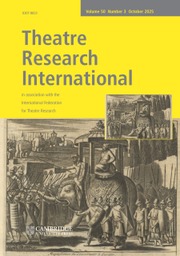
Here, the distinction between metonymy and its better-known sibling metaphor is key. While metaphor relies on similarity, equivalence and processes of representation – acts of referring to or signifying aesthetic conventions, production and reception habits, cultural assumptions and sociopolitical phenomena – metonymy functions through association, proximity and exchange. In ‘Elephants in the Room’, Peter W. Marx provides a succinct explanation of this conceptual difference crucial to historiographic thought. He cites thirteenth-century Persian poet Rumi’s parable of blind men describing an elephant; each man understands the elephant differently based on the part of the elephant that they touch. Touching the trunk evokes ‘a water-pipe kind of creature’, the ear ‘a very strong, always moving back and forth fan-animal’, the leg ‘a column in a temple’, the back ‘a leathery throne’ and the tusk ‘a rounded sword made of porcelain’. While the divine candle of metaphor grants a view of the holistic totality of the elephant through metalanguage, metonymy’s material touch highlights partial, fragmentary, yet tangible truths ‘that never grow into a coherent comprehensiveness’. Metonymy therefore functions as an altogether different technology of vision for writing history. Like the parts of the elephant, ephemera or the scattered, unintentionally kept, debris of the past – object remains, leftovers, material remnants – are threads entangled with the liveness of a larger fabric that cannot be grasped in its entirety.
Foregrounding this partiality, historiography as metonymy entails forms of proximity – physical, imaginary or associative – rather than symbolic reference (the relationship between signifier and signified) or, in other words, a process of looking beyond archival documentation as evidence for the reconstruction of historical events. Historiography as metonymy is not primarily concerned with the ability of theatrical things to record, reproduce or illustrate events, meanings or intentions. Nor do we consider theatrical objects as simply sites where traces are imprinted through contact – passive, inert receptors that are prerequisites for or products of making. Rather, we focus on the capacity of theatrical things to actively gather and transmit, through proximity and contact, specific qualities of performances, actions, people and other entities with which they come into relation.
Hermann Nitsch’s image of the seismometer – the device which measures the movement of the earth during earthquakes – is a useful analogy to better understand our aims.Footnote 5 Theatrical remains, we argue, are akin to seismometers in that they capture, record and transmit (rather than simply depict) the affective vibrations of past performances. We therefore do not focus on essential properties of objects as discrete, self-contained entities, but on interactions that emerge within the relational configurations that they traverse as components of larger assemblages. The articles in this issue are underpinned by the ‘recognition of materials as ongoing processes—rather than as raw resources or finished products—center[ing] human actors and systems in the event of material transformation’.Footnote 6 To paraphrase Kate Katafiasz’s thesis, the special issue foregrounds how ‘object remains not only conjure, but entangle us physically with, the bodies of people who are no longer there, or people who we know perfectly well never existed’. We therefore prioritize topology rather than chronology.
Stickiness, intra-action and entanglements
Several scholars have explored the metonymic capacity of things to evoke ideas, feelings and patterns of thought. In her introduction to the Cultural Politics of Emotion, Sara Ahmed argues that emotions which ‘cannot be separated from bodily sensations’ can be traced in texts and other modes of representation by following figures of metonymy.Footnote 7 She posits the concept of ‘stickiness’ – ‘an effect of the histories of contact between bodies, objects, and signs’.Footnote 8 In a similar vein, Karen Barad proposes the idea of intra-action, which views agency not as ‘an inherent property of an individual or human to be exercised, but as a dynamism of forces in which all designated “things” are constantly exchanging and diffracting, influencing and working inseparably’.Footnote 9 According to Barad,
the neologism ‘intra-action’ signifies the mutual constitution of entangled agencies. That is, in contrast to the usual ‘interaction,’ which assumes that there are separate individual agencies that precede their interaction, the notion of intra-action recognizes that distinct agencies do not precede, but rather emerge through, their intra-action.Footnote 10
In contrast to interaction, which presumes that distinct individual agencies precede interaction, the notion of intra-action recognizes the impossibility of a clean separation between the doings of bodies and things. Following Ahmed’s theory of affective economies and Barad’s concept of intra-action, we believe that a ‘sticky’ or ‘intra-active’ relationship exists between past performances and their ‘relics’ or leftovers. Stories, images and feelings stick to the remains of historical performances, blurring the boundaries between the ephemeral nature of live events and the material objects associated with them. Examining material remains of past performances as figures of metonymy entails understanding their affective life beyond representations and the meanings that they generate, exploring them as tangles of forces or assemblages of materials and bodies in continuing performance. Theatrical things are not merely traces or remnants of events lost in time; they are entangled with past events, bodies and liveness, continuing to act across time.
It is this metonymic relationship between objects, bodies and events that has allowed us to preserve, exhibit and collect performance art over the decades (for example, the 2,000-pound clay sculpture from Heather Cassils’s Becoming an Image, bricks moved from a wall in Guangzhou in Lin Yilin’s Hotbed, the taught pantyhose previously worn by dancers in Senga Nengudi’s R.S.V.P. series, or land artworks like Robert Smithson’s Nonsites). Erupting, undulating, cascading, promiscuously proliferating, these artefacts do not simply represent the performance. Rather, their close proximity suggests ‘l’evocation et non l’illustration’; that is, the ability to trigger a tactile gaze or physical response, evoke the pleasure of movement and thereby trace and convey the unfolding of a performance artwork through time. Unlike metaphor, which relies on resemblance, metonymy operates through proximity and exchange, enabling these material remains to metonymically replace the absent performance.
Drawing on the concept of ‘entanglement’ introduced by Ian Hodder, Nick Kaye describes the capacity of performance art to ‘affect the material remains by which it is known’.Footnote 11 Citing Chris Burden’s use of relics and Valie EXPORT’s Action Pants: Genital Panic, amongst others, he explains how the material remains and artefacts of performance art assert agency and meaning, provide evidence and act as mnemonics and prompts to action. The entanglements between artists, things and the performance event, he says, erode
the conventional dichotomies between the ephemeral live and its remainder: between an un-representable event and the things upon which events depend. ‘Liveness’ surrounds these artefacts, is carried forward in the stories and associations in which these things gain meaning and remains evident in their potential.Footnote 12
Performance historiography, presence and time
While contemporary performance art serves as a compelling illustration, concerns regarding the presentness of performance leftovers extend more broadly to all object remains in theatre history. Prompting fundamental inquiries into the relationship between theatre and its material components, the artefacts left over from past performances not only bring to the forefront considerations about the limits of representation in writing theatre history but also point to a radically different way of doing performance historiography. If performance generates specific affects and ideas and makes its leftovers sticky with them, performance historiography can begin to be understood as an investigation into how these affects are produced and why they appear in societies at particular points in time. Such a mode of historiographic analysis requires a form of ‘reading’ quite different from that developed for the conventional study of archival documentation.
All too often, historians view object remains simply as a complement to other forms of discursive evidence in the desire to ‘mirror’ or reflect the truth of the historical event or produce an accurate representation of the past. These shortcomings, as Eelco Runia describes, stem from representationalism’s focus on the ‘transfer of meaning’. He emphasizes that ‘presence’ (‘the unrepresented way that the past is present in the present’) is at least as important as ‘meaning’. ‘Whereas metaphor’, he says, ‘is instrumental in the “transfer of meaning” metonymy brings about a “transfer of presence”.’Footnote 13 Presence, which is stored in material remains through metonymy, can be encountered on the plane of the present. In line with Runia’s emphasis on how the past can be present in the present and how it makes itself felt by us through remains, we believe that leftovers should be recognized in their own right as referents or indices of history operating through condensation and displacement rather than simple illustration. Hidden from plain view, performance leftovers carry through metonymy an unspoken, public Gedankenwelt, our hidden communal desires and the shared cultural assumptions and views of the past that have shaped our historical consciousness and our identities.
This capacity of metonymy to bring together past and present and make connections between different levels of being has repercussions on how theatre historians understand and structure time. Raymond Williams, British drama scholar and founder of cultural studies, argued for the need to critically examine culture in what he denoted as the ‘present tense’. In his chapter ‘Structures of Feeling’ in Marxism and Literature, he decries the limitation of cultural and social studies, which consistently use the past tense in describing human cultural activity. In his words, ‘analysis is then centred on relations between these produced institutions, formations and experiences, so that now, as in that produced past, only the fixed explicit forms exist, and living presence is always, by definition, receding’.Footnote 14 Analysing culture as an unchanging monolith produces a significant break between the social described as past and the personal, which is always denoted in the present tense. At the heart of Williams’s approach to cultural analysis is the search for
terms for the undeniable experience of the present: not only the temporal present, the realization of this and this instant, but the specificity of present being, the inalienably physical, within which we may indeed discern and acknowledge institutions, formations, positions, but not always as fixed products, defining products.Footnote 15
For Williams, then, the present tense of analysis becomes indispensable for understanding changes in common experience through structures of feeling before they take the shape of institution, knowledge, discourse or canon.Footnote 16 Not unrelatedly, the present tense is also imperative for analysing works of art: ‘we have to make them present’, he says, ‘in specifically active “readings”.’Footnote 17 Williams thus alludes to the possibility of both describing ‘social experience which is still in process’ and breaching the boundaries between individual artistic expression, with its conventions, styles and aesthetic choices and reception: the way the artwork is seen, experienced and felt by the public.Footnote 18
According to Williams’s biographer John Higgins, these ideas were born from theatrical experience.Footnote 19 Theatre happens in the ‘present time’ and ‘structures of feeling’ describe a perspective in which that present time can be re-established in the process of analysis. By this logic, historiography as metonymy can be understood as a search for feelings or presence, for the relationships between stage and public that make leftover things sticky or intra-active with affective charge. Metonymy thus becomes a tool for grasping the ‘present movement’ of past performance, a search for becomings rather than origins – not the recovery of a past performance event, but an inquiry into how it persists, endures and transforms dynamically through its material remains. Here, however, we are careful to avoid essentialist and metaphysical ideas of presence. Neither do we suggest an unmediated and transparent access to reality and its (presumed) truth, nor do we reject critical analyses of our mediated relationship with the ‘real’. In considering the ‘presence’ of theatrical things as an operative notion, we recognize that things constitute not merely evidence of the past but also carriers of affective resonance and instruments for constructing identity and imagining the present and future.
What, therefore, does a metonymic gaze reveal about the history of theatre and performance? Not an exact representation of the past, but the processes and dynamics that the past sets into motion. Not viewing ‘stages primarily as spaces that are impacted by their “times”’ but ‘the dialectical flip side of the argument: how the “times” can be impacted by dramatized spaces’.Footnote 20 Not the original performance but its unfolding across a wealth of things and remains. Historiography as metonymy is a gaze – one that does not seek to reconstruct the exact image of the past, but rather to recognize, through its fragments and remains, the way in which the past endures and becomes present. In this sense, a metonymic approach to theatre and performance historiography does not impose a dualistic separation between live performance and its documents or material remains. Remains, documents and objects are not merely traces of an original live event irretrievably lost, nor simple remainders of something sealed off in the past. Instead, they are entangled with the liveness of performance: the qualities, affects and relations generated by the performance cling to them and continue to live on and transform through them.
Indexes, hauntings
Seen from this perspective, the non-representational attention to theatrical things characteristic of historiography as metonymy intersects with the concept of the indexical relationship as employed by Rosalind Krauss in her interpretation of 1970s art and its photographic logic. ‘Index’ refers to a mode of meaning-making that is not mediated by representation or resemblance. The index is a trace that bears the mark of contact with the thing that it refers back to. It evokes the object through direct contact via a causal relation. Examples of indexes include footprints in the sand or medical symptoms. Similarly, photography was understood and presented as an index: a site where light imprinted itself through contact, leaving a trace of the object itself. The index does not resemble the thing that it denotes; rather, it points to it:
As distinct from symbols, indexes establish their meaning along the axis of a physical relationship to their referents. They are the marks or traces of a particular cause, and that cause is the thing to which they refer, the object they signify …Footnote 21
A fundamental difference between the indexical relationship, as outlined by Krauss, and the approach of historiography as metonymy is that the indexical relationship appears to privilege physical contiguity – a trace left through direct imprint. Metonymy as a rhetorical and methodological figure, by contrast, also points to conceptual contiguity – an evocative and associative capacity – and thus does not necessarily rely on ‘real’ contact. The qualities and relationships involved need not be physical; they may be affective (linked to the object’s former owner, for example), connected to the processes through which the object came into being, or to its functions.Footnote 22 This quality is an important aspect of Sarit Cofman-Simhon’s analysis of Immanuel Romano’s prologue of the Machberot – a performative text that bears witness to practices, both documenting the past and scripting possible futures. Cofman-Simhon uses the term ‘broad cushions’ in the prologue as an entry point for conceptualizing Romano’s work in terms of a relic or index. The physicality of the cushions cited in the poem allows us to understand the written remains of past actions in the Machberot as a scenario for re-enactment, facilitating a suspension of the difference between reflection and practice.
The potential of objects to function as actants possessing agency – a capacity to collect, generate and transmit effects and meanings without being governed by human intention – rather than representational signs of history also lies at the core of John M. Andrick’s essay on American theatrical impresario David Belasco and his fascination with psychometry – the science of ‘soul reading’. Drawing on Elaine Freedgood’s concept of ‘strong metonymy’ and New Materialism’s interrogation of the binaries of alive and dead, animate and inanimate, Andrick points to how theatrical objects function as potent indexes possessing the spectral capacity to capture traces of people, their histories and their surroundings. Andrick thus inadvertently echoes Marvin Carlson’s influential The Haunted Stage: The Theatre as Memory Machine, which proposed haunting as a paradigm for understanding how public memory materializes in bodies and things present on the theatrical stage.Footnote 23 However, while underscoring the spectrality of theatrical object remains, Andrick goes a step further than Carlson, arguing for the place of ‘strong metonymic imaginaries … in the ontological and epistemological considerations of theatre historiography’. He presents psychometry as a research tool for tracing these hauntings, for reading objects with ‘reference to “the knowledge that is stockpiled in … things …”’. This unorthodox approach, he says, has already entered art history where art historian Jennifer Fisher has proposed psychometry – acquiring information regarding a person or thing through interactions with objects associated with them – as a research tool.
Museums, bones, affect
Andrick’s theory of psychometry is valuable not only for its emphasis on how antiques, souvenirs and collectibles are haunted by the mysterious, subliminal and uncommonly powerful presence of the past, but also for the connections that he draws between theatrical relics, museum objects, household items and contemporary art. As he argues,
varieties of object animism and psychometry routinely present themselves in the myriad ways in which objects are treated as if they were sentient subjects. Examples are abundant. Museum-goers and art show attendees, when contemplating artefacts before them, ‘see the presence of a subject or a soul’, implying that ‘in front of artistic objects we are all animists’. In a similar sense we are all psychometrists, drawing upon a metonymic imagination from the objects which surround us in our homes. As put by one animist theorist, home is the place where we relate to our possessions as if they ‘were populated by souls different from our own’.
In this excerpt, Andrick usefully alludes to how museums have long recognized the mystical, ghostly ability of objects to exert a pull on us and conjure impressions of the living past. Adam Bencard describes how people are drawn to objects in museums due to feelings and sensations that inadvertently delay representational thought and evaluative critique: ‘a desire for remembrance, for commemoration, for closeness and authenticity, for being in touch with, moved by and in the presence of past reality’.Footnote 24 Decisions behind object selection and display in museums rely primarily on anticipated feelings evoked in the viewer and only secondarily on narratives (cultural, social, scientific) that the object may evidence. Referring to an exhibition of pathological bone specimens at the Medical Museum in Copenhagen, Bencard argues that the focus of the curators was primarily on the feelings (à la Raymond Williams) elicited by the bones and only secondarily on stories (scientific, medical, cultural) that the bones evidenced. Stories or contextual detail (such as on the development of anatomical knowledge or changing patterns of experimental medicine and pathology) run, he says, at a
different voltage than the immediate impact on the observer of the objects themselves; they impart a whole range of affects and sensations, at once both extremely individual but also touching upon a common and shared sensitivity towards issues of life, death, illness and health. To put it metaphorically, the displayed bones seem to reverberate with the spectator’s bones; our internal body image contorts in the attempt to match our form to the form in front of us.Footnote 25
Bencard’s poignant description of how spectators use their own bodies to imagine the shape of the spine on the pedestal is inadvertently echoed by both Rebecca Schneider and Katafiasz in different contexts. Upon visiting the archive of the RISD Museum of Art in Providence, Rhode Island, Schneider came across a small coin made of bone. The object – passed from hand to hand in ancient Rome and decorated with a masked face of an actor – was likely a theatre ticket to enter performances. Holding the coin in her gloved hand, Schneider asks,
With the disk in my hand, it seems a strange question to ask whether I am experiencing the object live. Of course I am, in that I am living, and experiencing an encounter with the disk in a cellar in an archive in the twenty-first century. But the question is complex. If the coin (let’s call it that for now) is part of an ongoing scene – say, the long Roman empire – then the bone face and I are both playing parts in an ongoing live scene.Footnote 26
Schneider alludes to how the coin, as an object charged with history, complicates the times and places of the bodies holding and perceiving it. Matter vibrates, in the words of Jane Benett, to question what live, liveness and performance mean.Footnote 27
A similar line of questioning forms the focus of Katafiasz’s essay in this special issue, where she refers to the Royal Shakespeare Company’s 2008 production of Hamlet featuring David Tennant. Tennant notoriously used the actual skull of André Tchaikowsky, a Polish Jewish pianist who went into hiding during the Second World War, to represent the skull of court jester Yorick. The unprecedented realism of the skull was kept secret until the show’s opening in Stratford-upon-Avon. Katafiasz describes how,
If the audience members are not aware they are looking at a real skull because the RSC is keeping it a secret or is actively lying to its audience, it operates iconically as objects onstage do – by resembling the outside world mimetically and representing fictional character Yorick’s skull. If the audience are aware that they are looking at the skull of André Tchaikowsky, obviously it indexes him, and by extension the Nazi Holocaust. This is likely to eclipse Yorick, and undermine the production’s entire scenographic attempts at ‘worlding’ Elsinore onstage …
According to Katafiasz, placing any object (let alone human remains) in the fictional space of performance obliterates the interface between real and imagined worlds in such a way that the imagined world collapses.
Crucially, Katafiasz alludes to how affective impact can be manipulated or produced through curated strategies of presentation. Historiography as metonymy does not merely record affective traces from a contemplative position, but rather accounts for how affects are constructed, framed and produced by specific contexts. Recognizing the agency of theatrical things and how they act in history does not entail abandoning critical accuracy towards evidence, ignoring distinctions between authentic and faked bones or how they may be made to resonate. The critical examination of the display of skulls and bones in performative contexts instead widens the gaze, throwing into focus affective histories entangled with processes of evidence construction and truth making. The use of such charged, often invisible objects reveals, in the words of Marx, ‘a larger fabric of cultural negotiations and transcultural interactions, regardless of the absence of a single, homogenous narrative’.Footnote 28 They throw the entire performance out of perspective ‘in order to bring into perspective what our usual mode of perception cannot comprehend’.Footnote 29
Scriptive things: ephemera as counterhegemonic evidence
Marx cites Homi Bhabha’s argument that metaphor foregrounds a totalizing, unifying perspective, thereby highlighting the dangers of ‘coherent comprehensiveness’ – an all-encompassing viewpoint, which is the province of colonial, totalitarian, nationalist perspectives. Ambivalence and ambiguity, he points out, allow for ‘political subversion’.Footnote 30 Examples of performances attempting to surpass (neo)colonial or authoritarian censorship through ambiguity are numerous and obvious. But how does this position apply to the writing of theatre history? How can a self-consciously partial view of the historical past offer a more radical perspective than one grounded, as Katafiasz says when critiquing Dan Rebellato and Jen Harvie’s The Cambridge Companion to British Theatre since 1945 (2024), in economic and linguistic signifiers?
In Ephemera as Evidence, José Esteban Muñoz formulated a new way of understanding history to include those violently excluded from society. He established the space of history as a crime scene where the researcher looks for invisible proofs and not present evidence – ephemera. A starting point for his analysis was a series of photographs by Tony Just of men’s public toilets, places of sexual rendezvous. Before taking a photograph, Just thoroughly cleaned these dirty, run-down spaces. Muñoz writes,
The result is a photograph that indexes not only the haunted space and spectral bodies of those anonymous sex acts, and Just’s performance after them, but also his act of documentation. This extended performance is, in multiple ways, an exemplary ‘queer act’. It accesses a hidden queer history of public sex outside the dominant public sphere’s visible historical narratives.Footnote 31
The ephemeral presence of a performance taking place in a public toilet, the spectral bodies of the actors, and the memory and atmosphere of the unsanitized place haunt the photographs despite the effacing act of cleaning. The photographs evidence what is absent in them; they point to something (akin to Marx’s oriental elephant) that can be seen only at an angle or from a particular, though elusive, point of view. According to Muñoz, this space of ephemera, characterized by the spectral presence of bodies excluded from the official sphere of visibility, is the space where histories of excluded minorities are built. Ephemera lie outside official institutions, outside archives that create hegemonic communal identities, that is, in spaces of absence on the border of disappearance. Composed of evanescent gestures, situations and statements, blurred images and unreadable texts, ephemera, he postulates, should be considered as legitimate as texts, documents and other sources for scientific investigation.
The catalogue of the avant-garde, intermedial performance Ararat (Milan, 1977), explored by Francesco Rossetti in ‘An Armenian Catalogue as Metonymy’, is a poignant example of ephemera as counterhegemonic tool. The Ararat catalogue, Rossetti argues, is not a mere paratext but a vital, living component of the performance that continues to support the cultural and historical narratives of the Milanese-Armenian community. It addresses the ephemeral – that which is left unsaid and unintended – thereby ‘drawing an implicit connection to the underrepresented or missing histories of Armenian diasporic performances’. Through the lens of the metonymic capacity of the catalogue to evoke broader cultural wholes, Rossetti delineates how diasporic communities influenced by post-traumatic legacies use performative objects to reconstruct ephemeral narratives and shape collective memory.
Muñoz’s concept of ephemera can be productively put into dialogue with ‘scriptive things’ – a theory developed by Robin Bernstein in ‘Dances with Things: Material Culture and the Performance of Race’. While exploring US archives from a race perspective, Bernstein came across an ugly, racist photograph of a young woman posing with a wooden caricature of an African-American boy eating a watermelon at a hotel industry fair in New York, circa 1930. The woman mimes the inanimate caricature; the caricature thus scripted the woman’s performance.
The photograph prompted Bernstein to analyse ‘scriptive things’ – the things that make people act or that set into motion the script of actions that we call performance (comprising performances of race).Footnote 32 Bernstein argues that the word ‘script’ does not signify a fixed command of action, but instead refers to a space that allows for a range of possibilities comprising improvisation and resistance. Individuals can deploy and act in response to material culture in different ways. Bernstein thus draws on the theatrical connotations of the word ‘script’ (such as Shakespeare’s Hamlet) – a starting point from which directors and actors construct manifold, differing performances. That which she describes as scriptive things structures a performance like a play script, while concurrently facilitating resistance through original, live, unpredictable variations.
Consequently, like Muñoz, Bernstein argues for ‘a revision of what qualifies as “reading” material evidence’.Footnote 33 Complicating Diana Taylor’s famous binary of archive and repertoire,Footnote 34 scriptive things, she says, are both archive and repertoire – to read the material evidence means to re-enact and thereby reformulate the scenario contained by them:
A scholar understands a thing’s script both by locating the gestures it cites in its historical location and by physically interacting with the evidence in the present moment. One gains performative competence not only by accruing contextualizing knowledge but also, crucially, by holding a thing, manipulating it, shaking it to see what meaningful gestures tumble forth.Footnote 35
Conclusion
Historiography as metonymy can thus be productively understood as a historian’s political negotiation of the past’s present moment. It seeks to capture the deep structures of continuing historical movements through objects, remnants and leftovers, even as it plays with the generative ideas contained within. The material artefacts brought into existence and left behind by actors speak rather profoundly; they not only echo narratives originally contained in the space of performance but also introduce parallel performances – variations, contestations, counterhegemonic movements in the present. Akin to a camera that succeeds but also fails at capturing an image of history, historiography as metonymy attempts to hold onto and yet move beyond the temporality of the past through conscious engagement with the past’s place in the present.
In this, we attempt a strange kind of freedom.
In this, we probe into the possibility of developing histories interested in structures of feeling, affects and atmospheres – the common background of everyday experience – that allow us to recognize social and political realities beyond meanings and images proposed by mainstream discourse.
In this, we attempt a strange freedom – the possibility of developing history free from the limitations of the regime of representation.
In this, ours may well be a failed liberation.Footnote 36


