


4.1 Introduction
For more than a century, US municipalities have managed urban stormwater by moving it off site as quickly as possible through storm drains, ditches, and pipes. This paradigm primarily addressed stormwater volumes on site but exacerbated downstream flooding and water quality problems. The system of drains and pipes flushed sediments, oil, nutrients, and other pollutants – and in some cases, partially treated sewage – into nearby waterbodies in a pulse of stormwater (Debo and Reese Reference Debo and Reese2002). Nonpoint source pollution, including stormwater runoff, is the largest remaining contributor to water quality problems affecting drinking water, recreation, fisheries, and wildlife (United States Environmental Protection Agency 2015a).
The National Research Council (2009, 5) noted that nearly all of the problems associated with urban stormwater “result from one underlying cause: loss of the water retaining and evapotranspirating functions of the soil and vegetation in the urban landscape.” Roads and parking lots account for up to 70 percent of impervious cover in intensely urbanized cities and generate most of the city’s stormwater.
A new ecological paradigm in stormwater management has emerged to recreate the “water retaining and evapotranspirating functions of the soil and vegetation” lost to urbanization. Often called “green stormwater infrastructure” (GSI), “low-impact development,” or “nature-based solutions,” the approach mimics natural hydrology by diverting stormwater runoff into well-designed rain gardens, bioswales, and other seminatural features. It also enhances biodiversity and community resiliency. Instead of a nuisance, stormwater becomes a valuable resource that is managed locally and integrated regionally (Debo and Reese Reference Debo and Reese2002).
Many cities are experiencing more intense rainfall as the climate warms. In some cases, the rainfall increase is overwhelming the capacity of the drain and pipe infrastructure to move stormwater effectively off site (Waters et al. Reference Waters, Watt, Marsalek and Anderson2003; Kourtis and Tsihrintzis Reference Kourtis and Tsihrintzis2021). GSI can play an important complementary role to existing “gray infrastructure” systems by detaining and/or absorbing excess stormwater volumes to prevent flooding and reduce pollution. GSI refers to the systems and engineering practices that use or mimic natural processes to manage stormwater runoff. These include rain gardens, green roofs, permeable pavements, bioswales, and rainwater harvesting systems. GSI is designed to infiltrate, evapotranspire, capture, or reuse stormwater to slow down or prevent it from running into the sewer system.
On the other hand, green infrastructure (GI) is a broader term encompassing a wide range of natural and seminatural landscape elements. It includes parks, open spaces, trees, gardens, and other vegetation that provide ecosystem services such as air and water purification, temperature regulation, and wildlife habitat. While GI can contribute to stormwater management, it also has other environmental and social benefits, such as enhancing urban biodiversity, mitigating urban heat islands, providing recreational spaces, and improving mental health.
The monetized social benefits of GSI, in many cases, can exceed the costs (Nordman et al. Reference Nordman, Isely, Isely and Denning2018). However, the upfront costs are often borne by the property owners while the long-term benefits are shared with the broader community. The GSI practices can be on private or public property and the practices can be spatially extensive. These contribute to overall stormwater management challenges and increase public costs. Property owners have little private incentive to install GSI. For example, a rain garden can manage the stormwater from a parking lot, but it might reduce parking availability. Most of the benefits of on-site stormwater management occur to those downstream, not the property owner. The challenge for municipalities, therefore, is to devise institutions, from formal rules to behavioral norms, to encourage the adoption of GSI.
4.2 Background
4.2.1 Policy Context
Stormwater degrades the nation’s waters, but mitigating its effects has proved to be challenging. A National Research Council report identified three reasons why stormwater is so difficult to manage:
1. It is produced from literally everywhere in a developed landscape;
2. Its production and delivery are episodic, and these fluctuations are difficult to attenuate; and
3. It accumulates and transports much of the collective waste of the urban environment. (National Research Council 2009, 28)
Stormwater runoff causes water quality impairments in the nation’s waters. Section 402(p) of the Clean Water Act identifies stormwater discharge as a point source of water pollution that can be regulated under the Act’s National Pollution Discharge Elimination System (NPDES). Operators of municipal separate storm sewer systems and for combined sewer systems for large and small urban areas and certain construction sites must obtain a NPDES permit. NPDES permits are also required for wastewater treatment facilities which may combine both wastewater and stormwater. The permit holders must create and implement stormwater pollution plans (National Research Council 2009).
Some states have opted to administer the NPDES permitting program themselves (United States Environmental Protection Agency 2020). In Michigan, the NPDES permitting program is administered by the state environmental agency, the Department of Environment, Great Lakes, and Energy. In southeast Michigan, including the city of Detroit, NPDES permit holders for stormwater include the Detroit Water Resource Recovery Facility (operated by the Great Lakes Water Authority) and the Detroit Water and Sewerage Department (DWSD) (Michigan Department of Environment, Great Lakes, and Energy 2019).
The US Environmental Protection Agency (EPA) designates the Detroit River as an Area of Concern (AOC) under the US–Canada Great Lakes Water Quality Agreement. The Agreement defines AOCs as “geographic areas designated by the Parties where significant impairment of beneficial uses has occurred as a result of human activities at the local level” (United States Environmental Protection Agency 2019). The EPA cites stormwater runoff as one of the contributors to the degradation of the Detroit River.
In 2017, Detroit mayor Mike Duggan created an Office of Sustainability to enhance collaboration among departments and agencies. One of its priorities was creating the Detroit Stormwater Hub to track GSI projects and improve education about stormwater management practices (Hughes Reference Hughes2020; City of Detroit n.d.).
Stormwater management in Detroit encompasses a combination of regulatory obligations and incentive programs to balance the need for infrastructural sustainability with encouragement for private property owners to participate in the effort actively. The nuances between the Post-Construction Stormwater Management Ordinance (PCSWMO), Drainage Charge, and Green Credit program form the crux of Detroit’s stormwater management framework.
PCSWMO is a regulatory obligation designed to manage stormwater runoff post-construction. It requires new nonresidential development that “creates or replaces one-half acre (21,780 square feet) or more of impervious surface” to design and install stormwater management practices that infiltrate, evapotranspire, capture, or reuse a specific runoff volume. GSI practices are among these encouraged approaches. The goal is to minimize the impact of development on stormwater runoff rates and volumes and to reduce pollutants in the runoff. It is mandatory, and noncompliance can result in penalties.
DWSD requires additional onsite stormwater management on properties. Any new development or redevelopment must follow the PCSWMO.
Drainage charge is another regulatory obligation imposed on all Detroit property owners. The charge is based on the extent of impervious areas (that water cannot penetrate, such as rooftops, driveways, parking lots) on the property. The concept behind this charge is that impervious surfaces increase stormwater runoff, burdening the city’s drainage system. Therefore, property owners with larger amounts of impervious surface area are charged more as they contribute more to the system’s load.
The 2022 drainage charge was $678.28 per month per acre of impervious surface (City of Detroit Water and Sewerage Department 2023a). The city assumes that residential customers have downspouts that are disconnected from the stormwater system and discharge onto a lawn. Therefore, all residential customers receive a 25 percent “green credit” toward their stormwater charge.
Contrary to the aforementioned regulatory obligations, the Green Credit incentive program is designed to encourage property owners to reduce their drainage charges. It provides a financial incentive for property owners to go above and beyond the minimum requirements set out by the PCSWMO. The credits are earned by implementing GSI practices that reduce the amount of impervious surface and/or manage stormwater onsite beyond the volume required by the PCSWMO. By doing so, they decrease the amount of runoff that enters the sewer system and thus can reduce their drainage charge. DWSD offers a two-part credit of up to 80 percent of the drainage charge for property owners who reduce stormwater volume (40 per cent) and peak flow (40 percent). Volume reduction, or “retention,” involves the permanent removal of stormwater volume from the system. Peak flow reduction, or “detention,” involves the temporary storage of stormwater volume during wet weather events. This incentive program represents a proactive approach to stormwater management, encouraging property owners to contribute to the solution.
In summary, the PCSWMO and Drainage Charge are regulatory obligations requiring property owners to manage a specific volume of stormwater runoff and pay a fee based on their impervious area, respectively. The Green Credit program, on the other hand, is an incentive-based initiative that rewards new development for meeting the regulatory requirements by lowering their monthly drainage charge and motivates existing property owners and further development to exceed the minimum requirements of stormwater management and reduce their impervious area, which can lead to a reduction in their drainage charges. While the regulatory obligations ensure a baseline level of stormwater management is maintained, the incentive program fosters an environment of continuous improvement and greater involvement in sustainable practices.
Residents of Detroit, Michigan, are facing a growing problem of urban flooding. This issue is mainly due to the city’s outdated water and sewer infrastructure, more frequent severe weather events, and other factors that are causing flooded basements and neighborhoods. A recent survey indicated that 43 percent of Detroit households experienced flooding between 2012 and 2020 (Sampson et al. Reference Sampson, White-Newsome, Gronlund, Leaphart, Miller, Steis Thorsby, Larson, Jackson, Ackerman, Washington and Thompson2021).
The root of Detroit’s flooding issues is the outdated combined-sewer system, which accounts for 97 percent of the city’s infrastructure. This system must be able to handle both sanitary flow during dry periods and runoff caused by storms during wet-weather events. Detroit was one of the last major cities in Michigan to adopt a PCSWMO, a measure that helps to reduce the impact of additional stormwater runoff from new private development. Additionally, the city was exempt from adhering to county stormwater regulations, which has compounded the issue.
Over time, this situation has increased the burden on the already overtaxed combined-sewer system. The cost of addressing these problems has fallen on the city’s taxpayers rather than on the private developers who played a role in exacerbating the problem.
The aging infrastructure and intense rainfall also result in combined-sewer overflows (CSO) in which partially treated sewage flows into the Detroit and Rouge rivers. The Clean Water Act requires DWSD, along with the Great Lakes Water Authority, to implement a CSO control program. Detroit is using GSI as well as conventional controls to reduce its CSO discharges (City of Detroit Water and Sewerage Department 2022). A study of Detroit GSI by Thorsby et al. (Reference Thorsby, Miller and Treemore-Spears2020) found that broader scale practices, such as bioretention basins, bioswales, and green roofs, had a larger effect on flood mitigation, especially when located at the upstream end of the storm sewer system. Smaller-scale systems, such as rain gardens, have a smaller mitigating effect. Webber et al. (Reference Webber, Fletcher, Cunningham, Fu, Butler and Burns2020) found a similar scaling effect.
The Green Credit program provides an economic incentive for property owners to reduce impervious surfaces by installing GSI practices. However, the economic approach may be insufficient. In Detroit, as in other cities, the drainage charge alone is often insufficient to change behaviors. Of the many thousands of properties in Detroit, only 268 GSI projects are listed in the city’s database (City of Detroit Water and Sewerage Department 2023). Those property owners who do adopt GSI practices often do so for other, complementary reasons.
In this chapter, we use the Governing Knowledge Commons (GKC) framework, built on Ostrom’s Institutional Analysis and Development (IAD) framework, to describe the complex institutions and motivations that influence the decision to adopt GSI practices.
4.2.2 Institutional and Economic Perspectives
Detroit’s fee-based stormwater ordinance is founded on a rational choice model. Property owners must pay for stormwater they discharge into the municipal system based on the parcel’s impervious surface area. The drainage charge also signals to the property owners that stormwater management is a scarce resource. The rational property owner is therefore expected to either reduce the amount of impervious surface (lowering the base charge) or manage the runoff (crediting against the base charge) as long as the present-value costs of on-site GSI practices are less than the present-value costs of the drainage charge.
Nordman et al. (Reference Nordman, Isely, Isely and Denning2018) found that the net present values of the social benefits of many GSI practices exceed those of the costs in Grand Rapids, Michigan. From a social perspective, GSI can be an economically efficient choice for managing stormwater on-site. However, such practices still require the landowner to pay for the capital and maintenance costs while delivering benefits to those downstream in the sewershed. Drainage charges, as in Detroit, may shift the parcel owner’s economic calculus in favor of adopting GSI practices.
The economic approach prioritizes technical knowledge and expertise with the goal of simplifying complex urban water issues. GSI implementation includes not only issues of power and expertise, but also of cultural values and leadership as well as structure and jurisdiction (Brown Reference Brown2005). Carolyn Johns (Reference Johns2019) surveyed key informants in Toronto, Canada, about barriers to GSI implementation. She identified several key barriers including the urban form (land use, soil), political leadership, funding challenges, institutional challenges, lack of interdisciplinary knowledge and expertise, lack of community buy-in, and a culture that values gray infrastructure.
The decision to adopt and implement GSI practices to manage stormwater on-site is not merely an economic one, however. As several authors noted, the decision is embedded in a variety of institution contexts (Brown Reference Brown2005; Mekala and MacDonald 2018; Johns Reference Johns2019). Brown (Reference Brown2005, 465), for example, notes that “the technocratic structure of the administrative regime inherently privileges technical expertise and economic rationalism over an interdisciplinary alternative that values community participation in decision making and environmental sustainability.” Harriden (Reference Harriden2021) emphasized the role of Indigenous water knowledge in her critique of the highly engineered approach to stormwater management.
Mekala and MacDonald (2018) used the IAD framework (Crawford and Ostrom Reference Crawford and Ostrom1995; Ostrom Reference Ostrom2009) to analyze the institutional context of GSI practices in Melbourne, Australia. Their institutional analysis identified several critical factors that affected GSI practices. The study region’s decentralized and loosely coordinated planning and natural resource management agencies impeded the systematic implementation of GSI. The IAD framework helped to identify the lack of interactions and collaboration among key actors.
The stormwater drainage charge’s economic approach assumes that parcel owners have access to the relevant information about the GI alternatives, have access to financing for the upfront costs of implementing GSI, have decision-making authority to implement on-site solutions, have access to technical knowledge or technical experts (engineers and landscape designers) who can design GSI systems that can be permitted and approved by DWSD, and understand how on-site stormwater management affects neighbors and communities downstream.
How do economic incentives, like the drainage charge, affect the decision to adopt GSI practices?
Do property owners know how to reduce their drainage charges using GSI?
Is the knowledge about GSI practices widely available (a knowledge commons) or essentially privatized within design/engineering firms?
4.3 Methods/Case Study Design
4.3.1 Institutional Analysis
This analysis builds on Haapaniemi et al. (Reference Haapaniemi, Patrick Doran, Elaine Isely, Paul Isely, Shanyn Viars, Giese and Noye2023) by situating the economic model within the GKC framework. The GKC framework extends Ostrom’s IAD framework to describe the public goods nature of information (Ostrom and Hess Reference Ostrom, Hess, Hess and Ostrom2006; Frischmann, Madison, and Strandburg Reference Dedeurwaerdere, Frischmann, Hess, Lametti, Madison, Schweik and Strandburg2014). In both frameworks, actors may consider economic costs and benefits within the action situation.
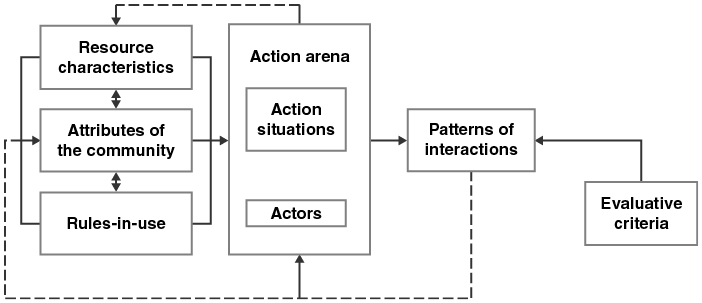
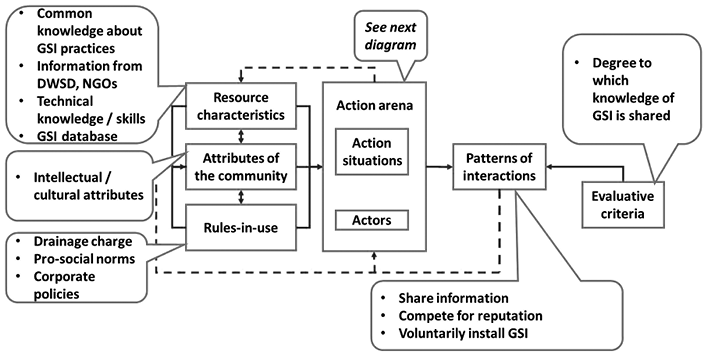
The GKC framework is a descriptive analytical tool that can help elucidate how knowledge is produced, shared, and managed. It can also identify and describe the collective action problems and key action arenas that emerge in various settings (Frischmann et al. Reference Dedeurwaerdere, Frischmann, Hess, Lametti, Madison, Schweik and Strandburg2014). The Knowledge Commons framework begins with a description of the study system including the resource characteristics, the attributes of the community, and what Ostrom called “rules-in-use.” Rules-in-use are the working rules used by the community of resource users which may be different from those that are formally codified (Ostrom Reference Ostrom2005). The action arena is the focal unit of analysis in the GKC framework as it is in Ostrom’s IAD framework. The action arena comprises a specific action situation – for example, a decision to be made – and a particular set of actors. Ostrom (Reference Ostrom2005, 14) described the action arena as “the social space where participants with diverse perspectives interact, exchange goods and services, solve problems, dominate one another, for fight (among the many things that individuals can do in action arenas).” The resource characteristics, community attributes, and rules-in-use affect the action arena’s structure and produce patterns of interactions. The GKC framework includes a feedback loop in which outcomes from the action arena can directly affect the resource characteristics. The patterns of interactions can affect both the study system and the action arena. Analysts may use evaluative criteria to assess the performance of the study system (Figure 4.1).
The generic Governing Knowledge Commons framework.
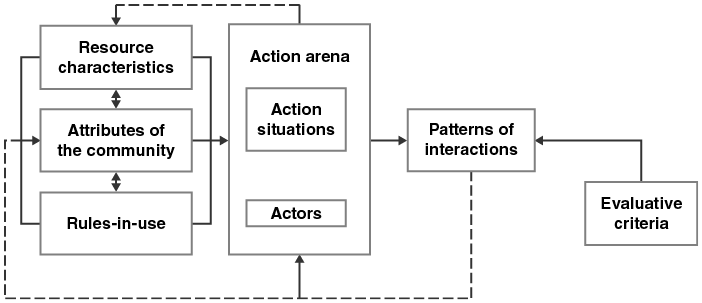
Figure 4.1 Long description
Diagram presents a left-to-right framework made up of labeled boxes connected by arrows. On the left are three boxes: Resource Characteristics, Attributes of the Community, and Rules-in-use. Double-headed arrows connect these three boxes to each other, and single arrows lead from each of them to a larger box in the center labeled Action Arena. The Action Arena contains two smaller internal labels: Action Situations and Actors. To the right of the Action Arena is a box labeled Patterns of Interactions, which is connected further right to another box labeled Evaluative Criteria. Dashed arrows show feedback from Patterns of Interactions back to the three structural variable boxes on the left and also back to the Action Arena, specifically to Actors. A dashed arrow also connects Resource Characteristics directly back to the Action Arena. The layout shows structural conditions influencing an action setting that leads to observable interactions, which then feed back to modify earlier components of the system.
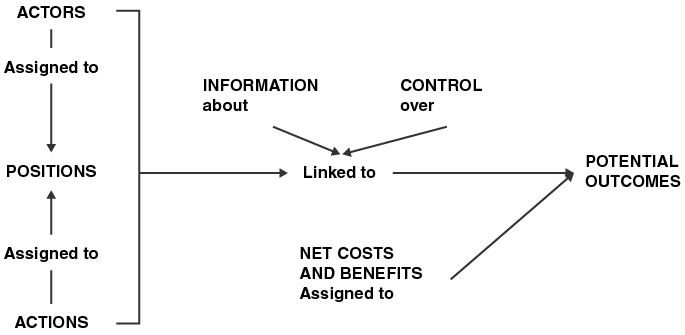
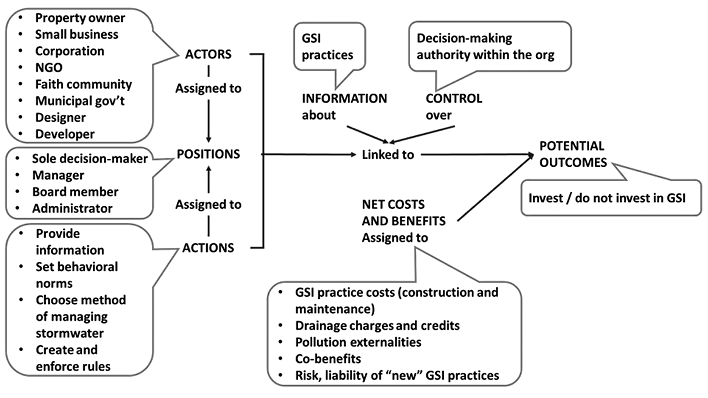
Ostrom (Reference Ostrom2005) further decomposed the action arena into component parts. Specific people (actors) may be assigned to positions or roles. The positions determine which actions may be taken. The actors may have limited information about the state of the system. Likewise, the actors in their positions may have limited control over the system. For example, the position may require an actor to do something, may prohibit it, or may allow it. The information and control combine with the net costs and benefits to define a range of potential outcomes. It is these outcomes that generate the patterns of interactions seen in the primary level of the GKC framework (Figure 4.2). The patterns of interactions include the spatial distribution of GSI practices, amelioration of stormwater discharges, and economic development.
Action situation in the Governing Knowledge Commons framework (same as the Institutional Analysis and Development framework, Ostrom Reference Ostrom2005).
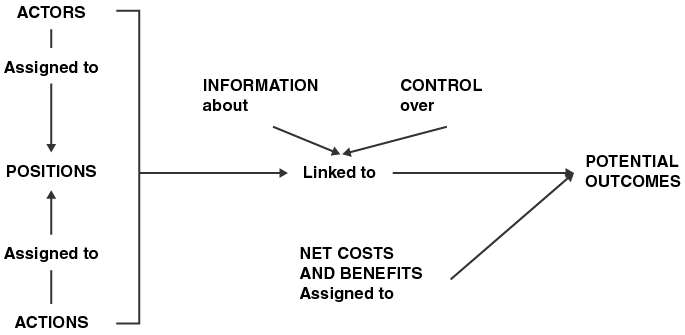
Figure 4.2 Long description
Diagram shows a chain of labeled elements connected by arrows. On the left is a grouped block containing three items: Actors, Positions, and Actions. Actors have an arrow labeled Assigned to pointing to Positions, and Actions have an arrow labeled Assigned to pointing to Positions. A bracket encloses all three items. From Positions, an arrow labeled Linked to leads to a box on the right labeled Potential Outcomes. Two labels, Information about and Control over, point toward the Linked to arrow, indicating factors that influence the link between Positions and Potential Outcomes. Another label, Net costs and benefits Assigned to, has an arrow that originates from the bracketed group and leads directly to Potential Outcomes. The layout shows how Actors, Positions, and Actions connect to Potential Outcomes with three factors modifying that connection.
As Aagaard and Frischmann note in Chapter 2 of this volume, every physical commons has a corresponding knowledge commons. That is, the institutional arrangements that govern a shared natural resource, for example, rely on an institutional arrangement that governs how the knowledge about the resource will be acquired, communicated, archived, curated, or secured. Therefore, we decompose the stormwater management case study into two parts, one for the operational level management of stormwater and one for its corresponding knowledge commons.
4.3.2 Types of Knowledge for GSI Implementation
Ostrom and Hess (Reference Ghosh, Hess and Ostrom2007) described knowledge commons as comprising facilities, artifacts, and ideas. Facilities store the information as physical libraries and archives or as digital repositories. Artifacts are articles, books, documents, files, and websites that are housed within the facilities. The artifacts are the discrete resource units of the knowledge commons. Ideas are the nontangible content transmitted by the artifacts. Ideas are not physical and therefore are nonrivalrous. However, the artifacts that contain the ideas may be rivalrous.
However, not all shared knowledge is stored and transmitted through physical artifacts. Scholars increasingly recognize the importance of local and traditional ecological knowledge. Such knowledge may be developed, accumulated, and transmitted across years and generations without being written down.
In the case of Detroit’s urban flooding challenges, there is a large body of formalized engineering knowledge. There is also local knowledge within the community about which locations are prone to flooding and how GI practices may or may not be effective (Carmichael et al. Reference Carmichael, Danks and Vatovec2019). Successful stormwater management will require a flow of information between these types of knowledge systems.
4.3.3 Benefit-Cost Analysis
The empirical research presented here focuses on the net costs and benefits within the stormwater model’s action situation. The research team was contracted by The Nature Conservancy – Michigan Chapter to analyze the “business case” for adopting GSI in Detroit. The team analyzed the capital and maintenance costs of constructing various GSI practices, the monetary value of the benefits, and the value of the avoided drainage charge. The benefit-cost analysis model was adapted from Nordman et al. (Reference Nordman, Isely, Isely and Denning2018) and modified with appropriate Detroit values and adjusted for inflation. The additional benefit of CSO avoidance was included in the Detroit model. Data on the green and gray infrastructure projects from the participating property owners was provided by The Nature Conservancy.
Detailed methods for the economic analysis can be found in the report Modeling the Business Case for Green Stormwater Infrastructure in Detroit, Michigan (Isely et al. Reference Isely, Viars and Nordman2022). The report includes the benefits and costs of three GSI practices: rain gardens/restored wetlands; bioretention basins; and detention basins/underground storage. The monetized benefits included avoided CSO discharge, avoided pollution, flood risk reduction, avoided stormwater volume, and scenic amenity. Detention basins and underground storage reduce the peak flow of stormwater but do not reduce pollution nor do they reduce the total volume discharged. They do not provide scenic amenities. Underground storage is not visible. Detention basins usually lack attractive plants that would be found in a bioretention facility, rain garden, or wetland (Table 4.1).
| Ecosystem service benefit | Economic value ($/gal/year) | Rain garden / Restored wetland | Bioretention | Detention / Underground storage |
|---|---|---|---|---|
| Avoided CSO | $0.0354 | Yes | Yes | Yes |
| Avoided pollution | $0.0069 | Yes | Yes | No |
| Scenic amenity | $0.0019 | Yes | No | No |
| Flood risk reduction | $0.0008 | Yes | Yes | Yes |
| Avoided volume | $0.0003 | Yes | Yes | No |
The team estimated the present value cost of managing stormwater including capital, annual operation and maintenance, annual drainage charges, and annual opportunity costs. The opportunity cost reflects the value of forgoing other productive activities (e.g., lost parking spaces). Costs were calculated over a fifty-year time horizon using a 3.5 percent real discount rate. We used a benefit-transfer approach to adapt cost estimates to the local conditions for Detroit. Cost estimates came from local GSI projects, published studies, and the Water Environment Resource Federation database.
The team used the US Environmental Protection Agency’s Storm Water Management Model and data from both the National Oceanic and Atmospheric Administration and the Detroit Water and Sewerage Department’s Stormwater Management Design Manual to estimate precipitation, stormwater volume, peak flow rates, detention, retention, and the Green Credit. The benefits and costs were applied to the volume of stormwater managed over the life of the practice.
The team evaluated fourteen properties where the owner installed stormwater management practices. The properties included two for-profit businesses, two houses of worship, and ten publicly owned properties.
The team analyzed the economic development impact of building GSI practices using the IMPLAN regional economic analysis software package. Installing GSI practices generates new economic activity through the hiring of designers and builders, buying supplies, and associated spending. In addition to these direct expenditures on GSI practices, economic development impact studies include indirect effects (purchases within the supply chain) and induced effects (increased economic activity generated by additional wages to laborers). IMPLAN reports economic development impact in three ways. First, it estimates the gross output. That is the total economic activity including the sum of the intermediate inputs and the value they add to the final good or service. Second, IMPLAN estimates labor income: the increase in wages, salaries, and proprietors’ incomes that results from a change in demand. Third, it estimates value added which is equivalent to the industry’s contribution to gross domestic product.
4.4 Results
4.4.1 Institutional Analysis of the Physical Commons
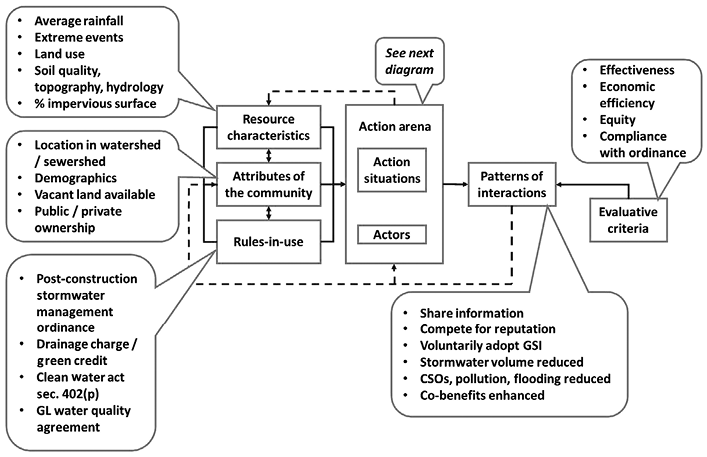
Figure 4.3 provides an overview of the GKC framework as applied to the case of Detroit GSI.
Institutional analysis of the physical commons for stormwater.
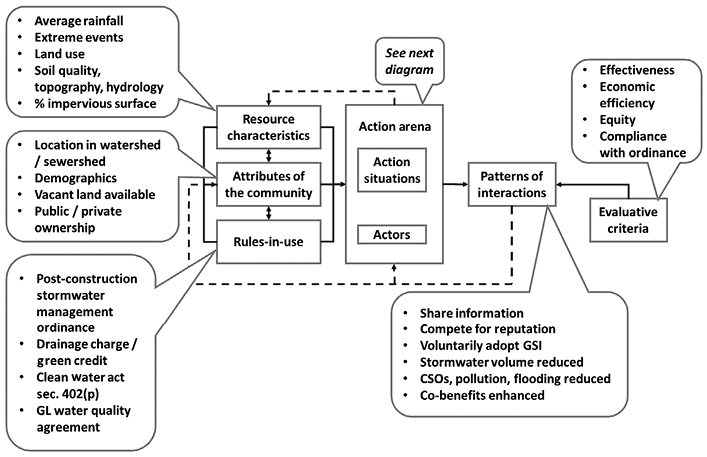
Figure 4.3 Long description
Flowchart illustrating the institutional analysis of the physical commons for stormwater management. Key components include resource characteristics, community attributes, rules-in-use, action situations, actors, and evaluative criteria. The flowchart connects these elements through stages highlighting factors such as average rainfall, extreme events, land use, soil quality, and demographics. It references post-construction stormwater management ordinances and regulations like the Clean Water Act and Green Credit. The diagram emphasizes effectiveness, economic efficiency, equity, and compliance with ordinances as evaluative criteria.
Detroit receives an average of 33.7 inches of rain annually. The distribution of precipitation is fairly even with a low of 2.08 inches in February and a high of 3.72 inches in May. However, rainfall patterns are changing. Climate scientists expect “a significant increase in the magnitude and frequency of heavy rainfall events” and “relatively more pronounced changes for heavy hourly rainfall as compared to daily events” across Michigan (Kim et al. Reference Kim, Ivanov and Fatichi2016). Recent weather events support these predictions. In 2014, intense storms caused $1.8 billion in flood damages in Detroit (National Weather Service n.d.). In June 2021, a single storm dumped more than 6 inches of rain on Detroit and surrounding areas, which resulted in widespread flooding (Rahal and Grzelewski Reference Rahal and Grzelewski2021). The city’s infrastructure is being overwhelmed by the increasing rainfall intensity. This leads to property damage and the discharge of untreated sewage as well as other pollutants.
Stormwater management is an environmental justice issue. More than 42 percent of Detroit residents reported experiencing home flooding resulting from rainfall between 2012 and 2020. Renters were more likely to experience flooding than homeowners (Sampson et al. Reference Sampson, White-Newsome, Gronlund, Leaphart, Miller, Steis Thorsby, Larson, Jackson, Ackerman, Washington and Thompson2021). Detroit residents report that repeated or severe flooding induces stress, anxiety, anger, and frustration (Sampson et al. Reference Sampson, Price, Kassem, Doan and Hussein2019). The City of Detroit owns many vacant parcels that can be used for neighborhood-scale GSI practices.
The drainage charge requires property owners to pay a fee for the property’s unmitigated impervious surface. Property owners may reduce their drainage charge by installing GSI practices and reducing stormwater runoff. The formal drainage charge stems from higher order, collective choice rules including the Clean Water Act Section 402 and the Great Lakes Water Quality Agreement.
The action situation involves the decision to reduce stormwater runoff by implementing GSI practices (Figure 4.4). The actors are the property owners, which include residential owners, small businesses, large corporations, nongovernmental organizations, faith communities, and municipal government entities. Additional actors include engineering design firms and developers. The actors may serve in positions such as sole decision-maker, manager, board member, or administrator. The actions include choosing a method of stormwater management (including not managing and paying the drainage charge), providing information about GSI practices, setting behavioral norms, and creating and enforcing rules.
Annotated action situation for green stormwater infrastructure in Detroit, Michigan.
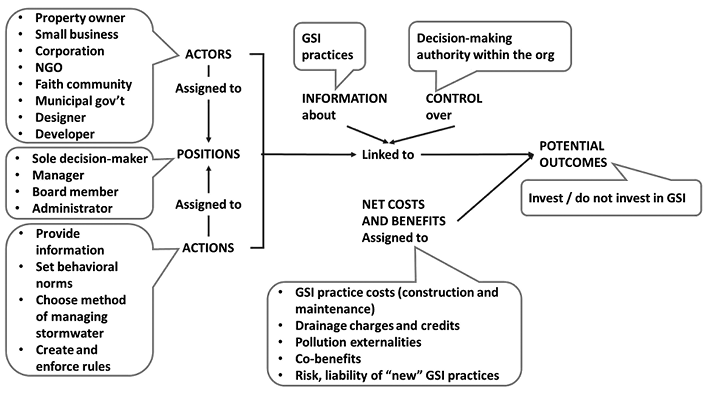
Figure 4.4 Long description
Diagram shows a left-to-right flow. On the left are three stacked sections labeled Actors, Positions, and Actions. Actors include property owner, small business, corporation, NGO, faith community, municipal government, designer, and developer. Positions, which are assigned to actors, include sole decision-maker, manager, board member, and administrator. Actions, which are assigned to positions, include provide information, set behavioral norms, choose method of managing stormwater, and create and enforce rules. From Positions, an arrow labeled Linked to Information about leads to a label listing GSI practices. Another arrow labeled Linked to Control over leads to a label for decision-making authority within the organization. A separate arrow labeled Net costs and benefits assigned to lists GSI practice costs for construction and maintenance, drainage charges and credits, pollution externalities, co-benefits, and risk and liability of new GSI practices. All of these factors lead into a box on the right labeled Potential Outcomes, which contains the options invest or do not invest in GSI. The diagram illustrates how actors, their positions, and their actions connect through information, control, and cost–benefit considerations to potential investment decisions.
The actors rely on information about GSI practices to aid their decisions. Information about GSI practices is publicly available through the City of Detroit, nongovernmental organizations (NGOs) such as The Nature Conservancy, local universities, and other organizations. The engineering design firms and developers may also have information, especially highly technical information, about GSI practices. As noted in the “positions” section, some actors have control over whether to install GSI practices. Others play an advisory or consultative role.
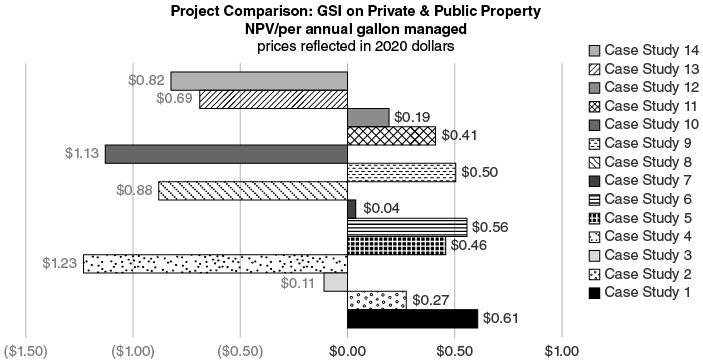
Of the fourteen cases studied, eight had a positive net present value. That is, the discounted lifetime benefits exceeded the discounted lifetime costs. Positive net present values ranged from $0.04 to $0.61/annual gallon managed. The cases with negative net present values ranged from $-0.11 to $-1.23/annual gallon managed. These calculations included both private benefits (reduced drainage charges) and public benefits (reduced pollution and flooding) (Figure 4.5).
Net present values for fourteen green stormwater infrastructure practices in Detroit, Michigan.
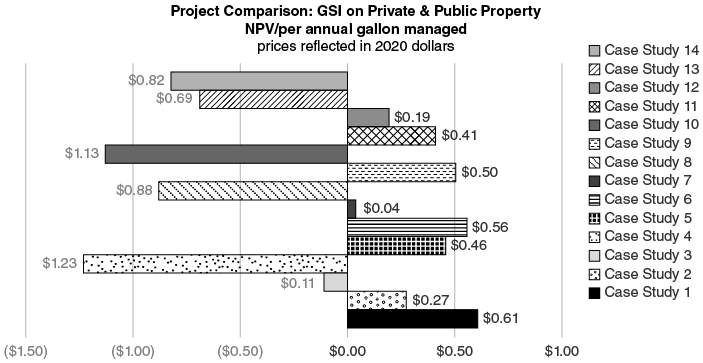
Figure 4.5 Long description
Horizontal bar chart titled Net Present Values for Fourteen Green Stormwater Infrastructure Practices in Detroit, Michigan, USA. The horizontal axis displays NPV per annual gallon managed in 2020 dollars, ranging from negative one point five zero on the left to positive one point zero zero on the right, with a vertical zero line at the center. Fourteen bars represent fourteen case studies, each using a distinct fill pattern. Bars extend either left of zero for negative values or right of zero for positive values, with numerical labels placed at the bar ends. Negative NPVs include values such as zero point eighty-two, zero point sixty-nine, zero point eighty-eight, one point twenty-three, and zero point eleven. Positive NPVs include values such as zero point nineteen, zero point forty-one, zero point fifty, zero point zero four, zero point fifty-six, zero point forty-six, zero point twenty-seven, and zero point sixty-one. One bar aligns with zero. The layout compares financial outcomes across the fourteen practices.
The two GSI practices installed by private businesses (Cases 1 and 2) had positive net present values. Case 1 involved a 20,230 ft2 detention basin adjacent to a manufacturing facility. The present value of the benefits exceeded $4.8 million. However, the present value of the private financial benefit (avoiding drainage charges) ranges from $276,371 to $555,476, depending on whether outflow is enforced. The estimated credits were based on modeled stormwater management performance. In some cases, these models showed an outflow rate greater than what was allowable for credit. But since this is model-dependent we estimated credits as a range, with the higher bound not including that enforcement and the lower bound including it. In Case 2, the property owner installed subsurface detention (underground storage tank). The total benefits had a present value of $535,515. The total present value costs were $368,848. The individual financial benefit (avoiding drainage charges) ranged from $3,715 to $39,671. The property owner indicated that the decision to install the underground tank was made at corporate headquarters, not by the local management team. In both Cases 1 and 2, the present value of the individual financial benefit is significantly lower than the present value of the costs. Most of the benefit from the GSI practice accrues to the public, not the property owner. Even though the projects have positive net present values for the community, the property owner does not recoup the costs of the GSI over its lifetime.
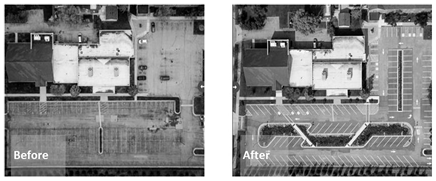
Cases 3 and 4 involved houses of worship. In Case 3, The Nature Conservancy initiated the project by developing a pilot project with Sacred Heart Church. This historic faith community is nestled in Detroit’s Eastern Market District. With its large parking lots, the church faced flooding challenges and steep drainage charges exceeding $16,000 annually. The Nature Conservancy worked with Sacred Heart Church to design and implement a bioretention/rain garden that not only manages stormwater, but also improves traffic flow and walkability, increases biodiversity, and fosters creative placemaking (Figure 4.6). The Nature Conservancy plans to use the Sacred Heart Church GSI practice as an example that can inspire other property owners. The Nature Conservancy and Sacred Heart shared detailed construction plans and costs with the team. The bioretention basin/rain garden had a total present value benefit of $1,147,089 and a total present value cost of $1,261,077. Therefore, the net present value was negative at $-113,988, in part demonstrating the difficulty of retrofitting sites.
Before (left) and after (right), the bioinfiltration/rain garden construction at Sacred Heart Church, Detroit, Michigan.
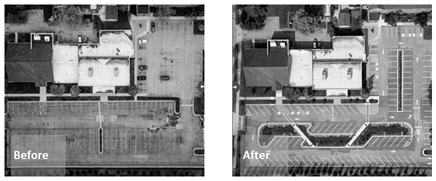
Figure 4.6 Long description
Image shows two side-by-side black and white aerial photographs labeled Before and After, depicting the same building and adjoining parking lot. In the Before photo, the parking lot appears worn with faded or unclear parking lines and a large, uninterrupted paved surface with little visible landscaping. In the After photo, the lot has been redesigned with clean, freshly painted parking spaces, directional arrows, and a visibly more organized layout. A large central green feature, shaped in a zig-zag or chevron pattern, has been added, functioning as a bioswale or rain garden that divides the lot and introduces landscaped space. The pavement looks newer and cleaner, illustrating improvements in traffic flow, visual quality, and stormwater management following redevelopment.
Similarly, another faith community in Case 4 constructed a bioswale/rain garden to manage its stormwater and reduce its $24,000 annual drainage charge. The GSI project had a total present value benefit of $299,336 and a total present value cost of $637,241. The project had a negative net present value of $-337,906. In both cases, the property owners were faced with high construction costs. The projects variously required moving utility infrastructure, removing and replacing pavement, and/or other costly retrofits. In Case 3, the additional benefits of improved traffic flow and walkability were not monetized. In Case 4, the bioswale is relatively shallow and provides limited stormwater capture and infiltration capacity. Therefore, the monetized value of the benefits was relatively low as well.
Cases 5–14 involved public properties managed by the City of Detroit. These practices include large-scale wetland restoration and bioretention retrofits at public parks as well as neighborhood-scale rain gardens on vacant lots, bioswales along streets, and permeable pavement. Six of the practices analyzed had positive net present values and four had negative net present values. Those with positive net present values generally provided many amenities, such as recreation and aesthetic quality in addition to managing stormwater. Those with negative net present values either had high construction costs owing to retrofits or provided few cobenefits. For example, a project using permeable pavement effectively managed stormwater. However, permeable pavement does not provide any scenic amenity. Another bioretention practice on a vacant lot was sized to capture more runoff, but the practice was not yet connected to the street. Another bioswale practice was shallow and captured a small amount of stormwater relative to its construction costs.
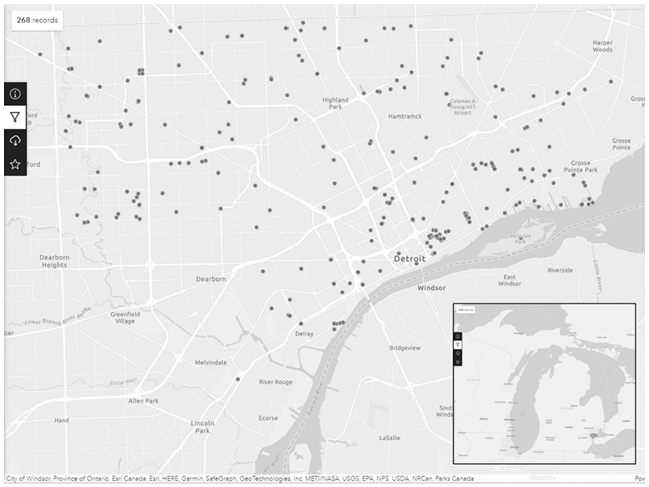
The action situation leads to a pattern of interactions. In this case, property owners use the information they must decide whether to install GSI practices. To date, only 268 properties have chosen to install a GSI practice. Many of these are publicly owned by the city (Table 4.2). The most common practice (disconnected impervious) simply means that the property’s impervious surface does not drain into the stormwater system and is therefore exempt from the drainage charge. The second most common practice (downspout disconnect) involves letting stormwater discharge onto a pervious surface instead of flowing directly into the storm drain. Neither the disconnected impervious nor the downspout disconnection involve actively constructed GSI practices. After accounting for those, only 121 properties actively manage stormwater on-site using GSI. The GSI practices are spread throughout the city (Figure 4.7).
| GI practice type | Number of properties |
|---|---|
| Disconnected Impervious | 105 |
| Downspout Disconnection | 42 |
| Bioretention | 31 |
| Multiple | 21 |
| Subsurface Detention | 14 |
| Water Harvesting | 13 |
| Rain Garden | 13 |
| Permeable Pavement | 8 |
| Bioswale | 6 |
| Green Roof | 5 |
| All Stormwater Stays On-site | 3 |
| Rain Barrel | 2 |
| Subsurface Infiltration | 2 |
| Surface Detention | 1 |
| Stormwater/Constructed Wetland | 1 |
| Other | 1 |
| Total | 268 |
Geographic distribution of GSI practices in Detroit, Michigan.
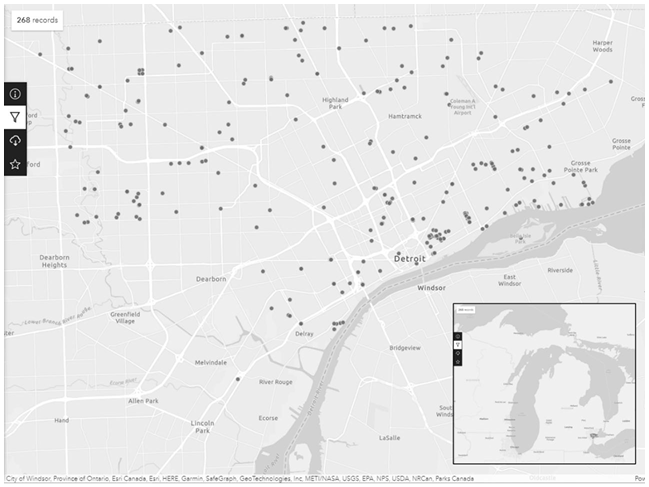
Figure 4.7 Long description
Map of the Detroit–Windsor region with 268 data points marking locations of GSI practices. Detroit and Windsor appear near the center, separated by the Detroit River. Surrounding cities such as Dearborn, Highland Park, Hamtramck, Lincoln Park, Melvindale, Harper Woods, and Grosse Pointe Park are labeled. The points are scattered across the metropolitan area, with the densest cluster in and around central Detroit and along the riverfront, gradually thinning toward the suburbs. Standard map interface icons for information, layers, filters, downloads, and favorites appear along the left side. An inset map in the lower right shows the region’s position within the broader Great Lakes area, with a highlighted box marking the extent of the main map. Attribution text from various geographic data providers runs along the bottom edge.
Constructing GSI practices generates economic activity across the region. The results of the IMPLAN economic development impact indicate that each $100,000 in GSI practice construction leads to $183,779 in gross output, $164,903 in earnings, and $190,726 in value added.
4.4.2 Institutional Analysis of Knowledge Commons
Figure 4.8 summarizes the GKC framework for GSI in Detroit. The basic concept of GSI has been around for decades and thus may be considered common knowledge. For example, the US EPA (United States Environmental Protection Agency 2015b) promotes GSI practices through its Soak Up the Rain program, which includes webinars, posters, and other resources in the public domain. DWSD provides publicly available information for property owners on how to reduce drainage charges through GSI (Detroit Water and Sewerage Department 2020). Numerous NGOs, such as the West Michigan Environmental Action Council and The Nature Conservancy, provide general and Michigan-specific information about on-site stormwater management using GSI. The Detroit Stormwater Hub Advisory Group is an especially important coalition of organizations working on GSI in some capacity (https://detroitstormwater.org/about-us).
Knowledge commons for GSI.
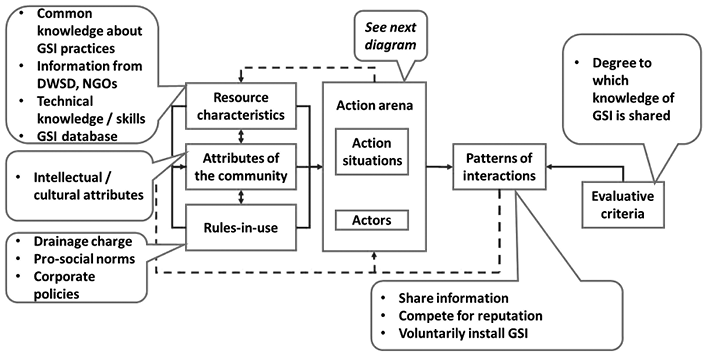
Figure 4.8 Long description
Diagram presents a framework for understanding how knowledge and community factors influence the adoption and coordination of GSI. On the left, inputs include resource characteristics such as common knowledge about GSI, information from DWSD and NGOs, technical skills, and a GSI database. Community attributes include intellectual and cultural traits. Rules in use include drainage charges, pro social norms, and corporate policies. These inputs connect to the center of the diagram, the action arena, made up of action situations and actors. Arrows show that resource characteristics and community attributes shape the action arena, while rules in use influence it and are also shaped by community attributes. A note from the action arena directs to another diagram. On the right, outputs show patterns of interactions such as sharing information, competing for reputation, or voluntarily installing GSI. A feedback arrow links these patterns back to the action arena. Evaluative criteria, such as the degree to which GSI knowledge is shared, assess these interaction patterns.
However, Detroit property owners can only obtain a drainage charge reduction (up to 80 percent) if their GSI practice is designed and installed by a professional engineer. The professional must certify that the practice meets the standards set in the Post-Construction Stormwater Management Ordinance (City of Detroit 2020b) and Stormwater Management Design Manual (Detroit Water and Sewerage Department 2022). This technical knowledge is a critical resource for managing stormwater, yet may be difficult to access for many property owners, especially residents.
DWSD also maintains two publicly accessible online databases. One is the DWSD Impervious Surfaces Public Viewer (https://detroitmi.gov/webapp/impervious-surfaces-public-viewer). The website features an interactive map of all impervious surfaces within DWSD’s service area. Anyone can locate properties, view the impervious surfaces, and inspect the details. DWSD has a procedure for property owners to correct the calculation of impervious surface. DWSD also maintains an online map of all registered GSI projects (https://detroitstormwater.org/). The map includes information about the GSI location, type, area managed, and other key attributes.
The intellectual and cultural attributes of the community members vary greatly. Property owners may have a high level of sophisticated, technical expertise about GSI or may know very little. Government/municipal properties and commercial/industrial properties account for about half of all GSI installations (Table 4.3). This suggests that these property owners have a high degree of knowledge about GSI practices and the capacity to seek out qualified installers. The city has 322,906 housing units of which 232,492 (72 percent) are single family homes. Yet only fifteen residential properties have installed GSI practices (Census Reporter 2021). Residential properties already receive a 25 percent credit, and it would be difficult to manage enough runoff on a typical residential lot to achieve more than that.
| Owner type | Number of properties | Percentage of total |
|---|---|---|
| Government | 61 | 22.7 |
| Commercial | 43 | 16.0 |
| Industrial | 24 | 9.0 |
| Faith-based | 16 | 6.0 |
| Residential | 15 | 5.6 |
| Nonprofit | 14 | 5.2 |
| Municipal (libraries, etc.) | 8 | 3.0 |
| Educational institute | 2 | 0.7 |
| Owner type unknown | 84 | 31.3 |
| Total | 268 | 100.0Footnote * |
* The percentages do not add up to 100.0 because of rounding.
The drainage charge and Green Credit are two of the more formal rules-in-use within the knowledge commons. The drainage charge and Green Credits are price signals alerting all property owners to the scarcity of stormwater management services. Less formally, some property owners take prosocial actions to encourage others to adopt GSI. This is especially true of the sixteen faith-based communities. Sacred Heart Church, for example, has an informative kiosk explaining how its rain garden works. The rules-in-use may also include corporate policies. In Case 2, the retailer installed an underground detention tank because of corporate policy. Some sections of the city have master or framework plans that address stormwater. For instance, the Eastern Market Neighborhood Framework and Stormwater Management Network Plan includes plans for significant GSI as new development comes into the area. This would be reiterated through the city permitting process (City of Detroit 2020a).
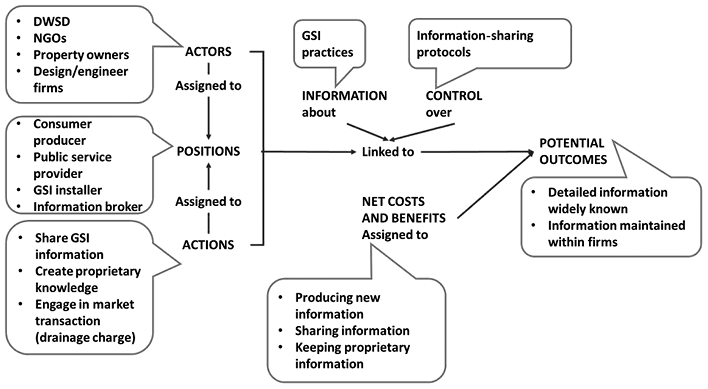
The action situation within the knowledge commons describes the choice whether to share information about GSI practices (Figure 4.9). Sharing information, such as engineering techniques and construction costs, may encourage others to adopt GSI practices. On the other hand, sharing might jeopardize valuable intellectual property. The actors include DWSD, various NGOs, property owners, and the design and engineering firms that install GSI. Property owners can be thought of as “consumer producers” who, when they install GSI, coproduce stormwater management services with DWSD, the public service provider. NGOs such as The Nature Conservancy can act as information brokers who can share knowledge that might otherwise be proprietary or hard to find. DWSD and design/engineering firms create knowledge about the costs, benefits, and operations of GSI when they design and install projects. Finally, all property owners share knowledge when they engage in the market transaction of the drainage charge.
Summary of the stormwater knowledge commons action situation.
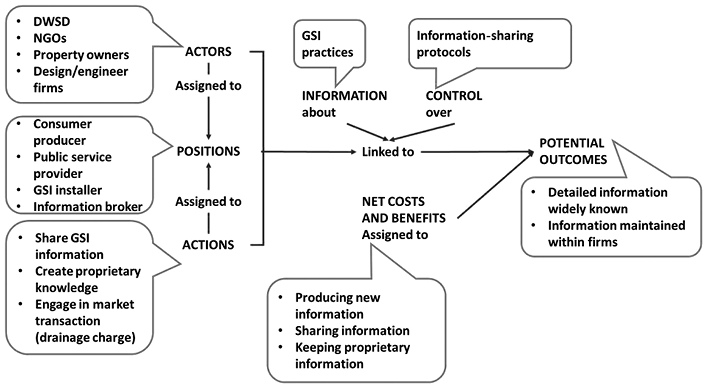
Figure 4.9 Long description
Diagram shows how different organizations influence the flow of GSI information. On the left, actors such as DWSD, NGOs, property owners, and design or engineering firms are assigned to positions including consumer producer, public service provider, GSI installer, and information broker. These positions perform actions such as sharing GSI information, creating proprietary knowledge, or engaging in market transactions like drainage charges. In the center, positions connect upward to information about GSI practices and downward to control over information sharing protocols. A second link points to net costs and benefits, assigned to producing new information, sharing it, or keeping it proprietary. All these factors lead to potential outcomes shown on the right: either detailed information becomes widely known or information remains within firms.
Actors then consider the information about GSI practices and their organizations’ protocols over information sharing. They assign costs and benefits to the actions of producing new information, sharing information, and keeping information proprietary. This can include not only the costs and benefits of whether to share, but of how much and when. Potential outcomes include a range of information availability from widely known details to secured, proprietary information.
4.4.3 Knowledge Commons Patterns of Interaction and Evaluative Criteria
Repeated decisions within the action situation result in a pattern of interactions. The organizations decide how much GSI information to share. But in doing so, they also engage in prosocial activity that can inspire others to act. Those organizations that are willing to share information may be held in higher esteem by their community members. Most importantly, the pattern of interactions will lead to some property owners installing practices. The evaluative criterion at this level is the degree to which GSI information is shared.
4.5 Conclusions
Detroit’s stormwater drainage charge is a price signal. It informs the property owner that stormwater management is a scarce resource and provides an economic incentive to reduce stormwater runoff. However, the fourteen GSI cases we reviewed showed that the discounted benefits of avoiding the drainage charge did not exceed the GSI practices’ discounted construction and maintenance costs. Either the drainage charge is too low to incentive the property owners to reduce runoff, or the costs are too high. The social benefits of GSI, on the other hand, often do exceed the construction and maintenance costs. As a result, only 268 properties have been documented to include GSI practices out of the many thousands of properties across Detroit.
The GKC framework enables us to explore more than economic motivations for implementing GSI practices. For example, our cases included two faith communities. Both stated they have a focus on environmental stewardship that stems from their religious missions. Part of that stewardship also entails sharing knowledge about GSI practices and encouraging others to install what they can. The Sacred Heart rain garden in particular is located in a district that emphasizes the use of GSI, is highly visible to the community, and includes informative kiosks. The Nature Conservancy worked closely with Sacred Heart and the team of designers and builders to construct the project.
The drainage charge’s economic model provides that price signal regarding stormwater management. But acting on that signal requires property owners to be aware of the alternatives. The Nature Conservancy team consulted with many property owners who installed GSI practices. Most of them declined to share their GSI projects’ details. Some GSI projects are relatively simple, such as a rain barrel or small rain garden. These can be done by the homeowner but may not manage much runoff or achieve much credit. However, constructing a rain garden for a parking lot, for example, requires significant technical expertise and equipment. The anecdotal information gathered from these conversations suggests that many property owners, large and small, do not know how to reduce their drainage charges with GSI practices. Many design and engineering firms tend to have expertise in specific GSI practices and stick to what is most familiar to them. In the case of one of the commercial buildings, the decision to install an underground storage tank was made at corporate headquarters, not by the local manager. Therefore, the drainage charge’s price signal may not work as well as intended.
Our research questions were:
How do economic incentives, like the drainage charge, affect the decision to adopt GSI practices?
Do property owners know how to reduce their drainage charges using GSI?
Is the knowledge about GSI practices widely available (a knowledge commons) or essentially privatized within design/engineering firms?
Our research has shown that the lifetime discounted benefits of avoiding the drainage charge are less than the lifetime discounted costs of constructing and maintaining GSI. However, the additional value of the cobenefits, including avoided pollution, avoided flood risk, and scenic amenity, provide substantial benefits to society. Therefore, the net present value GSI is, in many cases, positive when the social benefits are included. The drainage charge alone is insufficient to encourage private property owners to install GSI practices.
Many property owners do not know how to reduce their drainage charges using GSI, and knowledge about GSI practices is not widespread. This information is held by a select set of technical experts – engineers and landscape designers. The Nature Conservancy collaborated with Sacred Heart Church to install a demonstration practice that effectively managed stormwater from the church’s parking lot. The project’s high cost was related to the complexity of moving utility lines and other nonstandard expenses. Highly visible projects such as those at Sacred Heart and the City of Detroit properties may educate residents and property owners about GSI practices.

 Open access