


In 1999 the UK Government White Paper Saving Lives: Our Healthier Nation set a target reduction in the rate of suicide among people with severe mental illness (Department of Health, 1999). The target was to reduce suicide by at least one-fifth by 2010. Schizophrenia is the second most common primary diagnosis in suicide inquiry cases, with around 1000 patients committing suicide in the UK each year (Reference ApplebyAppleby, 1999). Those most at risk experience severe illness, frequent relapse, hospitalisation (Reference Modestin, Zarro and WaldvogelModestin et al, 1992) and significant depressive symptoms (Reference Addington and AddingtonAddington & Addington, 1992), characteristics typical of treatment-resistant schizophrenia.
Clozapine has been shown to be more effective than conventional neuroleptic drugs in reducing both the positive and negative symptoms of schizophrenia (Reference Wahlbeck, Cheine and EssaliWahlbeck et al, 1999), being effective in around 60% of all patients with treatment-resistant disease (Reference Meitzer, Burnett and BastaniMeltzer et al, 1990). Studies in the UK and USA now show that clozapine may also reduce the risk of suicide (Reference Meitzer and OkayliMeltzer & Okayli, 1995; Reference Munro, O'Sullivan and AndrewsMunro et al, 1999).
Although the average annual acquisition cost of clozapine is significantly greater than that of either typical or atypical drugs (£2920 and £1770 respectively), clozapine has been shown to significantly decrease in-patient stay and therefore total health service costs (National Institute for Clinical Excellence, 2002).
The aim of this study was to model the potential impact of increased clozapine prescribing on patient mortality and the resulting resource implications.
METHOD
A 40-year time series, based on a static prevalence and current UK population trends, was modelled. The prevalence of schizophrenia was taken from systematic reviews conducted by the Cochrane Schizophrenia Group (Reference AdamsAdams, 1999).
The model compared the impact of extending current levels of clozapine prescribing to all those with treatment-resistant schizophrenia who were willing to take the drug and were compliant with therapy. Although 30% of patients are reported to have treatment-resistant illness (Reference MeitzerMeltzer, 1997) and are therefore potentially suitable for clozapine therapy, a proportion will decline therapy or not comply. Accordingly we assumed that only 20% of patients would be treated with clozapine and that 60% of this group would experience sufficient clinical benefit to remain on treatment (Reference Meitzer, Burnett and BastaniMeltzer et al, 1990). The percentage of patients currently prescribed clozapine was derived from data provided by the Clozaril Patient Monitoring Service.
Modelling the rate of suicide
In each scenario, patients were divided into those receiving clozapine and those receiving conventional neuroleptic therapy. No comparison was made with other atypical neuroleptics, as clozapine remains the only medication licensed for use in patients with treatment-resistant schizophrenia.
The annual incidence of suicide in people with schizophrenia was calculated from data presented in Safer Services: National Confidential Inquiry into Suicide and Homicide by People with Mental Illness (Reference ApplebyAppleby, 1999). The reduction in risk experienced by patients on clozapine therapy was taken from Munro et al (Reference Munro, O'Sullivan and Andrews1999). In this study of 12 760 patients, those treated with clozapine experienced a four-fold decrease in the expected risk of suicide compared with the general population with schizophrenia. The annual incidence of suicide in people with schizophrenia was combined with the findings of Munro et al in order to calculate suicide rates for patients prescribed cloza clozapine and those treated with other drugs. These incidence rates were then applied to the two patient groups, those on clozapine therapy and those on standard neuroleptic therapy. The resulting number of suicides was combined to give a total figure for each year.
Cost calculations
Costs were divided into patient support and suicide costs.
Cost of patient support
Annual support costs were calculated using a weighted average cost of £5127 per patient per year. This was based on an incident patient cost to the National Health Service (NHS) of £8740 (Reference Guest and CooksonGuest & Cookson, 1999) and a prevalent patient cost of £5038 (Reference Knapp, Chisholm and LeeseKnapp et al, 2002). Using these figures, a weighted cost was calculated based on the proportion of ‘incident’ and ‘prevalent’ patients (the incidence of schizophrenia being 1/10 000 (Reference TurnerTurner, 1997) or 2.4% of the population with schizophrenia).
Patients surviving each year were assumed to incur the total annual support cost, whereas those who committed suicide were assumed to incur only half this figure. This uses the concept of half-cycle correction and is based on the assumption that equal proportions of patients die in each month of the year. Some die in the first month, avoiding management costs for the whole year, whereas others die in the last month, having used 12 months of health care resources. Arithmetically, this is the same as assuming that all patients who die do so at month 6.
Clozapine therapy and the cost of patient support
Evidence suggests that treatment with clozapine is either cost-saving or cost-neutral when compared with standard neuroleptic therapy (Reference RevickiRevicki, 1999; details of a recent unpublished systematic review are available from the author upon request). Guidance from the National Institute for Clinical Excellence (2002) has estimated that clozapine generates savings regardless of whether the patient has previously been treated with a typical or an atypical antipsychotic drug, and that the levels of savings are similar. In our analysis, costs were calculated for both scenarios, one in which clozapine was assumed to be cost-neutral and a second in which it was assumed to be cost-saving. In the cost-saving scenario, support costs were reduced by 10% for all patients taking clozapine (Reference Aitchison and KerwinAitchison & Kerwin, 1997). This is relatively conservative in relation to the recent estimates from the National Institute for Clinical Excellence.
Cost of suicide
A cost of £187 was applied to suicides (Reference Netten and DennettNetten & Dennett, 1996). This figure includes only ‘general hospital costs’ and is therefore narrow in its definition, excluding the considerable consequences associated with distress and lost productivity.
Acute bed requirement calculations
Utilisation of acute bed days was calculated from hospital episode statistics for schizophrenic psychosis (Department of Health, 1996). These data suggest that 16.7% of people with schizophrenia use acute in-patient services each year, with an average length of stay of 129.7 days. The number of days hospitalised was reduced by 16.9% for people treated with clozapine (Reference Rosenheck, Cramer and XuRosenheck et al, 1997). Other studies have reported reductions in ‘hospitalisation’, but this figure is less easily applied to the calculation of a reduction in bed days.
Life-years saved calculations
Life-years saved were calculated on the assumption that the life expectancy of a person with schizophrenia at diagnosis is 37 years (Reference Davies and DrummondDavies & Drummond, 1993). It was assumed that the average life expectancy of a patient at any one time was half this figure.
Discounting
When estimating the cost-effectiveness of treatments that have an impact over extended periods, it is common practice to discount both future costs and benefits. This reflects the fact that people attach a lower value today to benefits and costs that occur in future years. Outcomes were discounted at 1.5% and costs at 6% in accordance with recommendations. We have reported our results both with and without discount rates applied.
RESULTS
It was estimated that 30 000 persons with treatment-resistant schizophrenia would be suitable for and compliant with clozapine therapy. This equates to an additional 16 330 patients in the UK. By prescribing clozapine to these patients, an average of 53 suicides would be avoided each year (Table 1), resulting in more than 10 250 life-years saved over the next 20 years.
Cumulative suicides potentially avoidable in the UK

| Year 3 | Year 10 | |
|---|---|---|
| Suicides avoided1 | 154 (151) | 518 (484) |
Cost-neutral scenario
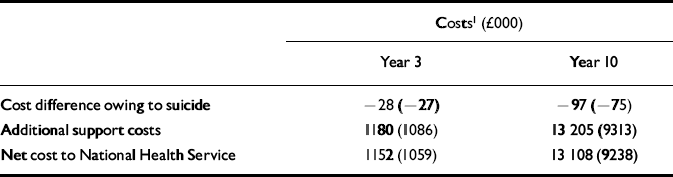
In the cost-neutral scenario (Table 2) the additional cost associated with keeping patients alive was approximately £3.8 million per year. A proportion of this cost was offset by savings that result from a reduction in the number of suicides. These savings totalled approximately £10 000 per year. Our analysis indicates that current support costs are just over £1300 million per year. An incremental £3.8 million therefore equates to a 0.3% increase in the cost of patient support. The cost per life-year saved was £5108.
Cost-neutral scenario: impact on cumulative costs in the UK
| Costs1 (£000) | ||
|---|---|---|
| Year 3 | Year 10 | |
| Cost difference owing to suicide | -28 (-27) | -97 (-75) |
| Additional support costs | 1180 (1086) | 13 205 (9313) |
| Net cost to National Health Service | 1152 (1059) | 13 108 (9238) |
Cost-saving scenario
In the cost-saving scenario (Table 3), the additional cost associated with keeping patients alive was more than offset by savings that accrue when patients are switched from conventional neuroleptic therapy to clozapine. Based on a 10% reduction in the cost of support for those receiving clozapine, the total cost of support fell by more than £8.7 million per year. Taking into account the £10 000 saved as a result of fewer suicides each year, the net annual saving totalled approximately £8 748 000.
Cost-saving scenario: impact on cumulative costs in the UK

| Costs1 (£000) | ||
|---|---|---|
| Year 3 | Year 10 | |
| Cost difference owing to suicide | -28 (-27) | -97 (-75) |
| Change in support costs | -24 786 (-23 406) | -83 492 (-65 045) |
| Net cost difference | -24 814 (-23 433) | -83 589 (-65 120) |
Acute beds
If more patients are kept alive, the impact on hospitalisation and therefore acute bed requirements is very positive. Studies show a reduction in hospitalisation among patients receiving clozapine therapy (Reference Meitzer, Cola and WayMeltzer et al, 1993; Reference Rosenheck, Cramer and XuRosenheck et al, 1997). Modelling this effect led to a saving of 167 acute beds in the UK per year.
Sensitivity analysis
A sensitivity analysis was carried out by varying the suicide risk reduction experienced by patients on clozapine therapy ν. patients on conventional neuroleptic therapy from 25% (Reference Meitzer, Cola and WayMeltzer et al, 1993) to 75% (Reference Munro, O'Sullivan and AndrewsMunro et al, 1999), the cost of patient support between £5038 (Reference Knapp, Chisholm and LeeseKnapp et al, 2002) and £8740 (Reference Guest and CooksonGuest & Cookson, 1999), and the reduction in the support cost of patients receiving clozapine from a 0% cost saving (i.e. cost-neutral; Reference RevickiRevicki, 1999) to 50% (Reference Meitzer, Cola and WayMeltzer et al, 1993). Ten thousand random scenarios were generated using figures ranging between the lowest and highest of these estimates. Suicides avoided, life-years saved, cost per life-year saved and cost savings were recorded based on the current UK population.
The mean number of suicides avoided was 35 per year (95% CI 34.96–35.09), the average number of life-years saved at 20 years was 6833 (95% CI 6831.8–6834.3) and the average cost per life-years saved was £6864 (95% CI 6863.4–6864.7). Cost savings occurred in 94.4% of cases and averaged £29.8 million per year (95% CI 29.79–29.82).
DISCUSSION
Suicide and evidence for existing interventions
Every year approximately 5000 suicides are recorded in the UK (Reference ApplebyAppleby, 1999). The Government has set a target reduction of 20% of this figure – 1000 suicides – by 2010 (Department of Health, 1999). This may be a challenging target to meet. There is little substantive evidence to show the benefit of any one intervention in the prevention of suicide; therefore health providers are limited to strategies that could be useful, rather than those that have proved to be so. Energetic management of the underlying causes of suicide, predominantly mental illness, is one strategy. In the case of schizophrenia, although drug therapy affords measurable health improvements through a reduction in symptoms, it has failed to decrease the number of either attempted or completed suicides.
Clozapine therapy
Schizophrenia is a major cause of suicide. Those most at risk are those who, despite medication, experience persistent positive and negative symptoms, depression and hopelessness, characteristics apparent in those resistant to treatment. In such patients, clozapine has been shown to reduce suicidality in a controlled trial setting. ‘Real life’ data from over 12 000 patients prescribed clozapine have further supported this observation. In terms of both the quality and quantity of evidence for the effectiveness of any given mental health intervention in preventing or reducing suicide, clozapine probably has the strongest supporting data. This study has shown that, given expected levels of efficacy, clozapine could prevent approximately 53 suicides per year, thus meeting 5.3% of the Government's target.
Impact on NHS budgets
The impact on NHS budgets and resource use requires some consideration. Prescribing clozapine keeps more patients alive. Although such cost considerations would not be used to prevent the introduction of a treatment, it is none the less important for health planners to be aware of the budgetary impact of a new prescribing policy. This study sought to highlight the economic impact of a clozapine-based strategy to reduce rates of suicide. The majority of published health economic studies and reviews have suggested that clozapine is cost-saving when used in treatment-resistant schizophrenia, mainly owing to a reduction in hospitalisation. This analysis suggests that the additional cost of keeping patients alive is more than offset by expected savings.
However, this analysis takes no account of the resource and cost impact of attempted suicide. It is expected that an analysis of these data would strengthen the case put here, but would require more thorough modelling to address the issue.
Clinical Implications and Limitations
CLINICAL IMPLICATIONS
-
▪ If all patients with treatment-resistant schizophrenia received clozapine therapy, approximately 53 suicides could be avoided in the UK each year.
-
▪ Clozapine frees resources. If all patients with treatment-resistant schizophrenia received clozapine therapy, approximately 167 acute beds per year would be freed and available for improving services elsewhere.
-
▪ Clozapine is cost-effective, with a cost per life-year saved of £5108 in treatment-resistant schizophrenia. This cost compared favourably with findings in other clinical areas.
LIMITATIONS
-
▪ Accurately estimating the number of suicides in any population is difficult. Only deaths that received a verdict of suicide (or an open verdict where suicide was a consideration) were included.
-
▪ The reduction in the risk of suicide among patients with treatment-resistant schizophrenia on clozapine therapy is based on an observation study.
-
▪ The process of modelling requires the acceptance of a number of assumptions, based wherever possible on UK-specific evidence.




eLetters
No eLetters have been published for this article.