


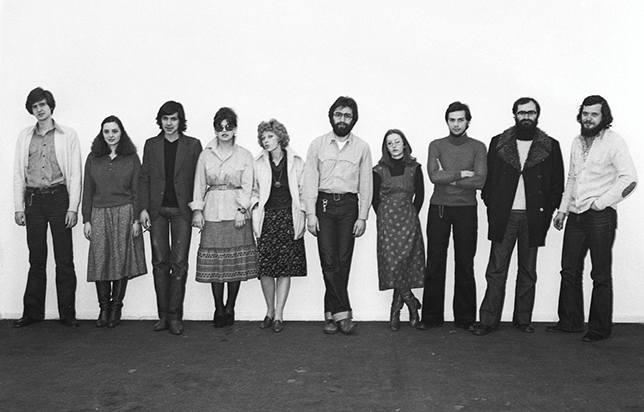
On December 7, 1977, Miloš Raičković assembled a group of friends from the Faculty of Music in Belgrade (FMU) and took center stage at the Student Cultural Center (SKC). The ensemble, comprising Olgica Antić, Aleksandar Damnjanović, Dragan Ilić, Nada Kolundžija, Anđelka Marjanović, Branka Parlić, Miroslav Savić, Slobodan Todorović, and Ksenija Zečević, would soon become known as Ansambl za drugu novu muziku (ADNM) [Ensemble for Different New Music] – a changing group of musicians who promoted music by minimalist composers (Figure 8.1). The pieces presented at this concert had caused an uproar at the FMU six months earlier, where Raičković was in his second year of studies in composition. Upon witnessing his thirty-five-minute work, Permutations for three pianos and eighteen hands, the jury, comprising three diehard traditionalists – Stanojlo Rajičić, Aleksandar Obradović, and Petar Ozgijan – gave him a failing grade. The cause for this tumult: Raičković had composed a piece of minimalist music.
Ansambl za drugu novu muziku [Ensemble for Different New Music] ca. 1978: (from left to right) Miloš Raičković, Katarina Miljković, Aleksandar Damnjanović, Ksenija Zečević, Nada Kolundžija, Miroslav Savić, Branka Parlić, Vladimir Tošić, Miodrag Lazarov Pashu, Milimir Drašković.
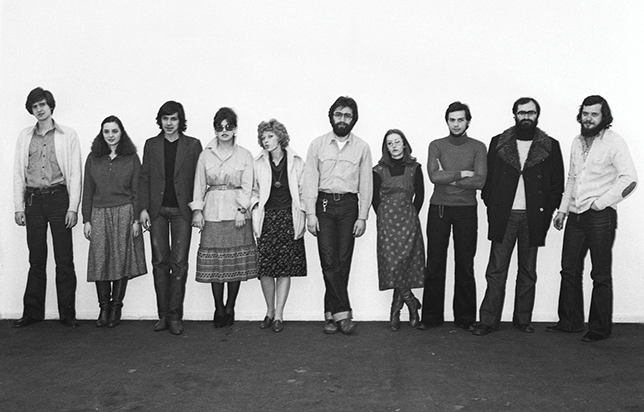
Figure 8.1 Long description
The ten members are lined up against the wall, standing casually, facing the camera are from left to right, Miloš Raičković, Katarina Miljković, Aleksandar Damnjanović, Ksenija Zečević, Nada Kolundžija, Miroslav Savić, Branka Parlić, Vladimir Tošić, Miodrag Lazarov Pashu, and Milimir Drašković.
In summer 1976, Raičković went to Paris to study with Olivier Messiaen (as auditeur libre in his courses at the Paris Conservatory). Raičković explains, “I was interested in serialism at that time, so Belgrade was not the place for me.”Footnote 1 However, while in Paris, Raičković encountered Steve Reich’s Music for 18 Musicians, which left a profound and everlasting effect on the young composer. Raičković reveals this experience in a candid interview with musicologist Valentina Radoman:
To me, Paris [in the 1970s], with composers like Messiaen, Boulez, and Xenakis, was the center of new music. Paradoxically, it was there that I “discovered” composers like Reich, Glass, Riley, and Meredith Monk, who performed their music at concerts. The minimal music of that time sounded new, powerful, and uninhibited, and it had already acquired a substantial audience. The atmosphere at these concerts seemed to me “healthier,” more open, and more humane than the atmosphere at the concerts given by the “dissonant avant-gardists.” At minimalists’ concerts, there was something “communal” about the music-making. People were friendly. In concerts at IRCAM, on the other hand, there was no sense of enjoyment and community, there was more of a feeling of “every man for himself,” or, rather, “every intellectual by himself.” Dissonant music had a neurotic and depressive effect. In some sense, there was a war between the two camps. On one side, you had a powerful, state-supported avant-garde with Boulez in charge of IRCAM; and on the other, you had visiting minimalists. The two styles never mixed at the same concert. These were separate worlds. I do remember an exception, a concert by the American minimalist Frederic Rzewski, presented at the Paris Conservatory (a bastion of dissonant aesthetics). After the first piece, all hell broke loose, and while some people were applauding, many more were shouting obscenities and booing. It was a strange phenomenon – that such anger was provoked by a very consonant piece.Footnote 2
When Raičković returned to Belgrade, he wrote a piece inspired by Reich – Permutations (1976–1977). Like his peers, Milimir Drašković, Miodrag Lazarov Pashu, Miroslav Savić, and Vladimir Tošić, who formed their composer collective, Opus 4, Raičković found no support or room for compositional growth at his home institution. Rather than succumbing to the “dogmatic and conservative” leanings of academia,Footnote 3 and giving in to the pressure of composing in “moderated modernism,” these rebellious students turned to American minimalism. They found a new, welcoming home for their experimentation and exploration: the Student Cultural Center.
The new musical style emerging from the SKC by these young composers during the late 1970s was grounded in American minimalism and experimentalism. Without support from their faculty and no means to learn about musical minimalism in Yugoslavia, these composers were self-taught and self-driven. As students at the FMU, they were familiar with early performance and conceptual art exhibitions by Marina Abramović, the “Belgrade Six,” and Joseph Beuys, among others, at the SKC during the early 1970s. They translated articles about American minimalist composers in their publication Nova/minimalna muzika [New/Minimal Music] and also Cage’s article, “The Future of Music: Credo,” which they referred to as truly “visionary.”Footnote 4 Savić, at the helm of the SKC Music Division, held the first public listening sessions for the recordings by Cage, La Monte Young, and others. Just as they were coming of age, Cage and the Merce Cunningham Dance Company made a spectacular showing at the Belgrade International Theater Festival (BITEF) in 1972.Footnote 5 Although the young composers did not attend this event, they certainly learned about the legendary performance later.Footnote 6 Shortly after, Cage’s influence changed the course of these composers’ artistic development. Raičković and the composers of Opus 4 would soon develop styles that “advocated for a new musical pluralism,” as Ivana Miladinović Prica argues – their radical musical innovation introduced experimental, minimalist, and electroacoustic music, and also performance art, video art, metamusic, and Fluxus to both the Belgrade and the Yugoslav art scene.Footnote 7
A Distinctive Brand of Yugoslav Minimalism
Musical minimalism emerged in the United States in the 1960s with the works of La Monte Young, Terry Riley, Steve Reich, and Philip Glass.”Footnote 8 The term “minimal” itself was coined by Michael Nyman and Tom Johnson to describe the compositions of Henning Christiansen and Alvin Lucier.Footnote 9 The term originated in reference to plastic arts, the type of art that was widely unfamiliar to critics, audiences, and musicians at that time, so when applied to music, the term was perceived negatively – it came to describe music with “no substance” or “music where nothing happens.”Footnote 10 With such a negative connotation, it is no surprise that both Reich and Glass adamantly detested the term and the association of their music with “minimalism.” As Jonathan Bernard points out, when Reich was asked to define minimalism, he responded, “I don’t. I steer away from that whole thing. Minimalism is not a word that I made up.” Glass showed an even stronger disdain by exclaiming that the term should be “stamped out.”Footnote 11 However, it is not just the term “minimalism” that has been contested historically; the reception of this music in the US was problematic from its inception. To this day, scholars remain divided on the state of minimalism. As Peter Shelley writes, for some scholars, “minimalism is a practice that died out almost as soon as it began,” while others view it as one of the most vital musical practices.Footnote 12 Even in 1980 when Glass and Reich were asked if minimalism as a living practice still existed, they quipped, “No – and good riddance, too.”Footnote 13
Strikingly, at the same time when music critics in the US were arguing that minimalism had reached the end of its short-lived run by the mid 1970s, citing that “its original practitioners [have] gone on to other things,”Footnote 14 the style was just emerging in Belgrade and Yugoslavia with the works of Opus 4 and Raičković. Their music was met with much criticism and resistance from academia, hardly surprising for conservative institutions that were still adhering to the principles of socialist realism.Footnote 15 Even the Zagreb Biennale avoided programming minimalist works in its rich and diverse offerings – the first minimalist work was not performed until May 13, 1979, when Raičković, with the Ensemble for Different New Music, and Michael Nyman with his ensemble, were programmed a concert, themed “Minimalia.” The program notes read, “It is a strange paradox that the Biennale had never before programmed even a single piece of so-called ‘minimal music,’ a significant phenomenon that emerged at the end of the 1960s.”Footnote 16 With the determination of Opus 4 (and individual effort by each composer), Raičković, and ADNM, minimalism reached all regions of Yugoslavia during the late 1970s and throughout the 1980s. But theirs was a distinctive brand of minimalism, grounded in the principles of conceptual art, music reduction, multimedia, individuality, and open structure (or opus ephemerum) for Opus 4 composers,Footnote 17 and a “purer” form of minimalism for Raičković, which he called “New Classicism.”
Miloš Raičković and New Classicism
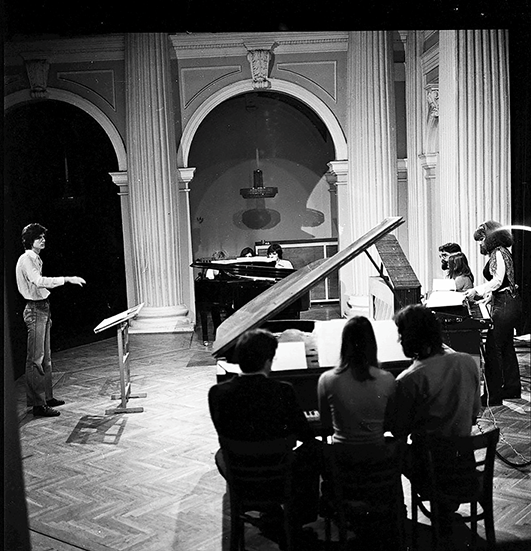
When Raičković and his friends took the stage at the SKC on December 7, 1977 (Figure 8.2), it was both an act in defiance of the “dogmatic” Faculty of Music and a liberating experience for the composer. In the program notes, the composer explains that he aimed to achieve “confidence in listening” – an assurance that the listener would not hear anything unpredictable.Footnote 18 The concert critic Dragan Mlađenović, in a review titled “The Situation with Professors Is Not Surprising,” referring to Raičković’s teachers at the FMU who had rejected his piece and had consequently flunked him, describes the novelty of Raičković’s approach to composition:
The music of Milos Raičković, a young composer from Belgrade (who, with his bad luck, is a student at the Faculty of Music) who recently performed at the Student Cultural Center, is divorced from 19th-century forms. The concert was especially interesting because it confirmed that the divorce is not only formal but also substantive, thus, it is definitive. Raičković deliberately runs away from an expression that is grounded in the principle of conflict and opposition – from a traditional harmonic structure. His music is based on a captivatingly calm flow and a predictable process of ordinary and unpretentious musical language.Footnote 19
Miloš Raičković conducts the Ensemble for Different New Music, December 7, 1977, Student Cultural Center in Belgrade.
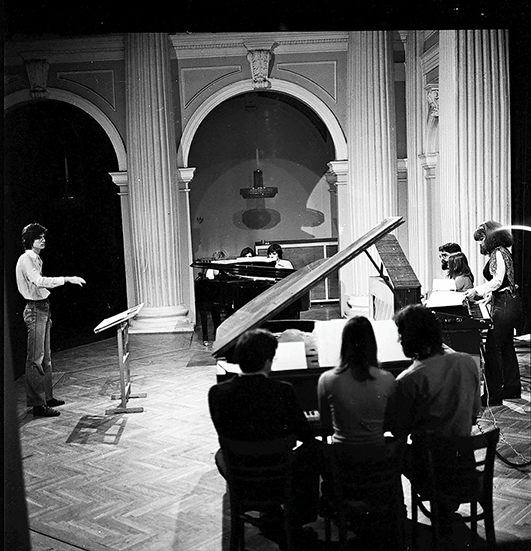
Figure 8.2 Long description
Clad in a white shirt and jeans, Raičković has a music stand with a score on it in front of him. He directs the ensemble with his right hand. On the stage are two grand pianos, one to Raičković’s right and the other to his left, with three performers sitting at each. In front of him is an upright piano with two pianists sitting at it and an electric keyboard next to it with another performer standing and playing it.
Permutations was originally a piece in three movements, based on the principle of permutations of six pitches, C, D, E, G, A, B (in some movements it is systematic, in others arbitrary), and repetition, a style to which Raičković referred to as “ascetic minimalism.”Footnote 20 Raičković later expanded the work into a cycle, Permutations I–V, each one constituting an individual “event” framed around a different procedure of permutations of these six notes. The first three pieces (titled “Little Peaceful Music,” “Canon,” and “Water Tones”) are based on a random order of permutations. Permutations I, written for a single line on any instrument but for two performers, repeats 192 segments of 6 pitches (6 segments per line, with 32 lines) (Example 8.1). The two performers take turns playing each line. In Permutations II (for two pianos played by seven performers), each performer is assigned a single octave, thus covering together the entire range of the piano. The seven parts begin in unison and gradually branch out into a canon. For the form of Permutations III, Raičković was inspired by Jackson Pollock’s “action painting” – a term coined by critic Harold Rosenberg to refer to a style of painting in which artists see the canvas as a space for action.Footnote 21 Raičković explains that in this work, the permutations of the pitches are arbitrary and there is no discernible pulse – the durations of long and short notes are also random. It is the conductor who shapes the piece by controlling who plays at any particular moment and determines the dynamics, articulation, and tempo for each performer. Hence, Raičković likens the role of the conductor to a painter who “makes a general gesture (spilling the paint in a certain way in a particular direction) but cannot predict the details of the painting.”Footnote 22 He concludes by noting that the musical form of “Water Tones” is thus “created by the conductor,” and each performance represents a new “version” of the piece.Footnote 23
Miloš Raičković, Permutations I, “Little Peaceful Music” (1976), the first line.

Example 8.1 Long description
Written in 6/4 meter on a single treble staff, it features six groups of sixteenth-note septuplets that play a rotating pattern of a melody that contains only six pitches, C, D, E, G, A, B.
Permutations IV, “Mirror” (1980), added a few years later, is for piano six hands, where each hand plays one note at a time, generating a chord with all six pitches. The work follows a systematic process of pitch reordering, both horizontally and vertically, until all 720 possible combinations are exhausted. In the last piece in the cycle, Permutations V, “Sound of the White Hole” (1978), for six performers on various keyboard and mallet instruments, all performers play the permutations (linearly or as chord clusters) in the same octave. The piece again features 720 systematic combinations, but each is orchestrated differently.Footnote 24
Following the initial presentations of Permutations at the SKC, Raičković reprised the same program with ADNM at the University Student Center in Zagreb [Studentski centar sveučilišta] on February 24, 1977, and then a month later, he returned to SKC in Belgrade with two other composers-performers – Aleksandar Damnjanović (b. 1958) and Katarina Miljković (b. 1959) – to present a new version of Permutations III.Footnote 25 Permutations III and V were performed at the Music Biennale in Zagreb on May 13, 1979 – the aforementioned “Minimalia” concert. The entire cycle was revived at the third rendition of the Festival for Different New Music, May 18–22, 1986, at the SKC.
By 1979, Raičković had started composing in a new style, which he termed “New Classicism” – a blend of minimalism and the “Viennese Classical and early Romantic” styles. In these works, the form is “classical” (such as sonata form or variations, among others), but tonally, the music is reduced to only a few pitches of the scale. However, Raičković does not see anything “reductionist” in working with a small number of pitches. He explains: “It is simply my own material. When I write, I don’t feel that anything is missing.”Footnote 26 His compositional technique is not grounded in the typical minimalist techniques, such as Reich’s repetitive patterns or Glass’s additive rhythms. Rather, Raičković applies a new method in each work; one such approach is using fragments from a theme, mixing them with the initial material, and then splitting them into even smaller fragments and proceeding to work with them again in a new way, “like a collage,” explains the composer.Footnote 27 This new approach creates a “new quality” and a “new energy” in his music, enabling Raičković to both express his feelings and satisfy his needs for a clear and coherent musical language.
Opus 4: Minimalism and Fluxus
The young composers comprising the Opus 4 collective – Drašković, Lazarov Pashu, Savić, and Tošić – emerged on the scene on May 20, 1976, about a year before Raičković’s debut. Also rebelling against rigid conservatism at the Faculty of Music and suffering the same fate of rejection by their professors, they robustly organized activities at the SKC, often together with Raičković and Miloš Petrović.Footnote 28 Their common interests in experimentation, musical pluralism, and individual growth brought them together and radically changed the course of music in Yugoslavia at the time. Their work as composers-performers within Opus 4 lasted until 1982, followed by continued individual experimentation. Even while working within the collective, freedom of individual expression was one of the group’s guiding principles. Lazarov Pashu reveals in an interview: “In our scheduled [Opus 4] meetings, each one of us would explain what we were working on, or what we were intending to do in the upcoming performances,” concluding that although they were all so different, they influenced and learned from one another.Footnote 29
The period coinciding with the formation of Opus 4 – the 1970s – was ripe for new artistic and cultural currents in Belgrade and Yugoslavia. The Electronic Studio of Radio Belgrade, the first electronic studio in Yugoslavia, was founded; the Third Program of Radio Belgrade, the first radio program dedicated to the promotion and broadcast of new music, was established; the SKC in Belgrade opened its doors to the young generation of student artists, free to experiment and express themselves in any way they wanted; the annual April Encounters – a festival of expanded media and conceptual art spearheaded by Marina Abramović and the “Belgrade Six” – were launched; many other festivals around Yugoslavia (especially in Belgrade, Zagreb, and Ljubljana), such as the Music Biennale Zagreb and BITEF, were already recognized as centers for international exchange; David Tudor, Cage, and the Merce Cunningham Dance Company created three different “events” for the 1972 BITEF;Footnote 30 Glass’s iconic performance of Einstein on the Beach was performed at BITEF in 1976;Footnote 31 and the innovation of the video recorder and other technology enabled these composers to incorporate multimedia in their works. Vladimir Tošić puts it succinctly:
It was our luck that this was the period of vast expansion of new art in Belgrade and Yugoslavia, and it was all happening at the Student Cultural Center – our second home. Conceptual art was at its peak with local artists such as Marina Abramović, Raša Todosijević, Zoran Popović, Neša Paripović, and world-renowned artists like Hans Otte, Mauricio Kagel, Joseph Beuys, among many others. As early as 1976, a cult play by Bob Wilson set to the music of Philip Glass, Einstein on the Beach, was performed at BITEF in Belgrade. We, too, created our most significant projects both individually and collectively at that time and ventured out into the world. It was truly the most creative moment for new art [in Yugoslavia], and we operated in total correlation to it and were a crucial part of it.Footnote 32
The young composers absorbed the radical creativity happening around them in Belgrade and, influenced by it all, especially by minimalism, Cage-inspired happenings and events, conceptual and performance art, and Fluxus, they developed their distinct style. It was not unusual that Fluxus and Cage were the primary sources of inspiration for the Opus 4 composers. Fluxus, founded by Lithuanian-born American artist George Maciunas in the 1960s, quickly spread across Eastern and Central Europe. Further, Cage and Cunningham had performed in Prague in 1964 and contributed to the further reach of Fluxus across the West. Amy Bryzgel argues that Fluxus was a “significant point of contact between East and West.”Footnote 33 With Cage’s influence on this avant-garde art movement, for young experimental composers in Yugoslavia, he was at the center of it all.
Milimir Drašković
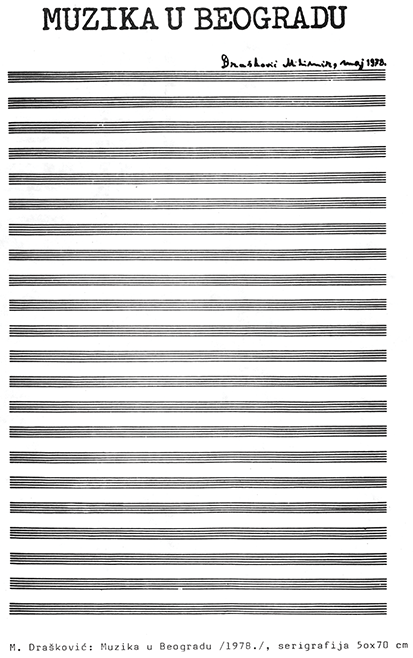
From the very beginning of his career, Drašković showed an interest in integrating multimedia, including installations, video projections, and performance art, into his compositions. Not considering his music as “minimalist” in style until 1988 (with HPSCHD I, 1988, followed by HPSCHD II, 1990, both for harpsichord), Cage’s experimentations and Fluxus resonated more with him. While Drašković’s minimalist works are rather simple – they are based on a strict repetition of small segments, which he treats as a series – his multimedia works illustrate daring innovation and originality. Cage’s treatment of silence had an impact on Drašković. In a conceptual work titled Muzika u Beogradu [Music in Belgrade] (1978), Drašković presents a blank score of music, with just the title written on it (Example 8.2), explicitly evoking Cage’s 4‘33".
Milimir Drašković, Muzika u Beogradu [Music in Belgrade] (1978).
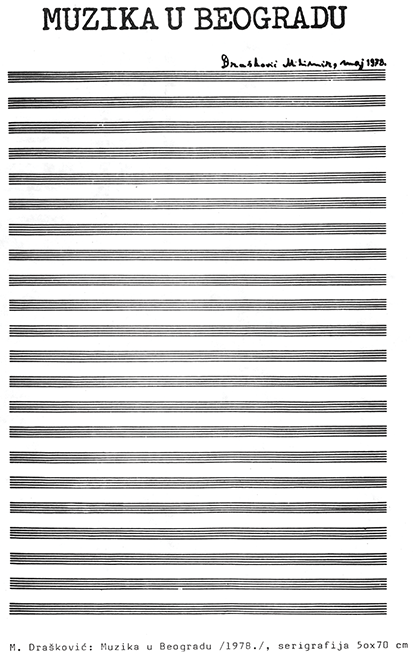
Example 8.2 Long description
On top of the page, typewritten in all-caps is the title of the work. Above the first staff line, on the right side, is the composer’s signature, Drašković Milimir, May 1978.
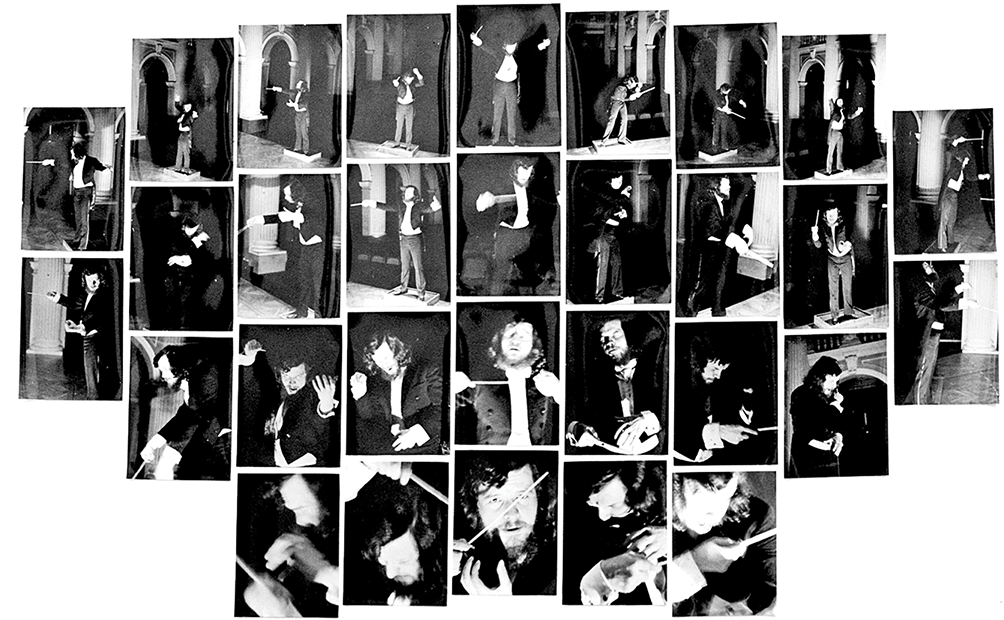
Dirigent [Conductor] (1979) is another conceptual work that has no traditionally notated music in it. The work, which, per Drašković’s inscription on the “score” (published as a booklet),Footnote 34 lasts for 22‘14", features thirty slides of Drašković, clad in a tuxedo and holding a baton, and making various gestures and facial expressions (Figure 8.3). Most of the slides are blurry, conveying motion. Each image portrays Drašković in a different position (i.e., gesture) and from a new angle, as if he were instructing specific sections of the orchestra, and the audience were listening. Lazarov Pashu described this project as both a musical work that one cannot hear and “a literary work that does not rest on any linguistic signifiers,”Footnote 35 while Mirjana Veselinović-Hofman regards Drašković’s works as a prime example of the “destruction of the institution of music,” much as Cage did with his experimentations at the New School in New York.Footnote 36
Milimir Drašković, Dirigent [Conductor] (1979), still photographs.
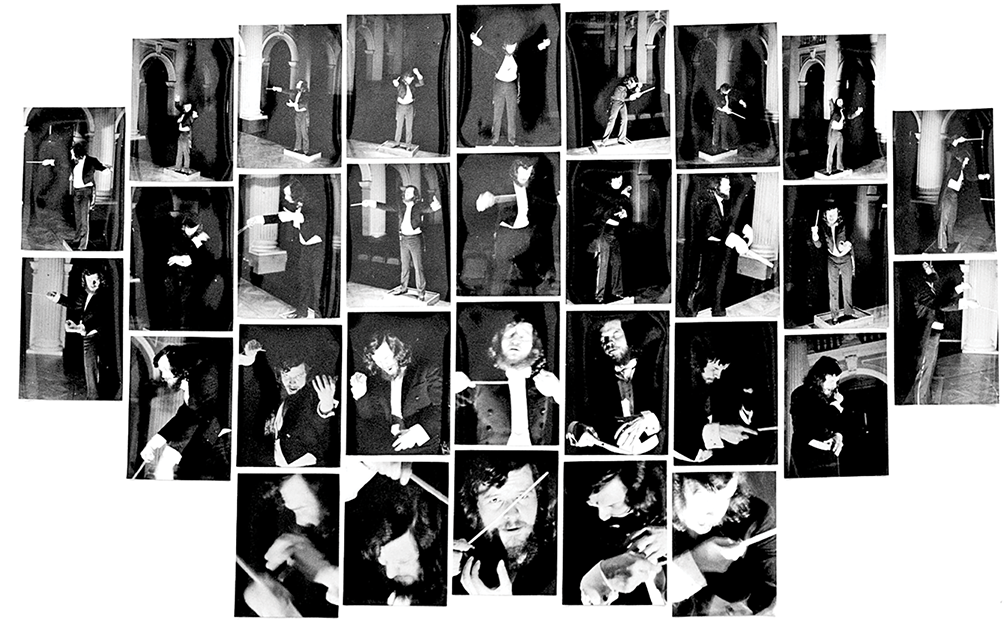
Figure 8.3 Long description
The slides are arranged in four rows. Each slide depicts Drašković in a different pose, standing on the podium and holding the baton with his arms horizontally spread out, conducting with one hand while gesturing with another, leaning to the side, making facial expressions, and so on. Some slides show his entire body on the stage from different angles, while others zoom in on his face to show his facial expressions and gestures.
In addition to the treatment of silence (that is, blurring the lines between music and silence), gestures, conceptual and performance art, and multimedia, Drašković’s works also exhibit Cage’s principles of indeterminacy and aleatory. They named these types of works ideosemas – combining the notions of an “idea” and “schema” – to denote “the entire body of works with contextual and immanent structural properties.”Footnote 37 In Drašković’s oeuvre, the concept of ideosemas is illustrated in works such as Opera (1979), 1–12 (1980), Klavir, Op. 4, No. 1 (1980), Video, Op. 4, No. 1 (1981), and Muzički magazin [Music store] (1982).
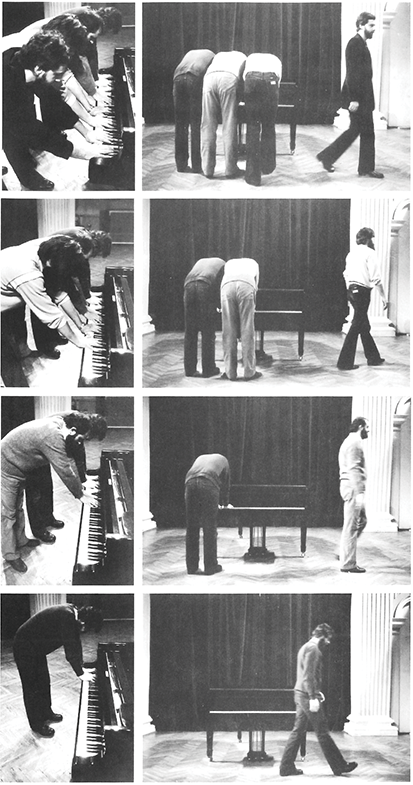
In 1–12, Drašković calls for up to twelve performers on different instruments. He further specifies that each player chooses a different pitch from the chromatic aggregate; they all begin playing together and stop once they have noticed that the others have stopped, without exceeding five minutes of inactivity. Klavir, Opus 4, No. 1 is for one to four performers on one to four pianos (with optional amplification) (Figure 8.4). The composer’s directions indicate the following:
Performers, all together, play a CLUSTER of 88 NOTES.
All players simultaneously STRIKE the cluster as HARD AS POSSIBLE
(with the pedal down) and remain STANDING at the piano(s)
as long as they can HEAR–SENSE the sound of the piano.
They can leave the stage one by one.Footnote 38
Milimir Drašković, Klavir, Opus 4, No. 1 (1980).
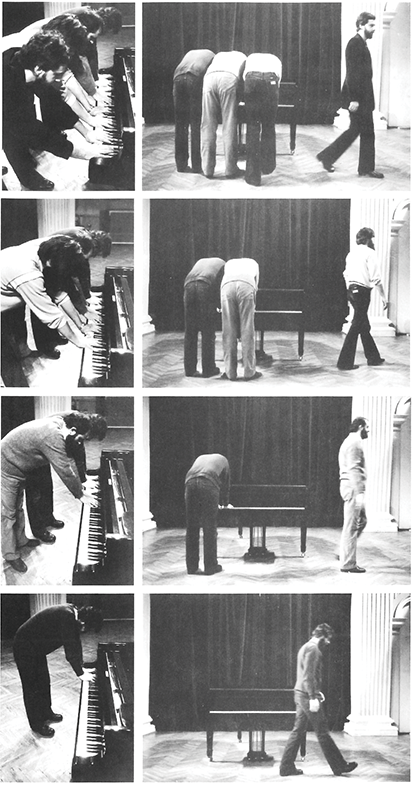
Figure 8.4 Long description
The collage is arranged in two columns, with four photographs in each. In the left column is a side view of the performers standing and leaning over the keyboard of the grand piano with both hands pressing the keys. The first photo shows all four players, the photo below shows three, the next one shows two, and the last photo shows the last remaining performer. In the right column is the view from behind each of the previous photos, showing four players, then one departing to leave three, and so on.
Similarly, in Video, Opus 4, No. 1 (again, intended for performance by Opus 4), Drašković calls for one to four author-performers, each standing in a corner of a square room. This work conveys each author’s attitude toward their own work, noting that with the presence of multiple authors in the same room, there is a possibility that there may be “common attitudes” displayed. Works like Music Store and Rođendan [Birthday] (1979) call for more variance and indeterminacy. In his event Rođendan, Drašković invites his friends to celebrate his twenty-seventh birthday at the SKC Happy New Art Gallery. There, Drašković presents twenty-seven blank audio cassettes, each one symbolically representing one year of his life. With this work, Drašković again blurs the lines of sound and silence, and of private and public, as Miladinović Prica notes, by transforming his private celebration into a public and cultural event.Footnote 39 In the Music Store, the composer invites others to join him in visiting a music instrument and record store on Terazije Street and playing all available instruments inside the store. Drašković records the sounds with various possible effects (with equipment available at the shop, such as echo machines) and then plays the recording in front of the store. This event, which took place on May 26, 1982, was part of the festivities organized by the SKC around Belgrade – in the streets, squares, and parks – in a week-long celebration (May 24–30, 1982) of National Youth Day.Footnote 40 The festivities, themed “Grad u reinkarnaciji” [A city in reincarnation], featured music performances, rock concerts, art and architectural installations, video and film projections, photo interventions, theater performances, and other street events.Footnote 41
Miodrag Lazarov Pashu
Pashu was also particularly influenced by Cage, especially by his events and happenings. For Pashu, Cage was “an irreplaceable figure of 20th-century music … because he made the very notion of research and experiment aesthetically relevant.”Footnote 42 Pashu’s approach to composition and application of Cage’s ideas differed in three ways from those of his Opus 4 peers, as he explains in an interview:
First, I implemented my philosophical and theoretical attitudes in complementing the multidisciplinary approach. In that, I was inventing new phenomenalistic forms, such as meta-music, integrated-object, or mic-medium. Second, I used theory as one of the disciplines in my global multidisciplinary approach … alongside composing music, conceptualizing, and realizing multimedia art and visual works. And, third, I ventured into visual art by conceptualizing and realizing works with neon as assemblages of neon tubes, neon sentences, or mathematical logic statements on canvas, marble, or gold plates.Footnote 43
Pashu’s approach is unmistakably influenced by conceptual, tactile, polymedial, and metamusical works by Radovanović, with whom he studied at EMS Radio Belgrade. Recognizing that Radovanović had already engaged in avant-garde music research decades ago, Pashu acknowledges his indebtedness to the Yugoslav experimental pioneer:
In our country, this new approach came into existence via the Expanded Media Festival, organized by the Student Cultural Center. It especially developed in the domain of visual arts … and sound – the auditory, in the broadest sense of the word. Before I joined this creative trend, it was already preceded by two elder colleagues, Vladan Radovanović and Paul Pignon, although the younger generation, which also includes myself, nonetheless differs in their approach.Footnote 44
Pashu’s creativity – influenced by Cage and Radovanović, but also with a distinct voice – is evident in his two cycles of metamusic/metalinguistic media: twenty works in his Muzika koja se misli [Music that is thought about] cycle and twenty-two works of Muzika koja se čita [Music that is read], both from 1982. The former features a numbered list with steps on how one should think about a specified piece of music. For instance, No. 10 only has one line of text, which directs the participant to think about the notion that one does not need to think about music or performers in a musical way. No. 8 provides a longer list of instructions:
1. Think about Igra.Footnote 45 If you think about Igra, you will free yourself of everything traditional, archetypical, conceptual, or semiotic.
2. Think about Tape–art 2 by Miodrag Lazarov Pashu.Footnote 46
3. Think about the supertonic.
4. Think [about the supertonic] in the highest register.
5. Check your pitch. Think about it.
6. Think about the adaptability of “I” with structure.
6a. Think about the adaptability of your “I, with Music that is thought about.”
7. Think about a segment of a piece. Why (and if) the segment must be as good as the work itself.
8. Walk around the city and try to compose. Think about what you think you are composing.
9. Think about G-sharp. And specifically, G-sharp in Ockeghem, da Venosa, Bach, Scarlatti, Mozart, Liszt, Schoenberg, and Cage.
10. Think about the harmony of spheres. About tutti. About harmony denoting an agreement between a musical thought and actual (realized) music.
11. Think about diminuendo.
11a. Also about ritenuto.
11b. And about perdendosi.
The latter cycle features a sheet with words written on it that are to be read (aloud or silently). No. 10, for instance, lists the following words: pianissimo, accelerando, sostenuto, herojski [heroically], and una corda. These works are built on the verbal and visual musical knowledge of music – Pashu expects the participants to apply their previous musical experience, understanding, and knowledge of music in order to interpret his compositions. That is, expecting the participants to think of a “G-sharp” presupposes that they know what that pitch denotes and how it sounds (i.e., its frequency). Asking them to think not only about that pitch but also about a particular musical, historical, and cultural context in which it may occur – in the works of specified composers – presupposes that the participant will have some knowledge about the history and theory of music.
Pashu created a series of ideosemas works. In Objekat koji svira na dodir [An object that plays on touch] (1982), Pashu sits on an ordinary wooden chair in a room and starts singing whenever someone touches him. He produces a new melody or a new sound each time, and the singing lasts as long as the duration of the touch. The piece lasts as long as there are “touchers.”Footnote 47 Several Fonoserije–Identiteti [Phonoseries–identities] explore a variety of musical and semantic characteristics. For instance, Dvanaest tonova temperovanog sistema [The twelve notes of the equal-tempered scale] explores the properties of acoustics and tone series. Pashu calls for the performer to depress a key on the amplified piano (with the lid raised, and a microphone placed near the strings) and shout the name of the key being depressed near the point where the hammer strikes the string. Then, the performer depresses several keys at the same time and shouts the name of those notes. While the order of pitches to be played/shouted is provided by the composer, the rhythm of shouting is variable, and the pitch and loudness level of shouting should be maintained throughout the performance. Pashu specifies that the amplification must be good enough to allow for the hall to echo with each shout and string resonance.
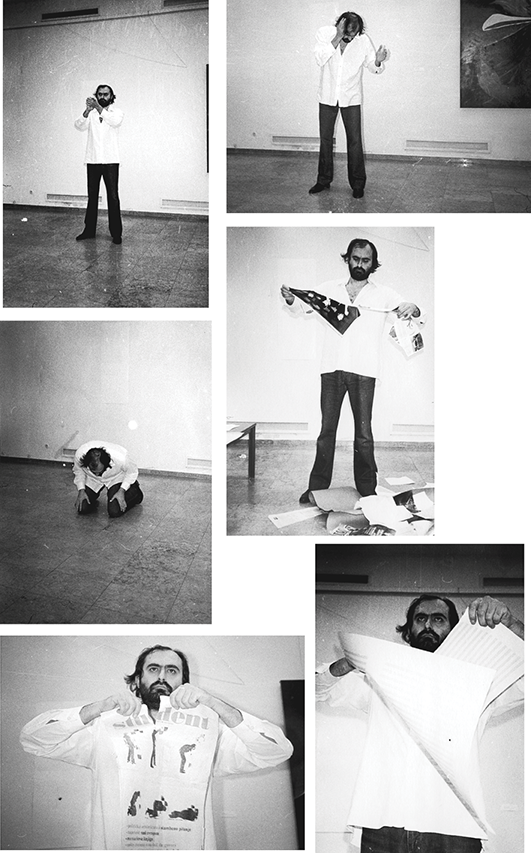
In exploring the musicality of semantic structures, Pashu presents several other works, such as Phonoseries–Identities / of Dynamic Structure, where he calls for the performer to pronounce the dynamic indications with the intensity they denote. In a work titled Struktura jednako struktura jednako struktura jednako struktura [Structure equals structure equals structure equals structure] (1982), Pashu sits at a table (in a gallery or a similar environment) and, either with or without sound amplification, utters the following text: “I am saying one word every minute,” pronouncing each word a minute apart. Pashu incorporates his body into the performance in Dva vida zvučnog [Two aspects of sound] (1981–1982), in which the work starts with the performer producing two contrasting sounds – loud and soft – by hitting his body in two different ways. While doing this, the Pashu stands up and takes a deep bow. Next to him are two piles of different types of paper. The performer first grabs a piece of paper from the first pile and tears it up quickly, producing a sound. This action is followed by tearing a paper slowly from the second pile, which produces a quieter sound (Figure 8.5).
Miodrag Lazarov Pashu, Dva vida zvučnog [Two aspects of sound] (1981–1982).
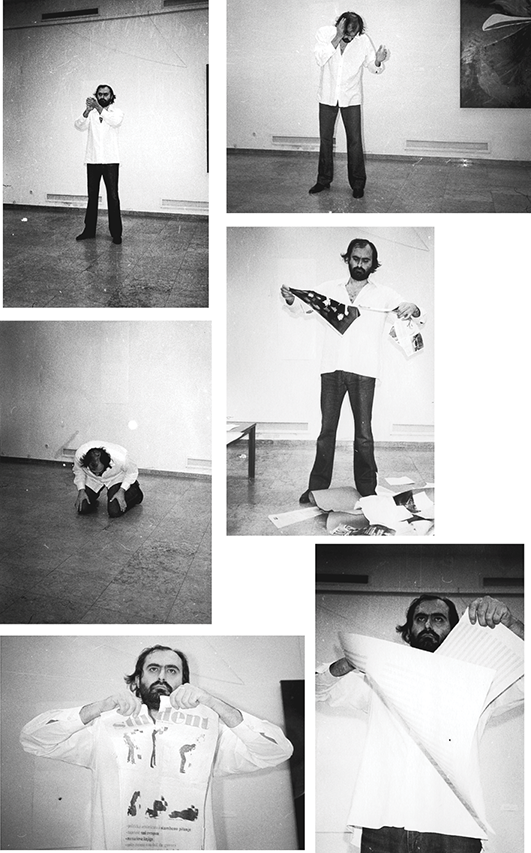
Figure 8.5 Long description
Pashu is shown in different poses, standing and clapping his hands in front of him, clapping his hands to the side, kneeling while resting his hands on his thighs, and standing up while ripping different kinds of paper, which he discards on the floor.
A similar type of performance is seen in Pashu’s work, John Cage 0‘00" (4‘33" br. 2). On the occasion of Cage’s seventieth birthday (in 1982), Drašković, Savić, and Lazarov Pashu each produced a version of a video with the same title. These works are a response to Cage’s work of the same title – 0‘00" (4‘33" No. 2) – and follow his instructions to create a performance of a “disciplined action.” Cage provides more details for the execution of the works, specifying that the particular action may be interrupted but cannot be repeated in another performance or cannot be the performance of a musical composition.Footnote 48 In his version, Pashu holds a large piece of paper with three lines of text, each containing one word, “Cage / 0‘00" / Pashu,” before proceeding to rip it.
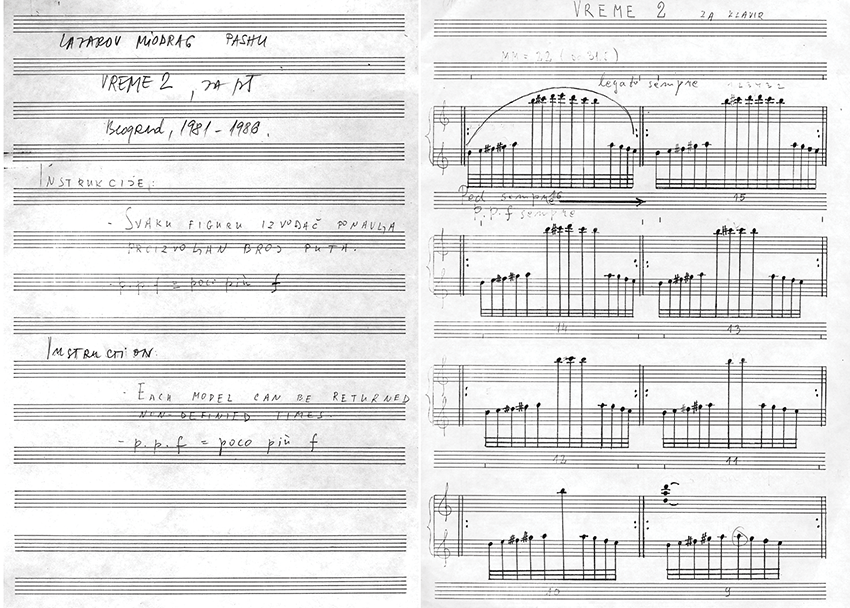
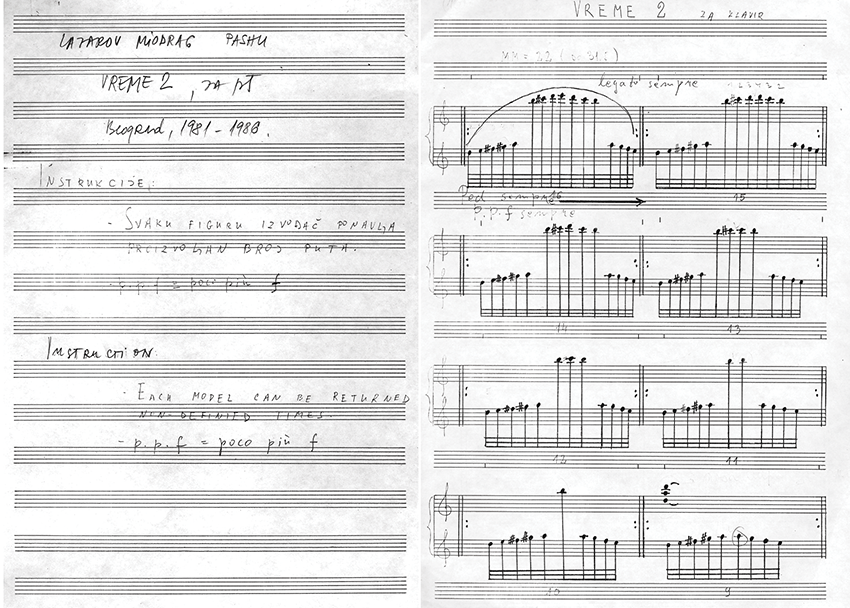
While the majority of Pashu’s works integrate audio-video installations, mixed media, performance and conceptual art, and events – such as Pashu reklama [Pashu advertisement], in which he rides in a car with public-address equipment that plays his music while he is speaking words of praise of his works and himselfFootnote 49 – he also composed several works in the minimalist style. Pashu’s minimalist compositions follow a “simple” method of exact repetitions of patterns, either a specified or an indeterminate number of times. This method is evident in his pieces Vreme 1 [Time 1] and Vreme 2, both from 1981. In Vreme 2 for piano, Pashu writes out the figures in exact musical notation (Example 8.3) but notes that each pattern can be repeated an indeterminate number of times. In Vreme 1 for two timpani, Pashu presents more specific verbal instructions but indeterminate musical notation. He notes that there are two possible formats in which this work can be presented. In the ideal format, each figure should be repeated exactly sixteen times, and in the relative format, there are four parameters of possibilities:
1. The performer decides how many times each figure should be repeated. This can be decided either before or during the performance.
2. It is recommended that the figures with smaller rhythmic values should be repeated at least sixteen times.
3. Figures with longer note values can be repeated fewer times.
4. The number of repetitions of figures can be done in a systematically decreasing way.
Miodrag Lazarov Pashu, Vreme 2 [Time 2] for piano (1981), first two pages of the score.
Example 8.3 Long description
The score is written on 14-stave loose manuscript sheets. The title page lists the composer’s name, title of the work, and the date (Belgrade, 1981 through 1986). Below, Pashu writes the instructions, first in Serbian and then in English. They read, Each model can be returned non-defined times / poco più forte. The page of the score shows the first eight measures of the work, two measures written in each system. Each measure is delineated by repeat bars. It shows a pattern of notes broken between two hands. The number of notes in each group (i.e., measure) systematically decreases by removing one note from the right-hand part. It starts with sixteen sixty-fourth notes playing the following pattern: left hand, treble clef playing D, E, F sharp, G sharp, and A. The right hand continues with B, C sharp, D, E, D, C sharp, and B. Then, the left hand takes over and continues the downward motion with A, G sharp, F sharp, E. In the next measure, the grouping is reduced to fifteen thirty-second notes, with the top E in the right hand eliminated. By the time we reach the end of the page, the pattern is reduced to nine notes, played only by the left hand, D, E, F sharp, G sharp, A, A, G sharp, F sharp, E. The piece is notated in tempo of 22 beats per minute, legato sempre, pedal sempre, and poco più forte sempre.
Pashu’s works created during the years of Opus 4’s activity illustrate how they thought of their pieces both individually and collectively. While some of Pashu’s works were intended to be performed by himself as a soloist, many of the works (as we also saw in Drašković’s Klavir, Opus 4 and Video, Opus 4) were created with the entire group in mind, each member having a role of a composer-performer. This collaboration among the members, as illustrated in Pashu’s Objektivne varijacije – Konkretne varijacije (Figure 8.6), ensured that their projects would be performed, which was one of the primary reasons for the creation of the group. Tošić further elaborates:
Like all (young) artists, members of Opus 4 also strongly desired to see their creations performed on the stage for the public. However, our road to success was marred by many challenges that were easier to overcome collectively. On the one hand, the existing traditional ensembles were not familiar with new practices and thus were not interested in playing avant-garde music. On the other hand, there were no ensembles fit to perform this kind of music. For these reasons alone, we were forced to perform our work by ourselves. Also, due to the fact that we needed creative performers who were versatile in many media types, we created works specifically with Opus 4 in mind, knowing very well the possibilities and limitations of each member, and using them to maximum capacity. This was quite advantageous to us because it allowed for the greatest mobility without any intermediaries, and also for the realization of each work with maximum authenticity. The group could perform almost any envisioned project, independently and adequately.Footnote 50
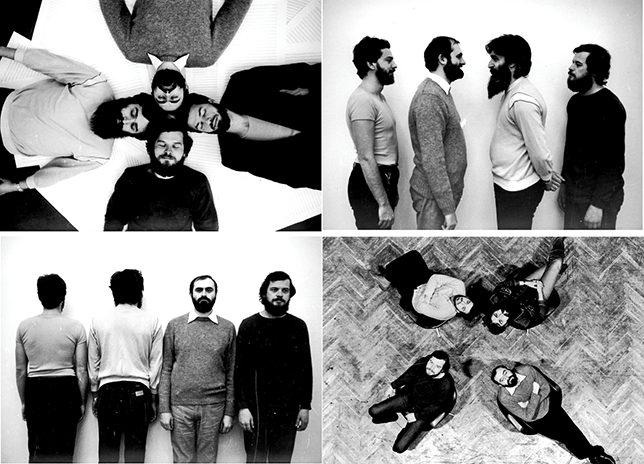
Miodrag Lazarov Pashu, Objektivne varijacije – Konkretne varijacije [Objective variations – Concrete variations] (1981), Student Cultural Center. In this work, performers change the position of their bodies according to parameters specified by the composer.
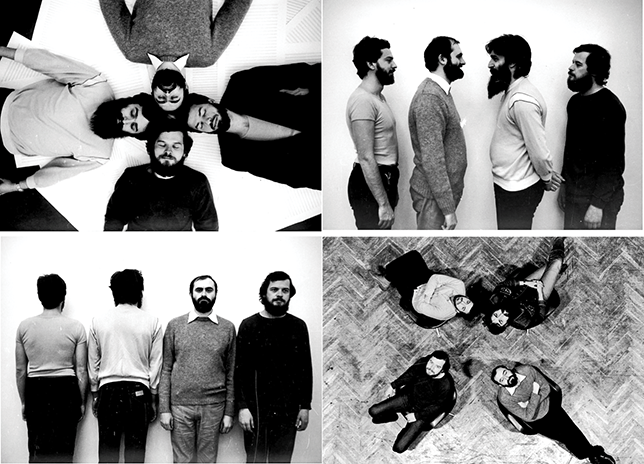
Figure 8.6 Long description
On each slide, performers change the position of their bodies according to parameters specified by the composer. On the top left photograph, the four performers are lying on the floor on their backs, positioned perpendicularly, their heads touching. The shot is taken from above. On the top right, the four performers are standing sideways, close together. Tošić and Pashu are facing to the right, while Savić and Drašković are facing to their left. In this way, Pashu and Savić are facing one another directly, their faces only inches apart. On the bottom left, two performers are standing closely next to each other. Two are shown facing backwards, and the other two are facing forward. On the bottom right, the four performers are sitting on chairs, facing away from each other, their heads leaning back and almost touching; the shot is taken from above.
Miroslav “Miša” Savić
As editor-in-chief of the Music Division at the SKC, the role he assumed in 1978, Savić launched a program Proširena muzika [Expanded music], with the purpose of “staging actions that would be essentially musical, but realized in different, extra-musical media, highlighting a different nature of music.”Footnote 51 In this role, Savić played a significant role in the success and visibility of Opus 4, Ensemble for Different New Music, and in general, all musical activity, including performances, publications, listening sessions, documentation, and festivals that took place at the SKC.
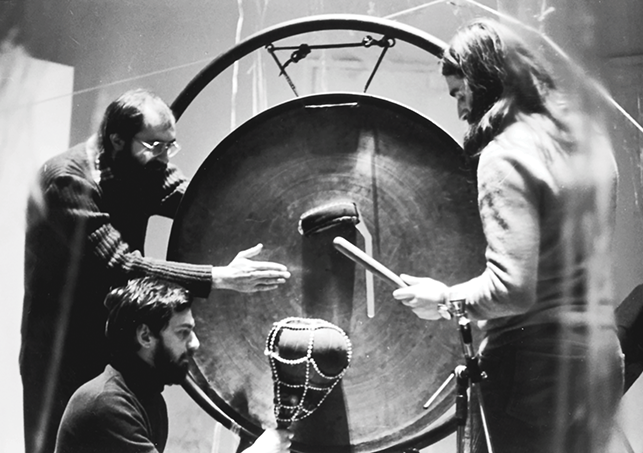
As a student of composition at FMU, Savić was introduced to the music of Messiaen and quickly became enthralled by the style and (serial) technique of the French composer. However, absorbing the radical presentations of new art by Marina Abramović and the “Belgrade Six” at the SKC, and hearing about new musical trends in the US, Savić made a conscious decision in his third year of studies to take the opposite stance in his then-serial approach to composing: minimalism.Footnote 52 He first demonstrated this departure from serialism and the formation of his own, distinct, and new style in the aforementioned 10 for piano (1974).Footnote 53 With the formation of Opus 4 and Ensemble for Different New Music, Savić created several renditions of the work, including a version for a gong (1976), which premiered on May 20, 1976 at the SKC (Figure 8.7).
Miroslav Savić, 10 for gong (1976). (From left to right): Miodrag Lazarov Pashu, Vladimir Tošić, and Miroslav Savić.
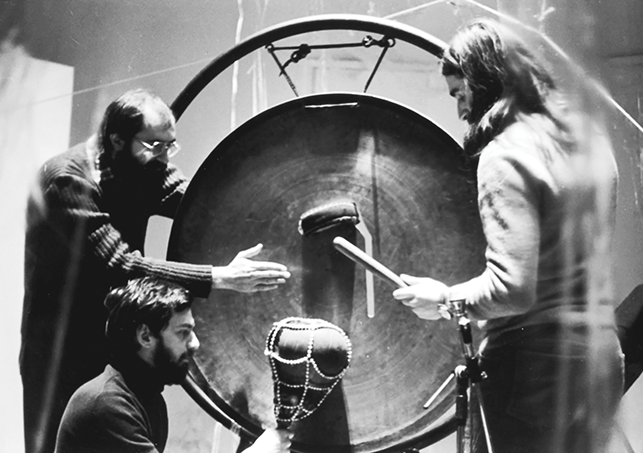
Figure 8.7 Long description
In the center is a large gong. On the left, Miodrag Lazarov Pashu taps the instrument with his right hand, while stopping the gong from the other side with his left hand. On the bottom left, Tošić is kneeling and hitting the gong with a large decorative mallet. On the right, Savić is hitting the gong with a stick.
About a month earlier, Savić took center stage at the SKC April Encounters Festival of Expanded Media for his performance of a solo piano work, 24 sata/akord [24 hours/chord]. In this intense work that pushes the boundaries of endurance of both the performer and the audience, Savić sits at the piano for an entire day and plays continuously a cluster of six notes – D♯, E, F, F♯, G, G♯ – at a tempo of fifty-four beats per minute. Thus, Savić and the audience listened to the repeated sounding of the chord nearly every second for twenty-four hours straight. Savić notes that by the end of the performance, about 500 people remained in the hall, and that at the conclusion, someone jokingly asked for one more minute.Footnote 54
Savić explored the limitations of his body in other early experimental works of this period. In
 [
[

 ] (1978), Savić lies on his back on top of the piano with his head and arms stretched above the keyboard. He remains in this position, not producing any sound, for as long as he can endure. As fatigue overtakes him, he lets his head and hands fall on the keyboard, producing sound. Similarly, in Zagrejani kružeći zvuk klavira [Heated circulating piano sound] (1978), Savić lies on his stomach on top of the piano with his head and arms above the keyboard, while playing a continuous tremolo. As fatigue advances, his hands move closer together (horizontally), while his head moves closer to the keyboard (vertically). The change in motion produces a change in the sound.Footnote 55 In an interview with Dunja Blažević, SKC Director at the time, following the 1978 performance at the SKC, Savić (nonchalantly smoking a cannabis joint on camera), reveals more information about the meaning of this work:
This work, unlike my other works up to this point, is very connected to the concept of “body art” because the body participates directly in the making of the sound. What is important concerning this work, in addition to the position of the body, is the hands. Hands present a visual element in the performance of any instrument, but especially in piano performance. Unlike my previous works, and likely not foreseeable in any pieces in the near future, this work displays a very pronounced use of the body. There are two elements at play here: a heated room and the sound that circulates in this heat around the room.Footnote 56 The action of the “body art” creates the sound, thus all elements merge together in this work.Footnote 57
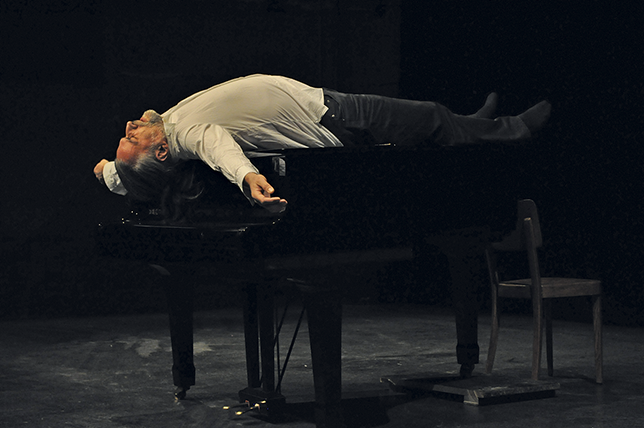
Miladinović Prica insightfully observes that in this work, the artist’s body plays the main part, whereas the piano performs a “supporting” role in what is a rather demanding and precarious bodily action.Footnote 58 The performances of these “body art” works are quite demanding and challenging. During the performance of Svirati/ne-svirati at the Bone 16 Performance Art Festival in Bern in 2014 (Figure 8.8), Savić fell off the piano, hit his head on the tiled floor, and had to be rushed to the hospital.
Miroslav Savić, Svirati / ne-svirati––ne-zvuk / zvuk [Play / not-play—not-sound / Sound] (1978), Bone 16 Performance Art Festival, Bern, 2014.
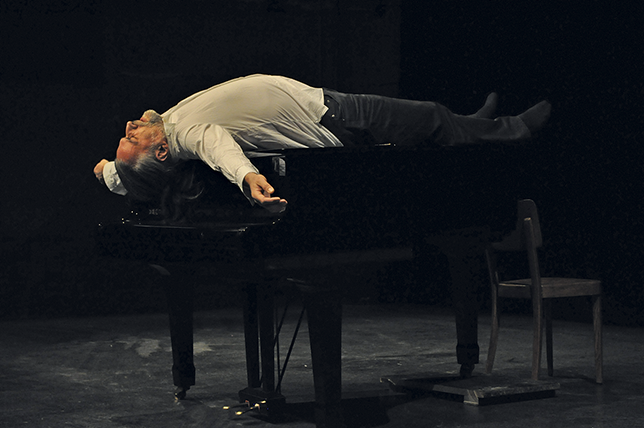
Figure 8.8 Long description
Savić, wearing a white shirt, black jeans, and black socks, is lying on his back on top of the grand piano, with his arms stretched outward and his head hanging backward over the lid. Next to the piano on a dimly lit stage is a dark brown wooden chair Savić used to climb on top of the piano.
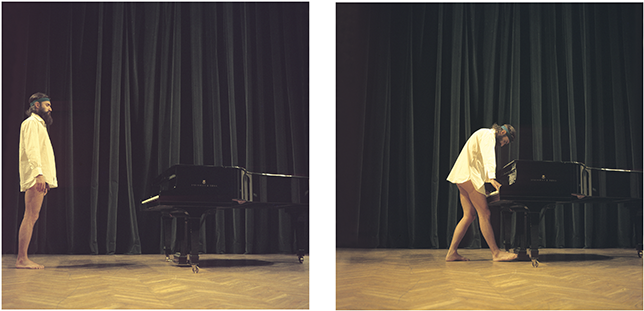
Savić created many other works that put the notions of sound and silence in opposition, incorporate the body as an instrument, and present music conceptually. In Dve pozicije [Two positions] (1978), Savić stands in front of a piano, dressed only in a white shirt, already testing the audience’s comfort with his nudity. Ten keys on the keyboard are taped down in advance. With his eyes closed, he approaches the piano and strikes another ten keys with all his fingers, remaining in this position as long as the sound resonates. Then, he steps back and repeats the same action another nine times (Figure 8.9). Other pieces, such as Guranje klavira po podlozi od celofana [Pushing a piano across the floor covered in cellophane], provide no other information than what the title already implies. However, these works, with simple instructions, reveal a radical departure of musical expression from what the majority of composers in Yugoslavia (and certainly all of their professors at the FMU) practiced or could even comprehend as music.
Miroslav Savić, Dve pozicije [Two positions] (1978), Bone 16 Festival, Bern, 2014.
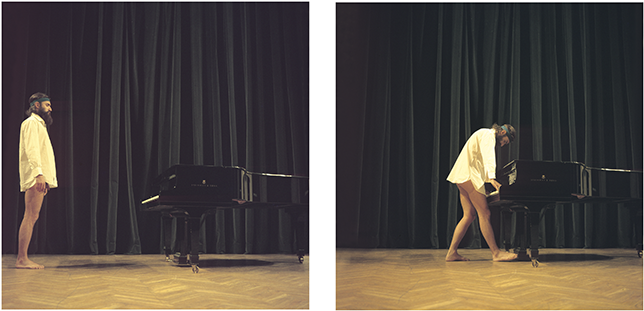
Figure 8.9 Long description
In the left photograph, Savić is standing barefoot on the stage, with his eyes closed, about three steps from the grand piano. He is wearing just a white button-down shirt and nothing else, exposing his nude lower body. He is sporting longish hair, a bushy, thick beard, and a bright blue headband. In the next photo, Savić is leaning over the keyboard, still with his eyes closed, as both hands depress the keys, with his right bare foot pressing the pedal.
In addition to these experimental body art and performance art projects, events, and happenings, Savić also created many multimedia and electroacoustic works and, as we saw in Chapter 6, did more for computerized music than any other composer in Yugoslavia. His conceptual art projects (i.e., ideosemas) are also notable. Similar to the works of Drašković and Pashu, Savić also relied on semantics to portray his musical works – these compositions produce no actual musical sound; the music is entirely conceptualized. One such example is Zatvoreni krug (klavira) [Imprisoned (piano) sound] (1976), an installation in which Savić covers the entire surface of a room with pages from a graphic score of his other piece Zvuk 326880. He then proceeds to shut the door and lock the room for the entire duration of “action,” barring the audience from “attending” the concert, even though this is a concert of conceptual music. Miladinović Prica suggests that Savić betrays his audience by confronting it with an impossible task – by placing the performance beyond the public’s reach.Footnote 59 However, according to Savić, this visual installation of music is not meant to be heard or even viewed – its form is time and space, which, in this case, is represented by the interior of the hall.
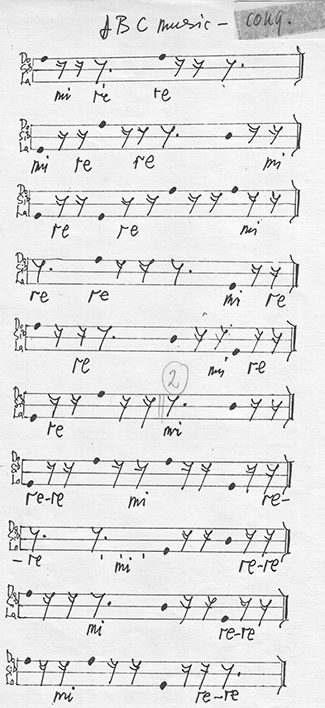
The drastic shift in Savić’s creative output during his student years was a reaction to what he was forced to compose by his professors. Thus, as Savić explained, the starkest stylistic opposition to the mandated serialism for him at that time was minimalism. Quite a prolific composer in this style as well, his method may be generally characterized as “integral serialism” – a technique in which several processes of repetition and reduction occur simultaneously in multiple parameters (such as pitch, rhythm, or text), albeit in a free manner. A prime example of this technique is a series of “ABC” compositions, especially his three works from 1983 – ABC Music, ABC Music for Conga, and N.N. for Piano (later reconstructed as ABC Music for Piano) – and also ABC Bossa Nova (1985), which he wrote for the Festival of Different New Music. ABC Music for Conga, for instance, contains thirty-four patterns that are repeated individually according to specified processes. Each pattern contains three pitches, A, B♭, and C (hence the title),Footnote 60 four solfege syllables, re, mi, fa, and sol, and rhythmic patterns of notes and rests. As the piece unfolds, the solfege syllables are gradually replaced with the three notated pitches, and rhythmic patterns turn into a steady pulse (Example 8.4).Footnote 61
Miroslav Savić, ABC Music for Conga (1983), the first page of the score.
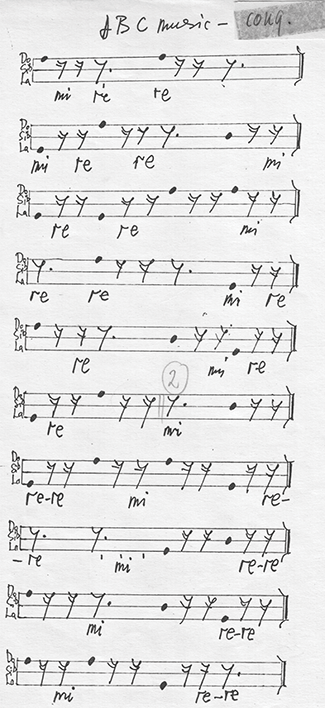
Example 8.4 Long description
The lines correspond to pitches Do on top, Si flat in the middle, and La on the bottom. Noteheads indicate when the pitch is sounding. For instance, in the first measure, the notehead is at the beginning of the measure on the top line, Do, followed by two sixteenth and one dotted eighth note rest. Underneath, syllables mi and re are written. Another notehead follows on the top line with the syllable re underneath, followed again by two sixteenth- and one dotted eighth note rest. In each measure, the rhythmic and pitch placement of noteheads changes, as do the durations of rests in between, and the placement of the syllables.
Minimalist works by both Savić and Tošić represent a breakthrough in “integral minimalism” in Belgrade and one of the most significant developments in the trajectory of Yugoslav music history. Their activity, together with that of Drašković, Pashu, Raičković, and ADNM, which pioneered and promoted their minimalist works, defined the new Yugoslav avant-garde in the late 1970s and early 1980s. While all four members of Opus 4 ventured into the realm of minimalism, Tošić most notably stayed the course throughout his career, still composing in this style.
Vladimir Tošić
Tošić debuted his piece Mélange in 1975. At that point, this piece represented a radical departure from the musical practice at the time and a direct defiance of the “establishment” (i.e., the FMU). The work, featuring graphic notation and minimalist techniques of repetitions and reductions, caused quite a stir among the musical “elites.” Tošić departed from traditional expression quite quickly and developed a new individual style early on, as he reveals:
My development was incredibly fast – it occurred during my first two years of studies at the [FMU] (1973–75). That is why there are not many examples of non-reductionist music in my opus. Those rare examples are from those early days of my studies when I had to create something that would fit the curriculum in some way. Already in my second year, I composed Mélange, and in it, I already established my basic musical foundation for all my future works. However, since I was still a student at that time, I had to compose pieces that were not purely minimalist. But I gave it my best to preserve my authentic voice in them.Footnote 62
Tošić is the most representative “minimalist” composer in Serbia, unapologetically still composing in the same style. Influenced by Reich from the beginning, Tošić’s music is characterized by strict processes of repetition and gradual reduction. While his method has evolved over the years, mainly by relaxing the strict integral processes, the essence of his style remains unchanged. Tošić reflects:
My [style of] minimalism evolved because I felt the need to “loosen” my method, which I found to be one of the strictest that I know. I wanted to “free” it a bit so that it would become more communicative, while still maintaining all characteristics of my musical thinking.
Simply put, I did it by taking my compositions that were based on a super strict process (like in Mélange and Di/fuzija) and creating new compositions that were based on several (typically, three to five) shorter and separate processes. This allowed me to speed up the flow of events in my music and establish a better connection with the audience (for example, in works like Dual, Varial, and Altus).Footnote 63
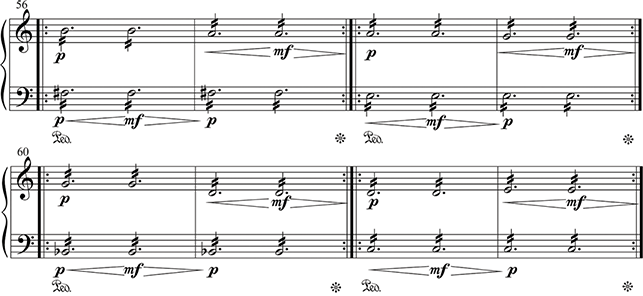
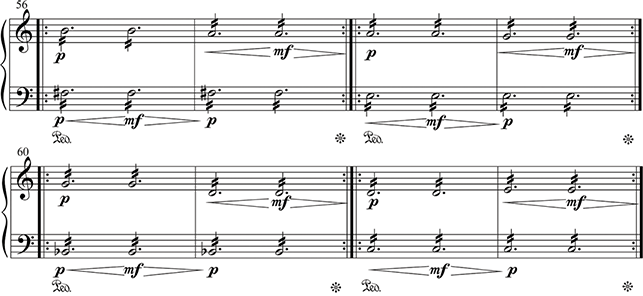
A meticulous and methodical person with an analytical mind and the need to understand musical structure and processes, Tošić has, in addition to his artistic work, written prolifically about music, especially about the principles of minimalism, providing analyses of his (and other composers’) music.Footnote 64 Unlike Raičković, who does not consider his minimalist music reductionist in any way, Tošić recognizes the concept of reduction as the basis of his (and all) music written in this style. He defines reduction as a “deliberate and consistent reduction of the number of elements on which a work is built,” which occurs through the principle of “reduction of sound and the reduction of procedures.”Footnote 65 He further elaborates that the reduction of the sound affects four basic elements of sound – pitch, duration, dynamics, and timbre – a method he uses in Mélange, for instance. Varial for piano (1990) is an example of a composition where the changes in dynamics constitute the principal reductionist process (Example 8.5). Here, the sound color and tension change through the process of systematic increase and decrease of dynamics.
Vladimir Tošić, Varial for piano (1990), mm. 56–63.
Example 8.5 Long description
Each motivic segment comprises two measures, delineated by repeat bars. Thus, there are four segments in this excerpt. Each measure in both hands only has two dotted half notes, with a double slash across the stem indicating that they are to be played as rapidly repeated sixteenth notes. The first segment has only two pitches in the right hand, the repeated B in the right hand with each notated as a dotted half note in measure 56 and a repeated A in measure 57. Meanwhile, the left hand only plays F sharp. In the next segment, the right hand plays repeated A in measure 58, followed by G in measure 57, while the left hand only plays E. In measure 60, the right hand plays G and then D in measure 61, while the left hand plays B flat. In the last segment, the right hand plays D in measure 62 and then E in measure 63, while the left hand plays C.
Reduction of procedures assumes that a composition is structured according to a single method or a small number of related techniques. Reduction of procedures is achieved through repetition, layering (of rhythms, timbres, melodies, etc.), permutations, interpolations (i.e., inserting one piece of musical material into another), and rotation.Footnote 66 As an example of a reductionist piece that is built on a single process and where all four parameters of sound (pitch, rhythm, dynamics, timbre) undergo a strict, systematic, and symmetrical process via the method of permutations and layering, he cites Mélange. That Tošić composed a minimalist piece with such a complex structure in his second year of undergraduate studies, without any formal training in the technique of this style – a style that was virtually unknown in Yugoslavia at the time – is truly remarkable. How and when Tošić heard about American minimalism is not quite clear; the music of Reich, Glass, Young, and Riley was certainly not performed anywhere in Yugoslavia at the time, not even at the Biennale, nor was it played over the radio. Tošić claims that in 1975, when he composed Mélange, he had not even heard the term “minimalism.” In his book, Words about Music, he clarifies:
What I know for certain is that in 1975, I never had any clue that something like [minimalism] existed. The first time I heard the word “minimalism” was when Miša Savić mentioned it in a public lecture at the Faculty of Music … I remember very well how, at that moment, I even thought, “What a dumb way to refer to music,” and I was certain at that time that he had made up that word. I believe this was in 1976. Even today, I still think the term is inappropriate, which is why I have always used the terms “reduction” and “reductionism.”Footnote 67
Whether or not Tošić’s recollection is accurate makes little difference. He would still have learned and understood the method on his own, which speaks volumes about his analytical and creative thinking.
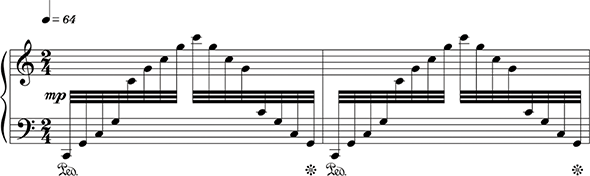
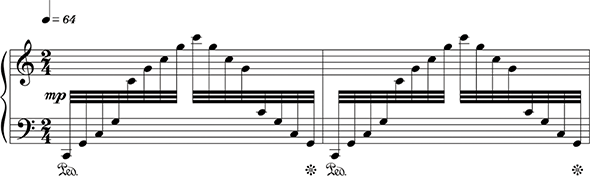
Many of Tošić’s minimalist compositions feature an identifying characteristic: a melodic and harmonic language is built using eight pitches, C, G, E, B♭, D, F♯, A, B, a sequence derived from every other pitch of the overtone series. He terms this collection his “aliquot mode.” Example 8.6 illustrates Tošić’s use of the eight-note mode, which he manipulates with reductionist principles of repetition throughout the piece. Varial also demonstrates Tošić’s preference for using few (and the same) rhythmic values in a work. He explains that using a small number of different rhythmic values, and often only one, creates a “neutral” pulsation. The absence of many different durational values diminishes the sense of motion. Typically, Tošić uses either long durational values (as in Varial) or consistently short ones, which he repeats, as in Aludijum for piano (1991).
Vladimir Tošić, Aludijum for piano (1990), two measures.
Example 8.6 Long description
Written in 2/4 meter and tempo of 64 beats per minute, it shows arpeggiation of C G C pitches across four octaves in thirty second notes. The left hand arpeggiates upward before the right hand takes over, continuing arpeggiation upward until it reaches C in the sixth register and then brings the arpeggiation downward to the left hand. The entire segment is indicated to be played under one pedal. The second measure is an exact repeat of the previous one.
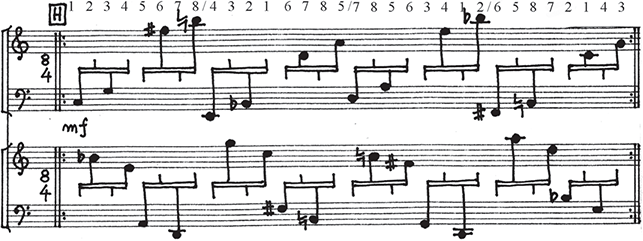
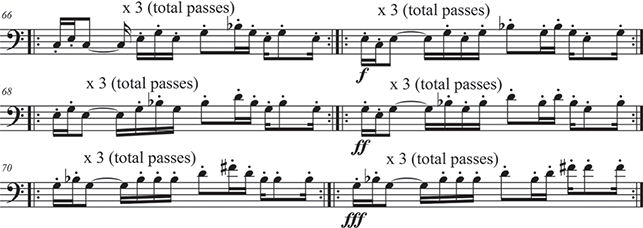
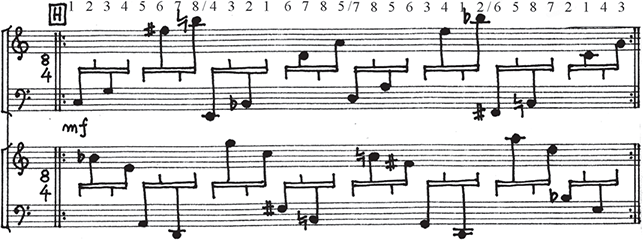
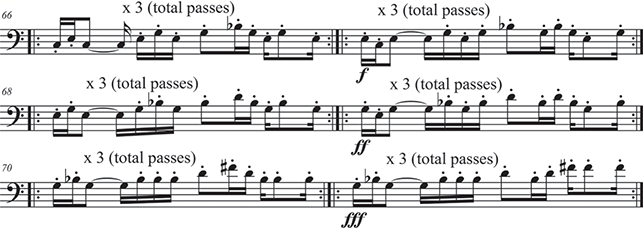
Working with eight pitches (“aliquot mode”) and small durational values, Tošić’s musical language is recognizable. However, an indefinite number of different ways to apply reductionist principles (repetition, rotations, permutations, and interpolations) of various musical parameters (pitch, timbre, dynamics, and rhythm), with one or several processes, sequential or simultaneous (i.e., integral), strict or free, allows Tošić to think about musical organization of his works in novel ways. The variety of his approach is evident even when looking at a small sample of his oeuvre. For instance, in Di/fuzija [Di/fusion] for two pianos (1982), Tošić applies the process of permutations of eight pitches, and in Arios for cello and piano (1986), he bases the principle on repetition (Example 8.7).Footnote 68
Vladimir Tošić’s minimalist/reductionist methods.
Di/fuzija for two pianos (1982), Reh. H.
Example 8.7a Long description
The excerpt depicts one measure at rehearsal H written in 8/4 meter and repeat bars. The motive alternates between two hands, written entirely in sixteenth notes, hence eight groups of sixteenth-note pattern. On the top system, showing the Piano 1 part, the left hand plays on the first and third sixteenth notes, arpeggiating a chord upwards, with the right hand continuing to play on the sixth and eighth sixteenth notes. The second piano does not coincide with the first piano. The second piano arpeggiates the chord downwards, with the right hand playing first on the second and fourth sixteenth notes and the left hand on the fifth and seventh. In this manner, each note in the sixteenth-note grouping is played by alternating pianist and alternating hand.
Arios for cello and piano (1986), mm. 66–71.
Example 8.7b Long description
It shows measures 66 through 71, written on a single staff with three lines in bass clef in 4/4 meter. Each measure has repeat bars, in which a motive is indicated to be repeated three times. The motives are simple, featuring only four different pitches and outlining seventh chords. Each motive is notated in staccato. The first line is in forte dynamics, the second in fortissimo, and the third in forte fortissimo. The first line outlines chord, C E G B flat; the next line outlines chord, E G B flat D; and the third line outlines G B flat D F sharp.
Tošić presented his work Di/fuzija in the US in 1987, when the work was programmed at the Bowling Green New Music Festival. He returned to Ohio in 2000 as artist-in-residence. Composer Adam Mirza was in his first year of master’s studies at Bowling Green during Tošić’s visit, and more than twenty years later he vividly recalled the event and the impact Tošić made on him at the time – but also his surprise at learning that American minimalism was so prevalent and popular in Yugoslavia. He explained:
I met Vladimir Tošić during my Master’s program in Music Composition at Bowling Green during the 2000–2001 academic year. I recall he visited the composition studio to share recordings and scores of his music (a piece for two pianos), and he also met individually with a few students, including me. At the time, I was very interested in minimalism, which I understood then as an essentially American phenomenon. Meeting Tošić and hearing his music came as something of a shock. It confused my understanding of a [perceived] binary opposition between American minimalism and European lyric expressionism. His form of minimalism seemed heavy and deep. His presence, steady-eyed and reflective, differed from what I was encountering in the energetic, personality-driven statements and entrepreneurial activities of West Coast and New York City artists. He moved at a different speed. Speaking with him, I think, helped me slow down.Footnote 69
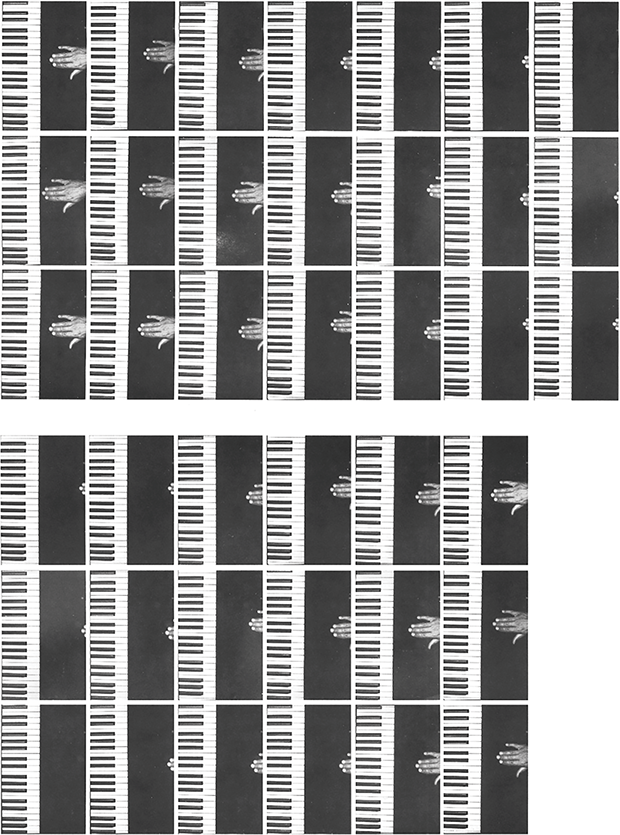
While Tošić is foremost a minimalist (i.e., reductionist) composer, he has also explored multimedia and conceptual art, especially during his tenure with Opus 4. For instance, in Ne/mogućnost [Im/possibility] (1981), he presents a series of thirty-nine slides in which a hand is seen approaching the piano and then retracting from it (Figure 8.10). This composition, with no actual sound, done entirely in the medium of photography, “condemns the event of sound to impossibility,” as Miladinović Prica proposes.Footnote 70 Tošić explains that he experimented with the visual element in his works both for curiosity and necessity (to represent ideas that traditional music notation could not convey). He further elucidates that he has always encountered music in two ways – through sound and sight – and thus decided to represent it in this work only visually.Footnote 71
Vladimir Tošić, Ne/mogućnost [Im/possibility] (1981).
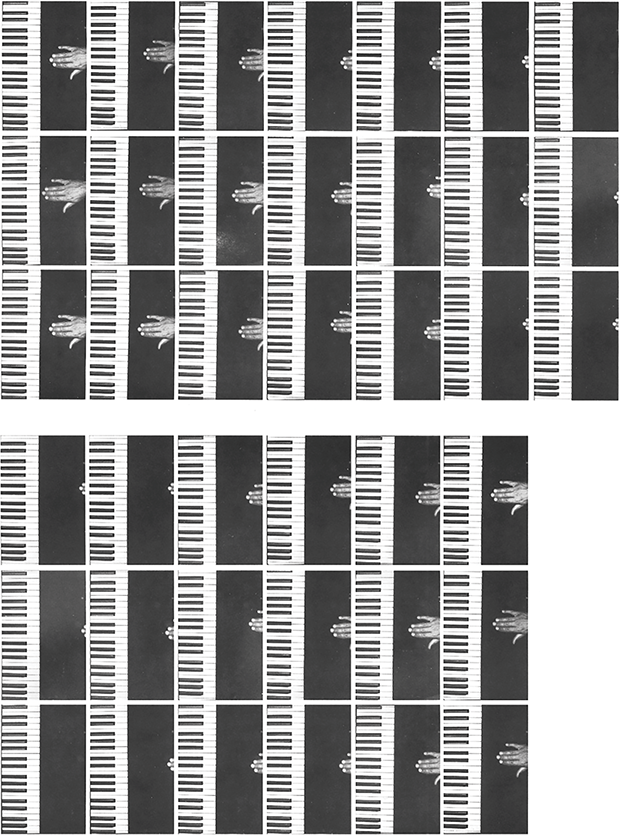
Figure 8.17 Long description
On top are shown two octaves of the piano keyboard. Below it is black space, in which Tošić’s right hand gradually appears in view. The first slide is just black space, the next slide shows tips of a couple of fingers and so on until the entire hand becomes visible gradually with each slide, before it starts to slowly disappear from view, ending again, with black space with white keyboard above it on the last slide.
Conclusion
Owing to the robust activity and organization of Opus 4, Miloš Raičković, and the Ensemble for Different New Music, the young experimental composers and performers in Belgrade gained national and international prominence. Their popularity spread quickly across Yugoslavia, with performances throughout the entire region, but especially in Croatia and Slovenia. Funded by the Yugoslav government but also by American, French, and German cultural centers in Belgrade, the group represented their radical and innovative creations abroad, with performances in Utrecht, Paris, Burges, and Almada (Portugal). Their impact on Yugoslav composers was enormous – the once-traditional Faculty of Music could no longer contain the composers’ “rebellion” against the system. Vuk Kulenović (1946–2017), Vlastimir Trajković (1947–2017), Zoran Erić, Katarina Miljković, Ana Mihajlović (b. 1968), and Ognjen Bogdanović (b. 1965) are just a few of the composers who were in some way influenced by American minimalism (and later postminimalism), Raičković, and Opus 4.Footnote 72
With Savić’s leadership of the SKC’s Music Division and his vision for international collaborations, the Center attracted those seeking artistic experimentation and looking to connect the East with the West in a fruitful exchange of ideas, despite the geopolitical division of the world at the time. Opus 4, ADNM (the ensemble that performed and promoted their music across Yugoslavia), and SKC – a student-led institution that was a conduit for all manner of expression and experimentation – became synonymous with the new wave of avant-garde music in Yugoslavia. Opus 4 was the neo-avant-garde.
The achievements of Opus 4 are well documented, owing to SKC reports, the composers’ preservation of documents, and their efforts in printing and recording their activities. Nebojša Čanković, the official SKC photographer during the 1970s and 1980s, captured these moments in history, providing a close visual document of artistic creativity in Belgrade.Footnote 73 Radio Television Belgrade aired many public events and made at least three films about musical minimalism in Belgrade, Opus 4, and the Different New Music Festivals that Savić organized. At the 1983 exhibition at the Art Gallery in Pristina (Kosovo), curated by Ješa Denegri, in collaboration with the Museum of Contemporary Art in Belgrade, celebrating “New Art in Yugoslavia 1970–1980,” the work of Opus 4 was prominently featured.Footnote 74 One newspaper article, noting that more than 130 artists were displayed at this exhibition, features the iconic shot of Savić performing his Zagrejani kružeći zvuk klavira at the SKC.Footnote 75
The experimental creations of these young, rebellious composers (and performers) at the SKC are the last example of such a radical shift in the history of Yugoslav music. Miladinović Prica argues that their open-mindedness toward new approaches to music composition and expression, and their radically new style, to this day constitute “the farthest reaches of new music in Serbian music history.”Footnote 76 I would extend this statement to note that Opus 4 composers have made some of the largest strides in Yugoslav music history, as no composers since them have defined a new era – a new avant-garde – in the trajectory of the country’s musical development. And to think it all started because they did not want to write serial music anymore makes a truly remarkable avant-garde statement in itself.


 Open access