





Introduction
Trisomy 21 is the most common chromosomal anomaly in humans, occurring in approximately 1 in 800 individuals worldwide. In the US, 6.7 per 10,000 newborns are diagnosed annually, amounting to about 5,700 new cases each year. Nearly half (49.9%) of these infants have CHD, a prevalence 50 times higher than in the general paediatric population. Reference Xu, Chen, Cheng and Du1 While advanced maternal age (≥35 years) increases the risk of Trisomy 21, most affected infants are born to younger mothers due to higher birth rates in this group. Reference Peterson, Clarke and Gelb2 Historically, early mortality was driven by untreated CHD and institutionalisation, but life expectancy now exceeds 60 years with modern interventions. Reference Fraser3 Despite its high prevalence and the emergence of surgical techniques capable of correcting complex cardiac defects by the mid-20th century, individuals with Trisomy 21 were historically denied equitable access to life-saving care. Deeply rooted in discriminatory beliefs, early medical management was shaped more by social stigma than by clinical evidence. From institutionalisation and the eugenics movement to delays in surgical referral and outright denial of intervention, the treatment of CHD in individuals with Trisomy 21 provides a window into the broader ethical and medical challenges faced by this community. This paper explores the historical evolution of CHD management in Trisomy 21, highlighting key medical milestones, landmark cases, systemic barriers, and the persistent advocacy that has transformed standards of care over time.
A historical overview of CHD in Trisomy 21
Early descriptions and harmful stereotypes
In 1866, a British physician Dr John Langdon Down provided the first formal description of what is now known as Trisomy 21. In his paper, titled Observations on the Ethnic Classification of Idiots, he proposed categorising conditions based on perceived ethnic traits, referring to Trisomy 21 as “mongolism” due to a supposed resemblance to people from Mongolia. While considered groundbreaking at the time, this theory has since been thoroughly disproven. Reference Mégarbané, Ravel and Mircher4 Institutionalisation was common practice. Individuals with Trisomy 21 were placed in long-term care facilities that offered minimal medical attention and social interaction, leading to premature death and poor quality of life. Life expectancy was around 10 years due to untreated CHDs, infections, and poor living conditions. Reference White5 The eugenics movements of the 1920s led to institutionalisation and sterilisation of persons with intellectual disabilities, such as Trisomy 21. Reference Champagne, Lewis and Gilchrist6
The genetic discovery: Trisomy 21
In 1961, French geneticist Dr Jérôme Jean Louis Marie Lejeune discovered that individuals with Trisomy 21 had an extra chromosome on the 21st pair, establishing the first link between an intellectual disability and a chromosomal abnormality. He later advocated for replacing the racially based terminology with “Langdon-Down anomaly,” “Down’s syndrome,” or “trisomy 21 anomaly.” In 1973, Congress enacted the Rehabilitation Act, which prohibited employment discrimination against individuals with disabilities in the federal government and in programmes receiving federal funding. 7 The Act also established federal initiatives focused on rehabilitation and vocational training for people with disabilities. The Rehabilitation Act served as the foundation for the Americans with Disability Act in 1990 with an expansion of anti-discrimination principles to the private sector and all public entities, regardless of federal funding. Reference Lee8
Early disparities in cardiac surgery
In the early 20th century, surgical interventions for CHD were virtually non-existent. Complex intracardiac surgery in infants without chromosomal abnormalities became routine in the early 1970s, but it wasn’t until 1976 that the first report of cardiac surgery on a patient with Trisomy 21 was published. Drs. Greenwood and Nadas from Harvard Medical School examined 230 Trisomy 21 patients with CHD admitted to Boston Children’s Hospital from 1962 to 1973. Reference Greenwood and Nadas9 The medical and surgical mortality rate was high in these 230 paediatric patients, particularly in those with more severe CHD. Among infant patients with Trisomy 21, the medical mortality rate for complete atrioventricular canal was 52.4, 26% for partial atrioventricular canal, and 15% for ventricular septal defect. Reference Greenwood and Nadas9 The surgical mortality rate was 55.6% for infant Trisomy 21 patients with complete atrioventricular canal and 31.6% for Tetralogy of Fallot and other cyanotic lesions. Reference Greenwood and Nadas9 However, only a minority of these patients received cardiac repair despite these procedures being common for paediatric patients without chromosomal abnormalities. Of the patients who did receive cardiac repairs, 7 out of 9 patients with complete atrioventricular canal were not eligible for full repairs because they had developed pulmonary hypertension. In response to this study, Dr Feingold surmised that these patients likely had worse outcomes than children with CHD who did not have chromosomal abnormalities because they did not receive prompt surgical repairs and not due to their Trisomy 21. Reference Feingold10
Progress in paediatric cardiac care
As shown in Figure 1, the 1970s and 1980s saw significant improvements in paediatric cardiac surgery with the introduction of echocardiography, enabling earlier diagnosis and repair. Reference Amark and Sunnegardh11 Data from Sweden showed that the rate of cardiac repairs in children with Trisomy 21 rose from 39% (1973–1977) to 97% (1993–1997), while 30-day mortality fell from 28.1% to 1.0% over the same period. Reference Frid, Björkhem, Jonzon, Sunnegårdh, Annerén and Lundell12 Peterson et al. conducted a large retrospective cohort study evaluating long-term outcomes in children with Trisomy 21 who underwent surgery for CHD, compared to children without chromosomal abnormalities. Reference Peterson, Kochilas and Knight13 The study included 3,376 T21 patients who received surgery for two-ventricle CHD between 1982 and 2003, with survival followed for up to 30 years. Reference Peterson, Kochilas and Knight13 Postoperative mortality in the T21 group was 9.7%, compared to 5.6% in matched euploid controls after a median follow-up of 22.86 years. Reference Peterson, Kochilas and Knight13 The adjusted hazard ratio for CHD-related death in the Trisomy 21 group was 1.34 (95% CI: 0.92–1.97, P = 0.127), suggesting no statistically significant difference in CHD-related mortality. Reference Peterson, Kochilas and Knight13 Children with Trisomy 21 did have significantly higher all-cause mortality, implying that co-occurring conditions in Trisomy 21 play a role in long-term survival.
Persistent discrimination in medical decision-making
Despite medical literature showing no difference in postoperative mortality in Trisomy 21 patients with CHD and CHD patients without chromosomal abnormalities, Trisomy 21 patients continued to be repeatedly denied surgical intervention well into the 1990s. Reference Lange, Guenther, Busch, Hess and Schreiber14,Reference Park, Mathews, Zuberbuhler, Rowe, Neches and Lenox15 In 1975, Crane’s surveys revealed the existence of bias within paediatric cardiac surgeons; while 90% of surveyed surgeons would repair CHD in a child with a cardiac defect and another physical anomaly, only 59% of surveyed surgeons would repair CHD in a child with a cardiac defect and Trisomy 21. Reference Crane16 Interestingly, the severity of the cardiac defect and the level of impairment from Trisomy 21 did not affect the surgeons’ responses. However, higher rates of surveyed surgeons opted for repair if the patient did not have siblings, was the product of a previous pregnancy, or had a family that requested surgery.
In 1985, Bull et al argued that withholding cardiac surgery was a valid clinical decision due to increased rates of operative mortality compared to corrective surgery in children without chromosomal abnormalities, as well as the shorter life expectancy and mental disability in children with Trisomy 21. Reference Bull, Rigby and Shinebourne17
That same year, Sondheimer et al published a case series showing Trisomy 21 children were more likely to receive delayed referrals, demonstrating a significant barrier to access for cardiac surgery. Reference Sondheimer, Byrum and Blackman18 Of the 36 total patients (28 with Trisomy 21, 8 without), all children without Trisomy 21 were referred, and surgical intervention was possible. Of the children with Trisomy 21, 18 were referred before age 1, and surgical intervention was possible in 17. About 10 children with Trisomy 21 were referred after age 1, and surgical intervention was possible in 5. 50% of the delayed referrals developed inoperable pulmonary vascular obstructive disease. In contrast, 94% of Trisomy 21 patients referred before age 1 achieved surgical success without pulmonary vascular obstructive disease. This study underscored the life-threatening consequences of delayed care and became a catalyst for advocating early evaluation (by 9 months of age) and equitable access to surgery for Trisomy 21 patients.
The Baby Doe case and legislative reform
In 1982, the Baby Doe case brought the bias against children with Trisomy 21 in medicine to the forefront of the nation. Reference White5 A newborn in Bloomington, Indiana, with Trisomy 21 and oesophageal atresia was denied life-saving surgery based on the physician’s pessimistic prognosis about the quality of life for individuals with intellectual disabilities. Despite legal challenges from other physicians and potential adoptive parents, the Indiana Supreme Court declined to review an appeal challenging the parents’ decision to withhold care, and the infant died at six days old. The child’s death from dehydration and pneumonia shocked the nation and catalysed a national debate on medical ethics in Trisomy 21.
Surgeon General C. Everett Koop became a vocal advocate for the rights of infants with disabilities during this controversy, framing it as a moral imperative to protect vulnerable children from discrimination. His efforts led to the establishment of Baby Doe Hotlines in 1983 by the Department of Health and Human Services, encouraging hospital staff and citizens to report cases where care was withheld from disabled infants. Although these hotlines were challenged and ultimately struck down in Bowen v. American Hospital Association (1986), Koop’s advocacy persisted and culminated in the 1984 Baby Doe Amendment to the Child Abuse Prevention and Treatment Act. This legislation prohibited withholding medically indicated treatments from disabled infants unless specific exceptions applied (e.g. irreversible coma or futile treatment) and tied federal funding for child abuse programmes to states’ enforcement of these protections. The law also established Infant Care Review Committees to assist hospitals in ethically complex decisions. Though controversial, the amendment pushed institutions to reconsider long-held biases and ushered in an era where surgeons more readily offered corrective procedures to Trisomy 21 patients.
Organ transplantation and disability rights
While cardiac surgery became routine for Trisomy 21 patients by the late 1970s and early 1980s, Reference Champagne, Lewis and Gilchrist6 systemic discrimination persisted in other areas of medical care—particularly organ transplantation. Sandra Jensen’s case in 1995 highlighted these challenges on a national scale. Reference Overby and Fins19 She was born with Trisomy 21 and a “hole in her heart that constantly leaks blood,” most likely a mild form of atrioventricular canal. 20 Sandra started to develop congestive heart failure and irreversible pulmonary hypertension at age 34, necessitating a heart-lung transplant to survive. Despite her independence—living alone, managing her finances, and co-founding two disability advocacy organisations—both Stanford University Medical Centre and UC San Diego rejected her application solely due to assumptions about her cognitive abilities and perceived inability to adhere to post-operative care regimens.
Sandra Jensen launched a public advocacy campaign alongside Dr William Bronston and the Disability Rights Education and Defense Fund, arguing that intellectual disability should not equate to ineligibility for life-saving treatment. National media attention pressured Stanford to reverse its decision, ultimately agreeing to perform the transplant after California Medicaid funded a full-time caregiver to address concerns about post-operative support. On January 23, 1996, Sandra became the first person with Trisomy 21 in the United States to receive a heart-lung transplant—a milestone that challenged discriminatory practices in transplant eligibility. She lived for 16 months following the procedure, marking a significant step forward in advocating for equitable access to advanced medical care.
Her case also led to legislative change through California Assembly Bill 2861, which prohibited hospitals from denying organ transplants solely based on physical or intellectual disabilities. Sandra’s success highlighted the importance of assessing patients on an individual basis and inspired ongoing efforts to eliminate discrimination in transplantation practices across the United States.
Evolving standards of care and societal attitudes
By the late 1980s and early 1990s, societal attitudes towards children with Trisomy 21 and CHD shifted significantly. Reference Delany, Gaydos and Romeo21 Both deinstitutionalisation and improved developmental and educational supports highlighted their full potential and increased their visibility in public life. In 1994, the American Academy of Paediatrics published the first health supervision guidelines for children with Trisomy 21, recommending routine cardiac screening of all infants with Trisomy 21. 22 These new health guidelines suggested that cardiac repairs to children with Trisomy 21 had become standard of care. Increasing evidence demonstrated that these patients tolerated cardiac surgeries as well as their peers, challenging long-held biases about their prognosis and quality of life. Early surgical repair within the first 6 months of life is strongly advised for large, post tricuspid shunts such as ventricular septal defects, atrioventricular septal defects, and patent ductus arteriosus to prevent irreversible pulmonary vascular disease. Reference Dimopoulos, Constantine and Clift23 Delayed repair increases the risk of pulmonary arterial hypertension, which develops earlier and more frequently in DS with an incidence ranging from 6–37.5% of cases. Reference Dimopoulos, Constantine and Clift23 Early intervention minimises this risk and avoids progression to Eisenmenger syndrome. Reference Dimopoulos, Constantine and Clift23 Advances in ICU care—such as better ventilatory support, improved infection control, and refined anaesthetic techniques—contributed to improved outcomes. Reference Kabbani, Giridhar, Elbarbary, Elgamal, Najm and Godman24
Contemporary advances and ongoing challenges
Advocacy efforts like the Baby Doe Amendment in 1984 played a pivotal role in dismantling discriminatory practices, mandating equitable access to life-saving treatments for infants with disabilities. By the early 2000s, cardiac surgery became the standard of care for Trisomy 21 patients with CHD, with complete repairs performed during infancy yielding survival rates exceeding 90%. Reference Peterson, Clarke and Gelb2 The focus shifted from merely achieving survival to optimising long-term outcomes, including neurodevelopmental support and social integration. Medical management also evolved: multidisciplinary teams now included genetics, endocrinology, developmental paediatrics, and early intervention services.
Advances in prenatal diagnostics have revolutionised early detection. Today, non-invasive prenatal testing and foetal echocardiography now enable identification of Trisomy 21 and associated CHD with over 90% accuracy. These tools allow families to make informed decisions about prenatal care and prepare for timely medical interventions.
Anaesthetic and perioperative challenges
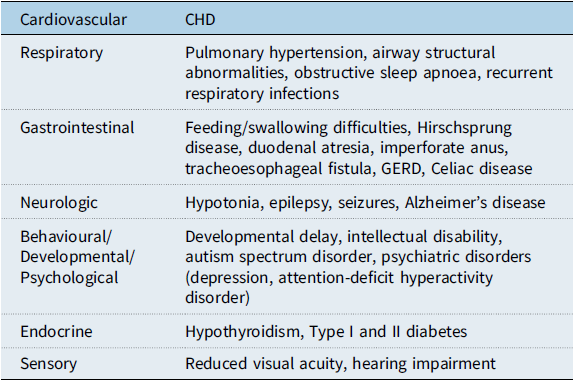
The perioperative management of individuals with Trisomy 21 and CHD requires careful consideration of a broad spectrum of extra-cardiac comorbidities that are highly prevalent in this population. Reference Steward25 As referenced in Table 1, Trisomy 21 patients are more likely to have a variety of physical, neurodevelopmental, and functional conditions. Children with Trisomy 21 are more likely to have risk of respiratory compromise due to a flat facial profile, short palate, and large tongue. 26 Over 50% of patients with Trisomy 21 have sleep-disordered breathing or obstructive sleep apnoea. Reference Andropoulos, Mossad and Gottlieb27 Patients with Trisomy 21 are more likely to present with generalised hypotonia and increased joint laxity in the atlanto-axial and occipital-atlantal joints, which can lead to cervical spine instability. Over 75% of children with Trisomy 21 have feeding or swallowing difficulties or gastroesophageal reflux disease, contributing to an increased risk for aspiration. Collectively, these comorbidities contribute to an increased risk of anaesthesia-related complications in children with Trisomy 21 compared to the general paediatric population. In addition, autonomic dysregulation may cause increased rates of bradycardia during induction of anaesthesia with sevoflurane, likely due to autonomic mechanisms. Reference Sinton, Cooper and Wiley28 Vascular access may also be more difficult, with increased incidences of obesity and hypoplastic or abnormal radial arteries that could make arterial catheterisation difficult.
Common comorbidities in children with Trisomy 21. Reference Kabbani, Giridhar, Elbarbary, Elgamal, Najm and Godman24 Common comorbidities observed in children with Trisomy 21, categorised by organ system, including cardiovascular, respiratory, gastrointestinal, neurologic, behavioural/developmental/psychological, endocrine, and sensory conditions

Contemporary cardiac management
Approximately 50% of newborns with Trisomy 21 have CHD. Reference Delany, Gaydos and Romeo21 There is an increased frequency of endocardial cushion defects in patients with Trisomy 21, emphasising the importance of specifically evaluating for inlet-type ventricular septal defects, primum-type atrial septal defects, and partial, transitional, or complete atrioventricular septal defects when evaluating shunts. About 33% of patients with Trisomy 21 and CHD undergo a complete atrioventricular septal defect repair, making it the most common congenital cardiac procedure followed by ventricular septal defect closure at 19% and mitral valve repair/replacement at 7%. Excluding minor defects such as a patent foramen ovale or small secundum atrial septal defects, nearly half (48%) of patients with Trisomy 21 undergoing complete atrioventricular septal defect repair require at least one additional cardiac surgical procedure during the same operation. Reference Delany, Gaydos and Romeo21,Reference Atz, Hawkins and Lu29 These additional procedures most commonly include patent ductus arteriosus ligation (44%), but may also involve repair of aortic arch anomalies, closure of remote ventricular septal defects, venous baffle for anomalous systemic venous drainage, pulmonary vein plasty, or subaortic stenosis resection. Reference Delany, Gaydos and Romeo21,Reference Atz, Hawkins and Lu29,Reference Dhillon, Ghanayem and Broda30
While much of this section highlights the types and frequencies of cardiac defects in Trisomy 21, a critical aspect of contemporary cardiac management is understanding how age and weight at the time of surgical repair impact patient outcomes. In 2020, a study found that children with Trisomy 21 are more likely to undergo surgery at younger ages and at lower weights than their non-Trisomy 21 peers. Reference Dhillon, Ghanayem and Broda30 This difference is clinically significant because younger age and lower weight at the time of surgery are associated with increased perioperative risks, including greater susceptibility to infection, longer ventilator dependence, and higher rates of postoperative complications. The average age at surgery for ventricular septal defect closure for children with Trisomy 21 is 4.8 months compared to 7.4 months for children without Trisomy 21. The average age at surgery for atrial septal defect closure for children with Trisomy 21 is 1.2 years compared to 4.1 years for children without Trisomy 21. Furthermore, earlier surgical intervention is often necessary for Trisomy 21 due to the more rapid development of pulmonary hypertension and congestive heart failure. In atrioventricular septal defect and Tetralogy of Fallot repairs, children with Trisomy 21 were on average the same age but weighed less compared to peers without chromosomal abnormalities. Reference Dhillon, Ghanayem and Broda30 Recognising and planning for these differences in timing and perioperative risk are integral to optimising outcomes in children with Trisomy 21 and CHD.
Surgical outcomes
Differences in complication rates and overall mortality have been observed between children with Trisomy 21 and peers without chromosomal abnormalities. Children with Trisomy 21 undergoing surgical closure of perimembranous ventricular septal defects have a 3.6-fold increased risk of postoperative complete heart block requiring permanent pacemaker placement compared to non-Trisomy 21 peers, independent of age or weight. Reference Fudge, Li and Jaggers31,Reference Tucker, Pyles, Bass and Moller32 This risk persists even when excluding complex atrioventricular canal defects, which are more prevalent in Trisomy 21 populations and inherently carry higher conduction system injury risks. Reference Fudge, Li and Jaggers31,Reference Tucker, Pyles, Bass and Moller32 Interestingly, children with Trisomy 21 had lower mortality rates after atrioventricular septal defect repair compared to peers without chromosomal abnormalities. Reference Dhillon, Ghanayem and Broda30 However, in operations for single ventricle palliation and Tetralogy of Fallot/pulmonary atresia, children with Trisomy 21 have experienced higher mortality rates than their peers without chromosomal abnormalities, with increased operative mortality noted at every stage. For example, in Norwood operations, operative mortality has been reported at 73% in children with Trisomy 21 compared to 19% in children without chromosomal abnormalities. In Glenn operations, operative mortality has been recorded as 19% in children with Trisomy 21 versus 2% in peers, and in Fontan operations, 24% versus 2%, respectively. These mortality rates have been adjusted for differences in prematurity, low birth weight, age, and sex. Peterson et al suggests that surgeons strongly evaluate hemodynamics after Glenn operations before proceeding to Fontan completion, as Fontan completion has not been associated with improved survival compared to sustained Glenn physiology. Reference Peterson, Setty, Knight, Thomas, Moller and Kochilas33
Pulmonary hypertension in Trisomy 21
One of the most significant contributors to operative mortality is increased pulmonary hypertension in children with Trisomy 21 and bi-ventricular CHD. Reference Dhillon, Ghanayem and Broda30 Children with Trisomy 21 have a 36-fold increased odds of developing pulmonary hypertension compared to the general paediatric population, with prevalence reaching 25–28% overall and 45% in those with CHD. This risk persists across the lifespan, with peak incidence in infancy and recurrence linked to respiratory comorbidities. Reference Dhillon, Ghanayem and Broda30 In addition, children with Trisomy 21 have a more rapid progression from reversible to irreversible pulmonary hypertension, emphasising the importance of early diagnosis and treatment. Reference Dhillon, Ghanayem and Broda30 In children with bi-ventricular CHD, early assessment of pulmonary vascular resistance is critical; neonates with Trisomy 21 and CHD who had pulmonary vascular resistance less than 3 indexed Wood units during infancy demonstrated significantly higher survival rates at 2 years compared to those with pulmonary vascular resistance greater than or equal to 3 indexed Wood units. Reference Colquitt, Morris, Denfield, Fraser, Wang and Kyle34
This increased risk of pulmonary arterial hypertension is due to the chromosomal abnormality in children with Trisomy 21. Chromosome 21 carries anti-angiogenic factors, including COL18A1, COL4A3, TIMP3, and APP, which are overexpressed in children with Trisomy 21. Reference Galambos, Minic and Bush35 This increased foetal lung anti-angiogenic leads to an overall decrease in foetal lung vessel growth and signalling, impairing alveolarisation and ultimately contributing to a higher risk for pulmonary arterial hypertension. Reference Bush, Wolter-Warmerdam and Wagner36,Reference Bush and Ivy37 These changes during development lead to 1) a smaller and less compliant left ventricle than in the normal population, 2) systolic and diastolic dysfunction of the right ventricle, 3) decreased pulmonary alveolarisation secondary to the underdevelopment of the pulmonary vascular tree, and 4) persistence of a two layered pulmonary capillary bed, a developmental anomaly where alveolar septa retain dual capillary networks instead of maturing into a single interconnected layer. Reference Smith, Bussmann and Breatnach38 This immature vascular architecture increases pulmonary vascular resistance by reducing gas-exchange efficiency and impeding blood flow redistribution. Reference Smith, Bussmann and Breatnach38 While pulmonary hypertension is a critical concern in bi-ventricular CHD, children with Trisomy 21 and single ventricle heart disease present unique and additional risks, which will be addressed in the following section.
Navigating single ventricle palliation, transplantation, and bi-ventricular conversion in Trisomy 21
Children with Trisomy 21 and single ventricle heart disease represent a particularly high-risk subset, facing distinct challenges at every stage of management. Unlike those with bi-ventricular CHD, these patients present additional complexities related to anatomy, physiology, and comorbidities that can complicate the traditional single ventricle palliation pathway. Although some research suggests that Trisomy 21 children with pulmonary vascular resistance <3 indexed Wood units·m2 had comparable mortality rates to non-Trisomy 21 peers during staged palliation, suggesting that in carefully selected patients with low pulmonary vascular resistance, proceeding to Fontan completion may be reasonable. Reference Colquitt, Morris, Denfield, Fraser, Wang and Kyle34 However, other studies show that long-term outcomes are less favourable for Trisomy 21 patients after Fontan completion even when pulmonary vascular resistance is accounted for, with a 10-year survival rate of 66.7% compared to 92.2% in patients without chromosomal abnormalities. Reference Peterson, Kochilas and Knight13,Reference Peterson, Setty, Knight, Thomas, Moller and Kochilas33,Reference Allen, Anderson, Bacha and LaPar39 This discrepancy highlights institutional variability in patient selection, as some centres restrict single ventricle pathways to patients with pulmonary vascular resistance<3 indexed Wood units·m2 during infancy (a threshold known as Colquitt’s criteria associated with 100% 2-year survival in optimised cohorts) while others report elevated mortality even when adhering to these hemodynamic parameters. Pulmonary hypertension, which is present in 25–45% of Trisomy 21 patients due to lung hypoplasia and comorbidities, accelerates Fontan failure, prompting debates about halting palliation at the Glenn stage. Reference Peterson, Clarke and Gelb2 Despite evidence supporting single ventricle palliation in select cases, persistent ethical concerns about transplant eligibility and emerging bi-ventricular conversion strategies further complicate decision-making. These conflicts underscore the need for risk-stratified protocols balancing pulmonary vascular resistance thresholds, ventricular morphology, and comorbidity profiles.
Cardiac transplantation in Trisomy 21
Cardiac transplantation is considered when surgical repair/palliation fails or is not an option. In 1995, the Sandra Jensen case established that “denying a patient with Trisomy 21 that would otherwise benefit from transplant the possibility of the same evaluation as a non-Trisomy 21 patient is unjust and prohibited by the Americans with Disabilities Act (ADA).” 40 Transplant evaluations must consider medical comorbidities, behavioural factors, and psychosocial factors that may impact transplant candidates. Relevant medical considerations include significant pulmonary vascular disease, increased risk of malignancy, and a higher prevalence of anaemia. During transplant evaluations, teams may carry out extensive conversations with families to ensure that they are financially and mentally able to carry out the potentially life-long burden of transplant care after their child’s operation.
An evaluation of three multi-centre studies of cardiac transplantation in patients with Trisomy 21 demonstrates the persistent paucity of both referrals and transplants for individuals with chromosomal abnormalities, a trend that is evident throughout the paediatric cardiac transplantation literature.
Leonard et al (2000) is a retrospective outcomes analysis at Freecastle Hospital in the UK. In a 14 year analysis with over 800 transplants, they reported only one cardiac transplant referral for a patient with Trisomy 21. No specific analysis of outcomes was performed due to the obvious lack of both referrals and operations, but Leonard et al acknowledged the surprising paucity of referrals. This study attributed the gap to a potential unconscious prejudice, suggesting that parents, referring physicians, and transplant centres may worry that transplant will be “too much” for someone with Trisomy 21 or that the patient will be difficult to manage as well as relevant comorbidities, infections, and malignant complications. These concerns have been echoed since its publication and remain a relevant concern.
Broda et al (2018) is a multi-institutional outcomes analysis on orthotopic heart transplants from 2004 to 2016 in children with Turner Syndrome, Trisomy 21, and other chromosomal abnormalities. 64 (2.1%) were performed in patients who had chromosomal abnormalities. 5 (0.16%) were patients with Trisomy 21. These patients did not have increased risk of in-hospital mortality and had similar 1-year survival rates post-orthotopic heart transplants. This analysis supported previous findings, demonstrating that patients with chromosomal abnormalities had outcomes comparable to those without such diagnoses. However, orthotopic heart transplants patients with chromosomal abnormalities had longer stays post-orthotopic heart transplant and overall higher adjusted hospital charges.
Bell et al (2022) is a retrospective case series of two international registries from 1992 to 2020 on heart transplantation in children with Trisomy 21 that focused on waitlist and post-transplant outcomes. Reference Bell and Saraf41 In this study, a total of 26 patients with Trisomy 21 were listed for cardiac transplantation from 1992 to 2020, most commonly due to high-risk or failed repair of CHD. Waitlist and post-transplant outcomes were similar in patients with and without Trisomy 21. Bell et al acknowledged the rare reports of cardiac transplantation in patients with Trisomy 21 despite the high burden of CHD in this patient population. In addition, other studies have reported a similar gap between anticipated number of patients with Trisomy 21 who might be candidates for operations and the actual number of transplants in these patients. Reference Arenson and Forde42,Reference Leonard, Eastham and Dark43 At this time, literature does not explain the lower-than-anticipated referral rates or explain which medical, behavioural, or psychosocial factors may account for this gap.
While these studies suggest that children with Trisomy 21 should not be categorically excluded from cardiac transplantation or advanced cardiac support solely due to their genetic diagnosis, it is important to recognise the limitations inherent in the current literature. The available outcomes are derived from very small cohort sizes; thus, any analysis or recommendations much be approached with caution. It must still be acknowledged that although equitable access to transplantation should be the standard, there are significant gaps in our understanding of long-term outcomes for this population. Ongoing research and open, individualised discussions are essential to ensure informed, family-centred decision-making.
Conclusion
Over the last hundred years, the approach to CHD in people with Trisomy 21 has been fundamentally transformed. Initially, care was limited by widespread social prejudice and a lack of medical intervention, with many children denied timely or appropriate treatment. As medical science advanced, particularly in the areas of diagnosis and cardiac surgery, and as ethical and legal frameworks evolved, the prognosis for these patients improved considerably. Today, early intervention and refined perioperative care have brought survival rates for many with Trisomy 21 and CHD much closer to those seen in the broader population. Nonetheless, significant obstacles remain, especially regarding fair access to heart transplantation and the need for individualised, multidisciplinary care. Examining this history reveals not only the progress achieved but also underscores the ongoing necessity to address persistent disparities in healthcare delivery for this vulnerable group.
Timeline of cardiac surgery in Trisomy 21 patients. Timeline illustrating major historical milestones in the management and surgical care of patients with Trisomy 21, including key advances in cardiac surgery and policy changes impacting clinical outcomes.



 Open access

