





1 Introduction
Definition 1.1. Let
$X \subset \mathbb {P}^M$
 be an irreducible non-degenerate variety of codimension at least
$1$
be an irreducible non-degenerate variety of codimension at least
$1$
 . Let
$k \geq 1$
. Let
$k \geq 1$
 be an integer. We say that X is
$k-$
be an integer. We say that X is
$k-$
 extendable if there exists a variety
$W \subset \mathbb {P}^{M+k}$
extendable if there exists a variety
$W \subset \mathbb {P}^{M+k}$
 different from a cone, with dim
$W =$
different from a cone, with dim
$W =$
 dim
$X + k$
dim
$X + k$
 and having X as a section by a
$M-$
and having X as a section by a
$M-$
 dimensional linear space such that W is smooth along
$X = W \cap \mathbb {P}^M$
dimensional linear space such that W is smooth along
$X = W \cap \mathbb {P}^M$
 . We say that X is precisely
$k-$
. We say that X is precisely
$k-$
 extendable if it is
$k-$
extendable if it is
$k-$
 extendable but not
$(k + 1)-$
extendable but not
$(k + 1)-$
 extendable. The variety W is called a k-extension of X. We say that X is extendable if it is
$1-$
extendable. The variety W is called a k-extension of X. We say that X is extendable if it is
$1-$
 extendable.
Extendability of a projective variety is a natural and fundamental question in projective geometry. This classical question has been the topic of intense research for decades and has revealed deep connections between the geometry of an embedding, Gaussian map of curve sections, deformations of cones over the hyperplane sections, etc. We refer to [Reference Lopez35] for an excellent recent survey of this topic.
This article revisits the question of extendability of an embedded
$K3$
 surface and its applications to the boundedness, classification and Hilbert schemes of Fano threefolds and more generally Mukai varieties, which are varieties with a canonical curve section. In [Reference Ciliberto, Lopez and Miranda15], [Reference Ciliberto, Lopez and Miranda16] and [Reference Ciliberto, Lopez and Miranda17], Ciliberto, Lopez and Miranda analyze the extendability of general
$K3$
surface and its applications to the boundedness, classification and Hilbert schemes of Fano threefolds and more generally Mukai varieties, which are varieties with a canonical curve section. In [Reference Ciliberto, Lopez and Miranda15], [Reference Ciliberto, Lopez and Miranda16] and [Reference Ciliberto, Lopez and Miranda17], Ciliberto, Lopez and Miranda analyze the extendability of general
$K3$
 surfaces by computing the coranks of Wahl maps of the canonical curve sections (see also [Reference Ciliberto and Dedieu11], [Reference Ciliberto and Dedieu12], [Reference Knutsen31], [Reference Totaro40]).
The questions on extendability have almost always involved Gaussian map, either on the surface or going to the hyperplane curve section. As noted in [Reference Lopez35] “the emerging philosophy is that if one can control the corank of the Gaussian maps of the curve section of X, then one can give information on the extendability of X.” It is further noted in [Reference Lopez35] that there are only two other general results ([Reference Knutsen, Lopez and Muñoz32], [Reference Ciliberto, Dedieu, Galati and Knutsen13]) that allow studying the extendability of surfaces, without passing to the hyperplane section.
The method in this article avoids the approach via Gaussian maps altogether, either on the surface or on the hyperplane curve section. It provides another general method, via degeneration to ribbons, to study extendability by directly computing
$\alpha (X) = h^0(N_{X/\mathbb {P}^M}(-1))-M-1$
 and
$h^0(N_{X/\mathbb {P}^M}(-2))$
and
$h^0(N_{X/\mathbb {P}^M}(-2))$
 for a general
$K3$
for a general
$K3$
 surface X. Once this is accomplished, we conclude using the following theorem due to Zak-L
$\acute{\rm v}$
surface X. Once this is accomplished, we conclude using the following theorem due to Zak-L
$\acute{\rm v}$
 ovsky.
Theorem 1.2. ([Reference Lvovsky36], [Reference Zak43])
Let
$X \subset \mathbb {P}^{M}$
 be a smooth irreducible non-degenerate variety of codimension at least
$1$
be a smooth irreducible non-degenerate variety of codimension at least
$1$
 and suppose X is not a quadric. If
$\alpha (X) \leq 0$
and suppose X is not a quadric. If
$\alpha (X) \leq 0$
 , then X is not extendable. Further, given an integer
$k \geq 2$
, then X is not extendable. Further, given an integer
$k \geq 2$
 , suppose that either:
-
(1) $\alpha (X) < M$
 or
or -
(2) $H^0(N_{X/{\mathbb {P}^{M}}}(-2)) = 0$
,


If
$\alpha (X) \leq k-1$
 , then X is not
$k-$
, then X is not
$k-$
 extendable.
By semicontinuity it is enough to give sharp upper bounds to
$\alpha (X)$
 by computing it over an embedded degeneration of X. We show that
$\alpha (\widetilde {Y})$
by computing it over an embedded degeneration of X. We show that
$\alpha (\widetilde {Y})$
 for ribbons
$\widetilde {Y} \subset \mathbb {P}^M$
for ribbons
$\widetilde {Y} \subset \mathbb {P}^M$
 called
$K3$
called
$K3$
 carpets (see Definition 2.1) on Hirzebruch surfaces
$Y \subset \mathbb {P}^M$
carpets (see Definition 2.1) on Hirzebruch surfaces
$Y \subset \mathbb {P}^M$
 embedded by the linear series
$|aC_0+bf|$
embedded by the linear series
$|aC_0+bf|$
 for suitably chosen values of a and b, achieve sharp upper bounds. Such
$K3$
for suitably chosen values of a and b, achieve sharp upper bounds. Such
$K3$
 carpets were shown to be smoothable in [Reference Bangere, Mukherjee and Raychaudhury8] (see also [Reference Gallego and Purnaprajna26]). When
$\operatorname {gcd}(a,b)> 1$
carpets were shown to be smoothable in [Reference Bangere, Mukherjee and Raychaudhury8] (see also [Reference Gallego and Purnaprajna26]). When
$\operatorname {gcd}(a,b)> 1$
 , the resulting smooth fibers are non-prime
$K3$
, the resulting smooth fibers are non-prime
$K3$
 surfaces while if
$\operatorname {gcd}(a,b) = 1$
surfaces while if
$\operatorname {gcd}(a,b) = 1$
 , the resulting smooth fibers are prime
$K3$
, the resulting smooth fibers are prime
$K3$
 surfaces (see Theorem 2.4). The computability of
$\alpha (\widetilde {Y})$
surfaces (see Theorem 2.4). The computability of
$\alpha (\widetilde {Y})$
 is facilitated by the fact that
$\widetilde {Y} \subset \mathbb {P}^M$
is facilitated by the fact that
$\widetilde {Y} \subset \mathbb {P}^M$
 is an embedded ribbon which is a local complete intersection scheme whose reduced part is a (possibly degenerate) Hirzebruch surface
$Y \subset \mathbb {P}^M$
is an embedded ribbon which is a local complete intersection scheme whose reduced part is a (possibly degenerate) Hirzebruch surface
$Y \subset \mathbb {P}^M$
 . We reduce the computations involving the cohomology of twists of the normal bundle
$N_{\widetilde {Y}/\mathbb {P}^M}$
. We reduce the computations involving the cohomology of twists of the normal bundle
$N_{\widetilde {Y}/\mathbb {P}^M}$
 to computing cohomology of twists of
$N_{Y/\mathbb {P}^M}$
to computing cohomology of twists of
$N_{Y/\mathbb {P}^M}$
 by a series of cohomological procedures and analysis of the related coboundary maps.
We now state our results. Let
$\mathcal {H}_{r,g}$
 denote the Hilbert scheme of
$K3$
denote the Hilbert scheme of
$K3$
 surfaces of index r and genus g. (see Definition 2.3) For general
$K3$
surfaces of index r and genus g. (see Definition 2.3) For general
$K3$
 surfaces of large genus, we show:
Theorem 1.3 (see Theorem 3.11, Proposition 4.1)
Let
$X \subset \mathbb {P}^{M}$
 be a general
$K3$
be a general
$K3$
 surface in
$\mathcal {H}_{r,g}$
surface in
$\mathcal {H}_{r,g}$
 embedded by the complete linear series of
$rB$
embedded by the complete linear series of
$rB$
 , where B is a primitive very ample line bundle, with
$B^2 = 2g-2$
, where B is a primitive very ample line bundle, with
$B^2 = 2g-2$
 and
$M = 1+r^2(g-1)$
and
$M = 1+r^2(g-1)$
 .
.
-
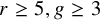
(1) If $r \geq 5, g \geq 3$
or
$r = 4, g \geq 4$
or
$r = 3, g \geq 5$
or
$r = 2$
,
$g \geq 7$
, then
$\alpha (X) = 0$
and consequently
$X \subset \mathbb {P}^M$
is not extendable. -
(2) If $r = 1$
and g is either
$g = 4k+1, k \geq 5$
or
$g = 18k+4, {k \geq 2}$
, or
$g = 18k+7, k \geq 2$
or
$g = 18k+13, k \geq 1$
or
$g = 18k+16, k \geq 1$
, then
$\alpha (X) = 0$
and consequently
$X \subset \mathbb {P}^M$
is not extendable. -
(3) If $r = 2, g \geq 4$
or
$r \geq 3, g \geq 3$
, then
$H^0(N_{X/\mathbb {P}^M}(-2)) = 0$
. Further, if
$(r = 2, g = 3)$
, then
$h^0(N_{X/\mathbb {P}^M}(-2)) \leq 1$
.













For non-prime
$K3$
 surfaces of lower genus, we show
Theorem 1.4 (see Theorem 3.15)
Let
$X \subset \mathbb {P}^{M}$
 be a general
$K3$
be a general
$K3$
 surface in
$\mathcal {H}_{r,g}$
surface in
$\mathcal {H}_{r,g}$
 embedded by the complete linear series of
$rB$
embedded by the complete linear series of
$rB$
 , where B is a primitive very ample line bundle, with
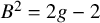
$B^2 = 2g-2$
, where B is a primitive very ample line bundle, with
$B^2 = 2g-2$
 and
$M = 1+r^2(g-1)$
and
$M = 1+r^2(g-1)$
 .
.
-
(1) If $r = 2$
,
$g = 3$
, then
$\alpha (X) = 10$
-
(2) If $r = 2$
,
$g = 4$
, then
$\alpha (X) = 6$
-
(3) If $r = 2$
,
$g = 5$
, then
$\alpha (X) = 3$
-
(4) If $r = 2$
,
$g = 6$
, then
$\alpha (X) = 1$
-
(5) If $r = 3$
,
$g = 3$
, then
$\alpha (X) \leq 4$
-
(6) If $r = 3$
,
$g = 4$
, then
$\alpha (X) = 1$
-
(7) If $r = 4$
,
$g = 3$
, then
$\alpha (X) = 1$


The above two theorems completely recover optimal results of [Reference Ciliberto, Lopez and Miranda17] (see also [Reference Ciliberto, Lopez and Miranda18]) in the case of non-prime
$K3$
 surfaces, while they recover results for infinitely many values of g in the prime case that were proven in [Reference Ciliberto, Lopez and Miranda15]. We intend to deal with the case
$r = 1$
surfaces, while they recover results for infinitely many values of g in the prime case that were proven in [Reference Ciliberto, Lopez and Miranda15]. We intend to deal with the case
$r = 1$
 and all possible values of g more systematically in a forthcoming article.
One of the key technical results proved in [Reference Ciliberto, Lopez and Miranda17], that crucially depends on the corank of the Wahl map, concerns the dimension of the component of the Hilbert scheme at points representing cones over canonical curves. Using Theorem 1.3
$(2)$
 and the bounds of
$\alpha (X)$
and the bounds of
$\alpha (X)$
 in Theorem 1.4, we prove this result directly for the cone over a
$K3$
in Theorem 1.4, we prove this result directly for the cone over a
$K3$
 surface.
The following theorem, which is a consequence of our results and a general principle outlined in [Reference Ciliberto, Lopez and Miranda17], gives a classification of non-prime Fano threefolds and more generally non-prime Mukai varieties of Picard rank one
Theorem 1.5 (see Theorem 4.6, Theorem 4.8)
-
(1) Let $\mathcal {V}_{r,g,1}$
denote the closure of the locus of points representing smooth Fano threefolds with Picard rank one in the Hilbert scheme of smooth anticanonically embedded Fano threefolds of index r and genus g. Let
$r \geq 2$
and
$g \geq 3$
(see Definition 4.2). Then-
(a) $\mathcal {V}_{r,g,1} = \varnothing $
if
$(r = 2, g \geq 7)$
,
$(r = 3, g = 3)$
,
$(r = 3, g \geq 5)$
,
$(r = 4, g \geq 4)$
or
$(r \geq 5, g \geq 3)$
. -
(b) For $(r = 2, 3 \leq g \leq 6), (r = 3, g = 4), (r = 4, g = 3)$
,
$\mathcal {V}_{r,g,1}$
is irreducible, and the families of Fano and Iskovskih form an open dense irreducible subset of
$\mathcal {V}_{r,g,1}$
. The general fiber of the projection map
$p: \mathcal {F}_{r,g} \to \mathcal {H}_{r,g}$
as defined in Definition 4.2 is irreducible. Up to projective transformations, a general
$K3$
surface in
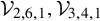
$\mathcal {H}_{2,6}, \mathcal {H}_{3,4}$
or
$ \mathcal {H}_{4,3}$
is contained in a unique Fano threefold in
$\mathcal {V}_{2,6,1}, \mathcal {V}_{3,4,1}$
or
$ \mathcal {V}_{4,3,1}$
respectively.
-
-
(2) For $n \geq 4$
, let
$\mathcal {V}_{n,r,g,1}$
denote the closure of the locus of smooth Fano
$n-$
folds of Picard rank one in the Hilbert scheme of smooth embedded Fano varieties of dimension
$n \geq 4$
, index
$r(n-2)$
and genus g with a canonical curve section. (see Definition 4.7). Let
$r \geq 2$
and
$g \geq 3$
. Then-
(a) $\mathcal {V}_{n,r,g,1} = \varnothing $
if
$(r = 2, 3 \leq g \leq 4)$
,
$(n \geq 6, r = 2, g = 5)$
,
$(r = 2, g \geq 6)$
,
$(r = 3, g \geq 3)$
, or
$(r = 4, g \geq 3)$
. -
(b) $\mathcal {V}_{4,2,5,1}$
and
$\mathcal {V}_{5,2,5,1}$
are irreducible, and the families of Mukai form an open dense irreducible subset of the components.
-


















Once again, we point out that the above results were proven using very different methods in [Reference Ciliberto, Lopez and Miranda17]. Finally in Theorem 5.2, we show that the
$K3$
 carpets
$\widetilde {Y} \subset \mathbb {P}^M$
carpets
$\widetilde {Y} \subset \mathbb {P}^M$
 on a Hirzebruch surface
$Y=\mathbb {F}_e$
on a Hirzebruch surface
$Y=\mathbb {F}_e$
 ,
$0 \leq e \leq 1$
,
$0 \leq e \leq 1$
 , embedded by arbitrary linear series lie in the closure of simple normal crossing varieties of the form
$V = Y_1 \bigcup _E Y_2 \subset \mathbb {P}^M$
, embedded by arbitrary linear series lie in the closure of simple normal crossing varieties of the form
$V = Y_1 \bigcup _E Y_2 \subset \mathbb {P}^M$
 , where each
$Y_i \cong Y$
, where each
$Y_i \cong Y$
 is embedded by
$aC_0+bf$
is embedded by
$aC_0+bf$
 and E is an anticanonical elliptic curve. The relation of these embedded type two degenerations of
$K3$
and E is an anticanonical elliptic curve. The relation of these embedded type two degenerations of
$K3$
 surfaces to the present context is as follows: In [Reference Ciliberto, Lopez and Miranda15], to deal with the prime case, the authors degenerated
$K3$
surfaces to the present context is as follows: In [Reference Ciliberto, Lopez and Miranda15], to deal with the prime case, the authors degenerated
$K3$
 surfaces into a union of scrolls (this is the case
$a=1$
surfaces into a union of scrolls (this is the case
$a=1$
 above.) These were further degenerated to a union of planes whose hyperplane sections are graph curves with corank one Gaussian map. The techniques introduced in this article show that in the non-prime case, degenerating the
$K3$
above.) These were further degenerated to a union of planes whose hyperplane sections are graph curves with corank one Gaussian map. The techniques introduced in this article show that in the non-prime case, degenerating the
$K3$
 surfaces to union of Hirzeburch surfaces embedded by arbitrary linear series, and further degenerating to
$K3$
surfaces to union of Hirzeburch surfaces embedded by arbitrary linear series, and further degenerating to
$K3$
 carpets, suffices to prove the results.
Using Theorem 1.3 along with results of [Reference Ciliberto, Dedieu and Sernesi14], [Reference Arbarello, Bruno and Sernesi2], we conclude that
Corollary 1.6 (see Corollary 3.12)
Let
$X \subset \mathbb {P}^{M}$
 be a general
$K3$
be a general
$K3$
 surface in
$\mathcal {H}_{r,g}$
surface in
$\mathcal {H}_{r,g}$
 embedded by the complete linear series of
$rB$
embedded by the complete linear series of
$rB$
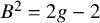
 , where B is a primitive very ample line bundle, with
$B^2 = 2g-2$
, where B is a primitive very ample line bundle, with
$B^2 = 2g-2$
 and
$M = 1+r^2(g-1)$
and
$M = 1+r^2(g-1)$
 . Let
$C \in |rB|$
. Let
$C \in |rB|$
 be any smooth curve section of X. Assume either
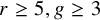
$r \geq 5, g \geq 3$
be any smooth curve section of X. Assume either
$r \geq 5, g \geq 3$
 or
$r = 4, g \geq 4$
or
$r = 4, g \geq 4$
 or
$r = 3, g \geq 5$
or
$r = 3, g \geq 5$
 or
$r = 2$
or
$r = 2$
 ,
$g \geq 7$
,
$g \geq 7$
 or
$r = 1$
or
$r = 1$
 and g is either
$g = 4k+1, k \geq 5$
and g is either
$g = 4k+1, k \geq 5$
 or
$g = 18k+4, k \geq 2$
or
$g = 18k+4, k \geq 2$
 , or
$g = 18k+7, k \geq 2$
, or
$g = 18k+7, k \geq 2$
 or
$g = 18k+13, k \geq 1$
or
$g = 18k+13, k \geq 1$
 or
$g = 18k+16, k \geq 1$
or
$g = 18k+16, k \geq 1$
 . Then
$\alpha (C) = \operatorname {cork}(\Phi _{\omega _C}) = 1$
. Then
$\alpha (C) = \operatorname {cork}(\Phi _{\omega _C}) = 1$
 .
.
The corank one theorem can also be derived from our methods independently by showing the injectivity of the map
$H^1(N_{\widetilde {Y}/\mathbb {P}^M}(-2\widetilde {H})) \to H^1(N_{\widetilde {Y}/\mathbb {P}^M}(-\widetilde {H}))$
 on the ribbon
$\widetilde {Y}$
on the ribbon
$\widetilde {Y}$
 (see Remark 3.13). For this, along with the methods introduced here, one needs to use results on Gaussian maps on Hirzebruch surfaces in [Reference Duflot and Miranda20] and [Reference Duflot and Peters22]. Since showing injectivity of this map is essential to systematically handle the case
$r = 1$
(see Remark 3.13). For this, along with the methods introduced here, one needs to use results on Gaussian maps on Hirzebruch surfaces in [Reference Duflot and Miranda20] and [Reference Duflot and Peters22]. Since showing injectivity of this map is essential to systematically handle the case
$r = 1$
 , that is, the case of prime
$K3$
, that is, the case of prime
$K3$
 surfaces, we will come back to this in a forthcoming article [Reference Bangere and Mukherjee10].
2 Preliminaries on degeneration of K3 surfaces into K3 double structures on Hirzebruch surfaces
We recall some definitions and a theorem on some special non-reduced degenerations of
$K3$
 surfaces in a projective space.
Definition 2.1. Let Y be a reduced connected projective variety.
-
(1) A scheme $\widetilde {Y}$
is called a ribbon on Y with conormal bundle L if
$\widetilde {Y}_{\operatorname {red}} = Y$
,
$\mathcal {I}_{Y/\widetilde {Y}}^2 = (0)$
and
$\mathcal {I}_{Y/\widetilde {Y}} \cong L$
as an
$\mathcal {O}_Y$
module where
$\mathcal {I}_{Y/\widetilde {Y}}$
is the ideal sheaf of Y inside
$\widetilde {Y}$
and L is a line bundle on Y. -
(2) If Y is a smooth surface, then a ribbon $\widetilde {Y}$
on Y is called a
$K3$
carpet if the dualizing sheaf
$K_{\widetilde {Y}} \cong \mathcal {O}_{\widetilde {Y}}$
and
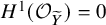
$H^1(\mathcal {O}_{\widetilde {Y}})= 0$
.


The following lemma characterizes the conormal bundle of a
$K3$
 carpet
$\widetilde {Y}$
carpet
$\widetilde {Y}$
 on a smooth surface Y.
Lemma 2.2 (see [Reference Gallego, González and Purnaprajna23, Proposition
$1.5$
])

A ribbon
$\widetilde {Y}$
 on a smooth regular surface Y with conormal bundle L is a
$K3$
on a smooth regular surface Y with conormal bundle L is a
$K3$
 carpet if and only if
$L \cong K_Y$
carpet if and only if
$L \cong K_Y$
 .
.
We recall the definition of the Hilbert scheme of
$K3$
 surfaces.
Definition 2.3. Let
$\mathcal {H}_{r,g}$
 denote the Hilbert scheme of
$K3$
denote the Hilbert scheme of
$K3$
 surfaces of index r and genus g, that is,
$K3$
surfaces of index r and genus g, that is,
$K3$
 surfaces
$X \subset \mathbb {P}^{1+r^2(g-1)} = \mathbb {P}^M$
surfaces
$X \subset \mathbb {P}^{1+r^2(g-1)} = \mathbb {P}^M$
 embedded by the complete linear series of
$rB$
embedded by the complete linear series of
$rB$
 where B is a primitive very ample line bundle with
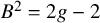
$B^2 = 2g-2$
where B is a primitive very ample line bundle with
$B^2 = 2g-2$
 . If
$r = 1$
. If
$r = 1$
 , we call
$\mathcal {H}_{r,g}$
, we call
$\mathcal {H}_{r,g}$
 the Hilbert scheme of prime
$K3$
the Hilbert scheme of prime
$K3$
 surfaces while if
$r \geq 2$
surfaces while if
$r \geq 2$
 ,
$\mathcal {H}_{r,g}$
,
$\mathcal {H}_{r,g}$
 is called the Hilbert scheme of non-prime
$K3$
is called the Hilbert scheme of non-prime
$K3$
 surfaces. Recall that
$\operatorname {dim}\mathcal {H}_{r,g} = h^0(N_{X/\mathbb {P}^M}) = 18+(M+1)^2$
surfaces. Recall that
$\operatorname {dim}\mathcal {H}_{r,g} = h^0(N_{X/\mathbb {P}^M}) = 18+(M+1)^2$
 .
.
Next we recall a degeneration theorem of
$K3$
 surfaces into
$K3$
surfaces into
$K3$
 carpets on Hirzebruch surfaces.
Theorem 2.4 ([Reference Bangere, Mukherjee and Raychaudhury8, Theorems
$3.1,4.3,4.4,5.1$
] and [Reference Gallego and Purnaprajna26, Proposition
$1.7$
, Theorems
$3.5,4.1$
])



Let
$Y = \mathbb {F}_e$
 be a Hirzebruch surface. Let
$H = aC_0+bf$
be a Hirzebruch surface. Let
$H = aC_0+bf$
 be a very ample line bundle on Y, where
$C_0$
be a very ample line bundle on Y, where
$C_0$
 is the class of a section, satisfying
$C_0^2 = -e$
is the class of a section, satisfying
$C_0^2 = -e$
 and f is the class of a fiber satisfying
$f^2 = 0$
and f is the class of a fiber satisfying
$f^2 = 0$
 (this happens if and only if
$b \geq ae+1$
(this happens if and only if
$b \geq ae+1$
 ). Consider the embedding
$Y \hookrightarrow \mathbb {P}^N$
). Consider the embedding
$Y \hookrightarrow \mathbb {P}^N$
 induced by the complete linear series
$|H|$
induced by the complete linear series
$|H|$
 .
.
-
(1) Then there exist $K3$
carpets
$\widetilde {Y}$
on Y along with a very ample line bundle
$\widetilde {H}$
on
$\widetilde {Y}$
such that
$\widetilde {H}|_Y = H$
. -
(2) If $\widetilde {Y} \hookrightarrow \mathbb {P}^M$
denotes the embedding induced by the complete linear series
$|\widetilde {H}|$
, then
$\widetilde {Y}$
is smoothable in
$\mathbb {P}^M$
into smooth
$K3$
surfaces embedded by the complete linear series of a very ample line bundle. -
(3) For $0 \leq e \leq 2$
, the Hilbert point of
$\widetilde {Y}$
is smooth and for
$0 \leq e \leq 1$
, the general smooth surface of the unique Hilbert component containing
$\widetilde {Y}$
is a-
(a) prime $K3$
surface if
$\textrm {gcd}(a,b) = 1$
-
(b) a non-prime $K3$
surface embedded by
$rB$
, with
$r = \operatorname {gcd}(a,b)$
and B is a primitive very ample line bundle.
-






Proof. Parts
$(1)$
 and
$(2)$
and
$(2)$
 and the statement on smoothness of Hilbert point in part
$(3)$
and the statement on smoothness of Hilbert point in part
$(3)$
 of the theorem follow from [Reference Bangere, Mukherjee and Raychaudhury8, Theorem
$3.1(3)$
of the theorem follow from [Reference Bangere, Mukherjee and Raychaudhury8, Theorem
$3.1(3)$
 , Theorem
$4.3$
, Theorem
$4.3$
 , Theorem
$4.4$
, Theorem
$4.4$
 , Theorem
$5.1$
, Theorem
$5.1$
 ] and [Reference Gallego and Purnaprajna26, Proposition
$1.7$
] and [Reference Gallego and Purnaprajna26, Proposition
$1.7$
 , Theorem
$3.5$
, Theorem
$3.5$
 , Theorem
$4.1$
, Theorem
$4.1$
 ].
].
We prove part
$(3)$
 . Let
$Y = \mathbb {F}_e$
. Let
$Y = \mathbb {F}_e$
 with
$0 \leq e \leq 2$
with
$0 \leq e \leq 2$
 . Consider the
$K3$
. Consider the
$K3$
 double cover of
$\pi :X \to Y$
double cover of
$\pi :X \to Y$
 branched along a very general smooth
$D \in |-2K_Y|$
branched along a very general smooth
$D \in |-2K_Y|$
 . Let
$H_0 = \pi ^{\ast }(\mathcal {O}_{Y}(1)) = \pi ^{\ast }(aC_0+bf)$
. Let
$H_0 = \pi ^{\ast }(\mathcal {O}_{Y}(1)) = \pi ^{\ast }(aC_0+bf)$
 and consider the composition

Recall the smoothing fibers
$X_t \stackrel{\varphi _t}{\hookrightarrow} \mathbb {P}^M$
 are obtained as the image of an embedding
$\varphi _t$
are obtained as the image of an embedding
$\varphi _t$
 which is a general deformation of
$\varphi $
which is a general deformation of
$\varphi $
 along a one-parameter family T and are hence embedded inside
$\mathbb {P}^M$
along a one-parameter family T and are hence embedded inside
$\mathbb {P}^M$
 by the complete linear series of a line bundle
$H_t$
by the complete linear series of a line bundle
$H_t$
 which is a deformation of
$H_0$
which is a deformation of
$H_0$
 . Since the multiplicity of a polarization remains constant on a smooth family, we have to find the multiplicity of
$H_0$
. Since the multiplicity of a polarization remains constant on a smooth family, we have to find the multiplicity of
$H_0$
 on the double cover X. Now since D is very general, smooth and irreducible part
$(3)$
on the double cover X. Now since D is very general, smooth and irreducible part
$(3)$
 for
$Y = \mathbb {F}_e$
for
$Y = \mathbb {F}_e$
 ,
$0 \leq e \leq 1$
,
$0 \leq e \leq 1$
 follows from the fact that
$\textrm {Pic}(X)$
follows from the fact that
$\textrm {Pic}(X)$
 is generated by
$\pi ^{\ast }\mathcal {O}_Y(C_0)$
is generated by
$\pi ^{\ast }\mathcal {O}_Y(C_0)$
 and
$\pi ^{\ast }\mathcal {O}_Y(f)$
and
$\pi ^{\ast }\mathcal {O}_Y(f)$
 (see [Reference Artebani, Hausen and Laface1, Proposition
$6.3$
(see [Reference Artebani, Hausen and Laface1, Proposition
$6.3$
 ] and [Reference Artebani, Hausen and Laface1, Proposition
$6.5$
] and [Reference Artebani, Hausen and Laface1, Proposition
$6.5$
 (i), (iii)]).
3 Extendability of general K3 surfaces
As mentioned before, to give an upper bound for
$\alpha (X)$
 for a
$K3$
for a
$K3$
 surface
$X \subset \mathbb {P}^M$
surface
$X \subset \mathbb {P}^M$
 , we will degenerate
$X \subset \mathbb {P}^M$
, we will degenerate
$X \subset \mathbb {P}^M$
 to a
$K3$
to a
$K3$
 carpet
$\widetilde {Y} \subset \mathbb {P}^M$
carpet
$\widetilde {Y} \subset \mathbb {P}^M$
 , using Theorem 2.4 and compute
$\alpha (\widetilde {Y})$
, using Theorem 2.4 and compute
$\alpha (\widetilde {Y})$
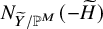
 . The main tool for all our computations that follow consists of the three exact sequences Equation(3.1), Equation (3.2) and Equation (3.3) that decompose the cohomology of the twisted normal bundle
$N_{\widetilde {Y}/\mathbb {P}^M}(-\widetilde {H})$
. The main tool for all our computations that follow consists of the three exact sequences Equation(3.1), Equation (3.2) and Equation (3.3) that decompose the cohomology of the twisted normal bundle
$N_{\widetilde {Y}/\mathbb {P}^M}(-\widetilde {H})$
 of a ribbon
$\widetilde {Y} \subset \mathbb {P}^M$
of a ribbon
$\widetilde {Y} \subset \mathbb {P}^M$
 in terms of cohomology of various twists of the normal bundle
$N_{Y/\mathbb {P}^M}$
in terms of cohomology of various twists of the normal bundle
$N_{Y/\mathbb {P}^M}$
 of the reduced part.
We introduce the following notation that will be used throughout the paper.
Notation.
-
(a) Let $\widetilde {V}$
be a vector bundle on the ribbon
$\widetilde {Y}$
and L is a line bundle on Y. Then L has the structure of an
$\mathcal {O}_{\widetilde {Y}}$
module due to the homomorphism
$\mathcal {O}_{\widetilde {Y}} \to \mathcal {O}_Y$
that defines the ribbon
$\widetilde {Y}$
. We define
$\widetilde {V}(L):=\widetilde {V}\otimes _{\mathcal {O}_{\widetilde {Y}}} L$
. -
(b) By $I_{\widetilde {Y}}$
and
$I_{Y}$
, we mean the ideal sheaf of
$\widetilde {Y}$
and Y in
$\mathbb {P}^M$
respectively.





Theorem 3.1. Let
$\widetilde {Y} \hookrightarrow \mathbb {P}^M$
 be a
$K3$
be a
$K3$
 carpet embedded by the complete linear series of a very ample line bundle
$\widetilde {H}$
carpet embedded by the complete linear series of a very ample line bundle
$\widetilde {H}$
 such that the possibly degenerate embedding
$Y = \mathbb {F}_e \hookrightarrow \mathbb {P}^M$
such that the possibly degenerate embedding
$Y = \mathbb {F}_e \hookrightarrow \mathbb {P}^M$
 induced on the reduced part is given by the complete linear series of a very ample line bundle
$H = aC_0+bf$
induced on the reduced part is given by the complete linear series of a very ample line bundle
$H = aC_0+bf$
 followed by a linear embedding of projective spaces. Assume
$H^1(-H+K_Y) = 0$
followed by a linear embedding of projective spaces. Assume
$H^1(-H+K_Y) = 0$
 .
.
-
(1) Let
$$ \begin{align*}\beta = h^1(T_Y(-H+K_Y)) + h^1(T_Y(-H)) - h^0(T_Y(-H)) + h^1(-H-K_Y) + h^0(-H-2K_Y)\end{align*} $$Then
$$ \begin{align*}\alpha(\widetilde{Y}) = h^0(N_{\widetilde{Y}/\mathbb{P}^M}(-\widetilde{H}))-M-1 \leq \beta\end{align*} $$In particular if $\beta = 0$
, then
$\alpha (\widetilde {Y}) \leq 0$
. Consequently, the general smooth
$K3$
surfaces in the Hilbert component containing
$\widetilde {Y}$
are not extendable .
-
(2) Let $a = 2$
,
$\widetilde {Y}$
a general embedded
$K3$
carpet represented by a general no-where vanishing section in
$H^0(N_{Y/\mathbb {P}^M} \otimes K_Y)$
and set $$ \begin{align*} \gamma & = h^0(N_{Y/\mathbb{P}^M}(-H+K_Y)+h^0(N_{Y/\mathbb{P}^M}(-H)+h^0(-H-2K_Y)-M-1 \\ & \leq h^1(T_Y(-H+K_Y))+h^0(N_{Y/\mathbb{P}^M}(-H)+h^0(-H-2K_Y)-M-1 \end{align*} $$Then
$$ \begin{align*}\alpha(\widetilde{Y}) = h^0(N_{\widetilde{Y}/\mathbb{P}^M}(-\widetilde{H}))-M-1 \leq \gamma\end{align*} $$In particular if $\gamma = 0$
, then
$\alpha (\widetilde {Y}) \leq 0$
. Consequently, the general smooth
$K3$
surfaces in the Hilbert component containing
$\widetilde {Y}$
are not extendable.





Proof. Part
$(1)$
 has been proved in [Reference Bangere and Mukherjee9, Theorem
$2.2$
has been proved in [Reference Bangere and Mukherjee9, Theorem
$2.2$
 ]. We prove part
$(2)$
]. We prove part
$(2)$
 . We have the following exact sequences (see [Reference Gallego, González and Purnaprajna23, Lemma
$4.1$
. We have the following exact sequences (see [Reference Gallego, González and Purnaprajna23, Lemma
$4.1$
 ])
])


Tensoring equation 3.1 by
$\mathcal {O}_{\widetilde {Y}}(-\widetilde {H})$
 , we have that

We compute
$h^0(N_{\widetilde {Y}/\mathbb {P}^M}(-H+K_Y))$
 . Tensoring equation 3.2 by
$\mathcal {O}_Y(-H+K_Y)$
. Tensoring equation 3.2 by
$\mathcal {O}_Y(-H+K_Y)$
 we have

Hence

Tensoring equation 3.3, by
$\mathcal {O}_Y(-H+K_Y)$
 we have

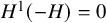
Since
$H^1(-H) = 0$
 , by Kodaira vanishing theorem, and
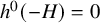
$h^0(-H) = 0$
, by Kodaira vanishing theorem, and
$h^0(-H) = 0$
 , we have that

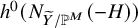
We now compute
$h^0(N_{\widetilde {Y}/\mathbb {P}^M}(-H))$
 . Tensoring equation 3.2 by
$\mathcal {O}_Y(-H)$
. Tensoring equation 3.2 by
$\mathcal {O}_Y(-H)$
 we have

Hence

Tensoring equation 3.3, by
$\mathcal {O}_Y(-H)$
 we have

Now we claim that
Claim 3.2. For a general ribbon
$\widetilde {Y}$
 , the induced map
$H^0(N_{Y/\mathbb {P}^M}(-H)) \to H^0(\mathcal {H}om(I_{\widetilde {Y}}/I_{Y}^2, \mathcal {O}_Y)(-H))$
, the induced map
$H^0(N_{Y/\mathbb {P}^M}(-H)) \to H^0(\mathcal {H}om(I_{\widetilde {Y}}/I_{Y}^2, \mathcal {O}_Y)(-H))$
 is surjective.
Granting the claim for now, we have that

Hence we have that


We now compute
$h^0(N_{Y/\mathbb {P}^M}(-H+K_Y))$
 . We have

and the Euler exact sequence restricted to Y

Tensoring equation 3.11 by
$\mathcal {O}_Y(-H+K_Y)$
 , we have

We have that
$H^0(\mathcal {O}_Y(K_Y)) = 0$
 and by assumption
$H^1(\mathcal {O}_Y(-H+K_Y)) = 0$
and by assumption
$H^1(\mathcal {O}_Y(-H+K_Y)) = 0$
 and hence
$H^0(T_{\mathbb {P}^M}|_Y(-H+K_Y)) = 0$
and hence
$H^0(T_{\mathbb {P}^M}|_Y(-H+K_Y)) = 0$
 .
.
Tensoring equation 3.10 by
$\mathcal {O}_Y(-H+K_Y)$
 , we have

Since
$H^0(T_{\mathbb {P}^M}|_Y(-H+K_Y)) = 0$
 ,
,

Plugging everything back into equation 3.9, we have

We now prove the claim.
Proof of Claim 3.2
Consider the exact sequence given by twisting equation 3.3 by
$-H$
 .
.

Let
$p: Y \to \mathbb {P}^1$
 denote the smooth fibration. Now note that
$-K_Y-H = -(b-e-2)f$
denote the smooth fibration. Now note that
$-K_Y-H = -(b-e-2)f$
 and hence
$R^1p_*(-H-K_Y) = 0$
and hence
$R^1p_*(-H-K_Y) = 0$
 . Hence we have the following exact sequence by pushing forward the exact sequence 3.14

It is enough to show that the exact sequence 3.15 is split for a general ribbon
$\widetilde {Y}$
 . To see this we first show that there is a surjection from
$p_*(N_{Y/\mathbb {P}^M}(-H))$
. To see this we first show that there is a surjection from
$p_*(N_{Y/\mathbb {P}^M}(-H))$
 to
$p_*(-H-K_Y)$
to
$p_*(-H-K_Y)$
 . To see this consider the exact sequence 3.10 twisted by
$-H$
. To see this consider the exact sequence 3.10 twisted by
$-H$
 to get

We show that

To see the first vanishing once again note that from the Euler exact sequence pulled back to Y and twisted by
$-H$
 , we have

Since
$R^1p_*(\mathcal {O}_Y) = R^2(p_*\mathcal {O}_Y(-H)) = 0$
 , we have that
$R^1p_*(T_{\mathbb {P}^M}|_Y(-H)) = 0$
, we have that
$R^1p_*(T_{\mathbb {P}^M}|_Y(-H)) = 0$
 . Now we turn to
$R^ip_*(T_Y(-H))$
. Now we turn to
$R^ip_*(T_Y(-H))$
 . Consider the exact sequence of horizontal and vertical tangent bundles on Y twisted by
$-H$
. Consider the exact sequence of horizontal and vertical tangent bundles on Y twisted by
$-H$


Using the relative Euler exact sequence we have that
$T_{Y/\mathbb {P}^1} = 2C_0+ef$
 , so that
$T_{Y/\mathbb {P}^1}(-H) = -(b-e)f$
, so that
$T_{Y/\mathbb {P}^1}(-H) = -(b-e)f$
 . Therefore
$p_*(T_{Y/\mathbb {P}^1}(-H)) = \mathcal {O}_{\mathbb {P}^1}(-(b-e))$
. Therefore
$p_*(T_{Y/\mathbb {P}^1}(-H)) = \mathcal {O}_{\mathbb {P}^1}(-(b-e))$
 and
$R^ip_*(T_{Y/\mathbb {P}^1}(-H)) = R^ip_*(-(b-e)f) = 0$
and
$R^ip_*(T_{Y/\mathbb {P}^1}(-H)) = R^ip_*(-(b-e)f) = 0$
 for
$i = 1,2$
for
$i = 1,2$
 . Now
$p^{\ast }T_{\mathbb {P}^1}(-H) = -2C_0-(b-2)f$
. Now
$p^{\ast }T_{\mathbb {P}^1}(-H) = -2C_0-(b-2)f$
 . Therefore,
$p_*p^{\ast }T_{\mathbb {P}^1}(-H) = p_*(-2C_0-(b-2)f) = \mathcal {O}_{\mathbb {P}^1}(-(b-2)) \otimes p_*(-2C_0) = 0$
. Therefore,
$p_*p^{\ast }T_{\mathbb {P}^1}(-H) = p_*(-2C_0-(b-2)f) = \mathcal {O}_{\mathbb {P}^1}(-(b-2)) \otimes p_*(-2C_0) = 0$
 and
and

Pushing forward the sequence 3.18, we have that

and

Now pushing forward the exact sequence 3.16, we have that

We now end the proof of the claim by showing that for a general ribbon
$\widetilde {Y}$
 , which is defined by an injection
$0 \to -K_Y \to N_{Y/\mathbb {P}^M}$
, which is defined by an injection
$0 \to -K_Y \to N_{Y/\mathbb {P}^M}$
 (see [Reference Bangere, Mukherjee and Raychaudhury8, Theorem
$1.1$
(see [Reference Bangere, Mukherjee and Raychaudhury8, Theorem
$1.1$
 ]), the map
$\lambda $
]), the map
$\lambda $
 is a section to the injective map induced by the pushforward after twisting by
$-H$
is a section to the injective map induced by the pushforward after twisting by
$-H$
 :
:

So the question is can we choose a ribbon or equivalently, an injection
$0 \to -K_Y \to N_{Y/\mathbb {P}^M}$
 , such that the induced map
$\beta $
, such that the induced map
$\beta $
 ,
,

which sits in the following diagram

satisfies
$\lambda \circ \beta = \operatorname {id}$
 . It is enough to choose
$\beta $
. It is enough to choose
$\beta $
 such that
$\lambda \circ \beta $
such that
$\lambda \circ \beta $
 is an isomorphism and since
$p_*(-H-K_Y) = \mathcal {O}_{\mathbb {P}^1}(-(b-e-2))$
is an isomorphism and since
$p_*(-H-K_Y) = \mathcal {O}_{\mathbb {P}^1}(-(b-e-2))$
 is a line bundle, it is enough to choose
$\beta $
is a line bundle, it is enough to choose
$\beta $
 such that
$\lambda \circ \beta $
such that
$\lambda \circ \beta $
 is non-zero. This happens in particular if
$\operatorname {Im}(\beta )$
is non-zero. This happens in particular if
$\operatorname {Im}(\beta )$
 is not contained in
$\operatorname {Ker}(\lambda )$
is not contained in
$\operatorname {Ker}(\lambda )$
 . So we need to show that
$\beta $
. So we need to show that
$\beta $
 does not factor as

It is enough to show that

does not surject. To see this note that (by sequence 3.21 and diagram 3.22), we have an exact sequence

Applying the functor
$\operatorname {Hom}(p_*(-H-K_Y),-)$
 we get

We first show that the map
$\operatorname {Ext^1}(p_*(-H-K_Y), p_*T_{Y/\mathbb {P}^1}(-H)) \xrightarrow []{\eta } \operatorname {Ext^1}(p_*(-H-K_Y), p_*(T_{\mathbb {P}^M}|_Y(-H))$
 is an injective map and is in fact an isomorphism.
First consider the two exact sequences, the first one is the relative Euler sequence on Y and the second one is the Euler sequence of
$\mathbb {P}^M$
 pulled back to Y.

The map y is the injective map induced by the composition of two injective maps given by
$0 \to T_{Y/\mathbb {P}^1} \to T_Y$
 and
$0 \to T_Y \to T_{\mathbb {P}^M}|_Y$
and
$0 \to T_Y \to T_{\mathbb {P}^M}|_Y$
 . We show that the map y has a unique lift to a map

Apply the functor
$\operatorname {Hom}(p^{\ast }(\mathcal {O}_{\mathbb {P}^1} \oplus \mathcal {O}_{\mathbb {P}^1}(-e))^{\ast } \otimes \mathcal {O}_Y(C_0), -)$
 to the bottom exact sequence we have

Now,
$\operatorname {Ext^1}(p^{\ast }(\mathcal {O}_{\mathbb {P}^1} \oplus \mathcal {O}_{\mathbb {P}^1}(-e))^{\ast } \otimes \mathcal {O}_Y(C_0), \mathcal {O}_Y) = \operatorname {Ext^1}(\mathcal {O}_Y(C_0) \oplus \mathcal {O}_Y(C_0+ef), \mathcal {O}_Y) = H^1(\mathcal {O}_Y(-C_0) \oplus \mathcal {O}_Y(-C_0-ef)) = 0$
 . Further,
$\operatorname {Hom}(p^{\ast }(\mathcal {O}_{\mathbb {P}^1} \oplus \mathcal {O}_{\mathbb {P}^1}(-e))^{\ast } \otimes \mathcal {O}_Y(C_0), \mathcal {O}_Y) = \operatorname {Hom}(\mathcal {O}_Y(C_0) \oplus \mathcal {O}_Y(C_0+ef), \mathcal {O}_Y) = H^0(\mathcal {O}_Y(-C_0) \oplus \mathcal {O}_Y(-C_0-ef)) = 0$
. Further,
$\operatorname {Hom}(p^{\ast }(\mathcal {O}_{\mathbb {P}^1} \oplus \mathcal {O}_{\mathbb {P}^1}(-e))^{\ast } \otimes \mathcal {O}_Y(C_0), \mathcal {O}_Y) = \operatorname {Hom}(\mathcal {O}_Y(C_0) \oplus \mathcal {O}_Y(C_0+ef), \mathcal {O}_Y) = H^0(\mathcal {O}_Y(-C_0) \oplus \mathcal {O}_Y(-C_0-ef)) = 0$
 . Hence the map y has a unique lift to the map z, which induces the following commutative diagram involving the two previous exact sequences

To see that the map w is an isomorphism, we only need to show that w is non-zero. To show this restrict the above diagram to a fiber of the projection map
$p: Y \to \mathbb {P}^1$
 . Since
$\mathcal {O}_Y(H) = \mathcal {O}_Y(2C_0+bf)$
. Since
$\mathcal {O}_Y(H) = \mathcal {O}_Y(2C_0+bf)$
 , we have that under the embedding, the fiber
$\mathbb {P}^1$
, we have that under the embedding, the fiber
$\mathbb {P}^1$
 is embedded by the complete linear series of
$\mathcal {O}_{\mathbb {P}^1}(2)$
is embedded by the complete linear series of
$\mathcal {O}_{\mathbb {P}^1}(2)$
 inside
$\mathbb {P}^2$
inside
$\mathbb {P}^2$
 followed by a linear embedding
$\mathbb {P}^2 \stackrel{i}{xhookrightarrow} \mathbb {P}^M$
followed by a linear embedding
$\mathbb {P}^2 \stackrel{i}{xhookrightarrow} \mathbb {P}^M$
 . Hence after restricting the above diagram to the fiber, we get

where
$\sigma _{\mathbb {P}^1}$
 and
$\rho _{\mathbb {P}^1}$
and
$\rho _{\mathbb {P}^1}$
 are the maps of the Euler exact sequence on
$\mathbb {P}^1$
are the maps of the Euler exact sequence on
$\mathbb {P}^1$
 , while
$i^{\ast }\sigma _{\mathbb {P}^M}$
, while
$i^{\ast }\sigma _{\mathbb {P}^M}$
 and
$i^{\ast }\rho _{\mathbb {P}^M}$
and
$i^{\ast }\rho _{\mathbb {P}^M}$
 are the maps of the Euler exact sequence on
$\mathbb {P}^M$
are the maps of the Euler exact sequence on
$\mathbb {P}^M$
 , pulled back to the quadric
$\mathbb {P}^1$
, pulled back to the quadric
$\mathbb {P}^1$
 ;
$\beta = di$
;
$\beta = di$
 is the differential map of the embedding i. As before, since
$\operatorname {Hom}(\mathcal {O}_{\mathbb {P}^1}(1)^{\oplus 2}, \mathcal {O}_{\mathbb {P}^1}) = \operatorname {Ext}^1(\mathcal {O}_{\mathbb {P}^1}(1)^{\oplus 2}, \mathcal {O}_{\mathbb {P}^1}) = 0$
is the differential map of the embedding i. As before, since
$\operatorname {Hom}(\mathcal {O}_{\mathbb {P}^1}(1)^{\oplus 2}, \mathcal {O}_{\mathbb {P}^1}) = \operatorname {Ext}^1(\mathcal {O}_{\mathbb {P}^1}(1)^{\oplus 2}, \mathcal {O}_{\mathbb {P}^1}) = 0$
 , the map
$\widetilde {\alpha }$
, the map
$\widetilde {\alpha }$
 is the unique map lifting
$di \circ \rho _{\mathbb {P}^1}$
is the unique map lifting
$di \circ \rho _{\mathbb {P}^1}$
 . Further since the embedding of the fiber
$i: \mathbb {P}^1 \hookrightarrow \mathbb {P}^{M}$
. Further since the embedding of the fiber
$i: \mathbb {P}^1 \hookrightarrow \mathbb {P}^{M}$
 factors as
$\mathbb {P}^1 \stackrel{\nu _2}{\hookrightarrow} \mathbb {P}^2 \stackrel{\iota }{\hookrightarrow} \mathbb {P}^{M}$
factors as
$\mathbb {P}^1 \stackrel{\nu _2}{\hookrightarrow} \mathbb {P}^2 \stackrel{\iota }{\hookrightarrow} \mathbb {P}^{M}$
 , where the last embedding is a linear embedding, the map
$di$
, where the last embedding is a linear embedding, the map
$di$
 actually factors as
$T_{\mathbb {P}^1} \to T_{\mathbb {P}^2}|_{\mathbb {P}^1} \to T_{\mathbb {P}^2}|_{\mathbb {P}^1} \oplus \mathcal {O}_{\mathbb {P}^1}(2)^{M-2}$
actually factors as
$T_{\mathbb {P}^1} \to T_{\mathbb {P}^2}|_{\mathbb {P}^1} \to T_{\mathbb {P}^2}|_{\mathbb {P}^1} \oplus \mathcal {O}_{\mathbb {P}^1}(2)^{M-2}$
 , where in the last map
$T_{\mathbb {P}^2}|_{\mathbb {P}^1}$
, where in the last map
$T_{\mathbb {P}^2}|_{\mathbb {P}^1}$
 sits as a direct summand. We claim that

is given by the Jacobian rule in the first three coordinates and zero in the remaining ones:

Since
$\widetilde {\alpha }$
 is the unique map lifting
$di \circ \rho _{\mathbb {P}^1}$
is the unique map lifting
$di \circ \rho _{\mathbb {P}^1}$
 , to prove this claim, it is enough to show that the above map makes the last diagram commutative. The proof of this claim is given in Lemma 3.4. Granting this claim, we note that
$\bar {w}(1) = 2$
, to prove this claim, it is enough to show that the above map makes the last diagram commutative. The proof of this claim is given in Lemma 3.4. Granting this claim, we note that
$\bar {w}(1) = 2$
 . To see this, recall that from Lemma 3.3,
$\widetilde {\alpha } \circ \sigma _{\mathbb {P}^1}(1) = \widetilde {\alpha }(u,v) = (2u^2, 2uv, 2v^2) = i^{\ast }\sigma _{\mathbb {P}^M}(2)$
. To see this, recall that from Lemma 3.3,
$\widetilde {\alpha } \circ \sigma _{\mathbb {P}^1}(1) = \widetilde {\alpha }(u,v) = (2u^2, 2uv, 2v^2) = i^{\ast }\sigma _{\mathbb {P}^M}(2)$
 . Therefore,
$\bar {w}(1) = 2$
. Therefore,
$\bar {w}(1) = 2$
 . Hence, w is an isomorphism.
Now twisting the commutative diagram (*) by
$\mathcal {O}_Y(-H)$
 , we have the following

Pushing forward the bottom row, we get

Note that
$\operatorname {Ext^i}(p_*(-H-K_Y), \mathcal {O}_{\mathbb {P}^1}^{M+1}) = H^i(\mathcal {O}_{\mathbb {P}^1}(b-e-2))^{\oplus M+1} = 0$
 for
$i = 1,2$
for
$i = 1,2$
 if
$b \geq e+1$
if
$b \geq e+1$
 . Hence applying the functor
$\operatorname {Hom}(p_*(-H-K_Y), -)$
. Hence applying the functor
$\operatorname {Hom}(p_*(-H-K_Y), -)$
 we get

Now consider the pushforward of the top row of diagram 3.25 to get

and hence we have an isomorphism

Because of the commutative diagram 3.25, Equation(3.27) and Equation(3.29), sit in a commutative diagram

The right hand vertical map above is isomorphism because it is induced by
$w(-H)$
 in diagram 3.25 which is an isomorphism. Hence the map
$\eta $
in diagram 3.25 which is an isomorphism. Hence the map
$\eta $
 is an isomorphism.
Going back to sequence 3.24, we have

Therefore, to show that the map in 3.23 does not surject, it is enough to show that

is not surjective. Since
$p^{\ast }p_*(-H-K_Y) = -H-K_Y$
 , by the projection formula, this is the same as showing

does not surject
Now by taking the cohomology of the exact sequence

we have

Now the required non-surjection of sequence 3.32 follows from the fact that
$H^1(T_Y \otimes K_Y) = \mathbb {C}^2$
 (see [Reference Bangere, Mukherjee and Raychaudhury8, Lemma
$2.5$
(see [Reference Bangere, Mukherjee and Raychaudhury8, Lemma
$2.5$
 ,
$(4)$
,
$(4)$
 ]) and
$H^1(T_{\mathbb {P}^M|_Y} \otimes K_Y) = \mathbb {C}$
]) and
$H^1(T_{\mathbb {P}^M|_Y} \otimes K_Y) = \mathbb {C}$
 (see [Reference Bangere, Mukherjee and Raychaudhury8, Lemma
$2.5$
(see [Reference Bangere, Mukherjee and Raychaudhury8, Lemma
$2.5$
 , (
$3$
, (
$3$
 )]).
)]).
Now we prove the claim regarding the map
$\widetilde {\alpha }$
 being the Jacobian map. We first recall the well-known descriptions of maps of the Euler sequence:
Lemma 3.3 (The Euler maps and the Euler exact sequence on
$\mathbb {P}^N$
)

Let k be a field and let
$\mathbb {P}^N=\mathbb {P}^N_k$
 with homogeneous coordinates
$[x_0:\cdots :x_N]$
with homogeneous coordinates
$[x_0:\cdots :x_N]$
 . Then there are canonical morphisms of sheaves

with the following properties.
-
(i) (Definition of the two maps.) The map $\sigma $
is defined by $$\begin{align*}\sigma(1)=(x_0,\dots,x_N), \end{align*}$$where each $x_i$
is viewed as the standard global section of
$\mathcal {O}_{\mathbb {P}^N}(1)$
.
The map $\rho $
is defined as follows. For any open set
$U\subset \mathbb {P}^N$
and any section
$s=(s_0,\dots ,s_N)\in \Gamma \!\big (U,\mathcal {O}_{\mathbb {P}^N}(1)^{\oplus (N+1)}\big )$
, choose (locally on U) homogeneous degree-
$1$
representatives of the
$s_i$
on the cone
$\mathbb {A}^{N+1}\setminus \{0\}$
. Form the k-derivation $$\begin{align*}\widetilde{X}_s \;:=\; \sum_{i=0}^N s_i\,\frac{\partial}{\partial x_i}. \end{align*}$$The induced derivation on $\mathbb {G}_m$
-invariant functions defines a vector field on U; we set
$\rho (s)$
to be this vector field.
-
(ii) (Local coordinate formula for $\rho $
.) On the standard affine chart
$U_0=\{x_0\neq 0\}$
, set $$\begin{align*}y_i=\frac{x_i}{x_0}\qquad (i=1,\dots,N). \end{align*}$$Then $\mathcal {O}_{\mathbb {P}^N}(1)$
is trivialized on
$U_0$
by
$x_0$
, so any section
$s_i\in \Gamma (U_0,\mathcal {O}_{\mathbb {P}^N}(1))$
can be written uniquely as
$s_i=x_0 f_i$
with
$f_i\in \mathcal {O}_{\mathbb {P}^N}(U_0)$
. For
$s=(x_0 f_0,\dots ,x_0 f_N)$
one has (3.33) $$ \begin{align} \rho(s) \;=\; \sum_{i=1}^N \big(f_i-f_0\,y_i\big)\,\frac{\partial}{\partial y_i}. \end{align} $$
-
(iii) (Euler exact sequence.) The sequence
$$\begin{align*}0\longrightarrow \mathcal{O}_{\mathbb{P}^N} \xrightarrow{\ \sigma\ } \mathcal{O}_{\mathbb{P}^N}(1)^{\oplus(N+1)} \xrightarrow{\ \rho\ } T_{\mathbb{P}^N} \longrightarrow 0 \end{align*}$$is exact.














Proof. The Euler exact sequence is classical; see Hartshorne [Reference Hartshorne27, Theorem II.8.13] for the dual (cotangent) version. We only give a proof of part (ii) because the local coordinate formula (3.33) will be used later.
Part (ii). We compute
$\rho (s)$
 on
$U_0$
on
$U_0$
 by evaluating the derivation
$\widetilde {X}=\sum _{j=0}^N s_j\,\partial /\partial x_j$
by evaluating the derivation
$\widetilde {X}=\sum _{j=0}^N s_j\,\partial /\partial x_j$
 on the affine coordinate functions
$y_i=x_i/x_0$
on the affine coordinate functions
$y_i=x_i/x_0$
 .
.

Substituting
$s_i=x_0 f_i$
 and
$x_i=x_0 y_i$
and
$x_i=x_0 y_i$
 gives
$\widetilde {X}(y_i)=f_i-f_0\, y_i$
gives
$\widetilde {X}(y_i)=f_i-f_0\, y_i$
 . Since a vector field on
$U_0\simeq \mathbb {A}^N$
. Since a vector field on
$U_0\simeq \mathbb {A}^N$
 is determined by its values on
$y_1,\dots ,y_N$
is determined by its values on
$y_1,\dots ,y_N$
 , we conclude
$\rho (s)=\sum _{i=1}^N (f_i-f_0\, y_i)\,\partial /\partial y_i$
, we conclude
$\rho (s)=\sum _{i=1}^N (f_i-f_0\, y_i)\,\partial /\partial y_i$
 .
.
Lemma 3.4. Let
$M\ge 2$
 and let
$i:\mathbb {P}^1\to \mathbb {P}^M$
and let
$i:\mathbb {P}^1\to \mathbb {P}^M$
 be a morphism whose image is a smooth conic. Equivalently, after choosing homogeneous coordinates
$[X_0:\dots ,X_M]$
be a morphism whose image is a smooth conic. Equivalently, after choosing homogeneous coordinates
$[X_0:\dots ,X_M]$
 on
$\mathbb {P}^M$
on
$\mathbb {P}^M$
 , the map i factors as

Let
$\rho _{\mathbb {P}^1}:\mathcal {O}_{\mathbb {P}^1}(1)^{\oplus 2}\to T_{\mathbb {P}^1}$
 be the Euler map on
$\mathbb {P}^1$
be the Euler map on
$\mathbb {P}^1$
 and let
$\rho _{\mathbb {P}^M}:\mathcal {O}_{\mathbb {P}^M}(1)^{\oplus (M+1)}\to T_{\mathbb {P}^M}$
and let
$\rho _{\mathbb {P}^M}:\mathcal {O}_{\mathbb {P}^M}(1)^{\oplus (M+1)}\to T_{\mathbb {P}^M}$
 be the Euler map on
$\mathbb {P}^M$
be the Euler map on
$\mathbb {P}^M$
 . Pulling back the Euler sequence of
$\mathbb {P}^M$
. Pulling back the Euler sequence of
$\mathbb {P}^M$
 along i yields a map

Define a morphism of vector bundles

by the Jacobian rule in the first three coordinates and zero in the remaining ones:

and let
$\beta =di:T_{\mathbb {P}^1}\to T_{\mathbb {P}^M}|_{i(\mathbb {P}^1)}$
 be the differential of i. Then the following square commutes:

Equivalently,
$i^{\ast }\rho _{\mathbb {P}^M}\circ \widetilde \alpha =\beta \circ \rho _{\mathbb {P}^1}$
 .
.
Proof. Let
$\mathbb {P}^1 = \operatorname {Proj}k[u,v], \mathbb {P}^2 = \operatorname {Proj}k[X_0,X_1,X_2]$
 and
$\mathbb {P}^M = \operatorname {Proj}k[X_0,X_1,X_2,X_3,\cdots , X_M]$
and
$\mathbb {P}^M = \operatorname {Proj}k[X_0,X_1,X_2,X_3,\cdots , X_M]$
 . Since the claim is local on
$\mathbb {P}^1$
. Since the claim is local on
$\mathbb {P}^1$
 , it suffices to check it on the affine chart
$U=\{v\neq 0\}\subset \mathbb {P}^1$
, it suffices to check it on the affine chart
$U=\{v\neq 0\}\subset \mathbb {P}^1$
 . Set
$y=u/v$
. Set
$y=u/v$
 on U.
on U.
Step 1: Local coordinates on
$\mathbb {P}^M$
 along
$i(U)$
along
$i(U)$
 . On the affine chart
$\{X_2\neq 0\}\subset \mathbb {P}^M$
. On the affine chart
$\{X_2\neq 0\}\subset \mathbb {P}^M$
 set
set

Along
$i(U)$
 we have
$X_0=u^2$
we have
$X_0=u^2$
 ,
$X_1=uv$
,
$X_1=uv$
 ,
$X_2=v^2$
,
$X_2=v^2$
 , and
$X_j=0$
, and
$X_j=0$
 for
$j\ge 3$
for
$j\ge 3$
 , hence

Therefore the differential
$\beta =di$
 satisfies

since
$w_j\equiv 0$
 on
$i(U)$
on
$i(U)$
 .
.
Step 2: Local formula for the Euler maps. On
$U=\{v\neq 0\}$
 the line bundle
$\mathcal {O}_{\mathbb {P}^1}(1)$
the line bundle
$\mathcal {O}_{\mathbb {P}^1}(1)$
 is trivialized by v, so any local section of
$\mathcal {O}_{\mathbb {P}^1}(1)^{\oplus 2}$
is trivialized by v, so any local section of
$\mathcal {O}_{\mathbb {P}^1}(1)^{\oplus 2}$
 can be written as
$(vA,\;vB)$
can be written as
$(vA,\;vB)$
 with
$A,B\in \mathcal {O}_{\mathbb {P}^1}(U)$
with
$A,B\in \mathcal {O}_{\mathbb {P}^1}(U)$
 . By Equation (3.33), from Lemma 3.3, we have

Similarly, on
$\{X_2\neq 0\}$
 the bundle
$\mathcal {O}_{\mathbb {P}^M}(1)$
the bundle
$\mathcal {O}_{\mathbb {P}^M}(1)$
 is trivialized by
$X_2$
is trivialized by
$X_2$
 . After pulling back to U, we have
$X_2=v^2$
. After pulling back to U, we have
$X_2=v^2$
 , so
$\mathcal {O}_{\mathbb {P}^1}(2)$
, so
$\mathcal {O}_{\mathbb {P}^1}(2)$
 is trivialized by
$v^2$
is trivialized by
$v^2$
 . Hence any local section of
$\mathcal {O}_{\mathbb {P}^1}(2)^{\oplus (M+1)}$
. Hence any local section of
$\mathcal {O}_{\mathbb {P}^1}(2)^{\oplus (M+1)}$
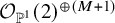 can be written as

with
$C_i,D_j\in \mathcal {O}_{\mathbb {P}^1}(U)$
 . The affine Euler formula on the chart
$\{X_2\neq 0\}$
. The affine Euler formula on the chart
$\{X_2\neq 0\}$
 in Equation (3.33), Lemma 3.3, gives

Restricting to
$i(U)$
 , we may substitute
$z_0=y^2$
, we may substitute
$z_0=y^2$
 ,
$z_1=y$
,
$z_1=y$
 , and
$w_j=0$
, and
$w_j=0$
 .
.
Step 3: The Jacobian map
$\widetilde \alpha $
 in local trivializations. Let
$(vA,\;vB)$
in local trivializations. Let
$(vA,\;vB)$
 be a local section of
$\mathcal {O}_{\mathbb {P}^1}(1)^{\oplus 2}$
be a local section of
$\mathcal {O}_{\mathbb {P}^1}(1)^{\oplus 2}$
 on U. Using
$u=yv$
on U. Using
$u=yv$
 we compute

Thus in the notation of (3.36),

Step 4: Compare both compositions. First compute
$(i^{\ast }\rho _{\mathbb {P}^M})\circ \widetilde \alpha $
 using (3.36) and (3.37), and then substitute
$z_0=y^2$
using (3.36) and (3.37), and then substitute
$z_0=y^2$
 ,
$z_1=y$
,
$z_1=y$
 , and
$w_j=0$
, and
$w_j=0$
 :
:

On the other hand, using (3.35) and then (3.34),

The two expressions agree, proving
$i^{\ast }\rho _{\mathbb {P}^M}\circ \widetilde \alpha =\beta \circ \rho _{\mathbb {P}^1}$
 on U.
on U.
In the following lemmas we find out for what values of
$a, b, e$
 , the estimates
$\beta $
, the estimates
$\beta $
 and
$\alpha $
and
$\alpha $
 in Theorem 3.1 are zero. The cohomology of the line bundles in Lemmas 3.5, 3.6, 3.7, 3.8 follow by pushing forward onto
$\mathbb {P}^1$
in Theorem 3.1 are zero. The cohomology of the line bundles in Lemmas 3.5, 3.6, 3.7, 3.8 follow by pushing forward onto
$\mathbb {P}^1$
 after possibly using Serre duality on Y (see [Reference Hartshorne27, III, Ex
$8.4$
after possibly using Serre duality on Y (see [Reference Hartshorne27, III, Ex
$8.4$
 ]).
]).
Lemma 3.5. Let
$H = aC_0+bf$
 be a line bundle on
$\mathbb {F}_e$
be a line bundle on
$\mathbb {F}_e$
 with
$a \geq 1$
with
$a \geq 1$
 . Then
-
(1) $H^1(2C_0+ef-H) = 0$
if $$\begin{align*}\begin{cases} a = 1, & b \leq 1 \\ a = 2, & b \leq e+1 \\ a = 3 & \\ a \geq 4, & b \geq ae-2e+1 \\ \end{cases} \end{align*}$$
-
(2) $H^0(2C_0+ef-H) = 0$
if $$\begin{align*}\begin{cases} a = 1, & b \geq e+1 \\ a = 2, & b \geq e+1 \\ a \geq 3 & \\ \end{cases} \end{align*}$$




Lemma 3.6. Let
$H = aC_0+bf$
 be a line bundle on
$\mathbb {F}_e$
be a line bundle on
$\mathbb {F}_e$
 with
$a \geq 1$
with
$a \geq 1$
 . Then
-
(1) $H^1(2f-H) = 0$
if $$\begin{align*}\begin{cases} a = 1 & \\ a \geq 2, & b \geq ae-e+3 \\ \end{cases} \end{align*}$$
-
(2) $H^0(2f-H) = 0$



Lemma 3.7. Let
$H = aC_0+bf$
 be a line bundle on
$\mathbb {F}_e$
be a line bundle on
$\mathbb {F}_e$
 with
$a \geq 1$
with
$a \geq 1$
 and
$b \geq ae+1$
and
$b \geq ae+1$
 . Then
$H^1(-H+K_{F_e}) = 0$
. Then
$H^1(-H+K_{F_e}) = 0$
 . Further,
$H^1(-H-K_{F_e}) = 0$
. Further,
$H^1(-H-K_{F_e}) = 0$
 if
if

Lemma 3.8. Let
$H = aC_0+bf$
 be a line bundle on
$\mathbb {F}_e$
be a line bundle on
$\mathbb {F}_e$
 with
$a \geq 1$
with
$a \geq 1$
 and
$b \geq ae+1$
and
$b \geq ae+1$
 . Then
${H^0(-H-2K_{\mathbb {F}_e}) = 0}$
. Then
${H^0(-H-2K_{\mathbb {F}_e}) = 0}$
 if
if

Lemma 3.9. Let
$H = aC_0+bf$
 be a line bundle on
$\mathbb {F}_e$
be a line bundle on
$\mathbb {F}_e$
 with
$a \geq 1$
with
$a \geq 1$
 and
$b \geq ae+1$
and
$b \geq ae+1$
 . Then
-
(1) $H^1(T_{\mathbb {F}_e}(-H)) = 0$
if $$\begin{align*}\begin{cases} a = 1, & b \leq 1 \\ a = 3, & b \geq ae-e+3 \\ a \geq 4, & {b \geq ae-e+3} \end{cases} \end{align*}$$
-
(2) $H^1(T_{\mathbb {F}_e}(-H+K_{\mathbb {F}_e})) = 0$
if $$\begin{align*}\begin{cases} a = 1, & b \geq e+1 \\ a \geq 2, & b \geq ae+1 \\ \end{cases} \end{align*}$$
-
(3) $H^0(T_{\mathbb {F}_e}(-H)) = 0$
if $$\begin{align*}\begin{cases} a = 1, & b \geq e+1 \\ a = 2, & b \geq e+1 \\ a \geq 3 & \\ \end{cases} \end{align*}$$





Proof. Let us first prove parts
$(1)$
 and
$(3)$
and
$(3)$
 . Let
$Y = \mathbb {F}_e$
. Let
$Y = \mathbb {F}_e$
 and let
$p: Y \to \mathbb {P}^1$
and let
$p: Y \to \mathbb {P}^1$
 denote the projection to
$\mathbb {P}^1$
denote the projection to
$\mathbb {P}^1$
 . Note that we have an exact sequence

and that
$T_{Y/\mathbb {P}^1} = 2C_0+ef$
 and
$p^{\ast }T_{\mathbb {P}^1} = 2f$
and
$p^{\ast }T_{\mathbb {P}^1} = 2f$
 . So it is enough to show
$H^i(2C_0+ef-H) = H^i(2f-H) = 0$
. So it is enough to show
$H^i(2C_0+ef-H) = H^i(2f-H) = 0$
 for
$i = 0,1$
for
$i = 0,1$
 . Now the claim follows by combining Lemmas 3.5 and 3.6. Part
$(2)$
. Now the claim follows by combining Lemmas 3.5 and 3.6. Part
$(2)$
 follows similarly after observing that
$H^1(-H-2f) = H^1(H-2f) = 0$
follows similarly after observing that
$H^1(-H-2f) = H^1(H-2f) = 0$
 under the given hypothesis.
Proposition 3.10. Let
$\widetilde {Y} \hookrightarrow \mathbb {P}^M$
 be a
$K3$
be a
$K3$
 carpet embedded by the complete linear series of a very ample line bundle
$\widetilde {H}$
carpet embedded by the complete linear series of a very ample line bundle
$\widetilde {H}$
 such that the possibly degenerate embedding
$Y = \mathbb {F}_e \hookrightarrow \mathbb {P}^M$
such that the possibly degenerate embedding
$Y = \mathbb {F}_e \hookrightarrow \mathbb {P}^M$
 induced on the reduced part is given by the complete linear series of a very ample line bundle
$H = aC_0+bf$
induced on the reduced part is given by the complete linear series of a very ample line bundle
$H = aC_0+bf$
 followed by a linear embedding of projective spaces. Then
-
(1) $\beta = 0$
if $$\begin{align*}\begin{cases} a = 3, b \geq 5 & e = 0 \\ a = 3, b \geq 7 & e = 1 \\ a = 3, b \geq 9 & e = 2 \\ \color{black} a = 3, b \geq 11 & {e = 3} \\ a = 3, b \geq 3e+1 & e \geq 4 \\ \color{black} a = 4, b \geq 5 & e = 0 \\ a \geq 5, b \geq 3 & e = 0 \\ {a = 4, b \geq 7} & {e = 1} \\ {a \geq 5}, b \geq a+2 & e = 1 \\ a \geq 4, b \geq ae+1 & e \geq 2 \\ \end{cases} \end{align*}$$
-
(2) If $a = 2$
, then
$\gamma = 0$
if
$b \geq 2e+5$


Proof (2)
Note that by Lemma 3.9,
$(2)$
 ,
$h^1(T_Y(-H+K_Y)) = 0$
,
$h^1(T_Y(-H+K_Y)) = 0$
 if
$a = 2$
if
$a = 2$
 and
$b \geq 2e+1$
and
$b \geq 2e+1$
 . Similarly by Lemma 3.8,
$h^0(-H-2K_Y) = 0$
. Similarly by Lemma 3.8,
$h^0(-H-2K_Y) = 0$
 if
$a = 2$
if
$a = 2$
 and
$b \geq 2e+5$
and
$b \geq 2e+5$
 . Now we show that
$h^0(N_{Y/\mathbb {P}^M}(-H)) = M+1$
. Now we show that
$h^0(N_{Y/\mathbb {P}^M}(-H)) = M+1$
 . Twisting the sequence

by
$-H$
 and taking cohomology, we have

Now by Lemma 3.9, part
$(3)$
 , we have that
$H^0(T_Y(-H)) = 0$
, we have that
$H^0(T_Y(-H)) = 0$
 if
$a = 2$
if
$a = 2$
 and
$b \geq e+1$
and
$b \geq e+1$
 . Turning to the Euler sequence on
$\mathbb {P}^M$
. Turning to the Euler sequence on
$\mathbb {P}^M$
 , restricting to Y, twisting by
$-H$
, restricting to Y, twisting by
$-H$
 , and taking cohomology, we get

Hence
$h^0(T_{\mathbb {P}^M}|_Y(-H)) = M+1$
 . So it is enough to show that the map
$H^1(T_Y(-H)) \xrightarrow {s} H^1(T_{\mathbb {P}^M}|_Y(-H))$
. So it is enough to show that the map
$H^1(T_Y(-H)) \xrightarrow {s} H^1(T_{\mathbb {P}^M}|_Y(-H))$
 is injective.
This once again follows from diagram 3.25 but we still give the details. Consider the diagram

Taking cohomology of the bottom row of diagram 3.40, we get

Similarly tensoring the exact sequence of horizontal and vertical tangent bundles of Y by
$-H$
 , we have

and taking the cohomology, we have that

Now note that
$p^{\ast }(T_{\mathbb {P}^1})(-H) = -2C_0-(b-2)f$
 . We have that
$H^0(-2C_0-(b-2)f) = 0$
. We have that
$H^0(-2C_0-(b-2)f) = 0$
 and
$H^1(-2C_0-(b-2)f) = H^1((b-e-4)f)^{\ast } = 0$
and
$H^1(-2C_0-(b-2)f) = H^1((b-e-4)f)^{\ast } = 0$
 if
$b \geq e+3$
if
$b \geq e+3$
 . Hence we have

On the other hand taking the cohomology of the top row of the diagram 3.40, we get

Hence taking the cohomology of the diagram 3.40, we have a commutative diagram

This shows that the map s is injective and is in fact an isomorphism. Hence we have that
$\gamma = 0$
 if
$a = 2$
if
$a = 2$
 and
$b \geq 2e+5$
and
$b \geq 2e+5$
 .
.
3.1 Extendability of general K3 surfaces of higher genus
The following theorem is the first of our main results in the article. We give upper bounds for
$\alpha (X)$
 for a general
$K3$
for a general
$K3$
 surface
$X \subset \mathbb {P}^M$
surface
$X \subset \mathbb {P}^M$
 of index r and large genus g. Using Theorem 3.1, we compute
$\alpha (\widetilde {Y})$
of index r and large genus g. Using Theorem 3.1, we compute
$\alpha (\widetilde {Y})$
 for a suitably chosen
$K3$
for a suitably chosen
$K3$
 carpet
$\widetilde {Y}$
carpet
$\widetilde {Y}$
 , which by semicontinuity gives us an upper bound.
Theorem 3.11. Let
$X \subset \mathbb {P}^{M}$
 be a general
$K3$
be a general
$K3$
 surface in
$\mathcal {H}_{r,g}$
surface in
$\mathcal {H}_{r,g}$
 embedded by the complete linear series of
$rB$
embedded by the complete linear series of
$rB$
 , where B is a primitive very ample line bundle, with
$B^2 = 2g-2$
, where B is a primitive very ample line bundle, with
$B^2 = 2g-2$
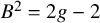 and
$M = 1+r^2(g-1)$
and
$M = 1+r^2(g-1)$
 . Assume either of the following conditions hold:
-
(1) $r \geq 5, g \geq 3$
-
(2) $r = 4, g \geq 4$
-
(3) $r = 3, g \geq 5$
-
(4) $r = 2$
,
$g \geq 7$
-
(5) $r = 1$
and g is either
$g = 4k+1, k \geq 5$
or
$g = 18k+4, {k \geq 2 }$
, or
$g = 18k+7, k \geq 2$
or
$g = 18k+13, k \geq 1$
or
$g = 18k+16, k \geq 1$
.







Then
$\alpha (X) = 0$
 and consequently
$X \subset \mathbb {P}^M$
and consequently
$X \subset \mathbb {P}^M$
 is not extendable.
Proof. We use Theorem 3.1 and Proposition 3.10 to show that
$\beta = 0$
 for
$a \geq 3$
for
$a \geq 3$
 and suitable values of b and
$\gamma = 0$
and suitable values of b and
$\gamma = 0$
 for
$a = 2$
for
$a = 2$
 and suitable values of b and hence
$\alpha (\widetilde {Y}) = 0$
and suitable values of b and hence
$\alpha (\widetilde {Y}) = 0$
 for a suitably chosen
$K3$
for a suitably chosen
$K3$
 carpet
$\widetilde {Y}$
carpet
$\widetilde {Y}$
 .
.
-
(1) For $r \geq 5$
, we can choose
$a = r, e = 0, b = rm, m \geq 1$
to get non-extendability of general
$K3$
surfaces of index r and genus
$2m+1$
,
$m \geq 1$
and
$a = r, e = 1, b = rm, m \geq 2$
to get non-extendability of general
$K3$
surfaces of index r and genus
$2m$
with
$m \geq 2$
. -
(2) For $r = 4$
, we can choose
$a = 4, e = 0, b = 4m, m \geq 2$
to get non-extendability of general
$K3$
surfaces of index r and genus
$2m+1$
,
$m \geq 2$
and
$a = 4, e = 1, b = 4m, m \geq 2$
to get non-extendability of general
$K3$
surfaces of index
$4$
and genus
$2m$
with
$m \geq 2$
. -
(3) For $r = 3$
, we can choose
$a = 3, e = 0, b = 3m, m \geq 2$
to get non-extendability of general
$K3$
surfaces of index
$3$
and genus
$2m+1$
,
$m \geq 2$
and
$a = 3, e = 1, b = 3m, m \geq 3$
to get non-extendability of general
$K3$
surfaces of index
$3$
and genus
$2m$
with
$m \geq 3$
. -
(4) For $r = 2$
, we use part
$(2)$
of Theorem 3.1 and Proposition 3.10. One can choose
$a = 2, e = 0, b = 2m, m \geq 3$
to get non-extendability of general
$K3$
surfaces of index
$2$
and genus
$2m+1$
,
$m \geq 3$
and
$a = 2, e = 1, b = 2m, m \geq 4$
to get non-extendability of general
$K3$
surfaces of index
$2$
and genus
$2m$
with
$m \geq 4$
. -
(5) For $r = 1$
, we first use part
$(2)$
of Theorem 3.1 and Proposition 3.10. We can choose
$a = 2, e = 0$
and
$b = k$
odd,
$k \geq 5$
to get non-extendability of general prime
$K3$
surfaces of genus
$4k+1$
and
$a = 2, e = 1$
and
$b = k+1$
,
$k \geq 6$
, k even to get non-extendability of general prime
$K3$
surfaces of genus
$4k+1$
. Then we use part
$(1)$
of Theorem 3.1 and Proposition 3.10. One can choose
$a = 3, e = 0, b = 3k+1, k \geq 2$
to get non-extendability of general prime
$K3$
surfaces of genus
$18k+7$
,
$a = 3, e = 1, b = 3k+2, k \geq 2$
to get non-extendability of general prime
$K3$
surfaces of genus
$18k+4$
,
$a = 3, e = 0, b = 3k+2, k \geq 1$
to get non-extendability of general prime
$K3$
surfaces of genus
$18k+13$
and
$a = 3, e = 1, b = 3k+4, k \geq 1$
to get non-extendability of general prime
$K3$
surfaces of genus
$18k+16$
.

























Corollary 3.12. Let
$X \subset \mathbb {P}^{M}$
 be a general
$K3$
be a general
$K3$
 surface in
$\mathcal {H}_{r,g}$
surface in
$\mathcal {H}_{r,g}$
 embedded by the complete linear series of
$rB$
embedded by the complete linear series of
$rB$
 , where B is a primitive very ample line bundle, with
$B^2 = 2g-2$
, where B is a primitive very ample line bundle, with
$B^2 = 2g-2$
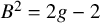 and
$M = 1+r^2(g-1)$
and
$M = 1+r^2(g-1)$
 . Let
$C \in |rB|$
. Let
$C \in |rB|$
 be any smooth curve section of X. Assume either
$r \geq 5, g \geq 3$
be any smooth curve section of X. Assume either
$r \geq 5, g \geq 3$
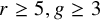 or
$r = 4, g \geq 4$
or
$r = 4, g \geq 4$
 or
$r = 3, g \geq 5$
or
$r = 3, g \geq 5$
 or
$r = 2$
or
$r = 2$
 ,
$g \geq 7$
,
$g \geq 7$
 or
$r = 1$
or
$r = 1$
 and g is either
$g = 4k+1, k \geq 5$
and g is either
$g = 4k+1, k \geq 5$
 or
$g = 18k+4, {k \geq 2}$
or
$g = 18k+4, {k \geq 2}$
 , or
$g = 18k+7, k \geq 2$
, or
$g = 18k+7, k \geq 2$
 or
$g = 18k+13, k \geq 1$
or
$g = 18k+13, k \geq 1$
 or
$g = 18k+16, k \geq 1$
or
$g = 18k+16, k \geq 1$
 Then
$\alpha (C) = \operatorname {cork}(\Phi _{\omega _C}) = 1$
Then
$\alpha (C) = \operatorname {cork}(\Phi _{\omega _C}) = 1$
 .
.
Proof. First note that
$2g(C)-2 = r^2B^2 = r^2(2g-2)$
 and hence
$g(C) = r^2(g-1)+1 \geq 11$
and hence
$g(C) = r^2(g-1)+1 \geq 11$
 . By [Reference Knutsen30, Lemma
$8.3$
. By [Reference Knutsen30, Lemma
$8.3$
 ], since X is general in
$\mathcal {H}_{r,g}$
], since X is general in
$\mathcal {H}_{r,g}$
 , we have
$\operatorname {Cliff}(C)> 2$
, we have
$\operatorname {Cliff}(C)> 2$
 . Now let
$\operatorname {cork}(\Phi _{\omega _C}) = {\gamma _C}$
. Now let
$\operatorname {cork}(\Phi _{\omega _C}) = {\gamma _C}$
 . Then by [Reference Ciliberto, Dedieu and Sernesi14,
$2.2$
. Then by [Reference Ciliberto, Dedieu and Sernesi14,
$2.2$
 ,
$\mathrm{2.2.1}$
,
$\mathrm{2.2.1}$
 ,
$\mathrm{2.2.2}$
,
$\mathrm{2.2.2}$
 ] (see also [Reference Arbarello, Bruno and Sernesi2]), we have the existence of an arithmetically Gorenstein normal variety W, such that every ribbon
$[v] \in \mathbb {P}(\operatorname {ker}(^T\Phi _{\omega _C}))$
] (see also [Reference Arbarello, Bruno and Sernesi2]), we have the existence of an arithmetically Gorenstein normal variety W, such that every ribbon
$[v] \in \mathbb {P}(\operatorname {ker}(^T\Phi _{\omega _C}))$
 (these are ribbons on C with conormal bundle
$\omega _C^{-1}$
(these are ribbons on C with conormal bundle
$\omega _C^{-1}$
 ) is contained in a unique section of W by a linear
$g(C)$
) is contained in a unique section of W by a linear
$g(C)$
 space. In particular, W contains all surface extensions of C. Therefore
$\alpha (X) = 0$
space. In particular, W contains all surface extensions of C. Therefore
$\alpha (X) = 0$
 forces
$\alpha (C) = 1$
forces
$\alpha (C) = 1$
 .
.
Remark 3.13. The corank one theorem can also be derived from our methods independently by showing that the map
$H^1(N_{\widetilde {Y}/\mathbb {P}^M}(-2\widetilde {H})) \to H^1(N_{\widetilde {Y}/\mathbb {P}^M}(-\widetilde {H}))$
 in the exact sequence

is injective. To show this, along with the cohomological computations and analysis of coboundary maps using Equations 3.1, 3.2, 3.3, as introduced in here, one needs to use results on Gaussian maps on Hirzebruch surfaces in [Reference Duflot and Miranda20] and [Reference Duflot and Peters22]. Since showing injectivity of this map is essential to handle the case of extendability of prime
$K3$
 surfaces, we will come back to this in a forthcoming article [Reference Bangere and Mukherjee10].
Proposition 3.10 has some consequences on extendability of
$K3$
 double covers X of
$\mathbb {F}_0$
double covers X of
$\mathbb {F}_0$
 or
$\mathbb {F}_1$
or
$\mathbb {F}_1$
 .
.
Theorem 3.14. Let X be a
$K3$
 surface which is a double cover
$\pi : X \to Y$
surface which is a double cover
$\pi : X \to Y$
 of
$Y = \mathbb {F}_0$
of
$Y = \mathbb {F}_0$
 or
$Y = \mathbb {F}_1$
or
$Y = \mathbb {F}_1$
 . Let
$T_0 = \pi ^{\ast }C_0$
. Let
$T_0 = \pi ^{\ast }C_0$
 and
$T_1 = \pi ^{\ast }f$
and
$T_1 = \pi ^{\ast }f$
 . Then for
$X \subset \mathbb {P}^M$
. Then for
$X \subset \mathbb {P}^M$
 where the embedding is induced by the complete linear series of a very ample line bundle
$B = aT_0+bT_1$
where the embedding is induced by the complete linear series of a very ample line bundle
$B = aT_0+bT_1$
 , we have
$\alpha (X) = 0$
, we have
$\alpha (X) = 0$
 if
$a = 3, b \geq 5, e = 0$
if
$a = 3, b \geq 5, e = 0$
 or a =
$3, b \geq 7, e = 1$
or a =
$3, b \geq 7, e = 1$
 respectively.
Proof. First note that the proof of [Reference Deopurkar and Mukherjee21, Proposition
$2.1$
 ] goes through verbatim for a ribbon over any smooth variety Y and not just a curve C. Hence in particular, for the split
$K3$
] goes through verbatim for a ribbon over any smooth variety Y and not just a curve C. Hence in particular, for the split
$K3$
 carpet
$\widetilde {Y}$
carpet
$\widetilde {Y}$
 on
$Y = \mathbb {F}_0$
on
$Y = \mathbb {F}_0$
 or
$Y = \mathbb {F}_1$
or
$Y = \mathbb {F}_1$
 , the line bundle
$\widetilde {H}$
, the line bundle
$\widetilde {H}$
 such that
$\widetilde {H}|_Y = H = \mathcal {O}_Y(aC_0+bf)$
such that
$\widetilde {H}|_Y = H = \mathcal {O}_Y(aC_0+bf)$
 is very ample if
$a \geq 2$
is very ample if
$a \geq 2$
 and
$b \geq \max \{(a-1)e+2, ae+1\}$
and
$b \geq \max \{(a-1)e+2, ae+1\}$
 . Further, any double cover X isotrivially degenerates to the split ribbon
$\widetilde {Y}$
. Further, any double cover X isotrivially degenerates to the split ribbon
$\widetilde {Y}$
 . This can be seen as follows: fix a smooth double cover X on any smooth variety Y, branched along a divisor B belonging to the linear system of
$L^{\otimes 2}$
. This can be seen as follows: fix a smooth double cover X on any smooth variety Y, branched along a divisor B belonging to the linear system of
$L^{\otimes 2}$
 . If
$s \in H^0(L^{\otimes 2})$
. If
$s \in H^0(L^{\otimes 2})$
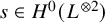 is a section representing B, then consider the one-parameter family given inside the total space of the line bundle L by the equation
$(y^2-\lambda s)$
is a section representing B, then consider the one-parameter family given inside the total space of the line bundle L by the equation
$(y^2-\lambda s)$
 where y is a local coordinate of the total space and
$\lambda $
where y is a local coordinate of the total space and
$\lambda $
 varies over the base field. This determines a flat one-parameter family of schemes parameterized by
$(T,0)$
varies over the base field. This determines a flat one-parameter family of schemes parameterized by
$(T,0)$
 , where the fiber over any
$\lambda \neq 0 \in T$
, where the fiber over any
$\lambda \neq 0 \in T$
 is isomorphic to X, while the fiber over
$\lambda = 0 \in T$
is isomorphic to X, while the fiber over
$\lambda = 0 \in T$
 is the split ribbon on Y with conormal bundle
$L^{-1}$
is the split ribbon on Y with conormal bundle
$L^{-1}$
 . Hence
$\alpha (X) = 0$
. Hence
$\alpha (X) = 0$
 if
$\alpha (\widetilde {Y}) = 0$
if
$\alpha (\widetilde {Y}) = 0$
 . Now the vanishing of the latter follows from Proposition 3.10,
$(1)$
. Now the vanishing of the latter follows from Proposition 3.10,
$(1)$
 .
.
3.2 Extendability of general non-prime K3 surfaces of lower genus
In the following theorem, we compute
$\alpha (X)$
 for a general
$K3$
for a general
$K3$
 surface
$X \subset \mathbb {P}^M$
surface
$X \subset \mathbb {P}^M$
 of index
$r \geq 2$
of index
$r \geq 2$
 and low genus g. We will use the upper bounds to compute the dimension of the tangent space corresponding to the Hilbert point represented by the cone over a
$K3$
and low genus g. We will use the upper bounds to compute the dimension of the tangent space corresponding to the Hilbert point represented by the cone over a
$K3$
 surface. We show later in Corollary 4.9 that the upper bounds are actually equalities.
Theorem 3.15. Let
$X \subset \mathbb {P}^{M}$
 be a general
$K3$
be a general
$K3$
 surface in
$\mathcal {H}_{r,g}$
surface in
$\mathcal {H}_{r,g}$
 embedded by the complete linear series of
$rB$
embedded by the complete linear series of
$rB$
 , where B is a primitive very ample line bundle, with
$B^2 = 2g-2$
, where B is a primitive very ample line bundle, with
$B^2 = 2g-2$
 and
$M = 1+r^2(g-1)$
and
$M = 1+r^2(g-1)$
 .
.
-
(1) If $r = 2$
,
$g = 3$
, then
$\alpha (X) \leq 10$
-
(2) If $r = 2$
,
$g = 4$
, then
$\alpha (X) \leq 6$
-
(3) If $r = 2$
,
$g = 5$
, then
$\alpha (X) \leq 3$
-
(4) If $r = 2$
,
$g = 6$
, then
$\alpha (X) \leq 1$
-
(5) If $r = 3$
,
$g = 3$
, then
$\alpha (X) \leq 4$
-
(6) If $r = 3$
,
$g = 4$
, then
$\alpha (X) \leq 1$
-
(7) If $r = 4$
,
$g = 3$
, then
$\alpha (X) \leq 1$
.


Proof. We first prove for
$r = 2$
 . Since
$3 \leq g \leq 6$
. Since
$3 \leq g \leq 6$
 . We can degenerate such a
$K3$
. We can degenerate such a
$K3$
 surface to a
$K3$
surface to a
$K3$
 carpet
$\widetilde {Y} \subset \mathbb {P}^M$
carpet
$\widetilde {Y} \subset \mathbb {P}^M$
 , extending
$Y \subset \mathbb {P}^M$
, extending
$Y \subset \mathbb {P}^M$
 , where
$Y = \mathbb {F}_e$
, where
$Y = \mathbb {F}_e$
 embedded by the complete linear series of
$2C_0+bf$
embedded by the complete linear series of
$2C_0+bf$
 , where
$b = 2m$
, where
$b = 2m$
 and
$e = 0$
and
$e = 0$
 or
$e = 1$
or
$e = 1$
 depending on whether g is odd or even respectively. In this case
$g = 2m-e+1$
depending on whether g is odd or even respectively. In this case
$g = 2m-e+1$
 . So it is enough to find an upper bound for
$\alpha (\widetilde {Y})$
. So it is enough to find an upper bound for
$\alpha (\widetilde {Y})$
 for a
$K3$
for a
$K3$
 carpet
$\widetilde {Y} \subset \mathbb {P}^M$
carpet
$\widetilde {Y} \subset \mathbb {P}^M$
 , extending
$Y \subset \mathbb {P}^M$
, extending
$Y \subset \mathbb {P}^M$
 , where
$Y = \mathbb {F}_e$
, where
$Y = \mathbb {F}_e$
 embedded by the complete linear series of
$2C_0+2mf$
embedded by the complete linear series of
$2C_0+2mf$
 where the pair
$(e,m)$
where the pair
$(e,m)$
 is one of
$(0,1), (0,2), (1,2), (1,3)$
is one of
$(0,1), (0,2), (1,2), (1,3)$
 . We have shown in Theorem 3.1, part
$(2)$
. We have shown in Theorem 3.1, part
$(2)$
 , that

So we calculate the right hand side of the above equation for the above-mentioned values of
$(e,m)$
 . By Lemma 3.9,
$(2)$
. By Lemma 3.9,
$(2)$
 , we have that for
$m \geq e+1/2$
, we have that for
$m \geq e+1/2$
 ,
$h^1(T_Y(-H+K_Y)) = 0$
,
$h^1(T_Y(-H+K_Y)) = 0$
 . Now in the proof of part
$(2)$
. Now in the proof of part
$(2)$
 of Theorem 3.10, using equations 3.38-3.45, we have shown that if
$m \geq e/2+3/2$
of Theorem 3.10, using equations 3.38-3.45, we have shown that if
$m \geq e/2+3/2$
 ,
$h^0(N_{Y/\mathbb {P}^M}(-H)) = M+1$
,
$h^0(N_{Y/\mathbb {P}^M}(-H)) = M+1$
 . Hence except for the case
$(e,m) = (0,1)$
. Hence except for the case
$(e,m) = (0,1)$
 ,
$\alpha (\widetilde {Y}) \leq h^0(-H-2K_Y)$
,
$\alpha (\widetilde {Y}) \leq h^0(-H-2K_Y)$
 . This gives us the upper bounds as stated in the statement for the cases
$r = 2, 4 \leq g \leq 6$
. This gives us the upper bounds as stated in the statement for the cases
$r = 2, 4 \leq g \leq 6$
 . On the other hand, in the case
$(0,1)$
. On the other hand, in the case
$(0,1)$
 , once again in the proof of part
$(2)$
, once again in the proof of part
$(2)$
 of Theorem 3.10, in equation 3.43, we have that
$H^1(p^{\ast }(T_{\mathbb {P}^1})(-H)) = H^1(\mathcal {O}_{\mathbb {P}^1}(-2)) = \mathbb {C}$
of Theorem 3.10, in equation 3.43, we have that
$H^1(p^{\ast }(T_{\mathbb {P}^1})(-H)) = H^1(\mathcal {O}_{\mathbb {P}^1}(-2)) = \mathbb {C}$
 for
$(0,1)$
for
$(0,1)$
 which in turn gives us
$h^0(N_{Y/\mathbb {P}^M}(-H)) \leq M+2$
which in turn gives us
$h^0(N_{Y/\mathbb {P}^M}(-H)) \leq M+2$
 from the sequence in 3.38. Hence in this case
$\alpha (\widetilde {Y}) \leq h^0(-H-2K_Y)+1$
from the sequence in 3.38. Hence in this case
$\alpha (\widetilde {Y}) \leq h^0(-H-2K_Y)+1$
 . This gives us the remaining case
$r = 2, g = 3$
. This gives us the remaining case
$r = 2, g = 3$
 .
.
We now prove for
$r = 3,4$
 . We can degenerate such a
$K3$
. We can degenerate such a
$K3$
 surface to a
$K3$
surface to a
$K3$
 carpet
$\widetilde {Y} \subset \mathbb {P}^M$
carpet
$\widetilde {Y} \subset \mathbb {P}^M$
 , extending
$Y \subset \mathbb {P}^M$
, extending
$Y \subset \mathbb {P}^M$
 , where
$Y = \mathbb {F}_e$
, where
$Y = \mathbb {F}_e$
 embedded by the complete linear series of
$rC_0+rmf$
embedded by the complete linear series of
$rC_0+rmf$
 , where
$e = 0$
, where
$e = 0$
 or
$e = 1$
or
$e = 1$
 depending on whether g is odd or even respectively. Again we have
$g = 2m-e+1$
depending on whether g is odd or even respectively. Again we have
$g = 2m-e+1$
 . So it is enough to find an upper bound for
$\alpha (\widetilde {Y})$
. So it is enough to find an upper bound for
$\alpha (\widetilde {Y})$
 for a
$K3$
for a
$K3$
 carpet
$\widetilde {Y} \subset \mathbb {P}^M$
carpet
$\widetilde {Y} \subset \mathbb {P}^M$
 , extending
$Y \subset \mathbb {P}^M$
, extending
$Y \subset \mathbb {P}^M$
 , where
$Y = \mathbb {F}_e$
, where
$Y = \mathbb {F}_e$
 embedded by the complete linear series of
$rC_0+rmf$
embedded by the complete linear series of
$rC_0+rmf$
 where the tuple
$(r,e,m)$
where the tuple
$(r,e,m)$
 is one of
$(3,0,1), (3,1,2), (4,0,1)$
is one of
$(3,0,1), (3,1,2), (4,0,1)$
 . In each case we calculate
$\beta $
. In each case we calculate
$\beta $
 in Theorem 3.1 which gives an upper bound for
$\alpha (\widetilde {Y})$
in Theorem 3.1 which gives an upper bound for
$\alpha (\widetilde {Y})$
 . In each case one can check that the only contribution to
$\beta $
. In each case one can check that the only contribution to
$\beta $
 comes from
$h^0(-H-2K_Y)$
comes from
$h^0(-H-2K_Y)$
 , which gives us the stated bounds.
4 Classification of non-prime Fano threefolds and Mukai varieties of Picard rank one and their Hilbert schemes
Boundedness and classification of smooth Fano threefolds and more generally varieties with a canonical curve section (Mukai varieties) with Picard rank one were first obtained by Iskovskih-Mori-Mukai in [Reference Iskovskih28], [Reference Iskovskih29], [Reference Mukai38] and [Reference Mori and Mukai37] (see also [Reference Bayer, Kuznetsov and Macrì6]). We give a new proof in the non-prime case using completely different methods and a general principle outlined in [Reference Ciliberto, Lopez and Miranda17].
In the following theorem we compute
$h^0(N_{\widetilde {Y}/\mathbb {P}^M}(-2\widetilde {H}))$
 which will be an upper bound for
$h^0(N_{X/\mathbb {P}^M}(-2))$
which will be an upper bound for
$h^0(N_{X/\mathbb {P}^M}(-2))$
 for a general non-prime
$K3$
for a general non-prime
$K3$
 surface. We will need this to compute the tangent space to the Hilbert scheme of non-prime Fano threefolds at the Hilbert point representing the cone over such a
$K3$
surface. We will need this to compute the tangent space to the Hilbert scheme of non-prime Fano threefolds at the Hilbert point representing the cone over such a
$K3$
 surface. Further, the vanishing of this cohomology group allows us to recover Wahl’s theorem on the non-surjectivity of the Gaussian-Wahl map
$\Phi _{\omega _C}$
surface. Further, the vanishing of this cohomology group allows us to recover Wahl’s theorem on the non-surjectivity of the Gaussian-Wahl map
$\Phi _{\omega _C}$
 for a curve lying on a
$K3$
for a curve lying on a
$K3$
 surface in the non-prime case.
Proposition 4.1. Let
$\widetilde {Y} \hookrightarrow \mathbb {P}^M$
 be a
$K3$
be a
$K3$
 carpet embedded by the complete linear series of a very ample line bundle
$\widetilde {H}$
carpet embedded by the complete linear series of a very ample line bundle
$\widetilde {H}$
 such that the possibly degenerate embedding
$Y = \mathbb {F}_e \hookrightarrow \mathbb {P}^M$
such that the possibly degenerate embedding
$Y = \mathbb {F}_e \hookrightarrow \mathbb {P}^M$
 induced on the reduced part is given by the complete linear series of a very ample line bundle
$H = aC_0+bf$
induced on the reduced part is given by the complete linear series of a very ample line bundle
$H = aC_0+bf$
 followed by a linear embedding of projective spaces. Assume
$H^1(-H+K_Y) = 0$
followed by a linear embedding of projective spaces. Assume
$H^1(-H+K_Y) = 0$
 . Then

Consequently,
$h^0(N_{\widetilde {Y}/\mathbb {P}^M}(-2\widetilde {H})) = 0$
 if either of the following conditions hold
-
(1) $a = 2, b \geq 3, e = 0$
-
(2) $a \geq 3, b \geq 2, e = 0$
-
(3) $a = 2, b \geq 4, e = 1$
or
$a \geq 3, b \geq a+1, e = 1$
-
(4) $a \geq 2, b \geq ae+1, e \geq 2$
.





Moreover, if
$a = 2, b = 2, e = 0$
 ,
$h^0(N_{\widetilde {Y}/\mathbb {P}^M}(-2\widetilde {H})) \leq 1$
,
$h^0(N_{\widetilde {Y}/\mathbb {P}^M}(-2\widetilde {H})) \leq 1$
 . In this case,
$h^0(N_{\widetilde {Y}/\mathbb {P}^M}(-3\widetilde {H})) = 0$
. In this case,
$h^0(N_{\widetilde {Y}/\mathbb {P}^M}(-3\widetilde {H})) = 0$
 . Hence if
$(r = 2, g \geq 4), (r \geq 3, g \geq 3)$
. Hence if
$(r = 2, g \geq 4), (r \geq 3, g \geq 3)$
 ,
$H^0(N_{X/\mathbb {P}^M}(-2)) = 0$
,
$H^0(N_{X/\mathbb {P}^M}(-2)) = 0$
 . Further, if
$(r = 2, g = 3)$
. Further, if
$(r = 2, g = 3)$
 , then
$h^0(N_{X/\mathbb {P}^M}(-2)) \leq 1$
, then
$h^0(N_{X/\mathbb {P}^M}(-2)) \leq 1$
 .
.
Proof. Let
$k \geq 2$
 . We tensor Equation (3.1) by
$-k\widetilde {H}$
. We tensor Equation (3.1) by
$-k\widetilde {H}$
 to obtain

Now tensoring Equation (3.2) by
$(-kH+K_Y)$
 and noting that
$h^0(-kH-K_Y) = 0$
and noting that
$h^0(-kH-K_Y) = 0$
 we have,

Once again, tensoring Equation (3.3), by
$-kH+K_Y$
 and noting that
$h^0(-kH) = h^1(-kH) = 0$
and noting that
$h^0(-kH) = h^1(-kH) = 0$
 , we have

Now tensoring Equation (3.2) by
$(-kH)$
 we have,

Once again, tensoring Equation (3.3), by
$-kH$
 and noting that
$h^0(-kH-K_Y)) = 0$
and noting that
$h^0(-kH-K_Y)) = 0$
 , we have

Hence we have,

Now Equation (3.10) and Equation (3.11) yield

and

Hence we have

Now the rest of the proof follows from Lemma 3.7, Lemma 3.8, Lemma 3.9. For the ease of the reader we point out that in the case
$a = 2, b = 2, e = 0$
 , the only term that contributes in the upper bound of
$h^0(N_{\widetilde {Y}/\mathbb {P}^M}(-2\widetilde {H}))$
, the only term that contributes in the upper bound of
$h^0(N_{\widetilde {Y}/\mathbb {P}^M}(-2\widetilde {H}))$
 is
$h^0(-2H-2K_Y) = 1$
is
$h^0(-2H-2K_Y) = 1$
 .
.
Definition 4.2. Let
$\mathcal {V}_{r,g}$
 denote the Hilbert scheme of smooth anticanonically embedded Fano threefolds of index r and genus g, that is, anticanonically embedded Fano threefolds
$V \subset \mathbb {P}^{2+r^2(g-1)}$
denote the Hilbert scheme of smooth anticanonically embedded Fano threefolds of index r and genus g, that is, anticanonically embedded Fano threefolds
$V \subset \mathbb {P}^{2+r^2(g-1)}$
 such that
$-K_V$
such that
$-K_V$
 is r-divisible in
$\operatorname {Pic}(V)$
is r-divisible in
$\operatorname {Pic}(V)$
 . Let
$\mathcal {V}_{r,g,1}$
. Let
$\mathcal {V}_{r,g,1}$
 denote the closure inside
$\mathcal {V}_{r,g}$
denote the closure inside
$\mathcal {V}_{r,g}$
 of the locus of points representing the Fano threefolds with Picard rank one. Recall that
$\mathcal {H}_{r,g}$
of the locus of points representing the Fano threefolds with Picard rank one. Recall that
$\mathcal {H}_{r,g}$
 denotes the Hilbert scheme of
$K3$
denotes the Hilbert scheme of
$K3$
 surfaces of index r and genus g, that is,
$K3$
surfaces of index r and genus g, that is,
$K3$
 surfaces
$X \subset \mathbb {P}^{1+r^2(g-1)}$
surfaces
$X \subset \mathbb {P}^{1+r^2(g-1)}$
 embedded by the complete linear series of
$rB$
embedded by the complete linear series of
$rB$
 where B is a primitive very ample line bundle with
$B^2 = 2g-2$
where B is a primitive very ample line bundle with
$B^2 = 2g-2$
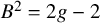 . Denote by
$C(X) \subset \mathbb {P}^{2+r^2(g-1)}$
. Denote by
$C(X) \subset \mathbb {P}^{2+r^2(g-1)}$
 the cone over such a
$K3$
the cone over such a
$K3$
 surface. Let
$\mathcal {F}_{r,g}$
surface. Let
$\mathcal {F}_{r,g}$
 denote the flag Hilbert scheme consisting of pairs
$(V,X)$
denote the flag Hilbert scheme consisting of pairs
$(V,X)$
 where
$V \in \mathcal {V}_{r,g,1}$
where
$V \in \mathcal {V}_{r,g,1}$
 and X is a hyperplane section of V and hence
$X \in \mathcal {H}_{r,g}$
and X is a hyperplane section of V and hence
$X \in \mathcal {H}_{r,g}$
 . There is a natural projection map
$p: \mathcal {F}_{r,g} \to \mathcal {H}_{r,g}$
. There is a natural projection map
$p: \mathcal {F}_{r,g} \to \mathcal {H}_{r,g}$
 .
.
We proved Corollary 3.12 by combining our results in Theorem 3.11 with [Reference Ciliberto, Dedieu and Sernesi14] and [Reference Arbarello, Bruno and Sernesi2]. However, using Proposition 4.1, we independently recover Wahl’s theorem on non-surjectivity of the Gaussian-Wahl map (see [Reference Wahl42], [Reference Beauville and Mérindol7], [Reference Ciliberto and Miranda19], [Reference Voisin41]) in the non-prime case.
Corollary 4.3. Let X be a
$K3$
 surface and let
$C \subset X$
surface and let
$C \subset X$
 be a smooth curve with
$C \in |rB|$
be a smooth curve with
$C \in |rB|$
 with
$r \geq 2$
with
$r \geq 2$
 . Then the Wahl map
$\Phi _{\omega _C}$
. Then the Wahl map
$\Phi _{\omega _C}$
 is not surjective.
Proof. Let
$B^2 = 2g-2$
 . The case
$g = 2$
. The case
$g = 2$
 can be worked out separately (see, e.g., [Reference Ciliberto, Lopez and Miranda17]). For
$r = 2, g = 3$
can be worked out separately (see, e.g., [Reference Ciliberto, Lopez and Miranda17]). For
$r = 2, g = 3$
 ,
$g(C) = 9$
,
$g(C) = 9$
 and
$\Phi _{\omega _C}$
and
$\Phi _{\omega _C}$
 cannot be surjective since the domain is of dimension less than the target. For
$r = 2, g \geq 4$
cannot be surjective since the domain is of dimension less than the target. For
$r = 2, g \geq 4$
 or
$r \geq 3, g \geq 3$
or
$r \geq 3, g \geq 3$
 , consider the Hilbert scheme
$\mathcal {H}_{r,g}$
, consider the Hilbert scheme
$\mathcal {H}_{r,g}$
 . It is enough to prove the statement for a general element of
$\mathcal {H}_{r,g}$
. It is enough to prove the statement for a general element of
$\mathcal {H}_{r,g}$
 since surjectivity of
$\Phi _{\omega _C}$
since surjectivity of
$\Phi _{\omega _C}$
 is an open condition. Let
$M = 1+r^2(g-1)$
is an open condition. Let
$M = 1+r^2(g-1)$
 . Now we have an exact sequence

By Proposition 4.1,
$H^0(N_{X/\mathbb {P}^M}(-2)) = 0$
 and hence we have that
$\operatorname {corank}(\Phi _{\omega _C}) = h^0(N_{C/\mathbb {P}^{M-1}}(-1))-M \geq h^0(N_{X/\mathbb {P}^M}(-1))-M \geq 1$
and hence we have that
$\operatorname {corank}(\Phi _{\omega _C}) = h^0(N_{C/\mathbb {P}^{M-1}}(-1))-M \geq h^0(N_{X/\mathbb {P}^M}(-1))-M \geq 1$
 .
.
Corollary 4.4. Let
$X \subset \mathbb {P}^{M}$
 be a general
$K3$
be a general
$K3$
 surface in
$\mathcal {H}_{r,g}$
surface in
$\mathcal {H}_{r,g}$
 embedded by the complete linear series of
$rB$
embedded by the complete linear series of
$rB$
 , where B is a primitive very ample line bundle, with
$B^2 = 2g-2$
, where B is a primitive very ample line bundle, with
$B^2 = 2g-2$
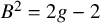 and
$M = 1+r^2(g-1)$
and
$M = 1+r^2(g-1)$
 .
.
-
(1) If $r \geq 2, g \geq 4$
, then the dimension of the tangent space of
$\mathcal {V}_{r,g,1}$
at the point
$C(X) \subset \mathbb {P}^{M+1}$
is given by (4.1) $$ \begin{align} \operatorname{dim}T_{C(X)}(\mathcal{V}_{r,g,1}) = h^0(N_{X/\mathbb{P}^M})+h^0(N_{X/\mathbb{P}^{M}}(-1)) = 18+(2+r^2(g-1))^2+\alpha(X)+(2+r^2(g-1)) \end{align} $$
-
(2) If $r = 2, g = 3$
, then the dimension of the tangent space of
$\mathcal {V}_{r,g,1}$
at the point
$C(X) \subset \mathbb {P}^{M+1}$
is given by (4.2) $$ \begin{align} \operatorname{dim}T_{C(X)}(\mathcal{V}_{r,g,1}) \leq h^0(N_{X/\mathbb{P}^M})+h^0(N_{X/\mathbb{P}^{M}}(-1)) + 1 = 18+(2+r^2(g-1))^2+\alpha(X)+(2+r^2(g-1))+1 \end{align} $$


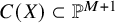


Proof. The proof of the corollary follows from Proposition 4.1, the fact that
$\operatorname {dim}\mathcal {H}_{r,g} = h^0(N_{X/\mathbb {P}^M}) = 18+(M+1)^2$
 and the fact that

Lemma 4.5. Let V be a general element of
$\mathcal {V}_{r,g,1}$
 . Then a general hyperplane section of V corresponds to a general
$K3$
. Then a general hyperplane section of V corresponds to a general
$K3$
 surface in
$\mathcal {H}_{r,g}$
surface in
$\mathcal {H}_{r,g}$
 .
.
Proof. The proof follows from standard deformation theory arguments (see, e.g., [Reference Ciliberto, Lopez and Miranda17, Lemma
$3.7$
 ], or [Reference Beauville4]).
Theorem 4.6. Consider
$\mathcal {V}_{r,g,1}$
 for
$r \geq 2$
for
$r \geq 2$
 and genus
$g \geq 3$
and genus
$g \geq 3$
 . Then
-
(1) $\mathcal {V}_{r,g,1} = \varnothing $
if
$(r = 2, g \geq 7)$
,
$(r = 3, g = 3)$
,
$(r = 3, g \geq 5)$
,
$(r = 4, g \geq 4)$
, or
$(r \geq 5, g \geq 3)$
. -
(2) For $(r = 2, 3 \leq g \leq 6), (r = 3, g = 4), (r = 4, g = 3)$
,
$\mathcal {V}_{r,g,1}$
is irreducible, and the families of Fano and Iskovskih form an open dense irreducible subset of
$\mathcal {V}_{r,g,1}$
. The general fiber of the projection map
$p: \mathcal {F}_{r,g} \to \mathcal {H}_{r,g}$
as defined in Definition 4.2 is irreducible. Up to projective transformations, a general
$K3$
surface in
$\mathcal {H}_{2,6}, \mathcal {H}_{3,4}$
, or
$ \mathcal {H}_{4,3}$
is contained in a unique Fano threefold in
$\mathcal {V}_{2,6,1}, \mathcal {V}_{3,4,1}$
, or
$ \mathcal {V}_{4,3,1}$
respectively.









Proof of
$(1)$

First note that for every r, there is a unique component
$\mathcal {H}_{r,g}$
 of the Hilbert scheme parameterizing
$K3$
of the Hilbert scheme parameterizing
$K3$
 surfaces
$X \subset \mathbb {P}^{h^0(rB)-1}$
surfaces
$X \subset \mathbb {P}^{h^0(rB)-1}$
 embedded by the complete linear of a very ample line bundle
$rB$
embedded by the complete linear of a very ample line bundle
$rB$
 , where
$B^2 = 2g-2$
, where
$B^2 = 2g-2$
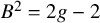 . Now except for the case
$(r = 3, g = 3)$
. Now except for the case
$(r = 3, g = 3)$
 , part
$(1)$
, part
$(1)$
 follows from Theorem 3.11. For the case
$(r=3, g=3)$
follows from Theorem 3.11. For the case
$(r=3, g=3)$
 , note that if the hyperplane section of a Fano threefold V in
$\mathcal {V}_{r,g,1}$
, note that if the hyperplane section of a Fano threefold V in
$\mathcal {V}_{r,g,1}$
 is denoted by
$rL$
is denoted by
$rL$
 and
$L^3 = d$
and
$L^3 = d$
 , then computing
$h^0(rL) = h^0(rB)-1$
, then computing
$h^0(rL) = h^0(rB)-1$
 by Riemann-Roch theorem, we have
$d = 2(g-1)/r$
by Riemann-Roch theorem, we have
$d = 2(g-1)/r$
 . But for
$r = 3, g = 3$
. But for
$r = 3, g = 3$
 , d cannot be an integer. This resolves the case.
Proof of
$(2)$

First one notes that for each r and g,
$\mathcal {H}_{r,g}$
 is irreducible. Now the list of examples of Fano-Iskovskih-Mori-Mukai (see, e.g., [Reference Ciliberto, Lopez and Miranda17, Table
$3.1$
is irreducible. Now the list of examples of Fano-Iskovskih-Mori-Mukai (see, e.g., [Reference Ciliberto, Lopez and Miranda17, Table
$3.1$
 ]), shows that in each of the cases mentioned by part
$(2)$
]), shows that in each of the cases mentioned by part
$(2)$
 , there exist
$K3$
, there exist
$K3$
 surfaces in
$\mathcal {H}_{r,g}$
surfaces in
$\mathcal {H}_{r,g}$
 which are extendable to smooth Fano threefolds. Hence by Lemma 4.5, in each of the cases,
$\mathcal {H}_{r,g}$
which are extendable to smooth Fano threefolds. Hence by Lemma 4.5, in each of the cases,
$\mathcal {H}_{r,g}$
 is dominated by
$\mathcal {V}_{r,g,1}$
is dominated by
$\mathcal {V}_{r,g,1}$
 . We end the proof by showing,
$\mathcal {V}_{r,g,1}$
. We end the proof by showing,
$\mathcal {V}_{r,g,1}$
 has a unique irreducible component and that the examples of Fano-Iskovskih-Mori-Mukai form an open dense subset of
$\mathcal {V}_{r,g,1}$
has a unique irreducible component and that the examples of Fano-Iskovskih-Mori-Mukai form an open dense subset of
$\mathcal {V}_{r,g,1}$
 . To see this, we observe first as in [Reference Ciliberto, Lopez and Miranda15] and [Reference Ciliberto, Lopez and Miranda17], that a projectively Cohen-Macaulay scheme degenerates along a flat family to the cone over its hyperplane section. Hence once again using, Lemma 4.5, it is enough to show that for a general
$K3$
. To see this, we observe first as in [Reference Ciliberto, Lopez and Miranda15] and [Reference Ciliberto, Lopez and Miranda17], that a projectively Cohen-Macaulay scheme degenerates along a flat family to the cone over its hyperplane section. Hence once again using, Lemma 4.5, it is enough to show that for a general
$K3$
 surface
$X \subset \mathbb {P}^{M}$
surface
$X \subset \mathbb {P}^{M}$
 in
$\mathcal {H}_{r,g}$
in
$\mathcal {H}_{r,g}$
 , the cone
$C(X) \subset \mathbb {P}^{M+1}$
, the cone
$C(X) \subset \mathbb {P}^{M+1}$
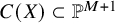 is a smooth point of
$\mathcal {V}_{r,g,1}$
is a smooth point of
$\mathcal {V}_{r,g,1}$
 . For the stated values of pairs
$(r,g)$
. For the stated values of pairs
$(r,g)$
 , Corollary 4.4 along with Theorem 3.15 gives an upper bound for
$\operatorname {dim}T_{C(X)}(\mathcal {V}_{r,g,1})$
, Corollary 4.4 along with Theorem 3.15 gives an upper bound for
$\operatorname {dim}T_{C(X)}(\mathcal {V}_{r,g,1})$
 which is listed as follows
-
(1) $\operatorname {dim}T_{C(X)}(\mathcal {V}_{2,3,1}) \leq 139$
-
(2) $\operatorname {dim}T_{C(X)}(\mathcal {V}_{2,4,1}) \leq 234$
-
(3) $\operatorname {dim}T_{C(X)}(\mathcal {V}_{2,5,1}) \leq 363$
-
(4) $\operatorname {dim}T_{C(X)}(\mathcal {V}_{2,6,1}) \leq 525$
-
(5) $\operatorname {dim}T_{C(X)}(\mathcal {V}_{3,4,1}) \leq 889$
-
(6) $\operatorname {dim}T_{C(X)}(\mathcal {V}_{4,3,1}) \leq 1209$
.




Now for a smooth Fano threefold
$V \in \mathcal {V}_{r,g,1}$
 , V represents a smooth point of
$\mathcal {V}_{r,g,1}$
, V represents a smooth point of
$\mathcal {V}_{r,g,1}$
 , since embedded deformations of an anticanonically embedded Fano variety of dimension at least
$3$
, since embedded deformations of an anticanonically embedded Fano variety of dimension at least
$3$
 can be shown to be unobstructed using the vanishing of
$h^1(N_{V/\mathbb {P}^{M+1}})$
can be shown to be unobstructed using the vanishing of
$h^1(N_{V/\mathbb {P}^{M+1}})$
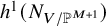 by Kodaira-Nakano vanishing theorem. Therefore the dimension of
$\mathcal {V}_{r,g,1}$
by Kodaira-Nakano vanishing theorem. Therefore the dimension of
$\mathcal {V}_{r,g,1}$
 at a smooth point is given by
$\operatorname {dim}T_V(\mathcal {V}_{r,g,1}) = h^0(N_{V/\mathbb {P}^{M+1}})$
at a smooth point is given by
$\operatorname {dim}T_V(\mathcal {V}_{r,g,1}) = h^0(N_{V/\mathbb {P}^{M+1}})$
 . Now using the descriptions of the examples of Fano-Iskovskih-Mori-Mukai, one can calculate the dimension
$h^0(N_{V/\mathbb {P}^{M+1}})$
. Now using the descriptions of the examples of Fano-Iskovskih-Mori-Mukai, one can calculate the dimension
$h^0(N_{V/\mathbb {P}^{M+1}})$
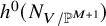 (see, e.g., [Reference Ciliberto, Lopez and Miranda15, Table
$2$
(see, e.g., [Reference Ciliberto, Lopez and Miranda15, Table
$2$
 , pg
$666$
, pg
$666$
 ] and [Reference Ciliberto, Lopez and Miranda17, Table
$3.1$
] and [Reference Ciliberto, Lopez and Miranda17, Table
$3.1$
 ]) to check that in each case,
$\operatorname {dim}T_V(\mathcal {V}_{r,g,1})$
]) to check that in each case,
$\operatorname {dim}T_V(\mathcal {V}_{r,g,1})$
 is exactly the upper bound just obtained. Hence
$C(X)$
is exactly the upper bound just obtained. Hence
$C(X)$
 is also a smooth point of
$\mathcal {V}_{r,g,1}$
is also a smooth point of
$\mathcal {V}_{r,g,1}$
 .
.
To see the statement on the irreducibility of fibers of p, note that for a general
$X \subset V$
 , we have an exact sequence

The surjectivity arises from the fact that from Lemma 4.5, one can show that every embedded deformation of X can be lifted to an embedded deformation of V. Since
$H^1(N_{V/\mathbb {P}^{M+1}}) = 0$
 , this implies
$H^1(N_{V/\mathbb {P}^{M+1}}(-1)) = 0$
, this implies
$H^1(N_{V/\mathbb {P}^{M+1}}(-1)) = 0$
 . This implies that V is a smooth point of the fiber and that the dimension of the fiber at V is
$h^0(N_V(-1))$
. This implies that V is a smooth point of the fiber and that the dimension of the fiber at V is
$h^0(N_V(-1))$
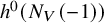 . Now once again the cone
$C(X)$
. Now once again the cone
$C(X)$
 lies in every irreducible component of the fiber and the tangent space to the fiber at
$C(X)$
lies in every irreducible component of the fiber and the tangent space to the fiber at
$C(X)$
 is given by

But we already checked that

This implies that
$C(X)$
 is a smooth point of the fiber and hence the fiber is irreducible.
The last statement follows from the fact that
$\alpha (X) = 1$
 in these cases.
Definition 4.7. Let
$\mathcal {V}_{n,r,g}$
 denote the Hilbert scheme of smooth embedded Fano varieties of dimension
$n \geq 4$
denote the Hilbert scheme of smooth embedded Fano varieties of dimension
$n \geq 4$
 , index
$r(n-2)$
, index
$r(n-2)$
 and genus g with a canonical curve section. The surface sections of such varieties are
$K3$
and genus g with a canonical curve section. The surface sections of such varieties are
$K3$
 surfaces
$X \in \mathcal {H}_{r,g}$
surfaces
$X \in \mathcal {H}_{r,g}$
 and hence their curve sections are canonical curves of genus
$1+r^2(g-1)$
and hence their curve sections are canonical curves of genus
$1+r^2(g-1)$
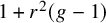 . Denote by
$\mathcal {V}_{n,r,g,1}$
. Denote by
$\mathcal {V}_{n,r,g,1}$
 the closure in
$\mathcal {V}_{n,r,g}$
the closure in
$\mathcal {V}_{n,r,g}$
 of the locus parameterizing the varieties with Picard number one. Such varieties are called Mukai varieties.
Theorem 4.8. Consider
$\mathcal {V}_{n,r,g,1}$
 with index
$r \geq 2$
with index
$r \geq 2$
 and genus
$g \geq 3$
and genus
$g \geq 3$
 . Then
-
(1) $\mathcal {V}_{n,r,g,1} = \varnothing $
if
$(r = 2, 3 \leq g \leq 4)$
,
$(n \geq 6, r = 2, g = 5)$
,
$(r = 2, g \geq 6)$
,
$(r = 3, g \geq 3)$
, or
$(r = 4, g \geq 3)$
. -
(2) $\mathcal {V}_{4,2,5,1}$
and
$\mathcal {V}_{5,2,5,1}$
are irreducible, and the families of Mukai form an open dense irreducible subset of the components.


Proof. By Theorem 3.11, the cases to deal with are the lower genus cases
$(1)-(7)$
 listed in Theorem 3.15. Now
$\mathcal {V}_{n,r,g,1} = \varnothing $
listed in Theorem 3.15. Now
$\mathcal {V}_{n,r,g,1} = \varnothing $
 for
$n \geq 4$
for
$n \geq 4$
 for cases 4, 6, 7 since
$\alpha (X) \leq 1$
for cases 4, 6, 7 since
$\alpha (X) \leq 1$
 .
$\mathcal {V}_{n,r,g,1} = \varnothing $
.
$\mathcal {V}_{n,r,g,1} = \varnothing $
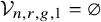 for
$n \geq 3$
for
$n \geq 3$
 for case 5 has been shown in Theorem 4.6 part
$(1)$
for case 5 has been shown in Theorem 4.6 part
$(1)$
 . Similarly
$\mathcal {V}_{n,r,g,1} = \varnothing $
. Similarly
$\mathcal {V}_{n,r,g,1} = \varnothing $
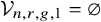 for
$n \geq 6$
for
$n \geq 6$
 for case 3 since
$\alpha (X) \leq 3$
for case 3 since
$\alpha (X) \leq 3$
 .
$\mathcal {V}_{n,r,g,1} = \varnothing $
.
$\mathcal {V}_{n,r,g,1} = \varnothing $
 for
$n \geq 4$
for
$n \geq 4$
 , for cases 1, 2, can be shown by basic adjunction theory arguments, for example, see [Reference Ciliberto, Lopez and Miranda17, Theorem
$3.15$
, for cases 1, 2, can be shown by basic adjunction theory arguments, for example, see [Reference Ciliberto, Lopez and Miranda17, Theorem
$3.15$
 ]. It remains to show part
$(2)$
]. It remains to show part
$(2)$
 . It is enough to show the statement for
$\mathcal {V}_{5,2,5,1}$
. It is enough to show the statement for
$\mathcal {V}_{5,2,5,1}$
 . In this case by the same arguments in Corollary 4.4, we see that dimension of the tangent space
$T_{C(X)}(\mathcal {V}_{5,2,5,1})$
. In this case by the same arguments in Corollary 4.4, we see that dimension of the tangent space
$T_{C(X)}(\mathcal {V}_{5,2,5,1})$
 to the (triple) cone
$C(X) \in \mathcal {V}_{5,2,5,1}$
to the (triple) cone
$C(X) \in \mathcal {V}_{5,2,5,1}$
 over
$X \in \mathcal {V}_{2,5,1}$
over
$X \in \mathcal {V}_{2,5,1}$
 is given by

Now the result follows by comparing with the number of parameters of Mukai’s family of example.
Corollary 4.9. Let
$X \subset \mathbb {P}^{M}$
 be a general
$K3$
be a general
$K3$
 surface in
$\mathcal {H}_{r,g}$
surface in
$\mathcal {H}_{r,g}$
 embedded by the complete linear series of
$rB$
embedded by the complete linear series of
$rB$
 , where B is a primitive very ample line bundle, with
$B^2 = 2g-2$
, where B is a primitive very ample line bundle, with
$B^2 = 2g-2$
 and
$M = 1+r^2(g-1)$
and
$M = 1+r^2(g-1)$
 .
.
-
(1) If $r = 2$
,
$g = 3$
, then
$\alpha (X) = 10$
-
(2) If $r = 2$
,
$g = 4$
, then
$\alpha (X) = 6$
-
(3) If $r = 2$
,
$g = 5$
, then
$\alpha (X) = 3$
-
(4) If $r = 2$
,
$g = 6$
, then
$\alpha (X) = 1$
-
(5) If $r = 3$
,
$g = 3$
, then
$\alpha (X) \leq 4$
-
(6) If $r = 3$
,
$g = 4$
, then
$\alpha (X) = 1$
-
(7) If $r = 4$
,
$g = 3$
, then
$\alpha (X) = 1$


Proof. Except in case
$(5)$
 , we have by Theorem 4.6 that
$\mathcal {V}_{r,g,1}$
, we have by Theorem 4.6 that
$\mathcal {V}_{r,g,1}$
 is non-empty and that
$T_{C(X)}(\mathcal {V}_{r,g,1}) = T_V(\mathcal {V}_{r,g,1})$
is non-empty and that
$T_{C(X)}(\mathcal {V}_{r,g,1}) = T_V(\mathcal {V}_{r,g,1})$
 where V is a smooth point of
$\mathcal {V}_{r,g,1}$
where V is a smooth point of
$\mathcal {V}_{r,g,1}$
 . Hence by Corollary 4.4, we conclude that the upper bounds for
$\alpha (X)$
. Hence by Corollary 4.4, we conclude that the upper bounds for
$\alpha (X)$
 in Theorem 3.15, are actually equalities.
5 Degeneration of
$K3$
surfaces to union of Hirzebruch surfaces embedded by arbitrary linear series

In this section we show how
$K3$
 carpets arise as degenerations of snc union of embedded Hirzebruch surfaces intersecting along an anticanonical elliptic curve. This relates our degeneration to that of [Reference Ciliberto, Lopez and Miranda15]. In [Reference Ciliberto, Lopez and Miranda15], the authors degenerate a prime
$K3$
carpets arise as degenerations of snc union of embedded Hirzebruch surfaces intersecting along an anticanonical elliptic curve. This relates our degeneration to that of [Reference Ciliberto, Lopez and Miranda15]. In [Reference Ciliberto, Lopez and Miranda15], the authors degenerate a prime
$K3$
 surface into a union of scrolls meeting along an elliptic curve and further degenerate such a union into a union of planes whose hyperplane sections are graph curves with corank one Gaussian maps. Similarly, one can think of our degeneration as a degeneration into a union of Hirzebruch surfaces embedded as non-scrolls, but instead of further degenerating to a union of planes, we degenerate into
$K3$
surface into a union of scrolls meeting along an elliptic curve and further degenerate such a union into a union of planes whose hyperplane sections are graph curves with corank one Gaussian maps. Similarly, one can think of our degeneration as a degeneration into a union of Hirzebruch surfaces embedded as non-scrolls, but instead of further degenerating to a union of planes, we degenerate into
$K3$
 carpets. To fix some notations, we start with a remark.
Remark 5.1. Let
$i: Y \hookrightarrow \mathbb {P}^M$
 be an embedding of a smooth variety inside a projective space. Let
$D \in |L^{-1}|$
be an embedding of a smooth variety inside a projective space. Let
$D \in |L^{-1}|$
 be a smooth divisor. Then there is an induced embedding of
$j: D \hookrightarrow \mathbb {P}^M$
be a smooth divisor. Then there is an induced embedding of
$j: D \hookrightarrow \mathbb {P}^M$
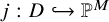 . Let
$p_1$
. Let
$p_1$
 and
$p_2$
and
$p_2$
 denote the Hilbert polynomials of
$Y \hookrightarrow \mathbb {P}^M$
denote the Hilbert polynomials of
$Y \hookrightarrow \mathbb {P}^M$
 and
$D \hookrightarrow \mathbb {P}^M$
and
$D \hookrightarrow \mathbb {P}^M$
 , respectively. Let
$\mathcal {H}(p_1, p_2)$
, respectively. Let
$\mathcal {H}(p_1, p_2)$
 denote the flag Hilbert scheme representing the flag-Hilbert functor as defined in [Reference Sernesi39], Section
$4.5.1$
denote the flag Hilbert scheme representing the flag-Hilbert functor as defined in [Reference Sernesi39], Section
$4.5.1$
 or [Reference Kleppe33]. Closed points of
$\mathcal {H}(p_1, p_2)$
or [Reference Kleppe33]. Closed points of
$\mathcal {H}(p_1, p_2)$
 parameterize pairs
$(D' \hookrightarrow Y' \hookrightarrow \mathbb {P}^M)$
parameterize pairs
$(D' \hookrightarrow Y' \hookrightarrow \mathbb {P}^M)$
 where the subschemes
$Y' \hookrightarrow \mathbb {P}^M$
where the subschemes
$Y' \hookrightarrow \mathbb {P}^M$
 and
$D' \hookrightarrow \mathbb {P}^M$
and
$D' \hookrightarrow \mathbb {P}^M$
 have Hilbert polynomials
$p_1$
have Hilbert polynomials
$p_1$
 and
$p_2$
and
$p_2$
 , respectively. Let
$\mathcal {D}$
, respectively. Let
$\mathcal {D}$
 denote the Hilbert scheme parameterizing subschemes
$(D' \hookrightarrow \mathbb {P}^M)$
denote the Hilbert scheme parameterizing subschemes
$(D' \hookrightarrow \mathbb {P}^M)$
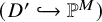 with Hilbert polynomial
$p_2$
with Hilbert polynomial
$p_2$
 . There is a projection map
$p: \mathcal {H}(p_1, p_2) \to \mathcal {D}$
. There is a projection map
$p: \mathcal {H}(p_1, p_2) \to \mathcal {D}$
 whose fiber
$\mathcal {F}_D$
whose fiber
$\mathcal {F}_D$
 at a subscheme
$(D \hookrightarrow \mathbb {P}^M)$
at a subscheme
$(D \hookrightarrow \mathbb {P}^M)$
 consists of all those subschemes
$Y' \hookrightarrow \mathbb {P}^N$
consists of all those subschemes
$Y' \hookrightarrow \mathbb {P}^N$
 with Hilbert polynomial
$p_1$
with Hilbert polynomial
$p_1$
 such that
$D \subset Y'$
such that
$D \subset Y'$
 . Let
$\mathcal F_{D,Y}$
. Let
$\mathcal F_{D,Y}$
 denote the union of irreducible components of
$\mathcal F_D$
denote the union of irreducible components of
$\mathcal F_D$
 containing the point
$(D \hookrightarrow Y\hookrightarrow \mathbb {P}^M)$
containing the point
$(D \hookrightarrow Y\hookrightarrow \mathbb {P}^M)$
 . Closed points parameterized by
$\mathcal {F}_{D,Y}$
. Closed points parameterized by
$\mathcal {F}_{D,Y}$
 correspond to deformations over an irreducible curve of the subvariety Y inside
$\mathbb {P}^M$
correspond to deformations over an irreducible curve of the subvariety Y inside
$\mathbb {P}^M$
 which keeps D fixed.
Theorem 5.2. Let
$Y = \mathbb {F}_e \hookrightarrow \mathbb {P}^N$
 be an embedding of the Hirzebruch surface
$\mathbb {F}_e$
be an embedding of the Hirzebruch surface
$\mathbb {F}_e$
 , with
$e \leq 2$
, with
$e \leq 2$
 , induced by the complete linear series of the very ample line bundle
$|aC_0+bf|$
, induced by the complete linear series of the very ample line bundle
$|aC_0+bf|$
 (hence
$b \geq ae+1$
(hence
$b \geq ae+1$
 ). Let
$i: \mathbb {P}^N \to \mathbb {P}^M$
). Let
$i: \mathbb {P}^N \to \mathbb {P}^M$
 be a linear embedding with
$M = N + h^0((a-2)C_0+(b-e-2)f)$
be a linear embedding with
$M = N + h^0((a-2)C_0+(b-e-2)f)$
 and consider the composed (possibly degenerate) embedding
$Y \hookrightarrow \mathbb {P}^M$
and consider the composed (possibly degenerate) embedding
$Y \hookrightarrow \mathbb {P}^M$
 . Let
$E \in |-K_Y|$
. Let
$E \in |-K_Y|$
 denote a smooth elliptic curve.
-
(1) If $Y_1$
is the subvariety Y of
$\mathbb P^M$
and
$Y_2$
is a subvariety of
$\mathbb P^M$
that corresponds to a general element of
$\mathcal {F}_{E,Y}$
, then the scheme-theoretic intersection of
$Y_1$
and
$Y_2$
is E and
$V = Y_1 \bigcup _E Y_2$
is smoothable inside
$\mathbb {P}^M$
to a smooth K3 surface embedded by the complete linear series of a very ample line bundle. The Hilbert point of V inside
$\mathbb {P}^M$
is smooth. Further the closure inside the Hilbert scheme of the locus of varieties of the form
$V = Y_1 \bigcup _E Y_2$
contains embedded
$K3$
carpets
$\widetilde {Y} \hookrightarrow \mathbb {P}^M$
which extend the embedding
$Y \hookrightarrow \mathbb {P}^M$
. -
(2) The locally trivial deformations of V inside $\mathbb {P}^M$
are unobstructed and form a subspace in the tangent space of the Hilbert scheme at
$[V]$
of codimension
$h^0(-2K_Y|_E) = 6$
. Furthermore, this subspace is the tangent space at
$[V]$
of an irreducible locus of the Hilbert scheme, which has codimension
$h^0(-2K_Y|_E) = 6$
and is smooth at
$[V]$
. The singularities of the subschemes parameterized by this locus are normal crossing singularities; in particular, they are non-normal and semi-log-canonical. They are analytically isomorphic to
$(x_1^2+x_2^2 = 0 \subset \mathbb {C}^M)$
. -
(3) The general smooth surface of the Hilbert component containing V is a
-
(a) prime $K3$
surface if
$\textrm {gcd}(a,b) = 1$
-
(b) a non-prime $K3$
surface embedded by
$rB$
, with
$r = \operatorname {gcd}(a,b)$
and B is a primitive very ample line bundle.
-


Proof. Let us prove part
$(1)$
 . We apply [Reference Bangere, Gallego and Mukherjee5, Theorem
$2.10$
. We apply [Reference Bangere, Gallego and Mukherjee5, Theorem
$2.10$
 ]. First of all, there exists nowhere vanishing sections inside
$H^0(N_{Y/\mathbb {P}^M} \otimes K_Y)$
]. First of all, there exists nowhere vanishing sections inside
$H^0(N_{Y/\mathbb {P}^M} \otimes K_Y)$
 corresponding to embedded ribbons
$\widetilde {Y}$
corresponding to embedded ribbons
$\widetilde {Y}$
 by [Reference Gallego and Purnaprajna26, Proposition
$1.7$
by [Reference Gallego and Purnaprajna26, Proposition
$1.7$
 ] for
$a = 1$
] for
$a = 1$
 and by [Reference Bangere, Mukherjee and Raychaudhury8, Theorem
$3.1$
and by [Reference Bangere, Mukherjee and Raychaudhury8, Theorem
$3.1$
 ] for
$a \geq 2$
] for
$a \geq 2$
 . A simple computation shows that
$H^1(N_{Y/\mathbb {P}^M}) = 0$
. A simple computation shows that
$H^1(N_{Y/\mathbb {P}^M}) = 0$
 and hence Y is unobstructed in
$\mathbb {P}^M$
and hence Y is unobstructed in
$\mathbb {P}^M$
 . If
$a = 1$
. If
$a = 1$
 , then we have that
$H^1(N_{Y/\mathbb {P}^M} \otimes K_Y) = 0$
, then we have that
$H^1(N_{Y/\mathbb {P}^M} \otimes K_Y) = 0$
 by [Reference Gallego and Purnaprajna26, Proposition
$1.7$
by [Reference Gallego and Purnaprajna26, Proposition
$1.7$
 ] while if
$a \geq 2$
] while if
$a \geq 2$
 , the same vanishing follows from [Reference Bangere, Mukherjee and Raychaudhury8, Lemma
$2.7$
, the same vanishing follows from [Reference Bangere, Mukherjee and Raychaudhury8, Lemma
$2.7$
 ,
$(2)$
,
$(2)$
 ] and hence, the functor
$F_{E, Y}$
] and hence, the functor
$F_{E, Y}$
 is unobstructed. If
$a = 1$
is unobstructed. If
$a = 1$
 , the smoothability of
$\widetilde {Y}$
, the smoothability of
$\widetilde {Y}$
 inside
$\mathbb {P}^M$
inside
$\mathbb {P}^M$
 and the smoothness of its Hilbert point follows from [Reference Gallego, González and Purnaprajna24, Theorem
$2.7$
and the smoothness of its Hilbert point follows from [Reference Gallego, González and Purnaprajna24, Theorem
$2.7$
 ] and [Reference Gallego and Purnaprajna26, Theorem
$4.1$
] and [Reference Gallego and Purnaprajna26, Theorem
$4.1$
 ] respectively while if
$a \geq 2$
] respectively while if
$a \geq 2$
 , the same follows from [Reference Bangere, Mukherjee and Raychaudhury8, Theorem
$4.3$
, the same follows from [Reference Bangere, Mukherjee and Raychaudhury8, Theorem
$4.3$
 ] and [Reference Bangere, Mukherjee and Raychaudhury8, Theorem
$5.1$
] and [Reference Bangere, Mukherjee and Raychaudhury8, Theorem
$5.1$
 ] respectively. Therefore part
$(1)$
] respectively. Therefore part
$(1)$
 follows from [Reference Bangere, Gallego and Mukherjee5, Theorem
$2.10$
follows from [Reference Bangere, Gallego and Mukherjee5, Theorem
$2.10$
 ].
].
To show part
$(2)$
 we need to show that
$H^1(N_{V/\mathbb {P}^M}') = 0$
we need to show that
$H^1(N_{V/\mathbb {P}^M}') = 0$
 for one subvariety of the form
$V = Y_1 \bigcup _E Y_2$
for one subvariety of the form
$V = Y_1 \bigcup _E Y_2$
 where
$Y_2 \in \mathcal {F}_{E,Y}$
where
$Y_2 \in \mathcal {F}_{E,Y}$
 . For this, first note that for any such V we have an exact sequence

Note that by part
$(1)$
 , we have a flat family
$\mathcal {Y} \to T$
, we have a flat family
$\mathcal {Y} \to T$
 over a smooth irreducible curve T, such that
$\mathcal {Y}_0$
over a smooth irreducible curve T, such that
$\mathcal {Y}_0$
 is an embedded
$K3$
is an embedded
$K3$
 carpet
$\widetilde {Y}$
carpet
$\widetilde {Y}$
 on Y and
$\mathcal {Y}_t$
on Y and
$\mathcal {Y}_t$
 is a subvariety of the form
$V = Y_1 \bigcup _E Y_2$
is a subvariety of the form
$V = Y_1 \bigcup _E Y_2$
 . When
$a \geq 2$
. When
$a \geq 2$
 , by [Reference Bangere, Mukherjee and Raychaudhury8, Theorem
$5.1$
, by [Reference Bangere, Mukherjee and Raychaudhury8, Theorem
$5.1$
 , equation
$(5.9)$
, equation
$(5.9)$
 ], we have that
$H^1(N_{\widetilde {Y}/\mathbb {P}^M}) = 0$
], we have that
$H^1(N_{\widetilde {Y}/\mathbb {P}^M}) = 0$
 , while for
$a = 1$
, while for
$a = 1$
 , the same holds by [Reference Gallego and Purnaprajna26, Theorem
$4.1$
, the same holds by [Reference Gallego and Purnaprajna26, Theorem
$4.1$
 ]. Now since the family
$\mathcal {Y} \to T$
]. Now since the family
$\mathcal {Y} \to T$
 is local complete intersection, we have that
$N_{\mathcal {Y}/\mathbb {P}_T^M}$
is local complete intersection, we have that
$N_{\mathcal {Y}/\mathbb {P}_T^M}$
 is locally free and hence flat over T. Therefore by semi-continuity,
$H^1(N_{\mathcal {Y}_t/\mathbb {P}^M}) = 0$
is locally free and hence flat over T. Therefore by semi-continuity,
$H^1(N_{\mathcal {Y}_t/\mathbb {P}^M}) = 0$
 , that is,
$H^1(N_{V/\mathbb {P}^M}) = 0$
, that is,
$H^1(N_{V/\mathbb {P}^M}) = 0$
 . The vanishing of
$H^1(N_{V/\mathbb {P}^M}')$
. The vanishing of
$H^1(N_{V/\mathbb {P}^M}')$
 now follows if we show that
$H^0(N_{V/\mathbb {P}^M}) \to H^0(T_V^1)$
now follows if we show that
$H^0(N_{V/\mathbb {P}^M}) \to H^0(T_V^1)$
 is a surjection. Once again, we show this is a surjection by passing to the ribbon, that is, we show that
$H^0(N_{\widetilde {Y}/\mathbb {P}^M}) \to H^0(T_{\widetilde {Y}}^1)$
is a surjection. Once again, we show this is a surjection by passing to the ribbon, that is, we show that
$H^0(N_{\widetilde {Y}/\mathbb {P}^M}) \to H^0(T_{\widetilde {Y}}^1)$
 is a surjection. First note that the sheaf
$T_{\widetilde {Y}}^1 = \mathcal {O}_Y(-2K_Y)$
is a surjection. First note that the sheaf
$T_{\widetilde {Y}}^1 = \mathcal {O}_Y(-2K_Y)$
 . Granting this, note that it sits as the last term in the exact sequence (see Equation (3.2))

while the map
$H^0(N_{\widetilde {Y}/\mathbb {P}^M}) \to H^0(T_{\widetilde {Y}}^1)$
 factors as
$H^0(N_{\widetilde {Y}/\mathbb {P}^M}) \to H^0(N_{\widetilde {Y}/\mathbb {P}^M} \otimes \mathcal {O}_Y) \to H^0(T_{\widetilde {Y}}^1)$
factors as
$H^0(N_{\widetilde {Y}/\mathbb {P}^M}) \to H^0(N_{\widetilde {Y}/\mathbb {P}^M} \otimes \mathcal {O}_Y) \to H^0(T_{\widetilde {Y}}^1)$
 where the first map is obtained by taking the cohomology of the exact sequence

So to show the surjection it is enough to show that
$H^1(\mathcal {H}om(I_{\widetilde {Y}}/I_{Y}^2, \mathcal {O}_Y)) = 0$
 and
${H^1(N_{\widetilde {Y}/\mathbb {P}^M} (K_Y)) = 0}$
and
${H^1(N_{\widetilde {Y}/\mathbb {P}^M} (K_Y)) = 0}$
 . For
$a = 1$
. For
$a = 1$
 , these vanishings follow from the proof of [Reference Gallego and Purnaprajna26, Theorem
$4.1$
, these vanishings follow from the proof of [Reference Gallego and Purnaprajna26, Theorem
$4.1$
 ] and for
$a \geq 2$
] and for
$a \geq 2$
 , from [Reference Bangere, Mukherjee and Raychaudhury8, Theorem
$5.1$
, from [Reference Bangere, Mukherjee and Raychaudhury8, Theorem
$5.1$
 ].
].
Now we show that
$T_{\widetilde {Y}}^1 = \mathcal {O}_Y(-2K_Y)$
 . The sheaf
$T_{\widetilde {Y}}^1$
. The sheaf
$T_{\widetilde {Y}}^1$
 is defined by the exact sequence

Since
$T_{\widetilde {Y}}^1$
 is supported on the singular locus Y of the ribbon
$\widetilde {Y}$
is supported on the singular locus Y of the ribbon
$\widetilde {Y}$
 , restricting the exact sequence to Y, we get

and hence

We will show that
$\operatorname {Coker}(\lambda ) = \mathcal {H}om(I_{\widetilde {Y}}/I_{Y}^2, \mathcal {O}_Y)$
 and then the conclusion follows by comparing with the exact sequence 3.2. To find
$\operatorname {Coker}(\lambda )$
and then the conclusion follows by comparing with the exact sequence 3.2. To find
$\operatorname {Coker}(\lambda )$
 , note that we have commutative diagram

where the first row is the normal bundle sequence of Y inside
$\widetilde {Y}$
 (recall that the normal bundle of Y inside
$\widetilde {Y}$
(recall that the normal bundle of Y inside
$\widetilde {Y}$
 is given by
$\mathcal {O}_Y(-K_Y)$
is given by
$\mathcal {O}_Y(-K_Y)$
 ), the second row is the normal bundle sequence of Y inside
$\mathbb {P}^M$
), the second row is the normal bundle sequence of Y inside
$\mathbb {P}^M$
 and the last column is sequence 3.3. Applying the Snake lemma now gives us the desired result.
Acknowledgments
We thank Professor Rick Miranda and Professor Angelo Lopez for useful discussions. We also thank Professor Thomas Dedieu for reading the paper carefully and for his helpful suggestions; in particular for pointing out that our results hold in greater generality than what was stated in our previous version. Finally, we are grateful to the referee for a very careful reading of the paper; his comments and suggestions improved the exposition and also brought greater clarity to the proofs on certain important points.
Competing interests
The authors have no competing interests to disclose.


 Open access

