


1. Introduction
A better understanding of how ice sheets behave over glacial and interglacial cycles requires more knowledge of the processes controlling ice dynamics. The alignment of crystals in ice, called crystal-orientation fabrics (COFs), has an important effect on ice deformation. As ice deforms, non-uniform COFs are produced which, in turn, influence further deformation (e.g. Reference Budd and JackaBudd and Jacka, 1989; Reference AzumaAzuma, 1994). Consequently, measurements of COF variations can help reveal the deformation history of the ice and indicate how deformation will continue in the future.
Radio waves are well known to scatter from acidity and density non-uniformities in ice sheets (e.g. Reference CloughClough, 1977; Reference MillerMiller, 1981). Less well known is scattering from non-uniformities in COFs. From laboratory experiments, it is known that the permittivity at radio frequencies is about 1 % larger for the component with polarization along the c axis as compared to other polarizations (Reference Fujita, Mae and MatsuokaFujita and others, 1993). This anisotropy can explain why COF variations likely cause radio-wave scattering. For example, a radar survey in eastern Dronning Maud Land, Antarctica, showed that contrasts of COF strength between layers are likely to develop where large amounts ofice shearing are expected and COF non-uniformity is a major source of internal scattering (Reference FujitaFujita and others, 1999). With the use of 60 MHz radar data, similar features of ice layering were found around Vostok lake (Reference Siegert and KwokSiegert and Kwok, 2000) and Dome C, Antarctica (Reference Siegert and FujitaSiegert and Fujita, 2001). More recently, a spot survey at an ice-coring site in eastern Dron- ning Maud Land found that anisotropic features in radar echoes at 179 MHz were caused by anisotropic COF patterns (Reference Fujita, Matsuoka, Maeno and FurukawaFujita and others, 2003). Reference MatsuokaMatsuoka and others (2003) found that this feature was continuous over a horizontal distance of 300 km. These studies have established COF variations as a major radar scattering mechanism, at least in East Antarctica, a finding that we rely upon to interpret our measurements in this study.
Although there is a large variety of ice-flow conditions responsible for COF development, no measurements have been made where the ice has parallel flow or longitudinal compression by nunataks. In particular, the latter is dominant along the Antarctic Peninsula, for >1000 km along the Transantarctic Mountains, and for >2000 km along the coast of Dronning Maud Land. In addition, smaller nuna- taks occupy a major portion of the coasts of Antarctica and Greenland. Furthermore, because the previous measurement in a convergent-flow region was done only in the midstream region, we have no knowledge of the COF features in the region further downstream towards the ice streams. Therefore, to broaden the applicability of high-frequency radar as a tool for measuring COFs and to gain better understanding ofice viscosity due to COFs over wide areas, it is important to investigate the spatial variations of COF echoes from ice with different flow conditions.
Here we present results of an airborne radar survey in adjacent basins in eastern Dronning Maud Land with different flow conditions. We found a distinct zone of large radar echoes at depths of 700—1200 m in the convergent-flow region and on the stoss side of nunataks, which cause longitudinal compression. This scattering zone emerged only when the polarization plane was parallel to the horizontal compression axis. In contrast, no such zone was observed in the parallel-flow region. We interpret this polarization- dependent difference to indicate distinct COF patterns that depend on regional-scale ice-flow characteristics.
2. Study Area
Airborne radar surveys were done in Ragnhild Glacier basin (RGB) and Shirase Glacier basin (SGB) as sketched in Figure 1. We assume that the ice flows in the direction of surface slope, which is consistent with ground surveys at many sites in these regions (Reference TakahashiTakahashi and others, 1997). Because the radar polarization plane is always along the flight path (see section 3), the angle 6 between the flow and the flight path equals the angle between the flow and the polarization plane.
(a) Ragnhild Glacier basin (RGB) and Shirase Glacier basin (SGB) in eastern Dronning Maud Land, Antarctica (Reference Liu, Jezek and LiLiu and others, 1999). The shaded rectangle in the inset map shows the area covered by the larger map. RGB has a chain of inland nunataks about 200 km from the coast that include the Yamato Mountains near R1, the Belgica Mountains near R2, and the Sor Rondane Mountains (SRM). This chain of nunataks and wide ice shelves characterize the Dronning Maud Land coast from 20° W to 35° E. Contour intervals are 100 m, and elevations of1000, 2000 and 3000 m are labeled. Black dashed lines highlight topographic divides. Flight-lines are shown as thick black lines. Thin solid lines in SGB show three previous ground-based measurement lines (Reference MatsuokaMatsuoka and others, 2003) including the Mizuho ice-coring site marked with an X. (b) The flight path and the locations of the continuous high-P r zone. The locations of the flight turning points are marked with letters and listed in Table 1. We denote the distances counterclockwise along these lines in RGB and SGB as xr and xg, respectively. Solid black lines mark the locations of the high-P r zone, the white-filled lines show locations where this zone was not detected, and the hatched-line segments mark regions with less distinct high-P r zones. The polarization was parallel to the flight path. We could not distinguish internal scattering and off-nadir bed scattering around R1 and R2. Line A is the lowest line in our previous study (Reference MatsuokaMatsuoka and others, 2003). Spatial variations of the high-P r zone due to Pcof-based anisotropic reflection zones along line A are marked in the same way.

Locations of theflight turning points

Our 480 km long survey path in RGB is triangular. The line starts at the Yamato Mountains (site R1), which is near the ice divide between RGB and SGB, and crosses the main ice flow in RGB on the way to the Belgica Mountains (site R2). This segment is 184 km long and roughly perpendicular to the ice flow (6 = 70—80°). Following this segment, the airplane headed inland. The second segment, from R2 to R3, is 73 km long and 6 is roughly 0°. The third segment, from R3 to R1, is 222 km long and 6 increases from 30° to 60° towards R1. The other study line, in SGB, is 195 km long. The first segment, between sites S1 and S2, is from Shirase Glacier to the inland region. The angle 6 is 45° near site S1, but decreases rapidly to 10—20° along the route to S2 and reaches 0° near site S2. Between S2 and S3, 6 > 70°. Between S3 and S4, 6 is 40—50°.
These two study lines cover three distinct ice-flow features. The first one is parallel flow. Regional-scale (~102 km) surface topography suggests that the ice flows parallel from the inland divide to the central part of segments R1—R2 and R3—R1. As segments R1—R2 and R3— R1 inclined 70—80° and 30—60° to the flow, respectively, we observed the parallel-flow region with this range of 6.
The second flow type is longitudinal compression on the stoss side of nunataks. In general, nunataks and the accompanying shallow bedrock form a barrier to ice flow and cause an ice ridge on the stoss side. Such an ice ridge can be recognized at the Belgica Mountains where there are three major nunataks in a 10 × 20 km2 area. A bare-ice field with a meteorite trap, which is evidence for emergent ice, was found only on the lee side (Reference Kojima, Yanai and NishidaKojima and others, 1981). Thus, we assume that vertical strains are small compared with longitudinal compression and transverse extension at the ice ridge on the stoss side. This area includes the segment R2—R3 and some portions of R3—R1. The polarization plane for the segment R2—R3 is longitudinal.
The third flow type is convergent flow towards an ice stream (Reference NaruseNaruse, 1978). We travelled through this area in SGB with a longitudinal polarization for the segment S1 — S2 and transverse polarization for the segment S2—S3—S4. This region has more convergent flow than in our previous, higher-elevation, ground-based survey in this drainage basin (Fig. 1).
Radar Method
The radar survey was done in 1986 with a pulse-modulated airborne system. A linearly polarized transmitting antenna was suspended under one wing, and a linear-polarized receiving antenna was under the other wing. The polarization plane here is always parallel to the flight-line. Other specifications of this radar system are listed in Table 2. Only 179 MHz radar data are available along these study lines.
Specifications of the 179 MHz radar system. See Reference Uratsuka, Nishio and MaeUratsuka and others (1996) for more details

The radar echoes were recorded as a time series of the received power P r. In general, P r is affected by dielectric properties of ice and radar system parameters. For a given depth z and polarization plane θ, the radar equation gives

This equation is modified from that in Reference MatsuokaMatsuoka and others (2003) to account for the airplane height above the ground h, which ranged between 150 and 300 m. S represents various system parameters that consist of transmitting power, antenna gain, antenna beamwidth, and wavelength. The ice properties include permittivity of ice ε = 3.15, loss factor L, back-scattering cross-section σ and birefringence.
If the c axes are not parallel to the wave-propagation axis, then the ice sheet is birefringent and an incident radio wave separates into two components within the ice. When the waves reach the ice-sheet surface after being scattered, they superimpose either constructively or destructively, depending on their phase difference. In Equation (1), B is a measure of birefringence, a power level relative to the maximum P
r, which is observed when the two components are in phase; B in decibels is always negative. Since L is independent of θ, the dependence of P
r on θ can come only from B, σ and ε. However, anisotropy from ε in the term 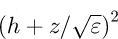 is less than ~0.1 dB and thus will be ignored.
Small instabilities in the transmitting power and the receiving-amplifier gain result in statistical errors in P r of < 1 dB. To determine the bedrock topography, we used 60, 250 and 1000 ns pulse widths in RGB. In contrast, only the 250 ns pulse width was used in SGB. We compensated for variations in h and the changes of transmitting power that occurred when we changed the pulse width. Also, we used the propagation speed of 169 m μs—1 to convert the twoway travel time to the depth.
Ice-sheet surface undulations from sastrugi and crevasses can cause off-nadir reflections that get mixed up with the internal scattering that we seek. To estimate a maximum depth below which this is not a problem, we assume h = 300 m and a 1000 ns pulse width. In this case, we estimate that off-nadir surface reflections with an incident angle of 77° have the same two-way travel time as the nadir reflections from 500 m depth. Therefore, as the antenna beamwidth is 70—90° (Table 2), all features in the radar echoes below 500 m, on which we will focus in this paper, should not be from surface undulations. Therefore, surface undulations are not a problem in this study.
4. Results
In the vicinity of sites R1 and R2, the ice thickness abruptly changes from about 1000 m to about 500 m and decreases quickly near some nunataks. That causes some echoes from the off-nadir bed that mix with the internal scattering. Thus, we discuss only the radar echoes 60—70 km or more from R1 and 20 km or more from R2. There were no such restrictions in SGB.
4.1. Parallel-flow region
Radar echoes along the line in RGB are shown in Figure 2. Ice flows parallel to the Princess Ragnhild Coast ice shelf in the central part of paths R1—R2 and R3—R1. For 60 < x r < 165 km and 280 < x r < 410 km, P r gradually decreases with increasing depth. Vertical profiles of P r (Fig. 2b) show small P r peaks (e.g. z = 800 m, x r = 100 km), but these peaks are isolated in horizontal extent and thus do not constitute extensive layers that can readily be analyzed. The polarization plane is nearly perpendicular to the ice flow with θ = 70—80° in R1—R2 and 0 = 30—60° in R3—R1. Despite this range of θ, no distinct layers were found in these parallel-flow regions.
Radar echo along the survey line in RGB. (a) Radargram. Locations of R1-R3 correspond to the sites shown in Figure 1b. R1 is at xr = 0 and 480 km. The gray scale on the right is for P r. The continuous, jagged white line in the right panel highlights the bed topography where scattering from the bed is not obvious. A white arrow marks the high-P r zone, a zone of relatively high internal P r. (b) Depth profiles of P r at x r = 100,140, 220, 240 and 260 km from left to right. The dotted line connects the bed depth at the different positions. Black horizontal arrows at x r = 220,240 and260 mark the high-P r zone. Detection limit ranges from —98 to —108 dBm, depending on the pulse width (Table 2).

4.2. Longitudinal compression on the stoss side of nunataks
In contrast to the parallel-flow region, a distinct zone of relatively high P r emerges at depths of 700—1200 m on the stoss side of the nunataks from R2 to R3 (Fig. 2a).The thickness of the high-P r zone decreases from 200—400 m to less than about 200 m as the ice approaches the nunataks around R2. In addition, it maintains a nearly constant distance over the underlying bed. The radar polarization is longitudinal between R2 and R3. A high-P r zone also exists about 10—20 km from R3 towards R1. Further from R3, P r becomes less distinct and disappears.
Vertical P r variations (Fig. 2b) show that the high-P r zone has an amplitude of about 6 dB over that of the ice immediately above it and that the peak values are about 15— 20 dB above the detection limit of —108 dBm (Table 2). Figure 2a shows that these numbers are typical for 205 < x r < 270 km. The depth profiles at x R = 220, 240 and 260 km in Figure 2b show that the high-P r zone has several P r peaks. However, the depths of P r peaks at these three sites do not correlate with each other, and no individual continuous layers were apparent within the high-P r zone in the radargram.
4.3. Convergent-flow region toward an ice stream
Radar echoes along the line in SGB are shown in Figure 3. P r along the segment S1—S2 gradually decreases with increasing depth. However, starting near site S2, where the flight path abruptly changed by about 90° such that the polarization became roughly perpendicular to the flow with θ > 70°, a distinct zone of relatively high P r appears. This zone is at 800—1100 m depth. It continues to site S3. After site S3, where the flight path changed again, this high-P r zone weakens and vanishes before site S4. Thus, this distinct high-P r zone is continuous for >80 km and maintains a nearly constant distance above the underlying bed, even as the bed changes elevation by 300 m. The only difference in observation parameters between segments S1—S2 and S2— S3—S4 is the polarization plane orientation relative to the ice-flow direction.
Radar echo along the survey line in SGB. (a) Radargram. Locations of S1-S4 correspond to the sites shown in Figure 1b. The white arrow marks the distinct high-Pr zone. The gray scale on the right represents P r. (b) Depth profiles of P r at x S = 50, 80, 110, 140 and 170 kmfrom left to right. The dotted line connects the bed depth at the different positions. Black horizontal arrows at x S = 110, 140 and 170 km mark the high-P r zone. Detection limit is at -103 dBm (Table 2).

Vertical profiles of P r at five sites are shown in Figure 3b. At x s = 110 km (near site S2) and 140 km (near site S3), the high-P r zone is 200—300 m thick and is stronger than the signal from the ice above by 8 dB. Figure 3a shows that this thickness and contrast in P r is typical between sites S2 and S3. At x s = 1170 km, which is between S3 and S4, the high-P r zone is thinner and weaker than between S2 and S3. The P r contrast between the high-P r zone and the ice above is several decibels.
4.4. Characteristics of the high-p 2 zone
The high-P r zones emerge both in the stoss side of the nuna- taks and in the convergent-flow region for >60 km (Fig. 1b). They have some similar features. The zone is several hundred meters thick and keeps a nearly constant distance from the bed. In addition to these geometric features, the P r contrast between the high-P r zone and ice above is typically 6— 8 dB, and P r decreases monotonically below the high-P r zone. The high-P r zone on the stoss side was observed only with longitudinal polarization, whereas that in the convergent flow was observed with transverse polarization. In the next section, we argue that variable COF causes this polarization-dependent feature in regions where horizontal compression occurs.
5. Discussion
We observed the high-P r zone on the stoss side of the nunataks and in the convergent ice flow. We argue below that the high-P r zone in both regions is caused by a similar mechanism.
5.1. Causes of the high-p 2 zone and its polarization dependence
The major causes of radio-wave scattering within ice are acidity, density and COF non-uniformities. Large acidity non-uniformities, which are usually due to volcanic eruptions (Reference HammerHammer, 1980), cause radio-wave scattering from high-acid layers throughout the entire ice sheet except for some portions near the bed (Reference MillerMiller, 1981). Density non-uniformities are smoothed out with increasing depth, and air bubbles turn into air hydrates. For the estimated temperature around S2 (Reference Nishio, Mae, Ohmae, Takahashi, Nakawo and KawadaNishio and others, 1989), this transformation should occur at about 600 m (Reference MillerMiller, 1969). The permittivity of N2 hydrate, at about 2.8 (Reference GoughGough, 1972), is significantly smaller than that of ice; however, because of its negligible volume fraction in ice (<10—3), air-hydrate non-uniformities cannot cause any permittivity changes significant for radio-wave scattering. Although density nonuniformities are insignificant below a certain depth, COF non-uniformities are stronger at greater depths. In addition to the gradual development of COF clustering with depth, abrupt changes of COF exist in ice cores including Dome Fuji at the head of RGB and SGB (see brief review in Reference Fujita, Matsuoka, Maeno and FurukawaFujita and others, 2003).
We focus here on the distinct zone of relatively high P only at depths exceeding 700 m. At 179 MHz, the Fresnel reflectivities derived from dielectric measurements of ice suggest that radio-wave scattering is largely caused by permittivity non-uniformities due to density and COF variations (Reference Fujita and MaeFujita and Mae, 1994). A simple calculation on the Fresnel reflectivities (Reference ParenParen, 1981) shows that the observed P contrast of about 6 dB between the high-P r zone and adjacent ice above (Figs 2 and 3) can be explained only when density variations exceed 7 kg m—3. This is equivalent to —64 dB when the ordinary reflectivities are about — 70 dB. This 7 kg m—3 is much larger than the maximum density fluctuation of 1 kg m—3 at 1000 m in the Byrd core (Reference CloughClough, 1977), which will be about 1.4 kg m—3 at 700 m depth under the glaciostatic pressure assuming that the air included in the ice follows the ideal gas equation. Therefore, it is unlikely that density non-uniformities cause the observed PT contrast. On the other hand, COF non-uniformities seem to dominate the scattering signal at depths exceeding about 400 m for a radar frequency of 179 MHz in SGB (Reference Fujita, Matsuoka, Maeno and FurukawaFujita and others, 2003; Reference MatsuokaMatsuoka and others, 2003). Furthermore, we estimate below that possible COF alternations give P r contrast in good agreement with the measurements. Thus, we argue that the most likely cause of the high-P r zone both on the stoss side of nunataks and in the convergent-flow region is permittivity non-uniformities due to COF variations.
The high-P r zone emerges near site S2, where the flight path abruptly changed by about 90°. Although we did not examine the ice at exactly the same location with two polarizations, the rotation of the airplane was completed within several seconds during which the airplane moved no more than several hundred meters. Hence, different polarizations were used at neighboring locations with similar flow. Furthermore, the height of the airplane was steady at about 300 m near S2. This dependence on polarization angle indicates that the high reflectivity in the high-P r zone is due to a polarization anisotropy. Other explanations do not fit with the data. In particular, measurements of the balance velocity around site S2 indicate that S2 is outside of a distinct tributary of Shirase Glacier (Reference Pattyn and NarusePattyn and Naruse, 2003); the balance velocity of 35 m a—1 at S2 is lower than those at other sites with a similar distance from the Shirase Glacier outlet. Also, we did not detect any abrupt changes in ice and bed topography near site S2 (Figs 1 and 3). Therefore, polarization anisotropy likely caused the high reflectivity.
Polarization anisotropy can be due to birefringence, backscattering or both (Equation (1)). We observed an 8 dB difference in P r at two polarization planes roughly perpendicular to each other near site S2 (Fig. 3). Although these do not rule out birefringence, birefringence seems unlikely for the following reasons. If birefringence were the primary cause of anisotropy in P r, then P r would change sinusoidally with the polarization plane orientation and have a maximum every 90° (Reference HargreavesHargreaves, 1977). If the principal axes of birefringence were parallel or perpendicular to the flow direction, which is generally the case, then the birefringence would show equal intensities at the two polarizations because they are 90° apart. This would contradict our measurements. Furthermore, a previous radar survey with eight polarization planes in SGB (Fig. 1) showed that a high-P r zone on two transverse profiles has its maximum only at one polarization plane orientation, showing that it is caused by anisotropic scattering due to certain one-axis-symmetric COF non-uniformities (Reference MatsuokaMatsuoka and others, 2003).
Therefore, we conclude that the high-P r zone in the convergent-flow region towards Shirase Glacier is caused by anisotropic COF scattering.
5.2. COF patterns in the high-P r zone
Ice deformation occurs by dislocation glide accompanied by crystal rotation (Reference Shoji and HigashiShoji and Higashi, 1978) under typical stresses and temperatures at middle depths of ice sheets. Because the c axes rotate away from the extension axis and cluster along the compression axis, various COF patterns can occur in ice sheets depending on strain configurations. Vertical single-pole patterns (Fig. 4a) generally occur under uniaxial compression and simple shear, whereas vertical- girdle patterns (Fig. 4c) generally occur under uniaxial extension (Reference AzumaAzuma, 1994). Between these two extremes is the more common elongated single pole (Fig. 4b). Other complex COF patterns with multiple maxima are not considered, because they are mainly found near the base of ice sheets or in ice shelves (e.g. Reference Budd and JackaBudd and Jacka, 1989, Fig. 3).
COF patterns inferred from the observed radar echoes. All diagrams are projected onto the horizontal plane. (a) Strong vertical single pole. (b) Elongated single pole. (c) Vertical girdle. For (b) and (c), the cluster plane of c axes is along the compression axis and perpendicular to the extension axis. Large scattering occurs only along the horizontal compression axis when COF patterns alter among (a-c), or if elongations of (b) change.

With these constraints, Reference MatsuokaMatsuoka and others (2003) proposed from a multi-polarization radar survey along ice flow from Dome Fuji (Fig. 1a) that COF-pattern alternations between single pole and vertical girdle likely occur when horizontal compression occurs on single-pole fabric ice with various clustering. Single-pole fabric ice with weak clustering has a large number of crystal grains that have easy-glide planes close to the maximum shear stress direction. In contrast, the single-pole fabric ice with stronger clustering has a larger viscosity under the same stress and is stiffer. Thus, stronger single-pole fabric remains single-pole, but weaker single-pole fabric changes into vertical-girdle fabric. Prior clustering variations of single-pole fabric are found at Dome Fuji, the head of RGB and SGB (Reference AzumaAzuma and others, 1999).
Spatial variations of the high-scattering zone (Fig. 1b) are consistent with theory and the above scenario. The ice ridge on the stoss side of the nunataks indicates local longitudinal compression and transverse extension. Thus, the c axes of deformed ice cluster in the longitudinal plane. In the convergent-flow region, the cluster plane will be transverse. Thus, it is most likely that COF alternations shown in Figure 4 occur where we found the anisotropic, high-P r zone. The alternations give larger and smaller P r, when the polarization plane is parallel and perpendicular to the compression axis, respectively. This is consistent with the observed anisotropy. Furthermore, the observed large anisotropy of about 8 dB near site S2 can occur provided we assume that COF patterns alter between single pole and vertical girdle (Reference MatsuokaMatsuoka and others, 2003). Thus, we interpret the high-P r zone as being caused by COF alternations as sketched in Figure 4, which will be construed as ice-flow features and their history in section 5.3.
5.3. Spatial variation of the high-P r zone
In addition to the distinct high-P r zone along the ice ridge, the less distinct high-P r zone was found for 10—20 km in the northeastern slope from the ridge. This suggests that the Belgica Mountains, which consist of three major nunataks in a 10 × 20 km2 area, and the accompanying shallow bedrock cause anisotropic ice structures over an area on the stoss side at least 85 km long and 20 km wide.
A distinct high-P r zone is lacking for various polarizations along paths R1—R2 and R3—R1, where ice flows paral-lel. Thus, COFalternations such as those sketched in Figure 4 do not exist in the parallel-flow region. Although elongated single-pole fabrics tend to form under pure shear (e.g. Reference AzumaAzuma, 1994), COF alternations in this region are not developed enough to cause distinct internal scattering zones. Geological evidence from the Spr Rondane Mountains (Fig. 1a) where ice flow is parallel shows insignificant variation of ice-sheet elevation for the last 106 years (Reference Moriwaki, Hirakawa, Hayashi, Iwata, Yoshida, Kaminuma and ShiraishiMoriwaki and others, 1992). This suggests that the parallel-flow areas that cross paths R1—R2 and R3—R1 have similar stress configurations induced by the current ice topography. Thus, we attribute this lack of a high-P r zone to the past and present ice flow.
The high-P r zone was observed in the convergent-flow region for 80 km, roughly along 1800ma.s.l. in this study, and for over 300 km along 2200 m a.s.l. and 20 km along 2600 m a.s.l. for the previous study marked in Figure 1.Thus, we argue that the high-P r zone spreads over a large area in the lower reaches of the convergent-flow region. If we assume that the age of the high-P r zone along S2—S3 is the same as that of the high-P r ice at roughly the same depth in the previous study (about 12 000 years) and if we apply current surface ice-flow speed variations along 40° E (Reference Nishio, Mae, Ohmae, Takahashi, Nakawo and KawadaNishio and others, 1989), then the high-P r ice along the segment S2—S3 was originally deposited about 210 km upstream in the upper part of the current convergent-flow region. However, the stacking of ice with single pole and vertical girdle requires a prior clustering variation in singlepole, which is unlikely to occur in the convergent-flow sector. Thus, the high-P r zone found along 1800 m a.s.l. in this study can be explained by the same mechanism as that for the 2200 and 2600 m a.s.l. ice in the previous study only if the ice 210 km upstream from S2—S3 had been out of the convergent-flow sector in the past. This condition is needed so that single-pole fabrics with clustering variations could have formed, which then would turn into alterations of single-pole to vertical-girdle COF. This agrees with the ice-core studies at Mizuho (X in Fig. 1a) that indicate that the lower part of SGB has thinned by up to 350 m since 2000 years ago, and the upper boundary of the convergent-flow region was at a lower elevation in the past (Reference Kameda, Nakawo, Mae, Watanabe and NaruseKameda and others, 1990).
According to the data in Figure 3, the P r peak amplitude at xs = 170 km (along S3—S4) is a quarter of that at x s = 110 and 140 km (along S2—S3). If we assume that reflectivities depend on 9 sinusoidally due to COF alternations between single pole and vertical girdle, the predicted ratio of the amplitude along segments S2—S3 and S3—S4 is 9:7, which is much less than the observed 4:1 ratio. Moreover, the relatively weak high-P r zone disappears entirely at x s = 180 km, even though the polarization was kept the same along the path. A similar absence of radar-reflecting layers occurs in some tributaries of Bindschadler Ice Stream (former Ice Stream D), West Antarctica (Reference Siegert, Payne and JoughinSiegert and others, 2003). Bed topography is unlikely to cause this disappearance, because spatial variations of the high-P r zone do not correlate significantly with bed topography for over 300 km (Reference MatsuokaMatsuoka and others, 2003). In addition to regional-scale ice topography, changes in the bed conditions may cause changes in the flow that produce COF-based echoes. At a transition between basal sliding and nonsliding, the stress configuration changes within ice (Reference WeertmanWeertman, 1976). The ice-sheet topography between line A and segment S3—S4 has features that indicate that the ice between S3 and S4 flows from a part of the less distinct high-P r zone along line A (Fig. 1b). Thus, we suggest that a tributary of fast-flowing ice with faster basal flow may penetrate inland across segment S3—S4 from the fast-flowing Shirase Glacier. Balance-velocity estimates indicate that a tributary of Shirase Glacier is near S3 and the tributary becomes indistinct at about 1700ma.s.l. (Reference Pattyn and NarusePattyn and Naruse, 2003). Modelling efforts to characterize regional- scale COF developments in conjunction with precise mapping of tributaries by satellite ice-flow measurements will give insights into how stream-flows become onset.
6. Conclusions
In our radar survey in eastern Dronning Maud Land, we found that when the polarization was across the ice flow, a distinct zone of relatively large radar echoes at depths of 700—1200 m occurred in convergent flow but not in parallel flow. A similarly distinct zone was found on an ice ridge impeded by nunataks. Thus, we detected large radar echoes in these two areas only when the polarization plane was parallel to the compression axis of ice. We concluded that this zone is caused not by birefringence but by anisotropic scattering. The most likely cause of this anisotropic scattering is COF alternations. If COF patterns alternate between single-pole and vertical-girdle, or, more generally, two elongated single poles with different elongations, then a large reflectivity would occur only along the polarization plane parallel to the compression axis as observed. Thus, we argue that the primary cause of the observed patterns is past and present flow features induced by ice topography (i.e. longitudinal compression with nunataks, convergent flow and parallel flow)and basal conditions.
In this study, we found that the orientation of the polarization plane relative to the principal stress can reveal information about the ice structure within wide areas of ice sheets. In particular, our high-frequency radar detected spatial variation of distinct COF patterns that are related to the deformational history of ice, information on which can be used to predict the deformation rate in the future. Therefore, airborne radar at high frequencies has a highpotential to map anisotropic ice structures over wide areas, which can complement evidence from ice cores and geological studies to gain a better understanding of the dynamic behavior ofice sheets.
Acknowledgements
Radar data were obtained by the 27th Japanese Antarctic Research Expedition; we thank all of the participants. We areindebtedto C. F. Raymond forhelpful comments ona first draft of this paper, C. Bentley and an anonymous referee for critical remarks during reviewing, and J. Glen for his efforts as scientific editor. K.M. was supported by a research fellowship from the Japan Society for the Promotion of Science.



