


Introduction
Digital technologies are widely used in many areas of private and professional lives. One such use is for self-presentation, for which digital platforms provide easy access for individuals to a large audience. Digital and social media platforms are frequently used by firms as a marketing tool (Martín-Rojas et al., Reference Martín-Rojas, Garrido-Moreno and García-Morales2020), and increasingly, many small firms depend solely on social media platforms to present and market their business activities without creating or maintaining a website (Kaplan & Haenlein, Reference Kaplan and Haenlein2010). Self-presentation on social media is particularly important for the solo self-employed, as their (one-person) businesses coincide with themselves. Self-presentation allows solo entrepreneurs (in this paper, the terms solo self-employed and solo entrepreneurs are used interchangeably) to create their brands online through self-promotion to differentiate themselves from the competition in the market and to accentuate certain aspects of their business (Pagis & Ailon, Reference Pagis and Ailon2017).
Using data from a unique survey of solo entrepreneurs in Austria, this paper investigates the personal and business characteristics of solo entrepreneurs who rely upon and consider the use of social media particularly important for their self-presentation, using the impression management theory of Goffman (Reference Goffman1956) as its theoretical lens. Austria offers a particularly valuable setting for examining solo entrepreneurship due to its distinctive regional and economic structure. While the country includes economically strong and urbanized regions such as Vienna or Salzburg, other federal states like Carinthia, where this study is situated, are more rural in character and marked by a limited number of urban centers. This spatial heterogeneity influences the opportunities and challenges faced by solo entrepreneurs, particularly in terms of visibility, access to networks, and digital self-presentation. Studying solo entrepreneurs in such a setting allows for deeper insights into how regional context shapes the ways in which individuals manage their business identity on social media platforms. Considering the role of social media use is particularly compelling in this context, as it raises the question of whether digitalization can help solo entrepreneurs in structurally weaker, rural regions overcome geographic limitations and reach broader customer bases.
Solo entrepreneurs may face particular challenges when presenting their business on social media. They define and are the figureheads of their businesses and the question may arise as to how far their identity as a private person blurs with that of the solo entrepreneur or to what extent boundaries are drawn (Zheng et al., Reference Zheng, Duff, Vargas and Yao2020). The possibility of social identity creation and self-presentation on social media through various communication features and tools (Kim & Chock, Reference Kim and Chock2015) is particularly relevant for solo entrepreneurs since they can never wholly separate themselves from the business. Small and medium-sized enterprises are the main focus of attention when studying social media in the entrepreneurial context (Effendi et al., Reference Effendi, Sugandini and Istanto2020), while solo entrepreneurs are more seldom considered. However, in European countries, more than 70% of entrepreneurs fall into the category of solo entrepreneurs (Bögenhold & Klinglmair, Reference Bögenhold and Klinglmair2016). To the best of our knowledge, this study is the first to combine the fields of research investigating social media use, impression management, and solo self-employment, using quantitative data to examine the social media use of solo entrepreneurs, focusing on impression management.
The paper makes at least three contributions to extant literature. First, while most of the research into social media use by businesses focuses on firms with employees, the present paper focuses on solo entrepreneurs. Arguably, social media use for business purposes is especially important for solo entrepreneurs as visitors to social media platforms may not distinguish between the person and the business. Second, the paper specifically examines social media use for self-presentation purposes. While social media is a well-known marketing and sales tool (Secundo et al., Reference Secundo, Del Vecchio and Mele2021), self-presentation is a much less researched purpose of social media use in a business context and may be especially important for solo entrepreneurs because, due to their business structure, they do not have a marketing department and are therefore responsible for their external presentation. Third, we use impression management (Goffman, Reference Goffman1956) as a theoretical link to embed the study into more recent debates within social sciences. While doing so, we acknowledge the limitations of applying Goffman’s framework in digital contexts; see the section ‘Positioning of the paper at the intersection of three extant fields of literature’.
The remainder of this paper is organized as follows. In the section ‘Solo entrepreneurship and social media’, the theoretical background of the research is presented, a description of the data and methods used in the section ‘Data and methods’. The section ‘Results’ presents the results of the study. The section ‘Discussion’ discusses the main results, while the section ‘Conclusions’ concludes.
Solo entrepreneurship and social media
Positioning of the paper at the intersection of three extant fields of literature
The present paper is located at the intersection of three streams of literature. The scope of this study is to combine the research domains of solo self-employment with those of impression management and social media use. Each of these three areas has a strong field of research with targeted journals and study programs.
Regarding the first area, the labor market category of self-employed individuals has gained increased interest as a research area within the last decade, with a focus on solo self-employment and freelancers as a subcategory within the broader field of self-employment (Cieślik & Van Stel, Reference Cieślik and Van Stel2024). Research on solo self-employment is in itself interdisciplinary (Conen and Reuter, Reference Conen and Reuter2024) as it combines (1) labor market research into occupations, (2) labor with sociological inquiry into the division of work, professionalism, and decentralized production, and (3) entrepreneurship research.
Impression management dates back to the seminal studies of Erving Goffman and his classic book ‘The Presentation Of Self In Everyday Life’ (Goffman, Reference Goffman1956). According to this sociological-interactionist view, human agents are permanently on a stage in life to perform in verbal or non-verbal dialogue with others. People work to create a better impression of themselves and aim to orchestrate and to adapt their personal image as presented to the public. Social psychology and identity research but also management and marketing studies and sociological research on life courses, concepts of the self, and interactionism have used some of the central ideas of impression management to improve and apply their own concepts.
While Goffman’s theory is foundational, the application of his 1950s framework to digital contexts raises difficulties. Especially in the age of social media, critiques primarily revolve around the transformations of social interaction online, where the boundaries, affordances, and temporalities differ from face-to-face interaction (Hogan, Reference Hogan2010; Li, Reference Li2023). Goffman’s dramaturgical metaphor assumes clear frontstage and backstage regions, but social media collapses these boundaries. Online audiences are not neatly separated; different social groups of intimacy and distances exist but all inhabit the same digital ‘space’. This limits tailored impression management and an adequate understanding of identity. Nevertheless, the ‘curated self’ has proven to be a key mechanism of sociality in the digital era (Davis, Reference Davis, Rohlinger and Sobieraj2022).
In Goffman’s framework, visibility is primarily controlled by the performer, whereas digital platforms mediate visibility through algorithms (Gilespie, Reference Gillespie2018). In consequence, self-presentation is now filtered through automated systems. Thinking of impression management as a useful theoretical tool for understanding online behavior must refer to a distinction between performance and exhibition (Hogan, Reference Hogan2010).
Research into social media use is an existing area of research but is increasingly applicable to other areas. Social media has diverse uses such as being used as a common place for communication, networking, and content sharing (Paniagua & Sapena, Reference Paniagua and Sapena2014). As mentioned, this research focuses on the intersection between three research areas, namely social media use, solo self-employment, and impression management (Fig. 1). While literature studying the intersection between two of these three topics already exists, the present study into the intersection of all three of these topics identifies a research gap which, to the authors’ knowledge, is uncovered so far.
Scope and area of study and research gap.

In examining this research gap, the goal is to explore how solo entrepreneurs with their particular business structure use social media and apply impression management in the process, to understand the social media use of solo entrepreneurs, and to identify for which specific types of solo entrepreneurs impression management is particularly important. This research question is highly relevant given the increased importance of solo self-employment in contemporary labor markets (Cieślik & Van Stel, Reference Cieślik and Van Stel2024), and given the increased importance of social media use in personal and business life.
The design of the research is intended as innovative and interdisciplinary, focusing on these ‘neglected links’ (Bögenhold, Reference Bögenhold2021), which are not only interwoven but also dependent upon each other. Despite the call for more interdisciplinary research (Frodeman et al., Reference Frodeman, Klein and Pacheco2017), academic practices are often organized in silos with a focus on a particular research area, and thus, those links are overlooked. The need for interdisciplinary research in business and society and entrepreneurship should lead to ways of integrating research to bridge the gap between separate islands of knowledge to create synergies and intellectual profit (Gish et al., Reference Gish, Lerner, McKelvie, Wiklund, Van Witteloostuijn and Wolfe2022; Li, Reference Li2023; Thurik et al., Reference Thurik, Audretsch, Block, Burke, Carree, Dejardin and Wiklund2024).
The next three subsections will discuss each of the three bilateral intersections between the three fields of research, as indicated by the shaded areas (1), (2), and (3) in Figure 1.
Impression management and social media research
As the Goffman (Reference Goffman1956) book was published in the 1950s, it refers to a time when face-to-face communication was the most usual way of communication, as of course, digital communication was not yet available. The present paper primarily investigates ‘the presentation of self’ on social media, which provides new platforms to create and present oneself in the societal space. Self-presentation can be characterized as the strategic presentation of personal information (Goffman, Reference Goffman1956). People adopt social roles in society, which they adapt to like actors in a theatre play. However, actors have autonomy and opportunities to define new roles and perform differently. The ‘art of impression management’ (Goffman, Reference Goffman1956: 132–151) includes diverse impression management techniques to upgrade the relevance of a person’s position in role settings. Creating images of oneself is a strategy used and observed in everyday interaction processes. To create appropriate modes of action on the front stage, individuals have various tools at their disposal. They can express themselves through language and visual factors such as clothing, facial expressions, or gestures. Tools can also be used strategically to create a consciously selected image (Collins, Reference Collins1992).
Self-presentation and impression management on social media platforms are of particular relevance, as the use of social media creates new opportunities. Some studies explore this topic area and combine impression management with social media research. Rui and Stefanone (Reference Rui and Stefanone2013), for example, study the strategic self-presentation on social networking sites such as social media platforms, which represent new methods of self-presentation to strategically position oneself online, but find that other users of the social network can also make contributions and posts that are inconsistent with the strategic image-based considerations of the profile owner. Along the same lines, Yoo’s (Reference Yoo2022) research examines the impression management of sports celebrities on social media and finds that different strategies were used, such as providing insights into their private lives to promote products or companies (Yoo, Reference Yoo2022). Al-Shatti, Ohana, Odou, and Zaitouni (Reference Al-Shatti, Ohana, Odou and Zaitouni2022), on the other hand, looked at the link between impression management on social media and unethical behavior. They found that impression management on social media can lead to fatigue, which increases unethical behavior at work (Al-Shatti et al., Reference Al-Shatti, Ohana, Odou and Zaitouni2022). In contrast to pre-digital times, online behavior and related impression management are more complicated since digital curation remains undertheorized (Davis, Reference Davis, Rohlinger and Sobieraj2022).
(Solo) self-employment and social media research
Although research on work-related social media use is often focused on employees (Pekkala & van Zoonen, Reference Pekkala and van Zoonen2024), social media use is important for entrepreneurs and self-employed workers as well. Entrepreneurship is a heterogeneous phenomenon encompassing a wide span of actors ranging from micro-entrepreneurs to entrepreneurial billionaires (Cieślik & Dvouletý, Reference Cieślik and Dvouletý2019). This heterogeneity is being further exacerbated by digitalization, creating many new opportunities for entrepreneurship and for (solo) entrepreneurs. New forms of self-employment arise that did not exist before such as digital influencers (Reinikainen et al., Reference Reinikainen, Tan, Luoma-Aho and Salo2021). In this context, it is social media in particular that both offers new job opportunities and helps create and promote businesses in areas such as marketing, customer service, and sales channels, as well as in the self-presentation of the solo entrepreneurs and the business (Baccarella et al., Reference Baccarella, Wagner, Kietzmann and McCarthy2018). Using social media actively means disclosing private and personal information to others, adopting an outside perspective to assess how one appears to others through certain self-presentation strategies (Meeus et al., Reference Meeus, Beullens and Eggermont2019). Accordingly, the use of social media not only creates positive effects for the business but can also lead to negative consequences (Sands et al., Reference Sands, Campbell, Ferraro and Mavrommatis2020). Secundo et al. (Reference Secundo, Del Vecchio and Mele2021) review studies of social media use and entrepreneurial activities to discuss related interdependencies, while Naudin and Patel (Reference Naudin and Patel2019) focus explicitly on the link between social media and women’s self-employment, specifically on self-branding and its relation to gender. Tulibaleka and Katunze (Reference Tulibaleka and Katunze2024) examine the role that social networks and social media play in enabling rural–urban migrant youth transition and integration into urban areas as self-employed workers and find that opportunities depend on social capital in combination with social media.
Impression management and (solo) self-employment research
The self in this paper’s context is a complex linkage between a small business professional and their firm, where the entrepreneur has at least a double identity, a private version of their life, and a visible identity for the public. Their public identity is created for symbolic messaging on social media; it is the intended image that others must perceive.
Identity is a motivating driver of organizational activity and strategic practice. Mead (Reference Mead1934) described identity as a permanent balance between one’s internal and external perception, which can be categorized into three levels: (i) individual, (ii) social and collective, and (iii) organizational. ‘I am my business’ means that the individual and organizational identities merge together in the smallest firms. The (visible) identity of the entrepreneur and the identity of the firm cannot be separated since they are individual strategic activities and corporations simultaneously. In the case of solo entrepreneurs, the strategy–identity nexus (Ravasi et al., Reference Ravasi, Tripsas and Langley2020) is nearly never distinct. Business failures are communicated by entrepreneurs’ distinct sets of impression management strategies to portray failure in public (Kibler et al., Reference Kibler, Mandl, Farny and Salmivaara2021). Gleasure (Reference Gleasure2015) finds that the behavior of entrepreneurs is also influenced by diverse forms of fear which must be understood in order to understand adequately the impression management perspective. Parhankangas and Ehrlich (Reference Parhankangas and Ehrlich2014) find that the form of impression management in business proposals is pivotal for securing external funding.
Social media use for impression management by solo entrepreneurs
Social media use for impression management by solo entrepreneurs may be influenced by personal and business-level characteristics.
Personal characteristics of solo entrepreneurs
Age and gender
Different age groups interact differently with new technologies and social media, as the so-called digital natives (Prensky, Reference Prensky2001) have grown up with technology, and often see themselves as content creators, sharing personal insights and individual content (Williams et al., Reference Williams, Crittenden, Keo and McCarty2012).
Use of social media and self-presentation can vary significantly by gender. Men tend to present themselves as being proficient and knowledgeable, while women are more likely to emphasize emotional abilities (Vohs et al., Reference Vohs, Baumeister and Ciarocco2005). Another noteworthy aspect that influences the self-presentation of men and women is the algorithm behind social media platforms. Existing research suggests that algorithmic structures on social media platforms are not neutral but tend to reinforce dominant aesthetic and behavioral norms. These algorithms often reward content that aligns with widely accepted standards of attractiveness – frequently featuring individuals who are conventionally attractive, lightly clothed, or wearing makeup – by amplifying its reach and visibility (Cotter, Reference Cotter2019; Duffy & Hund, Reference Duffy and Hund2019). This dynamic creates an uneven playing field, particularly for women, who may feel compelled to conform to these visual standards in order to gain engagement and visibility online. Such tendencies are not merely individual choices but are shaped by a platform architecture that favors certain types of self-presentation. These biases can further exacerbate gendered expectations, as women disproportionately adapt their online personas to fit what is algorithmically rewarded.
Education
Educational levels are found to affect the choice of social media platforms and purpose of use. LinkedIn and Instagram are used more by those with a university degree (Auxier & Anderson, Reference Auxier and Anderson2021), while Facebook is more frequently used by the less educated (Correa, Reference Correa2015).
Well-being
Evidence has been found for a self-reinforcing negative feedback loop between social media use and well-being (Luo & Hancock, Reference Luo and Hancock2020; Shensa et al., Reference Shensa, Escobar-Viera, Sidani, Bowman, Marshal and Primack2017), with excessive use being associated with anxiety and depression (Shensa et al., Reference Shensa, Escobar-Viera, Sidani, Bowman, Marshal and Primack2017), as well as a deterioration in self-esteem and quality of sleep (Alonzo et al., Reference Alonzo, Hussain, Stranges and Anderson2021). The phenomenon of Fear of Missing Out is likewise a particular aspect that influences the use of social media and thus the deterioration of well-being (Scott & Woods, Reference Scott and Woods2018), which for solo entrepreneurs can stem from the feeling of missing the next customer or not providing customer service quickly enough. As the direction of causality between social media use and well-being has not yet been definitely established, we include well-being variables as explanatory variables to explore the existence of statistical associations rather than causal relationships.
Combined, the above discussion leads to the following broad hypothesis:
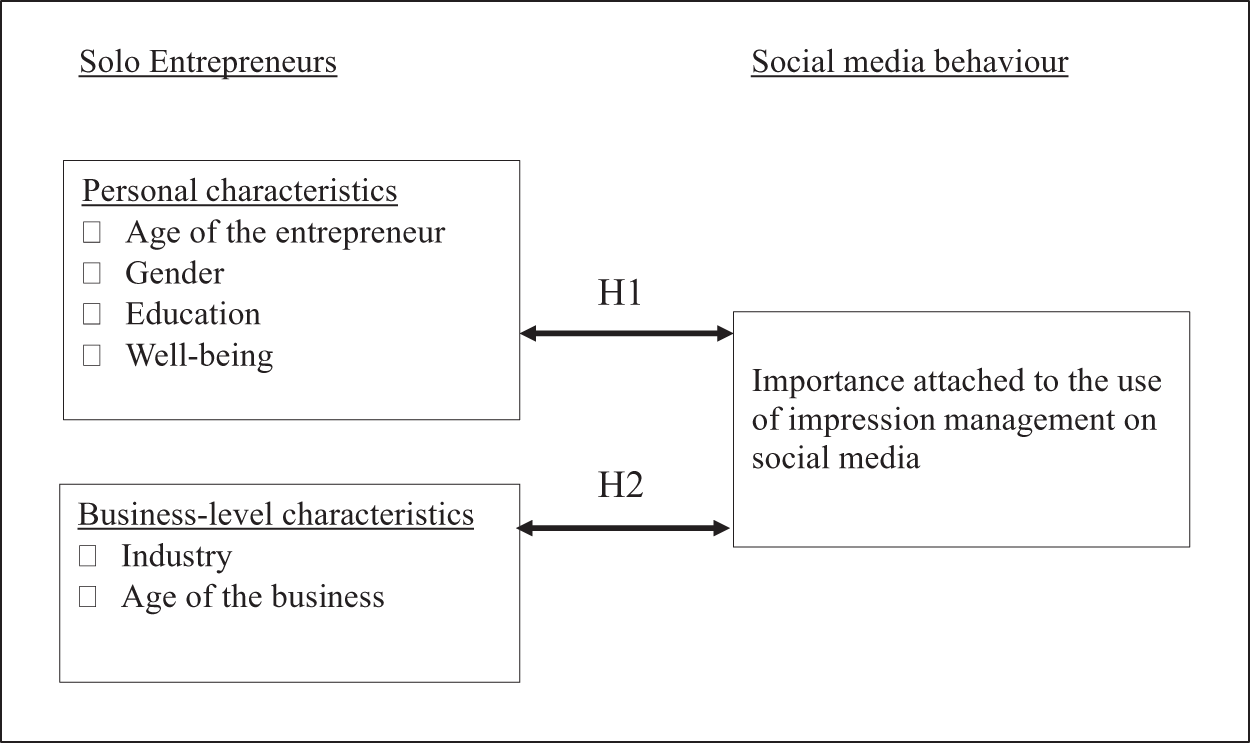
Hypothesis 1: The personal characteristics of solo entrepreneurs are statistically associated with the importance attached to the use of impression management on social media.
Business-level characteristics of solo entrepreneurs
In social and economic research that uses business-level data, the most commonly employed business characteristics are business size, business age, and the sector of economic activity (or industry). In the present study, we include industry and business age. Business size – often measured as the number of employees, or the level of revenues – is typically included to distinguish between firms of very different sizes: think of small, medium-sized, vs. large firms. However, as our study focuses on solo self-employed individuals, whose businesses by definition have no employees and also in terms of revenues tend to belong to the very smallest of firms, a measure of business size does not apply to our study. Moreover, solo businesses are quite similar on some other dimensions as well that are sometimes used to distinguish different types of businesses. For instance, for the majority of solo entrepreneurs, the business model or business strategy mainly consists of entrepreneurial marketing through social media (Kraus, Filser, Eggers, Hills, & Hultman, Reference Kraus, Filser, Eggers, Hills and Hultman2012). Hence, because the population of solo businesses is relatively homogeneous on a number of business aspects, the relevant business characteristics of solo businesses considered in our study are limited to industry and the age of the business. These aspects are discussed below.
Industry
Social media use is found to differ by industry. Digitization and social media use are being implemented at a relatively low pace in banking and insurance (Sawhney & Ahuja, Reference Sawhney and Ahuja2021) due to lower customer demand for communication via social media, as well as security concerns regarding data security and anonymity (Mitic & Kapoulas, Reference Mitic and Kapoulas2012). In manufacturing, social media enables customer inquiries and the distribution of information and knowledge to be managed in a targeted manner (Aspasia & Ourania, Reference Aspasia and Ourania2015). In the retail sector, social media is often used by customers as a decision-making tool. Customers have more control and information through the internet, which leads to strong competition for attention on social media platforms, which can lead to the creation of customer attachment, but can also fail to result in committed buyers (Wang et al., Reference Wang, Chowdhury Ahmed, Deng and Wang2019). In the tourism and leisure sector, the focus is on creating images to attract tourists and customers (Saeed & Shafique, Reference Saeed and Shafique2020). In the transport and traffic industry, social media is becoming increasingly relevant as a marketing tool to impact brand equity and customer relations (Seo & Park, Reference Seo and Park2018). In trade and craft, it can impact brand creation and brand awareness (Guha et al., Reference Guha, Mandal and Kujur2021), while in information and consulting it is especially useful for solo entrepreneurs to improve innovations (Benedic, Reference Benedic2023).
Age of the business
Entrepreneurs who have been running their business for many years may be reluctant to change their existing work habits that they have become used to (inertia), which in the case of older businesses may involve relatively fewer new approaches to work that involve social media use. Hence, it may be expected that the older the business, the lower the perceived importance of social media use.
Combined, the above discussion leads to the following broad hypothesis:
Hypothesis 2: The business-level characteristics of solo entrepreneurs are statistically associated with the importance attached to the use of impression management on social media.
Our broad Hypotheses 1 and 2 are visualized in the conceptual framework of our study, as illustrated in Figure. 2.
Conceptual framework.

Data and methods
Data collection
Data were collected by means of a web-based questionnaire distributed by the Carinthian Chamber of Commerce (WKK) in December 2019, January 2020, and September 2020 to self-employed individuals with no employees who are listed with e-mail addresses and are commercially registered in Carinthia, Austria. Carinthia is located in the southernmost part of Austria and has just under 561,000 inhabitants. Compared to other Austrian provinces, it is a rural region with two smaller cities, Klagenfurt (92,160 inhabitants) and Villach (61,221 inhabitants), as central areas (Knapp & Sawy, Reference Knapp, Sawy, Orel, Dvouletý and Ratten2021). We maintained a regular contact throughout the data collection process with the WKK. This collaboration allowed us to monitor the response rate and send two follow-up reminders via the Chamber’s network to ensure a sufficient number of completed questionnaires. Random sampling was used to ensure an unbiased representation of the overall set (Martin, Reference Martin2016). The sampling frame consisted of 11,018 solo entrepreneurs and the data collection resulted in 380 complete responses, which complies with the requirements of a minimum of 372 completed questionnaires for a targeted confidence level of 95%. Respondents were asked to provide information about their employment, aspects of well-being, their use of social media for business purposes, and demographic information. The questionnaire was structured into four main sections: (a) lifestyle of entrepreneurs, (b) work behavior, (c) approaches to success (not analyzed in this study), and (d) sociodemographic information. All questions were closed-ended and answered by selecting pre-defined response options. The average completion time was approximately 15 min. This design aimed to keep the questionnaire accessible and concise while capturing a wide range of relevant variables. The questionnaire content was guided by current literature on solo entrepreneurship, identity, and social media, ensuring theoretical relevance.
The web-based questionnaire used in this study was developed specifically for the purpose of this research. As there is currently no established or standardized instrument tailored to the context of solo entrepreneurship, self-presentation on social media, and related identity dimensions, we designed the questionnaire based on a comprehensive review of the relevant literature. In particular, we considered existing research in the fields of self-employment, solo entrepreneurship, social media use, and identity construction to identify key aspects relevant to our target group. The selected items on mental health, sleep, work–life Balance, and financial well-being are based on studies highlighting the unique challenges faced by solo entrepreneurs in balancing personal and professional domains (Wiklund et al., Reference Wiklund, Nikolaev, Shir, Foo and Bradley2019). Furthermore, the development of the questionnaire was guided by the concept of Quality of Work Life (QWL), as introduced by Sirgy, Efraty, Siegel, and Lee (Reference Sirgy, Efraty, Siegel and Lee2001) and further elaborated by Leitão, Pereira, and Gonçalves (Reference Leitão, Pereira and Gonçalves2019). The QWL framework encompasses various dimensions, including health and safety needs, economic and family needs, social needs, esteem needs, self-actualization, knowledge, and aesthetic needs. Leitão et al. (Reference Leitão, Pereira and Gonçalves2019), in particular, highlight the importance of both subjective and behavioral components in shaping employees’ perceptions of their contribution to organizational productivity. While our questionnaire is not directly based on the QWL model, the selected variables – such as mental health, sleep quality, work–life balance, and financial satisfaction – align with core elements of this conceptual framework. This theoretical linkage is particularly relevant given Leitão et al.’s (Reference Leitão, Pereira and Gonçalves2019) empirical findings, which demonstrate that workers’ perceptions of contributing to organizational performance are significantly influenced by subjective experiences – such as feeling heard and supported by supervisors, being embedded in a positive work environment, and receiving respect both professionally and personally. These aspects, they argue, are increasingly critical in modern service-oriented and digitalized labor markets. Although our study focuses on solo entrepreneurs rather than employees in traditional organizations, the QWL framework offers a valuable lens through which to interpret well-being and performance-related perceptions in non-traditional work settings. New items and scales were developed and implemented, in line with the novelty of our research topic and the exploratory nature of our analysis.
Variables
In Table 1, the survey questions are listed that were used to create the dependent variable, Social Media Use for Self-Presentation, and the independent variables, which include measures of personal characteristics and business-level characteristics. We employed two types of Likert scales: a 5-point scale and a 6-point scale. The choice of scale for each variable was guided by both theoretical considerations and established practices in prior research. The 5-point Likert scale, which includes a neutral midpoint, was used for constructs where a neutral or undecided response was considered meaningful. For example, the item ‘I want to present myself as a solo entrepreneur’ was measured using a 5-point scale, as it is reasonable for some respondents to feel neutral or ambivalent about their intention to engage in self-presentation. In contrast, the 6-point Likert scale, which omits a neutral midpoint, was used for items where a more definitive stance was desired, such as questions related to subjective well-being and financial health. These topics often involve self-evaluation, and the 6-point scale helps reduce the tendency to choose a non-committal middle option, thereby encouraging respondents to reflect more critically on their actual state. The use of both scale types aims to balance the need for nuanced responses with the goal of eliciting clear and interpretable data, in line with best practices in survey-based research.
Variable descriptions

a Negatively worded items were recoded so that a higher value indicates better well-being.
In the survey, respondents are asked ‘For what reasons do you use social media channels professionally?’ followed by 10 statements about social media usage in their professional lives for different purposes. Respondents are asked to agree or disagree with each statement, using a 5-point Likert scale ranging from 1 = strongly disagree, 2 = disagree, 3 = neither agree nor disagree, 4 = agree, to 5 = strongly agree. The paper focuses specifically on the two statements that relate to social media use for the purpose of self-presentation: ‘I want to present myself as a solo entrepreneur’ and ‘I can present myself and my business’. The authors create the variable Social Media Use for Self-Presentation using an average of the scores for the two statements.
Respondents are asked to agree or disagree with 13 statements that relate self-employment to well-being and health. Responses are measured on a 6-point Likert scale ranging from 1 = strongly disagree, 2 = moderately disagree, 3 = slightly disagree, 4 = slightly agree, 5 = moderately agree, to 6 = strongly agree. The authors create measures of well-being using an average of the responses to between two and five survey questions relating to Mental Health, Sleep, Work–Life balance, and Financial Well-Being. Higher scores represent more positive well-being. Statements that were formulated negatively (e.g., I have the feeling that I am close to burnout) are re-coded so that a higher value indicates better well-being in all cases.
Respondents’ ages are grouped into three categories: under 40, between 40 and 60, and over 60. Gender is coded as 0 = female and 1 = male. Respondents’ education is measured as the highest education level achieved: Compulsory Schooling, Apprenticeship, School-Leaving Certificate, University Degree, Masters or Diploma, or PhD. Respondents were asked to select one of 22 sectoral categories based on different professions (the choices were Accounting and Finance, Administration and Office Support, Banking and Finance, CEO and Managing Director or Board of Directors, Construction, Design and Architecture, Education and Training, Engineering, Operations Management, Healthcare and Science, Hospitality and Tourism, Human Resource Management and Recruitment, Information and Telecommunications Technology, Materials and Manufacturing, Marketing and Media, Mining, Supply Chain or Process Management, Public Sector, Retail, Sales, Other (open question). The selection of sectors followed the classification of the Austrian Federal Economic Chamber (https://www.wko.at/branchen/Branchenauswahl.html), which were combined into eight sectoral categories: Banking and Insurance, Trade and Crafts, Retail, Manufacturing, Information and Consulting, Tourism and Leisure, Transport and Traffic, and Public Sector. A dummy variable called Wave was created which is coded 0 for survey responses collected in December 2019 to January 2020 and 1 for survey responses collected in September 2020. The number of years in solo self-employment is categorized as Employed less than 5 years, Employed between 5 and 15 years, or Employed over 15 years.
Descriptive statistics
The mean and standard deviation (SD) for the dependent and independent variables are presented in Table 2. Social Media Use for Self-Presentation has a mean value of 3.52, and on average respondents report having good Mental Health, with low SD, while work–life balance has the lowest average value. Financial Well-Being has the highest SD, suggesting a range of financial situations in which the solo entrepreneurs find themselves.
Descriptive statistics

Notes: The table lists the mean and SD for each of the variables used in the regression analysis.
The majority (64%) of respondents are aged between 40 and 60°years, with 20% under 40 and 15% over 60 years of age. The sample is evenly balanced between males and females. Most respondents in the sample (41%) work in Trade and Crafts, followed by 26% in Information and Consulting and 13% in Retail. Forty percent of the survey responses were collected in the second wave, during the Covid pandemic. The age of the business is evenly spread between less than 5 years, between 5 and 15 years, and over 15 years. (The variable ‘Years of solo self-employment’ is categorized into three categories: Employed less than 5 years; Employed between 5 to 15 years; and Employed over 15 years. These three categories together account for 92%; the remaining 8% are composed of the response options ‘no indication’ and ‘every now and then’, which were not included in the calculations.) Of the respondents, 40% have at least a university degree (categories 4, 5, and 6), 30% have a school-leaving certificate, and 27% have an apprenticeship; 2% completed compulsory schooling only.
Results
Main results
We estimate the associations between Social Media Use for Self-Presentation and our independent variables using ordinary least squares (OLS). The regression results are listed in Table 3.
Regression results

Notes: This table shows the results of regressing Social Media Use for Self-presentation on the Personal characteristics and Business-level characteristics.
Reference groups for categorical variables: between 40 and 60 (respondent’s age); female (gender); compulsory schooling (education); banking and insurance (industry); December 2019 to January 2020 (Wave); and employed between 5 and 15 years (business age).
Standard errors are shown in parentheses. Significance levels are indicated as follows:
* p < .1; ** p < .05; *** p < .01.
Personal characteristics
For the well-being variables, it was found that Mental Health has a positive and significant relationship with social media use. This result may reflect that among the population of solo entrepreneurs, those who feel mentally stable and healthy are more likely to have higher levels of confidence about presenting a positive image of themself and their business on social media, in order to benefit their business.
No evidence was found for a significant relationship between Sleep or Work–life balance, while Financial Well-Being has a negative and significant relationship which implies that lower financial well-being is associated with greater social media usage. Solo entrepreneurs who are struggling financially tend to use social media more often. They must increasingly turn to opportunities that will move their business forward, including creating greater visibility for the business. Social media, with its accessibility and ease of use, is an effective tool for this challenge. This is particularly applicable to solo businesses operating in the retail sector. They are more likely to use social media to attract and retain customers in a competitive industry characterized by low consumer loyalty.
For the demographic variables, female solo entrepreneurs are strongly associated with using social media for self-presentation in their businesses. This may be due to the need to counteract an unconscious (or conscious) bias among potential customers that men are more likely to be successful business owners. Women are aware of this bias and know that they may need to work harder to present themselves and their business online, promoting themselves and their business in a positive light.
No significant relationship was found with the age of the entrepreneur, our results showed that social media use by entrepreneurs is not linked to the age of the entrepreneur but rather to the age of their business.
Business-level characteristics
We found a strongly significant and positive relationship with those who have been solo self-employed for less than 5 years. Older businesses place a lower importance on social media usage, which is a potential risk, as it may signal a failure to adapt to new and modern ways of working and communicating (inertia). Young businesses are more likely to use social media to build brand awareness or reputation, which they may not have built yet, as they can be more agile and flexible in testing and introducing new routines. As it has become visible in recent years, social media creates many opportunities, ranging from certain entrepreneurial purposes to specific job opportunities (e.g. influencer). The results suggest that these opportunities are more likely to be detected and used by younger businesses. This implies that solo entrepreneurs already operating a business for a longer time must be careful to keep up to date with the latest technical developments.
We found strong evidence for social media use by businesses operating in the retail sector. The retail sector is particularly competitive compared to other industries, which is often characterized by low levels of customer loyalty with shifting trends and fashions leading to exogenous shifts in demand. These types of businesses need to work harder to maintain customer awareness of their products, and to ensure that their business keeps offering relevant, desirable, and competitive products in relation to their competitors.
Finally, a positive relationship between Social Media Use for Self-Presentation and the Wave dummy was found, indicating a greater likelihood of social media use for self-presentation during the Covid-19 pandemic. The early years of the pandemic were marked by (the threat of) lockdowns, business closures, and exit restrictions, in both Western Europe and Austria. Due to the novelty of this situation and the resulting consequences for entrepreneurs, new (digital) entrepreneurial approaches had to be applied.
Robustness test
As a robustness test, we have also estimated the model using ordered logistic regression (also known as ordered logit). Since the dependent variable is a categorical variable with ordered values (varying from strongly disagree to strongly agree, corresponding to ascending values from 1 to 5), an ordered logit model can be applied. Results are presented in Table A1 in the Appendix. The first column shows the coefficients of the ordered logit estimation. We can see that the results are qualitatively similar to the OLS results (note that although OLS and ordered logit coefficients can be compared qualitatively, they cannot be compared quantitatively [as logit coefficients are interpreted in terms of changes in log-odds ratios].) in the sense that the same independent variables have a statistically significant association with social media use for self-presentation (namely mental health, financial well-being, gender, the retail sector, the business age variable, and the wave dummy), and in the same direction. We can therefore say that the results are robust to the estimation method employed.
The second to sixth column of Table A1 shows marginal effects of explanatory variables on the probability that a respondent’s social media use is categorized in the lowest category (strongly disagree with the notion that the use of impression management on social media is important, i.e. category 1), up to the highest category (strongly agree, category 5). Here, we can see the different impacts of explanatory variables on the probabilities of falling in different social media use categories. (As our social media construct is an average of two items that are both measured on a 5-point scale, we also have in-between categories representing values 1.5, 2.5, 3.5, and 4.5. We have not reported these results to save space but they are available upon request from the authors.) As an example, taking the variable retailing, we see that, relative to the sector Banking and Insurance (the reference group), solo entrepreneurs in the sector Retailing have an 11.3 percentage point lower chance of belonging to category 1 (social media use for impression management deemed very unimportant), and a 16.3 percentage point higher chance of belonging to category 5 (very important).
Discussion
This paper investigates the links between impression management, solo entrepreneurs, and their social media use. Social media platforms are used by solo entrepreneurs to create a desired impression of themselves and their business activities. These places are new areas of electronic commerce that are governed not only by technical rules and possibilities but also by social constraints and opportunities to communicate, to behave, and to act. Impression management strategies on social media are divergent in form and intention from face-to-face interaction processes; they are intentional and non-intentional, explicit or implicit, and only sometimes reciprocated. Social media analytics (Kim, Sabherwal, Bock, & Kim, Reference Kim, Sabherwal, Bock and Kim2020; Stieglitz, Dang-Xuan, Bruns, & Neuberger, Reference Stieglitz, Dang-Xuan, Bruns and Neuberger2014) list several dimensions of media use and media working. However, systematic literature reviews of social media monitoring (Zachlod, Samuel, Ochsner, & Werthmüller, Reference Zachlod, Samuel, Ochsner and Werthmüller2022) do not include impression management on social media.
Using a unique survey among solo entrepreneurs in Austria, this paper investigates social media use, specifically for the purpose of self-presentation. It was found that among solo entrepreneurs, the typical entrepreneur who attaches great importance to social media use for self-presentation purposes is a female entrepreneur running a young business (younger than 5 years) in the retail industry, with strong mental health but relatively poor financial health. This suggests that female solo entrepreneurs may use social media as a cost-effective way to let their young businesses compete with established businesses in a competitive market where profit margins are small (the retail industry). The authors note that this does not necessarily imply that solo entrepreneurs who consider social media use very important for their business, will be more successful, as the link between social media use and firm performance was not investigated.
The paper’s link with literature on social media and entrepreneurship
Based on a systematic review of the literature on social media use for entrepreneurship, Secundo et al. (Reference Secundo, Del Vecchio and Mele2021) identify four streams of research: (1) social media for entrepreneurial learning and self-employment; (2) social media as tools for entrepreneurial marketing; (3) social media as sources of entrepreneurial opportunities; and finally, (4) social media as enablers of networking and entrepreneurial ecosystems. The present research can be positioned in nearly all streams. Regarding the first stream, research has shown that social media use may facilitate entrepreneurship in resource-constrained environments (Hui, Toyama, Pal, & Dillahunt, Reference Hui, Toyama, Pal and Dillahunt2018). While their paper was located in Detroit, USA, the negative relationship between financial well-being and social media use found in the present study suggests that also in Europe, social media use facilitates necessity entrepreneurship, which may also be applicable in other contexts (Morris, Santos, & Neumeyer, Reference Morris, Santos and Neumeyer2020), allowing solo entrepreneurs to communicate to broad groups of stakeholders (including customers and suppliers) at low cost.
Regarding the second stream, the empirical analysis explicitly distinguished social media use for self-presentation. Research about entrepreneurial social media use focuses strongly on social media marketing (Chen & Lin, Reference Chen and Lin2019; Wibowo, Chen, Wiangin, Ma, & Ruangkanjanases, Reference Wibowo, Chen, Wiangin, Ma and Ruangkanjanases2020). Social media and its many functions are constantly evolving and taking on greater importance in the business strategies of enterprises. Therefore, it is important to understand different purposes of use in more detail and to make the differences clear, as social media with its technical functions creates more possibilities besides implementing marketing activities. This study showed that the purpose of self-presentation is particularly important for solo entrepreneurs to distinguish themselves from the mass of competitors. Self-presentation on social media is a particularly effective tool for demonstrating one’s skills or biography, which may positively influence the business. Finally, social media use is closely linked to individuals’ social networks, which leads to a broad discussion on social embeddedness (Bruning, Alge, & Lin, Reference Bruning, Alge and Lin2020).
Regarding the third and fourth streams, in a critical discussion of articles on opportunity finding and creation (Alvarez & Barney, Reference Alvarez and Barney2007, Reference Alvarez and Barney2010; Shane & Venkataraman, Reference Shane and Venkataraman2000), Davidsson (Reference Davidsson2015) introduced the concept of external enablers. External enablers combined with opportunity confidence and new venture ideas may trigger new business opportunities. Institutional conditions but also social media can be interpreted as external enablers (Davidsson, Reference Davidsson2015; Davidsson, Recker, & von Briel, Reference Davidsson, Recker and von Briel2021). Viewed through this lens, the present paper considers not only the question of what entrepreneurs do with social media but also what social media might do to entrepreneurs. Since businesses created and run by women are the fastest-growing population of (small) enterprises, the findings of this study confirm the assumption that the link between modern female entrepreneurs and social media use is strong. Social media and an increase in women entrepreneurs can be interpreted as triggers fostering the creation of new ventures (Davidsson, Reference Davidsson2023).
The paper’s link to literature on impression management
As Goffman (Reference Goffman1956) discusses, processes of self-presentation are orchestrated in multidimensional spaces. Solo entrepreneurs experience not only a thin but also a blurred line between a private and business self, as the private is always part of the public business sphere and the business life and its demands and constraints overlap with private areas. The consequence is that the interaction between entrepreneurs and market stakeholders has more aspects involved so that the interplay is increasingly diffuse and complex. Identity processes (Guenther, Wilton, & Fernandes, Reference Guenther, Wilton, Fernandes, Zeigler-Hill and Shackelford2020) are almost restricted to the interpretation and filling of individual roles. Since people usually are portrayed in different roles simultaneously, those identity roles are in turn blurred in their interactions with other actors.
Conceptually, many of the ideas provided by Goffman (Reference Goffman1956) retain applicability beyond the domain of face-to-face interaction (Leeds-Hurwitz & Winkin, Reference Leeds-Hurwitz, Winkin, Jacobsen and Smith2022; Walsh, Reference Walsh, Jacobsen and Smith2022). Impression management on social media operates with a much wider range of options than face-to-face communication allows (Gottschalk, Reference Gottschalk2018). ‘People now freely mix reality and unreality in online presentations of self, using a spaceship background on Zoom or digital filters on Snapchat alongside their actual faces’ (Shulman, Reference Shulman, Jacobsen and Smith2022: 30). The application of impression management to digital contexts provides avenues for future explicit, empirical, and conceptual research on identity and impression management in combination with digitalization. While Goffman (Reference Goffman1956) emphasized the importance of audience segregation, where individuals present different selves in different contexts, digitally mediated communication differs. Online audiences consist of an amorphous entity. Also, offline impressions are ephemeral, but digital self-presentations are persistent (e.g., tweets from a decade ago remain searchable) and replicable (shared, copied, or reposted). They are also searchable and visible to unintended audiences – undermining Goffman’s assumption of bounded performance.
Accordingly, ‘digital personhoods’ (Kerrigan & Hart, Reference Kerrigan and Hart2016) are created as artificial constructs of oneself. This reasoning provides the framework that the present study on the principles of one-(wo)man-firms is ultimately linked to the study of impression management which is a channel of both self-marketing and company marketing.
Implications for female entrepreneurs
The findings of this paper also shed light on the role of social media use to overcome gender issues in entrepreneurship (Camelo-Ordaz, Dianez-Gonzalez, & Ruiz-Navarro, Reference Camelo-Ordaz, Dianez-Gonzalez and Ruiz-Navarro2016; Secundo et al., Reference Secundo, Del Vecchio and Mele2021). The results reveal a greater use of social media by female solo entrepreneurs in comparison to their male counterparts. In recent decades, there has been an increased emancipation movement of women in terms of career and start-up activity (Cardella, Hernández-Sánchez, & Sánchez-García, Reference Cardella, Hernández-Sánchez and Sánchez-García2020). The 5th Sustainable Development Goal of the United Nations (United Nations, 2022) focuses on empowering women and girls as well as achieving gender equality. The use of social media to pursue or support business activity allows women more unrestricted access to opportunities. Furthermore, women are more likely to use social media for self-presentation to counteract stereotypes regarding the assumption of being less capable of running a successful business. This helps female entrepreneurs in particular to break free from male standards in the start-up industry. Likewise, social media with its constant availability creates more work flexibility for women (Olsson & Bernhard, Reference Olsson and Bernhard2021). This is especially true with regard to the compatibility of family and career, which is still a more women-related issue. Thus, social media can also be described as an enabler with regard to female entrepreneurship.
Conclusions
Self-presentation and entrepreneurial (self-) marketing have changed considerably in times of digitalization (Yoo, Boland, Lyytinen, & Majchrzak, Reference Yoo, Boland, Lyytinen and Majchrzak2012). Advantages may be seen for solo entrepreneurs at the interface of electronic media and customer creation and customer maintenance. As a highly pervasive and universal channel of communication, the importance of advertising and self-presentation cannot be overstated. This is especially true for solo entrepreneurs who are limited in time and resources, and for whom entrepreneurial self-marketing through social media is an attractive, cost-effective way of reaching many customers. This paper established a profile, in terms of personal and business-level characteristics, of the typical solo entrepreneur who attaches great importance to social media use for self-presentation purposes. This was found to be a female entrepreneur running a young business (younger than 5 years) in the retail industry, with good mental health but relatively poor financial health.
An effective social media presence can be a vital resource for solo entrepreneurs seeking to strengthen their market position and connect with customers on a limited budget. There are several practical implications and approaches that solo entrepreneurs can follow for a positive self-presentation on social media. Best practices in this context generally include maintaining a consistent personal brand across platforms, with a coherent visual identity and clear communication of core values. Authenticity is key: sharing personal stories, challenges, and successes in a transparent yet professional manner helps create emotional connections and enhances relatability. Active engagement with followers through comments, direct messages, and interactive content further strengthens community ties and customer loyalty. Additionally, aligning social media efforts with broader business goals, such as promoting products or services, ensures that these activities contribute to the financial sustainability of the venture. Adopting these best practices can support solo entrepreneurs in maximizing the benefits of social media for both personal branding and business growth.
This paper is not free from limitations. First, the cross-sectional nature of the study does not allow the authors to measure causal relations. For instance, the poor financial well-being of solo entrepreneurs attaching great importance to social media use may either be a cause of or a consequence of the type of entrepreneurial activity these solo entrepreneurs have chosen (or both). Did these entrepreneurs choose a highly competitive sector with low barriers to entry (retailing), because of their poor financial well-being, or is their poor financial situation a consequence of operating in a competitive market with low-profit margins? Future research using longitudinal data should try to distinguish between these possibilities. Similarly, the causality between social media use and well-being may go both ways but it was not possible to distinguish empirically between different directions of causality. This is not uncommon in this field of research and we join the call for future research to develop and implement longitudinal research designs (Luo & Hancock, Reference Luo and Hancock2020; Shensa et al., Reference Shensa, Escobar-Viera, Sidani, Bowman, Marshal and Primack2017).
Second, the research data were collected in Carinthia which is a Federal Country in Austria where just the capital Klagenfurt has about 100,000 inhabitants, while the rest of the country is more rural including small cities and villages. Therefore, it might be challenging to generalize the findings towards more metropolitan cities such as Vienna, Graz, Salzburg, and Innsbruck and toward other countries in Europe or outside of Europe. The authors recommend further cross-regional and cross-national comparisons.
Third, an important consideration in our study is the subjective nature of the dependent variable, which captures solo entrepreneurs’ self-reported use of social media for self-presentation. As this measure relies on personal perception rather than objective behavior (e.g., content analysis or usage data), it is inherently influenced by individual interpretations, self-awareness, and potential biases such as social desirability or inaccurate self-assessment. These concerns are particularly relevant when studying sensitive topics like well-being and financial health, which may be under- or over-reported due to personal, social, or cultural pressures. While subjective measures are commonly used in studies of perception and self-presentation – given that these constructs are, by nature, internal and experience-based – we acknowledge that they may limit the generalizability and comparability of findings. Future research could benefit from combining self-reported data with behavioral or objective metrics (e.g., frequency or type of posts and financial records) to provide a more comprehensive and triangulated understanding. Nonetheless, we consider the subjective perspective particularly relevant in this context, as it reflects how entrepreneurs perceive and frame their own behavior – a critical aspect of self-presentation itself. Moreover, given the novel focus of this study on solo entrepreneurs’ self-presentation via social media, we believe that capturing their individual perceptions provides valuable first insights into this emerging research area.
Another suggestion for future research is to delve deeper into the intriguing negative relationship that was found between financial well-being and the perceived importance of social media use by solo entrepreneurs. Moreover, to deepen the understanding of solo entrepreneurship in digital environments, future research would benefit from targeted interdisciplinary collaboration. In particular, joint efforts between sociologists, digital marketing scholars, and economists could provide a more comprehensive view of how social positioning, market dynamics, and economic behavior shape entrepreneurial self-presentation on social media platforms. Furthermore, future research could further investigate the social media profiles of solo entrepreneurs, e.g. the content of their postings, received ‘likes’, or comments of other social media users. Finally, future research could consider additional variables that may explain social media use but that were not available in our dataset, like digital literacy and innovation propensity.
As a concluding remark, the present study explores the links between the private self and the presented entrepreneurial self on social media. The title ‘I am my business’ is already a research program: How can people understand that a social being falls together with an economic being as it is the case with solo entrepreneurs? The economic entities of one-person firms which are so widely present in today’s economies can only be understood adequately when they are also realized as social units, including their social media use, with all related advantages and disadvantages. The authors believe that the present paper has provided a valuable empirical contribution to the emerging field of social media use by solo entrepreneurs.
Acknowledgements
The authors are grateful for the support provided by the Carinthian Chamber of Commerce, Klagenfurt, Austria. We confirm that this work is original and has not been published in any ‘preform’, nor is it currently under consideration for publication elsewhere. All authors have agreed to the submission.
Funding statement
No funding was received for conducting this study.
Conflict of interest
The authors declare they have neither financial nor non-financial interests.
Appendix: Results for ordered logit estimation
Table A1 shows the results of our ordered logit estimation. The first column presents the coefficients, while the second to sixth column show the marginal effects of the explanatory variables on the probability of belonging to each of the five social media categories.
Ordered logistic regression results

Notes: This table shows the results of estimating the model in Table 3 using an ordered logistic regression. Besides the coefficients, we also report the marginal effects (dy/dx) for each of the five possible outcomes for the dependent variable, 1–5.
Reference groups for categorical variables: between 40 and 60 (respondent’s age); female (gender); compulsory schooling (education); banking and insurance (industry); December 2019 to January 2020 (wave); and employed between 5 and 15 years (business age).
Standard errors are shown in parentheses. The values of significance levels:
* p < .1; **p < .05; ***p < .01.



 Open access

