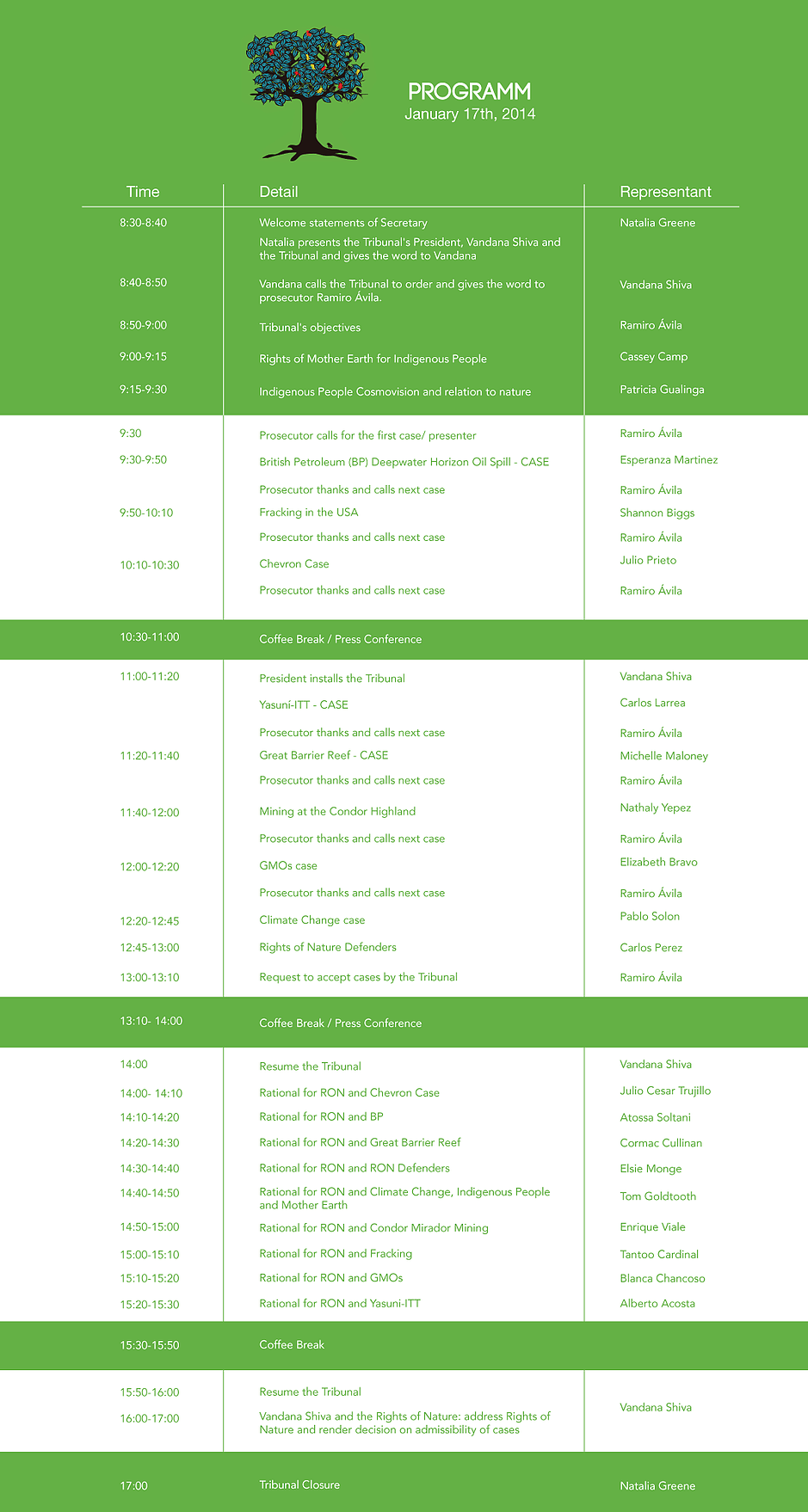


‘We are nature protecting itself.’
— International Rights of Nature TribunalFootnote 1
‘We can create peoples’ institutions… we can enter into agreements ourselves and begin to create the future that we want.’
— Tribunal President Cormac CullinanFootnote 21. Introduction
On 28 June 1919, Germany and the Allied powers agreed to the Treaty of Versailles. Signed in the Hall of Mirrors at the Palace of Versailles, 12 miles outside of Paris, this treaty concluded the First World War and set the terms for international legal relations in the interwar period.Footnote 3 It determined reparations and limited German industrial, military, and economic capacities. It also shaped and reorganized borders and relationships between the colonised world and metropolitan Europe, and constituted both the League of Nations, and its colonial branch, the Mandate System. The treaty did thus not simply set the terms of peace.Footnote 4 It also inaugurated a new era in international law, defined by processes and practices of international legal institution-building which previously had been a less central feature of the discipline.Footnote 5 It commenced the establishment of international legal institutions concerned with the ‘development’ and ‘wellbeing’ of ‘peoples’ through international law, and subsequently played an important role in the development of the contemporary international legal order itself.
Shy of 100 years after the signing of the Covenant of the League, another international legal institution was assembled in the same city. In December 2015, the members of the International Rights of Nature Tribunal gathered at the performing arts theatre Maison des Métallos in central Paris. The Paris Tribunal had been organized concurrently with the COP21 Climate Change Summit with the intention of offering an ‘alternative’ response to the environmental questions addressed by the state delegates that gathered in the city. It followed two earlier meetings in Quito and Lima the year prior, at which the Tribunal members had considered six thematic cases and ‘tested’ the concept of an ‘International Ethics Tribunal’ for the rights of nature.Footnote 6 But the meeting in Paris was more than just another opportunity for this peoples’ tribunal to hold hearings on issues of environmental justice and the rights of nature. In Paris, the Tribunal would come together to formally constitute itself as an international legal institution through the Peoples’ Convention and the Tribunal Statute.Footnote 7
As the South African lawyer and scholar Cormac Cullinan, acting as the Tribunal President, announced in his inaugural speech: ‘here today we are reasserting the rights of all peoples, not only to adopt the Declaration that we believe in but also to sign a Peoples’ Convention that establishes the Tribunal as a people’s organisation that can pioneer our way into the future’.Footnote 8 ‘Today’, he declared, ‘we establish a peoples’ tribunal as a global peoples’ organisation that promotes liberty and freedom of all that exists to continue to play their unique role in the living earth system.’Footnote 9 The Tribunal was thus, too, concerned with the ‘wellbeing’ of ‘peoples’ through international law. Albeit, it had a slightly different understanding of international law: it was a peoples’ tribunal that established itself outside the international legal order.
This article is concerned with how each of these ‘institutions’ constituted themselves, and what it tells us about the discipline of international law. Or to be more precise: it is concerned with how both of these bodies imagined and claimed to speak for two different international legal communities when they constituted themselves – and how they did so precisely by presenting different ideas of ‘nature’ and ‘peoples’.Footnote 10 The piece reads these two institutional moments together and traces how they put forward a series of conceptions of ‘peoples’ in relation to sovereignty, statehood, nature and international law that arguably still figure at the heart of international institution-building and legal ordering. It explores a series of overlaps in the techniques and practices that these institutions used when they constituted themselves that complicates – without directly answering – what it is that makes the story we tell about international law and its authority so much different from that of the Tribunal. And why we perhaps tend to take the story about international law’s form and authority for granted. In the process, it captures how different notions of ‘nature’ and ‘people’ are essential in the crafting and normalizing of the international legal order that we currently live by, including for some of the world-making techniques associated with international law as a discipline.
Whilst there is by now a considerable body of scholarship on peoples’ tribunals and international law, less attention has been paid to the constitutive role of ‘peoples’ – and particularly so in relation to the International Rights of Nature Tribunal and international law.Footnote 11 Moreover, literature on peoples’ tribunal and international law tend to focus on the differences between the two, taking the character of international law as ‘real law’ (lex lata) and peoples’ tribunals as ‘law as it ought to be’ (lex ferenda) rather seriously. Even in more critical accounts, the focal point is often the difference itself, be it the prefigurative aspects or the modes of juridical resistance expressed by peoples’ tribunals.Footnote 12
This paper builds on existing accounts but attends more explicitly to the similarities between peoples’ tribunals and formal international legal institutions – an account it develops by tracing the institutional constitutive practices and techniques that the International Rights of Nature Tribunal and the League followed as they claimed to speak in the name of an international legal community. It cautions against a sense of romanticising, in which peoples’ tribunal are seen as the answer to the shortcomings of international law. It is moreover written in a different register than accounts that reduce peoples’ tribunals to bodies without law, or without an institutional structure. The fact that peoples’ tribunal might not follow traditional institutional and legal forms, or do not flow from states, does not mean that they act without either. Taking the institutional structure and legal matters of the Tribunal seriously, the piece rather asks precise questions about the international legal norms, procedures, protocols that the Tribunal puts into movement by comparing it with an institution that might not appear very similar at first sight. Or to put it shortly, it takes seriously (and as a starting point) the fact that even peoples’ institutions hold power in the world, and deal with law and institutional questions.Footnote 13
The argument that the piece develops is that the Tribunal and the League – for all their differences – both deployed ideas of ‘nature’ to construct their authority as vanguards of two seemingly given international legal orders. And that in the process, they crafted their own international legal communities and could present them as natural and given. In fact, as the piece argues, there are several important overlaps in how the institutions claimed an authority to speak law in the international legal domain. They both deployed a series of similar legal techniques and narratives that problematically constrained and limited what the international legal domain might, and might not, look like. The League was upholding the anthropocentric and colonial tendencies of formal international law, and the Tribunal was concerned with overcoming them; and yet, both institutions similarly leaned against ‘nature’ to authorize them as the ‘true’ representative of a ‘natural’ international legal community. In terms of international law, the article hence captures how notions of ‘peoples’ and ‘nature’ play distinct roles in the crafting and normalizing of the international legal order that we live by today, including the authorizing of certain institutional and legal forms. In terms of the Tribunal, the piece brings into view a series of problems that might arise when a collective ‘we the people’ – in the form of a peoples’ tribunal – attempt to go from collective critique of international law to practices of critical institution-building.Footnote 14 In particular, it notes a concern with the Tribunal’s idea of itself as an institutionally embodied representation of both an international community of peoples and nature itself, as if the two were the same thing.Footnote 15
The piece relates to a subset of scholarly concerns that, from different directions, have attempted to think through the techniques and ways in which the international legal domain is crafted, claimed, conceptualized, and normalized.Footnote 16 Or as some accounts have put it, the constitutionalizing practices of international law that tend to legitimize and claim a particular kind of international legal domain as ‘proper’ and real.Footnote 17 Perhaps in particular, the questions and matters engaged speak to an emerging tradition in international legal thought that considers world-making practices and institutional matters in relation to non-human legalities, demanding an attention to how international ‘institutional designs constrain or facilitate transformative changes in response to disruptions to Earth processes’.Footnote 18 But also how we are, and might better, ‘constitutionalize more-than-human relations as political and legal collectives’.Footnote 19 Whilst the piece does not speak distinctly to non-human agency as such, it interrogates a series of institutional practices with world-making capacity which evoked a collective ‘we’ by either rejecting ‘nature’ or claiming to represent ‘nature’. It implicitly addresses ideas of how we co-constitute the world together with the non-human, including how we authorize world-making institutional and legal practices by presenting the non-human world in particular ways.
The article begins by telling a story about how the League of Nations conceptualized the notion of ‘peoples’ when it emerged on the international legal stage. It details how the institution constituted itself by imagining an international legal community of states through its own conception of nature, in which the ‘proper’ and ‘fully formed’ people were those that could overcome nature and take up the form of statehood under international law. The second section considers how the Tribunal came together and constituted itself in Paris in 2015, with attention to previous meetings in Quito and Lima in 2014. It traces how the Tribunal crafted an idea of itself as an international legal community of peoples in contrast to the international legal community of states – a community which was also seen as a literal extension, or an embodiment, of nature itself. Namely, how the Tribunal claimed to be acting on behalf of a ‘natural’ international legal (and ecological) community, simply realising what it called the ‘laws of nature’. The final section then reads these different constitutive moments together, tracing the lines of similarities and divergences. It details how both institutions, by explicitly or implicitly engaging with nature, proceeded to make universalizing claims that presented each institution as a representative of a natural order of things. And how these constitutive acts, in turn, seemed to foreclose certain political concerns and relationships with the environment through law in the international domain. It subsequently offers a critical reading of the notions of ‘peoples’, ‘statehood’, and ‘nature’ under international law, whilst also questioning many of the assumptions that tend to frame the existing international legal order as natural and given.
2. At the Palace of Versailles: Peoples, statehood and nature
Both the Mandate System and the League of Nations constituted a significant shift in how international legal relations were governed and managed under international law.Footnote 20 The tone of international law as a vehicle of empire had changed towards the end of the War and the old annexation of territories in the form of colonies faced significant resistance from multiple fronts.Footnote 21 The 1917 Bolshevik Revolution in Russia had unsettled many of the established assumptions about people’s politics and the strength of empires in Europe, posing a substantial threat of spill over into Europe and its colonies.Footnote 22 Furthermore, the First World War was marked by nationalist and anti-colonial movements in European colonies, increasingly leveraging a European discourse of self-determination and nationhood as a vehicle of liberation from imperialism.Footnote 23 This was partly an expression of sustained resistance to Western colonialism. It was also a result of how the War had, through the involvement of the United States, been waged with a vague promise of self-determination, formalised by Woodrow Wilson’s Fourteen Points.Footnote 24
It was in this context that the Commission on the League of Nations pieced together the new international legal institution as a vanguard of a specific imaginary of international law and the role of the state within it.Footnote 25 The Commission told a particular narrative of the ‘Great War’, casting it as a battle for a new world order held together by the aspirations of democracy and ‘peace through law’.Footnote 26 In this story, Germany, as an autocratic aggressor, was cast as a form of barbaric diversion from an otherwise seemingly coherent teleology, in which international law was to be composed, at last, by the French Enlightenment promise of le peuple that take up the political form of statehood. As Rose Parfitt captures in her reading of the League, ‘it was not the state itself that should be singled out for blame, but rather a perversion of it, manifested in the autocratic (as opposed to liberal) imperialism of the Central Powers’.Footnote 27 The ‘primary sin of these “Central Empires”, as Wilson called them, was their refusal to “accept a place of equality among the peoples of the world”’, expressed both in terms of a failure of democracy and disrespect of sovereign equality in the international domain.Footnote 28
The story of Germany as evolutionarily ‘anachronistic’ was well expressed by the German-British jurist Lassa Oppenheim in a series of lectures, titled The League of Nations and its Problems, that he delivered at the University of Cambridge in 1918.Footnote 29 To Oppenheim, the emergence of the League signified a natural sense of evolution of states, and international law more broadly, away from authoritarian governance in the form of ‘military states’ towards constitutional governance in the form of ‘civilised’ states:
During the nineteenth century the nations, so to say, found themselves; some kind of constitutional government was everywhere introduced; and democracy became the ideal, although it was by no means everywhere realised. It is for this reason that the outbreak of the present war is epoch-making: at the bottom of this World War is a fight between the ideal of democracy and constitutional government on the one hand, and autocratic government and militarism on the other. Everywhere the conviction has become prevalent that things cannot remain as they were before… and therefore the demand for a League of Nations… has arisen.Footnote 30
To Oppenheim and many other international jurists at the time, it was through the War that the tension between the ‘nations’ that had ‘found themselves’ and the autocratic world had come to a head. Importantly, these ‘nations’ had not simply found themselves, but found themselves as modern nation-states. As Oppenheim clarified, it ‘should always be remembered that, when we speak of a League of Nations, we do not really mean a League of Nations but a League of States’.Footnote 31 In the crisis that the war constituted, the old was, at least to Oppenheim, dying and the new was already being born – and the War paved the way for a world of civilised states that adhered to a governance model of proper constitutional and democratic principles.Footnote 32 The task of the League, and international law more broadly, was thus to help this world come into its fullest form. The League – as an international legal institution – was formed to act as a vanguard of an international legal order of liberal states as the true and proper subjects of international law. And to ensure that other ‘nations’ ‘found themselves’ in the political form of the state so to become rightful members of the international legal community.
It was perhaps also in this context that the idea of ‘people’ that the League grounded its authority in, expressed most acutely in the Mandate System, made best sense. The Mandate System was initially proposed by the South African General Jan Smuts as a tutelage to apply to the peoples of European territories that previously fell under the Ottoman, Austro-Hungarian, and Russian Empires.Footnote 33 To Smuts, most of the peoples under these territories lacked the necessary political and legal capacity of immediate self-governance. They thus required ‘nursing towards political and economic independence’.Footnote 34 This did not, however, mean that the colonies should be handed back to Germany. Smuts rather argued that ‘German imperial administration had in practice proved “barbaric”, in comparison to the benevolent and civilised British empire’.Footnote 35 Suggesting different possibilities of ‘development’ ‘imbued’ into ‘different races’, Smuts accordingly argued that a protectorate model based on the British Empire ‘would secure development for colonized peoples according to their specific capacities and cultures’.Footnote 36
The proposal of annexation did not materialize, but Smuts’ system of tutelage, best captured in his 1918 proposal The League of Nations: A Practical Suggestion, would, under the influence of US President Wilson, come to shape the structure of the Mandate System and be applied to non-European peoples and territories.Footnote 37 In a now well-told story, Article 22 of the League Covenant set out the broader obligations of tutelage under a ‘sacred trust of civilization’.Footnote 38 With a strong sense of transitional character, Article 22 held that the colonies which
have ceased to be under the sovereignty of the States which formerly governed them and which are inhabited by peoples not yet able to stand by themselves under the strenuous conditions of the modern world, there should be applied the principle that the well-being and development of such peoples form a sacred trust of civilisation.Footnote 39
Under this prerogative, the Mandate System developed three hierarchies of ‘advancement’, transferring into A, B, and C mandates. Class A mandates, concerning territories in the Middle East previously under Ottoman rule, had ‘reached a stage of development where their existence as independent nations can be provisionally recognised’.Footnote 40 Class B mandates, concerning primarily the German colonies in Central Africa, were seen as relatively far from the civilised status required for statehood, meaning that the mandatory had to ‘be responsible for the administration of the territory’.Footnote 41 Class C Mandates, which related to colonies in South-West Africa, New Guinea and the Pacific, were seen to be inhabited by such ‘backwards peoples’ that they would ‘be best administered under the laws of the mandatory as integral portions of its territory’.Footnote 42 The line between annexation and administration, as Cait Storr notes, was thin at best.Footnote 43
The Mandate System, in other words, ‘enshrined in legal form an evolutionary view of human society’.Footnote 44 Under this legal form, peoples would evolve to eventually constitute themselves through law. Unlike the German Empire, which had stagnated and not evolved on the liberal teleological trajectory, the peoples under the Mandate System would, under correct guidance, ‘move’ from a primitive state of development to an advanced state, taking their place as fully formed legal actors able to speak international law in the international domain.Footnote 45 With the exception of the C Mandates, they would one day reach the evolved status of statehood. Or as Wilson put it in response to the struggle for independence in the Philippines, ‘self-government is not a given right, but “gained, earned and graduated into from the hard school of life”’.Footnote 46
The Mandate System thus created a complex apparatus of international legal ‘norms, policies, standards, regulations and treaty provisions’ aimed at transforming the mandates into economic and legal actors as part of an international legal order of states.Footnote 47 And whilst there is much that can be said about how the League shaped the colonial past into the ‘post-colonial’ present, there is something quite telling about the sense of ‘peoples’ that the League imagined would constitute this international legal order – something which has continued to define what it means to be recognized as an actor on the international legal stage.Footnote 48 The idea of peoples that the League crafted out of a longer continuing tradition of European international law was a ‘peoples’ that would, one day, transcend their primitive limitations and grow up to constitute themselves as actors in a global world of commerce, capital accumulation and international law. It was at this stage that ‘the people’, or a group of peoples, would take up the form of statehood, and become an evolved and formed people: a people ‘proper’, a European people.
2.1. A state of nature: Statehood, peoples and man as a political animal
The notions of peoples and statehood that the League imagined was, in the turn to civilisation and evolution, also crafted with the backdrop of an imaginary of nature which was prevalent at the time. Whilst the modern understanding of ‘nature’ did not necessarily figure as the object of inquiry for nineteenth and twentieth century international jurists, different imaginaries of nature were indeed an important reference point for much of international legal thinking prior and during the rise of the League.Footnote 49 To take just one example, an understanding of nature as a ‘primitive’ evolutionary ‘stage’ was instrumental to the nineteenth and twentieth century international legal doctrinal debates that constructed the modern concept of territory around (European) sedentariness and settledness.Footnote 50 As Stefan Salomon has noted, this narrative ran through the work of jurists from Carl Victor Fricker and Georg Friedrich von Martens to Hans Kelsen, and so forth.Footnote 51
The environment also figured as an explicit concern in and of itself for the League. Indeed, the League of Nations developed its own regime for environmental concerns, foregrounding many of the matters that would later influence the emergence of international environmental law.Footnote 52 As Omer Aloni has shown, the League considered and attempted to address issues from whaling to the environment’s role in disease spread and sanitation measures, including issues of deforestation and resource governance of ‘raw materials’. With that said, its engagement with the environment was often through economic terms, foreshadowing a conceptual way of thinking which would later emerge in foundational concepts such as sustainable development. Aloni’s account thus offers an important insight into the intersections between the environment regime and colonial politics which informed how the League conceptualized peoples and statehood.Footnote 53 It does not, however, explicitly focus on the notion of ‘peoples’ under international law. Nor does it, in and of itself, speak to the full extent of how the League used ‘nature’ as a broader backdrop category to formulate its own ideas of ‘statehood’ and ‘peoples’, and to present them as natural.
It is arguably rather by attending the broader understanding of ‘nature’ that influenced international jurists and the League at the time that we can begin to properly comprehend how ‘nature’ underpinned the League’s concept of ‘statehood’ and ‘peoples’ – including the League’s claim to speak for a given international legal community. And this broader backdrop relation between nature, statehood and peoples is perhaps best captured by the Swiss nineteenth-century jurist Johann Kaspar Bluntschli in his The Theory of the State, published in English in 1895.Footnote 54 Bluntschli was a central figure in the preluding debates about international law that led towards the creation of the League of Nations, arguing for the need of a substantial reform of the European system in which peace was to be secured through international law (the ‘peace through law’ movement).Footnote 55 His notion of the organic state was also highly influential on Woodrow Wilson, and particularly Wilson’s understanding of administration and international law.Footnote 56
In crafting his theory of the state, Bluntschli stressed an understanding of people that was rather indicative of the narrative that the League developed. ‘Whilst history explains the organic nature of the State’, Bluntschli argued, ‘we learn from it at the same time that the State does not stand on the same grade with the lower organisms of plants and animals, but is of a higher kind’.Footnote 57 ‘We learn’, as he held, ‘that it is a moral and spiritual organism, a great body which is capable of taking up onto itself the feelings and thoughts of the Nation, of uttering them in laws, and realising them in acts’.Footnote 58 In contrast to nature, the state held a set of ‘moral qualities and other character’ that gave it ‘a personality which, having spirit and body, possesses and manifests a will of its own’.Footnote 59
Importantly, this personality was ‘only recognised by free people, and only in the civilised nation-state has it attained to full efficacy’.Footnote 60 Unlike ‘the earlier stages of politics’ in which ‘only the prince is prominent… and the State is merely the realm of his personal rule’, Bluntschli’s state was thus something more: it was constituted by, and depended on, the people.Footnote 61 Whilst this is perhaps still far from the democratic principles imagined by President Wilson, Bluntschli’s state reached its maturity when it could, largely, protect individual rights and freedoms and received recognition by free people in return. And here, a peculiar imaginary of the people emerged. The state, and particularly a civilized state with a personality in the juridical sense, was a state because the people organized politically, transcending the ‘lower grade of plants and animals’ at the very moment when they constituted themselves by taking up the political form of the state.Footnote 62
Bluntschli’s notion of the state as having transcended an animalistic existence did not, however, mean that the state was an ‘unnatural construction’.Footnote 63 Quite the contrary, ‘man’s’ ability to organize politically and transcend the animalistic state was thought of as part of human nature. As Bluntschli explained, there is ‘one common cause of the rise of States, as distinct from the manifold forms in which they appear. This we find in human nature, which besides its individual diversity has in it the tendencies of community and unity.’Footnote 64 Due to the fact that ‘man’, as Bluntschli argued through Aristotle, ‘is “a political animal”’, it is also a fact that the ‘association (Gesammtheit) of men’ will eventually come together in the form of a state, taking dominion over ‘a definite territory, united together into a moral organised masculine personality’.Footnote 65 Because when ‘the germ of political capacity unfolded itself and come to light’, Bluntschli argued, ‘the inward impulse to Society (Statstrich) produces external organization of common life in the form of manly self-government, that is, in the form of the State’.Footnote 66 And in this order of things, ‘our view recognises the significance of the real force which is indispensable for the formation of the State; for the essential power depends upon the common impulses of human nature’.Footnote 67
For Bluntschli, the state was thus both a natural evolutionary form and, at the same time, a human construction in which the people could constitute themselves as a state with the ability to speak law precisely by becoming ‘fully’ human. The sense of the people as a contrast to nature which Bluntschli articulated was also not a new configuration, but rather central to the Enlightenment project of le peuple. Footnote 68 The ‘people’ ‘as a political actor – in the form of a popular government’ – that emerged in revolutionary France was, as Daniel Matthews notes, based on a modern conception of transcendence; a human agency to organize political life by overcoming our natural instincts and bending nature into obedience.Footnote 69 Under popular sovereignty, ‘the human reaches towards the divine – picking up the transcendent remnants of sublime kingship – or else it is diminished and denuded in the direction of the creaturely and animalistic’.Footnote 70 Here, ‘popular sovereignty’ thus ‘established a set of co-ordinates in which the human, in order to become properly political, must detach itself from its animal nature, abstract itself from a physiological and natural milieu: and if it fails, is destined to become not merely human but less than human’.Footnote 71 The people of popular sovereignty take up the form of the Derridean ‘as if’: the fictional or the consciously false that is imagined to constitute the body of the people in the image of a king, absent of any grounding in the environment.Footnote 72
This account also fits neatly with the existing readings of the League of Nations discussed in the previous section, including the League’s embeddedness in the broader conversations about sedentariness, primitiveness and nature held by international jurists at the time.Footnote 73 The League was built around a civilising mission which very prerogative was constituted around a discourse of non-European people as less advanced or developed on an evolutionary ladder: a ladder which starts with ‘nature’ broadly conceived.Footnote 74 In this context, the proper peoples – or as Oppenheim would have it, peoples that could ‘find themselves’ and form states – were peoples that could overcome nature, shedding their animalistic tendencies and earthly relationships at the moment that they constituted themselves through law.
If we read the imaginary of peoples that emerged during the negotiations of the League Covenant closely, we can thus begin to sense a quite particular understanding of what it means for a nation, or people (or group of peoples), to ‘find themselves’ in the form of a state under international law. To become part of the international community of civilised nations and enter the world of international law as a state, peoples have to take control over nature and enter a political economy of accumulation and extraction. The ‘emptiness’ at the heart of ‘the people’ as ‘unbound’ to nature was thus,Footnote 75 perhaps ironically, foundational for a people to become less barbaric and properly themselves through international law, and ‘able’ to contribute to the peaceful coexistence of states. In other words, the act of ‘becoming a State’ was nearly impossible for those peoples that were ‘too’ close to nature; but the failure to set oneself apart from nature was to be out of touch with ‘human nature’. Or perhaps more pointedly for the argument advanced in this piece: the people that ‘failed’ to transcend nature through law were governed by ‘the laws of nature’ and those that had transcended nature were governed by international law – which, if we read with Bluntschli, in and of itself was an expression of human nature (i.e. some form of the laws of nature).
3. Imagining an international legal community of peoples
Nearly a 100 years after the League was formed in Versailles, the International Rights of Nature Tribunal gathered in Paris to adopt the Peoples’ Convention and the Tribunal Statute. These documents would, in the words of the Tribunal, establish it as an ‘autonomous judicial institution’ in the international domain.Footnote 76 The meeting in Paris followed two meetings in Quito and Lima the year prior, during which its members had tested the idea of an ‘International Ethics Tribunal’ for the rights of nature.Footnote 77 And whilst the constitutive role of ‘the people’ came through most succinctly in the meeting in Paris, it also functioned as a frame of reference for the gatherings in Quito and Lima. For example, during the very first Tribunal gathering in Quito, the prosecutor (known as the ‘Earth Prosecutor’) Ramiro Ávila grounded the project in an undefined notion of ‘we the people’.Footnote 78 Introducing the Tribunal’s objectives, Ávila noted the following: ‘We the people assume the authority to conduct an Ethics Tribunal for the Rights of Nature. We will investigate cases of environmental destruction which violate the Rights of Nature. We plan for this to be a Permanent Tribunal.’Footnote 79
Ávila, however, was not the only participant making fleeting references to ‘we the people’ as the place from which the Tribunal drew its authority. During a press conference with Ecuadorian journalists, Cullinan also stressed the existence of an international community of peoples: ‘On behalf of the international community of people… I would like to ask the government to explain how… closing Fundación Pachamama is consistent with… the constitution’.Footnote 80 Cullinan thus added to Ávila’s assertion of an authority grounded in ‘we the people’ and, if only loosely, situated the Tribunal and its members as representative of an imagined international community of peoples. Or as the Tribunal would later note in a press release following the Paris Tribunal, it was ‘the peoples of the world’ that had established the ‘existing International Tribunal on the Rights of Nature’.Footnote 81 Similar tensions between an imagined international community of people and international law arose elsewhere too. For example, during the Lima Tribunal, Ponca woman Casey Camp-Horinek stressed how ‘we the people’ was everything but the states that make up the international legal community: ‘we are’, she argued, ‘speaking of the power of the people. Not the power of the United Nations. Not the power of the States that are in the United Nations. But the power of the people themselves.’Footnote 82
To the Tribunal, the existing body of international law was not only a barrier but a central force behind the ecological crisis of our time. In an open access essay published by the Tribunal in the aftermath of the hearings in Quito and Lima, the Tribunal also pressed this point.Footnote 83 To the Tribunal organizers, the essay noted, international law was ‘an arid wasteland devoid of leadership and of any discernible tracks towards a viable future for most of humanity’.Footnote 84 ‘International law’, it argued,
legitimises the exercise by national governments of the power to regulate the exploitation by humans of every aspect of Earth, subject only to any restraining rules which those governments may have voluntarily subjected themselves to by means of a treaty, and which they are willing to implement.Footnote 85
This analysis led the Tribunal to conclude that there was little room for reform of international law. A ‘rights of nature tribunal’, it noted, ‘could not simply apply an existing body of international law since the content of international law… is part of the problem’.Footnote 86 Instead, the Tribunal would have to be guided by existing recognitions of the rights of nature (such as the Ecuadorian constitution) and ‘primarily by the worldview reflected in the Earth Rights Declaration [the UDRME]’, including whatever the Tribunal deemed relevant under international law.Footnote 87
It was thus not only the international community of states that, in the Tribunal’s view, should hold the authority to make international norms and institutions. Because of international law’s failures, it was up to the international community of peoples – in this instance organizing itself in the form of a peoples’ tribunal – to take up the law-making role that otherwise befalls on sovereign states. Transcending critique, the people that the Tribunal positioned as the foundation for its authority was a people that should prefigure but also craft and assemble the judicial institutions for a new world. Or as President Cullinan noted in Paris: ‘the formal establishment of the Tribunal represents an example to people everywhere how, when the governance of the world fails, we can step forward as people and begin to create the world that we want to see’.Footnote 88 ‘We can’, he emphasized, ‘create peoples’ institutions: we can enter into agreements ourselves and begin to create the future that we want.’Footnote 89
The composition of the imagined community that the Tribunal claimed to represent and embody thus looked quite different to the Westphalian international legal order, and that of the sovereign state. To Max Weber, for example, the state was a human community – or what he referred to as a Gemeinschaft – which has ‘monopoly on the legitimate use of physical force’ as ‘limited to a certain geographical area’.Footnote 90 It is from this political and legal form that law can be spoken, constituted and executed. To the Tribunal, however, the authority to ‘enter treaties as peoples’ rested on an assumption that the Gemeinschaften that can do international law might not always take the form of the state. In fact, the authority to constitute the Tribunal through the Peoples’ Convention rested on an assumption that there was such a thing as an international community of peoples – and that this community was equipped to craft international legal norms and institutions.
3.1. An international ecological community
The understanding of the Tribunal as an institution that represented an international community of peoples was also present in the Peoples’ Convention and the Tribunal’s Statute that constituted the Tribunal in Paris in 2015. For example, in contrast to the UN Charter’s ‘We the Peoples of the United Nations’, the Peoples’ Convention preconditioned admission on not having transformed ‘we the people’ into states. Article 9(1) of the Convention limited signatories to ‘a nation, tribe or other traditional group of indigenous peoples’, or on behalf of organizations and ‘any population of people who reside within a particular area’.Footnote 91 Furthermore, the Peoples’ Convention preconditioned adoption or accession to the ‘treaty’ on being a political community that conceived of itself as part of, rather than constituted in contrast to, nature. As the preamble to the Convention states, ‘We, the peoples and nations of Earth… understand… that we are all part of Earth, [as] an indivisible, living community of interrelated and interdependent beings with a common destiny.’Footnote 92 The international community of peoples that constituted the Tribunal through the Peoples’ Convention was thus not merely presented as a community that refuted the world-making power of existing international law. It was also presented as a community which was bound into the environment in a different manner.
This sense of conflation between the ‘international community of people’ and ‘nature’ had, to some degree, already been substantiated through earlier Tribunal hearings. For example, during the Quito Tribunal, the President and Indian activist Vandana Shiva offered a polemical speech that located the Tribunal’s peoples as a political body that was also a material expression of nature. Returning to a set of concerns addressed throughout her remarks, Shiva noted how the Tribunal offered an opportunity to realign ‘the people’ so to live in harmony with nature and in accordance with what she called the ‘natural laws of the universe’.Footnote 93 In a promotional video for the Tribunal, Shiva explained that the coming together of this international community of peoples constituted a sense of almost biological self-organizing; it was nature that came together to protect itself. As she argued in relation to the Tribunal and with a reference to Gandhi’s idea of freedom (swaraj): ‘We now know from biology that self-organising is the nature of life’, but it is also the ‘the nature of freedom’.Footnote 94
Shiva’s understanding of the Tribunal as almost a self-organizing biological principle was most acutely expressed in her closing remarks. Taking the example of GMOs, Shiva located the Tribunal, and the rights of nature, on the side of the natural force of evolution itself. The ‘second violation of the rights of Mother Earth’, she noted, ‘is scrambling the evolutionary tree of life’.Footnote 95 The very act of producing GMO seeds, she continued, ‘symbolises a dying and obsolete civilization that is not living in accordance with the laws of nature’.Footnote 96 Because, as she concluded, it ‘genetically engineers seeds to be sterile by design, when the laws of Mother Earth is fertility by design’.Footnote 97 Continuing with the seed analogy, she also noted that the Tribunal represented this ‘paradigm’ of fertility:
This Tribunal was called the seed Tribunal. It is a seed sowed, with a lot of potential… I know the creativity that we derive from the Earth is a creativity that cannot be stopped… This is a small seed that I can see growing into a magnificent tree with many branches. Let’s water it, nourish it and hug it… This Tribunal, and the process from which it has emerged and the process into which it will grow… will allow the growth of the green on the earth.Footnote 98
Concluding her presidential remarks, Shiva thus told an origin story about the Tribunal. In this story, the making of the body politic of the Tribunal – and its people – was in some sense a self-organizing organic act of life. As a seed sowed by the Global Alliance for the Rights of Nature (GARN) and the international community of peoples, the Tribunal was the beginning of a journey of realignment with the ‘laws of nature’, in which the people, in the form of a peoples’ institution, would be the driving force of change. The states making up the contemporary international legal order were, by Shiva, presented as artificial entities (i.e. non-organic). The body of the Tribunal, however, was presented as a natural form of peoples that gathered under a desire to align human existence with some already existing ‘laws of nature’.Footnote 99
The notion of the international community of peoples as an ‘embodiment’ of nature itself also filtered through the Peoples’ Convention and the Tribunal Statute. For example, Article 3 of the Tribunal Statute, concerning ‘Jurisdiction and applicable law’, sets out a wide range of legal regimes that would guide the Tribunal.Footnote 100 As it stated, the Tribunal ‘may have regard to’ anything from ‘international human rights law’ to ‘treaties and customary international law’, including ‘generally accepted principles of law reflected in judicial decisions or the teachings of respected jurists’.Footnote 101 But even so, the Tribunal was to be guided by the very ‘laws of Nature’.Footnote 102 As Article 3(3) sets out, in ‘interpreting and applying the Universal Declaration of the Rights of Mother Earth, the Tribunal: (a) must have regard to the laws of Nature’ and ‘(b) must have regard to, but is not bound by, previous decisions of the Tribunal that are relevant to the matter before the Tribunal’.Footnote 103
The Tribunal, in being guided by the ‘laws of nature’, thus saw nature as a repository of law itself. And these laws were, through the activities of the Tribunal, to be excavated from nature and then used as guiding principles in how the Tribunal would apply the UDRME. As Article 3(4) clarified: ‘In determining the content and likely implications of natural laws the Tribunal may have regard to the opinion of scientists, persons with long standing experience of, or traditional wisdom in relation to, a particular ecological community or other experts.’Footnote 104 Whilst the laws of nature were defined as largely dependent on human interpretation, they were thus also, here, given a distinctly predetermined connotation in the sense that these laws represented a natural law ‘out there’. This was perhaps best expressed by the Tribunal in the lead up to the Paris Conference. As the Tribunal clarified, ‘the Tribunal must be guided primarily by the worldview reflected in the Earth Rights Declaration and by our (imperfect) knowledge of the systems of order inherent in the universe’.Footnote 105 As it emphasized, ‘the Tribunal explicitly recognises the need to align human conduct not only with agreed principles but also with the universal “laws” or system of order that is not determined by human beings’.Footnote 106 Because, ‘the Tribunal recognises that, as the great ecological philosopher Thomas Berry said, “[t]he Universe is the primary lawgiver” and consequently its decisions must be guided by more than articles in a declaration’.Footnote 107 The UDRME and the rights of nature, in other words, were guiding frameworks for the realization of a law embedded in some kind of natural order of things.Footnote 108
Under this normative system, ‘the people’ appears to have merged with nature – a merging which is well captured in Cullinan’s closing remarks in Paris. Unlike common conceptions of popular sovereignty, the normative force of the people did not, to Cullinan, end with the people itself. Or at least it did not simply end with the people. As Cullinan noted, the Tribunal was also constituted by a more holistic Earth Community:
We also have, of course, life on our side. Those mysterious wild forces that have brought our universe into existence; that have created the extraordinary diversity of life around us… I think that these have been good days. Good days not only for us, but good days for Mother Earth. Good days for the birds and the fishes, and the forests. Because what is happening here is that you are seeing the emergence of an ecological society.Footnote 109
In this sense, the Tribunal was not only constituted by the people as a normative force in and of itself. The Tribunal claimed to be expressing a social and legal order that was the normative form of life (i.e. nature). It was not simply representing and realizing an international legal community of peoples. It claimed to be representing an ecological community which included peoples – an ecological community which, to the Tribunal, had the ‘laws of nature’ inscribed in its existence. Because the law that the Tribunal brought into motion was considered by them to be a natural law innate to the operational form of the universe, codified into the UDRME and expressed by the Tribunal members. As noted in a press release, the Tribunal was ‘focus[ed] on listening to Nature and was based on the recognition that Nature’s laws cannot be broken – an understanding that appears to be absent from COP 21’.Footnote 110 Or as GARN put it in a 2022 newsletter that reported on the Tribunal’s activities: ‘we are nature protecting itself’.Footnote 111
The Tribunal, then, presented itself as an international community of peoples that, per definition, constituted the very normative order of law (i.e. laws of nature) that the Tribunal members took upon themselves to codify and express. It was an international community which claimed a natural authority to speak law for nature because it was nature. This international ecological community was a community of peoples and of non-human actors governed by a normative order, bringing harmony to the community as a coherent ‘whole’. It was an international ecological community of peoples and nations, each composed quite differently than the Gemeinschaft that takes the form of the modern nation-state under international law. And it was, as a result, an international legal community which held, at first sight, seemingly different standard of admission for membership as subjects of law in the international domain. Or at least a seemingly different standard when compared to international law and the international community of states that constitutes it.
4. Peoples with nature and with international law
On the surface, the practices and techniques that each institution followed as it crafted its international legal community might appear rather different. But as a closer reading encapsulates, there were distinct similarities with how the institutions imagined these communities, and how they claimed authorization by them. Namely, both institutions evoked a sense of authority that was grounded in a predetermined idea of peoples in relation to nature, speaking and acting as if they simply were carrying out what appeared to constitute a set of laws embedded in nature. And in the process, they gave shape and meaning to the law and international legal community they claimed to represent in the international legal domain – both of which appeared universal and given.
The League of Nations imagined the people on a teleological spectrum of progress, moving from animalistic lesser ‘people’ to the fully formed ‘we the people’ of French Enlightenment thought. To become part of international law, the people (or several peoples) had to ‘successfully’ set themselves apart from nature and, in the words of Oppenheim, ‘find themselves’ in the form of the modern nation-state.Footnote 112 The League was cast as an institution that, due to its advanced membership, could help others on their evolutionary path towards participation in the world of international law. That is, as an institution that could shepherd an already determined human futurity of modern nation-states into being, and to do so through international law. The ‘sacred trust of civilisation’ was a question of acting as institutional vanguards; setting the parameters that are necessary to realize a world that was already in the process of making itself.
The Tribunal also turned to nature to construct its peoples and international legal community. But in the case of the Tribunal, nature did not figure as the contrast to ‘the people’. The people and nature were part and parcel of the same matter. Escaping Rousseau’s circularity of the people constituting the law and the law constituting the people,Footnote 113 the Tribunal presented a view of the world in which nature constituted both the people and the law simultaneously. The circularity gained a normative grounding not in a transcendental imaginary of the fiction of the people taking up the divine body of the king,Footnote 114 but in a normative order of the ‘laws of nature’. In the register of the Tribunal, ‘we the people’ was the normative force: the international community of peoples of the Tribunal was the lawmaker and judicial agent of the law, and the embodiment of this given normative order – the laws of nature – at the same time. Just like the League of Nations, the Tribunal seemingly also laid claim to holding the key to human futurity: it was an institution which purpose was to shepherd those that still ‘lived in the old paradigm’ into a new paradigm of harmony with nature through the rights of nature. Whilst not a sacred trust of civilisation, it was imagined as a trust of advanced members that both spoke for nature and was nature, codifying the ‘natural law’ that is ‘necessary’ to bring harmony through law to the whole.Footnote 115
In a perhaps surprisingly similar sense, then, both institutions cast themselves as ‘life organising itself’. Expressed by the Tribunal or the League, the idea of statehood and peoples that the institutions put forward were seen as representations of life simply organizing its existence, following a natural evolutionary order. For both the Tribunal and the League, the activity of constituting and performing was indeed part of a larger story; a story of two international legal orders, or perhaps worlds, coming into being. And here, a broader reading of Weber’s Gemeinschaft might be instructive. When Weber used Ferdinand Tönnies’ Gemeinschaft in ‘Politics as a Vocation’ to define the human community that takes up the form of the state, he projected the state as a sense of given political community.Footnote 116 In doing so, however, he also evoked a terminology of boundedness through common norms, embedded in social relationships which could easily exist in other forms. To Tönnies, and then to Weber, Gemeinschaft sat in contrast to Gesellschaft (‘society’), in which the latter referred to social and legal relationships mediated by ‘rationality’ and the former to affective interpersonal relationships.Footnote 117 In terms of Gemeinschaft, the normative imaginary embedded in communal relations functioned to bind together actors in local and situated assemblages, forming a normative community – or what Robert Cover, put in jurisprudential terms, would call a ‘nomos’: a normative universe.Footnote 118
If we read the moments when the Tribunal and the League constituted themselves against a backdrop in which the Gemeinschaft can be something else than the state, we might then say that they laid claim to two normative international legal orders (or normative universes) – each crafted, imagined and forged in the image of peoples and their relationships to nature and to international law. One represented a positivist reading of law, buttressed by an assumption that there was an established natural normative order in which non-European peoples would one day become truly European through statehood. Another which represented a natural reading of law, underpinned by the assumption that there was an already established normative order of the universe where nature, law and people was one – codifiable in the rights of nature and the UDRME. In both instances, the world ‘was what it was’, and the institutions themselves were tasked to help the world (i.e. their world) take its fullest form so that peoples could live in harmony rather than conflict with themselves and nature through international law (i.e. peace through law).Footnote 119 Each institution was a vanguard for a world that ‘already’ existed or was about to exist soon; a world which also happened to be the world that its members claimed to represent, protect and realize – or constitutionalize, depending on what language we use to describe these attempted world-making acts.
When staging these similarities, we might therefore sense an uneasiness with the claim of acting in the name of ‘the (real) people’ – even if done with the very best of intentions. In On Revolutions, Hannah Arendt aptly warned that it ‘is by no means merely a matter of misguided theory that the French concept of le peuple has carried, from its beginning, the connotation of a multiheaded monster, a mass that moves as one body and acts as though possessed by one will’.Footnote 120 Her note is an apt reminder of the dangers associated with the slippages from people, to nature, to law that unfolded as the Tribunal and the League constituted themselves. Even though the Tribunal did not aspire to inhabit the body of the king,Footnote 121 it did make a move towards an ontological reality that conflated nature, law and people.Footnote 122 And so did the League, albeit with an evolutionary narrative that sets humanity apart from nature.
Whilst the people, as Judith Butler shows through her work on assemblies, is a material ‘thing’ – a composition of real bodies – it is equally, as Kevin Olson reminds us, a normative idea and force.Footnote 123 As much as ‘we the people’ is part of nature, it is not simply nature. It also always harbours a normative character, with some form of normative claim. To claim to act in the name of the people is a profoundly normative activity: it lays claim to a particular imaginary of the people on the basis of an often loosely crafted idea of a collective whole, moving in one direction, speaking on behalf of everyone.Footnote 124 When the Tribunal claimed an authority to speak law that is the legal embodiment of an international community of peoples and, most importantly, an entire international ecological community, it risked presenting the normative character of the institutional project as the only ontological reality that existed.
Reading the constitutive acts of the League of Nations and the International Rights of Nature Tribunal together hence offers an apt reminder for those of us working on international law to not take the normative imaginary of sovereignty and statehood for granted. Or to assume that the people imagined and constituted through the League are far gone from the imaginaries that animate current international legal debates. Staging the constitutive moments of the League and the Tribunal in parallel tells us a lot about how international law is assembled, and what idea of people with what understanding of the environment it propels. It also tells us a lot about the importance of taking seriously the role that the environment has in shaping international law as a discipline, and to engage, on a deeper level, with the stories that international lawyers and institutions tell about the environment.Footnote 125 Particularly since it opens the possibility of thinking radically differently about the form that international law could take, or is perhaps already taking.
To read how the Tribunal constituted itself is thus a way of telling a story about international law as much as it is a way of telling a story about the Tribunal and its claim to speak law in the international domain. When we think about the political community that makes up a state under international law we consider attributes that we take as given to constitute statehood.Footnote 126 These attributes are seldom cast as questions concerning how we conceptualize the environment, and are almost always taken for granted as part and parcel of how the order of things is organized. To think of the activities of the Tribunal, however, as constitutive of multiple Gemeinschaften that come together begs the question of what it is that makes the story we tell about international law so much different from the story of the Tribunal. What is it about the narrative arc of international law as one constituted by states that makes it different from the constitutive acts of the Tribunal?
Whilst there are, of course, obvious differences between the Tribunal and international law, these are yet questions worth unpacking – questions evoked by a reading of the constitutive moments of the Tribunal and the League. It demands a reflexivity over what it means to speak law in the name of an international community, be it as ‘states’, or ‘peoples’ or ‘nature’ itself. It also requires us to think critically about the legal and institutional forms that peoples’ tribunals give life to when they claim an authority to speak international law in the name of an international community of peoples. It, in short, requires us to resist the urge to assume that peoples’ tribunals can or will do all the things that international law fails to do, and that they inherently bring the justice and law that ‘we the people’ want. And to do so without equally assuming that the prefigurative performance of another world through peoples’ institutions holds no authority and no transformative potential. To rather take them seriously as institutions, and consider how they assemble and perform law in the international legal domain.
5. Conclusion
This piece has explored how the League of Nations and the International Rights of Nature Tribunal constituted themselves around ideas of statehood and peoples through competing ideas of ‘nature’. Turning primarily to the Tribunal’s constitutive gathering in Paris in 2015, the piece suggested that it presented itself as an ‘international legal institution’ that was not only a representation of and authorized by an international community of peoples, but also a material representation of ‘nature’ itself. It has traced how different Tribunal members framed its activities and its international community in ways that, ultimately, cast them as ‘nature defending itself’ by realizing the rights of nature as a form of natural law already embedded in a seemingly given order of things that constitute our universe.Footnote 127 The piece reads this constitutive moment alongside the crafting of the League of Nations and the Mandate System, taking place just shy of 100 years prior in the very same city that the Tribunal constituted itself in. Reading the emergence of the League and its impact on present day international law, the piece described how it engaged with ‘nature’ as it crafted a limited and evolutionary notion of ‘real’ and ‘proper’ people as those that take up the political and legal form of a state by transcending nature – and subsequently joined the international legal order.
It has argued that both of these institutions reached into nature in order to construct their authority as vanguards of two seemingly given international legal orders. Whilst notions of people, universality, sovereignty, and statehood were engaged and conceptualized differently, both of these institutions claimed to be acting as vanguards of a real and natural international legal community – realizing its full potential of peace, harmony, and prosperity. In fact, as the piece has argued, for all their institutional differences, there are several overlaps in how they claim an authority to speak law in the international legal domain precisely in how they both frame their own international legal communities by crafting competing ideas about ‘nature’ and ‘law’. This inflection has invited a critical reflexivity over the institutional legal form of international law as well as the Tribunal, both in terms of their limits and possibilities. Indeed, reading these two institutional stories together invites a reflexivity over what it means to speak law in the name of an international community – be it as ‘states’ or ‘peoples’, or ‘nature’ itself. And what kind of international law with what kind of international legal institutions, communities and relationships these different acts of speaking law bring alive. This is perhaps also, as a way of concluding, most accurately expressed with a reference to a poem by Emily Dickinson. In the last stanza of ‘What Mystery Pervades a Well!’, which Marie Petersmann evokes in her monograph When Environmental Protection and Human Rights Collide,Footnote 128 Dickinson writes the following:
But nature is a stranger yet;
The ones that cite her most
Have never passed her haunted house,
Nor simplified her ghost.
To pity those that know her not
Is helped by the regret
That those who know her, know her less
The nearer her they get.Footnote 129
When Petersmann takes her cue from Dickinson, she lingers in the ‘haunted’ house that Dickinson invokes to show that the collision of human rights and environmental rights produces unintended consequences. In this piece, I have dwelled on those that cite nature most precisely by entering its haunted house. I have done so to show how much of the world – and particularly the world of international law – can be imagined as natural and given when we think we know nature’s haunted house. Because in the case of both of these institutions, the claim to knowing nature completely, does not just simplify nature’s ghost; it produces its own ghosts. Or as Philippe Sands notes in relation to the transformative power of paragraph 3 of the Atlantic Charter: the ‘world of international law was – and still is – conservative and cautious, but once words are agreed they often take on a life of their own’.Footnote 130 And perhaps this is also the case for the Peoples’ Convention and the international community of peoples that constituted the International Rights of Nature Tribunal. Perhaps it, just like international law, is harbouring both conservative and transformative tendencies – each of which invites us to think critically about international law and creatively about the kind of international legal order, institutions and relationships we need in order to survive into the future.

 Open access