





Collaborative efforts and the formation of consortia signify one of the major developments in twin registries in the third decade of the 21st century. In line with this, this special issue of Twin Research and Human Genetics developed an interactive online tool, ‘Twin Registries Worldwide’, that provides continuously updated tabular information on existing twin registries worldwide. Easing access to basic information in twin research, this tool aims to facilitate networking, collaboration, consortia studies, and data discovery among researchers, clinicians, and policy makers. Twin Registries Worldwide is available via the International Society for Twin Studies (ISTS) at the website https://twinstudies.org/information/ or at the link https://ofnht3-dmitry-kuznetsov.shinyapps.io/version2904/.
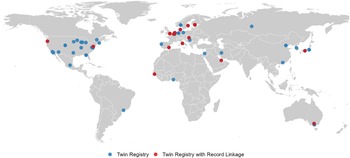
The online resource translates the information presented in this special issue into a searchable, structured, and continuously expandable format and straightforward design. In particular, it provides an up-to-date global overview of twin registries, including their design characteristics, data types, and reported linkage activities. Inspired by the fruitful work of previous overviews of twin registries worldwide (Hur et al., Reference Hur, Bogl, Ordoñana, Taylor, Hart, Tuvblad, Ystrom, Dalgård, Skytthe and Willemsen2019), the current version compiles two sources of information: information gathered from previous special issues of TRHG on twin registries and the information continuously collected via private communication with the twin registries’ data management and available additional data from contacts. As a result, the online tool extends the previous reports and, in line with the focus of the current special issue, adds up-to-date information on the availability of omics data, biobanking, and administrative linkages to the table (Figure 1).
World map indicating all registers and registers with record linkage efforts. Countries with linkages: Australia, Belgium, Denmark, Finland, Guinea-Bissau, Hungary, Italy, Japan, Mexico, Netherlands, Norway, Qatar, Spain, Sweden, UK, USA.

The core functionality of the online tool supports two main views: a Table View that is searchable through filters as a sortable table listing all registries, and a World Map View, where each country with one or more twin registries is highlighted. The filters allow finding key characteristics of each registry (e.g., country, sample size, linkage options, omics data), while the World Map allows for better spatial understanding of the data and the ease at navigating.
For most of the registries, the following fields are available:
-
• Country
-
• Name of registry
-
• Target region (e.g., national, regional, city-based)
-
• Year start
-
• Year end (or flag as ‘ongoing’)
-
• Major recruitment methods (e.g., population registry, school-based, clinic-based, volunteer)
-
• Total sample size (twin pairs/individuals)
-
• Subjects (e.g., twins only, twins + parents, siblings, spouses, offspring)
-
• Age in years (age range of participants at recruitment or in follow-up)
-
• Major phenotypes (broad overview; e.g., mental health, cardiovascular, fertility, included in the limited list of keywords).
-
• DNA data
-
• Omics data
-
• Presence of biobanking
-
• Presence of linkage (list of linkages; e.g., to health registries, pathology archives, environmental/exposome datasets)
-
• Website (URL of registry website or institutional page).
As from mid-April 2026, Twin Registries Worldwide covers 67 registries of more than 2,000,000 individuals and 200,000 twin pairs worldwide, covering 23 countries. The data on the number of registries has already been updated. To see which data is most recent, the ‘last update’ column shows the year the information in the registry was gathered.
The development of Twin Registries Worldwide contributes to the efforts made so far to facilitate the international collaborations, possibilities for meta-analyses, and more complex analyses (Buchwald et al., Reference Buchwald, Kaprio, Hopper, Sung, Goldberg, Fortier, Busjhan, Sumathipala, Cozen, Mack, Craig and Harris2014). We hope that it will become a ‘living’ resource of inspiration and entry points for a number of groups that include: (a) researchers in twin studies, genetic epidemiology, and population health; (b) clinicians and clinical researchers interested in registry-based recruitment; (c) policy makers and funding bodies seeking an overview of twin infrastructures; (d) twin registry coordinators looking for collaboration opportunities.

 Open access

