




Introduction
The securitization of Russian-speakers has been a central component of nation-building in Estonia and Latvia since they regained independence in 1991. Securitization at the levels of discourse and policy has varied over time in response to historical legacies that include the suppression of majority culture during the Soviet period, Russia’s kin state activism, and the minority protection requirements of European institutions.Footnote 1 Nationalizing policies adopted by both states in the early 1990s, which privileged titular majorities and politically disenfranchised the vast majority of Russian-speakers, drew considerable attention from both Russia and European institutions. Russia emerged as an active kin state on behalf of Russian-speakers in Estonia and Latvia in the early 1990s and has used a variety of harder and softer power mechanisms against both states in the name of protecting Russian-speakers. The pursuit of membership in the European Union, in part driven by the desire for security guarantees against Russia, required that Estonia and Latvia meet minority protection criteria, which affected the ways in which Russian-speakers were securitized at the levels of discourse and policy. The combination of external pressures resulted in the reform of the most exclusionary policies in both states prior to EU and NATO accession in 2004. Nevertheless, the securitization of Russian-speakers has remained a central feature of nation-building in both states. Russia’s support for large-scale minority mobilization in the mid-2000s around issues of cultural integration and identity, its wars in Georgia in 2008, and in Ukraine since 2014, all raised concerns about the potential threat Russian-speakers pose to Estonian and Latvian security (Kuczyńska-Zonik Reference Kuczyńska-Zonik2017). Russia’s invasion of Ukraine in February 2022 is another important inflection point for understanding the securitization of Russian-speakers in these states. Over the years, policymakers have framed the threats that Russian-speakers (and their connections to Russia) pose to the state and core nation in a variety of ways and have advocated for an array of policy responses.
This article aims to situate recent trends in the securitization of Russian-speakers after Russia’s invasion of Ukraine within the broader context of securitization in Estonia and Latvia. To that end, we address the following: 1) How have Russian-speakers been securitized at the levels of discourse and policy in Estonia and Latvia since regaining independence in 1991?; 2) How has the securitization of Russian-speakers evolved in the period immediately following Russia’s invasion of Ukraine?; 3) How have Russian-speakers responded to the newest cycle of securitization? and; 4) How might we evaluate recent securitization in light of potential threats?
In order to map dominant securitizing trends in Estonia and Latvia over time, we introduce a securitization typology that links securitizing frames with policies. In developing that frame-policy nexus, we draw heavily on existing research that demonstrates the various ways that Russian-speakers have been securitized or desecuritized in the service of both more exclusionary and inclusionary policy agendas. We then demonstrate the utility of the frame-policy nexus through an analysis of securitization processes in Estonia and Latvia following Russia’s invasion of Ukraine in February 2022. Through thematic frame analysis of public broadcast media in Estonia and Latvia, we map the variety of securitizing frames circulating immediately after Russia’s invasion of Ukraine, paying particular attention to the speech acts of elites that are used to justify particular policy initiatives. Process tracing then allows us to connect securitizing frames to the introduction or passage of policy initiatives aimed at combating potential security threats from Russian-speakers. While we cannot claim to have captured the entirety of securitizing frames in either country, the frames that emerge from the analysis represent real existing frames that have circulated within widely read and trusted news sources. We conclude with a discussion of minority political mobilization in response to securitization in the form of public demonstrations and voting behavior in parliamentary elections and consider recent securitization in light of representative surveys on support for the active defense of the state.
The findings build upon previous studies of securitization in Estonia and Latvia temporally, empirically, and theoretically. While previous studies argue that securitization patterns in Estonia and Latvia had been diverging following EU accession, our analysis points to increasing convergence across cases in favor of securitizing exclusion. Nevertheless, securitization is not monolithic or static, and alternative frame-policy patterns that are identified in the analysis could become more significant in response to domestic or external pressures. Minority mobilization in response to recent securitization has been minimal in comparison to previous cycles of securitization despite opinion polls that show considerable opposition to recent policies among Russian-speakers. This suggests that Russian-speakers are assessing the costs and benefits of mobilization differently in the current context. Finally, quantitative analysis of public opinion surveys reveals that Russian-speakers are less supportive of active defense of the state than titulars. While it is possible that a “fifth column” is present among those respondents who answer negatively or refuse to answer, open-ended questions reveal considerable similarities across linguistic communities with respect to why they are willing, or reluctant, to support active defense, revealing little evidence of a potentially subversive agenda among the majority of Russian-speaking respondents. This is only one possible lens through which to evaluate recent securitization; however, it suggests that policymakers should carefully weigh the potential security benefits against the potential costs to social cohesion, when pursuing securitizing strategies.
Securitizing Russian-speakers: The Frame-Policy Nexus
The securitization of minorities happens through discourse, policy, and practice. Some scholars emphasize the discursive component, defining securitization as a speech act or discursive process whereby an actor claims that some referent object is existentially threatened by another (Jutila Reference Jutila2014, 928; Wæver et al. Reference Wæver, Buzan, Kelstrup and Lemaitre1993). While securitization often takes place through speech acts (Buzan et al. Reference Buzan, Wæver and de Wilde1998, 26), it can also take non-verbal forms that include visual representations (Hansen Reference Hansen2011, 68–69), physical actions (Wilkinson Reference Wilkinson2007, 21–22), or bureaucratic proceedings (McDonald Reference McDonald2008, 568–569). Minorities are likely to be securitized and portrayed as threatening to the survival of dominant nations where active kin states, states claiming to act on behalf of that minority (co-nationals), aggravate ethnic tensions (Csergő, Kallas and Kiss Reference Csergo, Kallas and Kiss2025). In such cases, minorities are likely to be portrayed as “fifth columns,” “domestic actors who work to undermine the national interest, in cooperation with external rivals of the state” (Radnitz and Mylonas Reference Mylonas and Radnitz2022, 10). This is the situation that Estonia and Latvia found themselves in following the Soviet collapse.
In the early 1990s, Russia claimed to be the protector of Russian-speakers stranded outside of Russia’s borders (King and Melvin Reference King and Melvin1998), adopting an official compatriot policy in 1999 (Sherr Reference Sherr2013). Russia has used a variety of hard and soft power tools against Estonia and Latvia in the name of protecting Russian-speakers. Those efforts have included military threats and economic pressure; financial and organizational support for minority-friendly parties and demonstrations; as well as European institutions and the Russian-language media as platforms to internationalize the situation of Russian-speakers and to influence public opinion. Russia’s own citizenship, visa, and educational policies toward the Baltic States are also intended to undermine ethnopolitics (Muižnieks Reference Muižnieks2011; Schulze Reference Schulze2021; Simons Reference Simons2015; Winnerstig Reference Winnerstig2014). Given these realities, it is hardly surprising that Russian-speakers have been securitized in Estonia and Latvia at the levels of discourse and policy. Nevertheless, the securitization of minorities is not a static condition, but a contested process that changes in response to both domestic and international events.
In order to map securitizing trends over time, we develop a typology that links securitizing frames with policies. “Frames,” provide an “idea or story line” that gives meaning to a set of events (Gross Reference Gross2008, 170), and are used to shape policies and to build support for policy agendas (Abolafia Reference Abolafia2004; Druckman Reference Druckman2004; Jacoby Reference Jacoby2000; Nelson, Clawson and Oxley Reference Nelson, Clawson and Oxley1997). Securitizing frames present minorities as a threat to the core state or nation in the service of policies that are more or less accommodative of minorities. International pressures to incorporate minority rights in democratic societies, or domestic processes that involve changes in leadership or social pressure, can lead to desecuritization. Desecuritizing frames appeal to notions of fairness or justice as opposed to threats (Roe Reference Roe2004, 288). We categorize policies that make it more difficult for minorities to participate in socio-political life or that do not accommodate difference, particularly with respect to language or culture, as exclusionary. We categorize policies that accommodate differences, or make it easier for minorities to participate, as inclusionary. Securitization processes along frame-policy dimensions can therefore be characterized according to the following typology (Table 1).
Frame-Policy Nexus of Securitization Processes
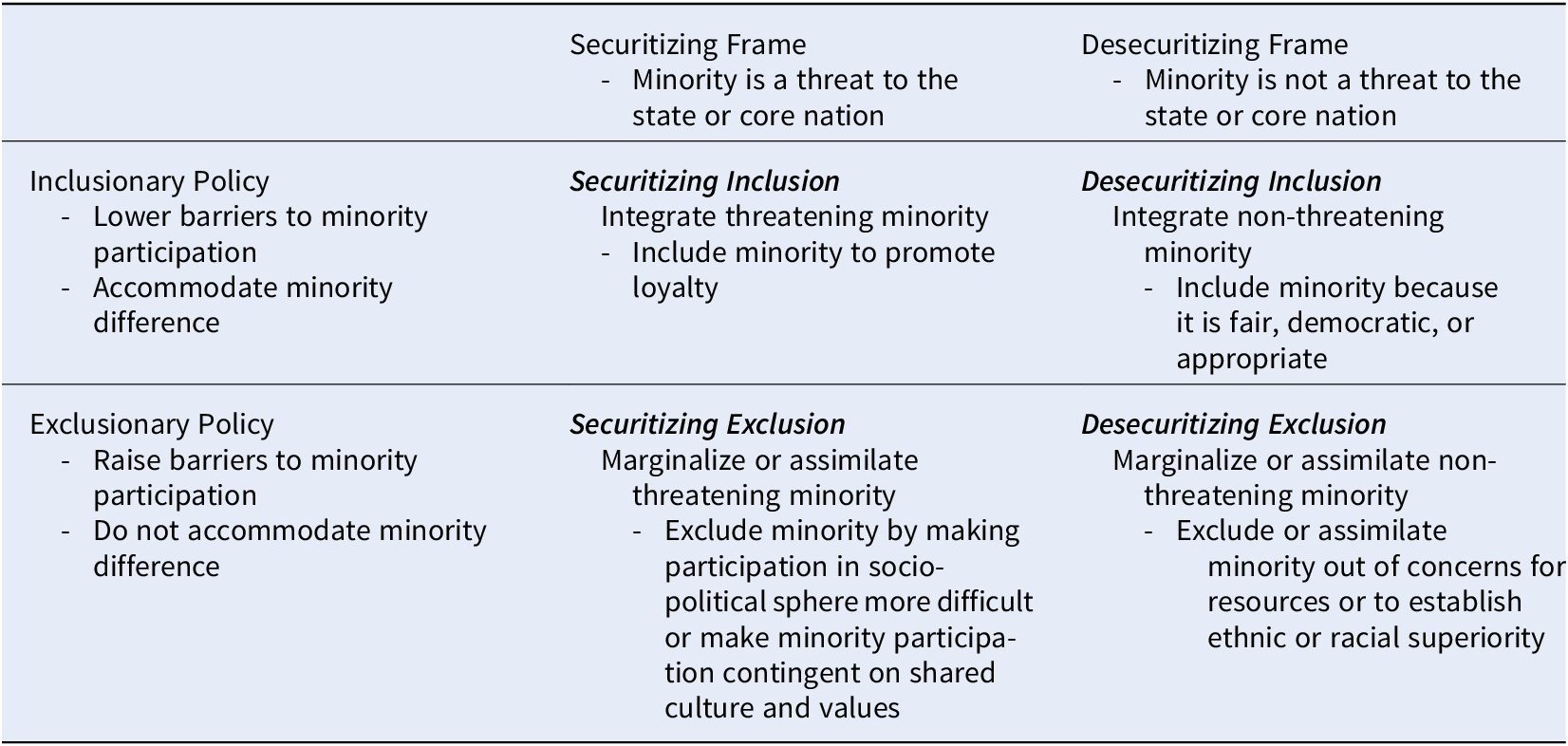
Securitizing exclusion occurs when policies that are less accommodating to the minority are justified by presenting the minority as a threat to the state or core nation. In such situations, connections between the minority and the kin state may be presented as potentially harmful to the state and nation, and the minority may be presented as a “fifth column” that is working to undermine the state or nation from within. This threat can be dealt with in one of two ways: through the passage of policies limiting or preventing the minority from participating in normal democratic processes; or through assimilative policies that raise the barriers to participation by requiring minorities to adopt the dominant culture and values. Both scenarios are aimed at removing the threat that the minority poses to the core state and nation, in part by removing opportunities for the kin state to influence politics through the minority (Kymlicka Reference Kymlicka2002, 20). While some may consider assimilation a model for minority incorporation, it is one that is less accommodating of minority differences and creates hurdles for minorities to overcome before being able to participate fully in the socio-political community. The passage of strongly nationalizing policies in Estonia and Latvia in the early 1990s, which privileged the ethnic majority, marginalized Russian-speakers politically, and established titular language proficiency as a gatekeeper for participation in the socio-political community (Brubaker Reference Brubaker1996), provide examples of the logics of securitizing exclusion.
Securitizing inclusion occurs when more accommodative policies are justified by security concerns. In this case, assimilative pressure is decreased alongside increased opportunities for minority participation. The goal is to encourage the attachment of the minority to the state through accommodation so that the minority has fewer incentives to undermine the state. It also aims to decrease opportunities for the kin state to destabilize ethnopolitics through minority cooptation, or through direct intervention on behalf of the minority on the grounds of minority discrimination. Securitizing inclusion was critical in the passage of minority policy reforms in Estonia and Latvia prior to EU accession and to varying degrees in Estonia and Latvia post-accession (Schulze Reference Schulze2018; Reference Schulze2021).
Desecuritizing inclusion happens when accommodative policies are justified without reference to security. In such cases, inclusionary policies may be justified through ethical or normative appeals, which include notions of fairness, democratic standards, and norms of appropriateness (Roe Reference Roe2004, 288). While these processes have not dominated minority policy development in either Estonia or Latvia, these frames have been utilized by policymakers claiming to represent minorities in Estonia and Latvia, and by those concerned with minority obligations under international frameworks (Kelly 2004; Sasse Reference Sasse2008; Schulze Reference Schulze2018; Vachudova Reference Vachudova2005).
Desecuritizing exclusion, where marginalizing policies are justified by factors other than security is theoretically possible. However, we find no evidence of such processes with respect to Russian-speakers in Estonia or Latvia during the period under consideration. Such processes might reflect concerns over competition for resources or agendas to establish ethnic or racial superiority.
Drawing on existing research, we apply this frame-policy typology to map dominant trends in how Russian-speakers have been securitized in Estonia and Latvia since 1991. Those trends are not monolithic, as framing contests over the degree of threat that Russian-speakers pose to the core state and nation have been prevalent, as have patterns of passing more exclusionary policies in one area to compensate for the passage of more accommodative policies in others. This contestation at the level of discourse and policy occurs as policymakers attempt to balance pressures from external actors, like Europe and Russia, alongside demands from their domestic audiences (Schulze Reference Schulze2018, Reference Schulze2021). The section below highlights the dominant securitization patterns that emerged during important critical junctures, which include the period following independence, the EU accession period, and the post-accession period. We then apply the frame-policy nexus to understand emergent securitization patterns in the period immediately following Russia’s invasion of Ukraine.
Twenty Years of Securitization (1991-2022)
The securitization of Russian-speakers in the early 1990s was the titular response to difficult historical legacies involving Russian imperialism and Soviet occupation. Soviet policies that encouraged the migration of Russian-speakers to Estonia and Latvia, alongside the forcible deportation of titular majorities, transformed the ethnic demography of both states. While the Estonian state in the 1930s was almost 90 percent ethnically Estonian, by 1989 the share of ethnic Estonians had declined to slightly over 60 percent of the population, with Russians comprising approximately 30 percent (Statistics Estonia 2021). In Latvia, the share of ethnic Latvians declined from around 77 percent in 1939 to 52 percent in 1989, with Russians comprising approximately 34 percent of the population (National Statistical System of Latvia 2022). These demographic shifts, alongside the suppression of majority culture and the promotion of the Russian language during the Soviet era, produced considerable resentment and perceptions of cultural threat among ethnic majority populations.
The politics of securitizing exclusion dominated the period immediately following re-independence in both states. In an effort to right historical wrongs, Estonia and Latvia passed citizenship, language, education, and electoral policies that privileged ethnic majorities and protected majority culture, while politically disenfranchising large numbers of Russian-speakers. Those who had citizenship in 1940 and their descendants were granted automatic citizenship, while most others had to naturalize through a process that included difficult language and civics tests, rendering the vast majority of Russian-speakers without the citizenship of any state (Jašina-Schäfer and Cheskin Reference Jašina-Schäfer and Cheskin2020, note 3). Language policies aimed to reestablish titular languages as the only official languages in public spaces. These policies were justified through discursive frames that presented Russian-speakers as “occupiers” and as a “fifth column,” and which questioned their loyalty to the state on the basis of cultural choices, political views, and attachment to Russia (Schulze Reference Schulze2010, 368; Reference Schulze2018; Sergunin and Karabeshkin Reference Sergunin and Karabeshkin2015, 357; Steen Reference Steen2010, 209). Those seeking naturalization were required to prove their loyalty to the state through language proficiency exams before being granted access to citizenship or employment in certain sectors. These policies created hurdles for minority participation both structurally and socially, resulting in the marginalization of large numbers of Russian-speakers who not only remained stateless in Estonia and Latvia, but who transferred that stateless status to their children (Muižnieks Reference Muižnieks2011; Schulze Reference Schulze2017, Reference Schulze2018). Non-citizens are not allowed to vote at the national level in either country, or the local level in Latvia, and are not allowed to belong to political parties in Estonia (policies that remain in place today).
This approach to state-building drew the involvement of both European institutions and Russia in minority policy development in the period leading up to EU and NATO accession in 2004. European institutions sought to influence policymaking through a combination of normative pressure and political conditionality (Kelley Reference Kelley2004; Vachudova Reference Vachudova2005). Russia used a variety of hard and soft power mechanisms (discussed above) as levers for influencing ethnopolitics in these states and for calling attention to the situation of Russian-speakers in Estonia and Latvia. The combination of external pressures resulted in the reform of the most exclusionary aspects of citizenship, language, and electoral policies prior to EU accession, a topic that has been the source of considerable scholarship (Brubaker Reference Brubaker1996; Cheskin Reference Cheskin2016; Galbreath Reference Galbreath2005; Kelley Reference Kelley2004; Sasse Reference Sasse2008; Schulze Reference Schulze2018; Smith Reference Smith2002; Vachudova Reference Vachudova2005). During debates over those reforms, Russian-speakers were discursively securitized and desecuritized in framing contests that resulted in significant delays in the passage of conditional amendments (those required for EU membership) (Budryte Reference Budryte2005; Crandall Reference Crandall2014; Galbreath Reference Galbreath2005; Golubeva Reference Golubeva2010; Kelley Reference Kelley2004; Muižnieks Reference Muižnieks2011). Russia’s interventions actually facilitated a shift toward securitizing inclusion by allowing policymakers to emphasize the importance of the security guarantees that came with membership as a way to justify their support for more accommodative policies, even when their domestic audiences preferred minority exclusion (Schulze Reference Schulze2018). The final form of conditional amendments nevertheless represented the bare minimum necessary for formal compliance as opposed to more inclusive recommendations favored by European advisors and some domestic actors (Sadurski Reference Sadurski, Weller, Blackloack and Nobbs2008, 209; Kymlicka Reference Kymlicka, Weller, Blackloack and Nobbs2008, 29).
The securitization of Russian-speakers in Estonia and Latvia continued post-accession in reaction to domestic and international events; however, securitization patterns diverged in important ways. Minority mobilization around issues of language, identity, and historical memory triggered new cycles of securitization, but with different policy outcomes in the two cases. In Latvia, education reform requiring the transition of all state-funded secondary and vocational education schools to teaching at least 60% of their curriculum in Latvian triggered mass protests in 2004 (Ryo 2014). Russian-speakers mobilized again around a national referendum to make Russian a second official language in 2012. In Estonia, the decision to relocate the Bronze Soldier monument in April 2007, a Soviet-era WWII memorial and tomb of the unknown soldier, from downtown Tallinn to a military cemetery on the outskirts of town sparked riots that resulted in the significant destruction of property, hundreds of injuries, and one death (Smith Reference Smith2008). Russia responded by launching a crippling wave of cyberattacks against the Estonian government and businesses. In both cases, policymakers used Russia’s involvement in helping to fund and organize those mass movements to securitize Russian-speakers and to question their loyalty to the state (Muižnieks Reference Muižnieks2011, 127).
In Latvia, securitizing exclusion is evident in reforms to referendum laws, the Latvian constitution, and education policies, all of which seek to limit the influence of Russian-speakers and the role of the Russian language in Latvian society. In the wake of the failed language referendum, policies were passed to make the organization of national referendums more difficult. In addition, the preamble of the Latvian Constitution was revised to define Latvia as a national state for ethnic Latvians, and Latvian as the only official language (Ijabs Reference Ijabs2016, 302; Schulze Reference Schulze, Rak and Backer2022). In both cases, reforms were justified by presenting minority mobilization around the language referendum as a threat to the Latvian nation. Education reform was passed in 2018 requiring the complete transition to titular language learning in grades 10–12; 80 percent of the curriculum was taught in Latvian in grades 7–9 and 50 percent in grades 1–6. The reform was justified by both integrationist (desecuritizing) and securitizing logics. Some policymakers emphasized the appropriateness of the reform for enhancing education and career opportunities among minorities. Others emphasized the potential security of Russian-speakers and framed the reform as a way to cultivate loyalty through the school system and to ensure access to a common Latvian information sphere (Schulze Reference Schulze2021). While similar debates over education policies were taking place in Estonia, legislation requiring a phased transition to Estonian language education in all schools was not passed until after Russia’s invasion of Ukraine.
By contrast, the politics of securitizing inclusion dominated debates surrounding reforms to make citizenship automatic for children born to stateless parents in Estonia (in 2018) and Latvia (in 2019). The number of persons without the citizenship of any state had decreased substantially in both countries (approximately 5 percent of the population in Estonia and 10 percent in Latvia). However, significant numbers of Russian citizens in Estonia (6 percent) and Latvia (2 percent) raised security concerns (Statistics Estonia 2021; Central Statistics Bureau Republic of Latvia 2021). Russia’s aggressions in Georgia and Ukraine, which Russia justified at least in part through claims of protecting Russian citizens, provided an important securitizing frame justifying more inclusionary legislation in both states (Nielson and Paabo Reference Nielson and Paabo2015, 128; Schulze Reference Schulze2017, 266–267; Schulze Reference Schulze2021, 280–283). In Estonia, the easing of naturalization requirements for children born to stateless parents was justified as a way to “win over” Russian-speakers and removed a pretext for Russia’s intervention (Schulze Reference Schulze2018). In Latvia, the reform was presented as a mostly symbolic gesture that would promote the loyalty of Russian-speakers; a move that was viewed as possible only after education reforms had been passed the previous year ensuring that children born to stateless parents would speak Latvian and learn Latvian values. Attempts to pass more sweeping legislation granting citizenship to all those who had been born in Estonia and Latvia since independence were defeated through securitizing frames advocating naturalization processes as a test of loyalty and as instruments to promote titular language proficiency (Schulze Reference Schulze2021).
Another example of securitizing inclusion is Estonia’s creation of ETV+, a Russian-language public broadcast television station, in 2015 in order to provide a reliable source of information for Russian-speakers and to combat Russia’s disinformation. This is an important point of divergence with Latvia, where nationalist parties resisted similar initiatives on the grounds that it would discourage titular language learning among Russian-speakers. The COVID-19 pandemic did not result in new minority policy initiatives and is, therefore, outside our scope of inquiry; however, Russian-speakers began to rely more on ETV+ for information during the pandemic. Russian-speakers were securitized for higher infection rates and lower vaccination rates, both of which were explained by Russia’s role in influencing public perceptions through the Russian media.
Securitizing Russian-speakers after Russia’s Invasion of Ukraine (Feb 2022-March 2023)
Russia’s invasion of Ukraine in 2022 is an important inflection point for understanding the securitization of Russian-speakers in Estonia and Latvia. The following sections apply the frame-policy typology to map securitizing trends that emerged immediately after Russia’s invasion of Ukraine. We do this through a thematic frame analysis of a subsection of articles that appeared in the public broadcast media from February 2022 through March 2023. Process tracing then allows us to connect securitizing frames to the introduction and passage of policy initiatives aimed at combating potential security threats from Russian-speakers.
We began by compiling all articles that appeared in the public broadcast media containing the term “Russian-speaker” during the specified time period (February 2022 to March 2023), cross-checking articles published on both the titular and English versions of the websites to ensure that we were not missing any significant discursive frames. Included in the analysis are only those articles that discussed the threat that Russian-speakers pose to the state or nation. We supplemented those articles with additional articles focusing on key minority policy initiatives resulting in thirty-three articles for Estonia and thirty-eight articles for Latvia. We recognize that this represents only a small subsection of the media landscape in Estonia and Latvia. It is possible, and even likely, that an analysis of other commercial media would yield additional frames. The advantage of using public broadcast media is that they are publicly available, widely read, relatively well-trusted as a source of factual reporting, and are intended to provide well-balanced information, including key views of government and society (Jõesaar, Rožukalne, and Jastramskis Reference Jõesaar, Rožukalne and Jastramskis2022, 592–593). Therefore, while the analysis is not exhaustive of all potential securitizing frames in each country, it nevertheless reveals real existing views on the threats that Russian-speakers pose to the state and nation in the immediate aftermath of Russia’s invasion of Ukraine. The analysis could and should be expanded to include a wider array of media sources as well as a broader analysis of political speeches and policy debates. In the analysis that follows, articles that appear in the public broadcast media are cited by a reference to the broadcasting site (ERR or LSM) and the publication date, with the full list of articles cited in this article in Appendix A.
In the analysis, we consider the speech acts of elites as well as the ways in which Russian-speakers are framed as a “threat” to the state or core nation in both the media and policy instruments. We treat each text as a holistic construct, constructing frames from the “bottom-up,” from text to frame, by categorizing securitizing discourse into higher-level concepts that provide common themes for analysis, and lower-level concepts that provide variations on those higher-level concepts (Johnston Reference Johnston1995, 237). In the sections below, we provide examples of speech acts that represent different frames within the discursive landscape in each country, highlighting those that are used in discussions around particular policies. Attention to how securitizing frames are linked to various policy initiatives within the text, along with careful process tracing that pays attention to the timing of policy initiatives, allows us to link discursive frames with policy developments. While it is possible to typologize individual policies as more or less accommodating of minorities, we aim to identify general policy trends in favor of more or less minority accommodation in the wake of Russia’s invasion of Ukraine.
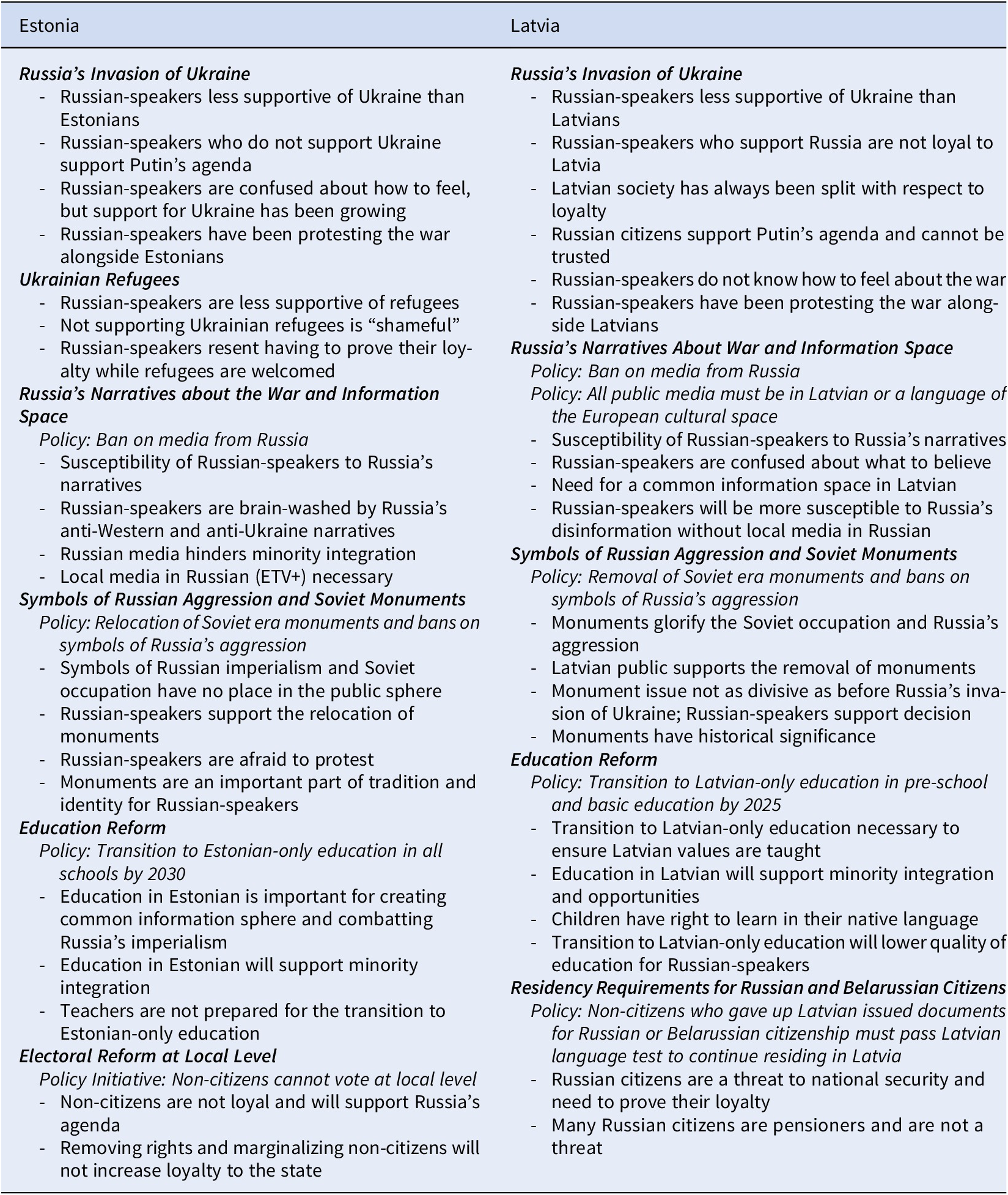
Recent studies have pointed to the discursive securitization of Russian-speakers as a potential “fifth column,” as a result of their perceived affective connections to Russia and their often divergent views on domestic and foreign policy (Andžāns Reference Andžāns2023; Pupcenoks, Rostoks, and Mierina Reference Pupcenoks, Rostoks and Mieriņa2024). In the analysis below, we connect securitizing frames to policy developments, revealing increasing convergence around a dominant pattern of securitizing exclusion in both countries. The analysis also reveals that securitizing frames are not monolithic and that there is contestation over the potential threat that Russian-speakers pose to the state, as well as disagreements over appropriate policy responses. The existence of alternative frames is part of the securitizing landscape, and could become more influential should the domestic preferences shift in favor of greater minority accommodation. Prevalent frames and policy initiatives are presented in Table 2 and discussed in the following sections.
Securitizing Frames and Policies in Estonia and Latvia after Russia’s Invasion of Ukraine
Estonia: Questionable Loyalty or Marginalized Minority?
In the year following Russia’s invasion of Ukraine, the public broadcast media reported regularly on levels of support for Ukraine and Ukrainian refugees among ethnolinguistic groups, which became an important lens through which to interpret Russia’s influence in Estonian society and the loyalty of Russian-speakers to the Estonian state. Much concern centered on the susceptibility of Russian-speakers to Russia’s narratives about the war in the Russian media. The securitizing frames that emerged from within those discussions provide the backdrop for more focused debates around specific policy initiatives concerning Russian media, the relocation of Soviet-era monuments, education reform, and local elections. The following sections are organized thematically around frames that permeated those policy debates.
“Brainwashed Putinoids” or Marginalized Minority: Media and Support for Ukraine
The Estonian public broadcast media (ERR) frequently reported lower levels of support for Ukraine and Ukrainian refugees among Russian-speakers compared with ethnic Estonians, divisions that remained significant throughout the first year of the war.Footnote 2 Consumption of Russian media by Russian-speakers was the predominant explanation for the difference in attitudes (ERR, March 22, 2022; October 4, 2022). For example, Katri Raik, Mayor of Narva, a predominately Russian-speaking city in northeastern Estonia, explained: “Everyone was opposed to the war at first, but as Putin’s propaganda intensified the support for it grew” (ERR, February 3, 2023). Kalev Stoicescu, a former official in the Ministry of Foreign Affairs and a research fellow at the International Center for Defense and Security, described the vulnerability of Russian-speakers to Russia’s narratives:
The Kremlin’s claim that Russia is combating “fascism” fools no one except thoroughly brainwashed Putinoids […] It is important to keep in mind that a considerable part of the Russian population (and Russian-speakers living elsewhere) is so brainwashed and saturated with anti-Western and anti-Ukrainian sentiment that it will take a very long time to change (ERR, May 13, 2022).
Sergei Matlev, member of the Board of the Estonian Institute for Historical Memory, explained how consumption of the Russian media affects support for Ukraine: “If a person is sincerely convinced that what we are dealing with is a limited operation meant to protect Russia and save people, they cannot feel deep solidarity with the refugees. This vacuum opens the door to taking issue with Estonia” (ERR, April 5, 2022). He also warned about the long-term negative impacts of Russia’s influence: “Persons who have engaged in this kind of influence activity for years are responsible for many of our Russians still lacking Estonian, for thousands of careers that never took off and the effort to cling on to a segregated Russian education system that, surveys suggest, usually offers poorer education than its Estonian counterpart” (ERR, April 25, 2022).
Concerns over the vulnerability of Russian-speakers to Kremlin narratives about the war prompted defensive policy responses. The Consumer Protection and Technical Regulatory Authority (TTJA) put a domestic ban on Russian TV channels immediately following the invasion. EU-wide sanctions resulted in a total of fifty TV channels that could not be broadcast in Estonia, along with eighty websites subject to similar sanctions (ERR, March 9, 2023). Estonian Public Broadcasting (ERR) reported regularly on the effectiveness of the policy in limiting Russian media consumption. The percentage of Russian-speakers naming Kremlin-controlled channels as among the top three most important sources of information declined from 37 percent at the end of February to only 19 percent at the end of March (ERR, April 12, 2022), and only 11 percent by the following year (ERR, March 9, 2023). ERR also noted the steady growth in the proportion of Russian-speakers who viewed the Estonian-language media as the most important and trusted source of information (March 9, 2022, March 22, 2022; April 12, 2022; June 22, 2022; October 4, 2022; March 9, 2023). Nevertheless, concerns persisted regarding the circulation of Russia’s narratives about the war through social media and everyday conversations (ERR, April 5, 2022; May 13, 2022; February 1, 2023). Helena Rohtla, TTJA’s social information chief noted that attempts to ban Russia’s narratives within social media “is somewhat a case of tilting at windmills” (ERR, February 1, 2023). As a result, some policymakers emphasized the importance of providing accurate information in the Russian language through local media like ETV+ (ERR, March 9, 2023).
Counter-frames emphasized high levels of support for Ukraine among Russian-speakers and warned of the dangers of minority marginalization. For example, Center Party Board Member and Member of European Parliament (MEP) Yana Toom warned: “We need to keep the peace at home. It would be worth calling off the witch hunt. Putting an end to pushing our Russian-speaking people to a point we don’t want them to reach. But if we constantly state that we don’t trust them and talk about a loyalty test […] We cannot allow this” (ERR, March 14, 2022). Mihhail Kõlvart, Mayor of Tallinn, argued: “The majority of Russian-speakers support Ukraine; I’ve seen as much with my own eyes […] Why aren’t we talking about that? Moreover, all messages to Russian-speakers are associated with words like ‘we’re banning,’ ‘we’re taking away,’ and so on” (ERR, February 1, 2023). He also warned of the danger of alienating Russian-speakers through securitization processes explaining:
Many Russian-speakers in Estonia feel they are constantly being asked to prove their loyalty to the country. I also feel it myself. On the one hand, it is said that Russian people are not Russia and they are not guilty of starting the war, but on the other, they are still regarded with suspicion […] It shows that there is no trust in relation to Russian people and it creates negative reactions. This could backfire and would be dangerous for society (ERR, March 23, 2023).
The presence of Russian-speakers at anti-war protests held regularly since the start of the war, as well as anti-war protests organized by Russian citizens, were also presented as evidence of Russian-speakers’ loyalty to Estonia and support for Ukraine (ERR, November 28, 2022). Lower levels of support for Ukrainian refugees among Russian-speakers were explained as a product of minority marginalization and resentment over the comparatively better treatment of Ukrainian refugees, many of whom are also Russian-speakers (ERR, March 23, 2022).
“Model of Integration” or “Model of Insecurity”: Monuments and Symbols of Aggression
Russia’s invasion of Ukraine also ignited debates over symbols of Russia’s aggression, Soviet monuments, and commemoration practices surrounding WWII. For many Russian-speakers, May 9 is a day to celebrate the victory over Nazi Germany in WWII, while it is remembered more solemnly by ethnic Latvians and Estonians as the beginning of the Soviet re-occupation that would last for fifty years. In April 2022, the Estonian parliament passed a bill banning symbols of Russia’s aggression in public spaces, punishable under the penal code, including the Ribbon of St. George and the Z-symbol (ERR, April 27, 2022). The promulgation of the bill on the fifteenth anniversary of the Bronze Night was intended to ensure that May 9 remained a day of remembrance for all the victims of WWII, and not a day to support Russia’s aggression against Ukraine (Republic of Estonia 2022).
In August 2022, monuments were securitized in the government’s decision to relocate all Soviet-era monuments to museums. Prime Minister Kaja Kallas explained in a tweet on August 16, “As symbols of repression and Soviet occupation they have become a source of increasing social tensions – at these times, we must keep the risk to public order at a minimum.” The relocation of the Soviet T-34 Tank from Narva to the Estonian War Museum in Viimsi attracted the most discussion in the media. However, in contrast to the Bronze Night in April 2007, the tank’s removal on August 16 did not provoke mass protests. The predominant explanation for the lack of protest by government officials focused on the agreement of Russian-speakers with the government’s decision. For example, Katri Raik, Mayor of Narva explained, “One of the changes brought about by the tank removal is that younger people have started referring to themselves as Russian-speaking Estonians,” in order to separate themselves from Russia (ERR, February 3, 2022). This is a trend that was already evident in census data, with increasing numbers of persons in Narva, whose mother tongue is not Estonian, identifying as Estonian (ERR, July 1, 2022). Irene Koassar, head of the Integration Foundation, noted that this made Russian-speakers the “model for integration,” a desecuritizing frame that stands in contrast to other securitizing frames that question their loyalty (ERR, July 1, 2022). However, surveys reported only one-third of Russian-speakers supported the relocation of Soviet monuments, while over half supported the reinterment of human remains currently buried in Soviet war graves (ERR, August 18, 2022). Russian-speakers who were interviewed expressed a variety of emotions in reaction to the tank’s removal, including confusion over the decision and its timing and a sense of loss over a tradition of congregating there (ERR, August 22, 2022). Mayor Katri Raik acknowledged that the absence of minority mobilization might also be explained by a profound sense of insecurity among Russian-speakers:
Since the start of the war, some people were already forced to leave; it has been made abundantly clear that anyone who is not loyal to the state must leave. Thirty-six percent of people in Narva are Russian citizens and they are not the ones who could take to the streets or demonstrate, they know they are Russian citizens living in Estonia and the world is changing around them (ERR, February 3, 2023).
Windows of Opportunity: Education Reform and Local Elections
Russia’s invasion of Ukraine created windows of opportunity for policy initiatives that had been long debated in Estonian society. In a sign of increasing policy convergence with Latvia, Estonia passed an education reform bill in December 2022 requiring the full transition of all schools to Estonian language instruction by 2030, beginning with kindergartens and grades 1–4 in the 2024/2025 school year. A diverse group of political parties supported the passage of the bill, and the justifications for the reform included both securitizing and desecuritizing logics. Minister of Education Tõnis Lukas explained that the reform was important both for combating Russia’s imperialist intentions through the creation of a shared information space, as well as for minority integration by ensuring that Russian-speakers have greater access to quality higher education (Baltic Times 2022). Some politicians objected not on principle, but on the grounds that there would not be enough qualified teachers, particularly in predominately Russian-speaking regions (ERR, December 12, 2022).
Concerns over Russia’s influence on public attitudes and the loyalty of Russian-speakers also renewed debates over electoral policy. “Fatherland” (Isamaa), and the “Estonian Conservative People’s Party” (EKRE) voiced support for initiatives revoking voting rights for Russian citizens and those with undetermined citizenship status at the local level. EKRE had proposed similar legislation back in 2017 with Isamaa’s support, and Isamaa submitted a new draft proposal to restrict voting rights in April 2022. Voting rights for non-citizens at the local level were guaranteed in the 1992 Constitution, a major point of divergence from Latvia, where voting rights at all levels are reserved only for Latvian citizens. Securitizing frames justifying the initiative in Estonia bear striking similarities to the justifications in favor of maintaining those restrictions in Latvia; namely that noncitizens are not loyal and would support the Kremlin’s agenda (Cianetti Reference Cianetti2019). An example of that framing can be found in EKRE Vice Chairman Jaak Madison’s explanation for his party’s support for the bill:
Let’s take into account the fact that a third of Estonia’s population lives in Tallinn, and that nearly half of Tallinn’s population are Russian-speakers, a very large proportion of whom are Russian citizens […] If they are able to influence the development and future of our capital, this clearly does not in any way align with the spirit of the Estonian constitution, which aims to preserve the Estonian nation. I think that those citizens who have Russian passports in their pockets probably do not consider that the preservation of Estonia as a nation-state should be the ideal of Estonia (ERR, June 8, 2022).
Others opposed the initiative out of concern for alienating Russian-speakers. For example, Lauri Läänemets, chairman of the Social Democratic Party argued:
It will not increase (non-Estonian and non-EU citizens’) loyalty to Estonia. I would put the question the other way round - how can we get more of these people to be loyal to Estonia? This would not be a complicated amendment, but then what? It is true that there would no longer be this influence on the local government through local elections, but how would this render the person more pro-Estonian? (ERR, June 8, 2022).
Researcher Tõnis Saarts noted divisions within the Russian-speaking community arguing, “not nearly all of them condone the Kremlin’s actions, with many admitting to be confused. This begs the question of whether punishing a group sporting such a wide variety of different attitudes is really justified?” (September 13, 2022). Still, others opposed the initiative on legal grounds and raised concerns over the security implications of disenfranchising significant Russian citizen and non-citizen populations in northeastern Estonia (ERR, June 8, 2022). Centre Party elites warned that the package of securitizing policies that include bans on Russian media, the transition to Estonian language instruction in schools, the relocation of monuments, and the reintroduction of policy initiatives to strip voting rights from non-citizens might result in a self-fulfilling prophecy of alienating Russian-speakers and pushing them closer to Russia (ERR, September 13, 2022). These concerns are supported by a decline in feelings of personal security among non-titular nationalities. A survey in September 2022 revealed that 75 percent of Estonians felt secure living in Estonia, compared with only 58 percent of other nationalities, a decline from 64 percent in the previous month (ERR, October 4, 2022). Despite these concerns, in November 2024, the Estonia government initiated the process to amend the Constitution in order to prevent Russian and Belarussian citizens from voting at the local level.Footnote 3
Latvia: Debating the Loyalty of Russian-speakers
In Latvia, Russia’s invasion of Ukraine has served as the catalyst for policies aiming to limit the political and cultural influence of Russia and Russian-speakers in Latvian society on the grounds that some Russian-speakers pose a threat to the Latvian state and core nation. Securitizing frames are similar to those in Estonia and include concerns about Russian-speakers’ lack of support for Ukraine and support for Russia’s aggression, the loyalty of Russian-speakers to Latvia, and the vulnerability of Russian-speakers to Russia’s propaganda. While policies have converged between the two states with respect to the removal of monuments and symbols of Russia’s aggression, bans on media from Russia, and the transition to titular language education, there are two important points of policy divergence that warrant attention. The first concerns the passage of a controversial immigration law amendment requiring Russian and Belarussian citizens to pass a Latvian proficiency test in order to continue residing in Latvia, while the second requires public broadcast media in Latvia to stop producing content in the Russian language.
“Maybe This is Not the Place for You”: Loyalty Tests and Immigration Policy Amendments
Securitizing frames questioning the loyalty of Russian-speakers to the state were prevalent in both Estonia and Latvia throughout the 1990s. In the post-accession era, such discourses remained more prominent in Latvia than in Estonia, and policies also remained less accommodating in Latvia (Schulze Reference Schulze2018). After Russia’s invasion of Ukraine, support for Ukraine became an important lens for assessing the loyalty of Russian-speakers to the state.
Public broadcasting reported in March 2022 that language spoken at home was the most significant predictor of attitudes toward Russia’s invasion of Ukraine, with 90 percent of Latvian speakers supporting Ukraine, compared with only 22 percent of Russian-speakers (LSM, March 10, 2022). Two months later, LSM reported that support for Russia among Russian-speakers had fallen to 13 percent and support for Ukraine had increased to 30 percent, while about half (47 percent) noted that they did not support either side (LSM, May 3, 2022). By July 2022, 40 percent of Russian-speakers were denouncing Russia’s invasion of Ukraine (LSM, July 7, 2022). Arnis Kaktiņš, director of the prominent public polling organization SKDS explained that differences in attitudes were not surprising: “It is not new after all. We knew long ago that the society was split [regarding Russia’s invasion of Ukraine].” He also highlighted the refusal of many Russian-speakers to respond when asked for their views (LSM, July 7, 2022). Differences in attitudes and the reluctance of Russian-speakers to answer in public opinion polls were used to securitize Russian-speakers and to question their loyalty to the Latvian state and nation. For example, Aivars Broks, the director of the music school in Daugavpils, a predominately Russian-speaking city in southeastern Latvia, explained that half of the inhabitants are loyal to Latvia and the other half are not (LSM, May 27, 2022). Riga Mayor Mārtiņš Staķis expressed the need to exclude those who support Russia stating: “If you don’t want to be integrated, or you want to live here, but you still believe in Russia in your heart, maybe this is not the best place for you” (LSM, November 17, 2022).
Desecuritizing counter-frames urged caution in presenting all Russian-speakers as supporters of Putin’s aggression. For example, philosopher Igor Gubenko argued: “Many supporters of the Putin regime are now disoriented as they can see that this situation is not right and it is not normal what is happening now” (LSM, March 1, 2022). Other frames attested to the loyalty of Russian-speakers, as evidenced by Russia’s inability to recruit young Russian-speaking residents to promote Russia’s interests in Latvia (LSM, May 8, 2022), and by Russian-speakers’ participation in anti-war protests and public statements against the war (LSM, April 23, 2022). Significantly, in the lead up to the October 2022 Latvian parliamentary election, Harmony, the largest party in Latvia representing Russian-speakers, denounced Russia as an aggressor.
Nevertheless, the Latvian government moved swiftly to counter the potential threat from some Russian-speakers in Latvia. Most controversially, on September 22, 2022, the government adopted amendments to the immigration law requiring the approximately 20,000 resident non-citizens, who had given up their Latvian-issued documents to take Russian or Belarussian citizenship, to pass a language test in order to continue residing in Latvia after September 2023 (Vohra Reference Vohra2023). The proposal issued by the Latvian Ministry of the Interior justified the amendments “to strengthen [Latvian] national security” and to promote the cessation of international crimes and human rights violations that have resulted from Russia’s war against Ukraine.Footnote 4 Jānis Dombrovskis, a Member of Parliament (MP) and the “National Alliance,” a national conservative party that has long espoused securitizing discourse, emphasized the importance of the bill for national security: “Integration is one of the goals, but the other goal of this law is filtering out those citizens of the aggressor country who create national security threats, who are unwilling or unable to integrate” (LSM, September 7, 2023)
The language test as a “proof of loyalty” raised concerns among many individuals subject to the law who were fearful of not being able to pass the test and being asked to leave (LSM, February 8, 2023). The only exemptions apply to those over seventy-five years old, those with long-term or unavoidable health disorders, and those who have acquired education in Latvian (Snipe Reference Snipe2023). Temporary residence permits can be issued in cases of family reunification, humanitarian considerations, and employment (in exceptional cases). While the test requires only a basic level of proficiency, only about half who have taken the test have passed, with the writing portion being the most problematic (LSM, May 18, 2023). The law was softened in September 2023 so that anyone who tried to take the test and failed could also request a temporary residence permit so that they could prepare to retake the test (LSM, March 8, 2023). During debates over those amendments, parties like the “National Alliance” continued to securitize Russian citizens, while others employed desecuritizing frames to argue in favor of softening the law. For example, MP Roslikovs, from the pro-Russian party “For Stability,” downplayed security concerns by emphasizing the lure of Russian pensions as main the reason that many Russian-speakers opted for Russian citizenship (Baltic News Network, March 30, 2023). Others, like MP Ainārs Šlesers (“Latvia First Party”), agreed: “I don’t believe that retirees threaten national security.” He also expressed humanitarian concerns that would accompany the deportation of large numbers of Russian citizens: “They have worked here and paid taxes. For the most part, their children and grandchildren are Latvian citizens” (LSM, September 7, 2023). Finally, others, including the “Progressives” MP, Atis Švinka, stressed that integration and security, not expulsion, should be the main goal of the policy (LSM, September 7, 2023). In this case, desecuritizing frames contributed to softening the law, while securitizing frames provided justifications for the original amendment and the importance of language loyalty tests for Russian citizens. The first six expulsion orders were issued in March 2024, and an additional two hundred persons were reported to have voluntarily left Latvia (LSM, March 8, 2024).
“Evil Speaks in Russian”: Debates on Russian Language Media in Latvia
As in Estonia, there are concerns about the impact of the Russian media and its ability to sway the opinions of Russian-speakers positively towards Russia’s aggression (LSM, May 9, 2022). Denis Hanovs, a professor at Riga Stradins University, explained “many Russians right now, as Russia invaded Ukraine, are experiencing an emotional crisis, because ‘evil speaks in Russian’” (LSM, March 7, 2022). The Latvian government quickly banned the transmission of Russian media sources, and discussions resurfaced about creating state-owned Russian-language media similar to ETV+ in Estonia. Inna Pavoka, the main director of the Daugavpils-based Russian language portal “Chayka,” argued that Russian-speakers will always seek information in Russian, and it would be better to have local media in Russian than for “people [to] seek information in the media from Russia” (LSM, April 28, 2022). In the past, such initiatives had been defeated on the grounds that they would decrease incentives for Russian-speakers to learn the Latvian language (Schulze Reference Schulze2018). Those frames again dominated debates, and the government deepened its commitment to creating a Latvian information sphere. In September 2023, parliament approved a National Security Concept requiring that, from January 1, 2026, all content created by Latvian public media (including LSM) be only in Latvian or a language that “belongs to the European cultural space” (LSM, September 28, 2023). This means that all financing for Russian language media by the state will end, affecting Russian language broadcasts on LTV and Latvian Radio, as well as the LSM’s Russian language service. Russian language content will continue to exist in commercial media space. While supporters of the move argue that it will result in a unified information space, critics argue that it will make Russian-speakers even more reliant on Russian media and more susceptible to Russia’s disinformation (LSM, September 28, 2023).
Relics of Occupation: Monuments and Education
The fate of Soviet-era monuments took center stage in political debates shortly after Russia’s invasion of Ukraine. Parliament passed a law in the final reading in June 2022, requiring that objects glorifying the Soviet or Nazi regimes be dismantled by November 15. Debates in the lead-up to the vote were framed around righting historical wrongs and outlawing symbols of Russia’s aggression. In April 2022, the Minister of Justice, Jānis Bordāns, argued that the move was justified on legal grounds by the failure of Russia to take care of Latvian monuments in Siberia, while others argued that monuments were not used for memorial purposes but to glorify the Soviet occupation (LSM, April 14, 2022). Such sentiments were expressed by Prime Minister Kariņš (“New Unity”): “Now everything is black or white. Supporting Russia means supporting the murdering, raping, and killing of civilians in Ukraine. Not supporting this means supporting freedom and democratic values. This relic of the occupation times can be regarded as a reminder of some sort that has no place in our country anymore” (LSM, May 6, 2022). Several other MPs supportive of the Conservative faction’s proposal to remove monuments utilized similar occupation frames (LSM May 10, 2022), while those who spoke out against their removal emphasized their historical importance (LSM, May 26, 2022). In public opinion polls, Latvian speakers overwhelmingly supported the removal of the iconic Soviet-era monuments, such as the Victory monument in Riga, where Russian-speakers would gather in celebration on May 9; sentiments that were noted by Latvian leaders when justifying the decision. While Prime Minister Kariņš and others suggested that views of Russia and monuments were changing among Latvia’s Russian-speakers, opinion polling shows that Russian-speakers were overwhelmingly opposed to the relocation of monuments (LSM, August 24, 2022). However, as in Estonia, there were no large-scale protests against the removal of the Soviet monuments in Latvia, and the Constitutional Court upheld the decision to remove the monuments in December 2023 (LSM, December 7, 2023).
While the transition to Latvian-only education began prior to Russia’s invasion of Ukraine, amendments were adopted in September 2022, requiring the complete transition to Latvian in pre-school and basic education by 2025. Securitizing frames were prevalent in debates, as members of the Conservative faction in parliament argued that the reform was necessary to ensure that children learn the values of the Constitution and are loyal to Latvia (LSM, June 7, 2022). By contrast, authors of the amendment from the Ministry of Education and Science emphasized that the quality of education in national minority schools was insufficient for ensuring adequate proficiency in the Latvian language, which can “limit social integration and hinder the development of a successful professional career.”Footnote 5 There were also discussions over the readiness of schools to make the transition given insufficient levels of Latvian language proficiency among minority school teachers (LSM, July 7, 2022), and Harmony MPs spoke out against the amendment citing the right of children to learn in their native language. These desecuritizing frames were discounted by members of the National Alliance as “pro-Kremlin policy” (LSM, September 28, 2022). Phasing out the teaching of Russian in Latvian schools has continued with the Cabinet of Ministers recently accepting changes that would exclude the teaching of Russian as a second foreign language (LSM, April 23, 2024). While Latvian speakers are largely supportive of the amendments, those whose first language is not Latvian are much more skeptical (LSM, August 17, 2023). Despite those divisions, there have been no mass protests against education reforms reminiscent of minority mobilization against school reform in 2004.
Securitization and Minority Political Mobilization in Estonia and Latvia
Minority communities often mobilize politically in response to cycles of securitization through formal democratic channels that include voting for parties that represent their interests or organizing referendums, as well as through non-electoral means of political engagement, such as demonstrations and participation in civil society. The latter is particularly important in cases where non-citizens may not be able to participate fully through formal channels, as is the case in Estonia and Latvia. In both countries, the ability of Russian-speakers to engage in meaningful political action in defense of their interests has been limited by weak political organization, inadequate political resources, and limited access points to national political systems, contributing to a participation gap between Russian-speakers and titulars (Agarin Reference Agarin2010; Auers Reference Auers2015; Schulze Reference Schulze2014). Nevertheless, Russian-speakers have managed to mobilize in response to previous cycles of securitizing exclusion in both states. Therefore, the limited political mobilization of Russian-speakers in response to the most recent cycle of securitization warrants consideration. We consider here minority political mobilization through the ballot box and public demonstrations. While additional forms of minority mobilization might include art performances, petitions, and smaller-scale protests (for example, see Cheskin Reference Cheskin2016; Vihalemm, Seppel, and Leppik Reference Vihalemm, Seppel, Leppik, Kalmus, Lauristin and Opermann2020), a nuanced analysis of smaller scale initiatives lies beyond the scope of this article.
Mobilization through the Ballot Box
The outcomes of the most recent parliamentary elections in each country in the wake of Russia’s invasion of Ukraine provide interesting points for comparison. In Estonia, Russian-speakers typically vote for the mainstream Centre Party, which has drawn support from both ethnic Estonians and Russian-speakers. The Centre Party has alternated with the Reform Party as the leading party in government and has dominated politics at the local level in the predominantly Russian-speaking northeast and in the capital city of Tallinn. Over the years, the party has included minority candidates on its party lists and has advocated for more accommodating minority policies. Other parties, such as the Social Democratic Party (SDP) and the Estonian Conservative People’s Party (EKRE), have also attempted to attract Russian-speaking votes in recent elections (Auers Reference Auers2015, 110; Nakai Reference Nakai2014, 77). In the lead up to the parliamentary election in March 2023, all major political parties denounced Russia’s invasion of Ukraine and firmly supported both Estonia’s membership in NATO and the raising of Estonia’s defense budget. The incumbent Prime Minister Kaja Kallas’s center-right liberal Reform Party won the most seats in the election, which was interpreted as support for the politics of the current government, particularly with respect to Ukraine. The Centre Party came in third behind Reform and EKRE, losing ten seats. This can be explained by an increasing sense of alienation or neglect on the part of Russian-speakers who traditionally vote for the party but might have been disappointed by the passage of education reform. Low voter turnout in northeastern Ida-Virumaa county and in Tallinn city districts where Russian-speakers are concentrated, combined with the loss of votes to former party member Mihhail Stahlnuhhin’s Independent List and the Estonian United Left Party in the northeast, helps to account for Centre Party losses (Kramer Reference Kramer2024). While Kaja Kallas’s Reform Party formed a government with Estonia 200 and the SDP, meaning that Estonia’s foreign and domestic policies are unlikely to shift, the results point to opportunities for more mainstream parties to appeal to Russian-speaking voters.
In Latvia, there is no equivalent of the Centre Party, and mainstream Latvian parties do not include minority candidates on their party lists or represent the interests of Russian-speakers, leaving Russian-speakers no alternative but to vote for parties explicitly representing their interests (Nakai Reference Nakai2014, 78). As a result, “Russian-speaking” parties have been represented in every parliament since 1993, and support for political parties is sharply divided along ethnic lines (Auers Reference Auers2015, 111). In 1998, Russian-speakers successfully organized a political bloc “For Human Rights in a United Latvia” (PCTVL), which enjoyed considerable electoral success in 1998 and 2002. Harmony Centre emerged as the leading party for Russian-speakers in 2006, becoming the largest party in the Latvian parliament from 2011 until the most recent election in 2022, and also leading the Riga City Council from 2009 to 2019. While neither PCTVL nor Harmony were ever included in a government coalition, the fact that Russian-speakers abandoned Harmony in the October 2022 election was a major shift in Latvian politics. Following its decision to denounce Russia’s invasion of Ukraine in 2022, Harmony lost many of its supporters, who decided to support smaller breakaway parties like “For Stability,” or not vote at all. “For Stability,” led by former Harmony politician Aleksejs Roslikovs, gained popularity for criticizing the handling of the COVID pandemic. He radically rejected EU and NATO membership, criticized Latvia’s extensive support for Ukraine as a waste of public funds, and called for the prosecution of those responsible for the removal of Soviet monuments. The electorate rewarded the party with 6.8 percent of the vote and ten seats in the parliament (Golubeva Reference Golubeva2022). While this could be interpreted as evidence of Russian-speakers’ support for Russia’s aggression in Ukraine and a form of mobilization against the state, it could also be the result of Russian-speakers feeling increasingly neglected, marginalized, and underrepresented by existing political parties. Seven parties crossed the electoral threshold led by the center-right “New Unity”, which formed a collation government with the “Greens and Farmers” and the social democratic “Progressives.” As a result, the foreign and security policy of Latvia is likely to remain stable, despite the entrance of “For Stability” into parliament.
Mobilization through Demonstrations
Russian-speakers in Estonia and Latvia have occasionally mobilized successfully through large-scale demonstrations in response to securitizing initiatives. Mass mobilization against securitizing policies took place in Estonia during the 1993 Alien’s Crisis and the 2007 Bronze Night, and in Latvia to protest education reform in 2004 and in the organization of a language referendum in 2012. However, in contrast to previous cycles of securitization, there has been little direct mass mobilization against recent securitizing policies in either case. The removal of Soviet-era monuments in 2022 produced only small-scale demonstrations. In Latvia, some small gatherings were broken up by the police, including a spontaneous demonstration at the Victory monument on May 10 (LSM, May 11, 2022), an unauthorized assembly in Town Hall Square on May 13 (LSM, May 13, 2022), and a small gathering around the monument in Daugavpils (LSM, October 31, 2022). In Estonia, small demonstrations in cities like Narva (Estonian Internal Security Service 2022, 6) stand in stark contrast to the mass mobilization against the removal of the Bronze Soldier in 2007. Similarly, neither recent policies toward foreign residents nor the newest rounds of education reform have sparked the mass mobilizations of the early 1990s or mid-2000s following the passage of similar legislation.
Lower levels of minority mobilization could be explained by growing numbers of Russian-speakers who identify with their resident state and support government policies (Kaprāns and Mieriņa Reference Kaprāns and Mieriņa2019; Jašina-Schafer and Cheskin 2020). However, public opinion polling demonstrates that, while some (often younger generations) Russian-speakers support recent policies, larger numbers have indicated opposition. Alternative explanations for the absence of significant minority mobilization likely include fears of being labeled “disloyal” or being arrested or deported for voicing objections to state policies, the political passivity of key minority leaders, exhaustion stemming from decades-long debates, as well as internal fragmentation and ideological confusion among Russian-speakers following Russia’s invasion of Ukraine (LSM, September 28, 2022; Andzans Reference Andžāns2023; Latvian State Security Service 2022). The question therefore remains whether recent securitization is justified in light of the potential threat that Russian-speakers present to the state and core nation. While we do not offer a definitive answer to that question, we propose one lens through which to evaluate the recent politics of securitizing exclusion.
Defending the State: A Lens for Evaluating Securitizing Exclusion
The securitization of Russian-speakers in Estonia and Latvia has taken place against the backdrop of larger questions and concerns about how Russian-speakers would behave in the case of an attack by an external power. Those concerns inspired a wave of research following Russia’s annexation of Crimea, which focused largely on the northeastern region of Estonia (Ida-Virumaa) and the southeastern region of Latvia (Latgale); predominately Russian-speaking regions that border Russia. Some studies argue that the majority of Russian-speakers are not only loyal to their resident countries but are far more likely to redress dissatisfaction through democratic channels that include demonstrations, referendums, or the ballot box than to engage in any kind of violence against the state (Neilson and Paabo Reference Nielson and Paabo2015; Bērziņa Reference Bērziņa2016; Kallas Reference Kallas2016; Kasekamp Reference Kasekamp2015). However, others identified space for unrest if Russia were to instigate it (Andžāns Reference Andžāns2021; Bērziņa and Zupa Reference Bērziņa and Zupa2020). Because the securitization of Russian-speakers has been intertwined with concerns over their loyalty in case of an armed attack, multinomial regression analysis of two nationally representative omnibus surveys conducted in late 2020 on support for active defense of the state provide one lens through which to evaluate recent securitization.Footnote 6
Respondents were asked: If Estonia/Latvia was attacked, should the inhabitants of Estonia/Latvia, in your opinion, take up arms to defend themselves in all situations, even if the outcome seemed uncertain? (See Appendix B, Figure 1).Footnote 7 Variables that are significant predictors of responses are presented below in Table 3.Footnote 8 In both cases, language spoken at home and gender are significant predictors of responses with titulars, and men are less likely to respond no or hard to say than yes compared with Russian-speakers and women. Age was treated as a categorical variable representing three categories: the age for mandatory military service, active duty or reservists, and those too old to serve in the military. Age was a significant predictor of responses in Estonia, with the younger age groups who are likely to be actively engaged in an armed conflict, more likely to say no or hard to say, as opposed to yes, compared with the oldest age group. Citizenship status and region of residence could not be included in the regression analysis due to low categorical frequencies. However, correlation analysis reveals that the relationship between citizenship status (having Estonian or Latvian citizenship or not) and support for the active defense of the state is not significant among Russian-speakers in either case (Appendix B, Figure 2). While the attitudes of residents in northeastern Estonia are not significantly different from attitudes elsewhere, residents in southeastern Latvia have significantly less support for active defense compared with other regions (Appendix B, Figures 3 and 4). Lower levels of identification with the state, the comparatively worse socio-economic situation in Latgale compared with other regions (Bērziņa, Reference Bērziņa2016), and its high probability of being the frontline of a Russian attack, could explain lower levels of support for active defense in the region.
Support for Active Defense of the State (Yes)

*p<.1; **p<.05; ***p<.001.
Data calculations completed by authors. 2020 dataset on the willingness to fight for one’s country. Funded by Riga Stradinš University, Latvia. Many thanks to Dr. Maris Andžans for sharing this data for the purposes of this research.
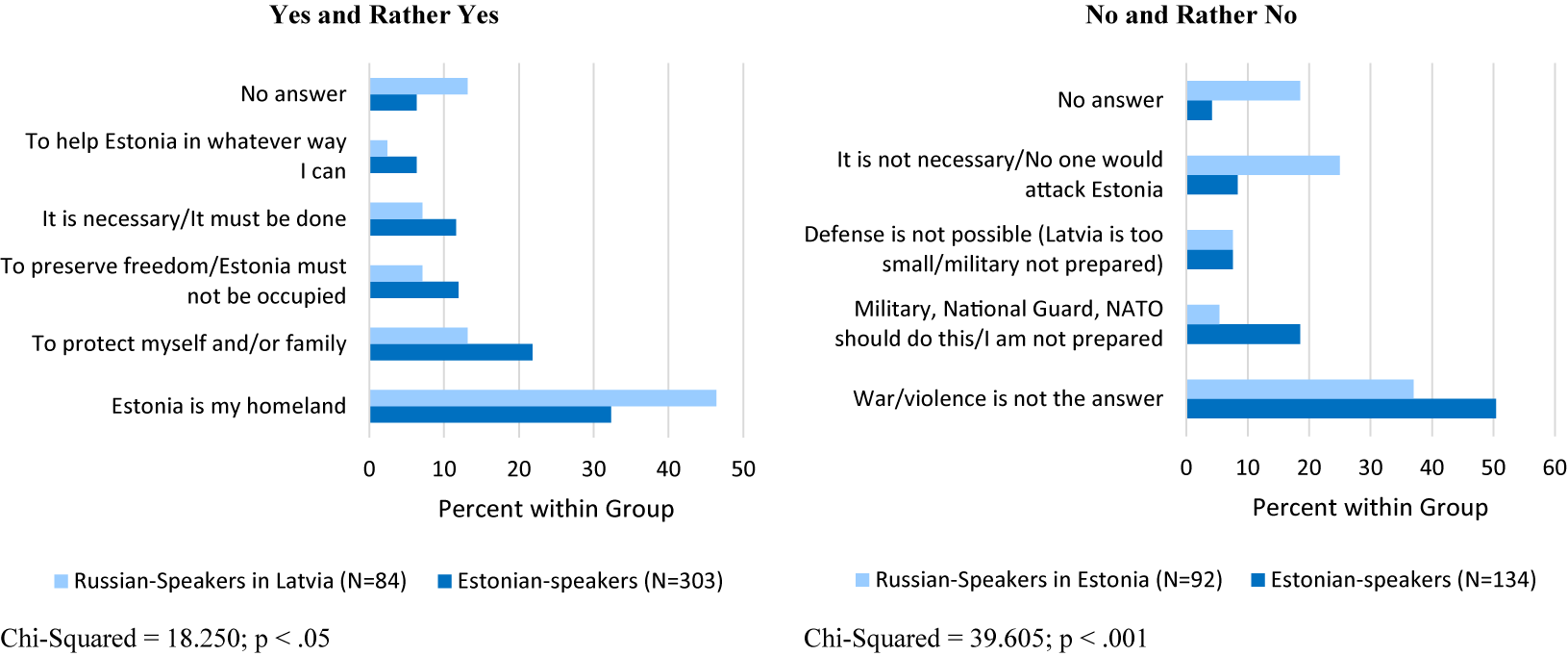
It is possible that Russian-speakers who are not supportive of active defense present a security concern for the state. Nevertheless, we are cautiously optimistic that negative responses are not necessarily indicative of disloyalty toward the state or a subversive agenda. An analysis of open-ended responses across language groups in both countries reveals that the most common reason for supporting the defense of the state is identification with the resident state as a homeland, followed by the need to protect oneself and family (Figures 1 and 2).Footnote 9 There is also considerable overlap in the reasoning for negative responses between titulars and Russian-speakers. The most common reasons for not supporting the active defense of the state are concerns about the utility of war and its consequences and concerns about the lack of knowledge, training, and capability to fight against an aggressor. Nevertheless, the possibility of subversive motivations cannot be entirely ruled out given that 18 percent of Russian-speakers declined to give a reason for their lack of support for active defense in Estonia. Furthermore, “hard to say” was the most popular response among Russian-speakers in both states and the survey did not ask respondents to explain that answer in an open-ended question. While a “fifth column” could be hiding within those numbers, it is important to note that substantial numbers of titulars in both states also answered negatively or declined to answer (Appendix B, Table 1).
Reasons Given for Support of Active Defense of the State in Latvia.
Data calculations completed by authors. 2020 dataset on the willingness to fight for one’s country. Funded by Riga Stradinš University, Latvia. Many thanks to Dr. Maris Andžans for sharing this data for the purposes of this research.

Reasons Given for Support of Active Defense of the State in Estonia.
Data calculations completed by authors. 2020 dataset on the willingness to fight for one’s country. Funded by Riga Stradinš University, Latvia. Many thanks to Dr. Maris Andžans for sharing this data for the purposes of this research.
Conclusion
The securitization of Russian-speakers in Estonia and Latvia has been a prominent feature of nation-building since these states regained their independence in 1991. This is not surprising considering Russia’s claims to be the protector of Russian-speakers stranded outside its borders after the Soviet collapse, the variety of hard and soft power tools that Russia has wielded to influence ethnopolitics in Estonia and Latvia, and the difficult historical legacies of Russian imperialism and Soviet occupation. In the years following the Russian-Georgia war in 2008, Russia’s annexation of Crimea in 2014, and, again, after Russia’s full-scale invasion in 2022, the loyalties of Russian-speakers to their resident state were questioned and they were framed as a potential threat to state security and national identity. However, securitization is always contested, and the ways in which minorities are securitized change over time in response to both international and domestic-level processes.
The frame-policy nexus facilitates a comparison of recent securitization with previous cycles through the application of a typology that accounts for whether policies are becoming more or less accommodating toward minorities, and whether Russian-speakers are framed as threatening or not in the justification of those policies. The utility of the frame-policy nexus is in the ability to map frame-policy patterns that are occurring simultaneously in the context of societal debates, and in the recognition that securitizing frames can be utilized in the service of more accommodating and less accommodating policies. While previous studies argue that Estonia and Latvia were diverging in significant ways with respect to minority accommodation in the post-accession period, the application of the frame-policy nexus to minority politics after Russia’s invasion of Ukraine reveals significant convergence around the politics of securitizing exclusion. Policies have become less accommodating to Russian-speakers in Estonia and Latvia following Russia’s invasion of Ukraine, including bans on Russian media and symbols of Russian aggression, the removal of Soviet monuments, and the transition to education only in the titular language. In Estonia, concerns over the loyalty of non-citizens have reignited debates over revoking voting rights for non-citizen residents at the local level. The requirements that Russian and Belarussian citizens “prove their loyalty” by passing a Latvian language test to continue residing in Latvia and that public media stop producing content in Russian are evidence of the deepening trend toward securitizing exclusion, which are important points of policy divergence from Estonia. Securitizing frames linking Russian-speakers to their support for Russia’s aggression, consumption of the Russian media, and cultural choices are used to present them as a potential security threat and to justify policies that raise the barriers to minority participation. However, education reforms in both countries are also partially justified by desecuritizing frames that emphasize minority integration. Desecuritizing frames that emphasize the loyalty of Russian-speakers that appeal to notions of appropriateness is also evident in other public debates, even if those frames have not moved policy in more accommodating directions. While the general thrust of policies has been in the direction of less minority accommodation and greater utilization of threat frames in the wake of Russia’s invasion of Ukraine in both countries, alternative frame-policy options may become more influential in response to domestic audiences or external pressures.
In contrast to previous cycles of securitization, minority mobilization against securitizing policies has been minimal. In both countries, Russian-speakers have lost faith in parties that have supported their interests, with significant numbers in both countries staying at home in the most recent national election, or voting for alternative parties. In Latvia, “Harmony,” the largest party in parliament since 2011, failed to cross the electoral threshold, with many Russian-speakers voting for “For Stability.” While such parties have largely played the role of the opposition at the national level, Russian-speaking parties have been influential in certain regions and municipalities. In Estonia, the mainstream “Centre Party,” which has carried the Russian-speaking vote since 2000, came in third in national elections in 2023, with significant numbers of Russian-speakers not turning out for the vote or voting for alternative parties in Tallinn and Ida-Virumaa. The removal of the Centre-led Tallinn City government in March 2024 in favor of one led by the Social Democratic Party, and the further fracturing of the Centre Party, raises questions of who will best represent Russian-speakers. The absence of large-scale demonstrations against securitizing policies can be explained by a number of factors, including the fact that some Russian-speakers may support those policies, while others fear being labeled “disloyal” and treated as a security threat. The latter is supported by public opinion polling data that shows increasing insecurity among Russian-speakers in both states in the period following Russia’s invasion of Ukraine.
Recent debates over securitization in both countries have taken place in the context of concerns over how Russian-speakers would behave in the case of external aggression against the state. Analysis of attitudes toward the defense of the state therefore provides one lens through which to evaluate recent securitization. Quantitative analysis of a 2020 survey points to significant differences between language communities in both states, with Russian-speakers less likely to support active defense. This could be indicative of a security threat; however, a closer examination of the reasoning behind those responses reveals important similarities between language groups and little evidence of disloyalty or a subversive agenda among the majority of Russian-speaking respondents.
The downsides of securitization for minority integration and interethnic relations should therefore be weighed carefully against the potential gains in security. On one side, supporters of recent policies argue that the introduction of legislation requiring the use of Estonian and Latvian in all schools, limiting the Russian media, outlawing controversial symbols of Russian aggression, and preventing those who are potentially disloyal from influencing politics could result in the greater cohesion of society over the longer term, which would, in turn, support the security of the state. On the other side, people warn of the exhaustion and resentment that being constantly asked to prove their loyalty creates within the Russian-speaking community, especially considering the diversity of views and ideological divisions among Russian-speakers. From this perspective, the state risks alienating Russian-speakers with hardly predictable implications for security. In between those two extremes are a variety of possibilities that include minority mobilization through democratic channels, as well as generational and regional variations in levels of minority integration. Continuing efforts to provide accurate information in the Russian language and to include Russian-speakers in discussions over both minority policy and the implications of Russia’s aggression might go a long way toward fostering social cohesion and shared understandings and preventing feelings of insecurity and alienation among Russian-speakers.
Supplementary material
The supplementary material for this article can be found at http://doi.org/10.1017/nps.2024.97.
Acknowledgements
We would like to thank Ellie Knott, Māris Andžāns, Sener Akturk, Matthius vom Hau, Vello Pettai, and Zsuzsa Csergo as well as anonymous reviewers for helpful feedback on earlier drafts. Juris Pupcenoks’ work on this article was partly funded by the Ministry of Education and Science of Latvia, project “Innovative and inclusive governance for the promotion of social involvement, trust, and communication” (Nr. VPPLETONIKA-2021/3-0004). He completed parts of the research during time spent on a fellowship at the Academy of International Affairs NRW in Bonn, Germany.
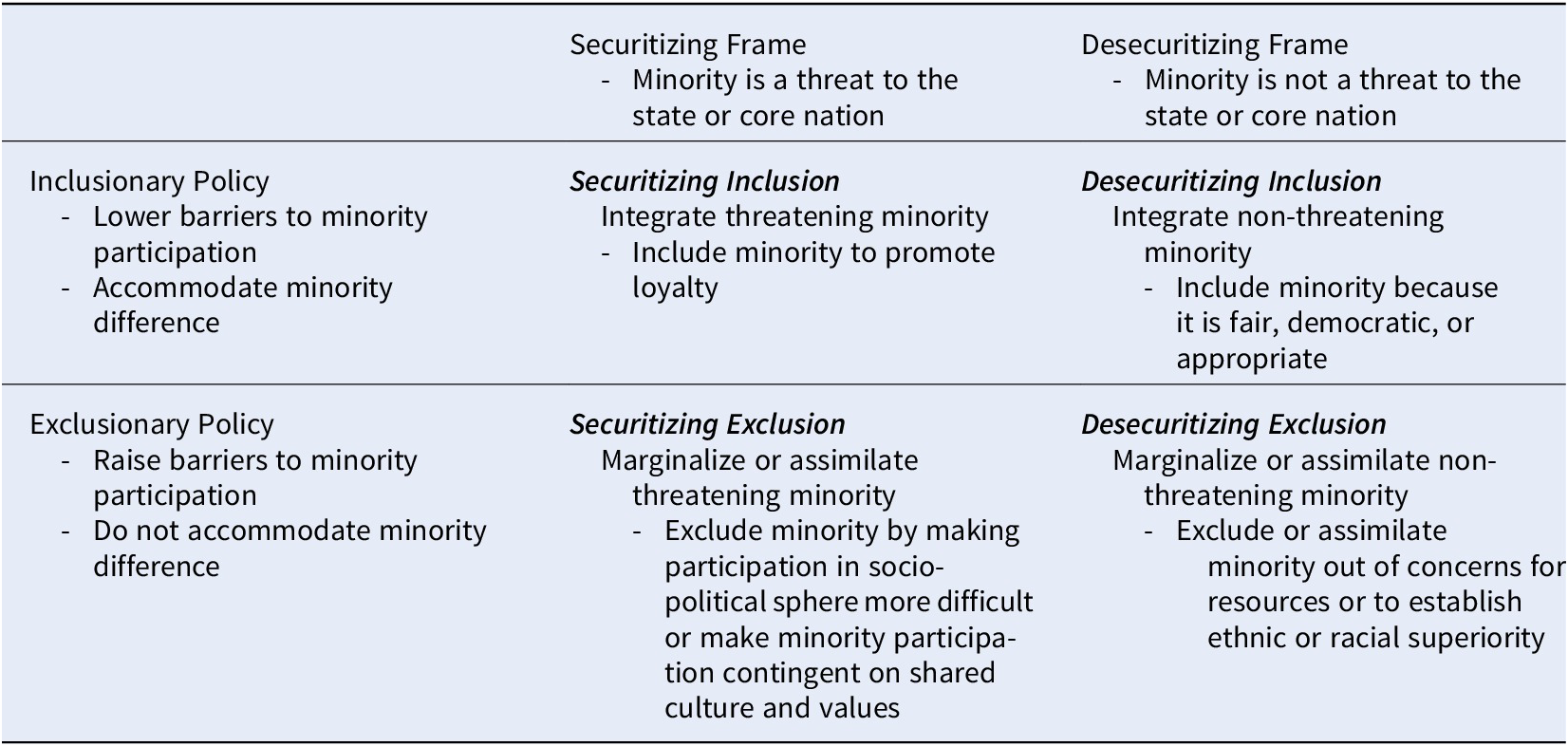
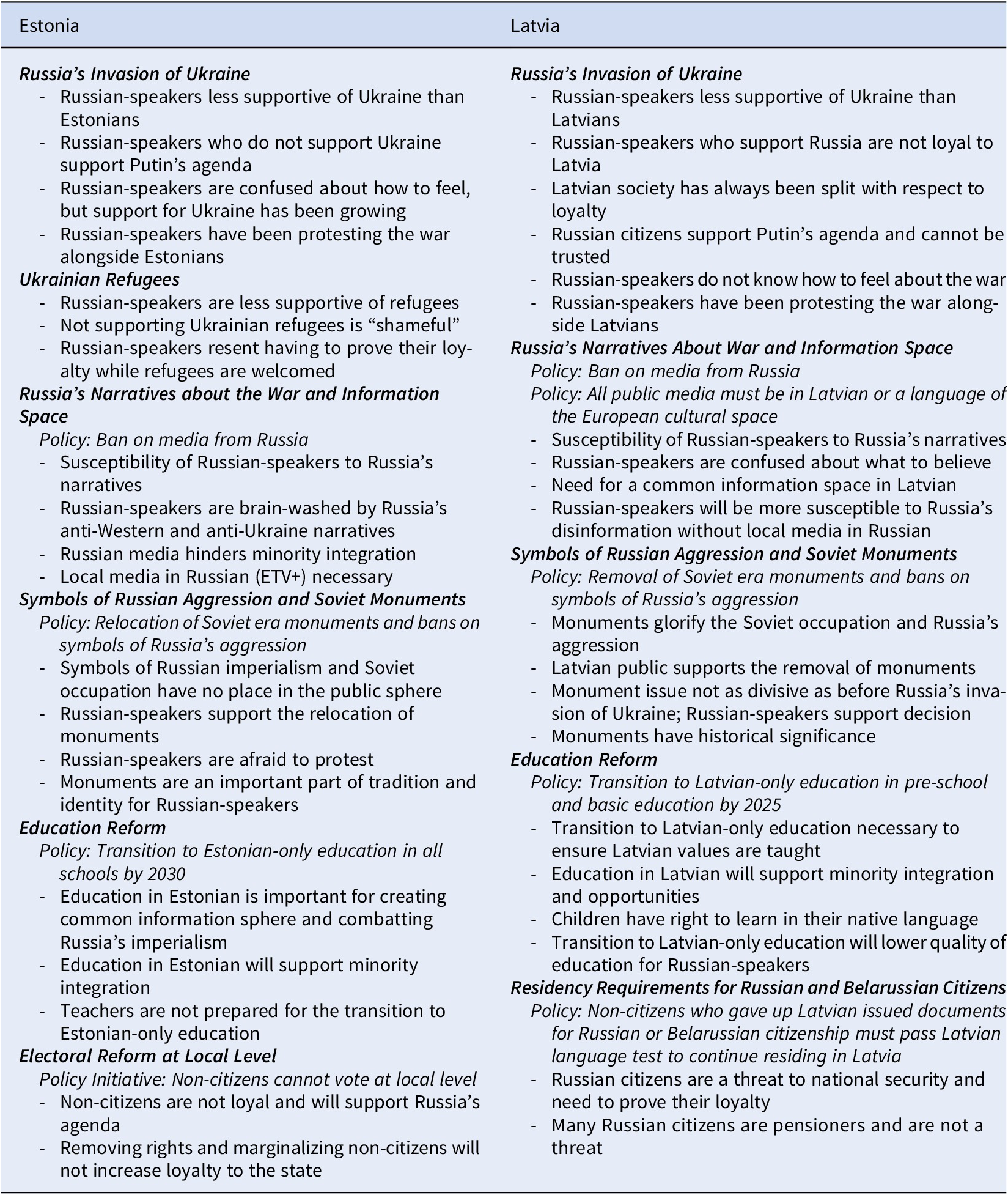
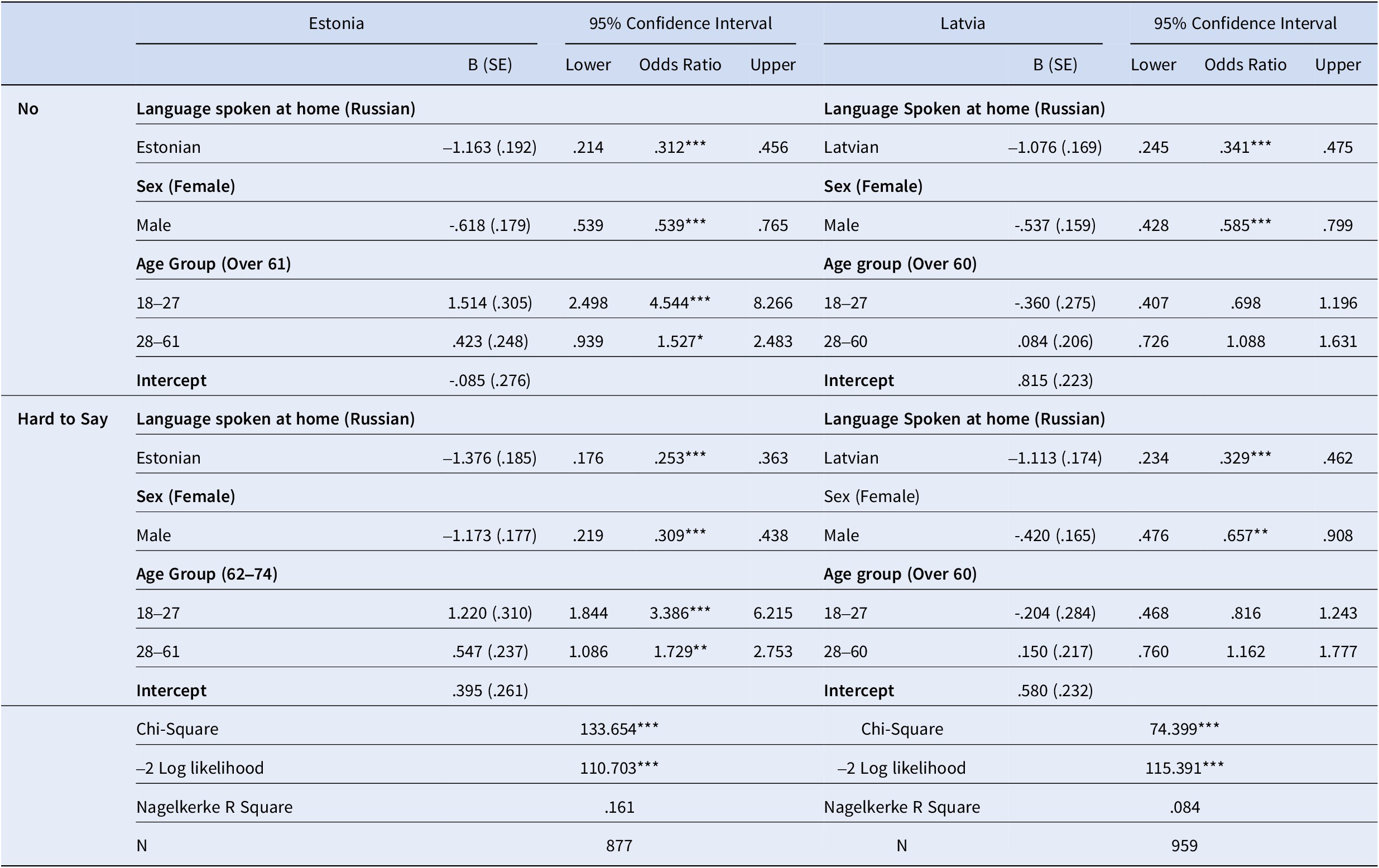
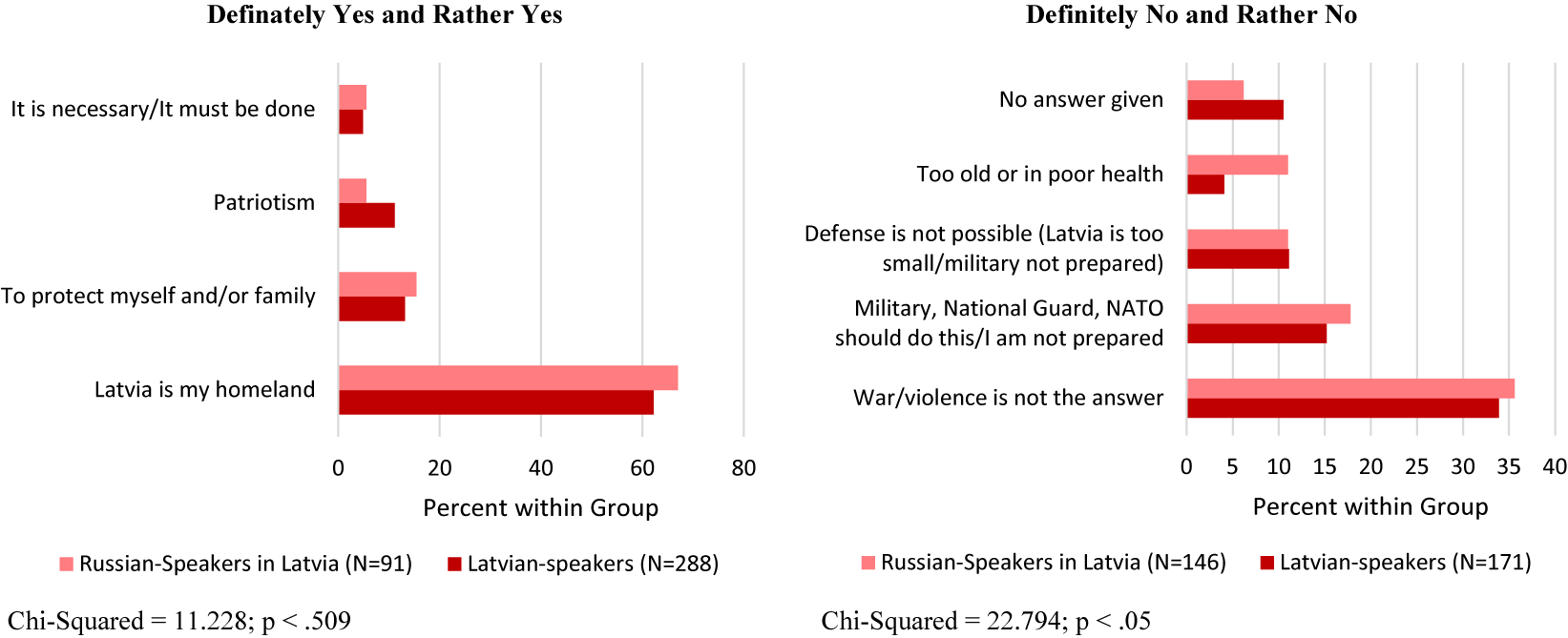
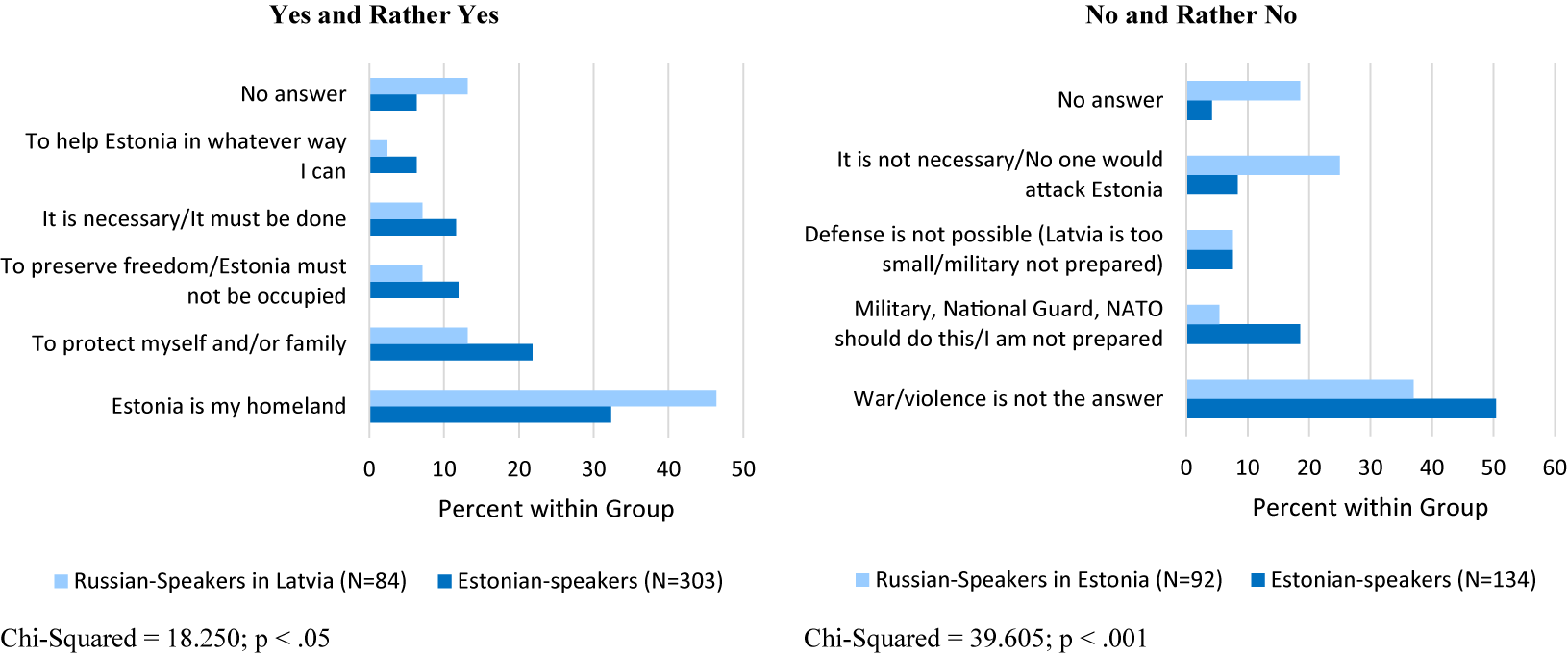


 Open access

