


Impact statement
This research holds significant implications for the effective implementation of the Global Plastics Treaty. The identified support for a National Plan or National Action Plan (NAP) based approach, surpassing 85% from participating countries, suggests a high likelihood of its adoption as the Treaty’s implementation mechanism. However, the study sheds light on a critical nuance: the current configuration of national plans which lack obligations under most multilateral environmental agreements (MEAs) may undermine their ability to achieve any ambitious targets set by the Treaty. By identifying six key enablers through interviews and literature reviews, the research offers practical pathways to enhance the impact of plastics NAPs. Integrating these enablers into the design of NAP-based approaches, either independently or as mandatory Treaty requirements, emerges as a primary recommendation. The potential impact of this research lies in its capacity to inform policy and decision-makers about the nuanced challenges associated with NAP-based approaches in the context of global plastic management. By advocating for strategic modifications, the study aims to contribute to the creation of more robust and impactful NAP-based approaches in MEAs, thereby fostering the successful implementation of the Global Plastics Treaty and advancing global efforts towards reducing plastic pollution.
Introduction
Plastics have become a staple material on a global scale, but overproduction has led to a major pollution crisis that is aggravating climate change, biodiversity loss, risks to human and public health, and compromising national development pathways (Borrelle et al., Reference Borrelle, Ringma, Law, Monnahan, Lebreton, McGivern, Murphy, Jambeck, Leonard, Hilleary, Eriksen, Possingham, De Frond, Gerber, Polidoro, Tahir, Bernard, Mallos, Barnes and Rochman2020; March et al., Reference March, Roberts and Fletcher2022; Walker, Reference Walker2022; UNEP, 2023a). Current policy approaches are failing to address the global scale of the problem and some predictions indicate that increased waste management capacity alone would be insufficient to keep pace with projected growth in plastic waste generation (Borrelle et al., Reference Borrelle, Ringma, Law, Monnahan, Lebreton, McGivern, Murphy, Jambeck, Leonard, Hilleary, Eriksen, Possingham, De Frond, Gerber, Polidoro, Tahir, Bernard, Mallos, Barnes and Rochman2020; UNEP, 2021). As such, there has been growing interest in how to address plastic pollution at a global level, across the plastics lifecycle, among the international community (Borrelle et al., Reference Borrelle, Ringma, Law, Monnahan, Lebreton, McGivern, Murphy, Jambeck, Leonard, Hilleary, Eriksen, Possingham, De Frond, Gerber, Polidoro, Tahir, Bernard, Mallos, Barnes and Rochman2020; Raubenheimer and Urho, Reference Raubenheimer and Urho2020; UNEP, 2021; Walker, Reference Walker2022). An overwhelming majority of governments and nongovernmental stakeholders have expressed their support for the establishment of a new legally binding global agreement to tackle plastic pollution (Raubenheimer and Urho, Reference Raubenheimer and Urho2020; March et al., Reference March, Roberts and Fletcher2022; Walker, Reference Walker2022).
During the 5th meeting of the United Nations Environment Assembly (UNEA) in March 2022, in Nairobi, Kenya, representatives from 175 nations proposed the first steps to enact the development of an international legally binding instrument on plastic pollution (the ‘Global Plastics Treaty’ or ‘the Treaty’ hereafter). To this end, the UNEA Resolution 5/14, ‘End Plastic Pollution: Towards a legally binding instrument’, has established an Intergovernmental Negotiating Committee (INC) to develop the specific content of the new Treaty (UNEP, 2022a, 2023a). Upon the agreement and adoption of the Treaty in late 2024 and mid-2025, respectively, the Treaty will be delivered nationally, to account for variation in development, economic, capacity and other contexts. Consequently, the need for effective policy at the national level is critical given the mandate to develop the Treaty which will require national-level action to deliver on its targets. What the Treaty will look like in terms of scope, structure and implementation mechanisms is still unclear at this stage (UNEP, 2023a). For example, there is much debate regarding whether the Treaty will adopt a stringent, well-defined set of requirements (similar to the Montreal Protocol on Ozone depleting substances), or a voluntary, national action plan (NAP) based approach (similar to the Nationally Determined Contributions (NDCs) with associated National Adaptation Plans of the Paris Climate Agreement).
NAPs are non-binding policy documents in which a government stipulates priorities and actions required to support the implementation of international, regional, or national obligations and commitments in a given policy area or topic. The current non-binding format of NAPs greatly dilutes their performance while being unable to guarantee effectiveness as they often rely on voluntary pledges and lack enforcement mechanisms (Ammendolia and Walker, Reference Ammendolia and Walker2022; Global Plastics Policy Centre, Reference March, Salam, Evans, Hilton and Fletcher2022). So far, NAPs have acted as catalysts for establishing multi-stakeholder coalitions, and for the achievement of broader agendas, such as the UN Sustainable Development Goals (SDGs) (Kim et al., Reference Kim, Smith, Mack, Cook, Furlow, Njinga and Cote2017; Wrzoncki, Reference Wrzoncki2017; Koser et al., Reference Koser, Osborne and Schumicky-Logan2020). NAP style approaches have also been employed in preexisting international or multilateral environmental agreements (MEAs) such as the Paris Climate Agreement and Stockholm Convention, to internalise international commitments into national law and policy, including planning processes, and to mobilise stakeholders for broad-based implementation (Raubenheimer and Urho, Reference Raubenheimer and Urho2020). It is important to note that there are various possible National Plan approaches to implementing a treaty which have notable differences to NAPs. One example is National Implementation Plans (NIPs) which focus on the methods by which a country will meet any obligations imposed by a treaty. Research suggests that while these approaches are commonly confused, they do have key differences and can be complementary to each other (CIEL, 2023). For the purposes of this study, while our research focussed on NAPs, many submissions and statements in interviews conflated various national plan approaches making it impossible to effectively separate them. For this reason, this article will use the term ‘NAP-based approaches’ when referring to implementation options for the Global Plastics Treaty.
Indeed, NAP-based approaches have also been identified as a possible implementation vehicle of the Treaty in the ‘Potential Options for Elements’ document (UNEP/PP/INC.2/4) prepared by the secretariat during the first session of the Intergovernmental Negotiating Committee (INC-1) in Uruguay, in 2022 (March et al., Reference March, Nieminen, Arora, Walker, Shejuti, Tsouza and Winton2023a). It has been proposed that the Treaty could take a similar approach to the Paris Agreement, which is driven by Nationally Determined Contributions (NDCs) with associated National Adaptation Plans. These, much like NAPs, are voluntary and non-binding in nature (Senathirajah et al., Reference Senathirajah, Bonner, Schuyler and Palanisami2023). The use of NAP-based approaches to deliver national commitments under the Treaty was also advocated by some parties during the second Intergovernmental Negotiating Committee (INC-2) in June 2023, although written submissions and verbal statements seemed to indicate that members and observers remain divided on this approach (March et al., Reference March, Nieminen, Arora, Walker, Shejuti, Tsouza and Winton2023a; UNEP, 2023b). The degree to which there is national support for NAP-based approaches as a means of implementing the Treaty is still unclear, despite the fact that the Zero Draft of the Treaty includes ‘National Plans’ (UNEP, 2023c, Section IV, p. 22). The Zero Draft acts as a ‘blueprint’ for the future Treaty, which includes the inputs from delegations in the INC process so far, synthesised by the INC Chair and Secretariat. At the time of this study, no official first draft of the Treaty exists, with only the revised Zero Draft which was published in December 2023 (UNEP/PP/INC.4/3, 2023). The revised zero draft includes reference to national [action] [implementation] plans in Part IV1. The use of square brackets throughout the document, a common practice in international negotiations, indicates areas where there is not yet consensus among parties. These brackets highlight the dynamic nature of the negotiation process, serving as placeholders for terms or provisions that are subject to change based on further discussions and agreements. In this instance, the choice between ‘action’ and ‘implementation’ in reference to national plans suggests ongoing debates about the extent of the obligations and the specificity of actions required from each party. The explicit reference to implementation plans in Part IV of the revised zero draft underscores a shift towards a more prescriptive and actionable framework if adopted.
Many governments have developed and implemented NAPs on various policy areas or topics, including but not limited to human rights; women’s rights, peace and security; renewable energy; cyber-security; and climate change (Wrzoncki, Reference Wrzoncki2017). In particular, climate change has received increasing attention over the past few years, and a type of NAP referred to as a national adaptation plan has been substantially developed to identify medium- and long-term adaptation needs in response to the climate crisis. Over 70 countries have adopted a national adaptation plan (Leiter, Reference Leiter2021; UNEP, 2022b). Regarding other policy areas, 105 countries have adopted a NAP on Women, Peace and Security (WPS) as of February 2023 (Women’s International League for Peace and Freedom (WILPF) Women, Peace and Security Programme, n.d.); 170 countries have developed NAPs on Antimicrobial Resistance as of November 2022, and an additional 38 were in the process of developing one as part of the Global Action Plan on Antimicrobial Resistance (WHO, 2022). Plastic pollution is another area that has seen increasing national action approaches with over 30 plastic-related NAPs produced to date (March et al., Reference March, Nieminen, Arora, Walker, Shejuti, Tsouza and Winton2023a). While these NAPs aim to tackle several plastics-related societal and environmental challenges, evidence indicates that some multilateral agreements relying on non-binding NAPs have been ineffective as they have not led to globally met targets (Raiser et al., Reference Raiser, Kornek, Flachsland and Lamb2020; Weikmans et al., Reference Weikmans, Asselt and Roberts2020). Moreover, most plastics-focused NAPs have been enacted in the past 6 years (March et al., Reference March, Nieminen, Arora, Walker, Shejuti, Tsouza and Winton2023a) and as a result, there is often limited evidence available to determine their effectiveness.
Given that NAPs have already been used in the context of addressing plastic pollution, as well as to address other global environmental problems (Wrzoncki, Reference Wrzoncki2017; Wu et al., Reference Wu, Walsh and Wu2021; March et al., Reference March, Nieminen, Arora, Walker, Shejuti, Tsouza and Winton2023a), the objectives of this article are to identity member state support for a NAP-based approach in the Treaty, uncover knowledge gaps about the effectiveness of NAPs (March et al., Reference March, Karasik, Roberts and Evans2023b), and to determine whether NAP-based approaches could be an appropriate solution for the implementation of the Treaty, should the outcomes of the negotiations favour a NAP based approach.
Most academic papers in the existing literature as of October 2023 focused on the performance of NAPs in one policy area, among which, few addressed plastic NAPs (Biesbroek et al., Reference Biesbroek, Swart, Carter, Cowan, Henrichs, Mela, Morecroft and Rey2010; Basini and Ryan, Reference Basini and Ryan2016; Reckien et al., Reference Reckien, Salvia, Heidrich, Church, Pietrapertosa, De Gregorio-Hurtado, D’Alonzo, Foley, Simoes, Krkoška Lorencová, Orru, Orru, Wejs, Flacke, Olazabal, Geneletti, Feliu, Vasilie, Nador, Krook-Riekkola, Matosovic, Fokaides, Ioannou, Flamos, Spyridaki, Balzan, Fülöp, Paspaldzhiev, Grafakos and Dawson2018; Drumond and Rebelo, Reference Drumond and Rebelo2020; Vincze et al., Reference Vincze, Hegedűsné Baranyai, Zsiborács, Csányi, Háber and Pintér2020; Chua et al., Reference Chua, Verma, Hsu and Legido-Quigley2021; Harant, Reference Harant2022; Carelli et al., Reference Carelli, Mitsouli, Ogne and Pierre2023; Shabangu et al., Reference Shabangu, Essack and Duma2023). In contrast, this article provides insight into their formulation and shared enablers and barriers of effective NAPs from a global perspective. The findings from this research can be used to inform the ongoing Treaty negotiations, and its implementation in the longer term (Raubenheimer and Urho, Reference Raubenheimer and Urho2020). Furthermore, these findings can be used at multiple scales (regional, subnational, national) to optimise the effectiveness of NAPs in plastics governance (Ferraro and Failler, Reference Ferraro and Failler2020).
This article describes the methodology used to gather and analyse data from Global Plastics Treaty documents for a NAP-based approach, including country and stakeholder submissions from INC-1 and INC-2, INC summaries by the Earth Negotiations Bulletin, and interviews from experts relevant to the process and outlines the limitations associated with this approach. Further, this article summarises findings from the literature review of previous NAPs targeting plastic pollution, antimicrobial resistance, and pre-existing multilateral agreements that rely on NAPs to deliver national commitments. Additionally, findings from the analysis offer evidence supporting the use of NAP-based approaches for the Treaty in relation to meetings of the INC. This article also explores the range of possibilities and implications associated with the use of NAP-based approaches for the global governance of plastic pollution. Finally, concluding remarks regarding the deliberations on the use of NAPs to achieve national targets under the Treaty, the key actors, who should be involved, and future research questions based on the findings introduced in this article are discussed.
Methods
This study synthesised and analysed evidence using qualitative data analysis methods including content analysis, narrative analysis, and discourse analysis. Evidence was gathered from 25 scientific articles; 172 stakeholder submissions to the INC Secretariat ahead of INC-2, as well as 60 nations and seven international grouping submissions (UNEP, 2023b); analysis of written and verbal statements made during INC-1 (Kantai et al., Reference Kantai, Hovden and Pinto-Bazurco2022a, Reference Kantai, Hovden and Pinto-Bazurco2022b, Reference Kantai, Hovden and Pinto-Bazurco2022c, Reference Kantai, Hovden and Pinto-Bazurco2022d, Reference Kantai, Hovden and Pinto-Bazurco2022e); and qualitative analysis of 10 interviews with experts and actors directly involved in the negotiations process.
For the purposes of this research, barriers that emerged through data collection were addressed as the inverse of enablers to allow for easier analysis and to prevent duplication and mirroring effects. Where enablers act as factors that can aid, drive and support the implementation or design of a policy, and barriers as factors that could impede or block that process. It is therefore difficult to isolate particular factors as driving or hindering the implementation of a policy approach (Burch, Reference Burch2010), as enablers and barriers act within a dynamic and closely interconnected context (OECD, 2009). Furthermore, some factors can act as both a barrier and enabler simultaneously (Azmat, Reference Azmat2013; Ocloo et al., Reference Ocloo, Garfield, Franklin and Dawson2021).
Literature review of previous NAP-based approaches
Evaluations of plastic NAPs were directly retrieved from the Global Plastics Policy Centre database (Global Plastics Policy Centre, Reference March, Salam, Evans, Hilton and Fletcher2023), and for the review of NAP-based approaches in different policy areas, evidence was obtained from the published literature according to its availability, spanning 15 years from 2009 to end of 2023. Multiple databases were searched to ensure full coverage of the published evidence, including Science Direct, Scopus, Google, and Google Scholar. Careful consideration was given to the choice of keywords and the design of each search to ensure it was as focused as possible. For instance, searches included a combination of the terms ‘national’, ‘action’, ‘adaptation’, ‘plan’, ‘NAP’, ‘plastics’, and ‘implementation plans’, alongside the names of key actors involved in the development of the Treaty. The abstract, introduction and conclusions of the papers were screened according to the keywords, and if they were found relevant, the whole document was read and analysed.
Analysis of Global Plastics Treaty documents for a NAP-based approach
Support for NAP-based approaches was investigated in the submissions from 172 stakeholders, 60 nations, and seven international groupings put forward to the INC Secretariat ahead of INC-2 (UNEP, 2023a). Country submissions were categorised into high income countries (HIC), upper-middle income countries (UMIC), lower-middle income countries (LMIC) and low-income countries (LIC) according to the World Bank classifications. Unclassified groups incorporated country groups and alliances including the European Union, the State of Palestine, the Alliance of Small Island States (AOSIS) and the Group of African States, and The Group of Latin America and Caribbean Countries (GRULAC) that could not be given a singular income classification. Submissions from 17 HIC, 20 UMIC, 16 LMIC, 7 LIC, and 7 unclassified groups were investigated. The contents of individual country submissions were analysed for any mentions of NAP-based approaches, and any suggestions, considerations or comments on their application, enablers, or challenges. These were extracted and documented in a Microsoft Excel spreadsheet to determine whether the country or country grouping was in favour or against a NAP-based approach, if the position was neutral, or if not mentioned at all.
Submissions from 172 stakeholders were analysed for any mention of NAP-based approaches, including any suggestions, considerations or comments on their application, enablers, or barriers. These were compiled into a Microsoft Excel spreadsheet. Submissions not mentioning NAP-based approaches (74 out of 172) were excluded from further analysis. Suggestions or comments extracted from submissions were categorised into themes. A total of 21 common enablers were identified from the remaining 98 submissions mentioning NAP-based approaches. The frequency that each categorised enabler was mentioned across 172 submissions was tallied (count of 1 mention per submission per enabler) to quantify the level of support for said enabler. The eight enablers with the highest frequency of mentions were selected for further analysis to compare with other data sources (interviews, support statements at INC-1, and literature review). Statements made during INC-1, where more than 2,300 delegates from 160 countries and stakeholder groups participated, were also examined using the Earth Negotiations Bulletin summaries of statements (Kantai et al., Reference Kantai, Hovden and Pinto-Bazurco2022a, Reference Kantai, Hovden and Pinto-Bazurco2022b, Reference Kantai, Hovden and Pinto-Bazurco2022c, Reference Kantai, Hovden and Pinto-Bazurco2022d, Reference Kantai, Hovden and Pinto-Bazurco2022e). Statements from all the sessions were analysed to determine if national delegations were in favour, against or had no preferences regarding NAP-based approaches. For this purpose, statements that highlighted potential benefits of NAP-based approaches were classified as in favour, while statements that held no clear opinion, judgement or that focused on NAP-based approaches requirements were considered inconclusive.
Interviews
Interviews (n = 21) were conducted in the month that followed INC-1 and INC-2 remotely with a panel of actors directly engaged in the Treaty development process. The inclusion criteria for participants included (1) participation in, or observation of INC meetings directly or indirectly; (2) availability and willingness to participate in an interview; (3) experience of national or international plastics policy, plastics management, or general international policy; and (4) the participant must speak English, Afrikaans, French, or Finnish as those represent the languages spoken by the interviewers. No exclusion criteria were deemed essential as a breadth of experience or technical expertise was pursued to achieve a balanced panel composition (Table 1). Consent was obtained from all research participants prior to conducting and recording the interviews (University of Portsmouth Ethics Committee, Reference Number SHFEC 2022-089). Post-recording protocol with the transcripts included anonymisation and interviewee review prior to analysis.
Case attributes of interviewed experts after INC-1 and INC-2
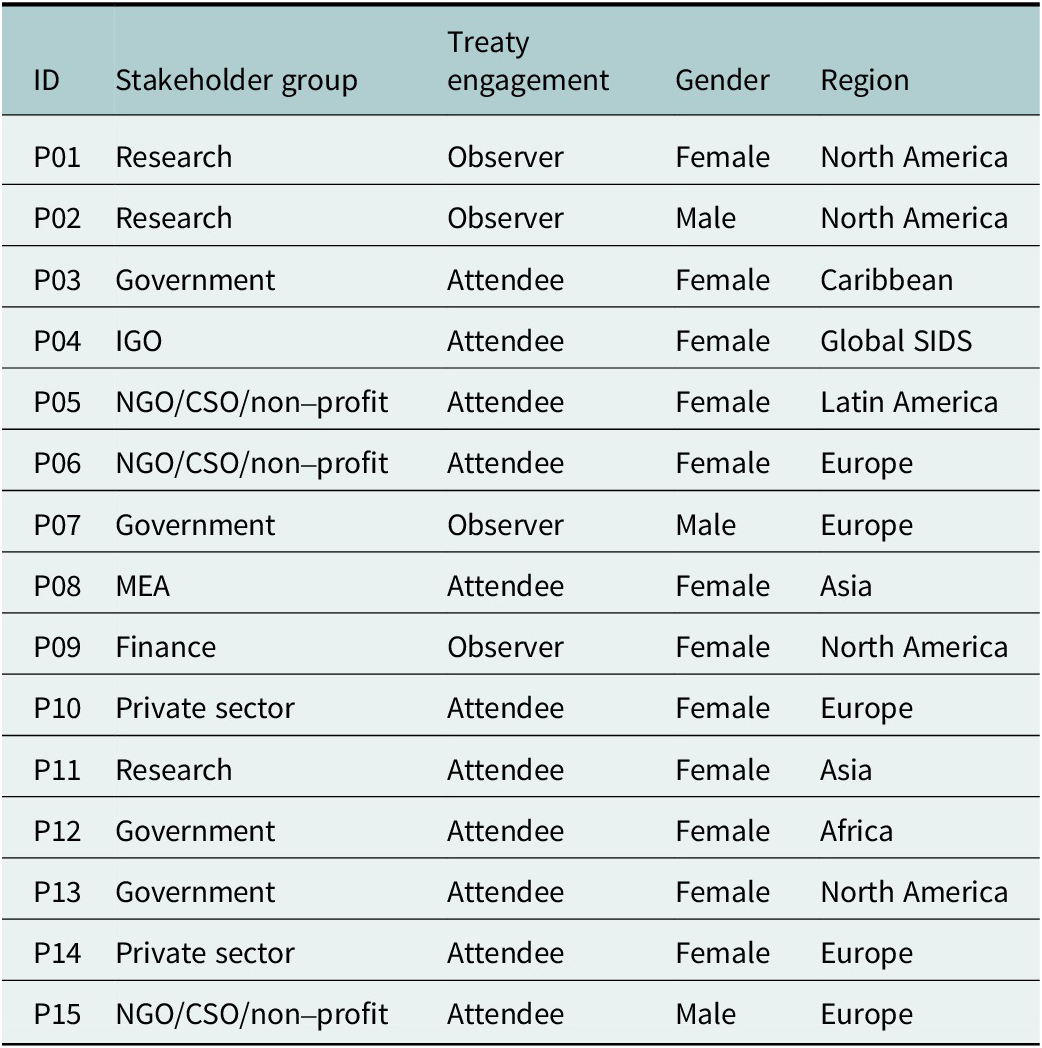
CSO, civil society organisation; IGO, intergovernmental organisation; MEA, multilateral environmental agreement; NGO, non-governmental organisation; Non-profit, non-profit organisation.
A semi-structured interview approach was adopted in which interviewees could raise any topic relevant to the Treaty. Discussions were interactive and the interviewees were asked to clarify their viewpoints when required. At least two researchers were present in each interview. The questions relevant to NAP-based approaches addressed the following aspects: the characterisation of the current plastics policy landscape and perceived effectiveness, the suitability of NAP-based approaches to different country contexts, the potential effectiveness of a NAP-based approach, and barriers to the NAP-based approach. Participants were also asked to elaborate further on the mechanisms that would be required at the international level for a NAP-based approach, including to avoid countries leaning towards the lowest common denominator. Due to the ongoing Treaty interview process, the relevant data (i.e. information, perspectives, opinions, or experience of NAP-based approaches either in general or in a specific context) occurring in the transcripts so far were the main foci, and these were transferred onto an Excel spreadsheet for further analysis and quote extraction.
Limitations
This study recognises limitations associated with the methods, approach and availability of information and data. The sample size for the literature analysis was largely determined by the availability of published literature in English. Translations of policy documents and evidence were used when available. Furthermore, this study acts as a snapshot in an ongoing process for INC negotiations and therefore only includes submissions and statements made by countries or other stakeholders up until the end of INC-2. The authors also recognise that since INC-3 and the publication of the Zero Draft text in September 2023, there may have been novel comments, opinions, or statements from countries or other stakeholders regarding NAPs, which will require future analysis that this article was not able to include.
The lack of previous studies about plastic NAP-based approaches and their role in plastic governance presented a limitation, as the vast majority of NAP-based approaches target antimicrobial resistance (AMR), climate change, WPS and other policy areas, rather than plastic pollution. Among the nationally led plastics NAPs independent of any MEA that have been published, only a relatively small number have been reviewed in the literature for their effectiveness, especially with a strong enough evidence base to make conclusions with high certainty (Global Plastics Policy Centre, Reference March, Salam, Evans, Hilton and Fletcher2022). Overall, limited evidence is available to determine whether NAP-based approaches have the potential to curb nation-specific plastic pollution (see Global Plastics Policy Centre, Reference March, Salam, Evans, Hilton and Fletcher2022 for evidence gaps in existing plastics NAPs) or contribute to global action for plastic pollution. In recognition of those considerations, evidence from other preexisting multilateral agreements and policy areas using NAP-based approaches was analysed to support the evidence base for NAP-based approaches in the literature.
Another limitation arose from the geographical spread of the non-state stakeholder submissions, whereby regions considered as higher income comprised the majority of those submissions, with marginal representation by regions with less resources and generally greater negative impacts from plastic pollution.
This study adopts an approach where enablers and barriers of effective policy are inverse of one another. The meaning of enablers can significantly vary depending on contextual differences such as the region, the political situation, economic context, or legal and governance infrastructure. Some enablers in one area can be perceived as barriers. For instance, in international agreement terms, NAP-based approaches can provide flexibility by allowing Member States to choose the most suitable options for their political and economic framework (European Commission, n.d.) acting as an enabler. On the other hand, some authors believe that flexibility or the varying levels of implementation among countries can be a barrier to effectively implement the targets of an international agreement (Pfohman, Reference Pfohman2022; Charani et al., Reference Charani, Mendelson, Pallett, Ahmad, Mpundu, Mbamalu, Bonaconsa, Nampoothiri, Singh, Peiffer-Smadja, Anton-Vazquez, LSP, Schouten, Kostyanev, Vlahović-Palčevski, Kofteridis, Corrêa and Holmes2023). This study has therefore adopted barriers and enablers as inverse of one another. However, in other instances, a barrier might exist that does not necessarily have an inverse that exists as an enabler, such as corruption for example.
Results
Literature review findings: Previous applications and enablers of NAPs
By conducting a literature search for effectiveness and enablers of NAP-based approaches in various MEAs, those for the Paris Climate Agreement, Stockholm Convention on hazardous chemicals and waste, and the Minamata Convention on Mercury yielded the most robust results. These NAP-based approaches, in combination with reviews of enablers for AMR and plastics NAPs, present both common and unique enablers to their effectiveness (Table 2).
Key enablers of NAPs and NAP-based approaches used in multilateral agreements and national approaches including the Paris Agreement, the Stockholm Convention, the Minamata Convention, national plastics NAPs, and AMR NAPs, as recommended by the existing literature
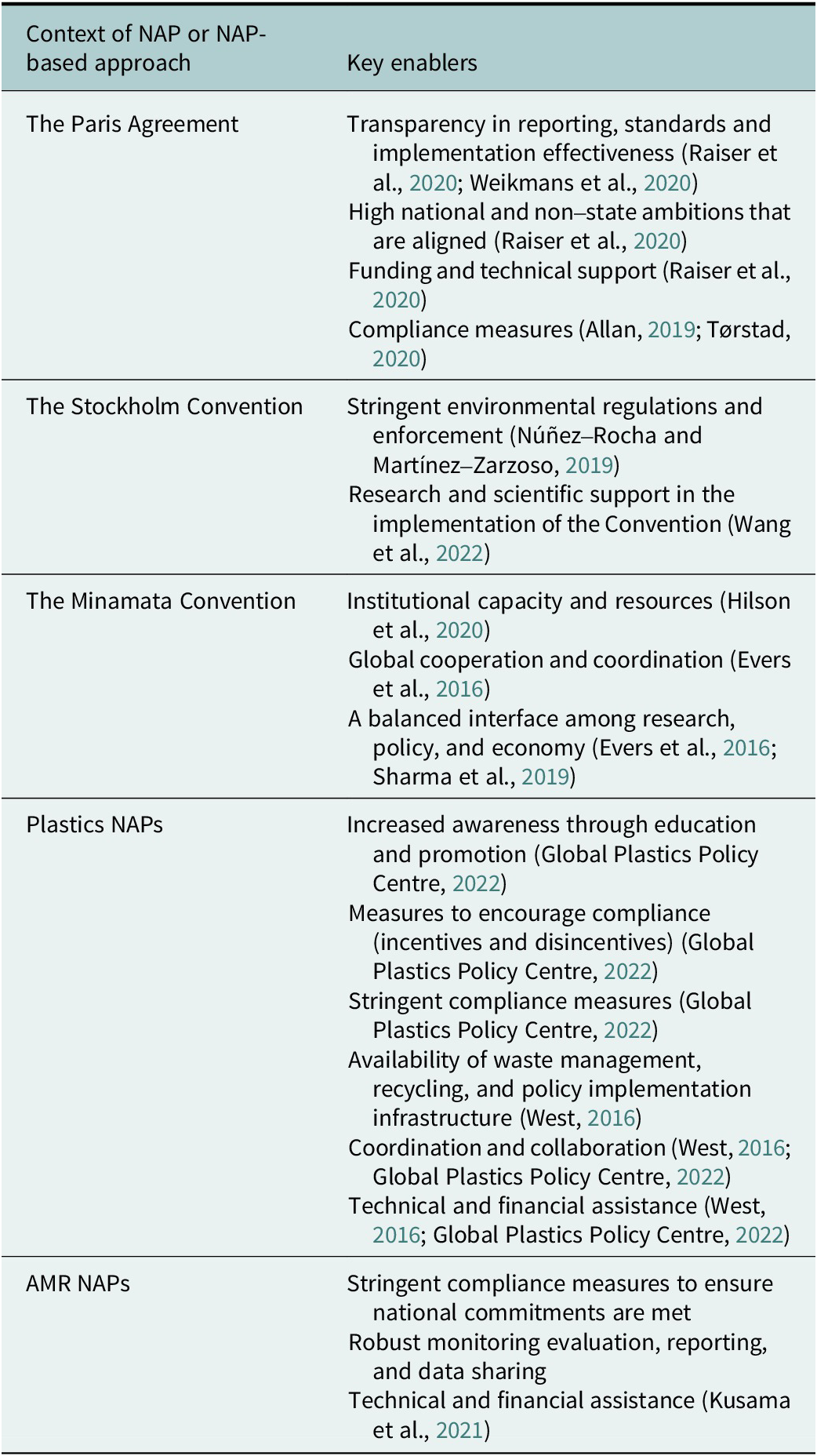
The Paris Agreement, which aims to hold ‘the increase in the global average temperature to well below 2 °C above pre-industrial levels’ and pursue efforts ‘to limit the temperature increase to 1.5 °C above pre-industrial levels’ (United Nations Climate Change, 2015), requires that all signatories set their own targets with NDCs, and develop and implement national adaptation plans. Predictions suggest that ‘as of yet, there is no consensus on whether the Paris Agreement will be effective’ (Raiser et al., Reference Raiser, Kornek, Flachsland and Lamb2020, p. 13), and that the NDCs have not been effective at maintaining Earth’s temperature within the limits set by the Agreement (Benvegnu, Reference Benvegnu2022). The majority of the published literature consists of mixed results, citing a variety of enablers and barriers affecting the Paris Agreement’s effectiveness. The barriers cited tend to be communicated more frequently, indicating that in its current state, the Paris Agreement is unlikely to meet its designated targets (Raiser et al., Reference Raiser, Kornek, Flachsland and Lamb2020). The most widely reported barriers to NAP-based approach of the Paris Agreement being effective: lack of transparency (Raiser et al., Reference Raiser, Kornek, Flachsland and Lamb2020; Weikmans et al., Reference Weikmans, Asselt and Roberts2020); weak compliance measures (Allan, Reference Allan2019; Tørstad, Reference Tørstad2020); lack of ambitious national and non-state climate actions to achieve the targets set in the agreement (Raiser et al., Reference Raiser, Kornek, Flachsland and Lamb2020); and lack of funding for implementation of the NAP (Raiser et al., Reference Raiser, Kornek, Flachsland and Lamb2020).
The Stockholm Convention aims to protect human health and the environment from hazardous chemicals and wastes. Under this convention, new parties are required to enact its implementation through the development of NAPs. The literature search identified that the Stockholm Convention has been relatively effective in reducing trade in hazardous chemicals and persistent organic pollutants (Núñez-Rocha and Martínez-Zarzoso, Reference Núñez-Rocha and Martínez-Zarzoso2019). Núñez-Rocha and Martínez-Zarzoso (Reference Núñez-Rocha and Martínez-Zarzoso2019) conclude that the enactment of the Stockholm Convention leads to a reduction in the trade of hazardous substances from the Organisation for Economic Co-operation and Development (OECD) countries to non-OECD countries, and that key enablers include stringent environmental regulations and enforcement. However, it is important to note for the purpose of this article, that the mandate of the Stockholm Convention is insufficient to regulate plastics-associated chemicals throughout their full life cycle and that the Treaty will need to address those gaps, while complementing the Stockholm and other MEAs, while avoiding duplication. Wang et al. (Reference Wang, Adu-Kumi, Diamond, Guardans, Harner, Harte, Kajiwara, Klánová, Liu, Moreira, Muir, Suzuki, Pinas, Seppälä, Weber and Yuan2022) highlight the role of research and scientific support in the implementation of the Convention, and that the low technical and financial capacity of low- and middle-income countries remains a barrier to successful implementation of the associated requirements of the Convention (Wang et al., Reference Wang, Adu-Kumi, Diamond, Guardans, Harner, Harte, Kajiwara, Klánová, Liu, Moreira, Muir, Suzuki, Pinas, Seppälä, Weber and Yuan2022).
Hilson et al. (Reference Hilson, Hu and Kumah2020) in their review of the effectiveness of the implementation of the Ghana NAP for the Minamata Convention identified that the institutional capacity and resources, expertise and commitment required ‘to capture the level of detail the Minamata Secretariat expects to be included in each NAP’ are lacking (Hilson et al., Reference Hilson, Hu and Kumah2020). Despite incorporating provisions for technical assistance and capacity building, especially aimed at developing countries and those undergoing economic transitions (Evers et al., Reference Evers, Keane, Basu and Buck2016), the effective implementation of the Convention faces significant barriers in developing regions (Sharma et al., Reference Sharma, Bharat, Šebková and Scheringer2019; Hilson et al., Reference Hilson, Hu and Kumah2020). Barriers are particularly evident in countries with substantial contributions to global mercury emissions, notably China and India (Sharma et al., Reference Sharma, Bharat, Šebková and Scheringer2019), and include the assessment of effectiveness through specific metrics and accurate data, as well as the need for global cooperation and coordination (Evers et al., Reference Evers, Keane, Basu and Buck2016). Other findings highlight the importance of having ‘a balanced interface among research, policy, and economy’ to implement a NAP successfully (Evers et al., Reference Evers, Keane, Basu and Buck2016; Sharma et al., Reference Sharma, Bharat, Šebková and Scheringer2019). This balance would ensure that policy formulation is grounded in the best available scientific and economic knowledge.
When looking at reviews of the effectiveness of AMR NAPs, Charani et al. (Reference Charani, Mendelson, Pallett, Ahmad, Mpundu, Mbamalu, Bonaconsa, Nampoothiri, Singh, Peiffer-Smadja, Anton-Vazquez, LSP, Schouten, Kostyanev, Vlahović-Palčevski, Kofteridis, Corrêa and Holmes2023) examined the gaps and potential opportunities to improve existing NAPs for antimicrobial resistance as part of the Global Action Plan on AMR. The authors performed NAP analysis using 108 NAPs, 39% from HICs, 46% from LMICs, and 15% from least-developed countries. Key findings revealed that the main barriers related to policy and strategic planning domain included: scarce evidence of political commitment and mechanisms to mobilise plans; lack of rationale for use or not of legislation to support NAP objectives; lack of governance of NAP delivery; lack of defined mechanisms for achieving sustained surveillance; and ineffective or complete absence of data sharing with policymakers and managers. Similar studies have also highlighted the lack of accountability and transparency in addition to the lack of feedback mechanisms to monitor NAP progress; and the lack of resource mobilisation for research activities and sustainability of AMR plans as barriers to NAP implementation (Chua et al., Reference Chua, Verma, Hsu and Legido-Quigley2021; Frumence et al., Reference Frumence, Mboera, Sindato, Katale, Kimera, Metta, Durrance-Bagale, Jung, Mshana, Clark, Rweyemamu, Legido-Quigley and Matee2021). Other studies have focused on enabling factors of effective NAPs. Kusama et al. (Reference Kusama, Tsuzuki, Muraki, Koizumi, Ishikane and Ohmagari2021) examined the impact of the Japanese National Action Plan on Antimicrobial Resistance (AMR) on antimicrobial use (AMU) (2016–2020). Results from the study demonstrated that the publication of the NAP was associated with an AMU reduction in antimicrobials, and that the plan resulted in both an immediate and accelerated reduction in antimicrobial use (Kusama et al., Reference Kusama, Tsuzuki, Muraki, Koizumi, Ishikane and Ohmagari2021). The main factors that contributed to the achievement of these results were stringent compliance measures to ensure national commitments, robust monitoring evaluation, reporting and data sharing, and technical and financial assistance.
In terms of plastic-specific NAPs, there is limited existing literature available that identifies their effectiveness, partly due to their recent adoption, where most NAPs were introduced in 2017 (Global Plastics Policy Centre, Reference March, Salam, Evans, Hilton and Fletcher2022). Another gap on the effectiveness of NAPs lies in the availability of published and impartial evaluations from all country income classifications: of the NAPs reviewed by the Global Plastics Policy Centre (Reference March, Salam, Evans, Hilton and Fletcher2022), seven out of nine of the evaluations were from HICs, while the remaining two were from LMICs. In a review of the Belgian Action Plan on Marine Litter introduced in 2017, the Global Plastics Policy Centre (Reference March, Salam, Evans, Hilton and Fletcher2022) identified key enablers that contributed to its success include increased public and stakeholder awareness through education and promotion of the NAP, as well as legally binding and stringent measures to encourage compliance (in this instance, through incentives). One of the key outcomes of the Belgian NAP was the introduction of ‘Fishing for Waste’ in which fishermen collect waste in big bags, which 98% of ports can receive and send for recycling. The ‘Fishing for Waste’ has since been adopted in other countries due to its success in Belgium (Arroyo Schnell et al., Reference Arroyo Schnell, Klein, Gómez Girón and Sousa2017; Mengo, Reference Mengo2017; Lazarus, Reference Lazarus2021). On the other hand, NAPs that were considered to be relatively ineffective such as the Australian Threat Abatement Plan for the impacts of marine debris on vertebrate marine life (2009) were inhibited by barriers such as the lack of stringent compliance measures, the lack of waste management and new policy infrastructure, the lack of coordination between states, and the lack of technical and financial assistance (West, Reference West2016; Global Plastics Policy Centre, Reference March, Salam, Evans, Hilton and Fletcher2022). In 2015, the Australian Government declared the plan a failure (Parliament of Australia, n.d.; West, Reference West2016). Efficient information gathering, monitoring and reporting is another key enabler for plastic NAPs, as demonstrated by the Vietnamese National Action Plan for Management of Marine Plastic Litter by 2030 (2020) whose centralised marine plastic database has significantly contributed to achieving some of the plan’s objectives for managing marine plastic debris (Walker et al., Reference Walker, McGuinty and Hickman2021). Other enablers identified by the Global Plastics Policy Centre (Reference March, Salam, Evans, Hilton and Fletcher2022) for NAP approaches include adaptability and updates, as well as sustainable financing mechanisms to support the NAPs delivery. The enablers mentioned across policy areas or are mentioned at least twice, include stringent measures, financial assistance, transparency, data sharing, and compliance mechanisms.
Global plastics treaty inputs: Submissions and interviews
Analysis of evidence from the first and second rounds of negotiations of the Treaty (INC-1 and INC-2) are discussed. First, enablers and support for NAP-based approaches are synthesised from the national country and stakeholder submissions to the INC secretariat (n = 172). Second, the enablers identified through 15 interviews with experts and actors in the Treaty process are presented.
INC statements and submissions analysis
This section presents the results from an analysis of evidence for and against the use of NAP-based approaches in verbal statements made during INC-1 (reports from Kantai et al., Reference Kantai, Hovden and Pinto-Bazurco2022a, Reference Kantai, Hovden and Pinto-Bazurco2022b, Reference Kantai, Hovden and Pinto-Bazurco2022c, Reference Kantai, Hovden and Pinto-Bazurco2022d, Reference Kantai, Hovden and Pinto-Bazurco2022e) and written submissions from 60 nations, seven international groupings, and stakeholders during INC-2 (to the INC Secretariat, UNEP, 2023b). Results of the analysis of verbal statements made during INC-1 (Kantai et al., Reference Kantai, Hovden and Pinto-Bazurco2022a, Reference Kantai, Hovden and Pinto-Bazurco2022b, Reference Kantai, Hovden and Pinto-Bazurco2022c, Reference Kantai, Hovden and Pinto-Bazurco2022d, Reference Kantai, Hovden and Pinto-Bazurco2022e) indicate clear support for NAP-based approaches in 23 statements, caution was expressed in three statements, and no mention (or thus opinion) of NAP-based approaches in 75 statements (Table 3).
Number of national or country groups’ verbal statements expressing support for NAP-based approaches from INC-1 (Kantai et al., Reference Kantai, Hovden and Pinto-Bazurco2022a, Reference Kantai, Hovden and Pinto-Bazurco2022b, Reference Kantai, Hovden and Pinto-Bazurco2022c, Reference Kantai, Hovden and Pinto-Bazurco2022d, Reference Kantai, Hovden and Pinto-Bazurco2022e)
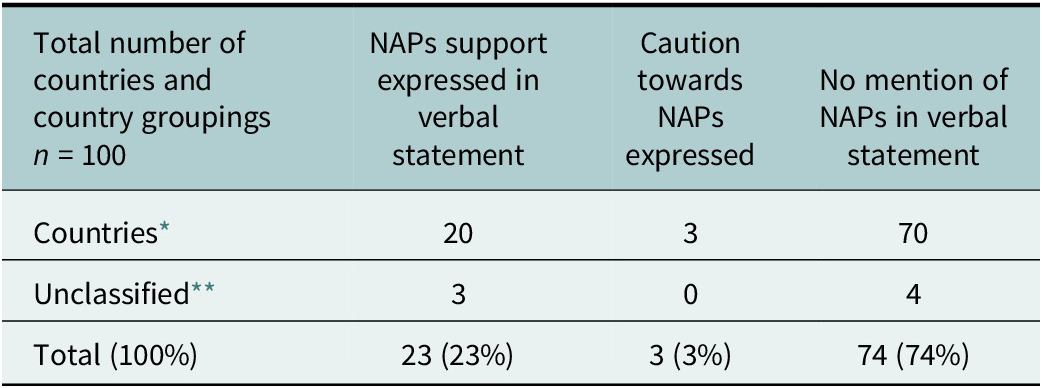
* Algeria, Antigua and Barbuda, Angola, Argentina, Armenia, Australia, Azerbaijan, Bangladesh, Bahrain, Brazil, Burkina Faso, Canada, Cameroon, Cuba, Colombia, Cook Islands, Congo, Costa Rica, Chile, China, Democratic Republic of Congo, Dominican Republic, Ecuador, Egypt, Equatorial Guinea, Eritrea, Eswatini, Federated States of Micronesia, Fiji, France, Gabon, Georgia, Ghana, Guinea, Iceland, India, Indonesia, Iran, Israel, Japan, Jordan, Kiribati, Kenya, Libya, Malawi, Maldives, Malaysia, Mali, Mexico, Monaco, Mongolia, Montenegro, Morocco, Mozambique, Nepal, New Zealand, Nigeria, Norway, Pakistan, Palau, Panama, Papua New Guinea, Peru, Qatar, Republic of Korea, Russian Federation, Rwanda, Saint Lucia, Saudi Arabia, Senegal, Singapore, South Africa, Sri Lanka, Sudan, Switzerland, Syria, Tanzania, Thailand, The Philippines, Togo, Tonga, Trinidad and Tobago, Turkey, Tuvalu, Uganda, UK, Ukraine, Uruguay, the US, Uruguay, Vietnam, Venezuela, and Zambia.
** Including country groups. The country groups included the Alliance of Small Island States (AOSIS), the African Group, the Asia Pacific Group, the Group of Latin America and the Caribbean (GRULAC), Pacific Small Island Developing States (PSIDS), the European Union (EU), and the High Ambition Coalition (HAC).
In total, 67 national or grouped country submissions were made to the INC secretariat ahead of INC-2. Of these, 57 (85% of submissions) supported a NAP-based approach (Table 4). Among the seven submissions from country groups and international groupings, five were supportive of NAP-based approaches. Since these 5 unclassified countries or country groups represent a total of 122 countries, in effect, a NAP-based approach was supported in submissions by 179 countries. The remaining submissions from 8 countries (including Tonga, the Republic of Moldova, Nigeria, Ghana, Georgia, Equatorial Guinea, Burkina Faso, and Azerbaijan) and 2 country groups (Norway and Rwanda as Co-Chairs of High Ambition Coalition to end plastic pollution, and Costa Rica on behalf of the Group of Latin America and the Caribbean Countries (GRULAC)) (15% of submissions) had no mention of NAP-based approaches. There were no national or country grouping submissions that actively opposed a NAP-based approach being adopted in the Treaty.
Number of national or country group submissions expressing support for NAP-based approaches ahead of INC-2
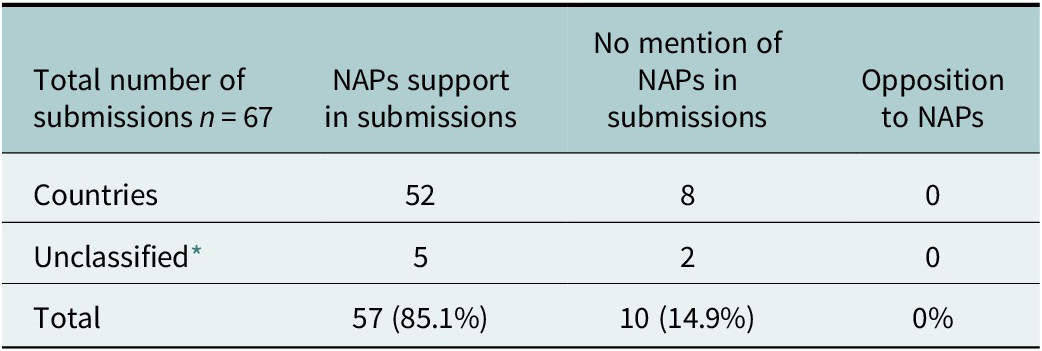
* Including country groups and alliances. At the time, The ‘State of Palestine’ was officially recognised by the United Nations as a Non-Member Observer State, AOSIS had 39 member states, the Group of African States was composed of 54 Member States, the European Union had 27 countries, GRULAC had 33 member states, and the High Ambition Coalitions had 60 members.
Results of submissions and statements at INC-1 and INC-2 highlight a majority support for NAP-based approaches. Table 5 shows that all submissions from HICs were supportive of NAP-based approaches while submissions from UMICs had the lowest number of submissions expressing NAP-based approach support.
Number of national or country group INC-2 submissions expressing support for NAP-based approaches per country classification
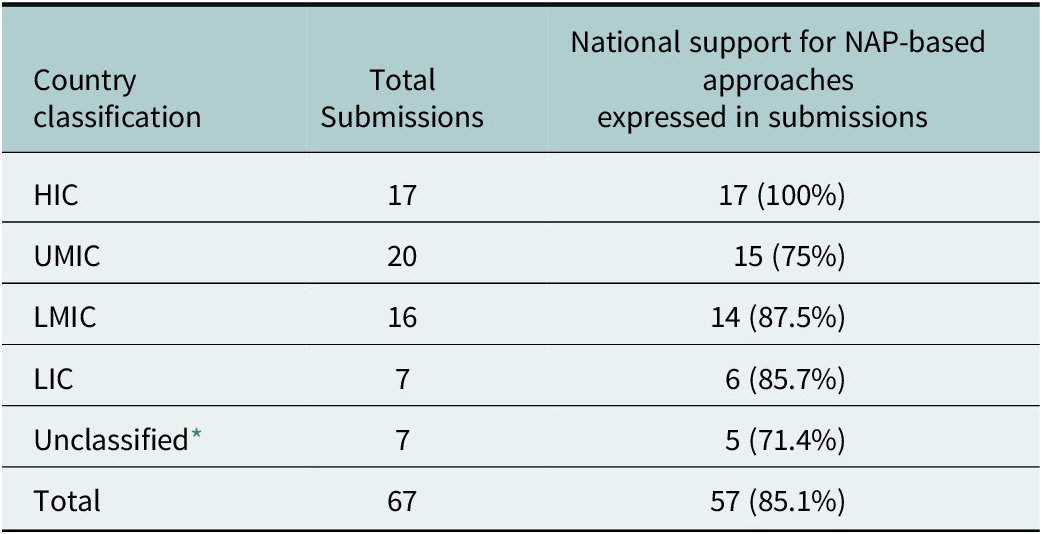
* Including country groups and alliances.
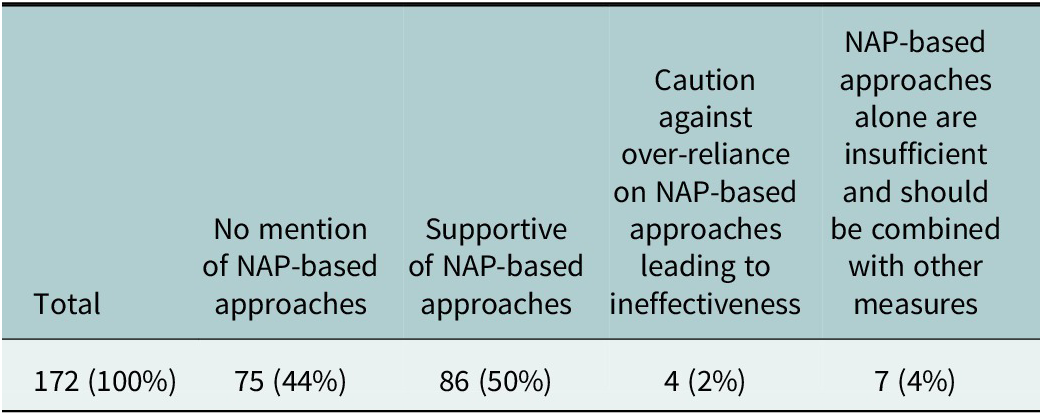
Nearly half (49%) of on-state stakeholder inputs on NAP-based approaches were supportive. There were 44% that made no mention of NAP-based approaches, four submissions (2%) expressed caution against over-reliance on NAP-based approaches leading to ineffectiveness for the implementation of the Treaty in their submissions and seven submissions (4%) identified that NAP-based approaches alone are insufficient, and should be combined with other, more stringent measures (Table 6) such as globally binding controls, reduction requirements and other mandatory policies to be implemented by countries.
INC-2 submissions from non-state stakeholders with input on NAP-based approaches
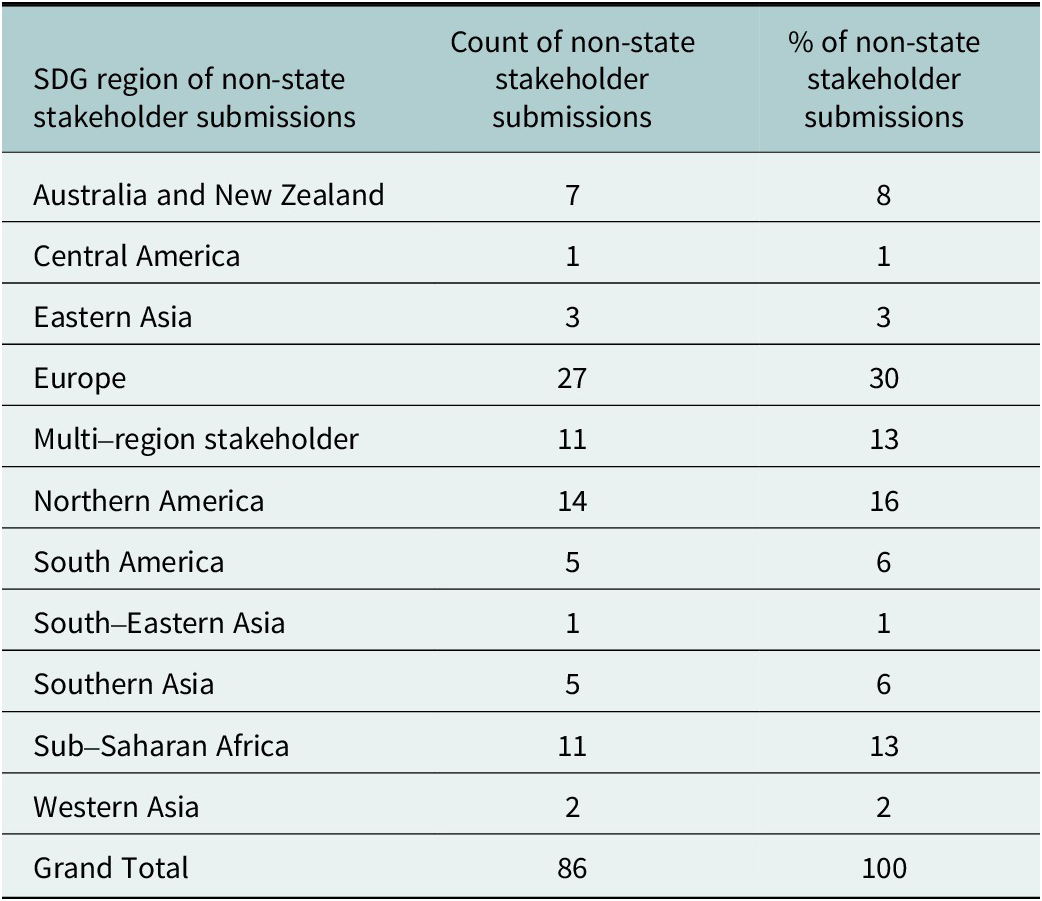
The non-state stakeholder submissions that supported NAPs were also screened for the location of their headquarters to ascertain the geographical extent of NAP support (Table 7). The majority of such submissions originated from non-state stakeholders based in Europe (31%) and Northern America (16%), followed by multi-region non-state stakeholders (13%). Of the SDG regions most affected by plastic pollution, Sub-Saharan Africa had the highest representation (12%) among the non-state stakeholder submissions.
SDG regions of non-state stakeholders who mention NAPs in their written submissions to INC-2. Region is based on the location of the headquarters
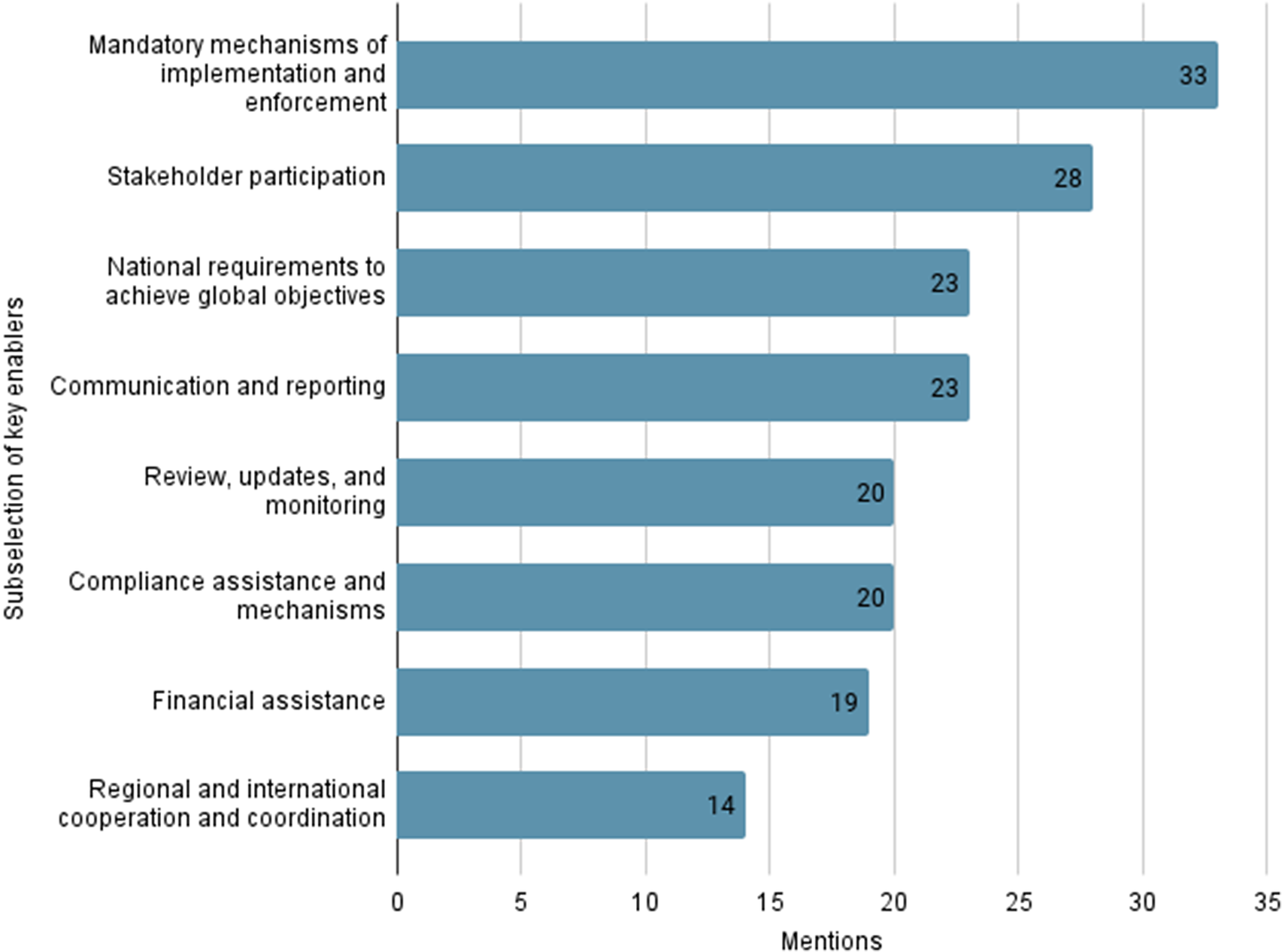
In total, 19 enablers for effective NAP-based approaches were identified from the 172 stakeholder submissions to the INC Secretariat ahead of INC-2. Of these, the enablers of NAP-based approach effectiveness that appeared the most frequently are presented in Figure 1. These include mechanisms of implementation and enforcement (33 submissions), stakeholder participation in the production of the NAP-based approach (28 submissions); commitments to achieve objectives such as having strong leadership, coupled with science-based targets and indicators, and a specific body tasked with overseeing implementation (23 submissions); communication and reporting, such as annual national reports with harmonised reporting standards, and clear messaging for the general public to understand (23 submissions); review, update and monitoring of NAP-based approaches to make them adaptive (20 submissions); access to finance for implementation (19 submissions); compliance assistance and mechanisms at the international level (15 submissions); and regional and international cooperation or coordination (14 submissions). Other enablers that were highlighted in the submissions included capacity building for implementation and policy coherence, awareness raising for the public and stakeholders, clearly defined roles and responsibilities, standardised NAP-based approach design and regulations, and scientific integrity, but all were mentioned 12 times or less and were therefore not taken forward for further analysis.
Frequency of enabler mentions in non-state stakeholder’s submissions to INC-2.
Interview analysis
Interviews with stakeholders after INC-1 regarding the effectiveness of NAP-based approaches and the associated enablers indicated that 6 of 10 interviewees opposed a NAP-based approach in their current non-binding form, 3 neither supported nor opposed the NAP-based approach, and 1 interview fully supported a NAP-based approach due to the flexibility of NAP-based approaches to allow for contextual factors and capabilities of countries, but still highlighted that improvements were necessary.
The enablers identified during the interviews that were mentioned by at least half of the interviewees included mandatory national requirements (6); globally aligned national targets (5); monitoring and evaluation (5); clearly defined roles, responsibilities and measurable targets (5); and mechanisms for compliance and to deal with non-compliance (5). Other enablers included financial assistance for implementation (4), transparency, reporting and data sharing (4); recognition of national context (3); technical assistance (2); and regional coordination (1). All quotes from interviews remain anonymous to ensure the confidentiality of participants.
In the interviews, the most frequently cited measure to ensure effectiveness was a mechanism to ensure that NAP-based approaches are legally binding. Mandatory national requirements were cited as a way to ensure meaningful change and not simply perpetuate the status quo. In line with this, the following statements were made by interviewees:
We don’t really believe in voluntary measures being anything related to the Treaty, so we don’t want to see any discussion of voluntary measures in the Treaty context. We think the Treaty should be a place only to discuss legally binding obligations. Just because from our perspective, voluntary measures represent what is currently happening (Participant P09).
For that national action approach you don’t really need global agreement, right? If countries think that it’s an important issue, they can already start doing it. Maybe you have an agreement that all countries will do something, but yeah, it’s very expensive to have a convention just to agree that you will implement domestic actions (Participant P08).
When asked as a follow on what further leverage points could ensure that NAP-based approaches would be effective if they had legally binding components, four interviewees further added that NAP-based approaches alone would be insufficient to create significant change. They suggested that substantive change could occur with a NAP-based approach backed by a solid institutional and legal framework, as demonstrated in the following interview quotes:
To effectively work towards elimination of plastic pollution it’s very important to have [an] institutional and legal framework put in place in order to make real change at the national level. But for that purpose, just having a national action plan will be very weak (Participant P07).
Even with them [NAPs], institutional strengthening and putting in place legislation that could change how industry or consumers approach plastic products and waste is really necessary. Such a legal framework can be put in place in a more harmonised manner if there is an international Treaty that sets the global standard on what needs to be legally binding and that needs, the countries’, including their stakeholders’, compliance (Participant P04).
In terms of national targets and implementation measures aligned at the global level, half of the interviewees stated that the harmonised design of NAP-based approaches would maximise their effectiveness, as highlighted in the following interview quotes:
So you need a national action plan, so just to focus on the main priorities for each part of the world, for each region. But as I said before, we also need to have measures at the local level, at least in terms of harmonisation, on where we want to go and speaking about the same things or using the same definitions using technical standards which are the same. So it should be a mix of national action plans and measures that are global level measures on elements at global level (Participant P10).
We have enough years of experience of looking at the Paris Agreement to see that the nationally determined contributions are essentially a voluntary obligation […] Because they’re set at the national level only. We need globally aligned targets and actions for implementation to prevent unambitious or limited national commitments (Participant P06).
Robust monitoring, evaluation and reporting, or mechanisms to review and update NAP-based approaches, were also raised by half of the interviewees. Without these, the interviewees stressed that the NAP-based approaches would not be much more than a wishlist, as highlighted in the following interview quotes:
You definitely need well defined targets and they should be legally binding but they also need to be coupled with a robust monitoring and reporting framework. So it might take time to basically get that in place, but that’s the piece that you can’t have the targets without monitoring and reports (Participant P05).
One of the pillars of the Plastics Treaty that will ensure success will be a robust monitoring and reporting framework, including reporting on things like imports, exports, production, and progress towards different objectives around reuse or reduction, for example (Participant P06).
….it’s great to have national action plans, but it’s meaningless if you can’t monitor what you’ve said you’re going to achieve because it’s just a piece of paper or a PDF in this case, but it’s meaningless without a mechanism to monitor and report against (Participant P08).
And that’s fine, as long as there is an action plan, it’s one or zero, right? It’s one, you have [done] it. Zero, you have not done it. [Beyond this there needs to be monitoring] in terms of checking that all of the mandatory contents have been looked at. But that requires some body of technical expertise to be able to assess whether it has been done or not (Participant P09).
One interviewee further suggested that the creation of an independent review committee to assess and follow up on reports in terms of national commitments and results would be useful in ensuring coordinated monitoring and evaluation, as presented below:
What we see with the Paris Agreement is that a country can submit to an NDC, and there’s no review of it. It’s just there. They can say that it’s the best NDC in the world. Everybody else knows it’s not, but that’s just where it ends. That there should be some sort of review so that it may not have any real action after it, but some review body, some process to say this doesn’t quite meet the [goals], so we think that that’s an innovation that should hold us to our ambitions. Those are some of the policy, Treaty features that we’re thinking of (Participant P08).
In line with monitoring and evaluation mechanisms and requirements, interviewees highlighted the need to ensure clear measurable targets against which progress can be measured, as indicated by the following interview quotes:
You definitely need well defined targets and they should be legally binding but they also need to be coupled with a robust monitoring and reporting framework. So it might take time to basically get that in place, but that’s the piece that you can’t have the targets without monitoring and reports (Participant P01).
I do think that well defined targets will be essential. Because you can see in, for example, measuring progress towards implementation of the Sustainable Development Goals, if you look at SDG 14.1 … just as it relates to marine plastic pollution, [it is] really wishy washy in terms of we don’t really know what a substantial reduction [in plastic pollution] is because we don’t how much there is (Participant P06).
I think we need to be clear on our objectives. I think we need to be clear on targets. But we need to allow for flexibility when it comes to the means of which we meet these targets (Participant P03).
If you haven’t got targets, then what’s the Treaty? It’s just a wishlist (Participant P07).
In response to this last quote, another interviewee highlighted the danger of using national context and flexibility as a means to dilute the outcomes or ambitions, and that there should be clearly defined responsibilities based on context.
I think there’s also a danger of using national context to make a very weak Treaty or framework… So that, [countries will] deal with this in our own way and not have any kind of strict stringent measures. A way to get at that is to have some very specific language in terms of what the responsibility is for national governments and what that would look like. So if you are a producing country that I think changes what your responsibilities are versus if you’re an importer like a small island that has to depend on what comes in. And this will affect the way in which you have to meet targets (Participant P05).
Finally, mechanisms to support compliance and deal with non-compliance were highlighted by half of the interviewees as necessary to ensure an effective Treaty. The suggestions made by interviewees included punitive measures, financial incentives or disincentives, naming-and-shaming, and dispute resolution, as presented in the interview quotes below:
You need to be accountable and you need to have incentives and penalties for non-compliance. Those are the mechanisms that you need to establish, because there is a compliance and an enforcement issue here, which we have to reference. But I think that would be, at least recognise that we need to financially incentivise the behaviours that we want to see, and also penalise people losing plastic [plastic pollution], losing out of the system, landfill, incinerated or just being lost in the environment (Participant P01).
At the initial stage to submit a national implementation plan or National Action Plan to describe how the countries plan to implement the Convention [Treaty], what they have done so far to comply with the minimum requirements, and for this there will be a need for reporting and effectiveness evaluation to ensure accountability, and to support this, a financial mechanism is really crucial to ensure compliance and without those just adopting and agreeing on the Convention text is really far from solving the issue (Participant P08).
Summary of the most recurring enablers
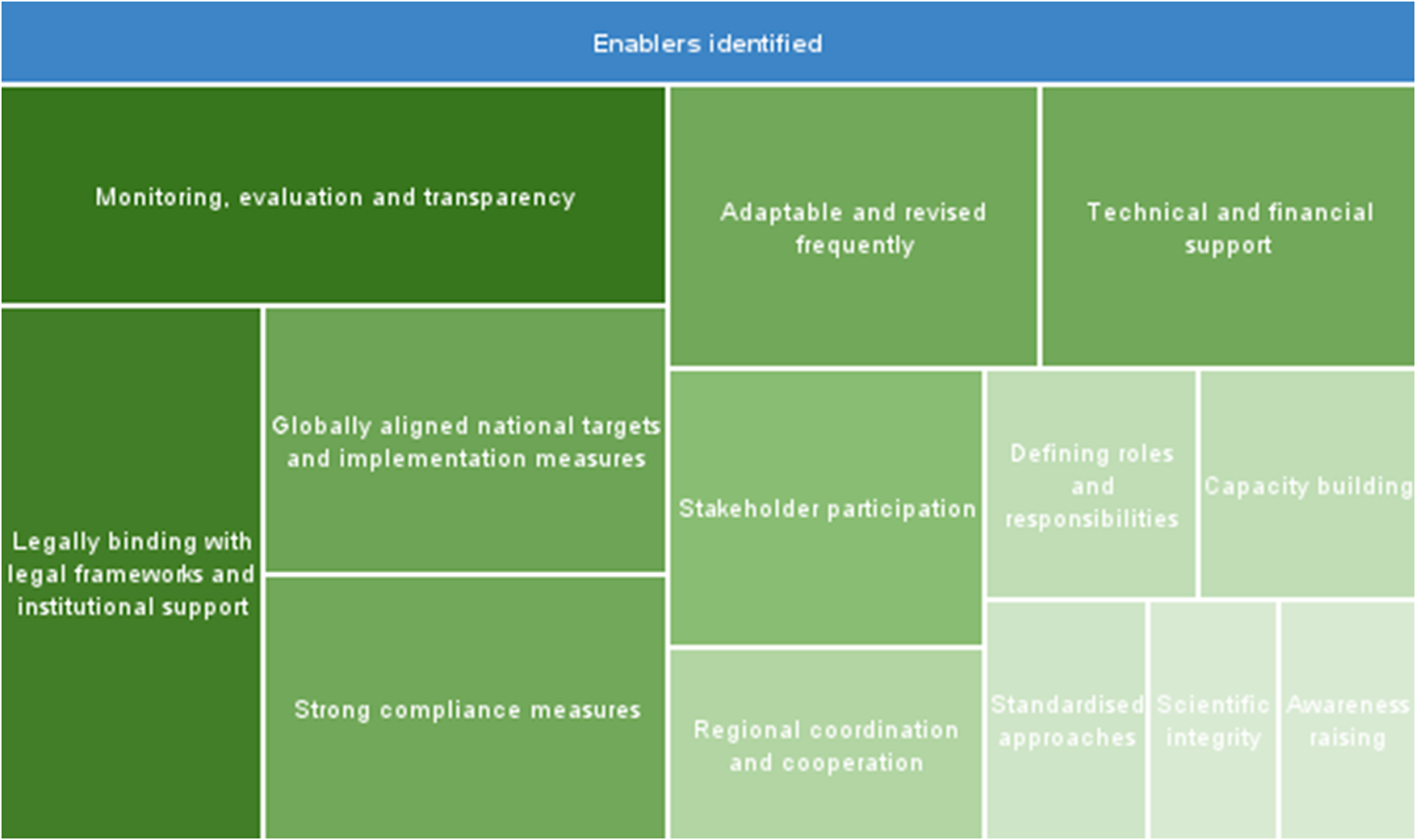
Drawing from all of the evidence presented in this article, there are six enablers most commonly associated with effective NAP-based approaches (Figure 2). These are (1) NAP-based approaches require the support of binding legal frameworks and institutions; (2) NAP-based approaches require strong compliance measures; (3) NAP-based approaches need to have well-defined and harmonised measures for monitoring, evaluation and transparency; (4) NAP-based approaches should be adaptable and revised frequently; (5) NAP-based approaches require technical and financial support for implementation, particularly in low capacity countries; and (6) NAP-based approaches need to be aligned with globally aligned national targets and implementation measures. NAP-based approaches that are designed with inclusive stakeholder engagement at the national level also appeared frequently.
Enablers for effective NAP-based approaches in the Global Plastics Treaty as identified by stakeholder submissions and interviews. The size and intensity of the colour represent the amount of support for each enabler.
Discussion
The results of this study show that at the time of INC-2, there was overwhelming national delegation support for a NAP-based approach in the Treaty. While stakeholder support for a NAP-based approach was significantly lower than that of national delegations, it is countries that will negotiate and decide on the approach implemented by the Treaty. In a parallel study by Arora et al. (Reference Arora, March, Nieminen, Shejuti and Walker2024), it was found that 100% of country submissions (n = 67) prior to INC-2 supported implementation and the development of NAPs to cover the entire plastic life cycle. Coupled with the very short timeline for the development of the Treaty (2 years) and the pressure this puts on coming to an agreement, as well as the common appearance of NAPs in the revised zero draft, it is indeed likely that a NAP-based approach will be adopted, given its current active consideration. Therefore, this article lays the foundation for further research on the topic of NAPs in plastics governance, both within and outside of the context of the Treaty, while indicating the need to fill knowledge gaps on other similar approaches such as national implementation plans (NIPs) and NDCs.
The appetite for and applicability of a NAP-based approach
There is much contention regarding whether the NAP-based approach will be effective or not in the context of a plastics MEA (Ferraro and Failler, Reference Ferraro and Failler2020; March et al., Reference March, Nieminen, Arora, Walker, Shejuti, Tsouza and Winton2023a). NAP-based approaches can provide flexibility to countries with different circumstances to set their own goals and schedules in line with global targets, as further highlighted by the interviewees. In the evolving discourse surrounding the Global Plastics Treaty, there is a discernible need for a mix of top-down and bottom-up regulatory regimes (Borrelle et al., Reference Borrelle, Rochman, Liboiron, Bond, Lusher, Bradshaw and Provencher2017; Raubenheimer and McIlgorm, Reference Raubenheimer and McIlgorm2018; Tessnow-von Wysocki and Le Billon, Reference Tessnow-von Wysocki and Le Billon2019). The intrinsic value of this mixed approach lies in its ability to marry the strategic oversight and enforceable standards characteristic of top-down systems (Simon et al., Reference Simon, Raubenheimer, Urho, Unger, Azoulay, Farrelly, Sousa, van Asselt, Carlini, Sekomo and Schulte2021) with the local adaptability and stakeholder engagement found in bottom-up methodologies (Dauvergne, Reference Dauvergne2023). Such a hybrid model would be beneficial to the implementation of the Treaty, ensuring that global mandates are effectively translated into localised action through NAPs. However, this level of flexibility can also add to the difficulty of setting internationally consistent baselines, monitoring metrics across NAP-based approaches, and assessing progress at a global scale (Anderson et al., Reference Anderson, Clift, Schulze, Sagan, Nahrgang and Mossialos2019; Global Plastics Policy Centre, Reference March, Salam, Evans, Hilton and Fletcher2022; March et al., Reference March, Roberts and Fletcher2022). Indeed their use in plastic governance can pose certain risks (Mayer, Reference Mayer2016; Global Plastics Policy Centre, Reference March, Salam, Evans, Hilton and Fletcher2022; March et al., Reference March, Roberts and Fletcher2022). For instance, national actions from different countries which lack ambition, cohesiveness or inclusion can fail to meet global goals (Mayer, Reference Mayer2016). Moreover, as plastic flows are often highly transboundary, a focus on NAP-based approaches is unlikely to have the reach to resolve plastic pollution that spans multiple jurisdictions. The evidence available suggests that whilst NAP-based approaches can generate coordinated national actions, the variation between plans can create unintended consequences that pushes plastic pollution to parts of the world with the least capacity to cope with it (Dauvergne, Reference Dauvergne2023; Walker, Reference Walker2023). Small island developing states (SIDS) and LICs are particularly at risk (Dauvergne, Reference Dauvergne2023; Monsanto et al., Reference Monsanto, Kohler, Binetti, Silburn, Russell, Corbin, Lyons, SNR and Maes2023; Walker, Reference Walker2023). Relying on measures (some of which are likely to be voluntary) spread across multiple NAP-based approaches intended to tackle systemic pollution across national boundaries may be of limited effectiveness (March et al., Reference March, Nieminen, Arora, Walker, Shejuti, Tsouza and Winton2023a) and would require strong guidance or legally binding measures in the Treaty to form the core content of NAP-based approaches. Further, to avoid unintentionally skewing the NAP-based approach effectiveness towards countries with more overall resources for implementation (i.e. HICs), any effectiveness evaluations should be conducted and made publicly available as a significant gap exists in the data and availability of NAP evaluations from LICs, LMICs and UMICs. Meanwhile, NAP-based approaches are a commonly applied measure in countries that are disproportionately suffering from the impacts of plastic pollution. This research aligns with and underscores the necessity for this dual approach of top-down and bottom-up measures within the treaty’s framework, proposing enhancements to NAPs that reflect both global ambitions and local realities.
A reason for the support for NAP-based approaches in the national submissions could be that the submission template for the INC-2 submissions might have been somewhat leading, and influenced national responses. The template for submissions prompted countries and stakeholders to think about NAPs as an option to implement the Treaty through the question ‘How to ensure implementation of the instrument at the national level (e.g. role national action plans contribute to meeting the objectives and obligations of the instrument?)’. Furthermore, as previously indicated, the mandate to develop the Treaty in the first place suggests a NAP-based approach to implementing the Treaty.
While the use of NAPs to combat plastic pollution based on the enablers identified in this study increases the probability of their success, it cannot guarantee their local enforcement or the expected outcomes of using such an approach in the Treaty (Ammendolia and Walker, Reference Ammendolia and Walker2022; Global Plastics Policy Centre, Reference March, Salam, Evans, Hilton and Fletcher2022). It is important to highlight that other international and multilateral agreements, which do not rely on NAP-based approaches for their implementation have been deemed relatively effective and, in some cases, highly successful such as the Montreal Protocol (UNEP, 2017; Mckenzie et al., Reference McKenzie, Bernhard, Liley, Disterhoft, Rhodes, Bais, Morgenstern, Newman, Oman, Brogniez and Simic2019; Barnes et al., Reference Barnes, Bornman, Pandey, Bernhard, Bais, Neale, Robson, Neale, Williamson, Zepp, Madronich, Wilson, Andrady, Heikkilä and Robinson2021).
Key recommendations to the existing NAP approach if adopted in the Treaty
Based on the results of this study, there are six key suggested recommendations to consider should a NAP-based approach be adopted in the Global Plastics Treaty.
First, results showed that NAP-based approaches that are supported by national legal and institutional frameworks will be more effective. Stakeholders and interviewees in this study have identified that NAP-based approaches that are backed with clearly defined national legal and institutional frameworks tend to be associated with higher compliance compared to those which rely on voluntary measures. This aligns with the findings of Charani et al. (Reference Charani, Mendelson, Pallett, Ahmad, Mpundu, Mbamalu, Bonaconsa, Nampoothiri, Singh, Peiffer-Smadja, Anton-Vazquez, LSP, Schouten, Kostyanev, Vlahović-Palčevski, Kofteridis, Corrêa and Holmes2023) who identify that a clear governance framework backed by financial commitment and political power are critical elements to ensure effective NAP-based approaches. Furthermore, Kamaruddin et al. (Reference Kamaruddin, Patittingi, Assidiq, Bachril and Al Mukarramah2022), in their research on the effectiveness of the legal approaches in governing plastic waste and marine plastic debris in Indonesia and Malaysia, indicate that a weakness of NAP-based approaches is their lack of legally binding power due to their soft-law nature (Kamaruddin et al., Reference Kamaruddin, Patittingi, Assidiq, Bachril and Al Mukarramah2022). Therefore, to hold countries accountable for their actions and commitments, legally binding measures used in combination with other compliance mechanisms such as financial incentives, or punitive measures, can play a critical role in establishing a level playing field and deterring some countries from abandoning their responsibilities while others honour their commitments (Tessnow-von Wysocki and Le Billon, Reference Tessnow-von Wysocki and Le Billon2019; Tingley and Tomz, Reference Tingley and Tomz2022). Legal obligations and elements within NAP-based approaches can also help to facilitate their implementation (Global Plastics Policy Centre, Reference March, Salam, Evans, Hilton and Fletcher2022).
Second, NAP-based approaches with stringent compliance measures are likely to increase the number of national commitments achieved. This is in line with a growing body of research that indicates that stringent compliance measures are often associated with successful NAP-based approaches (Núñez-Rocha and Martínez-Zarzoso, Reference Núñez-Rocha and Martínez-Zarzoso2019; Han et al., Reference Han, Sun, Gong, Zhang, He, Xing, Li, Wang, Ye and Miao2020; Kusama et al., Reference Kusama, Tsuzuki, Muraki, Koizumi, Ishikane and Ohmagari2021). The mandatory requirements of nations under the Treaty should include the delivery of NAP-based approaches and provide guidance on how NAP-based approaches can be adapted to reflect national context while still meeting the requirements of the Treaty. For this purpose, the Treaty could define a framework of policy requirements for actions and commitments that includes a selection of measures aligned with the Treaty’s objectives while driving national progress. Moreover, a compliance mechanism is critical to ensure that commitments presented in NAP-based approaches are met. Robust monitoring and effectiveness evaluations at the national and global levels are essential to ensure the compliance and delivery of NAP-based approaches. Penalties for non-compliance, or incentives for compliance could be examples of compliance mechanisms. Opposing views have also been reported in the literature (Tessnow-von Wysocki and Le Billon, Reference Tessnow-von Wysocki and Le Billon2019; Tingley and Tomz, Reference Tingley and Tomz2022; and references therein). Tingley and Tomz (Reference Tingley and Tomz2022) argue that the Paris Agreement ‘achieved nearly universal participation because the key obligations were flexible and unenforceable, at least by traditional legal means’ (p. 448). Tessnow-von Wysocki and Le Billon (Reference Tessnow-von Wysocki and Le Billon2019) also argue that ‘if a state does not want to alter its behaviour it might still enter a Treaty if it perceives compliance as unenforceable’ (p. 102), making it challenging to address collective action. In this ‘free-rider’ situation, some states may take advantage of the benefits of the Treaty without fully contributing to or adhering to its provisions.
Third, NAP-based approaches should have robust monitoring, evaluation, reporting and data sharing. Full transparency and disclosure are a necessity to ensure accountability. Similar findings have been reported by Tessnow-von Wysocki and Le Billon (Reference Tessnow-von Wysocki and Le Billon2019) and Harant (Reference Harant2022). Regular and frequent monitoring and reporting are essential to guarantee the effectiveness of NAP-based approaches (Edelson et al., Reference Edelson, Håbesland and Traldi2021). In line with this finding, Deprez et al. (Reference Deprez, Colombier and Spencer2015), in their research on the Paris NDC approach, explain that a solid monitoring and transparency system is essential ‘for building trust in collective action among countries’ (p. 1), and that monitoring and associated transparency plays a critical role ‘in allaying concerns countries may have on lack of collective action, concerns which currently limit their ambition’ (p. 1). Other studies have shown that uncoordinated efforts, definitions, and metrics can significantly hamper the impact of NAPs (Weikmans et al., Reference Weikmans, Asselt and Roberts2020; Global Plastics Policy Centre, Reference March, Salam, Evans, Hilton and Fletcher2022). As such, clearly defined baselines, schedules, and methods for the assessment of NAP-based approach, would be required to evaluate progress. Such methods would also need to be based on validated and standardised criteria. Since studies have shown that self-reporting is rarely sufficient to ensure full compliance (Bharadwaj et al., Reference Bharadwaj, Baland and Nepal2020; Munkholm and Rubin, Reference Munkholm and Rubin2020; Clayton et al., Reference Clayton, Walker, Bezerra and Adam2021; Maris and Flouros, Reference Maris and Flouros2021), the establishment of an independent review committee would be recommended to increase the likelihood of reporting by both governments and the private sector being well communicated and openly accessible to increase transparency and information exchange. Furthermore, research from the Global Plastics Policy Centre suggests that within any nation, plastic policies could benefit from a standard monitoring method with data published for the same time periods so that different policy types could be directly compared. In addition, such methods need to be combined with international standardisation metrics (Global Plastics Policy Centre, Reference March, Salam, Evans, Hilton and Fletcher2022). Weikmans et al. (Reference Weikmans, Asselt and Roberts2020) share similar findings. They explain that one of the challenges of the Paris Agreement is the difficulty in assessing and comparing progress made by Parties towards achieving their NDCs due to their heterogeneity and the lack of a shared baseline among developed and developing countries. Another obstacle is linked to the variety of methods and indicators that Parties use to report their progress; and the lack of clarity in the reporting guidelines on climate action and support. Countries are required to provide ‘business as usual’ projections for their emissions, but such projections are obtained using different methods, which makes it difficult to assess the efforts of countries using the same metric (Weikmans et al., Reference Weikmans, Asselt and Roberts2020).
Fourth, frequent revisions of NAP-based approaches will ensure they incorporate new knowledge and adapt to policy successes or failures. Experiences of measures implemented through NAP-based approaches, including legislation, regulations, and policies, should be shared among nations to allow for collaborative learning and adaptation. NAP-based approaches should function as living documents and be regularly revised, using the lessons learned from other countries. NAP-based approaches should have progressive staged targets as developments in capacity, infrastructure, technology, and innovation allow for improved plastic pollution reduction. Increasing ambition is strongly linked to the principle of non-regression, urging nations to sustain and enhance progress. This is in line with the technical guidelines of the United Nations Framework Convention on Climate Change (UNFCCC) which stipulate that a ‘National Adaptation Plan should be a living document, and be revised on a regular basis to incorporate new knowledge and experience, and to take into account changing national development priorities’ (UNFCCC, 2012).
Fifth, NAP-based approaches require technical and financial assistance to ensure successful implementation and compliance. To support the implementation of NAP-based approaches, especially for countries with limited capacity, technical and financial assistance can play a critical role in terms of implementation and compliance (Monsanto et al., Reference Monsanto, Kohler, Binetti, Silburn, Russell, Corbin, Lyons, SNR and Maes2023), guidance and tools to support national target setting and delivery, and support for data collection to ensure alignment of standards and methodologies (Global Plastics Policy Centre, Reference March, Salam, Evans, Hilton and Fletcher2022; Charani et al., Reference Charani, Mendelson, Pallett, Ahmad, Mpundu, Mbamalu, Bonaconsa, Nampoothiri, Singh, Peiffer-Smadja, Anton-Vazquez, LSP, Schouten, Kostyanev, Vlahović-Palčevski, Kofteridis, Corrêa and Holmes2023). The establishment of an expert science-policy research body in collaboration with international development organisations could also help provide technical support (Ferraro and Failler, Reference Ferraro and Failler2020; Monsanto et al., Reference Monsanto, Kohler, Binetti, Silburn, Russell, Corbin, Lyons, SNR and Maes2023). The importance of having a dialogue between policymakers and scientists to define national priorities has also been highlighted (Monsanto et al., Reference Monsanto, Kohler, Binetti, Silburn, Russell, Corbin, Lyons, SNR and Maes2023). Regarding financial measures, a mechanism potentially based on the polluter pays principle, could offset the risk of low-ambition NAP-based approaches, as suggested by Egli and Stünzi (Reference Egli and Stünzi2019), the Heine et al. (Reference Heine, Faure and Dominioni2020), Global Plastics Policy Centre (Reference March, Salam, Evans, Hilton and Fletcher2023), and Zhu (Reference Zhu2023). NAP-based approaches should also aim to thoroughly describe financial and technical arrangements at the national level, including identifying technology transfer needs and offers (UNFCCC, 2012; Kim et al., Reference Kim, Smith, Mack, Cook, Furlow, Njinga and Cote2017; Monsanto et al., Reference Monsanto, Kohler, Binetti, Silburn, Russell, Corbin, Lyons, SNR and Maes2023).
Finally, NAP-based approaches should have clear national targets and implementation measures aligned to the Treaty. In support of this, Borrelle et al. (Reference Borrelle, Ringma, Law, Monnahan, Lebreton, McGivern, Murphy, Jambeck, Leonard, Hilleary, Eriksen, Possingham, De Frond, Gerber, Polidoro, Tahir, Bernard, Mallos, Barnes and Rochman2020) explain that existing commitments such as the G7 Plastics Charter, and the European Union Strategy usually lack specific numerical targets and quantitative monitoring approaches that provide a measurable reduction in plastic pollution associated with these commitments individually or as a whole. To foster a sense of unity, setting common goals within an international agreement such as the Treaty is critically important to drive consistent implementation and action (Borrelle et al., Reference Borrelle, Rochman, Liboiron, Bond, Lusher, Bradshaw and Provencher2017). In order to ensure unity and common goals for effective Treaty implementation, ‘the international community must commit to specific, measurable, time-bound targets to reduce plastic emissions into our oceans’ (Borrelle et al., Reference Borrelle, Rochman, Liboiron, Bond, Lusher, Bradshaw and Provencher2017, p. 9997). Borrelle et al. (Reference Borrelle, Ringma, Law, Monnahan, Lebreton, McGivern, Murphy, Jambeck, Leonard, Hilleary, Eriksen, Possingham, De Frond, Gerber, Polidoro, Tahir, Bernard, Mallos, Barnes and Rochman2020) add that achieving significant reductions in global plastic emissions would require among other things setting global limits for virgin plastic production, and creating globally aligned standards for commodity plastics to be practically recoverable and recyclable by design. A Global Plastics Treaty should ensure that ‘global targets and goals are added to national efforts to harmonise policy, enhance investment planning, stimulate innovation and coordinate the development of infrastructures, waste traceability and education’ (Williams and Rangel-Buitrago, Reference Williams and Rangel-Buitrago2022, p. 17). NAP-based approaches can contribute to that end by ensuring alignment with the core obligations and goals of the Treaty while enabling the translation of global goals to a national level which takes account of the national context. To increase the cohesiveness of NAP-based approaches, coordination should be organised at the global level rather than at the national level to prevent NAP-based approaches from becoming fragmented and disconnected plans.
Conclusion
NAPs can play an important role in national- and international-level policy commitments, and can ensure that nationally appropriate policy, legislative, and institutional arrangements are implemented in response to the Treaty. NAPs can also be effectively used to engage key stakeholders in national-level implementation of the Treaty through both participation in the development of NAPs and institutional arrangements for their implementation. Yet, NAPs often rely on voluntary commitments and lack enforcement mechanisms.
In the context of the Treaty, this research sought to identify what stakeholder and national delegation support for a NAP-based approach looked like at the INC-2, and what key enablers need to be in place to ensure that the Treaty is effective should a NAP-based approach be adopted. The findings demonstrated that most of the written submissions from both nations and international groupings to the INC Secretariat ahead of INC-2 indicated a strong preference towards NAP-based approaches, with 85% of submissions supporting them. These results suggest that there is a high possibility that this approach could be adopted for the Treaty. Indeed the discussions in the negotiations since INC-2 continue to position a NAP-based approach as highly probable, which is further demonstrated by the clear positioning of NAPs in the revised zero draft with many of the options for provisions including an option that is ‘subject to [a country’s] national action plan’. Therefore, should this scenario come to pass, NAP-based approaches would need to be significantly revised to enhance their effectiveness such as through taking into account the key enablers identified in section ‘Results’. Other key elements such as a clear timeline would need to be incorporated into the development of NAP-based approaches to ensure their long-term consistency be.
This study has highlighted the limitations to the research approach adopted, and has also exposed further areas for research to supplement these findings and the plastics policy research field as a whole. This includes, firstly, conducting research into how existing international or multilateral agreements can be used as a model whether they rely on NAP-based approaches or not. Despite being central to the fight against climate change, the Paris Agreement is often criticised for failing to achieve its intended targets and its relative effectiveness is often under debate. This research has highlighted several key enablers such as compliance measures and legally binding components for NAP-based approaches, and there is thus a need to further investigate the nature of these compliance measures and the methods employed to enforce them within the scope of the Treaty.
Further research is also required to determine whether NAP-based, bottom-up approaches should be used as an approach at all. Given that the use of a NAP-based approach presents both advantages and disadvantages, there is significant consideration needed to determine whether it should be used as the sole instrument of implementation of the Treaty. In that regard, caution against over-reliance on NAP-based, bottom-up approaches leading to ineffectiveness for the implementation of the Treaty is expressed. This research identifies that while NAP-based approaches should not be entirely dismissed, they should not act as the primary form of Treaty implementation.
The identification of the requirements for effective NAP-based approaches in the context of the Treaty holds significant implications for a range of stakeholders. Policymakers and government officials can glean valuable insights from this research to refine and strengthen their existing or upcoming plastic NAPs beyond the requirements of the Treaty. Furthermore, this research serves as a compass for environmental organisations, guiding their advocacy efforts and allowing them to effectively engage with governments and international bodies. Equipped with the knowledge of optimal NAP-based approach components, these organisations can offer targeted recommendations and ensure the accountability of decision-makers. Additionally, international organisations can use the research outcomes to guide their support initiatives for member countries, assisting in the design and execution of NAP-based approaches that effectively fulfil the mandates of the Global Plastics Treaty. Ultimately, the insights gained from this research have the potential to catalyse informed decision-making, facilitate intergovernmental collaboration, and pave the way for a more harmonised global approach to combating plastic pollution through well-structured, redesigned NAPs.
Open peer review
To view the open peer review materials for this article, please visit http://doi.org/10.1017/plc.2024.11.
Data availability statement
Data are available upon request.
Acknowledgements
The authors would like to extend their gratitude to the interviewees for their time, reflections and experiences shared with us to conduct this study.
Author contribution
All authors have accepted responsibility for the entire content of this manuscript and approved its submission. The contribution of all authors is as follows: A.M.: Conception, Data collection, Data analysis, Writing – first draft, Writing – review and editing, Supervision; A.T.: Data collection, Data analysis, Writing – first draft, Writing – review and editing; L.N.: Data collection, Data analysis, Writing – review and editing; H.A.: Data collection, Data analysis, Writing – first draft; S.W.: Writing – first draft, Writing – review and editing; S.S.-M.: Data collection, Data analysis; T.R.W.: Writing – first draft; Writing – Review and editing; S.F.: Conception, Writing – review and editing.
Financial support
The Global Plastics Policy Centre received philanthropic financial support from the Flotilla Foundation to conduct this research.
Competing interest
The authors declare no conflict of interest in the development of this research article.


 Open access


Comments
No accompanying comment.