

Introduction
As a stepping stone between the Balkans and south-western Europe, the Italian peninsula has long facilitated social and cultural contact between distant human groups. This is clear from at least the late Upper Palaeolithic, with evidence of strong affinities between the Epigravettian lithic industries from these two sides of the European continent (Kozlowski 1999). With the beginning of the Holocene, the Adriatic Sea became one of the main routes for contact and exchange, documented through the diffusion of material culture such as impressed pottery, in a south-east to north-west direction towards the Tyrrhenian Sea, and from there to southern France.
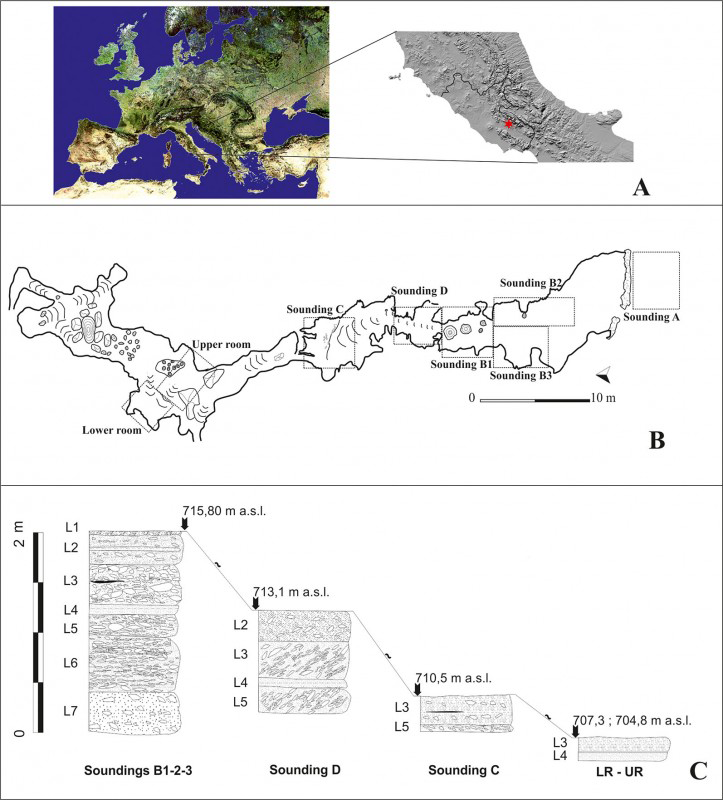
A) Location of Grotta Mora Cavorso; B) plan of the cave and location of soundings; C) stratigraphy and levels of the soundings.

Long-established models of prehistoric human occupation consider Apennine central Italy as marginal in the context of the framework discussed above. The cave site of Grotta Mora Cavorso has the potential to challenge this assumption. Through ongoing excavations and multidisciplinary analyses, this site has already proved to be an important crossroads between the Adriatic and the Tyrrhenian coasts, in an area—the Aniene Valley—that would have been attractive to large human groups. The study of this cave will contribute to the reinterpretation of central-Italian prehistoric settlement and society.
Description and preliminary interpretations
In 2006, the karstic cave of Grotta Mora Cavorso (Figure 1A) was discovered approximately 150m above the river Aniene and 715m asl in the Simbruini Mountains of south-eastern Lazio. Investigation of eight areas (soundings A, B1, B2, B3, D, C, lower room-LR, upper room-UR) indicates an outstanding continuity of use, shedding light on a complex, anthropised stratigraphy ranging from at least the Late Pleistocene to the last century (Figure 1B).
Just outside the cave (sounding A), the presence of structures and coins attests to sporadic but long-lasting historical frequentation, probably related to shepherds and bandits. Inside, the first room of the cave (soundings B1, B2, B3), was used as a stable and war shelter until the last century (Achino et al. 2013); it is also characterised by sporadic protohistoric, as well as historical, finds (fifth–sixth centuries AD) (Figure 1).
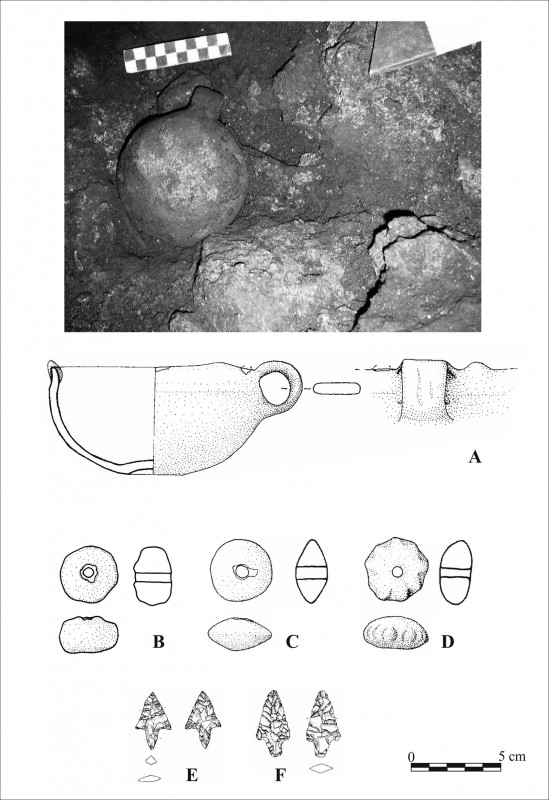
Bronze Age artefacts from soundings B1 and D: A) drawing and photograph of the intact bowl; B–D) spindle whorls; E–F) flint arrowheads (drawings courtesy of Giuseppina Mutri and Daniela Mancini).

An early Middle Bronze Age deposit (Rolfo et al. 2013) was discovered in soundings B1 and D. Finds include an overturned bowl and a flint bladelet in a pit associated with a spindle whorl, and two flint arrowheads found in the nearby area (Figure 2). Most of a disarticulated skeleton of a mature female, aged over 45 years, was also retrieved in the innermost sector of this area. This burial was associated with several sub-juvenile domestic caprines and pigs, whose unusual kill-off pattern suggests an accompanying sacrifice. These deposits reflect the ritual and burial patterns of other Bronze Age central-Italian caves (Cocchi Genick 1999), reinforcing the idea of an existing cultural connection between the Adriatic and the Tyrrhenian regions during the second millennium BC.
Below this layer, in sounding B1, a well-preserved and structured Neolithic deposit revealed hearths as well as pottery, flint, obsidian, sandstone tools, and carved or polished animal teeth and bones. The faunal record suggests domesticated animals managed for dairy products (sub-juvenile ovicaprines) and meat (young pigs), while the occurrence of red deer and wild boar indicates hunting. Early Neolithic deposits were identified in every sounding except for the more external soundings of B2, B3 and A.
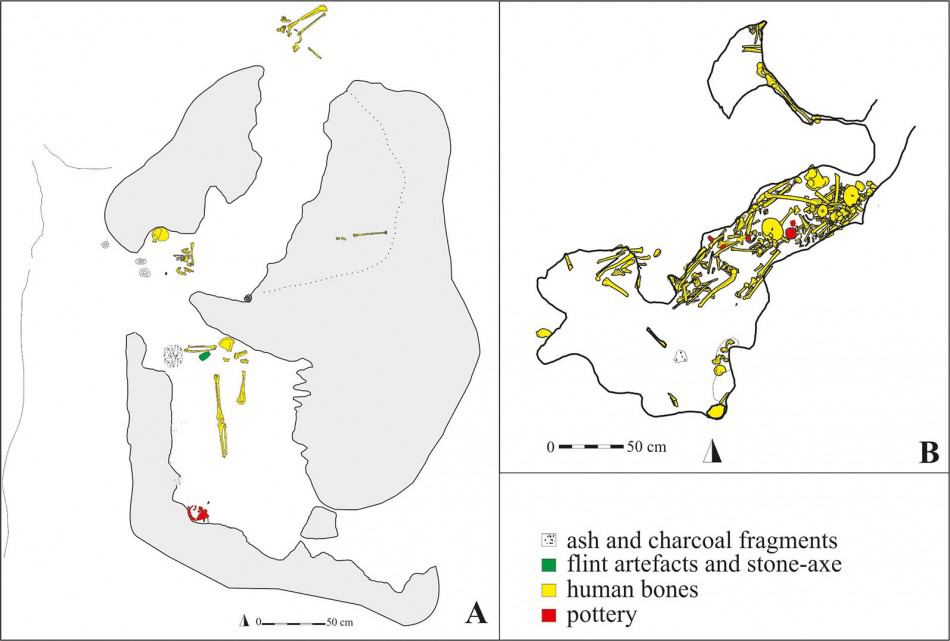
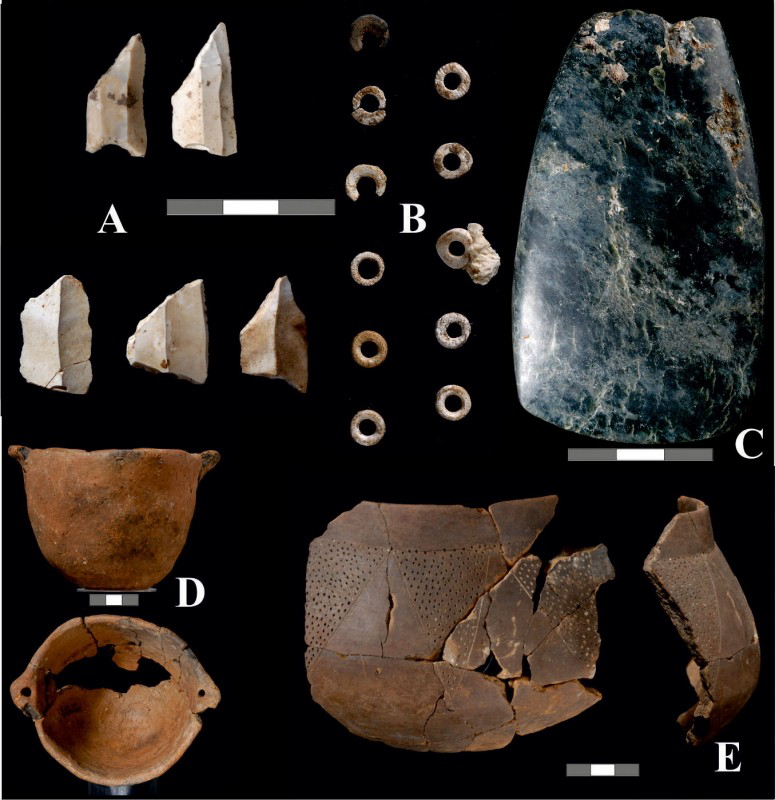
The inner rooms (UR and LR) yielded approximately 600 human bones, articulated in the UR and chaotically piled in the LR (Rolfo et al. 2012) (Figure 3), indicating the co-existence of primary burial practices and of a natural or intentional stacking of human bones. At least 21 individuals, of which 9 are juveniles and 12 adults, have been identified, with the numbers probably to rise as the osteological study progresses. The few artefacts retrieved include possible grave goods such as a polished green stone axe, decorated vessels, flint tools and necklace beads (Figure 4). This is one of the most important burial deposits of Early Neolithic central-southern Italy; ongoing study will shed light on aspects of the provenance, diet (Scorrano et al. 2014) and cultural practices of the earliest farmers of this part of the Mediterranean.
A–B) Detailed plan of the Neolithic burial remains in the inner rooms.

Some Neolithic artefacts from soundings B1, D, UP and the LR: A) flint tools; B) necklace beads; C) polished stone axe; D–E) vessels.

Below the Neolithic deposit, thin, non-anthropic Early Holocene layers, characterised by abundant red deer bone, have been discovered in the LR and soundings D and B1.
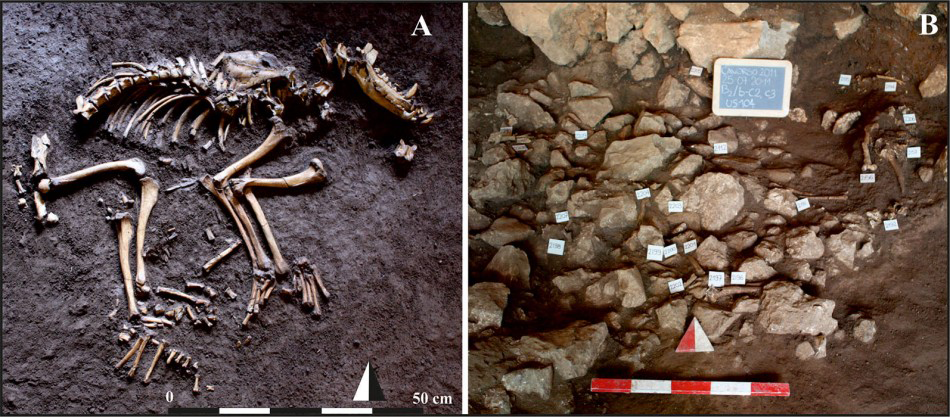
Almost complete skeletons of Pleistocene wolf (A) and chamois (B).

The investigation of the Pleistocene layers is ongoing. So far, three main levels have been identified: the latest—and only—anthropic layer has yielded Palaeolithic artefacts dated to the final Epigravettian period, as well as large mammal bones with butchery marks among the numerous vertebrate remains recovered (Salari et al. 2011) (Figure 5). The intermediate layer, rich in micro-vertebrate remains, correlates with the Last Glacial Maximum, while the earliest layer, with macrofaunal remains, has been dated to Marine Isotope Stage 3.
Discussion and future expectations
The long human occupation of Grotta Mora Cavorso stands out in an allegedly ‘peripheral’ area (Barker 1981). The presence of imported raw materials (e.g. obsidian and green stone), as well as the molecular evidence for the Neolithic, demonstrate the involvement of this site in long-distance contacts; the cultural similarity of Grotta Mora Cavorso with key sites of better-known central-Italian regions (e.g. Abruzzi and Tuscany) allows us to consider this part of the Apennines, including the Aniene Valley, as equally important and as intensely frequented. This is also supported by the extraordinarily long-lasting and rich chrono-stratigraphical sequence of the cave, which could well become a reference point for prehistoric central Italy. This highlights the need for continuing research at the site, while expanding the investigation in the archaeologically undervalued surroundings, through extensive and systematic surveys of the Upper Aniene Valley.