


Introduction
On Earth, pressures can range from one bar (10–4 GPa) at the surface, to a few hundreds of bars (on the order of 10–2 GPa) at the bottom of the oceans, to around 3.6 × 10⁶ bar (360 GPa) at the Earth’s center Reference Dziewonski and Anderson1 ( Figure 1 ). In comparison, the pressure at the center of the sun is estimated to be around 26.5 × 10⁶ GPa. For many years, scientists have been motivated to attain ever higher pressures in the laboratory, to reproduce and study some of the phenomena seen in real life, and to create novel materials with new and unique properties. Reference Badding2–Reference Hemley6 The applied pressure can be varied almost continuously by more than seven orders of magnitude above ambient pressure, and its influence can have a profound effect on the electronic structure, bonding, and coordination environments of atoms, the rates and types of possible reactions, and the microscopic to macroscopic volumetric response and deformation to such loads. The state of matter can be changed in a controlled way. In addition, advances in instrumentation are enabling completely new regions of phase space to be explored by experiment, while at the same time giving enhanced access to the information required to solve materials-related issues.
The pressure inside the Earth as a function of depth. The data are taken from the Preliminary Reference Earth Model of Dziewonski and Anderson. Reference Dziewonski and Anderson1

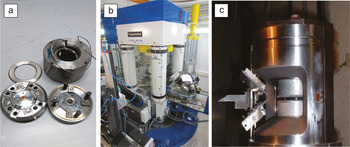
The definition of “high pressure” depends on the field of interest. Pressures can be small, at just a few tens of MPa, as in the investigation of biological systems such as the extremophile organisms that live at the bottom of the oceans or the study of protein folding, or they can be in excess of 1 TPa, which are not found naturally on Earth, but are achievable in shock compression experiments that are leading to the discovery of novel states of matter and novel physicochemical phenomena. Reference Knudson, Desjarlais and Dolan7 The theme of this issue is “Materials under pressure.” It presents an overview of recent advances in high-pressure experimental methods and instrumentation (such as diamond anvil cells [DACs], Reference Bassett8 multianvil presses, Reference Liebermann9 or the Paris-Edinburgh press Reference Besson, Nelmes, Hamel, Loveday, Weill and Hull10 [ Figure 2 ]) to study matter in materials science, physics, chemistry, engineering, and biology.
Examples of different high-pressure device types in use at synchrotron and neutron sources: (a) a membrane-driven diamond anvil cell, (b) a four-column 20 MN, large-volume multianvil press, and (c) a VX Paris-Edinburgh press with collimator and shielding for neutron-scattering studies.
Superhard materials
In their article in this issue, Sumiya reports on current progress in the development of ultrahard materials for abrasives, cutting tools, and wire dies. Reference Sumiya and Harano11 This work extends the discussion of the March 2003 issue of MRS Bulletin on “Superhard coating materials” Reference Chung and Sproul12 toward the nanoscale, illustrating binderless nanopolycrystalline diamond and cBN phases. The physical properties of these synthetic ultrahard materials surpass those of microscopic and single-crystal materials through loss of binder and the absence of cleavage and anisotropy. Reference Sumiya and Harano13 Sumiya discusses the industrial significance of the high-pressure and -temperature sintering processing of these materials, their influence on the microstructure, as well as their mechanical properties. They also discuss how these tie to the eventual improved application of both nanophase diamond and cBN in high-precision machining of nonferrous advanced alloys and ceramics, and for ferrous materials, respectively. Reference Sumiya, Harano and Ishida14,Reference Harano, Arimoto, Ishida and Sumiya15
Superhigh pressures
At the extreme pressures occurring deep in planets and stars, which until now had not been studied, different chemistries form extended and dense forms of low-Z compounds. The article by Yoo Reference Yoo16 in this issue draws from the behavior of ices, Reference Hermann, Ashcroft and Hoffmann17 CO2, Reference Iota, Yoo and Cynn18,Reference Yoo, Sengupta and Kim19 and nitrogen Reference Eremets, Gavriliuk, Trojan, Dzivenko and Boehler20–Reference Tomasino, Kim, Smith and Yoo22 to illustrate some of the structures that have been discovered and their associated properties. This work opens up the opportunity to make novel compounds with, for example, new piezoelectric, ferromagnetic, or superconducting functionality, Reference Drozdov, Eremets, Troyan, Ksenofontov and Shylin23,Reference Dias, Yoo, Struzhkin, Kim, Muramatsu, Matsuoka, Ohishi and Sinogelkin24 or extremely high energy densities. It may prove possible to recover to ambient conditions long-lifetime metastable materials with transformative properties, as illustrated by the existence of diamond with superhard properties.
Chemistry at high pressure
Pressure can be used as a method to access and tune structural and electronic configurations not available at atmospheric conditions. Once the desired property is identified and the structure is determined, an attempt can be made to reproduce this structure using alternative synthesis methods. In their article in this issue, Postorino and Malavasi illustrate these effects with two classes of modern technological materials. Reference Postorino and Malavasi25
First, the pressure-induced variation of the properties of hybrid perovskites for solar-energy cells (see also MRS Bulletin, May 2014 Reference Amine, Kanno and Tzeng26 and August 2015 Reference Nazeeruddin and Snaith27 ) are illustrated and discussed in parallel with the chemically induced changes that occur by substituting different halides or organic ligands. Reference Capitani, Marini, Caramazza, Postorino, Garbarino, Hanfland, Pisanu, Quadrelli and Malavasi28–Reference Wang, Wang, Xiao, Zeng and Zou30 The authors illustrate how the bandgap and carrier lifetime—both critical for solar application—could be influenced by substitution or by substrate selection, thus suggesting new (potentially pressure-influenced) directions of approach to longstanding issues. The second class of materials are manganites, which show exceptional magnetic and electronic functional diversity. Reference Dagotto31 They exhibit phenomena that range from high-temperature superconductivity to colossal magnetoresistance.
Postorino and Malavasi demonstrate the wide applicability of the diamond anvil cell (DAC) to combined measurements of the structural, optical, electronic, and magnetic properties of these materials, often carried out in parallel. With the DAC, they describe influencing the many degrees of freedom that affect the previously mentioned phenomena, intrinsic (e.g., chemistry, ionic radii) as well as extrinsic (e.g., temperature, pressure, applied field). These investigations illustrate the rich phase diagrams of manganites, Reference Baldini, Struzhkin, Goncharov, Postorino and Mao32,Reference Baldini, Muramatsu, Sherafati, Mao, Malavasi, Postorino, Satpathy and Struzhkin33 with possible metallic, insulating, charge-ordered, or various magnetic phases.
Plastic deformations
How elastic moduli, which control fundamental mechanical properties of deformation and rheology, are affected by pressure is discussed in the article by Carrez and Cordier in this issue. Reference Carrez and Cordier34 The fact that the elastic moduli and pressure scales are of a similar order implies that they will have a significant effect on the bonding, strength, and dynamics of materials studied under load. This is further complicated by the presence of defects—point defects, dislocations, and grain boundaries—in materials, and to the dependence of these defects on the class of material. The authors draw on examples from calculations on the pressure response to defect behavior in body-centered-cubic (bcc) metals, Reference Yang, Söderlind and Moriarty35,Reference Yang, Tang, Moriarty, Hirth and Kubin36 and in ionic Reference Amodeo, Carrez and Cordier37 and covalent systems to illustrate the wide variation possible. They extend this discussion to illustrate the contrasting behavior of two forms of MgSiO3, the perovskite Reference Hirel, Kraych, Carrez and Cordier38 and the post-perovskite. Reference Goryaeva, Carrez and Cordier39 The transformation between the two is one of the more fundamental transformations in the Earth’s deep mantle.
Glasses under pressure
Increasing defect density further, the article by Salmon and Huang Reference Salmon and Huang40 discusses the inherently disordered nature of glasses that makes investigations into its structural response a complex task. Much ground has, however, been covered in recent years in the characterization of glasses at all length scales. Reference Zeidler and Salmon41,Reference Salmon and Zeidler42 The local atomic environments such as bonding, coordination, and angular distribution of adjacent units, and their organization on an intermediate scale, have been investigated. These have been linked to the macroscopic mechanical bulk responses to increased load or strain. Reference Salmon and Zeidler43
Salmon and Huang discuss the importance of pressure on the ability to control and understand the mechanical properties of a glass. They illustrate that harder, more robust, denser glasses are desirable for scratch resistance, or for changing optical properties, where the power of lenses, or the resolution of a microscope, are given by functions of the refractive index, which generally varies with density. As in other materials, glasses can be affected by both mechanical and chemical pressure, thereby changing the structure and properties of these materials. Reference Gy44,Reference Luo, Lezzi, Vargheese, Tandia, Harris, Gross and Mauro45 High pressures in the GPa regime are produced under the tip of an indenter, which is used to simulate the scratching or deformation of the surface of the glass. Reference Yuan and Huang46,Reference Yoshida, Sanglebœuf and Rouxel47 Glasses can have inherently long relaxation times. This means that it is possible to recover new materials from high-pressure conditions in a densified form, which may lead to more fracture-resistant materials. Experimental and computational approaches can now be used to investigate the response of glasses to tests of these functionalities through detailed understanding of their structure–property relations. Reference Guerette, Ackerson, Thomas, Yuan, Watson, Walker and Huang48,Reference Kohara and Salmon49
Biological systems under pressure
High pressure is also an important parameter in natural systems, with augmented interest in biotechnological applications. As in inorganic systems, the application of pressure affects reactions, activation barriers, and reaction rates. In their article, Czeslik et al. discuss the complex processes involved and the methods employed for investigating how reactions in biological systems can be altered by the application of hydrostatic pressure, using enzymes as an example. Reference Czeslik, Luong and Winter50 As enzymes are natural catalysts, they are key to developing more advantageous biotechnologies; Reference Eisenmenger and Reyes-De-Corcuera51,Reference Akasaka, Nagahata, Maeno and Sasaki52 particularly when pressure can be used to enhance reaction rates when other extrinsic parameters cannot (e.g., when higher temperatures might cause denaturation). Reference Luong, Kapoor and Winter53,Reference Royer54 Other features such as strengthened hydrogen bonds, interrupted hydrophobic and hydrophilic interactions, formation of new conformations, tuned flexibility in structural conformation, and overall energetic description of the process all play a role. Reference Akasaka and Matsuki55 The authors illustrate such enzyme activity using stopped-flow technology in a well-chosen model system that reveals how pressure could be useful to biotechnological applications. Reference Sun, Winter and Winter56,Reference Blow57 The pressures involved in this case are orders of magnitude smaller (in the MPa regime) than in the inorganic systems discussed earlier.
Summary
Pressure can have a dramatic effect on the structure and properties of materials and hence it can be used as a means for manipulating and probing materials of technological and biological interest.
Acknowledgment
A.Z. is supported by a Royal Society—EPSRC Dorothy Hodgkin Research Fellowship.

Anita Zeidler is a Royal Society–Engineering and Physical Sciences Research Council Dorothy Hodgkin Research Fellow at the University of Bath, UK. She completed her undergraduate studies in chemistry at Phillips University of Marburg, Germany, in 2005, and her PhD degree in physics at the University of Bath in 2009. She is the recipient of the 2015 Sir Alastair Pilkington Award from the Society of Glass Technology, the 2014 B.T.M. Willis Prize from the Royal Society of Chemistry and the Institute of Physics (IOP), and the 2013 Liquids and Complex Fluids Early Career Award from the IOP. In 2016, she was the Gordon S. Fulcher Distinguished Scholar at Corning Inc. Zeidler can be reached by phone at +44 (0)1225 384565 or by email at az207@bath.ac.uk.

Wilson A. Crichton is a scientist at the European Synchrotron Radiation Facility, France. He leads the large-volume press at the beamline ID06, following positions on beamlines ID09A, ID27, and ID30. He obtained his PhD degree at University College London, UK, in 2000. He earned his BSc degree in geology and applied geology from the University of Glasgow, UK, and his MSc degree in crystallography from Birkbeck, University of London. He is a former editorial board member of Mineralogical Magazine, and a Fellow of the Mineralogical Society of America. Crichton can be reached by phone at +33(0)4 76 88 22 69 or by email at wilson.crichton@esrf.fr.



