





Recently, public interest in fungi has mushroomed, with mycological research being disseminated through a range of media including popular science writing and fiction; a movement which “may help to conserve fungi as much as the expansion of scientific approaches and knowledge.”Footnote 1 In particular, mycorrhizal networks—a complex and dynamic system of symbiotic associations between plants and fungi, popularly conceived as the “wood wide web”—have generated speculation and curiosity among scientists, humanities scholars, and wider society. Various metaphors have been taken up to both comprehend mycorrhiza and communicate them to the wider public. However, the line between metaphor and the more-than-metaphorical has not always been clear in the public’s understanding of fungi, reigniting wider debates about the power and perils of metaphor in the scientific imagination.Footnote 2
As a mycologist and a literary scholar, we write this article together as an attempt to enact a mycorrhizal-like interdisciplinary symbiosis. Scholars of literature and science such as Gillian Beer and Devin Griffiths have argued that the analogical impulse connecting disparate disciplines was a 19th-century pursuit of synthesis-an impulse resurfacing today in the development of mycorrhizal metaphors within scientific and public imagination.Footnote 3 By examining some of the influential science writing and fiction published in the past decade and the role of mycological metaphors, we endeavor to unearth their fascinating entanglement and potential for mutual enrichment.
1. The wood wide web
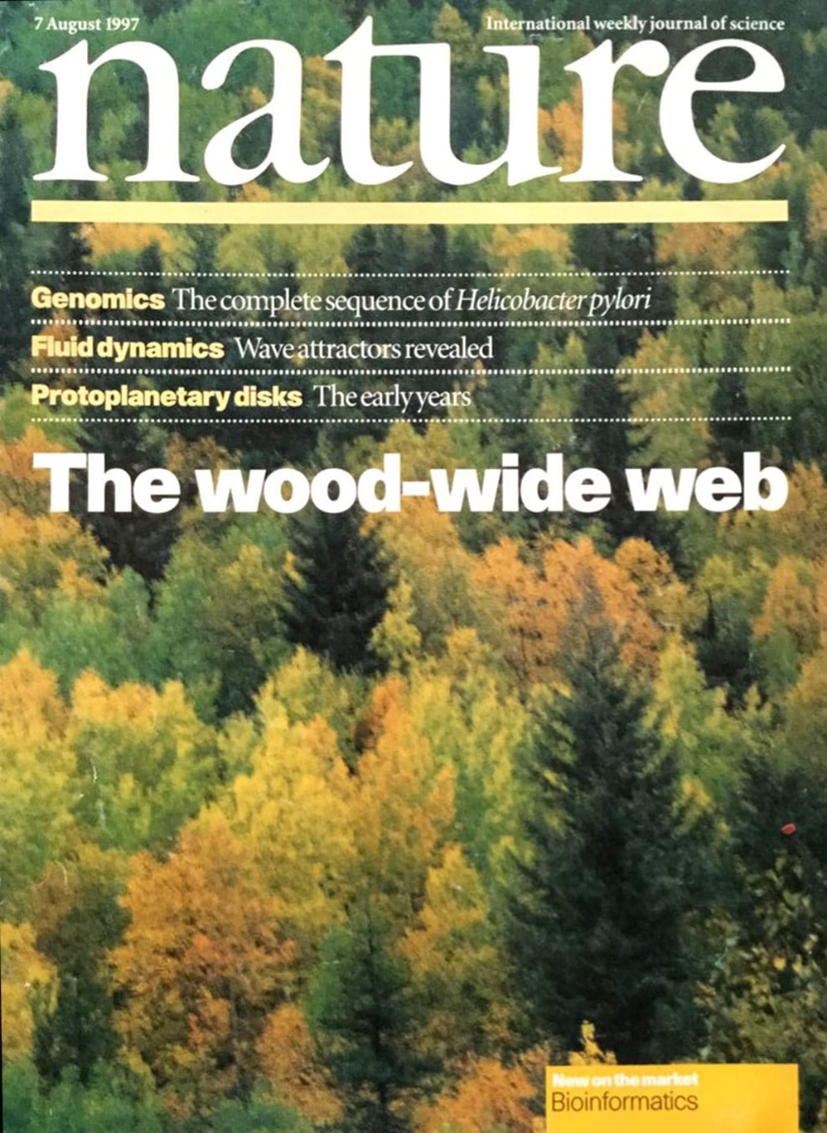
The “wood wide web” first emerged on the front cover of Nature in 1997 (Figure 1), chosen by the editors to describe research on mycorrhiza by forest ecologist Suzanne Simard. The phrase concerns ectomycorrhizal fungi—a polyphyletic group of fungi intimately associated with and interlinking plants, and particularly trees, in intimate networks. Ectomycorrhizal symbioses see fungi improve the plant partners’ access to nutrients and water in exchange for photosynthesized carbon products such as sugars. Whilst only occurring in ~2% of plant species, these species represent the most ecologically and economically important trees, which dominate forest communities in a wide range of habitats across the globe.Footnote 4 Substantial scientific and scholarly claims have been made about the wood wide web—such as its ability to allow trees to “communicate” with each other, or its ability to serve as a model for living contra to capitalist systems—and the phrase has gained considerable public reach.Footnote 5
Issue number 6642 of Nature, first published on August 7, 1997, showing the first documented use of the term “wood-wide web” in reference to the paper “Net transfer of carbon between ectomycorrhizal tree species in the field” in which Suzanne Simard was first author.

Merlin Sheldrake observes that when Simard’s research was first published, network scientists were busy modeling the structure and properties of the nascent internet and had begun applying the new mathematical tools they had developed to study a range of other complex systems.Footnote 6 As mycorrhiza began sporulating into cultural consciousness, network theory was simultaneously expanding into diverse spheres of research; ecology, sociology, epidemiology, astrophysics, neuroscience. Much like in the discovery of mycorrhizal interrelationships between plants and fungi, underlying interdisciplinary connections were revealed between seemingly distinct and disparate phenomena. However, by associating the biological interaction via metaphor to the emerging world wide web, the editors of Nature implied extended characteristics to the symbiosis that go beyond Simard’s chosen terms of “common hyphal network” or “guilds”—namely the potential of ectomycorrhiza to facilitate near-instant communication between distant nodes and of fungal hyphae as information-carrying cables.Footnote 7 Such analogies generate profound questions about more-than-human intelligence and communication.Footnote 8 But they have also provoked criticism through certain claims being overstated or misleading.Footnote 9 Nevertheless, in Devin Griffiths terms, these metaphors may begin as “formal analogies”—applying a pre-existing model of digital connectivity to an ecological system—but they also contain the potential to evolve into “harmonic analogies,” in which reciprocal insights between network science and mycology reshape our understanding of both.Footnote 10
2. Intertextual exchange
Metaphors about mycorrhizal networks have passed through a scientific-cultural system of intertextual exchange, transforming public understanding of them with each new iteration. Richard Powers’s The Overstory (2018) fictionalizes Simard’s research and life story in the character of Patricia Westerford, a botanist who discovers biochemical communication through volatile organic compounds and mycorrhizal networks. She faces ridicule and exile from the scientific community but is later vindicated and proceeds to write a bestselling popular science book, The Secret Forest. Westerford’s book recalls the real bestseller, which disseminated mycorrhiza among the wider public, Peter Wohlleben’s The Hidden Life of Trees (2015), as well as the one Simard herself later writes, Finding the Mother Tree (2021), appearing not dissimilar in form, style, and content to Westerford’s.Footnote 11
Such mycological mises en abyme seem modelled on the mycorrhiza themselves, formed through intercommunication and interaction between species down to a cellular scale. The Overstory embodies intertextuality by the way certain refrains are repeated throughout the polyvocal narrative, themselves echoing recurrent phrases and analogies used to describe mycorrhizal networks. The refrains in Powers’s novel work to intertwine the diverse cast of characters into a community, which comes to recognize the underlying truths Westerford seeks to disseminate by publishing her book. Literary scholar Shannon Lambert describes the refrains as “textual analogues to physical processes of biochemical transmission” which “modify the humans with which they come into contact, creating an interspecies ‘mesh’ or community that challenges human individualism and exclusivity.”Footnote 12
3. The politics of forest altruism
Powers communicates the urgent need for a collective response to deforestation. This is expressed through the characters’ awareness of mutualism as a biological reality of the wood wide web–albeit one that ultimately the characters are unable to apply to their own lives as they fail to coordinate their actions as effectively as mycorrhizal networks. Westerford communicates her vision of the forest as an altruistic social network in The Secret Forest by describing old and seemingly altruistic trees in a forest in the “Giving Trees,” reminiscent of Simard’s “Mother Trees.”
Environmental humanities scholar Rob Nixon suggests that altruistic conceptions of forest ecosystems have received popular interest because they offer a counter-narrative to neoliberal “hyperindividualism and hyperconsumption.”Footnote 13 Nixon points out that neoliberals themselves “have sought to naturalize by invoking three pervasive figures of speech: ‘the selfish gene,’ ‘the tree of life,’ and the ‘mind of the market’.”Footnote 14 The naturalized free market capitalist economics of competition plays out in the traditional commercial plantation forestry that Simard and Westerford, respectively, seek to overturn.
But altruistic conceptions of fungi can also be challenged. Tade Thompson’s Afrofuturist science fiction novel Rosewater (2016) problematizes mycological analogies for altruism, which inscribe a kind of cosy interconnectedness common in environmental fiction and nonfiction.Footnote 15 An extraterrestrial fungoid entity known as “Wormwood” has burrowed itself beneath the Earth’s crust and contaminated the biosphere with microscopic “xenoforms.” Wormwood sprouts a strange biodome in a future Nigeria, healing those who come into contact with it by replacing human cells with alien ones—aiming to replicate this process until indigenous life is fully entangled within the xenosphere. The “first contact” between xenoforms and indigenous human cells observed through a microscope is described in ways that superimpose the first contact of Wormwood into the Earth’s crust, as well as the historical “first contact,” colonization and exploitation of Nigeria by the British:
The xenoform changes form, extends pseudopodia like an amoeba, moving towards the skin and flattening itself against the epidermis, maintaining the connection to the neuron like a drill pipe from an oil rig.Footnote 16
Magnifying through these superimposed scales, much like reading across the overlaid analogies of networks used to describe mycorrhiza, enables us to critically consider patterns of difference and connection between them. Here, the supposed inherent altruism of mycorrhizal networks is problematized when we consider the colonial mindset of fossil fuel extractivism and the ulterior motives of the xenoforms themselves in colonizing Earth and human consciousness.
Tellingly, Thompson’s xenoforms are classified as “Ascomycetes xenosphericus”—a fictional species presumably placed in the terrestrial fungal phylum Ascomycota, whose members can be ectomycorrhizal but which also contains species that includes penicillium, yeasts, ergot, and the symbionts in most lichen.Footnote 17 Such a taxonomic placement introduces a level of uncertainty around the fungus—particularly around whether it might be mutualistic or parasitic or whether it will be beneficial to humanity. Thompson’s novel recenters fungi as distinct and independent organisms which—whilst they may enter mutualistic or commensal symbioses—should not be viewed as possessing a desire or altruistic will to help other species and its metaphor of fungi as alien facilitates this repositioning.
4. Neurological networks
In Rosewater, the fictional mycologist Professor Ileri explains that the now ubiquitous xenoforms collectively constitute a global “xenosphere”—an imperceptible network “made up of strands of alien fungi-like filaments and neurotransmitters”—which attach themselves via natural fungi growing on the surface of human skin to the central nervous system.Footnote 18 Everyone connected to the xenosphere “is uploading information constantly, passively, without knowing,” creating a biotechnological network of information exchange.Footnote 19 In Thompson’s novel, the various analogies used to communicate mycorrhiza to the wider public become intricately entangled.
I believe that mycelium is the neurological network of nature. Interlacing mosaics of mycelium infuse habitants with information-sharing membranes. These membranes are aware, react to change, and collectively have the long-term health of the host environment in mind.Footnote 20
These words are not those of Thompson’s Ileri but of the real mycologist Paul Stamets, in a chapter titled “Mycelium as Nature’s Internet” in his book Mycelium Running: How Mushrooms Can Help Save the World (2005). Thompson’s xenosphere seems at least partly inspired by the slippage between metaphor and the more-than-metaphorical in how mycorrhiza have been communicated to the public. Unlike Stamets’s flowery use of language, Rosewater is self-consciously fictional, enabling readers to explore the implications of the metaphor and speculate about the similarities and differences between mycorrhiza and other complex systems.Footnote 21
5. Anthropmorphic and mycomorphic metaphors
Returning to the concept of the mother tree, Simard recounts her revelation in her memoir, Finding the Mother Tree, in ways which literary scholars Tathagata Som and Kit Dobson describe as “tumbl[ing] into fragmentary form, the emotional register pushing language past syntax and evermore into metaphor”:Footnote 22
The oldest trees were the mothers of the forest.
The hubs were Mother Trees.
Well, mother and father trees, since each Douglas-fir tree has male pollen cones and female seed cones.
But… it felt like mothering to me. With the elders tending to the young. Yes, that’s it. Mother Trees. Mother Trees connect the forest. Footnote 23
For Westerford, Simard’s fictional equivalent, such unapologetic use of anthropomorphism is because “the reading public needs such a phrase to make such a miracle a little more vivid, visible. It’s something she learned long ago from her father: people see better what looks like them.”Footnote 24 In other words, anthropomorphic metaphors are justified by their ability to solicit public attention and affection for phenomena that are scientifically complex or not widely known—something seemingly embraced by Simard herself.Footnote 25 Undoubtedly, recent popular interest and newfound affection for fungi in the public sphere in supposedly “mycophobic” Western countries can be attributed to the power of such analogies to not only explain largely invisible phenomena but to cultivate a sense of wonder upon their discovery.Footnote 26
Yet, as these metaphors proliferate and gain public traction, they have also received substantial criticism.Footnote 27 For Jennifer Bernstein and Justine Karst, metaphors are useful only as “a form of science communication” that can “bridge the unknown with the known to clarify concepts and establish meaning” particularly “when there is not yet more precise terminology.”Footnote 28 Yet, such a limited view of metaphors is to ignore their generative potential to both science and the humanities; their ability to facilitate speculations and shape hypotheses: If the wood wide web exists, can it go wireless?; If fungi are neurological networks, can they retain memories?; If the mother trees tend to their young, can relatedness impact on common mycorrhizal networks?
6. Reimagining metaphor
The view of science advocated for by Karst and others—shaped by a reductionist and unreformed positivism—both limits the potential for metaphor within science and is deeply uninterested in the potential of metaphors outside of science’s remit. In response, we have aimed to contribute to ongoing debates about mycorrhiza and how they are communicated to the wider public by recognizing the fundamental value of metaphors in how we—scientists and nonscientists alike—conceive fungi. Indeed, metaphors are an essential tool of scientific investigation. Much like computational models, whilst metaphors may not be entirely accurate, they are approximations of how we currently understand the world and can facilitate the scientific process through contributing to hypothesis formation. It is the disparities between the metaphor and reality—or even the further implications of a metaphor—that help generate new questions for research and new ways of thinking; misunderstanding itself becomes generative, “motivat[ing] the search for a new shared understanding that both subjects might acknowledge.”Footnote 29 Metaphors, then—even imprecise ones—can deepen both public understanding and the scientific imagination. The question is not whether they belong in science, but how they might be used most productively—as instruments that not only translate but also transform scientific understanding.
Author contribution
Conceptualization: D.D.; N.S.
Conflicts of interest
The authors declare no competing interests.

 Open access

