




Antarctica’s human history has been a history of human work. Early sealers and whalers, Heroic Era explorers and modern-day scientists have all headed south in service of their employment (Maddison Reference Maddison2015, Jaksic et al. Reference Jaksic, Steel, Stewart and Moore2019). One of the most famous Antarctic texts is a job advertisement purportedly written by Ernest Shackleton; the lines ‘Men wanted for hazardous journey. Low wages, bitter cold, long hours of complete darkness. Safe return doubtful. Honour and recognition in case of success’ have gone down in Antarctic folklore (Nielsen Reference Nielsen2023). Today, Antarctica continues to be a place of work, both for the 5500 personnel who go down with National Antarctic programmes each summer (Cordero et al. Reference Cordero, Sepúlveda, Feron, Damiani, Fernandoy and Neshyba2022), fishers involved in the Southern Ocean fisheries and the ship-based workforce who deliver the polar tourism product to over 120 000 tourists each summer season (Senigaglia et al. Reference Senigaglia, Hatton MacDonald, Stoeckl, Tian, Leane and Adams2026). When recruiting a workforce for the Antarctic, it is important to consider aspects such as the person-environment fit (Nielsen & Jaksic Reference Nielsen and Jaksic2018). Yet we also need to look beyond the confines of the continent itself. The Antarctic workforce includes not only those who work south of 60° (the region governed by the Antarctic Treaty) but also the many people back home who work across domains including policy, logistics, science, fisheries, heritage, tourism, education, hospitality and the arts. These people make important contributions to knowledge about and the ongoing protection of Antarctica. They have specialized skills and come from diverse backgrounds, but they are all united by their focus on the far south. Very little is known about the complexities of the workforce that underpin human engagement with the Antarctic. This paper addresses this gap by providing an analysis of the breadth of the Antarctic workforce and situating the discussion in the Antarctic city of Christchurch/Ōtautahi. By bringing together stakeholders from across local and national government, academia, tourism and local business owners and training providers, we asked what Antarctic work looks like now and what is needed to support the sector into the future.
Christchurch as Antarctic city
Perched on the edge of the Southern Ocean, the cities of Cape Town (South Africa), Christchurch (New Zealand), Hobart (Australia), Punta Arenas (Chile) and Ushuaia (Argentina) are all known as ‘Antarctic gateway cities’ due the important role they play in facilitating access to the continent. However, these cities are more than transit hubs for planes and ships; as Leane et al. have demonstrated, ‘each city is also connected to the south in historical, cultural, political, and affective ways that exceed these logistical and transport functions’ (Leane et al. Reference Leane, Lucas, Marx, Datta, Nielsen and Salazar2021, p. 522). Existing studies have explored the concept of Antarctic cities at a local level (e.g. Hobart (Marx et al. Reference Marx, Alexander, Leane and Nielsen2025), Punta Arenas and Ushuaia (Herbert Reference Herbert2014, Elzinga Reference Elzinga2013)) and across the southern rim (Salazar et al. Reference Salazar, James, Leane and Magee2021, Roldan & Nielsen Reference Roldan and Nielsen2022). The term ‘Antarctic city’ recognizes that connections can be wide-ranging. This paper turns the focus to Christchurch. Christchurch is the largest city on New Zealand’s South Island, located on the east coast in the Waitaha Canterbury region and covering ~1426 km2 (Hobbs et al. Reference Hobbs, Ahuriri-Driscoll, Kingham, Wiki, Marek, Dionisio and Mackenbach2022). Known as Ōtautahi in te reo Māori, it is the ancestral home of the Ngāi Tahu people. In the early 1800s, European settlers, predominantly from England, arrived in large numbers to the area, transforming its natural and cultural landscapes into an English colonial city (Hobbs et al. Reference Hobbs, Ahuriri-Driscoll, Kingham, Wiki, Marek, Dionisio and Mackenbach2022). According to census data, over 390 000 people inhabit Christchurch, representing ~8% of the country’s total population (Statistics New Zealand 2023). At present, Christchurch’s cultural diversity continues to be dominated by people identified as Europeans, followed by Asian communities, Māori and Pacific Peoples and other minorities (Statistics New Zealand 2023).
New Zealand’s Antarctic connections date back to the first human interactions with the far south. Oral histories of early Polynesian voyagers sailing to the far south, such as Hui Te Rangiora, are among the first recollections of Indigenous Peoples’ engagement with the Antarctic (Wehi et al. Reference Wehi, Scott, Beckwith, Rodgers, Gillies, Van Uitregt and Watene2022). In February 1773, Captain Cook commanded his ships to spend the winter in the bountiful shores of New Zealand after becoming the first people to have sailed as far south as the Antarctic Circle (Quartermain Reference Quartermain1971). Since then, Antarctic expeditions of different kinds have used New Zealand’s transport infrastructure to travel to Antarctica. Sealers and whalers both passed through the ports and hunted migratory cetaceans from shore-based stations along the coast both north and south of Christchurch. At the beginning of the twentieth century, Christchurch’s port, Lyttelton, became increasingly important to the British Antarctic Expeditions of the so-called ‘Heroic Era’ of Antarctic exploration, such as those commanded by Captain Robert Falcon Scott and Ernest Shackleton. The local people, who were often the last to bid farewell to explorers and the first to receive them on their return, supported the expeditions with interest, as well as through in-kind and financial assistance. Christchurch’s reputation as an Antarctic city was renewed in 1955 when the United States Navy’s mission to Antarctica, also known as Operation Deep Freeze, commenced their operations from the city. This international partnership between Christchurch and the US Antarctic Program (USAP) continues today. Antarctic tourism also impacts on the local region; the tour company Heritage Expeditions is based in Christchurch, while operators including Ponant Expeditions have visited the port in recent seasons (Driver et al. Reference Driver, Guenther and Saunders2024, p. 5).
Christchurch’s modern international airport and Lyttelton port facilities sustain the gateway’s transport role in accessing Antarctica’s Ross Sea region. They facilitate access not only to New Zealand’s Scott Base but also to the Republic of Korea’s Jang Bogo Station, Italy’s Mario Zuchelli Station and the USA’s McMurdo and Amundsen-Scott South Pole stations (Christchurch Antarctic Office 2025). At the purposely built International Antarctic Centre Campus, the above-mentioned National Antarctic programmes (NAPs) have office space and storage facilities to accommodate operational and logistical needs to work in Antarctica. In addition, the University of Canterbury also hosts Gateway Antarctica - Centre for Antarctic Studies and Research and the Secretariat of the Council of Managers of National Antarctic Programs (COMNAP) on its Christchurch campus. Yet Christchurch is more than just a logistics hub or gateway to the south. Rather, as an Antarctic city it assumes ‘values associated with custodianship for the Antarctic, in particular in relation to environmental protection and stewardship but also with regard to science and international scientific and logistical cooperation’ (Salazar et al. Reference Salazar, James, Leane and Magee2021, p. 23). Cultural connections with Antarctica - and how the place is viewed by those who live in the city - are therefore also important to consider (Nielsen et al. Reference Nielsen, Leane, Philpott, Jackson, Senatore, Meredith, Melbourne-Thomas, Garabato and Raphael2025).
In 2017, Christchurch City Council formalized its commitment with Antarctic stakeholders, creating The Antarctic Office (TAO), a dedicated unit that supports and develops opportunities and provides advice to national and international programmes interested in Antarctica. TAO’s work is guided by Christchurch’s Antarctic Gateway Strategy, a local government document created to support the city’s involvement with Antarctica and the Southern Ocean, its international gateway city status and its custodian responsibility to Antarctica (Christchurch City Council 2021). To support the city’s Antarctic gateway role, TAO created an online directory of providers for products and services called Christchurch’s Antarctic Network (CAN). This all-in-one resource showcases Christchurch and New Zealand’s direct and indirect Antarctic stakeholders, from science and logistics in Antarctica, to the overall workforce capability to support and host Antarctic International programmes from the gateways (categories include Accommodation, Tourism and Attractions; Government, Community Organizations and NGOs; Photography, Film and Publications; Research and Education; Specialised Equipment and Services; Technology; and Transport and Logistics). Moreover, CAN facilitates collaboration and networking opportunities between members who annually showcase their capabilities to international visitors during the Christchurch Antarctic Season Opening events.
A 2024 report commissioned by Antarctica New Zealand and TAO provided an economic analysis across five domains, namely NAPs; Tourism and Events; Fishing; Education and Research; and Antarctic Heritage (Driver et al. Reference Driver, Guenther and Saunders2024). The report concluded that Antarctic-related activities contributed NZD 158.3 million to the Canterbury region and NZD 229.3 million to New Zealand in 2023. That economic impact comes with jobs - but the workforce associated with the Antarctic sector has not been the focus of studies to date. This project adds depth to the economic analysis and also provides updated perspectives on the issues flagged during a 1998 Antarctic foresight workshop held in New Zealand on Antarctic futures (Tetley Reference Tetley1998).
The 1998 workshop saw a broad spectrum of participants - from the research and tourism sectors as well as from government, industry and non-governmental organizations (NGOs) - discuss the trends and discontinuities they had observed in Antarctic science, tourism, fisheries and geopolitics. They also explored a suite of challenges facing the Antarctic and its governance regime in relation to diverging values, global pressures and geopolitical tensions before deliberating about sets of scenarios depicting what Antarctica might look like by 2010. On the whole, the workshop participants’ collectively envisioned futures appeared bleaker than the situation on the ground in 2010, with dystopian notions of people living semi-permanently in Antarctica, more pervasive tourism and national pressures, mining and iceberg harvesting, commercial Antarctic drilling projects (be it for freshwater or hydrocarbons), marine aquaculture and even agriculture in the Antarctic echoing earlier predictions by well-known figures such as Sir Douglas Mawson and Rear Admiral George Dufek (Nielsen Reference Nielsen2024, p. 5). While mention was made of people living and operating in Antarctica, including societal structures and infrastructures such as a university present on the continent, the realities and challenges of living and working in the Antarctic received little attention. The focus of the workshop’s presentations and futuring exercise was on big-picture changes rather than operationalization of the envisioned futures. Interestingly, infrastructure upgrades at, for example, the USAP’s Antarctic stations or government investments in mobile assets such as the New Zealand Defence Force’s (NZDF) C-130 Hercules airplanes were envisaged by representatives of the NZDF and the USAP who spoke at the workshop to be well underway, if not complete, by 2010 (Tetley Reference Tetley1998, pp. 32, 58). In hindsight, we know that these prognostications were overly optimistic and were subject to the planning fallacy.
Antarctica as a workplace
There is a substantial body of literature detailing the challenges associated with living and working in an isolated, confined and extreme (ICE) environment (O’Reilly & Salazar Reference O’Reilly and Salazar2017, Bartone et al. Reference Bartone, Krueger and Bartone2018, Steel Reference Steel2001, Pickett & Hofmans Reference Pickett and Hofmans2019, Norris et al. Reference Norris, Holland, Hecker, Liang, Holland and Brewster2020, Nicoll et al. Reference Nicoll, Ali, Silveira, Harper and Smart2023). This includes research on the extent to which Antarctic work environments can be made both physically and psychologically safe (Nash Reference Nash2022, Karplus et al. Reference Karplus, Young, Anandakrishnan, Bassis, Case and Crawford2022), as well as the extent to which the exposure to and working in ICE environments can stimulate personal growth (Nicoll et al. Reference Nicoll, Ali, Silveira, Harper and Smart2023). The nature of Antarctic work - including the importance of well-functioning teams, as Antarctic personnel depend on the support of others in an otherwise-inhospitable-to-humans environment - leads to a focus on the process of ‘selecting-in’ as a key difference between the Antarctic-based workforce and Antarctica’s ex situ workforce (Jenkins & Palmer Reference Jenkins and Palmer2003, Nash Reference Nash2022). Key features of work on the Antarctic continent, as well as on vessels in the Southern Ocean, include isolation (weeks, months or even a year away from home in a remote environment); confinement and a lack of privacy; harsh conditions; and emotional stresses associated with extreme environments (Pickett & Hofmans Reference Pickett and Hofmans2019). Psychosocial adaptation has seasonal, situational and social components (Palinkas Reference Palinkas2003). Issues identified by scholars investigating the experiences of Antarctic workers include loneliness; person-environment fit, with a need for personnel to be comfortable both indoors and outdoors; the need to select for compatible personality traits; challenges around the lack of privacy; and sleep disturbance (Jaksic et al. Reference Jaksic, Steel, Stewart and Moore2019, Sarris et al. Reference Sarris and Kirby2007). Person-culture or person-organization fit is also important - as Nash explains, ‘organizational cultural factors play an important role in the interpersonal/social aspects of working in an extreme environment’ (2022, p. 444). NAPs also acknowledge the challenges personnel face when transitioning both onto and off the continent (Norris et al. Reference Norris, Paton and Ayton2010). Such issues associated with Antarctica as a remote and extreme workplace are recognized and taken into account by NAPs when making personnel selections.
Antarctica is now accessible to a much wider range of people via tourism (Liggett & Stewart Reference Liggett, Stewart, Saarinen and Hall2025). The phenomenon of Antarctic tourism has been growing exponentially, with numbers of visitors increasing from over 36 000 in 2014/2015 to over 122 000 in the 2023/2024 season (Antarctic Treaty Consultative Meeting 2024, IP102). Although the majority of Antarctic tourism operates out of Argentina and Chile (with Ushuaia and Punta Arenas, respectively, being key departure points for the tourism industry to access the popular Antarctic Peninsula), other tour operators travelling to the Ross Sea also operate from New Zealand ports. The tourism workforce on board Antarctic tour vessels is drawn from many different nations, including New Zealand, meaning that those visiting the continent via other gateways may still encounter connections to Christchurch (e.g. through expedition team members from the region).
Methods
Over the course of a half-day workshop (held in October 2024 at Tūranga, Christchurch), we used expert elicitation to address several key questions related to the Antarctic workforce in Christchurch and New Zealand. The workshop aimed to review Christchurch’s relationship and connections with the Antarctic; assess the current skills and capabilities associated with Antarctic work in the region; and explore the future of the Antarctic workforce. Participants were invited to participate based on their professional connections to the local Antarctic sector. The majority of participants were members of CAN. The workshop included representatives from a range of government levels, tourism and hospitality businesses, infrastructure providers and manufacturers and the education and heritage sectors. A total of 29 people participated in the workshop. Most of the participants had multiple connections across different Antarctic sectors, and many had moved between roles throughout their careers. Based on their professional backgrounds, they self-identified as having expertise related to NAP support, education and outreach, tourism, international relations, NGOs, academia, government, project management and governance and industry and trade, then they formed discussion groups of five to six people with a designated rapporteur. Groups were asked to discuss the following questions, with a particular focus on the local context:
-
1) What work will/could be done in the Antarctic and Southern Ocean?
-
2) What changes might occur over the next 5 years?
-
3) What are the key challenges and opportunities associated with developing the future Antarctic workforce in Christchurch?
To ensure a range of voices were included in the analysis, we asked each group to write their points down. Smaller groups then reported back their ideas in plenary, allowing the facilitators to create a mind map representing the themes from all of the groups. Recurrent themes were collated on slides and projected onto a screen for further discussion. Participants were invited to reflect on these themes during the final plenary session and to suggest concrete actions that might enhance the capacity of the local Antarctic workforce over the coming 5–10 years. Written responses were revisited during the post-workshop analysis so that details could be included in relevant sections. The workshop was approved by the Human Research Ethics Committees of the University of Tasmania (H0029738) and the University of Canterbury (202490LR-PS).
A similar Antarctica Day workshop, held in Hobart, Tasmania, in 2022, examined subsets of the Antarctic workforce, including arts, infrastructure and logistics, tourism, science, engineering and technology and policy. Hobart has the highest concentration per capita of Antarctic researchers of any city, while the Antarctic sector is worth AUD 204 million annually to the local economy (Antarctic Tasmania 2024) - this makes it an interesting comparison for the Christchurch case study. The project report detailing the findings from the Hobart workshop identified attrition rates of skilled staff associated with seasonal employment and ‘the need to provide sustainable, safe and secure employment opportunities to enable growth and diversification of Antarctic-located workforces’ (Woods et al. Reference Woods, Nielsen and Forrest2023, p. 7) as key challenges. The importance of identifying and maintaining career pathways for those both entering and already involved in the sector was also identified as a priority, with the report noting the risks of losing skilled personnel if local opportunities were not available. The Hobart report provides a useful framework against which to compare the Christchurch findings.
Results
Participants were asked to discuss what work will/could be done in the Antarctic and Southern Ocean and what skills are required for this work. They were then asked to look forward 5–10 years and envisage a best-case scenario for workforce capability across all sectors. Fields of work discussed included science, technology, fisheries, tourism, medicine, infrastructure, art and education. The level of detail provided regarding each area depended on the backgrounds of the experts in each breakout group, and all responses were collated into a master document during the plenary discussion. In order to protect the identities of participants, we have removed any information that might identify individuals. This was in line with the human ethics guidance provided by the University of Canterbury and the University of Tasmania. This section outlines the skills and key discussion topics associated with top-level fields of work, namely: Tourism and Events; National Antarctic Programs; Fisheries; Policy; Arts, Heritage and Education; and Science and Research. These divisions map onto similar categories used by the Canterbury Antarctic Network, the Tasmanian Polar Network and the 2024 report on Antarctica’s economic impacts for Canterbury (Driver et al. Reference Driver, Guenther and Saunders2024). While others combine research and education, we address education alongside arts and heritage given the overlap in the public outreach component. This breakdown of sectors is followed by a comparison with findings from the 2022 Hobart report, an analysis of the perceived changes over the coming 5–10 years and a synthesis of the key challenges and opportunities that participants identified in relation to building the future polar workforce in Christchurch.
Antarctic workforce matrix
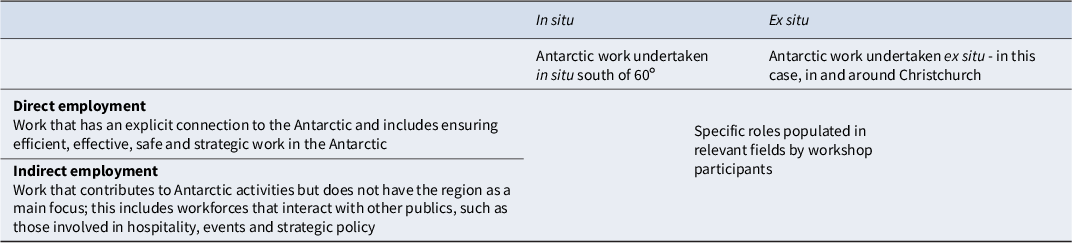
To assist in this discussion, we suggest a matrix for classifying Antarctic work (Table I). While some Antarctic work is undertaken in situ south of 60°, there is also a key workforce based ex situ - in this case, in Christchurch. In situ and ex situ therefore sit on one axis. The other axis categorizes work as either direct or indirect employment. Direct employment relates to work that has an explicit connection to the Antarctic, and this includes ensuring efficient, effective, safe and strategic work in the Antarctic. Indirect employment is work that contributes to Antarctic activities but does not have the region as a main focus - this includes workforces that interact with other publics, such as those involved in hospitality, events and strategic policy. Driver et al.’s Reference Driver, Guenther and Saunders2024 report on the value of Antarctic-related activities to the Canterbury region identified ‘over 800 firms that supply goods and services to the National Antarctic Programs (NAPs)’ (p. 7), so this sector is not insignificant. While in situ work involves direct employment, ex situ examples can be direct or indirect. Some industries comprise multiple roles, with certain positions occupying different parts of the matrix. This model is useful when considering the Antarctic workforce and its connections with Christchurch, as it encompasses the broad range of positions that relate to the far south, and it can help to identify opportunities for further growth.
Antarctic workforce matrix, including descriptions of each field.

Table I. Long description
The table has three columns with headers: blank, In situ, and Ex situ. The first row under In situ reads Antarctic work undertaken in situ south of 60 degrees. Under Ex situ, it reads Antarctic work undertaken ex situ, in and around Christchurch. The next row, first column, is Direct employment, defined as work explicitly connected to the Antarctic, ensuring efficient, effective, safe, and strategic work. Under In situ, it lists specific roles populated in relevant fields by workshop participants. The Ex situ cell is blank. The third row, first column, is Indirect employment, defined as work contributing to Antarctic activities but not focused on the region, including hospitality, events, and strategic policy. The In situ and Ex situ cells for this row are blank. The table is a model for the following tables, which are populated with sector-specific roles.
The following subsections of the paper introduce a specific matrix for the workforces associated with Tourism and Events; National Antarctic Programs; Science and Research; Policy; Fisheries; and Arts, Heritage and Education. A comprehensive matrix including all roles is included as Table S1.
Tourism and events
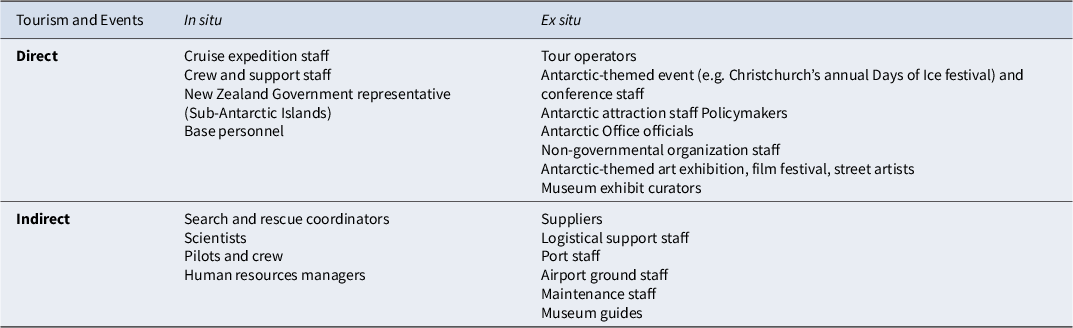
The tourism workforce includes local companies that operate Antarctic itineraries; individuals who work as guides or crew on tourist vessels; travel agencies with a home base in Christchurch; and extends to both the Port of Lyttelton and local companies that provision tour vessels (Table II). Tour itineraries including New Zealand sub-Antarctic islands must carry a New Zealand Government representative on board as an observer - due to a shortage of trained staff, government agencies (Department of Conservation, Fisheries New Zealand, Antarctica New Zealand, Ministry of Foreign Affairs and Trade (MFAT)) pool resources to supply a government representative rather than expecting each agency to have its own observer. We also consider pilots, crew and ground staff for the Aurora Australis viewing flights that operated in 2021 and 2022, carrying 250 passengers (Driver et al. Reference Driver, Guenther and Saunders2024). Tourism and events also encompass activities undertaken by Antarctic personnel pre- and post-departure, event organizing in the city and the impacts generated by delegates who visit for conferences and events. In recent years, these have included the Scientific Committee on Antarctic Research (SCAR) Biology Symposium (2023) and the Australia New Zealand Antarctic Science Conference (2023), which brought over 1000 delegates to the region. The direct impacts of Antarctic-related tourism on Canterbury were estimated to be NZD 71.2 million in 2023 (Driver et al. Reference Driver, Guenther and Saunders2024).
Antarctic workforce matrix populated with Tourism and Events roles.
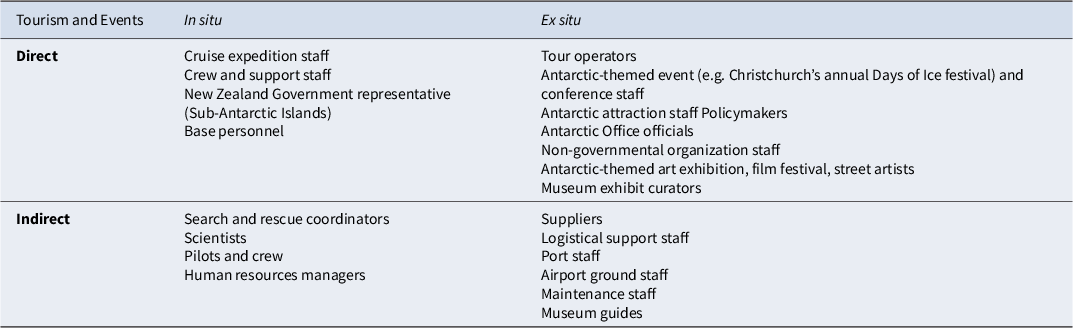
Table II. Long description
The table has three columns: Tourism and Events, In situ, and Ex situ. The first row under Direct lists In situ roles as Cruise expedition staff, Crew and support staff, New Zealand Government representative for Sub-Antarctic Islands, and Base personnel. Ex situ roles for Direct include Tour operators, Antarctic-themed event and conference staff, Antarctic attraction staff, Policymakers, Antarctic Office officials, Non-governmental organization staff, Antarctic-themed art exhibition, film festival, street artists, and Museum exhibit curators. The second row under Indirect lists In situ roles as Search and rescue coordinators, Scientists, Pilots and crew, and Human resources managers. Ex situ roles for Indirect include Suppliers, Logistical support staff, Port staff, Airport ground staff, Maintenance staff, and Museum guides.
Participants noted that tourism can have a positive impact via education but expressed concerns about potential overtourism. The idea of ‘Antarctic Ambassadors’ was raised as an area that deserves more focus to ensure that people who visit the Antarctic region have the opportunity to practice pro-environmental behaviours both on the voyage and once back home (Alexander et al. Reference Alexander, Liggett, Leane, Nielsen, Bailey, Brasier and Haward2019). Participants also noted opportunities to open up sub-Antarctic tourism as a greater market, with the New Zealand departure points (including Christchurch) presented as an important part of the overall Southern Ocean tourism experience. The redevelopment of Antarctic tourism facilities in Christchurch (e.g. the Canterbury Museum and the International Antarctic Centre) was flagged as both a challenge and an opportunity for fostering an interest in Antarctica in a wide range of people (locals and tourists to the city). Enhanced collaboration between scientists and tour operators was also identified as an opportunity, with vessels of opportunity and citizen science both presenting ways to access different types of data from those in situ in the Antarctic.
National Antarctic programmes
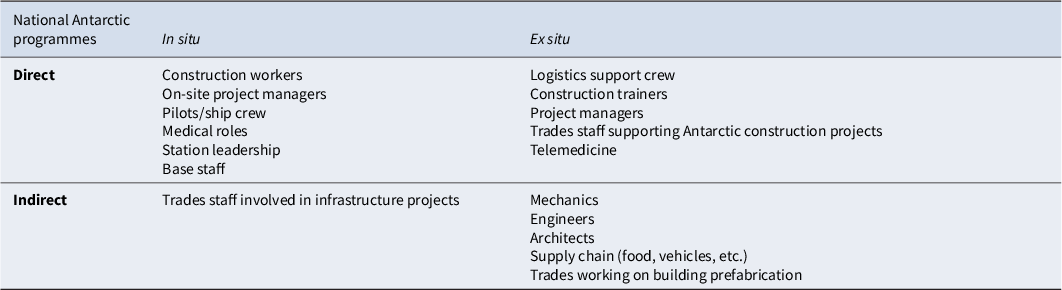
NAPs are an important sector to consider as they facilitate access to Antarctica and act as an umbrella for a diverse range of roles (Table III). Under this heading we include support staff; engineering and technology roles; trades; logistics and operations; and medical staff. More specifically, the types of roles available at Antarctic stations include station leadership; science and field support; logistics support; medical positions; engineering and trades; communication and information technology (IT) specialists; meteorologists; mechanics; vehicle, maritime and aviation operations; hospitality and cleaning roles; fuel staff; environmental staff; health and safety; and waste management (Jordan Reference Jordan2024). At times, people move between quadrants - for instance, construction workers working ex situ on equipment for use in the Antarctic can later be taken to work in situ. This was the case with the completion of the US Amundsen Scott South Pole Station, for which New Zealand tradespeople were enlisted to complete the project. The direct impacts of Antarctic-related activities from NAPs on Canterbury was estimated to be NZD 70.1 million in 2023 (Driver et al. Reference Driver, Guenther and Saunders2024).
Antarctic workforce matrix populated with National Antarctic programme roles.
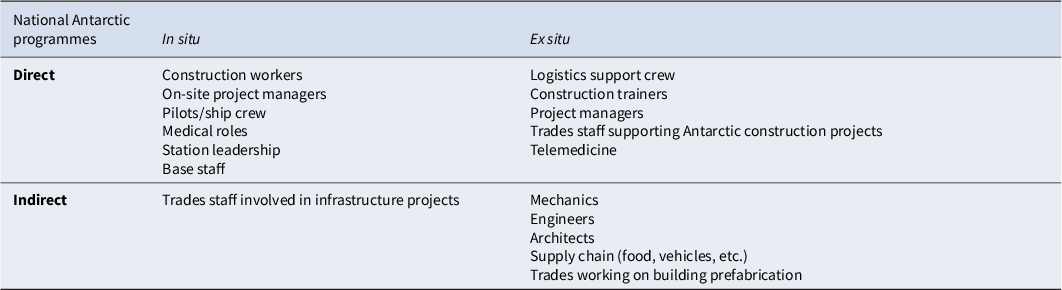
Table III. Long description
The table has three columns: National Antarctic programmes, In situ, and Ex situ. The first row under National Antarctic programmes is Direct. In situ direct roles are construction workers, on-site project managers, pilots or ship crew, medical roles, station leadership, and base staff. Ex situ direct roles are logistics support crew, construction trainers, project managers, trades staff supporting Antarctic construction projects, and telemedicine. The next row is Indirect. In situ indirect roles are trades staff involved in infrastructure projects. Ex situ indirect roles are mechanics, engineers, architects, supply chain for food and vehicles, and trades working on building prefabrication.
The technology workforce includes those involved in the creation of technological infrastructure; those who operate and deploy such infrastructure; manufacturers of specialist equipment; and experts and advisors with cold-weather expertise. The engineering workforce was flagged as particularly significant in the context of a Scott Base redesign, with roles both ex situ and in situ and overlaps between these as projects progress. Participants highlighted the role that remote sensing will play in future data collection in the region, noting that developments such as Starlink mean that data are coming back faster and are capable of being processed ex situ. Remote technologies could be used to monitor human impacts in Antarctica. However, participants also acknowledged the challenges associated with new technology and the need to ground-truth data - so the relationship between in situ and ex situ work in the engineering and technology realm will remain important.
The ex situ, indirect workforce is particularly important when considering NAPs, as this encompasses a wide range of support types that enable Antarctic operations while contributing to the local economy. This was identified as an opportunity by workshop participants:
One of the things that is a massive opportunity for the NAPs and NZ is that we can shortcut the supply chain by [a] substantial amount with suppliers from New Zealand rather than bringing it all the way from the US. There are some politics around that that may be managed around funding and wanting to keep American people employed and all those sorts of things. But there’s got to be some kind of crossover point where actually that doesn’t make any sense to do that and there’s the opportunity for us. So maybe identifying those things, whether its timber or fuel or whatever those options are.
(R-004)Science and research
The science and research workforce includes researchers affiliated with research institutions and NAPs; technicians who support the collection of scientific data; and modellers working with Antarctic data (Table IV). It also includes adjacent roles such as research fund managers and suppliers of specialized scientific equipment that facilitates research activity. Discussion centred on the most visible scientific workforce, namely the researchers who travel to the continent to conduct fieldwork. Participants placed emphasis on the importance of the sustainability of scientific operators, particularly in light of the increasing environmental costs of operating in the region - and perceptions of those costs by the wider public. To enhance science capability without creating a greater human footprint, participants suggested upskilling the science capability of Scott Base staff so that they could engage in more basic data retrieval from instruments, as well as investigating opportunities for creating and promoting a Christchurch-based laboratory rather than relying on Scott Base-based facilities. This speaks directly to the transfer of skills from the in situ to the ex situ arena and opens the door to strengthening capacity in Christchurch.
Antarctic workforce matrix populated with Science and Research roles.

Table IV. Long description
Column headers from left to right are Science and Research, In situ, and Ex situ. The first row under Science and Research is Direct. In situ direct roles include Researchers, Ph D candidates and post-doctorates, and Science support personnel. Ex situ direct roles include University staff such as lecturers, supervisors, support staff, Modellers working on Antarctica, and Ph D candidates and post-doctorates. The second row is Indirect. In situ indirect roles are absent, marked with a dash. Ex situ indirect roles include Research fund managers, Suppliers of specialized equipment and clothing, and Software developers.
Policy
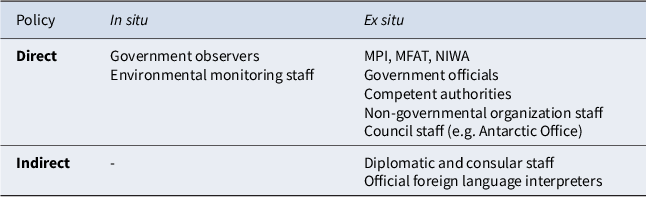
The policy workforce includes decision-makers across a range of levels (local, national and international), as well as those working for NGOs (Table V). Antarctica New Zealand is home to a significant number of those in the Antarctic policy workforce, but roles also exist in other parts of the country, particularly in Wellington, where New Zealand’s parliament is located - this includes positions within the Ministry of Primary Industry (MPI) and MFAT, as well as the National Institute of Water and Atmospheric Research (NIWA; now known as Earth Sciences New Zealand). The geographical spread was highlighted as a potential challenge. This workforce includes diplomatic and consular staff who may encounter Antarctic issues in their day-to-day work, the competent authorities who grant permits for activities in the Antarctic, as well as officials who represent New Zealand’s interests on the international stage at the Antarctic Treaty Consultative Meeting (ATCM) and the Commission for the Conservation of Antarctic Marine Living Resources (CCAMLR).
Antarctic workforce matrix populated with Policy roles.
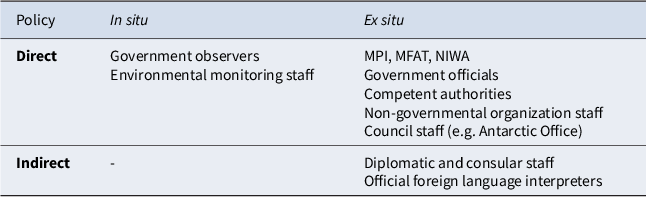
Table V. Long description
The table has three columns labeled Policy, In situ, and Ex situ. The first row under Policy is Direct. In situ Direct lists Government observers and Environmental monitoring staff. Ex situ Direct lists M P I, M F A T, N I W A, Government officials, Competent authorities, Non-governmental organization staff, and Council staff such as Antarctic Office. The second row under Policy is Indirect. In situ Indirect is empty. Ex situ Indirect lists Diplomatic and consular staff and Official foreign language interpreters. Table footnotes define M F A T as Ministry of Foreign Affairs and Trade, M P I as Ministry of Primary Industry, and N I W A as National Institute of Water and Atmospheric Research, now Earth Sciences New Zealand.
MFAT = Ministry of Foreign Affairs and Trade; MPI = Ministry of Primary Industry; NIWA = National Institute of Water and Atmospheric Research (now Earth Sciences New Zealand).
Fisheries
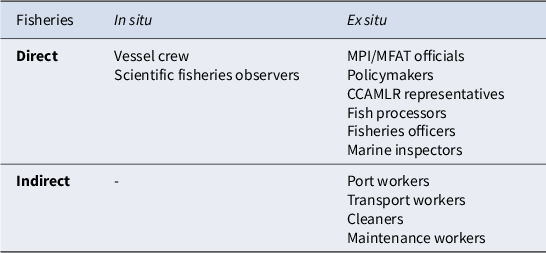
The fisheries workforce includes those who work on vessels that operate in the Southern Ocean (captains and crew); people back home who receive the catch; those involved in fisheries management; marine inspectors; port workers; distributors and transporters; and those involved in documenting the catch (Table VI). In the Southern Ocean, fisheries are managed through the CCAMLR, which formally sits within the broader Antarctic governance regime: the Antarctic Treaty System (ATS). Delegates meet in Hobart each October for annual governance meetings and to deliberate reports from the Scientific Committee for the Commission for the Conservation of Antarctic Marine Living Resources (SC-CAMLR), who provide scientific input on ecosystem function, the impacts of fisheries, zoning questions and whether any areas should be closed to fishing. CCAMLR can also set catch limits for subareas around the Antarctic. Target species include Antarctic krill (Euphausia superba), mackerel icefish (Champsocephalus gunnari), Patagonian toothfish (Dissostichus eleginoides) and Antarctic toothfish (Dissostichus mawsoni). This fishery opens on 1 December each year and remains open until the catch quotas are reached - this makes it a time-sensitive sector, with in situ roles available at specific times of year (early summer). Discussions highlighted that environmental changes in the Antarctic region could impact fishing activity. Social licence to operate in the region was also an issue, as highlighted by The Last Ocean campaign, which advocated for a Marine Protected Area (MPA) in the Ross Sea (a Ross Sea MPA was agreed upon in 2016). The direct impacts of Antarctic-related fisheries on Canterbury were estimated to be NZD 12.5 million in 2023 (Driver et al. Reference Driver, Guenther and Saunders2024).
Antarctic workforce matrix populated with Fisheries roles.

Table VI. Long description
The table has three columns labeled Fisheries, In situ, and Ex situ. The first row under Fisheries is Direct. In situ roles for Direct are Vessel crew and Scientific fisheries observers. Ex situ roles for Direct are M P I slash M F A T officials, Policymakers, C C A M L R representatives, Fish processors, Fisheries officers, and Marine inspectors. The second row under Fisheries is Indirect. There are no In situ roles for Indirect, indicated by a dash. Ex situ roles for Indirect are Port workers, Transport workers, Cleaners, and Maintenance workers. Table footnotes define C C A M L R as Commission for the Conservation of Antarctic Marine Living Resources, M F A T as Ministry of Foreign Affairs and Trade, and M P I as Ministry of Primary Industry.
CCAMLR = Commission for the Conservation of Antarctic Marine Living Resources; MFAT = Ministry of Foreign Affairs and Trade; MPI = Ministry of Primary Industry.
Arts, heritage and education
The arts workforce includes creative roles (artists, writers and musicians), as well as producers and officials in adjacent roles (Table VII). The heritage workforce includes those who conduct restoration work in situ in Antarctica, as well as those promoting Antarctic heritage and connections back home. The education workforce includes teachers and university staff, as well as education officers from organizations such as the International Antarctic Centre and Canterbury Museum. We consider these workforces together given their common focus on outwards-facing communication and extensive overlap in outreach activities conducted by organizations such as the Antarctic Heritage Trust and the International Antarctic Centre. Discussion about this workforce segment highlights the need for science, technology, engineering, mathematics and medicine (STEMM) education across all levels, as well as interactions with the tourism sector - participants suggested leveraging local knowledge to help make information regarding Antarctica more accessible for tourists, and they proposed a local guide academy to train those interested in moving into the tourism space. The direct impacts of Antarctic heritage activities on Canterbury was estimated to be around NZD 3 million per year (Driver et al. Reference Driver, Guenther and Saunders2024) - this figure does not account for the additional impacts related to arts and education.
Antarctic workforce matrix populated with Arts, Heritage and Education roles.

Table VII. Long description
The table has three columns: Arts, Heritage and Education; In situ; Ex situ. The first row under Direct lists N Z A H T staff, Youth expedition staff, and Visiting artists for In situ, and Ministry of Arts, Culture and Heritage officials, Education officers such as International Antarctic Centre, and Public outreach staff for Ex situ. The second row under Indirect lists a dash for In situ and Teachers such as geography, science, history, and Artists, musicians, writers for Ex situ. N Z A H T stands for New Zealand Antarctic Heritage Trust.
NZAHT = New Zealand Antarctic Heritage Trust.
Other sectors
For the purposes of this project, taking note of the sectors of the workforce that were not discussed at the workshop is also important. This includes the support workforce at stations; the policy workforce back home that shapes access requirements; and the administrators and logistical personnel back in Christchurch who facilitate that access to Antarctica. This is a significant gap - when talking about the future Antarctic workforce, it is important to consider all of those whose work influences and facilitates human interactions with the far south. As remote technologies become more readily available and concerns regarding the human footprint in the Antarctic grow, more scientific work is likely to be conducted from afar. While ground-truthing data will always play an important role in furthering knowledge regarding Antarctica, knowledge creation from afar is becoming easier and more accessible.
Discussion
Workshop participants were asked to consider what they would like the Antarctic work landscape to look like in 5–10 years. Feedback included: a workforce that is multi-disciplinary, with social science perspectives integrated; where languages are valued; where improved efficiencies and decarbonization are prioritized; where Antarctic-specific skills are taught as an integral part of trades courses; and where Antarctica New Zealand plays more of an influential role in New Zealand science systems rather than being perceived as a reactive ‘service provider’. When looking forward to the next 5–10 years, participants noted the importance of the wider Antarctic context in shaping the demand for particular skills. Dramatic changes to the physical environment, including shrinking ice and changing fishing inventory, were likely to influence human activity in the region.
Local contextual factors that were flagged as important included the proposed redevelopment of Scott Base and the current redevelopment of Antarctic tourism facilities in Christchurch (including the Canterbury Museum and the International Antarctic Centre). The Scott Base redevelopment was a common focus for workshop participants. This will play an important role in shaping the future work landscape, as Scott Base is New Zealand’s only Antarctic station, and it is the centre of the nation’s Antarctic research programme. The redevelopment has been in planning for approximately a decade now and has undergone a number of revisions to curb costs and focus on what is feasible. A revised Scott Base Redevelopment Masterplan was approved by the New Zealand government in May 2025, and a detailed business case is to be delivered to the government in mid-2026. The Masterplan details a three-stage process for upgrading Scott Base, starting with the oldest buildings in the first stage. This is expected to be completed by 2030 and involves the construction of new living quarters and the refurbishment of the Hillary Field Centre, which houses laboratories, equipment and staging areas for field events and science projects (Antarctica New Zealand 2025).
On the international level, participants highlighted the potential pressure from other nations to use Antarctic resources differently, and how changes to other NAPs (e.g. NAPs leaving New Zealand for another Antarctic gateway base) would have wide-ranging effects on the variety of industries that support Antarctic operations each season. Other NAPs have different priorities in terms of the research they support and how they operate. Some NAPs rely to a greater extent on ship-based access to the Antarctic and spend longer times at sea, or they might even focus their research activity on marine phenomena, while other NAPs operate inland or on sea ice, all of which require different skillsets to support (Jardine & Clack Reference Jardine, Clack, Clack, Meral and Selisny2023, Brooks et al. Reference Brooks, Press, Bloom, Goldsworthy, Chen, Meredith, Melbourne-Thomas, Garabato and Raphael2025). With global geopolitical shifts, we are also seeing an expanding interest in the Southern Ocean and the Antarctic, with new operators - national and private - emerging and also requiring a workforce.
Challenges and opportunities identified
Workshop participants pointed to environmental, economic, political and social drivers of change that could impact upon the makeup of the Antarctic workforce in Christchurch. Key in situ challenges identified over the coming 5–10 years included ongoing changes to the polar environment, including shrinking ice; and environmental and commercial concerns around shifts in the fishing inventory, including issues with sustainability and pressure on stocks. Key opportunities related to greater use of technology to enhance science and technical capabilities; and undertaking science off cruise ships (using ships of opportunity) in the Southern Ocean. Back home, potential changes to NAP structures and policy priorities was noted as challenges, as NAPs could choose to operate from another Antarctic gateway in the future. Meanwhile, greater connection between businesses that identify as Antarctic partners - facilitated by local Antarctic knowledge-brokers - and courses to help grow Antarctic knowledge and capacity were commonly suggested as opportunities. The lack of a long-term cohesive Antarctic plan for Christchurch was identified as a challenge, with participants highlighting the need for a strategic vision of Christchurch as an Antarctic city. Political changes were also flagged as potential challenges, with the question of identity coming to the fore with regards to whether the city would want to continue as an Antarctic gateway or move to focus on other priorities. Participants noted the importance of investing in both Antarctic science and the social sciences, with the latter crucial to informing a long-term strategy for developing the Antarctic workforce in the city. The geographical distance between people in different Antarctic workforces across New Zealand was also highlighted as a challenge that could lead to siloing of skills and approaches.
With careful planning, tomorrow’s Antarctic workforce will be found in and around Antarctic cities such as Christchurch. The 2022 event in Hobart identified as a challenge ‘attracting, recruiting, and enabling entry into Antarctic and Southern Ocean workforces’ (Woods et al. Reference Woods, Nielsen and Forrest2023, p. 33). Specific initiatives suggested to make Antarctic-related positions more visible included hosting an Antarctic job fair ‘to promote and enable connection to job opportunities, including in related industries such as fisheries and tourism’; establishing an Antarctic jobs portal to ‘make the diversity of Antarctic-related jobs, professions, employers and industries more visible’; and offering internships to build capacity at a local level (Woods et al. Reference Woods, Nielsen and Forrest2023, p. 34). An Antarctic jobs portal was also raised during the discussions in Christchurch. In Hobart, the seasonal nature of Antarctic work was raised as a barrier to the continuity of roles. This was not raised in Christchurch, possibly due to the availability of alternative cold-weather work opportunities close to the city (e.g. ski fields require technicians). The length of the season may also be a factor, with Scott Base being much more accessible via air link than the Australian Antarctic stations, which are predominantly serviced by sea. Given the specificity of the Antarctic sector, a platform highlighting Antarctic-related career opportunities from across the Antarctic cities and beyond could help strengthen the quality of applications for roles and promote knowledge transfer between key Antarctic cities (Salazar et al. Reference Salazar, James, Leane and Magee2021). Exchange between Antarctic cities could also be a good way to build capacity across a number of sectors.
Workshop participants highlighted connections as a priority, suggesting ways to broker connections between NAPs and local skillsets and to make knowledge about local expertise available (Fig. 1). These processes included establishing a portal for knowledge sharing and improving the visibility of existing skills to providers to NAPs. When considering remote place attachment with Antarctica in the Hobart context, Marx et al. note that ‘future engagement strategies should aim to bridge the social divide between community members who have and have not visited such places’ (2025, p. 1) in order to support the development of place attachment and an ethic of care. Focusing on developing Antarctic identities and networks - including through events such as Antarctic festivals and initiatives such as the Antarctic Youth Coalition - could help with this. Workshop participants also suggested a range of concrete actions to build and retain the skills of the local Antarctic workforce. These are presented in the following and grouped by theme, with some suggestions being more applicable to specific sectors (e.g. training providers, tourism industry, local government) than others, and with the high-level strategy informing all other elements.
Image showing Antarctica and New Zealand highlighting four key actions, namely: implementation of an overarching Antarctic strategy; training to improve local talent and pathways; visibility of and connection to existing skills (knowledge of who does what and where experts are available); and improving tourism connections (both in Antarctica and in Christchurch).

Recommendations coming out of discussions included:
-
• Creating a clear Antarctic strategy that maps from the local to the national level (and connects with international priorities). The need for a high-level strategy addressing not only the Antarctic workforce but also broader Antarctic priorities was noted by many workshop participants. Led by the policy workforce, this would guide the decisions of those working across all other areas within the Antarctic sector.
-
• Enhancing the visibility of local skills for NAPs could build capacity in the polar workforce and create new opportunities. Participants noted the importance of ensuring that the city’s Antarctic support capabilities were well-publicized. Better awareness of capacity and connections between different sectors and the different nations that use Christchurch as a logistical base could help with this. People who are centralized connectors or ‘Antarctic knowledge-brokers’ could be deployed to bring such network connections together, avoiding duplication while enhancing Christchurch’s reputation as a trusted Antarctic gateway. This could be supported through the development of a portal hosting information for both tourists and NAP staff coming through Christchurch and specifically tailored for those needing businesses to support on-ice activities.
-
• Streamlining employment processes was noted, as participants highlighted procedural difficulties (e.g. medical requirements and policies around hiring external personnel) as a barrier to working in the Antarctic. Practical solutions included ensuring a local doctor could complete the medicals required by the NAPs operating out of Christchurch and connecting the needs of NAPs with local skilled workers (see above).
-
• Adding Antarctic modules to training in New Zealand, across universities, polytechnics, and trades training courses, would be beneficial. This would prepare a wider range of people with Antarctic-ready skills, making individuals more competitive for opportunities as they arise and ensuring a wider skills base is available to draw upon locally. Specific skills discussed included cold-weather building and guiding tours (addressed below). While market forces drive expertise (e.g. construction projects in the Ross Sea drive demand for skills locally), it is important to maintain a baseline of knowledge regarding working in the region. The University of Tasmania’s (UTAS) course on remote medicine (called ‘Expedition Medicine’; UTAS 2024) is an example in which the Antarctic content was included as a case study alongside traditional materials, while the University of Canterbury’s Postgraduate Certificate in Antarctic Studies was highlighted as a useful example of Antarctic education that enhanced capacity across multiple fields.
-
• Investing in Antarctica-specific skills is important. Participants suggested that training focused on specific Antarctic skills (e.g. cold-weather trades) could be supported by central grant involvement that promotes workforce development for Antarctica (e.g. via MFAT/Ministry of Business, Innovation and Employment (MBIE), in collaboration with NAPs). Participants raised the possibility of including Antarctic content in local trades training (e.g. by including a module on cold-weather building) to ensure those being trained in trades are well-placed to work in the Antarctic. Trainees could then take their skills that are applicable in an ex situ, indirect situation (e.g. repairing equipment that will be used in the Antarctic) and transfer these to an in situ, direct situation (e.g. working on a station).
-
• Improving tourism connections and capabilities was highlighted. Participants noted the potential of hosting an International Association of Antarctica Tour Operators (IAATO) office in Christchurch or hosting an Antarctic or polar guide academy where the knowledge and skills required to operate in the Antarctic were taught to those wanting to enter into the industry. This could be established in collaboration with existing training providers (see above) and would help strengthen Christchurch’s role as an Antarctic knowledge hub.
-
• Local Antarctic tourism within Christchurch was also identified as an area of growth, with the redevelopment of Canterbury Museum and renewal of exhibitions at the International Antarctic Centre offering opportunities to foreground Antarctic connections from afar. A focus on the concept of bringing Antarctica to Christchurch would support educational objectives and strengthen Antarctic connections without increasing the human footprint on Antarctica.
-
• Developing Antarctic identities was highlighted. When discussing how to get people excited about getting involved with Antarctica, participants pointed to both education in schools and an awareness of opportunities to engage with the continent, especially for those who have not been to the far south. Educating decision-makers regarding why Antarctica is important for Christchurch and for New Zealand was also identified as important, with local festivals such as IceFest/Days of Ice playing a role in sparking interest among those who do not engage with Antarctica on a regular basis (Christchurch City Council 2024).
-
• Facilitating exchange opportunities would enable the building of capacity locally and further afield. These could include exchanges between Antarctic cities, but also connections with other tourism locations, including the Third Pole (e.g. working with Nepalese Sherpa). The University of Canterbury has the potential to host scientists from other countries, with participants noting that valuable Antarctic research also takes place outside of Antarctica. The Antarctic Youth Coalition could play a role in enhancing ‘south-south cultural polar diplomacy’ (Salazar et al. Reference Salazar, Leane, Roldán, Fraser, Macías Díaz and Power2022).
The themes outlined are interconnected, and action in one domain will influence others. For instance, a strategy that prioritizes the visibility of Antarctic skills will also help make a case for Antarctic-specific education and training modules in the region. These suggestions also highlight the importance of creating pathways by which people can move between the various quadrants of our Antarctic work matrix. For instance, Antarctic training modules would equip tradespeople to work both in situ in the Antarctic and in roles based back home that require specialist understanding of cold-weather processes. Investing in local Antarctic tourism and promoting the message regarding Antarctic connections across the region could help visitors to develop Antarctic identities while also encouraging tourism service providers to see themselves as ex situ yet direct contributors to the Antarctic sector rather than only having tangential interactions. Broadening the view of Antarctic work to include the many important roles that take place back home in Christchurch makes the region more accessible to a wider range of people and encourages a more inclusive view of who Antarctica is for.
Next steps
Antarctic work relies on international teams, and so it is closely linked to what is happening elsewhere. Key challenges include the global geopolitical situation, by which instabilities in other parts of the world can impact upon Antarctic research, logistics and support at a local level. This was demonstrated in 2013 when a government shutdown in the USA disrupted planned deployments through Christchurch (United States Antarctic Program 2013). The threat that domestic budget cuts in the USA pose to the international logistics pool again became salient in 2025 (Brettkelly Reference Brettkelly2025). In this paper, we examine Christchurch to demonstrate the breadth of the Antarctic workforce, but it is important to highlight that the Antarctic sector is very connected internationally. This conversation therefore needs to be broader than one regional area; rather, the focus on a range of positions and the specialized character of much of this work highlights opportunities for development and exchange.
Repeating such a workshop in other Antarctic cities (Punta Arenas, Ushuaia, Cape Town) could help identify the specific skillsets and capacities available in each location, allowing these cities to articulate their particular advantages and to plan to make use of inter-city exchanges to build their own capacity. Looking forward, it would also be beneficial to run similar events in locations that have been identified as emerging Antarctic gateways (Puerto Williams, Stanley, Invercargill) to better understand how the skills associated with the Antarctic workforce may be geographically distributed in the future. Antarctica is a place of work - but as this paper demonstrates, work on, about and for Antarctica also takes place at lower latitudes. To best plan for the future of Antarctica, we must start by building capacity back home.
Supplementary material
To view supplementary material for this article, please visit http://doi.org/10.1017/S0954102026100728.
Financial support
This paper was made possible by the support of an Antarctic Science Bursary (HN) and collaboration with the NWO-funded project ANTARC-SHIP: Fostering environmental stewardship among Antarctic tourism governance actors and institutions (DL, GR).
Competing interests
The authors declare none.




 Open access

