

Research in the bog Rönneholms Mosse
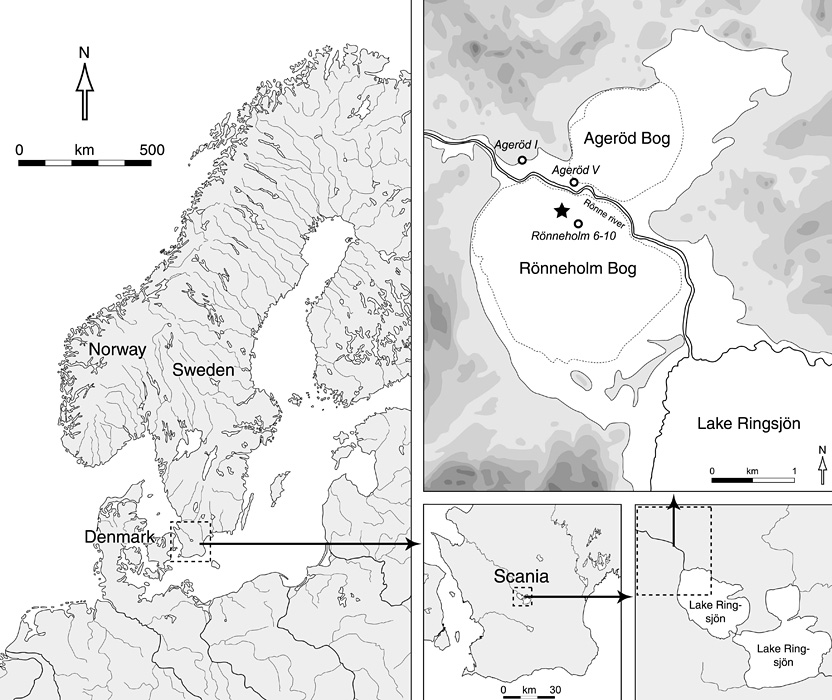
Ageröds Mosse and Rönneholms Mosse together form a north-westerly arm of the Ringsjö basin of central Scania (Figure 1). These peat-bogs indicate the extent of a prehistoric lake that was filled by organic sediment during the late Atlantic and Subatlantic chronozones. A number of Mesolithic sites, dating to the Maglemose and Kongemose cultures, have been found during peat cutting in Ageröds Mosse before the 1960s (Althin 1954; Reference LarssonLarsson 1978, 1983). Peat cutting in Rönneholms Mosse has intensified, and a layer of peat about 4m thick has been extracted so far from the late raised bog. The exploited area today is c. 1.4km². Thin layers of 10–15mm are stripped about ten times every season. The production field is divided into long parcels by drainage ditches every 20m, the longest of these measures c. 1.5km.
Location of the bogs Ageröds Mosse and Rönneholms Mosse with the location of the arrow (star). The white area north-west of Lake Ringsjön on the enlarged map shows the extent of the ancient lake before it was filled in. Topographic elevation on the enlarged map: 5m.

From an archaeological perspective this method of extraction is very good because it is possible to obtain an overview of the flat cutting surface, and the sites can be detected before too much damage has been done (Sjöström 2004). The first finds were made in 1993. The bog has been surveyed annually and hundreds of stray finds of flint and bone tools have been found. Campsites have been found along old shorelines on former peat islands. More than 100 very small sites of a few square metres have been recorded, often combined with a fireplace and a small number of flints and bones showing the presence of short stays (Hammarstrand Dehman & Sjöström 2009). The sites are dated by microliths and radiometric analysis to the period from the late Maglemose culture to the late Kongemose culture (c. 7000–6000 cal BC).
Hafted microliths
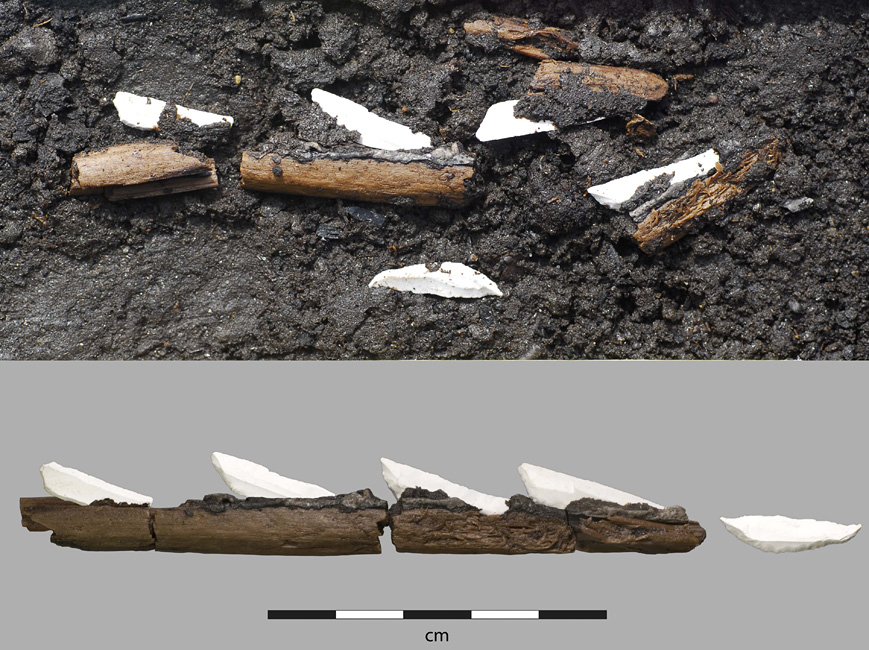
A special object was recovered from a patch of scattered finds in 2009. It consisted of pieces of wood and microliths, some attached by resin to the pieces of wood. The flints and wood could be re-assembled to form the point of an arrow with a length of 10.2cm and a diameter of 0.9cm (Figure 2). The arrow shaft was made of a one-year-old branch of hazel. A V-shaped groove had been cut into the wood, which can be followed from the break all the way to the tip. Four microliths had been fixed into the groove with resin. The microliths are triangular, obliquely retouched at the proximal end and also somewhat retouched along the shorter side of the triangle and they vary in length and width between 18–25mm and 5–6mm, respectively. They were obliquely fastened to the arrow in such a way that they formed barbs.
The original find situation of an arrow with four triangles attached by resin (A) and the position of the parts set together (B) (photographs: Arne Sjöström.

A fifth microlith was also found in close contact with the other finds. In contrast to the other microliths, it has not only oblique retouch of the distal end, but also continuous retouch forming an almost rounded margin. The shape is intermediate between a triangle and a lanceolate. There was no resin attached to this microlith. It is possible that this is a rare example of a microlith used as an arrow tip.
Mode of use
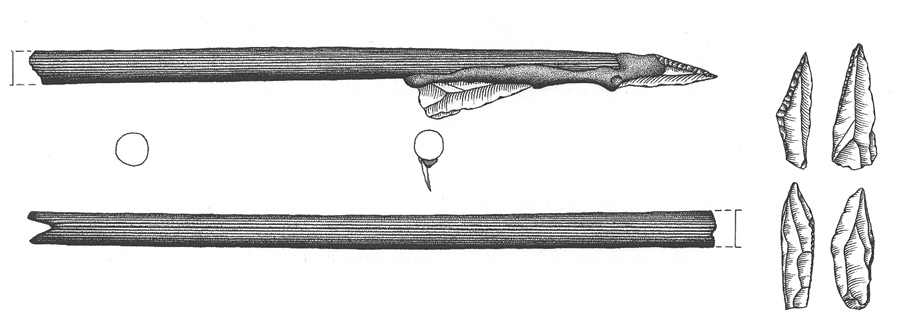
The only other sure example of an arrow tip is a find made in Lilla Loshults Mosse in the northernmost part of the county of Scania, southern Sweden, in 1951 (Petersson 1951; Reference MalmerMalmer 1969). The remains of two arrows were found in the course of peat cutting at a depth of about 2m. On one of the arrows the tip was still in situ, and was fastened only by a lump of resin over the head of the shaft, without a groove (Figure 3). Although the original report described the other flints illustrated in Figure 3 as 'microliths as arrowheads' (Microlithen als Pfeilspitzen), only one of them is a true microlith, made using the micro-burin technique. The remainder are microblades, with the bulb of percussion more or less preserved (Reference LarssonLarsson 2009). This distinction between microliths and microblades is relevant for another composite tool, namely the slotted bone points, where it appears that only microblades were used.
The arrow shaft and microliths from Loshult used for arrowheads. The microlith is depicted in the top left; the others are micro-blades, scale 2:3 (redrawn after Nilsson & Hanlon 2006).

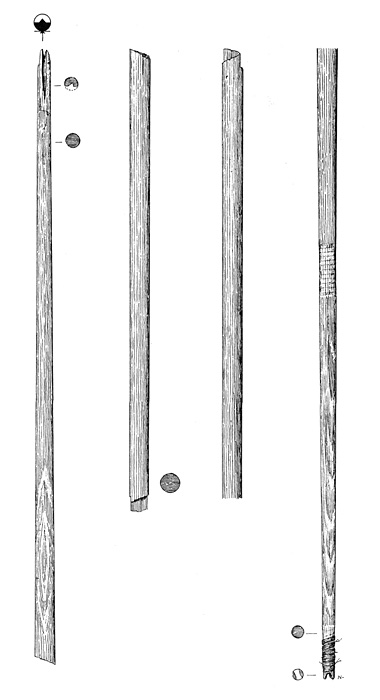
The Vinkel find of an arrow shaft (redrawn after Troels-Smith 1962).

The arrow shaft most similar to those from Loshult and Rönneholm is a find from Vinkel in Jutland, Denmark (Troels-Smith 1962) (Figure 4). It was found in a bog during peat digging and is dated to the Early Boreal chronozone. The shaft, cut from a pine stem, has a length of 102cm and a diameter of about 0.7cm. It is bevelled flat at the tip and a notch has been cut at the back to receive the string of the bow. Traces of lashing to fasten a feather are evident just above the notch. Fragments of arrow shafts have also been found at the Early Mesolithic site of Holmegaard IV, Zealand (Becker 1945). On one tip a furrow cut into the wood was identified and fragments of flints were still fixed in the resin that filled the furrow. However, we do not know if the insets were microblades or microliths.
A context of use for these arrows is indicated by a find from Prejlerup in northern Zealand, Denmark, where the intact skeleton of an aurochs was excavated, with 15 intact or fragmentary microliths and a small part of the arrow shaft (Aaris-Sørensen & Brinch Petersen 1986: 112–14). The flints included triangles, as well as lanceolates. Two triangles were found in a line at a distance of 3cm and could have belonged to the same arrow shaft. The arrowshaft fragment from Prejlerup was no more than 4cm long, but a piece of resin was still fixed to the wooden shaft.
Dating
The aurochs at Prejlerup has been dated to 8410±90 BP, 7595–7284 cal BC (K-4130) (Oxcal 4.1). The Loshult arrows are dated to the middle part of the Maglemose culture, close to the Early Boreal/Late Boreal (BO1/BO2) transition, with radiocarbon dates 8915±80 BP, 8279–7794 cal BC (Lu S 7195) and 8770±70 BP, 8004–7604 cal BC (Lu S 7217). The microliths from Rönneholm have a shape very similar to those of the latest Maglemose culture (Reference LarssonLarsson 1978: fig. 35), and dates of 7905±60 BP, 7032–6645 cal BC (LuS 8992) were obtained for resin, and 7855±60 BP, 6862–6589 cal BC (LuS 8993) for wood. These dates show that the time discrepancy between the samples is small and that they fit very well to a Late Maglemose material culture. The Loshult find, the first in the world to show how microliths were hafted, and the second find we now have from Rönneholm bog, are both located within Scania, the southernmost part of Sweden.