


1. Introduction
In education, design projects are often executed in teams to help students better navigate the complexities of real-life challenges (Reference FleischmannFleischmann, 2022). Working as a team enhances learning success rates by offering cross-learning opportunities and expanding students’ problem-solving approaches during the design process (Reference KastasKastas Uzun, 2020). To achieve success in teams, effective cooperation is essential (Reference McDonoughMcDonough, 2000). This cooperation is facilitated through enhanced communication and decision-making, which are largely influenced by understanding and managing personal differences in working styles and approaches (Reference Ryder-SmithRyder-Smith, 1999). A shared understanding within the team can improve overall performance, driven by factors such as group potency, team effort, and task routineness (Reference Aubé, Rousseau and TremblayAubé et al., 2015). One effective strategy to foster this understanding is recognizing and addressing the personality types of team members (Reference Filbeck and SmithFilbeck & Smith, 1997).
Recognizing personality differences within teams can improve interpersonal dynamics, promoting collaboration and minimizing conflicts (Reference Filbeck and SmithFilbeck & Smith, 1997). Personality traits directly influence communication skills, including active listening and assertiveness, which are fundamental for successful teamwork (Reference SimsHassan et al., 2019; Reference Hassan, Sumardi and AzizSims, 2017). These traits also impact task-related conflicts and overall team effectiveness, as divergent personalities can lead to disputes that hinder project success (Reference Montequín, Balsera, Fernández and De Cos JuezD’Silva et al., 2016; Reference Silva, Ortega and SulaimanMontequín et al., 2010). Furthermore, the personality traits of leaders are positively associated with more effective communication practices, such as transparency and symmetry, underscoring the importance of personality awareness for team success (Reference LeeY. Lee, 2022). Task conflicts within teams are also shaped by the members’ personalities, making it critical to understand these traits in order to manage conflict effectively (Reference Bradley, Klotz, Postlethwaite and BrownB. H. Bradley et al., 2013).
There are many types of personality tests, such as: the Myers-Briggs Type Indicator (MBTI), the Sixteen Personality Factor Questionnaire (Reference Cherry16PF), and the Big Five Personality Traits(Cherry, 2024). Each of these tests has its own distinct history, theoretical foundation, and intended purpose, which may include diagnosing psychological conditions, tracking personality changes, or screening candidates for employment (Reference CherryCherry, 2024). Singapore University of Technology and Design (SUTD) has adopted the MBTI personality test. All undergraduate students admitted to SUTD are required to do this test to help distribute the admitted students uniformly into different cohort classes during their first (freshmore) year of studies.
Previous research has shown that the group’s MBTI types composition can effectively predict group performance, identify potential interpersonal conflicts, and reveal leadership traits in both educational and professional settings (Reference Montequín, Mesa, Balsera and GarcíaAmato & Amato, 2005; Reference Kuipers, Higgs, Tolkacheva and de WitteKuipers et al., 2009; Montequín et al., 2010; Reference Amato and AmatoMontequín et al., 2013). Our research aims to contribute to this line of research through the analysis of a study involving SUTD students participating in a first-year team-design project. Specifically, this exploratory study seeks to provide insights into:
1) The possible influence of student design team MBTI type diversity on design team performance in terms of the team’s final grade.
2) The possible influence of a student’s individual’s MBTI type on design team performance in terms of the team’s final grade.
2. Background
2.1. Myers-Briggs Type Indicator (MBTI)
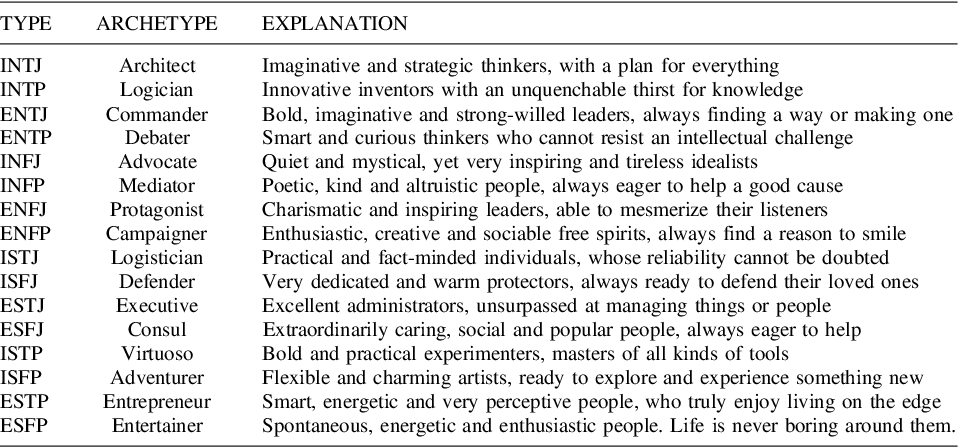
The Myers-Briggs Type Indicator (MBTI) is a widely used personality assessment tool that helps individuals gain insights into their psychological preferences and tendencies (Reference Capraro and CapraroCapraro & Capraro, 2002). MBTI is considered a reliable tool for measuring personality traits and provides valuable insights into how people perceive the world and make decisions (Zárate-Torres & Correa, 2023). Based on Carl Jung’s theories (Reference CoeCoe, 1992), MBTI categorizes individuals into distinct personality types along four dimensions: where they focus their energy - extraversion (E) vs. introversion (I), how they gather information - sensing (S) vs. intuition (N), how they make decisions - thinking (T) vs. feeling (F), and how they deal with the external world - judging (J) vs. perceiving (P). Based on (NERIS, 2024), definitions for each MBTI type are as follows:
Definitions for each MBTI type (NERIS, 2024)

Despite its widespread use, the MBTI is not without its shortcomings as a substantial amount of literature shows. One major criticism is its tendency to reduce the complexity of human personality into just sixteen distinct categories, which many argue oversimplifies individual differences (Reference PittengerPittenger, 1993). Additionally, the MBTI’s dichotomous structure is problematic, as its paired traits (e.g., Thinking vs. Feeling, Sensing vs. Intuition) are not true opposites but rather exist on a continuum; this approach fails to capture the nuances of personality and misrepresents the complexity of psychological processes (Reference Stein and SwanStein & Swan, 2019). Another criticism is that MBTI can change, especially during students’ academic and personal development (Reference LeeLee, 2019). Nevertheless, a study has shown that core MBTI preferences do not change, but behaviours can be adapted over time (Reference HaynieHaynie, 2022).
Despite its limitations, the MBTI remains a widely used and user-friendly psychological tool to categorize individual personality preferences (Reference FurnhamFurnham, 2022). It is considered effective for fostering self-reflection, promoting interpersonal understanding, and supporting team building and communication, particularly in non-clinical settings (Reference Stein and SwanStein & Swan, 2019), enhancing self-awareness and recognizing differences in working styles (Reference FurnhamFurnham, 2022). The profile-based approach and dichotomy combinations are easy to comprehend, making it particularly useful in educational contexts such as student group projects (Reference Montequín, Mesa, Balsera and GarcíaMontequín et al., 2013), which is the context of our study.
2.2. Diversity of team’s MBTI type compositions and team’s performance
Personality diversity, in terms of MBTI type, within teams is positively correlated with team synergy and the quality of deliverables (Reference Pieterse, Leeu and Van EekelenPieterse et al., 2018). By leveraging different MBTI types within the team, team can improve their communication, problem-solving, and decision-making process (Reference YangYang, 2022). Previous studies have shown that teams with diverse MBTI types demonstrate improved interactions and better problem-solving capabilities, showing a consistent correlation between team organization and team interaction (Reference Taehoon, Kim and Han-JinPieterse et al., 2018; Reference Pieterse, Leeu and Van EekelenTaehoon et al., 2015). These teams have varying perspectives and cognitive approaches that can lead to more innovative solutions and efficient problem-solving (Reference Choi, Deek and ImChoi et al., 2008). By leveraging different members’ strengths and perspectives, these teams achieve better collaboration and outcomes (Reference Mazni, Syed-Abdullah and HussinMazni et al., 2010).
In line with these findings, we hypothesize that design teams with a higher MBTI type diversity will have a better team performance. Based on the experience of the authors, poor team dynamics often lead to poor team grades and thus, that the team grade can in this context be used as an indicator of team’s performance. Therefore, we hypothesize that design teams with a higher MBTI type diversity will obtain a higher grade than those with lesser diversity.
2.3. Influence of individual’s MBTI type
Research has explored the relationship between MBTI personality types and academic success in various fields, suggesting that individual personalities can affect individual performance in specific courses or majors (Reference Putri, Puji and AhmadAhmed et al., 2010; Reference Ahmed, Campbell, Jaffar, Alkobaisi and CampbellKim & Han, 2014; Putri et al., 2016). Performance differences are often linked to the course’s nature and the preferences of different personality types. Putri et al. (Reference Putri, Puji and Ahmad2016) found that ENTJ individuals excel in history education, because of their ability to connect historical events better with current social, political, and community contexts. Montequín et al. (Reference Montequín, Mesa, Balsera and García2013) found that in teams (engineering project-based learning), the leader’s personality type influences the success of the team which is attributed to their communication and motivation skills.
In line with these findings, we hypothesize that specific MBTI types influence student design team performance, as measured by their final grades, independently of the design team’s MBTI diversity.
3. Methodology
This study was carried out at SUTD. In the first year of its four-year undergraduate program, all SUTD students complete common courses in science, mathematics, and technology. In the following years, students can specialize in one of five so-called pillars: Engineering Product Development (EPD), Architecture for Sustainable Design (ASD), Engineering Systems and Design (ESD), Design and Artificial Intelligence (DAI), or Computer Science and Design (CSD). In the first year, students are divided into “cohorts”, each comprising around 50 students and having their own cohort classroom. Teaching is done within the cohort classrooms by cohort instructors (faculty) for each course. One instructor teaches their course in up to three cohorts. The research team was not involved as cohort instructors and had no contact with the students.
3.1. Design project
This study focused on the first-year mandatory course, “Introduction to Design,” which spans 14 weeks and introduces students to the fundamentals of design thinking using the Double Diamond framework (UK Design Council, 2024). As part of the course, students work on a team-based design project based on a theme, rather than a design brief, allowing each team the freedom to interpret and define the problem in their own way. The theme of the analyzed project was “Interacting with Light.” Teams attend weekly lectures and participate in weekly consultation sessions with their two assigned cohort instructors to support their project’s development.
Team performance in our study is represented by the final project grade of the team. There are four components that make up the final project grade: discovering the problem (15%), defining the problem (15%), developing ideas (20%), and delivering their final prototype (50%). The first three components are graded by their own cohort instructors. The last component is graded by two cohort instructors who did not guide them in weekly consultations. Team performance in terms of how well the team worked together is not assessed explicitly but is likely to have had an influence on all components.
3.2. Participants
Of the 550 students enrolled in the “Introduction to Design” course, 535 students (97%) participated in the study, even though participation was voluntary with no incentives were provided. The enrolled students were free to form their own teams, each comprising four to six members of their cohort, resulting in a total of 108 teams. The study received approval from SUTD’s Institutional Review Board (IRB).
3.3. Data Collection
The research team obtained the MBTI test results of each participant from the university. The participants did this test (“Personality Test based on Jung and Briggs Myers Typology” by Humanmetrics Inc (2016)) four months prior to our study. The university also provided the research team with the cohort number, design team name and design team grade for the course “Introduction to Design” of each participant after the students completed the course.
4. Results
The 535 participants’ MBTI dichotomy profiles and MBTI personality types are shown in Table 2 and Figure 1.
MBTI dichotomous profiles (n=535 participants)

MBTI personality type distribution (n=535 participants)

The traits prevalent among the participants (Table 2) are introvert (I) rather than extrovert (E), intuition (N) rather than sensing (S), and judging (J) rather than Perceiving (P). No prevalence was found for feeling (F) or thinking (T). The data shows a clear dominance of personality type INTJ with 18% of participants (Figure 1), with all other types at 10% (INFJ) or less.
4.1. Influence of design team’s MBTI type diversity on design team performance
In this section, we investigate the possible correlation between design team’s MBTI type compositions on design team performance. Figure 2 shows the average grades of teams based on the number of MBTI types in the team. The following findings are observed:
-
There is one team with 1-MBTI type. The team has four members, and all of the members have INTJ (architect) type, the most common personality type among the participants.
-
There is one team with 2-MBTI types. The team has four members: two INTJ (architect) types and two ISFJ (defender) types.
-
The data shows have a weak (r=0.189) but statistically significant (p=0.0457) correlation. The correlation shows that the more diverse the MBTI types in the team correlates to higher design team grade.
Average grade based on the number of unique MBTI types in the team (n=108 teams)

The analysis of possible correlation between average design team grade and design team’s diversity based on the number members of each MBTI trait (extroverts, introverts, intuition, sensing, etc) shows that average grade is not correlated with the number of members of most personality traits (r<0.1) except for introvert (I) traits (r=0.164, p=0.0861) and intuitive (N) traits (r=0.232, p=0.0131).
Figure 3 shows a weak positive (r=0.164) and a marginally significant (p=0.0861) correlation between the average grade and the number of members with introvert (I) traits in the team. This suggests that as the number of students with introvert (I) trait in the team increases, the average grade tends to be slightly higher. The number of members with extrovert (E) traits in the team, however, does not show any correlation and significance to the average grade (r=0.0099, p=0.919).
Average grade based on the number of member(s) with introvert (N) trait in the team (n=108 teams)

Figure 4 shows a weak positive (r=0.232) and a statistically significant (p=0.0131) correlation between the average grade and the number of members with intuitive (N) traits in the team. This suggest that as the number of students with intuitive (N) trait in the team increases, the average grade tends to be slightly higher. The number of members with sensing (S) traits in the team, however, does not show any correlation and significance to the average grade (r=-0.0606, p=0.610).
Average grade based on the number of member(s) with intuitive (N) trait in the team (n=108 teams)

4.2. Influence of individual’s MBTI type on design team performance
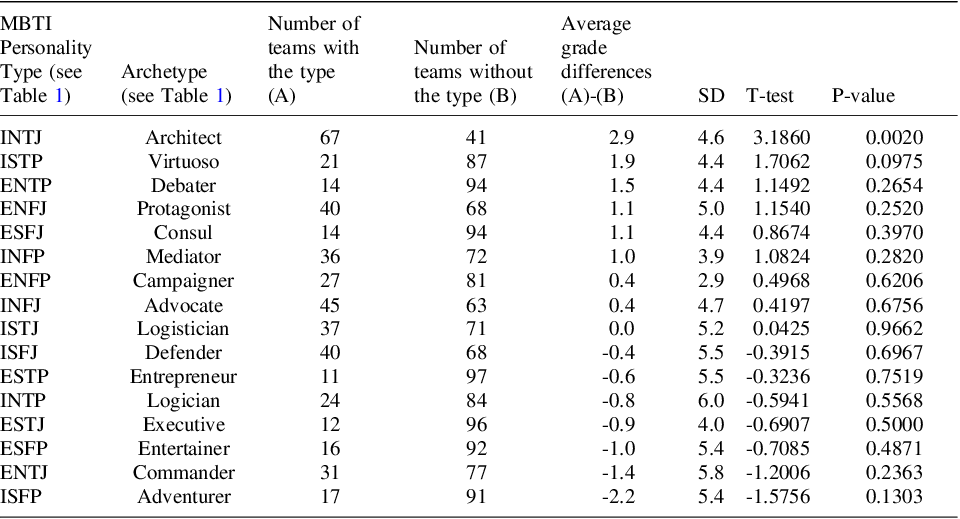
In this section, we investigate the possible influence of individual MBTI personality types on team performance. Table 3 shows the results of a comparison of the average grades of teams with and without at least one student of a particular personality type using an independent sample t-test. The following findings are observed:
-
Teams with at least one INTJ (Architect) member exhibited a statistically significant (p=0.0020) higher average grade compared to teams without INTJ members (average difference=2.9, SD=4.6).
-
Teams with at least one ISTP (Virtuoso) member showed a marginally significant (p=0.0975) higher average grade compared to teams without ISTP members (average difference=1.9, SD=4.4).
-
Teams with at least one ISFP (Adventurer) member (average difference= -2.2, SD= 5.4) has the highest negative difference with teams without ISFP members.
Average grade analysis of teams with and without members of a specific MBTI personality type (n=108 teams)

5. Discussions
In the following section, the research team analyzes the findings and proposes possible explanations. These explanations are largely inferential, drawing from existing literature in various contexts and applying them to the “Innovation by Design” course at SUTD to initiate further discussion. As the research team did not participate in the course, it was not possible to directly validate these explanations. Further studies are necessary to assess the validity and reliability of these proposed explanations.
5.1. Design team’s diversity and team’s performance
Section 4.1 shows that design teams with greater MBTI diversity achieved higher average grades than those with less diversity. This finding aligns with previous research, in Section 2.2, suggesting that personality diversity within teams is positively correlated with the quality of their output (Reference Pieterse, Leeu and Van EekelenMazni et al., 2010; Reference Mazni, Syed-Abdullah and HussinPieterse et al., 2018), can enhance problem-solving capabilities (Reference YangTaehoon et al., 2015; Reference Taehoon, Kim and Han-JinYang, 2022), and fosters creativity in idea development (Reference Choi, Deek and ImChoi et al., 2008) which, in this study, is expected to be reflected in the final design project grades.
Section 4.1 shows that design teams with more members with introvert (I) traits generally obtain higher grades than teams with less. Introversion is characterized by a preference for solitary activities, introspection, and a focus on internal thoughts and feelings, rather than external stimulation (Reference CainCain, 2012). Introverts’ deep reflection fosters well-structured ideas and thoughtful decision-making while their reserved nature encourages balanced team dynamics by allowing others to contribute (Reference Dennis, Barlow and DennisDennis et al., 2022). Introverts excel in demonstrating strategic leadership through careful planning and maintaining team stability under pressure (Reference FlemingFleming, 2025). Therefore, the observed correlation between the number of members with introvert (I) traits in a team and the final grade may be due to their strengths in deep reflection, strategic planning, and balanced collaboration.
Section 4.1 shows that design teams with more members with intuition (N) traits generally obtain higher grades than teams with less. Intuitive personality traits tend to envision the past and future possibilities of what they observe (NERIS, 2024). Intuitive individuals bring innovative ideas and a focus on future possibilities (Reference Bradley and HebertJ. H. Bradley & Hebert, 1997). Teams with a higher proportion of intuitive (N) members tend to perform better in tasks requiring creativity and abstract thinking, such as design projects, as these individuals are adept at generating new possibilities and envisioning long-term outcomes (Reference Mazni, Syed-Abdullah and HussinMazni et al., 2010).
5.2. INTJ personality type - the architects
Section 4.2 shows that design teams with an INTJ member(s) generally perform well. INTJs are imaginative and strategic thinkers who excel in leadership roles due to their ability to plan meticulously (NERIS, 2024). Moreover, their preference for taking charge in project leadership roles allows them to guide the team effectively, leveraging their strategic vision to anticipate challenges and develop innovative solutions (Reference GehringGehring, 2007). INTJs channel their creativity and insights into structured, logical plans and decisions, while remaining adaptable and responsive to new evidence (Reference SymondsSymonds, 2012). These traits help INTJ’s team to follow and have clear plans to achieve, which may lead the design team to have better performance.
5.3. ISTP personality type - the virtuoso
Section 4.2 shows that design teams with an ISTP member(s) generally perform well. ISTPs are bold, practical experimenters who are highly skilled with tools (NERIS, 2024). ISTPs are most likely the hands-on students who e.g. build prototypes (Reference Diab-BahmanDiab-Bahman, 2021), which significantly contribute to the design team’s success in delivering the final prototype well for the design team’s grading. ISTPs are valuable assets in fast-paced or high-pressure projects due to their ability to adapt quickly and respond effectively, especially when there’s an element of challenge or competition (Truity, 2024), making them ideal for time-constraint 14 weeks design project.
5.4. ISFP personality type - the adventurer
Section 4.2 shows that design teams with an ISFP member(s) generally do not perform well. ISFPs focus on personal values and emotions, which may lead to misaligned priorities in task-oriented settings (NERIS, 2024). ISFPs tend to focus on enjoying the present moment and avoiding ambitious goals may hinder their ability to meet long-term project deadlines (Truity, 2024). While they have a strong aesthetic sense and creative talent (Truity, 2024), their difficulty with assertiveness and lack of interest in structured leadership can limit their effectiveness in a collaborative, time-sensitive design setting.
5.5. Limitations and future research
A key limitation of this study is the reliance on self-report measures for collecting MBTI data, which are inherently vulnerable to response biases and subjective interpretations. Participants may provide socially desirable answers or responses based on their self-perceptions rather than their actual behaviors or preferences, leading to misclassifications in the MBTI’s dichotomous structure.
The findings of this study are limited to the context of a first-year design course, teaching fundamental design knowledge. The generalizability of the results to other design education settings or higher-level courses may be limited.
While this study found a correlation between greater MBTI diversity and certain personality types to higher team grades, it does not establish causation, as team performance is influenced by multiple factors. The reasons behind these differences remain unclear.
Future research should aim to address these limitations such as by incorporating behavioral observations, replicating studies across courses and academic levels, investigating causal mechanisms behind team performance, and identifying reasons for underperforming traits to develop targeted interventions for improved collaboration.
6. Conclusion
This study examined the relationship between MBTI personality type diversity and team performance in a first-year design course at SUTD. Findings suggest that teams with greater MBTI diversity tend to achieve higher project grades, indicating that a mix of cognitive styles may enhance problem-solving, creativity, and overall team effectiveness. Additionally, teams with more introvert (I) and intuitive (N) members performed better, likely benefiting from deep reflection and forward-thinking approaches. Specific MBTI types also correlated with performance differences, with teams featuring INTJ (Architect) and ISTP (Virtuoso) members excelling due to their strategic planning, adaptability, and problem-solving skills, while teams with ISFP (Adventurer) members exhibited lower performance, possibly due to a preference for flexibility over structured collaboration. However, these correlations provide insight into team dynamics rather than establishing causation.
Despite these findings, the study has limitations. The reliance on self-reported MBTI classifications introduces potential response biases, and the study’s context—a first-year design course—may limit the generalizability of the results. Additionally, team performance is influenced by multiple factors beyond personality composition, including communication, leadership roles, and group dynamics. Future research should address these limitations by incorporating objective behavioral observations, expanding studies across different academic levels, and investigating causal mechanisms behind team performance. In conclusion, this study serves as a foundation for further discussion, highlighting the importance of personality diversity in educational teamwork and the need for continued exploration into its broader implications.




 Open access

