




A soundtrack of chamber strings signals the start of a runway show, only to be quickly swallowed up by the excited murmurs of spectators and the incessant clicks of cameras. A young woman promptly steps onto a custom hand-painted catwalk. She is wearing Verdi. This opening dress of Maison Valentino’s Spring–Summer 2014 fashion show, titled ‘La valse de Violetta Valéry’, features not a waltz, but fragmented hand-embroidered excerpts of La traviata ’s ‘Dell’invito trascorsa è gia l’ora’ from Act I, which appear in black and pearlescent gold on the skirt of the diaphanous gown. The showstopper (Figure 1), which took the Roman fashion house’s ateliers 1,600 collective hours to make, was the first of fifty-five pieces created to revivify a selection of famous heroines and historical divas from operatic history – Maria Callas among them. Four years later, incarnations of Callas strutted down Valentino’s runway for their Autumn–Winter 2018 Haute Couture Collection. The show opened to a soundtrack of the soprano’s performances of arias by Bellini and Puccini. Sculptural taffeta and bouffant hair, magnified patterns reminiscent of the sixties in luxe fabrics, and Callas’s trademark cat-eyeliner in jewelled tones were just a few of the show’s arresting visual gestures. In the period between these two collections, Maison Valentino collaborated with the Teatro dell’Opera di Roma for their 2016 production of La traviata , directed by Sofia Coppola. Co-creative directors Maria Grazia Chiuri and Pierpaolo Piccioli designed the costumes for the majority of the cast, while company founder Valentino Garavani came out of retirement to design Violetta’s four looks for the production, citing Callas as a ‘great master’ who ‘inspired’ his emergence from retirement.Footnote 1
‘“La valse de Violetta Valéry”, parchment-coloured tulle dress embroidered with the score from La traviata.’ Valentino Spring–Summer 2014 Couture Collection.

Figure 1. Long description
At the center, a model stands facing forward on a runway, wearing a floor-length, translucent tulle gown in a parchment shade. The dress features a fitted bodice with ruffled tulle at the shoulders and a voluminous skirt. Across the entire skirt and lower bodice, black musical notes, staffs, and Italian lyrics are embroidered in horizontal bands, resembling a printed musical score. The model’s arms and legs are visible through the sheer fabric. The runway is bordered by panels decorated with butterfly motifs, and an audience is seated in shadow along the left. In the background, another model in a black sheer gown is visible, slightly out of focus.
Valentino’s project with the Teatro dell’Opera is just one of many collaborations forged between high fashion brands and Italian opera houses in recent decades. La Scala has hosted many of these, perhaps unsurprisingly given its longstanding history of evolutions in sartorial design on stage as well as its location in Milan, Italy’s industrial epicentre. During the 1982–83 season, for example, Missoni collaborated with theatre director and set designer Pier Luigi Pizzi to pattern and drape 120 Scottish-inspired costumes for a production of Lucia di Lammermoor. Fendi, under the leadership of Karl Lagerfeld, famously created a sixty-three-piece collection of colourful denim and trademark fur costumes for a 1986 production of Carmen. The following year, Versace joined forces with experimental theatre director Robert Wilson to produce a gothic-punk inspired production of Salome, launching a series of commissions to design opera and ballet costumes in European theatres that ran through the 1990s. Meanwhile Armani collaborated with La Scala on three productions – La donna del lago (1991), Elektra (1993) and Les contes d’Hoffmann (1994) – and offered ready-to-wear clothes for the Royal Opera House for Jonathan Miller’s production of Così fan tutte (1995). Some twenty-eight collaborative design productions with opera theatres took place between 1980 and 2007, and these examples represent just a snapshot of a common collaborative phenomenon in operatic practice that is still going strong.
As Valentino’s 2014 and 2018 shows demonstrate, opera’s histories and legacies have also given rise to numerous haute couture collections debuted on runways. In Valentino’s projects opera’s women served as muses: fictional heroines and real divas of ages past energised each respective collection. For Louis Vuitton’s Spring–Summer 2013 collection, Marc Jacobs found inspiration from an opera director’s design sensibilities. Specifically, Jacobs’s clean, geometrical designs are indebted to Robert Wilson’s iconic production of Einstein on the Beach for the opera’s 1976 premiere.Footnote 2 Over the last fifteen years, Dolce&Gabbana has used their Alta Moda platform to pay homage to Italian operatic history numerous times. Notably, in 2022 they created a 108-piece collection inspired by one of their most beloved and referenced operas, Cavalleria rusticana .Footnote 3
While costuming and fashion are sometimes understood as interchangeable terms, they rarely are in principle or practice. For the purposes of this study, costuming will refer to the art of designing and creating clothing for a particular role, determined by occasion, historical setting and/or culture. Fashion, on the other hand, will be used to reference an industry of corporatisation and brand-centred production that responds to changing trends and marketing. Regarded (variously) as relevant, fickle, paradigm-defining and at times elitist, fashion has over the past forty years become an important creative and collaborative means of articulating taste and social identity on a public scale.Footnote 4
It may seem obvious that fashion would play an important role in operatic practices, given that costuming and material design have been core to the genre since its inception. At the same time, much has changed over the last few centuries, with costumes moving from the individual responsibility of the singer to a practice that is much more conceptually cohesive within the hands of directors, costume designers and – as this article will show – high fashion designers. In the mid-eighteenth century, singers were contractually obligated to bring an abundance of accessories and supply their own devised costumes for performance.Footnote 5 As Susan Rutherford has observed, this tradition led a handful of nineteenth-century singers, including Maria Malibran and Pauline Viardot, to create geographically and historically informed costumes for their roles.Footnote 6 Within Parisian production, however, the increased reliance on production books ( livrets de mise en scène ) for grand opéra and opéra comique prompted greater consistency of performance choreography and production design within a fully conceived work that could be replicated.Footnote 7 In the case of Meyerbeer’s Le prophète (1849), for example, the production book specifies costume designs for the opera. The French model was impactful for Wagner and Verdi, though Wagner typically entrusted the design and execution of costumes to collaborative artists rather than taking matters into his own hands.Footnote 8 At the turn of the twentieth century, many singers still followed the examples of Malibran and Viardot, devising their own costumes with authenticity in mind, such as Emma Calvé.Footnote 9 Others took a more provocative approach, including Victor Maurel with his troublingly primitivistic portrayal of Amonasros in Aida. Footnote 10 As late as 1917, baritone Tito Gobbi stated that it was still common practice for principals to supply their own costumes.Footnote 11
Yet, simultaneously, as Mary E. Davis has shown, Paris-based practitioners were once again devising new models of collaboration for staged works in the early decades of the twentieth century. In the 1910s and 1920s, famed designers, composers and visual artists collaborated on works for the Ballets Russes, making some of the first inroads into avant-garde design on stage.Footnote 12 Paris-based figures including Paul Poiret, Coco Chanel and Christian Dior also transformed the role of the designer; prior to the early twentieth century a fashion designer was understood as a dressmaker, seamstress or tailor rather than a conceptual artist working in a specialised field. During this period in Paris, couture houses hosted fashion shows which became spectacles of performance in their own right. Poiret famously used the theatrical stage to advertise his works, realising its potential as a dramatic platform for visibility and celebrity endorsement.Footnote 13 Nancy Troy has demonstrated that this practice set a precedent for the Hollywood red carpet, where movie stars would later feature custom looks and haute couture designs that would garner designers publicity and note.Footnote 14
The development of an Italian fashion industry in the 1920s spoke to national efforts to expand industry and develop greater consumerist self-sufficiency, particularly in northern centres such as Milan.Footnote 15 The nationalist women’s fashion magazine, Lidel, for instance, even encouraged readers to eschew their reliance on French imports in order to support the blossoming Italian industry.Footnote 16 At this time, La Scala attracted the talents of emergent Italian visual artists such as Umberto Brunelleschi and Luigi Sapelli (known professionally as ‘Caramba’), who represent two common models for collaboration between designers and theatres. On the one hand, Brunelleschi freelanced on projects at La Scala alongside his other work with theatres in Paris and New York City. On the other hand, Caramba served as an artistic director at La Scala from 1921 until his death, and during his tenure he designed costumes for numerous opera and ballet productions for that theatre, including the first production of Puccini’s Turandot. The Teatro dell’Opera in Rome – the theatre at the centre of this article – began to produce sets and complete costumes for operas and ballets consistently from the 1930s.Footnote 17
Poiret’s strategic approach to promotion as a theatrical designer further influenced a generation of post-war designers affiliated with La Scala. While leading figures such as Lila de Nobili and Nicola Benois worked extensively in stage design, costume design and scenography at the theatre, fashion designers such as Elvira Leonardi Bouyeure (known professionally as ‘Biki’) styled stars of the day to promote their reputations off stage and in the public eye. Specifically, Biki transformed Maria Callas into a fashion icon when the singer rose to fame at La Scala in the 1950s: she dressed and accessorised Callas from 1954 through to the end of the singer’s life in 1977.
What follows is a multilayered consideration of Maison Valentino’s three operatic projects in the 2010s, which demonstrates how contemporary high fashion can amplify our understanding of embodied and material agency within contemporary operatic practice. Recognising longstanding connections between Italian costumery and fashion design in opera – with Callas strategically poised amidst these efforts – company founder Valentino Garavani and (then) creative co-directors Maria Grazia Chiuri and Pierpaolo Piccioli sought to memorialise and advance Italian opera’s artisanal practice and legacy within the realm of corporatised fashion.Footnote 18 I first demonstrate this point through a brief survey of the company’s 2014 collection A Dreamlike World, and illustrate how Valentino pays homage to nineteenth-century operatic culture in order to position Italian opera as a stepping-stone for expanding the legacy of Italian material culture and artisanal design. I am guided in my approach by recent examinations of canonic rearrangement, fluidity and fracture.Footnote 19 Turning next to the 2016 Traviata , I show through assessments of press coverage, studies of the production’s institutional impact, and analyses of its extravagant look how the particular artistic investments of Valentino – a company founded in Rome – were forged strategically to elevate the city’s operatic reputation through its alliance with the Teatro dell’Opera’s creative designers. Accordingly, these sections also highlight how Valentino’s artists and Rome-based newspaper journalists represented the Roman production as a modern extension of mid-century collaborations forged at La Scala by well-recognised artists such as Callas alongside Visconti, de Nobili and Benois. In 2018, Valentino invokes Callas and her centrality within performance and fashion collaborations even more pointedly, re-contextualising looks from her staged performances and from Biki’s designs to re-embody the singer through newly created materials. Ultimately, Valentino’s reformulations of material and sound function meaningfully within and without conventional boundaries and structures of contemporary operatic performance.
A brief overture: the high fashion heroines of 2014
Valentino’s Spring–Summer 2014 Haute Couture Collection, entitled A Dreamlike World, was the company’s first reflection on opera through material art. While operatic heroines served as the focal point of the collection, remembrance and revitalisation were the guiding values for the artistic interpretations. Maria Grazia Chiuri, then the co-creative director of Valentino, remarked of the collection: ‘We wanted to describe the protagonist of each opera in a primordial way’, so as to ‘create an imaginary mise-en-scène of the complex feminine world.’Footnote 20 Chiuri and Pierpaolo Piccioli also took direct inspiration from the Teatro dell’Opera in Rome and collaborated with a number of its scenographic artists and designers. The theatre’s artisans, led by head set designer, the late Maurizio Varamo, painted the show’s botanical coverings for the runway floor and backdrop at the Hotel Salomon Rothschild in Paris. Featuring large tile-like inserts of floral designs, branches and butterflies (see Figure 2), the runway became a set for botanical fantasy.
From A Dreamlike World, Valentino Spring–Summer 2014 Couture Collection; clothing designed by Maria Grazia Chiuri and Pierpaolo Piccioli (co-directors of Valentino); set designed and led by Maurizio Varamo (from Teatro dell’Opera, Rome).
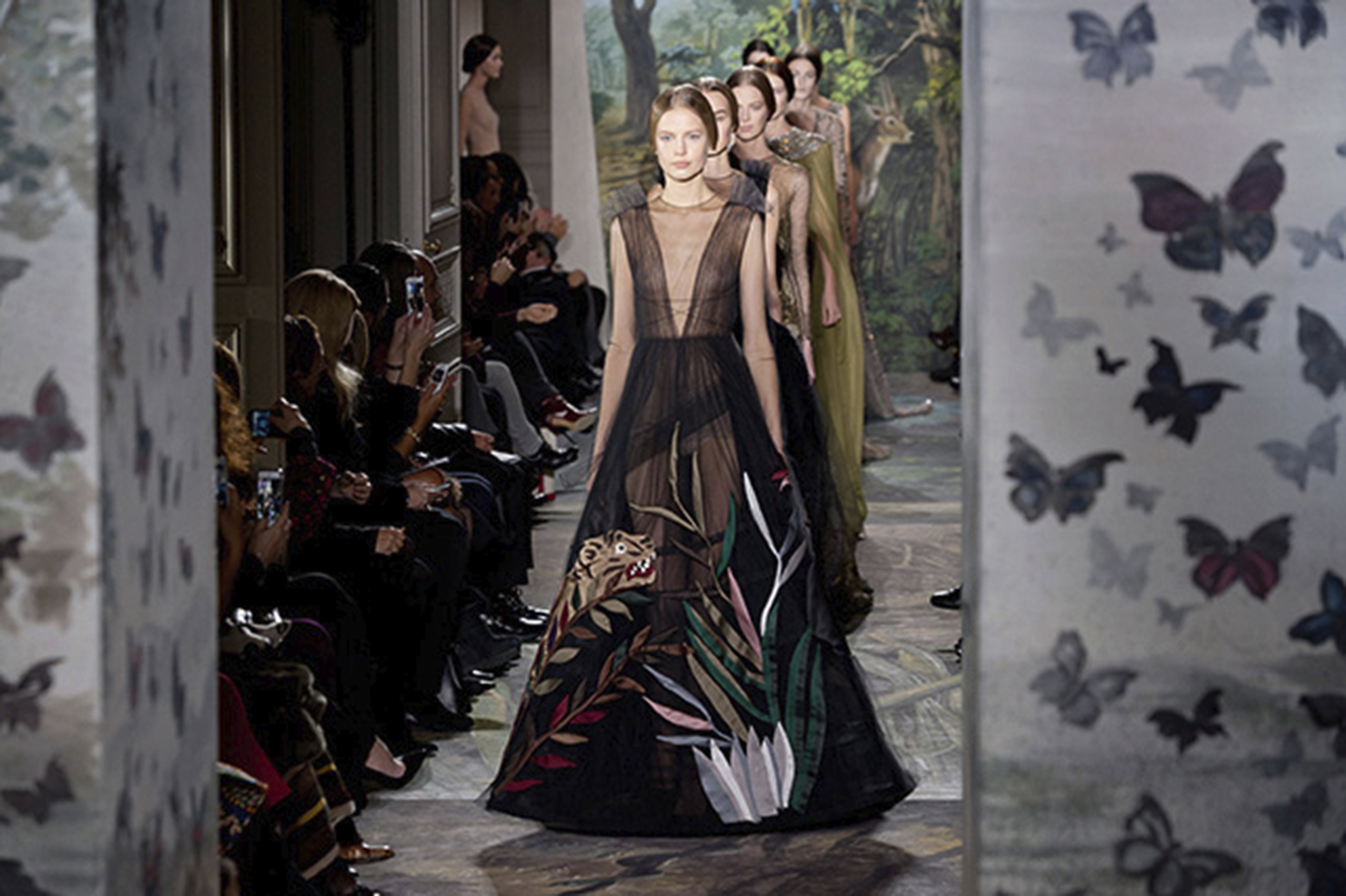
Figure 2. Long description
At the center, a model walks toward the viewer wearing a sheer black gown with a deep V neckline and a full skirt featuring appliqué leaves, branches, and a stylized animal face near the hem. Behind her, several models in similarly elaborate, earth-toned gowns proceed in single file. The runway is flanked by seated audience members, many holding up phones to photograph the show. The left and right foregrounds are bordered by tall panels decorated with multicolored butterflies in flight. The background shows a painted forest scene with trees and a deer, reinforcing the dreamlike, nature-inspired theme.
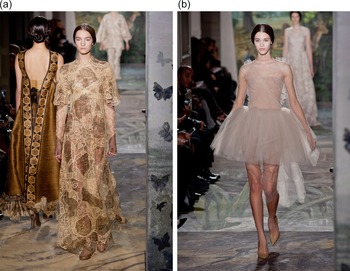
Some pieces appeared to approach texture, fabric, weight and silhouette in an interpretative way, demonstrating a keen understanding of specific operatic characters, their dramaturgical impact, and even the quality of the vocal writing. We can see this evidenced in the wispier looks from the collection, which take on a kind of lyrical, ephemeral appearance. Examples include the gown inspired by Violetta from La traviata described above, a gown designed as homage to Donizetti’s Lucia, as well as a piece for Bellini’s Amina ( La sonnambula ). These three characters, like their garments, express a barely there quality through floating vocal floridity, the fleeting presence of body and voice, and physical or mental fragility from illness. As shown in Figure 3a, Lucia’s lace dress with gold and bronze patches slips between solidity and transparency in its appearance and evokes Lucia’s fragmentary thematic remembrances, the breakdown of the double-aria form, and the eventual shattering of self within the operatic frame. Figure 3b, the dress for Amina, pays homage to Maria Callas’s famous embodiment of the character in 1955 at La Scala. Unlike previous interpretations of the character, which often featured Amina sleepwalking in a white dressing-gown, or in a more rustic, peasant-style garment, Callas, under Visconti’s direction, donned a ballerina-style gown as a reference to the ethereality of the famous classical nineteenth-century ballerina Marie Taglioni. Callas is remembered in the role as much for her performance as for her own body at this time: she had only recently returned to La Scala with an incredibly thin physique in the mid-1950s. I consider this shift below.
(a) ‘“Lucia régnait dans le silence”, dentelle lace dress interwoven with gold and bronze’ and (b) ‘“Amina, la somnambule”, tutu dress draped with skin toned tulle.’ Valentino Spring–Summer 2014 Couture Collection.

Figure 3. Long description
The left panel centers on a model in a floor-length gold lace dress with intricate floral patterns, interwoven with gold and bronze threads. The dress features elbow-length sleeves and a high neckline. Behind her, another model wears a gold gown with a geometric black pattern and a deep V-shaped back. The runway floor has a marbled pattern, and the background shows a blurred nature scene. The right panel features a model in a short, voluminous tutu dress made of skin-toned tulle, sleeveless with a fitted bodice and flared skirt. Her shoes are nude-toned, matching the dress. In the background, another model in a pale, long dress is visible, and the audience is seated along the runway. Both panels are separated by a vertical column decorated with butterfly motifs.
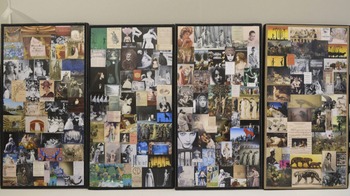
Despite their aim to create a feminine mise en scène , Chiuri and Piccioli did not formulate a cohesive vision of operatic heroines through time so much as offer a collage-like trip through contemporary and historical impressions of opera as a form of fantasy or escapism. A selection of the collection’s pieces were archetypal, at times simply resembling historical costumes as, for example, Mimì’s dark blue cape over an understated dress for La bohème , or Norma’s austere, monastic gown. Other costumes contributed to the mise-en-scène framework itself. Four looks featured solid-coloured, natural tussore silk with exaggerated fringe finishes, which seemingly referenced the stage’s materiality: specifically, the curtain. But the pairings for these pieces seem arbitrary: Verdi’s Luisa Miller, Handel’s Galatée, Monteverdi’s Pénélope and Offenbach’s Olympia. The effect of the collection’s tributes taken in full is of a collage-like fantasy rather than a consistent matching of character, persona or voice with qualities such as material, weight, texture, transparency or opacity or colour. This approach – one that foregrounds many angles of sartorial craftsmanship – becomes even clearer when one views the inspiration board for the collection, shown as Figure 4: this is a true collage, containing among other things playbills, scores, historical posters and photographs of historical sopranos.
Inspiration board for Valentino Spring–Summer 2014 Couture Collection.

Figure 4. Long description
Starting at the top left of the first panel, there are sepia and black-and-white portraits of women in historical dress, opera posters, and architectural images. Moving downward, ballet scenes, handwritten notes, and colored illustrations appear, interspersed with images of stage sets and classical arches. The second panel begins with more vintage fashion sketches, monochrome photos of performers, and program covers, followed by ballet dancers, costume studies, and blue-toned stage scenes. The third panel features classical paintings, mythological figures, and stylized black-and-white portraits, with handwritten notes and colored costume illustrations layered throughout. The fourth panel, at the far right, contains animal illustrations, scenes from nature, and classical artworks, with yellow and green tones dominating the lower half. Across all panels, text clippings in various fonts are scattered, and the arrangement is dense, with images and text overlapping to create a textured, research-oriented inspiration board.
In a complementary way, the music showcased layered and sometimes juxtaposed qualities of sound for the runway show. The soundtrack references the forms and instrumental forces of Western art music but incorporates electronics and minimalist techniques. While I was not able to trace the identity of a specific music director or sound producer or arranger, it is standard for the creative director of a fashion company to choose music to match the aesthetic of the collection or offer an evocative trajectory as the collection’s presentation evolves. The full track – played at high volume through surround speakers in the suite that hosted the runway show – was constructed in the form of a five-part rondo (ABAB′A). A chamber ensemble of Classical strings plays repetitive four-bar phrases with a consistent pulsing ostinato, supporting an undulating melody that shifts slowly through the voices of the ensemble (A section). Quiet electronics and synthesised percussion initiate the B section, to which is added a haunting chorus of spectral-like voices on open vowels, and from which ominous violins emerge, saturating the simple, harmonic colour of the opening. The result suggests a quasi-Wagnerian chromatic palette before a simple piano line enters and the original Classical-minimalist texture is heard again. When the electronic soundscape of the second episode returns, it launches a fragmented section of Icelandic singer Björk’s 1997 song ‘Hunter’ before the soundtrack closes with a final reiteration of the A section.
While the music and garments draw from a wide timespan, the references to characters are more focused. Thirty-three of the fifty-five looks feature nineteenth-century characters; seven are from the twentieth century (with the majority of them right after 1900); seven works come from the eighteenth century; and seven more are drawn from either the late sixteenth or seventeenth centuries. The most recent point of reference is Britten’s A Midsummer Night’s Dream (1960). All works come from Italian, French, Austro-German or English operatic traditions, with Italian works dominating with thirty-one characters represented. Chiuri and Piccioli’s resulting Italian Romantic-centred collection set a precedent for their opera-centred endeavours over the following four years.
Valentino’s Rome: collaborating at the Teatro dell’Opera
At the Teatro dell’Opera, the collaboration with Valentino in 2016 for La traviata was a clear point of pride for the personnel involved, as not only was it a successful moment for the institution, but it also articulated values espoused by the theatre since its inception. As I learned from my research in the theatre’s archive, as well as from conservations with its longtime curator, Alessandra Malusardi, the Roman opera house is self-conscious about its position in relation to other Italian houses such as La Scala or the San Carlo in Naples: it was a relatively late bloomer. Originally named the Teatro Costanzi after the contractor who built the theatre, it was inaugurated in 1880 (La Scala had opened in 1778, the San Carlo in 1737). Malusardi considers the Teatro dell’Opera unique for its commitment to novelty and its partnerships with interdisciplinary creatives over its nearly 150-year history. From the beginning, the personnel of the Roman theatre staked their claim on novelty, including, for example, the emerging verismo tradition. The Costanzi hosted the world premiere of Mascagni’s Cavalleria rusticana in 1890, followed ten years later by Puccini’s Tosca . In 1919, the theatre also hosted the Italian premiere of Puccini’s Il trittico following its world premiere in New York at the Metropolitan Opera the year prior. During the first decades of the twentieth century, the Costanzi was also the first Italian home for recently premiered productions from the Ballets Russes.
The reception of the 2016 La traviata reveals a great deal about the economic, political and aesthetic significance of the collaboration with Valentino in light of this history of novelty. Indeed, it raises questions about the nature of opera’s contribution to the Italian cultural canon given that Valentino’s works are considered cultural artefacts in the Italian – and more specifically Roman – imagination. On 24 May 2016, the day of the Traviata premiere, Valerio Capelli’s remarks in the Roman Corriere della sera were typical: ‘Valentino and opera are a “piece” of Italy that everyone knows: you have to live it to fully understand it, the thrill of a tour to the most distant places, the only opportunity to speak Italian in the world. This call has always been ignored by Italian politicians.’Footnote 21 Three days earlier, Maria Corbi wrote more pointedly in La stampa: ‘Valentino gives a gift to his city where it all began.’Footnote 22 As we will see, this ‘call’ has in fact been answered by Italian politicians and agencies in recent years.
According to Dario Franceschini, Italy’s Minister of Culture at the time of the premiere, Sofia Coppola’s appointment as director for the production was an important strategic choice ‘because it is important for us to attract young people to the Opera and she is a cult director’.Footnote 23 For many involved in the cultural–political sphere today, opera is an art form ready for a makeover. Franceschini remarked further: ‘opera is a world full of potential, but we need to broaden the audience, to extend the discussion to TV rights, there is ample room for growth’.Footnote 24 This would not be Franceschini’s last endorsement of opera’s broad cultural potential during his eight-year tenure as Minister of Culture (2014–22). As Siel Agugliaro has observed, Franceschini’s endorsements are driven as much (or even more) by political and practical motivations as by cultural or aesthetic ones.Footnote 25 In his study of UNESCO’s inclusion of the singing of Italian opera on their Lists of Intangible Cultural Heritage in March 2022, Agugliaro states, ‘For their part, Italian politicians presenting opera as a distinctly Italian cultural phenomenon are primarily motivated by financial reasons. Their aim is to secure a reliable public and private funding stream in support of opera and theatre professionals, whose job security has been put increasingly at risk… by decades of insufficient government funding.’Footnote 26
La traviata ’s run from 24 May to 30 June 2016 at the Teatro dell’Opera was, in fact, quite successful, attracting A-list celebrities, sold out performances, and 1.2 million Euros in sales revenue even before the premiere. This was significant for the theatre, which had been suffering great financial hardship, particularly before the appointment of Carlo Fuortes, superintendent and general manager of the theatre at that time. Reflecting upon the impact of the production, Fuortes remarked proudly: ‘the success of La traviata is proof that public companies can recover’, and the ‘ Traviata model is proof that Rome can get going again’.Footnote 27 In his perception, the success of a culturally and artistically significant institution could boost the morale of a whole city.
Valentino Garavani, too, considered the collaboration a crucial opportunity to raise opera’s popularity and visibility in Italy. He reflected, ‘Unfortunately, in Italy and abroad, it has great success but has been relegated to the background. This time, with the incredible strength of the staging, the costumes, the direction, the orchestra, it will prove to be something much more important than many rock concerts that attract the masses.’Footnote 28 The wide appeal of celebrity figures and unabashed glamour were key to attracting attention not only to the star-studded event, but to the genre itself by connecting opera with fashion, popular media and the consumption patterns of younger generations, as Franceschini’s remarks above suggested. Furthermore, the collaboration demonstrated that fashion need not change the nature of opera in order to make it appeal to contemporary society, but rather transform its practices more generally into something financially viable for institutions of performance. One tremendous success, however, does not produce the kind of continuous revenue stream required to keep most opera houses afloat today, especially as houses like the Teatro dell’Opera rely on an event-specific flow of revenue from both public and private funding. Viewed in this light, the collaboration between the Teatro dell’Opera and Valentino invites critical enquiry into contemporary strategies for bringing about systemic change to operatic institutions.
The Teatro dell’Opera’s personnel have drawn from the theatre’s history the core institutional value of forging novel collaborations and projects, which have been launched in great part because of Fuortes’s interventions. It has made impressive efforts to reach broader audiences with novel approaches to operatic production. While the collaboration with Valentino was a highlight, it was far from a one-off. In addition to hosting new productions with esteemed directors, such as Àlex Ollé’s contemporary approach to La bohème during the 2017–8 season, the theatre has captured the magic of site-specific performances in Rome. The Caracalla Festival, the theatre’s summer programme, returned in 2023 after the COVID-19 pandemic. For approximately two months, the festival features operatic, symphonic, dance and popular music performances at the ancient Roman bath just southeast of the Circus Maximus. This archaeological site, visited by tourists, is transformed into a 4,500-seat performance arena. The festival is supported by private members of the Teatro dell’Opera’s foundation, drawn from Rome’s Chamber of Commerce as well as from larger Roman companies that sponsor events for the festival, such as ACEA, Banca del Fucino, Terna and BMW Roma. During the pandemic, the theatre broadcasted filmed operas and dance productions on various channels of RAI, Italy’s public television.Footnote 29 As Emanuele Senici has recently observed, the theatre very intelligently utilised the city of Rome during this time, creating ‘opera within urban imaginaries, especially in the context of mass tourism’, when people quite literally could not leave their homes.Footnote 30 Examples of these productions included Rigoletto staged in the Circus Maximus, the aria concert Il suono della bellezza set in the Galleria Borghese, and the dance-film Nuit romaine shot in the Palazzo Farnese. The result of such efforts positioned opera as part of Roman history, further solidifying Italy’s historical (if stereotyped) associations to Western humanistic traditions through opera.
Related in part to these site-specific, filmic and televisual initiatives, the Teatro dell’Opera has continued to forge ahead with projects in collaboration with high fashion design houses beyond the 2016 collaboration with Valentino. During the 2016 Traviata production, Chiuri and Piccioli reflected on their indebtedness to the Teatro dell’Opera as a crucial local source of artistic inspiration for the direction of their work beyond the single collaboration: ‘The Teatro dell’Opera di Roma represents [the] heritage of our city for us’, they proudly stated: ‘Their art workshop reflects the values we believe in and that we follow with our Maison Haute Couture.’Footnote 31 Chiuri, in particular, has continued to articulate these values in practice through her collaborations with the Teatro dell’Opera, even as she took on the position of creative director at Dior in 2016, shortly after she completed the Traviata project with her colleagues at Valentino. For example, she designed the costumes for the 2024 Caracalla Festival’s Le notti romane di Dior , a compilation of two dance pieces. These included an adapted live version of the aforementioned Nuit romaine , originally created in 2022 with choreography by Angelin Preljocaj, as well as the staged Nuit dansée , choreographed by Giorgio Mancini. Chiuri designed the costumes for the latter before the pandemic, in 2019, for another ballet with the Teatro dell’Opera, Nuit blanche .
Chiuri’s continued involvement with the Teatro dell’Opera not only demonstrates her commitment to promoting Roman cultural institutions but represents a strategically transnational alliance between France and Italy through artistic performance and design. Christian Dior, the founder of Dior, famously designed costumes for the Paris Opéra in the first half of the twentieth century. In her role as Dior’s director from 2016–25, Chiuri subsequently broadened the company’s institutional reach by continuing to design for the Teatro dell’Opera in her home city of Rome. This also boosts the reputation of the Teatro dell’Opera through an implied collaborative alliance with the Paris Opéra. The Parisian–Roman connections continue: the Palazzo Farnese, the set for the dance-film Nuit romaine , is the seat of the French Embassy in Rome. Additionally, Eleonora Abbagnato, the director of the corps de ballet of the Teatro dell’Opera since 2015, previously danced as Étoile at the Paris Ballet from 2013 to 2021. Abbagnato starred in Nuit romaine alongside the corps de ballet. Remarking on Nuit blanche , the pre-pandemic balletic collaboration between Dior and the Teatro dell’Opera, as she watched a rehearsal, Chiuri said: ‘I see the costumes, and the width of a dress will inspire a movement. So I’ll increase the movement. It’s a permanent dialogue between Paris and Rome, France and Italy.’Footnote 32 Through her remarks and actions, Chiuri expresses creative and cultural allegiances to Rome, a kind of indebtedness that amplifies rather than limits collaborative directions for the historically French company. Simultaneously, Chiuri’s efforts capitalise on Roman, and more broadly, Italian qualities – of design, artisanal processes, individuals and cultural institutions – as commodities with which to create a novel and alluring stamp for an increasingly international company.
Costume or couture?: the impact of the Valentino Traviata
Prior to the premiere of the Valentino–Coppola Traviata in 2016, many reporters anticipated that the glamour of the production would be achieved only with the sacrifice of interpretive adventurousness or musical effectiveness. A week before opening night, Giovanni d’Alò, for La repubblica Roma, stated: ‘Certainly, there has never been more attention paid before to costumes’, and ‘the other certain fact is that it will be a traditional Traviata’.Footnote 33 Critics invested in the musical and dramaturgical aspects of the production bemoaned the imbalance of sensory priorities; it was a feast for the eyes somewhat to the detriment of devoted ears. A writer from La repubblica wrote:
The costumes (by Valentino) were elegant: black tie for the men, long dresses for the ladies. But the story stops there… Here’s the problem. It is as if no drama was represented, no suffering was recounted. Elegant spaces for pure nothingness… Jader Begamini’s direction is correct, but not a single moment of heartbeat, and he appears little interested in supporting or helping the singers. Francesca Dotto’s Violetta [is] stylistically precise. But the character is not excavated.Footnote 34
Other accounts from the premiere stressed that the big applauses among attendees were for the costumes rather than the music or action,Footnote 35 and many lamented that Coppola’s traditional direction lacked originality.Footnote 36 Lorenzo Tozzi, for Il tempo , went so far as to suggest: ‘After so many questionable directions (see Barbiere and Cenerentola ) cooked up with the alibi that we need to renew ourselves, whatever the cost, in order to gain an audience, Coppola’s flaw was basically her greatest value. Perhaps one might wonder what other reason to invite her there was except that of safe business.’Footnote 37 The critic for Internazionale , complemented this attitude: ‘It’s a pity that such breadth of means wasn’t enough to do a good service to the music: the result is a company that knows how to do its job without being able to distil the slightest emotion.’Footnote 38
A particularly significant moment of the production, painstakingly rehearsed by the creative team and discussed among critics, was the opening tableau of the opera, designed by Nathan Crowley. During the orchestral prelude, soprano Francesca Dotto, as Violetta, descends an enormous white staircase in one of Garavani’s gowns. In rehearsals prior to the final dress, the two principals – Dotto and Maria Grazia Schiavo in the second cast – practised the tricky descent and finding the marks for Act I in multi-layered tulle slips to avoid excessive damage to the custom-designed dress (in which it was difficult to move). Even in the rehearsal process, the material elements were highly prioritised. Paul Atkinson has shown that contemporary operatic productions are often characterised by an ongoing process of collaborative adaptation and improvisation, where material elements (i.e. props, masks, costumes) are adjusted to ensure other elements of the production run smoothly, especially for the performers involved.Footnote 39 In his study, he furthermore emphasises opera as a form of labour by highlighting regular processes of production. The Traviata example presents a clear inverse: this opening scene prioritises the appearance of the luxury artisanal, which is misaligned with contemporary values of artistic craftsmanship, which prioritises the practical.
It is clear that the gown was designed to be the focal point not only for the audience’s visual attention, but also for the storytelling. The ballgown, a feat of black lace, taffeta and tulle with a ruffled train, took 800 hours to complete. The silhouette pays homage to traditional, nineteenth-century presentations of Violetta, but the elaborately long mallard-green tulle train is certainly the most remarkable feature of the garment. Its glimmer catches the sparkle of the dimly lit chandelier of the salon, enhancing the relationship between the scene’s extravagance and Violetta’s flamboyant persona in the first act. In Act I, she is focused on external appearances, enjoying a free and luxurious lifestyle in spite of her complex, noble inner world. The staircase serves as its own kind of catwalk, amplified in range, depth and overall dimension to present the gown as an expressive force in its own right. The cool-toned green of the train creates an optical illusion – a literal ripple effect – as blue lighting plays across Violetta’s presence, the ruffled cascade an echo of her body, a dancing shadow that further enlivens the first hints of her melody from ‘Amami Alfredo’. It is not until the bright, brilliant start of the Act I Allegro that we fully appreciate the material’s effects. Here, the gown exudes a kind of material vitality, shaping both the form and the kind of embodiment that Dotto enacts, and creating magic and tension through the interaction.
When asked about the opening scene, shown as Figure 5, the head designers were committed to their vision. Garavani claimed that the staircase helped to ‘valorise’ Violetta’s life,Footnote 40 while Piccioli reflected to the New York Times: ‘We sought to create a big picture as though it were a painting, because in the end what is impressive about opera is the grandiosity of the stage.’Footnote 41 In performance, the full garment exudes equal if not more power than the actual scene as the drama develops. The curtain opens slowly on Francesca Dotto’s difficult descent of the extravagant white staircase. Some critics scoffed at the excess of this opening scenery, with one commentator claiming the ‘unjustified Wanda Osiris-like staircase’ distracted from the establishment of the opera’s dramatic climate.Footnote 42 Likely, this critic inferred that the opening scenery was ill-fittingly campy, as Osiris was a famous revue and comedy film star from the 1920s to the 1950s in Italy.
Francesca Dotto as Violetta during a dress rehearsal for the 2016 production of La traviata, directed by Sofia Coppola. Teatro dell’Opera di Roma.

This garment attracted more attention than its artistic wearer. From a performance standpoint, the costume was produced to appear beautiful rather than functional (to accommodate the singer and the stage action). From a reception standpoint, little of the published coverage of the prelude or Act I discusses or features images of Dotto performing in the gown (or indeed performing at all). The gown’s agency continues to reveal itself, seemingly able to articulate its own sensibility without a body occupying and enlivening it. Records feature countless sketches of the gown, drafts, in-progress work samples, and the final dress donned gracefully by a mannequin. The most memorable feature, in short, is vocally silent.
Garavani’s own praise of Dotto as Violetta in this production, was due, in great part, to her ability to model the gown in accordance with contemporary beauty industry standards. He did not mince words when referring to Dotto: ‘I can say I was lucky because the soprano who plays her is very beautiful’,Footnote 43 the opposite of the prime donne of his own childhood, who he claimed ‘were often very large’.Footnote 44 Garavani’s comment echoes hauntingly the critiques levelled at Maria Callas in the early 1950s about her physique, especially those made by director Luchino Visconti, her close collaborator at this time. It is perhaps no coincidence that while Callas’s performance career at La Scala lasted from 1950 to 1962, her most lauded era was the mid-1950s, specifically her busy 1954–55 season, when she returned to the stage after losing a dramatic amount of weight. This period is still to this day celebrated by La Scala as the prime era of Callas’s collaboration with the theatre. As Pierpaolo Polzonetti has argued, Maria Callas’s infamous slim-down before her return to Milan for Visconti’s 1955 revival of La traviata produced a new standard for women singers on the operatic stage, that is, to embody the physique of their fictional characters, creating a new kind of realism. ‘After the Callas diet’, he remarked, ‘singers have generally been expected to fit a particular role or role type, at least where body size defines the role… In Dumas’s novel, the literary source of Traviata , the protagonist is described as “slender almost to a fault” as a result of tuberculosis.’Footnote 45 Prior to Callas’s dramatic transformation, according to Polzonetti, audiences were able to ‘suspend their disbelief’ in matters of gender and body type when enjoying performances in the genre.Footnote 46 It is no coincidence that Callas was subsequently celebrated for her ability to showcase couture looks by famed individuals such as Lila de Nobili and Nicola Benois, both of whom worked as renowned costume designers at the time. De Nobili, in particular, had a well-established reputation dating back to the early 1940s as a fashion illustrator for haute couture collections before she turned to operatic costume design in the 1950s. Polzonetti further notes, ‘during the 1950s the Italian fashion industry abandoned previous ideals of plumpness as a symbol of fertility and motherhood and began to employ slender and even emaciated models’.Footnote 47 At the time, Callas represented a new feminine archetype in Italy: a modern, slender woman for a postwar and post-Fascist era.Footnote 48 Moreover, Callas represented a body type that was increasingly corporatised. Her transformed figure became her standard of representation and remembrance.
Another layer of preconditions and expectations reveals itself in the reception surrounding Dotto. Local reviews often praised Dotto as a fine vocalist without referring to a specific number or scene; many stressed her wonderful fit for this role due to her beauty and youth. These remarks suggest what Crowley’s scene shows: Dotto was valued not only for her thinness, as Valentino implies, but also for qualities that established her as an archetypal model. She embodied desirable beauty standards that a wide range of consumers would ascribe to, consumers that extended beyond the traditional audiences for Rome’s Teatro dell’Opera. Lauded more in the press for her visual appeal than for her skills as a vocalist and actress, effectively descending an avant-garde runway at the start of the opera, Dotto was understood to be performing a double-role as a dutiful model and as a vocalist. Furthermore, given contemporary understanding of the opera house’s cultural and institutional role, especially in Italy, as a kind of musical museum, Dotto also helped to preserve the musical artefact of La traviata as score and ideal, rendering herself virtually invisible in her individual labour.Footnote 49
A finale for Valentino: Callas on the catwalk
When considering Valentino’s 2018 Autumn–Winter collection in relation to the 2016 Traviata production, it seems that the aspirational recreation of Callas’s glory days through operatic costumes and runway designs brought them a sense of purpose and identity as part of a longer legacy, even canon, of practice. For reasons both notorious and commemorative, Callas was the soprano who loomed over the Teatro dell’Opera’s 2016 collaboration like a spectre. Critics cited her scandalous 1958 exit from the theatre after a shaky first act of Norma, but also noted that the shocking event was a glamorous, unforgettable night for the theatre.Footnote 50 Others considered her a trailblazer for such a collaboration between designers and musicians. Garavani cited Callas, alongside collaborators Visconti, Zeffirelli and de Nobili, as ‘the greater masters’ who ‘inspired’ his emergence from retirement with Traviata. Footnote 51 Gianluca Bauzano wrote in the Corriere della sera,
A project like the Valentinian one… represent[s] an important chapter for Italian culture. It doesn’t matter how much the bel canto purists turn up their noses. Fashion gives strength to art. Opera included. When Visconti at La Scala stitched [cucì] Traviata onto Callas, the ‘fashionable’ wardrobe created by Lila de Nobili was epochal. Today culture and opera houses need support. Collaborating through projects such as those in Rome and Milan indicate a path with strong potential.Footnote 52
As Micaela Baranello has considered, nostalgia for the conditions and sociopolitical environment that produced music (and, here, a specific performer) can act as a significant factor in the construction of cultural canons.Footnote 53 Callas was also reclaimed for Rome through this collaboration in a deliberate way by Valentino’s creative forces and the local Roman critics.
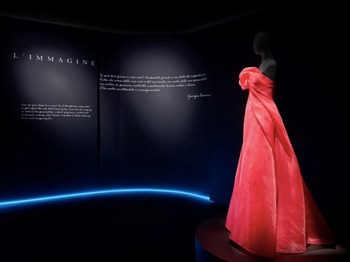
Despite her notorious period in the capital city in the 1950s, Callas spent the majority of her time defining her career at La Scala, where her legacy also continues to be proudly represented. For instance, the Amici della Scala presented a full 2017 exhibition of Callas’s most breathtaking costumes, entitled Incantesimi , at the Palazzo Reale in Milan to honour the fortieth anniversary of her death. In 2024, the Museo Teatrale alla Scala hosted Fantasmagoria Callas, an exhibition curated by Francesco Stocchi and designed by Margherita Palli that showcases five artists’ interpretations – each cast as individual ‘acts’ – of Callas’s legacy. On the floor above the museum’s permanent collection, a prelude to Fantasmagoria Callas showcases mannequins around the entrance to the exhibition wearing a selection of Maria Callas’s famed costumes at the theatre. All of the garments featured on display postdate her weight loss. At the top of a stairwell, an introductory video designed by a visual or musical artist contextualises the five core pieces of the exhibition. The homage to the singer served to commemorate the centenary of her birth, and the exhibit emphasised the theme of re-evocation. Giorgio Armani was responsible for the fifth and final act of the exhibit, a magenta-red sculptural gown, shown as Figure 6. While he designed the one-shoulder A-line dress for his 2021 Privé (private haute couture) line, he considered the piece an appropriate articulation of the artist’s voice. On the wall of the exhibition room around the dress, his reflections read as follows: ‘Can one give shape to a voice? So I thought of a dress that might reflect the idea that I had of her voice and her singing, as well as her personality: a whirl of passion, control and sentiment, a sharp, clear timbre. I picked it while listening to her and imagining her.’Footnote 54 Taken in full, the gown is Armani’s interpretation of Callas’s immaterial voice in material form. However, in the gallery room and in the supporting documentary video for the construction of the exhibition, the gown is not worn by a body at all. In the exhibition, a headless and armless mannequin dons the dress, a sartorial sculpture without personhood.
In Rome, by contrast, Callas is not only positioned as a figure of nostalgia or memory but also as a beacon of hope and forward momentum, because of her understood legacy as a force of repertorial revival, embodied glamour and collaboration. Perhaps now more than ever, operatic institutions in Italy are vulnerable, and much is at stake, whether the reputation of a single theatre or the stature of the city that houses it. As noted above, conscious of its more venerable rivals, the Teatro dell’Opera has always sought to increase its visibility and secure acclaim. By claiming Callas, collaborators and commentators in Rome also appropriated values and attributes aligned traditionally with those of Milan, and thereby marked itself as similarly industrious, modern and fashion-centric.
Giorgio Armani, 2021 Privé gown featured in exhibition act L’immagine of Fantasmagoria Callas, Museo Teatrale alla Scala, November 2023 to April 2024 (extended through summer 2024).

Callas has appeared again and again as a central figure in debates about opera’s continuity and afterlives through remediated means.Footnote 55 Common to many evaluations are multifaceted questions concerning the manipulation, displacement and re-contextualisation of her voice and presence in film and media. In contrast to the 2014 collection, the music for this 2018 show was more direct in its referentiality, but more obviously displaced from the body – specifically of Callas. Similar to the 2014 runway, the music was presented as a recorded soundtrack that played over speakers throughout the multi-room runway show.Footnote 56 Of course, no one was singing live. The full track featured an ABA form, with remastered recordings of Callas performing ‘Casta diva’ (from Norma), then ‘Un bel dì’ (from Madama Butterfly), and a reprise of the same version of ‘Casta diva’ to conclude the show. The version of ‘Casta diva’ comes from Callas’s well-known 1961 studio recording with Warner Classics, conducted by Tullio Serafin and performed with the Orchestra del Teatro alla Scala. Callas’s performance of ‘Un bel dì’ also featured the Orchestral del Teatro alla Scala, but the studio recording was produced earlier in 1955 under the direction of Herbert von Karajan. While neither piece’s lyrics or dramatic contexts map onto the collection’s pieces in any notable way, both recordings are lauded as definitive performances from Callas. The effect, taken in full, calls to mind Michal Grover-Friedlander’s remarks on Callas on film: ‘One outcome of privileging the singing voice in a predominantly acoustic domain – in which reflections and refractions are induced by the very translation of the vocal into the visual, the body being a sign of the voice – is that singers require no body at all.’Footnote 57 But what happens in circumstances such as these, in which musically referential bodies (conceptually, that is) require no voice at all to signify an acoustic history? Here, new materials evoke very specific musical memories and histories. Callas is subject to the trickiness of re-presentation, of articulating embodiment, for she teeters between being a ‘cultural artefact’ and a ‘body-subject’, to borrow again from Sobchack.Footnote 58
It is clear that Callas is a source of both remembrance and mythology in the sixty-three pieces. The collection summary states, ‘Memories that chase each other and overlap with the present, to be consumed by the breath of time. A sense of surprise that passes from one glance to another, myths that take on different hues.’Footnote 59 Further, it describes how Callas inspired in this collection ‘emotions that are imprinted in the air, between the intarsias, in the weavings’. Her presence is ideologically imbued in the very fabric of the pieces, notably with a technique that has strong artistic ties to Italy in historical woodworking and garment making. The pieces each capture the importance of the material for creating a meeting point that defies lived temporalities: ‘it is the dresses that connect and withhold personality and essence, points of view and gestures’.
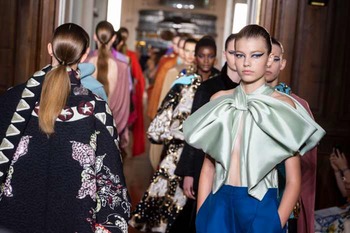
The looks, inspired by a blend of the contemporary and retro 1960s style, consistently exaggerate. As shown in Figure 7, the collection’s silhouettes were voluminous, many times oversized, referencing in amplified, modernised fashion the colours, patterns, fabrics and even trademark styles Callas wore on operatic stages as well as in concert performances. Ample silks, intarsia techniques, sculpturesque flower detail, enormous scarf-wraps, cloud-like taffeta sleeves all expanded the notion of Callas as diva and stylistic muse. In my view, the models are not meant to replicate Callas or any distinct operatic characters. Rather, the collection is an impression: it provokes a feeling of Callas, not an emulation. Artistry and craftsmanship are undoubtedly shared by Callas and Valentino’s forces, and in that sense the homage is moving and affective. But what kind of material expansion is achieved here: are the looks breathtaking palimpsests? Is the whole production a soundtracked simulacrum – the fashion company’s artisanal labour notwithstanding? As with the 2016 Traviata and its discourse, this collection is another effort to recuperate Callas as a Roman icon – though perhaps achieved more subtly. Many of the dresses that Piccioli referenced in this collection were in fact made for Callas in Milan. The soprano’s historical connection to La Scala is once again swept under the rug, showcasing how she functions even today as a prized gem for regional, institutional and even commercial authority.
Valentino Autumn–Winter 2018 Haute Couture Collection.

Despite such iconic recreations and resurrections – from the displaced to the uncannily holographic – Callas can of course never be recovered in her own living body, especially not that of the 1950s and 1960s. When faced with a presentation explicitly oriented around the expressiveness of external appearances, I find it difficult to locate her own subjectivity. With ongoing standards of physical embodiment articulated by leading figures in the fashion world, where thinness and/or youth are prioritised (for both Dotto and Callas), sinister issues of misogynistic and corporatised diminution or disappearance must also be acknowledged. Simultaneously, however, it is important not to re-inscribe the age-old devaluation or mistrust of the material, and in this case, of the vocal, even when it is merely suggested. The reality of this study, for better or for worse, is that Callas had a voice and an image as a performance icon of the 1950s and 1960s that inspired material and colourful, textural amplification rather than diminution. Perhaps this is a justified form of recovery. I am reminded here of Vivian Sobchack’s hopeful concept of a body-subject, as an aesthetic force of expansion that creates an ‘enhanced awareness of what it is to be material’.Footnote 60 In this context, these pieces – inspired by Callas and achieved through amplified colour, texture and visual signs – achieve a kind of beyond-ness that many would celebrate and identify as an appropriate way to honour the artist. In this form of materialised amplification, Callas becomes a valorised historicised subject that provokes her own kind of interdisciplinary creative canon.
***
This study allows us to consider anew the amalgam of forces – ranging from powerful individuals, to ideologies, to sartorial materials – that presents evolving forms of influence within contemporary operatic practices. These case studies offer a snapshot of Valentino’s recent operatic endeavours to demonstrate how fashion served as a core aspirational strategy of revitalisation: of historical women characters through a feminist lens (2014), of a city’s operatic culture and its institutions (2016) and of individual historical stars (2018). Each of Valentino’s interventions forged meaningful artistic expressions of nostalgia, but the aspiration to carry forward historical legacies, channelled in each instance through Callas, ultimately fell short in terms of advancing novel, contemporary sensibilities of operatic aesthetics or style. A new sense of operatic material and presence was nevertheless achieved, but at (literally) high cost. Despite attempts to reach new audiences and supporters, such a collaborative approach between opera and fashion threatened to re-inscribe the form of elitism that many invested practitioners are trying to combat. The 2014 Valentino collection employed evocative materials, nostalgic design and artistic craftsmanship to (re)interpret opera’s historical women. The Teatro dell’Opera collaboration with Valentino in 2016 invited commentary on opera’s potential to bring together fashion and celebrity notoriety in order to promote regional culture, institutional continuity and further economic growth. The continued collaborative efforts between the theatre and Dior generated by Chiuri has amplified the institution’s role as culturally representative of both Rome and italianità , within and beyond the country’s geographic borders. Indeed, the Teatro dell’Opera’s past and ongoing collaborations demonstrate the high stakes for institutional visibility and acclaim within the Italian peninsula. While Rome is the nation’s capital, it has long lacked the modern or progressive reputation that Milan possesses. These cities’ historical operatic infrastructures certainly make this distinction apparent. Nevertheless, the 2016 Traviata prompted attitudinal shifts among cultural leaders and local journalists to conceive of Rome as a city with momentum and potential for grandiose artistic and capitalistic representation that rivals that of its northern counterpart. 2018 marked the most ideologically focused effort of the three collaborations. Callas’s larger-than-life legacy as a figure of revitalisation of operatic practices in the last century is complex, even troubling, as she was not merely a character or a torchbearer in the narrative, but an actual person. With each collaboration, however, there was evidently a destabilisation of traditional priorities of Italian operatic practice. To put it another way: beautiful sights upstaged bel canto sounds. Yet, at the same time, the very prioritisation of the material here seemed to celebrate that which is precisely distinct about Italian operatic practices.Footnote 61 Italian opera has historically been very much about the material, about the body, in ideological terms. What results from an art form that aims to revivify operatic presence or subjectivity that is not explicitly musical, and instead foregrounds celebratory and troublesome histories of opera’s bodies through materials? The result is evocative, but unsettling, as it displaces and relocates the expressive priorities of operatic production. This study illuminates the fascinating relationships between materials, performance and of course performers themselves. Costumes and runway garments possess their own vital qualities: they bend, shift, scratch, hold sweat, provoke movement and produce their own subtle sounds, they remain after the show a material entity, sometimes even a relic of a character, of an individual’s art, of operatic moments, famous or mundane. Immediacy and liveliness in such collaborations are not necessarily the predominant priority of such collaborations. As shown through Valentino’s multifaceted creations across these three projects, contemporary fashion’s ability to capture sonic relics, performance history and musical signs in a stable material form confronts the traditionally ephemeral nature of opera in a new and capitalistic way.
Acknowledgements
I am grateful for the generous feedback from the reviewers who evaluated this article. My friends and colleagues Dan DiPiero, Noel Torres Rivera and Siel Agugliaro offered supportive, constructive insights throughout the drafting process that expanded the scope of this article in a meaningful and exciting way. Finally, a special thank you to Alessandra Malusardi, the curator of the historical archive at the Teatro dell’Opera di Roma. Her generosity, assistance and enriching conversations laid important foundations for this article.




 Open access

