


1. Introduction
The circular economy seeks to preserve material and functional value in technical systems by slowing, closing, and narrowing resource flows (Reference Bocken, Pauw, Bakker and van der GrintenBocken et al., 2016). In practice, strategies are often organized along the 9R framework (Reference Kirchherr, Reike and HekkertKirchherr et al., 2017; Reference Potting, Hekkert, Worrell and HanemaaijerPotting et al., 2017), and measures that retain functional value such as reuse, repair, refurbish, remanufacture, and reconfiguration show particularly high leverage (Reference Juresa, Mollahassani and GoebelJuresa et al., 2024). Early integration of circular strategies into product design, supported by Model Based Systems Engineering (MBSE), is a key prerequisite for achieving ecological and economic targets over the lifecycle (Reference Gonçalves, Soares, Pinto, Gouveia and BarbosaGonçalves et al., 2025). Industrial practice is still led by recycling (Reference Potting, Hekkert, Worrell and HanemaaijerPotting et al., 2017), which often causes losses of material properties and functional performance and therefore misses higher value loops (Reference Bubinek, Knaack and CimpanBubinek et al., 2025). Policy is beginning to counter this imbalance, as the European Commission emphasizes prevention, reduction, and reuse over material focused recycling (European Commission. Joint Research Centre., 2024).
Studies support this prioritization e.g. for information and communication technology products, reuse and refurbishment can cut greenhouse gas emissions by about one third relative to new production or recycling only baselines (Reference Rittershaus and MagaRittershaus & Maga, 2025). More broadly, reuse is effective because it preserves intended function and avoids conversion losses in materials and energy, especially when only minimal repair or modification is needed (Reference Cooper and GutowskiCooper & Gutowski, 2017; Ellen MacArthur Foundation and McKinsey, 2015). Whether products or components can be reused later is largely decided in early design. Critical determinants include modularity, standardized interfaces, accessible connections that allow disassembly without damage, and the separation of wear prone from durable assemblies (Reference Schischke, Proske, Nissen and Schneider-RamelowSchischke et al., 2019; Reference Weyrich, Klein and StedenWeyrich et al., 2014). These features increase the feasibility of reuse, repair, and remanufacturing across downstream lifecycle phases, yet they are still not systematically embedded in many development projects (Reference Du, Bryson and QamarDu et al., 2025; Reference Parchomenko, Smet, Pals, Vanderreydt and van OpstalParchomenko et al., 2023). However, widely applicable methods for early development remain limited, and many circularity-relevant attributes are included late, which delays their realization (Reference Bocken, Pauw, Bakker and van der GrintenBocken et al., 2016; Reference Stölzle, Roth and KreimeyerStölzle et al., 2023a, Reference Stölzle, Roth and Kreimeyer2023b). MBSE helps to bring circular criteria to the front end by linking requirements, architecture, analysis, and verification in a single model that synchronizes disciplines and supports consistent change and variant management (Reference EignerEigner, 2021; Reference Watz and HallstedtWatz & Hallstedt, 2018; Reference Wilking, Horber, Goetz and WartzackWilking et al., 2024). In contrast to document centric templates or isolated assessment tools, a system model can act as an integrating backbone in which circularity targets, structural enablers such as modularity and standardization, and lifecycle indicators are co-located, traceable, and reusable across projects and product generations, so that circular constraints influence the same decisions that shape performance and cost. Artificial intelligence (AI) can complement this approach with large language models (LLMs) to enable retrieval augmented generation (RAG) across project knowledge, and these can be constrained to deliver structured results that refer to specific model elements. AI thereby addresses typical bottlenecks of MBSE in practice by extracting and structuring information from dispersed documents and regulations, proposing architecture and requirement variants, and highlighting tradeoffs that would be difficult to explore manually, while the system model provides the formal boundary conditions for safe use. When combined with human decision making and with processes that ensure traceability and rule conformance, generative assistance can move beyond suggestion lists toward testable hypotheses about architecture changes (Reference Hunger, Arnold, Engesser and van den Gerald BoogaartHunger et al., 2025; Reference Jiang, Ouyang, Jiao, Zhong, Tian, Han, Antonie, Pei, Yu, Chierichetti, Lauw, Sun and ParthasarathyJiang et al., 2025; Reference Kulkov, Kulkova, Rohrbeck, Menvielle, Kaartemo and MakkonenKulkov et al., 2024). To ground these needs in a realistic setting, a fused deposition modeling print head is considered. This mechatronic subassembly concentrates thermal, fluidic, electrical and mechanical functions in a compact envelope and is serviced repeatedly across its life. In practice, bonded heaters and sensors, inaccessible fasteners, and bespoke connectors hinder nondestructive disassembly and the reuse of wear prone parts. The print head is therefore a representative smart product module in which early interface definitions, module boundaries and joining choices determine whether reuse becomes feasible at acceptable effort and cost.
The paper presents a reuse-centered MBSE framework that formalizes circularity objectives in SysML v2 and links them to product architectures and verification models. By leveraging AI-assisted retrieval and generation, the framework ensures that reuse-enabling design decisions remain traceable, testable, and actionable across the product lifecycle. It is structured according to the Design Research Methodology (Reference Blessing and ChakrabartiBlessing & Chakrabarti, 2009), which provides the overarching research context. Chapter 2 analyzes existing approaches and their strengths (Research Clarification and Descriptive Study I), thereby demonstrating the need for a more comprehensive framework that builds on established methods and best practices where appropriate (Prescriptive Study), as developed in Chapter 3. Chapter 4 validates this framework using an existing system model to illustrate the resulting improvements (Descriptive Study II). Finally, Chapter 5 summarizes the findings and outlines implications and directions for future research.
2. State of the art
SysML v2 is a textual, formally specified systems modeling language with a standardized API. Its machine-interpretable syntax increases tool interoperability and enables end-to-end linking of requirements, functions, structures, and verification (Object Management Group, 2025). In a circularity-oriented development context, reuse objectives can be formalized as reusable packages and properties, mapped to architectural artifacts such as blocks, ports, interfaces, connection concepts, and variant rules, and anchored in a verifiable manner through satisfy and verify relations. MBSE provides the process and governance layer around these model and links requirements, architecture, analysis, and verification, keeps disciplines synchronized, and supports change and variant management. This creates the basis for human in the loop use of generative AI. LLMs can interact with models through textual SysML v2 and can propose traceable changes against baselines and rule sets while engineers retain decision authority. AI-supported approaches in systems engineering address various activities along the V-model, from requirements management and architecture synthesis to verification (Reference Poulsen, Guertler, Eisenbart and SickPoulsen et al., 2025). Systematic reviews highlight the potential of generative methods for accelerating modeling (Reference Gupta, Ding, Guan and DingGupta et al., 2024), deriving structured alternatives from unstructured sources (Reference Shahid, Hsu, Chang and JianShahid et al., 2025), and strengthening traceability (Reference Cheng, Husen, Lu, Racharak, Yoshioka, Ubayashi and WashizakiCheng et al., 2024), but they also identify barriers like data availability domain adaptation, explainability, and the need to embed automation in controlled, auditable processes (Reference Clark, Barton, Albarqouni, Byambasuren, Jowsey, Keogh, Liang, Moro, O’Neill and JonesClark et al., 2025). To systematically classify the state of the art, a distinction is made between four interrelated approaches, which are characterized by their target vision, their degree of formalization, and the role of MBSE and AI.
The first class comprises approaches that embed environmental and lifecycle indicators directly into system models so that ecological effects can be considered already in early design. Reference Bougain and GerhardBougain and Gerhard (2017) exemplify this class by integrating lifecycle environmental indicators directly into SysML v1 models and thus enabling informed eco design decisions at concept stage. However, the link from such indicators to circular 9R imperatives is not continued across downstream lifecycle phases so that the operationalization of circularity remains fragmented and its effectiveness limited.
The second class consists of end to end workflows and templates that support reliability, maintainability, and cost assessment over the whole lifecycle. Reference Chandler and MatthewsChandler and Matthews (2013) define a holistic SysML workflow with templates that supports through life availability analysis on this basis. Explicit circular economy strategies are however absent, which means that ecological options and 9R pathways cannot be weighed systematically against classic support metrics. The approach therefore remains of limited use for circularity driven architectural decisions even though it demonstrates how structured workflows can be embedded in SysML. The third class is architecture centered and focuses on mapping 9R principles to structural and interface decisions in the system architecture. Reference Breimann, Rennpferdt, Wehrend, Kirchner and KrauseBreimann et al. (2023) extend modular function development so that decisions in each lifecycle phase are explicitly assigned to a 9R principle and the circular potential of modular products becomes visible. Yet quantitative traceability of these decisions to requirements and verification against sustainability goals is still missing. Without verifiable evidence, goal achievement and conflicts among goals cannot be controlled reliably. Reference Lipšinić, Husung, Pavković and WeberLipšinić et al. (2024) use SysML v1 and MagicGrid to integrate design for replacement, upgrading, and remanufacturing into modeling and thereby enable targeted interventions at subsystem level. The functional R strategies are however not converted into formal attributes that can be processed by requirements management tools, so that links to requirements, baselines, and verification artifacts remain incomplete.
The fourth class comprises AI supported methods that bring assistance along the V model into practice, from requirements capture through architecture synthesis to verification, including text to model techniques and large language models in the loop with SysML v2. The systematic review by Reference Poulsen, Guertler, Eisenbart and SickPoulsen et al. (2025) shows how AI can support requirements, architecture, integration and verification, and validation, and identifies data scarcity, trust and explainability, and technical limitations as key barriers. The review deliberately remains generic and does not operationalize 9R or reuse goals in SysML v2. Reference DeHartDeHart (2024) demonstrates how textual SysML v2 syntax allows language models to read, generate, and modify models through natural language and thereby removes interface barriers, while still relying on human oversight and without a governance framework with baselines, change sets, and metric references. Reference Johns, Carroll, Medina, Lewark and WalliserJohns et al. (2024) integrate GPT 4 into CATIA Magic to generate requirements, block diagrams, and internal block diagrams in SysML v1, which increases speed but also reveals redundancies and inconsistencies; the focus lies on productivity rather than on linking 9R goals to verifiable structural features. Reference Chami, Zoghbi and BruelChami et al. (2019) automatically generate selected SysML elements such as actors, use cases, and blocks from semi structured text to ease the transition from document based to model based systems engineering. The scope remains restricted to v1 semantics and basic elements and does not yet address SysML v2 rules, sustainability or reuse goals, or a controlled change process.
Nevertheless, there is a significant lack of approaches, to enable AI-based modeling in an MBSE environment (Reference Mollahassani, Becker, Eickhoff, Pickel, Goetz, Wartzack and GöbelMollahassani et al., 2025). The identified classes of contributions provide valuable building blocks, but no integrated MBSE and AI based method that systematically embeds reuse oriented 9R strategies as verifiable requirements in SysML v2 across process, model, and tooling perspectives, thereby motivating the following two research questions. (1) How can reuse strategies be expressed as modeling constructs and anchored in a model-based process so that they lead to operationally verifiable architecture decisions? (2) How can generative proposals be embedded in a human-in-the-loop modeling workflow whose governance ensures the traceability, admissibility, and verifiability of change histories while enabling evaluation based on defined reuse metrics?
3. Methodological framework: human-in-the-loop MBSE for reuse
This chapter presents an approach that incorporates circular economy principles into product development early and in a form that is traceable and verifiable, with a focus on reuse. It is based on established MBSE methodologies such as VDI 2206 (VDI, 2021) with artifacts such as requirements, functions, logical and physical architecture. Section 3.1 defines the framework across four aligned levels and introduces the SysML v2 library that operationalizes reuse goals as verifiable model content. Section 3.2 specifies the AI-supported method that transforms the system model into governed change proposals under human control.
3.1. Reuse-centric framework and SysML v2 library
Figure 1 situates the framework in four aligned levels, business model, goal, structure, and verification, that operationalize reuse as the primary circular strategy. Reuse denotes the repeated use of products, assemblies, modules, and components in their original or equivalent function without material reprocessing. Limited inspection, cleaning, testing, and repair are admissible as long as functional role and core structure remain unchanged. Reuse is treated as a design commitment expressed through quantitative targets such as reuse share, lifetime extension, and allowable disassembly effort.
The process perspective refines the V-model of VDI 2206 (VDI, 2021) for a reuse- oriented context by inserting dedicated activities and decision gates on both branches. On the left branch, concept and system design include selection of circular strategies, derivation of reuse targets, and synthesis of modular architectures with explicit interface decisions. On the right branch, integration and validation include structured disassembly trials, assessment of module and interface compatibility across generations, and evaluation of reuse scenarios against business objectives. At the business and service level the portfolio owner selects admissible reuse-oriented strategies and business models, for example product-as-a-service or part harvesting, and fixes boundary conditions such as service regions, product families, and policies on warranty, spare parts, and target service life. At the goal level these choices are formalized as measurable circularity requirements in the system model.
Circularity requirements in systems engineering product development

Figure 1 Long description
A diagram of the circular economy integration process in systems engineering product development. The diagram is structured into multiple layers and levels, showing the transformation layer, business model, goal level, structural level, and verification level. The transformation layer includes circularity strategies and product strategies. The business model level features circularity requirements and measurable target values. The goal level contains SysML definitions and SysML elements. The structural level includes SysML test cases. The verification level is supported by PLM, SysML tools, and verification tools. The diagram illustrates the process of integrating circular economy strategies into product design, emphasizing the use of Model Based Systems Engineering to achieve ecological and economic targets over the lifecycle.
For every such artefact there is a linked element in the model and language perspective, implemented in a SysML v2 based system model and libraries. Reuse-related goals are represented as reusable requirement packages with parameters for target values and scope. Structural decisions are captured as blocks, parts, ports, and interface families together with rules for compatibility, accessibility, separation of lifetimes, and grouping of modules into families that share function and lifecycle behavior. Scalable reuse is enabled by modular structures with stable boundaries, standardized interfaces across mechanical, electrical, and software domains, reversible and non-destructive joining with good accessibility, and separation of wear parts from long-life carriers. Verification intent is represented through logical and parametric test cases that compute disassembly effort, check interface family coverage, and confirm nondestructive separability. Satisfy and verify relations connect business objectives, architectural decisions, and evidence so that downstream processes can identify feasible reuse pathways.
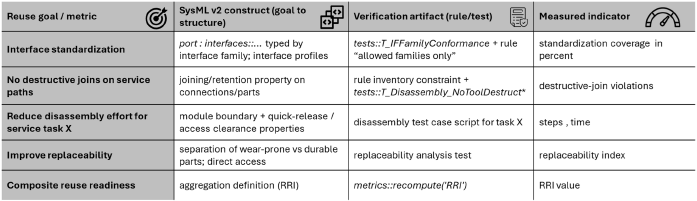
The tooling perspective specifies how these relations are implemented. A central SysML v2 environment stores the system model with versioned elements. A PLM system manages project structures and document artefacts with references to model elements. A semantic integration layer represents modules, interfaces, joining techniques, and disassembly knowledge as a knowledge graph queryable across products and generations. An assistant layer uses only this governed context to generate proposals, ensuring that all suggestions remain auditable and can be validated with established procedures. To address RQ1, the reuse strategy is operationalized as a SysML v2 library separated into different parts as shown in Table 1: The reusable requirement definitions capturing reuse goals as measurable targets with explicit attributes for scope and target values, the design constructs that realize these goals in the architecture through modular decomposition, interface families, joining and retention mechanisms, lifetime separation of wear-prone and durable parts, access clearance specifications, and cross-generation module family compatibility rules, and the verification artifacts that compute reuse indicators directly from the model and enforce invariants Each goal row in Table 1 also specifies a concrete target value or threshold that anchors the verification. Each requirement is allocated and later satisfied by concrete model elements, ensuring traceability from goal to structure. Verification is captured as model-linked test cases that compute disassembly step counts and time estimates for exemplar service tasks and check interface-family conformance. This creates an executable link from reuse objectives to verifiable model evidence.
Mapping from reuse goals to SysML v2 constructs, verification artifacts, and indicators

3.2. AI-supported reuse-centric human-in-theloop method
This section presents the method that links the model and language layer with the tool layer, in particular AI-based tools. Its purpose is to operationalize large language models within the development process by transforming the system model and the circularity requirements library into concrete, verifiable change proposals under explicit human control. Figure 2 illustrates the end-to-end loop in six steps that are mirrored in the instantiation in Chapter 4.
Human-in-the-loop SysML recommendation generation method

In step 1, the systems engineer authors and curates the SysML v2 product model. This model captures the structural and behavioral elements of the assembly under analysis. A service then extracts a bounded sub-context from this model using three selection criteria. The goal-scope criterion selects every circularity requirement whose scope references the target assembly and its descendant parts. The structural-neighborhood criterion traverses the block–port–connection graph one hop outward and includes adjacent interfaces, connectors, and enclosing modules. The rule-relevance criterion adds every rule-inventory entry whose precondition mentions an element already in the selection. The resulting snapshot is deterministic. Any proposal can therefore be traced to the exact model state that triggered it.
In step 2, the sub-context is assembled into a prompt package comprising eight ordered sections: a Run-Header identifying project, baseline, and timestamp. A Task Instruction stating the objective analysis in natural language; the Bounded Model Snapshot serialized as a self-contained SysML v2 fragment. Rule Inventory of invariants the model must not violate. Metric Targets with current baselines and improvement direction. Allowed Catalogs restricting material, connector, and joining-technique choices to governed entries. Retrieved Evidence and Pattern Hints injected by the RAG layer and an Output Contract requiring each proposal to identify addressed elements by qualified SysML v2 names, present a minimal textual delta with before and after states, state expected metric effects with units and confidence, enumerate trace updates for satisfy and verify completeness, and flag any rule the change approaches. Because the prompt is generated from the model vocabulary, the language model cannot introduce constructs outside the governed scope.
Step 3 provides the circularity requirements library described in Section 3.1. It is maintained independently of the product model so that reuse objectives can be applied across projects and product generations. In step 4, the retrieval layer enriches the prompt by querying a curated knowledge base of joining and separation techniques, material and component data, and previously accepted change sets with measured effects. Retrieved fragments are filtered against the sub-context rules and inserted as evidence and pattern hints into the prompt package assembled in step 2. The retrieval layer is deliberately separated from generation so that provenance of every injected fragment remains traceable independently of the downstream language model.
In Step 5 the language model receives the complete prompt package, now augmented with the retrieved evidence and pattern hints from step 4, and generates change proposals. For each proposal the service emits a human- readable summary explaining rationale and expected effect, and a machine-readable JSON record for automated processing. Before any proposal reaches the engineer, validation proceeds in three sequential gates: a syntax gate parses the delta against the SysML v2 grammar; a rule-compliance gate evaluates the modified snapshot against the full rule inventory, rejecting violating proposals with diagnostic feedback; and a metric-prediction gate recomputes claimed effects using parametric test cases, flagging inconsistencies for manual inspection. Only proposals that pass all three gates are presented to the engineer together with their retrieval provenance. The combined retrieval–augmentation–generation pipeline constitutes the RAG architecture of the framework, in which the retrieval (step 4) and the generation (step 5) are deliberately separated to maintain auditability. The engineer accepts, amends, or rejects each proposal. Accepted items are applied as atomic change sets on a dedicated branch and baselined with a rationale linking the change to its governing requirement and predicted metric effects. Rejected proposals are archived with structured reasons to prevent repetition.
In step 6, an explainability chat allows the engineer to query the proof of any proposal. The chat runs on the same sub-context and retrieved fragments and responds by citing specific model elements and knowledge fragments, never leaving the bounded context. When deviations between predicted and observed effects appear after baselining, the discrepancy is recorded and rules, metrics, and prompt templates are refined accordingly.
4. Instantiation
This instantiation demonstrates the framework in a single development run on a fused deposition modeling print head. The objective is to show that reuse objectives can be translated into verifiable SysML v2 artifacts, that retrieval augmented generation can propose meaningful model changes, and that these changes can be governed, integrated, and measured within one coherent workflow. The print head represents a compact mechatronic subsystem that couples thermal, fluidic, electrical, and mechanical domains under tight space and weight constraints. In practice, reuse is often impeded by bonded or difficult to access connections, nonstandard interfaces, and the absence of a clear separation between short life and long-life parts such as nozzle, heat break, heater, and sensors. The instantiation therefore focuses on the circular strategy of reuse and instantiates circularity requirements that encode modularity, standardized interfaces, accessibility, and avoidance of destructive joints.
Figure 3 depicts the operational pipeline in six parts. Step 1 shows an excerpt of the SysML v2 system model of the print head with a functional decomposition into feed, heat, extrude, and regulate, mapped to early structural allocations. Step 3 shows an excerpt of the circularity requirements package described in Section 3.1, providing reuse objectives and measurable target values adapted from Reference Juresa, Mollahassani and GöbelJuresa et al. (2025). Both inputs converge in step 2, the prompt package structure, which assembles the eight sections defined in Section 3.2. Step 4 shows the RAG retrieval output, consisting of evidence fragments, pattern hints, a provenance map, and retrieval metadata drawn from a curated knowledge base of joining techniques, interface family rules, and previously accepted change patterns. The retrieved fragments are filtered against the sub-context rules and injected into the prompt package before generation. Step 5 shows the generation output, split into a human-readable summary with rationale and expected metric effects, and a machine-readable JSON change set with qualified element names, textual deltas, metric predictions, and trace updates. Together, steps 4 and 5 realize the RAG pipeline. Step 6 shows the explainability chat through which the engineer can query the provenance of proposals, inspect the retrieved evidence, and trace reasoning to concrete SysML elements.
Instantiation of 3D printer print head and circularity strategy of reuse

Figure 3 Long description
Panel 1: Excerpt of SysML v2 system model of 3D printer print head. This panel shows a code snippet detailing the attributes and ports of a 3D printer print head, including mass, temperature, power consumption, and maintenance time. Panel 2: Prompt Package Structure. This panel outlines the structure of a prompt package, including components such as Run-Header, Task Instruction, Bounded Model Snapshot, Rule Inventory, Metric Targets, Allowed Catalogs, Retrieved Evidence & Pattern Hints, and Output Contract. Panel 3: Excerpt of SysML v2 global requirement definition package for reuse. This panel displays another code snippet focusing on global requirements for reuse, including attributes and constraints. Panel 4: RAG Output Package Structure. This panel describes the structure of the RAG output package, including Evidence Fragments, Pattern Hints, Provenance/Source Map, and Retrieval Metadata. Panel 5: Reuse-Centric Generation Output. This panel shows an example of reuse-centric generation output, with both human-readable and machine-readable sections. Panel 6: Explainability Chat. This panel illustrates a chat interface where a chat assistant provides explanations and answers questions related to the system model.
The system boundary comprises filament feed, melt zone and nozzle, thermal management, sensing and actuation, structural support, and interconnects to the motion system. In the initial model, blocks for HeatSink, HeatBreak, HeaterBlock, Nozzle, FilamentPath, Thermistor, HeaterCartridge, CableHarness, QuickConnect, and MountInterface are defined. Ports are typed against project level interface families for thermal, electrical, fluidic, and mechanical interactions. Reuse requirements define targets for interface standardization coverage, maximum disassembly steps and time for module level replacements, separation of wear prone from durable parts, and the avoidance of destructive joining on service relevant paths. Each requirement is linked through satisfy to candidate structures and through verify to scripted test cases that compute step counts for exemplar tasks such as nozzle exchange, heater replacement, and sensor replacement and that check interface family conformance.
To illustrate the pipeline concretely, one proposal is traced end to end. In the initial model the Thermistor is attached to the HeaterBlock via an AdhesiveBond connection, a permanent joining technique with four disassembly steps, an estimated task time of 3.5 minutes, and one destructive-join violation on the sensor-replacement service path. The sub-context extractor selects the Thermistor block, its thermalContact port, the AdhesiveBond connection, and the rule NoDestructiveJoinOnServicePath. The retreival layer retrieves a data sheet for spring loaded clamp sleeves and a previously accepted change pattern where a bonded heater cartridge was replaced by set-screw retention. The language model proposes to replace AdhesiveBond with a ClampSleeve connection defined as reversible, non-destructive, requiring two steps and 0.8 minutes. The proposal specifies the satisfy link from NoDestructiveJoinOnServicePath to the new connection and updates test case T_Disassembly_NoToolDestruct_Sensor. The validation pipeline confirms syntax conformance, rule compliance, and metric consistency. The engineer accepts the proposal with the rationale that the clamp sleeve maintains thermal contact within 0–350 °C while enabling tool-free sensor exchange. Step 5 of Figure 3 shows the human-readable summary and JSON change set for this proposal.
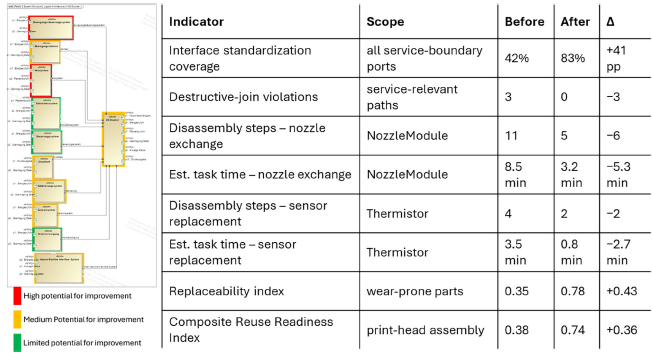
Reuse indicator values before and after the accepted change sets

Beyond the sensor path, further proposals isolate Nozzle and HeaterBlock as a quick-release submodule with a standardized mechanical interface, route the CableHarness through keyed serviceable connectors typed by electrical interface profiles, and introduce explicit access clearances to reduce tool changes. All proposals are returned as structured change sets validated against the rule inventory and test suite.
Integration follows a version-controlled process. The engineer accepts, edits, or rejects each proposal, then merges accepted change sets on a dedicated branch and creates a baseline. Each accepted change carries a rationale referencing the triggering requirement and affected test plan. Rejected proposals are archived with reasons to prevent repetition. Decision authority remains with the human engineer and the full trail from suggestion to baseline is auditable. Evaluation is performed by recomputing indicators before and after the accepted change sets. Table 2 reports the results. The largest relative improvement appears in sensor replacement, where eliminating the adhesive bond removes the only destructive operation on that service path and reduces estimated task time by 77%. Nozzle exchange benefits from the quick-release submodule, which halves the step count by eliminating upstream disassembly. Interface standardization coverage nearly doubles through project-wide interface families. The composite RRI rises from 0.38 to 0.74, reflecting gains across all three constituent dimensions. Model quality improves through elimination of undocumented nonreversible bonds, greater rationale coverage due to the enforced justification field, and more localized deltas at module boundaries that increase baseline stability. The pipeline is executed with a single LLM configuration consistent with project policy; it is compatible with Mistral Small for local processing or Qwen 3 30B A3B for longer contexts. The instantiation shows that the framework surfaces reuse leverage points, that proposals can be traced to objectives and rules, and that accepted changes measurably improve reuse readiness. The single-run design limits inference scope but suffices to establish end-to-end enactment. Disassembly times are architecture-level estimates requiring physical validation in future work.
5. Conclusions and future work
This paper introduced a human-in-the-loop MBSE method that encodes reuse objectives as testable requirements, maps them to SysML v2 artifacts across goal, structure, and verification levels, and employs retrieval-augmented generation to produce governed, traceable model deltas validated by rules and metrics before baselining. The instantiation on an FDM print head demonstrated the workflow end to end: a system model and a circularity requirements library were exported to the generation environment, proposals emphasizing standardized interfaces, reversible joints, and accessible exchangeable modules were synthesized, and accepted changes were integrated with documented rationales and immediate recomputation of reuse indicators. Table 2 confirmed measurable improvements across all tracked indicators, with the composite reuse readiness index rising from 0.38 to 0.74. Key benefits include operationalizing circularity in early product design, increasing transparency through provenance of suggestions, and achieving consistent rule and metric checks that connect requirements, structure, and evidence. Limitations stem from validation in a single product domain, dependence on model completeness and document coverage for retrieval, and architecture-level disassembly estimates that require physical confirmation. Future research will extend the rule inventory to additional 9R strategies, generalize the vocabulary across product lines and generations, integrate knowledge graphs to propagate environmental consequences into decisions, benchmark alternative language models and prompt designs, and run controlled studies that quantify effort, quality, and lifecycle impact across diverse smart product categories.




 Open access

