

Thousands of civil society organizations (CSOs) have used the complaints mechanisms of international organizations (IOs) to accuse governments of human rights violations. In turn, these accusations have led IOs to ‘name and shame’ perpetrator states.Footnote 1 Complaint mechanisms that give direct access to IOs may strengthen the power of CSOs vis-à-vis state governments. For instance, the complaints mechanism of the Special Procedures of the UN Human Rights Council (UNSP) has been praised for ‘pierc[ing] the veil of [the] national sovereignty’ (Buergenthal Reference Buergenthal1993) and ensuring that ‘human rights are given concrete meaning’ (OHCHR 2024a). Yet, anecdotal evidence cautions optimism. The Algerian government, for example, decided to ban one of the oldest CSOs in the country, the Algerian League for the Defence of Human Rights, due to its ‘submission of false information’ to the UNSP complaints mechanism (UNSG 2023, 20). Likewise, UN human rights bodies themselves note incidents of reprisal.Footnote 2 We address this puzzle and ask: does international ‘naming and shaming’ in response to complaints filed by CSOs to international human rights complaints mechanisms improve respect for their rights, or does it backfire and trigger reprisals?
Existing research does not answer this question. International relations literature largely expects positive human rights consequences when IOs provide CSOs with an opportunity to hold states accountable (Keck and Sikkink Reference Keck and Sikkink1998; Murdie and Davis Reference Murdie and Davis2012; Smith-Cannoy Reference Smith-Cannoy2012). Studies on specific instruments for civil society access to IOs – for example, complaints mechanisms (Schoner Reference Schoner2024), consultation forums (Steffek et al. Reference Steffek, Kissling and Nanz2007), and international courts (Sikkink and Kim Reference Sikkink and Kim2013) – highlight the empowerment of civil society’s human rights defenders.Footnote 3 Research on complaint mechanisms, the body of studies most related to our manuscript, likewise does not investigate potential negative outcomes for the civil society actors who file complaints (Montal and Pauselli Reference Montal and Pauselli2023; Schoner Reference Schoner2024; Ullmann and Von Staden Reference Ullmann and Von Staden2024). Instead, they examine (and find evidence for) improvements in aggregate human rights outcomes upon international shaming in response to complaints. By examining the repressive consequences for CSOs who file complaints with the UNSP, we fill a significant research gap on the unintended negative consequences of civil society engagement in IOs.
Combining insights from the literature on ‘naming and shaming’ (DeMeritt Reference DeMeritt2012; Hendrix and Wong Reference Hendrix and Wong2013; Murdie and Davis Reference Murdie and Davis2012) and strategic repression (Daxecker Reference Daxecker2014; Gohdes Reference Gohdes2020; Ritter and Conrad Reference Ritter and Conrad2016), we expect that shaming by an international human rights institution in response to complaints by CSOs leads to an increase in state repression against CSOs. Rational and forward-looking governments have incentives to use targeted reprisals to deter future complaints. Shaming in response to complaints provides governments with detailed information on complainants, for example, by revealing the names of CSOs. Governments may thus find it easy to identify and target mobilized challengers. Moreover, reprisals against CSOs that filed complaints are likely because they are comparatively cheap, considering the limited international follow-up monitoring of government actions against complainants.
We test our argument using three studies of shaming in response to complaints filed to the UNSP in the 2010–2021 period. First, we employ cross-national regression analyses drawing on novel data on complaint-based shaming by the UNSP, namely the public letters or so-called ‘communications’ that the UNSP send to governments in response to human rights complaints. UNSP communications explicitly include the names of the CSOs and individuals whose rights have allegedly been violated, and they are publicly available and presented in each session of the UN Human Rights Council. We regress the count of UNSP communications received by governments on repression targeting CSOs and on a newly coded measure of reprisals against collaborators with UN human rights bodies. Second, and given that the cross-country evidence cannot tell us whether governments target precisely those CSOs that filed complaints, we move the analysis to the level of CSOs. Drawing on an original survey with representatives of CSOs from 15 countries, we use regression to test whether the perceived quality of relations with the government systematically deteriorated after the CSOs were mentioned in UNSP communications. Third, and addressing potential limitations of self-reported repression data, we regress a novel measure of media-reported repression targeting CSOs on the occurrence of UNSP communications mentioning these CSOs in India. We chose India because of (i) a large number of Indian CSOs mentioned in UNSP communications and (ii) the country’s comparatively free media, which allows us to measure media-reported repression. Moreover, India is an important case in itself because its CSO sector is large and has experienced increasing repression (Sirur Reference Sirur2024). We examine whether the growing use of the UNSP complaints mechanism has contributed to this repressive trend.Footnote 4
We address endogeneity concerns (for example, the possibility that complaints and communications are more likely when repression is worsening) using instrumental variables. Specifically, we exploit personnel turnover of the human rights experts (also known as UNSP mandate-holders, Special Rapporteurs, or Independent Experts) responsible for screening and acting upon complaints at the UNSP. When a UNSP mandate-holder is newly appointed, they must familiarize themselves with their dossier and the work environment. Consequently, as we show empirically, they process fewer complaints and file fewer communications than more experienced experts. Hence, we instrument the number of UNSP communications targeting a country with the number of newly appointed UNSP experts in the same year and the total number of UNSP experts. The research design section explains why the instrument plausibly fulfils the independence and excludability assumptions.
The variety of analyses at different levels shows consistent results in line with our argument. Complaint-based shaming produces a repressive backlash against CSOs in general and those involved in complaints in particular. Across countries, we find positive correlations between the number of UNSP communications and levels of repression against CSOs and reprisals against collaborators of the UN human rights bodies. The results of our instrumental variables regressions suggest that these relationships are likely causal. Across CSOs, we find that CSOs systematically report a deterioration in their relationship with their government after filing a complaint and being mentioned by a UNSP communication. Finally, we show that media-reported events of repression against Indian CSOs increase after these organizations have participated in the UNSP complaints mechanism. Additional analyses highlight that the repressive backlash associated with UNSP communications is not limited to autocratic settings but applies to a variety of countries, including democratic states.
Our findings have important practical and theoretical implications. For practice, they inform the reform of complaints mechanisms in the international human rights regime in line with ‘do no harm’ principles. For theory, our findings push the frontier of the human rights literature by shifting attention from empowering effects to specific adverse consequences of direct civil society access at IOs. In the next section, we elaborate on our contributions to research and explain the starting points for our argument, which are situated in the literature on ‘naming and shaming’ and complaints mechanisms.
Research on shaming and complaint mechanisms
Research on international human rights complaints mechanisms, which are platforms that allow CSOs to file complaints about governments’ human rights abuses to international organizations, considers this form of civil society participation as an opportunity for human rights progress (for example, Montal and Pauselli Reference Montal and Pauselli2023; Schoner Reference Schoner2023; Ullmann and Von Staden Reference Ullmann and Von Staden2024). This perspective relates to a strand of research on international ‘naming and shaming’, which finds that shaming governments for human rights abuses is more effective with broader civil society support (for example, Keck and Sikkink Reference Keck and Sikkink1998; Murdie and Davis Reference Murdie and Davis2012; Smith-Cannoy Reference Smith-Cannoy2012). According to transnational advocacy theory, domestic CSOs in repressive states may reach out to international and domestic CSOs in democratic states, which in turn cooperate with international organizations to ‘name and shame’ repressive states (Keck and Sikkink Reference Keck and Sikkink1998). Both large-N cross-national research and case studies confirm that participation by civil society actors from below increases the success of international shaming from above (Brysk Reference Brysk1993; Murdie and Davis Reference Murdie and Davis2012; Smith-Cannoy Reference Smith-Cannoy2012). We contribute to both research on ‘naming and shaming’ and research on complaints mechanisms by considering when and why civil society participation in international human rights mechanisms can unintentionally lead to more targeted repression against CSOs.
Research on state repression suggests that governments are rational and forward-looking in their response to (anticipated) shaming. For instance, they shift to repressive tools that are difficult to link to the incumbent regime (DeMeritt and Conrad Reference DeMeritt and Conrad2019; Payne and Abouharb Reference Payne and Abouharb2016; Rejali Reference Rejali2009), or they intensify repression during periods of limited international scrutiny (Daxecker Reference Daxecker2014; Scharpf et al. Reference Scharpf, Gläßel and Edwards2023). Relatedly, Bakke et al. (Reference Bakke, Mitchell and Smidt2020) suggest that it is due to anticipated shaming that states repress CSOs when they violate international human rights treaties.Footnote 5 What remains unexplored, however, is when and why shaming triggered by direct CSO participation at international organizations – in our case, human rights complaints mechanisms – leads to more repression.
We also contribute to a growing literature on complaint mechanisms.Footnote 6 Research shows that domestic complaint mechanisms can decrease human rights violations in democracies (Hu and Conrad Reference Hu and Conrad2020) and even shape policy outcomes in autocracies (Lueders Reference Lueders2022). However, much less is known about complaint mechanisms operated by international organizations. Examples of complaint mechanisms from other international organizations include the independent redress mechanism of the Green Climate Fund or the complaints mechanisms of the ILO’s Committee on Freedom of Association. The most prominent complaints mechanism discussed in the literature is the World Bank Inspection Panel (for example, Buntaine Reference Buntaine2015; Clark et al. Reference Clark, Fox and Treakle2003). Notably, there are several reports on reprisals against individuals and organizations that have filed complaints to the World Bank Inspection Panel and other development finance institutions (Daniel et al. Reference Daniel, Genovese, Huijstee and Singh2016; Front Line Defenders 2016). However, the discussion of reprisals is currently limited to anecdotal evidence. Our study advances this broader literature on complaint mechanisms by providing the first systematic empirical analysis of reprisals against complainants.
The most related studies have focused on the complaint mechanisms of UN human rights treaty bodies (Schoner Reference Schoner2023, Reference Schoner2024; Ullmann and Von Staden Reference Ullmann and Von Staden2024; Von Staden Reference Von Staden2022) and regional human rights courts (Montal and Pauselli Reference Montal and Pauselli2023; Zuloaga Reference Zuloaga2020). Using cross-national analyses in a global sample of states, Schoner (Reference Schoner2023) demonstrates that respect of physical integrity rights positively correlates with ‘naming and shaming’ in response to complaints to the Human Rights Committee (that is, the body monitoring the implementation of the International Covenant on Civil and Political Rights). Yet, this international complaints mechanism – like all others that have been studied so far – is only open to citizens in a subset of states that have voluntarily and formally accepted its jurisdiction (Montal and Pauselli Reference Montal and Pauselli2023; Schoner Reference Schoner2024; Ullmann and Von Staden Reference Ullmann and Von Staden2024). As such, these studies likely exclude some of the hardest cases for human rights protection. This makes it questionable whether their evidence travels to universally accessible complaints mechanisms, such as the complaints mechanism operated by the UNSP. Moreover, by focusing on aggregate human rights outcomes such as states’ respect of physical integrity rights (Schoner Reference Schoner2023) or determinants of compliance (Ullmann and Von Staden Reference Ullmann and Von Staden2024), researchers do not investigate the possibility of a repressive backlash against the complainants. In this manuscript, we develop a new theoretical framework on the unintended repressive consequences of complaint-based shaming, which is presented in the following section.
Explaining the repressive consequences of complaints to IOs
When CSOs file complaints with an international human rights body, they pose a challenge to the incumbent government. By accusing their governments of violating human rights and bringing this accusation before international human rights experts, they draw international attention to the repressive actions of their governments. International human rights experts examine these accusations and, in response, they may file public letters (called ‘communications’ by the UNSP) to governments, demanding governments to justify their actions and to address these abuses. Hence, complaints to international human rights bodies allow CSOs to impose external pressure on their governments. In other words, by filing complaints, the representatives of victims of human rights abuse transform individual experiences of state repression into an issue of contention between governments and international human rights authorities.
Given that complaints directed to international human rights bodies may impose significant (reputation) costs on governments, we consider the submission of such complaints as a form of anti-regime mobilization. Research suggests that anti-regime mobilization is a strong determinant of state repression (Ritter and Conrad Reference Ritter and Conrad2016), but governments could also relieve pressure from anti-regime mobilization and resulting shaming by opting for compliance (DeMeritt Reference DeMeritt2012; Franklin Reference Franklin2008). In order to explain how governments respond to complaint-based shaming, it is necessary to examine their unique characteristics.
Complaints give rise to a specific and personalized form of shaming, whereby governments are accused based on detailed information obtained through complaints. For instance, in response to a human rights complaint, the UNSP filed a communication to the Turkish government concerning the incommunicado detention and investigations linked to terrorism against the human rights defenders Veli Acu and Günal Kursun, who work for the CSO ‘Insan Haklari Gündemi’ (Human Rights Agenda Association) (OHCHR 2017). In this letter, the UNSP expressed their deep concern about the arrest of the human rights defenders and called on the Turkish government to provide further information on these cases and to respect the right not to be arbitrarily detained. Such specific and personalized ‘naming and shaming’ could be especially effective in shaping the repressive actions of states. Personalized ‘naming and shaming’ contains concrete policy recommendations and may enable targeted remedies. Research also suggests that personal frames are highly suitable for triggering emotional responses and sparking mobilization (McEntire et al. Reference McEntire, Leiby and Krain2015). In response, governments may address the concerned abuses or even address human rights violations more broadly to reduce the risk of future complaints.
However, we argue that there are profound risks linked to such specific and personalized ‘naming and shaming’, especially if it is co-initiated by victimized individuals and CSOs. In particular, there is a fundamental trade-off between the specificity and personalization of human rights allegations and the protection of the anonymity of victims of human rights abuses. Human rights allegations can focus broadly on the human rights situation in a given country (‘There are systematic human rights violations in country X’) without mentioning specific individuals, which makes shaming general and comprehensive but also somewhat vague and generic. Alternatively, human rights shaming can focus on cases of repression directed against specific individuals or CSOs (‘The rights of person X or organization Y have been violated’). Such accusations of human rights abuse are much more concrete, but they also expose individuals and CSOs to the risk of targeted reprisals.
The risk of state reprisals is likely acute in the context of complaints to international human rights bodies. Given the costs that human rights complaints impose on states, forward-looking governments have incentives to deter future complaints. If governments addressed the concerns of complainants, others could be motivated to file a complaint as well. Conversely, if others observe that complainants and their supporters suffer from greater repression, they may refrain from reporting their grievances to international human rights bodies. The costs of retaliating against complainants may be comparatively low. Recommendations from international human rights bodies are not legally binding on states, and ignoring them does not result in sanctions (Zhou et al. Reference Zhou, Kiyani and Crabtree2023). International human rights bodies have a limited capacity to monitor the fate of complainants, and there are often no effective follow-up mechanisms.Footnote 7 Hence, continued violations are relatively cheap, and retaliation is difficult to observe.
Furthermore, human rights complaints provide repressive governments with valuable information for targeted repression. Research shows that indiscriminate repression is costly for governments as it involves a loss of legitimacy and a risk of backlash (Pechenkina et al. Reference Pechenkina, Bausch and Skinner2019). In contrast, selective violence tends to be cheaper and potentially more effective (Demirel-Pegg and Rasler Reference Demirel-Pegg and Rasler2021). Targets of repression are generally difficult to identify for repressive governments as repression creates incentives to engage in preference falsification and covert dissent (Kuran Reference Kuran1998). Personalized information provided through international shaming in response to complaints resolves this informational dilemma for repressive states.Footnote 8 State governments may perceive the information on complainants as particularly trustworthy because it is obtained from independent international human rights experts. Moreover, complainants are likely to be considered as worthwhile targets as turning to international human rights bodies signals high levels of resolve, which may be regarded as threatening by repressive regimes (De Mesquita Reference De Mesquita2010).
Of course, not only governments may act strategically. CSOs and international human rights bodies like the UNSP are also forward-looking actors. Thus, if CSOs anticipate retaliation, they may be less likely to file complaints. Likewise, international organizations may refrain from ‘naming and shaming’ states in response to complaints if they fear that complainants will face a backlash. As UN reports demonstrate, the international human rights regime is aware of reprisal risks associated with complaint mechanisms.Footnote 9 To the extent that CSOs and the international human rights bodies strategically adapt their behaviour in anticipation of reprisals, repressive consequences become less likely. Put differently, selection issues make it harder to find evidence in favour of a repressive backlash against the complainants. Indeed, if anything, the contemporaneous number of UNSP communications is weakly negatively related to previous levels of repression (see Appendix C.11). Although strategic adaptation is plausible, we nevertheless observe that many CSOs file complaints in highly repressive and autocratic states and that UNSP communications are also sent to such regimes. For instance, the UNSP raised concerns about the physical integrity of the human rights defender Huang Xueqin in a communication sent to the Chinese government in November 2023 (OHCHR 2023).
Taken together, given the incentives to deter future complaints, the informational value of complaint-based shaming, and the lack of follow-up mechanisms provided by international human rights bodies such as the UNSP, we hypothesize the following:
Hypothesis 1: If governments face shaming in response to human rights complaints to IOs, they increase repression targeting CSOs.
Hypothesis 2: If shaming in response to human rights complaints to IOs mentions a particular CSO, repression against this specific CSO increases afterwards.
Empirical case: UN Special Procedures communications
In this manuscript, we examine shaming in response to human rights complaints filed with the UN Special Procedures (UNSP). The UNSP mandate-holders send public letters – so-called communications – to governments that address allegations of human rights abuses received through a complaint procedure for CSOs and individuals (OHCHR 2024d). In these letters, the UNSP reports on the alleged human rights violations and urges governments to prevent them or to take effective remedial action. UNSP communications are a publicly visible shaming instrument. A summary of UNSP communications is presented in each session of the UN Human Rights Council, and the full text of UNSP communications is publicly available online.Footnote 10
UNSP communications follow-up on the allegation of human rights abuses obtained through a complaints mechanism for individuals and civil society organizations. Importantly, the complaints mechanism of the UNSP is universally open; that is, any individual or civil society organization can file complaints about human rights violations they have experienced or witnessed (ISHR Academy 2024). This differs, for instance, from the complaints procedures of the UN human rights treaty bodies, which are open only to citizens of states that have formally delegated this competence to a treaty body (Steinert Reference Steinert2024). Moreover, in contrast to the complaints mechanisms of UN human rights treaty bodies, there is no requirement that domestic remedies are exhausted, which means that complaints can be filed immediately after human rights violations have occurred (OHCHR 2024d).
The names of the individuals and CSOs whose rights have allegedly been violated are explicitly mentioned in UNSP communications, and UNSP mandate-holders call on governments to address these specific cases.Footnote 11 Moreover, UNSP communications also mention CSOs that advocate on behalf of others.Footnote 12 In that latter case, filing a complaint requires the explicit consent of victims, who are also mentioned by name in the UNSP communications.Footnote 13 Therefore, we conceptualize all individuals and CSOs mentioned in UNSP communications as ‘mobilized challengers’.
Currently, there are forty-six UNSPs with thematic mandates and fourteen UNSPs with country mandates (OHCHR 2024d). In this study, we focus on the UNSP with thematic mandates for two reasons.Footnote 14 Compared to country-specific mandates, civil society actors in any country have the same chance to file a complaint pertaining to particular thematic mandates, which makes our main independent variable – that is, the count of communications in response to complaints – globally comparable. Moreover, the establishment of a country-specific mandate is highly endogenous to the human rights situation in that country, making it difficult to isolate the human rights effect of communications pertaining to this country-specific mandate. By contrast, UNSP with thematic mandates address global human rights needs, which means that their establishment is likely exogenous to the rise of human rights abuses in particular countries.
UNSP communications do not rely on media reporting to come to the attention of governments, as they are sent directly to governments and publicly presented in sessions of the UN Human Rights Council. However, it is plausible that media reporting can amplify the pressure created through UNSP communications. For instance, the Dhaka Tribune reported in 2022 on a communication that the UN Special Rapporteur on Peaceful Assembly has sent to the government of Bangladesh (Dhaka Tribune 2022). Similarly, the Philippine online news platform The Philippine Star reported in 2020 on a communication sent by the Working Group on Enforced or Involuntary Disappearances (Patag Reference Patag2020).
Research design
We test our theoretical argument using three empirical studies. In Study 1, we present evidence from a cross-country analysis of the impact of UNSP communications on country-wide levels of repression of CSOs. In Study 2, we show evidence from a survey with CSOs that filed complaints to the UNSP and were mentioned in UNSP communications. In Study 3, we present a media analysis of repressive events against CSOs that filed complaints to the UNSP and were mentioned in UNSP communications. Across the different studies, our findings provide robust support for the hypothesized backlash effect of complaint-based shaming.
Study 1: Cross-country analysis
We test Hypothesis 1 about the influence of complaint-based shaming on the repression of CSOs using a global sample of countries in the 2011–2022 period. Source data on UNSP communications – a form of complaint-based shaming – comes from a publicly accessible digital database maintained by the OHCHR.Footnote 15
While the UNSP complaints mechanism has existed since 2003, our period of analysis only starts in 2011 for two reasons. First, knowledge of the UNSP complaints mechanism was initially limited to a select group of individuals, which is reflected in a low number of complaints during the 2003–2010 period.Footnote 16 In 2010, the UNSP established an online form for complaint submission, which enhanced civil society’s access to its complaints mechanism. Second, UNSP communications have only been publicly available since 2010, likely limiting their shaming effects before that year and, therefore, the applicability of our argument. As we lag the count of communications by one year in the cross-country analyses, the period of analysis starts in 2011.
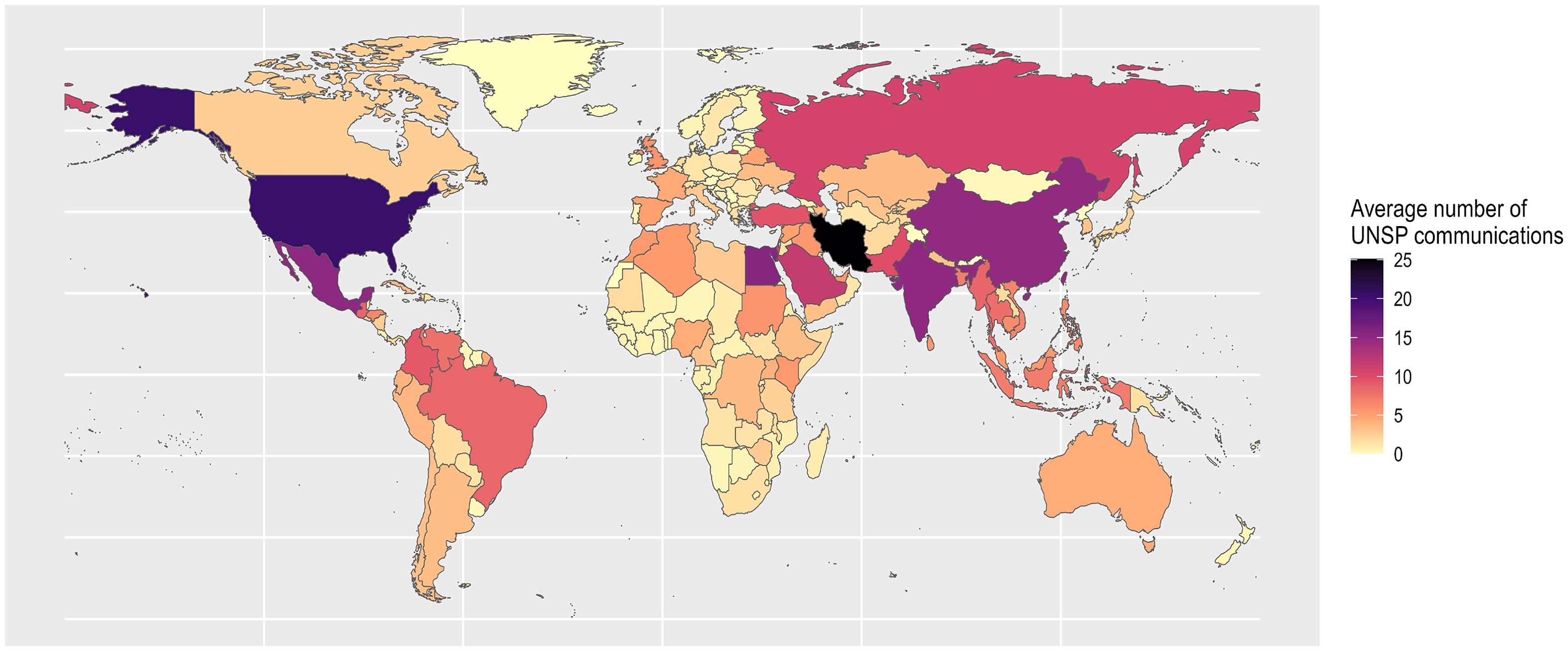
Our key explanatory variable is the number of communications sent by the UNSP to governments in response to human rights complaints for each country and year. We only count UNSP communication that follows up on complaints (‘allegation letters’ and ‘urgent appeals’) and exclude those that raise general concerns about laws (‘other letters’). We also exclude communications that are sent by the UNSP with a country-specific mandate or directed at non-state actors.Footnote 17 Figure 1 shows the average number of UNSP communications across countries for our period of analysis.Footnote 18
Yearly average of the number of UNSP communications from 2010 to 2021.
We use two dependent variables in the cross-national analyses. First, we employ a measure of repression against CSOs from the V-Dem project version 13 (Coppedge et al. Reference Coppedge2023). V-Dem expert coders are asked to indicate whether ‘the government attempts to repress civil society organizations (CSOs)?’ on a scale from 0 (severely) to 4 (not at all). Multiple expert codings are then transformed into a continuous rating using an item response model (Pemstein et al. Reference Pemstein, Marquardt, Tzelgov, Wang, Medzihorsky, Krusell, Miri and von Römer2023). We reverse the scale of this measure so that higher values indicate more repression.Footnote 19
While our theoretical argument has implications for both CSOs and individuals who file complaints, we focus on CSOs for three reasons. First, research shows that repression against CSOs may have potentially long-term detrimental consequences (Chaudhry Reference Chaudhry2022; Heinzel and Koenig-Archibugi Reference Heinzel and Koenig-Archibugi2023; Smidt et al., Reference Smidt, Johansson and Richter2025, Reference Smidt, Perera, Mitchell and Bakke2021). Second, and relatedly, Schoner (Reference Schoner2024) demonstrates that complaints are more effective in improving human rights records if supported by civil society actors. Considering this power of civil society, backlash effects are especially concerning for human rights progress. Third, CSOs are publicly identifiable, and contact information is often available. This allows us to use surveys and media analyses to systematically trace self-reported and media-reported repression against these groups.
For the second outcome variable, we construct a measure of repression of those civil society actors that have collaborated with UN human rights bodies, including the complaints mechanism of the UNSP. We collected original data on reprisals in response to such collaboration. Source data comes from the Annual Reports on Reprisals for Cooperation with the UN published by the UN Secretary-General (UNSG 2023). We hand-coded our reprisal variable as 1 if the government of a country is accused of repressing individuals or organizations for their cooperation with UN human rights bodies in a given year and 0 otherwise (see Appendix C.9 for more details).Footnote 20 While this measure includes reprisals against CSOs and individuals, the vast majority of the individuals mentioned in the UN reports on reprisals are closely associated with CSOs.
Previous research suggests that under-reporting of reprisals may bias cross-country comparisons based on the UN reprisal reports (Spannagel Reference Spannagel2021). However, our models only analyze within-country variation in reprisal. Moreover, under-reporting likely biases our results against our hypotheses. This is because we propose (and find) that UNSP communication triggers repression against CSOs. If repression also leads to under-reporting of reprisals (for example, because repression makes it difficult to obtain testimonies and evidence on reprisals), it will be difficult to find evidence of the expected positive correlation between UNSP communications and reprisals.
Identification strategies
We expect a positive relationship between UNSP communications and our measures of repression. Selection is a potential alternative explanation. If a government becomes more repressive, CSOs may file more complaints, and consequently, the UNSP may issue more communications. Even if such selection is present,Footnote 21 we expect that UNSP communications have an additional independent effect on repression. To identify this hypothesized backlash effect, we estimate dynamic panel models and use instrumental variables regressions.
The dynamic panel models include both country fixed effects and the lagged dependent variable. We instrument the lagged dependent variable with deeper lags of itself to avoid Nickell bias (Arellano and Bond Reference Arellano and Bond1991). Since ordinary least squares estimation produces biased standard errors in dynamic panel models, we use system generalized methods of moments estimation and report robust Windmeijer standard errors.Footnote 22
In the dynamic panel model, fixed effects allow us to isolate the effect of UNSP communications from time-invariant factors, and the lagged dependent variable allows us to isolate this effect from temporal trends in repression. Thus, the model accounts for the fact that an increase in UNSP communications targeting a country’s government might be caused by an increase in repression in that country, while also exerting an independent effect on a future increase in repression in that country.
As a second identification strategy, we instrument the number of UNSP communications in country i and year t with personnel turnover of UNSP mandate-holders (also known as Special Rapporteurs and Independent Experts) who are responsible for screening and acting upon complaints in year t. We additionally include the total number of UNSP human rights experts in year t.Footnote 23 Our instruments are both theoretically and empirically relevant. When UNSP human rights experts have just entered office, they have to familiarize themselves with their dossier and the working procedures at the UNSP. Thus, they process fewer complaints than more experienced experts. Consequently, higher personnel turnover in the UNSP leads to fewer communications. Yet, communications increase if there is a greater overall number of UNSP human rights experts who continue to process complaints.
Table 1 shows the empirical relevance of our instruments in a fixed effects regression with the above-specified time-varying controls. In line with our expectations, a higher number of newly appointed UNSP experts in a given year is negatively correlated with UNSP communications in that year. In contrast, the total number of UNSP experts is positively correlated with UNSP communications. The F-statistic is large (28.285), well above the rule of thumb value of 10, indicating that the instruments are valid. Following Lal et al. (Reference Lal, Lockhart, Xu and Zu2024), we also affirm that the effective F-statistic and the F-statistic adjusted for clustered standard errors meet the threshold and that the coefficient on instrumented UNSP communications remains significant when we use bootstrapped uncertainty estimates.
First stage model
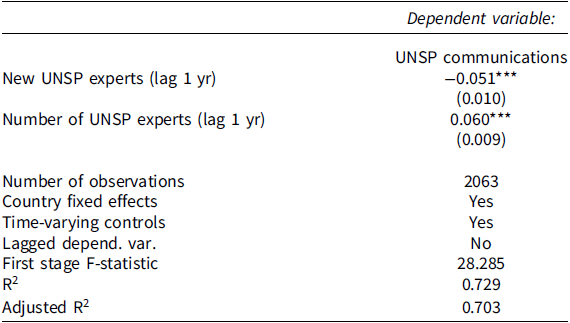
Notes: The models are estimated with ordinary least squares regression. The control variables are education (lag 1 yr), conflict occurrence (lag 1 yr), freedom of media (lag 1 yr), judicial independence (lag 1 yr), logged GDP per capita (lag 1 yr), and UNSP country visits (lag 1 yr). Cluster-robust standard errors are in parentheses. †p < 0.1; *p < 0.05; **p < 0.01; ***p < 0.001.
First stage model
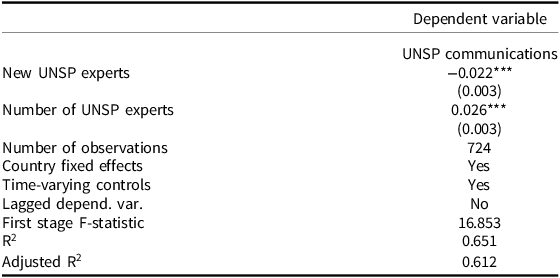
Notes: The models are estimated with ordinary least squares regression. Cluster-robust standard errors are in parentheses. †p < 0.1; *p < 0.05; **p < 0.01; ***p < 0.001.
Our instruments plausibly fulfil the independence and excludability assumptions. The overall number of UNSP human rights experts in a given year depends on the thematic priorities of the UN, path dependencies, and the global human rights situation. As such, it is unlikely that the number changes with human rights outcomes in a particular country. In addition, the appointment of UNSP human rights experts is always for six years and bound to specific thematic mandates with global scope (for example, women’s rights or rights of persons with disabilities). Hence, it is unlikely that turnover at the UNSP in existing positions relates to human rights respect in a particular country (independence). Moreover, UNSP human rights experts work on the human rights situation of multiple countries at the same time. Therefore, we think it is unlikely that their overall number relates to human rights outcomes in particular countries through mechanisms other than their country-specific activities (excludability).
The only possible violation of this excludability assumption that we can think of is other activities of UNSP mandate-holders that are likewise affected by personnel turnover. According to the Manual of Operation of the UNSP, communications and country visits are the two primary activities of UNSP mandate-holders (UNSP 2008). Thus, we collected data on these visits provided by the OHCHR (2024b) and include country visits by UNSP mandate-holders as a control variable in our models.
Cross-country results
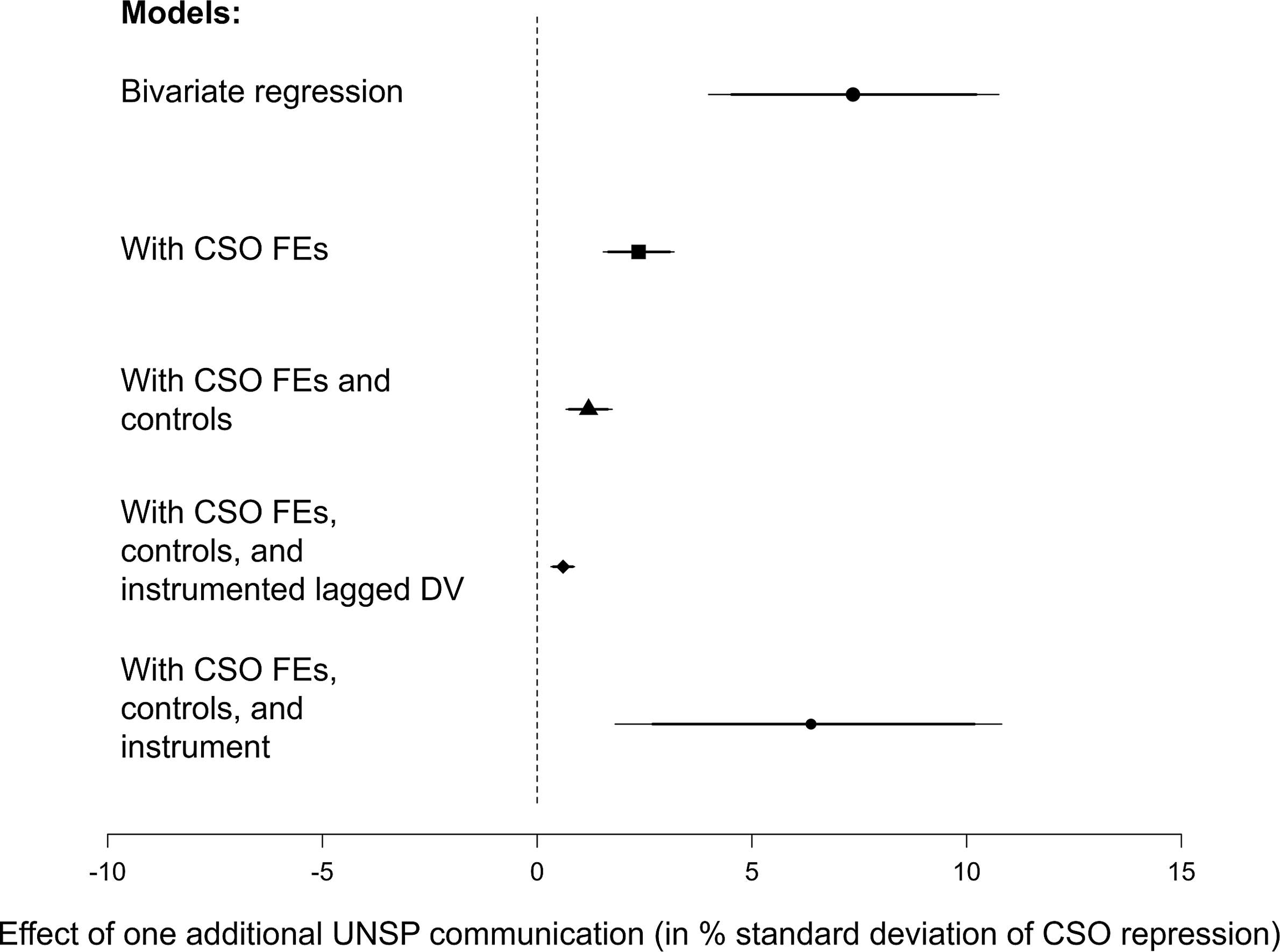
Figure 2 shows the marginal effect of one additional UNSP communication as a percentage of the standard deviation of CSO repression for five model specifications (see Appendix C.2 Table A.4 for full results). While Model 1 shows the simple bivariate correlation, Model 2 adds country fixed effects and Model 3 further controls for the time-varying confounders, that is, logged GDP per capita, educational equality, high court independence, media censorship, and armed conflicts, all lagged by one year.Footnote 24 Model 4 further adds the lagged dependent variable (instrumented with deeper lags), and Model 5 presents the instrumental variables regression, where we instrument UNSP communications with personnel turnover at the UNSP. Across all five model specifications, the effect coefficient on UNSP communications is positive and statistically significant (with at least p < 0.05). Based on the instrumental variables regression, our preferred specification, one additional UNSP communication increases CSO repression by 6.5 per cent of its standard deviation, all else equal. This effect is roughly six times larger than the average change in CSO repression produced by the onset of armed conflict (that is, a change in 1.1 per cent of the standard deviation of CSO repression).
Marginal effect of UNSP communications on CSO repression using 95%-confidence intervals (thin bars) and 90%-Confidence intervals (thick bars).
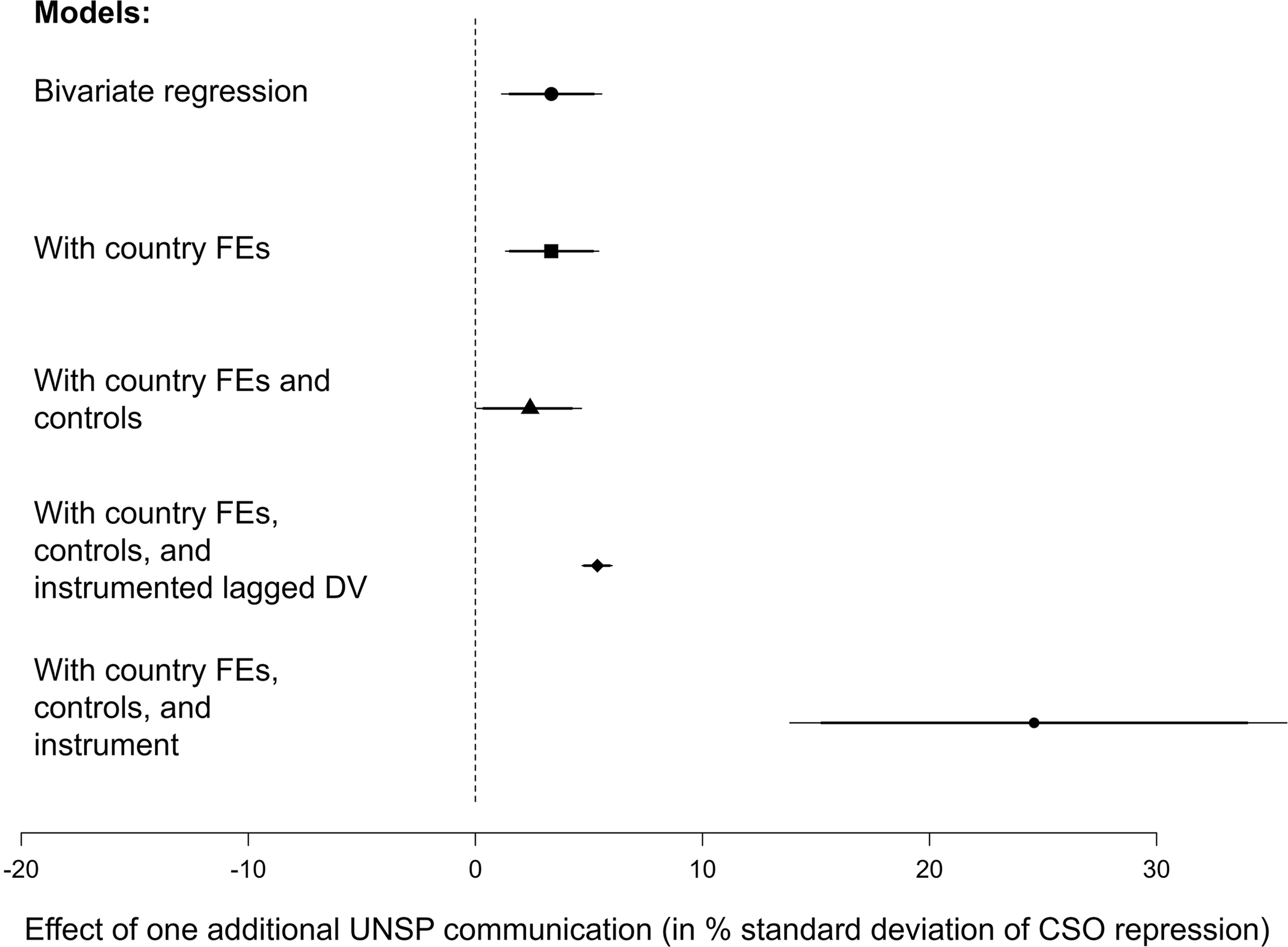
Turning to the second outcome, Figure 3 illustrates the marginal effects of one additional UNSP communication on the change in the reprisal variable expressed as a percentage of its standard deviation (see Appendix C.2 Table A.4 for full results).Footnote 25 Across the five model specifications (which are the same as above), the coefficient on UNSP communications is positive and statistically significant (with at least p<0.05). Based on the instrumental variables regression model, one additional communication leads to an increase of the reprisal measure by 24.3 per cent of its standard deviation, all else equal. This effect is roughly four times larger than the average effect of the onset of armed conflict (which increases the reprisal measure by 6.0 per cent of its standard deviation).
Marginal effect of UNSP communications on reprisals using 95%-confidence intervals (thin bars) and 90%-Confidence intervals (thick bars).
Several robustness tests strengthen our confidence in the results. First, our findings replicate with a dichotomous measure of UNSP communications (see Appendix C.4). Second, our results become even stronger when we subset to UNSP communications focused on physical integrity rights abuses (see Appendix C.5). This finding aligns with Terman and Byun (Reference Terman and Byun2022) who argue that governments are more sensitive to shaming of some human rights abuses like physical integrity rights violations (for example, torture and extrajudicial killing) compared to others.
Third, we leverage the fact that the UNSP differentiate between two types of communications: ‘allegation letters’ and ‘urgent appeals’. Allegation letters focus on violations that have already occurred, whereas urgent appeals are emergency tools to prevent imminent violations (ISHR Academy 2024). We show that the positive effect of UNSP communications on measures of repression against complainants is not driven by urgent appeals. Put differently, the finding holds when we subset communications to allegation letters only (see Appendix C.6). Fourth, our results remain virtually identical if we rerun the analysis only with communications that are not signed by the Special Rapporteur on Human Rights Defenders and, thus, do not follow up on alleged government-perpetrated abuse against human rights defenders. This result speaks against endogeneity concerns, that is, that UNSP communications do not cause reprisal but just follow on an ongoing trend of worsening repression (see Appendix C.7). Finally, we explored potential heterogeneous effects across regime type. The evidence presented in Appendix C.8 shows that UNSP communications can provoke a repressive backlash in both autocratic and democratic contexts.
Study 2: CSO survey
Next, we examine Hypothesis 2 that focuses on targeted repression against those CSOs that initiated international shaming through filing human rights complaints to the UNSP. We randomly selected fifteen countries targeted by more than forty (third quartile) UNSP communications (Algeria, Bahrain, Belarus, Brazil, Kenya, India, Malaysia, Mexico, Morocco, Nigeria, the Philippines, Spain, Sri Lanka, Turkey, and Uganda). This selection provides a hard test for our theory. Our interviews with UNSP staff members revealed that the risk of reprisals is an important factor in the decision to send UNSP communications to governments. Considering this strategic decision, we would expect that the reprisal risk is lower in countries that receive many communications, which makes it more difficult to find support for our hypothesis.
We identified all CSOs mentioned in the UNSP communications sent to the governments of the selected fifteen countries in the 2010–2022 period. We searched for the contact details of these CSOs and individually contacted them both via email (one invitation email and two reminders) and phone, inviting their staff (either with the heads of the organization or a member in a leading position) to participate in our survey. Some CSOs mentioned in UNSP communications no longer existed at the time of our survey. As repression might have led to the liquidation of those CSOs, this selection issue may lead us to under-estimate repression. The survey was conducted in five different languages (English, French, Spanish, Portuguese, and Arabic).Footnote 26 To limit self-selection related to repression, we worded the survey invitation broadly to prevent CSO representatives from inferring our research focus.
From a population of 485 CSOs mentioned in the UNSP communications, 66 CSOs from 15 countries participated in our survey. Thus, the response rate is roughly 13.6 per cent.Footnote 27 Information drawn from the CSOs’ websites or Facebook pages (for example, their issue focus, professional outreach, or longevity) does not reveal any systematic differences between the sample and the population. Moreover, our model specifications include CSO fixed effects, isolating variation in repression faced by a given CSO over time. This modelling strategy mitigates concerns that a positive correlation between UNSP shaming and targeted repression is driven by the selection of specific CSOs into the sample.
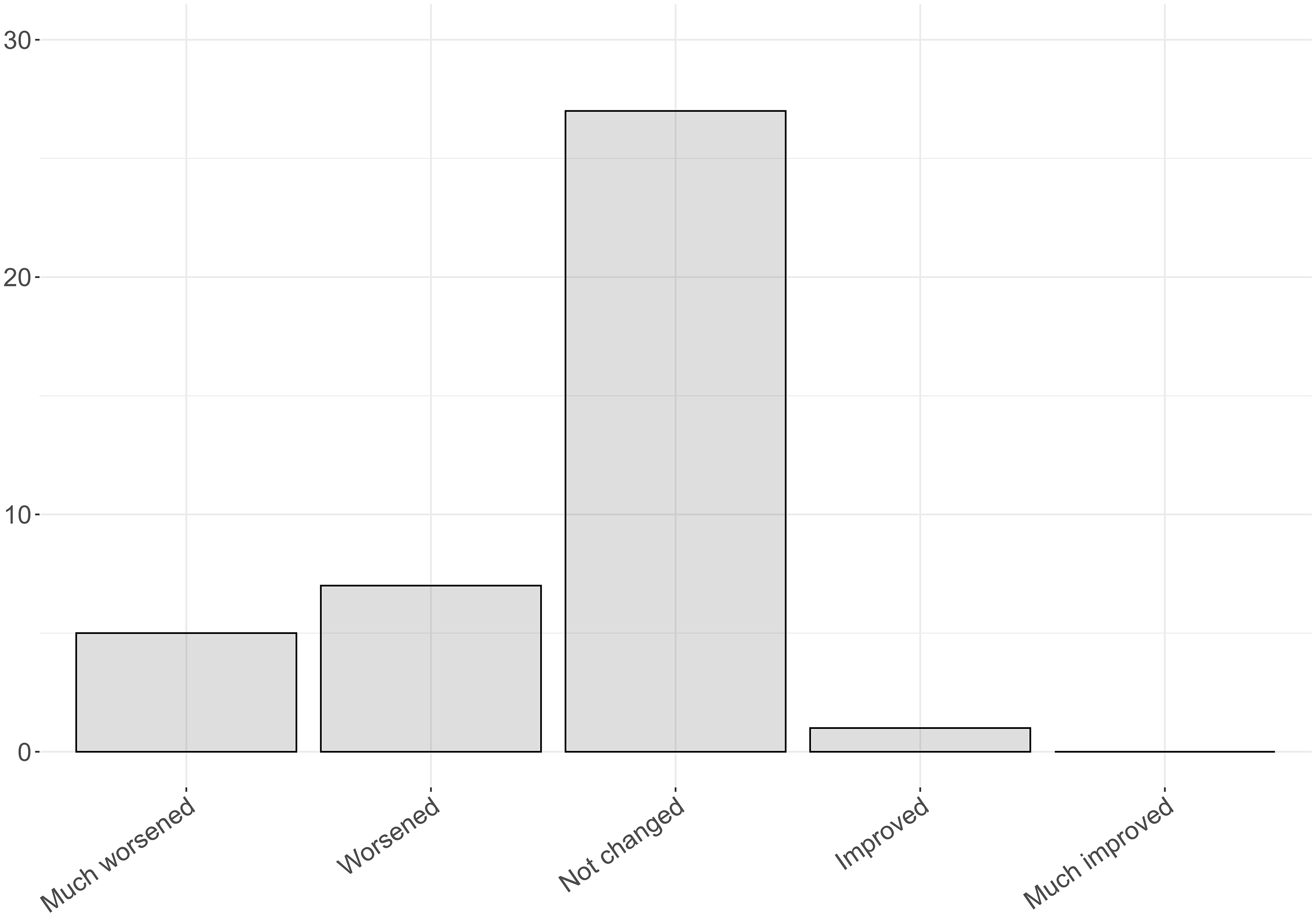
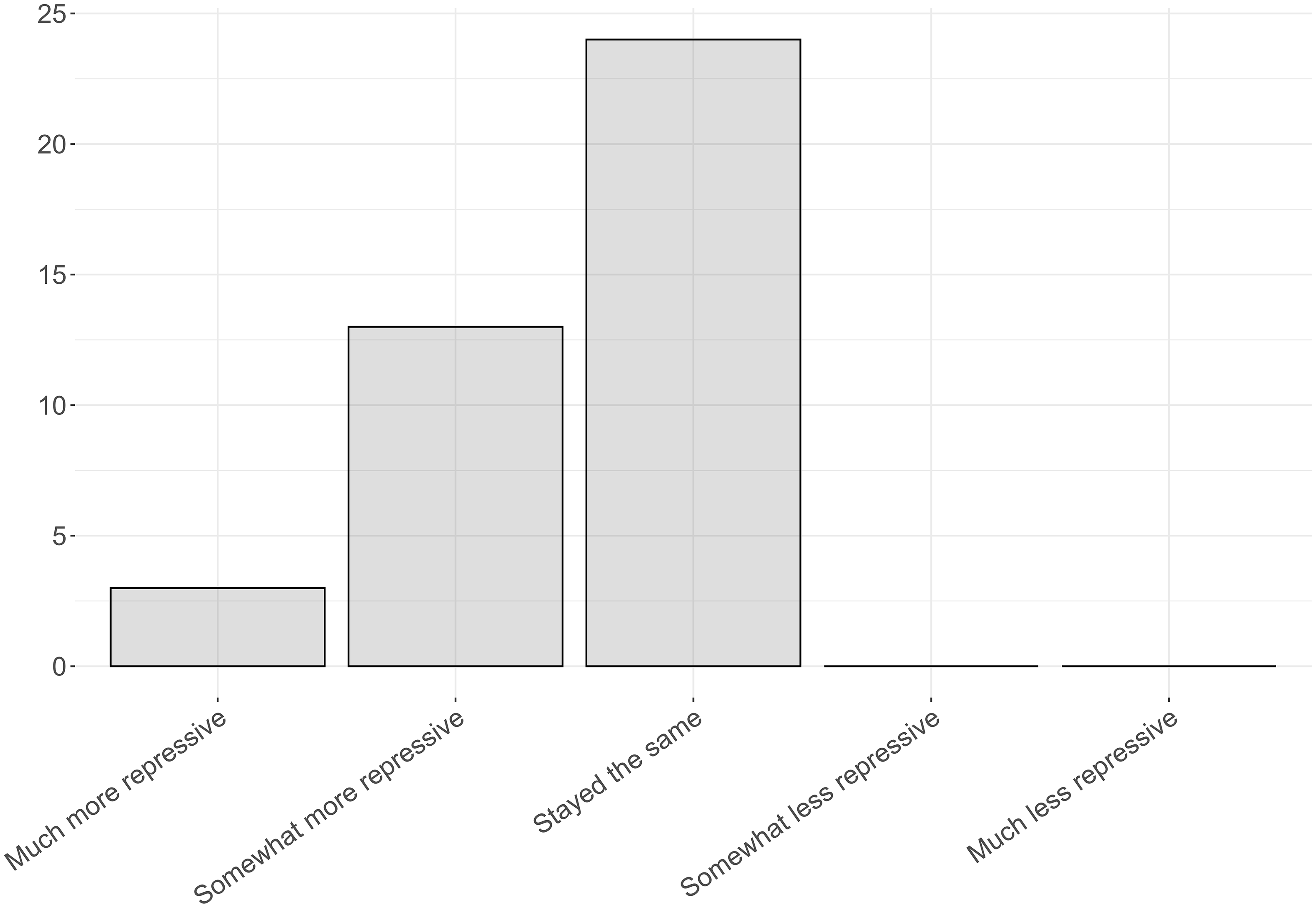
In the survey, we asked CSO representatives directly whether the relationship between their organization and the government had changed as a result of filing a complaint with the UNSP. As shown in Figure 4, a significant number of CSOs reported a deterioration in their relationship with the government, while only very few reported an improvement. Further, we asked CSOs whether the behaviour of the government towards society changed after they filed the complaint.Footnote 28 Figure 5 shows that several CSOs reported that the government became ‘somewhat more repressive’ after their complaint with the UNSP, whereas none reported that it became less repressive.
Reported change in CSO-government relations after complaints to the UNSP.
Reported change in government behavior towards CSOs after complaints to the UNSP.
Importantly, we also asked CSO representatives to rate their relationship with the government in each year since the establishment of the complaints mechanism of the UNSP (the full questionnaire is shown in Appendix D). For our statistical models, we use these yearly ratings of CSO-government relations as an outcome variable. This rating is recorded on a five-point Likert scale ranging from very negative to very positive.Footnote 29 We decided to ask CSO representatives about relations with the government rather than state repression because of social desirability concerns. CSO representatives operating in repressive contexts may be reluctant to directly accuse their governments of repression, while reporting deteriorating relations with the government leaves more room for interpretation and could therefore be considered less sensitive.
Our explanatory variable is an indicator for whether a given CSO has been the subject of complaint-based shaming by the UNSP. The binary variable is coded as 1 for the first year in which a given CSO was mentioned in a UNSP communication and for all subsequent years, and 0 for the years in which a given CSO was not yet mentioned in a UNSP communication. We also include the count of years after the publication of a UNSP communication mentioning a given CSO. The count is coded as 0 for those years before a given CSO was named the first time in a UNSP communication.
Marginal effect of UNSP communications on relations with the government using 95%-confidence intervals (thin bars) and 90%-Confidence intervals (thick bars).
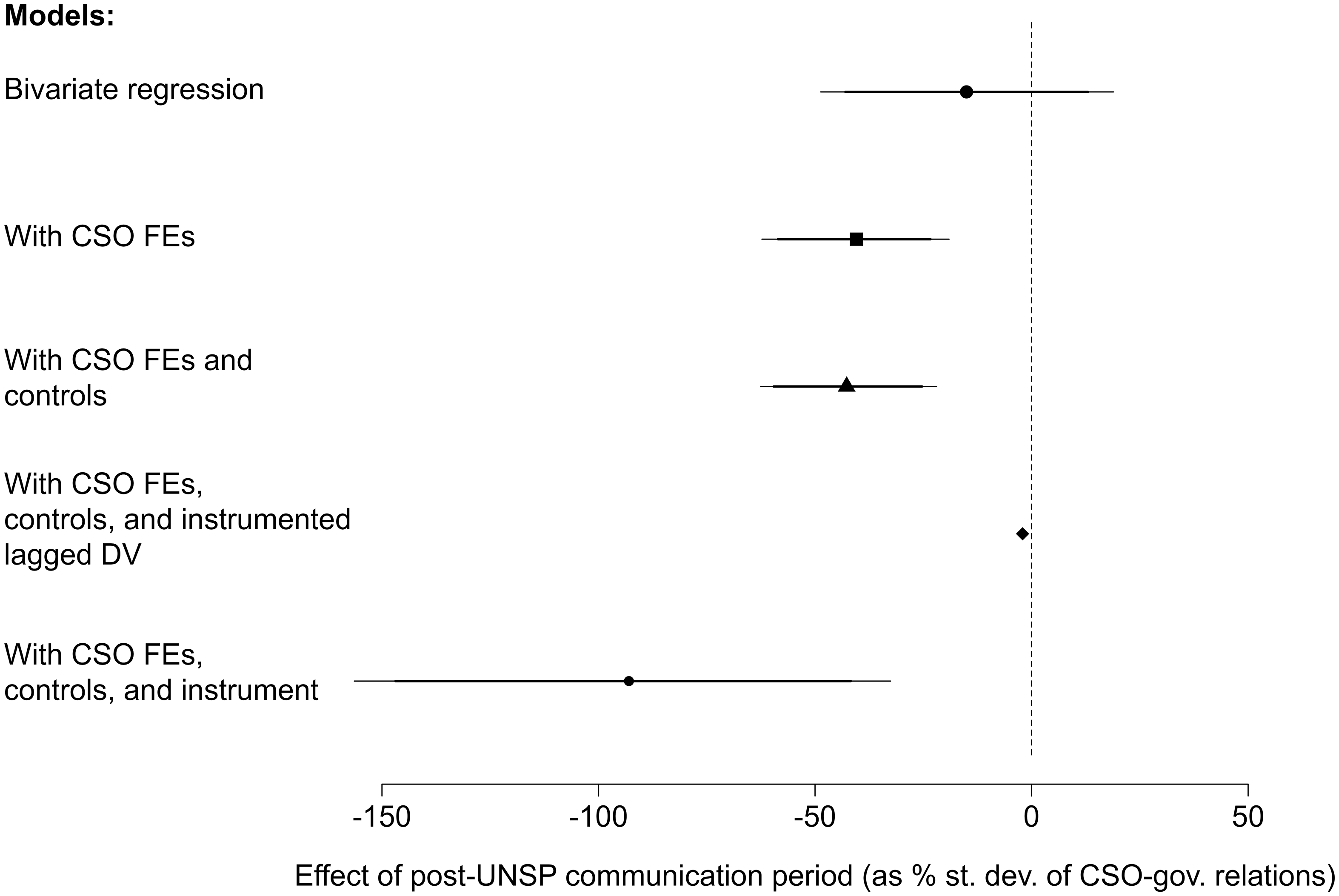
We use the same models as in the cross-country analysis, including the instrumental variable specification. The first stage for the CSO-level analysis is presented in Table 2. The number of new experts in a given year correlates negatively with the likelihood of a UNSP communication mentioning a CSO in a given country and year. In contrast, the total number of UNSP experts in a given year correlates positively with the likelihood of a UNSP communication mentioning a CSO in a given country and year. The F-statistic is above the rule of thumb value of 10 (16.853), indicating that the instrument is relevant. Additional tests using bootstrapped uncertainty estimates confirm the validity of the instruments (Lal et al. Reference Lal, Lockhart, Xu and Zu2024).
Results of CSO-level analysis
Figure 6 shows the marginal effect of the post-UNSP communication period on the quality of CSO-government relations as a percentage of its standard deviation (see Appendix D.1 for full results). The coefficient of the ‘post-communication’ variable – that is, the indicator for the period after a CSO was mentioned in a UNSP communication – is negative across all models. In the bivariate regression, and when we include both CSO fixed effects and the lagged dependent variable, the coefficient fails to reach conventional levels of significance. However, in our preferred specification, the instrumental variables regression, the negative coefficient on the instrumented ‘post-communication’ variable is statistically significant at p < 0.05.
Our instrumental variables regression thus suggests that after a given CSO has been mentioned in a UNSP communication, the self-reported quality of its relationship with the government decreases by roughly 95 per cent of the standard deviation of this outcome measure, all else equal. As expected, this effect is larger than in the cross-national analyses that focus on country-wide repression against all CSOs. In fact, the deterioration of CSO-government relations following a UNSP communication is more than nine times as large as the deterioration of CSO-government relations that would be expected following the onset of armed conflict (which would amount to a deterioration in the quality of CSO-government relations by 10.5 per cent of its standard deviation).
In our analysis above, we examine within-CSO variation across time in CSO-government relations using the survey item that asks CSO representatives to rate their relationship with the government in different years retrospectively. Therefore, recall bias could be a concern in this analysis. In Appendix D.3 in Table A.20, we show that the results also hold when we compare between-CSO variation in reported relations with the government for the most recent year (that is, 2022). Specifically, CSOs rate their relations with the government more positively the more time has passed since they were first mentioned in UNSP communications, providing further support for our argument.
As another robustness test, we subset our sample of analysis to those CSOs that indicated in our survey that they have filed a complaint to the UNSP (60.6 per cent). We exclude CSOs whose representatives said that they had not filed a complaint (28.8 per cent) and CSOs whose representatives preferred not to answer or did not know (10.6 per cent). Appendix D.2 shows that our results remain substantively the same in the sub-sample.
Study 3: Media analysis
We complement the survey-based analysis of self-reported repression with original data on media-reported repression targeting CSOs that have filed complaints to the UNSP. For this analysis, we use the full population of Indian CSOs mentioned in UNSP communications in the 2010-2022 period (N=70).Footnote 30 The Indian government has increasingly cracked down on CSOs during our observation period. Since the 2014 elections, it has stripped many NGOs of external funding under the Foreign Contribution Regulation Act (Sirur Reference Sirur2024) and targeted civil society in the context of electoral violence (Daxecker Reference Daxecker2020; Daxecker and Fjelde Reference Daxecker and Fjelde2022). As such, it is important to understand whether and how international shaming in the form of UNSP communications contributed to this repressive trend. Importantly, however, the country-wide trend in mounting repression itself cannot explain why the targeting of specific CSOs might be related to the timing of their appearance in UNSP communications.
We draw on evidence from a systematic media analysis of relevant newspaper articles conducted through Lexis-Uni. Specifically, we individually searched for the names of each CSO in each year of the period of analysis and manually recorded whether a media report mentioned events of repression against these CSOs.Footnote 31 For instance, we code that the Narmada Bachao Andolan was subject to repression in 2017 based on the following news reports: ‘Narmada Bachao Andolan (NBA) activist Medha Patkar and five other associates […] were forcibly taken into custody at around 6.40 pm on Monday’ (Free Press Journal, August 8, 2017). We created a binary variable coded as 1 if there was at least one event of media-reported state repression targeting a given CSO on an annual basis.Footnote 32 The model specifications align with the empirical models described above. However, since the data only includes CSOs in India, we cannot run the instrumental variables regression.
Media data may suffer from reporting bias. In fact, the media may become more likely to report on the repression of specific CSOs after UNSP communications drew attention to their plight. Our previous survey-based analysis reduces concerns that such biases drive our results in favour of Hypothesis 2. In turn, our media-based data complements the survey analysis in two ways. First, it includes the full population of CSOs that have been mentioned by UNSP communications targeting India, while the survey includes CSOs (from many countries) that voluntarily participated. Thus, the media analysis mitigates concerns that unequal sample selection probabilities of CSOs drive the results. Second, media sources describe repression from an external (that is, journalistic) perspective, while surveys capture self-reported repression experiences. Even though it is unclear why CSOs should exaggerate repression, especially after they have been mentioned by a UNSP communication, the media analysis mitigates such concerns.
Results of the media analysis
Figure 7 illustrates the average marginal change in the risk of repression after Indian CSOs have been mentioned in UNSP communications (see Appendix E.3 Table A.22 for full results). We find that this marginal change is positive and statistically significant at p < 0.001 across model specifications. Specifically, the positive effect of a CSO being mentioned in UNSP communications on repression targeting that CSO holds in a bivariate model, a model with CSO fixed effects, a model including both CSO-specific and time-varying country-level controls, and a lagged dependent variable model. Regarding the time-varying controls, we account for whether a CSO focuses primarily on human rights, maintains an English website, and appears on Facebook and X. We consider those variables as useful proxies for the international salience of a CSO, which may influence both attention by the UNSP and risks of state repression (for example, Esberg Reference Esberg2021). Using data from V-Dem (Coppedge et al. Reference Coppedge2023), we also control for the time-varying countrywide level of journalist harassment in India to account for biases in media reporting on repression.
Marginal effect of UNSP communication on media-reported CSO repression using 95%-confidence intervals (thin bars) and 90%-Confidence intervals (thick bars).
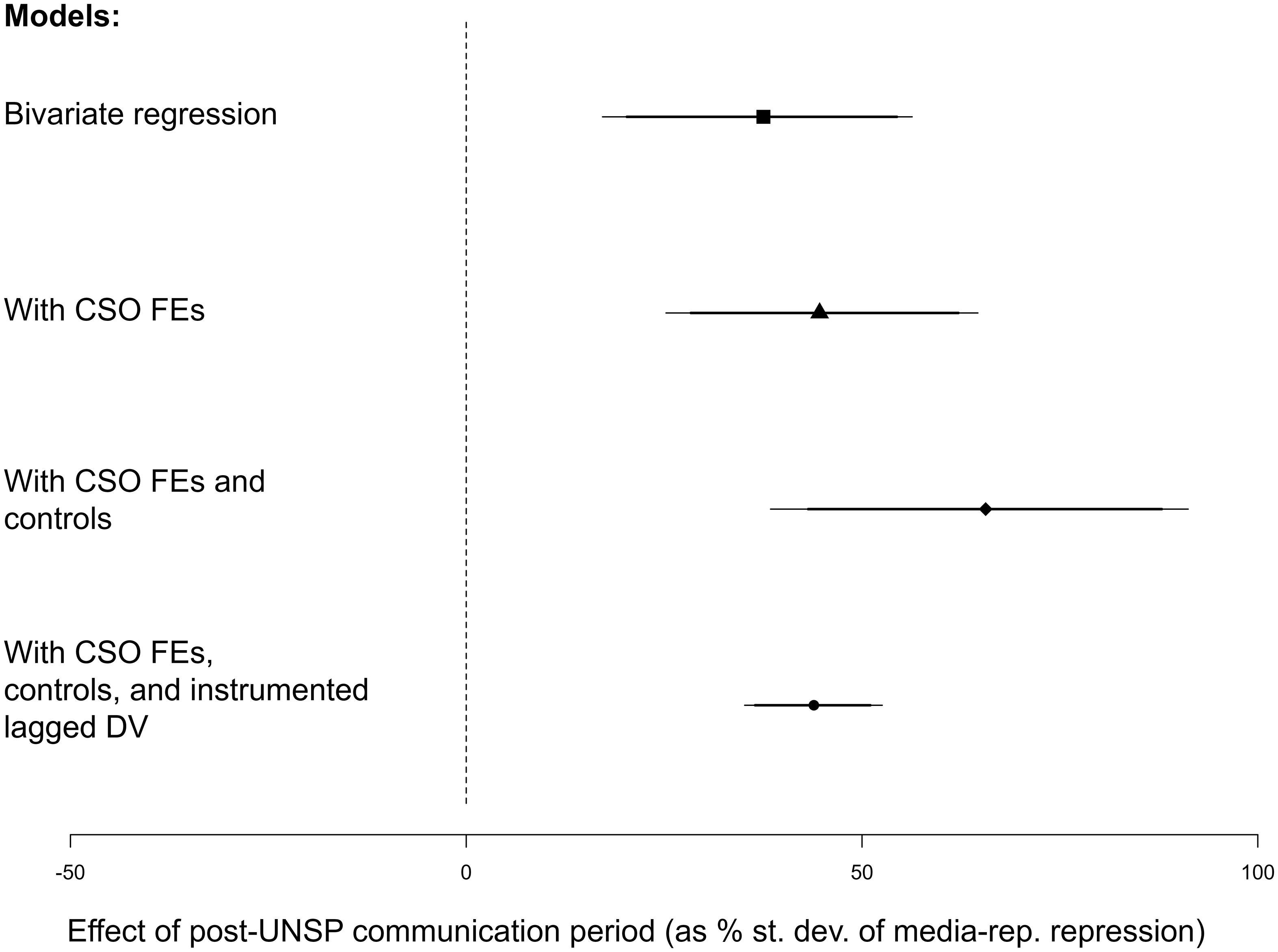
Based on the lagged dependent variable model, which is the most demanding model specification, being mentioned in a UNSP communication increases the risk of repression against CSOs by about 47 per cent of its standard deviation.Footnote 33 This effect is more than twice as large as the expected increase in repression when a CSO works on human rights issues rather than presumably less sensitive issues (which increases the risk of repression by about 23 percentage points of its standard deviation).Footnote 34
We do not believe that these results are an artefact of reverse causality, that is, that CSOs are mentioned in a UNSP communication when the risk of future repression is high. If anything, anticipated repression likely deters CSOs from participating in the UNSP complaints mechanism and the UNSP from issuing communications. However, to further exclude concerns of reverse causality, we show that our findings are not driven by those cases (N=27) in which repressive events against CSOs occurred in the same year when CSOs were mentioned in UNSP communications. Specifically, we re-run the media analysis at a monthly level for all CSOs that were targets of state repression in the same year that they were mentioned in UNSP communications (see Appendix E.4). Like in the annual media analysis, we systematically studied all media reports on Lexis-Uni that mentioned the name of a given CSO but this time we coded repressive events per month. Our monthly analyses reproduce the main findings. The coefficient on the ‘post-communication’ variable is consistently positive and statistically significant. In other words, CSOs are more likely to be targeted in the months after their names appeared in UNSP communications.
Conclusions
This study set out to investigate how shaming based on complaints to international organizations influences the level of respect for the human rights of civil society actors that use these complaint mechanisms. Empirical evidence from the human rights complaints mechanisms of the UNSP suggests that shaming upon complaints is associated with increasing repression of CSOs and a surge of state reprisals against civil society actors that cooperate with UN human rights bodies. Additional analyses show that this repressive backlash occurs in both autocracies and democracies. The evidence further highlights that governments specifically target those CSOs that are directly involved in submitting complaints. CSOs report deteriorating relations with governments and are more likely to be the subject of media reports of state repression after their names appear in UNSP communications. Overall, the evidence suggests that complaints to the UNSP are linked to a substantial risk of state reprisals in a variety of political contexts.
The findings contribute to three important debates in the literature. First, a growing body of research on complaint mechanisms demonstrates their positive human rights consequences for society as a whole (Hu and Conrad Reference Hu and Conrad2020; Lueders Reference Lueders2022; Schoner Reference Schoner2024; Ullmann and Von Staden Reference Ullmann and Von Staden2024). Our findings add important nuance. While we do not contest that UNSP communications may lead governments to reduce aggregate levels of abuse (Schoner Reference Schoner2024) and provide remedies to victims (Ullmann and Von Staden Reference Ullmann and Von Staden2024), our findings suggest that UNSP communications can also incentivize governments to silence CSOs that act on behalf of victimized parts of society. In so doing, governments might seek to weaken complaint mechanisms in the long run. Interestingly, however, the number of UNSP communications increases over time in most states, suggesting that governments may not succeed in their endeavour. Nevertheless, it is possible that targeted repression reduces the likelihood that the targeted CSOs will file complaints. Future research could analyze the impact of state repression on complaint propensities both across states and across CSOs.
Second, and more broadly, we contribute to research on growing civil society participation at international organizations. Human rights scholars largely emphasize how international access empowers CSOs (Keck and Sikkink Reference Keck and Sikkink1998), while the literature on global governance focuses on the consequences of civil society participation for international organizations themselves (for example, Scholte Reference Scholte2011; Tallberg et al. Reference Tallberg, Sommerer and Squatrito2013). Our findings show that governments do not stand idly by but try to regain control and punish CSOs for their participation in complaint mechanisms of international organizations.
Third, our findings contribute to research on the unintended adverse outcomes associated with international shaming (for example, DeMeritt and Conrad Reference DeMeritt and Conrad2019; Snyder Reference Snyder2020; Terman Reference Terman2023). At the heart of the backlash effect identified in this study lies the inclusive and personalized nature of complaint-based shaming by the UNSP. We think that it is not the possibility of filing complaints as such that is detrimental to the rights of CSOs, but the way in which the personalized information from these complaints is used and publicized by the UNSP in open letters to governments. Such personalized shaming makes individual challengers visible to governments and reveals their determination to garner international support. In the absence of international safeguards, governments tend to retaliate against CSOs that are involved in complaints in order to silence their opposition and deter future complaints. Important policy implications can be drawn from this study. If civil society’s human rights defenders rightly fear negative repercussions for their participation in international organizations working on human rights, this threatens the core mission of these organizations. Against this backdrop, it is essential that the UN and other international organizations make every effort to address and minimize the risk of state reprisals in response to citizens’ interactions with their mechanisms and agencies. At a general level, this means that the UN and other international organizations should strengthen their instruments against intimidation and state reprisals, such as the treaty bodies’ San José Guidelines (OHCHR 2024c). The UN and other international organizations need greater capacity to monitor the fate of CSOs after their cooperation with them, ideally, through the establishment of measures along the lines of national witness programs (Geneva Academy 2013). While the UNSP operate a so-called Coordination Committee as a focal point on reprisals, the findings of this study suggest that it lacks the resources to monitor, let alone prevent, reprisals.
In the specific context of human rights complaints mechanisms, the evidence raises concerns about the personalized nature of complaint-based shaming. At present, complaints to the UNSP ‘by default include the name(s) of the alleged victim(s)’, while experts may ‘exceptionally decide to withhold the victims’ names from the communication’ (OHCHR 2024d). In light of the findings of this study, we think that the standard practice should be to withhold victims’ names from UNSP communications and to allow anonymous complaints from the outset. However, while anonymized communications may provide an effective safeguard against reprisals, they preclude the possibility of targeted remedies for those who file complaints. This implies a profound trade-off: international organizations can either demand targeted remedies for the individuals or CSOs that report human rights abuses, or seek to protect complainants from reprisals by keeping their identities anonymous. However, given the incentives of governments to repress mobilized challengers, it is difficult to realize both objectives at the same time.
Supplementary material
Supplementary material for this article can be found at https://doi.org/10.1017/S0007123425000249.
Data availability statement
Replication data for this paper can be found at the Dataverse of the British Journal of Political Science https://doi.org/10.7910/DVN/6ABQ0H.
Acknowledgements
We would like to thank Noémie Buergi for her excellent research assistance. We would also like to thank to Tina Freyburg, Stefanie Walter, and Simon Hug for their valuable comments on earlier versions of our manuscript as well as the participants of the International Affairs panel at the Swiss Political Science Association Conference 2024, the participants in the staff seminar for International Affairs at the University of Geneva, the participants of the publication seminar the University of Zurich, the participants of the Global Governance Talk Series at the Graduate Institute of Geneva, and the staff of the Ludwig Boltzmann Institute for Human Rights. We also want to thank the staff members of the OHCHR in Geneva who provided important insights into the UNSP complaints mechanism.
Financial support
This work was supported by the International Postdoctoral Fellowship of the University of St. Gallen and by the SNF Postdoctoral Fellowship (grant number: TMPFP1_217181).
Competing interest declaration
None [to disclose].
Christoph Valentin Steinert is a postdoctoral research fellow at the University of Zurich. He leads a research project funded by the Swiss National Science Foundation on the human rights complaints mechanisms of the United Nations. He holds a PhD degree from the University of Mannheim, and an MPhil degree from the University of Oxford.
Hannah Marietta Smidt is an Assistant Professor of Political Science at the University of St. Gallen. Her research interests include human rights, international organization, and restrictions targeting civil society organizations. She holds a PhD degree from University College London.


 Open access

