




Introduction
This article concerns the once-unified indigenous northeast Asian group now known as the Hezhe (赫哲族) in China and the Nanai (Nanaitsy) in Russia, specifically the distinctly material nature of their incorporation into their respective states over the past two centuries. Today Nanai number around 12,000 on the Russian side of the Amur river border (Goskomstat 2010: 15) and around 5,400 Hezhe live in China (Guowuyuan 2010). I wish to argue here that their experiences of separation, and limited re-engagement in the postsocialist era, are grounds for a new, materially rooted understanding of successive Chinese and Russian states in the region. Academically, the two polities studied in cross-border fashion often lie in distinct regional siloes (East Asian/Slavonic studies). But as vast Asian land empires, I shall suggest, the pair in fact have much in common when seen from the vantage point of the Amur river, and the (non-)porosity of the border between them can be understood in terms that are distinct from their status as very different ‘civilizations’. As far as Nanai/Hezhe are concerned,Footnote 1 the presence and power of both have, to a large extent, been constituted by the usages and flows of material things in very similar ways. This has been the case for a long period of time and remains so in the present, and so this article also offers an argument in favour of considering long-term continuities within and between two countries whose histories have often been examined in terms of rupture and revolution—for example, the ‘century of perestroikas’ coined from the Russian Far East by Bruce Grant (Reference Grant1995).
My principal argument here is for the analytical usefulness of the idea of ‘politico-material regimes’. This term seeks to draw attention to the state-level political role played by the circulation and disposition of material objects in Nanai/Hezhe worlds over time. Seen through a politico-material lens, the operation of macro-level conceits such as ‘China’ or ‘Russia’ as states or ‘economies’ (cf. Hann and Hart Reference Hann and Hart2011: 4–7) can be discerned on an intimate day-to-day level. Further specificities regarding this idea and its relationship with cognate concepts will be fleshed out in greater detail below, but my overall intention—including in the elaborated ethnographic section of the article which follows—is to invite us to look more closely at the points of physical engagement between people and the material world that make up the wider states and economies of which they are part. By doing so, I shall argue, we stand a better chance of understanding both Nanai/Hezhe lives and the large, powerful states in which they find themselves.
Written to anthropological purposes but historical in scope, and using present-day ethnography as a window into deeper pasts, much of this article draws from Chinese and Russian/Soviet scholarship on a group that has not been widely discussed in English, particularly from a cross-border perspective.Footnote 2 Consistent application of a materially focused lens on these sources is not intended to elide all differences in approaches to materiality over time and across borders. As will be explored later, successive regimes into which the Nanai/Hezhe have been incorporated—from imperial through to the socialist and postsocialist eras—have had various attitudes to material things that have also interfaced with indigenous materialities among Nanai/Hezhe themselves. Yet, however various these approaches, they have also been layered on top of one another as each political entity—from empires to socialist republics, and so on—has succeeded the last. This circumstance—together with the persistently political nature of materiality throughout—may in itself offer new grounds for interpreting not only Russian and Chinese statehood, but also how entities broadly labelled ‘Russia’ or ‘China’ have continued to exist here over time. However, before explaining these strands of argument in detail, and so as to provide contemporary ethnographic grounding for the article as a whole, I begin with a pair of descriptions of the quite different material worlds inhabited respectively by the Hezhe and Nanai today.
Tongjiang, Jiejinkou, and the Bi family
One recent winter's day I travelled on a smartly repaved road along the river Amur's southern bank from Tongjiang to Jiejinkou (see Figure 1). Tongjiang's Chinese name, meaning ‘joining rivers’, refers to its location at the confluence of the great Sungari and Amur waterways. The basins and banks of these two rivers, and of the Ussuri, form the historic range of Nanai/Hezhe residence. Correspondingly, Tongjiang also has an alternative appellation, ‘Lahasusu’, meaning ‘old home’ in Hezhe/Manchu (Lü 1994), and indeed this has long been recorded as a place where Hezhe fishermen engaged in the activity that once sustained the seasonally semi-nomadic group. Proportionally, today Tongjiang (population 210,000) has only a tiny minority of Hezhe residents: around 1,500 live in the entire municipality, which includes Jiejinkou (Tongjiang.gov.cn 2018). But the city's riverside park is home to a Hezhe Museum and along the Sungari promenade, stone reliefs depict idyllic scenes of happily folkloric Hezhe life, focused on hunting, fishing, and dwelling in forest camps. These contrast with a more solemn nearby memorial to the ‘educated youths’ (知青) who were ‘sent down’ to the area from distant Hangzhou during a late-1960s Maoist campaign.
Map of the Nanai/Hezhe region. Source: Map by author.

With its grid-lined streets named after socialist totems such as ‘construction’ (建设), ‘new people’ (新民), and ‘friendship’ (友谊); its six-storey apartment buildings; and two large shopping malls with Russian signage, Tongjiang today differs little from other northeastern Chinese towns of comparable size. Restaurants advertise food from across China, and even in winter, when temperatures plunge to –25°C, Han vendors stand outside in thick, padded, floor-length coats selling sugared fruit on sticks and traditional cures in small glass vials. Local fishermen and vendors of tackle, nets, and other supplies are also Han,Footnote 3 and like the museum and murals, evidence of a Hezhe presence is limited to specific spaces along the riverbank.
By contrast, Jiejinkou (see Figure 2)—Gaijin in Hezhe—is a tourist destination whose physical forms are suffused with imagery advertising its status as a ‘Hezhe ethnic village’ (赫哲族乡), an official title it bears on maps and signs. Here Hezhe form a larger proportion of the population, numbering 537 out of 3,894 in 2012 (Huang 2012: 197). But those running the village's hospitality industry are mostly Han, as are the migrant salespeople who line its main street proffering household items, winter socks, gloves, and hats. These vendors are the first people one encounters on entering Jiejinkou via a bridge over the narrow Penghua river which feeds into the Amur. The single main street, Wurigong Avenue, runs parallel to the river and is flanked by buildings clad in wooden boards, many of them decorated with colourful murals to appeal to tourists. Straight, well-ordered lanes of single-storey yellow homes branch off at right angles, leading down to a waterside promenade on one side, and gently sloping upwards away from the river on the other.
Fishermen, Jiejinkou. Source: Photo by author.

Yet, if on the surface Tongjiang and Jiejinkou seem respectively ‘Chinese’ and ‘Hezhe’, it is significant for my argument here that the latter is Hezhe in a distinctly material Chinese way. This will be explained further below.
Bi AnmeiFootnote 4 and her family live outside Jiejinkou's small central stretch, a little beyond the village's only petrol station and the local offices of the China State Grid, the national electricity supplier. After entering her house through a small, neat front yard enclosed by a low wall, Ms Bi and I sit on her kang (炕)Footnote 5 which is covered by a blue plastic tablecloth decorated with pink roses. Under the window is a wooden table with an old Chinese-made sewing machine, and arranged behind the kang are tall built-in cupboards in which Ms Bi keeps needles, reels of thread, scissors, a ruler, and sheets of dried fish skin from which she makes articles of clothing. Completed and half-made pieces, including matching trousers and jackets, are stored in a freestanding wardrobe next to the sewing machine. Several Hezhe in Jiejinkou and Tongjiang, mostly women over the age of 50, make these traditional fish skin outfits which are sold to museums for 6,000–10,000 yuan (circa US$ 1,000–1,600). The historical Nanai/Hezhe practice of wearing such garments, which led early Chinese-speaking outsiders to derogatorily label them ‘Fish-skin Tatars’ (鱼皮鞑子or simply 鱼皮), reflected the status of fish as a bearer of both material and cosmological significance in local lives. Serving materially as both insulation and food, these beings also played a spiritual role in shamanist and animist views of the wider world. It is thus a hallmark of politico-material change that much of Jiejinkou fishing is now Chinese-dominated and Bi Anmei sells her garments to museums in China, Switzerland, and Canada. Crafting these pieces from the skins of Amur pike and chum salmon, a skill Ms Bi learned from her mother, a recognized master of the art, now confers a different kind of material comfort.
After conversing with Ms Bi, I share a meal with her son and nephews who have recently returned from a fishing trip. A small pile of their modest catch lies frozen on a wooden panel in the front yard. This is the off-season, but Ms Bi's clothing sales ensure their financial security year-round. The kang is a powerful source of heat, but, like many Jiejinkou homes, the house also has a boiler, and there is a small radiator in each room. Double-glazed windows retain warmth, and a small entryway also separates the house from the freezing outside air. In a concrete-floored kitchen across from the room with the kang, and next to a spacious, light-filled living room with large windows overlooking the back yard, we use chopsticks to eat a selection of cooked and raw fish alongside smaller plates of assorted offal, pickled cabbage, and rice (see Figure 3). Here is a material engagement with Chinese implements and foodstuffs which over recent centuries have arrived on the right bank of the Amur conterminously with Chinese power.
Lunch with the Bi family. Source: Photo by author.

Wu Yougang, one of the nephews, sits on a plastic stool opposite me. Into chipped, florally decorated rice bowls, the 39-year-old fisherman decants unbranded locally produced baijiu spirit from a thick, transparent plastic bottle, which he pulls from under a plumbed-in sink on one side of the room. All Jiejinkou's houses have had running water since 2009. Conversation begins with widely discussed Hezhe-related themes, notably their suffering and resistance during the 1931–1945 Japanese occupation of Manchuria, and the importance of fish (‘If you only eat fish, you never get ill,’ declares Yougang). Competition for fish along this stretch of the river is fierce, and locals often contrast the scarce catches on their side to perceived abundance on the Russian Amur. Indeed, as the influence of alcohol grows, subjects which, like this China/Russia comparison bear a distinctly national inflection, attain greater prominence than earlier Hezhe-based topics. Sentences increasingly begin ‘we Chinese people…’ (我们中国人…), particularly as Yougang compares life in China to the three years he spent working over the Amur in Russia's Jewish Autonomous District. The cousins’ views on people from Russia, which, like many residents of northeast China of all ethnicities and ages, they refer to as ‘the Soviet Union’ (苏联), is generally positive, particularly when it comes to their neighbours’ purported ability to consume alcohol. Yet Yougang admits to having been glad to leave Russia in the end, particularly after several unfortunate encounters with policemen demanding bribes.
As the meal finishes, and despite our inebriation, Yougang offers to take me back into the centre of Jiejinkou in his Chinese-made four-wheel-drive. Heading downhill, we pass metal lamp posts in abstract human form, whose raised arms bear solar panels like waiters’ trays, and roadside signs promoting local ‘urbanization’ (城镇化) and the creation of a ‘beautiful and happy new Hezhe village’ (美好幸福的新赫哲乡). As the smartly painted houses and neat streets show, much government investment has gone into realizing these campaigns, and show the material benefits of being a politically contented Chinese minority group. Yougang tells me proudly that for 13 years he himself was a member of the village's Communist Party branch and worked as an assistant to the company commander of the local Shenyang Military District troop detachment. The army's offices and watchtower perch on a Russia-facing hill at one end of the village, just above a point on the Amur riverbank known as the ‘Fishing Platform’. This spot, long a place where Hezhe men would catch fish by whisking hooked lines through eddying water and flicking them onto the bank (Lattimore Reference Lattimore1933: 34), is one of Jiejinkou's foremost attractions in summer when thousands of domestic tourists come here to experience local ‘minority culture’. The state is thus a notable presence not only in the village as a whole, but directly on top of a historical Hezhe site.
Khabarovsk, Daerga, and the Khodzher family
Two weeks later I made a parallel journey downriver from Khabarovsk to the Nanai village of Daerga. With its population of 593,000, among whom indigenous groups number only a few hundred, Khabarovsk is an even larger non-Nanai entity than Tongjiang is a non-Hezhe one (Goroda Reference Rossii2017). Named after Ierofei Khabarov, the first Russian colonial explorer-merchant to navigate the Amur, the city lies at the confluence of this river and the Ussuri. The old Manchu and Nanai/Hezhe name for this location is ‘Buri’,Footnote 6 and like Tongjiang and Jiejinkou, today's city took shape on what was once an important Nanai fishing spot. Yet, as in Tongjiang, there is limited recognition of the historic indigenous presence in this area.Footnote 7 The pedestal of one not-particularly prominent 2008 statue of Iakov Diachenko, 1858 founder of the Khabarovka outpost that later became the city, includes a depiction of native fishing peoples etched into a bronze relief. But rather than engaging in ‘traditional’ activities, as they do on Tongjiang's riverside friezes, Nanai here merely stand by watching as several bearded men unload boxes from a boat, setting down the material foundations for the new Russian city.
As capital (until 2018) of the Russian Far Eastern Federal District and appearing on the highest-value 5,000-ruble banknote, Khabarovsk is today central to Russian national cosmology. Its main thoroughfares—Lenin, Kalinin, Seryshev (a Bolshevik martyr from their 1920s struggle in the Far East)—bear unequivocally statist appellations, and the central shopping boulevard is named Muravev-Amurskii after the noble who sealed the 1858 Treaty of Aigun with the Qing empire. It was by this treaty that territory around Khabarovsk was annexed and the Amur defined as the Russo-Chinese border. The centre of town boasts an eclectic ensemble of elegant, pastel-toned tsarist buildings and brick edifices, Japanese and Chinese restaurants, stylish coffee shops, boutiques selling Western fashion labels, bookshops, and lumpen concrete Soviet extrusions, including a cinema and the central Post Office.
The grandeur of the centre quickly fades, however. Outside Khabarovsk, the potholed highway towards Komsomolsk clears the jumbled mess of the city's rusting outskirts and follows the Amur at a respectful distance across a floodplain landscape of lakes and forest. Scattered settlements of wooden houses and rectangular Soviet blocks punctuate the vast whiteness. At Maiak, the highway enters Nanaiksii raion—a district named for the Nanai but with no formal ‘autonomous’ status—and from here tracks branch off into the forest towards the Amur. After a five-minute drive down one such road into the village of Daerga (see Figure 4), Vera Khodzher and I get out of her friends’ right-hand-drive Japanese microbus and creak over the snow to her aunt's wooden home.
Fisherman near Daerga. Source: Photo by author.

Filing through a low rickety gate we enter the yard which continues around the side of the house to the kitchen garden and wooden outhouse behind. Very similar home spaces speckle Russia's old Eurasian realms from here to Lviv, material marks of imperial spread. A large porch with firewood stacked up to waist height runs the length of the house, which is entered through a close-fitting door covered in a layer of sacking that must be stiffly jerked open. A similar door then leads into the living space proper, the porch serving as a kind of airlock preventing freezing mid-December air from entering the inner rooms. This is also the place to remove thick coats and clump snow off boots, which are then removed and taken into the house to dry, preventing frost damage.
Immediately to the right of the front door is a washbasin, freestanding on the painted wooden floorboards under a small cistern with a tap. Despite the village's riverside location, water for the cistern and for other household use is delivered to Daerga by truck and must be purchased. Nanaiskii raion's water is some of the most polluted in the Amur region (Gubernia 2017). Moving through the entrance room with its mirrored dresser, coat hooks, fixed line telephone, and the stove that heats the house, we enter the living room where Vera's cousin Aleksei is perched on an expansive brown Soviet sofa watching boxing on a widescreen Chinese-made television. Reflecting substantial material imbalances, such goods are purchased on cross-border shopping trips to China by Russian Far Easterners of all ethnic groups, Nanai included. The television sits in a corner on a low, tan, lacquered table which also supports family photographs, a Sony Playstation 2, and a hi-fi with bulky speakers. Opposite Aleksei, a tall glass-fronted dresser the same colour as the TV table extends along the wall holding neatly arranged glassware and books; opposite it, and next to the sofa, an amorphous brown 1980s armchair with a lace doily over the headrest squats like a toad. With its mix of Chinese imports and Soviet items, which also appear from here to the Poltva river, this is a far busier and more claustrophobically padded interior than the Bi family's simpler surrounds.
Aleksei works with Khabarovsk merchants who come to Daerga to buy fish,Footnote 8 although when I arrive he is in relaxation mode and, engrossed in the boxing, responds to my attempts at conversation in monosyllables. But Vera soon calls me through for tea which we drink from chipped china mugs, stirring in jam and honey with near-weightless aluminium spoons. Facing one another across the square table under the window, we sit on wooden stools as she encourages me, between sips of scalding tea, to eat the bread, sausage, and colourfully wrapped Russian sweets that are set in a bowl between us.
Like many people I have met throughout the Russian Far East, Vera makes jocular suggestions that I am a ‘spy’ while her aunts prepare fish dishes similar to those I ate in Jiejinkou. By contrast, however, these are accompanied by Russian pelmeny dumplings, mayonnaise, and spongy white bread cut into tall narrow slices from a small loaf (see Figure 5). Nanai would not countenance consuming the Chinese entrails or rice in the volume it was being consumed back in Jiejinkou, and these tastes have been shaped by very material processes. Discussion moves on to local life. Vera is only 28, but she laments the state of Nanai youth as though speaking of her own children, describing the unemployment and alcoholism which wrack the community and despairing of local youngsters who only seem interested in money, Japanese cars, and being ‘cool’ (kruto). No one much cares about fishing, she says, but many have struggled to find work since the 1990s demise of the local fishing collective (rybolovetskii kolkhoz) whose old building lies ruined on the riverbank.
Lunch with the Khodzher family. Source: Photo by author.

Nevertheless, a few still do fight scarcity or boredom by going fishing, and the next day I head with Vera's father Egor to the nearby river Anyui, an Amur tributary. Before we start, Egor pours a splash of vodka into the ice hole from a lacquered white tin mug.
‘This is for god,’ he says.
‘The river god?’ I ask, likely looking for traces of old Nanai/Hezhe animism.
He shakes his head dismissively. ‘No no, just the general [obshchii] god,’ he replies. But he is not Orthodox either, so it is unclear whom Egor has in mind. In any case, despite the offering, and as a combined result of my inexperience and Egor's disinterest, we catch nothing and are soon sitting around a bonfire on a nearby island with Egor's friend Sasha. Between slugs of vodka from the mug, Egor and Sasha share dark jokes about the local fisheries inspector (rybinspektor) and politicians past and present, ambivalently comparing Russia's current state with Soviet times. The ‘mess’ (bardak) of modern ‘democratic’ society and the problems of Soviet secrecy, fakeness (pokazukha), and lack of freedom are all equal targets of vitriol and distinctly Russian black humour, hardly surprising in dilapidated and isolated Daerga, which sees very few outside visitors.
Political and material
That today's Hezhe and Nanai inhabit quite different material worlds, surrounded by the symbols and furniture of distinct states, consuming different foods—despite some similar fish dishes—with different implements, driving different cars through villages varying in terms of fabric, amenities, and upkeep, is not altogether surprising. Northeast China and the Russian Far East are places whose contrasts are as stark as those between the unrelated languages in which Hezhe (Chinese) and Nanai (Russian) are today most comfortable.Footnote 9
It is, however, important to state here that for a long time, and with patchily renewed vigour in the present, the oneness of the people who today form the two groups has been assumed, even if variations in customs and linguistic dialect were historically observable over the long riverine distance from the upper Sungari to the lower Amur. Although individually using various names,Footnote 10 early outside visitors generally grouped all fishing people living in the current Nanai/Hezhe lands under a single ethnonym. Only during the twentieth century, as a result of processes discussed in the rest of this article, were populations severed and ‘Nanai’ and ‘Hezhe’ became fixed as nationally exclusive categories on the Russian and Chinese sides respectively.Footnote 11
Terminological division is, however, only the most obvious index of the bifurcated fates of this group, and in this article I wish to argue for the importance of considering the material dimension to their distinct circumstances as not only reflective of, but constitutive of, their separation. In this I draw on insights into materiality from anthropology, which in recent years has looked beyond ‘approaches which view material culture as merely the semiotic representation of some bedrock of social relations’ (Miller Reference Miller and Miller2005: 3) to see the more agentive role played by objects in social and political life. Since their likely arrival on the Amur several centuries ago as descendants of groups of Evenk herders (Shirokogoroff Reference Shirokogoroff1926: 171), Nanai/Hezhe have been substantially affected by the expansion of successive (Manchu-)Chinese and (Soviet-) Russian states, and the formalization of the border between them. Reflecting this, movement between Hezhe and Nanai locations today sometimes requires a 1,000-mile detour: the Amur between Tongjiang and Khabarovsk is crossed by ferry in summer and pontoon bridge in deep winter but, as I learned on one visit, when the ice is too thick for ferries but not strong enough for the pontoon, diversion is required to Suifenhe-Pogranichnyi on the century-old tsarist Russian-built China Eastern Railway (CER), still the only Sino-Russian border crossing anywhere nearby which is open year-round.Footnote 12 As I shall set out below, the expansion of both states via projects like the CER, and the incorporation of sections of the Nanai/Hezhe population which this has entailed, has been a distinctly material—indeed, a politico-material—process, one in which the circulation of, exchange in, and use of the physical stuff of each state has been an inseparable part of incorporative dynamics.
My use of the term ‘incorporation’ here is not intended to frame the Nanai/Hezhe as mere supine objects of processes in which they have been powerless to participate. As is evident throughout, the Nanai/Hezhe have always actively inhabited the politically material worlds that have taken shape around them. But power has nevertheless often been wielded very unequally, and I employ the term in deliberate reference to an argument made by Owen Lattimore (Reference Lattimore1947), who—discussing long-term patterns beyond what was happening on the ground in the 1930s–1940s (see below)—distinguishes Russian ‘incorporation’ of indigenous peoples from Chinese ‘absorption’. Here I wish to make the case for there being far more similarity than difference between Russian and Chinese contact with the Nanai/Hezhe, and thus apply the same word to developments on both sides.
The Russian and Chinese statehoods that have been established here have come about as Nanai and Hezhe have been targeted by various ‘civilizing missions’ emanating from the political centres, and incorporated within the borders of these polities as subjects of regimes of power, law, and ethnic classification. The ‘material’ things through which this has occurred, I wish to suggest, comprise a broad array of traded goods, household objects, technologies of transport, clothing, hairstyles, foodstuffs, and other elements of the physical world with which Nanai/Hezhe engage on a daily basis. This catalogue may resemble the ‘vulgar’ understanding of what constitutes a ‘thing’ critiqued by the influential theorist of materiality Daniel Miller (Reference Miller and Miller2005: 7) during his search for a more philosophically grounded ‘thing theory’. But, as I will show, it is precisely these items, and their uses and circulations, that have been understood locally as having had an instrumental role in achieving political ends, both by state actors on each side and Nanai/Hezhe themselves. Rather than being any inherent property of the objects per se, their statist agency has been inferred in a fashion redolent of how artworks are understood to exert power in Alfred Gell's (Reference Gell1998) influential Art and Agency. Returning to Miller (Reference Miller and Miller2005: 38), I wish to expand on the succinct injunction that ‘we need to show how the things that people make, make things’ to consider how the ‘things that states make, make states’. In examining this, I argue, we may see China and Russia anew as particular historical entities constituted in similar ways by the circulations and uses of material objects occurring within, or across, their borders. This has applied across apparent political ruptures taking place in Beijing and Moscow/St Petersburg, and it is these continuities, I suggest, that have led so forcefully to the separate incorporations of Nanai/Hezhe.
Key to the operation of these politico-material regimes has been the movement of things. I therefore also build on the well-established anthropological precedent of seeing object circulations as productive of social and political value—from the kula trade described by Bronislaw Malinowski (Reference Malinowski1978 [1922]) to Arjun Appadurai's (Reference Appadurai1988) Social Life of Things, and Marilyn Strathern's (Reference Strathern1988) exploration of how gift exchange cements status positions and clusters and chains of relationships. To apply cognate ideas at the state level is an admittedly broader approach than that taken by these existing works. But by rooting my argument locally, I hope to offer persuasive, fine-grained evidence for the claim that Chinese and Russian polities have established themselves on the Amur through object-mediated relational bonds very similar to those discussed by these anthropological forebears. Much more recently, political sociologists Flor Avelino et al. (Reference Avelino2016) have introduced the idea of ‘politico-material ontologies’ to describe how new technologies ‘create new governance arrangements’ when states transition to novel modes of power-generation. While this notion applies to a relatively narrow sphere of politics, as Avelino et al. use it, transition studies in general do usefully draw attention to how material legacies and the debris of earlier political projects impede or influence their successors. China and Russia and their Nanai/Hezhe residents have long had to negotiate and continue to act through the accreted physical detritus of previous political realities, a fact that both helps us to understand the enduring existence of each state and allows us to look analytically at developments over the longue durée.
This capacious yet grounded approach pushes back against several existing understandings of how past and present Chinese and Russian states operate. Prominent studies have generally eschewed materiality- and circulation-related concerns, understanding incorporative processes, for example, in terms of identity (Harrell (ed.) Reference Harrell1995), ‘traffic in symbols and representations’ (Ssorin-Chaikov Reference Ssorin-Chaikov2003: 4), or through Marxist-influenced Hegelian (Reference Hegel2011 [1822]) lenses of landscape-management (Wittfogel Reference Wittfogel1967), modes of production (Wolf Reference Wolf1982; Gates Reference Gates1997), or—where materiality has appeared—top-down material ideologies (Oushakine Reference Oushakine2014; Kiaer Reference Kiaer2005). All of these raise concerns that are important to our understanding of the operation of Chinese and Russian statehoods, but here I suggest that we benefit from addressing the lack of specific focus in these works on materialities and the kind of political entities they produce.Footnote 13
As James Hevia (Reference Hevia2009: 71) correctly notes when elucidating his notion of ‘imperial formations’, China—and I would add Russia too—has often borne traits of a Geertzian (Reference Geertz1980) ‘theatre state’ whose sovereignty relies on grand routines, performances, ceremonies, and rituals. But rather than privileging ritual itself, I suggest here that the most influential performative quality to these states’ assertion of their right to govern is evident in their orchestrated marshalling of resources and quasi-ritualistic circulations of goods. Through a Nanai/Hezhe lens, I will demonstrate that this has been so from imperial periods when both Russia and China extracted sovereignty-conferring tribute from Amur fishing peoples, through to Sino-Soviet state socialisms whose sovereign economic logics were predicated on a top-down distribution of goods, to the present day when a Russia reliant on the extraction of underground material resources borders a China whose economic success has been predicated on the mass export of manufactured goods. It is to this historical trajectory that I now turn.
Material history and imperial overlaps
I begin my argument for the coterminous nature of political and material incorporation by showing how, in an era when both Chinese and Russian empires sought to exert power by levying tribute among the Nanai/Hezhe, the incompleteness of both sides’ success was embodied in the only partial participation of indigenous people in nationally inflected regimes of material circulation.
Up to the nineteenth century, the Manchus, whose Tungusic language is closely related to Nanai/Hezhe dialects,Footnote 14 were the primary power along the Amur, although their control fluctuated over time and was always limited on the river's lower reaches. Before their dominance, some Amur fishing peoples had earlier been in shifting relationships with Ming China, which extracted tribute from them in the form of furs, deer horn, and ginseng (Forsyth Reference Forsyth1994: 213).Footnote 15 These goods were redirected as the Manchus consolidated power regionally under the ‘Later Jin’ (后金) state from the 1610s. Tribute was a central pillar of a dynamic whereby groups known to the Manchus as ‘Heje’ or ‘He-chin’ (Lattimore Reference Lattimore1933: 20) increasingly saw their local leaders appointed as Later Jin village chiefs, whose daughters entered strategic marriages with Manchu nobles. Nodes of the tribute-based relationship whereby Hezhe thus became politically bonded to the Manchus were often river confluences, and furs (贡貂皮) were regularly handed over to the authorities at Sanxing (today's Yilan) where the Mudan and Sungari rivers meet (Ling 1934: 56). In 1709 French Jesuit missionaries also observed Amur fishermen bringing sable furs (peaux de zibelines) all the way upriver to the regional Manchu power centre at Ninguta (today's Ning'an) (du Halde Reference du Halde1735: 6), something Russian ethnologists noted was still occurring 150 years later (Arsenev Reference Arsenev2004). The incorporative power relationship constituted through tribute paved the way for the Hezhe to enter the social-military ‘banner’ ranks as ‘New Manchus’ (Elliott Reference Elliott2001: 85) and, after the 1644 establishment of the Qing dynasty in Beijing, Jiejinkou was designated a riverside banner garrison under Emperor Kangxi (r. 1661–1722) (Huang 2012: 198).
Yet 1644 marked not only the Qing foundation but also the onset of a fluctuating Russian presence in the region, as that same year Cossack fur-trappers first wintered where the Amur empties into the Sea of Okhotsk beyond the northernmost reaches of Manchu influence. The Russian expeditionary advances that followed were initially rebuffed by the Qing, but by the mid-nineteenth-century, with Beijing hobbled by internal frailties and Western colonial encroachment, the Russians returned to the Amur permanently. Amid this imperial expansion from the west, many Nanai/Hezhe—particularly those on the lower Amur farthest from Qing power—thus also entered processes of incorporation into the Russian empire which, even before the 1858 and 1860 Treaties of Aigun and Peking defined the Amur and Ussuri as the new borders of the Romanov and Qing empires, involved politically inflected tribute (known as iasak). Cossack outriders had been levying iasak from Amur peoples since earlier in the century and, indeed, St Petersburg's arguments for the justness of the Aigun and Peking treaties included assertions that because of this material traffic, local groups were already ‘de facto Russian subjects and their hunting grounds de facto Russian territory’ (Slezkine Reference Slezkine1994: 95; Maak Reference Maak1859). Furs collected as iasak from indigenous people across Russia's vast eastern empire had for centuries been viewed in the same sovereignty-conferring terms as they had by Chinese dynasties.
The Qing and Russian empires thus became competitors, both seeking politically agentive tributary goods. Such endeavours, as recent scholarship on China has documented, did not comprise monolithic ‘tribute systems’ or brands of purely charismatic ‘Asiatic’ autocracy, for the political incorporations that occurred here were made still stronger by the involvement of trade, something evident from a close reading of Nanai/Hezhe-related sources. As anthropologist Hill Gates and historian James Hevia have both noted, in much of their activity at the empire's frontiers, Qing officials were as preoccupied by the ‘need of government for cash’ as they were with the ‘cosmological order-creating aspect of their duties’ (Gates Reference Gates1997: 21). Tribute was about more than despotic assertion of the ‘mandate of heaven’ (天命) since it involved complex interactions of ritualized exchange and ‘pragmatic’ trade (Hevia Reference Hevia2009: 63–64). The same applied on the Russian side, where the income derived from selling iasak furs on European markets was a key revenue stream for St Petersburg authorities (Ssorin-Chaikov Reference Ssorin-Chaikov2003: 4).Footnote 16 Throughout Siberia, moreover, engaging in mandated tributary relations also allowed indigenous groups access to freer market trade with colonists.
Tribute and trade goods thus operated in tandem to draw Nanai/Hezhe closer to both sides. This was expressed spatially as the physical marketplaces for trade emerged at precisely the same river-confluence fishing sites where tribute was conferred. Like Sanxing and Ninguta earlier, Tongjiang emerged as a substantial Han Chinese and Manchu settlement when late-Qing authorities under British colonial stewardship managed cross-Amur trade with Russia from a single-storey 1910 brick building on the Sungari riverbank (now the Lahasusu Customs Museum). As represented by the boxes being unloaded by Russians on the abovementioned statue of Diachenko, the original Khabarovka outpost was also a key location for managing commerce with the rest of the Russian empire and China.
The markets in turn brought larger Chinese and Russian colonial settlements, which evolved into administrative centres and the locus of power. Materially constituted political orders were thus consolidated in places that had once been spaces of largely unincorporated Nanai/Hezhe lives, and the modern map of the region therefore bears the imprint of the pre-colonial fishermen and their lives clad materially and spiritually in fish skin. On both sides of the Amur, the mixing of tribute with trade made the new relationships powerful, two-way, state-forging dynamics that bound each party to the other and overlaid earlier material regimes: emperor and tsar received the desired acknowledgement of fealty, and Nanai/Hezhe lived lives irreversibly altered, but also materially enriched by goods gained in return.
The traded material items which served to draw Nanai/Hezhe into their respective political bodies were various. Since the Ming period, Chinese textiles, furniture, rice, tea, and tobacco had travelled in the opposite direction from the southbound tributary goods. This flow intensified following the Qing foundation as the Manchus provided a conduit for the transmission of Chinese goods up to the northeast. The early eighteenth-century Jesuits noted that Nanai/Hezhe-Manchu tributary contact at Tongjiang (known to them as San tcha ho) had seen local ‘tatars’ (yupi) donning modified Manchu and Chinese outfits and jewellery. However, proportionate to the only partial power of the nominal Manchu authorities in the area, some still wore fish-skin clothes whose fineness the missionaries admired (du Halde Reference du Halde1735: 10–12). Considerably later, Chinese material influence was also patchily evident lower down the Amur in the form of heated homes, iron pots, cotton, and silk, and some agricultural implements (Forsyth Reference Forsyth1994: 214). Visiting eastern Siberia in 1843–1844, Alexander von Middendorff, a German surveyor for St Petersburg's Imperial Academy, observed that locals enjoyed nothing more than a divine meal (Götterspeise) of dough made from flour fried in butter (neither indigenous products) and wore clothes with Chinese patterns (Middendorff Reference Middendorff1847: 1493–1495). Yet, as another German Leopold von Schrenk noted, material logics proceeded in step with political incorporation: while offering occasional tribute to the Manchus, Nanai/Hezhe below the Anyui river (which he calls the Dondon) ‘do not even have the Manchu haircut’ (in Arsenev Reference Arsenev2004: 58), a material manifestation of political subjugation to Qing rule.
The fact that, in whatever balance they existed, trade and tribute together constituted a regime of material goods with political agency was further evident in each imperial centre's top-down interpretation of the situation. Diverting the Amur region's tributary goods away from Beijing and towards St Petersburg had been a source of Qing anxiety since the very earliest Sino-Russian contact (Forsyth Reference Forsyth1994: 98). Mirroring this, as agents of the Russian state sought to import their own ideas of exclusive, bounded sovereignty into the region, Nanai/Hezhe involvement in the circulation of objects (however patchy) from the wrong source (that is, Chinese) became increasingly politically problematic. As imperial explorer Vladimir Arsenev (Reference Arsenev2004: 94) noted in 1907, Tsarist administrators struggled to assert control over Nanai/Hezhe communities who would agree to pay taxes to newly introduced local Russian governors, but nevertheless remained loyal to the Chinese authorities as well. Indeed, positioning themselves to benefit most from the inter-imperial competition, many Nanai/Hezhe offered tributary goods to both the Chinese/Manchus and the Russians in order to be allowed to trade with each (ibid.: 58).
The overlapping political spheres thus operated in distinctly material terms, as indigenous people adopted goods from and offered tribute in both directions. The mixed material spheres which Nanai/Hezhe thereby came to inhabit coloured the most intimate quarters of indigenous existence. Writing in 1935 about death rituals on the Russian side of the Amur, Ivan Lopatin (Reference Lopatin1960: 70–71) describes how a ‘white kerchief of Russian manufacture’ was placed on the face of the departed who, if the event occurred near a Russian settlement, was buried in a wooden coffin. But also during the burial, ‘relatives of the deceased lay a copper coin on some red Chinese paper and strike it with a wooden block, thereby leaving an imprint of the coin on the paper’ before burning it, like a Chinese funerary offering, along with paper representations of animals. These were still Nanai/Hezhe ceremonies, built on shamanist ritual foundations, but showed clear signs of politico-material overlap, something further evident when the commemorative feast held several days later involved consumption of both Russian vodka and Chinese millet (gaoliang), rice, noodles (lapsha), and tobacco. Nanai/Hezhe hosts could increase prestige by inviting Russians and Chinese from neighbouring settlements (ibid.: 163). Russian material consumption habits had also begun to have notable negative effects. During a 1910 Far Eastern expedition, Russian explorer Lev Shternberg was warned by a merchant in Viatskoe, downriver from Khabarovsk, not to travel to Nanai districts because of rampant alcoholism (Shternberg Reference Shternberg1933: 467). Later, a 1914 ban on spirit sales occasioned by the outbreak of the First World War, and new customs restrictions at the nearby Chinese border, led to a major crisis for the Nanai who had become accustomed to using vodka as ‘a sacred and ritualistic drink’ (Lopatin Reference Lopatin1960: 161), attesting to their entanglement in mutually reinforcing political (war) and material (vodka) logics. Yet the overlaps observed by Arsenev and Lopatin were not to last. Political and material worlds underwent decisive processes of separation in the twentieth century, as I now move on to show.
From material history to historical materialism: twentieth-century separation
As exemplified by concern on both sides over Nanai/Hezhe allegiances and involvement in the wrong material flows, politico-material overlap generated inter-empire tension in the early days. But competition of this kind attained still greater magnitude later as the socialist states that replaced both of the Amur region's large dynastic polities subscribed to still-stricter beliefs regarding the materiality of politics and culture—in both cases a combination of Marxism and statism—and ultimately sought to exert power by enforcing material autarchy. Reflecting the staggered establishment of these states, my account here briefly bifurcates before reconverging to discuss the Amur border in the Sino-Soviet socialist era.
Becoming Soviet
Although often interpreted as a radical cleft in Russian history, the October 1917 Revolution and 1922 establishment of the USSR saw practices very similar in form to iasak prevail in the Far East. Throughout the 1920s, indigenous hunters still paid 86.5 per cent of tax in furs (Slezkine Reference Slezkine1994: 137). Moreover, while incorporation into the new socialist state did lead to a reconfiguration of material flows as tribute and trade were replaced by the Soviet command economy, the circulation and use of goods within this played a politico-material role cognate to that of tribute and trade under empire. Nanai material lives were now governed by output norms demanded by delivery to the centre, in return for the manufactured items that were distributed nationwide. Cooperatives named Nanai Partisan (Nanaiskii partisan), International (Internatsional), and Five-year Plan (Piatiletka) were founded to exploit nationalized Amur fish stocks and were given the best stretches of river on which to do so. Yet the organizational problems which dogged the new political project (alongside long-standing inattention to indigenous populations) were also expressed materially, and the state fisheries agency Gosrybkom, which conducted requisitions in Nanai areas from 1925, set inflexible quotas often well in excess of the sustainable catch, meaning locals starved in lean years. Amid such inconsistent instructions from the centre and competition from other industries, especially forestry, disorganization persisted for decades. By the late 1960s overfishing mandated that fishing ranges be extended hundreds of miles beyond the Amur estuary into the Sea of Okhotsk (Turaev Reference Turaev2003: 68–74). If the Soviet Union had expanded to fill the political space of a failed imperial predecessor, then it too generated plenty of its own developmental failures. Even before its demise it was generating instances of material ruination later interpreted as harbingers of its political collapse (Ssorin-Chaikov Reference Ssorin-Chaikov2016).
But while this situation differed from the ‘order’ recalled by Egor and Sasha in Daerga, Nanai fishing collectives (kolkhozy), like those across the USSR, participated in distributive material flows that knitted together the Union's disparate peoples and provinces. Political and material imperatives coalesced: Khabarovsk krai's 12 fishing kolkhozy included more and more Russians—by the mid-1980s, only half had over 50 per cent Nanai employees (Turaev Reference Turaev2003: 72)—and packaged fish produced in Daerga's now-derelict kolkhoz ‘New Way’ (Novyi Put’), founded in 1930, was exported to the Baltic Republics (Pribaltika)—at over 4,000 miles away, the most distant possible region of the entire USSR (see Figure 6).
Former Novyi Put’ fishing collective, Daerga. Source: Photo by author.

The fact that centralized Soviet regimes of circulation shared many state-making qualities with Tsarist tributary antecedents has been noted by Nikolai Ssorin-Chaikov (Reference Ssorin-Chaikov2006: 360) who observes parallels between iasak and elaborate gifts, such as birthday presents to Stalin, which were sent to Soviet leaders from the provinces. Moreover, Daerga's Baltic-bound fish represented a surplus of a kind which, disposed of in convoluted ways, was a Soviet counterpart to the furs the Tsarist state once sold on in Europe. As Caroline Humphrey (Reference Humphrey1983: 170) observes in her fine-grained study Karl Marx Collective, the generation of such surpluses across the Soviet economy was itself a material mode of state-formation, for people involved in its production ‘became social groups’ (my emphasis). Soviet approaches to materiality drew substantially on lofty Marxist historical materialism, notably elucidated in his Contribution to the Critique of Political Economy (Reference Marx1904 [1859]). Yet, like so much in Soviet politics, and especially following Stalinist retrenchment under ‘socialism in one country’, ideological motivations were also married with a powerful statism.
Material politics north of the Amur thus meant that involvement in the wrong—Chinese—material flows again became stigmatized as it had under Tsarism. Occurring at the same time as the formation of the kolkhozy, Stalinist anti-capitalist and anti-cosmopolitan campaigns targeted Soviet citizens with perceived ties abroad, rendering the historically border-crossing Nanai particularly vulnerable. Early Soviet economic planners had sought to ‘protect’ indigenous Far Easterners from the ‘threat’ of capitalist trade, particularly cross-border exchange with the Chinese (Slezkine Reference Slezkine1994: 133–134), but as Stalinist paranoia intensified, any hint of past or present material contact with China became politically outright dangerous. Even the Chinese silks many Nanai/Hezhe were accustomed to wearing was cause for suspicion (Grant Reference Grant, Diment and Slezkine1993: 227–231).
A politically correct Soviet life was to be lived through involvement in Soviet material flows, even if the domestic goods which Nanai—now known as such under a Soviet system for ethnic classification—were supposed to use instead of imports that were often hardly up to the job. The ever-erratic central distribution network ensured that dispatches to the Russian Far East included ‘scissors that did not cut, wicks that did not fit lamps, and binoculars through which nothing could be seen, as well as goods of less vital importance in the tundra such as high-heeled shoes or mirrors decorated with pictures of naked women’ (Slezkine Reference Slezkine1994: 165). As advancement through Marxian historical stages conveniently also meant living more ‘Russian’ lives, Nanai were encouraged to inhabit physical dwellings expressive of progressive, urbanizing Soviet existence. By the 1970s, Leningrad-born ethnographer Iurii Sem was describing how ‘basic construction is carried out by the kolkhoz and the state. Most Nanai have new, sturdy dwellings with multi-room layouts and urban-style conveniences [obstanovka gorodskogo tipa ]’ (Sem Reference Sem1973: 70; see Figure 7). As reflected in the ‘urbanization’ slogans visible in today's Jiejinkou, very similar processes would, somewhat later, be set in motion over the increasingly enforced Chinese border, which we now cross.
‘Contemporary furnishings of a room in a Nanai home’. Source: From Sem Reference Sem1973: 66; reproduced with permission of the Institute of History, Archaeology and Ethnography of the Peoples of the Far-East, FEBRAS (Vladivostok, Russia).

Chinese goods
As Nanai were being marshalled into early Soviet material flows, the Chinese side of the Amur underwent a drawn-out breakdown in both the political and material spheres. Travelling through Manchuria in 1930, Owen Lattimore (Reference Lattimore1933: 6) was acutely conscious around Tongjiang (Lahasusu) and Jiejinkou (Gaij) of ‘an unsettled feeling on the Russian frontier’ caused by the banditry, economic adventurism, and social upheaval that reigned throughout northern Heilongjiang. This area remained beyond the control of even former-bandit warlord Zhang Zuolin who had seized local power after the 1911 fall of the Qing Dynasty (Shan Reference Shan2014: 127). Amid massive Han immigration, Hezhe in Jiejinkou had been marginalized, driven from fishing into eking out a living as low-level traders in elk horn and ginseng (Lattimore: Reference Lattimore1933: 35–39). Many had also been forced by ruination to inhabit only small intact corners of their dwellings (ibid.: 28). Also in 1930, during an expedition to Tongjiang, Jiejinkou, and other sites along the Sungari and Amur, Western-trained Chinese ethnologist Ling Chunsheng was struck by the damage wreaked on Hezhe locals by alcoholism and opium (Ling 1934: 62). During this time of material deprivation, those items that were being used by Hezhe remained a polysemous jumble of two-wheeled Chinese and four-wheeled Russian carts, and both Russian and Chinese hunting rifles (Ling 1934: 79). Some Hezhe houses were of Manchu style with kangs and chimneys (烟囱) and a few older men still bore the Qing-era queue; all wore the same traditional Chinese clothing that would have provoked arrest on the Soviet side of the border at the time (Lattimore Reference Lattimore1933: 42–45).
The Chinese Civil War and Japanese occupation of Manchuria (1931–1945) wrought further destruction on Hezhe communities south of the Amur: by 1945 their total population numbered only a few hundred (Huang 2012: 30). The Japanese also resettled many Hezhe away from the riverbank, further cutting them off from the fisheries on which they previously relied (Pulford Reference Pulford2017). But with the 1949 establishment of the People's Republic of China (PRC), they returned and became incorporated into the material logics that would constitute the new China. Like earlier Soviet collectivization in Daerga, Jiejinkou was reorganized in 1956 into a ‘people's commune’ (人民公社), and the Hezhe—formally categorized as such under a Chinese ethnic classification regime borrowed from the USSR—were assigned to fishing teams (渔业队). In 1958 these were incorporated into the collective agricultural system and broader PRC circulation regimes which, like Soviet ones, have also been understood by scholars as echoes of earlier state-making tributary logics (Gates Reference Gates1997). This did not make Chinese and Soviet regimes identical, and these modes of ethnic reorganization around material resources proceeded much more rapidly on the Chinese side, for example. But as Soviet Marxism and its nineteenth-century freight of ideas about historical stages became hegemonic on both sides, Hezhe were, like Nanai before them, dragooned into energetically progressive national life and made to discard and desecrate old ways by destroying ritual objects.
As ethnologist and journalist Huang Renyuan (2012: 55–60) recounts, Hezhe were encouraged leave their traditional ‘cellar houses’ (地窨, wooden structures above ground with deep basements for insulation) and move into rural Chinese-style mud-thatch or courtyard homes (土草房; 马架子). As one of the ‘sent down’ Hangzhou youths today memorialized on Tongjiang's riverside, Huang—like Iurii Sem in the USSR—was an urban intellectual thrust out onto the imperial frontier. He witnessed first-hand how the Cultural Revolution, coterminous with the Sino-Soviet split, accelerated the incorporation of the Hezhe into autarchic politico-material PRC space. The 1967-founded Jiejinkou Revolutionary Committee dissolved the ethnically delineated fishing teams, Hezhe were reorganized into mixed work units (Huang 2012: 198), and amid Maoist anti-foreign campaigns rivalling their Stalinist antecedents in their ferocity, cross-border contact with the northerly ‘Soviet revisionists’ (苏修) became dangerous. Mirrored processes on either bank had thus seen Hezhe and Nanai incorporated into mutually exclusive spheres as distinctly classified groups within larger, materially political entities. This has important consequences for our understanding of the state border between the two.
Material boundaries
Assessing at what point contact definitively ceased between the groups who became defined as ‘Nanai’ and ‘Hezhe’ is difficult, but my own interviews suggest that once the uncompromising xenophobia of Stalinist campaigns had subsided, some cross-border movement remained possible until the 1960s. Speaking in Tongjiang's ‘Port Hotel’ during one of my visits, 60-year-old Fu Zhihao recalled that his father had travelled down the Amur into the Soviet Union to buy guns and work as a labourer even ‘during the Stalin years’. Heroic tales of 1940s exploits by indigenous spies who crossed in both directions to infiltrate the common Sino-Soviet Japanese enemy provide further evidence that the border remained permeable during the 1940s;Footnote 17 even during the 1950s the Sino-Soviet alliance made some crossings possible. Contact did not end decisively, therefore, until the Cultural Revolution.
This situation sets those dwelling along the Amur apart from other indigenous people on late Chinese and Russian imperial frontiers, and indeed from borderland-inhabitants within twentieth-century empire-to-nation state transitions more broadly. For comparison, the Turkish-Georgian border described by anthropologists Chris Hann and Ildiko Bellér-Hann (Reference Hann, Bellér-Hann, Wilson and Donnan1998: 238–242) has many parallels with the Amur—the region also became a site of inter-empire (here Ottoman-Russian) competition from the 1870s, for example—but indigenous ‘Laz’ people lost cross-border ties much earlier, from 1929.
Seeing China and Russia in material terms, I argue, provides a way of interpreting why contact persisted longer on the Amur. As Appadurai (Reference Appadurai1988: 15) notes, flows of material goods are bound up with creating ‘regimes of value’ and I suggest that shifts in compatibility between Russian and Chinese politico-material value regimes offer a lens through which to understand the porosity of the border. Imperial tribute and trade had, however uncomfortably for each side, represented similar regimes which, for a time, could overlap in a situation of non-mutual exclusivity. But as twentieth-century political entities with a stricter adherence to historical materialism, post-Westphalian borders, and, later, anti-foreign campaigns sought to govern through goods, imperatives grew on both sides to rigidly demarcate spheres of material autarchy. The 1950s period of Sino-Soviet ‘Friendship’ when a mass of Soviet political and material technology was transferred to China, including the Stalinist ethnic group (minzu) categorization system, represented a last glimmer of compatibility, but thereafter incorporations occurred separately. This persisted for much of the late twentieth century. However, when politico-material value regimes shifted anew and became compatible once more as the era of high socialism in both countries came to an end, contact again became possible. I now move on to discuss this.
Materially mediated postsocialist contact
The political demise of the USSR was a ‘painful, difficult, material experience’ (Ries Reference Ries1997: 19) for most of its population, and the Nanai felt this acutely. In 1988, as subsidies were cut, dispatches of centralized consumer goods to the Far East ceased by order of the USSR Council of Ministers (Slezkine Reference Slezkine1994: 376).Footnote 18 As noted, life in Nanaiskii raion had been transformed, but my Daerga ethnography demonstrates that not all tasks such as ‘making houses warmer, more comfortable and supplying them with running water, sewerage and 24-hour electricity’ (Sem Reference Sem1973: 70) had been achieved. The kolkhozy, whose decline had actually begun two decades previously as overfishing and unchecked logging ruined spawning grounds (Turaev Reference Turaev2003: 72), also hit crisis point during late-Soviet days and, although an inherent feature of the system since its inception, the struggle to ‘beat out’ (vybit’) material resources from the centre intensified considerably (cf. Ssorin-Chaikov Reference Ssorin-Chaikov2003: 5). China too was undergoing radical modifications to its politico-material operations at this time as Deng Xiaoping's reforms laid the groundwork for the country's emergence as an industrial powerhouse and force in global trade, with significant ramifications for life in northern Heilongjiang.
In both places, for different reasons, the political ‘openings up’ to the wider world which accompanied these developments were performed materially. On the Soviet side, border restrictions had first been cautiously loosened in an ultimately ill-fated effort to marketize the USSR's economy, but once the whole Union disintegrated, cross-border contact became a matter of survival, especially in the materially depleted Far East. In Nanai areas, collapsed stocks made the fishing corporations founded in the 1990s on the ruins of the kolkhozy almost universally unviable, and by 1997 unemployment had reached over 50 per cent in many villages (Turaev Reference Turaev2003: 75–76). As in all remote areas of Russia at the time, the ruble had essentially ‘vanished’ as a medium of exchange and so barter trade effloresced within and beyond national borders as individuals, small firms, and larger corporations all began to ‘act through goods’ (Humphrey Reference Humphrey and Seabright2000b: 267).Footnote 19 On the Amur this trend formed one-half of a reharmonization of cross-border politico-material value regimes: in China too barter was emerging as a preferred mode of exchange, being seen by the more cautiously reformist Deng government as a means of engaging in contact with outside economies without risking exposure to naked capitalism (ibid.: 270).
Under these circumstances, therefore, barter trade on both individual and more official levels became the impetus for renewed contact over the river. Individually, the fact that Russian Nanai mostly live downstream of Khabarovsk meant that those the Hezhe initially encountered were ethnic Russians. Fu Zhihao recounts that ‘after Reform and Opening Up we started to swap things [换东西了]: Russians would bring alcohol and guns to the Chinese bank and trade them for TVs and speakers’. The trade, Fu explains, was occasioned by a material imbalance in what each side had access to and the fact that nobody had much cash. China was already emerging as a manufacturer of consumer goods and Russians would, he said, come in boats all the way over to the Chinese riverbank since Hezhe and Chinese would not dare to cross to the other side because of stricter controls there. Other trades showed that, if tributary practices had persisted, reimagined, from imperial into socialist times, then the fruits of Soviet emphasis on factory production both continued and were now being reappropriated: scrap metal and concrete from seized-up Soviet industrial ruins were also among the goods traded southwards to resource-hungry China.
Official Nanai/Hezhe contact began when Nanai members of the Russian Association of Peoples of the Amur learned from a magazine article that the Hezhe were alive and well. As related by then-Association member Nikolai Aktanko,Footnote 20 several letters were subsequently dispatched to the Chinese side through a trading company which was establishing cross-border links in 1989–1990. A reply was eventually received which included an invitation to send a five-person Nanai delegation to Tongjiang in February 1991. Overlapping with celebrations for the Chinese Lantern Festival, the visit occasioned some of the first Nanai-Hezhe meetings in decades and was an emotional experience. A few greetings were exchanged in ‘a shared mother tongue’ by (now deceased) older community members. This and other early meetings were marked by singsongs (including a bilingual Sino-Russian version of the Soviet hit Moscow Nights), shared meals, and, on parting, tears were shed on both sides (Beldy Reference Beldy2002: 41–56).
But consistent with initial contact having been made via a trading company, and despite the moving cultural component of the trip, the first visit was also timed to coincide with the opening of a China-USSR trade exhibition in Tongjiang (see Figure 8); within a year, a large-scale barter deal had being concluded to exchange 6,000m3 of Nanaiskii raion timber for Chinese consumer goods, including clothes, shoes, beef, and sweets (Beldy Reference Beldy2002: 68–72). Speaking of the novel, convoluted political configurations that emerged conterminously with the late-Soviet redirection of material flows, the deal was only concluded via an improbable alliance between the local head of the International Association for the Fight Against Drug Addiction (who had the cross-border contacts) and the head of Nanaiskii raion (who had the export licence).Footnote 21
The first Nanai delegation to Tongjiang, February 1991. The bilingual banner reads ‘Exhibition of sample goods for export to the USSR’. Source: From Beldy Reference Beldy2002: 45, from the personal collection of Leonid Sungorkin, reproduced with permission.

Trade concerns remained central during subsequent return trips in both directions, although concluding deals, including for the delivery of a machine to produce packaged Chinese noodles in Russia (Beldy Reference Beldy2002: 57–58), was rarely straightforward, and many of the issues which kicked up ‘great cloud[s] of resentment’ during 1990s barter transactions in Buriatiia (Humphrey Reference Humphrey and Seabright2000a: 78) were evident here too. Incorporated within distinct politico-material regimes, albeit ones that were now interacting, the Nanai/Hezhe did not see the new cross-Amur trade as a likely vehicle for ‘reunification’. Russian Nanai became frustrated at the discrepancies—still more evident today—between their own circumstances and those of the Hezhe: during a 1991 visit to Harbin's Heilongjiang Trade and Economics Company, Nanaiskii raion Council chairman Valerii Beldy declared it ‘immensely upsetting’ (chertovski obidno) to see such developmental success on the Chinese side when Nanai efforts to start businesses received no support (Beldy Reference Beldy2002: 62).
This was a separation paradoxically embodied in material exchange, for while the long history of Nanai and Hezhe tribute, trade, and socialist circulations had seen them incorporated into lasting political relationships with their state-based exchange partners, 1990s cross-border transactions engendered no such ties. Lacking durable relationships of trust among chains or circles of participants such as those explored in Seabright (Reference Seabright2000), and Humphrey and Hugh-Jones’ (Reference Humphrey and Hugh-Jones1992) anthropological work on more sophisticated and enduring barter dynamics, these were closer to straightforward one-off swaps without long-term relational consequences. Indeed, the situation was closer to that described in Hann and Bellér-Hann's abovementioned Georgian-Turkish study where, despite the 1988 reopening of the border to vigorous trade, Laz from each side remained divided. Usually ritualized negotiation practices between the sides were jettisoned in favour of merciless bargaining, and from a Turkish Laz perspective, Georgian Laz vendors were considered just as ‘Russian’ (Rus) as the frontier's blonde Slavic prostitutes (ibid.: 250–252).
In the present, whether captured in Yougang's self-identification as one of ‘we Chinese people’ or Egor and Sasha's very Russian complaints about their venal leaders, there are many lasting indications of the effects of the Amur meeting of Chinese and Russian states which forged mutually exclusive politico-material realms. This, I suggest, has two further key dimensions observable today. These relate to how ‘culture’ has come to be seen materially in both places, and to local understandings of each state as a realm of distinct values, expressed through objects. These are now briefly discussed before I move on to my conclusion.
Material culture
With both progress through history and national/ethnic belonging being viewed in the socialist USSR and PRC through a Marxian lens of material and technological stages, ‘culture’ itself came to be widely conceived of in largely object-based terms. At the official level, Tongjiang's government-funded and -curated Hezhe Museum describes early Amur fishing implements as tools that allowed for ‘accelerated economic development’, while displays in the Nanaiskii raion Museum in the settlement of Troitskoe emphasize the ‘progress’ made by the Nanai after the Russian arrival which allowed them to ‘master the use of firearms’. On a 1998 visit to Khabarovsk, anthropologists Alexia Bloch and Laurel Kendall (Reference Bloch and Kendall2004: 108) also observed this trend in local museum practices, leading them to wonder rhetorically, ‘does the sum of weapons, tools and embroideries make a Nanai?’
But local Nanai/Hezhe too enact a ‘vernacular’ version of such material approaches (cf. Kruglova Reference Kruglova2017), as today's attempts to revivify forgotten elements of their culture from a pre-colonial past paradoxically take a distinctly colonial, materially rooted form. A late-2013 visit I made to the Amur occurred a mere few months after massive flooding had caused devastation on both the Russian and Chinese sides. This event had curiously served both to assist and hinder efforts to recover materialized ‘culture’. In Tongjiang, Yibing, a retired schoolteacher, recounted how her home in Bacha had been inundated, irreparably drenching notes from which she was developing a Hezhe-language textbook, an endeavour she described in terms of ‘excavating’ (挖掘) lamentably neglected Hezhe ways. Many others I spoke to employed similar digging metaphors to describe the act of preserving Hezhe tradition.
Down the Amur in Daerga, Vera also voiced regret at young Nanai not knowing ‘their own’ culture (svoe ne znaiut). I was reminded of Yibing's ‘excavations’ when it turned out that the flooding had resulted in some cultural digging on the Russian side. As the waters had receded from Vera's grandmother's Daerga plot, the top layer of ground had been washed away, revealing a selection of evocative artefacts, including a Qing Dynasty coin, old fishing hooks, and a clay opium pipe. Now all stashed away somewhere, these items had a special place as pictures saved on the desktop of Vera's laptop and, she said, were key to understanding lost Nanai culture here.
Discussions of indigenous ‘culture’ among Nanai/Hezhe thus imply that it is a material thing that can be buried, uncovered, coveted, destroyed, held, recorded, sectioned off, politically mobilized, displayed, or sold. This remains the case in an era of postsocialist contact between the two sides which remains materially mediated. Despite moving away from the barter of the early years, occasional visits to and fro, invariably headed by Han Chinese or Russian ‘leaders’ and enjoyed by a small number of Nanai/Hezhe participants from each state,Footnote 22 are largely occasions for objects to be exchanged and then placed in museums on both sides after festivities. From shamanic drums to costumes and handicrafts, these generally accord with the restricted repertoires of objects which are seen to embody indigenous ‘culture’.
Material borders and values
As today's largely enduring separation shows, politico-material processes have forged bounded realms of value. A signpost on Jiejinkou's riverside promenade (see Figure 9) appeals to local residents not to cross the frozen Amur illegally, citing the 2010 case of a Russia-based Chinese citizen who was apprehended upon re-entering China to celebrate Spring Festival with his family in Jiejinkou. ‘We warn all border-dwellers to respect the law … in order to avoid unnecessary hassle and harm to their family’, the sign states soberly, drawing together political (immigration law), ritual (Spring Festival), and kin values.
Sign on Jiejinkou riverside. The heading reads ‘A profound lesson’. Source: Photo by author.

The fact that Hezhe and Nanai inhabit distinct realms of value has been an underlying theme throughout this article, as I have observed that material goods circulating within or between them have carried important moral weight, either as sovereignty-conferring or threatening items. Today, trans-border goods are mostly not seen as a source of menace in either Russia or China, and, indeed, by passing through the statist border-crossing ritual where tariffs are paid, goods weighed, and shipments inspected,Footnote 23 items from over the river may even gain enhanced value. Like many Sino-Russian border towns, Tongjiang boasts numerous emporia advertising ‘Russian products’ (俄货), from Ussuriiskii Balzam to Stavropol wine, Alenka chocolates, instant coffee, vats of caviar, flour, and even Orion Choco Pies (Korean, but imported from Russia). Advertising these goods as exotic ‘foreign’ curiosities is enough to give them undeniable allure. Similar trends were observable in the reverse direction during the era of closed borders, as Liubov Beldy recalls from her upbringing in 1960s Dada (a settlement slightly upriver from Daerga):
We knew from our early childhood that somewhere on earth there was this amazing place called China. She seemed enchantingly distant, wonderful and mysterious (skazochno dalekaia, prekrasnaia i zagadochnaia). This was probably because in our grandfathers’ and fathers’ chests were stored unusual objects from a long time ago, brought by them from China during a different era.
There were huge long-hemmed coats with astonishingly fine and soft fur, sky-blue silk blankets, pieces of the most delicate fabric with woven scaly dragons, unknown birds, flowers and pagodas, richly embroidered ladies’ and men's robes, shirts, shawls and belts, bags and caskets, silver bracelets, earrings and many other things. In a separate chest there was crockery: china, glazed earthenware, glass. Most likely our grandfather Inge and our father Dekimbu knew all about kitchen utensils, how else could you explain the presence of so many of them? (Beldy Reference Beldy2002: 19–23)
Beldy recalls herself and the other children being keen to get everything out and play with it. But the grown-ups told them this was forbidden as—in an echo of Lopatin's times—the items were being saved for the burial of their elders.
Although this allusion to traditional funerary rites is notable, given the usual assumptions about Soviet intolerance for such practices, this family had also done well to hold onto items that were amassed during the father and grandfather's fur-trading trips to China—under Stalin this would have been dangerous signs of traitorous politics. In fact, attributions of negative moral value to objects from some alien politico-material spheres have persisted into the present day: during our conversation in Daerga, Vera asked me whether I was aware that ‘during the 1990s the freemasons imported American cigarettes and Coca Cola to destroy Russia [chtoby unichtozhat’ Rossiiu]’ by poisoning the country's youth. This was not the first time that nefarious Western intentions had been read into everyday items: stories from the Bering Strait during the Cold War told of how brave Chukchi fended off clandestine imports of Alaskan canned food, which purportedly caused diarrhoea (Slezkine Reference Slezkine1994: 330).
Conclusion: material divisions today
Even as tribute has given way to command economics and then postsocialist capitalism, Russia and China have remained material states and, in successively repurposing the accreted material of collapsed predecessor regimes, have remained Russia and China. As such, both places have also long been politically evaluated according to their provision of goods for populations living amid both the ruins of and monuments to politico-materialism. As Iurii Sem (Reference Sem1973: 30) reported:
In pre-revolutionary Nanai villages, the streets drowned in darkness. In the evenings they were deserted. Families would shut themselves up in their houses as though in patriarchal fortresses, fearing the attacks of belligerent neighbours.
Today in all ethnic villages the streets are illuminated with electric light … In the evenings songs can be heard in the streets from local radio stations.
That spiritual, political, and technological enlightenment are of a piece in socialist settings has also been observed by David Sneath (Reference Sneath2009: 74–76), and I wish to conclude here by reiterating that the material differences highlighted at the outset of this article are thus more than merely incidental, and in fact can be seen as co-constitutive of a range of other genres of difference between contemporary Nanai and Hezhe.
Both China and Russia today remain politico-material entities. Hailing his own ‘China Dream’ slogan in 2013, Communist Party Chairman Xi Jinping declared: ‘we must continually reinforce the material basis for the realisation of the China Dream’, using a term for ‘reinforce’ which literally means ‘tamp’ (夯实), as though referring to a road, earthen wall, or flood defence (Renmin wang 2013). In Russia, during the onset of the ongoing crisis over Ukraine, President Vladimir Putin publicly expressed concern that Kyiv's political rapprochement with Europe would mean that ‘Russia will be flooded with goods from the EU’, an arresting echo of earlier Stalinist fears (Emerson Reference Emerson2014).
In this context, it remains important whether or not these states continue to show evidence of political health by ensuring material wellbeing for their populations, a fact frequently commented on along the Amur. For Hezhe in Jiejinkou, there is an important distinction between their own brick and concrete houses, which are merely clad in wooden planks to give a more ‘authentic’ feel to the tourist village, and Nanai homes that they know to be constructed entirely from wooden beams, a sign of impoverishment. Indeed, for a people whose livelihoods once relied entirely on rivers, it is also grimly ironic that Daerga's water arrives in trucks that can be held up, break down, or see drivers go on strike (as they did in 2017), a marked contrast with Jiejinkou's convenient plumbing. Hezhe interlocutors, living amid visible signs of China's development—both as propaganda advertising ‘urbanization’ and notable infrastructural improvements—seem considerably more content with their situation, despite expressing regret at the loss of language and tradition. Lower down the Amur, however, Nanai continue to live among the ruins—physical in the case of the old kolkhoz, social in the case of alcoholism—of collapsed material flows into which they were once vigorously incorporated. In common with many in Russia, Vera, Egor, Sasha, and others are today deeply sceptical of ideas of ‘progress’ and ‘development’, which are in any case mostly seen to be brought about by foreign objects—Japanese cars, Chinese TVs, and American Coca Cola.
The contemporary situation of the Hezhe and Nanai is thus, I have argued here, profitably understood along the Amur in terms of how material goods have been seen to play an inseparable role in political processes. Via regimes whose political values have been enacted through circulations of tributary furs, traded silks and cooking utensils, two- and four-wheeled carts, guns, aluminium forks, chopsticks, floral rice bowls, coffins, houses, and many other items, since imperial times Nanai/Hezhe have come to inhabit distinct realms, both physical and political. The effects of this endure as ‘culture’ and the political climate in general are understood in material terms on both sides. Politico-material regimes offer a new framework for understanding the Chinese and Russian states along the Amur over time, and the at-times-painful consequences of their failures and reincarnations.

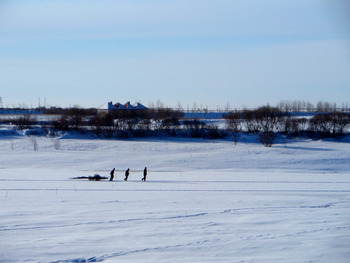
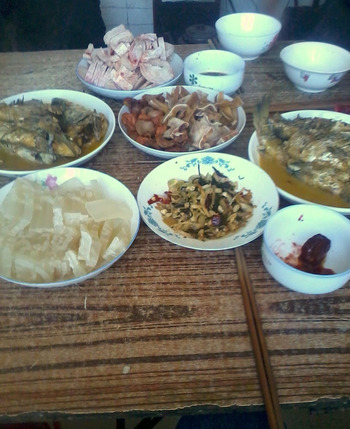
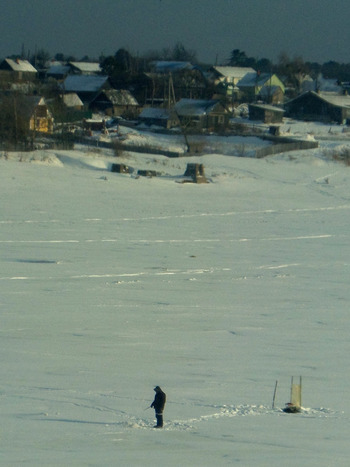
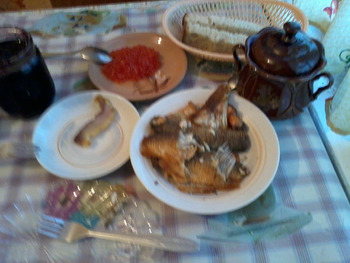
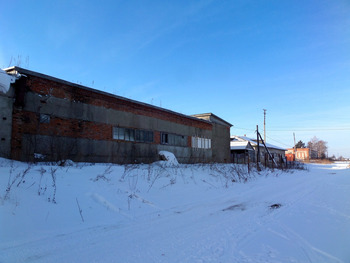
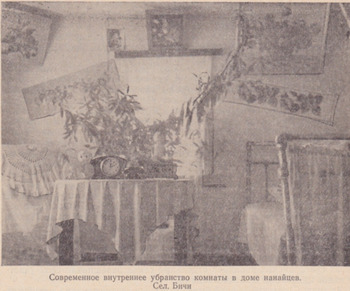
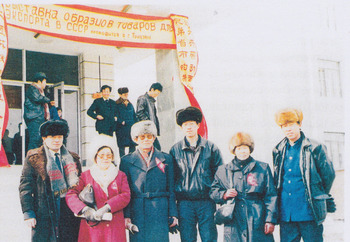
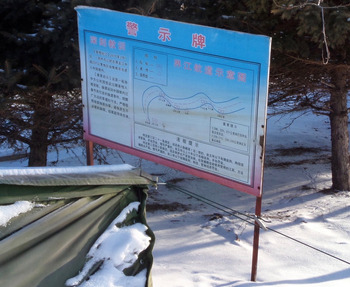

 Open access

