





Introduction
Major depressive disorder (MDD) and anxiety disorders are characterized by emotional symptoms, including low mood, excessive worry, and fear, which can cause clinically significant distress or impairment in important areas of functioning. Functional impairment refers to difficulties performing tasks and roles, such as work or social activities, and is a critical factor in distinguishing normal symptom variation from diagnostic conditions. Patients rate a return to normal functioning as an important treatment outcome (Zimmerman et al., Reference Zimmerman, McGlinchey, Posternak, Friedman, Attiullah and Boerescu2006). Despite this, in both clinical and research contexts, definitions of remission and recovery often rely on symptom severity scales that typically do not explicitly measure impairment (Kamenov, Cabello, Coenen, & Ayuso-Mateos, Reference Kamenov, Cabello, Coenen and Ayuso-Mateos2015). While individuals experiencing no symptoms will, by extension, not experience functional impairment due to symptoms, beyond this, individuals with the same level of symptom severity can experience different levels of functional impairment (Denninger et al., Reference Denninger, van Nieuwenhuizen, Wisniewski, Luther, Trivedi, Rush and Fava2011; Zimmerman et al., Reference Zimmerman, McGlinchey, Posternak, Friedman, Boerescu and Attiullah2008). Phenotypic correlations between total symptom scores and measures of functional impairment are, therefore, typically moderate (e.g., r = 0.43–0.63; Kroenke, Spitzer, & Williams, Reference Kroenke, Spitzer and Williams2001; Spitzer, Kroenke, Williams, & Löwe, Reference Spitzer, Kroenke, Williams and Löwe2006; Zahra et al., Reference Zahra, Qureshi, Henley, Taylor, Quinn, Pooler and Byng2014). Furthermore, some patients considered to be in remission report persistent impairment from residual symptoms (IsHak et al., Reference IsHak, James, Mirocha, Youssef, Tobia, Pi and Cohen2016; Saris et al., Reference Saris, Aghajani, van der Werff, van der Wee and Penninx2017). These findings highlight the importance of assessing impairment alongside symptoms for a more complete and accurate reflection of patient well-being and treatment efficacy.
MDD and anxiety disorders show moderate heritability, defined as the proportion of phenotypic variance due to genetic variation in the population, with twin-based estimates of approximately 25–40% (Hettema, Neale, & Kendler, Reference Hettema, Neale and Kendler2001; Sullivan, Neale, & Kendler, Reference Sullivan, Neale and Kendler2000). Heritability estimates from genetic variant-level analyses, known as genome-wide association studies (GWASs), are lower, roughly 5–20% (Cross-Disorder Group of the PGC, 2013; Purves et al., Reference Purves, Coleman, Meier, Rayner, Davis, Cheesman and Eley2020), as they capture only the additive effects of common genotyped variants rather than all genetic influences. This heritability is explained by many genetic variants, each with a very small effect size (Purves et al., Reference Purves, Coleman, Meier, Rayner, Davis, Cheesman and Eley2020; Wray et al., Reference Wray, Ripke, Mattheisen, Trzaskowski, Byrne and Abdellaoui2018). The substantial genetic overlap between MDD and anxiety disorders is well-established; genetic correlation (rg) estimates typically range from 0.8 to 1 (Kendler et al., Reference Kendler, Neale, Kessler, Heath and Eaves1992; Purves et al., Reference Purves, Coleman, Meier, Rayner, Davis, Cheesman and Eley2020).
Research into the genetic influences on functional impairment is much more limited (McGrath et al., Reference McGrath, Cornelis, Lee, Robinson, Duncan, Barnett and Smoller2013; Ordonana et al., Reference Ordonana, Bartels, Boomsma, Cella, Mosing and Oliveira2013). Twin studies suggest a moderate heritable component (20–30%) (Rijsdijk et al., Reference Rijsdijk, Snieder, Ormel, Sham, Goldberg and Spector2003; Romeis et al., Reference Romeis, Heath, Xian, Eisen, Scherrer, Pedersen and True2005). One twin study found that, while most genetic influences on functional impairment were shared with MDD, a modest proportion (14%) were specific to impairment (Foley et al., Reference Foley, Neale, Gardner, Pickles and Kendler2003). However, genomic data have not successfully been used to estimate the heritability of impairment, and genetic correlations between symptoms and impairment remain unclear. Moderate genetic correlations between symptoms and impairment, mirroring phenotypic correlations (Waszczuk, Zavos, Gregory, & Eley, Reference Waszczuk, Zavos, Gregory and Eley2014), would indicate a shared genetic liability alongside symptom-specific and impairment-specific genetic influences.
To maximize sample sizes, some GWAS have used current symptom scores as depression or anxiety phenotypes (Direk et al., Reference Direk, Williams, Smith, Ripke, Air, Amare and Sullivan2017; Levey et al., Reference Levey, Gelernter, Polimanti, Zhou, Cheng, Aslan and Stein2020). While there is evidence of high genetic correlations between symptoms and disorder phenotypes (Direk et al., Reference Direk, Williams, Smith, Ripke, Air, Amare and Sullivan2017; Levey et al., Reference Levey, Gelernter, Polimanti, Zhou, Cheng, Aslan and Stein2020; Purves et al., Reference Purves, Coleman, Meier, Rayner, Davis, Cheesman and Eley2020), more recent analyses in the UK Biobank reported lower correlations between current and lifetime worst-episode depression symptoms (between 0.43 and 0.87; Huang et al., Reference Huang, Tang, Rietkerk, Appadurai, Krebs, Schork and Cai2023). Impairment-specific genetic influences could capture a liability, beyond that for current symptoms, that is relevant to full diagnostic presentations of depression and anxiety. Genetic correlation estimates could clarify whether there is value in supplementing symptom scales with measures of functional impairment in genetic studies of depression and anxiety. Furthermore, as genetic information is increasingly explored as a prognostic predictor, the extent of the correlation could indicate whether supplementing genetic information on symptom severity with that on impairment may improve predictive accuracy.
We investigated the genetic influences on self-reported measures of current depression symptoms (Patient Health Questionnaire 9-item version [PHQ-9]) (Kroenke et al., Reference Kroenke, Spitzer and Williams2001), anxiety symptoms (Generalized Anxiety Disorder 7-item scale [GAD-7]) (Spitzer et al., Reference Spitzer, Kroenke, Williams and Löwe2006), and functional impairment (Work and Social Adjustment Scale [WSAS]) (Marks, Reference Marks1986). In a sample of individuals with lifetime depression or anxiety, we estimated single-nucleotide polymorphism (SNP)-based heritability (h 2SNP) and genetic correlations between these measures. To better understand the genetic characteristics of functional impairment, we also estimated genetic correlations with selected external phenotypes. Understanding the genetic influences on these measures and the relationships between them is important for interpreting findings in studies where they are used. The PHQ-9 and GAD-7 are endorsed by research funders and academic journals as standard measures of adult depression and anxiety (Farber, Gage, Kemmer, & White, Reference Farber, Gage, Kemmer and White2023; Wellcome, 2020). Furthermore, the PHQ-9, GAD-7, and WSAS are core outcome measures in the National Health Service (NHS) England ‘Talking Therapies for anxiety and depression’ program (formerly ‘IAPT’), with the symptom scales used to define recovery and improvement (The National Collaborating Centre for Mental Health, 2023). We expected moderate genetic correlations significantly different from zero (0.4–0.7) between symptoms and impairment, reflecting existing phenotypic estimates (Kroenke et al., Reference Kroenke, Spitzer and Williams2001; Spitzer et al., Reference Spitzer, Kroenke, Williams and Löwe2006; Zahra et al., Reference Zahra, Qureshi, Henley, Taylor, Quinn, Pooler and Byng2014).
Materials and methods
Sample
This analysis used a sample of participants from the Genetic Links to Anxiety and Depression (GLAD) Study. GLAD is an online study recruiting individuals primarily from the general UK population, aged 16 years and older, with lifetime experience of depression and/or anxiety (Davies et al., Reference Davies, Kalsi, Armour, Jones, McIntosh, Smith and Breen2019). Participants were, therefore, more likely to have nonzero symptom scores, allowing us to investigate associations with impairment across a full distribution of severities. GLAD participants provide informed consent before completing an online sign-up questionnaire, which includes assessments of clinical and demographic information. Participants are required to meet the case criteria on diagnostic questionnaires or self-report a diagnosis by a medical professional. They are then sent a saliva sample collection kit with which they provide their genetic data. Almost all (96%) participants have received treatment for their depression or anxiety, the majority have recurrent depression, and over half have experienced an anxiety disorder (Davies et al., Reference Davies, Kalsi, Armour, Jones, McIntosh, Smith and Breen2019). The analysis was centered around three phenotypes as described below: depression symptoms, anxiety symptoms, and functional impairment. Our analysis was limited to participants with phenotypic data collected during the sign-up questionnaire for at least one of these measures, covariate information, and genotype data that passed quality control (N = 17,130; range across phenotypes = 17,081–17,107). Ethical approval for the GLAD Study was obtained from the London–Fulham Research Ethics Committee (REC reference: 18/LO/1218). The authors assert that all procedures contributing to this work comply with the ethical standards of the relevant national and institutional committees on human experimentation and with the Declaration of Helsinki 1975, as revised in 2013.
Phenotype measures
Depression symptoms were assessed using the PHQ-9 (Supplementary Information 1), which measures the recent frequency of nine symptoms using the stem question: ‘Over the last 2 weeks, how often have you been bothered by any of the following problems?’ Each item has a four-point response scale from ‘not at all’ (scored 0) to ‘nearly every day’ (scored 3). Summed scores indicate severity from 0 to 27. The PHQ-9 had good internal reliability in the GLAD sample (α = 0.90) and has demonstrated good test–retest reliability in other studies (intraclass correlation = 0.84) (Kroenke et al., Reference Kroenke, Spitzer and Williams2001).
Anxiety symptoms were assessed by the GAD-7 (Supplementary Information 1), which has a similar format to the PHQ-9. It has the same overarching question regarding the frequency of recent problems, with seven anxiety symptoms rated on the four-point scale, yielding total scores from 0 to 21. Internal consistency in the GLAD sample was good (α = 0.91), and good test–retest reliability has been reported (intraclass correlation = 0.83) (Spitzer et al., Reference Spitzer, Kroenke, Williams and Löwe2006).
The development papers for the PHQ-9 and GAD-7 (Kroenke et al., Reference Kroenke, Spitzer and Williams2001; Spitzer et al., Reference Spitzer, Kroenke, Williams and Löwe2006) presented the symptom scales alongside a functional impairment item to validate their use (see Supplementary Information 1). This item was not included for either measure in the GLAD Study, and is not consistently used across clinical settings (e.g., NHS Talking Therapies for anxiety and depression) or research settings. Even when the impairment item is present, it is not incorporated into the total PHQ-9 and GAD-7 symptom scores used to define clinical outcomes.
The WSAS assesses the impact of symptoms on daily living (functional impairment) across the following five domains: the ability to work, home management, social leisure activities, private leisure activities, and the ability to form and maintain close relationships. Each item is worded as, “because of my problem my <domain> is impaired.” A nine-point response scale of not at all (scored 0) to very severely (scored 8) gives total scores from 0 to 40. The WSAS showed good internal consistency in GLAD (α = 0.85). In another sample, the WSAS was captured by a single factor and demonstrated acceptable test–retest reliability (0.73) (Mundt, Marks, Shear, & Greist, Reference Mundt, Marks, Shear and Greist2002). One limitation is that the ‘ability to work’ item could be answered ‘not applicable’ if respondents were not in employment or education. The subsequent missing data can be handled by imputation using the mean of the individual’s four nonmissing WSAS items (as done in NHS Digital), but this can introduce bias and lead to spurious results if the data are missing ‘not at random’ (Little & Rubin, Reference Little and Rubin2002). We explored a complete case of the total WSAS sum score from all five items and a four-item WSAS sum score excluding the work item. This exploration, presented in Supplementary Information 2, included phenotypic analyses (Cronbach’s alpha and group comparisons) and genetic correlations between each WSAS sum score and the work item. Subsequently, we present the results from an individual mean imputed WSAS sum score (as per NHS Digital), with results from sensitivity analyses using the complete case and four-item sum scores in the Supplementary Materials.
Genotyping and quality control
Genotyping was performed by ThermoFisher on behalf of the National Institute for Health and Care Research (NIHR) Cambridge Biomedical Research Centre using the Affymetrix UK Biobank Axiom Array. The dataset used was from Freeze 2.0. Genetic quality control, further detailed in Supplementary Information 3, was conducted in PLINK v1.9. (Chang et al., Reference Chang, Chow, Tellier, Vattikuti, Purcell and Lee2015) by applying the following exclusion thresholds for individuals: >5% missing variants, non-European genetic ancestry (as specific ancestry groups were insufficiently sized for analysis), and signs of potential genotyping error or contamination (global identity by descent outliers, discordant reported sex at birth, and genetically inferred sex). The sample comprised 18,349 individuals before quality control and 17,147 afterward (1,202 were removed), with further exclusions for missing phenotype data resulting in an analysis sample of 17,130. Genetic variants were excluded if they had missingness >2%, minor allele frequency < 1%, or Hardy–Weinberg equilibrium p < 1 × 10⁻⁸. Genotype imputation was performed using the TOPMed reference panel (version r2 on GRCh38; Das et al., Reference Das, Forer, Schönherr, Sidore, Locke, Kwong and Fuchsberger2016; Fuchsberger, Abecasis, & Hinds, Reference Fuchsberger, Abecasis and Hinds2014; Taliun et al., Reference Taliun, Harris, Kessler, Carlson, Szpiech, Torres and Stilp2021). Quality control filters were applied both before and after imputation, with an additional post-imputation quality threshold of R 2 > 0.3. A total of 7,027,957 variants remained for analysis.
Statistical analyses
A GWAS was performed with each phenotype using REGENIE (version 2.2.4; Mbatchou et al., Reference Mbatchou, Barnard, Backman, Marcketta, Kosmicki, Ziyatdinov and Marchini2021) under a linear model. We included covariates that could act as confounders or explain variance in the phenotypes (Salk, Hyde, & Abramson, Reference Salk, Hyde and Abramson2017; Sutin et al., Reference Sutin, Terracciano, Milaneschi, An, Ferrucci and Zonderman2013). In linear regression, this can yield more precise SNP effect estimates and increase power (Mefford & Witte, Reference Mefford and Witte2012). Covariates were age, age2, sex (binary), genotyping batch (categorical, four levels), and the first 10 genetic principal components. The h 2SNP was estimated with genomic-relatedness-based restricted maximum-likelihood in ‘genome-wide complex trait analysis’ software (GCTA-GREML, version 1.94; Yang, Lee, Goddard, & Visscher, Reference Yang, Lee, Goddard and Visscher2011). GREML methods create a genomic relatedness matrix using individual-level data on common SNPs genotyped on the genetic array. To prevent inflation of the matrix and biased estimates, we followed standard recommendations (Lee et al., Reference Lee, Yang, Goddard, Visscher and Wray2012; Yang et al., Reference Yang, Lee, Goddard and Visscher2011) and excluded one of each pair of participants with genomic relatedness >0.05 (n = 373). For all GREML analyses, we used genotyped data and included the same covariates as for the GWAS, described above.
The genetic correlations between the three phenotypes were calculated using GCTA bivariate-GREML (Lee et al., Reference Lee, Yang, Goddard, Visscher and Wray2012). We tested whether the genetic correlations between symptoms and functional impairment differed from 1 using the ‘reml-bivar-lrt-rg’ flag in GCTA to perform a likelihood ratio test and generate a p-value. This test was also used to produce p-values for the default test of difference from rg = 0. Furthermore, we estimated the proportion of the phenotypic correlation attributable to genetic correlation by performing calculations and simulating standard errors as described previously (de Vries et al., Reference de Vries, van Beijsterveldt, Maes, Colodro-Conde and Bartels2021; Morris, Davies, Hemani, & Smith, Reference Morris, Davies, Hemani and Smith2020).
We estimated genetic correlations with 10 prespecified external phenotypes using linkage-disequilibrium score regression (LDSC, version 1.0.1; Bulik-Sullivan et al., Reference Bulik-Sullivan, Finucane, Anttila, Gusev, Day, Loh and Neale2015; Bulik-Sullivan, Loh, et al., Reference Bulik-Sullivan, Loh, Finucane, Ripke, Yang and Neale2015). First, we selected five case–control psychiatric phenotypes: MDD (Wray et al., Reference Wray, Ripke, Mattheisen, Trzaskowski, Byrne and Abdellaoui2018), anxiety disorders (Purves et al., Reference Purves, Coleman, Meier, Rayner, Davis, Cheesman and Eley2020), schizophrenia (Trubetskoy et al., Reference Trubetskoy, Pardiñas, Qi, Panagiotaropoulou, Awasthi, Bigdeli and Lazzeroni2022), attention-deficit and hyperactivity disorder (ADHD; Demontis et al., Reference Demontis, Walters, Athanasiadis, Walters, Therrien, Nielsen and Børglum2023), and post-traumatic stress disorder (PTSD; Stein et al., Reference Stein, Levey, Cheng, Wendt, Harrington, Pathak and Gelernter2021). See Supplementary Table 1 for further details of the source studies. Genetic correlations with MDD and anxiety disorders would reveal shared genetic influences between our symptom and impairment measures and phenotypes that incorporate diagnostic elements beyond symptom severity, including impairment. The remaining case–control phenotypes were selected to investigate whether the genetic influences on anxiety- or depression-related impairment were shared with diagnostically distinct disorders. Second, we examined five additional traits, four quantitative and one binary: neuroticism (Gupta et al., Reference Gupta, Galimberti, Liu, Beck, Wingo, Wingo and Levey2024), self-rated fatigue (Deary et al., Reference Deary, Hagenaars, Harris, Hill, Davies, Liewald and Deary2018), years of education (Lee et al., Reference Lee, Wedow, Okbay, Kong, Maghzian, Zacher and Cesarini2018), self-rated health (Harris et al., Reference Harris, Hagenaars, Davies, David Hill, Liewald, Ritchie and Deary2017), and smoking (Liu et al., Reference Liu, Jiang, Wedow, Li, Brazel, Chen and Vrieze2019). These were selected for their relevance to our phenotypes. Neuroticism is a risk factor for both anxiety and depression (Fryers & Brugha, Reference Fryers and Brugha2013), and an analysis of depression symptoms showed that fatigue explained substantial variance in impairment (Fried & Nesse, Reference Fried and Nesse2014). Education reflects cognitive and socioeconomic factors, while self-rated health and smoking are each associated with mental and physical health, with smoking representing a health behavior. To formally test whether the genetic correlations with functional impairment differed from those estimated with the symptom measures, we used a block jackknife procedure with 200 blocks. Bonferroni corrections were applied to significance thresholds: p < 0.017 for each of the three heritability and internal correlation estimates, p < 0.005 for 10 external correlation tests per measure, and p < 0.017 for the correlation comparisons. Analysis was conducted within the King’s College London computational research environment (King’s College London, 2023). Data preparation and visualization were performed in R version 4.1.2 (R Core Team, 2021).
Results
Sample characteristics
The characteristics of the sample (N = 17,130) are presented in Table 1. Participants had moderate current depression symptoms (PHQ-9), mild anxiety symptoms (GAD-7), and moderate functional impairment (WSAS), on average (Kroenke et al., Reference Kroenke, Spitzer and Williams2001; Mundt et al., Reference Mundt, Marks, Shear and Greist2002; Spitzer et al., Reference Spitzer, Kroenke, Williams and Löwe2006; see Supplementary Figure 1 for distributions).
Characteristics of analysis sample from the Genetic Links to Anxiety and Depression (GLAD) Study (N = 17,130)
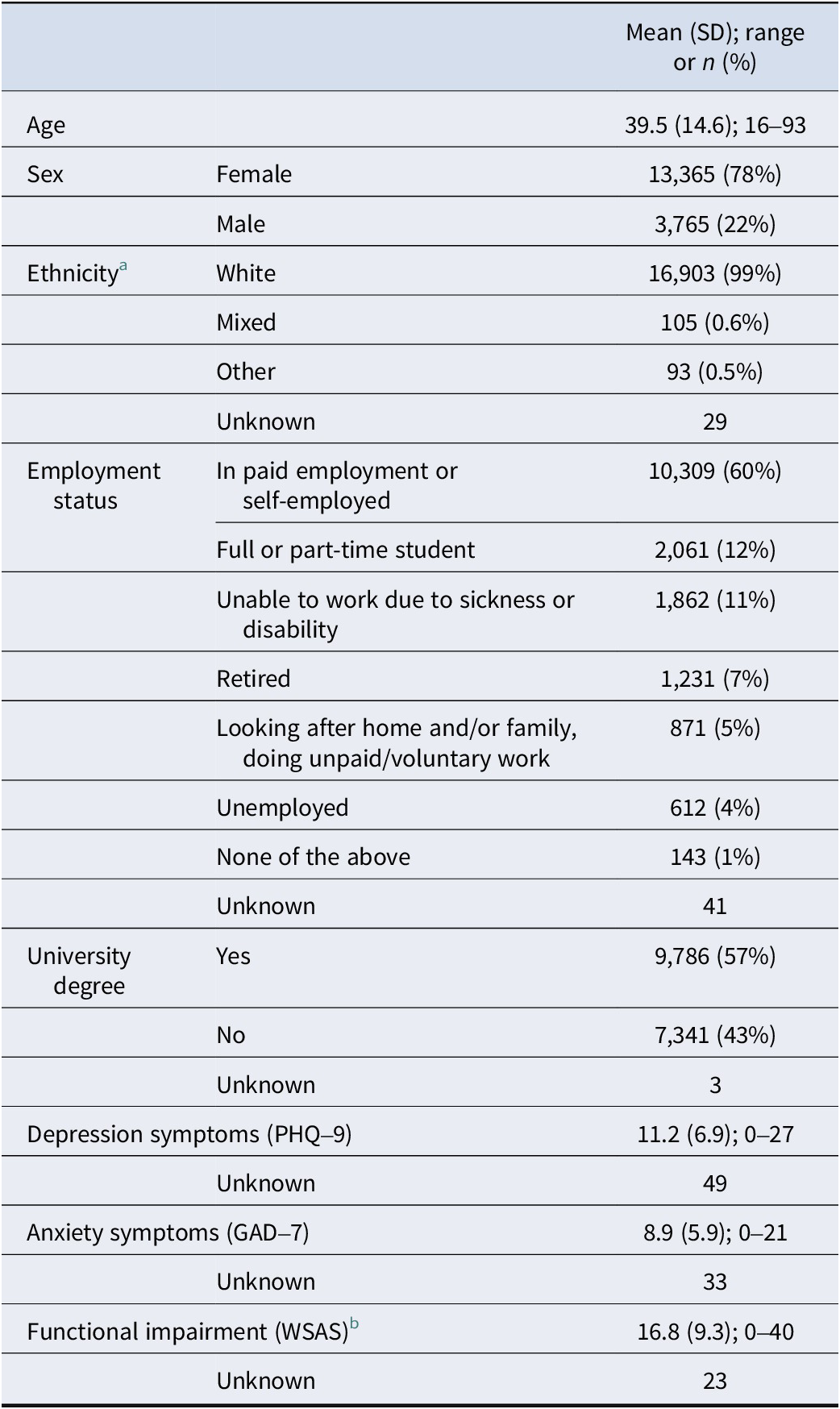
a Self-reported ethnicity. All participants in this analysis sample met genetic quality control criteria for European ancestry.
b Mean-imputed WSAS score used in the analyses. Unknown values reflect participants with >1 missing WSAS item, ineligible for imputation. Descriptives for the WSAS score before imputation: 17.2 (9.2); 0–40, unknown = 2,064 (majority were ‘not applicable’ responses to the work item).
Heritability estimates
No variants reached genome-wide significance (p < 5 × 10⁻⁸) in the GWAS of any of the three traits (Supplementary Figure 2). SNP-based heritability estimates were significant (p < 0.017) for depression symptoms (0.19, SE = 0.04, p = 6 × 10⁻⁹), anxiety symptoms (0.17, SE = 0.03, p = 2 × 10⁻⁷), and functional impairment (0.11, SE = 0.03, p = 2 × 10⁻⁴).
Phenotypic and genetic correlations between traits
Phenotypic and genetic correlations between depression symptoms, anxiety symptoms, and functional impairment are presented in Figure 1 (and Supplementary Tables 2 and 3). Phenotypic correlations between traits were significantly different from zero (at p < 0.017) and moderate (r = 0.50–0.69), with the highest correlation observed between depression and anxiety symptoms and the lowest between anxiety symptoms and functional impairment.
Genetic and phenotypic correlations between depression symptoms, anxiety symptoms, and functional impairment in a sample from the GLAD Study (N = 17,130).
Note: Error bars represent 95% confidence intervals. *Significant at p < 0.017. Depression symptoms = PHQ-9 score, anxiety symptoms = GAD-7 score, functional impairment = WSAS score. Genetic correlations were estimated using GCTA bivariate-GREML and phenotypic correlations using Pearson’s r. For ease of comparability, both sides of the correlations are presented; therefore, information is duplicated. For example, the depression symptoms–functional impairment genetic correlation is presented by the filled orange triangle above ‘Depression symptoms’ on the x-axis and the filled pink square above ‘Functional impairment’.
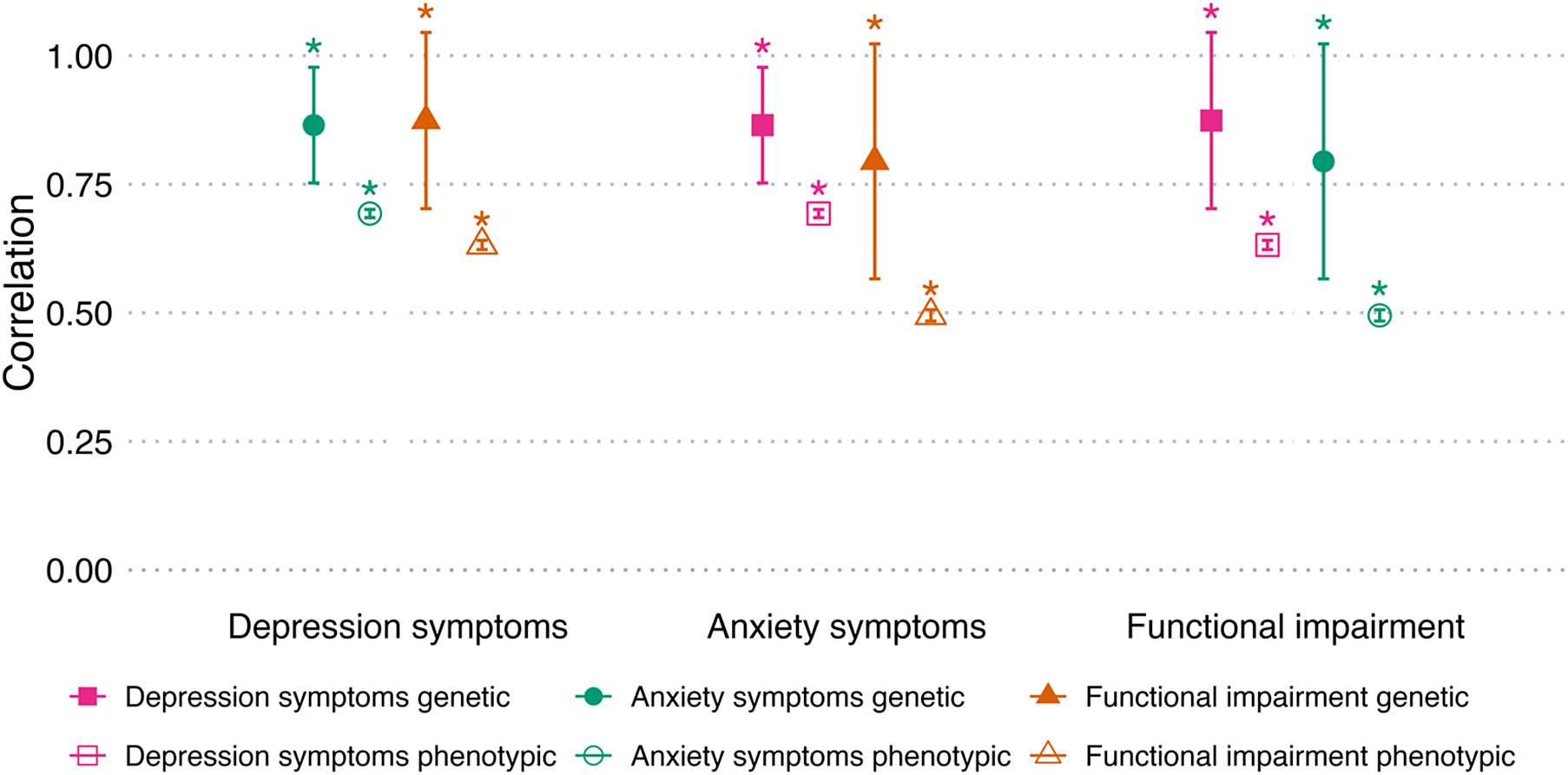
The genetic correlation between depression symptoms and functional impairment was 0.87, which was significantly different from zero (at p < 0.017 and p = 1.5 × 10⁻⁶). For anxiety symptoms and functional impairment, the genetic correlation was 0.79 and significant (p = 1.3 × 10⁻⁵). Although all genetic correlations were higher than their corresponding phenotypic correlations, the lowest correlation, both phenotypically and genetically, was observed between anxiety symptoms and impairment. As the genetic correlations between impairment and depression or anxiety symptoms were strong, we formally tested whether they were significantly different from 1. The results indicated that they were not (p = 0.098 and p = 0.049, respectively, at p < 0.025).
The proportion of phenotypic correlation attributable to common genetic variants shared between functional impairment and depression symptoms was 0.20 (95% CI = 0.12–0.27), and for functional impairment and anxiety symptoms was 0.22 (95% CI = 0.12–0.31). This indicated that the measured genetic correlation explained one-fifth of the phenotypic correlation between traits. Using LDSC to estimate genetic correlations produced similar results to those from GCTA-GREML, while heritability estimates were significant but attenuated (Supplementary Information 4), consistent with the reduced power of this summary-statistics-based method (Evans et al., Reference Evans, Tahmasbi, Vrieze, Abecasis, Das, Gazal and Keller2018). Phenotypic and genetic explorations of the complete case WSAS with and without the work item showed similar results to the mean-imputed WSAS used in the main analysis and are presented in Supplementary Information 4.
Genetic correlations with external phenotypes
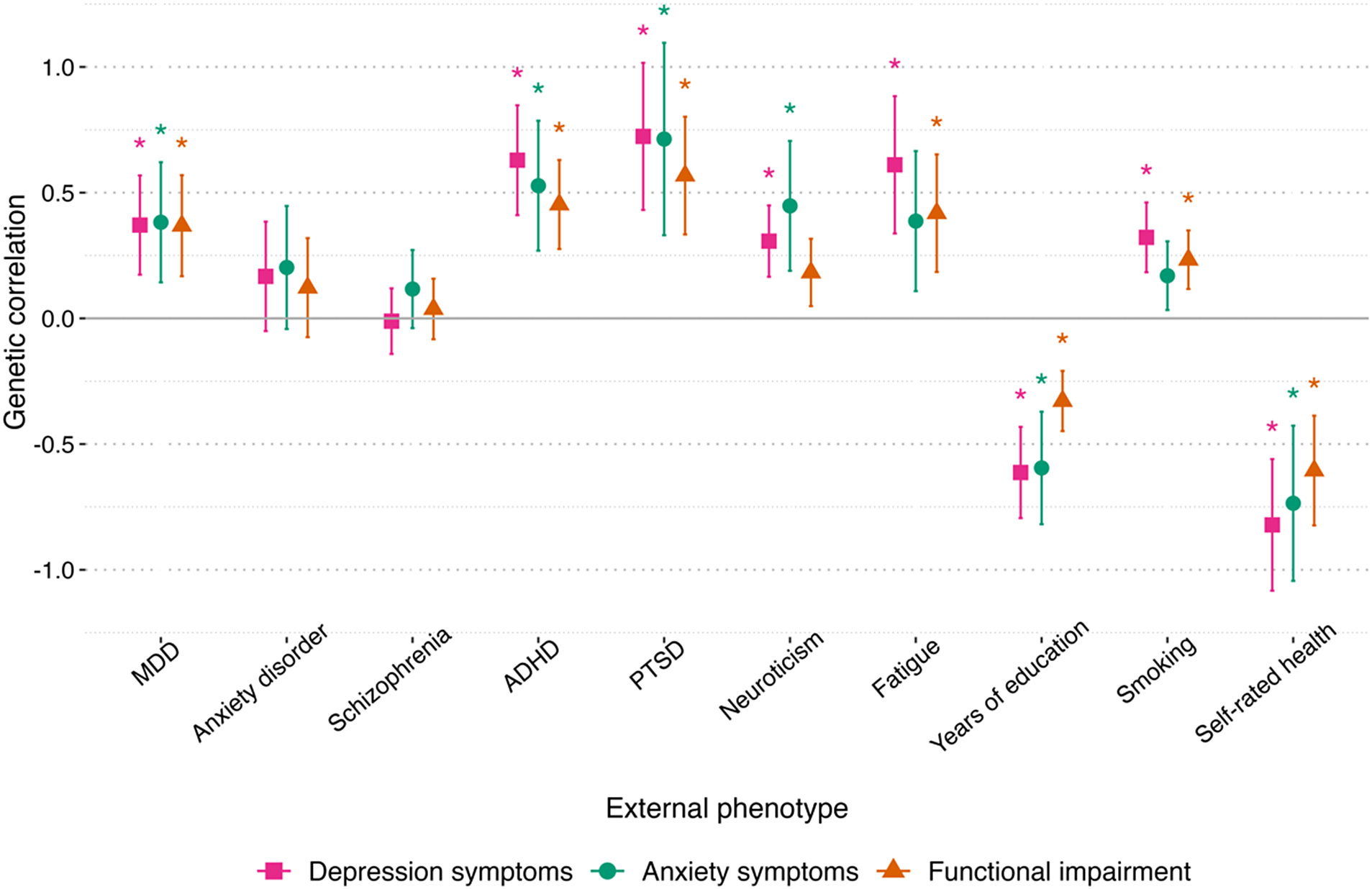
LDSC estimates of genetic correlations between each of the measures and 10 external phenotypes are shown in Figure 2 and Supplementary Table 4. All three phenotypes showed nonzero estimates with MDD, ADHD, PTSD, years of education, and self-rated health, which remained significant after correction for multiple testing. Negative correlations with years of education and self-rated health indicated that genetic variants associated with higher symptom or impairment scores were associated with fewer years of education and poorer health ratings. Genetic correlations with neuroticism were significant for depression and anxiety symptoms but not for functional impairment. For both self-rated fatigue and smoking, only depression symptoms and functional impairment showed significant associations. No significant genetic correlations were observed with anxiety disorder or schizophrenia. Comparisons using a block jackknife method revealed that the genetic correlations with external phenotypes did not significantly differ between impairment and symptom measures, except in the case of education. Here, the correlation was significantly weaker for impairment than for symptoms (p = 7.7 × 10⁻⁴ for depression symptoms and 1.0 × 10⁻² for anxiety symptoms).
Genetic correlations between depression symptoms, anxiety symptoms, and functional impairment in a GLAD Study sample (N = 17,130) and 10 external phenotypes.
Note: Error bars represent 95% confidence intervals. *Significant at p < 0.005. Depression symptoms = PHQ-9 score, anxiety symptoms = GAD-7 score, functional impairment = WSAS score. MDD = major depressive disorder (Wray et al., Reference Wray, Ripke, Mattheisen, Trzaskowski, Byrne and Abdellaoui2018), anxiety disorder (Purves et al., Reference Purves, Coleman, Meier, Rayner, Davis, Cheesman and Eley2020), schizophrenia (Trubetskoy et al., Reference Trubetskoy, Pardiñas, Qi, Panagiotaropoulou, Awasthi, Bigdeli and Lazzeroni2022), ADHD = attention deficit hyperactivity disorder (Demontis et al., Reference Demontis, Walters, Athanasiadis, Walters, Therrien, Nielsen and Børglum2023), PTSD = post-traumatic stress disorder (Stein et al., Reference Stein, Levey, Cheng, Wendt, Harrington, Pathak and Gelernter2021), neuroticism (Gupta et al., Reference Gupta, Galimberti, Liu, Beck, Wingo, Wingo and Levey2024), fatigue (Deary et al., Reference Deary, Hagenaars, Harris, Hill, Davies, Liewald and Deary2018), years of education (Lee et al., Reference Lee, Wedow, Okbay, Kong, Maghzian, Zacher and Cesarini2018), smoking (Liu et al., Reference Liu, Jiang, Wedow, Li, Brazel, Chen and Vrieze2019), and self-rated health (Harris et al., Reference Harris, Hagenaars, Davies, David Hill, Liewald, Ritchie and Deary2017). See Supplementary Table 1 for further details of the external phenotypes. Genetic correlations were estimated using LDSC.
Discussion
This study investigated the genetic influences on, and correlations between, self-reported functional impairment (WSAS) and current symptoms of depression (PHQ-9) and anxiety (GAD-7) in 17,130 individuals with lifetime depression or anxiety. We observed significant SNP-based heritability estimates for all three measures as well as genetic correlations among them. These findings indicate that functional impairment and symptom severity are each influenced by genetic variants that substantially overlap.
Heritability
SNP-based heritability estimates for depression and anxiety symptoms were comparable to those reported for case–control definitions of MDD and anxiety disorder (e.g., 9% (Wray et al., Reference Wray, Ripke, Mattheisen, Trzaskowski, Byrne and Abdellaoui2018) and 26% (Purves et al., Reference Purves, Coleman, Meier, Rayner, Davis, Cheesman and Eley2020), respectively). The heritability of functional impairment was similar to that of symptoms, aligning with prior twin-based estimates (Rijsdijk et al., Reference Rijsdijk, Snieder, Ormel, Sham, Goldberg and Spector2003; Romeis et al., Reference Romeis, Heath, Xian, Eisen, Scherrer, Pedersen and True2005).
Phenotypic and genetic correlations between traits
Phenotypic correlations were consistent in size and pattern with previous estimates (Kroenke et al., Reference Kroenke, Spitzer and Williams2001; Spitzer et al., Reference Spitzer, Kroenke, Williams and Löwe2006; Zahra et al., Reference Zahra, Qureshi, Henley, Taylor, Quinn, Pooler and Byng2014) and existing evidence that symptom severity and functional impairment are partially independent. The stronger phenotypic correlation between functional impairment and depression symptoms, compared to anxiety symptoms, may reflect a greater functional impact of depression or conceptual overlap between the PHQ-9 and WSAS. Notably, although sleep difficulties, low energy, and impaired concentration feature in diagnostic criteria for both MDD and generalized anxiety disorder, they are included in the PHQ-9 but not the GAD-7. These symptoms appear to be especially relevant to functional impairment (Fried & Nesse, Reference Fried and Nesse2014), which may potentially drive the higher observed correlation. Further insights into the relationships between these measures could be gained by investigating item-level associations using factor or network analysis. For example, a factor analysis of PHQ-9 and GAD-7 items identified four factors (Thompson et al., Reference Thompson, Hübel, Cheesman, Adey, Armour, Davies and Eley2021); how these relate to, or are changed by, the addition of WSAS items might reveal clinically useful presentations.
Genetic correlations between measures were higher than expected based on the corresponding phenotypic correlations, indicating substantial overlap in the common genetic variants associated with self-reported depression or anxiety symptom severity and functional impairment. These genetic correlations accounted for approximately one-fifth of the phenotypic correlations, which is likely to be lower than what a twin study capturing all genetic influences would estimate. The high genetic correlations suggest that much of the common genetic variant signal associated with self-reported functional impairment is also captured by symptom-based measures. This aligns with findings from the UK Biobank (Jermy et al., Reference Jermy, Glanville, Coleman, Lewis and Vassos2021) showing that adding components of a diagnostic questionnaire for depression, including a binary item assessing functional impairment, had little impact on heritability or relevant genetic correlations beyond the core symptoms. Together, these results suggest that it may not be crucial to supplement symptom-based scales with information on functional impairment for genetic variant discovery. Self-reported symptom scales also enable vastly larger sample sizes than are feasible with clinician-derived diagnostic instruments, which are essential for well-powered genetic analyses. Despite the value of data from symptom-based scales, they typically assess recent rather than lifetime symptoms. Evidence from the depression literature suggests that the PHQ-9 only captures a proportion of the genetic information relevant to diagnostic presentations, instead more closely reflecting a broader distress phenotype (Cai et al., Reference Cai, Revez, Adams, Andlauer, Breen, Byrne and Flint2020; Huang et al., Reference Huang, Tang, Rietkerk, Appadurai, Krebs, Schork and Cai2023). From a clinical perspective, it is essential to assess functional impairment; it is relevant for diagnosis and treatment outcomes, prioritized by patients, and cannot be inferred from symptom scale scores alone.
Genetic correlations with external phenotypes were broadly similar in magnitude across all three measures (depression symptoms, anxiety symptoms, and functional impairment). The strongest correlations were positive with PTSD and negative with self-rated health. The high genetic correlation between PTSD and functional impairment is consistent with indications that PTSD is a particularly impairing condition (Olatunji et al. Reference Olatunji, Cisler and Tolin2007). Comparisons between the genetic correlations revealed that the negative association with years of education was significantly weaker for functional impairment than for symptoms. This suggests that the genetic influences on lower educational attainment may be more closely related to liability to internalizing symptoms than to their functional consequences. Several correlations with depression and anxiety symptoms were similar to those reported from studies of case–control MDD and anxiety (Harris et al., Reference Harris, Hagenaars, Davies, David Hill, Liewald, Ritchie and Deary2017; Purves et al., Reference Purves, Coleman, Meier, Rayner, Davis, Cheesman and Eley2020; Stein et al., Reference Stein, Levey, Cheng, Wendt, Harrington, Pathak and Gelernter2021; Wray et al., Reference Wray, Ripke, Mattheisen, Trzaskowski, Byrne and Abdellaoui2018). On the other hand, unexpectedly weak or null genetic correlations were observed with case–control anxiety disorders, schizophrenia, anorexia, and MDD, as well as with neuroticism. These discrepancies between our analyses and the literature are likely attributable to selection bias, which is discussed further in the limitations.
Strengths and limitations
This is the first study to perform SNP-based genetic analyses of the relationship between depression and anxiety symptoms and functional impairment. It is also one of the few genetic studies of functional impairment, an outcome of considerable clinical relevance. The measures used are widely employed in both clinical and research settings and have been validated across a range of cultures and patient groups (e.g., Mughal et al., Reference Mughal, Devadas, Ardman, Levis, Go and Gaynes2020). However, several limitations should be noted when interpreting these results.
First, our analyses were restricted to individuals with lifetime depression or anxiety from the GLAD Study, a sample characterized by high rates of depression recurrence, treatment receipt, and comorbidity (Davies et al., Reference Davies, Kalsi, Armour, Jones, McIntosh, Smith and Breen2019). Given that depression and anxiety are influenced by both genetic and environmental risk factors, individuals who experience them will generally have higher levels of disorder-related genetic variants than unaffected controls. As such, although phenotypic scores were approximately normally distributed, the sample likely overrepresents individuals at the upper end of the genetic risk distribution. This restricted range of relevant genetic variation limits the generalizability of our findings to a broader population. It likely also underlies the unexpectedly weak genetic correlations we observed with several external phenotypes, including case–control GWAS of psychiatric conditions and population-based traits such as neuroticism, which capture a broader spectrum of genetic liability. The interpretation of the genetic correlations is further complicated by the low statistical power of the internal phenotypes, as indicated by heritability z-scores below the suggested threshold of 4 (Zheng et al., Reference Zheng, Erzurumluoglu, Elsworth, Kemp, Howe, Haycock and Neale2017). On the other hand, the high genetic correlation between depression and anxiety symptoms was consistent with analyses of the same measures in the UK Biobank, a population-based sample (Thorp et al., Reference Thorp, Campos, Grotzinger, Gerring, An, Ong and Derks2021). In addition, investigating associations between symptom severity and functional impairment arguably requires a sample with nonzero levels of these traits, as impairment only becomes relevant in the presence of symptoms. In the present study, symptom and functional impairment scores were relatively normally distributed, in contrast to population-based samples where floor effects are common and many participants typically score zero. This strong skew makes a linear model unsuitable, and the transformation of zero-inflated distributions for GWAS has been criticized (e.g. Beasley, Erickson, & Allison, Reference Beasley, Erickson and Allison2009). As such, analyses of these measures in the UK Biobank have been constrained, for example, dichotomizing the GAD-7 to perform a case–control GWAS and thereby sacrificing quantitative information (Purves et al., Reference Purves, Coleman, Meier, Rayner, Davis, Cheesman and Eley2020).
Second, two common limitations of GWAS also apply to this study: low statistical power to detect genome-wide significant associations after Bonferroni correction, and limited sample diversity, particularly with respect to sex, education, and ancestry. These issues restricted, respectively, our ability to further investigate the genetic correlations between the measures and the generalizability of our findings.
Third, although widely used in clinical and research settings, all three measures were self-reported. Therefore, the relationships between these measures may, in part, be driven by negative cognitive biases that are observed in individuals both with and without clinically relevant levels of mental health problems (Roiser, Elliott, & Sahakian, Reference Roiser, Elliott and Sahakian2012). Indeed, prior research using objective measures of impairment reported lower phenotypic correlations with symptoms (Kroenke et al., Reference Kroenke, Spitzer and Williams2001; Spitzer et al., Reference Spitzer, Kroenke, Williams and Löwe2006).
Future directions
Future studies of functional impairment would benefit from using more comprehensive measures, for example, by incorporating items on self-care (e.g., washing), and avoiding questions that apply only to a subset of respondents (e.g., ability to work). Greater insight may also be gained from objective indicators of impairment, such as work absences. Impairment has been proposed as a transdiagnostic phenotype to maximize sample sizes across mental health conditions (McGrath et al., Reference McGrath, Cornelis, Lee, Robinson, Duncan, Barnett and Smoller2013) and may be relevant to the general genetic liability underlying these disorders (Caspi et al., Reference Caspi, Houts, Belsky, Goldman-Mellor, Harrington, Israel and Moffitt2014). Functional impairment could also offer an additional phenotyping method when other information, such as symptom data, is unavailable. Testing this will require investigations of the genetic influences on functional impairment across a range of mental health disorders. In addition, it is important to consider that genetic correlations can result from multiple mechanisms. A genetic variant can influence both traits or may affect one trait, which then impacts the other (van Rheenen et al., Reference van Rheenen, Peyrot, Schork, Lee and Wray2019), and correlations can arise from genetically similar subgroups. In this study, of the moderate phenotypic correlations between symptoms and impairment, a small proportion was attributable to the strong genetic correlations between them. A twin-based design would be required to determine whether the remaining phenotypic overlap reflects environmental contributions, measurement error, or genetic factors not captured by common SNPs.
Conclusions
Functional impairment is often overlooked in clinical and research contexts despite its clinical importance and only moderate phenotypic correlation with symptom severity. In this analysis of individuals with lifetime depression or anxiety, we found high genetic correlations between functional impairment and symptoms. This suggests that genetic analyses of functional impairment did not capture many additional variants relevant to full diagnostic presentations beyond those identified through symptom scores.
Supplementary material
The supplementary material for this article can be found at http://doi.org/10.1017/S0033291725101037.
Data availability statement
The GLAD Study data are available via a data request application to the NIHR BioResource (https://bioresource.nihr.ac.uk/using-our-bioresource/academic-and-clinical-researchers/apply-for-bioresource-data/). The data are not publicly available due to restrictions outlined in the study protocol and specified to participants during the consent process. A specific data freeze is available, including the variables used for the analyses described in this article; email gladstudy@kcl.ac.uk for details.
Analytical code availability
The code for the analyses included in this article is available at https://github.com/megskelton/impairment_sympt_overlap.
Acknowledgments
The authors would like to thank all the GLAD Study volunteers for their participation, without which this research would not be possible. The authors gratefully acknowledge the National Institute for Health and Care Research (NIHR) BioResource centers, NHS Trusts, and staff for their contribution. The authors would like to thank the NIHR, NHS Blood and Transplant, and Health Data Research UK as part of the Digital Innovation Hub Program. The authors would also like to acknowledge the use of the King’s College London research computing facility, CREATE (https://doi.org/10.18742/rnvf-m076).
Author contributions
MS: Formulation, data curation, genetic data quality control, analysis, writing of original draft, visualization, review, and editing. JM: Data curation, analysis support, review, and editing. ArtK: Data curation, analysis support, review, and editing. BNA: Data curation, genetic data quality control, review, and editing. CA: GLAD Study PI for Northern Ireland (management and data collection), review, and editing. JEJB: Review and editing. JRIC: Data curation, genetic data quality control, analysis support, review, and editing. MRD: Data curation, review, and editing. CRH: Review and editing. MH: Review and editing. IRJ: GLAD Study PI for Wales (management and data collection), review, and editing. GKa: GLAD Study project administration and recruitment lead, review, and editing. GKr: Review and editing. SHL: Data curation, genetic data quality control, review, and editing. YL: Data curation, review, and editing. AMM: GLAD Study PI for Scotland (management and data collection), review, and editing. AJP: Data curation, review, and editing. CR: Review and editing. KAR: Review and editing. DJS: GLAD Study management and data collection, review, and editing. KNT: Data curation, review, and editing. DV: Review and editing. JTRW: GLAD Study management and data collection, review, and editing. CH: Data curation, review, and editing. GB: GLAD Study principal investigator, supervision, formulation, review, and editing. TCE: GLAD Study principal investigator, supervision, formulation, review, and editing.
Funding statement
Megan Skelton was supported by an NIHR Maudsley Biomedical Research Centre studentship. Brett N. Adey was funded by an NIHR predoctoral fellowship (NIHR301067). Joshua E. J. Buckman is funded by a research grant from the Royal College of Psychiatrists. Katherine N. Thompson was supported by an Economic and Social Research Council (ESRC) LISS-DTP Studentship. This study represents independent research funded by the National Institute for Health and Care Research (NIHR) Maudsley Biomedical Research Centre at South London and Maudsley NHS Foundation Trust and King’s College London. The views expressed are those of the authors and not necessarily those of the NHS, the NIHR, the Department of Health and Social Care, or King’s College London.
Competing interests
Gerome Breen has received honoraria, research or conference grants, and consulting fees from Illumina, Otsuka, and COMPASS Pathfinder Ltd. Matthew Hotopf is the principal investigator of the RADAR-CNS consortium, an IMI public–private partnership and, as such, receives research funding from Janssen, UCB, Biogen, Lundbeck, and MSD. Andrew M. McIntosh has received research support from Eli Lilly, Janssen, and the Sackler Foundation, and has also received speaker fees from Illumina and Janssen. James T. R. Walters has received grant funding from Takeda for work unrelated to the GLAD Study. The remaining authors have nothing to disclose.



 Open access

