


INTRODUCTION
Attention to end-of-life care for both patients diagnosed with cancer and their families has gained an increasingly important place in medical care policy recommendations (Qaseem et al., Reference Qaseem, Snow and Shekelle2008; Institute of Medicine, Reference Field and Cassel2014). Yet, addressing the psychosocial needs and potential mental health struggles of family members at the end of life and throughout bereavement can prove challenging. For example, psychosocial resources for family members may be limited, and follow-up may be offered inconsistently (Downar et al., Reference Downar, Barua and Sinuff2014; Prigerson & Jacobs, Reference Prigerson and Jacobs2001). A brief, clinically useful risk self-report assessment tool would enable clinicians from a variety of disciplines to better identify individuals at risk and not at risk for challenges in bereavement in order to facilitate access to psychosocial support.
The present study was the first in a three-phase project to address this need by developing a clinically useful self-report risk-screening tool—the Bereavement Risk Inventory and Screening Questionnaire (BRISQ)—to identify high-risk family members before or after losing a loved one to cancer. Using patient-reported outcome (PRO) methods, this first phase involved item generation, the second will involve item improvement through cognitive interviews with family members, and the third will involve clinical validation of the tool (Rothrock, Reference Rothrock, Kaiser and Cella2011).
While the intensity of psychological symptoms tends to decrease over time in bereavement (Bonanno & Kaltman, Reference Bonanno and Kaltman2001), a relatively small but important subset of bereaved family members (Lannen et al., Reference Lannen, Wolfe and Prigerson2008) go on to develop more severe and persistent bereavement-related mental health challenges (Kersting et al., Reference Kersting, Brahler and Glaesmer2011; Kristensen et al., Reference Kristensen, Elklit and Karstoft2014; Prigerson et al., Reference Prigerson, Horowitz and Jacobs2009; Aoun et al., Reference Aoun, Breen and Howting2015), including major depressive disorder, posttraumatic stress disorder (PTSD), prolonged grief disorder (PGD), and substance abuse. Screening for risk factors may not only provide an opportunity for prophylactic mental health support but also for prevention of the numerous emotional and physical health challenges associated with the intense and impairing psychological distress in bereaved individuals, including psychiatric hospitalization (Li et al., Reference Li, Laursen and Precht2005), suicidality (Latham & Prigerson, Reference Latham and Prigerson2004), increased rates of cancer, heart problems, gastrointestinal problems, sleep disturbances, unhealthy behaviors (Prigerson et al., Reference Prigerson, Bierhals and Kasl1997; Stroebe et al., Reference Stroebe, Schut and Stroebe2007; Ott, Reference Ott2003), stress-related physiological vulnerabilities (Kiecolt-Glaser et al., Reference Kiecolt-Glaser, Preacher and MacCallum2003), and even mortality (Schulz & Beach, Reference Schulz and Beach1999; Cohen-Mansfield et al., Reference Cohen-Mansfield, Shmotkin and Malkinson2013).
RISK FACTORS
Literature reviews (Burke & Neimeyer, Reference Burke and Neimeyer2012; Lobb et al., Reference Lobb, Kristjanson and Aoun2010) have identified a number of risk factors associated with mental health challenges. These are captured by three main categories: background, illness/death-related, and bereavement-related factors (Burke & Neimeyer, Reference Burke and Neimeyer2012). We further describe these categories and the supporting literature herein.
Background Risk Factors
Background risk factors for bereavement-related mental health challenges are varied and include such demographic factors as younger age (Tomarken et al., Reference Tomarken, Holland and Schachter2008), female gender (Stroebe et al., Reference Stroebe, Stroebe and Schut2001; Chiu et al., Reference Chiu, Huang and Yin2010), minority race or ethnicity (Goldsmith et al., Reference Goldsmith, Morrison and Vanderwerker2008; Youngblut et al., Reference Youngblut, Brooten and Cantwell2013), and lower socioeconomic status (van der Houwen et al., Reference van der Houwen, Stroebe and Stroebe2010). Additionally, prior loss or trauma experiences and/or a previous psychiatric diagnosis can put individuals at risk when they face bereavement (Kelly et al., Reference Kelly, Edwards and Synott1999; Ellifritt et al., Reference Ellifritt, Nelson and Walsh2003). Studies also suggest that an avoidant or a ruminative style of coping (Galatzer-Levy & Bonanno, Reference Galatzer-Levy and Bonanno2012; Kapari et al., Reference Kapari, Addington and Hotopf2010) and insecure attachment style (Field & Filanosky, Reference Field and Filanosky2010; Johnson, Reference Johnson, Zhang and Greer2007) have been identified as risk factors. Particularly in spouses, if the relationship with the deceased was characterized by a high degree of dependency, the surviving family member may also be at higher risk (Thomas et al., Reference Thomas, Hudson and Trauer2014; Lichtenthal & Sweeney, Reference Lichtenthal, Sweeney and Kissane2014; Johnson, Reference Johnson, Zhang and Greer2007). Finally, kinship to the deceased has been associated with mental health challenges, with parents of young children and elderly spouses being at greatest risk (Bonanno et al., Reference Bonanno, Wortman and Nesse2004; Kersting et al., Reference Kersting, Brahler and Glaesmer2011; van Doorn et al., Reference van Doorn, Kasl and Beery1998).
Illness/Death-Related Factors
Greater cancer severity toward the end of life (Zisook et al., Reference Zisook, Chentsova-Dutton and Shuchter1998), challenges with advanced care directives (Kristensen et al., Reference Kristensen, Elklit and Karstoft2012), and poor patient quality of life at the end of life (Garrido & Prigerson, Reference Garrido and Prigerson2014) have been linked with greater psychological distress in bereavement. Additionally, when the circumstances of a cancer death are perceived as traumatic or unexpected by family members—such as medical interventions that result in disfigurement, uncontrolled pain, seizing or bleeding at the time of death—family members are at greater risk for PTSD (Currier et al., Reference Currier, Holland and Neimeyer2006; Zisook et al., Reference Zisook, Pies and Iglewicz2013; Sanderson et al., Reference Sanderson, Lobb and Mowll2013). Caregivers who experience high levels of emotional distress and/or stressful events during the patient's cancer may be particularly vulnerable to intense emotional distress during bereavement (Kapari et al., Reference Kapari, Addington and Hotopf2010; Tomarken et al., Reference Tomarken, Holland and Schachter2008). Finally, lack of emotional preparedness for the death (Barry et al., Reference Barry, Kasl and Prigerson2002; Lobb et al., Reference Lobb, Kristjanson and Aoun2010) and low social support (Kurtz et al., Reference Kurtz, Kurtz and Given1997; Thomas et al., Reference Thomas, Hudson and Trauer2014) can place caregivers at greater risk.
Bereavement-Related Factors
While the type and circumstances of death can have a significant impact on bereavement outcomes, studies have also found that the way individuals process the death, particularly the degree to which an individual experiences feelings of regret, guilt, shame, or self-blame (Akiyama et al., Reference Akiyama, Numata and Mikami2010; Rosenzweig et al., Reference Rosenzweig, Prigerson and Miller1997; Kelly et al., Reference Kelly, Edwards and Synott1999), can also place them at risk. Those who significantly struggle with maintaining a sense of meaning in life or purpose and/or with making sense of the death may be at increased risk for mental and physical health problems (Lichtenthal et al., Reference Lichtenthal, Currier and Neimeyer2010; Neimeyer & Sands, Reference Neimeyer, Sands and Neimeyer2011; Lichtenthal et al., Reference Lichtenthal, Neimeyer and Currier2013).
Protective Factors
Spirituality and religion have been found to be both protective and risk factors for intense grief reactions (Bonanno et al., Reference Bonanno, Wortman and Lehman2002). Insufficient and/or negative social support has been identified as a significant risk factor, while positive high-quality social support can be a significant protective factor present at any point in the bereavement process, prior to or following the death (van der Houwen et al., Reference van der Houwen, Stroebe and Stroebe2010; Ott, Reference Ott2003).
NEED FOR BEREAVEMENT SCREENING
Despite the increased risk for protracted distress that bereaved family members of cancer patients may face (Vanderwerker et al., Reference Vanderwerker, Laff and Kadan-Lottick2005; Allen et al., Reference Allen, Haley and Small2013), they also tend to underutilize mental health services (Cherlin et al., Reference Cherlin, Barry and Prigerson2007; Lichtenthal et al., Reference Lichtenthal, Corner and Sweeney2015). As they become disconnected from medical providers after the death or if the treating medical institution has limited resources to initiate and maintain bereavement care, surviving family members often “fall through the cracks” (Azoulay et al., Reference Azoulay, Pochard and Kentish-Barnes2005; Sealey et al., Reference Sealey, O'Connor and Aoun2015b ). A recent survey of intensive care unit (ICU) medical providers and family members of ICU patients post-loss revealed that 68% of family members expressed a desire for bereavement support but only 31% reported receiving professional support for emotional concerns (Downar et al., Reference Downar, Barua and Sinuff2014). Further, more than half of family members believed that routine bereavement screening should be a standard of care, and 98% of medical providers reported that they would support and/or participate in bereavement screening. Additionally, in their interviews with palliative care providers, Sealey et al. (Reference Sealey, O'Connor and Aoun2015b ) found that, though providers supported the idea of bereavement screening, they viewed current methods of assessing bereavement risk as insufficient and limited by staff intuition.
Despite the compelling need for a brief self-report bereavement risk-screening tool, measures to assess transdiagnostic psychosocial risk factors for the development of bereavement-related mental health challenges have a number of limitations, contributing to challenges in the implementation of systematic screening (Sealey et al., Reference Sealey, Breen and O'Connor2015a ). Clinician-administered screening tools have not proved to be reliable (Rose et al., Reference Rose, Wainwright and Downing2011; Kristjanson, Reference Kristjanson2006; Sealey et al., Reference Sealey, O'Connor and Aoun2015b ), and self-report bereavement risk assessments (Jordan et al., Reference Jordan, Baker and Matteis2005; Guldin et al., Reference Guldin, O'Connor and Sokolowski2011) have not been widely used or validated due to their burdensome length and limited clinical utility (Agnew et al., Reference Agnew, Manktelow and Taylor2010). In addition, such measures have not been developed using systematically obtained expert feedback or respondent input. This step in measure development is not only quickly becoming a standard in psychometric methodology in healthcare settings (Sofaer, Reference Sofaer2002; Ahmed et al., Reference Ahmed, Bestall and Payne2009), but it is also crucially important in the case of bereavement, as the topic is subject to controversy (Lamb et al., Reference Lamb, Pies and Zisook2010), is emotionally provocative, and the target respondents can be considered emotionally vulnerable. Finally, though screening tools exist for bereavement-related disorders (Ito et al., Reference Ito, Nakajima and Fujisawa2012), their purpose is to assess for symptoms associated with a specific disorder, rather than transdiagnostic risk factors, potentially excluding family members who do not meet the criterion being assessed.
The purpose of identifying family members at risk for developing bereavement-related mental health challenges pre- or post-loss is twofold: (1) to make a connection with the at-risk family members so that they might feel more comfortable seeking assistance in the future should they need psychosocial services, and (2) to track identified at-risk family members in order to allocate limited bereavement follow-up resources. Importantly, the BRISQ may reduce the impact of informal gatekeeping and staff bias noted by Sealey et al. (Reference Sealey, O'Connor and Aoun2015b ) as barriers to psychosocial care by offering a brief method of universal assessment of family members pre- or post-loss that is not dependent on staff recognition of clinically significant symptoms. Many cancer settings do not have the resources to provide consistent, in-depth, specialized psychosocial care to every family member. Similarly, hospitals may lack the tools to track family members once patients die (Downar et al., Reference Downar, Barua and Sinuff2014), and when tools are available, they have not been systematically implemented, suggesting limitations to current bereavement screening practices (Sealey et al., Reference Sealey, Breen and O'Connor2015a ). A brief self-report tool administered in medical care settings could be used as a basic way to initiate a conversation about psychosocial care for each family member prior to the loss in order to provide them with psychosocial treatment options and referrals before the death occurs, regardless of risk (Lichtenthal et al., Reference Lichtenthal, Nilsson and Kissane2011).
The present study represents the first steps in developing the BRISQ to assess bereaved family members and ultimately to facilitate appropriate and effective psychosocial support. To determine the clinical utility of the BRISQ, we employed qualitative and quantitative methods to seek expert (clinicians and academics specializing in bereavement) input on an initial item pool and bereavement screening overall.
METHODS
Participants
Consistent with methods utilized in previous studies to recruit expert panels (Butler et al., Reference Butler, Fernandez and Benoit2008), our selection of experts was purposive. Several prior studies have found that 8 to 20 is an acceptable number of experts to provide valuable information in order to validate the content of a measure (Grant & Davis, Reference Grant and Davis1997; Polit et al., Reference Polit, Beck and Owen2007). Using personal recommendations from other experts in the field, including members of the study team (WL, HP, and JH), 20 experts in the bereavement field were invited to complete an online survey to provide quantitative and qualitative feedback on the preliminary BRISQ.
Some 15 of the 20 bereavement experts invited participated. The remaining five individuals were unresponsive to our invitation. The majority of participants identified as both a researcher and mental health clinician (n = 10), with the remaining five identifying as either a clinician (n = 3) or a researcher (n = 2). Of those who reported engaging in clinical work, most were psychologists (n = 9), and the other 4 clinicians identified as a grief counselor (n = 1), psychiatrists (n = 2), social worker (n = 1), or another specialty (n = 2). Participants had been in the bereavement field for an average of 26 years, with a range of 7 to 41 years. While the experts all identified as non-Hispanic and Caucasian, there was an approximately equal gender distribution, with 8 males and 7 females. Additionally, the expert panel represented the American (n = 11) and international (n = 4) perspectives. The average age of participants was 58 years and ranged from 36 to 75. Participants were informed about all the components and goals of our project and were offered $50 compensation for their time.
Measures
Bereavement Risk Inventory and Screening Questionnaire (BRISQ)
The overall design of the BRISQ was formatted to assess various timepoints and to include a multitude of risk factors. Additionally, the BRISQ was designed in checklist format, with a “yes” or “no” response for each item, making the screening tool potentially easier to understand and faster to complete and score. However, we also sought feedback to determine the best response scale. For a number of constructs (e.g., attachment style, sense of meaning), several items were proposed in order to obtain expert feedback on the most appropriate method of assessing for these factors. Finally, the BRISQ was designed to ultimately have two different versions to be administered either pre- or post-loss with language appropriate to the respective timeframe.
The preliminary items for the BRISQ were developed based on a thorough review of the bereavement risk factor literature (as described above) using reviews by Lobb et al. (Reference Lobb, Kristjanson and Aoun2010) and Burke and Neimeyer (Reference Burke and Neimeyer2012) as guides. Additionally, items verified by the literature as prominent risk factors were selected from preexisting bereavement screening tools, including the Grief Evaluation Measure (Jordan et al., Reference Jordan, Baker and Matteis2005) and those developed by Rose et al. (Reference Rose, Wainwright and Downing2011) and Guldin et al. (Reference Guldin, O'Connor and Sokolowski2011). Items were identified as being within three main categories of risk described above: “background factors,” “illness/death-related factors,” and “bereavement-related factors” (Burke & Neimeyer, Reference Burke and Neimeyer2012; Lobb et al., Reference Lobb, Kristjanson and Aoun2010).
Expert Survey
Experts provided ratings and input on all candidate items compiled through an anonymous web-based survey on a secure data-collection platform (Qualtrics, 2005). The Content Validity Index (CVI), a scale utilized in medical research scale development, was employed to obtain expert input on item relevance and to establish that the BRISQ has an appropriate selection of items sufficient to measure the construct being studied (Polit et al., Reference Polit, Beck and Owen2007). The CVI is a 4-point Likert-type scale (1 = not relevant, 4 = highly relevant) that has been demonstrated as effective in assessing for content validity in other studies that used expert ratings (Polit et al., Reference Polit, Beck and Owen2007). Relevance was considered synonymous with clinical utility in assessing expert feedback using the CVI. For certain items that could be relevant to pre- or post-loss experiences (e.g., emotional preparedness for death), experts were asked to indicate the timepoint at which the item would be appropriate to ask. Free response boxes were also included to enter any qualitative feedback experts had to offer about a given item. Finally, they were asked to indicate their overall opinion on the value of risk screening.
Procedures
A total of 65 risk factors were selected from systematic reviews of the bereavement risk literature and previous bereavement risk-screening tools for the initial item pool. These items underwent first-level refinement using the expert opinion of KR, WL, and JH, resulting in a preliminary pool of 49 items presented in the expert survey.
Based on modified methods proposed in previous studies (Butler et al., Reference Butler, Fernandez and Benoit2008; Polit et al., Reference Polit, Beck and Owen2007), quantitative (CVI) and qualitative results from the expert survey were utilized to refine the preliminary BRISQ and develop pre- and post-loss versions. The CVI results were analyzed using descriptive statistics to determine which items had the highest mean ratings of clinical relevance, as well as the distribution of ratings. Items were determined to have sufficient content validity by calculating interrater agreement using methods described by Polit et al. (Reference Polit, Beck and Owen2007)—that is, the proportion of experts that gave an item a moderate to high relevance rating (3 or 4) on the CVI. Items that fewer than 80% of the experts rated as relevant were eliminated, except in cases where the qualitative feedback suggested that the item should be retained with changes.
The qualitative feedback provided for individual items and the overall measure was coded for shared themes using a thematic analysis approach (Braun & Clarke, Reference Braun and Clarke2006). Two coders (KR and CS) developed a coding system and independently coded the responses for feedback related to content, language, additions, eliminations, and utility. The coders reached consensus on the themes, and these findings were discussed by WL and KR to determine refinements to the BRISQ. In cases where expert feedback significantly differed from the evidence in the literature or suggested changing it to such a degree that it did not represent the risk factor, the item or its language was retained. These pre- and post-loss versions of the BRISQ were further reviewed by HP and WL to refine the language and ensure that all potentially significant risk factors were included following elimination of items.
RESULTS
The original item pool of the BRISQ was reduced by 22%, with retained items reflecting those that at least 80% of the experts rated as quite or highly relevant. These items corresponded with the experts’ qualitative feedback and those items that the primary authors (WL and KR) determined as representative of significant risk factors within the literature. In most cases, items that were rated as relevant by the least number of experts also had weak support for their unique predictive validity in the literature (e.g., female gender, level of education, and African-American race). The expert ratings of whether the items should be asked pre-loss, post-loss, or in both timeframes was also considered for each item. When the experts indicated that an item should be used both pre- and post-loss, the language of the item was changed accordingly in each version.
The qualitative feedback provided by the experts was generally positive regarding the included items, though suggestions for changing the language of items were offered to enhance their clinical utility. These language suggestions ranged from purely grammatical to increasing the emotional or cultural sensitivity of an item. Additionally, some experts suggested that certain items (e.g., trauma history) should include clear indicators of the timeframe being assessed (e.g., “prior to your adulthood”) or should eliminate specific descriptors (e.g., “feeling constantly angry” to “feeling angry”). Though there was a consensus on the utility of including items assessing attachment style and personality traits, the experts were conflicted on how best to assess these concepts, offering various suggestions. They proposed additional items, such as one assessing the family member's perception of the physical pain experienced by the patient.
Specific items that were eliminated based on expert relevance ratings and qualitative feedback on their clinical utility included the time since death (given its particular use in diagnosis of PGD rather than assessing for overall risk), experiencing stress during caregiving, experiencing other stressors of daily life, feeling anxious, lacking a sense of peace, and finding comfort in spirituality or religion. Experts who rated these items as irrelevant provided such reasons as the lack of specificity of an item (e.g., other stressors eliminated); the ubiquity of the experience (e.g., stress during caregiving eliminated); or overlap with another item that captured the concept better (e.g., one attachment item retained, and spirituality eliminated in favor of meaning-making). The feedback led to a number of changes to item language, including minor rephrasing, combination of items (e.g., those assessing attachment), and clarification of key terms.
Experts also provided qualitative input on the design of the BRISQ. With regard to the response options, some experts suggested using Likert-type scales rather than the binary yes/no option. Accordingly, items were revised to be in question form, rather than statements. Four-point Likert-type scales were assigned to each item, with the response options varying based on whether the question was meant to assess frequency or degree of agreement. One important piece of feedback was to alter references to the deceased individual, originally referred to as the “loved one,” to a term without emotional valence, particularly since having a conflicted relationship with the deceased tends to put one at higher risk. Thus, references to the “loved one” were changed to the more neutral “family member.” Finally, all expert participants agreed that there would be value in screening, with some noting that a self-report tool would be useful for their clinical practice or institution.
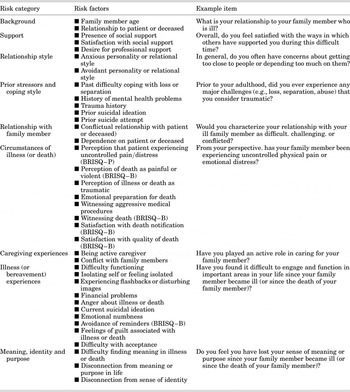
Combined, these findings guided the refinement of the screening tool language, format, and content, resulting in a final set of 34 items in the pre-loss version (BRISQ–P) and 38 items in the post-loss version (BRISQ–B). Overall, most of the risk factor categories captured in the original item pool were retained, but items were refined and the number was reduced to increase the utility and clarity of the BRISQ. Table 1 displays the risk factor categories included in the revised BRISQ, the specific risk factors assessed, and examples of revised items.
The broader risk categories, factors assessed, and examples of items in the revised Bereavement Risk Inventory and Screening Questionnaire
DISCUSSION
Our study obtained expert feedback on the clinical utility and wording of items being considered for inclusion in a clinically useful and brief self-report bereavement risk-screening tool that could be employed to inform referrals for professional psychosocial support. In general, participating bereavement experts confirmed Sealey et al.’s (Reference Sealey, O'Connor and Aoun2015b ) findings on the need for a clinically useful self-report bereavement screening tool and verified the utility and thoroughness of the preliminary item pool. Our results reflected a general consensus between experts on risk factors for bereavement-related mental health challenges, with the majority of the feedback suggesting modifications to the phrasing of items and the response scale.
Although the experts agreed that the proposed content was important to include, their feedback resulted in substantial revisions to the length, presentation, and language used in the BRISQ. A significant change was the adaptation from a checklist format (with items phrased as statements and responses as yes/no options) to a question format (with Likert-type scale response options). Items that were eliminated because of their lower clinical relevance ratings by the experts or qualitative feedback were noted to be inconsistently and/or not uniquely linked to bereavement-related mental health challenges in the literature. Most notably, the items on race and gender were eliminated because the evidence of risk associated with female gender or African-American race (Burke et al., Reference Burke, Neimeyer and McDevitt-Murphy2010; Stroebe et al., Reference Stroebe, Stroebe and Schut2001) did not point to these being risk factors on their own, but rather representative of the cumulation of other risk factors (e.g., lower income, lack of provider cultural competency, and systemic oppression). Because the intent of the BRISQ is to facilitate referrals for individuals in distress, the consensus among the experts and the authors was that these demographics would be insufficient indicators of risk for prolonged distress. These and others were eliminated in order to reduce the item pool and burden of completion. We focused on retaining the most potentially powerful predictors, as suggested by the literature and the experts.
The results of our study demonstrate the importance of researcher and clinician input with respect to the specifics of item development, such as language and phrasing, rather than solely relying on the research literature, as much of the revised language on the BRISQ was facilitated by the breadth and depth of the experts’ knowledge. Despite this strength, the study had several limitations, most notably the lack of both racial/ethnic diversity and diversity of professional disciplines represented by the sample. This limitation is largely due to the use of a convenience sample of experts known to the authors, a method common to psychometrics but not ideal for gathering a wide range of perspectives. A related challenge is the limited utility of expert panels on the whole. Though expert feedback has been found to be useful in assessing the content validity of items (Patrick et al., Reference Patrick, Burke and Gwaltney2011), care was taken to not rely solely on expert opinion to eliminate items because of the potential to miss an important predictor. The evidence for items in the literature should be considered, and items should be retained until the measure's predictive validity can be assessed in a longitudinal study.
In order to further refine the Bereavement Risk Inventory and Screening Questionnaire and improve its utility as a self-report tool, a second phase of the study is underway that involves conducting cognitive interviews with family members of cancer patients and bereaved family members to obtain information about their comprehension of and feedback on the BRISQ–P and BRISQ–B, respectively. In part due to the limitations of expert panels, this is an essential step in PRO methodology used in healthcare settings (Patrick et al., Reference Patrick, Burke and Gwaltney2011). Approaching the development and validation of this screening tool using PRO methodology increases its utility and emotional sensitivity and promotes person-centered care within palliative, hospice, and bereavement care. The BRISQ will be further refined based on family member feedback, and refined versions will be used in a longitudinal study of the psychometrics to test and finalize the BRISQ. By incorporating both expert and family member feedback, the intention is to create a screening tool that represents top clinical and research knowledge in bereavement in a way that addresses barriers to care (Sealey et al., Reference Sealey, O'Connor and Aoun2015b ; Lichtenthal et al., Reference Lichtenthal, Corner and Sweeney2015) and is comprehensible and sensitive to family members who may be struggling during bereavement or caregiving.
DECLARATIONS
Ethics Approval
This study was approved by the Memorial Sloan Kettering Cancer Center (MSK) Institutional Review Board on April 16, 2014. The protocol was approved as exempt research as per 45 CFR 46.101(b)(c). HIPAA authorization and informed consent were waived as per 45 CFR 164.512(i)(2)(ii) and 45 CFR 46.116(d).
Competing Interests
The authors hereby state that they have no competing interests to declare.
Funding
This research was generously supported by National Cancer Institute grants T32 CA009461 26, K07 CA172216, P30 CA008748, F31 CA192447 and by the Seth Sprague Foundation.
Statement of Authorship
KR designed the study, conducted data collection and analysis, and drafted and edited the manuscript. JH assisted with screening tool item development, editing the manuscript, and final approval. HP assisted with screening tool item development, editing the manuscript, and final approval. CS assisted with data analysis, editing the manuscript, and final approval. GC assisted with data analysis, editing the manuscript, and final approval. WB assisted with editing the manuscript and final approval. WL designed the study, conducted data analysis, and assisted with drafting and editing the manuscript. All authors read and approved the final manuscript.
ACKNOWLEDGMENTS
The authors would like to thank Robert Neimeyer, Ph.D., Laurie Burke, Ph.D., Sherry Schachter, Ph.D., and Stacy Stabler, M.D. for their contributions to the project and Lisa Rubin, Ph.D., the first author's (KR) graduate school advisor at the New School for Social Research, for her invaluable mentorship. We also thank the MSK Behavioral Research Methods Core for their support.



