

I. Background
The sharing and reuse of syringes from unsafe injection drug use significantly raise the transmission risk of HIV and hepatitis C virus (HCV).Reference Assoumou 1 Syringe services programs (SSPs) are evidence-based public health initiatives that reduce injection risk behaviors associated with injection drug use by providing access to sterile syringes, ultimately reducing disease transmission and preventing outbreaks.Reference Mackey 2 SSPs also typically provide services such as naloxone distribution, testing for blood-borne infections, referrals to counseling and/or drug abuse treatment, and syringe disposal,Reference Mackey 3 which can further mitigate harm from injection drug use. Decades of research and experience suggest SSPs are safe, efficacious, cost-effective, boost treatment initiation, and do not contribute to an increase in drug use or criminal activity.Reference Mackey 4
Since the earliest SSPs, state drug paraphernalia laws have created an uncertain and complex legal environment for SSPs in the US because these laws generally prohibit the distribution, possession, or both, of any item that one knows (or should know) will be used with illicit drugs, or that is designed or intended to be used with illicit drugs.Reference Burris 5 Judges, legal experts, and many state and local policymakers have questioned the application of drug paraphernalia laws to the operation of SSPs, 6 but without comprehensive statutory reform, the perceived tension between paraphernalia laws and SSPs has remained a barrier to the operation and use of SSPs in many places.Reference Burris 7
US states (including the District of Columbia) have made efforts to clarify the legal status of SSPs through legislation in different ways and to different degrees. Many states have enacted laws explicitly authorizing the establishment of SSPs, some with various procedural or substantive requirements for their operation. For example, some of these laws require local government approval prior to SSP operation, require SSP participants to exchange a used syringe for a new one, limit the number of syringes that an SSP participant may obtain, or prohibit the redistribution of sterile syringes received from an SSP (“secondary exchange”).Reference Pridgen 8 In addition to, or instead of, explicitly authorizing SSPs, some states have amended drug paraphernalia laws to allow for syringe distribution and possession by removing syringes entirely from drug paraphernalia laws, or creating SSP-related exclusions for syringes.Reference Pridgen 9 In some states, drug paraphernalia laws have led to a lack of clarity about the legality of SSP operations or SSP participants’ possession of syringes obtained from SSPs.Reference Ibragimov 10 The result is a patchwork of state SSP laws that generally fail to provide a legal environment most conducive to SSP operation and participation. 11
Scientific legal mapping can be used to accurately track the character of state laws, and to create transparent and replicable legal data for evaluation.Reference Burris 12 Previous legal mapping studies have analyzed state-specific differences in SSP authorization, regulatory requirements, and associated drug paraphernalia laws.Reference Burris 13 The most recent study reported that the number of states explicitly authorizing SSPs more than doubled (from 14 to 32) between 2014 and 2019, but also that barriers to SSPs and the possession of syringes by participants remain in place in more than 20 percent of states. 14
While there is substantial research on the health effects of SSPs as such, studies focusing on the effects that SSP and drug paraphernalia laws and policies have on SSP operations, injection risk behaviors, and health outcomes have been rare. Although sparse, the existing evidence provides plausible support for legislation to enable SSPs, and specific guidance for policymakers considering the details of SSP-related bills. Laws authorizing SSP operation have been associated with reduced hepatitis B and hepatitis C virus transmissions and syringe sharing.Reference Motie 15 Laws requiring local government approval of SSPs have been found to present challenges for their operation. 16 Laws without limits on the number of syringes a participant may obtain per visit to an SSP are associated with reduced syringe reuse.Reference Bluthenthal 17 SSP policies that increase the number of syringes participants may access on a single exchange visit can lower rates of multi-person use of syringes, reduce HIV incidence,Reference Kerr 18 and promote secondary exchange.Reference Green 19 Removing legal consequences for possession of syringes can reduce multi-person use of syringes.Reference Groseclose 20
These studies collectively suggest SSP laws and policies permitting broad syringe distribution, and syringe possession without fear of legal consequences, are associated with safer injection practices and reductions in blood-borne infectious disease transmission, but more research is needed to assess the health impact of specific elements of SSP and drug paraphernalia laws. The legal mapping work reported in this paper provides an overall update on the state of the law and aims to facilitate needed research by creating a thorough account of the key elements of state laws controlling SSPs and syringe possession and distribution from January 1, 2010, through June 1, 2024.
II. Methods
Using scientific legal mapping methods,Reference Wagenaar 21 the research team (“team”) developed a longitudinal legal dataset measuring key features of state-level laws authorizing and regulating SSP operations, as well as laws regulating possession and distribution of drug paraphernalia, across the 50 states and the District of Columbia, capturing laws in effect as of January 1, 2010, through June 1, 2024. When referring to “states” in this article, we include the District of Columbia.
The team, which consisted of four legal researchers and a supervisor, all possessing a Juris Doctor degree, began their work with a literature scan of existing research and data related to state laws regulating SSPs and drug paraphernalia.Reference Burris 22 The team worked closely with epidemiologists from Drexel University’s Dornsife School of Public Health (Drexel) to develop a causal diagram to hypothesize the mechanisms through which features of syringe access laws could plausibly affect HIV, viral hepatitis, and other infectious diseases. Based on this background research and analysis, the team developed a set of coding questions through which to measure relevant observable features of syringe access laws. The team received and incorporated feedback on the coding questions from subject matter experts at Drexel, Temple University Beasley School of Law, the National Association of County and City Health Officials (NACCHO), and the Network for Public Health Law.
Following the determination of the initial scope and context of the project, the team identified relevant state statutes and administrative regulations using keyword searches and table-of-contents reviews on WestLaw Advantage and confirmed amendment history using Lexis. State-specific legislative and administrative websites were used to collect the text of statutes and regulations. Historical notes in the legal codes were used to identify earlier laws or versions of law in effect during the study period. Search strings utilized for keyword searches are as follows:
-
1. (sale or sell! or distribu! or deliver! or possess! or exchange or access) /50 (syringe or hypodermic or needle or paraphernalia)
-
2. (“controlled substance!” or drug) /30 residu!
-
3. syringe! or hypodermic or needle! or inject!
(If there were more than 200 results, the first 200 were reviewed)
The team compared all results with laws collected in a prior legal dataset with a similar scope. 23 To verify that all relevant laws were collected, two researchers independently researched each state, and then the team reviewed and resolved any divergences in their research.
The team used an iterative coding process designed to produce stable, accurate, and reproducible observations. The team redundantly coded statutes and regulations in five batches, using MonQcle™ policy surveillance software (app.monqcle.com). Each batch of states was 100 percent redundantly coded. The supervisor compared coding at the end of each batch, identifying divergences between coders. The team then discussed and resolved divergences before beginning the next batch. Following completion of coding, the team conducted post-production statistical quality control (SQC). This process involved independently recoding a targeted random sample of 157 variables drawn from the full dataset of 57,340 coded cells to estimate the error rate with 95 percent confidence. SQC identified a divergence rate of 1.91 percent, and each divergence was subsequently reviewed by the supervisor and resolved collaboratively by the team. The data and accompanying codebook can be found at LawAtlas.org, along with the research protocol that describes the scope, legal research procedures, coding scheme, and quality control steps. 24
III. Results
Most states now have at least some law that authorizes or removes one or more legal barriers to SSPs and their use by people who inject drugs (PWID). From January 1, 2010, to June 1, 2024, the number of states with any legal mechanism enabling the distribution of syringes from SSPs nearly doubled, increasing from 22 states to 42 (Table 1). The number of states explicitly authorizing SSPs by law grew from 14 as of January 1, 2010 to 33 as of December 31, 2021, where it remained throughout the study period (Figure 1). State laws explicitly authorizing SSPs included language such as “authorize,” “shall establish,” “may operate,” or other comparable phrasing provided in more detail in the research protocol. All of these states explicitly authorized SSP operation via state statute except New York, which did so via administrative regulation. As of June 1, 2024, four other states (Minnesota, Montana, Oregon, and Washington) had laws that implicitly recognized the legality of SSPs but not a law authorizing them explicitly. 25 For example, Minnesota law required that a public health agency “that participates in a needle exchange program” post certain information on its website about how it disposes of syringes, a provision that would not be needed unless SSPs were deemed legal. 26 Five additional states (Alaska, Arkansas, Michigan, South Carolina, and Wisconsin) do not have a law specifically referencing SSPs, but their drug paraphernalia laws (or lack thereof in Alaska) are such that they allow for the distribution of syringes from SSPs (Table 1). As of June 1, 2024, nine states did not have any legal mechanism enabling SSP operations in any way (Alabama, Iowa, Kansas, Mississippi, Missouri, Nebraska, Pennsylvania, South Dakota, and Wyoming).
Legal mechanisms that allow for distribution of syringes from syringe services programs (SSPs) in the 50 US states and the District of Columbia as of January 1, 2010, and June 1, 2024

Asterisk * indicates authorization is for a pilot program or limited geographic area.
Note: Because states may allow distribution of syringes in more than one way, the sum of the totals reported by mechanism exceeds the total number of states that allow distribution of syringes by SSPs.
US states with a law that explicitly or implicitly authorizes syringe services programs (SSPs) from January 1, 2010, through June 1, 2024.
Note: Asterisk * indicates authorization is for a pilot program or limited geographic area. Parentheses ( ) indicate state law implicitly authorizes SSP operation.

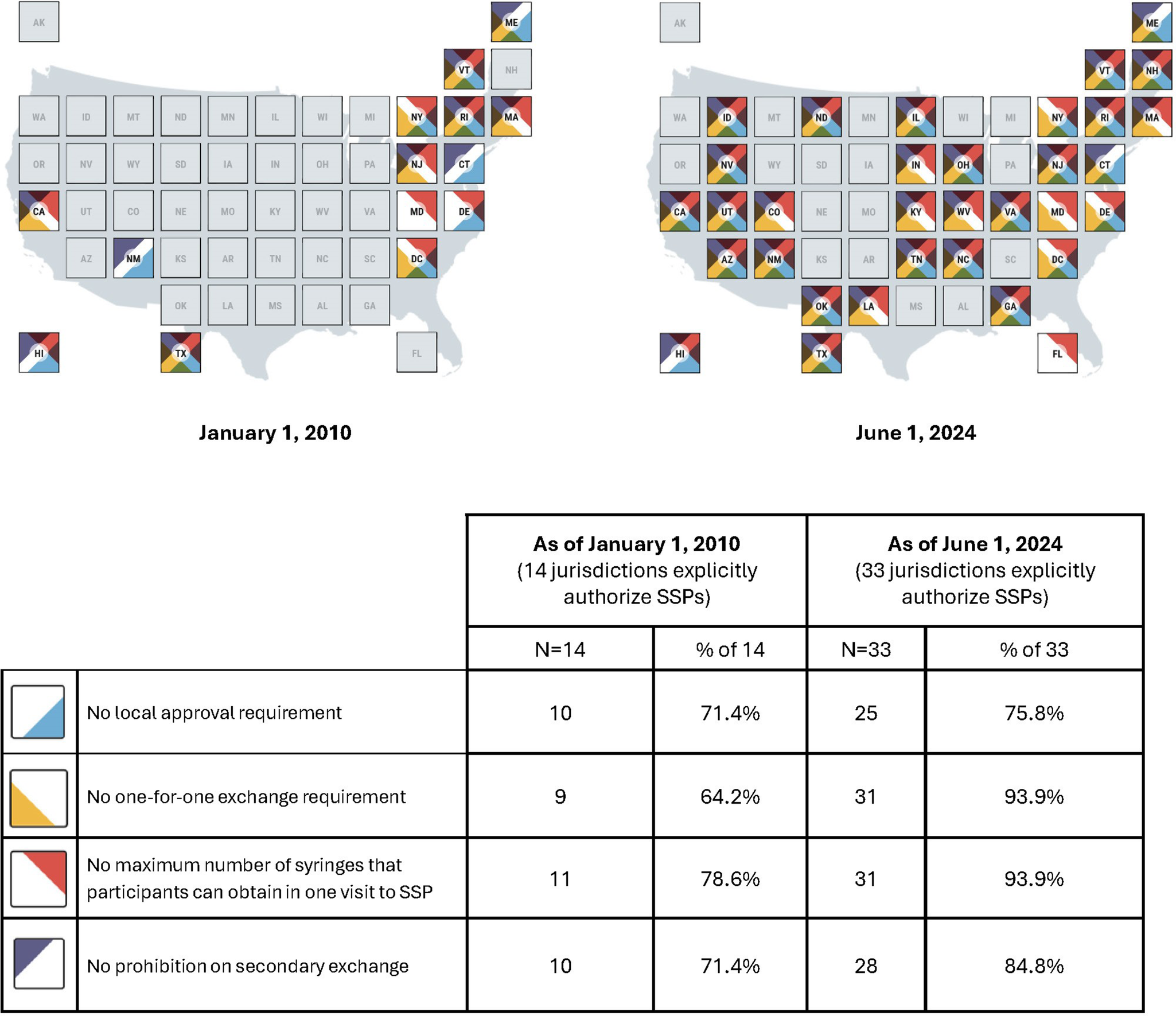
An increasing proportion of states explicitly authorized SSPs without requiring one-for-one exchange of a used syringe to obtain a sterile syringe, imposing a limit on the number of syringes distributed per visit, or barring secondary exchange (Figure 2). The proportion of state SSP authorization laws that do not require local government approval increased from 10 of 14 states as of January 1, 2010 to 25 of 33 states as of June 1, 2024, leaving 8 states with local approval requirements (Colorado, Florida, Indiana, Kentucky, Louisiana, Maryland, Massachusetts, and West Virginia). The proportion of explicit authorization states that had none of these barriers increased from 3 of 14 states to 19 of 33 states. As of June 1, 2024, 14 states with explicit authorization laws still had at least one of these limits on SSP operations.
US states with a law that explicitly authorizes syringe services programs (SSPs) and supports evidence-based practices, as of January 1, 2010, and as of June 1, 2024.
Note: States that are completely gray do not have a law explicitly authorizing SSPs.
Of the 33 states that explicitly authorized SSPs as of June 1, 2024, 24 had enacted at least one law that allowed for the possession of syringes obtained from SSPs — most commonly, exempting SSP participants from prohibitions against drug paraphernalia possession (Figure 3). During the project period, three states that previously excluded only SSP participants from drug paraphernalia possession laws enacted broader exceptions: California and New Jersey amended their laws to exclude syringes from their prohibition against drug paraphernalia possession; the District of Columbia removed the prohibition against drug paraphernalia possession altogether. New York amended its statute to remove the prohibition on syringe possession but maintained a regulation that prohibited possession of syringes with exceptions, including for SSP participants. Two states (Georgia and Maine), where previously there had been no possession exemption for syringes obtained from SSPs, amended their laws to explicitly exclude syringes from drug paraphernalia laws altogether.
US states with a law explicitly authorizing syringe services programs (SSPs) and with a supportive law regarding drug paraphernalia possession, as of January 1, 2010, and as of June 1, 2024.
Note: States that are completely gray do not have a law explicitly authorizing SSPs.
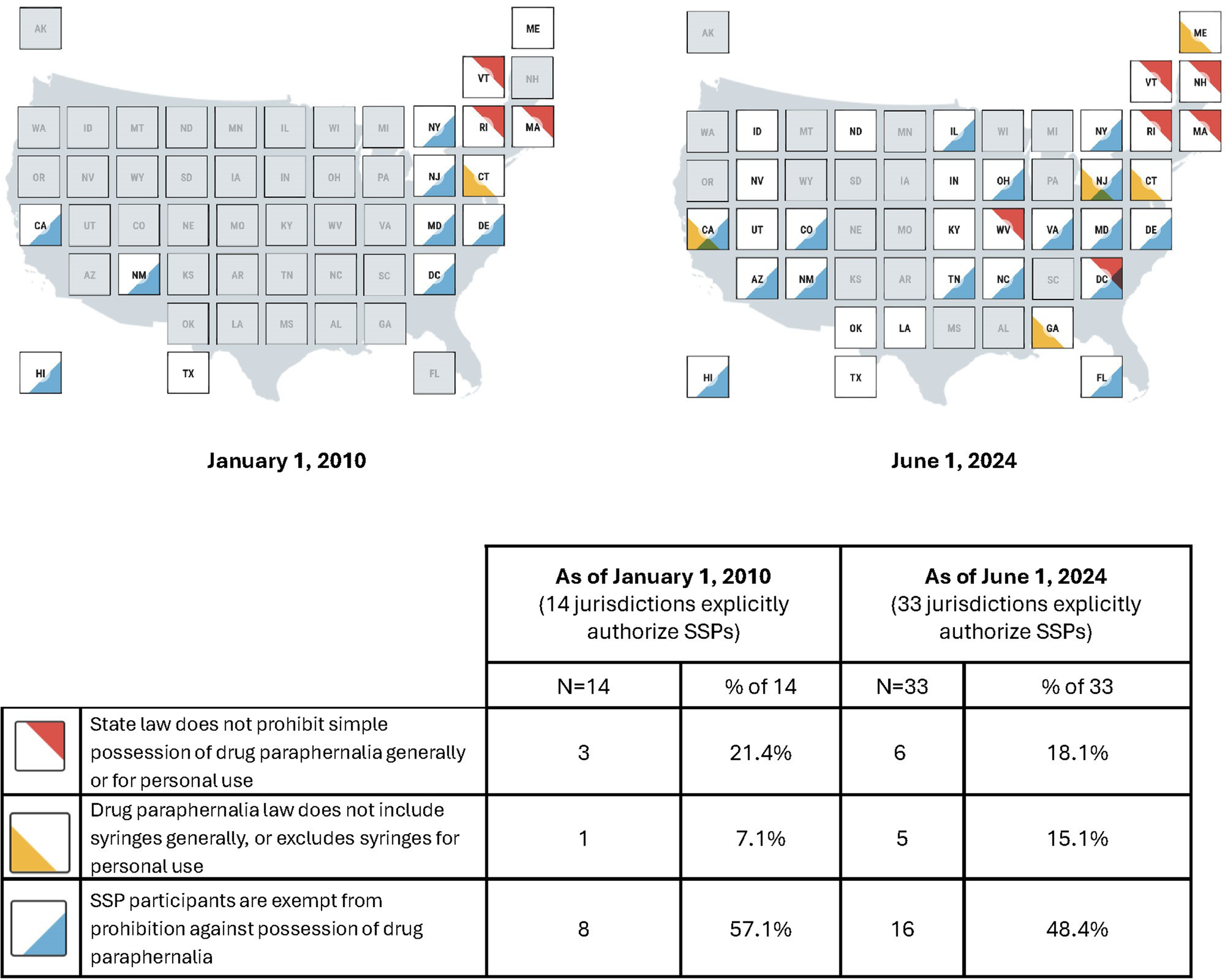
Of the 33 states explicitly authorizing SSPs, 25 had amended their drug paraphernalia laws to allow the distribution of syringes from SSPs. As of June 1, 2024, 3 states that explicitly authorized SSPs did not prohibit the free distribution of drug paraphernalia (Massachusetts, Vermont, and West Virginia), up from 2 states as of January 1, 2010; 5 states that explicitly authorized SSPs did not include syringes in their drug paraphernalia distribution law (Connecticut, Maine, Nevada, New Hampshire, and New Jersey), up from 1 state as of January 1, 2010; and 17 states specifically exempted SSP employees from their syringe or drug paraphernalia distribution prohibitions, up from 8 states as of January 1, 2010.
Figure 4 summarizes the state of SSP-enabling laws as of June 1, 2024. Despite the trend towards explicit authorization, and many changes in the patchwork of SSP restrictions and drug paraphernalia law barriers, only one state, Vermont, took legal steps on each of the identified barriers to eliminate operational restrictions or potentially deterrent paraphernalia law provisions.
Filter showing US states with the specified combination of legal features supportive of syringe services program (SSP) operations as of June 1, 2024.

IV. Discussion
Forty-two states now have laws in place that authorize SSPs, remove at least some paraphernalia law impediments to SSP operation and sterile syringe use, or both. While state law has tended to become more conducive to this public health intervention, challenges remain. SSP authorization and drug paraphernalia laws in most states still have provisions that are unclear or contrary to the deployment of the intervention in some way, and at least one state (Idaho) repealed its SSP authorization law after the study period ended.
Many current state SSP authorization laws exhibit elements that may complicate implementation. Laws describing SSP activities in terms of “exchanging” syringes may be perceived as ambiguous on the question of whether actual exchange of a used syringe for new ones is required or if participants may obtain sterile syringes without returning at least one or an equal number of used ones. 27 Requirements to obtain local approval to operate an SSP can be a barrier to opening SSPs 28 (and even in Vermont, the state with the fewest measured barriers in our study and where local approval is not required, state official approval remains as a potential hurdle to SSP operations). 29 Beliefs that SSPs increase drug use, crime, and syringe litter may contribute to local community conceptions of SSPs.Reference Volkow 30 While groups establishing SSPs should work with their local communities to understand and address concerns that arise, laws mandating local approval for SSP operation go beyond community engagement. 31 Requiring formal approval from local government may be burdensome for organizations, and stigmatize an intervention that has already gone through the democratic process at the state level. 32 The increasingly large proportion of SSP laws without local government approval requirements may indicate changing legislative viewpoints on these requirements. Finally, some state laws authorize only specific programs: for example, Texas’ SSP law, on the books for the entirety of the study period, authorizes only a “pilot” program in one county.
The primary public health goal of SSPs is to ensure that every person injecting drugs uses a sterile syringe every time to prevent the spread of infectious diseases and stop outbreaks before they happen. This goal does not solely depend on directly providing the syringe to the user; it may also be achieved when syringes distributed to SSP clients are passed on to other users not willing or able to attend an SSP themselves.Reference Brothers and Kerr 33 SSP authorization policies that allow syringe distribution without numerical limits or exchange requirements, and that authorize or do not forbid secondary exchange, lead to more sterile syringes being available.Reference Kral 34 The overall trend away from these types of requirements, seen through the study results described in this paper, may demonstrate support for evidence-based practices generally.
SSP authorizing law is not always consistent with general drug paraphernalia law. States that have removed specific references to syringes in one statute but continue to prohibit distribution of items that could be used for injecting in a separate statute leave uncertainty regarding the lawfulness of distributing syringes. 35 Drug paraphernalia laws can be a barrier to SSP operations by creating uncertainty for SSP operators and participants regarding lawful distribution or possession of syringes, and by impeding secondary exchange. 36 Exempting SSP participants from drug paraphernalia laws still may leave PWID open to law enforcement interactions when their SSP participation may not be clear. 37 Further, limiting drug paraphernalia exceptions to SSP employees leaves clients at legal risk for possessing the syringes they were legally provided, and offers no protection for secondary exchangers or the informal distribution of sterile syringes by health care providers or other well-meaning volunteers.Reference Burris 38 Paraphernalia laws may also create a de facto local authorization requirement, by giving a basis for legal action against would-be SSP operators.
While most states now have laws that enable SSP operation, a legal climate most conducive to effective SSP operations would provide clear, explicit authorization without requirements that limit evidence-based practices — including distributing syringes based on need without numerical limits, and not requiring local approval — and without drug paraphernalia laws that might deter operators from offering SSP services, or participants from possessing the syringes they obtain.
Law is just one element among many that influence the founding, operation, and effectiveness of SSPs. The primary mechanism of SSP effect is not law, but the actual delivery of services to the people in need. Over the nearly five decades that SSPs have operated in the US, service providers have worked to save lives from infectious diseases, preventable outbreaks, and overdoses.Reference Ray 39 Ambiguous law has not always stopped them, and positive law may not always have translated into available and accessible services. Research on the effects of various types and degrees of legal support on actual health outcomes could better inform policymakers on the importance of optimizing SSP law to prevent infectious disease outbreaks.
This study measures law “on the books.” Observation of statutes, regulations, and court decisions cannot determine whether or how SSPs operate, or how drug paraphernalia laws are actually enforced by law enforcement and local prosecutors. Nor does this study measure local-level drug paraphernalia or SSP laws or policies, which could differ from state-level laws. For example, Alaska has no state paraphernalia law, but some municipalities do; 40 in Pennsylvania, SSPs are not authorized by state legislation, but operate legally in Philadelphia and Pittsburgh under local authorizations.Reference Ferguson 41
V. Conclusion
Previous research has shown that SSPs are a safe and effective tool for reducing harms caused by injection drug use, including HIV and HCV transmission. 42 Existing evidence suggests the legal environment associated with more effective SSP operations consists of laws that explicitly authorize SSPs without limitations through local government approval, without restrictions that hinder the broad distribution of syringes, and without prohibitions on the possession or distribution of drug paraphernalia. This study demonstrates that states have enacted legislation creating a legal environment more conducive to SSP operations. Still, only Vermont’s laws explicitly authorize SSPs without a local approval requirement, a one-for-one exchange requirement, a limit on the number of syringes a participant can receive, and a prohibition on secondary exchange, while also not prohibiting the possession or distribution of drug paraphernalia. The longitudinal dataset created in this study facilitates evaluation of the variations in SSP and drug paraphernalia laws to better understand the relationship between these laws and health outcomes.
Acknowledgement
This work was supported by the Centers for Disease Control and Prevention of the US Department of Health and Human Services (HHS) as part of a financial assistance award totaling $750,000, with 100 percent funded by CDC/HHS. The contents are those of the authors, and do not necessarily represent the official views of, nor an endorsement by, CDC/HHS or the US government.
Disclosure
The authors have nothing to disclose.


 Open access

