









1 Introduction
If $\mathcal {V}$
is a finite-dimensional vector space over a field
$\mathcal {V}$
is a finite-dimensional vector space over a field $\mathbb {F}$
, a family
$\mathbb {F}$
, a family ${\cal F}$
of linear transformations on
${\cal F}$
of linear transformations on ${\cal V}$
is called irreducible if the lattice Lat
${\cal V}$
is called irreducible if the lattice Lat ${\cal F}$
of common invariant subspaces of
${\cal F}$
of common invariant subspaces of ${\cal F}$
is trivial, that is, if Lat
${\cal F}$
is trivial, that is, if Lat ${\cal F}=\{(0),{\cal V}\}$
. Every finite irreducible family of matrices over a field
${\cal F}=\{(0),{\cal V}\}$
. Every finite irreducible family of matrices over a field $\mathbb {F}$
contains a subfamily which is irreducible but has no proper irreducible subfamily. Such a subfamily is then minimally irreducible. Burnside’s well-known theorem (see [Reference Lomonosov and Rosenthal6], [Reference Radjavi and Rosenthal8, Theorem 1.2.2]) gives a linear algebraic characterisation of irreducibility. It states that the family
$\mathbb {F}$
contains a subfamily which is irreducible but has no proper irreducible subfamily. Such a subfamily is then minimally irreducible. Burnside’s well-known theorem (see [Reference Lomonosov and Rosenthal6], [Reference Radjavi and Rosenthal8, Theorem 1.2.2]) gives a linear algebraic characterisation of irreducibility. It states that the family ${\cal F}$
is irreducible if and only if the unital algebra generated by
${\cal F}$
is irreducible if and only if the unital algebra generated by ${\cal F}$
is the algebra of all linear transformations on the space, providing
${\cal F}$
is the algebra of all linear transformations on the space, providing $\mathbb {F}$
is algebraically closed and has dimension greater than one. Because of this theorem, the notion of ‘irredundant generating set of matrices’ investigated in [Reference Blumenthal and First1, Reference Laffey5] coincides with ‘minimally irreducible set of matrices’ when the underlying field is algebraically closed. With such an underlying field
$\mathbb {F}$
is algebraically closed and has dimension greater than one. Because of this theorem, the notion of ‘irredundant generating set of matrices’ investigated in [Reference Blumenthal and First1, Reference Laffey5] coincides with ‘minimally irreducible set of matrices’ when the underlying field is algebraically closed. With such an underlying field $\mathbb {F}$
, the main theorem of [Reference Blumenthal and First1] is as follows.
$\mathbb {F}$
, the main theorem of [Reference Blumenthal and First1] is as follows.
Theorem 1.1. If $n\ge 2$
, every minimally irreducible set of matrices in
$n\ge 2$
, every minimally irreducible set of matrices in $M_n(\mathbb {F}) $
has at most
$M_n(\mathbb {F}) $
has at most $2n-1$
elements.
$2n-1$
elements.
Here, $M_n(\mathbb {F}) $
denotes the set of
$M_n(\mathbb {F}) $
denotes the set of $n\times n$
matrices with entries in
$n\times n$
matrices with entries in $\mathbb {F}$
.
$\mathbb {F}$
.
In this paper, we consider minimally irreducible families of complex $n\times n$
matrices,
$n\times n$
matrices, $n>1$
, from a more lattice theoretic point of view. Irreducible families of rank one matrices are characterised in [Reference Longstaff7, Theorem 3]. A corollary of this result leads to an interpretation of some of the results of [Reference Brualdi and Hedrick2] in terms of the minimal irreducibility of families of matrix units. Specifically, a minimally irreducible family of matrix units in
$n>1$
, from a more lattice theoretic point of view. Irreducible families of rank one matrices are characterised in [Reference Longstaff7, Theorem 3]. A corollary of this result leads to an interpretation of some of the results of [Reference Brualdi and Hedrick2] in terms of the minimal irreducibility of families of matrix units. Specifically, a minimally irreducible family of matrix units in $M_n({\mathbb {C}})$
has k elements where
$M_n({\mathbb {C}})$
has k elements where $n\le k\le 2n-2$
. We also consider families of (a) rank one projections, (b) unicellular matrices and (c) orthoatomic matrices (see definitions below). If
$n\le k\le 2n-2$
. We also consider families of (a) rank one projections, (b) unicellular matrices and (c) orthoatomic matrices (see definitions below). If $n>2$
, such a family has k elements where respectively (a)
$n>2$
, such a family has k elements where respectively (a) $k=n$
, (b)
$k=n$
, (b) $2\le k\le n-1$
and (c)
$2\le k\le n-1$
and (c) $2\le k\le n-1$
. All of the values of k in these ranges are attained. If
$2\le k\le n-1$
. All of the values of k in these ranges are attained. If $n=2$
, each such family has
$n=2$
, each such family has $2$
elements.
$2$
elements.
If $A\in M_n( {\mathbb {C}})$
, Lat A denotes the set of invariant subspaces of A. Then, Lat A is a lattice under the inclusion ordering, with joins being linear spans and meets being intersections. It has a least element
$A\in M_n( {\mathbb {C}})$
, Lat A denotes the set of invariant subspaces of A. Then, Lat A is a lattice under the inclusion ordering, with joins being linear spans and meets being intersections. It has a least element $(0)$
and a greatest element
$(0)$
and a greatest element ${\mathbb {C}}^n$
.
${\mathbb {C}}^n$
.
2 Matrix units
Throughout what follows, $n\in {\mathbb {Z}}^+$
and
$n\in {\mathbb {Z}}^+$
and $n\ge 2$
, unless otherwise specified. Every rank one matrix
$n\ge 2$
, unless otherwise specified. Every rank one matrix $R\in M_n({\mathbb {C}})$
is of the form
$R\in M_n({\mathbb {C}})$
is of the form $R=e\otimes f$
, where
$R=e\otimes f$
, where $e,f\in {\mathbb {C}}^n$
are nonzero vectors and
$e,f\in {\mathbb {C}}^n$
are nonzero vectors and $Rx=(x|e)f$
for all
$Rx=(x|e)f$
for all $x\in {\mathbb {C}}^n$
. Here, ‘
$x\in {\mathbb {C}}^n$
. Here, ‘ $(\cdot |\cdot )$
’ denotes the usual inner-product. If
$(\cdot |\cdot )$
’ denotes the usual inner-product. If ${A,B\in M_{n}({\mathbb {C}})}$
, we have
${A,B\in M_{n}({\mathbb {C}})}$
, we have $ARB=A(e\otimes f)B=(B^*e)\otimes (Af)$
, where ‘
$ARB=A(e\otimes f)B=(B^*e)\otimes (Af)$
, where ‘ $^*$
’ denotes adjoint.
$^*$
’ denotes adjoint.
Let $\{e_1, e_2,\ldots , e_n\}$
denote the standard ordered basis of
$\{e_1, e_2,\ldots , e_n\}$
denote the standard ordered basis of ${\mathbb {C}}^n$
. For
${\mathbb {C}}^n$
. For $1\le i,j\le n$
,
$1\le i,j\le n$
, $E_{i,j}=e_j\otimes e_i$
denotes the usual
$E_{i,j}=e_j\otimes e_i$
denotes the usual $n\times n$
matrix unit. Notice that
$n\times n$
matrix unit. Notice that $E_{i,j}E_{k,l}=\delta _{j,k} E_{i,l}$
, where
$E_{i,j}E_{k,l}=\delta _{j,k} E_{i,l}$
, where $\delta _{j,k}$
is the Kronecker delta function. The linear span of a subset
$\delta _{j,k}$
is the Kronecker delta function. The linear span of a subset ${\cal F}$
of
${\cal F}$
of $M_n({\mathbb {C}})$
is denoted by
$M_n({\mathbb {C}})$
is denoted by $\langle {\cal F}\rangle $
. Irreducible families of matrix units are characterised in [Reference Longstaff7, Corollary 2]. This characterisation and others are given in the following proposition.
$\langle {\cal F}\rangle $
. Irreducible families of matrix units are characterised in [Reference Longstaff7, Corollary 2]. This characterisation and others are given in the following proposition.
Proposition 2.1. Let ${\cal D}$
be a nonempty subset of
${\cal D}$
be a nonempty subset of $\{1,2,\ldots , n\}\times \{1,2,\ldots , n\}$
and let
$\{1,2,\ldots , n\}\times \{1,2,\ldots , n\}$
and let $\{E_{i,j}: (i,j)\in {\cal D}\}$
be the corresponding set of matrix units. Let A be the
$\{E_{i,j}: (i,j)\in {\cal D}\}$
be the corresponding set of matrix units. Let A be the ${n\times n\ (0,1)}$
-matrix
${n\times n\ (0,1)}$
-matrix $A=\sum \{E_{i,j}: (i,j)\in {\cal D}\}$
. The following statements are equivalent:
$A=\sum \{E_{i,j}: (i,j)\in {\cal D}\}$
. The following statements are equivalent:
-
(i) A does not have a proper nontrivial invariant subspace spanned by standard basis vectors;
-
(ii) there does not exist a partition $\alpha , \beta $
of
$\{1,2,\ldots ,n\}$
into nonempty sets such that the submatrix
$A[\alpha , \beta ]$
of A consisting of the elements of A at the intersections of rows
$i\,(i $
in
$\alpha )$
and columns
$j\,(j$
in
$\beta )$
is a zero matrix;
$\alpha , \beta $
of
$\{1,2,\ldots ,n\}$
into nonempty sets such that the submatrix
$A[\alpha , \beta ]$
of A consisting of the elements of A at the intersections of rows
$i\,(i $
in
$\alpha )$
and columns
$j\,(j$
in
$\beta )$
is a zero matrix; -
(iii) every row and every column of the matrix A contains a nonzero element and, for every proper, nonempty subset
${\cal E}$
of
${\cal D}$
satisfying
$\{i: (i,j)\in {\cal E}\}\ne \{1,2,\ldots ,n\}$
, there exist
$i,j,k$
such that
$(i,j)\in {\cal E}, (k,i)\in {\cal D}\backslash {\cal E}$
and
$(k,m)\not \in {\cal E}$
for
$1\le m\le n$
; -
(iv) the family
${\cal D}$
is irreducible.


Proof. We prove that (i) $\implies $
(ii)
$\implies $
(ii) $\implies $
(iii)
$\implies $
(iii) $\implies $
(iv)
$\implies $
(iv) $\implies $
(i).
$\implies $
(i).
(i) $\implies $
(ii). Assume that statement (i) holds. Suppose there was a partition
$\implies $
(ii). Assume that statement (i) holds. Suppose there was a partition $\alpha , \beta $
of
$\alpha , \beta $
of $\{1,2,\ldots ,n\}$
as described in statement (ii). Let
$\{1,2,\ldots ,n\}$
as described in statement (ii). Let $M=\langle \{e_j: j\in \beta \}\rangle $
. Then, M is proper and nontrivial. Since
$M=\langle \{e_j: j\in \beta \}\rangle $
. Then, M is proper and nontrivial. Since $A_{i,j}=0$
for every
$A_{i,j}=0$
for every $i\in \alpha , j\in \beta $
, it follows that
$i\in \alpha , j\in \beta $
, it follows that $Ae_j\perp e_i$
for every
$Ae_j\perp e_i$
for every $i\in \alpha , j\in \beta $
. Thus, M is invariant under A.
$i\in \alpha , j\in \beta $
. Thus, M is invariant under A.
(ii) $\implies $
(iii). Assume that statement (ii) holds. If A had a row of zeros, say the pth, then the submatrix
$\implies $
(iii). Assume that statement (ii) holds. If A had a row of zeros, say the pth, then the submatrix $A[\alpha , \beta ]$
with partition
$A[\alpha , \beta ]$
with partition $\alpha =\{p\}, \beta =\{q:q\ne p\}$
is a zero matrix. So, every row of A contains a nonzero element. Similarly, every column of A contains a nonzero element.
$\alpha =\{p\}, \beta =\{q:q\ne p\}$
is a zero matrix. So, every row of A contains a nonzero element. Similarly, every column of A contains a nonzero element.
Let ${\cal E}$
be a proper, nonempty subset of
${\cal E}$
be a proper, nonempty subset of ${\cal D}$
, satisfying
${\cal D}$
, satisfying $\{i: (i,j)\in {\cal E}\}\ne \{1,2,\ldots ,n\}$
. Define
$\{i: (i,j)\in {\cal E}\}\ne \{1,2,\ldots ,n\}$
. Define $\beta =\{i: (i,j)\in {\cal E}\}$
. Then,
$\beta =\{i: (i,j)\in {\cal E}\}$
. Then, $\beta $
is a proper, nonempty subset of
$\beta $
is a proper, nonempty subset of $\{1,2,\ldots ,n\}$
. Let
$\{1,2,\ldots ,n\}$
. Let $\alpha $
be the complement of
$\alpha $
be the complement of $\beta $
in
$\beta $
in $\{1,2,\ldots ,n\}$
. Since statement (ii) holds, the submatrix
$\{1,2,\ldots ,n\}$
. Since statement (ii) holds, the submatrix $A[\alpha , \beta ]$
is not the zero matrix. Thus,
$A[\alpha , \beta ]$
is not the zero matrix. Thus, $A_{k,i}\ne 0$
for some
$A_{k,i}\ne 0$
for some $k\in \alpha , i\in \beta $
, so that
$k\in \alpha , i\in \beta $
, so that $(k,i)\in {\cal D}$
. Since
$(k,i)\in {\cal D}$
. Since $i\in \beta , (i,j)\in {\cal E}$
for some j. Since
$i\in \beta , (i,j)\in {\cal E}$
for some j. Since $k\not \in \beta $
,
$k\not \in \beta $
, $(k,m)\not \in {\cal E}$
for
$(k,m)\not \in {\cal E}$
for $1\le m\le n$
. Since
$1\le m\le n$
. Since $(k,i)\in {\cal D}$
,
$(k,i)\in {\cal D}$
, $(k,i)\in {\cal D}\backslash {\cal E}$
.
$(k,i)\in {\cal D}\backslash {\cal E}$
.
(iii) $\implies $
(iv). See [Reference Longstaff7, Corollary 2].
$\implies $
(iv). See [Reference Longstaff7, Corollary 2].
(iv) $\implies $
(i). Assume that statement (iv) holds. Suppose that A has a proper nontrivial invariant subspace M spanned by standard basis vectors. Let
$\implies $
(i). Assume that statement (iv) holds. Suppose that A has a proper nontrivial invariant subspace M spanned by standard basis vectors. Let ${M=\langle \{e_j: j\in \gamma \}\rangle }$
, where
${M=\langle \{e_j: j\in \gamma \}\rangle }$
, where $\gamma $
is a proper nonempty subset of
$\gamma $
is a proper nonempty subset of $\{1,2,\ldots ,n\}$
. For every
$\{1,2,\ldots ,n\}$
. For every $j\in \gamma , Ae_j\in M$
so
$j\in \gamma , Ae_j\in M$
so $(Ae_j|e_i)=0$
for every
$(Ae_j|e_i)=0$
for every $i\not \in \gamma $
. Now, let
$i\not \in \gamma $
. Now, let $(p,q)\in {\cal D}$
. We show that
$(p,q)\in {\cal D}$
. We show that $E_{p,q}$
leaves M invariant. Recall that
$E_{p,q}$
leaves M invariant. Recall that $E_{p,q}(x)=(x|e_q)e_p$
for all
$E_{p,q}(x)=(x|e_q)e_p$
for all $x\in {\mathbb {C}}^n$
. If
$x\in {\mathbb {C}}^n$
. If $e_p\in M$
, then M is invariant under
$e_p\in M$
, then M is invariant under $E_{p,q} $
. If
$E_{p,q} $
. If $e_p\not \in M$
, then
$e_p\not \in M$
, then $p\not \in \gamma $
. Since
$p\not \in \gamma $
. Since $A_{i,j}=0$
for every
$A_{i,j}=0$
for every $j\in \gamma $
and
$j\in \gamma $
and $i\not \in \gamma $
, and
$i\not \in \gamma $
, and $A_{p,q}\ne 0$
, it follows that
$A_{p,q}\ne 0$
, it follows that $q\not \in \gamma $
. Thus,
$q\not \in \gamma $
. Thus, $e_q\in M^{\perp }$
, so
$e_q\in M^{\perp }$
, so $E_{p,q}(x)=0$
for every
$E_{p,q}(x)=0$
for every $x\in M$
. This contradicts the irreducibility of the family
$x\in M$
. This contradicts the irreducibility of the family ${\cal D}$
.
${\cal D}$
.
In [Reference Brualdi and Hedrick2], the authors define an $n\times n$
,
$n\times n$
, $(0,1)$
-matrix A, with
$(0,1)$
-matrix A, with $n\ge 2$
, to be ‘irreducible’ if it satisfies condition (ii) of the preceding proposition. So, the preceding proposition gives a correspondence between ‘irreducible’
$n\ge 2$
, to be ‘irreducible’ if it satisfies condition (ii) of the preceding proposition. So, the preceding proposition gives a correspondence between ‘irreducible’ $(0,1)$
-matrices and irreducible families of matrix units. Also, their definition of a ‘nearly reducible’
$(0,1)$
-matrices and irreducible families of matrix units. Also, their definition of a ‘nearly reducible’ $(0,1)$
-matrix corresponds to a minimally irreducible family of matrix units. The article [Reference Brualdi and Hedrick2] includes a detailed account of ‘
$(0,1)$
-matrix corresponds to a minimally irreducible family of matrix units. The article [Reference Brualdi and Hedrick2] includes a detailed account of ‘ ${nearly\, \,reducible}$
’
${nearly\, \,reducible}$
’ $(0,1)$
-matrices couched in the language of connected digraphs. Using the correspondence outlined above, [Reference Brualdi and Hedrick2, Theorem 2.12] leads to the following result.
$(0,1)$
-matrices couched in the language of connected digraphs. Using the correspondence outlined above, [Reference Brualdi and Hedrick2, Theorem 2.12] leads to the following result.
Theorem 2.2. A minimally irreducible family of matrix units in $M_n({\mathbb {C}})$
,
$M_n({\mathbb {C}})$
, $n\ge 2$
, has cardinality k, where
$n\ge 2$
, has cardinality k, where $n\le k\le 2n-2$
. Each value of k within these bounds is attained.
$n\le k\le 2n-2$
. Each value of k within these bounds is attained.
The following examples correspond to examples given in [Reference Brualdi and Hedrick2]. They are included primarily for the reader’s convenience.
Example 2.3. (i) The family of rank one matrices ${\cal E}_1=\{E_{i,i+1}: 1\le i\le n-1\}\cup \{E_{n,1}\}$
is minimally irreducible. The corresponding
${\cal E}_1=\{E_{i,i+1}: 1\le i\le n-1\}\cup \{E_{n,1}\}$
is minimally irreducible. The corresponding $(0,1)$
-matrix is
$(0,1)$
-matrix is
 $$ \begin{align*} \begin{bmatrix} 0&1&0&\cdots&0\\ 0&0&1&\cdots&0\\ \cdot &\cdot &\cdot &\cdots &\cdot\\ 0&0&0&\cdots&1\\ 1&0&0&\cdots&0 \end{bmatrix}. \end{align*} $$
A direct proof is not difficult. The above matrix is equal to $J+E_{n,1}$
, where J is the elementary Jordan matrix. It is well known that J is unicellular with nonzero invariant subspaces
$J+E_{n,1}$
, where J is the elementary Jordan matrix. It is well known that J is unicellular with nonzero invariant subspaces $\{\langle e_1,e_2,\ldots ,e_k\rangle : 1\le k\le n\}$
. Every nonzero subspace M invariant under J contains
$\{\langle e_1,e_2,\ldots ,e_k\rangle : 1\le k\le n\}$
. Every nonzero subspace M invariant under J contains $e_1$
, and it contains
$e_1$
, and it contains $e_n$
if and only if
$e_n$
if and only if $M={\mathbb {C}}^n$
. Thus,
$M={\mathbb {C}}^n$
. Thus, ${\cal E}_1$
is an irreducible family.
${\cal E}_1$
is an irreducible family.
Clearly, each element of ${\cal E}_1\backslash \{E_{n,1}\}$
leaves
${\cal E}_1\backslash \{E_{n,1}\}$
leaves $\langle e_1\rangle $
invariant. It is easily checked that each element of
$\langle e_1\rangle $
invariant. It is easily checked that each element of ${\cal E}_1\backslash \{E_{i, i+1}\}$
, where
${\cal E}_1\backslash \{E_{i, i+1}\}$
, where $1\le i\le n-1$
, leaves
$1\le i\le n-1$
, leaves $\langle e_{i+1}, e_{i+2}, \ldots , e_n\rangle $
invariant.
$\langle e_{i+1}, e_{i+2}, \ldots , e_n\rangle $
invariant.
(ii) The family of rank one matrices
 $$ \begin{align*}{\cal E}_2=\{E_{i,i+1}: 1\le i\le n-1\}\cup\{E_{i+1,i}: 1\le i\le n-1\}\end{align*} $$
is minimally irreducible. The corresponding $(0,1)$
-matrix is
$(0,1)$
-matrix is
 $$ \begin{align*}\begin{bmatrix} 0&1&0&\cdots&0&0\\ 1&0&1&\cdots&0&0\\ 0&1&0&\cdots&0&0\\ \cdot &\cdot &\cdot &\cdots &\cdot &\cdot \\ 0&0&0&\cdots&0&1\\ 0&0&0&\cdots&1&0 \end{bmatrix}. \end{align*} $$
For a direct proof, notice that J and $J^*$
have no common nontrivial invariant subspace. This proves the irreducibility of
$J^*$
have no common nontrivial invariant subspace. This proves the irreducibility of ${\cal E}_2$
. For minimality, it is easily checked that
${\cal E}_2$
. For minimality, it is easily checked that $\langle e_1,e_2, \ldots , e_i\rangle $
, where
$\langle e_1,e_2, \ldots , e_i\rangle $
, where $1\le i\le n-1$
, is invariant under each element of
$1\le i\le n-1$
, is invariant under each element of ${\cal E}_2\backslash \{E_{i+1,i}\}$
and
${\cal E}_2\backslash \{E_{i+1,i}\}$
and $\langle e_{j+1}, e_{j+2}, \ldots , e_n\rangle $
, where
$\langle e_{j+1}, e_{j+2}, \ldots , e_n\rangle $
, where $1\le j\le n-1$
, is invariant under each element of
$1\le j\le n-1$
, is invariant under each element of ${\cal E}_2\backslash \{E_{j,j+1}\}$
.
${\cal E}_2\backslash \{E_{j,j+1}\}$
.
(iii) If $n<k<2n-2$
, the family of rank one matrices
$n<k<2n-2$
, the family of rank one matrices
 $$ \begin{align*}\{E_{i,i+1}: 1\le i\le n-1\}\cup\{E_{i+1,i}: 1\le i\le k-n\}\cup\{E_{n,k-n+1}\}\end{align*} $$
is minimally irreducible with k elements.
3 Rank one projections
In what follows, projection will mean orthogonal projection. So, P is a projection if and only if $P=P^*=P^2.$
If
$P=P^*=P^2.$
If ${\cal P}$
is a family of projections, a subspace M is invariant under every element of
${\cal P}$
is a family of projections, a subspace M is invariant under every element of ${\cal P}$
if and only if
${\cal P}$
if and only if $P_M$
, the projection onto M, commutes with every element of
$P_M$
, the projection onto M, commutes with every element of ${\cal P}$
if and only if
${\cal P}$
if and only if $P_M$
leaves the range of every projection in
$P_M$
leaves the range of every projection in ${\cal P}$
invariant. So,
${\cal P}$
invariant. So, ${\cal P}$
is irreducible if and only if the commutant
${\cal P}$
is irreducible if and only if the commutant
 $$ \begin{align*}{\cal P}'=\{T\in M_n({\mathbb{C}}): TP=PT \text{ for every } P\in {\cal P}\}\end{align*} $$
of ${\cal P}$
contains only the trivial projections
${\cal P}$
contains only the trivial projections $0,I $
(and since every von Neumann algebra is generated by the projections it contains, if and only if
$0,I $
(and since every von Neumann algebra is generated by the projections it contains, if and only if ${\cal P}'={\mathbb {C}} I$
). If M and N are subspaces and
${\cal P}'={\mathbb {C}} I$
). If M and N are subspaces and $N\subseteq M$
, then
$N\subseteq M$
, then $P_M$
leaves N invariant, in fact,
$P_M$
leaves N invariant, in fact, $P_MP_N=P_NP_M=P_N$
. It follows from this that if
$P_MP_N=P_NP_M=P_N$
. It follows from this that if $\{P_1,P_2,\ldots , P_m\}$
is a minimally irreducible family of projections, then
$\{P_1,P_2,\ldots , P_m\}$
is a minimally irreducible family of projections, then $\bigvee _{k=1}^{m}$
Ran
$\bigvee _{k=1}^{m}$
Ran $(P_k)={\mathbb {C}}^n$
and
$(P_k)={\mathbb {C}}^n$
and $\bigcap _{k=1}^{m}$
Ran
$\bigcap _{k=1}^{m}$
Ran $(P_k)= (0)$
, where Ran
$(P_k)= (0)$
, where Ran $(P)$
denotes the range of P. It follows that a minimally irreducible family of rank one projections has at least n elements. We show that it must have exactly n elements. Every rank one projection on
$(P)$
denotes the range of P. It follows that a minimally irreducible family of rank one projections has at least n elements. We show that it must have exactly n elements. Every rank one projection on ${\mathbb {C}}^n$
has the form
${\mathbb {C}}^n$
has the form $f\otimes f$
, where f is a unit vector of
$f\otimes f$
, where f is a unit vector of ${\mathbb {C}}^n$
.
${\mathbb {C}}^n$
.
Example 3.1. Let $f_2, f_3,\ldots ,f_n$
be linearly independent vectors in
$f_2, f_3,\ldots ,f_n$
be linearly independent vectors in ${\mathbb {C}}^n$
. Let
${\mathbb {C}}^n$
. Let ${\langle f_1\rangle = \langle f_2, f_3,\ldots ,f_n\rangle ^{\perp }}$
and let
${\langle f_1\rangle = \langle f_2, f_3,\ldots ,f_n\rangle ^{\perp }}$
and let $f_{n+1}=\sum _{k=1}^{n}f_k$
. Then,
$f_{n+1}=\sum _{k=1}^{n}f_k$
. Then, $\{P_{\langle f_k\rangle }: 2\le k\le n+1\}$
is minimally irreducible.
$\{P_{\langle f_k\rangle }: 2\le k\le n+1\}$
is minimally irreducible.
Irreducibility. Let P be a projection leaving $\langle f_k\rangle $
invariant for
$\langle f_k\rangle $
invariant for $2\le k\le n+1$
. Then, P leaves
$2\le k\le n+1$
. Then, P leaves $\langle f_2, f_3,\ldots ,f_n\rangle $
invariant, so leaves
$\langle f_2, f_3,\ldots ,f_n\rangle $
invariant, so leaves $\langle f_1\rangle $
invariant. Let
$\langle f_1\rangle $
invariant. Let $Pf_k=\lambda _k f_k, 1\le k\le n$
, and let
$Pf_k=\lambda _k f_k, 1\le k\le n$
, and let $Pf_{n+1}=\lambda f_{n+1}$
, where
$Pf_{n+1}=\lambda f_{n+1}$
, where $\lambda _1,\lambda _2,\ldots , \lambda _n$
and
$\lambda _1,\lambda _2,\ldots , \lambda _n$
and $\lambda $
are scalars. Then,
$\lambda $
are scalars. Then, $Pf_{n+1}=\lambda f_{n+1}=\sum _{k=1}^{n}\lambda f_k=\sum _{k=1}^{n}\lambda _k f_k$
. Hence,
$Pf_{n+1}=\lambda f_{n+1}=\sum _{k=1}^{n}\lambda f_k=\sum _{k=1}^{n}\lambda _k f_k$
. Hence, $\lambda _k=\lambda $
for
$\lambda _k=\lambda $
for $1\le k\le n$
. It follows that
$1\le k\le n$
. It follows that $P=\lambda I$
since P acts as
$P=\lambda I$
since P acts as $\lambda I$
on each element of a basis.
$\lambda I$
on each element of a basis.
Minimality. The set ${\cal V}=\{f_2,f_3,\ldots , f_n, f_{n+1}\}$
is a basis, so, for
${\cal V}=\{f_2,f_3,\ldots , f_n, f_{n+1}\}$
is a basis, so, for $2\le k\le n+1$
, the projection onto
$2\le k\le n+1$
, the projection onto $\langle {\cal V}\backslash \{f_k\}\rangle $
leaves each
$\langle {\cal V}\backslash \{f_k\}\rangle $
leaves each $\langle f_j\rangle , 2\le j\ne k\le n+1$
invariant and is not a scalar multiple of the identity.
$\langle f_j\rangle , 2\le j\ne k\le n+1$
invariant and is not a scalar multiple of the identity.
The proof of the next theorem uses the following lemma.
Lemma 3.2. Let $n\ge 3$
and let
$n\ge 3$
and let $\{f_1, f_2, \ldots , f_m\}$
be a family of nonzero nonparallel unit vectors of
$\{f_1, f_2, \ldots , f_m\}$
be a family of nonzero nonparallel unit vectors of ${\mathbb {C}}^n$
. Let
${\mathbb {C}}^n$
. Let ${\cal P}=\{P_{\langle f_i\rangle }: 1\le i\le m\}$
. Then, the subspace
${\cal P}=\{P_{\langle f_i\rangle }: 1\le i\le m\}$
. Then, the subspace $M\subseteq {\mathbb {C}}^n$
belongs to
$M\subseteq {\mathbb {C}}^n$
belongs to $\mathrm{Lat}\ {\cal P}$
if and only if
$\mathrm{Lat}\ {\cal P}$
if and only if
 $$ \begin{align*}\vee_I f_i\subseteq M \subseteq (\vee_{j\not\in I} f_j)^{\perp} \quad\text{for some subset } I \text{ of } \{1,2,\ldots,m\},\end{align*} $$
with the convention that $\vee \varnothing = (0)$
.
$\vee \varnothing = (0)$
.
Proof. Let M be a subspace of ${\mathbb {C}}^n$
satisfying
${\mathbb {C}}^n$
satisfying $M\in $
Lat
$M\in $
Lat ${\cal P}$
. For
${\cal P}$
. For $1\le i\le m$
,
$1\le i\le m$
, $P_{\langle f_i\rangle }=f_i\otimes f_i$
, so clearly
$P_{\langle f_i\rangle }=f_i\otimes f_i$
, so clearly $P_{\langle f_i\rangle } M\subseteq M$
if and only if
$P_{\langle f_i\rangle } M\subseteq M$
if and only if $f_i\in M$
or
$f_i\in M$
or $f_i\in M^{\perp }$
. The sufficiency of the condition is now obvious. For necessity, let
$f_i\in M^{\perp }$
. The sufficiency of the condition is now obvious. For necessity, let $M\in $
Lat
$M\in $
Lat ${\cal P}$
and put
${\cal P}$
and put $I=\{i: f_i\in M\}$
. Then,
$I=\{i: f_i\in M\}$
. Then, $\vee _I f_i\subseteq M$
and since
$\vee _I f_i\subseteq M$
and since $f_j\in M^{\perp }$
, if
$f_j\in M^{\perp }$
, if $j\not \in I$
, we have
$j\not \in I$
, we have $M\subseteq \vee _{j\not \in I} f_j$
.
$M\subseteq \vee _{j\not \in I} f_j$
.
Corollary 3.3.
-
(i)
${\cal P}$
is not irreducible if and only if either
$\vee _{1}^{m}f_i\ne {\mathbb {C}}^n$
or there exists a partition
$I,J$
of
$\{1,2,\ldots ,n\}$
with
$I\ne \varnothing , J\ne \varnothing $
such that
$\vee _{I} f_i \subseteq (\vee _{J} f_j)^{\perp }$
. -
(ii) If
${\cal P}$
is minimally irreducible, then
$\vee _{1}^{m}f_i={\mathbb {C}}^n$
and, for
$1\le i\le m$
, if
$\vee _{j\ne i}f_j= {\mathbb {C}}^n$
, there exists a partition
$I_i,J_i$
of
$\{j: 1\le j\ne i\le m\}$
with
$I_i\ne \varnothing , J_i\ne \varnothing $
such that
$\vee _{I_i} f_ k =(\vee _{J_i} f_l)^{\perp }$
. For such a partition,
$f_i\not \in (\vee _{I_i} f_ k)^{\perp }$
and
$f_i\not \in (\vee _{J_i} f_ l)^{\perp }$
.


Definition 3.4. If ${\cal B}=\{f_1,f_2,\ldots , f_n\}$
is a basis for
${\cal B}=\{f_1,f_2,\ldots , f_n\}$
is a basis for ${\mathbb {C}}^n$
and
${\mathbb {C}}^n$
and $g\in {\mathbb {C}}^n$
with
$g\in {\mathbb {C}}^n$
with $g=\sum _{i=1}^{n}\alpha _if_i$
, the support of g with respect to
$g=\sum _{i=1}^{n}\alpha _if_i$
, the support of g with respect to $ {\cal B}$
is the set
$ {\cal B}$
is the set $\{i: \alpha _i\ne 0\}$
.
$\{i: \alpha _i\ne 0\}$
.
Theorem 3.5. Every minimally irreducible family of rank one projections on ${\mathbb {C}}^n, n\ge 2$
, has n elements.
${\mathbb {C}}^n, n\ge 2$
, has n elements.
Proof. First, consider the case $n=2$
. If
$n=2$
. If ${\cal P}=\{P_{\langle f_i\rangle } :1\le i\le m\}$
is minimally irreducible, the vectors
${\cal P}=\{P_{\langle f_i\rangle } :1\le i\le m\}$
is minimally irreducible, the vectors $f_i, 1\le i\le m$
, are nonzero and nonparallel. Furthermore,
$f_i, 1\le i\le m$
, are nonzero and nonparallel. Furthermore, ${\langle \{f_i, 1\le i\le m\}\rangle ={\mathbb {C}}^2}$
, so
${\langle \{f_i, 1\le i\le m\}\rangle ={\mathbb {C}}^2}$
, so $m\ge 2$
. If
$m\ge 2$
. If $f,g$
are nonzero, nonparallel and nonorthogonal vectors in
$f,g$
are nonzero, nonparallel and nonorthogonal vectors in ${\mathbb {C}}^2$
, it is easily shown that
${\mathbb {C}}^2$
, it is easily shown that $\{P_{\langle f\rangle },P_{\langle g\rangle }\}$
is irreducible. Hence,
$\{P_{\langle f\rangle },P_{\langle g\rangle }\}$
is irreducible. Hence, $m\le 2$
.
$m\le 2$
.
Let $n\ge 3$
and let
$n\ge 3$
and let ${\cal P}$
be a minimally irreducible family of rank one projections on
${\cal P}$
be a minimally irreducible family of rank one projections on ${\mathbb {C}}^n$
. Then,
${\mathbb {C}}^n$
. Then, ${\cal P}$
is finite [Reference Blumenthal and First1]. Let
${\cal P}$
is finite [Reference Blumenthal and First1]. Let ${\cal P}=\{f_i \otimes f_i : 1\le i\le m\}$
, where
${\cal P}=\{f_i \otimes f_i : 1\le i\le m\}$
, where $f_i, 1\le i\le m$
, are nonparallel unit vectors. By the preceding corollary,
$f_i, 1\le i\le m$
, are nonparallel unit vectors. By the preceding corollary, $\bigvee _{i=1}^{m}f_i={\mathbb {C}}^n$
, so
$\bigvee _{i=1}^{m}f_i={\mathbb {C}}^n$
, so $m\ge n$
. We next show that
$m\ge n$
. We next show that $m\le n$
, so that
$m\le n$
, so that $\{f_i: 1\le i\le m\}$
is a basis for
$\{f_i: 1\le i\le m\}$
is a basis for ${\mathbb {C}}^n$
.
${\mathbb {C}}^n$
.
Suppose that $m>n$
. By the preceding corollary,
$m>n$
. By the preceding corollary, $\{f_i:1\le i\le m\}$
spans
$\{f_i:1\le i\le m\}$
spans ${\mathbb {C}}^n$
so without loss of generality,
${\mathbb {C}}^n$
so without loss of generality, $\{f_i: 1\le i\le n\}$
is a basis for
$\{f_i: 1\le i\le n\}$
is a basis for ${\mathbb {C}}^n$
. Let
${\mathbb {C}}^n$
. Let $f_{n+1}=g$
and let
$f_{n+1}=g$
and let ${\cal G}$
be the support of g with respect to
${\cal G}$
be the support of g with respect to $\{f_i: 1\le i\le n\}$
so that
$\{f_i: 1\le i\le n\}$
so that ${g=\sum \{\alpha _p f_p : p\in {\cal G}\}}$
with
${g=\sum \{\alpha _p f_p : p\in {\cal G}\}}$
with $\alpha _p\ne 0$
for every
$\alpha _p\ne 0$
for every $p\in {\cal G}$
. We can take
$p\in {\cal G}$
. We can take ${\cal G}=\{1,2,\ldots ,k\}$
. Then,
${\cal G}=\{1,2,\ldots ,k\}$
. Then, $k\ge 2$
since
$k\ge 2$
since $f_i, 1\le i\le m$
, are pairwise nonparallel. Let
$f_i, 1\le i\le m$
, are pairwise nonparallel. Let $p\in {\cal G}$
. Then,
$p\in {\cal G}$
. Then, $g\not \in \vee \{ f_i: 1\le i\ne p\le n\}$
, so
$g\not \in \vee \{ f_i: 1\le i\ne p\le n\}$
, so $\{g\}\cup \{f_i: 1\le i\ne p\le n\}$
is a basis for
$\{g\}\cup \{f_i: 1\le i\ne p\le n\}$
is a basis for ${\mathbb {C}}^n$
. Thus,
${\mathbb {C}}^n$
. Thus, $\vee \{f_i:1\le i\ne p\le m\}= {\mathbb {C}}^n$
and so by Corollary 3.3(ii),
$\vee \{f_i:1\le i\ne p\le m\}= {\mathbb {C}}^n$
and so by Corollary 3.3(ii), ${\mathbb {C}}^n= (\vee {\cal D}_p)\vee (\vee {\cal E}_p)$
, where
${\mathbb {C}}^n= (\vee {\cal D}_p)\vee (\vee {\cal E}_p)$
, where ${\cal D}_p,{\cal E}_p$
are pairwise disjoint nonempty subsets of
${\cal D}_p,{\cal E}_p$
are pairwise disjoint nonempty subsets of ${\{f_i:1\le i\ne p \le m\}}$
with
${\{f_i:1\le i\ne p \le m\}}$
with ${\cal D}_p\cup {\cal E}_p=\{f_i:1\le i\ne p \le m\}$
and
${\cal D}_p\cup {\cal E}_p=\{f_i:1\le i\ne p \le m\}$
and $\vee {\cal D}_p=(\vee {\cal E}_p)^{\perp }$
. We may assume that
$\vee {\cal D}_p=(\vee {\cal E}_p)^{\perp }$
. We may assume that $g\in {\cal D}_p$
for every
$g\in {\cal D}_p$
for every $p\in {\cal G}$
.
$p\in {\cal G}$
.
Let $P_1$
be the projection onto
$P_1$
be the projection onto $\bigvee _{p=1}^{k}{\cal E}_p$
. Then,
$\bigvee _{p=1}^{k}{\cal E}_p$
. Then, $P_1g=0$
. If
$P_1g=0$
. If $f_q\in \bigcup _{p=1}^{k}{\cal E}_p$
for
$f_q\in \bigcup _{p=1}^{k}{\cal E}_p$
for ${1\le q\le k}$
, then
${1\le q\le k}$
, then $P_1 f_q=f_q$
for such q and since
$P_1 f_q=f_q$
for such q and since $g=\sum _{q=1}^{k} \alpha _q f_q$
, we would then have
$g=\sum _{q=1}^{k} \alpha _q f_q$
, we would then have $0=P_1f= \sum _{q=1}^{k}\alpha _q f_q$
, giving the contradiction that
$0=P_1f= \sum _{q=1}^{k}\alpha _q f_q$
, giving the contradiction that $\alpha _q=0, 1\le q\le k$
. Thus, there exists q with
$\alpha _q=0, 1\le q\le k$
. Thus, there exists q with $1\le q\le k$
such that
$1\le q\le k$
such that $f_q\not \in \bigcup _{p=1}^{k}{\cal E}_p$
. We can suppose that
$f_q\not \in \bigcup _{p=1}^{k}{\cal E}_p$
. We can suppose that $f_1\not \in \bigcup _{p=1}^{k}{\cal E}_p$
. Then,
$f_1\not \in \bigcup _{p=1}^{k}{\cal E}_p$
. Then, $f_1\in \cap \{{\cal D}_p:2 \le p \le k\}$
. So,
$f_1\in \cap \{{\cal D}_p:2 \le p \le k\}$
. So, $\langle g, f_1\rangle \subseteq (\bigvee _{p=2}^{k}{\cal E}_p)^{\perp }$
. Let
$\langle g, f_1\rangle \subseteq (\bigvee _{p=2}^{k}{\cal E}_p)^{\perp }$
. Let $P_2$
be the projection onto
$P_2$
be the projection onto $\bigvee _{p=2}^{k}{\cal E}_p$
. Then,
$\bigvee _{p=2}^{k}{\cal E}_p$
. Then, $P_2g=P_2f_1=0$
. We cannot have
$P_2g=P_2f_1=0$
. We cannot have $P_2 f_q=f_q$
for every q with
$P_2 f_q=f_q$
for every q with $2\le q\le k$
since
$2\le q\le k$
since $0=\sum _{q=2}^{k}\alpha _q P_2f_q$
, so there exists q with
$0=\sum _{q=2}^{k}\alpha _q P_2f_q$
, so there exists q with $2\le q\le k$
such that
$2\le q\le k$
such that $f_q\not \in \bigcup _{p=2}^{k}{\cal E}_p$
. We can suppose that
$f_q\not \in \bigcup _{p=2}^{k}{\cal E}_p$
. We can suppose that $f_2\not \in \bigcup _{p=2}^{k}{\cal E}_p$
. Then,
$f_2\not \in \bigcup _{p=2}^{k}{\cal E}_p$
. Then, $f_2\in \cap \{{\cal D}_p:3\le p \le k\}$
. After
$f_2\in \cap \{{\cal D}_p:3\le p \le k\}$
. After $k-1$
steps, we have
$k-1$
steps, we have $\langle g, f_1,f_2,\ldots , f_{k-1}\rangle \subseteq ( {\cal E}_k)^{\perp }$
. If
$\langle g, f_1,f_2,\ldots , f_{k-1}\rangle \subseteq ( {\cal E}_k)^{\perp }$
. If $P_k$
is the projection onto
$P_k$
is the projection onto $\vee {\cal E}_k$
, then
$\vee {\cal E}_k$
, then $P_k g=P_k f_1=P_k f_2=\cdots =P_k f_{k-1}=0$
. Thus,
$P_k g=P_k f_1=P_k f_2=\cdots =P_k f_{k-1}=0$
. Thus, $0=P_k g=\alpha _k P_k f_k$
, so
$0=P_k g=\alpha _k P_k f_k$
, so $P_kf_k=0$
. So,
$P_kf_k=0$
. So, $f_k\in (\vee {\cal E}_k)^{\perp }={\cal D}_k$
. Since
$f_k\in (\vee {\cal E}_k)^{\perp }={\cal D}_k$
. Since $f_p\not \in {\cal D}_p\cup {\cal E}_p$
for
$f_p\not \in {\cal D}_p\cup {\cal E}_p$
for $1\le p\le k$
, this is a contradiction, so
$1\le p\le k$
, this is a contradiction, so $m=n$
.
$m=n$
.
Before we give the next result, we recall a definition and some remarks from [Reference Longstaff7, Definition 2].
Let $\Omega $
be a nonempty finite subset of
$\Omega $
be a nonempty finite subset of ${\mathbb {Z}}^+$
. By a
${\mathbb {Z}}^+$
. By a ${cover}$
for
${cover}$
for $\Omega $
, we mean a finite family of nonempty subsets of
$\Omega $
, we mean a finite family of nonempty subsets of $\Omega $
whose union equals
$\Omega $
whose union equals $\Omega $
. A cover
$\Omega $
. A cover ${\cal C}$
for
${\cal C}$
for ${\Omega }$
is called a connecting cover for
${\Omega }$
is called a connecting cover for $\Omega $
if every pair
$\Omega $
if every pair $i,j$
(possibly with
$i,j$
(possibly with $i=j$
) of elements of
$i=j$
) of elements of $\Omega $
are connected by
$\Omega $
are connected by ${\cal C}$
in the following sense: there exists a finite sequence
${\cal C}$
in the following sense: there exists a finite sequence $C_{p_{1}}, C_{p_{2}} , \ldots , C_{p_{r-1}}, C_{p_{r}} $
of elements of
$C_{p_{1}}, C_{p_{2}} , \ldots , C_{p_{r-1}}, C_{p_{r}} $
of elements of ${\cal C}$
such that
${\cal C}$
such that $i\in C_{p_{1}}, \, j\in C_{p_{r}}$
and
$i\in C_{p_{1}}, \, j\in C_{p_{r}}$
and $C_{p_{u}}\cap C_{p_{u+1}}\ne \varnothing $
for
$C_{p_{u}}\cap C_{p_{u+1}}\ne \varnothing $
for $1\le u\le r-1$
.
$1\le u\le r-1$
.
If ${\cal D}$
is any cover of
${\cal D}$
is any cover of $\Omega $
,
$\Omega $
, $\Omega $
is then the disjoint union of sets, called the
$\Omega $
is then the disjoint union of sets, called the ${components}$
of
${components}$
of ${\cal D}$
, where each component is a union of elements of
${\cal D}$
, where each component is a union of elements of ${\cal D}$
and those elements form a connecting cover for their union. The cover
${\cal D}$
and those elements form a connecting cover for their union. The cover ${\cal D}$
is a connecting cover if it has only one component.
${\cal D}$
is a connecting cover if it has only one component.
Proposition 3.6. Let $n\ge 3$
and let
$n\ge 3$
and let ${\cal B}=\{f_1, f_2, \ldots , f_n\}$
be a basis for
${\cal B}=\{f_1, f_2, \ldots , f_n\}$
be a basis for ${\mathbb {C}}^n$
. For
${\mathbb {C}}^n$
. For ${1\le i\le n}$
, let
${1\le i\le n}$
, let $(\vee _{j\ne i}f_j)^{\perp }=\langle g_i\rangle $
and let
$(\vee _{j\ne i}f_j)^{\perp }=\langle g_i\rangle $
and let ${\cal G}_i$
be the support of
${\cal G}_i$
be the support of $g_i$
with respect to the basis
$g_i$
with respect to the basis ${\cal B}$
. Then,
${\cal B}$
. Then, $\{P_{\langle f_i\rangle }: 1\le i\le n\}$
is minimally irreducible if and only if
$\{P_{\langle f_i\rangle }: 1\le i\le n\}$
is minimally irreducible if and only if $\{{\cal G}_i : 1\le i\le n\}$
is a connecting cover for
$\{{\cal G}_i : 1\le i\le n\}$
is a connecting cover for $\{1,2,\ldots , n\}.$
Proof. Since $g_i\ne 0$
and
$g_i\ne 0$
and $g_i\perp f_j$
for every
$g_i\perp f_j$
for every $j\ne i$
, we have
$j\ne i$
, we have $i\in {\cal G}_i$
for
$i\in {\cal G}_i$
for $1\le i\le n$
. So,
$1\le i\le n$
. So, $\{{\cal G}_i : 1\le i\le n\}$
is a cover for
$\{{\cal G}_i : 1\le i\le n\}$
is a cover for $\{1,2,\ldots , n\}$
. Let P be a projection leaving
$\{1,2,\ldots , n\}$
. Let P be a projection leaving $\langle f_i\rangle $
invariant, with
$\langle f_i\rangle $
invariant, with $Pf_i=\lambda _i f_i$
for
$Pf_i=\lambda _i f_i$
for $1\le i\le n$
. Then, for
$1\le i\le n$
. Then, for $1\le i\le n$
, P leaves
$1\le i\le n$
, P leaves $ \vee _{j\ne i}f_j$
invariant and so leaves
$ \vee _{j\ne i}f_j$
invariant and so leaves $ (\vee _{j\ne i}f_j)^{\perp }= \langle g_i\rangle $
invariant. Let
$ (\vee _{j\ne i}f_j)^{\perp }= \langle g_i\rangle $
invariant. Let $Pg_i=\mu _i g_i, 1\le i\le n.$
It follows that P is a constant multiple of the identity on
$Pg_i=\mu _i g_i, 1\le i\le n.$
It follows that P is a constant multiple of the identity on $\{\vee f_j: j\in {\cal G}_i\} $
. For if
$\{\vee f_j: j\in {\cal G}_i\} $
. For if $g_i=\sum \{\alpha _{i,j} f_j : j\in {\cal G}_i\}$
, then
$g_i=\sum \{\alpha _{i,j} f_j : j\in {\cal G}_i\}$
, then $Pg_i=\sum \{\alpha _{i,j} Pf_j : j\in {\cal G}_i\}=\sum \{\alpha _{i,j} \lambda _j f_j : j\in {\cal G}_i\} =\mu _i g_i=\sum \{\mu _i \alpha _{i,j}f_j:j\in {\cal G}_i\}$
. Thus,
$Pg_i=\sum \{\alpha _{i,j} Pf_j : j\in {\cal G}_i\}=\sum \{\alpha _{i,j} \lambda _j f_j : j\in {\cal G}_i\} =\mu _i g_i=\sum \{\mu _i \alpha _{i,j}f_j:j\in {\cal G}_i\}$
. Thus, $\alpha _{i,j} \lambda _j =\mu _i \alpha _{i,j}$
and
$\alpha _{i,j} \lambda _j =\mu _i \alpha _{i,j}$
and $\lambda _j=\mu _i$
for every
$\lambda _j=\mu _i$
for every $j\in {\cal G}_i$
. So,
$j\in {\cal G}_i$
. So, $Px=\mu _i x$
for every
$Px=\mu _i x$
for every $x\in \{\vee f_j: j\in {\cal G}_i\} $
. It follows that P is a constant multiple of the identity on each component of the cover
$x\in \{\vee f_j: j\in {\cal G}_i\} $
. It follows that P is a constant multiple of the identity on each component of the cover ${\cal G}_i$
. Since components are pairwise disjoint, the result follows.
${\cal G}_i$
. Since components are pairwise disjoint, the result follows.
4 Unicellular matrices
A complex $n\times n$
matrix A is unicellular if its Jordan canonical form consists of a single Jordan cell, equivalently, if its minimum polynomial is
$n\times n$
matrix A is unicellular if its Jordan canonical form consists of a single Jordan cell, equivalently, if its minimum polynomial is $(A-\lambda )^n$
for some scalar
$(A-\lambda )^n$
for some scalar $\lambda $
. In this case, A is unicellular if and only if Lat A is totally ordered by inclusion, so that Lat
$\lambda $
. In this case, A is unicellular if and only if Lat A is totally ordered by inclusion, so that Lat $A=\{M_k: 1\le k\le n-1\}\cup \{(0), {\mathbb {C}}^n\}$
, where
$A=\{M_k: 1\le k\le n-1\}\cup \{(0), {\mathbb {C}}^n\}$
, where $M_1\subseteq M_2\subseteq \cdots \subseteq M_{n-1}$
and the dimension of
$M_1\subseteq M_2\subseteq \cdots \subseteq M_{n-1}$
and the dimension of $M_k$
is k.
$M_k$
is k.
Proposition 4.1. Every minimally irreducible family of unicellular matrices in ${\mathbb {C}}^n$
has at most
${\mathbb {C}}^n$
has at most $n-1$
elements if
$n-1$
elements if $n\ge 3$
and
$n\ge 3$
and $2$
elements if
$2$
elements if $n=2$
.
$n=2$
.
Proof. In ${\mathbb {C}}^2$
, a unicellular matrix has precisely one nontrivial invariant subspace. So, a minimally irreducible family of such matrices has
${\mathbb {C}}^2$
, a unicellular matrix has precisely one nontrivial invariant subspace. So, a minimally irreducible family of such matrices has $2$
elements.
$2$
elements.
Let $n\ge 3$
and let
$n\ge 3$
and let $\{C_1,C_2,\ldots ,C_m\}$
be a minimally irreducible set of unicellular
$\{C_1,C_2,\ldots ,C_m\}$
be a minimally irreducible set of unicellular $n\times n$
complex matrices. Since
$n\times n$
complex matrices. Since $n\ge 3$
, we can suppose that
$n\ge 3$
, we can suppose that $m\ge 3.$
For
$m\ge 3.$
For $1\le i\le m$
, the elements of
$1\le i\le m$
, the elements of $\{C_j: j\ne i\}$
have a common nontrivial invariant subspace. Let
$\{C_j: j\ne i\}$
have a common nontrivial invariant subspace. Let $d(i)$
be the dimension of such a subspace. Notice that
$d(i)$
be the dimension of such a subspace. Notice that $d:\{1,2,\ldots ,m\}\rightarrow \{1,2,\cdots n-1\}$
is injective. For if
$d:\{1,2,\ldots ,m\}\rightarrow \{1,2,\cdots n-1\}$
is injective. For if $i,j,k$
are different integers in
$i,j,k$
are different integers in $\{1,2,\ldots , m\}$
, and the common nontrivial invariant subspace of
$\{1,2,\ldots , m\}$
, and the common nontrivial invariant subspace of $\{C_p: p\ne i\}$
is M and the common nontrivial invariant subspace of
$\{C_p: p\ne i\}$
is M and the common nontrivial invariant subspace of $\{C_p: p\ne j\}$
is N, then both M and N belong to Lat
$\{C_p: p\ne j\}$
is N, then both M and N belong to Lat $C_k$
, and
$C_k$
, and $M\ne N$
since
$M\ne N$
since $\{C_1, C_2, \ldots , C_m\}$
is irreducible. Thus, M and N have different dimensions, so
$\{C_1, C_2, \ldots , C_m\}$
is irreducible. Thus, M and N have different dimensions, so $d(i)\ne d(j)$
. Hence,
$d(i)\ne d(j)$
. Hence, $m\le n-1$
.
$m\le n-1$
.
Example 4.2. Let $n\ge 3$
. If
$n\ge 3$
. If $\{f_1, f_2,\ldots f_n\}$
is an ordered basis for
$\{f_1, f_2,\ldots f_n\}$
is an ordered basis for ${\mathbb {C}}^n$
, there is a unicellular matrix C with Lat
${\mathbb {C}}^n$
, there is a unicellular matrix C with Lat $C=\{(0)\cup \{\langle f_1\rangle , \langle f_1,f_2\rangle , \ldots , \langle f_1,f_2, \ldots , f_n\rangle \}$
, namely
$C=\{(0)\cup \{\langle f_1\rangle , \langle f_1,f_2\rangle , \ldots , \langle f_1,f_2, \ldots , f_n\rangle \}$
, namely $SJ_nS^{-1}$
, where
$SJ_nS^{-1}$
, where $J_n$
is the upper triangular elementary Jordan matrix and S is the invertible matrix satisfying
$J_n$
is the upper triangular elementary Jordan matrix and S is the invertible matrix satisfying $Se_i=f_i$
,
$Se_i=f_i$
, $1\le i\le n$
. Write
$1\le i\le n$
. Write $C:= \{f_1,f_2\ldots,f_n\}$
.
$C:= \{f_1,f_2\ldots,f_n\}$
.
Let $n=3$
. Let
$n=3$
. Let $C_1, C_2$
be the unicellular matrices obtained from the following ordered bases for
$C_1, C_2$
be the unicellular matrices obtained from the following ordered bases for ${\mathbb {C}}^3$
in the way described in the first paragraph. Let
${\mathbb {C}}^3$
in the way described in the first paragraph. Let $C_1: \{e_1, e_2, e_3\}$
, and
$C_1: \{e_1, e_2, e_3\}$
, and $C_2:\{e_2, e_3,e_1\}$
(so
$C_2:\{e_2, e_3,e_1\}$
(so $C_1=J_2$
). Then,
$C_1=J_2$
). Then, $\{C_1,C_2\}$
is minimally irreducible.
$\{C_1,C_2\}$
is minimally irreducible.
Let $n\ge 4$
. We describe a minimally irreducible family
$n\ge 4$
. We describe a minimally irreducible family $\{C_1, C_2, \ldots , C_{n-1}\}$
of unicellular matrices on
$\{C_1, C_2, \ldots , C_{n-1}\}$
of unicellular matrices on ${\mathbb {C}}^n$
with
${\mathbb {C}}^n$
with $C_1=J_n$
. They are each defined, as in the first paragraph, by specifying an ordered basis. On the set
$C_1=J_n$
. They are each defined, as in the first paragraph, by specifying an ordered basis. On the set $\{1,2,\ldots ,n\}$
, let
$\{1,2,\ldots ,n\}$
, let $\sigma _1=\text {id}$
be the identity permutation and let
$\sigma _1=\text {id}$
be the identity permutation and let $\sigma _2=(\begin {smallmatrix} 1&2&3\\ 2&3&1\end {smallmatrix})$
. For
$\sigma _2=(\begin {smallmatrix} 1&2&3\\ 2&3&1\end {smallmatrix})$
. For $3\le i\le n-1$
, let
$3\le i\le n-1$
, let ${\sigma _i=(\begin {smallmatrix} 1&2&i&i+1\\ 2&1&i+1&i\end {smallmatrix})}$
. Let
${\sigma _i=(\begin {smallmatrix} 1&2&i&i+1\\ 2&1&i+1&i\end {smallmatrix})}$
. Let $\Sigma $
be the
$\Sigma $
be the ${(n-1)\times (n-1)}$
matrix, with subspace entries, defined by
${(n-1)\times (n-1)}$
matrix, with subspace entries, defined by ${\Sigma =(\langle e_{\sigma _i(1)},e_{\sigma _i(2)},\ldots , e_{\sigma _i(j)}\rangle )}$
. Then,
${\Sigma =(\langle e_{\sigma _i(1)},e_{\sigma _i(2)},\ldots , e_{\sigma _i(j)}\rangle )}$
. Then, $\Sigma $
is
$\Sigma $
is
 $$ \begin{align*} \begin{pmatrix} \langle1\rangle&\langle12\rangle&\langle123\rangle&\cdots&\langle123\cdots (n-2)\rangle&\langle123\cdots(n-1)\rangle\\ \langle2\rangle&\langle23\rangle&\langle123\rangle&\cdots&\langle123\cdots (n-2)\rangle&\langle123\cdots(n-1)\rangle\\ \langle2\rangle&\langle12\rangle&\langle124\rangle&\cdots&\langle123\cdots (n-2)\rangle&\langle123\cdots(n-1)\rangle\\ \cdot&\cdot&\cdot&\cdots&\cdot&\cdot\\ \cdot&\cdot&\cdot&\cdots&\cdot&\cdot\\ \cdot&\cdot&\cdot&\cdots&\cdot&\cdot\\ \langle2\rangle&\langle12\rangle&\langle123\rangle&\cdots&\langle123\cdots (n-3)(n-1)\rangle&\langle123\cdots(n-1)\rangle\\ \langle2\rangle&\langle12\rangle&\langle123\rangle&\cdots&\langle123\cdots (n-2)\rangle&\langle123\cdots(n-2)(n)\rangle \end{pmatrix}, \end{align*} $$
where $\langle abcd\rangle $
means
$\langle abcd\rangle $
means $\langle e_a,e_b,e_c,e_d\rangle $
and so on. If
$\langle e_a,e_b,e_c,e_d\rangle $
and so on. If $C_i$
is the unicellular matrix corresponding to the ordered basis
$C_i$
is the unicellular matrix corresponding to the ordered basis $\{e_{\sigma _i(1)}, e_{\sigma _i(2)},\ldots , e_{\sigma _i(n)}\}$
for
$\{e_{\sigma _i(1)}, e_{\sigma _i(2)},\ldots , e_{\sigma _i(n)}\}$
for $1\le i\le n-1$
, then the invariant subspace of dimension j of
$1\le i\le n-1$
, then the invariant subspace of dimension j of $C_i$
is
$C_i$
is $\Sigma _{i,j}$
. Thus, the family
$\Sigma _{i,j}$
. Thus, the family $C_1, C_2, \ldots , C_{n-1}$
is minimally irreducible.
$C_1, C_2, \ldots , C_{n-1}$
is minimally irreducible.
Proposition 4.3. If $n\ge 3$
and
$n\ge 3$
and $2\le k\le n-1$
, there is a minimally irreducible family of unicellular matrices with k elements.
$2\le k\le n-1$
, there is a minimally irreducible family of unicellular matrices with k elements.
Proof. We need only consider the case where $n\ge 4$
. Let
$n\ge 4$
. Let $2\le k\le n-1$
and let
$2\le k\le n-1$
and let $\Sigma $
and
$\Sigma $
and $C_1,C_2,\ldots ,C_{n-1}$
be as defined in the preceding example. Consider
$C_1,C_2,\ldots ,C_{n-1}$
be as defined in the preceding example. Consider $C_1,C_2, \ldots ,C_k$
. These matrices do not have a common nonzero invariant subspace of dimension k or less and their j-dimensional invariant subspaces are the same for
$C_1,C_2, \ldots ,C_k$
. These matrices do not have a common nonzero invariant subspace of dimension k or less and their j-dimensional invariant subspaces are the same for $j>k$
, the one of dimension j being
$j>k$
, the one of dimension j being $\langle e_1, e_2, \ldots , e_j\rangle $
. Change the ordered basis defining
$\langle e_1, e_2, \ldots , e_j\rangle $
. Change the ordered basis defining $C_1$
from
$C_1$
from $\{e_1,e_2, \ldots , e_n\}$
to
$\{e_1,e_2, \ldots , e_n\}$
to $\{e_1,e_2,\ldots , e_k,e_{k+2}, e_{k+3}, \ldots , e_n, e_{k+1}\}$
with corresponding unicellular matrix
$\{e_1,e_2,\ldots , e_k,e_{k+2}, e_{k+3}, \ldots , e_n, e_{k+1}\}$
with corresponding unicellular matrix ${\tilde C}_1$
. The j-dimensional invariant subspace of
${\tilde C}_1$
. The j-dimensional invariant subspace of ${\tilde C}_1$
for
${\tilde C}_1$
for $j>k$
is
$j>k$
is $\langle e_1, e_2, \ldots , e_{k-1}, e_{k+1}, e_{k+2}, \ldots , e_{j+1}\rangle $
. It follows that
$\langle e_1, e_2, \ldots , e_{k-1}, e_{k+1}, e_{k+2}, \ldots , e_{j+1}\rangle $
. It follows that ${\tilde C}_1, C_2, C_3, \ldots , C_{k}$
is minimally irreducible.
${\tilde C}_1, C_2, C_3, \ldots , C_{k}$
is minimally irreducible.
5 Orthoatomic matrices
Definition 5.1. An $n\times n$
complex matrix A will be called
$n\times n$
complex matrix A will be called ${atomic}$
if Lat A is an atomic Boolean algebra (with one-dimensional atoms, of course, each spanned by an eigenvector of A). A matrix A will be called
${atomic}$
if Lat A is an atomic Boolean algebra (with one-dimensional atoms, of course, each spanned by an eigenvector of A). A matrix A will be called ${orthoatomic}$
if it is atomic with pairwise orthogonal atoms.
${orthoatomic}$
if it is atomic with pairwise orthogonal atoms.
A matrix A is orthoatomic if and only if it is unitarily similar to a diagonal matrix with distinct diagonal entries if and only if A is normal with n distinct eigenvalues if and only if Lat A is an orthocomplemented and distributive subspace lattice.
Example 5.2. Let $n\ge 3$
. We give examples of a family of orthoatomic matrices (i) with
$n\ge 3$
. We give examples of a family of orthoatomic matrices (i) with $n-1$
elements and (ii) with
$n-1$
elements and (ii) with $2$
elements. In part (iii), we show how an example of a family of orthoatomic matrices with k elements can be obtained, where
$2$
elements. In part (iii), we show how an example of a family of orthoatomic matrices with k elements can be obtained, where $2<k<n-1$
and
$2<k<n-1$
and $n>3$
. Let
$n>3$
. Let ${\cal B}=\{e_1,e_2,\ldots ,e_n\}$
be the standard basis for
${\cal B}=\{e_1,e_2,\ldots ,e_n\}$
be the standard basis for ${\mathbb {C}}^n$
.
${\mathbb {C}}^n$
.
(i) For $1\le i\le n-1$
, let
$1\le i\le n-1$
, let ${\cal B}_i$
be the ordered orthonormal basis obtained by replacing
${\cal B}_i$
be the ordered orthonormal basis obtained by replacing $e_i$
and
$e_i$
and $e_{i+1}$
in
$e_{i+1}$
in ${\cal B}$
by
${\cal B}$
by ${(e_i+e_{i+1})}/{ \sqrt 2}$
and
${(e_i+e_{i+1})}/{ \sqrt 2}$
and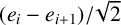 ${(e_i-e_{i+1})}/{\sqrt 2}$
, respectively. Let
${(e_i-e_{i+1})}/{\sqrt 2}$
, respectively. Let $A_i$
be an
$A_i$
be an $n\times n$
matrix whose matrix with respect to
$n\times n$
matrix whose matrix with respect to ${\cal B}_i$
is diagonal with distinct diagonal entries
${\cal B}_i$
is diagonal with distinct diagonal entries $\alpha _{j}^{(i)}, 1\le j\le n$
. Then,
$\alpha _{j}^{(i)}, 1\le j\le n$
. Then, $A_i$
is an orthoatomic matrix with eigenvectors
$A_i$
is an orthoatomic matrix with eigenvectors ${{\cal E}_i\cup \{e_i+e_{i+1},e_i-e_{i+1}\}}$
, where
${{\cal E}_i\cup \{e_i+e_{i+1},e_i-e_{i+1}\}}$
, where ${\cal E}_i=\{e_j : j\ne i, i+1\}$
. We show that
${\cal E}_i=\{e_j : j\ne i, i+1\}$
. We show that $\{A_1,A_2, \ldots , A_{n-1}\}$
is minimally irreducible.
$\{A_1,A_2, \ldots , A_{n-1}\}$
is minimally irreducible.
Irreducibility. $\langle e_i, e_{i+1}\rangle =\langle e_i+e_{i+1},e_i-e_{i+1}\rangle $
and
$\langle e_i, e_{i+1}\rangle =\langle e_i+e_{i+1},e_i-e_{i+1}\rangle $
and $2e_i=(e_i+e_{i+1})+ (e_i-e_{i+1})$
, so
$2e_i=(e_i+e_{i+1})+ (e_i-e_{i+1})$
, so $A_ie_i=\tfrac 12(\alpha _{i}^{(i)}+\alpha _{i+1}^{(i)} )e_{i}+\tfrac 12(\alpha _{i}^{(i)}-\alpha _{i+1}^{(i)})e_{i+1}$
. Also,
$A_ie_i=\tfrac 12(\alpha _{i}^{(i)}+\alpha _{i+1}^{(i)} )e_{i}+\tfrac 12(\alpha _{i}^{(i)}-\alpha _{i+1}^{(i)})e_{i+1}$
. Also, $2e_{i+1}=(e_i+e_{i+1})-(e_i-e_{i+1})$
, so
$2e_{i+1}=(e_i+e_{i+1})-(e_i-e_{i+1})$
, so $A_ie_{i+1}=\tfrac 12(\alpha _{i}^{(i)}-\alpha _{i+1}^{(i)} )e_{i}+\tfrac 12(\alpha _{i}^{(i)}+\alpha _{i+1}^{(i)})e_{i+1}$
. From this, it follows that a subspace invariant under
$A_ie_{i+1}=\tfrac 12(\alpha _{i}^{(i)}-\alpha _{i+1}^{(i)} )e_{i}+\tfrac 12(\alpha _{i}^{(i)}+\alpha _{i+1}^{(i)})e_{i+1}$
. From this, it follows that a subspace invariant under $A_i$
contains
$A_i$
contains $e_i$
if and only if it contains
$e_i$
if and only if it contains $e_{i+1}$
, since
$e_{i+1}$
, since $\alpha _{i}^{(i)}\ne \alpha _{i+1}^{(i)}$
. Thus, a proper subspace M invariant under every
$\alpha _{i}^{(i)}\ne \alpha _{i+1}^{(i)}$
. Thus, a proper subspace M invariant under every $A_i, 1\le i\le n-1$
, contains no standard basis vectors. Since M is spanned by the atoms of Lat
$A_i, 1\le i\le n-1$
, contains no standard basis vectors. Since M is spanned by the atoms of Lat $A_1$
and Lat
$A_1$
and Lat $A_2$
, we must have
$A_2$
, we must have $M\subseteq \langle e_1,e_2\rangle \cap \langle e_2,e_3\rangle =\langle e_2\rangle $
. So,
$M\subseteq \langle e_1,e_2\rangle \cap \langle e_2,e_3\rangle =\langle e_2\rangle $
. So, $M=(0)$
and
$M=(0)$
and $\{A_1,A_2, \ldots , A_{n-1}\}$
is irreducible.
$\{A_1,A_2, \ldots , A_{n-1}\}$
is irreducible.
Minimality. It is easily checked, for $1\le i\le n-1$
, that
$1\le i\le n-1$
, that $A_j, 1\le j\ne i\le n-1$
, leaves
$A_j, 1\le j\ne i\le n-1$
, leaves $\langle e_1,e_2,\ldots , e_i\rangle $
invariant.
$\langle e_1,e_2,\ldots , e_i\rangle $
invariant.
(ii) We can suppose that $n>3$
. Let A be the orthoatomic matrix whose unit eigenvectors form the ordered orthonormal basis
$n>3$
. Let A be the orthoatomic matrix whose unit eigenvectors form the ordered orthonormal basis $\{f_1,f_2,\ldots , f_n\}$
, where
$\{f_1,f_2,\ldots , f_n\}$
, where
 $$ \begin{align*}f_i= \begin{cases} {(e_i+e_{i+1})}/{\sqrt 2} & \text{if } i \text{ is odd},\\ {(e_{i-1}-e_{i})}/{\sqrt 2} & \text{if } i \text { is even}. \end{cases}\end{align*} $$
Let B be the orthoatomic matrix whose unit eigenvectors form the ordered orthonormal basis $\{g_1,g_2,\ldots , g_n\}$
, where
$\{g_1,g_2,\ldots , g_n\}$
, where $g_1=e_1$
and
$g_1=e_1$
and
 $$ \begin{align*}g_i= \begin{cases} {(e_i+e_{i+1})}/{\sqrt 2} & \text{if } i \text{ is even},\\ {(e_{i-1}-e_{i})}/{\sqrt 2} & \text{if } i\ge 3 \text { is odd}. \end{cases}\end{align*} $$
Let M be a proper common invariant subspace of A and B. Once again, we see that M can contain no standard basis vector and, since M is spanned by the eigenvectors of A that it contains and by the eigenvectors of B that it contains, $M=(0)$
.
$M=(0)$
.
(iii) Let $n>3$
and
$n>3$
and $2<k<n-1$
. Let
$2<k<n-1$
. Let $A_3,A_4,\ldots , A_k$
be as in part (i) above. In
$A_3,A_4,\ldots , A_k$
be as in part (i) above. In $A_1$
in part (i) above, replace its eigenvectors
$A_1$
in part (i) above, replace its eigenvectors $e_{k+1}, e_{k+2}, \ldots , e_n$
with
$e_{k+1}, e_{k+2}, \ldots , e_n$
with $f_{k+1}, f_{k+2}, \ldots , f_n$
to get the orthoatomic matrix A. Define
$f_{k+1}, f_{k+2}, \ldots , f_n$
to get the orthoatomic matrix A. Define
 $$ \begin{align*}f_{k+i}= \begin{cases} {(e_{k+i}+e_{k+i+1})}/{\sqrt 2} & \text{if } i\ge 1 \text{ is odd},\\ {(e_{k+i-1}-e_{k+i})}/{\sqrt 2} & \text{if } i\ge 2 \text { is even}. \end{cases}\end{align*} $$
In $A_2$
in part (i) above, replace its eigenvectors
$A_2$
in part (i) above, replace its eigenvectors $e_{k+2}, e_{k+3}, \ldots , e_n$
with
$e_{k+2}, e_{k+3}, \ldots , e_n$
with $g_{k+2}, g_{k+3}, \ldots , g_n$
to get the orthoatomic matrix B. Define
$g_{k+2}, g_{k+3}, \ldots , g_n$
to get the orthoatomic matrix B. Define
 $$ \begin{align*}g_{k+i}= \begin{cases} {(e_{k+i}+e_{k+i+1})}/{\sqrt 2} & \text{if } i\ge 2 \text{ is even},\\ {(e_{k+i-1}-e_{k+i})}/{\sqrt 2} & \text{if } i\ge 3 \text { is odd}. \end{cases}\end{align*} $$
Take $f_n$
equal to
$f_n$
equal to $e_n$
if
$e_n$
if $n-k$
is odd and take
$n-k$
is odd and take $g_n$
equal to
$g_n$
equal to $e_n$
if
$e_n$
if $n-k$
is even. It can be verified that
$n-k$
is even. It can be verified that $\{A,B, A_3, A_4, \ldots , A_k\}$
is minimally irreducible.
$\{A,B, A_3, A_4, \ldots , A_k\}$
is minimally irreducible.
To prove our next theorem, we need some results from the study of finite atomic Boolean algebras. We follow the notation and terminology in [Reference Koppelberg3, Reference Kunen4]. A Boolean algebra $\mathbf {B}$
is a complemented distributive lattice containing a least element, usually denoted by
$\mathbf {B}$
is a complemented distributive lattice containing a least element, usually denoted by $0$
, and a greatest element, usually denoted by
$0$
, and a greatest element, usually denoted by $1\ne 0$
. The complement of an element x is denoted by
$1\ne 0$
. The complement of an element x is denoted by $x'$
. An element a of a Boolean algebra
$x'$
. An element a of a Boolean algebra $\mathbf {B}$
is an atom if
$\mathbf {B}$
is an atom if $0<b\le a$
and
$0<b\le a$
and $b\in \mathbf {B}$
implies
$b\in \mathbf {B}$
implies $b=a$
. A Boolean algebra
$b=a$
. A Boolean algebra $\mathbf {B}$
is atomic if
$\mathbf {B}$
is atomic if $b\in \mathbf {B}$
and
$b\in \mathbf {B}$
and $b\ne 0$
implies that
$b\ne 0$
implies that $a\le b$
for some atom a of
$a\le b$
for some atom a of $\mathbf {B}$
. Every finite Boolean algebra is atomic and every element of
$\mathbf {B}$
. Every finite Boolean algebra is atomic and every element of $\mathbf {B}$
is the join of the atoms it contains (taking
$\mathbf {B}$
is the join of the atoms it contains (taking $\vee \phi =0$
). A subalgebra of
$\vee \phi =0$
). A subalgebra of $\mathbf {B}$
is a subset
$\mathbf {B}$
is a subset $\mathbf {{\cal A}}$
that is closed under meets, joins and complements, and contains
$\mathbf {{\cal A}}$
that is closed under meets, joins and complements, and contains $0$
and
$0$
and $1$
, that is,
$1$
, that is, $\mathbf {{\cal A}}$
is a sublattice of
$\mathbf {{\cal A}}$
is a sublattice of $\mathbf {B}$
which is closed under complements and contains
$\mathbf {B}$
which is closed under complements and contains $0,1$
. Every subalgebra is a Boolean algebra in its own right, whose atoms are elements of
$0,1$
. Every subalgebra is a Boolean algebra in its own right, whose atoms are elements of $\mathbf {B}$
but not necessarily atoms of
$\mathbf {B}$
but not necessarily atoms of $\mathbf {B}$
. If
$\mathbf {B}$
. If $\mathbf {{\cal E}}\subseteq \mathbf {B}$
, the subalgebra generated by
$\mathbf {{\cal E}}\subseteq \mathbf {B}$
, the subalgebra generated by $\mathbf {{\cal E}}$
is denoted by sa(
$\mathbf {{\cal E}}$
is denoted by sa( $\mathbf {{\cal E}}$
). A subset
$\mathbf {{\cal E}}$
). A subset $\mathbf {{\cal E}}$
of
$\mathbf {{\cal E}}$
of $\mathbf {B}$
is irredundant if
$\mathbf {B}$
is irredundant if $a\not \in $
sa(
$a\not \in $
sa( $\mathbf {{\cal E}}\backslash \{a\})$
for every
$\mathbf {{\cal E}}\backslash \{a\})$
for every $a\in {\cal E}$
.
$a\in {\cal E}$
.
Lemma 5.3 [Reference Kunen4].
Let $\mathbf {{\cal E}_0}$
be an irredundant subset of a Boolean algebra
$\mathbf {{\cal E}_0}$
be an irredundant subset of a Boolean algebra $\mathbf {B}$
. If
$\mathbf {B}$
. If ${d\in \mathbf {B}\backslash \mathrm {sa}(\mathbf {{\cal E}_0})}$
satisfies
${d\in \mathbf {B}\backslash \mathrm {sa}(\mathbf {{\cal E}_0})}$
satisfies $a\in \mathrm {sa}(\mathbf {{\cal E}_0})$
,
$a\in \mathrm {sa}(\mathbf {{\cal E}_0})$
, $a\le d$
implies
$a\le d$
implies $a=0$
, then
$a=0$
, then $\mathbf {{\cal E}_0}\cup \{d\}$
is irredundant. In particular, if
$\mathbf {{\cal E}_0}\cup \{d\}$
is irredundant. In particular, if $\mathbf {{\cal E}}$
is a maximally irredundant subset of
$\mathbf {{\cal E}}$
is a maximally irredundant subset of $\mathbf {B}$
, then
$\mathbf {B}$
, then $\mathrm {sa}({\cal E})=\mathbf {B}$
.
$\mathrm {sa}({\cal E})=\mathbf {B}$
.
Proposition 5.4. Let $\mathbf {B}$
be a finite Boolean algebra with
$\mathbf {B}$
be a finite Boolean algebra with $n\ge 3$
atoms. Let
$n\ge 3$
atoms. Let $\{b_1,b_2,\ldots , b_m\}$
be an irredundant subset of
$\{b_1,b_2,\ldots , b_m\}$
be an irredundant subset of $\mathbf {B}$
with
$\mathbf {B}$
with $m\ge 2$
. Then:
$m\ge 2$
. Then:
-
(i)
$m\le n-1$
; -
(ii) if
$m=n-1$
and
$\mathbf {B}_1=\mathrm {sa}(\{b_2,b_3,\ldots , b_{n-1}\})$
, the set of atoms of
$\mathbf {B}$
can be enumerated as
$\{a_1,a_2,\ldots , a_n\}$
in such a way that
$a_1\vee a_2, a_3,a_4,\ldots , a_n$
all belong to
$\mathbf {B}_1$
, but
$a_1$
and
$a_2$
do not.


Proof. (i) Since $\{b_1,b_2,\ldots , b_m\}$
is irredundant,
$\{b_1,b_2,\ldots , b_m\}$
is irredundant, $b_1\not \in \text {sa}(\{b_2,b_3,\ldots , b_m\})$
, so there is an atom
$b_1\not \in \text {sa}(\{b_2,b_3,\ldots , b_m\})$
, so there is an atom $a_1$
of
$a_1$
of $\mathbf { B}$
such that
$\mathbf { B}$
such that $a_1\le b_1$
and
$a_1\le b_1$
and $a_1 \not \in \text {sa}(\{b_2,b_3,\ldots , b_m\})$
. By Lemma 5.3,
$a_1 \not \in \text {sa}(\{b_2,b_3,\ldots , b_m\})$
. By Lemma 5.3, $\{a_1, b_2,b_3,\ldots , b_m\}$
is irredundant. Repeating this, we get
$\{a_1, b_2,b_3,\ldots , b_m\}$
is irredundant. Repeating this, we get $\{a_1, a_2,b_3,\ldots , b_m\}$
is irredundant for some atom
$\{a_1, a_2,b_3,\ldots , b_m\}$
is irredundant for some atom $a_2$
of
$a_2$
of $\mathbf {B}$
. Continuing, finally we get
$\mathbf {B}$
. Continuing, finally we get $\{a_1, a_2,a_3,\ldots , a_m\}$
is irredundant, where each
$\{a_1, a_2,a_3,\ldots , a_m\}$
is irredundant, where each $a_i, 1\le i\le m$
, is an atom of
$a_i, 1\le i\le m$
, is an atom of $\mathbf {B}$
. Now, the set of atoms
$\mathbf {B}$
. Now, the set of atoms $\{c_1, c_2,\ldots , c_n\}$
of
$\{c_1, c_2,\ldots , c_n\}$
of $\mathbf {B}$
is not irredundant since
$\mathbf {B}$
is not irredundant since $c_n=(\vee _{i=1}^{n-1}c_i){'}$
. Hence,
$c_n=(\vee _{i=1}^{n-1}c_i){'}$
. Hence, $m\le n-1$
.
$m\le n-1$
.
(ii) Let $\{b_1,b_2,\ldots , b_{n-1}\}$
be irredundant. As before, there is an atom
$\{b_1,b_2,\ldots , b_{n-1}\}$
be irredundant. As before, there is an atom $a_1$
of
$a_1$
of $\mathbf {B}$
such that
$\mathbf {B}$
such that $a_1\le b_1,\,a_1 \not \in \mathbf {B}_1$
and
$a_1\le b_1,\,a_1 \not \in \mathbf {B}_1$
and $\{a_1, b_2, \ldots , b_{n-1}\}$
irredundant. The latter is maximally irredundant by what has been proven in part (i) so, again by Lemma 5.3,
$\{a_1, b_2, \ldots , b_{n-1}\}$
irredundant. The latter is maximally irredundant by what has been proven in part (i) so, again by Lemma 5.3, ${\text {sa}(\mathbf {B}_1\cup \{a_1\})=\mathbf {B}}$
. Now, by [Reference Koppelberg3, Corollary 4.7], every atom a of
${\text {sa}(\mathbf {B}_1\cup \{a_1\})=\mathbf {B}}$
. Now, by [Reference Koppelberg3, Corollary 4.7], every atom a of $\mathbf {B}$
different from
$\mathbf {B}$
different from $a_1$
has the form
$a_1$
has the form $a=(x\wedge a_1)\vee (y\wedge a_1')$
with
$a=(x\wedge a_1)\vee (y\wedge a_1')$
with $x,y\in \mathbf { B}_1$
. It follows that
$x,y\in \mathbf { B}_1$
. It follows that $a=y\wedge a_1'$
, so
$a=y\wedge a_1'$
, so $y=a$
or
$y=a$
or $y=a\vee a_1$
. Thus, every atom a of
$y=a\vee a_1$
. Thus, every atom a of $\mathbf {B}$
different from
$\mathbf {B}$
different from $a_1$
either belongs to
$a_1$
either belongs to $\mathbf {B}_1$
or satisfies
$\mathbf {B}_1$
or satisfies ${a\vee a_1\in \mathbf {B}_1}$
. We cannot have both a and
${a\vee a_1\in \mathbf {B}_1}$
. We cannot have both a and $a\vee a_1$
in
$a\vee a_1$
in $\mathbf {B}_1$
since then,
$\mathbf {B}_1$
since then, ${a_1=(a\vee a_1)\wedge a'\in \mathbf {B}_1}$
. However, we cannot have distinct atoms
${a_1=(a\vee a_1)\wedge a'\in \mathbf {B}_1}$
. However, we cannot have distinct atoms $c,d$
of
$c,d$
of $\mathbf {B}$
with
$\mathbf {B}$
with $c\vee a_1, d\vee a_1\in \mathbf {B}_1$
since then,
$c\vee a_1, d\vee a_1\in \mathbf {B}_1$
since then, ${a_1=(c\vee a_1)\wedge (d\vee a_1)}$
. Thus, there is precisely one atom
${a_1=(c\vee a_1)\wedge (d\vee a_1)}$
. Thus, there is precisely one atom $a_2$
of
$a_2$
of $\mathbf {B}$
different from
$\mathbf {B}$
different from $a_1$
satisfying
$a_1$
satisfying $a_1\vee a_2\in \mathbf {B}_1$
and all the others belong to
$a_1\vee a_2\in \mathbf {B}_1$
and all the others belong to $\mathbf {B}_1.$
We cannot have
$\mathbf {B}_1.$
We cannot have $a_2\in \mathbf {B}_1$
since then,
$a_2\in \mathbf {B}_1$
since then, $a_1=(a_1\vee a_2)\wedge a_2'\in \mathbf {B}_1$
.
$a_1=(a_1\vee a_2)\wedge a_2'\in \mathbf {B}_1$
.
Theorem 5.5. If $n\ge 3$
, a minimally irreducible family of orthoatomic matrices in
$n\ge 3$
, a minimally irreducible family of orthoatomic matrices in $M_{n}({\mathbb {C}})$
has k elements, where
$M_{n}({\mathbb {C}})$
has k elements, where $2\le k\le n-1$
. If
$2\le k\le n-1$
. If $n=2$
, such a family has
$n=2$
, such a family has $2$
elements.
$2$
elements.
Proof. Let $n\ge 3$
and let
$n\ge 3$
and let $\{A_1,A_2,\ldots , A_m\}$
be a minimally irreducible family of orthoatomic matrices in
$\{A_1,A_2,\ldots , A_m\}$
be a minimally irreducible family of orthoatomic matrices in $M_n({\mathbb {C}})$
. Then,
$M_n({\mathbb {C}})$
. Then, $m\ge 2$
. We may suppose, applying a unitary similarity if necessary, that the atoms of
$m\ge 2$
. We may suppose, applying a unitary similarity if necessary, that the atoms of $A_1$
are
$A_1$
are $\{\langle e_i\rangle : 1\le i\le n\}$
, where
$\{\langle e_i\rangle : 1\le i\le n\}$
, where $\{e_i: 1\le i\le n\}$
is the set of standard basis vectors. For
$\{e_i: 1\le i\le n\}$
is the set of standard basis vectors. For $1\le i\le m$
, let
$1\le i\le m$
, let $M_i$
be a common invariant subspace of
$M_i$
be a common invariant subspace of $A_j, 1\le j\ne i\le m $
(see Table 1). For
$A_j, 1\le j\ne i\le m $
(see Table 1). For $1\le i\le n$
, the subspaces
$1\le i\le n$
, the subspaces $M_j$
,
$M_j$
, $1\le j\ne i\le m$
, all belong to Lat
$1\le j\ne i\le m$
, all belong to Lat $A_i$
. Moreover, this set of subspaces is an irredundant set of elements of the finite atomic Boolean algebra Lat
$A_i$
. Moreover, this set of subspaces is an irredundant set of elements of the finite atomic Boolean algebra Lat $A_i$
since if
$A_i$
since if $M_j\in $
Lat
$M_j\in $
Lat $ A_i$
with
$ A_i$
with $ j\ne i$
belongs to
$ j\ne i$
belongs to $\text {sa}(\{M_k: 1\le k\ne i,j\le n\})$
, then
$\text {sa}(\{M_k: 1\le k\ne i,j\le n\})$
, then $M_j$
belongs to Lat
$M_j$
belongs to Lat $A_j$
, since Lat
$A_j$
, since Lat $A_j$
contains
$A_j$
contains $\{M_k: 1\le k\ne i,j\le n\}$
. Then, every
$\{M_k: 1\le k\ne i,j\le n\}$
. Then, every $A_i$
leaves
$A_i$
leaves $M_j $
invariant, and this contradicts the irreducibility of
$M_j $
invariant, and this contradicts the irreducibility of $\{A_1,A_2,\ldots , A_m\}$
. It follows from Proposition 5.4(i) that
$\{A_1,A_2,\ldots , A_m\}$
. It follows from Proposition 5.4(i) that $m-1\le n-1$
, so
$m-1\le n-1$
, so $m\le n$
.
$m\le n$
.
Table 1 The invariant subspaces in the proof of Theorem 5.5.

Suppose that $m=n$
. Consider Lat
$m=n$
. Consider Lat $A_i, \, 2\le i\le n$
. It is a finite atomic Boolean algebra with ‘joins’ being ‘linear spans’, ‘meets’ being ‘intersections’ and ‘complements’ being ‘orthogonal complements’. Its atoms are the one-dimensional subspaces spanned by the n orthogonal unit eigenvectors of
$A_i, \, 2\le i\le n$
. It is a finite atomic Boolean algebra with ‘joins’ being ‘linear spans’, ‘meets’ being ‘intersections’ and ‘complements’ being ‘orthogonal complements’. Its atoms are the one-dimensional subspaces spanned by the n orthogonal unit eigenvectors of $A_i$
. Let
$A_i$
. Let $f_1^{(i)}, f_2^{(i)}, \ldots , f_n^{(i)}$
be such orthogonal eigenvectors. Let
$f_1^{(i)}, f_2^{(i)}, \ldots , f_n^{(i)}$
be such orthogonal eigenvectors. Let $\mathbf { B}_i= \text {sa}(\{M_j: 1\le j\ne 1, i\le n\})$
. By Proposition 5.4(ii), the atoms of Lat
$\mathbf { B}_i= \text {sa}(\{M_j: 1\le j\ne 1, i\le n\})$
. By Proposition 5.4(ii), the atoms of Lat $A_i$
can be enumerated so that
$A_i$
can be enumerated so that $ \langle f_1^{(i)}, f_2^{(i)}\rangle , \langle f_3^{(i)}\rangle , \ldots , \langle f_n^{(i)}\rangle $
all belong to
$ \langle f_1^{(i)}, f_2^{(i)}\rangle , \langle f_3^{(i)}\rangle , \ldots , \langle f_n^{(i)}\rangle $
all belong to $\mathbf {B}_i$
, but
$\mathbf {B}_i$
, but $\langle f_1^{(i)}\rangle $
and
$\langle f_1^{(i)}\rangle $
and $\langle f_2^{(i)}\rangle $
do not. Now,
$\langle f_2^{(i)}\rangle $
do not. Now, $\langle f_3^{(i)}\rangle , \langle f_4^{(i)}\rangle , \ldots , \langle f_n^{(i)}\rangle $
all belong to
$\langle f_3^{(i)}\rangle , \langle f_4^{(i)}\rangle , \ldots , \langle f_n^{(i)}\rangle $
all belong to $\mathbf {B}_i$
and
$\mathbf {B}_i$
and $\mathbf {B}_i\subseteq $
Lat
$\mathbf {B}_i\subseteq $
Lat $A_1$
whose atoms are
$A_1$
whose atoms are $\langle e_1\rangle ,\langle e_2\rangle ,\ldots ,\langle e_n\rangle $
, so each of
$\langle e_1\rangle ,\langle e_2\rangle ,\ldots ,\langle e_n\rangle $
, so each of $\langle f_3^{(i)}\rangle , \langle f_4^{(i)}\rangle , \ldots , \langle f_n^{(i)}\rangle $
is
$\langle f_3^{(i)}\rangle , \langle f_4^{(i)}\rangle , \ldots , \langle f_n^{(i)}\rangle $
is $\langle e_p\rangle $
for some standard basis vector
$\langle e_p\rangle $
for some standard basis vector $e_p$
. Hence, there is a permutation
$e_p$
. Hence, there is a permutation $\sigma _i$
of
$\sigma _i$
of $\{1,2,\ldots ,n\} $
such that the atoms of Lat
$\{1,2,\ldots ,n\} $
such that the atoms of Lat $A_i$
are
$A_i$
are $\langle g_i\rangle , \langle h_i\rangle , \langle e_{\sigma _i(3)}\rangle , \langle e_{\sigma _i(4)}\rangle ,\ldots ,\langle e_{\sigma _i(n)}\rangle $
, where
$\langle g_i\rangle , \langle h_i\rangle , \langle e_{\sigma _i(3)}\rangle , \langle e_{\sigma _i(4)}\rangle ,\ldots ,\langle e_{\sigma _i(n)}\rangle $
, where $\langle g_i, h_i\rangle =\langle e_{\sigma _i(1)},e_{\sigma _i(2)}\rangle $
, and
$\langle g_i, h_i\rangle =\langle e_{\sigma _i(1)},e_{\sigma _i(2)}\rangle $
, and $g_i= \alpha _ie_{\sigma _i(1)}+\beta _ie_{\sigma _i(2)}$
and
$g_i= \alpha _ie_{\sigma _i(1)}+\beta _ie_{\sigma _i(2)}$
and $h_i=\gamma _ie_{\sigma _i(1)}+\delta _ie_{\sigma _i(2)}$
, where
$h_i=\gamma _ie_{\sigma _i(1)}+\delta _ie_{\sigma _i(2)}$
, where $\alpha _i\cdot \overline {\gamma _i}+\beta _i\cdot \overline {\delta _i}=0$
and where
$\alpha _i\cdot \overline {\gamma _i}+\beta _i\cdot \overline {\delta _i}=0$
and where $\alpha _i,\beta _i,\gamma _i,\delta _i$
are nonzero complex numbers.
$\alpha _i,\beta _i,\gamma _i,\delta _i$
are nonzero complex numbers.
Summarising, each of the atoms of Lat $A_i$
, for
$A_i$
, for $i\ge 2$
, is spanned by a standard basis vector, with precisely two exceptions. Each of the exceptions is the span of a linear combination of the pair of standard basis vectors that are not exceptions. Denote the span of the exceptional atoms by
$i\ge 2$
, is spanned by a standard basis vector, with precisely two exceptions. Each of the exceptions is the span of a linear combination of the pair of standard basis vectors that are not exceptions. Denote the span of the exceptional atoms by $N_i$
. Then, we have
$N_i$
. Then, we have $N_i=\langle g_i,h_i\rangle =\langle e_{\sigma _i(1)},e_{\sigma _i(2)}\rangle \in $
Lat
$N_i=\langle g_i,h_i\rangle =\langle e_{\sigma _i(1)},e_{\sigma _i(2)}\rangle \in $
Lat $A_1 \cap $
Lat
$A_1 \cap $
Lat $A_i$
.
$A_i$
.
Let M be a subspace of ${\mathbb {C}}^n$
invariant under every
${\mathbb {C}}^n$
invariant under every $A_i, \,2 \le i\le n$
. Then, since
$A_i, \,2 \le i\le n$
. Then, since ${\{A_k:1\le k\le n\}}$
is irreducible, M is not spanned by standard basis vectors. For
${\{A_k:1\le k\le n\}}$
is irreducible, M is not spanned by standard basis vectors. For ${2\le i\le n}$
, M is spanned by the atoms of Lat
${2\le i\le n}$
, M is spanned by the atoms of Lat $A_i$
that it contains. It cannot contain both
$A_i$
that it contains. It cannot contain both $\langle g_i\rangle , \langle h_i\rangle $
, otherwise, it would contain
$\langle g_i\rangle , \langle h_i\rangle $
, otherwise, it would contain $N_i$
and be spanned by standard basis vectors. However, M must contain
$N_i$
and be spanned by standard basis vectors. However, M must contain $\langle g_i\rangle $
or
$\langle g_i\rangle $
or $\langle h_i\rangle $
, since otherwise, it would again be spanned by standard basis vectors. Also, no atom of Lat
$\langle h_i\rangle $
, since otherwise, it would again be spanned by standard basis vectors. Also, no atom of Lat $A_i$
contained in M can be
$A_i$
contained in M can be $\langle e_k\rangle $
for some k with
$\langle e_k\rangle $
for some k with $1\le k\le n$
since otherwise,
$1\le k\le n$
since otherwise, $\langle e_k\rangle $
is invariant under every
$\langle e_k\rangle $
is invariant under every $A_k, \, 1\le k\le n$
. Thus,
$A_k, \, 1\le k\le n$
. Thus, $M\subseteq \cap \{N_i: 2\le i\le n\}$
. We must have
$M\subseteq \cap \{N_i: 2\le i\le n\}$
. We must have $N_p\ne N_q$
for some
$N_p\ne N_q$
for some $p,q$
with
$p,q$
with $2\le p\ne q \le n$
because
$2\le p\ne q \le n$
because $\{A_k, \, 1\le k\le n\}$
is irreducible. Now,
$\{A_k, \, 1\le k\le n\}$
is irreducible. Now, $M\subseteq N_p\cap N_q$
, where the latter belongs to Lat
$M\subseteq N_p\cap N_q$
, where the latter belongs to Lat $A_1$
. Since
$A_1$
. Since $M\not \in $
Lat
$M\not \in $
Lat $A_1$
,
$A_1$
, $M=(0)$
. This shows that
$M=(0)$
. This shows that $\{A_i: 2\le i\le n\}$
is irreducible and this contradicts the minimal irreducibility of
$\{A_i: 2\le i\le n\}$
is irreducible and this contradicts the minimal irreducibility of $\{A_k : 1\le k\le n\}$
.
$\{A_k : 1\le k\le n\}$
.
Finally, let $n=2$
. Let
$n=2$
. Let $\{A_1,A_2,\ldots , A_m\}$
be a minimally irreducible family of orthoatomic
$\{A_1,A_2,\ldots , A_m\}$
be a minimally irreducible family of orthoatomic $2\times 2$
complex matrices. For
$2\times 2$
complex matrices. For $1\le i\le m$
, Lat
$1\le i\le m$
, Lat $A_i=\{(0), \langle f_i\rangle , \langle g_i\rangle , {\mathbb {C}}^2\}$
, where
$A_i=\{(0), \langle f_i\rangle , \langle g_i\rangle , {\mathbb {C}}^2\}$
, where $f_i, g_i$
are orthogonal unit vectors. In fact,
$f_i, g_i$
are orthogonal unit vectors. In fact, $\langle g_i\rangle =\langle f_i\rangle ^{\perp }$
. If Lat
$\langle g_i\rangle =\langle f_i\rangle ^{\perp }$
. If Lat $A_i\,\cap $
Lat
$A_i\,\cap $
Lat $A_j\ne \{(0),{\mathbb {C}}^2\}$
, then Lat
$A_j\ne \{(0),{\mathbb {C}}^2\}$
, then Lat $A_i=$
Lat
$A_i=$
Lat $A_j$
. Thus,
$A_j$
. Thus, $m\le 2$
. For an example with
$m\le 2$
. For an example with $m=2$
, take
$m=2$
, take $A_1$
to be the matrix with two distinct eigenvalues and eigenvectors
$A_1$
to be the matrix with two distinct eigenvalues and eigenvectors $e_1$
and
$e_1$
and $e_2$
, and take
$e_2$
, and take $A_2$
to be the matrix with two distinct eigenvalues and eigenvectors
$A_2$
to be the matrix with two distinct eigenvalues and eigenvectors $e_1+e_2$
and
$e_1+e_2$
and $e_1-e_2$
.
$e_1-e_2$
.



