

Introduction
In her foundational paper on Neo-Assyrian cylinder seals, Irene J. Winter (Reference Winter and Uehlinger2000) proposed a hierarchical image-system for iconography found on both cylinder seals and royal palace reliefs, where seal-holders operating in official political or administrative capacities choose visual motifs found on palace reliefs in order to reference the kingly person.Footnote 1 Such a formulation for the Neo-Assyrian period was likely influenced by arguments of earlier scholars who wondered whether the narrative scenes on cylinder seals were adapted from paintings or reliefs in palaces and templesFootnote 2 (Barrelet Reference Barrelet1970; Paley Reference Paley and Kelly-Buccellati1986: 217; Porada 1980:10; Reference Porada1993: 568). While it is certainly compelling for particular cases, Winter’s proposal somewhat masks the semiotic influence of cylinder seal iconography and perhaps overemphasizes the role of palace relief art across the roughly three centuries of Neo-Assyrian visual cultureFootnote 3 (934-612 B.C.E). The primacy at times attributed to monumental objects can implicitly perpetuate traditional Western art historical expectations placed on Mesopotamian art.Footnote 4 Scholars have since shown that the visual imagery strategically employed by royals and officials in their self-presentation was borrowed from across media types regardless of scale.Footnote 5 This widening interpretation invites further analysis on the roles and uses of images in Neo-Assyrian visual culture, specifically as it affected the planning and execution of that icon of monumental art par excellence: the palace relief programme. Rather than focusing on the self-presentation of Assyrian kings, instead I consider here how non-human actors, specifically animals and monsters,Footnote 6 inform the production and reception of the royal image. As a case-study, I explore the visualization of a famous mythological being in Neo-Assyrian court culture, the Anzû, and its thematic and formal connection to lions in royal hunt narratives.
The Anzû and the lion appear throughout this period on various media and at multiple scales: from miniature renditions on cylinder seals to over life-size reliefs complementing royal architectural programs. Despite the concomitant appearance of lions and the Anzû in similar contexts of image consumption and proposed intertextual parallels between descriptions of royal lion hunts and the Ninurta-Anzû myth, comparatively little has been done in considering any concrete visual relationship between the two subjects. Lion imagery as a visual corpus has a rich history in Mesopotamia, extending back into the Uruk period (ca. 3900-3100 B.C.E.). In the Neo-Assyrian period, the evolving relationship between royal administrative stamp seals depicting the king stabbing a lion and similar compositions found on the palace reliefs of Ashurnasirpal II (r. 883-859 B.C.E.) and Ashurbanipal (r. 668-631 B.C.E.) indicate that this motif was conceptualized at multiple scales (Nadali Reference Nadali, Fales and Lanfranchi2010). Anzû imagery is less studied for the Neo-Assyrian period, with greater attention paid to its appearance in textual sources (Annus Reference Annus2001; Vogelzang Reference Vogelzang1988). Its sole surviving appearance in monumental form is from a pair of reliefs located within a doorway of the Ninurta Temple at Nimrud (Reade Reference Reade2002). Despite a general hesitancy in its identification, many scholars have nevertheless labelled it as such on cylinder seals in which this creature appears (Annus Reference Annus2001; Green Reference Green, Finkel and Geller1997).Footnote 7 Its Early Dynastic predecessor is the Imdugud, which appears as a heraldic lion-headed bird across southern Mesopotamia, including the ‘Stele of the Vultures’ at Girsu (modern Telloh) and on a copper frieze adorning the Temple of Ninhursag at Tell al’Ubaid. It is still unclear exactly when and why the form of this monster shifted between the third and first millennium BCE (Watanabe Reference Watanabe and DiPaolo2018).
From a thematic perspective, both creatures signify the chaotic environment located outside of ordered urban society, and feature prominently in narratives which reaffirm divine and royal authority. To that end, I suggest that Ashurbanipal and his court administration knowingly drew upon mythological imagery when designing his palace relief programme, specifically that which depicted Ninurta battling the Anzû. Mostly known from glyptic examples, this mythological scene was a recurring choice on officials’ seals (Watanabe Reference Watanabe and Watanabe1999). It arranges the hunted figure of Anzû in a rare physical position, which is echoed by particular lions on the reliefs. Tracking this reciprocity via visual composition and figural gesture, I explore the reliefs as a polysemicFootnote 8 and intervisual product that crafted deep links between temporal and mythical narratives of kingship.
New image studies and Neo-Assyrian visual culture
While the influence of the portable arts has long been established elsewhere in Mesopotamian art history,Footnote 9 such studies on the Neo-Assyrian period were initially slow to form, perhaps due to the early framing of how visual culture production works in imperial polities. Many of these foundational arguments were formulated in the late 1970s and 1980s, and understood Neo-Assyrian political history as primarily rooted in the actions of a single individual (the king),Footnote 10 and its visual expression best elaborated by royal sculpture and architecture. Consequently, studies on palace relief programs and visual communication focused on the relationship between propaganda, historical narrative, and royal ideology (Reade Reference Reade and Larsen1979a; Winter Reference Winter1981). While more recent treatments focus on other aspects such as narrative strategies (Gillman 2015; Watanabe Reference Watanabe, Brown and Feldman2014), the depiction of non-Assyrians (Cifarelli Reference Cifarelli1998; Reed Reference Reed, Cheng and Feldman2007), or artistic production (Aker Reference Aker, Cheng and Feldman2007), they nevertheless build on these earlier iconographic interpretations. Studies that problematize the outright political functioning of palace reliefs have since emerged from the mid-2000s (Ataç Reference Ataç2010; Portuese and Pallavidini Reference Portuese and Pallavidini2022).
Similarly to how scholarship on Neo-Assyrian relief art tends to preserve its own autonomy, Stein (Reference Stein, Gansell and Shafer2020: 172) argues that seals have also historically been treated as a “canonical, self-contained body of evidence”; moreover, she maintains that seals remain “separate but occasionally useful to the study of archaeology, texts, and other types of art.” This is despite common consensus that cylinder and stamp seals are incredibly useful vehicles for spreading highly specific visual motifs and compositions, arguably more than imagery stationed inside temples and palaces.Footnote 11 The infinite possibilities of its replication via sealings distributes agency of not only the image itself but also—in the case of inscribed sealsFootnote 12 —the person to whom the seal is attached (Winter Reference Winter, Osbourne and Tanner2007). It is curious that direct comparisons between Neo-Assyrian cylinder seals and palace reliefs are rare (Winter Reference Winter and Uehlinger2000; Nadali Reference Nadali, Fales and Lanfranchi2010), when identifying the roles and tracking the durability of images across media in time and space has always been an interest to scholars of ancient Southwest Asia.Footnote 13 The wide variety of terms applied to the articulation of connections between images—ranging from metaphor to quotation, appropriation to adaptation—underlines the effort to show how images both contribute to and are shaped by intricate visual networks. With the emergence of the so-called ‘iconic turn’ in the late 1990s and early 2000s,Footnote 14 new theoretical frameworks to discuss image relations have emerged under the designations of intervisuality (Mirzoeff Reference Mirzoeff1999), interpictoriality (Isekenmeier Reference Isekenmeier2013), and intericonicity (Arrivé Reference Arrivé2015).Footnote 15 Interpictoriality and intericonicity in particular have been used rather interchangeably to describe the relatedness of images to each other and the mechanism(s) and rationale(s) by which their relation occurs. Applications of these particular frameworks to Mesopotamian art are a recent and highly productive endeavorFootnote 16 (Eppihimer Reference Eppihimer2019; Nadali and Portuese Reference Nadali, Portuese and Bracker2020; Portuese Reference Portuese, Pallavidini and Portuese2020), and there is further scope for its exploration in Neo-Assyrian visual culture.
Utilizing an intervisual framework expands interpictorial or intericonic perspectives to the entire intermedial field of visual culture (Isekenmeier Reference Isekenmeier2013: 27). It is inherently multimodal, reflecting how when images are encountered in different media contexts, they exploit multiple resources to construct meaning (Bruhn and Schirrmacher Reference Bruhn, Schirrmacher, Bruhn and Schirrmacher2022: 3). Examples of multimodal communication in Mesopotamian art abound, from statues and reliefs accompanied by captions or narratives to cylinder seals inscribed with dedicatory and/or genealogical information. The intervisual explication of such objects can thus be formulated from the aesthetic and sensorial qualities of their materials, the spatial and temporal contexts which they inhabit, and the semiotic significance ascribed to them. With such examples in mind, intervisual studies work to frame the act of visuality as a product of multiple perceptive modesFootnote 17 that stem from simultaneous interactions with texts, pictures, and materials (Isekenmeier and Bodola Reference Isekenmeier, Bodola, Bodola and Isekenmeier2017), media which themselves are subject to “different conventions and channels of transmission” (Wolf Reference Wolf, Herman, Jahn and Ryan2010: 253). This acknowledgement of the inherent modal entanglement between text, image, and material is a fruitful framework for the study of Mesopotamian objects, which are still at times subject to logocentric or purely iconographic frameworks of analysis (cf. Bahrani Reference Bahrani, Watts and Knappett2022: 129-131).
As Melissa Eppihimer (Reference Eppihimer2019: 21) notes in her study on the interpictorial and intervisual possibilities of Akkadian imagery in later Assyrian art, an intervisual product may contain within it any degree of specific reference to another image or general association with a conceptual model intended by its maker. While a viewer might successfully identify some of the maker’s original intent, the product instead might invoke specific images in the viewer’s mind that may not be related but were nevertheless triggered by a small component or its entire schema. Such invocations could be informed not only by memories of other objects or textual sources, but also via recollections of oral performances or similar lived experiences. Thus, while Eppihimer (Reference Eppihimer2019: 187) doubts the direct interpictorial quotation of Akkadian contest imagery into the palace art of Sargon II, she does suggest the prospect of an intervisual allusion more generally made between heroes and lions from Akkadian into Assyrian art. This does not preclude, however, the possibility that Neo-Assyrian palace relief programmes may have encoded esoteric references to the visual past, particularly since their layout and content were planned and executed via the intellectual and skilled efforts of court scholars and master craftsmen (Ataç Reference Ataç2010; Moorey Reference Moorey1994: 34-35; SAA XIII: xiii-xiv). As their comprehension was affected by varying levels of social experience and cultural knowledge, Neo-Assyrian palace relief programmes are a particularly rich avenue for intervisual study.
Intervisuality is also strategic in the sense that its modalities may uphold or reject convention as well as negotiate relationships to identity and memory, in the circumstances between and including its production and reception (Arrivé Reference Arrivé2015: 11). Successful comprehension of its visual code might serve as a criterion of social inclusion, marking shared cultural and/or intellectual knowledge. Exploring differing modes of visual comprehension, Karen Sonik (Reference Sonik, Brown and Feldman2014: 284) discusses the image of Ninurta battling Anzû on the doorway relief panel from Nimrud as a polysemic image that simultaneously embodies multiple versions of Ninurta from written sources, including his appearances “as a famous monster-wrangler, a hero-god extraordinaire, and also as a model of human kingship.” The production of palace reliefs can also activate temporal and geographic scales across royal visual programmes: Nadali and Portuese (Reference Nadali, Portuese and Bracker2020) compare the lion hunt reliefs of Ashurnasirpal II and Ashurbanipal and track how Ashurbanipal, a ‘known antiquarian’,Footnote 18 preserved, modified, and substituted earlier motifs to create his own unique version of royal hunting ritual. They acknowledge that these correspondences “can be diverse, shifting from simple to complex quotation, transformation and re-adaptation of images” (2020: 141). For Neo-Assyrian art, this fluidity is one that is equally informed by gesture and pose as much as it is by the flexible use of accoutrements in determining these correspondences. Far from being solely applicable to humans and the gods, monsters and animals also participate in this flexible making of meaning. As a monster emblematic of disorder, Anzû is a productive figure to consider as an intervisual motif embodied though image, text, and experience.
Anzû in the time of Ashurbanipal
By the Neo-Assyrian period, the Old Babylonian Ningirsu myth known as Bin šar dadmē ‘son of the king of habitations’ had received an extended revamp to some 720 lines of text and shifted the protagonist’s role to Ninurta (Dalley Reference Dalley1989: 203). In the Standard Babylonian version of the myth, Anzû is described as a lion-bird with the head, forelegs and body of a lion and the wings, hind leg talons, and feathered tail of a bird. At first a trusted doorkeeper of the god Enlil, one day Anzû steals Enlil’s Tablet of Destinies and carries the tablet away to its mountain lair. As a symbol of cosmic order and divine rulership, the Tablet of Destinies embodies the gods’ legitimate right to rule (Sonik Reference Sonik and Wilhelm2012). Anzû’s theft thus creates a crisis within the divine hierarchy, as whoever possesses the Tablet of Destinies can claim authority over the gods. Enlil asks Adad, then Girra, then Šara, to retrieve his tablet and they all refuse before finally Ninurta agrees to go. After losing their first battle,Footnote 19 Ninurta defeats Anzû by calling the storm wind to make Anzû’s wings falter, which allows Ninurta to cut off Anzû’s wings and pierce its heart with an arrow. He retrieves the Tablet of Destinies for Enlil, thereby restoring divine order (Watanabe Reference Watanabe2002: 131). The updated Standard Babylonian version contained multiple repetitive sections to aid in the mnemonic recall and possible oral performativity of key plot points in the story, such as the search among the gods for a worthy opponent to Anzû. Neo-Assyrian versions of the text were found at Nineveh, Tarbiṣu, and Sultantepe, all of which Dalley (Reference Dalley1989: 203) dates to the 7th century BCE. Other mythological attestations of Anzû at this time include its appearance in Erra and Ishum, as well as via the preservation of the Sumerian Lugal-e and Angim myths, both of which were present in the ‘library’ of Ashurbanipal (Watanabe Reference Watanabe2002: 78-79). The preservation and circulation of myths involving Anzû could have thus become part of the wider scholarly and ritual environment at Nineveh, expressed not only through continued cuneiform production and oral performance, but also perhaps visually through the royal body and palace relief programmes.
Furthermore, some scholars have identified connections between Neo-Assyrian royal inscriptions and Ninurta mythology to suggest that some Assyrian kings may have deliberately emulated aspects of the god (Maul Reference Maul and Watanabe1999: 210; Portuese Reference Portuese, Pallavidini and Portuese2020: 131). For example, Ashurbanipal describes his conquest over Elam with the phrase ‘I flattened (it) like the Deluge’ (Akk. abūbāniš aspun), a power otherwise only given to Ninurta or to other storm deities (RINAP 5: 227, r. 2; Annus Reference Annus2001: xxi). The king’s body and image in Assyrian texts can also be described as of ‘the flesh of the gods’ (Akk. šēr ilāne) (Gansell Reference Gansell and Nadali2016: 90). According to a ritual commentary,Footnote 20 Ashurbanipal symbolically reenacted some of Ninurta’s own exploits as part of his royal investiture (Maul Reference Maul and Watanabe1999: 211). Other aspects of Ninurta mythology were made visual, as Anzû was a recurring choice of doorkeeper for Ashurbanipal’s temple renovations, including at the Ešarra (Assur), Emašmaš (Nineveh), Eḫulḫul (Harran), and Egašankalamma (Arbela) temples (RINAP 5: 3, i. 18-20). Perhaps at first glance an atypical choice of apotropaic being for stationing at entrances, Anzû was clearly deemed an appropriate choice to guard the homes of multiple deities. It is unclear whether Anzû was also specifically associated with guarding the Tablet of Destinies in this context (Pongratz-Leisten Reference Pongratz-Leisten, Finkbeiner, Dittmann and Hauptmann1995: 554). Regardless, new images of Anzû were actively produced as part of visual programmes sustaining divine beneficence via the royal obligation to maintain temple complexes.
Ashurbanipal’s famous self-identification as a scholarFootnote 21 may have played out in subtle ways in his own visual programme at his ‘North Palace’ at Nineveh. Built between 646 and 643 B.C.E, it was the last in a series of Sargonid capital palaces built on the Nineveh citadel (Reade Reference Reade, Ebeling, Meissner, Weidner, von Soden and Edzard2000: 417). While it is only partially excavated and remains somewhat poorly understood, the North Palace nevertheless retained the royal Neo-Assyrian aesthetic tradition of lining its corridors and rooms with relief panels. Reliefs depicting scenes of lion hunts are located in Room C, which was a connecting corridor from the central courtyard, and in the western portico that included entrance Room S, and S1, which was some type of architectural space possibly located above Room S at ground level (Kertai Reference Kertai2015a: 179). While these rooms were ‘visible’ in the sense that viewers would have presumably encountered this imagery when either entering the palace from an external area or inner courtyard,Footnote 22 it remains difficult to pinpoint the actual or intended audience(s) of the North Palace reliefs. There were certainly many different kinds of people present in a Neo-Assyrian palace at any given time beyond the royal family, from foreign dignitaries and envoys bearing tribute (Winter Reference Winter1993: 36; Gansell Reference Gansell and Nadali2016: 90) to magnates and scribes conducting administrative and/or economic activities (Russell Reference Russell1991: 231-2; Kertai and Groß Reference Kertai and Groß2019). However, using a conceptual distinction between ‘outsiders’ and ‘insiders’ in the palace, Ataç (Reference Ataç2010: 89) has postulated that in Ashurnasirpal II’s earlier Northwest palace reliefs at Nimrud,Footnote 23 the primary audience was the king and court officials who were responsible for creating and shaping the imagery itself. By the time of Ashurbanipal, relief art had at least 200 years to develop in complexity (Larsen Reference Larsen, Finkel and Simpson2020: 123), and it is possible that esoteric interpretations remained throughout the development of visual historical narratives (Collins Reference Collins, Brown and Feldman2014: 624),Footnote 24 albeit articulated differently than in previous palace programs.
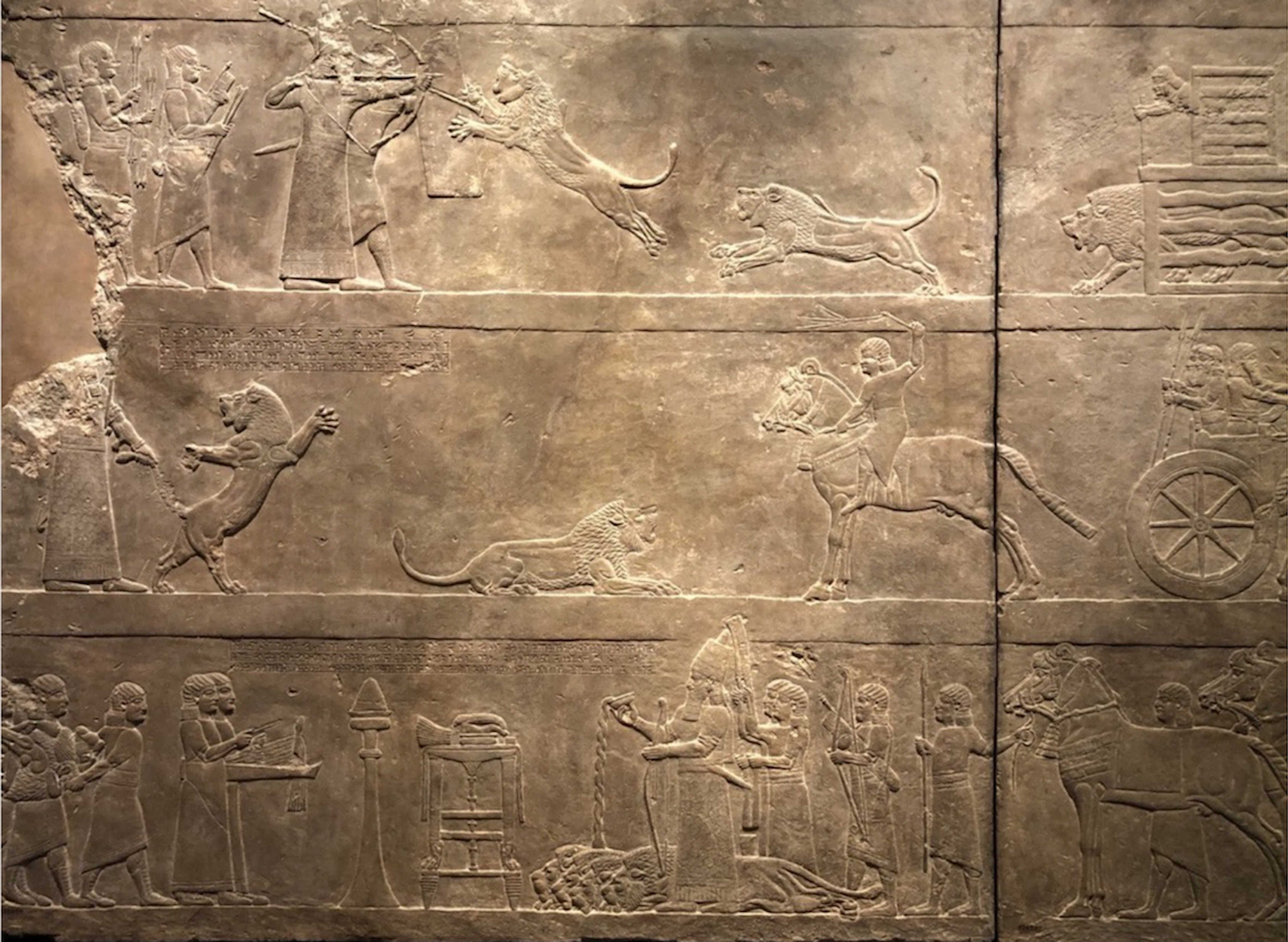
To that end, scholarship on Ashurbanipal’s lion reliefs has mainly sought to establish how best to ‘read’ and understand this imagery. The visual construction of Ashurbanipal’s role(s) in the lion hunts has been broadly examined (Aker Reference Aker, Cheng and Feldman2007; Reade Reference Reade and Porter2005; Watanabe Reference Watanabe and Prosecký1998, Reference Watanabe2002, Reference Watanabe, Brown and Feldman2014). Chikako Watanabe (Reference Watanabe, Brown and Feldman2014: 345-6) suggests that continuous interplay between ‘linear’ and ‘centric’ narratives are intended to create a semi-historical, strategically constructed picture of Assyrian kingship and royal ritual. Visual accounts of Ashurbanipal’s lion hunts reflect both a linear progression of events, such as in sequences of caged to killed lions, and centric arrangements composed of multiple events performing outside of historical time, which emphasize the king’s divinely bestowed ability to impose order over a chaotic environment, here personified by the lion [fig. 1]. Weissert (Reference Weissert, Parpola and Whiting1997a) suggests these reliefs narrate a particular royal lion hunt that took place in a Nineveh arena.Footnote 25 Lions are described as ‘tragic heroes’ in emotional relation to the king in the hunt narrative (Watanabe Reference Watanabe2002: 146), invoking empathic human response (Sonik Reference Sonik and Kipfer2017: 242). Additional attention has been drawn to the ‘imaginative’ portrayal of defeated lions, in which they are shown bleeding out onto the earth or coughing up blood, relating this to a uniquely Assyrian brand of ‘comic-horror’ also seen in the torture of Assyrian prisoners (Reade Reference Reade and Porter2005: 23-4). Negative, violent imagery in general—in which Neo-Assyrian palace reliefs are well-versed—can also act as neurological stimuli, capturing the attention and recollection of viewers (Nadali & Portuese Reference Nadali, Portuese and Bracker2020: 138).
Gypsum wall relief from room S1 of the North Palace at Nineveh (645-635 B.C.E.), which shows successive phases of the royal lion hunt. In the second register, Ashurbanipal hunts on foot. BM 124886-7. Author’s own photo

Regarding the thematic interpretation of Ashurbanipal’s lion reliefs, Watanabe (Reference Watanabe2002: 79-81) and Annus (Reference Annus2002: 102-8) have drawn connections to Ninurta-Anzû mythology. While this paper proposes that there are intervisual relationships between hunted lions and the hunted Anzû, Watanabe and Annus instead ground their thematic comparison by focusing on intertextual relationships between the Anzû myth and Assyrian royal inscriptions.Footnote 26 There are three suggested connections: firstly, a giš nar’amtu, a special weapon used to kill lions, is attested on the so-called ‘Broken Obelisk’ from Nineveh that is attributed to the Middle Assyrian ruler Tiglath-Pileser I (r. 1114-1076 B.C.E.).Footnote 27 Nar’amtu stems from the verb ru”umu ‘to cut off’, which is used in the Akkadian version of the Anzû myth to describe Ninurta’s action of cutting off Anzû’s wings (Anzû II: 110, III: 11; Watanabe Reference Watanabe and Prosecký1998: 442). Secondly, Assyrian kings hunted lions in special ‘open’ chariots (giš gigir pattūte), described in numerous royal inscriptions,Footnote 28 mimicking the actions of Ninurta in the Angim hymn,Footnote 29 who returned to Nippur in his chariot with the bodies of eleven conquered monsters. Thirdly, Ashurbanipal is shown on his palace reliefs hunting on foot,Footnote 30 and earlier Neo-Assyrian royal inscriptions describe hunting lions ina šēpīya lassamāte ‘on my swift feet’.Footnote 31 The use of the word lassamātu is associated with the cultic lismu-footrace that commemorates Ninurta’s victory over Anzû (Watanabe 1998: 444, Reference Watanabe and DiPaolo2018: 34). These intertextual examples suggest that beyond merely hunting lions, Ashurbanipal is also connecting his exercise of kingship to that of Ninurta’s actions in the Anzû myth. Watanabe (Reference Watanabe2002: 145) mentions that the lion can represent mythological figures along the lines of Anzû and other enemies of Ninurta, as a scapegoat whose defeat endorses the overarching royal narrative of imposing order over chaos. It is also argued that such allusions to mythological literature are found elsewhere among palace reliefs at Nineveh, for example the parallel between the treatment of Humbaba’s head from Tablet 5 of the Epic of Gilgamesh and the transport of the Elamite king Teumman’s head in Ashurbanipal’s Battle of Til-Tuba reliefs from Sennacherib’s Southwest palace (Bonatz Reference Bonatz, Collon and George2004).
One common thread throughout these iconographical and intertextual explanations is the central importance of Ashurbanipal, from his explicit actions to minute changes in dress and accoutrements between relief panels, as informing and driving the overall meaning of his lion hunt reliefs. But what about the other main protagonist on these reliefs, or, from an Assyrian perspective, the antagonist? Apart from describing these lions as comically horrific or heroically emotive, how else might artistic decisions of physical gesture or motion and compositional arrangement inform our understanding of these reliefs?
Anzû as an intervisual subject
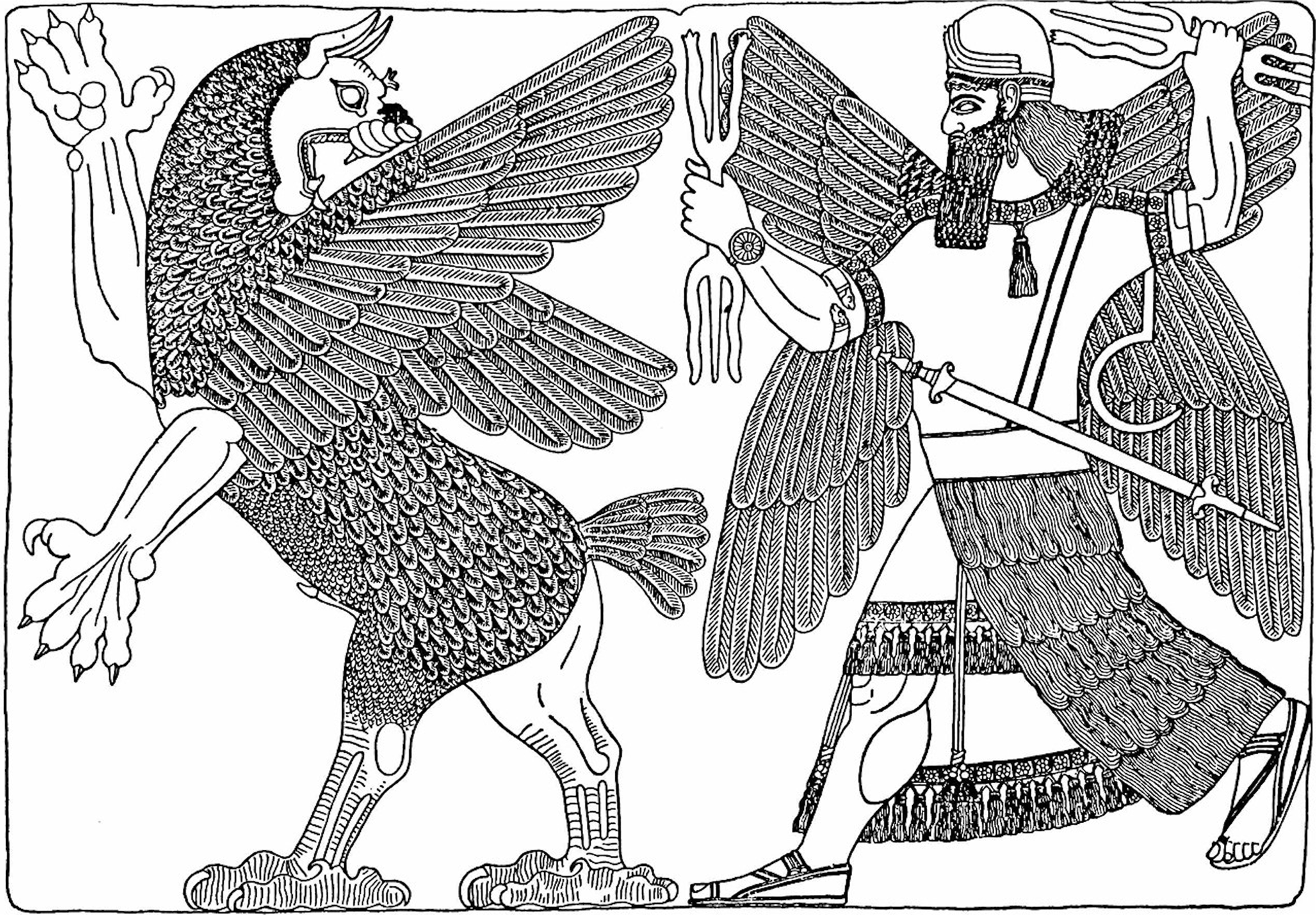
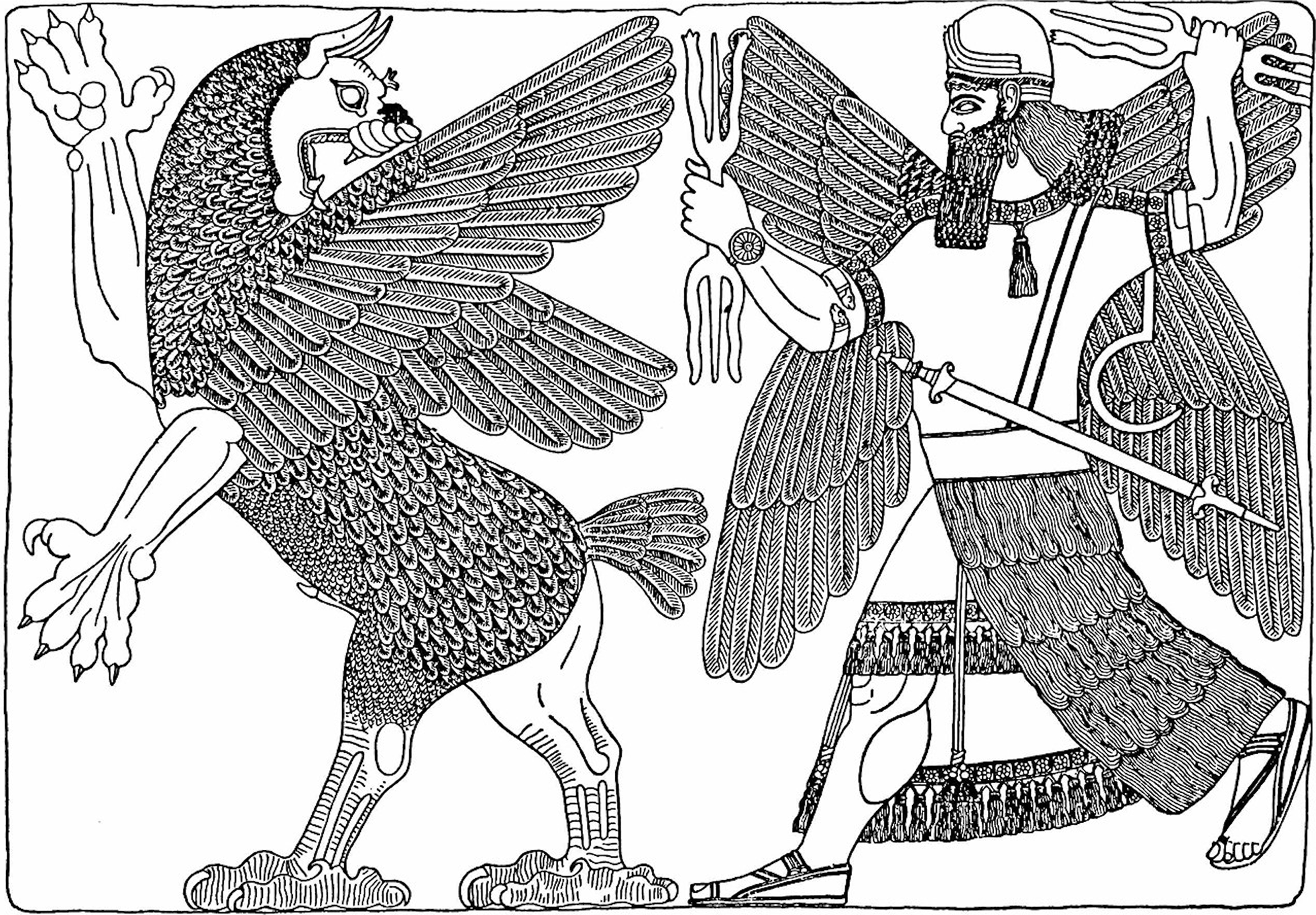
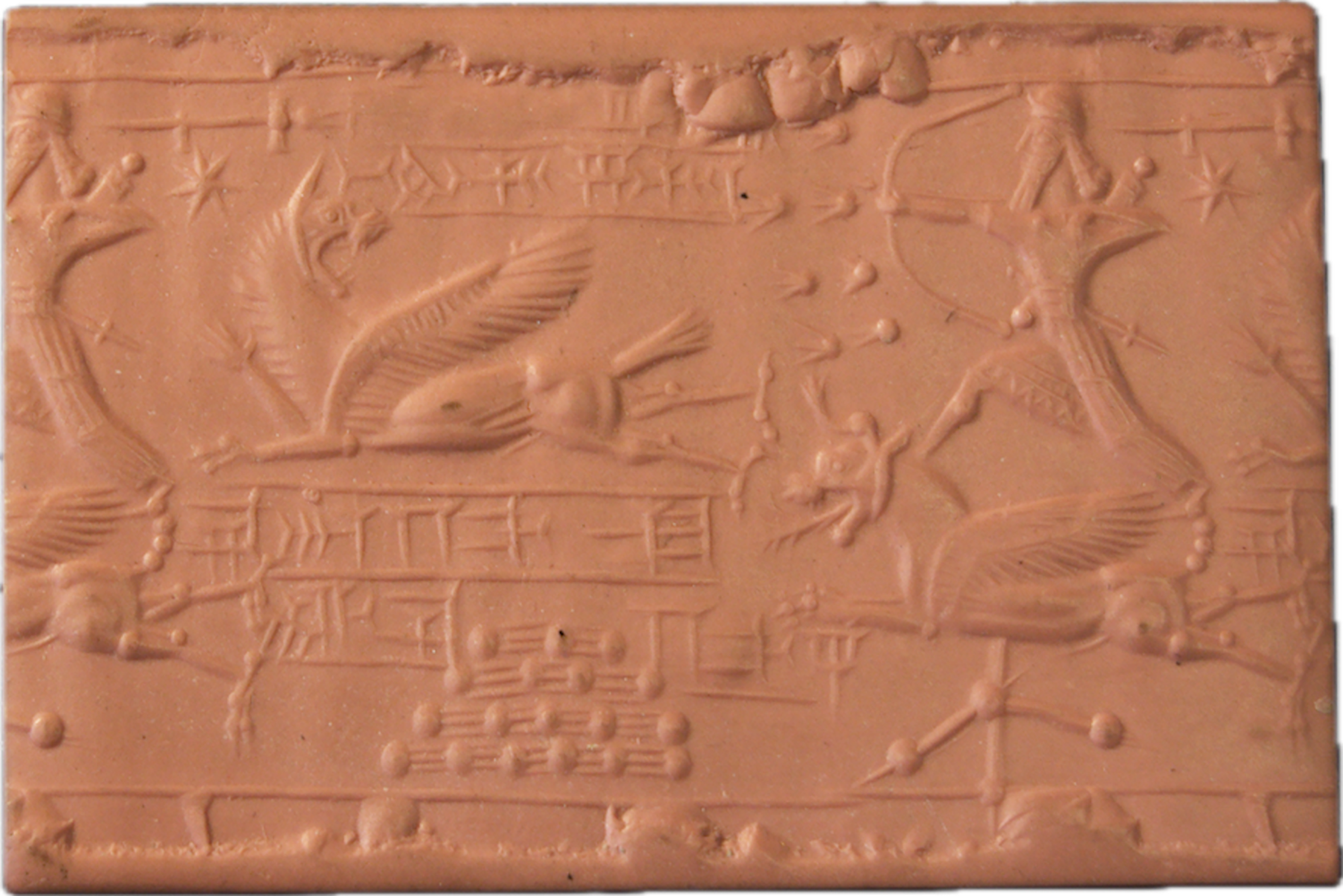
The visualization of the Anzû myth has been proposed as one of the few identifiable mythological scenes in Mesopotamian art (Green Reference Green, Finkel and Geller1997). When scholars do point out any visual examples of the Anzû myth, they cite its appearance generally on Neo-Assyrian linear-style cylinder seals of the 9th and 8th centuries and specifically on the relief from the Ninurta temple at Nimrud (Watanabe Reference Watanabe and Prosecký1998: 442; Winter Reference Winter and Uehlinger2000: 74) [fig. 2].Footnote 32 Additionally, the temple relief has been previously regarded as the blueprint for cylinder seals depicting the myth (Kolbe Reference Kolbe1981: 75).Footnote 33 Again, the citations of Anzû imagery in relation to the lion reliefs are seemingly made at a thematic level, but when compared to visual examples of Anzû on cylinder seals with the Ninurta temple relief, they are actually quite different. The Ninurta temple relief, which likely depicts NinurtaFootnote 34 battling with the AnzûFootnote 35 , arranges the Anzû such that its body is in profile, wings behind its body and forelegs in front, as its twists its neck backwards to roar at its assailant. This particular poseFootnote 36 also occurs on a Neo-Assyrian cylinder seal inscribed with the name of Ištar-balāṭa-ēreš, governor of Kilizu, a province in the Assyrian heartland [fig. 3].
Gypsum wall relief (BM 124572) from the Temple of Ninurta at Nimrud (Kalḫu) which likely depicts Ninurta battling Anzû (865-860 B.C.E.). H: 240.7 cm, W: 362.7 cm. Drawing by Kyra Kaercher
Impression of chalcedony cylinder seal. 9th-7th centuries B.C.E., unprovenanced. H: 4.05 cm, D: 1.6 cm. BM 135752. After Collon Reference Collon2001: no. 291, pg. 151. © The Trustees of the British Museum

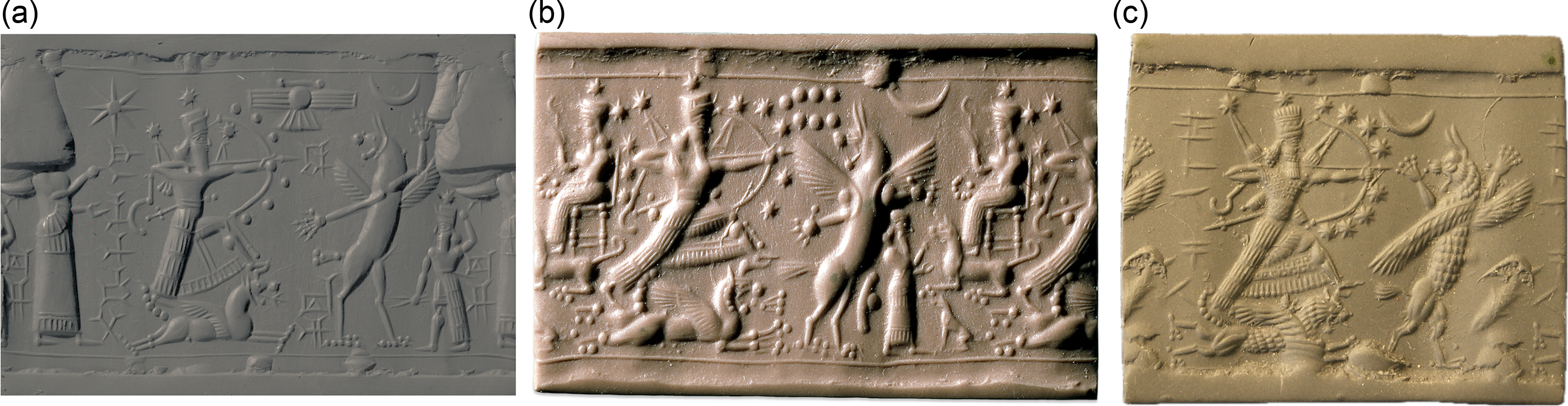
However, the composition of Anzû on most linear-style cylinder sealsFootnote 37 diverges slightly from the oft-cited Ninurta temple example and could represent an alternative conceptualization of Anzû’s actions in the Ninurta-Anzû myth. On these seals, the Anzû’s hind legs are shown in profile, and its wings and forelegs separate from each other and fully extend outwards [fig. 4a-c]. The presentation of wings on either side of the body is normally reserved for figures that appear in fully frontal form, such as female divinities, or en face (front+profile), such as daimons who act as beneficent protectors and gatekeepers (Asher-Greve Reference Asher-Greve2003; Bahrani Reference Bahrani2001; Sonik Reference Sonik, Feliu, Llop, Millet Albà and Sanmartín2013b).Footnote 38 Its twisted profile, complete with its outstretched paws and roaring maw, highlights its monstrous nature in comparison to the orderly figure of Ninurta, who appears in full profile.Footnote 39 This juxtaposition in body language between a god (whose actions are sanctioned) and a monster (whose actions were subversive) can serve to evoke distinctions between the familiar and the ‘Other’ in the experience of the viewer (Sonik Reference Sonik and Kipfer2017). Moreover, the positioning of Anzû’s body is now ambiguous- are we supposed to be looking at its chest or its back? The presentation of the entire back would be highly unusual in Neo-Assyrian art.Footnote 40 There appears to be limited attempts to render shoulder blades on fig. 4b, and a later 8th century example shows Anzû’s left wing clearly emerging from its back [fig 4c].
a, b, c: Examples of 9th-8th centuries B.C.E. impressions of chalcedony cylinder seals which show Ninurta battling Anzû. 4a: VA 5180, H: 4.2 cm, D: 1.7 cm from Assur. ©Staatliche Museen zu Berlin – Vorderasiatisches Museum. 4b: BM 119426, H: 3.45 cm, D: 1.5 cm, unprovenanced, after Collon Reference Collon2001: 123, no. 232. ©The Trustees of the British Museum. 4c: BM 129560, H: 2.9 cm, D: 1.1 cm, unprovenanced, after Collon Reference Collon2001: 152, no. 292. ©The Trustees of the British Museum

While each cylinder seal with this scene is inscribed with its own composite image, there does appear to be some general overlap. Anzû’s twisting pose heightens the tension in the overall scene, capturing the moment just before Ninurta surprises Anzû with the decisive arrow. In Tablet II of the Standard Babylonian version, Anzû locks eyes with Ninurta (line 36) before roaring like a lionFootnote 41 (line 38). This locked gaze is present on a majority of examples, where the faces of Anzû and Ninurta are fixed at the same height. On others, Ninurta shoots an arrow tipped in lightning,Footnote 42 echoing Ea’s advice to Ninurta to shoot arrows like lightning (II: line 111). The striding figure of Ninurta usually stands on similar-looking creature who is differentiated from Anzû by a scorpion-tail. Seidl (Reference Seidl1998) argues this is the abūbu, a creature representing the Deluge who aids Ninurta in his hunt.Footnote 43
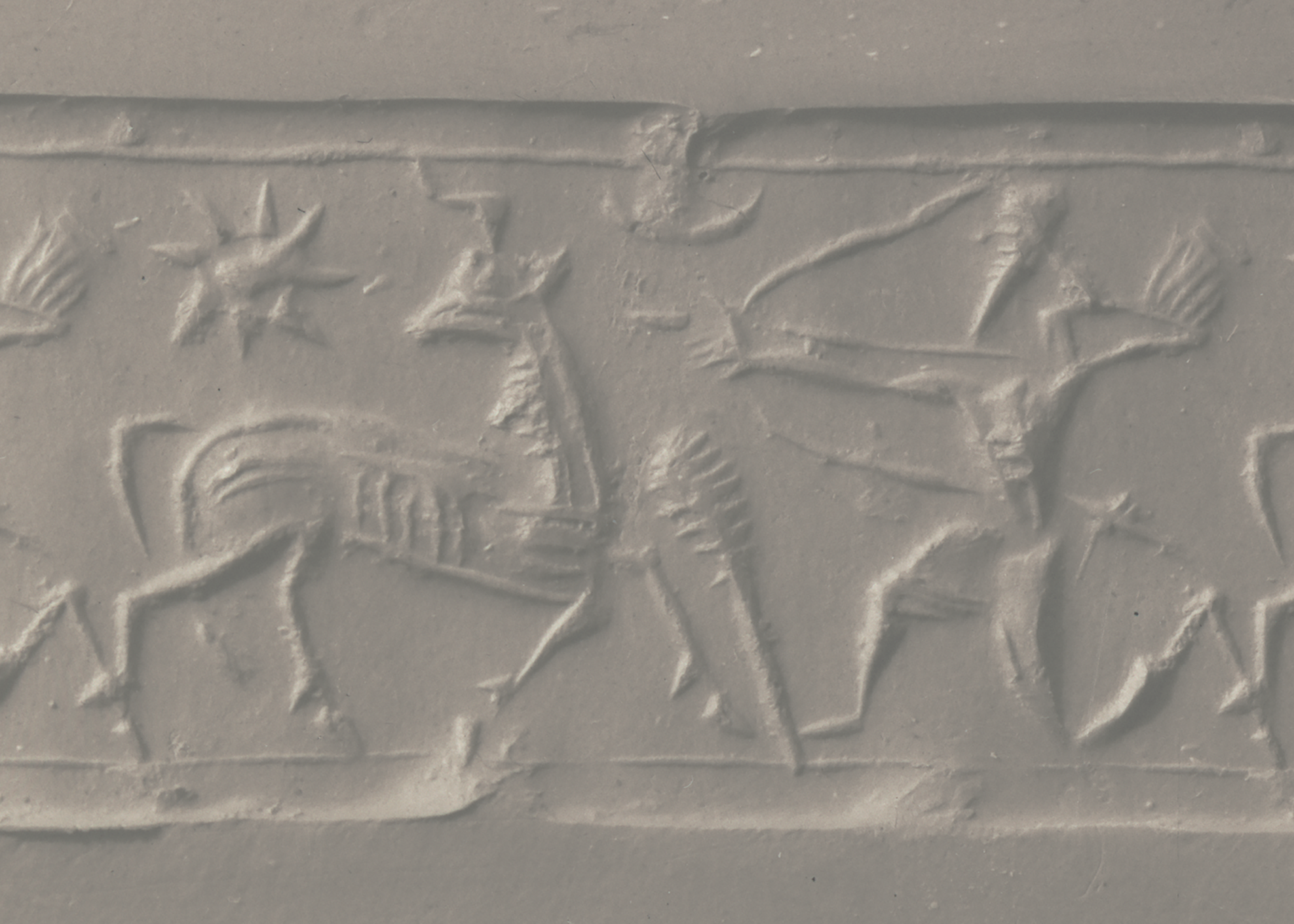
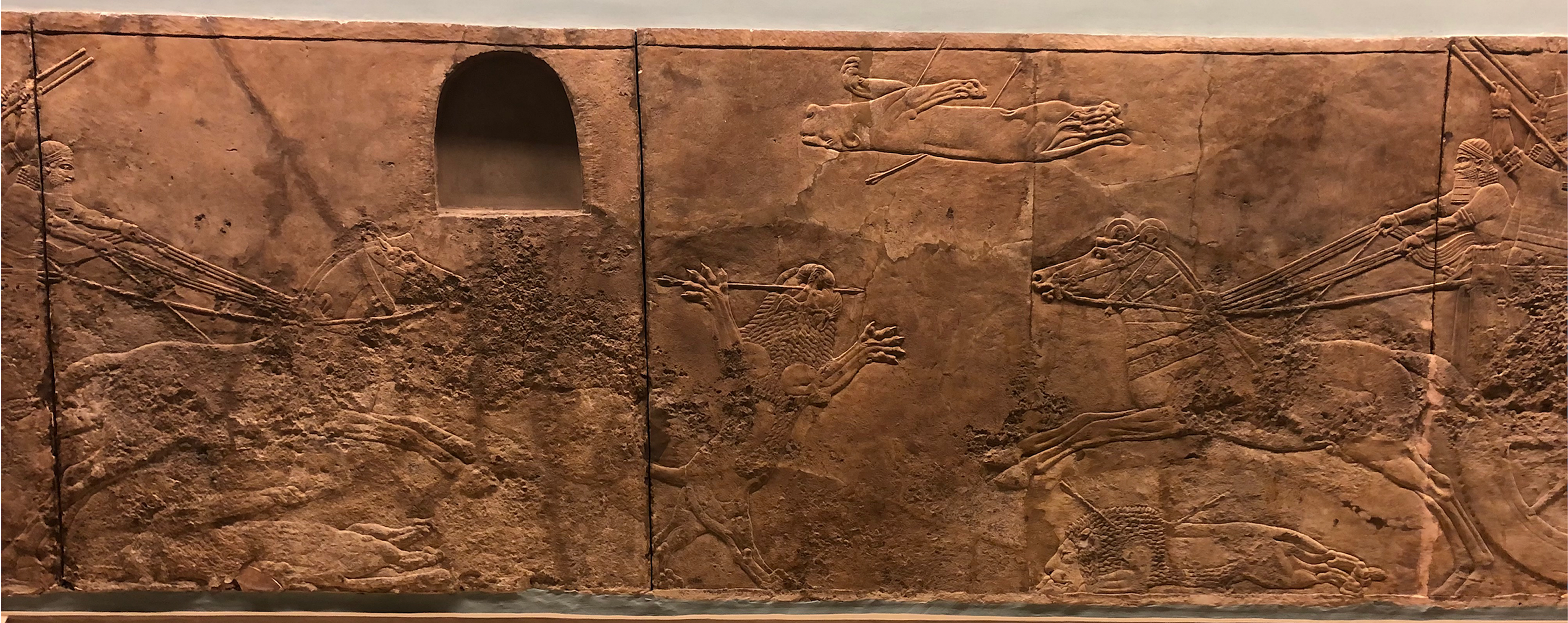
In comparison to other hunt or combat scenes on Neo-Assyrian cylinder seals, the hunted creature is typically shown in full profile [fig. 5]. Its neck will often twist around to look over its shoulder away from (or at the back of) its pursuer, which is akin to the physical arrangement of the hunted Anzû from the Ninurta temple. On the above seals, however, Anzû appears to twist its entire upper body in order to present its back, emphasizing its impressive wingspan as if to foreshadow their impending doom. To my knowledge, the only other creatures to be composed in such a way, and perhaps mirroring or referencing this rather unique pose, are particular lions on Ashurbanipal’s relief program.Footnote 44 Indeed, the rampant and splayed dying lion between two chariots in room C shows this correspondence at its largest scale [fig. 6]. Taking up the majority of the Southwest wall, this composition is described by Watanabe as “difficult to make sense of […] from the point of view of time and space in reality” (2014: 353). Ashurbanipal, who is shown twice in separate chariots on either side of this lion, is practically a supporting character along with his charioteers. The arrangement of this lion between two chariots echoes other heraldic compositions in Neo-Assyrian art, including three-figure contest scenes on cylinder seals and the sacred tree relief from Ashurnaṣirpal II’s throneroom. Its body twists aggressively at its middle, presenting its back and modelled shoulder blades to the viewer. The strong articulation of each digit of the forepaws as they spread out in empty space is also paralleled in Anzû seal imagery (e.g. fig. 4c). Although Ashurbanipal is hunting from each approaching chariot with either a sword or a spear, it is an arrow through the face that is the principal demise of this particular lion, in this specific case perhaps another reference to the defeat of Anzû beyond hunting lions with arrows.
Impression of a stone cylinder seal from Assur which shows a typical Neo-Assyrian hunting scene. 9th–8th centuries B.C.E. VA Ass 1685, H: 2.3 cm, D: 1.1 cm. ©Staatliche Museen zu Berlin – Vorderasiatisches Museum

Series of gypsum reliefs from the Southwest wall of room C in the North Palace at Nineveh (645-635 B.C.E.). BM 124851-4, H: 160 cm. Author’s own photo

Intervisuality as a mnemonic device in Neo-Assyrian visual culture
Exploring intervisual relationships between cylinder seals and palace reliefs can help unpack social relationships between aesthetic producers and consumers. To what extent did individuals, either loosely or directly affiliated with the institution of Assyrian kingship, interact with and/or contribute to the ongoing production and development of motifs within Neo-Assyrian art? Among inscribed seals and extant impressions of inscribed seals, Ninurta is the most frequently depicted deity (Collon Reference Collon and Taylor2006: 104). Watanabe (Reference Watanabe and Watanabe1999: 322) similarly noted the popularity of Ninurta imagery for seals of officials, which she attributed to an ideological connection between royal lion hunts and Ninurta hunting Anzû. Of the inscribed examples,Footnote 45 most belonged to individuals either involved in political administration and governance, or whose skills were used in the Neo-Assyrian courtly milieu: Ninurta-bēl-uṣur, ša rēši to Ninurta-ašarēd [fig. 4a], eponym in 812 B.C.E.; Ištar-balāṭu-ēreš, rab ālāni of Kilizu [fig. 3]; Bēl-ēmuranni, who is perhaps identified with one of three eponyms (Raṣappa- 737 B.C.E., Karkemiš- 691 B.C.E., or as turtānu in 686 B.C.E.); one Marduk-šumu-ibni; and Yapa-Haddu, whose Aramaic inscription names them as a mpšr, or ‘dream interpreter’.Footnote 46 One rather interesting Babylonian example belonged to Nabû-ēṭir, a paqdu-official, with a later inscription added by Erība-Marduk, who was either father or grandfather to the Babylonian ruler Marduk-apla-iddina II (r. 722-710 B.C.E.).Footnote 47
Whether this mythological scene was the personal choice of these individuals, or perhaps indicative of a more widely adopted composition among those involved in political administration, it is not yet known, but it is the impressed version of Anzû on these seals that particular lions on the North Palace reliefs match most closely. Winter (Reference Winter and Uehlinger2000: 65) argued that cylinder seals with imagery complementary to palace reliefs often show the same scene in reverse, as if the seal maker saw (or even heard about) a relief and copied it directly onto the seal surface, which then produced a reverse impression. If the planners of Ashurbanipal’s reliefs previously experienced this Anzû type impressed into clay, the near exact copying of pose from seal impression to palace relief would suggest conscious emulation of the seal impression—using Winter’s logic. This would also seem to complement Nadali’s (2010) argument that the North Palace reliefs directly copied or indirectly referenced older images of the king hunting lions from stamp seals for the layout of various lions in the hunt scenes. Although no full examples of inscribed cylinder seal impressions containing the Anzû scene as yet appear on surviving documents,Footnote 48 it does seem to suggest that this particular image of Anzû must have been circulated to some degree, to the point where those determining the figural composition of lions on the North Palace reliefs were perhaps familiar with its unique pose.
A fragmentary limestone plaque found at Nineveh, tentatively dated to the 9th-8th centuries B.C.E., could be an example of such a vector. Originally perhaps 30 by 18 cm, its portability could have eased the distribution of its visual program and recalls the oft-cited hypothesis of ‘pattern books’ (Moorey Reference Moorey1994: 34) to explain how motifs were circulated among artisans and workshops. Depicting on one side the lower half of a striding god atop the remaining upper half of a winged creature, with a smaller figure to the right in a similar striding pose, Reade (Reference Reade2001/2: 158-160) interprets this scene as the Ninurta-Abūbu-Anzû composition found on cylinder seals of the same period (e.g. fig. 4a).Footnote 49 He argues that the plaque “implies the existence of larger versions of the Ninurta-Abūbu-Anzû scene, from which the makers of cylinder seals could have drawn their imagery” (2001/2: 160). Ranked notions of media aside, it is unfortunate that we are missing the entire Anzû on this plaque, to see whether its form matched the posture found on the majority of relevant cylinder seals, or whether it was arranged more in line with the one from the Ninurta temple at Nimrud. Regardless of whether such larger examples may have once existed, the total breadth of possible mental and material references to such imagery was likely much wider.
If this were indeed an image associated with the personal and/or professional actions of government officials, its metaphorical inclusion on Ashurbanipal’s reliefs could suggest a strategic choice in coopting a pose identifiable to particular members of his court. The composition of Anzû on cylinder seals could have communicated a powerful visual message complementing familiarity with Anzû in textual and oral settings, and thus resonating with the community responsible for the design of relief programmes. Utilized in this way across multiple visual scales, this imagery had the capacity to create and activate specific relationships between the gods, the Assyrian king, and members of his court (Collins Reference Collins, Portuese and Pallavidini2022). Indeed, the king and his court complex, composed of family members, scholars, and political officials, would have understood this type of imagery in a more nuanced way than outside visitors (Collins Reference Collins, Brown and Feldman2014: 621). While the occasional outsider might read these lion reliefs as a series of lion hunts, those who frequent the palace might recognize the message of Assyrian kingship, and still others might identify a relationship to Ninurta and Anzû through recognition of this visual covalence between certain lions and the Anzû, or even via recollection of the myth. The visual affinity between both battles could stimulate shared perceptions about the nature of combat as it relates to the maintenance of royal authority and divine order. Gansell’s (2016: 86-7) notion of ‘elite ideological memory’ is helpful here; as individuals enculturated in the intellectual milieu of the palace encountered relief narratives, they would have re-experienced their own participation in the ‘political and sacral events portrayed’. While this collective memory could have served to prop up notions regarding embodied divinity in the visual portrayal of the Assyrian king, elevating their mortal actions into mythological stages, it also could have applied to the perception of ‘supporting characters’ in the narrative. Consequently, I suggest that the rear-facing pose of Anzû establishes an intervisual paradigm between the pursued Anzû and hunted lions within particular vignettes amongst the wider lion hunt relief program. The composition of ‘Ashurbanipal-chariot-lion’ crafted on the Southwest wall of Room C and ‘Ninurta-Abūbu-Anzû’ on 9th and 8th century linear-style cylinder seals carry the same visual structure, allowing for an implicit connection that is bolstered by the distinctive posture of certain lions and the Anzû.Footnote 50
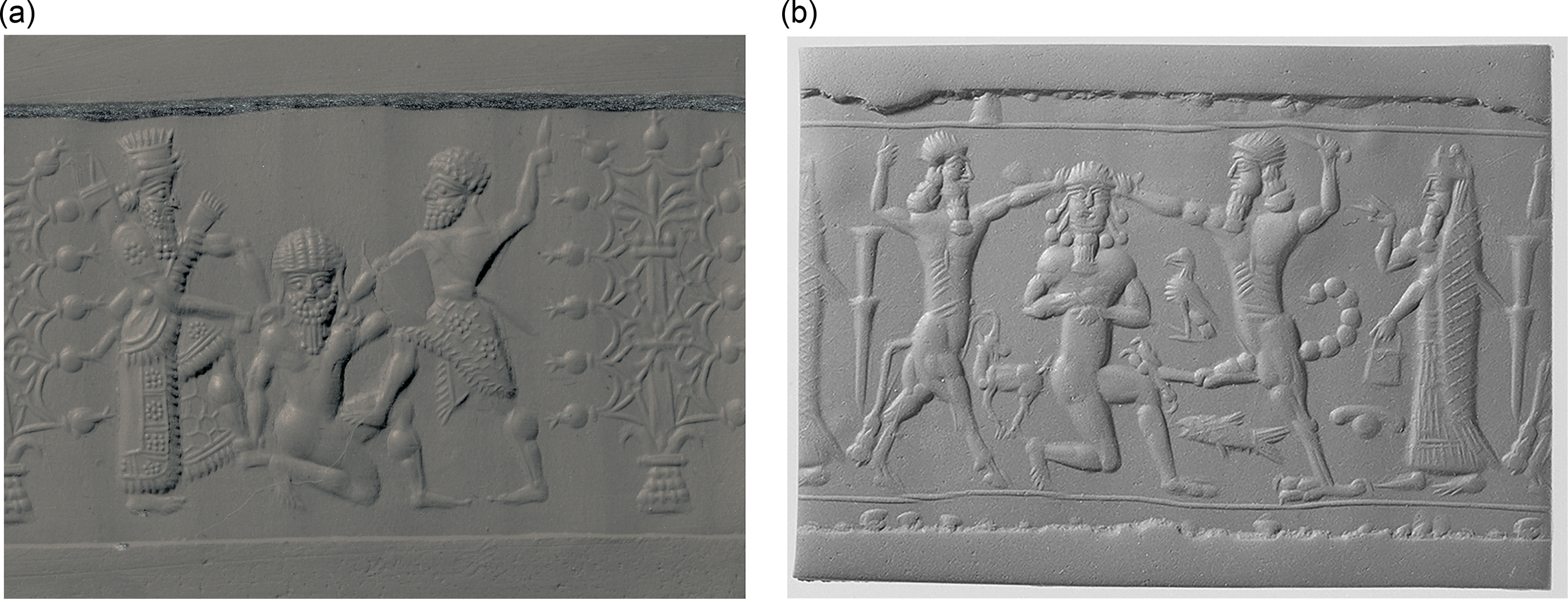
Interestingly, this type of mnemonic device also arguably occurs among cylinder seals at a compositional level, in which figures are substituted in mythological scenes. Anthony Green (Reference Green, Finkel and Geller1997) cites an example of this substitution from another of the few identifiable mythological scenes in Mesopotamian art, that of Gilgamesh and Enkidu slaying the monster Humbaba. On a 9th-8th century B.C.E. chalcedony cylinder seal from Assur (VA 4215),Footnote 51 Gilgamesh and Enkidu flank Humbaba on either side, and Humbaba is shown kneeling, facing frontally [fig. 7a]. A later 8th-7th century cylinder seal (Met 1983.314.13) shows a strikingly similar composition, except that each figure is substituted by a kusarikku ‘bull-man’, laḫmu ‘hairy one’ and girtablullû ‘scorpion-man’ respectively [fig. 7b]. Green (Reference Green, Finkel and Geller1997: 138) suggests that this substitution is a sort of humorous visual play, one that would have been recognizable to and enjoyable for ancient viewers who were familiar with Gilgamesh’s exploits. Viewed thusly, the correspondence between particular lions and Anzû in Ashurbanipal’s lion reliefs may have even been an esoteric visual pun for members of Ashurbanipal’s inner court. What is particularly curious is that neither Neo-Assyrian ‘royal’ seals nor ‘bureau’ seals seem to use mythological iconography, but rather it is found on the seals of court officials. Beneath the upper echelons of activities conducted by/on behalf of royals and high officials, there appears to be a dynamic visual landscape constituted by the personal seals of officials and courtiers, likely influenced by and contributing to the production of court-centered art, which by extension includes the play and display of scholarly knowledge.
a, b: On the left, impression of a chalcedony cylinder seal from Assur which shows Gilgamesh and Enkidu slaying Humbaba. 9th-8th centuries B.C.E. VA 4215, H: 3.2 cm, D: 1.9 cm. ©Staatliche Museen zu Berlin – Vorderasiatisches Museum. On the right, impression of a chalcedony cylinder seal (unprovenanced) showing a kusarikku, laḫmu, and girtablullû mimicking the figural composition of fig. 7a. Late 8th-7th centuries B.C.E. Met 1983.314.13, H: 3.6 cm. 2025 © The Metropolitan Museum of Art/Art Resource/Scala, Florence

The suggested intervisual relationship between Anzû imagery and particular lions on Ashurbanipal’s North Palace reliefs aims to widen frameworks of visual transfer in the Neo-Assyrian period. Intervisual approaches can help disentangle the complex origin and interpretative range of a given motif or composition among different social groups. The transposition of Anzû into Ashurbanipal’s lion hunt reliefs implies a strategic adaptation of imagery across media that worked to craft deep links between narratives of mythological order and royal authority. It also points towards a coded system of visual representation which knowingly engaged with composition, visuality, and gesture across human and animal categories. The production and reception of Ashurbanipal’s relief programme was contingent upon a web of social, intellectual, and material communication, and there are likely more semiotic interpretations yet to be revealed.
Acknowledgements
I would like to extend my heartfelt thanks to Augusta McMahon, Paul Collins, Yağmur Heffron, and Christina Tsouparopoulou for their helpful comments on successive drafts of this paper, and to Jon Taylor for his kind assistance with cylinder seal images from the British Museum. I would also like to thank the anonymous reviewers for their critical feedback. Any mistakes are my own.

 Open access

