

Introduction
Most countries in the world have a formal constitution (i.e. a legal document or legal documents which have stronger legal normativity than other legal documents and burdensome procedural requirements for its/their amendment or its judicial review). Having a constitution may be seen as a symbolic marker of national sovereignty; it can also contain credible commitments and help to coordinate the political process.Footnote 1 The discourse on constitution-making is dominated by the search for the best procedural solutions to produce a ‘legitimate’ (whatever that is supposed to mean) constitution.Footnote 2 Procedures are important indeed: they can influence the content of the constitution and directly impact the political context (both in positive and negative ways).
However, we should not ask only how a new constitution should be made, but also whether and when this should be done. Creating new constitutions, no matter how well designed the procedure is and how smart its content is, can under certain social and political circumstances (especially in highly polarised societies) result in more harm than good. In such situations more modest means of democratisation (e.g. amending the old constitution, changing the judicial interpretation of the old constitution, creating new ordinary laws, changing political practice, or a combination of these) are appropriate.
The overly optimistic or even enthusiastic view of constitution-making processes (especially in post-authoritarian situations as a means of democratisation) is to a large extent defined by the success of some of these processes in the past. Many other processes, however, failed – either by producing constitutions that did not prove to be ‘legitimate’ or by directly triggering unfavourable social and political dynamics. Finding the right procedural steps is sometimes impossible, as sometimes the time is just not ripe for a constitution-making process (no matter how well-meant and smartly designed it may be).Footnote 3 Just like sport: it is in general healthy to do some sport, but if you have certain medical conditions then it may not (at least until you get better) be advisable.
Constitutional lawyers usually favour the idea of constitution-making (some of them might even hope to participate in such processes one day) and politicians love to promise their voters a new constitution – as if it were a solution for the complex social, economic, political and cultural challenges a country faces. We should not be blind, however, to the potential futility and even dangers of such processes – not only because these can be instrumentalised by power-hungry politicians,Footnote 4 but also, even with the best altruistic intentions, they can be untimely if you want to maximise their ‘legitimacy’. Institutional small print (including informal rules and practices) is usually more important anyway for changes in the political culture that are necessary for successful democratisation, than the theatrical grandeur of a constitution-making process.Footnote 5
In the first section of this article, I am going to show various possible meanings of the term ‘legitimacy’ so that we know what should actually be maximised by the constitution-making process. In the second section I summarise the state-of-the-art concerning the effects of various constitution-making procedures on various conceptions of legitimacy. In the final section, I give an overview of the combined effects of various democratic constitution-making procedures concerning various conceptions of legitimacy, with a focus on sequencing and overall timing.
Various Conceptions of Legitimacy
Legitimacy is a very multifaceted concept, containing a series of potential conceptual elements.Footnote 6 Moreover, as with many generic concepts of constitutional theory (like democracy, the rule of law etc.), the exact definition will imply certain political views and wishes. Therefore, when we define such a concept, we necessarily also wish for a certain political community – even if constitutional lawyers or political philosophers tend to pretend that they simply describe (or discover) the ‘true’ content of a concept.Footnote 7 Instead of playing this frustrating game of hide-and-seek, I think that it is more useful for the discourse on constitution-making procedures to show in an ‘if … then’ manner exactly which constitution-making procedures contribute to which conception of legitimacy.
Legitimacy is usually understood as something good (‘a virtue’) that political institutions (and the decisions made within them about laws, policies, and candidates for political office) claim to have; something that is, loosely speaking, worthy of support.Footnote 8 If we talk about the legitimacy of constitutions, then several conceptions (or a combination thereof) are possible, and fulfilling one of them is quite possible without fulfilling the others.Footnote 9 Most of these criteria are not simply a ‘yes/no’ binary but an issue of degrees or gradients.Footnote 10
The usual twofold distinction between descriptive (sociological) and normative (ethical) legitimacy does not seem sophisticated enough for the purposes of the present analysis, therefore I suggest a threefold terminology differentiating between substantive legitimacy, formal legitimacy and output legitimacy (some of them comprising further sub-categories).Footnote 11 As we will see, there can be correlation (and even causality) between the various conceptions of legitimacy, but there can also be cases where they clearly diverge (and, under certain circumstances, trade-offs should also be recognised). There is no hierarchy between the various conceptions of legitimacy (or at least I am hesitant to rank them); all of them are virtues that make a new constitution worthy of our support.
Substantive legitimacy based on the text of the constitution
A usual approach is to talk about the legitimacy of a constitution as depending on its text. We expect a constitution to contain values such as democracy, the rule of law (including division of powers), human rights or even justice.Footnote 12 These are, however, essentially contested concepts themselves, so their exact content is open to debate. (The content of the text might be improved or worsened by subsequent judicial case law, but that phenomenon is not part of our current enquiry).
This conceptual tradition goes back to Pufendorf, who defined ‘potestas legitima’ by being bound to substantive natural law principles.Footnote 13 Nowadays, substantive legitimacy concepts usually no longer apply the language of natural law; they simply talk more modestly about ‘legitimate’ as ‘just’ or as having an ‘ethical quality’.Footnote 14
If we apply this approach, then the question is which constitution-making procedure is most likely to produce a text in which these preferred values are explicitly mentioned and/or implicitly promoted in the constitutional text.
A possible objection against this conception of legitimacy could be to refer to sham constitutions which also mention these noble ideas. The text of a constitution does not, in truth, say much about what is actually happening. We may even suspect that the more aspirational the text of a constitution is, the uglier legal reality will be.Footnote 15 An overly aspirational text (which implies maximum substantive legitimacy) can be not just a symptom of a legal culture in which legal norms are not taken seriously at all, but it can also strengthen the tradition of viewing the constitution as no more than a political declaration, as the standards set (e.g. concerning social rights) can, in certain cases, be unachievable.
Formal legitimacy: source, legality, fair procedure
Formal legitimacy concerns: (1) the source of authority; (2) the legality of the procedure; and/or (3) the fairness of the procedure in which the constitution is adopted.Footnote 16
Ad (1) Whereas historically, legitimacy was bound to monarchical rule,Footnote 17 in modern constitutional thought the source of political legitimacy is the people.Footnote 18 Even though this idea is mostly traced back to Rousseau,Footnote 19 for the purposes of modern constitutional theory another French social contract theorist, Abbé Sieyès is actually more important. He invented the concept of pouvoir constituant, meaning ‘the people’ as the only legitimate source of the authority of constitutions.Footnote 20 If not the people themselves, then at least their representatives (in the parliament or in a constituent assembly) should approve the constitution, so there is a chain of legitimacy leading back to the people.Footnote 21
Another sub-version within the strand of formal legitimacy conceptions is to equate it with legality. A constitution is thereby legitimate if it was adopted according to the legal rules which foresee the adoption of a new constitution. This is the original meaning of the word in Roman law, where the ‘legitimate’ heir was the person who had a legal claim for the legacy if there was no will (testament).Footnote 22 Also later, in the 19th century, such uses of ‘legitimacy’ arose from time to time both in France and Germany.Footnote 23
Even if sometimes legality is considered exactly the counter-concept of legitimacy,Footnote 24 and is therefore irrelevant for the legitimacy of a constitution, it is definitely not considered as harmful. The fact that a constitution was made legally does not make it illegitimate – quite the opposite (depending on the definition of legitimacy): an illegal constitution could be considered by some also as illegitimate.Footnote 25 I therefore keep it in my cluster of legitimacy definitions, while recognising that this one is even more open to debate than the other ones.
A third sub-version within the strand of formal legitimacy approaches concentrates on the fairness of the procedure. Fairness can especially mean transparency (as opposed to secrecy) and inclusiveness (taking into account the voice of those who are affected). It is primarily not about the moment of consent, but more about the prior process leading up to the decision. Concentrating on the fairness of the procedure as the source of legitimacy is characteristic, for example, of the legitimacy theories of LuhmannFootnote 26 and Habermas.Footnote 27
Unfortunately, there seems to be a trade-off between the fairness of the procedure, on the one hand, and the quality of the text or (under certain circumstances) possibly even the social output of the constitution, on the other hand. As Klein and Sajó put it:
At the Philadelphia Convention, great and successful efforts were taken to ensure secrecy of the debates; although the opposite model was found imperative in 1789 in Paris. The drafts and debates of the National Constituent Assembly were published daily and commented on in endless pamphlets within hours. The debates were open and it seems that it was very fashionable at the time to be seen during the deliberations. Threats from the gallery and the street and the immediate reactions of public opinion played a remarkable role. The imperfections of the work in committees and the noise in the general debate that lost arguments contributed to inefficiency.Footnote 28
Output legitimacy (social result): just and free society, economic growth, stability and support
Output legitimacy of a constitution is all about the social consequences, the social result of the document.Footnote 29 Did our society become a more just (free, equal etc.) place because of the constitution? Does the constitution ensure economic growth?Footnote 30 Does it guarantee stability and support by the main political actors, the officials (justices, policemen etc.) and by the people?Footnote 31 Sometimes this approach is referred to as descriptive legitimacy, but it is probably better not to call it ‘descriptive’,Footnote 32 as by referring to these social facts (such as support) as legitimating factors, we are actually implying normative ideas.Footnote 33 By referring, for example, to social support as ‘legitimacy’, we are implying that social support is desirable (because it is democratic etc.).
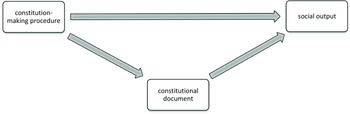
The constitution-making process should not be seen simply as a means to achieving a good text: the process itself can have transformative power on the future of the polity that can be even more consequential than the actual constitutional text.Footnote 34 Instinctively, we would think that certain procedural steps lead to a constitutional document, and then this document has social consequences (indirect social output of the constitution-making procedure). There are signs, however, that there is a direct social output of the process and that this might be even more important. All these mechanisms exist, but their relative strength is far from obvious (we are going to return to these questions in the second part of the present article).
Lawyers are familiar with a similar phenomenon concerning trials by juries: a jury’s main virtue is in the procedure and not in the outcome. As a matter of fact, a jury is a notoriously bad decision-maker (also concerning facts),Footnote 35 but it helps citizens (not only jury members) to feel that they ‘own’ the legal system. It therefore can contribute to more popular support for the legal system,Footnote 36 at the price of having less good court judgments. Also in the case of constitution-making processes, we have to entertain the idea that a certain procedural step might have a certain effect on the new constitutional document, but at the same time it might have an opposite effect on the social and political context of the constitution. If we do have two causal chains (as shown in Figure 1), then even a failed constitution-making process can have positive effects: one could potentially argue, for example, that the over-inclusive deliberative Icelandic process (2010–2013) contributed to the failure of the actual adoption of a new constitution, but at the same time it also improved the Icelandic democratic culture.Footnote 37
Direct and indirect social output of constitution-making procedures

The various social outputs are themselves (and more so than any other above-mentioned factors of substantive or formal legitimacy) of a more-or-less nature and are not binary: it is not obvious what percentage of the population has to support the constitution at a certain time in order to be able to say that it enjoys popular support. It is also unclear what the actual (psychological or sociological) content of such support is: most ordinary citizens do not know the actual content of their own constitution (or at least not in detail). Do we measure support with approval rates (and, psychologically, how intense should this approval be?) or rather by how far the legal system based on the constitution is followed in practice?Footnote 38 How do we define ‘the’ people, and can the meaning of this term change over time (e.g. through the extension of voting rights)?Footnote 39 Is it not the constitution itself which defines ‘the’ people of the political community?
If it is about the support of political actors and officials, do they need to internalise the constitution or simply obey it? Also, in this approach, legitimate constitutions can become illegitimate over time or, conversely, illegitimate constitutions can step-by-step gain legitimacy.
Sometimes, this support legitimacy can grow also despite severe deficiencies in the formal legitimacy. The German Grundgesetz of 1949, which may well be the most influential and (at least in Europe) the most often copied constitution,Footnote 40 has a dubious pedigree. Here, the military pressure of foreign countries (viz the occupying Western allied forces) can be proven (i.e. both ‘source’ and ‘legality’ are questionable).Footnote 41 The frameworks for constitution-making (also in terms of substance) were determined by the occupying forces, and even the final draft had to be approved by them. Once the final version had been drafted, US generals ‘persuaded’ the Länder (notably Bavaria which seemed to have had enough of ‘Northern Protestant rule’ and planned to opt for a more Catholic vision) that were unwilling to accept the Grundgesetz. Initially, the Grundgesetz was not held in high esteem by (West) German citizens, either. Yet it soon became the symbol of post-war economic prosperity and of the new regime (promoting democratic values) in general which then led to the currently high support legitimacy of the German Constitution.Footnote 42
And finally, the border between long-standing traditional legality, on the one hand, and the support by officials and political actors resulting in stability, on the other hand, can be blurred, so it might be unclear which conception of legitimacy we are talking about.Footnote 43
How to create magic? Various procedural options in constitution-making and their consequences for various conceptions of legitimacy of new constitutions
Legitimacy has also been compared to magic: it is a magical characteristic of documents or political institutions which makes them worthy of being followed.Footnote 44 If this is so, then what are the steps of the successful spell? How can a designer of a constitution-making process become Gandalf, or at least Harry Potter?
There are authors according to whom the procedural steps of a constitution-making process are just symptoms of a certain pre-existing political culture, and that political culture (i.e. not the constitution-making process itself) causes a constitution to fail or to succeed – therefore the process is just a predictor, not the cause of the success.Footnote 45 I also think that the procedural steps of a constitution-making do not determine, on their own, whether a constitution will be successful or not.Footnote 46 Nevertheless, I believe that certain procedural solutions (or ‘rituals’) are indeed helpful for certain conceptions of legitimacy,Footnote 47 and political culture offers a frame within which it does matter which procedural solution we choose. In the following, I am presenting some usual constitution-making procedural steps through the lenses of legitimacy-creation.Footnote 48
Before we venture into the questions of how, we should also consider whether or when constitution-making is appropriate. For the output legitimacy, certain political contexts of a potential constitution-making are a mission impossible. In highly polarised societies, the mere fact that a new constitution is being made can aggravate polarisation.Footnote 49 In such cases, constitutional amendments (and reinterpretation of the existing text) are better suited: adopting a new constitution is a symbolic act (a national ritual), and if the polarisation is strong already then such an act will most likely just result in even more polarisation. (Popular participation will usually not lead to national consensus, see below.) In such cases, the idea of constitution-making needs to be abandoned or at least postponed. Once the polarisation situation has improved (it will take time, but there are constitutional methods to help this, e.g. proportionate electoral system, negative voting, preferential voting etc.). The thread can be picked up again, but in the meantime self-restraint is advised. Sometimes keeping the old constitution is bad, but adopting a new constitution would be even worse. Fresh wounds would be created in one half of the country – no matter which text version is adopted and no matter how smart the process design is, the ‘other’ half will hate this symbolic act. Amending and re-interpreting existing constitutional texts could solve a lot of problems, in a less symbolic and less emotional way. It is better to incrementally improve the situation than to aim for a theatrical and cathartic victory which ends up as a painful failure with long-lasting damage. If for some reason (total collapse, chaos, war or civil war) it is not possible to keep the old constitution in a highly polarised society, adopting first an interim constitution (or something similar, such as a formal agreement between key actors about the subsequent constitution-making process) can be helpful to build trust, to lower the stakes and to guarantee core interests of the polarised actors.Footnote 50
Representative bodies: parliamentary procedures versus constituent assemblies
There are two main institutional solutions when choosing the body which deliberates the new constitution: ordinary parliaments and specifically convened constituent assemblies. Constituent assemblies have two main functions: originally, they were a substitute for referenda at a time when referenda were difficult to organise logistically;Footnote 51 nowadays, they are established if the usual (mostly parliamentary) adoption does not suffice (e.g. the parliament still belongs to the ancien régime, or a radical personal separation seems to be appropriate). In constitutional history, we have seen both failures (like the Österreich-KonventFootnote 52 or the Convention on the Future of Europe)Footnote 53 and successes (USA) of constituent assemblies. The fact that a constituent assembly is in place does not say anything about its fairness (outliers are possible) or its legality.Footnote 54 Widely constituted constituent assemblies (like the above-mentioned Österreich-Konvent and the Convention on the Future of Europe) tend to have deadlocks and/or pack the text with favourite topics (which would normally be more suitable for ordinary laws).
A possible advantage of a constituent assembly as opposed to an ordinary parliament could be that it is not biased towards the interests of the parliament. There is no systematic research, however, which would prove this (and there are signs of exactly the opposite in empirical research).Footnote 55 A special risk bound to this institutional solution is that the election of a new constituent assembly, especially in a polarised society and under turbulent circumstances, could easily lead to a body in which a large part of the traditional elite is not represented. This can result in substantial efforts from this excluded elite to undermine the new constitution. This was a major concern in the case of the (eventually failed) 2021-2022 Chilean constitution-making process, where the traditional right-wing elite had only very low-level representation in the 2021 Constitutional Convention.Footnote 56 Moreover, assembly members who are more likely to be elected on non-partisan tickets are not necessarily impartial: they have a tendency to focus on single issues (such as rights of certain minorities, environmental problems, or the status of their own religious communities and churches) and they are on average more likely to represent radical positions than party politicians. Compromises are necessary for any new constitution. However, if delegates only care about isolated single issues, in a radical manner, then it is difficult achieve these necessary compromises (especially in the various thematic committees where the respective fundamentalist positions can be even more concentrated).Footnote 57 In this way, non-partisan romanticism by the designers of constituent assemblies (such as it happened in Chile, where assembly delegates were excluded from future legislative positions) can easily backfire.Footnote 58
There are various approaches towards the ideal composition of constituent assemblies: (1) they can be ordinarily elected representative bodies, just like parliaments (especially if the authority of the latter is questionable, e.g. because of former issues in the electoral process); (2) they can be representative bodies into which various social (ethnic, religious, professional) groups and/or state organs delegate members. The question is, of course, how we determine which groups and organs qualify for inclusion. Also, because of the lack of direct electoral input, a referendum is normally also expected at the end of the process. Additionally, of course, a combination of elected and delegated membership is also possible.
It is often claimed that if members of the constitution-making body are excluded from future political offices (‘veil of ignorance’ not in a perfect Rawlsian sense, but at least as an exclusion of perpetuating current political offices), then they might consider public interest more, be more cooperative rather competitive,Footnote 59 resulting in a better text.Footnote 60 Postponing the date on which the new constitution comes into force (e.g. after the next general elections) can have similar veiling effect.Footnote 61 If the negotiations in the constitution-making body are too transparent (e.g. where even committee meetings are open to the public, televised or streamed), then finding compromises (which implies changing one’s formerly stated position) might be more difficult.Footnote 62
As to the majority rules and veto rules within the deliberating body, Ginsburg, Elkins and Blount note that as:
the veto power of minorities increases, one might expect the adoption of more minoritarian institutions, such as judicial review …, bicameralism, and, assuming that relevant cleavages are geographically concentrated, federalism. Supermajoritarian processes might produce supermajoritarian rules and institutional configurations, to the extent that a rule-making body will produce others in its likeness.Footnote 63
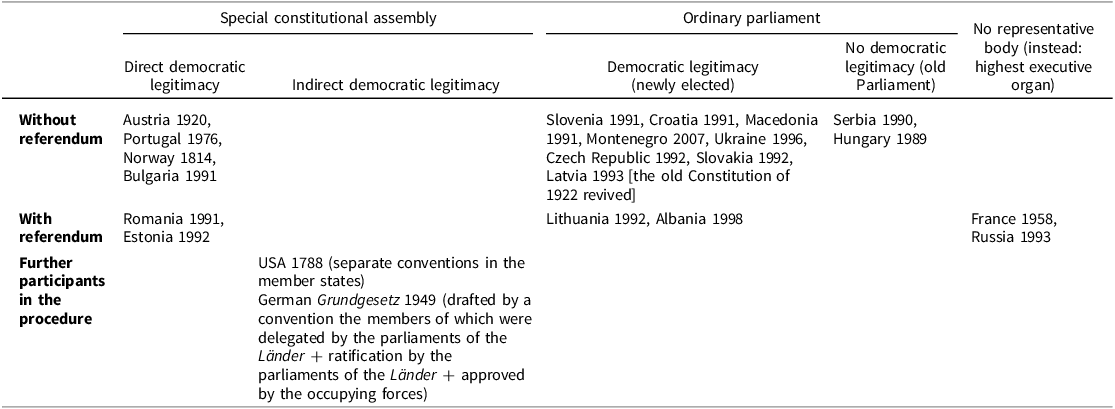
Below in Table 1, I show the variability of the use of deliberative representative bodies in constitution-making procedures. There is no mainstream solution, no overwhelming majority for any of the solutions. The only clear tendency seems to be that if no representative organ is involved (i.e. constitution-making by the executive branch), then at least a referendum is necessary in order to also give it some source legitimacy.
Adoption by Representative Bodies in Constitution-Making Procedures Footnote 66

Direct popular involvement
There are two major ways of direct popular involvement: (a) referenda (i.e. decisions at various stages of the process, most typically at the final ratification); (b) citizens’ fora and consultations (i.e. including citizens in the drafting process).Footnote 64 Even though there is a general consensus that popular involvement is somehow recommended (it can even be framed as the right to participate in public affairs),Footnote 65 empirical evidence concerning its effects is mixed at best.Footnote 67 It seems that popular involvement on its own (without accompanying consensus-building among rival elites) will most likely not result in a high quality subsequent democracy.Footnote 68
(a) Referenda (decisions at various stages of the process): Constitutions are often considered to be made at least rhetorically by ‘we, the people’ (source legitimacy),Footnote 69 the expression of which in a procedural sense is usually (and historically more and more) a referendum.Footnote 70 Referenda tend to contribute to support legitimacy, even though the exact political circumstances (political polarisation), the time and the financial tools given for the campaign, the behaviour of the elites (who tend to be gatekeepers of referenda), the approval threshold, and the structure of the question (one single question of yes or no vs decision about a series of options) can all make a difference.Footnote 71 Referenda (at least in democracies) tend to contribute to the durability of constitutions, i.e. to the stability of the regime.Footnote 72 Procedures ending in referenda tend to create texts which contain more fundamental rights, as drafters anticipate the supposed wishes of the electorate, the fulfilment of which can make success at the polls more likely.Footnote 73
It seems to be a contemporary tendency that constitution-making processes become more and more inclusive and apply direct means of public participation in different moments of the procedure, such as an ‘entry referendum’ about whether or not to change the current constitution, and an ‘exit referendum’ to approve the final text of the constitution (ratification). Referenda can also be used to solve deadlocks in the deliberating body during the drafting, i.e. concerning specific questions.
As to the likelihood of resulting the referendum in a yes vote, Zachary Elkins and Alexander Hudson note that:
leaders maximize their chances of success when the constitutional change takes the form of a new constitutional text. If amendments are the chosen path, more amendments are better than fewer, and special referenda are better than those that co-occur with other elections. However, from the perspective of the citizen who wishes to exercise a veto on potentially anti-democratic constitutional change, the reverse is true.Footnote 74
While referenda are good for the ‘source legitimacy’ of a new constitution, they can have detrimental effects on the ‘output legitimacy’ as they can drive the public discourse towards polarisation. If the public discourse is already anti-intellectual, overly emotional (hateful), polarised, captured by the state or extreme ideologies, binary choices at referenda are most likely going to make things even worse. Referenda are not the right institutional tools for solving disagreements constructively and for achieving compromise. They are also much more susceptible to being abused by would-be authoritarians than other forms of direct popular involvement.Footnote 75
(b) Citizens’ fora, consultations: inclusiveness in drafting: Popular constitution drafting processes (constitutional crowddrafting)Footnote 76 and various consultation mechanisms have become popular in recent years.Footnote 77 The most well-known example is the Icelandic one (2010-2013) where: first, 950 randomly selected individuals (an age-, gender- and geography-balanced, one-day long ‘National Forum’, divided into small discussion groups moderated by trained discussion leaders) established ‘the principal viewpoints and points of emphasis of the public concerning the organization of the country’s government and its constitution’;Footnote 78 second, a directly elected (but for procedural reasons, later appointed) constituent assembly of 25 non-professional politicians had to prepare a text (in an iterative process in which the Constitutional Council collected online comments, redrafted, then collected comments again, and so on, several times); and third, a non-binding referendum had to approve the text.Footnote 79 Participation at the referendum was unusually low by Icelandic standards (47%), even though two thirds of those who voted were in favour of the text. The Icelandic parliament, however, never voted on the final text (shown by the low referendum participation and also by the 2013 electoral success of those parties which opposed the process), so as of today, there is no new Icelandic Constitution.Footnote 80
Such processes have the taste of anti-elitist (or even populist) distrust towards political parties and professional politicians (professional politicians thus tend to distrust these processes; they even could try to prevent their adoption), and it is questionable whether this is a good purposeFootnote 81 and also whether such an effort can be successful.Footnote 82 As Mark Tushnet put it:
Existing political groupings and parties will almost certainly affect how crowd-sourcing and similar mechanisms of direct public participation in drafting actually operate. For example, parties may prompt their members to submit identical proposals, thereby multiplying the apparent public support for the proposals.Footnote 83
The result of such an inclusive process has a mixed effect on the quality of the text output.Footnote 84 On the one hand, fundamental rights tend to have wider scope and include some rarely-emphasised aspects; direct democratic mechanisms are also usually more influential. On the other hand, inconsistencies can also be expected: various provisions might contradict, interact or could simply be badly written (as tested in constitutional history). The logistics of avoiding such pitfalls is unclear, to put it mildly.Footnote 85 It is not always clear whether such instruments serve the inclusion of popular ideas, or whether they just provide the illusion of actual popular influence (digesting the large amount of citizens’ submissions can be also an insurmountable logistical challenge). One way to take popular influence more seriously, institutionally, is to require the drafters to give reasons why particular popular suggestions were accepted or rejected, instead of just cherry-picking some of them.Footnote 86 Experience shows that the actual influence of popular involvement on the text is, in general, limited, and if political parties are strong, then very, very limited.Footnote 87 If the political and legal culture of the citizens is less liberal democratic, such processes can even make the text less friendly towards principles of liberal democracy (and/or prone to abuse by charismatic politicians).Footnote 88
Inclusive processes are supposed to create popular support for the new constitution.Footnote 89 As to the actual quality of democracy after the constitution-making process, popular involvement in the drafting does seem to have a positive effectFootnote 90 (as opposed to ratification referenda, which have no significant influence on the quality of subsequent democracy),Footnote 91 most likely because participants gain ownershipFootnote 92 and are also educated through the participation process.Footnote 93 The most important practical advantage of popular drafting is information dissemination and education of citizens.Footnote 94 This makes popular support later on much more likely.
The risk is, however, that if the fora are badly designed (e.g. they are homogenous, even though society is heterogeneous), then this can contribute enormoudly to political polarisation. Homogenous discussion groups do not simply reconfirm their own opinion, but normally even become more extreme through the discussion process.Footnote 95 In highly polarised societies, just like in the case of referenda, the risk of further polarisation is especially high through popular participation.Footnote 96
Drafting by expert bodies (constitutional lawyers)
Expert bodies (domestic, foreign or international, such as the Venice Commission) consisting of constitutional lawyers tend to contribute positively to the quality of the text (and therefore to the substantive legitimacy).Footnote 97 Well-crafted legal texts also tend to enjoy some support from legal professions (such as judges). Such texts also tend to contribute to foreseeability in a legal system, and legal certainty is helpful for economic development.
In many cases, however, their work is not very transparent, and they can also seem suspicious from a perspective of source legitimacy. Moreover, legal experts ‘tend to resist the technically flawed and deliberately ambiguous formulations that may be necessary to achieve consensus’ amongst political actors.Footnote 98 This can be detrimental to stability and the ongoing support of political actors.
Drafting by extra-legal political negotiating bodies (unelected roundtables)
Unelected roundtables can be used for effective elite bargains, if the ordinary representation (Parliament) lacks representation, and even the rules of a new election are open to debate. In such cases, transitions (including transitional constitutions) can be negotiated by the relevant (but extra-parliamentary) political actors. Such negotiations are sometimes (partly) secretive. The formal approval can either be given by the parliament of the ancien régime or by referendum (for a combination, see Hungary in 1989, with a partial referendum on four constitutionally relevant political questions on the transition). Elite cooperation can be fostered by such methods; this seems to be important for the stability of democratic regimes,Footnote 99 and it also improves the quality of democracies.Footnote 100
As Andrew Arato has explained it:
While formally relying on the inherited amendment rule and legal continuity, materially this method uses a new institution, the round table, where old regime actors formally negotiate with oppositional forces concerning interim constitutional rules under which a new constitution can be made. The weakness of this method is that it can reduce the process to mere bargaining among élites, producing a strong legitimacy problem. But this weakness is often a strength. Much more conscious of the need to generate legitimacy than reformers or revolutionaries, the protagonists of the round table can and often do mobilize inclusion, consensual decision-making, public openness, strict legality and a new democratic election producing the final drafting body as sources of democratic legitimacy.Footnote 101
It has been empirically confirmed that the most likely improvement of the subsequent democracy can be achieved by well-designed methods for including various interests (whether in the form of roundtable or not, consisting of not only political parties, but interest groups, labour unions, human rights activists etc.), and public participation is less important: ‘smoke-filled rooms which include relevant socially anchored interests are more relevant to enhancing democracy than thousands of Facebook “likes” and social media commentary’.Footnote 102 Moreover, direct participation usually influences more the actual text of the constitution than non-elected inclusion.Footnote 103 When compared with representative solutions, however, non-elected (or not representatively elected) inclusion seems to risk amplifying, entrenching and overvaluing unrepresentative minority voices.Footnote 104
The question of constitutional revolutions
The term ‘legitimacy’ is sometimes used in a revolutionary sense (i.e. as a concept that helps to contest the bases of the legal system), but sometimes it is exactly a counter-concept of revolutions.Footnote 105 In any case, it is not harmful to adopt a constitution legally – in certain cases it can simply be irrelevant whether the constitution was adopted legally or not (if the old regime collapsed).
The fact of a legal revolution (i.e. illegal replacement) itself does not legitimise: it is the substantive content or the source (the people) that was brought about by the revolution to which legitimacy claims of revolutionary constitutions refer. Illegality itself is a risk for support legitimacy (especially in the eyes of those who considered the former constitution legitimate), and it is of course in clear contradiction to legitimacy as legality. Revolutions can also have an economic price (especially because they can be used in the future as precedents, and therefore can endanger legal certainty).
Conclusion and overview: combined effects, sequencing and overall timing
The success of a constitution-making process (measured on the various conceptions of legitimacy) depends on a number of contextual elements (like elite cooperation, political and legal culture, revolutionary events preceding the constitution-making),Footnote 106 and also on how these interact with each other and the very precise details of the procedural rules. Because of the high variability, it does not seem possible to give any more detailed guidance without knowing which concrete country and which period we are dealing with. We should, however, definitely avoid any oversimplication of the precise recipe of concrete procedural steps that would necessarily result in a constitution achieving ‘legitimacy’. We need to accept the sad fact that by opting for a certain procedure in order to enhance one conception of legitimacy, we often pay the price in another conception of legitimacy of the new constitution.Footnote 107
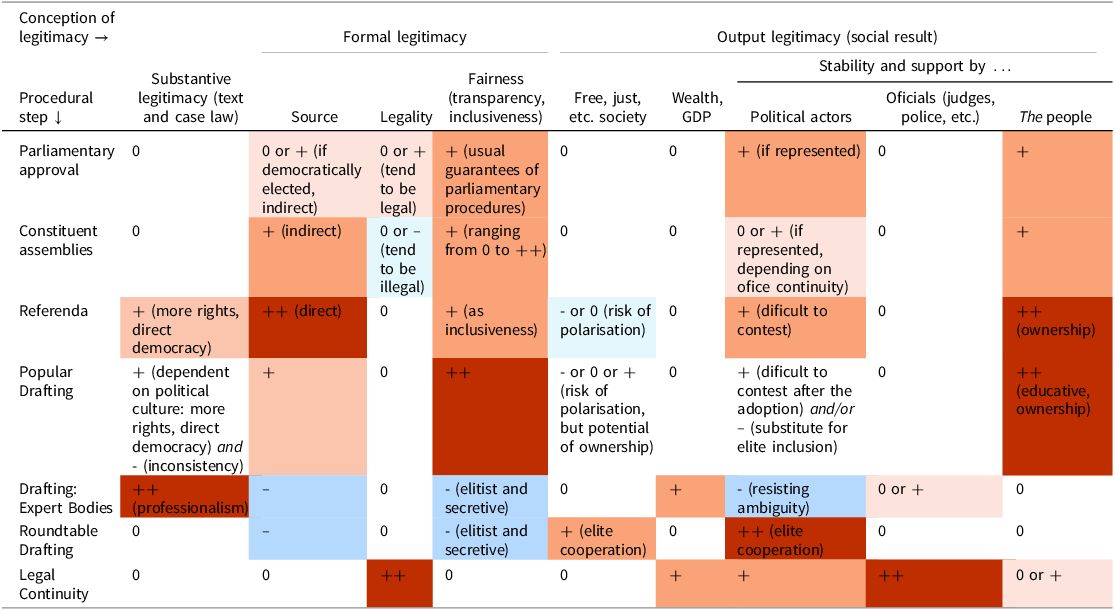
Our conclusion as to the relationship between various types of legitimacy and different procedures is therefore a conditional one (‘if … then’): if you want this type of legitimacy, then you should use this constitution-making procedure; and if you want that type of legitimacy, then you should use that constitution-making procedure. In Table 2, we summarise the findings of the present article concerning the effect of various procedural steps on various conceptions of legitimacy.
The effect of procedural steps on various conceptions of legitimacy

As already mentioned above, there seems to be a negative correlation between substantive legitimacy and output legitimacy of constitutions. It is not a causal relationship, but overly aspirational constitutional texts seem to be symptoms of legal cultures with low constitutional normativity. Moreover, such texts can also strengthen the tradition of viewing the constitution as just a political declaration, as realistically their standards (e.g. concerning social rights) are unachievable.
References to the pouvoir constituant (source legitimacy) might be used/abused as justifications for illegality (i.e. violating formal legitimacy as legality) and can in practice end up in constitutions of authoritarian regimes (i.e. violating output legitimacy as free, just etc. society).Footnote 108 Further, as also mentioned above, there seems to be a negative causal relationship between a very high degree of transparency, on the one hand, and the quality of the text and the social output, on the other. Such trade-offs should be taken into account and weighed thoroughly when designing constitution-making procedures. Ideally, with the combination (and the right sequencing) of various steps, the advantages could be combined to a limited extent, but we have to accept that there is no perfect procedure.
In any case, the design of a constitution-making process requires very thorough consideration and goodwill. Probabilities are very much context-dependent and it is impossible to identify one single (fit-all) procedure with precisely detailed steps. If we want to do well on as many conceptions of legitimacy as possible, then we can only give some very generic tentative advice about the ideal procedural steps, their sequencing and the overall timing of the procedure:
-
(1) It seems that at the beginning of the process, some kind of combination of expert drafting and roundtable discussion is useful (if there is no elite cooperation in this matter, then the hopes for high quality subsequent democracy are low, no matter what procedural tricks are applied).
-
(2) The proposed draft can then be adjusted via popular involvement (electronic and in person discussion fora).
-
(3) Generally, keeping the whole process legal is more beneficial than attempting a revolution in a legal (Kelsenian) sense.
-
(4) The involvement of the ordinary parliament or a special constituent assembly should be considered as of only secondary importance; on their own they do not provide any special benefits (and public debates risk running into theatrical grandstanding).Footnote 109 Reasons for their involvement could be to ensure the legality of the process (ordinary parliaments) and to guarantee inclusivity, to insert brakes to avoid high-jacking and non-consensual texts (constituent assemblies).
-
(5) As an additional final ritualistic step, a referendum usually seems appropriate. However, a referendum on its own cannot heal on its own preceding procedural deficiencies of a constitution-making process.
-
(6) In highly polarised societies, forms of direct popular involvement tend to aggravate conflicts if the new constitution is rejected by a sizeable minority.Footnote 110 The democratic constitution-making procedure itself (independently from the actual content of the new constitution) can therefore trigger social and political dynamics which doom the new constitution to fail in certain aspects of ‘legitimacy’. In such societies, constitution-making should possibly be postponed until the fever of polarisation has cooled.Footnote 111 In the meantime, more modest solutions (e.g. amending the old constitution, changing the judicial interpretation of the old constitution, creating new ordinary laws, changing the political practice, or a combination thereof) should be applied.Footnote 112
Acknowledgements
I am grateful for critical remarks of Eszter Bodnár, László Detre, Tamás Győrfi, Dániel Karsai, Lando Kirchmair, János Kis, Christoph Konrath, Sebastian Krempelmeier, Zoltán Miklósi, Fruzsina Orosz, Zoltán Pozsár-Szentmiklósy, Howard Schweber, Pál Sonnevend, Péter Techet, Michael Thaler, Csaba Tordai, the participants of the ELTE ÁJK Department of Constitutional Law workshop on 14 December 2022, and the participants of the workshop ‘How to Replace a Constitution in Adverse Conditions?’ organised by the New School for Social Research (New York), EUI (Florence), Universidad del Desarrollo (Chile) and P. Universidad Católica de Chile on 19 November 2021, especially Andrew Arato, José Manuel Díaz de Valdés, Gábor Halmai, Renáta Uitz, Veronica Undurraga and Sergio Verdugo. I dedicate this article to Johanna Fröhlich, with whom I have had many discussions on these issues over the last couple of years. I have received valuable research assistance from Larissa Bley, Susa Engeler and Edvin Zukic.

 Open access

