


1. Introduction
Learning Model-Based Systems Engineering (MBSE) often proves difficult: Students and young engineers face abstract notations, new modeling languages, and complex tool environments, while industry increasingly demands MBSE competence (Reference Madni and SieversMadni & Sievers, 2018). Initial research and empirical observations (see Section 4) highlight that successful learning heavily relies on continuous practical application and contextualized feedback. While traditional instructional formats provide valuable foundations, they often face scalability issues in providing individual adaptivity and real-time support. Recent advances in Large Language Models (LLMs) open new opportunities to address these gaps (Reference Swacha and GracelSwacha & Gracel, 2025). By combining curated MBSE knowledge bases with LLMs, chatbots can provide context-sensitive explanations and immediate feedback.
This paper explores key barriers and drivers in MBSE learning to derive design requirements for a prototype RAG-based chatbot. The scientific contribution lies in the exploratory development and validation of this system through both a field study and a controlled laboratory experiment, comparing it against conventional learning materials.
2. Theoretical background
Effective MBSE learning requires understanding its methodological foundations and the role of emerging AI-based support. This section introduces MBSE’s educational challenges and discusses how RAG-enabled LLMs can mitigate barriers and strengthen drivers in MBSE education.
2.1. Model-based systems engineering
MBSE is a paradigm shift within Systems Engineering, replacing document-centric practices with formalized system models across the life cycle (Reference Walden, Shortell, Roedler, Delicado, Mornas, Yew-Seng and EndlerWalden et al., 2023). A coherent system model relies on a triad of modeling languages (e.g., SysML), methodologies (e.g., SYSMOD), and software tools (e.g., Cameo Systems Modeler). While this triad is vital (Reference Friedenthal, Moore and SteinerFriedenthal et al., 2014), its complexity creates substantial learning challenges.
Within MBSE, established views typically materialize as static artifacts such as SysML diagrams, tables, or spreadsheet-based representations that expose selected model content to specific stakeholders. The concept of smart views extends this notion toward interactive and intelligible access formats, such as AI-based chatbots or explanatory media, that combine filtered model content, intuitive visualizations, and method knowledge with contextual explanation and guidance (Reference Förster, Bausen, Bernijazov, Koldewey, Dumitrescu and BursacFörster, Bausen, et al., 2025).
Despite these advantages, the adoption of MBSE in both academia and industry remains limited. A steep learning curve arises from the high abstraction level of the methodologies, the cognitive demand of formal notations, and the fragmented ecosystem of tools (Reference Förster, Koldewey, Bernijazov, Dumitrescu and BursacFörster, Koldewey, et al., 2025; Reference Madni and SieversMadni & Sievers, 2018). Contemporary teaching of MBSE therefore relies on multi-modal, scaffolded learning architectures that integrate conceptual systems thinking, methodological modeling processes, and tool-centric execution skills across progressive educational formats.
In higher education, MBSE is most frequently introduced through lecture-based courses supplemented by active learning elements such as integrated exercises, modeling workshops, and guided reviews. These formats are often followed by semester-long team projects in which students apply SysML or alternative modeling languages to complex socio-technical systems (Reference Bajczi, Szekeres, Siegl and MolnárBajczi et al., 2024; Reference Butting, Konar, Rumpe and WortmannButting et al., 2018; Reference Matthiesen, Schmidt and MoeserMatthiesen et al., 2015). Problem- and project-based learning formats are particularly dominant, enabling learners to work on end-to-end development chains that span requirements modeling, behavioral and structural system design, simulation, and verification, thereby approximating industrial MBSE practice (Reference Huang, Wang, Lei and YanHuang et al., 2022).
Parallel to campus-based teaching, digital and blended learning formats have gained traction. MOOCs and flipped-classroom designs combine asynchronous video lectures, interactive quizzes, and cloud-based modeling environments with synchronous project simulations. This enables scalable skills acquisition and iterative feedback through automated model assessment (Reference Bajczi, Szekeres, Siegl and MolnárBajczi et al., 2024; Reference Shani, Wengrowicz, Kohen, Gluskin, Lavi and DoriShani et al., 2020). Across textbooks, instructional videos, simulation labs, and hardware-integrated PBL environments, the literature consistently indicates that effective MBSE education relies on combining theoretical instruction, experiential modeling practice, and collaborative tool use within staged pedagogical designs that mitigate cognitive overload while building holistic systems competence.
Learners frequently struggle to translate abstract theoretical constructs into applicable modeling practice, especially when training relies exclusively on static instructional materials, creating a clear need for more adaptive and engaging learning scaffolds.
2.2. Artificial intelligence in digital learning
2.2.1. Large language models (LLMs) and retrieval-augmented generation (RAG)
Natural language processing developments have established LLMs as promising instruments for domain-specific reasoning, provided they are grounded through methods like RAG. Their ability to generate contextually coherent responses from vast textual corpora allows them to support engineering tasks beyond traditional knowledge bases, including adaptive tutoring, requirements clarification, and methodological guidance (Reference Deng, Jiang, Yu, Lu and LiuDeng et al., 2025). Within MBSE, LLMs offer the potential to bridge the gap between formal notations and intuitive explanation, thereby lowering cognitive barriers for new learners.
While LLMs offer strong generative capabilities, their responses can lack reliability and domain-specific grounding. RAG mitigates this limitation by coupling LLMs with external retrieval pipelines (Reference Swacha and GracelSwacha & Gracel, 2025). Queries are matched against curated corpora, such as MBSE textbooks, methodological guides, or project documentation, before being contextualized through the LLM. This architecture increases factual accuracy and contextual adaptation, aligning AI outputs with established engineering knowledge. In educational contexts, RAG-based approaches provide source-anchored feedback during modeling tasks, reducing hallucinations and improving the transfer of theoretical constructs into practice (Reference Kestin, Miller, Klales, Milbourne and PontiKestin et al., 2025; Reference Swacha and GracelSwacha & Gracel, 2025).
Beyond technical performance, recent educational research emphasizes the pedagogical implications of chatbot integration. Dialogue-based AI systems expand opportunities for individualized interaction, particularly in settings where direct instructor support is limited. Conversational agents can create low-threshold learning environments in which learners articulate uncertainties more openly and iteratively refine their understanding (Reference Swacha and GracelSwacha & Gracel, 2025).
2.2.2. Digital learning and AI
While digital formats like textbooks and e-learning platforms remain essential in engineering education, they lack the adaptivity required for personalized learning. Recent studies indicate that AI-based systems, specifically interactive tutors and chatbots, address this gap by providing tailored guidance for complex tasks, achieving results comparable or even superior to traditional active learning in certain STEM contexts (Reference Kestin, Miller, Klales, Milbourne and PontiKestin et al., 2025).
The educational impact of conversational AI, however, extends beyond immediate knowledge transfer; it actively reshapes learning strategies. AI-supported learners shift from linear content consumption to dialogic knowledge construction, engaging in iterative questioning, trial-and-error reasoning, and just-in-time clarification (Reference Swacha and GracelSwacha & Gracel, 2025). These interaction patterns foster increased learner agency, adaptive pacing, and a deeper cognitive integration of abstract concepts.
In MBSE education, chatbots offer a concrete way to lower entry barriers. They provide direct access to structured knowledge and deliver context-specific explanations during modeling tasks. Reviews confirm that conversational systems like ChatGPT enhance learning through individualized feedback (Reference Deng, Jiang, Yu, Lu and LiuDeng et al., 2025). Although the integration of AI into Systems Engineering is still emerging (Reference Poulsen, Guertler, Eisenbart and SickPoulsen et al., 2025), LLMs already demonstrate solid performance in MBSE knowledge and SysML modeling (Reference Bernijazov, Rasor and DumitrescuBernijazov et al., 2025).
Despite these advancements, empirical evidence regarding concrete learning outcomes remains scarce. While usability and response quality are well-documented, few studies measure educational effects such as competency development, retention, or transfer performance (Reference Swacha and GracelSwacha & Gracel, 2025). This highlights a critical need for controlled studies to evaluate how AI-mediated environments influence domain understanding, modeling proficiency, and long-term knowledge application.
Ultimately, in MBSE, AI assistants should function as complementary coaches rather than replacements for expert instruction. By democratizing access to methodological knowledge and enabling interactive exploration, they can strengthen both academic and industrial training, driving not only knowledge acquisition but also sustainable learning strategies and measurable competence gains.
3. Research design and methodology
The aim of this study is threefold. First, it seeks to identify key barriers and drivers that shape the learning of MBSE in both academic and industrial contexts. Second, it develops a RAG-based chatbot focused on the transmission of MBSE methodology, designed to reduce abstraction, lower cognitive load, and provide practical entry points into structured modeling approaches. Third, it validates the effectiveness of this prototype in comparison with conventional learning materials.
To achieve this aim, the study is guided by the following research questions:
-
1. RQ: What barriers and drivers shape MBSE learning in academic and industrial contexts?
-
2. RQ: How can a RAG-based chatbot be designed to convey MBSE methodology effectively by addressing barriers and leveraging drivers?
-
3. RQ: How does the chatbot perform in MBSE compared to conventional learning materials in terms of learning outcomes, user satisfaction, and perceived self-efficacy?
Inspired by the Design Research Methodology (DRM) (Reference Blessing and ChakrabartiBlessing & Chakrabarti, 2009), this study is structured into three phases: First (Descriptive Study I), a systematic literature review and expert interviews identify barriers and drivers in MBSE learning. Second (Prescriptive Study), these findings inform the development of a prototype RAG-based LLM chatbot. Finally (Descriptive Study II), the prototype is evaluated through a controlled laboratory experiment and an exploratory semester-long field study.
4. Drivers and barriers of learning MBSE
Barriers and drivers in MBSE learning were analyzed through two complementary steps: a systematic literature review and expert interviews. The literature provided structured evidence from academic publications, while the interviews captured perspectives from academia and industry. In line with the exploratory nature of the study, the analysis focused on conceptual convergence and thematic saturation rather than frequency-based quantification. Together, they form a consolidated set of influencing factors that support the chatbot design.
4.1. Data collection and analysis
4.1.1. Systematic literature review
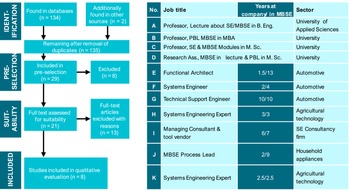
To identify barriers and drivers in MBSE learning, a systematic literature review (SLR) was conducted following a predefined review protocol to ensure transparency and reproducibility (see Figure 2, left). The search was performed primarily in Scopus and complemented by targeted searches in the INCOSE Online Library and The Design Society database, using database-specific syntaxes and a bilingual keyword set (English and German) documented in Figure 1.
Representation of the search string used in the systematic literature search

Following duplicate removal, records underwent a two-stage screening based on predefined criteria. Included were peer-reviewed, accessible papers in English or German focusing explicitly on individual MBSE education. Studies solely addressing organizational MBSE deployment were excluded. The PRISMA-oriented selection process (see Figure 2, left) resulted in eight relevant publications (n = 8).
For analysis, qualitative coding was performed using an inductive content analysis. Relevant passages were extracted, paraphrased, and condensed into discrete factors, which were assigned open codes and iteratively consolidated into higher level categories. The resulting system grouped factors into overarching challenge classes, missing knowledge, existing learning methods, and cultural problems, with each factor additionally classified as barrier or driver. Quality assurance was ensured through the predefined review protocol, explicit inclusion and exclusion criteria, and a structured extraction and coding scheme enabling traceability. Iterative refinement strengthened category clarity. Subsequent expert interviews provided an external validation layer by reflecting, confirming, and extending the SLR based categories, reinforcing coding robustness through methodological triangulation.
4.1.2. Expert interviews
To complement the literature review, eleven semi-structured expert interviews were conducted with four academics and seven industry practitioners (see Figure 2, right).
PRISMA scheme of the SLR (left) and interviewees (right)

The interviews addressed three focal topics: current MBSE training formats, perceived barriers and drivers, and the role of AI tools in education. Interviews followed a semi-structured format, were transcribed, and analyzed with Grounded Theory (Reference Glaser and StraussGlaser & Strauss, 1967). Codes were iteratively developed through memoing and clustered into higher-level categories until theoretical saturation was reached (Reference EisenhardtEisenhardt, 1989). This ensured that recurring patterns, rather than a priori assumptions, structured the subsequent results for both academia and industry.
4.2. Results
4.2.1. Systematic literature review
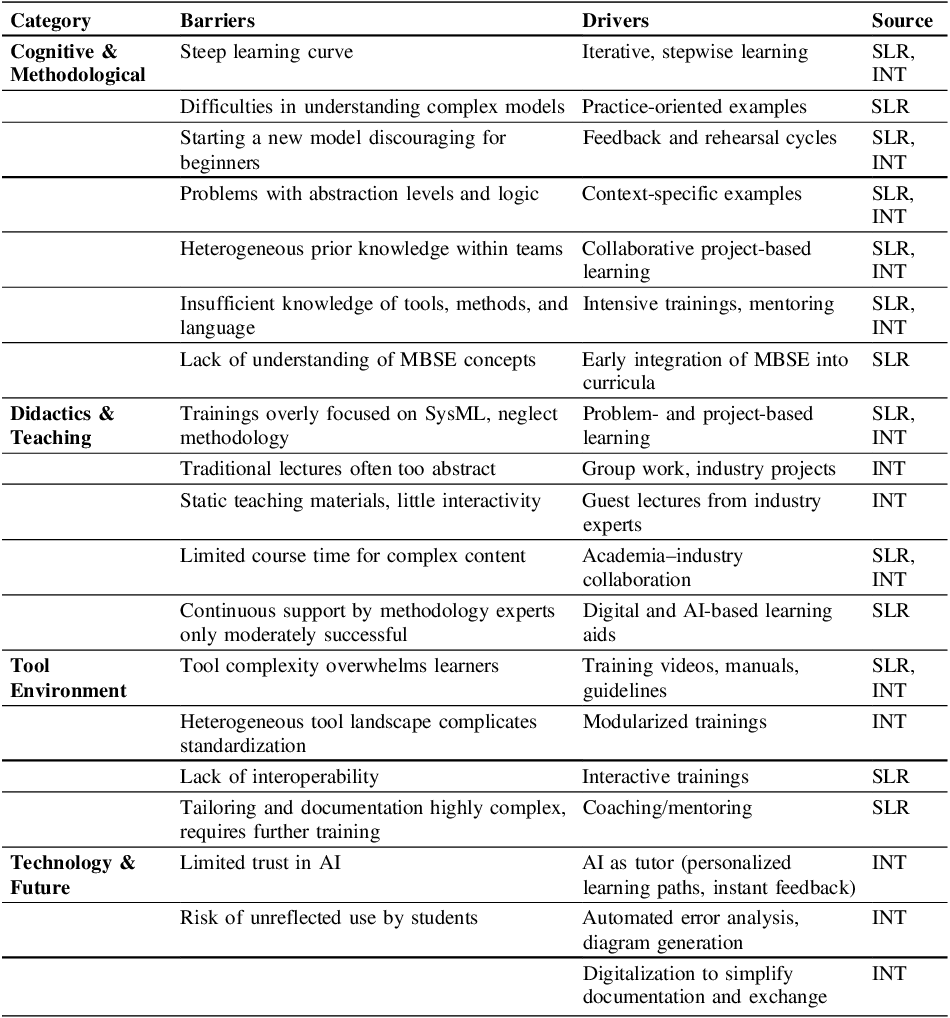
The systematic literature review identified a wide set of barriers affecting individual learners, summarized alongside corresponding drivers in Table 1. A frequently cited obstacle is the steep learning curve inherently associated with MBSE. Beginners consistently struggle not only with methodological complexity but also with the cognitive load of mastering tools and formal languages like SysML. Consequently, initiating a new model is discouraging, while existing ones remain opaque (Reference Akundi and AnkobiahAkundi & Ankobiah, 2024; Reference Henderson, McDermott and SaladoHenderson et al., 2024).
Furthermore, educational programs often focus narrowly on SysML syntax rather than holistic methodology. Tool complexity itself constitutes an independent barrier, overwhelming learners with software interfaces and formalization requirements (Reference Huldt and SteniusHuldt & Stenius, 2019).
Finally, cultural resistance emerges as a critical theme. Stakeholders often expect traditional document-based deliverables, perceiving the added workload and complexity of MBSE as disproportionately high, often doubting its immediate benefits (Reference Kozak, Bonjour, Mayer and MicaëlliKozak et al., 2023; Reference Wang, Izygon, Okon, Wagner and GarnerWang et al., 2016). These insights underline the need for adaptive assistance systems that actively reduce cognitive load and provide individualized guidance.
4.2.2. Expert interviews
The expert interviews confirmed the literature findings (see Table 1), adding practical depth. A dominant theme was the severe difficulty of abstraction. As one academic emphasized: “Students see boxes and lines but cannot link them to a real product”. A practitioner similarly noted: “New engineers spend more time fighting the tool than thinking about the system”, a challenge amplified by the need to learn methodology, notation, and tools concurrently. In academia, limited course time restricts deeper practice, while tool heterogeneity complicates the transition to industry: “Every company uses a different toolchain – what you learn at university rarely transfers one-to-one”. Organizationally, cultural resistance remains strong: “We still exchange Word files and Excel sheets. Many don’t see why a model should be better”. Despite these barriers, interviews highlighted effective drivers. Practical, context-rich examples are pivotal. One lecturer noted: “In our MBA program, students build a small robot that autonomously fetches drinks from the local bar and delivers it back. That makes SysML tangible”. Industrial experts emphasized that intrinsic motivation rises when project benefits become visible: “As soon as engineers see that the model helps reduce errors in integration, they are much more open”. Ultimately, strategically designed, practice-oriented examples and demonstrable benefits act as powerful educational enablers.
Barriers and drivers of MBSE learning identified through the SLR and interviews (INT)

5. Development of the RAG-based AI-Chatbot
Chatbots offer a scalable way to support MBSE learning by providing individualized, context-sensitive guidance where traditional teaching formats fall short. The design of our system builds directly on the barriers and drivers identified in the literature review and expert interviews. By addressing key obstacles such as abstraction, cognitive load, and missing feedback, and by leveraging proven drivers such as practice-oriented examples, iterative feedback, and interactive engagement, the chatbot translates empirical findings into concrete functionalities that complement established teaching formats.
5.1. Requirements for the chatbot
Based on the empirical findings, 12 key requirements for the chatbot were derived. Functionally, the system must 1) translate formal notations into plain language, 2) contextualize abstract models via practical examples, and 3) mask underlying tool-related complexity. Furthermore, it must provide iterative feedback and structured progression to support validation and refinement of knowledge beyond the limited course time. In addition, the bot must link MBSE concepts to real engineering practice, demonstrate tangible benefits to overcome scepticism, and should be accessible on demand, independent of class hours, as an interactive complement to established teaching formats. The requirements are presented here in excerpted form to emphasize the most central dimensions. To make the derivation traceable, each requirement was mapped to at least one concrete design decision in the chatbot concept, namely knowledge scope restriction to curated MBSE sources, stepwise tutoring behavior, and immediate feedback mechanisms embedded into the prompt and interaction flow.
5.2. System architecture and implementation
The chatbot was conceived as a RAG system that combines a curated MBSE knowledge base with large language models. The architecture integrates three main components: a knowledge base containing textbooks (methodological guides such as SYSMOD, Harmony-SE and MagicGrid, SysML specifications); a retriever that selects relevant passages to contextualize user queries; and a generative backend that produces adaptive, conversational responses. A guiding system prompt defined the assistant’s role as an MBSE tutor and structured its output, including layered explanations, contextual examples, and fallback strategies for ambiguous queries. In addition, the prompt explicitly constrained the assistant to answer based on the attached course sources only, in order to reduce unsupported statements and increase answer faithfulness. In this way, the architecture connects robust retrieval with adaptive dialogue to align model behavior with identified educational requirements.
For prototyping, the documents were ingested into the platform as a curated corpus, they were made searchable via semantic retrieval over embedded text segments, and the language model backend was accessed via API and configured with parameter control (e.g., temperature, top-p) to balance factual accuracy and adaptivity. Various LLMs were evaluated (including GPT-4o-mini and Llama 3.2). Ultimately, GPT-4o was selected as the generative backend for its superior instruction-following, high response quality, and low latency during complex queries. DocsBot AI served as the platform due to its accessibility and data analysis capabilities: Interaction logs were captured for analysis and refinement during the validation studies. Instead of relying solely on automated IR metrics, retrieval accuracy and response faithfulness were measured and refined through iterative manual validation. During the prototyping phase, the system was stress-tested using a defined set of targeted test queries. The retrieved contexts and generated answers were qualitatively evaluated by domain experts for correctness, completeness, and comprehensibility until the prompt instructions consistently prevented off-topic or ungrounded responses.
As described in Section 2.2.1, RAG mitigates hallucinations. In this prototype, this was technically enforced by disabling web search and applying strict prompt constraints that mandated source-restricted answers from the curated MBSE corpus, alongside explicit fallback behavior for underspecified queries. A key limitation remained the restricted handling of figures and diagrams in the uploaded sources, which affected questions that depend on visual model artifacts.
5.3. Functionalities
In the evaluated learning scenarios, this support targeted typical early MBSE activities, namely method orientation and sequencing, interpretation of provided model artifacts, identification of modeling issues in risk representations, and completion of structured requirement descriptions aligned with the taught methodology.The chatbot primarily supported learners by answering concrete questions that typically arise during the modeling process, such as “What should I do next?” or “How do I proceed with this step?”. Instead of consulting lengthy textbooks, users could request direct, context-specific guidance and receive explanations tailored to their individual situation. Through textual instructions and generated illustrative examples, abstract concepts were translated into concrete scenarios, allowing learners to relate general MBSE methods to their own work. This interactive exchange enabled clarification of uncertainties, follow-up questions, and stepwise progression in the modeling task. While the chatbot did not generate SysML, it effectively complemented formal instruction by offering immediate, accessible support that made MBSE learning more tangible and less dependent on static reference material. When the requested information was not sufficiently supported by the retrieved context, the chatbot was designed to request clarification, or to direct learners back to the relevant source section in the provided material, instead of producing a speculative answer.
6. Explorative validation
6.1. Study setup
The chatbot was evaluated in two complementary studies: A semester-long field study at Technische Universität Berlin was designed as an exploratory investigation of the chatbot’s use in authentic MBSE project work, aiming to generate practice-based insights rather than to provide formal validation. Students worked in pairs to develop a model-based system concept for an autonomous cooking system, a self-cooking wok station, by specifying use cases, requirements, system architecture, and traceability with MagicGrid in Cameo Systems Modeler, supported by lectures and coaching, thereby learning systems language, MBSE methodology, and tool-based modeling in an integrated semester-long project setting.
As the second study, an exploratory laboratory experiment with eighteen master’s students compared the chatbot directly to the SYSMOD e-book using identical tasks, measuring solution quality, task time, and questionnaire feedback. Both studies were exploratory in nature: while the field study provided ecologically valid insights into real-world usage, the laboratory experiment primarily aimed to test the feasibility of a controlled comparative evaluation format and to gather initial quantitative insights.
6.2. Semester-long field study
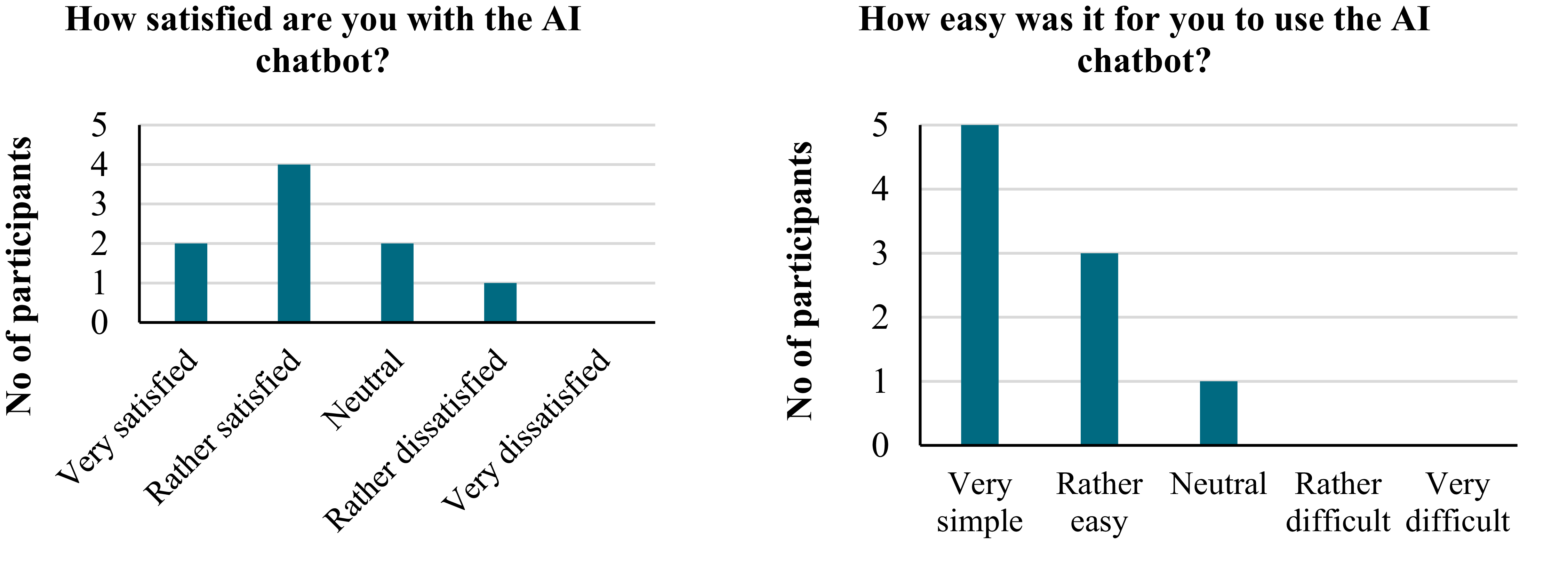
The semester-long field study showed how the chatbot functioned in authentic MBSE project work. Students used it continuously alongside a real project assignment and perceived it as an accessible tool that reduced entry barriers, clarified terminology, and provided immediate explanations of abstract diagrams and notations. Quick, targeted retrieval of information was particularly valued under time pressure, making the chatbot a first point of contact and complement to conventional resources. Most students were satisfied with the chatbot and found it easy to use (see Figure 3). In the semester-long study, hallucinations were reported only rarely (56% never, 33% rarely), and when they occurred, they had virtually no impact on the students’ work (87% not at all).
Chatbot satisfaction (left) and usability (right)

Future developments could address limitations in tasks requiring architectural decisions, where responses tended to remain too generic. Enhancing multimodal capabilities, for example, by integrating visual support, could significantly increase usefulness in diagram-heavy work. Overall, the study confirmed that the chatbot acted as a motivating companion for self-directed learning, with clear strengths in accessibility and efficiency but weaknesses in depth, contextual sensitivity, and multimodality.
6.3. Controlled laboratory study
During the laboratory experiment, participants solved time-constrained SYSMOD modeling assignments on a pedelec system. Tasks included interpreting a system architecture, explaining the underlying method, analyzing a modeled risk table, and formulating structured system requirements. Results showed comparable performance: both groups achieved similar solution quality and completion times, and independent-samples t-tests revealed no statistically significant differences between conditions (p > .05). Solutions were scored using a predefined assessment scheme and subsequently reviewed and corrected by domain experts. Claims of enhanced MBSE competence development cannot be derived from the present results and would require further empirical validation. From a validation perspective, these findings do not indicate improved learning outcomes through chatbot use. Instead, they suggest comparable performance to textbook-based learning within the limited scope of the experimental setting.
Beyond performance metrics, the analysis of interaction logs provided deeper insights into usage patterns. Dialogic exchanges with the chatbot, where participants asked follow-up questions and engaged in multi-turn dialogues, yielded more comprehensive and contextually relevant answers than short keyword queries. This finding does not in itself demonstrate improved learning outcomes; however, it highlights behavioral and didactic mechanisms that may influence learning processes. Effective use of conversational AI in MBSE appears to depend not only on system design but also on user interaction strategies and digital literacy.
7. Discussion, interpretation of findings and limitations
The evaluation across both settings yields nuanced insights. The exploratory field study indicates the chatbot supports authentic project work by providing rapid explanations, clarifying terminology, and offering stepwise modeling guidance, directly addressing key learning drivers like contextualization and iterative clarification.
The controlled laboratory experiment provides a boundary condition. When compared to the SYSMOD e-book on standardized, time-constrained tasks, no significant differences were found in solution quality or completion time. Under these conditions, the chatbot did not demonstrate improved short-term task performance. Interaction logs nevertheless show that multi-turn dialogue yields more context-relevant assistance than brief prompts, indicating a process-level advantage not captured by performance metrics.
Overall, the results support the chatbot as a feasible complement to established learning materials, particularly for just-in-time explanation, while effects on competence development remain open.
The findings can be directly related to the challenges identified in the literature and interviews:
Barriers addressed in the studies are primarily located at the individual entry level. Abstraction and unfamiliar terminology were partly mitigated through accessible explanations. Limited availability of support, especially beyond scheduled teaching, was reduced through on-demand access. The conversational format enabled iterative clarification, supporting learners when progressing through modeling tasks. Other challenges were not mitigated in an evidenced way. Tool complexity and heterogeneous toolchains remained unaffected because the prototype was not integrated into modeling environments. Support for architectural decision-making was limited, with responses perceived as too generic in complex situations. Diagram-centric work was constrained by the absence of visual explanation. Organizational and cultural resistance to MBSE adoption was not evaluated as an outcome.
The demonstrated contribution therefore lies in accessibility and comprehension support rather than advanced modeling execution or adoption dynamics.
The field study provides high ecological validity but relies on perception-based data, which limits causal interpretation of learning effects. The laboratory experiment enables controlled comparison but is short-term and task-focused, which restricts sensitivity to deeper educational outcomes. In addition, interaction logs indicate that support quality depends on user dialogue behavior, suggesting that effective use requires a certain level of interaction competence.
The chatbot can be interpreted as a smart view on MBSE knowledge. Smart views provide stakeholder-appropriate, context-sensitive access to model and method information, including method instructions. In this form, the chatbot reduces cognitive load and supports comprehension without replacing tool-centered modeling practice.
8. Conclusion and future work
This paper presents a RAG-based chatbot designed to mitigate MBSE learning barriers through contextualized explanations and stepwise tutoring based on curated knowledge. Across both studies, the system was perceived as accessible and supportive for early modeling steps, effectively mitigating entry-level barriers like abstraction and terminology gaps. However, systemic challenges—such as software complexity, organizational resistance, and advanced visual reasoning—remain unaffected by isolated text-based tutoring. Furthermore, as the controlled experiment did not yield significant short-term performance gains, its impact on objective learning outcomes remains exploratory, and the measurable educational value in formal assessments remains to be proven.
Future work should therefore evaluate added value more rigorously. Comparative studies should include lectures, guided exercises, project based and blended learning formats. Educational effects should be quantified via pre and post tests, retention measures, and transfer tasks. Interaction analytics should be linked to outcomes to assess the role of dialogue depth and AI literacy. System side advances should focus on stronger project context grounding, curated examples, multimodal diagram support, and integration into modeling tools for context aware guidance.


 Open access

