


1. Introduction
In an increasingly complex society, design futuring has been attracting growing attention. Practices and theories related to “designing for the future” vary widely (Reference Sharma, Howell, Ventä-Olkkonen, Iivari, Eden, Hartikainen, Kinnula, Durall, Nitsche, Okkonen, Pait, Rubegni, Sluis-Thiescheffer, van der Velden and VaranasiSharma et al., 2024), encompassing approaches such as speculation (Reference LightLight, 2021), foresight (Reference CuhlsCuhls, 2020), and design futuring (Reference Kozubaev, Elsden, Howell, Søndergaard, Merrill, Schulte and WongKozubaev et al., 2020). In this paper, we adopt design futuring as an umbrella term for these diverse approaches and position it as a means of facilitating the design of future exploration (Reference Sharma, Howell, Ventä-Olkkonen, Iivari, Eden, Hartikainen, Kinnula, Durall, Nitsche, Okkonen, Pait, Rubegni, Sluis-Thiescheffer, van der Velden and VaranasiSharma et al., 2024). Recent studies have highlighted the importance of collaborative design futuring, in which participants collectively envision future possibilities (Reference Farias, Bendor and van EekelenFarias et al., 2022; Reference Kitazaki and TakeKitazaki & Take, 2024; Reference Ye, Duoduo, Gray, Ciliotta Chehade, Hekkert, Forlano, Ciuccarelli and LloydYe & Duoduo, 2024). The development has led to a convergence of speculative design and co-design (Reference Farias, Bendor and van EekelenFarias et al., 2022), the latter of which values the active involvement of non-designers in the design process (Reference Sanders and StappersSanders & Stappers, 2012). Non-designers’ level of engagement in such processes can range from passive modes to more active contributions (Reference Farias, Bendor and van EekelenFarias et al., 2022). Various methods for including non-designers emphasize the importance of stimuli (Reference Groß and MandirGroß & Mandir, 2024). In the process, a common strategy is to use external stimuli, prompts, or representations to spark imagination and broaden perspectives (Reference CuhlsCuhls, 2020; Reference Groß and MandirGroß & Mandir, 2024).
Collaborative design futuring faces challenges in addressing long-term futures. As the temporal scope of the design target extends, non-designers often struggle with the perceived “remoteness” of the subject (Reference Björgvinsson, Ehn and HillgrenBjörgvinsson et al., 2012; Reference Edeholt and MainsahEdeholt & Mainsah, 2014). The distant future, characterized by global issues such as climate change, is often perceived as unreal, which reduces individuals’ motivation to act (Reference Shabnam, Quaddus, Roy and QuaziShabnam et al., 2021). While co-design has strengths in addressing local and concrete issues, it tends to face limitations when applied to more abstract or long-term futures (Reference Björgvinsson, Ehn and HillgrenBjörgvinsson et al., 2012; Reference Edeholt and MainsahEdeholt & Mainsah, 2014). The “remoteness” is a key challenge to engaging non-designers in collaborative design futuring. The concept of “remoteness” is conceptualized in terms of psychological distance, which refers to the perceived gap between the self and a given object or context (Reference Trope and LibermanTrope & Liberman, 2010). The closer this perceived distance, the more concretely people can engage with the topic (Reference Trope and LibermanTrope & Liberman, 2010). Thus, psychological distance may affect how concretely participants can explore future scenarios, and external stimuli could play a significant role in controlling perceived psychological distance.
The effect of stimuli has long been researched to examine the influence of external stimuli on designers’ creativity, particularly in professional contexts (Reference Blandino, Montagna, Cantamessa and ColomboBlandino et al., 2023; Reference Vasconcelos and CrillyVasconcelos & Crilly, 2016). There is a clear lack of frameworks remaining for designing stimuli in collaborative design futuring settings involving participants from various backgrounds. This study aims to develop a stimulus selection framework for collaborative design futuring that supports the appropriate selection of stimuli based on the context of non-designers and the overall project context. We evaluate the framework’s effectiveness through a set of empirical case studies. To guide the investigation, we set the following two research questions:
RQ1. What project-context factors should be considered when selecting stimuli in collaborative design futuring?
RQ2. What specific stimulus attributes influence participants’ understanding of those stimuli and the resulting project-level and individual-level outcomes?
2. Related studies on design methods and stimuli in collaborative design futuring
To enable active engagement in collaborative design futuring, various design methods have been developed and applied (Reference Kitazaki and TakeKitazaki & Take, 2024). Workshops are commonly used methods in collaborative design futuring, which also serve as a core approach in co-design to enhance the quality of participation (Reference Sanders and StappersSanders & Stappers, 2012; Reference Taoka, Kagohashi and MougenotTaoka et al., 2021). Within workshops, participants are guided through a movement across past, present, and future. Such temporal navigation is important in collaborative design futuring (Reference InayatullahInayatullah, 2008). The influence of technology in shaping society plays a vital role in collaborative design futuring as the technologies become more complex and prominent (Reference Østvold Ek, Paulsen and TrondsenØstvold Ek et al., 2024). Its impact is discussed through stimuli, such as the use of artifacts or processes (Reference Tsekleves, Darby, Whicher and SwiatekTsekleves et al., 2017), cards representing the application of cutting-edge technologies (Reference Smith, Sadek, Wan, Ito and MougenotSmith et al., 2024), and the systematic collection and presentation of weak signals of change (Reference SaritasSaritas, 2013). The weak signal is fragments of information not yet mainstream but potentially meaningful for future scenarios (Reference Groß and MandirGroß & Mandir, 2024), which are classified through frameworks such as STEEP (Social, Technological, Environmental, Economic, and Political) and PEST (Politics, Economy, Society, Technology), which are commonly used to organize weak signals (Reference Groß and MandirGroß & Mandir, 2024). In workshops, card-based tools have been proposed for non-expert users to facilitate both technology comprehension and idea generation (Reference Smith, Sadek, Wan, Ito and MougenotSmith et al., 2024). In a review of card-based tools designed specifically for design futuring, cards served not only to explain specific technologies but also to help participants reconstruct meaning based on their own contexts (Reference Ernstsen, Thuesen, Mossing, Brinck, Maier and NirasErnstsen et al., 2023).
3. Method
3.1. Development of proposed framework
This study developed an analytical framework for stimulus design in collaborative design futuring. The framework was developed based on studies of co-design frameworks, creativity stimuli, and psychological distance. Co-design frameworks encompass a temporal sequence that encourages reflection on one’s own values and aspirations through the relational framing of time (Reference Sanders and StappersSanders & Stappers, 2012). Reference Lee, Jaatinen, Salmi, Mattelmäki, Smeds and HolopainenJ.J. Lee et al. (2018) categorized four design choices in co-design activities derived from multidisciplinary collaboration projects: participants, project preconditions, project outcomes, and co-creation events. The participants’ backgrounds are highlighted as significantly shaping diverse images of the future (Reference Mahboob Kanafi, Iivari, Kinnula and SharmaMahboob Kanafi et al., 2022). The participants’ embodied accumulation of past social practices offers a valuable lens for understanding the differentiated responses of participants to the same design process (Reference Vainionpää, Aalto and KinnulaVainionpää et al., 2024). Creativity stimuli aim to stimulate designers’ idea generation, which is categorized as external or internal and is closely related to the design process (Reference Crilly and CardosoCrilly & Cardoso, 2017; Reference Vasconcelos and CrillyVasconcelos & Crilly, 2016). Key factors influencing external stimuli include modality of representation (e.g., text, image, video) and fidelity, while variables on the designer side include prior experience and disciplinary background (Reference Vasconcelos and CrillyVasconcelos & Crilly, 2016). Psychological distance refers to the degree to which an object or event feels distant from the self (Reference Trope and LibermanTrope & Liberman, 2010). Psychological distance consists of four dimensions: temporal, spatial, social, and hypothetical (Reference Trope and LibermanTrope & Liberman, 2010). Psychologically closer objects are perceived more concretely and vividly, whereas distant objects are perceived more abstractly (Reference McDonald, Chai and NewellMcDonald et al., 2015). It has been suggested that self-awareness and perceived similarity to oneself also play influential roles in psychological distance (Reference Connors and SpangenbergConnors & Spangenberg, 2025). It is assumed that the closer the psychological distance, the more concretely future images can be envisioned, thereby increasing their quality.
The proposed framework categorizes factors that influence the design and selection of stimuli into three layers: Aim, Constraint, and Design (see Figure 1). The Aim layer refers to the goals the project seeks to achieve, which are divided into two types: Project and Individual, with different projects emphasizing one or both. Project Outcome refers to the tangible outputs or deliverables generated through the activity (Reference Lee, Jaatinen, Salmi, Mattelmäki, Smeds and HolopainenLee et al., 2018). Individual Outcome refers to the transformation, insights, or learning that participants personally experience (Reference Akasaka, Mitake, Watanabe and ShimomuraAkasaka et al., 2022; Reference Lee, Jaatinen, Salmi, Mattelmäki, Smeds and HolopainenLee et al., 2018). The Individual Outcome is critical when participants engage in design speculation based on intrinsic motivation.
The Constraints layer encompasses the practical limitations in implementing the Aim. These constraints include Environmental factors (e.g., in-person vs. online formats, location), Time limitations, and Human Resources (e.g., organizational structure and recruitable participant profile).
Both Aim and Constraints influence Design. The Design layer is further subdivided into Program, Participants, and Stimuli. Definitions of each component of the Design layer and hypotheses regarding their influence on psychological distance are summarized in Table 1. While Stimuli can be considered part of the Program, for clarity in this study, we treat them as separate components.
The Program and Participants’ Profile directly influence the roles and representational forms of the Stimuli. The Program refers to the specific design elements of a project. Based on the related studies, we define the elements as Theme (Reference Lee, Jaatinen, Salmi, Mattelmäki, Smeds and HolopainenLee et al., 2018), Target Year (Reference Trope and LibermanTrope & Liberman, 2010), Activity Type ( Reference Lee, Jaatinen, Salmi, Mattelmäki, Smeds and Holopainen Lee et al., 2018 ; Reference Sanders and Stappers Sanders & Stappers, 2012 ), and Timeline (Reference Farias, Bendor and van EekelenFarias et al., 2022). Participant refers to characteristics of the expected participants. Based on discussions in design capital (Reference Mahboob Kanafi, Iivari, Kinnula and SharmaMahboob Kanafi et al., 2022) and prior stimuli research (Reference Blandino, Montagna, Cantamessa and ColomboBlandino et al., 2023; Reference Vasconcelos and CrillyVasconcelos & Crilly, 2016), the key elements are defined as Literacy (Reference Mahboob Kanafi, Iivari, Kinnula and SharmaMahboob Kanafi et al., 2022), Historical Body (Reference Mahboob Kanafi, Iivari, Kinnula and SharmaMahboob Kanafi et al., 2022; Reference Vainionpää, Aalto and KinnulaVainionpää et al., 2024), Design Experience (Reference Lee, Jaatinen, Salmi, Mattelmäki, Smeds and HolopainenLee et al., 2018; Reference Mahboob Kanafi, Iivari, Kinnula and SharmaMahboob Kanafi et al., 2022), and Motivation (Reference Akasaka, Mitake, Watanabe and ShimomuraAkasaka et al., 2022). Stimuli are external information presented to participants, ranging from static forms, such as illustrations or text, to dynamic formats, such as video. Stimuli play a crucial role in triggering ideas, broadening perspectives, and influencing psychological distance. Table 1 outlines their classification and functions of stimuli. The categories are based on prior research of creativity stimuli (Reference Blandino, Montagna, Cantamessa and ColomboBlandino et al., 2023; Reference Vasconcelos and CrillyVasconcelos & Crilly, 2016) and impact of stimuli representation in collaborative design futuring (Reference Yasuoka, Nakatani, Taoka and HamaguchiYasuoka et al., 2024).
Psychological distance arises between participants and both the Program and the Stimuli. Program-induced distance depends on factors such as the topic and temporal scope of the future being addressed; typically, the more distant or unfamiliar the future scenario, the greater the psychological distance. In contrast, the distance induced by Stimuli varies based on the presentation format, content, and participant characteristics. Even when using the same Program or Stimuli, Psychological distance can differ depending on participants’ level of understanding, interest, or changes in self-perception.
Factor Structure in designing collaborative design futuring programs

The factors in the design layer

3.2. Evaluation
This study aims to exploratory evaluate the proposed framework by analyzing the contextual factors that influenced the selection of stimuli in past collaborative design futuring projects (RQ1). We also seek to clarify how the selected stimuli affected both project-level and individual-level outcomes (RQ2). Specifically, the analysis focuses on a series of initiatives conducted since 2022 within a university-based living lab currently being developed by the authors. This living lab serves as a platform for exploring new forms of co-creation within the university context, bringing together students, university researchers, companies, and government organizations to address social issues and envision desirable future societies. The effects of the stimuli were evaluated based on both participant interviews and observations during workshops. Multiple researchers analyzed each case, and the evaluations were synthesized collaboratively after individual analyses.
4. Result
4.1. Case studies applying the proposed framework
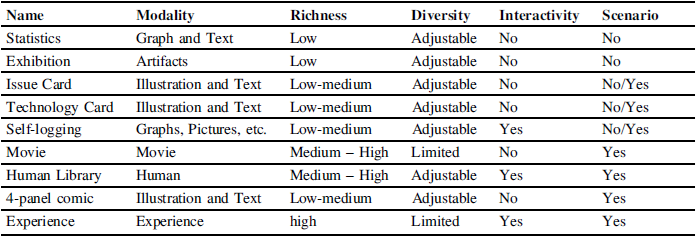
In each workshop conducted as part of this study, a variety of stimuli were designed and used to support participants, as shown in Table 2. Stimuli that conveyed social issues included cards, statistical data, and video-based scenarios. In the card format, social issues and user concerns were presented through combinations of text and illustrations, making them visually accessible and easy to understand. Statistical data included not only general macro-level indicators but also everyday figures directly linked to participants’ lives, such as “daily vegetable consumption”. Video scenarios incorporated themes such as alternative meats, veganism, and nutrition-focused food cultures to evoke imagination around future lifestyles. There were also attempts to use self-logged stimuli, such as participant-submitted photos and daily life logs, such as images of home gardening or records of refrigerator use. Interactive stimuli were also introduced. In particular, the Human Library format invited domain experts to serve as “living books,” enabling participants to engage in dialogue and acquire knowledge through personal conversation (Reference Yasuoka, Nakatani, Taoka and HamaguchiYasuoka et al., 2024). As technical stimuli, VR and health-related technologies were offered for hands-on experience. Participants engaged in short interactions with the technologies before joining group discussions. In addition, technology-related stimuli were presented in card format, ranging from simple illustrations to more detailed cards with supplementary explanations. Some stimuli implicitly embed technical content into narrative formats. For instance, technologies related to alternative or lab-grown meat were integrated into storylines or four-panel comic strips, allowing participants to naturally associate the technology with broader social issues.
Table 3 summarizes a series of past workshops and exhibition-based projects using the proposed framework and an overview of the stimuli presented in each project. Due to space limitations, not all framework elements are included. Nonetheless, the table facilitates comparison across various Design Futuring activities, including exhibitions and workshops. In Projects 1–5, stimuli were designed to span multiple levels of psychological distance. In contrast, Projects 6 and onward, which were conducted under tighter time constraints, featured only a limited number of stimuli.
Factors of stimuli used for the workshops and exhibitions

The overview of analyzed projects

Table 3 Long description
A table with 15 rows and 6 columns. The columns are labeled as follows: Number, Activity Type, Theme, Target year, AIM, Participants' Profile, and Representations. The table provides an overview of analyzed projects, including workshops and exhibitions, and the stimuli used in each. Each row details specific projects with varying themes, target years, aims, participant profiles, and types of representations used. The table facilitates comparison across different Design Futuring activities, noting variations in psychological distance and time constraints for different projects.
4.2. Framework application to illustrative projects
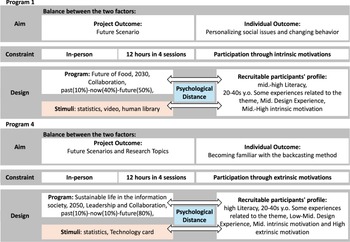
Figure 2 illustrates the application of the proposed framework to analyze actual decision-making in the design of two workshop programs (Projects 1 and 4, as listed in Table 3). Project 1’s primary aim was to maximize Individual Outcome. Accordingly, the theme selected for discussion, which was the future of food, was intentionally set to be psychologically close to the participants. In contrast, potential future challenges, such as food loss and animal welfare, could be perceived with a greater psychological distance. One of the key constraints was the voluntary nature of participation. The constraints required a workshop design that enabled participants to derive benefit and be motivated. Thus, in designing the workshops, we selected three types of stimuli, the Human Library, and self-logging, to reduce psychological distance with future-oriented topics. The statistical data were used to provide both a broad overview (e.g., the current state of climate change) and more relatable insights into daily life (e.g., average vegetable intake). The timeline of the session was also balanced, with roughly half of the time allocated to thinking about the future and the other half to reflecting on one’s past and present.
Project 4 explored sustainable life scenarios in 2050, which aimed to prioritize the project outcome by specifically identifying future R&D topics for a corporate partner. Due to confidentiality concerns, the participant pool was restricted to company employees and students, thereby limiting diversity. However, because participants attended the workshop in their professional capacity, their engagement was high. Another major constraint imposed by the company was the fixed target year of 2050, which was often perceived as psychologically distant. Thus, we designed the workshop themes to have a broader thematic scope, allowing participants to select themes with a psychologically closer fit during the workshops. Given the longer temporal distance to 2050, statistical stimuli emphasized familiar, everyday data. Additionally, to help participants narrow the psychological gap, approximately 80% of the session was devoted to envisioning future scenarios, thereby encouraging a stronger sense of connection with future society.
The analysis of two projects through the proposed framework

4.3. Observed effects of stimuli and psychological distance
Variations in participants’ perceived psychological distance were observed even when the same content was conveyed through different forms or storytellers. For instance, in a video narrated by a child from Denmark, participants in Japan sometimes reported a strong impression despite the significant geographical distance (Program 1-3 in Table 3). Conversely, in cases where an adult from a different cultural background spoke a foreign language, such as Japanese scenarios viewed by participants in Hawai‘i, both spatial and societal distances were perceived as large, and engagement tended to be lower. However, in some cases, these unexpected cultural differences evoked surprise and left a memorable impression (Program 4).
“I really resonated with the woman who was close to my age. Depending on the person, the point of resonance differed, and that really influenced the discussion.” (quote in Program 1)
In the Human Library format, in which participants directly conversed with storytellers, participants gained a deeper understanding that extended beyond surface-level knowledge. Storytellers adjusted their narratives to participants’ comprehension levels, resulting in more effective communication. Differences in participant responses across the storyteller’s age and social role in the video and human library suggest that narrative structure and speaker selection are crucial considerations in stimulus design.
“It is different from just watching a video. Beyond the answers to our questions, I felt I got a broader sense of their life.” (quote in Program 1)
Familiar statistical data, namely those with low societal distance, such as average vegetable consumption, tended to evoke imagination and a sense of ownership in participants. In contrast, abstract and large-scale statistics (i.e., those with high psychological distance) were often less impactful and more challenging to integrate into discussions (Program 1-4).
“The large-scale stuff did not really register. […] It was hard to imagine how forest loss and reduced crop yields would affect my life.” (quote in Program 1)
When data related directly to participants’ own lives (i.e., zero psychological distance), such as photos of their gardens or refrigerator use, participants demonstrated strong comprehension and engaged in reflective reinterpretation of their daily practices. These stimuli also appeared to serve as prompts to reconsider their historical body.
In four-panel comic strips (Program 10), prior discussions were summarized visually. However, understanding of the content was limited without supplemental explanations; once the background context was provided, the participant’s discussion became more active. In experiential stimuli (Programs 9 and 15), such as VR with a Head-Mounted Display, participants gained a tangible understanding of the technologies. In addition, participants were able to empathize with roles such as childcare workers, in which technology may be used in the future. The experience of technology appeared to promote idea generation, particularly when the workshop context was specific and concrete. In cases where technology was introduced via cards (Program 4), adult and university student groups actively used them as cognitive aids. However, among middle school students and teachers (Program 13-14), technical terminology and visual representations were difficult to interpret, necessitating facilitator supplementation in a Human Library format. Consequently, the impact of technology cards on the discussion was limited. Workshops with no or minimal stimuli (Program 6-8) tended to yield ideas confined to participants’ existing frames of reference. The results suggest that such sessions may not sufficiently promote future-oriented thinking. In exhibition-based stimuli (Program 11-12), participants often perceived the installations as real technologies. However, many treated the displays as objects of appreciation rather than as media that reflected personally relevant experiences. Without mechanisms to encourage personal connection, these stimuli rarely triggered deep reflection or discussion. Still, when researchers actively engaged participants in conversation, the effect of the stimuli was amplified. Some participants spontaneously shared personal narratives rooted in their lived experiences, indicating that such stimuli can evoke memories and emotions that connect to individual life stories.
5. Discussion
This study explored how the presentation of diverse stimuli in Collaborative Design Futuring projects influenced participants’ thinking and discussions. The proposed framework visually structures the parameters according to the aims and constraints of each project. In particular, psychological distance to themes and target year, aims, and time limitations were found to be critical in determining the quantity and complexity of feasible stimuli. This paper extended the co-design framework (Reference Lee, Jaatinen, Salmi, Mattelmäki, Smeds and HolopainenLee et al., 2018) to collaborative design futuring by introducing the concept of psychological distance. The findings suggest that stimuli can function as levers to modulate psychological distance. Stimuli may also play a role in shaping participants’ self-perceptions of their historical bodies.
The analysis of stimuli used in the projects suggests that combining multiple stimuli with varying psychological distances contributed to enhanced project outcomes. As participants’ understanding of the stimuli deepened, their psychological distance from the stimuli was reduced. Furthermore, this process led to increased comprehension of future societies and technological means, ultimately decreasing the overall psychological distance to the design subject. In addition, as evidenced by self-logging data, reflective engagement with stimuli enhanced self-understanding, leading to improved individual outcomes and a positive impact on the project’s overall results. Differences in stimulus representation, particularly the attributes of narrators and degrees of interactivity in the video and human library, also influenced how participants perceived psychological distance and how broadly they could imagine alternative futures. These effects appeared to be mediated by participants’ prior experience and accumulated knowledge, i.e., their historical body. In settings without external stimuli, participants’ ideation tended to remain narrow, underscoring the importance of external stimuli in broadening everyday thinking, even when systematic methods such as horizon scanning (Reference CuhlsCuhls, 2020) are not feasible. Furthermore, participants’ literacy and prior workshop experience affected their ability to interpret and use the stimuli. This finding is consistent with previous research focused on professional designers, which has shown that participants’ design experience (Reference Blandino, Montagna, Cantamessa and ColomboBlandino et al., 2023; Reference Hu and ReidHu & Reid, 2018) and design process (Reference Vasconcelos and CrillyVasconcelos & Crilly, 2016) influence how stimuli are interpreted. In participatory design contexts, however, a wider range of participant attributes, such as contextual experience and technological literacy (Reference Mahboob Kanafi, Iivari, Kinnula and SharmaMahboob Kanafi et al., 2022), may also affect the impact of stimuli, underscoring the need for a more inclusive analytical framework.
Taken together, these findings suggest that when designing and selecting stimuli in collaborative design futuring, both project context and participants’ profiles must be carefully considered. Stimuli should be evaluated not only for their effectiveness as communication tools, but also for their potential to modulate psychological distance. It should be noted, however, that this study is an exploratory investigation into the domains of technology and everyday life. The long-term effects of stimuli on participant learning and group discussion have not been thoroughly examined. Future research should empirically investigate how stimuli affect participants over time and how these effects propagate through the broader collaborative design process using a qualitative approach.
6. Conclusion
This study examined the role of stimuli not merely as tools for idea generation, but as means of supporting participants in interpreting current societal contexts and envisioning future society in collaborative design futuring. We proposed a three-layer framework for selecting stimuli and applied it across multiple case studies. The findings suggest that project aims and constraints shape workshop design, which includes program and stimulus selection. The preliminary evaluation indicated that psychological distance played a significant role in both the selection and the effectiveness of stimuli. Notably, psychological distance was observed to be relative rather than fixed, varying with the modality of the stimuli and the narrator’s attributes. The participants’ literacy levels also influenced their understanding and engagement with the stimuli. Furthermore, stimuli impacted not only project-level outcomes but also individual outcomes by fostering deeper self-understanding. While the findings are preliminary and limited to specific participant groups and thematic contexts, this study offers a multifaceted exploration of the importance and complexity of stimuli. It is intended as an initial step toward developing more systematic support tools for designing effective collaborative design futuring.
Acknowledgement
This work was supported by dLab challenge program from Institute of Science Tokyo, and JSPS KAKENHI Grant Number 23K17155 and 24K15615.




 Open access

