

1. In memory of Jaak Panksepp (1943–2017)
1.1. What is Affective Neuroscience (AN) Theory?
The term Affective Neuroscience (AN) was first coined by Jaak Panksepp (Reference Panksepp1992), and his full theory (Panksepp, Reference Panksepp1998) encompasses seven primary emotional systems that undergird psychological well-being and (affective) brain disorders (Panksepp, Reference Panksepp2006). Moreover, his theory deals with questions about the affective lives of animals and consciousness (Panksepp, Reference Panksepp2005). Panksepp’s main research methods consisted of electrical stimulation of avian and mammalian brains as well as pharmacological challenges.
Basic features of primary emotional systems were outlined by Panksepp (Reference Panksepp1998, Reference Panksepp2010) as follows. First, activation of each neural network underlying a primary emotion should elicit a characteristic emotional–behavioral action pattern (such as emotional PLAY behavior usually accompanied by 50-kHz chirps in rats; Panksepp & Burgdorf, Reference Panksepp and Burgdorf2003). Second, activity in such an emotional neural network is initially only triggered by unconditional stimuli (such as the inborn tendency to react with FEAR to the sight of a snake). Third, these basic emotional neural networks are connected to secondary and tertiary brain levels to facilitate learning such that after learning these primary neural networks also can be activated by previously neutral stimuli. Thus, a child learns to FEAR a hot stove. Fourth, with maturity mammals exhibit stronger cortical control over the ancient neural networks underlying primary emotions. For example, most children gradually learn to better regulate their affective emotions (see also a study on the development of frontal lobe functions by Romine & Reynolds, Reference Romine and Reynolds2005). Fifth, the emotional arousal elicited by these primary emotional systems influences sensory gating processes of the brain. This means that activation of emotional neural networks can modify what information ultimately will be processed from the brain (and also in what manner). In addition, the salience of a stimulus is modified by the activity of neural networks underlying primary emotional systems: When strong FEAR is triggered a person could have difficulty shifting attention to other stimuli aside from the FEAR eliciting source. For example, when a person has a weapon pointed at him/her, they will not remember anything except the weapon (“weapon effect;“ e.g., Tooley, Brigham, Maass, & Bothwell, Reference Tooley, Brigham, Maass and Bothwell1987). Sixth, the arousal generated by activation of the neural network underlying a primary emotion persists beyond the initially triggering event. Please note our usage of the term affect generally conforms with Panksepp’s rule of thumb: “Affects are the subjectively experienced aspects of emotions, commonly called feelings” (Panksepp, Reference Panksepp2010, p. 534).
Altogether, Panksepp mapped seven primary emotions across the mammalian brain. These seven emotional systems include the SEEKING, LUST, CARE and PLAY systems (positive emotions) and FEAR, RAGE/ANGER, and PANIC/SADNESSFootnote 1 (negative emotions). Panksepp did not include disgust in his group of primary emotions because his evidence strongly suggested that disgust was a sensory affect, which did not satisfy the criteria to be designated a primary emotional action system (Panksepp, Reference Panksepp1998). All Panksepp’s primary emotions represent evolved “tools for survival,” which have been largely conserved across mammalian species including homo sapiens. Activation of the SEEKING system energizes the mammalian organism and provides energy for obtaining resources such as the search for food (the homeostatic hunger system), or a mating partner (LUST). The SEEKING system is theoretically being utilized by other primary emotions such as the case of FEAR and SEEKING safety. The SEEKING system is also very likely involved in the initiation of PLAY (for further explanations on the relationship between emotion and motivation see Montag & Panksepp, Reference Montag and Panksepp2017, p. 4).
Both the LUST and CARE circuitry are closely entwined. The LUST system must represent the evolutionary older emotion because programs for reproduction naturally must preceed the evolutionary development of an emotional CARE system prototypically for nurturing the offspring, but also (perhaps not only in humans) for caring for family, close relatives, and friends. Finally, the PLAY system has been observed in nearly all mammals (perhaps bred out of lab mice) given its relevance for learning social competencies (Pellegrini, Reference Pellegrini1988) and shaping motoric skills (Pellegrini & Smith, Reference Pellegrini and Smith1998). In particular, rough and tumble play could exert a critical effect on shaping young minds as in learning adaptive limits for interacting socially (Panksepp, Reference Panksepp2007; Pellis & Pellis, Reference Pellis and Pellis2007).
On the side of negative emotions, the FEAR system is of relevance to help the organism get out of a danger zone, for example, via a flight response. The RAGE/ANGER system is triggered by protecting life resources as well as escaping bodily restraint such as being held by a predator. The PANIC/SADNESS system is most strongly triggered by separation distress, such as a child losing contact with a parent or someone being apart from a loved one. This can also be the case when couples break up, and in situations of homesickness (see Montag, Widenhorn-Müller, Panksepp, & Kiefer, Reference Montag, Widenhorn-Müller, Panksepp and Kiefer2017).
1.2. AN theory and personality
Many applications of Panksepp’s AN theory have been put forward in the last years, in particular, those to better understand brain disorders with a focus on affective components. Among others Montag et al. (Reference Montag, Widenhorn-Müller, Panksepp and Kiefer2017b) demonstrated that low SEEKING, high FEAR, and high SADNESS might be at the heart of depression, something also already noted earlier (e.g., Panksepp & Watt, Reference Panksepp and Watt2011; Panksepp, Wright, Döbrössy, Schlaepfer, & Coenen, Reference Panksepp, Wright, Döbrössy, Schlaepfer and Coenen2014).
A relatively new scientific area also profiting from AN theory represents the area of personality neuroscience, which tries to carve out individual differences in brain structure/functionality including molecular foundations to get insights into the neuroscientific/biological underpinnings of human personality. In this context, Davis, Panksepp, and Normansell (Reference Davis and Panksepp2003) published a self-report questionnaire called Affective Neuroscience Personality Scales (ANPS) assessing individual differences in primary emotions constructed as defined in Panksepp’s AN theory. We believe this self-report inventory contributes to the field, because (i) there is a long tradition of understanding personality by investigating individual differences in strongly genetically determined temperaments (one can study individual differences in temperaments from early in life of infants; e.g., Rothbart, Reference Rothbart1986) and (ii) temperament is a concept closely linked to individual differences in emotionality and therefore also of relevance to understand primary affects. The importance of this inventory will be highlighted in more detail below when contrasting the AN theory’s approach to study human personality with the prominent Big Five Model of Personality. However, it is anticipated that beyond its comparisons with Big Five scales, additional biological validation of the ANPS primary emotion scales will be forthcoming to better link these scales to the massive amount of preclinical evidence Panksepp’s group has provided. In the realm of personality psychology, it has been hypothesized that individual differences in primary emotions represent ancient evolutionary foundations of human personality with primary emotions being anchored in the subcortical mammalian brain. These primary emotions drive our behavior in a bottom-up fashion (see also similarities to MacLean‘s (Reference MacLean1990) Triune Brain ConceptFootnote 2 ).
We are aware of current discussions in the scientific scene (between the affective neuroscientists and the constructivists/cognitive neuroscientists) even arguing against the idea that primary emotions exist or that primary emotions (more or less uniquely) arise from subcortical areas (see the detailed constructivist’s view in Barrett, Reference Barrett2017; for a discussion with the cognitive neuroscientist’s view see Panksepp, Lane, Solms, & Smith, Reference Panksepp, Lane, Solms and Smith2017). In our opinion abundant evidence speaks for basic emotions arising from subcortical regions of the mammalian brain, perhaps with best arguments arising from decorticated animals showing emotional responses after deep brain stimulation (Panksepp, Normansell, Cox, & Siviy, Reference Panksepp, Normansell, Cox and Siviy1994), but also see human evidence (Damasio, Damasio, & Tranel, Reference Damasio, Damasio and Tranel2013; Merker, Reference Merker2007). However, Panksepp never argued against the learned cortical regulation of emotions (see the Three-Level Nested Brain Hierarchy, Panksepp, Reference Panksepp2011), and wisely stated the current discussion might be resolved, if we accept that “such debates may simply reflect investigators working at different levels of control” (Panksepp, Reference Panksepp2010, p. 536).
From this bottom-up neuroscience perspective, AN theory uniquely offers a detailed guide for understanding the ancient origins of human personality and offers a reinterpretation of the widely used Big Five Model of Personality. The Big Five Model has been constructed on a lexical background. This means that by applying factorial analysis, psychologists started in the thirties/forties of the last century to identify five broad personality dimensions derived from human language, sometimes summarized with the acronym OCEAN (for the beginning of this kind of research see e.g., Allport & Odbert, Reference Allport and Odbert1936; Fiske, Reference Fiske1949): Openness to Experience describes humans who are rather intellectual, creative and open to try new things. Conscientiousness describes diligent and punctual humans who prefer planning and an orderly approach to life. Extraversion relates to humans being described as socially outgoing, talkative, and assertive. Agreeable persons are empathic and good team-players, whereas Neuroticism (or low Emotional Stability) is linked to negative emotionality, being depressed and anxious. Although this model has represented a major step for personality psychology (see McCrae & John, Reference McCrae and John1992), the statistical methods used to arrive at the five dimensions make it clear that the Big Five represents a descriptive rather than explanatory model of personality. Even with heritability studies demonstrating a solid genetic basis, the Big Five largely lack a theoretical basis for hypothesizing on potentially involved brain neuroanatomy/molecules underlying individual differences in human personality, a significant shortcoming in the world of neuroscience.
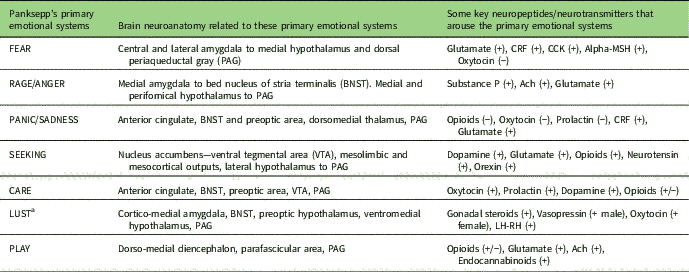
How is AN personality-based theory different? As earlier mentioned, Panksepp mapped out his AN theory in detail including the underlying neuroanatomies and neurotransmitter/neuropeptide systems of the earlier mentioned seven primary emotions. If researchers now assess individual differences in primary emotions (e.g., with the ANPS), they indirectly can assume (based on findings from AN theory) which brain anatomy and linked neurotransmitter systems might be involved in certain emotional personality dimensions such as being a high PLAY or high PANIC/SADNESS endophenotype—helping, for example, researchers disentangle the molecular foundations of the emotional parts of personality. To further illustrate this with an example: The SADNESS circuitry is strongly innervated by the opioid and oxytocin brain transmitter systems (Panksepp & Watt, Reference Panksepp and Watt2011). Thus, physical hugs by a close friend or family member elicit the release of these transmitters and thereby downregulate the activity of the SADNESS system (theoretically explaining why social support in sad times feels so good; see also Holt-Lunstad, Birmingham, & Light, Reference Holt-Lunstad, Birmingham and Light2008; Løseth, Leknes, & Ellingsen, Reference Løseth, Leknes and Ellingsen2016).
The ANPS (Davis, Panksepp, & Normansell, Reference Davis and Panksepp2003) was published to facilitate assessing individual differences in primary emotions in accordance with Panksepp’s AN theory (see below for more detail). Using the ANPS, earlier work by Davis, Panksepp, and Normansell (Reference Davis and Panksepp2003), but also evidence from cross-cultural findings by Montag and Panksepp (Reference Montag and Panksepp2017) demonstrated that higher trait SADNESS is robustly linked to higher Big Five Neuroticism. Therefore, screening the genome for genes impacting oxytocinergic and opioid transmission might reveal genetic variants being linked specifically to individual differences in trait PANIC/SADNESS rather than focusing on the higher-order personality trait of Neuroticism. As such, AN theory can be used as a roadmap to study the biological basis of human personality with a clear focus on subcortical emotional regions of the mammalian brain (for a detailed overview on the brain and molecular candidates see the Appendix).
Of note, also other important biologically oriented personality theories exist to guide researchers in the study of personality neuroscience. Among these are the works by Eysenck (Reference Eysenck1967) with his prominent dimensions Neuroticism and Extraversion, and the works by his former student Jeffrey Gray and his Behavioral Inhibition System (BIS), Behavioral Approach System (BAS), and Fight-Flight-Freeze System (e.g., Gray, Reference Goldberg1972; Gray & McNaughton, Reference Gosling and John2000) and also Cloninger, Svrakic, and Przybeck (Reference Cloninger, Svrakic and Przybeck1993). Eysenck’s theory on the biological basis of personality proposed first interesting hypotheses on the underlying neural foundations of personality. Whereas the Intro-/Extraversion dimensions and individual differences in arousability should be linked to a massive structure called the ascending reticular activation system (see Yeo, Chang, & Jang, Reference van der Westhuizen and Solms2013, for a detailed anatomical description), an overactivity/lower threshold of arousability of the limbic system in reaction to stress should underlie Neuroticism (vs. Emotional Stability). Cloninger’s biosocial theory of personality became prominent for providing testable hypotheses on which neurotransmitters should underlie his prominent temperament traits called Novelty Seeking (low dopamine), Harm Avoidance (high serotonin), and Reward Dependence (low norepinephrine; Cloninger, Reference Cloninger1986). Panksepp provided both detailed ideas with respect to the neuroanatomy (such as Eysenck) and the transmitter/neuropeptide systems (such as Cloninger) underlying primary emotional systems.
On a questionnaire level, there is a clear overlap between the scales assessing the different personality theories. As provided in Montag, Reuter, Jurkiewicz, Markett, and Panksepp (Reference Montag, Reuter, Jurkiewicz, Markett and Panksepp2013) one can see that, for example, (Eysenck’s) Neuroticism and (ANPS) FEAR correlate with r=.72 and Cloninger’s Harm Avoidance and (ANPS) FEAR with r=.57. With respect to the proposed biological systems underlying the different personality theories an overlap can also be observed in parts; for example, Panksepp suggests an influence of dopamine on the SEEKING system, whereas SEEKING likely is associated with Novelty Seeking (and this in turn according to Cloninger with dopamine). Although overlaps between theories can be observed on the self-report and biological level, as mentioned, Panksepp’s approach to studying the mammalian brain by means of electrical stimulation and pharmacological challenges led to a much more fine-grained picture of the primary emotional systems driving human personality in a bottom-up fashion. Originally, we refrained from providing a detailed list of all brain candidates underlying primary emotional systems, because it is redundant information available in numerous publications (Montag & Panksepp, Reference Montag and Panksepp2017, Reference Montag and Pankseppin press; Panksepp, Reference Panksepp2011). Nevertheless, it became apparent in the review process, that it would be a help for readers to not need to switch to these older publications. Therefore, we provide the readers with this information in the Appendix of this work, again.
Finally, we want to mention that Gray and McNaughton’s revised reinforcement sensitivity theory also represents a much elaborated biologically framework, which in its revised version, in particular, made large progress in disentangling the emotions of FEAR and anxiety (see also McNaughton & Corr, Reference McNaughton and Corr2004). In Gray and McNaughton’s well-respected work called “The Neuropsychology of Anxiety” they summed up: “… we identity fear (elicited by exposure to aversive stimuli without conflict) with activity in the amygdala, and anxiety (fear to which an approach-based conflict is added) with concurrent activity in the amygdala and septo-hippocampal system” (Reference Gosling and John2000, pp. 122–123). Disentangling anxiety and fear is something that AN theory researchers have not attempted to do because AN theory assumes that all primary emotions arise subcortically and that cortically measured expressions of emotions are likely re-representing subcortical emotional foundations. Much additional preclinical research will be required to adequately resolve such issues. Here, we refer to recent approaches in personality neuroscience, using also self-reports attempting to disentangle both emotions (Corr & Cooper, Reference Corr and Cooper2016; Reuter, Cooper, Smillie, Markett, & Montag, Reference Reuter, Cooper, Smillie, Markett and Montag2015).
1.3. The ANPS as a measure of individual differences in primary emotional systems
The ANPS was first published by Davis, Panksepp, and Normansell (Reference Davis and Panksepp2003) and revised by Davis and Panksepp (Reference Davis and Panksepp2011). The ANPS consists of six scales item, with 14 items each assessing Panksepp’s six primary emotions and 12 additional items assessing spirituality. The latter dimension clearly does not represent a primary emotion and was included due to Jaak’s interest in working with recovering alcoholics in Alcoholics Anonymous programs as well its relevance in the treatment of psychiatric patients (e.g., Angres, Reference Angres2010; see also the self-transcendence dimension in Cloninger’s Temperament and Character Inventory shortly called TCI). The ANPS only covers six instead of seven primal emotions, because items on LUST have not been included given the large possibility to trigger social desirably biased answers carrying over on the answers given on the remaining scales (see Schmitt, Allik, McCrae, & Benet-Martinez, Reference Schmitt, Allik, McCrae and Benet-Martinez2007, p. 182). A 2011 revision of the ANPS changed only a small number of items from its earlier version to achieve better psychometric properties. Moreover, it is possible to construct a short lie-scale consisting of five items. The remaining items of the ANPS represent filler items. Davis, Panksepp, and Normansell (Reference Davis and Panksepp2003) stated that all items included on a primary emotion scale were written to reflect the experience of that emotion based on AN theory. That is, “Items for all scales were written with the goal of accessing personal feelings and behavior rather than more cognitive social judgments” (Davis, Panksepp, & Normansell, Reference Davis and Panksepp2003, p. 56). Thus, the ANPS represents “only” an indirect assessment of one’s emotional nature in the context of personality. In detail, Davis and Panksepp stated “we interpret the ANPS scales as tertiary (thought-mediated) approximations of the influence of the various primary emotional systems in people’s lives. However, it is our working hypothesis that the subcortical primary-processes neural systems, where the foundations of emotions reside, can generate individual differences in normal personality as well as the affective imbalances characterizing mental disorders” (Reference Davis and Panksepp2011, p. 1952). Meanwhile, the ANPS has been translated into many languages. Among these languages are French (Pahlavan, Mouchiroud, Zenasni, & Panksepp, Reference Pahlavan, Mouchiroud, Zenasni and Panksepp2008), Spanish (Abella, Panksepp, Manga, Bárcena, & Iglesias, Reference Abella, Panksepp, Manga, Bárcena and Iglesias2011), Turkish (Özkarar-Gradwohl et al., Reference Özkarar-Gradwohl, Panksepp, İçöz, Çetinkaya, Köksal, Davis and Scherler2014), Italian (Pascazio et al. Reference Pascazio, Bembich, Nardone, Vecchiet, Guarino and Clarici2015), and German (Reuter, Panksepp, Davis, & Montag, Reference Reuter, Panksepp, Schnabel, Kellerhoff, Kempel and Hennig2017). A Chinese version has also been translated and published recently (Sindermann et al., Reference Sindermann, Luo, Zhao, Li, Li, Kendrick and ,... Montag2018) and a Serbian version is following soon (please contact author Christian Montag for further information).
1.4. ANPS validation studies
The ANPS has seen a number of validation studies in the last years confirming clear relationships with the Big Five scales as well as clarifying where the Big Five fails to address key primary emotions. Among these are studies using the ANPS to better understand personality disorders (Geir, Selsbakk, Theresa, & Sigmund, Reference Gosling, Rentfrow and Swann2014; Karterud et al., Reference Karterud, Pedersen, Johansen, Wilberg, Davis and Panksepp2016), depression (Montag et al., Reference Montag, Widenhorn-Müller, Panksepp and Kiefer2017), multiple sclerosis (Sindermann et al., Reference Sindermann, Saliger, Nielsen, Markett, Karbe and Montag2017), stroke (Farinelli et al., Reference Farinelli, Panksepp, Gestieri, Leo, Agati, Maffei and … Northoff2013), creativity (Reuter et al., Reference Reuter, Panksepp, Davis and Montag2005), bipolar disorder (Savitz, van der Merwe, & Ramesar, Reference Savitz, van der Merwe and Ramesar2008a, Reference Savitz, van der Merwe and Ramesar2008b), and chill experiences (Laeng, Eidet, Sulutvedt, & Panksepp, Reference Laeng, Eidet, Sulutvedt and Panksepp2016). A new study investigated how growing up in rural versus urban areas shape primary emotional systems (Sindermann et al., Reference Sindermann, Kendrick, Becker, Li, Li and Montag2017). The ANPS has also been investigated in the context of vengefulness (Sindermann et al., Reference Sindermann, Luo, Zhao, Li, Li, Kendrick and ,... Montag2018) and recently religious/spiritual well-being (Hiebler-Ragger et al., Reference Hiebler-Ragger, Fuchshuber, Dröscher, Vajda, Fink and Unterrainer2018). Aside from this, several studies used (molecular) genetic and brain imaging approaches to search for associations with the ANPS (Deris, Montag, Reuter, Weber, & Markett, Reference Deris, Montag, Reuter, Weber and Markett2017; Felten, Montag, Markett, Walter, & Reuter, Reference Felten, Montag, Markett, Walter and Reuter2011; Montag, Fiebach, Kirsch, & Reuter, Reference Montag, Fiebach, Kirsch and Reuter2011; Montag, Sindermann, Becker, & Panksepp, Reference Montag, Sindermann, Becker and Panksepp2016; Reuter, Weber, Fiebach, Elger, & Montag, Reference Reuter, Weber, Fiebach, Elger and Montag2009). Moreover, also endocrinological approaches have been applied (Sindermann et al., Reference Sindermann, Li, Sariyska, Lachmann, Duke, Cooper and … Montag2016; van der Westhuizen & Solms, Reference Yarkoni2015). In sum, these first studies show that it is feasible to search for associations between biological markers and individual differences with the ANPS.
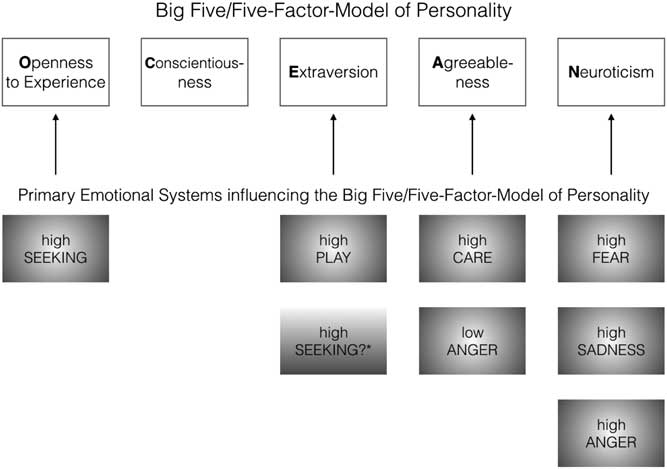
As mentioned earlier, individual differences in primary emotions could represent the phylogenetically oldest part of human personality driving our behavior in a bottom-up fashion. In a recent paper of Montag and Panksepp (Reference Montag and Panksepp2017) both researchers provide evidence for robust associations between the Big Five/Five-Factor Model of Personality and primary emotions from a cross-cultural study including the original US-data from Davis, Panksepp, and Normansell (Reference Davis and Panksepp2003) together with new data from China and Germany. In all studies, robust correlation patterns could be observed with FEAR, SADNESS, and ANGER being the primary emotions driving Neuroticism, high CARE and low ANGER being the driving forces of high Agreeableness, high SEEKING being the bottom-up force of Openness to Experience and high PLAY being the primary emotional foundation of Extraversion. Note that no link was robustly observed between Conscientiousness and primary emotions across cultures, which fits with the observation that Conscientiousness has only been reliably measured in chimpanzees and homo sapiens (Gosling & John, Reference Geir, Selsbakk, Theresa and Sigmund1999; King & Figueredo, Reference King and Figueredo1997) and brown capuchin monkeys (Morton et al., Reference Morton, Lee, Buchanan-Smith, Brosnan, Thierry, Paukner and Weiss2013). The model relating primary emotions and the Big Five of Personality has been slightly modified in Montag and Panksepp (Reference Montag and Pankseppin press) with the hypothesis that high SEEKING could also be a driving force for high Extraversion, because both constructs are linked to reward processing (for extraversion and reward processing see Smillie, Reference Smillie2013; the medial forebrain bundle is part of “the intrinsic reward SEEKING system of the brain”; Coenen, Schlaepfer, Maedler, & Panksepp, Reference Coenen, Schlaepfer, Maedler and Panksepp2011, p. 1972). Nevertheless, this idea was only partially supported in the data presented by Montag and Panksepp (Reference Montag and Panksepp2017): In this work, only two out of three correlation patterns pointed toward such an association. In addition, please see that also in the new data set below the association between Extraversion and SEEKING is lower compared with the other robustly observed associations as described above (see Table 3). The present section dealt foremost with data stemming from self-report. It is anticipated that beyond the comparison of ANPS with Big Five scales, additional biological validation of the ANPS primary emotion scales will be forthcoming to better link these scales to the massive amount of preclinical evidence Panksepp’s group has provided. Nevertheless it needs to be mentioned that currently the ANPS, although theoretically grounded in Panksepp’s AN theory, is probably no more directly linked to the mentioned primary emotions than Carver and White’s scales (Reference Carver and White1994) to the BIS/BAS or Reuter and Montag’s revised RST-Q (Reinforcement Sensitivtiy Theory-Questionnaire; Reuter et al., Reference Reuter, Cooper, Smillie, Markett and Montag2015) to the BIS/BAS/Fight-Flight-Freeze System and the neural underpinnings of Gray’s systems. Again, future studies are much needed to demonstrate which scales are most closely linked to the neural circuitry of interest.
1.5. Primary emotions as assessed with the ANPS and 42-item Big Five short-scale personality facets
In a recent commentary by Di Domenico and Ryan (Reference Di Domenico and Ryan2017) on Montag and Panksepp’s work (Reference Montag and Panksepp2017), the authors pointed among others to the importance of exploring associations between facets of the Big Five and individual differences in primary emotions. Among others they hypothesized that PLAY would be associated with the subscale Enthusiasm of Extraversion, but less with the subscale of Assertiveness: “Indeed, like PLAY, Enthusiasm has been linked to both dopamine and endogenous opioids, whereas Assertiveness appears to be more strongly associated with dopamine“ (Di Domenico & Ryan, Reference Di Domenico and Ryan2017, p. 2).
To provide first insights into associations between facets of the Big Five Personality Model and primary emotions, we conducted a small study, where participants (N=182; 50 males and 132 females; mean-age: 23.47 [SD=4.57]) were asked to fill in the German version of the ANPS (Reuter et al., Reference Reuter, Panksepp, Schnabel, Kellerhoff, Kempel and Hennig2017) and the German version of the 42-item Big Five short-scale assessing with 42 items the broad Big Five scales as well as several facets (for detailed information on the German version of the 42-item Big Five short-scale see Olaru et al., Reference Olaru, Witthöft and Wilhelm2015; for the theoretical background of the 42-item Big Five short-scale, see Tupes & Christal, Reference Tupes and Christal1961, as well as Christal, Reference Christal1994). Answer options of the ANPS were 1= “strongly disagree” to 4= “strongly agree.” Answer options of the 42-item Big Five short-scale were 1= “strongly disagree” to 7= “strongly agree.” Means and standard deviations of the ANPS/42-item Big Five short-scale questionnaire data are presented in Table 1. Internal consistencies of both measures were mostly satisfactory (the lowest being the Neuroticism subscale, Irritated, with a Cronbach’s α of .50, please see Tables 2). The study was approved by the local ethics committee at Ulm University, Ulm, Germany.
Means and standard deviations of the Affective Neuroscience Personality Scales (ANPS) and 42-item Big Five short-scale measures
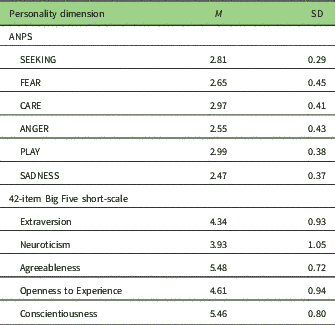
Note. The range of answer options was 1–4 with respect to the ANPS and 1–7 with respect to the 42-item Big Five short-scale; 1= “strongly disagree,” and 4 respective 7= “strongly agree”.
Internal consistencies of the Affective Neuroscience Personality Scales (ANPS) and the 42-item Big Five short-scale both on scale and subscale levels
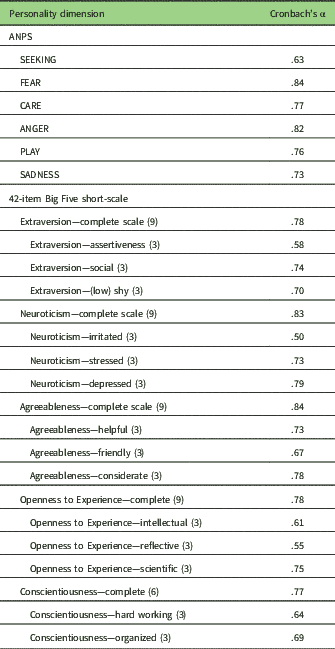
Note. Numbers in brackets give information on the item number of each scale.
We also provide the correlation patterns between primary emotions as assessed with the ANPS and the Big Five as assessed with the 42-item Big Five short-scale. As the 42-item Big Five short-scale has not been applied before in the context of ANPS research (for an exception see Sindermann et al., Reference Sindermann, Luo, Zhao, Li, Li, Kendrick and ,... Montag2018), the correlation patterns from the present work can provide additional support for the already observed robust cross-cultural correlation patterns between the Big Five and primary emotions as described earlier in this text (taken from Montag & Panksepp, Reference Montag and Panksepp2017). Indeed, the same robust associations could be observed such as higher FEAR, SADNESS, and ANGER being linked to higher Neuroticism; higher PLAY being associated with higher Extraversion; SEEKING was linked to higher Openness to Experience; and lower ANGER plus higher CARE were associated with higher Agreeableness (see Table 3). Thus, these basic findings seem to generalize across independent Big Five measures. Note that in the original work by Davis, Panksepp, and Normansell (Reference Davis and Panksepp2003) Goldberg’s Big Five adjectives (Goldberg, Reference Gray1992) were applied, whereas in Montag and Panksepp’s work (Reference Montag and Panksepp2017) data came from the NEO-FFI (Costa & McCrae, Reference Costa and McCrae1992). Of importance, the 42-item Big Five short-scale provided basically the same associations with the ANPS as the other Big Five measures applied earlier. However, some unexpected findings such as (1) FEAR and SADNESS being moderately/strongly linked to lower Extraversion, (2) lower PLAY to higher Neuroticism, and (3) higher PLAY related to higher Agreeableness could be 42-item Big Five short-scale specific (see Table 3).
Correlation patterns between the Affective Neuroscience Personality Scales and the Big Five as assessed with the 42-item Big Five short-scale
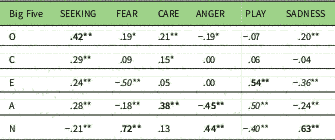
Note. Bold printed correlation patterns indicate similarities with the works by Davis, Panksepp, and Normansell (Reference Davis and Panksepp2003) and Montag and Panksepp (Reference Montag and Panksepp2017); italic printed correlation patterns could be 42-item Big Five short-scale specific.
*p<.05; **p<.01.
Given the commentary by Di Domenico and Ryan (Reference Di Domenico and Ryan2017), we also provide in Tables 4–7 the associations between individual differences in primary emotions and the facets of the Big Five Personality Model. We only present the facets of those Big Five dimensions that are most robustly associated with primary emotional systems (again we refer to the work by Montag & Panksepp, Reference Montag and Panksepp2017).
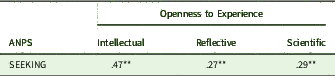
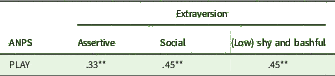
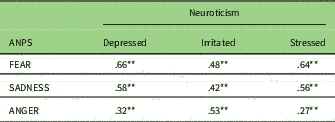
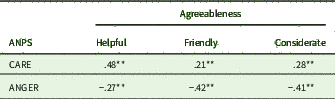
Selected associations between 42-item Big Five short-scale subscales and the ANPS are presented in Tables 4–7. In short, SEEKING is most strongly linked to the Intellectual subscale of Openness to Experience (although the remaining subscales are also significantly linked to SEEKING). PLAY associations are strongest for the Extraversion subscales of Social and (low) Shy and Bashful. This is line with the idea of Di Domenico and Ryan’s comment (Reference Di Domenico and Ryan2017), but see that also the Assertiveness subscale shows a significant association with PLAY. Whereas the FEAR and SADNESS dimensions are most strongly linked to the Neuroticism subscales Depressed and Stressed, ANGER is most strongly linked to being Irritated. Finally, focusing on 42-item Big Five short-scale Agreeableness subscales, CARE is most strongly linked to being Helpful and high ANGER most strongly to being less Friendly and Considerate. Please note that we consider the results from the Correlation Tables 4–7 as first insights into putative associations between individual differences in primary emotions and subscales of the Big Five. Some of the internal consistencies of the respective subscales are in the lower area of acceptability and the associations presented here need to be replicated with the 42-item Big Five short-scale and also other inventories (and subscales) across cultures. Moreover, correction procedures for multiple testing need to be considered. Without proper hypothesis (perhaps aside from the ideas mentioned in Di Domenico and Ryan’s work, one might have needed to adjust the α of .05 to .004 (Bonferroni adjustment with dividing .05 by 14 subscales of the 42-item Big Five short-scale). We refrain from doing this here because we understand the present data as a starting point for further research endeavors. The here presented associations concerning relations between facets of the Big Five and primary emotions in every case need to be replicated. Please see Figure 1 for further illustrations.
Primary emotional systems influence the Big Five/Five-Factor-Model of Personality in a bottom-up fashion. *More information on a potential SEEKING-Extraversion link is provided on page 4 (right column).

Correlation patterns between Affective Neuroscience Personality Scales (ANPS) SEEKING and subscales of Openness to Experience
Note. **p<.01, two tailed.
Correlation patterns between Affective Neuroscience Personality Scales (ANPS) PLAY and subscales of Extraversion
Note. **p<.01, two tailed.
Correlation patterns between Affective Neuroscience Personality Scales (ANPS) FEAR, SADNESS, ANGER, and subscales of Neuroticism
Note. **p<.01, two tailed.
Correlation patterns between Affective Neuroscience Personality Scales (ANPS) CARE, ANGER, and subscales of Agreeableness
Note. **p<.01, two tailed.
Affective Neuroscience Personality Scales-adjective ratings (ANPS-AR) items with valence and scale
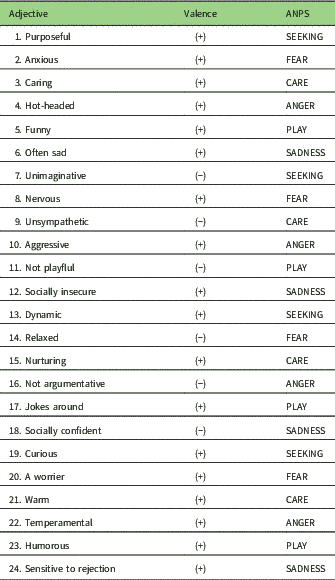
Note. + = positive loadings; − = needs to be reversed before a score can be computed.
A new adjective-based short measure to assess individual differences in primary emotional systems (all items are answered with a 7-point Likert scaling ranging from 1= “Very Inaccurate,” 2= “Inaccurate,” 3= “Slightly Inaccurate,” 4= “Neither,” 5= “Slightly Accurate,” 6= “Accurate,” to 7= “Very Accurate”): The ANPS-adjective ratings (ANPS-AR) data reported here were collected on a U.S. student sample (total n=424, 254 females) Cronbach’s αs for the adjective-based ANPS scales ranged from .75 for PLAY to .69 for ANGER except for SEEKING at .51. The ANPS-AR can be used to collect observer ratings of other persons (e.g., therapy clients, family members, or colleagues) in addition to self-ratings. Table 9 shows the intercorrelations of the six ANPS-AR scales.
1.6. Outlook on future research directions using AN theory in personality neuroscience
The final part of the paper tries to give an outlook on important avenues for future research in the realm of primary emotional systems in the context of personality neuroscience. Some of the points have been already made by Montag and Panksepp (Reference Montag and Panksepp2017). However, here we propose also new directions.
First of all, we believe that experimental work that can provide evidence of causes rather than limited to correlations is of tremendous importance to illuminate the emotional nature of human personality. Self-report questionnaires naturally can only represent one data layer, which needs to be enriched by more “objective“ measures. This could be the assessment of individual differences in primary emotions by means of brain imaging (largely correlational) or other more experimental techniques (e.g., see Markett, Montag, & Reuter, Reference Markett, Montag and Reuter2014; Montag et al., Reference Montag, Reuter, Jurkiewicz, Markett and Panksepp2013). If we want to fully understand the biological underpinnings of primary emotions, we need to take a look at direct (emotional) behavior and if possible also pure raw affects. This is not an easy task, because raw affects only rarely can be observed in human adults, because our “cortical thinking cap” usually holds a tight grip on the activity of neural networks, where primary emotions arise. Good examples of research approaches for studying raw affect in humans include the startle reflex to study the FEAR system (e.g., Montag et al., Reference Montag, Buckholtz, Hartmann, Merz, Burk, Hennig and Reuter2008). Mobbs et al. (Reference Mobbs, Petrovic, Marchant, Hassabis, Weiskopf, Seymour and , … Frith2007) brought the concept of defensive distance to the magnetic resonance imaging scanner (for the concept of defensive distance among others see Blanchard, Hynd, Minke, Minemoto, & Blanchard, Reference Blanchard, Blanchard, Rodgers and Weiss2001; Blanchard, Blanchard, Rodgers, & Weiss, Reference Blanchard, Hynd, Minke, Minemoto and Blanchard1990). Defensive distance describes the distance between predator and prey. The closer the distance the stronger activity can be observed in the FEAR system. Its response such as fight, flight, or freezing also depends to some extent on the defensive distance.
It also needs to be mentioned that in particular triggering negative primary emotions in humans poses stronger ethical problems than triggering positive primal emotions (but see Damasio et al. Reference Damasio, Grabowski, Bechara, Damasio, Ponto, Parvizi and Hichwa2000; Mobbs et al. Reference Mobbs, Petrovic, Marchant, Hassabis, Weiskopf, Seymour and , … Frith2007; Reference Mobbs, Marchant, Hassabis, Seymour, Tan, Gray and , … Frith2009). “Indeed, because of such ethical concerns, JP decided to devote practically all his research effort for the past three decades to the study of positive emotions, especially animal play and ‘laughter,’ and specifically focusing on how such work may help identify new psychiatric treatments …” (Panksepp et al., Reference Panksepp, Lane, Solms and Smith2017, p. 204). However, we are of the opinion that primary emotions can be well studied in young children, because their prefrontal cortex has developed less control over ancient neural subcortical circuits. Yet, given the ethical problems with studying negative affect, in children, at least the study of PLAY in childhood might provide excellent insights into the biological basis of becoming an extra-/introvert (again see associations between PLAY and extraversion as presented in Tables 3 and 5).
Another new interesting avenue to understand the workings of primary emotions in humans will stem from Psychoinformatics (Montag et al., Reference Montag, Sindermann, Becker and Panksepp2016; Yarkoni, Reference Yeo, Chang and Jang2012). Psychoinformatics describes a new research discipline where computer science methods are used to better understand psychological phenotypes. At present, the study of digital human–machine interaction is also of high interest for the affective neurosciences, because emotional energy finds its way also into our communication (we see the irony that the link toward lexical approaches of the Big Five is strong in this distinct domain of Psychoinformatics; Schwartz et al., Reference Schwartz, Eichstaedt, Kern, Dziurzynski, Ramones, Agrawal and Ungar2013). This could identify how many positive or negative words we use in our text messages (analyzed by textmining techniques) and the kind of movement/locomotion patterns we provide via GPS signals or if we show communication behavior at all (e.g., a depressed person withdraws from his/her social network: Canzian & Musolesi, Reference Canzian and Musolesi2015; Markowetz, Błaszkiewicz, Montag, Switala, & Schlaepfer, Reference Markowetz, Błaszkiewicz, Montag, Switala and Schlaepfer2014). The feasibility to combine smartphone-app recorded data with neuroscientific magnetic resonance imaging scans has been demonstrated, recently (Montag et al., Reference Montag, Widenhorn-Müller, Panksepp and Kiefer2017).
A final note concerns again the ANPS itself as a self-report measure to get insights into individual differences in primary emotions. Given the manifold possibilities to collect self-report data via smartphones or the Internet in general, it has become easy to collect a large amount of data sets to also study primary emotions in thousands of participants (e.g., see an example for such a large-scale personality/mood assessment in Andone et al., Reference Andone, Błaszkiewicz, Eibes, Trendafilov, Montag and Markowetz2016). A problem for large-scale studies often poses the length of the applied questionnaire. This is, in particular, the case if persons fill in items via small devices such as a smartphone. As the ANPS is a rather long questionnaire, shorter measures to assess individual differences in primary emotions are strongly needed. This also reflects in the already existing short versions of the ANPS by Pingault, Pouga, Grèzes, & Berthoz (Reference Pingault, Pouga, Grèzes and Berthoz2012) and the B-ANPS/ANPS-S presented by Geir et al. (Reference Gosling, Rentfrow and Swann2014). As with very brief forms of the Big Five Model of Personality (e.g., Gosling, Rentfrow, & Swann, Reference Gray and McNaughton2003; Rammstedt & John, Reference Rammstedt and John2007), we would like to present interested researchers a very short form of the ANPS with Table 8.
Intercorrelations of the Affective Neuroscience Personality Scales-adjective ratings (ANPS-AR) dimensions, n=394
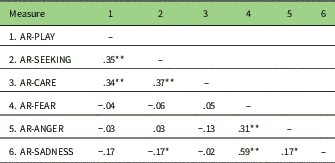
Note. *p<.05, two-tailed; **p<.01, two-tailed. p values adjusted for Bonferroni Corrections.
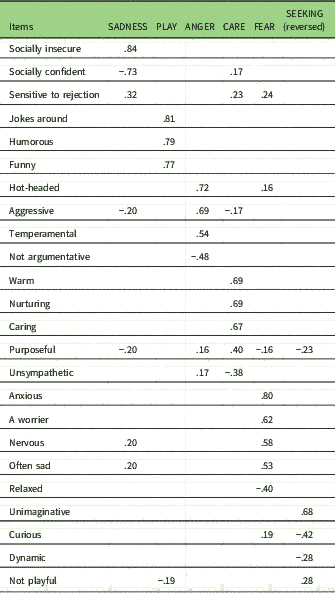
The ANPS-AR adjectives were selected from the sample of 156 Big Five adjectives for subjects with no missing data (which reduced the n to 200 subjects) based on high correlations with the six primary ANPS scales as well on discriminate validity, that is, correlating highest with the corresponding ANPS scale (a criterion reached for all adjectives except “socially insecure” and “socially confident”). The 24 ANPS-AR adjectives were also subjected to exploratory factor analysis (SPSS version 20: Maximum likely extraction, oblimin rotation, seven eigen values >1.0, n=394). With six factors rotated all but three adjectives loaded highest on their designated scale, although the SEEKING items loaded negatively. A six-factor solution was arrived at by rotating two through seven factors. With two factors, all factors appropriately loaded on either a total negative affect or positive affect factor with no exceptions. With rotations from three to six, an additional affective neuroscience dimension emerged until rotating six factors revealed all six affective neuroscience scales. With seven rotations, no item loaded most strongly on the seventh factor, which did not have a loading reaching the 0.30 level. Factor loadings >0.15 can be seen in Table 10. A similar exploratory factor analysis including an additional 27 adjectives targeting the six ANPS primary emotions (six factors rotated) resulted in all but one of the ANPS-AR adjectives loading on its intended scale. The correlations of the six ANPS-AR scales with the six corresponding ANPS scales are listed in Table 11, which again shows the close relationship between the FEAR and SADNESS measures.
Oblique-rotated factor loadings from the 24 Affective Neuroscience Personality Scales-adjective rating (ANPS-AR) items, n=394
Correlations of Affective Neuroscience Personality Scales (ANPS) with ANPS-Adjective Rating (ANPS-AR), n=209
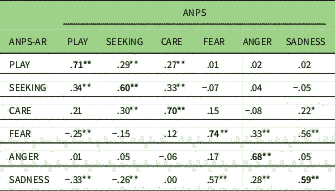
Note. Central correlations between same dimensions of the ANPS and ANPS-AR. Alternate versions of the same scale correlations are in boldface.
*p<.05, two-tailed; **p<.01, two-tailed. p values adjusted for Bonferroni Corrections.
In addition, some items or even scales of the original (perhaps also of our short scale) might see some further work-over in the future. For example, the SEEKING scale of the German ANPS could have better psychometric properties (see also the lowest internal consistencies of the ANPS scales in the present work, Table 2) and Reuter et al. (Reference Reuter, Panksepp, Schnabel, Kellerhoff, Kempel and Hennig2017) proposed how to improve this scale in the German version of the ANPS manual. Finally, as with other inventories (see the Junior-TCI; e.g., Lyoo et al., Reference Lyoo, Han, Lee, Yune, Ha, Chung and … Hong2004), an ANPS version adapted for children will be necessary to be developed in the near future.
2. Conclusions
In sum, we are convinced that AN theory has a lot to offer personality neuroscience. We hope that many researchers will use AN theory as a guide in the investigation of the evolutionary foundations of human personality, namely individual differences in emotionality. This said, while AN theory offers important insights into the emotional aspects of human personality, it is based on preclinical research, and much more research is needed to expand our knowledge of the mammalian brain. In the meantime, this perspective can be enriched by more cognitive views to get a fuller picture of human personality. In terms of administering self-report inventories, we recommend using the ANPS along with more established measures of the Big Five (e.g., BFI-2 by Soto & John, Reference Soto and John2017) to get a more comprehensive view of human personality.
Financial Support
This work was supported by a Heisenberg grant awarded by the German Research Foundation (C.H., grant number MO 2363/3-2).
Conflicts of Interest
The authors have nothing to disclose.
Appendix
The primary emotional systems of a cross-species affective neuroscience and their underlying neuroanatomical structures and neurotransmitter/neuropeptides (information abstracted from Montag & Panksepp, Reference Montag and Panksepp2016; Panksepp, Reference Panksepp1998, Reference Panksepp2005, Reference Panksepp2011; this table is exactly taken from Montag & Panksepp, in press)




 Open access

