





Introduction
Languages have different phonotactic constraints, allowing or prohibiting specific sound sequences. As a result, foreign sequences not permitted in speakers’ or listeners’ native languages are often “repaired” (e.g., Hallé et al., Reference Hallé, Dominguez, Cuetos and Segui2008; Kang, Reference Kang, Oostendorp, Ewen, Hume and Rice2011). For example, onset consonant clusters in English are phonotactically illicit in Korean. Consequently, Korean speakers tend to perceive an illusory vowel that does not have acoustic correlates in the signal (e.g., Berent et al., Reference Berent, Lennertz, Jun, Moreno and Smolensky2008) or produce a vowel between consonants, either phonologically epenthesized or excrescent, to break up the illicit onset clusters (e.g., Kang, Reference Kang2012; Shin and Iverson, Reference Shin, Iverson, Lee and Zee2011, Reference Shin and Iverson2014). The vowel insertion is often present in the speech of Korean learners of English and can introduce a challenge to English speakers communicating with the learners. To correctly identify English words containing onset clusters produced with the vowel insertion, English-speaking listeners have to adjust their perception strategies.
How listeners perceive foreign-accented speech may not always be identical. In the framework of the exemplar-based models (Clapp et al., Reference Clapp, Vaughn and Sumner2023; Goldinger, Reference Goldinger1998; Johnson, Reference Johnson1997; Nygaard and Pisoni, Reference Nygaard and Pisoni1998; Palmeri et al., Reference Palmeri, Goldinger and Pisoni1993; Sumner et al., Reference Sumner, Kim, King and McGowan2014), listeners store episodic memory traces for the speech they are exposed to and use them when perceiving new speech inputs. The episodic memory not only includes phonetic details but also non-linguistic information, such as who the talker is, what the situation is, and so on. Therefore, listening to a familiar accent and a novel accent are two very different tasks. As listeners may have stored numerous exemplars for the familiar accent, they would rely on these memory traces when listening to a (purported) speaker of the accent. Thus, exemplar-based models predict that listeners’ perception strategies are affected by both the purported talker identity and their linguistic experience (e.g., McGowan, Reference McGowan2015; Melguy and Johnson, Reference Melguy and Johnson2021; Vaughn, Reference Vaughn2019). This study aims to systematically investigate how speech perception is shaped by those two factors by expanding on Darcy and Thomas (Reference Darcy and Thomas2019), where English native speakers with little experience with Korean-accented English reject English words produced with vowel insertion. Here, we compare responses of English speakers with varying familiarity with Korean-accented English on a lexical decision task for English words with the vowel insertion while manipulating the talker identity.
Background
The effect of talker identity on speech perception
Earlier studies of speech perception proposed that any variations in speech, including talker details, are irrelevant to listeners’ task of retrieving the linguistic messages and thus abstracted away (e.g., Jakobson et al., Reference Jakobson, Fant and Halle1952; Kiparsky, Reference Kiparsky and Fujimura1973; Stampe, Reference Stampe1979). More recently, however, it has been suggested that listeners use such details when perceiving speech sounds and retrieving lexical information rather than filtering them out (the exemplar-based models of speech perception; e.g., Clapp et al., Reference Clapp, Vaughn and Sumner2023; Goldinger, Reference Goldinger1998; Johnson, Reference Johnson1997; Nygaard and Pisoni, Reference Nygaard and Pisoni1998; Palmeri et al., Reference Palmeri, Goldinger and Pisoni1993; Sumner et al., Reference Sumner, Kim, King and McGowan2014). For example, the information on talkers’ gender affects how listeners distinguish /s/ and /ʃ/ (Bouavichith et al., Reference Bouavichith, Calloway, Craft, Hildebrandt, Tobin, Beddor, Calhoun, Escudero, Tabain and Warren2019; Johnson, Reference Johnson1991; Munson et al., Reference Munson, McDonald, DeBoe and White2006). In these studies, English-speaking participants reported that they were hearing /ʃ/ more often than /s/ in a /s-ʃ/ continuum when they were presented with an image of a female talker. This effect was evident in the opposite direction as well, such that the participants thought the talker was a female more often when they were primed with words starting with /ʃ/ (e.g., shack). This indicates that both the perception of lexical or phonological categories and the perception of speaker information are malleable and that they interact with each other.
Talkers’ age, social class, and accent also affect speech perception. In an event-related potentials study, Van Berkum et al. (Reference Van Berkum, Van den Brink, Tesink, Kos and Hagoort2008) measured listeners’ neural responses when they heard sentences that did not match the talker’s age or social class (e.g., Every evening I drink some wine before I go to sleep spoken with a young child-like voice, or I have a large tattoo on my back with an upper-class accent). Listeners show an N400 effect in both cases, indicating that they consider such sentences semantically anomalous, although the sentences themselves were semantically natural. Furthermore, Cai et al. (Reference Cai, Gilbert, Davis, Gaskell, Farrar, Adler and Rodd2017) show that regional accents modulate speech perception—in particular, auditory word recognition. They report that when a word such as “bonnet,” which has a different meaning in American English (“a hat”) and in British English (“a hood of a car”), is pronounced in a British accent, participants interpret its meaning to be a car part more often than a hat. Based on these findings, Cai et al. (Reference Cai, Gilbert, Davis, Gaskell, Farrar, Adler and Rodd2017) propose that spoken word recognition involves two pathways that are activated in parallel: the lexical-semantic pathway that maps the acoustic-auditory input onto linguistic representations such as phonemes, syllables, and wordforms, and the indexical pathway that encodes the acoustic details to infer information about the talker (c.f., Pierrehumbert, Reference Pierrehumbert2016; Sumner et al., Reference Sumner, Kim, King and McGowan2014). These two pathways interact such that the “speaker model,” formed through the indexical pathway, can modulate lexical access in the lexical-semantic pathway.
Information about the talker’s identity may also facilitate the processing of foreign-accented speech and adaptation to it when that information matches the phonetic characteristics of the speech sounds, including segmental and prosodic information (McGowan, Reference McGowan2015; Melguy and Johnson, Reference Melguy and Johnson2021; Vaughn, Reference Vaughn2019). While some earlier accounts have suggested otherwise, such that the non-native status of the talker inhibits foreign-accented speech perception (Kang and Rubin, Reference Kang and Rubin2009; Rubin, Reference Rubin1992), McGowan (Reference McGowan2015) reports that English-speaking participants who see an Asian face are more accurate in transcribing Chinese-accented speech than those who see a Caucasian face. This result indicates that the alignment between the given information about the speaker and the speech signals makes it easier to process foreign-accented speech. This facilitatory effect is driven by the listeners’ expectations based on the information about the talker provided along with the speech materials. Listeners understand the signals better when their expectations align with the input than when they do not, as the mismatch induces greater cognitive efforts (Van Engen and Peelle, Reference Van Engen and Peelle2014).
The effect of linguistic experience on speech perception
The aforementioned studies that show talker identity effects in speech perception suggest that listeners make use of fine-grained phonetic details to perceive the talker identity and adjust to various talkers to optimize their comprehension of the linguistic messages (e.g., Cai et al., Reference Cai, Gilbert, Davis, Gaskell, Farrar, Adler and Rodd2017; McGowan, Reference McGowan2015; Vaughn, Reference Vaughn2019). The underlying assumption is that listeners are already equipped with knowledge about the fine-grained phonetic differences that different talker identities may induce. This raises an important question about the role of prior experience with specific talkers: do listeners who are familiar with certain talkers and their speech perceive foreign-accented speech differently than those who are not?
Studies on the perception of foreign-accented speech have shown that, in general, native speakers experience more difficulties processing non-native accents than native accents (Floccia et al., Reference Floccia, Goslin and Girard2009; Munro, Reference Munro1998). For example, when English-speaking participants hear English utterances (e.g., Most people wear hats on their feet [false]) with and without a Mandarin accent, it takes them longer to determine the truth or falsehood of the utterance when produced with a Mandarin accent than a native accent (Munro, Reference Munro1998). Nevertheless, previous experience with non-native accents may influence the process of making various linguistic decisions during speech perception (e.g., Caffarra and Martin, Reference Caffarra and Martin2019; Cai et al., Reference Cai, Gilbert, Davis, Gaskell, Farrar, Adler and Rodd2017; McGowan, Reference McGowan2015). That is, listeners with prior exposure to a foreign accent can adjust their processing strategies based on relatively robust representations compared to those without such exposure. Cai et al. (Reference Cai, Gilbert, Davis, Gaskell, Farrar, Adler and Rodd2017) report that the general pattern of the accent effect on disambiguating lexical ambiguity is limited to listeners with prior exposure to the accent in question. Specifically, when British participants and American participants are asked to write a word that comes to their mind upon hearing words such as “bonnet” spoken with a British or American accent, the accent effect is not evident for American participants with little experience with British English. Caffarra and Martin (Reference Caffarra and Martin2019) show that Spanish speakers who are more familiar with English-accented Spanish experience less difficulty processing Spanish agreement errors spoken with an English accent than those with less familiarity, as evidenced by their reduced P600 response. In McGowan (Reference McGowan2015), English speakers who have grown up in Chinese-speaking households are overall more accurate in transcribing Chinese-accented English than their monolingual counterparts.
Put together, although listeners who have been exposed to foreign-accented speech may still have difficulties with the accents (e.g., Munro, Reference Munro1998), prior experience with certain accents seems to have some processing advantages, as the listeners are able to adjust their processing strategies based on the experience. Listeners who have not had such an experience, on the other hand, may not be able to readily make well-informed adjustments as they are less likely to be equipped with the knowledge about the accent in question. In the current study, we examine whether prior experience with Korean-accented English affects the accurate recognition of a specific feature of the accent, namely, vowel insertion to break up onset clusters. Specifically, we examine the proportion and speed at which words spoken with that feature are recognized by English listeners who are familiar or unfamiliar with Korean-accented English.
The role of talker identity and linguistic experience in speech adaptation
It has been repeatedly shown that listeners can quickly adaptFootnote 1 to foreign-accented speech even in just one minute (e.g., Bradlow and Bent, Reference Bradlow and Bent2008; Clarke and Garrett, Reference Clarke and Garrett2004; Sidaras et al., Reference Sidaras, Alexander and Nygaard2008; but see Adank and McQueen, Reference Adank, McQueen, Trouvain and Barry2007; Floccia et al., Reference Floccia, Goslin and Girard2009). This kind of quick online adaptation seems to interrelate with the longer-lasting expectation-based benefits of the talker information (e.g., McGowan, Reference McGowan2015; Vaughn, Reference Vaughn2019). For instance, Vaughn (Reference Vaughn2019) shows that listeners better adapt to the speech signals when provided with talker information than when not. Listeners in Vaughn (Reference Vaughn2019) are asked to transcribe English sentences spoken with a Spanish accent and are told that the talker is either a Latinx English speaker, a Spanish learner of English, or provided with no information. Not only did the former two groups show overall greater accuracy than the other group, but they also demonstrated a greater increase in accuracy throughout the experiment, as revealed by a quartile-based analysis of the trials. These findings suggest that the talker information has both the expectation-based benefits (i.e., overall better performance when the talker background is provided than not) and online perceptual learning (i.e., better adaptation). Such findings seem to corroborate the claim that these two processes are not separate but have a common neural mechanism (e.g., predictive coding account; Sohoglu and Davis, Reference Sohoglu and Davis2016). When listeners are provided with prior information that matches the speech signals, the perceptual learning of, or adaptation to, the novel speech patterns is enhanced as the prediction error from the top-down predictive processes (i.e., a mismatch between the prediction and the sensory input) is reduced. These online adjustments, over time, can lead to more accurate predictions, in turn, leading to longer-term benefits of prior knowledge. While the predictive coding account makes specific predictions about the advantages (vs. disadvantages) of the matching (vs. mismatching) prior information, in Vaughn (Reference Vaughn2019), both types of prior information matched the speech signals, as the speech could be interpreted as recorded by either a Latinx English talker or a Spanish learner of English. The impact of talker information, either matching or mismatching the speech signals during online adaptation, is not clear, which is one of the research questions in the current study. Specifically, we examine English listeners’ adaptation to a phonetic feature typical of Korean-accented English with matching (Korean) or mismatching (American and Mexican) talker information. Comparing Korean and Mexican talker conditions allows us to test whether listeners respond in the same manner for non-native talkers regardless of their purported native language or adapt different strategies based on the talkers’ language background. Additionally, we also test whether the previous exposure to Korean accents enhances adaptation to the phonetic feature during the experiment, which has not previously been investigated.
Phonotactic repairs in L2: vowel insertion in Korean-accented English
Phonotactic constraints are language-specific. Therefore, what is allowed in one language may not be permissible in another language. Models of L2 speech learning (e.g., Flege, Reference Flege and Strange1995; Best and Tyler, Reference Best, Tyler, Bohn and Munro2007) state that learners perceive or produce L2 sounds based on their L1. This often results in modifying L2 sound sequences by deleting, inserting, or changing sounds to comply with the learners’ L1 phonotactics, a process known as phonotactic repair (e.g., Hallé et al., Reference Hallé, Dominguez, Cuetos and Segui2008).
One example of this kind of phonotactic repair is vowel insertion to repair phonotactically illicit consonant clusters. Spanish speakers insert [e] before word-initial [s]-consonant clusters in English, since those clusters are not allowed in Spanish (e.g., snob becomes esnob, Cuetos et al., Reference Cuetos, Hallé, Domínguez, Segui, Lee and Zee2011). As Korean does not allow onset consonant clusters altogether, when Korean speakers perceive or produce consonant clusters in English, they tend to insert a vowel similar to /ɨ/ inside, not before, the cluster (e.g., blue is perceived or pronounced as /bɨlu/, Berent et al., Reference Berent, Lennertz, Jun, Moreno and Smolensky2008; Kang, Reference Kang2012; Shin and Iverson, Reference Shin, Iverson, Lee and Zee2011, Reference Shin and Iverson2014). Whether these inserted vowels are excrescent or phonological is controversial and beyond the scope of the current investigation. However, Darcy and Thomas’s (2019) findings suggest that these phonotactic repairs may lead to L2 learners having different representations than native speakers of the target language. Darcy and Thomas (Reference Darcy and Thomas2019) illustrate such representational differences between English speakers and Korean learners of English by comparing the two groups of participants in an auditory lexical decision task with English stimuli with word-onset CC clusters. The stimuli include English words produced in three forms: a native-like pronunciation (e.g., /blu/ for blue), a form with /ʊ/ inserted between the two consonants (e.g., /bʊlu/), and a form with /ɪ/ inserted (e.g., /bɪlu/). All stimuli are recorded by a phonetically-trained male native speaker of English. The vowel /ʊ/ sounds similar to the vowel typically inserted by Korean speakers to break up the consonant cluster, whereas /ɪ/ does not, hence serving as a control condition. English speakers in Darcy and Thomas (Reference Darcy and Thomas2019) reject the /ʊ/-inserted and the /ɪ/-inserted forms at similar rates and with comparable response times, treating both as nonwords. In contrast, Korean participants reject the /ʊ/-insertion less frequently and more slowly than the /ɪ/-insertion, suggesting that they may have the /ʊ/-insertion as well as the well-formed form in their lexicon. This outcome, according to Darcy and Thomas (Reference Darcy and Thomas2019), indicates that Korean learners of English, unlike English native speakers, have dual representation (e.g., both /blu/ and /bʊlu/ for blue) for English words in their mental lexicon.
In Darcy and Thomas (Reference Darcy and Thomas2019), /ʊ/ is used to approximate the Korean epenthetic vowel, which the authors transcribe as /ɯ/. While the Korean epenthetic vowel, in our view, is closer to a high central unrounded vowel /ɨ/ than /ɯ/, American English /ʊ/ would be a reasonable counterpart to this Korean epenthetic vowel due to its acoustic and perceptual similarities, regardless of the transcription convention. For example, according to Yang (Reference Yang1996), Korean /ɨ/ is close to American English /ʊ/ and /u/ in its formants, but is clearly distinct from /ɪ/ or /ʌ/. Similarly, Ryu (Reference Ryu2018) shows that Korean /ɨ/ is most similar to Canadian English /ʊ/ based on a linear discriminant analysis. Furthermore, Heo and Park (Reference Heo and Park2012) report that native English listeners most frequently map Korean /ɨ/ to English /ʊ/ in perceptual assimilation tasks. These findings suggest that English /ʊ/ is the most likely perceptual counterpart of Korean /ɨ/ for North American English listeners, despite their differences in lip rounding.
The difference between English speakers and Korean learners of English in Darcy and Thomas (Reference Darcy and Thomas2019) is intriguing. However, the English-speaking participants in their study would presumably have little, if any, exposure to Korean or Korean-accented English, given that they are monolinguals who have not lived in any other country than the United States. It remains to be tested whether English speakers who are familiar with Korean-accented English will show patterns more similar to Korean speakers owing to their previous exposure to the vowel insertion. Also, Darcy and Thomas (Reference Darcy and Thomas2019) have not examined whether the English monolinguals show any evidence for adaptation over the course of the experiment, although online adaptation is likely to occur, considering the aforementioned findings on rapid adaptation to foreign-accented speech (e.g., Bradlow and Bent, Reference Bradlow and Bent2008; Clarke and Garrett, Reference Clarke and Garrett2004; Sidaras et al., Reference Sidaras, Alexander and Nygaard2008).
This study
The current study aims to investigate the role of (1) purported talker identity and (2) listeners’ prior linguistic experience in recognizing and adapting to foreign-accented speech, focusing on a common feature of Korean-accented English, namely the vowel insertion to break up onset clusters. We compare English speakers living in the US (Experiment 1) and those living in Korea (Experiment 2) on an auditory lexical decision task on words beginning on CC clusters with or without the phonotactic repair (i.e., vowel insertion), with the talker described as American, Korean, or Mexican (Experiment 2 tested only American and Korean talker conditions). Motivated by Darcy and Thomas (Reference Darcy and Thomas2019), we use two different types of vowel insertion, [ʊ] and [ɪ]. The vowel [ʊ] is used to approximate the epenthetic [ɨ] commonly produced by Korean speakers, following Darcy and Thomas (Reference Darcy and Thomas2019). Word-initial CC clusters broken up by inserted [ʊ], but not [ɪ], could be interpreted as a feature of Korean-accented English. We ask whether the talker identity and the prior experience modulate the participants’ tendency to accept tokens with [ʊ] insertion and [ɪ] insertion as English words and overall speech of doing so. In addition, we investigate whether the participants’ behaviors change over the course of the experiment, showing evidence for online adaptation. The outcomes suggest that talker identity affects adaptation patterns, while previous exposure facilitates both the overall speed of recognizing those words and adaptation.
Experiment 1
Experiment 1 examines the effect of alleged talker identity (American, Mexican, and Korean) on perceiving onset clusters broken up with vowel [ʊ] or [ɪ] insertion by English speakers living in the US.
Methods
Participants
Fifty-one English speakers (20 males, 28 females, 3 other responses; age: mean = 26.26, SD = 8.36) were recruited at a university in the midwestern US (n = 26) and an online recruitment platform Prolific (n = 25). All participants who were recruited from Prolific were residing in the United States at the time of participating in the study. One participant recruited in person who reported having lived in Tokyo, Japan, was excluded from data analysis. As the Japanese also repair English consonant clusters with similar vowel insertion (e.g., Shoji and Shoji, Reference Shoji, Shoji, Kingston, Moore-Cantwell, Pater and Staubs2013; Yazawa et al., Reference Yazawa, Konishi, Hanzawa, Short and Kondo2015), the experience of living in Japan would have increased exposure to the vowel insertion that is tested in the current study. The rest of the participants reported neither experience of living in Korea nor other Asian countries nor knowledge of Korean. Participants were assigned to one of the three talker conditions (American: n = 17; Korean: n = 17; Mexican: n = 16). For all participants, the mean self-reported familiarity with Korean-accented English was 3.20 (SD = 1.74) on a 1-7 Likert scale. Additionally, those who were assigned to the Mexican talker rated their familiarity with Spanish-accented English as 4.50 (SD = 2.13) on average.Footnote 2
Materials
A total of 72 experimental stimuli and 120 filler words were used. The experimental stimuli consisted of 24 English monosyllabic words containing an onset cluster consisting of an obstruent C1 followed by a liquid C2 (e.g., blue, cream) and 48 pseudowords that were formed with a vowel inserted between the cluster. Twenty-four of the pseudowords had the vowel [ʊ] inserted (“[ʊ]-type”; e.g., [bʊˈluː]), which sounds similar to the inserted vowel in Korean-accented English, and the other 24 contained the vowel [ɪ] inserted (“[ɪ]-type”; e.g., [bɪˈluː]). The obstruents in onset clusters had an equal number of places of articulation (eight labials, eight alveolars, and eight velars), half of which were followed by [l] and the other half followed by [ɹ].
The filler items consisted of 72 English words and 48 pseudowords to match the total number of words and pseudowords (e.g., coob, begut) throughout the experiment. In addition, as the 48 pseudowords in the experimental stimuli were disyllabic (if the listeners perceived the inserted vowels as a syllabic nucleus), the total proportion of monosyllabic (e.g., air) and disyllabic words (e.g., corrupt) and pseudowords was matched by constructing the filler items to consist of 24 monosyllabic and 48 disyllabic words, and 24 monosyllabic and 24 disyllabic pseudowords. None of the filler items contained onset clusters. As a result, a participant listened to 72 monosyllabic stimuli and 120 disyllabic stimuli.
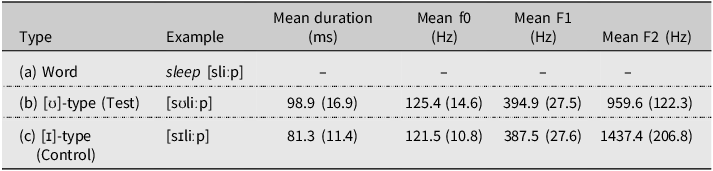
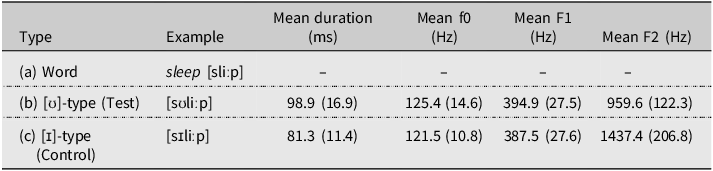
The stimuli were recorded by a linguistically trained male talker in his 20s who was born and grew up in Indiana, US, speaking English as his first language. The recording was conducted in a sound-attenuated room at Seoul National University, using Praat software (Boersma & Weenink, Reference Boersma and Weenink2016) and a Shure BETA 87A microphone attached to a laptop computer through a Sound Devices USBPre 2 preamplifier, with the sampling rate of 44,100 Hz. The talker was presented with the stimuli in IPA (International Phonetic Alphabet) symbols and produced each item three times. From the three repetitions, one token with the most natural intonation and, for experimental pseudowords, with a clear inserted vowel, was selected for inclusion. See Table 1 for sample tokens and the mean duration, fundamental proportion (f0), and formant frequencies (F1 and F2) of the inserted vowels. A full list of the experimental stimuli with the acoustic details for each token is presented in Appendix A.
Examples of experimental stimuli and the mean duration, f0, F1, and F2 of the inserted vowels (SD in parenthesis)
Procedure
Participants performed a lexical decision task using the Psychopy software (version 2020.1.3; Peirce, Reference Peirce2007) either in person or online. They listened to auditory stimuli through headphones (the AKG K271 MKII headphone was used for in-person participants, and online participants used their own) and decided whether each item was an English word or not. Online participants were instructed to complete the task in a quiet space while wearing headphones. All participants had a practice session of twelve trials consisting of six words and six pseudowords. The procedure was similar to the main experiment, but the auditory stimuli were recorded by a female English speaker, and no prior information about the talker was provided. Participants heard words and pseudowords in random order and indicated whether they heard real English words by pressing “z” or “m.” The association of the keys and yes/no responses was counterbalanced, such that half of the participants pressed “z” for “yes” and “m” for “no,” and the other half pressed “z” for “no” and “m” for “yes.”
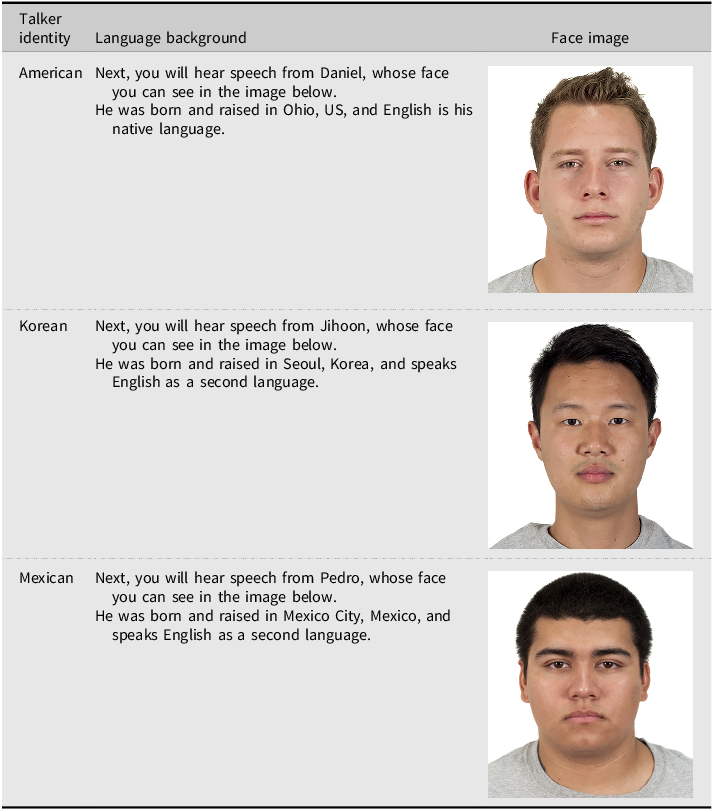
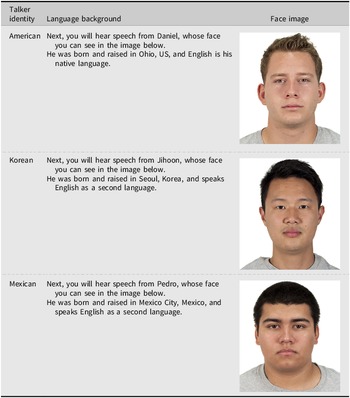
Before the main experiment, participants saw a screen with one of three descriptions of the talker’s language background, with a corresponding image of their face selected from the Chicago Face Database (Ma et al., Reference Ma, Correll and Wittenbrink2015) (Table 2). Then they performed a lexical decision task. The alleged talker’s face remained on the screen throughout the main experiment. The main experiment consisted of three blocks with a three-minute long break between the blocks. Each block had 24 experimental items (8 items per condition) and 40 filler items. Since each word had three different forms (e.g., blue [bluː], [bʊluː], and [bɪˈluː]), each block contained only one of those forms per word to minimize any repetition effect. The order of the blocks was randomized for each participant. Participants’ responses and reaction times were recorded during the experiment.
Descriptions of the talker’s language background and face image
Data analysis
Trials with excessively short or long reaction times (less than or greater than 2.5 SD from the mean per participant) were removed, which accounted for 3.0% of the whole data. Also, data from one participant recruited online was excluded due to low accuracy on filler items (< 70%), as the low accuracy can be interpreted as a lack of sufficient effort in performing the task. For statistical analysis, participants’ responses (word or not, coded as 1 or 0) were analyzed with a generalized mixed-effects regression model using the glmer function (Bates et al., Reference Bates, Mächler, Bolker and Walker2015) in R (R Core Team, 2021) with a binomial family. This model had Stimuli type (word, [ʊ]-type, and [ɪ]-type), Talker (Korean, American, and Mexican), Order (Block 1, Block 2, and Block 3), and all possible interactions as fixed effects. Dummy coding was used for Stimuli type with [ʊ]-type as reference and simple effect regression coding (simple-effect contrasts with sum-to-zero weights: C1 = c(-1/3, 2/3,-1/3), C2 = c(-1/3,-1/3, 2/3)) for Talker (reference = Korean) and Order (reference = Block 1). Under this specification, the intercept equals the [ʊ]-type grand mean across Talker and Order, and the coefficients compare each non-reference level to its reference. The effects of Platform (online vs. in-person), C1 Place of articulation (Labial, Alveolar, or Velar), and C2 (r vs. l) were not statistically significant, nor did those factors increase the model fit, so they were excluded from the final modelFootnote 3. As for random effects, results from the most complex model that reached convergence are reported, which includes a random slope for Stimuli type for item and random intercepts for participant and item.
Reaction times were measured from the offset of each stimulus. As the reaction time values are positively skewed, those for word responses were transformed according to the Box-Cox test ((ylambda-1)/lambda) (Box and Cox, Reference Box and Cox1964)Footnote 4 and were analyzed with a linear mixed-effects regression with the lmer function (Bates et al., Reference Bates, Mächler, Bolker and Walker2015). The fixed effects were Stimuli type (word, [ʊ]-type, and [ɪ]-type), Talker (Korean, American, and Mexican), Order (Block 1, Block 2, and Block 3), Platform (coded as −0.5 for in-person, and 0.5 for online), and a four-way interaction of these factors. Stimuli type, Talker, and Order were coded in the same manner as in the previous model. C1 Place of articulation (Labial, Alveolar, or Velar) and C2 (r vs. l) were excluded from the final model as they neither increased the model fit nor showed statistically significant effects. The random effect structure included a random slope for Stimuli type for item and random intercepts for participant and item.
Alpha was set to 0.05. The in-text results focus on the predictors that are directly related to the research questions (Stimuli type, Talker, Order). See Appendix B and Appendix C for the full results of the reported models.
Results
Proportion of word responses
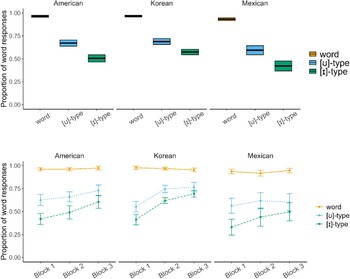
Figure 1 shows the by-subject mean proportion of word responses for each stimulus type and talker condition.
Proportion of word responses across blocks (top) and in each block (bottom) in Experiment 1.

The statistical model for responses (Appendix B) showed that across the three blocks and three talker conditions, [ʊ]-type was responded to as a word less frequently than word type (β = 3.53, CI = [2.87, 4.19], p < 0.001). On the other hand, [ʊ]-type was responded to as a word more frequently than [ɪ]-type (β = −0.94, CI = [−1.33, −0.55], p < 0.001). The effects of Talker did not yield statistically significant main effects or interaction with Stimuli (all p > 0.062), which suggests that participants’ responses for [ʊ]-type did not differ by Talker identity when the three blocks were collapsed together.
The [ʊ]-type stimuli showed evidence for adaptation, as the main effects of Order 1 (Block 1 vs. Block 2: β = 0.59, CI = [0.22, 0.96], p = 0.002) and Order 2 (Block 1 vs. Block 3: β = 0.58, CI = [0.21, 0.95], p = 0.002) were statistically significant. These effects indicate that the word responses for [ʊ]-type increased in Block 2 and Block 3 compared to Block 1. These order effects also interacted with Stimuli 1 ([ʊ]-type vs. [ɪ]-type) (Stimuli 1 × Order 2: β = 0.78, CI = [0.25, 1.30], p = 0.004), Talker 1 (Korean vs. American) (Talker 1× Order 1: β = −1.05, CI = [−1.94, −0.15], p = 0.022, Talker 1× Order 2: β = −1.01, CI = [−1.91, −0.10], p = 0.029) and Talker 2 (Korean vs. Mexican) (Talker 2× Order 2: β = −1.18, CI = [−2.09, −0.26], p = 0.011). Three-way interactions of Stimuli 2 ([ʊ]-type vs. word), Talker 1 (Korean vs. American), and Order 2 (Block 1 vs. Block 3) (β = 4.00, CI = [1.20, 6.80], p = 0.005) and Stimuli 2 ([ʊ]-type vs. word), Talker 2 (Korean vs. Mexican), and Order 2 (Block 1 vs. Block 3) (β = 2.42, CI = [0.41, 4.44], p = 0.018) were also observed, indicating that the adaptation patterns differ by stimulus type and talker identity. These interactions were further investigated with post-hoc analyses using the emmeans() function in the emmeans package (Lenth et al., Reference Lenth, Singmann, Love, Buerkner and Herve2018). The interaction between Stimuli 1 and Order 2 was due to a larger increase in word responses for [ɪ]-type (β = 1.36, CI = [0.91, 1.81], p < 0.001) than [ʊ]-type from Block 1 to Block 3. The latter interactions between Stimuli 2, Talker, and Order were due to lack of increase in word responses for [ʊ]-type in American and Mexican talker conditions from Block 1 to later blocks (all p > 0.794) in contrast to Korean talker condition that showed a significant increase in Block 2 (β = 1.13, CI = [0.14, 2.11], p = 0.012) and Block 3 (β = 1.31, CI = [0.31, 2.31], p = 0.002) than Block 1. The effect of Talker identity was not significant in Block 1 (all p > 0.354). Finally, word responses for word type did not increase in Block 2 and Block 3 in any of the talker conditions (all p > 0.291).
Reaction times
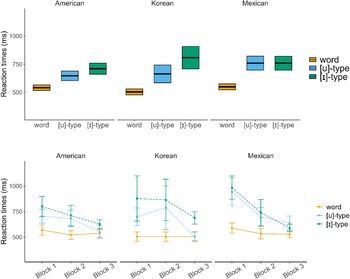
Figure 2 shows reaction times (computed only for word responses) for each stimulus type and talker condition, collapsed over the three blocks (top) and per block (bottom).
Reaction times for word responses across blocks (top) and in each block (bottom) in Experiment 1.
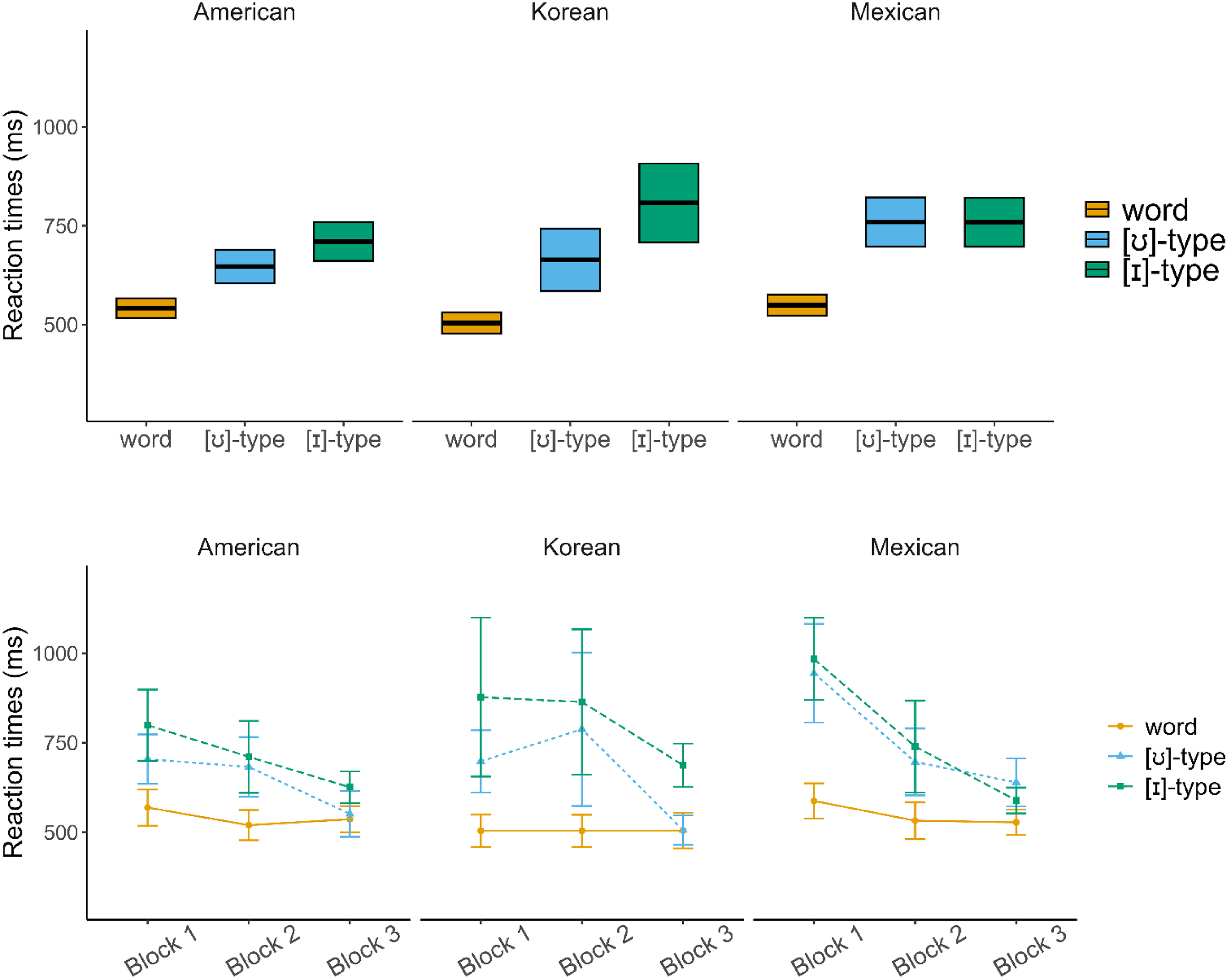
In the model with reaction times as the dependent variable, reaction times were slower for [ʊ]-type than word type (β = −0.45, CI = [−0.63, −0.28], p < 0.001) when participants gave “word” responses across the talker conditions and blocks. The difference in the reaction times for [ʊ]-type and [ɪ]-type was not statistically reliable (β = 0.16, CI = [−0.01, 0.32], p = 0.068). The main effect of Platform (β = −0.56, CI = [−0.89, −0.24], p < 0.001) indicates generally slower reaction times for in-person participants.
When comparing blocks, the reaction times for [ʊ]-type decreased over time across three talker conditions, as indicated by the main effects of both Order 1 (Block 1 vs. Block 2) (β = −0.28, CI = [−0.45, −0.12], p < 0.001) and Order 2 (Block 1 vs. Block 3) (β = −0.47, CI = [−0.64, −0.30], p < 0.001). In addition, Order 2 interacted with Stimuli 2 ([ʊ]-type vs. word) (β = 0.33, CI = [0.11, 0.55], p = 0.003), as the decrease in reaction times for [ʊ]-type is statistically larger than word type (β = −0.14, CI = [−0.26, −0.02], p = 0.020) from Block 1 to Block 3. On the other hand, Order 1 interacted with Talker 2 (Korean vs. Mexican) (β = −0.71, CI = [−1.13, −0.29], p < 0.001) and showed a three-way interaction with Talker 2 and Stimuli 1 ([ʊ]-type vs. [ɪ]-type) (β = 0.57, CI = [0.03, 1.10], p = 0.039). Post-hoc analyses indicated that the effect of Order 1 was greater for Mexican (β = −0.41, CI = [−0.71, −0.11], p < 0.001) than for Korean talker (β = −0.36, CI = [−0.70, −0.02], p = 0.040), while the reaction times did not decrease for word type in both talker conditions.
Additionally, Platform showed a two-way interaction with Stimuli 2 ([ʊ]-type vs. word) (β = −0.20, CI = [−0.38, −0.03], p = 0.022), and three-way interactions with Stimuli 2 and Talker 1 (Korean vs. American) (β = 0.49, CI = [0.08, 0.90], p = 0.020), and Stimuli 2 and Talker 2 (Korean vs. Mexican) (β = 0.54, CI = [0.10, 0.97], p = 0.017). Post-hoc tests revealed that the effect of Stimuli 2 is greater among online participants (β=−0.56, CI = [−0.79, −0.33], p < 0.001) than in-person participants (β = −0.34, CI=[−0.53, −0.16], p < 0.001) in the Korea talker condition. Also, only online participants showed a statistically significant interaction between Stimuli 2 and Talker 1 (β = 0.41, CI = [0.06, 0.76], p = 0.020). In order to assess whether the observed platform effect is consistent across all participants, we examined individual participants’ responses. This follow-up inspection indicated that the interactions were largely driven by one participant in the online platform assigned the Korean talker condition, who showed an atypical pattern with extremely slow reaction times for [ʊ]-type (mean RT = 2238.48 ms) and [ɪ]-type (mean RT = 2988.56 ms) than word type (mean RT = 634.18 ms)Footnote 5
Interim discussion
Experiment 1 examined the effect of talker identity on the perception of and adaptation to onset clusters produced with an inserted vowel [ʊ] or [ɪ] by English listeners. The listeners had limited exposure to Korean-accented English, which inserts /i/, similar to [ʊ], within onset clusters. Overall responses were similar regardless of whether the talker was described as American, Korean, or Mexican; participants preferred word type to [ʊ]-type, followed by [ɪ]-type. Importantly, when these measures were compared across the three blocks of the experiment, the proportion of word responses increased only for the Korean talker, whereas reaction times became faster over time, with the reduction being greater for the Mexican talker than the Korean talker.
While the general preference for word type over [ʊ]-type is as expected, the higher proportion of word responses for [ʊ]-type than [ɪ]-type contrasts with the findings in Darcy and Thomas (Reference Darcy and Thomas2019), in which the proportion of word responses for the two types was comparable among English listeners. We suspect this discrepancy may have stemmed from the stimuli. The stimuli in the current study differ from those in Darcy and Thomas (Reference Darcy and Thomas2019) in several notable ways. First, the vowels ([ʊ] and [ɪ]) in our stimuli are shorter and more central (Table 1) than those in Darcy and Thomas (Reference Darcy and Thomas2019, p.7, Table 2). While the vowels in our stimuli can be seen as longer than typical schwas in English (Crystal and House, Reference Crystal and House1988), they might have been less pronounced than those in Darcy and Thomas (Reference Darcy and Thomas2019). In addition, the makeup of C1 obstruents in our stimuli differs from that in Darcy and Thomas (Reference Darcy and Thomas2019). Out of 24 words, we had 10 voiced and 14 voiceless C1s (see Appendix A), but Darcy and Thomas (Reference Darcy and Thomas2019) had 6 voiced C1s out of 30 words. These differences could have led the inserted vowels in our stimuli more likely to be perceived as part of consonant clusters rather than separate syllabic nuclei. This is particularly plausible when C1 is voiced, and the following consonant is a liquid, as liquids have well-defined formant structures, including higher formants such as F2 and F3, which resemble those of vowels. As a result, the formant structures between a voiced C1 and a liquid C2 may be attributed to the consonant cluster itself, rather than interpreted as a vowel between the consonants. This could partly explain why the proportion of vowel-inserted pseudowords accepted as words was much higher in our study than in Darcy and Thomas (Reference Darcy and Thomas2019). In the American talker condition, which is comparable to Darcy and Thomas’s (2019) English listeners, the mean proportion of word response was 67% for [ʊ]-type and 50% for [ɪ]-type (see also Figure 1), much higher than those in Darcy and Thomas ([ʊ]-type: 14%, [ɪ]-type: 11.5%). We suspect that more conspicuous vowels in Darcy and Thomas (Reference Darcy and Thomas2019) could have arguably induced some sort of ceiling effects, increasing the likelihood of both [ʊ] and [ɪ] being correctly rejected, diminishing the difference between the two types of vowel insertion.
In contrast to the overall responses, the adaptation patterns for [ʊ]-type showed a significant talker identity effect. While reaction times to provide word responses to this type became faster over time across all talker conditions, the proportion of word responses increased only in the Korean talker condition. It warrants caution in interpreting these results, considering the accuracy-speed trade-off. That said, we tentatively suggest that the increase in the proportion of word responses reflects changes in more voluntary cognitive processes than reaction times, as the current experiment was designed to draw participants’ attention to their word/nonword responses but not their reaction times. Thus, the results in Experiment 1 seem to indicate that the effect of talker information is more evident in the word response measure, which reflects more conscious decision-making mechanisms than reaction times, and that listeners not only differentiate native versus non-native talkers but also non-native talkers from different language backgrounds (Korean vs. Mexican). That is, although the participants in Experiment 1 were not highly familiar with Korean-accented English, they were relatively more familiar with Spanish-accented English, which does not involve vowel insertion within onset clusters. This might have led to a mismatch between listeners’ expectations and the incoming speech signals in the Mexican as well as American talker condition, preventing listeners from providing more word responses to [ʊ]-type even after repeated exposure to this type compared to the Korean talker condition. In contrast, in the Korean talker condition, listeners might have been less certain about whether a true mismatch existed, which made them more generous in their judgments and thus allowed for greater adaptation over time. This also explains the adaptation patterns shown for [ɪ] types.
On the other hand, the Mexican talker condition showed a larger decrease in reaction times to [ʊ]-type compared to the Korean talker condition in the second block. The results in the first block show that the proportion of word responses to [ʊ]-type is similar for Mexican talker and Korean talker conditions, while reaction times for word responses are much slower for the Mexican talker condition than the Korean talker condition. This suggests that participants in the Mexican talker condition initially needed more time to determine the [ʊ]-type stimuli as words during the first block of the experiment, but the reaction times decreased quickly in the second block. We suspect that this may also be due to the mismatch between the speech signal and the expectations stemming from the purported talker identity (McGowan, Reference McGowan2015). The speech signals were originally produced by a native speaker of American English without any hint of discernible foreign accents except the characteristics of Korean-accented English, an inserted vowel within onset clusters. When these signals were provided with a Mexican talker, the episodic memory traces appropriate for the talker’s identity would have been activated, which did not match the incoming signals. This mismatch presumably led to longer reaction times for the listeners in the Mexican talker condition, but they quickly adjusted from the second block, as evidenced by the reduced reaction times (but note that this did not lead to increased word responses).
As a whole, the results in Experiment 1 expand the predictive coding account of speech perception, according to which the alignment between the expectations and the actual signals induces not only general benefits in processing degraded or foreign-accented speech but also greater online adaptation to it (McGowan, Reference McGowan2015; Sohoglu and Davis, Reference Sohoglu and Davis2016; Vaughn, Reference Vaughn2019). We build on Vaughn (Reference Vaughn2019) and demonstrate that, even when talker identity is provided, it does not facilitate adaptation as effectively when the provided information about the talker mismatches the speech signals—the current results suggest that the adaptation is suppressed in the American and Mexican talker conditions (mismatch between talker and signals) compared to the Korean talker condition, where listeners do not have concrete expectations about the talker (neither match nor mismatch).
The participants in Experiment 1 were English speakers living in the US with limited exposure to Korean or Korean-accented English. In Experiment 2, we examine how prior exposure to Korean-accented English affects processing [ʊ]-insertion by recruiting English speakers living in Korea.
Experiment 2
Experiment 2 investigates the effect of linguistic experience on speech perception and adaptation by English speakers living in Korea.
Methods
Participants
A total of 43 English speakers living in Korea (13 males, 30 females, 0 other responses; age: mean = 26.77, SD = 5.82) participated in the study either in-person at a university in Seoul, Korea (n = 27) or online via Prolific (n = 16). They had lived in Korea for an average of 3.47 years (SD = 2.77), and a majority of them (n = 31) reported that Korean accounted for at least 10% of their daily language use. Five participants recruited in person were excluded because they reported having learned both Korean and English from birth. The remaining participants learned Korean as an additional language (mean age of acquisition = 18.44, SD = 6.67) and rated their familiarity with Korean-accented English as 5.82 (SD = 1.43) on average on a 1-7 Likert scale. They were assigned to either the Korean (n = 22) or the American (n = 16) talker condition. Mexican talker’s condition was not tested in Experiment 2.
Materials and procedure
The stimuli and the procedure were the same as in Experiment 1.
Data analysis
Trials with excessively short or long reaction times (less than or greater than 2.5 SD from the mean per participant) were removed, with an exclusion rate of 3.1%. Accuracy rates for filler items were above 70% for all participants, so no participant was excluded based on this criterion.
Participants’ responses (coded as 1 for word and 0 otherwise) were analyzed with a generalized mixed-effects regression model using the glmer function in R with a binomial family. Fixed effects included Stimuli type ([ʊ]-type, and [ɪ]-type, word), Talker (coded as −0.5 for Korean, and 0.5 for American), Order (Block 1, Block 2, and Block 3), and all possible interactions as fixed effects. Dummy coding was used for Stimuli type with [ʊ]-type as reference, and simple effect regression coding was used for Order with Block 1 as reference. The effects of C1 place of articulation (Labial, Alveolar, or Velar), C2 (r vs. l), and Platform (in-person vs. online) were excluded from the final model as they did not increase the model fit and did not yield statistically significant effects. The random effects included random intercepts for participant and item.
Reaction times with “word” responses measured from the offset of each stimulus were transformed according to the Box-Cox test ((ylambda-1)/lambda) and were analyzed with a linear mixed-effects regression. This model had Stimuli type (word, [ʊ]-type, and [ɪ]-type), Talker (Korean, and American), Order (Block 1, Block 2, and Block 3), and the three-way interaction of these factors as fixed effects. Those factors were coded in the same way as in the previous model. C1 place of articulation, C2, and Platform were removed from the model because they did not improve its fit or show any statistically significant effects. The random effects included a random slope for Order for participant, a random slope for Stimuli type for item, and random intercepts for both participant and item. Alpha was set to 0.05. See Appendix D and Appendix E for the full results of these models.
Results
Proportion of word responses
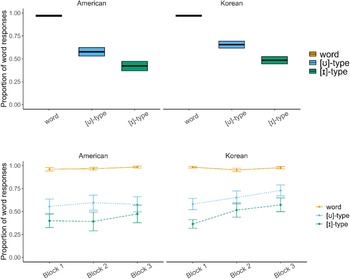
Figure 3 shows the proportion of word responses for each stimulus type and talker condition.
Proportion of word responses across blocks (top) and in each block (bottom) in Experiment 2.
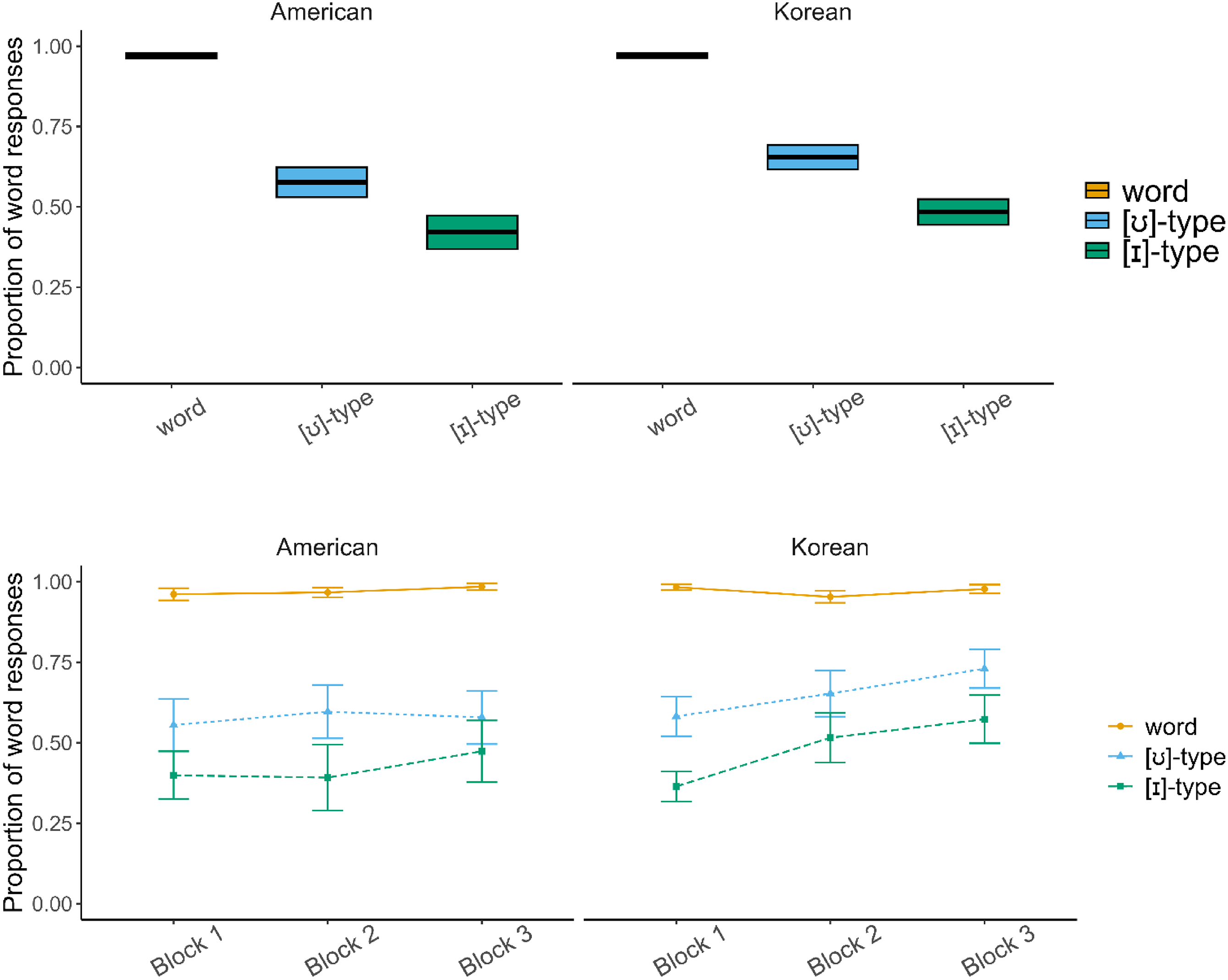
As in Experiment 1, participants responded as word less frequently for [ʊ]-type than for word type (β = 4.90, CI = [3.83, 5.96], p < 0.001) but more frequently than [ɪ]-type (β = −1.20, CI = [−1.63, −0.76], p < 0.001) across the two talker conditions and three block conditions.
The effect of Order 2 (Block 1 vs. Block 3) was statistically significant (β = 0.58, CI = [0.10, 1.05], p = 0.017), and it interacted with Talker (β = −1.08, CI = [−2.00, −0.16], p = 0.021). Post-hoc analyses showed that while the talker effect is not significant in Block 1 (β = −0.31, CI = [−1.80, 1.17], p = 0.681), the increase in word responses for [ʊ]-type in Block 3 was statistically significant only for Korean talker (β = 1.12, CI = [0.21, 2.02], p = 0.006) and not American talker (β = −0.04, CI = [−0.97, 1.05], p = 1.000).
Reaction times
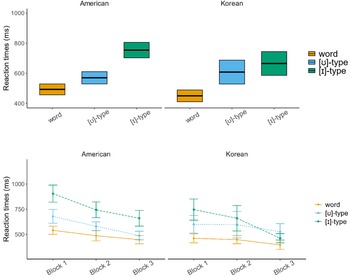
The reaction times (computed only for word responses) for each stimulus type and talker condition are presented in Figure 4.
Reaction times for word responses across blocks (top) and in each block (bottom) in Experiment 2.
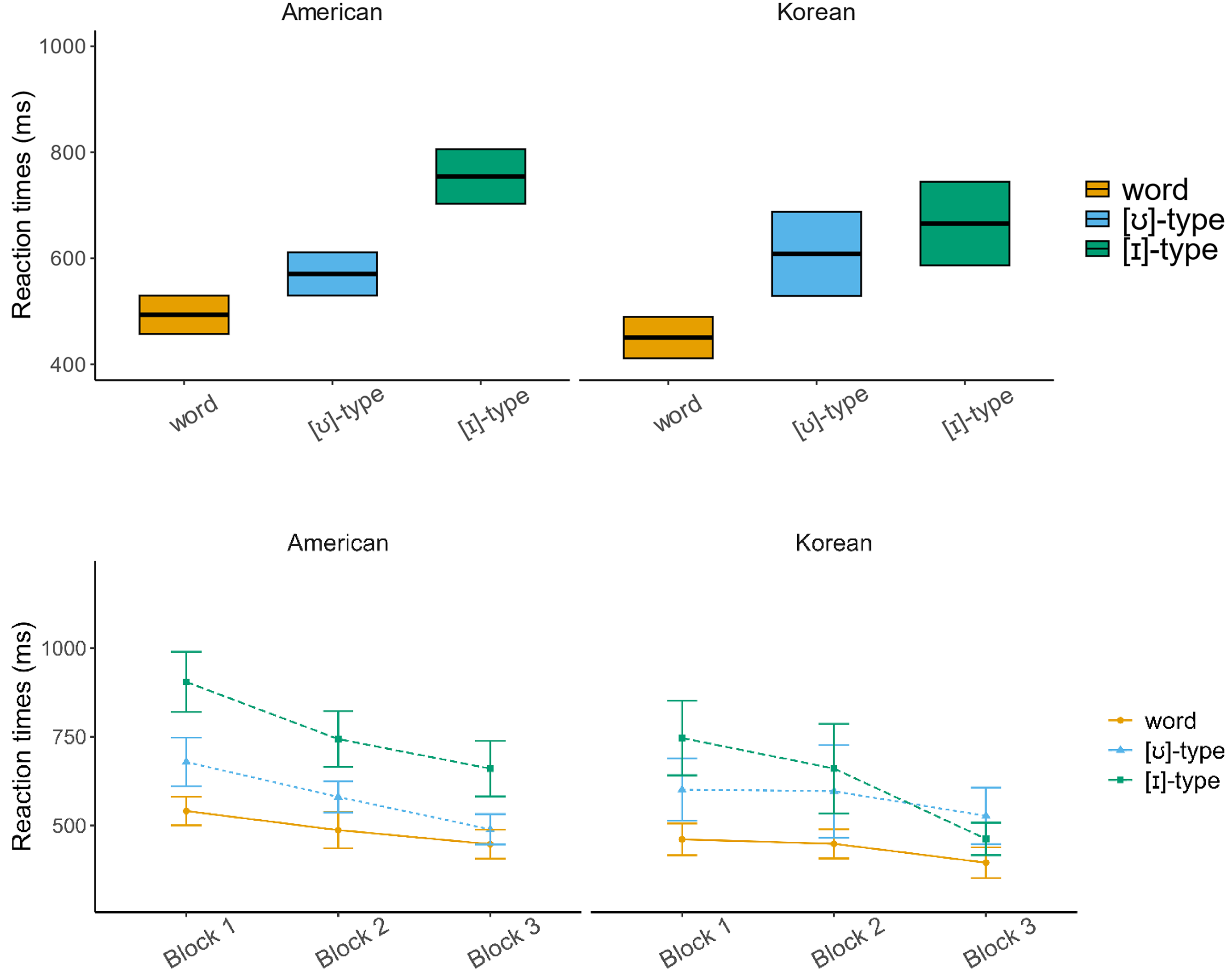
The model with reaction times as the dependent variable revealed similar patterns as the proportion of word responses regarding Stimuli type: reaction times for [ʊ]-type were slower than word type (β = −0.81, CI = [−1.22, −0.41], p < 0.001) and faster than [ɪ]-type (β = 0.90, CI = [0.47, 1.33], p < 0.001) when decided as “word” across blocks and talker identities.
Also, both the effects of Order 1 (Block 1 vs. Block 2) (β = −0.94, CI = [−1.47, −0.42], p < 0.001) and Order 2 (Block 1 vs. Block 3) (β = −1.14, CI = [−1.67, −0.61], p < 0.001) were statistically significant, indicating that reaction times for [ʊ]-type decreased in Block 2 and Block 3 compared to Block 1 across talker conditions. The interaction between Stimuli 2 ([ʊ]-type vs. word type) and Order 2 (Block 1 vs. Block 3) (β = 0.59, CI = [0.02, 1.17], p = 0.044) is also significant, with no significant decrease in reaction times for word type in Block 3 (β = 0.40, CI = [−0.82, 1.63], p = 0.520) as opposed to [ʊ]-type.
Comparison between Experiment 1 and Experiment 2
In order to compare the responses in Experiment 1 and those in Experiment 2, additional analyses were conducted comparing results from the two experiments for Korean and American talker conditions.
A generalized mixed-effects regression model with a binomial family analyzed participants’ responses to each trial (1 if responded as word, 0 if not). Reaction times for word responses were transformed based on the Box-Cox test ((ylambda-1)/lambda) and analyzed with a linear mixed-effects regression model. In both models, fixed effects were Stimuli type (word, [ʊ]-type, and [ɪ]-type), Talker (coded as −0.5 for Korean and 0.5 for American), Order (Block 1, Block 2, and Block 3), testing Location (coded as −0.5 for United States in Experiment 1 and 0.5 for South Korea in Experiment 2) and their interactions. Stimuli type was dummy coded with [ʊ]-type as reference, and Order was coded using the simple effect regression coding scheme with Block 1 as reference. The random effects of both response and reaction time models included a random slope for Stimuli type for the item and random intercepts for both participant and item. In this section, we focus only on reporting effects related to the Location factor.
In the response model, a statistically significant interaction was observed between Stimuli 2 ([ʊ]-type vs. word type) and Location (β = 0.83, CI = [0.05, 1.61], p = 0.038), due to a greater effect of Stimuli 2 for the South Korean participants (β = 4.58, CI = [3.40, 5.76], p < 0.001) than the US participants (β = 3.75, CI = [2.50, 5.00], p < 0.001). Other effects concerning Location did not reach statistical significance (all p > 0.095). In summary, the preference for word type over [ʊ]-type was greater for participants tested in South Korea and those in the US.
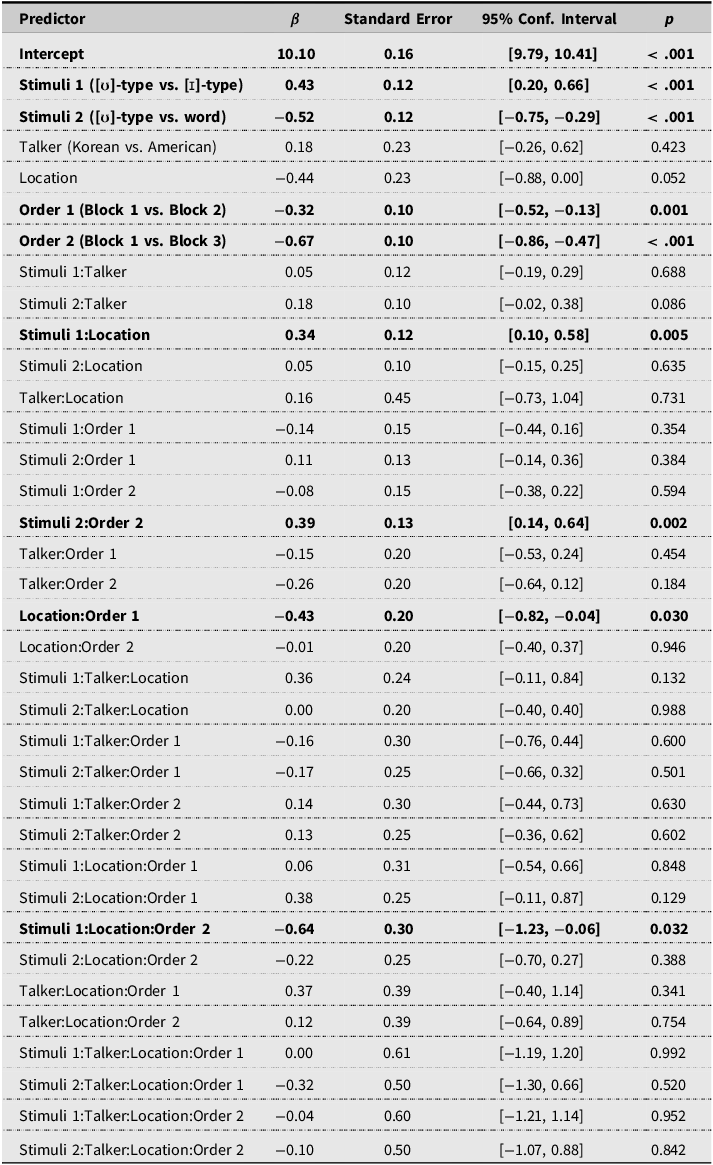
The reaction time model showed a statistically significant interaction of Order 1 (Block 1 vs. Block 2) and Location (β = −0.43, CI = [−0.82, −0.04], p = 0.030) as reaction times for [ʊ]-type decreased in Block 2 among the South Korean participants (β = −0.54, CI = [−0.94, −0.14], p = 0.002) but not the US participants (β = −0.11, CI = [−0.51, 0.29], p = 0.970). The interaction between Stimuli 1 ([ʊ]-type vs. [ɪ]-type) and Location was also statistically significant (β = 0.34, CI = [0.10, 0.58], p = 0.005); the difference in reaction times for the two types was greater in the South Korean participants (β = 0.60, CI = [0.22, 0.98], p < 0.001) than in the US participants (β = 0.26, CI = [−0.11, 0.64], p = 0.365). Finally, the three-way interaction between Stimuli 1, Location, and Order 2 (Block 1 vs. Block 3) was significant (β = −0.64, CI = [−1.23, −0.06], p = 0.032). Post-hoc analyses showed a statistically reliable interaction between Stimuli 1 and Location in Block 1 (β = 0.58, CI = [0.18, 0.98], p = 0.005) but not in Block 3 (β = −0.15, CI = [−0.54, 0.23], p = 0.442) due to a great amount of decrease in reaction times for [ɪ]-type in Block 3 by the South Korean participants (β = −1.07, CI = [−1.54, −0.61], p < 0.001) compared to [ʊ]-type (β = −0.67, CI = [−1.07, −0.28], p < 0.001). For the US participants, the decrease in reaction times in Block 3 was not significant for [ɪ]-type (β = −0.42, CI = [−0.88, 0.04], p = 0.10) and comparable to South Korean participants for [ʊ]-type (β = −0.66, CI = [−1.06, −0.26], p < 0.001). In other words, the South Korean participants showed faster reaction times for [ʊ]-type than [ɪ]-type at the beginning of the experiment compared to the US participants, but such group difference disappeared in the last block because they greatly adapted to [ɪ]-type over time.
General discussion
The current study examined the effect of talker identity and prior linguistic exposure on speech perception, focusing on a feature commonly observed in Korean-accented English, namely the vowel insertion within onset clusters. In Experiment 1, where English speakers had minimal exposure to Korean-accented English, talker identity did not affect the overall responses but influenced the adaptation patterns, such that word responses for [ʊ]-type increased only for Korean talker. Experiment 2, which examined English speakers living in Korea, showed similar results—word responses for [ʊ]-type increased for Korean talker but not for American talker. On the other hand, when the results of Experiment 1 and Experiment 2 were compared, participants in Experiment 2 showed a greater advantage in reaction times for the [ʊ]-type stimuli over the [ɪ]-type control stimuli than those in Experiment 1. In addition, participants in Experiment 2 also showed earlier adaptation to [ʊ]-type in terms of reaction times than those in Experiment 1. In other words, English speakers with greater experience with Korean-accented English more readily recognized the words showing a feature of the accent than those with limited experience and adapted to the feature earlier during the experiment.
Adaptation patterns differ by talker identity
While no reliable effect of talker identity is found for overall responses or at the beginning of the experiment, the amount of adaptation differed by talker identity over the course of the experiment in both Experiment 1 and Experiment 2. The results from Experiment 1 indicate that listeners distinguish not just the native versus non-native status of the talker, but also among non-native talkers with different L1 backgrounds (i.e., Korean vs. Mexican). In other words, it is not the case that listeners adapt to any non-native talker in the same manner as opposed to the native talker, as predicted by the reverse linguistic stereotyping, according to which the non-native status of the talker affects how listeners perceive the speech (e.g., Kang and Rubin, Reference Kang and Rubin2009). Listeners instead make particular expectations about the talker based on their knowledge of the talker’s background, which then affects the degree of the adaptation. A similar pattern was found in Experiment 2, in which participants were residing in South Korea and reported a higher familiarity with Korean-accented English than those in Experiment 1: word responses increased over time only in the Korean talker condition and not the American talker condition.
It is striking that there is no evidence for differential effects of talker identity on adaptation patterns between the two experiments. Although the South Korean participants are expected to have more robust representations of [ʊ]-inserted forms connected to the Korean talker than the US participants, the two groups of participants showed similar results, such that word responses to these forms increased only in the Korean talker condition. Despite limited exposure to Korean-accented English, the US participants at least were likely aware that neither the American nor the Mexican talker would produce [ʊ]-inserted forms, which may explain the absence of increased word responses to these forms produced by either talker. Conversely, they were more flexible with the Korean talker, likely due to an expectation of greater pronunciation variations from a foreign speaker that they were not familiar with. This interpretation is also consistent with the outcome that the US participants in the Korean talker condition adapted to (showed an increase in word responses over the course of the experiment), not just the [ʊ]-inserted forms but also the [ɪ] inserted forms. It appears that the South Korean participants adopted a similar strategy, showing more flexibility to the Korean talker. Unlike the US participants, however, this flexibility may stem from their prior knowledge and expectations about Korean-accented EnglishFootnote 6. On the other hand, we observe the Location difference in reaction times, where the South Korean participants exhibited reduced reaction times to vowel insertion at an earlier time (i.e., in the second block) than the US participants, regardless of the talker identity. We return to this point in the next section.
In contrast to a long line of studies that report the effect of talker identity on speech perception, only a few studies (Melguy and Johnson, Reference Melguy and Johnson2021; Vaughn, Reference Vaughn2019) have examined the effect of talker identity on the online speech adaptation in a transcription task of foreign-accented speech. As far as we are concerned, the current study is the first to demonstrate that providing a matching versus a mismatching talker identity to the accented speech also affects adaptation in an auditory lexical decision task. These findings contribute to a more nuanced understanding of the relation between social information and speech adaptation.
Prior experience facilitates processing and adaptation to foreign-accented speech
When comparing the results in Experiment 1 (US) and Experiment 2 (South Korea), the reaction times in deciding [ʊ]-type words were faster than [ɪ]-type words, and this difference was greater for the South Korean participants than the US participants in the first block. This pattern is partially in line with what was found in Darcy and Thomas (Reference Darcy and Thomas2019), in which Korean-English bilinguals preferred [ʊ]-type to [ɪ]-type more than did English monolinguals in both proportion of word responses and reaction times. The current results further suggest that, in terms of reaction times, the perception of foreign-accented speech differs even among English speakers based on their familiarity with the accent.
In addition, the previous experience facilitated a decrease in reaction times in recognizing both [ʊ]-type and [ɪ]-type. The South Korean participants showed an earlier decrease in reaction times for [ʊ]-type: unlike the US participants, they responded to this type as words faster in the second block than in the first block. Also, they adapted to [ɪ]-type in the third block to a great extent, diminishing the initial preference they showed for [ʊ]-type. These results demonstrate an advantage of previous linguistic experience in speech adaptation, to both familiar and unfamiliar sound forms.Footnote 7 However, such an advantage did not manifest in the proportion of word responses.
Regarding participants’ word responses, South Korean participants showed a greater preference for word type over [ʊ]-type. Unlike the difference between [ʊ]-type and [ɪ]-type, this contrast is not directly comparable to the results in Darcy and Thomas (Reference Darcy and Thomas2019) because they did not include the word type in their experiment. In order to identify when this pattern emerges during the experiment, we conducted post-hoc analyses that examined the interaction between Stimuli 2 and Location per block. The interaction is significant in block 3 (β = 1.67, CI = [0.44, 2.90], p = 0.008) and not in block 1 and block 2, which means that the group difference is only evident in the final third of the experiment. This suggests that the Location difference is likely to be a result of the adaptation during the experiment, rather than a pattern that existed from the beginning.
Another important observation is that the Location difference for [ʊ]-type versus [ɪ]-type did not interact with talker identity. In other words, it was not the case that the difference between the US participants and the South Korean participants was greater for the Korean talker than the American talker. This means that although the South Korean participants had previous exposure to Korean-accented English that is likely associated with Korean talkers, the activation of the exemplars was not constrained to a particular talker identity during the experiment. This outcome corroborates the extensive literature that tested talker-independent generalization of speech adaptation (Bradlow and Bent, Reference Bradlow and Bent2008; Xie et al., Reference Xie, Liu and Jaeger2021; Xie and Myers, Reference Xie and Myers2017). These studies show that adaptation to foreign-accented speech generalizes to different talkers speaking the same accent, especially when listeners are trained with multiple talkers, as their “long-term linguistic representations are updated in response to novel input” (Bradlow and Bent, Reference Bradlow and Bent2008, p.14). While our study was not designed to explicitly test such generalizability, we speculate that the South Korean participants in our study would presumably have had exposure to Korean-accented English spoken by a large sample of Korean talkers compared to US participants, which led to more malleable categories among the South Korean participants for English words with consonant cluster onset. The richer set of exemplars could have enabled them to more readily recognize the [ʊ]-inserted forms at the outset of the experiment, regardless of the alleged talker identity. This suggests evidence for a broad generalization of adaptation. As far as we are aware, it has not been explicitly tested whether adaptation to novel speech patterns generalizes to talkers described as belonging to different races or even to native talkers, which we leave as a topic for future studies.
Taken together, the current results are broadly in line with the exemplar models of speech perception (e.g., Goldinger, Reference Goldinger1998; Johnson, Reference Johnson1997), which posit that talker-specific details are stored in memory and used while perceiving speech sounds. Across two experiments, we show that listeners’ perception of accented speech is influenced both by the previous experience with the accent and by the contextual plausibility of the talker-accent combination. Listeners with previous exposure to Korean-accented English recognize the stimuli modeled on the accent faster than the control stimuli, providing evidence for the perceptual benefit of experience. At the same time, a more plausible talker-accent pairing facilitates adaptation to the accent regardless of prior experience. These findings contribute to refining our understanding of how foreign-accented speech is perceived and processed, highlighting that listeners integrate socially grounded expectations based on talker identity to navigate various speech inputs more efficiently.
Acknowledgments
This research was funded by the Department of Linguistics at the University of Michigan to J.C. and the New Faculty Startup Fund at Seoul National University to H.K. We have no known conflict of interest to disclose. This study was not preregistered. The authors used ChatGPT (version 4o) to check grammar and spelling. All content was reviewed and edited by the authors, who take full responsibility for the final version.
Appendix A. A full list of experimental stimuli and acoustic details of the inserted vowels

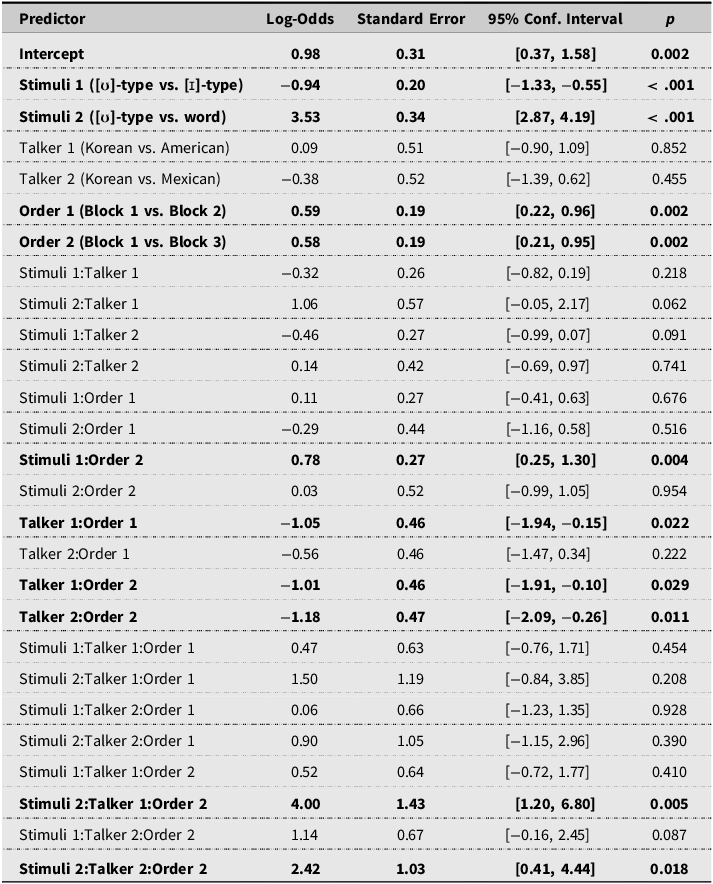
Appendix B. Summary of results from the generalized mixed-effects model for word versus nonword responses in Experiment 1 (reference = [ʊ]-type).
Model equation: response ∼ Stimuli * Talker * Order + (1|participant) + (1+Stimuli|item)
Appendix C. Summary of results from the linear mixed-effects model for reaction times for word responses in Experiment 1 (reference = [ʊ]-type).
Model equation: (rtlambda-1)/lambda ∼ Stimuli * Talker * Order * Platform + (1|participant) + (1+Stimuli|item)

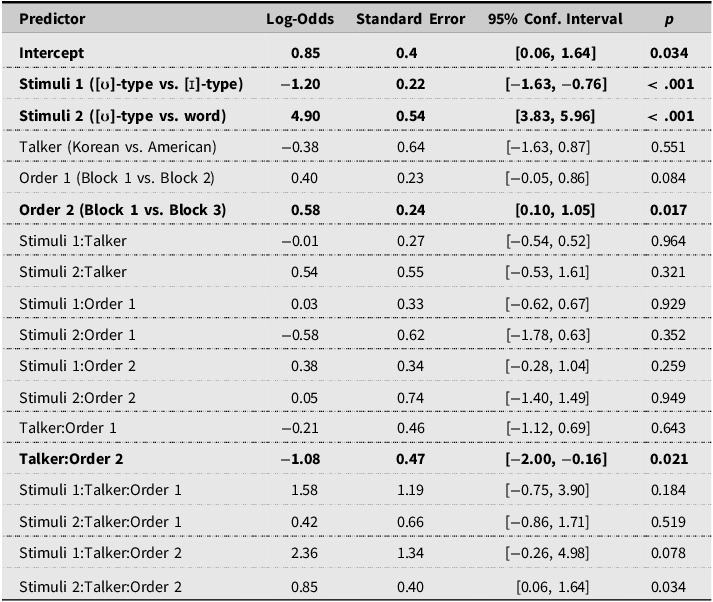
Appendix D. Summary of results from the generalized mixed-effects model for word versus nonword response in Experiment 2 (reference = [ʊ]-type).
Model equation: response ∼ Stimuli * Talker * Order + (1|participant) + (1+Stimuli|item)
Appendix E. Summary of results from the linear mixed-effects model for reaction times for word responses in Experiment 2 (reference = [ʊ]-type).
Model equation: (rtlambda-1)/lambda ∼ Stimuli * Talker * Order + (1+Order|participant) + (1+Stimuli|item)

Appendix F. Summary of results from the generalized mixed-effects model for word versus nonword responses comparing Experiment 1 and Experiment 2 (reference = [ʊ]-type).
Model equation: response ∼ Stimuli * Talker * Location * Order + (1|participant) + (1+Stimuli|item)

Appendix G. Summary of results from the linear mixed-effects model for reactions times for word responses comparing Experiment 1 and Experiment 2 (reference = [ʊ]-type).
Model equation: (rtlambda-1)/lambda ∼ Stimuli * Talker * Location * Order + (1|participant) + (1+Stimuli|item)

 Open access

