




Introduction
On a midsummer Saturday morning, I take the long West Coast Road from Cape Town into Atlantis, to attend a community stakeholder meeting for the Atlantis Special Economic Zone (SEZ). Today’s meeting is a significant occasion, because the Community Stakeholder Network, the group elected to represent all Atlantis residents for the zone company, will present to residents on what they have accomplished in the preceding year. The community participation programme is the flagship programme of the zone company’s social inclusivity mandate, part of its commitment to demonstrating to the people of Atlantis that when the zone eventually attracts significant investment and creates jobs, it will ‘include’ and even ‘empower’ the large numbers of poor and unemployed in this area.
The hall is full, animated with chatter as people register and collect tea and biscuits. By nine o’clock, they take their seats on rows of red plastic chairs. The meeting begins amicably with the hired facilitator calling the participants of the Community Stakeholder Network to the stage. They are dressed for the occasion, signalling professional identities in smart suits and heels. The chairperson, Henderson, opens the meeting by saying, ‘The Community Stakeholder Network is endorsed by the community … and that is a fact. It is no joke to serve on this structure. So, you may wonder, what have we done?’ He explains how the group was established almost three years earlier, and how they have set up a constitution and founding documents, and how they have engaged in regular meetings with the zone company. They do all of this, he explains, without pay.
The polite and professional tone of Henderson’s address quickly descends into a cacophony of responses from the audience. Someone standing at the back in a fraying yellow T-shirt shouts, ‘Tien jaar gelede [ten years ago, in Afrikaans] 500 million rand came into this community. I’m asking: what have you done? Ek wil die CSN vra hoe gaan ons benefit met hulle as partners [I want to ask the CSN [Community Stakeholder Network], how will we benefit with them as partners]?’ The audience cheers. Some people film on their mobile phones. The man in yellow goes on: ‘What are you going to do to ensure these 500 million will be reflected in the community? We are talking about our people’s livelihoods. It’s been years. I haven’t seen anything as yet.’ At the back of the room, the zone company officials text about another ‘successful’ community stakeholder event – which they later document as evidence of ‘market inclusion’.
This article unpacks these contradictory perspectives on community participation. It explores ethnographically how the participation programme for the Atlantis SEZ is understood by three sets of differently positioned actors: officials administering the programme, who view it as ‘inclusion’; participants themselves, who view it as ‘exploitation’; and the residents of Atlantis more broadly, who criticize participants for pursuing personal gains over collective benefits. It asks: what does it mean to draw on the time, energy and status of poor and unemployed people in the name of collective ‘inclusion’, without pay, in a context of widespread and chronic unemployment?
This question is even more pertinent when set against the contemporary context where ‘development’ and ‘inclusion’ are often framed in terms of markets and hinge on market uncertainties. Where existing Africa-focused perspectives on market inclusion programmes, and on volunteering for development initiatives more generally, tend to emphasize the benefits accrued either to capital (in the form of profits extracted), the state (in the form of subsidized programmes), or to volunteers themselves (in the form of marginal livelihoods, status and belonging), Atlantis offers another lens on the terms of participation. The contemporary SEZ, imagined as a policy solution to poverty and unemployment, has yet to attract envisioned green technology investment, after over ten years in the making, or to create many job opportunities. Economic forecasting and strategy consultants’ initial projections failed to materialize, when, in the years after the zone was designated and institutions appointed to run it, global and domestic renewable energy markets underwent unexpected changes, in part due to national policy uncertainties. While the participation programme rests on ideas about collective benefits through job creation, and while volunteers hope their role as participants in the zone will yield benefits in the form of remuneration and recognition, none of these imagined gains were fully realized. By illuminating empirically the conflicting interpretations of participation in this context, shaped in part by the delays and uncertainties of the programme, this article contributes an expanded understanding of how even chronically unemployed people come to bear risks and costs associated with ‘market inclusion’ in contemporary capitalism.
The ambiguities of participation for market inclusion amid chronic unemployment
Unpaid or underpaid work has a long history on the continent. Colonial labour recruitment fuelled capitalist development, and in South Africa an extensive process of cheap Black labour recruitment underpinned the expansion of agriculture, mining and industry (Beinart Reference Beinart2001; Bolt and Rajak Reference Bolt and Rajak2016; Cooper Reference Cooper2002). But more recently, following structural changes in the global economy after the 1970s, due to mechanization and financialization, the economic value of African people as labour has been increasingly called into question. On much of the continent, like elsewhere in the global South, increasing numbers of people are being rendered ‘surplus’ to the needs of capital at any scale (Ferguson Reference Ferguson2013; Ferguson and Li Reference Ferguson and Li2018; Li Reference Li2013; Reference Li2017). Jobs are few and far between, and work, of any sort, is coveted, as a means of livelihood, identity, political membership and status. South Africans have been on the particularly sharp end of such global processes: here, a long history of dispossession and proletarianization means that people tend to rely on formal wages for survival (Hull and James Reference Hull and James2012). Even as South Africa’s unemployment is among the highest in the world, public political discourses – and the majority of the poor themselves – remain committed to the normative ideal of the formal job (Dawson and Fouksman Reference Dawson and Fouksman2020; Fouksman Reference Fouksman2020; Fouksman and Dawson Reference Fouksman and Dawson2024).
Even SEZs, famed in Asia and elsewhere for being sites of hyper-exploitative ‘neoliberal’ capitalism (for anthropological perspectives, see Cross Reference Cross2010; Ong Reference Ong2006), often fail to create the mass employment they are designed for in Africa. This is in part because many of the continent’s zones, as elsewhere in the world, are located in peripheral, depressed regions (Farole Reference Farole2011). While these are where jobs and opportunities are most needed, these areas, and their populations, are often ‘unusable’ (Ferguson Reference Ferguson2005; Reference Ferguson2006) for global capital, as they are far from markets, and greater profits can be accrued in more ‘strategic’ locations, such as those adjacent to ports or airports. But in South Africa, zones’ failures to attract job-creating investment mirror the case in the rest of the country, where speculative portfolio flows began to outpace productive foreign direct investment (FDI) after the financial crisis (Toussaint et al. Reference Toussaint, Bond, Lesufi and Thompson2019). Hence, political commitments to use zones as policy tools to catalyse employment and growth are often more aspirational than practical. Zones might rather be read as high-profile symbolic gestures of public commitments to dealing with mass unemployment.
The Atlantis SEZ is a case in point. But in Atlantis, the promise of jobs, and the failure to deliver, dates back further. Atlantis was originally built in the 1970s, to employ so-called ‘Coloured’ labour outside of the ‘White’ city, as part of the national industrial decentralization scheme and Coloured Labour Preference Area policy. This latter policy, announced in 1955, encouraged the employment of Coloured people over Africans, following contemporary academic and longstanding political concerns about the so-called Coloured population being outcompeted in the labour market by cheaper African labour.Footnote 1 But the apartheid zone never fully made good on promises of jobs. By the early 1980s, journalists and academics were complaining about the low rates of investment, and about unemployment and the high cost of living for new residents (Ebrahim et al. Reference Ebrahim, Roberts, Ruiters and Solomons1986; Newton Reference Newton1988).
The decentralization scheme relocated Coloured populations to the city’s outskirts, where chronic unemployment persists.Footnote 2 This helps to explain the declaration of a ‘crisis’ in Atlantis in 2011 (City of Cape Town 2011b), and the decision in 2013 by the provincial government, with support from the City of Cape Town, to apply to the Department of Trade and Industry (DTI) to establish an SEZ here.Footnote 3 As part of this scheme to create ‘inclusion’ via the SEZ, the zone project management unit initiated a community participation programme, drawing influence from global frameworks on how to make contemporary SEZs more ‘sustainable’. For example, the World Bank’s Eco-Industrial Parks Framework sets out participation as a means to ensure that workers and their families are not marginalized or exploited, and to ensure that zones have a ‘social licence to operate’. But here, participants represent not labour but a largely unemployed population hoping for future jobs in the zone. Contrary to the idea of unemployed people as ‘surplus’ in every meaningful sense, these people are still active, offering their time, energy, social capital and often even personal income to participate in this scheme. But on what terms?
Amid chronic structural unemployment, schemes to create ‘market inclusion’ have an ambiguous valence in terms of who benefits, and at whose cost. A growing literature on market inclusion schemes, usually focused on micro-credit and micro-enterprise schemes in Africa and Asia, examines how, even without conventional labour regimes, the poor can be made into new frontiers of value extraction and accumulation (Dolan and Rajak Reference Dolan and Rajak2016; Elyachar Reference Elyachar2005; Huang Reference Huang2017; Kar Reference Kar2013; Meagher Reference Meagher2016; Rajak and Dolan Reference Rajak and Dolan2024; Roll et al. Reference Roll2021). Here, in the name of ‘empowerment’ and ‘self-reliance’ at the ‘bottom of the pyramid’ meant to benefit the poor, different kinds of labour, including physical, emotional and social, are recruited to support the accumulation of capital for corporations, while the risks and costs of flexible accumulation are outsourced onto the most vulnerable. Julia Elyachar (Reference Elyachar2005), through an ethnographic focus on micro-enterprise schemes in Cairo, shows how the cultural practices of the poor are valorized as a form of ‘social capital’ that can be financialized through new forms of credit and debt. This, she argues, amounts to a distinct kind of ‘accumulation by dispossession’, mediated by non-governmental organizations (see also Elyachar Reference Elyachar2010; Reference Elyachar2012). Others have drawn on the concept, derived from poverty studies in Africa, of ‘adverse incorporation’ (du Toit Reference du Toit2004; Hickey and du Toit Reference Hickey and du Toit2007), whereby programmes and relations called ‘inclusion’, which are meant to remedy structural ‘exclusion’ and unemployment, in practice augment existing forms of precarity and exploitation (Meagher Reference Meagher2018; Reference Meagher2020; Meagher and Lindell Reference Meagher and Lindell2013; Meagher et al. Reference Meagher, Mann and Bolt2016; Phillips Reference Phillips2011). Here, the terms of inclusion are key: not just whether people are provided with market connections that they did not have before, but what effects such connections have for their livelihoods and security.
Left out of view in this discussion of contemporary market inclusion initiatives, however, is the more ambiguous case of the recruitment of ‘voluntary’ participation where there is no discernible capital accumulation. Useful here is a set of anthropological perspectives about volunteering for the ‘public good’, usually facilitated by state or non-profit institutions. But even here, exploitation has remained a key analytic. Writing about volunteering in the global North, in response to the demise of Fordism and austerity, Andrea Muehlebach (Reference Muehlebach2011) emphasizes how affective yearnings for public recognition (for one’s work) and for belonging are harnessed by the Italian state. Citizens are encouraged to provide unwaged labour in place of state-provided social services (see also Muehlebach Reference Muehlebach2012). It is the ‘newly dispossessed’, she argues, including unemployed youth and pensioners, who bear the burden of providing this labour, as their claims to proper citizenship rest on their performance of useful activity for the national polity. But even as such voluntary labour resembles a form of exploitation, it is ambiguous in that it supports new forms of social belonging and status. She argues, ‘Affective labour exists as a curious double. Like wage labour, it is a complex composite of exploitation and salvation, exclusion and utopia, alienation and new forms of sociality’ (Muehlebach Reference Muehlebach2011: 76).
In Africa, too, the poor have often been recruited to perform unpaid labour to subsidize the delivery of public services and national development more broadly. Scholars have written about volunteering in early postcolonial national development (most notably in East Africa), and, since the 1980s, the rising emphasis on ‘civil society’ and ‘community participation’ (Brown and Prince Reference Brown and Prince2015; Prince and Brown Reference Prince, Brown, Prince and Brown2016). Participation offers a means through which the responsibilities of the state can be devolved to individuals and collectives, understood to promote the ‘sustainability’ of development projects via ‘community ownership’. While some argue that this is structurally reminiscent of colonial forced labour regimes (Hunter Reference Hunter2015; Rossi Reference Rossi2015), others have observed volunteers’ genuine desire to participate in constructing national futures through ‘public’ participation (Geissler Reference Geissler2011; Prince Reference Prince2015). But, whether participating in the rollout of social service delivery or peer education, or in the consultative participation for ‘market inclusion’ described in this article, voluntary activity in Africa is arguably uniquely ambiguous in that the potential benefits accrued personally to volunteers are often starker than in the global North. This is because, in the absence of other opportunities for livelihood, status and formal social membership, volunteering opportunities are frequently highly valued by volunteers themselves as opportunities for self-making and self-advancement.
While volunteering itself is often normatively defined vis-à-vis its lack of remuneration (i.e. it is the act of doing something for free through which volunteering acquires virtuous status), in Africa, amid unemployment, claims about selflessness and altruism often mask motivations rooted in pragmatic desires for potential gains (Colvin Reference Colvin, Prince and Brown2016). Materially, even the smallest stipends or other resources (like a free meal) are valued benefits, which volunteers can combine with other forms of income, even from other volunteering positions, to make ends meet. These are even understood, in some contexts (and against Western ideals of volunteering as necessarily uncompensated), as entitlements (Wig Reference Wig, Prince and Brown2016).
Volunteering on the continent is a path not just to resources, but also to status and recognition, and to potential formal jobs. Through volunteering, the poor gain access to formal institutional worlds and can learn specialized knowledge and skills, such as the bureaucratic and technical practices that make up international development and state institutions (Brown and Green Reference Brown and Green2015). Through the rise of community participation as a paradigm of development, ‘community’ has become a category through which the poor can enact professionalized roles. Through volunteer roles, the poor can undergo formal capacity building (Phillips and Ilcan Reference Phillips and Ilcan2004) and acquire the language and don the professional dress and artefacts (like business cards or email addresses) that are the global signifiers of capable worldly professionals (Green Reference Green2003). Indeed, studies of peer educator volunteers during the early days of the HIV/AIDS crisis in South Africa argue that volunteering offered a sense of upward social mobility. While volunteers’ roles were premised on egalitarian relations with their ‘community’, volunteers themselves often hoped to leverage their roles to transcend or leave their own communities (James Reference James2002; McNeill Reference McNeill2011).
This literature on volunteer participation in Africa helps to reveal the more complicated nature of volunteer labour in various contexts characterized by poverty and unemployment. Such labour cannot straightforwardly be analysed as ‘exploitation’ or ‘accumulation by dispossession’ in contexts where little capital accumulation occurs, and where participants might themselves benefit from their involvement in ‘development’ and the ‘public good’. But matters are more complicated still. What remains to be drawn out is that, despite hopes for material and social advancement through participation in developmental schemes, such advancement is not always, or often, meaningfully realized: anticipation of future jobs rarely translates to actual job opportunities (Brown and Green Reference Brown and Green2015), and development schemes are often precarious and unreliable, closing down or retrenching staff due to fiscal and donor pressures, among other reasons (Prince Reference Prince2014). Prince and Brown surmise that ‘the opportunities, trajectories, and institutional forms that connect [African volunteers] to [desired] destinations are uncertain, transient and precarious’ (Prince and Brown Reference Prince, Brown, Prince and Brown2016: 9). Yet still to receive sustained exploration are the terms of volunteering for development schemes that are often ineffective and uncertain – indeed, when hopes for advancement and incorporation backfire. This is pertinent in a context where development today is often framed in terms of market inclusion, subjecting schemes, and the ‘volunteers’ hoping to benefit from them, to the genuine uncertainty of global capital mobility and the exigencies of tight balance sheets.
In Atlantis, the SEZ scheme that is meant to bring jobs and other market opportunities to the poor and unemployed has been plagued by long delays and uncertain prospects. While community participants are supposed to represent and champion ‘inclusion’ for their ‘community’, they are instead blamed for the lack of progress to date. In contrast to popular ideas about communities as egalitarian and homogeneous, in a social context marked by close interdependence, social distinction here brings potential for jealousy and competition. Their peers publicly accuse them of pursuing self-advancement and incorporation, and they gossip behind their backs, while officials plot to replace them with others, in the hope of keeping the programme legitimate among the wider population. Moreover, even the small stipend they receive for airtime and transport is, they claim, insufficient to fund their own engagement, and their pleas for more formal remuneration are rejected.
Community participation here is an ambivalent activity through which the poor strive for belonging and recognition, even as they bear the costs of uncertain market conditions and stalled projects. This article shows how contemporary market inclusion initiatives, even in sites with few market connections, depend on the unwaged labour, affective commitments and reputational risks of those they claim to empower. This case invites us to view contemporary market inclusion initiatives in contexts marked by chronic unemployment as contradictory processes that nonetheless augment the precarity of the poor.
This article draws on twelve months of ethnographic fieldwork (from March to October 2022 in person, and subsequently online) and over seventy semi-structured interviews from 2022 and since then. I worked as an ‘embedded researcher’ for the zone company, attending community stakeholder engagements, and engaging informally and during semi-structured interviews with participants and other residents. When I spoke to Atlantis residents, I made it clear that I was not a company official but an independent researcher keen to take seriously their own perspectives. All the names in this article have been changed to preserve anonymity.
The article now sketches out three ethnographic accounts of three different sets of actors – officials, participants and other residents – by whom community participation was apprehended differently. The final section draws out the implications for participants themselves, arguing that market inclusion here can be read as an ambiguous kind of adverse incorporation.
Participation as ‘market inclusion’
Today, SEZs are expected to be socially responsible and sustainable, addressing past reputations as hubs of exploitation and environmental harm (cf. World Bank 2021). For the Atlantis SEZ, community participation demonstrates official commitment to such ideals, helping shore up its status as a ‘green technology’ SEZ to make it attractive to future investors. An official told prospective investors, ‘We are rock solid on the community development metrics. We tick all those boxes.’ The zone company observes the United Nations Industrial Development Organization (UNIDO) Eco-Industrial Park Framework, developed by the World Bank and the Deutsche Gesellschaft für Internationale Zusammenarbeit, which defines ‘social performance’ as ‘inclusiveness, community welfare, and economic opportunities’ based on the idea that a ‘social licence to operate’ benefits both business and communities.
As one executive put it, the SEZ company was committed to ‘just doing the right thing by the community and the environment’. Zone officials took pride in following the 2014 SEZ Act, which requires every SEZ to include a member of ‘civil society’ on its board. But the SEZ leadership went further, engaging in extensive community participation since 2014. They established the Community Stakeholder Network, through a series of planning engagements with residents. During these early meetings a constitution for the network was decided upon: it was agreed by all present that participation should be ‘voluntary’ as any form of payment was seen to ‘dilute’ the intentions of elected representatives. This resonates with scholarship on voluntarism more generally, which argues that it gains its moral force precisely from its lack of remuneration (Mindry Reference Mindry2001; Prince and Brown Reference Prince, Brown, Prince and Brown2016). An official explained that behind the principle of voluntarism in this instance was the idea that the representatives should be participating ‘for the good of the community’, not for themselves. As a result, elected participants, cast as ‘volunteers’, received only a small stipend for airtime and transport.
Company officials insisted that community participation was not ‘charity’ or even ‘corporate social responsibility’ (CSR), but an opportunity for ‘shared value’ between future businesses and the community. A ‘community-facing’ official explained:
CSR is a bit outdated in terms of ‘shared value’ principles and tangible socio-economic transformation. People think soup kitchens and maybe a Christmas party. Nice-to-haves. When we say it, we mean economic empowerment and transformation. It’s about market inclusion: jobs and actual opportunities that are sustainable in the long run.
In contrast to corporations just giving away ‘handouts’, like free soup, the community participation programme was established to prepare the community for the thriving industrial zone, in which its working-age population was promised jobs and ‘actual opportunities’ in the market. The 2021–22 annual report describes the relationship with the community as follows: ‘Our aim is to empower citizens in the broader Atlantis area with the opportunity to learn, grow and develop skills and experience and become meaningful stakeholders (participants) in the Western Cape economy’ (ASEZ 2022: 8).
These commitments were reflected in annual reports and publicized online, on social media and in investor meetings. Every community meeting was documented, with attendees signing in with ID numbers. The number of events per quarter was tallied and reported. For example, the 2021–22 annual report noted: ‘This past year saw a total of 836 people supported in Atlantis through our Community Integration, Skills, and Enterprise Development Initiatives’ (ASEZ 2022: 46).
As ‘a conduit between the SEZ and the community’ (GreenCape 2019: 4), the community representatives were meant to share information and advertise community-wide meetings so that information would reach the ‘whole community’. In addition, the company advertised upcoming community meetings in local newspapers (see Figure 1). Noah, the official in charge of the programme, often repeated the refrain: ‘Everyone must know so that everyone can benefit. Even my ouma moet weet [my grandmother must know].’ But as Noah explained:
It’s difficult to figure out who the key stakeholders are in Atlantis, it changes year after year. It’s basically only the people on the mailing list. The ones who openly engage with us. But the database is always a moving target as people change their phone numbers and emails all the time, so the [Community Stakeholder Network] is very important.
An example of a newspaper publication for a community engagement.
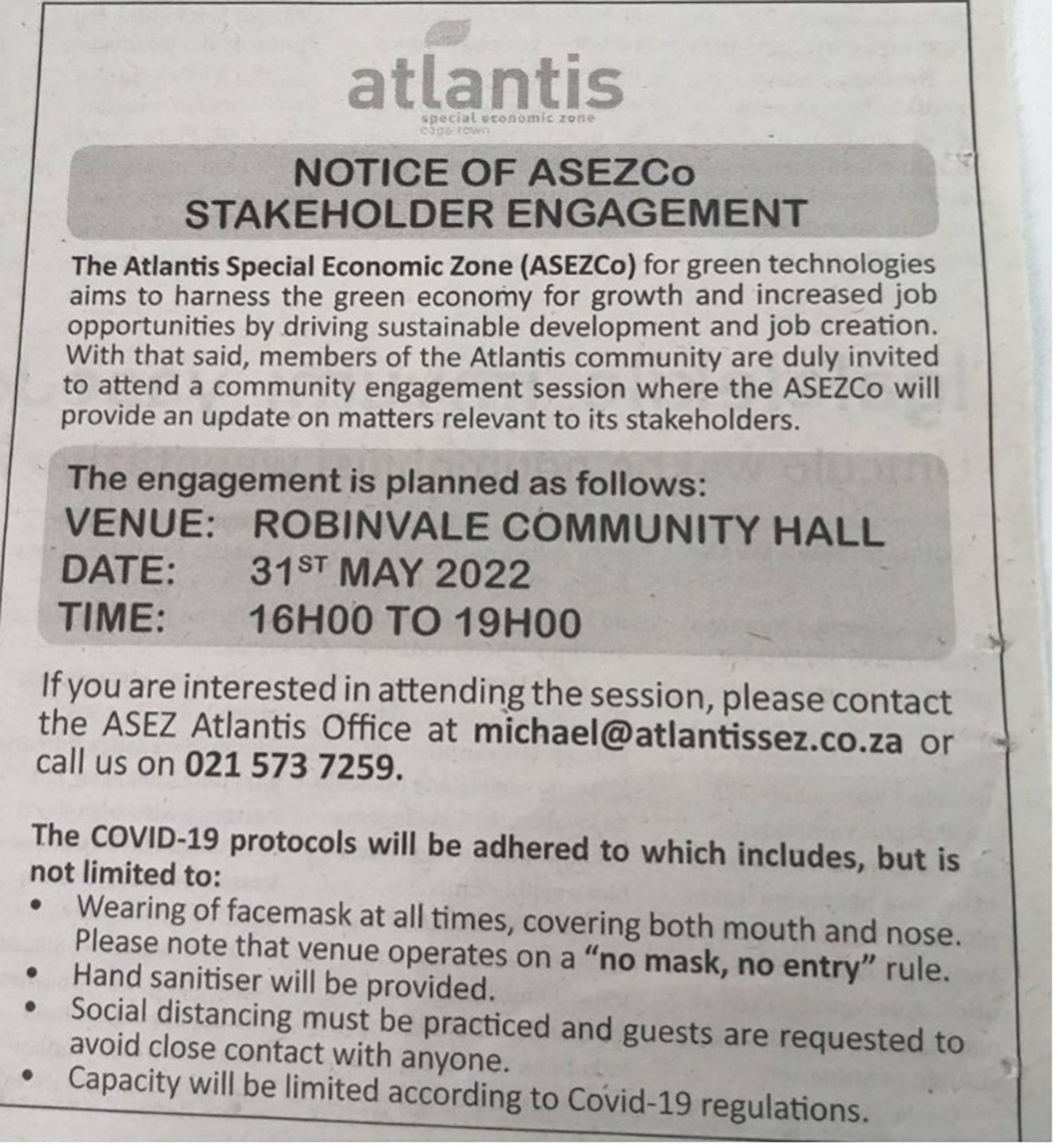
Figure 1 Long description
The image contains a notice of stakeholder engagement for the Atlantis Special Economic Zone for green technologies. The notice invites members of the Atlantis community to attend a community engagement session. The session will provide an update on matters relevant to stakeholders. The engagement is planned to take place at the Robinvale Community Hall on May 31, 2022, from 16h00 to 19h00. The notice also includes COVID-19 protocols such as wearing facemasks, social distancing, and limited capacity.
The community representatives were crucial to the zone company’s mission to be ‘socially inclusive’, about which officials were clearly passionate. In one meeting, an official told the group, ‘The intention of gathering you round the table is because we are very serious about taking your advice into consideration.’ As a testament to this ‘seriousness’, the representatives were asked to attend public events and occasionally give speeches to show the ‘community’s support’.
But the community-facing officials demonstrated their genuine commitments to ‘inclusion’ through more informal means as well: they had close personal relationships with everyone on the stakeholder network and would spend countless hours outside work time talking to them and helping them with personal favours. Noah and others described their roles as their ‘life calling’ or ‘true passion’, and felt that they were really ‘making a difference’.
Even so, the following sections reveal that the terms of participation are more ambiguous when viewed from other perspectives. The next section explores participants’ views, in which they voiced a critical analysis of the terms of their incorporation into the programme.
Participation as ‘exploitation’
Most of the elected participants were nominated to the Community Stakeholder Network as well-known and respected residents of Atlantis. They were largely in their forties and fifties, having either been born in Atlantis or migrated to Witsand, the informal settlement on its periphery, in search of work in the industrial section of the town. Many of them shared stories of previous factory jobs, being laid off, leaving to find work elsewhere, and returning to care for family or start small businesses. To ‘keep busy’, as one participant said, they joined civic, activist or political groups, or business forums. Some worked (doing the books for a tavern, as administrators for a labour union, or as a nurse at a hospital), but many did not.
When I asked how they got involved with the network, most said they heard about it through friends or at the December 2018 event when President Ramaphosa formally opened the zone. One person described it as ‘a massive fanfare of two, three, four hundred people, with massive marquee tents’.
Once established, the Community Stakeholder Network met regularly with officials, with pre-circulated agendas and minutes for comment. They dressed smartly, followed strict meeting protocol – raising hands for a point of information or to make or second motions – and sometimes even policed officials’ decorum. Officials would report on zone progress, and the representatives would ask critical questions and give endorsements. The company also ran capacity-building workshops for the representatives to make participation more substantive, covering topics such as minute writing, professional communication, public procurement (e.g. requests for quotations) and infrastructure (e.g. bills of quantities), as well as thematic issues like the ‘green economy’ and ‘net zero’. They also arranged site visits, including making plans to visit another zone in the province to learn how SEZs work.
At first, I viewed the participants’ constant presence in the office as evidence of the extent of their participation and their enthusiasm as volunteers, hopeful about market inclusion. But over time, as I noticed no major investment or job creation and as I talked more with participants, other motivations became apparent. Many saw their involvement as valuable ‘work’ and hoped to be recognized and paid by the zone company for their contributions.
During a group meeting, a charismatic representative, looking around the table and winking at people as he named them, said, ‘We have so much skills [sic], talent and experience around this table. We’ve got to look out for that legacy now: what will my child experience that we can leave behind? I want to make it easier to get a job.’ Here, he projected the participants themselves as having ‘skills, talent and experience’ that would contribute to making the zone a success. More generally, participants depicted themselves as capable and professional, and depicted their activities as a form of work.
On days without meetings or events, some representatives stayed at the company offices, using a workspace with computers set aside for them. This fostered a sense of important roles and work to do. Kayleen exemplified this. In her mid-forties with three daughters, she was elected as a representative to the zone through her involvement in the Khoisan Revival Movement. She had a growing constituency in Atlantis, organized cultural celebrations, and travelled the province supporting ‘indigenous rights’.Footnote 4 Unemployed, but involved in activism and with the SEZ, Kayleen was in the office almost every day. When I asked her what she was doing in the office, she answered, with an email inbox open on the screen in front of her, ‘I have always been a very proactive person. You do not need permission to do the right thing.’ She was working across multiple tabs at once, submitting comments on official documents. As the secretary of the Community Stakeholder Network, she felt responsible for being up to date with her email on all matters and attending public events.
Kayleen told me she had been upset when the zone company introduced voluntarism as a principle. She said:
It was actually very shocking. We contested that in meetings. Why are you now introducing this voluntary thing? So, I feel there was a major … I don’t know … deviation I would say, from the original intent. And I feel that … it seems like … for me I expected we would be compensated and resourced amply. But that is not the case because we are now considered ‘volunteers’.
The participants cast their activities as a form of work worthy of recognition and remuneration. When Kayleen had signed the constitution for the network, she had scribbled in the margins ‘with reservations as stipulated in email dated 26 January 2021’. I never saw the email, but when I asked her about it later, she said, ‘Oh, it’s the compensation story. There is none of that. Apparently, it was promised but there is none of that … How can a person who doesn’t work, who doesn’t have an income, be taking their bread money?!’Footnote 5
Kayleen reckoned that as she spent countless hours travelling to and from meetings, working in the office and attending public events on behalf of the SEZ, she deserved payment. But, more than this, given that she did not have another job or source of income, she felt that the terms of her involvement were even more unfair as she also had to contribute her ‘bread money’ to fund her participation. She explained that even the process of attending meetings and appearing in the appropriate dress demanded resources that she lacked. She had to divert money meant for her three daughters’ needs – hospital fees, food – to fund her zone work. She exclaimed:
I would literally take my own money to get to meetings and hope I come back. It came with a lot of sacrifice! Because you don’t get income! And now you can’t even go to the doctor because you don’t have an income. And I need to make an appearance, but I don’t even have enough … Obviously you want to be well groomed and look your best, but you can’t do it with nothing.
She described the terms of this participatory encounter as a ‘sacrifice’. Another member of the network complained to me that he could barely afford his medical bills to deal with a chronic illness, yet spent his time ‘volunteering’. Participants’ views of volunteering – labouring for free and having their own income put towards company processes – bear resemblances to more established concepts of exploitation or even expropriation (Fraser Reference Fraser2016; Reference Fraser2022). In Kayleen’s view, participation not only extracted value from her labour without fairly compensating for it (exploitation) but also expropriated the ‘bread money’ and time needed for social reproduction (expropriation). Indeed, one of the participants related their experiences to the concept of labour exploitation more concretely, saying, ‘This is part of history of exploitation by government institutions and private companies that used Atlantis human resources. Earlier and still now.’ This interlocutor was drawing a link between traditional labour exploitation in factories and contemporary efforts to establish inclusion in Atlantis. In this view, the contemporary inclusion scheme, while yet to create typical labour arrangements, was nonetheless drawing on Atlantis’s ‘human resources’, without pay.
This resonates with scholarly perspectives on market inclusion cited earlier, treating programmes as novel forms of labour exploitation (cf. Huang Reference Huang2017; Meagher et al. Reference Meagher, Mann and Bolt2016). But in this instance, while the participants had their own reasons for wanting to cast their activity as labour exploitation, and while the concept was meaningful to them in vernacular and affective terms, its application has analytical limits. For one, no capital was accumulated from participants’ efforts.
Indeed, both officials and the wider population of Atlantis refused to see participants’ involvement as a form of work, or as worthy of remuneration. Instead, in this context of chronic unemployment, many Atlantis residents saw this participation as a form of unfair personal advantage. This evokes another set of normative valences through which to view unpaid activity amid unemployment, not as exploitation, but as an opportunity for personal mobility.
Participation as ‘unfair advantage’
Many Atlantis residents viewed the community participation programme as an opportunity for self-advancement in a context where most people experience not inclusion but economic abandonment. Volunteering, in this view, was not for the benefit of the community, but rather a privileged means to incorporation, or insider status and access to imagined benefits, at the expense of marginalized outsiders. This evoked envy and resentment in a context of few opportunities (Dawson Reference Dawson2014).
The Community Stakeholder Network was a constant source of animated gossip and conversation in social settings at the weekend. In one conversation, someone explained that there had been ‘drama’ when the elections took place: ‘There was a lot of fighting to become part of the CSN because the community believed this was the place to be to get opportunities out of the SEZ.’ Rumours circulated that some representatives were ‘political appointments’, lacking community popularity or credentials.Footnote 6 Even those representatives who were initially praised and well liked now attracted criticism – from petty insults about the irritating way they spoke in public to more substantive accusations that they simply ‘did nothing for the community’. These accusations were hugely significant in a place where many residents expressed ardent hope that the SEZ would create jobs, describing it as their only or last hope.
A resident involved in early Community Stakeholder Network workshops, before the elections, said those who later became participants lacked the skill set to engage government and were more focused on personal gain than community welfare:
They would only focus on these petty little things instead of the bigger picture. Those meetings were very painful. It was all about having a seat, and positions, and being seen to be involved in this big thing that is going to drive the future of Atlantis, blah blah blah. So, ja [yes], it became a very painful conversation often to have government officials with a very specific agenda and mandate interacting with people who doesn’t [sic] have a clue.
This private gossip was expressed in public stakeholder meetings, which became regular sites of intense confrontation. Members of the audience would heckle and shout down representatives’ responses. In these meetings, discussion invariably revolved around project resources and their distribution. Residents would ask for a financial breakdown of programme funds, or claim that official reports, where project finances were officially published, were incorrect. At one meeting, following a series of questions and complaints about where the budget for the zone had gone, someone said, ‘Everyone wants that money except people that really need it. It’s not supposed to be like that. Those millions – it’s the poorest of the poor’s tax! And what do they get back? Nothing!’ This implies that those involved in the project (officials and participants) had taken the public funds for themselves in an unjust manner, depriving the poor of their entitlements. While this, to my knowledge, was not the case, as the zone company officials were fastidious about getting a ‘clean audit’, the sentiment emerged from a feeling that, despite the various programmes the company was running, there was little substantive benefit to the community in terms of job opportunities. A local resident who had attended most of the public meetings, who worked in a local crèche but still struggled to make ends meet, contextualized this further: ‘There was an announcement that monies were made available. For what it was, I don’t know for what it was. But that is money that people want. So, ja, there is this perception that there was a pool of money and the money is no longer there.’
From the perspective of residents, the terms of the community participation programme revolved around the question of who was really benefiting, given that the process had been going on for years without promised results materializing. I often heard people describe the SEZ, and its community participation programmes, as ‘a scapegoat for somebody else to make money’. Another resident, Rolette, unemployed but very active in local politics and civic organizations, aired her concerns to me. In her view, the people who seemed to be benefiting were the people in ‘managerial and senior positions’, who, she surmised, were mostly white, while the Atlantis residents were sabotaging each other in their bids for personal gain. Rolette said:
I hope and pray this SEZ is going to really happen because for me as a community member you look at all these millions and billions that they talk about, is it really for us as a community?! But because I want a position for myself, I’m dragging you down, putting myself forward.
Rolette said she ‘hoped and prayed’ for the market inclusion that the zone was promised to yield but doubted that these aspirations would be realized because of the self-promoting actions of the participants. The participants are cast not as virtuous volunteers, but as amoral characters sabotaging collective benefit.
Rather than the future-looking temporal horizon of market inclusion, residents viewed participation with a backward-looking temporal horizon, focusing on delays. In all, hope and conviction about future market opportunities were expressed interchangeably with scepticism and doubt. Sitting with Rolette one day at a local fast-food chain, watching some teenagers milling about the mall, she mused, moments after expressing hope about the success of the SEZ:
As much as they want to claim that they bring stuff to the benefit of Atlantis, we as a community will never trust them again. I am talking about anyone that comes here whether it’s this [SEZ] company or any company that wants to put up a production plant. We are too wise for them now.
Implied here is the longer history of state promises of job creation, under apartheid, via the industrial decentralization programme and Coloured Labour Preference Area, as well as in the post-apartheid era via the SEZ, that so far have failed to deliver. Rolette elaborated, ‘We are coming from apartheid where incentives and plans collapse.’ Even so, people continued to repeat that they ‘hoped and prayed’ that the SEZ would be different, if only the community were adequately represented. People insinuated that the category of ‘community’ was used as justification for a select few to gain access to public resources that were otherwise out of reach.
This collective paranoia makes sense against a broader backdrop wherein Atlantis residents, and many Coloured people in the country, view themselves as not just economically but politically marginalized by a ‘Black majoritarian’ state, which ‘prioritizes its own’. Although ‘Black Economic Empowerment’, a major legal framework aimed at rectifying apartheid racial inequality, targets Coloured and Black people equally, many in Atlantis claimed that in practice Coloured people were not the priority. ‘They will see your surname [that it’s not a typical African name] and your CV will go in the bin,’ someone said. Many in Atlantis described themselves as ‘stepchildren’ of the post-apartheid regime (see also Adhikari Reference Adhikari2005). In such a context, community participation is cast not as part and parcel of incoming market inclusion, nor as labour exploitation, but as an unfair opportunity for personal gain and self-advancement, in a population otherwise suffering from interlocking forms of exclusion.
But to treat community participation in this setting as a chance for self-enrichment, as these critics did, is limited. To my knowledge, the participants did not receive substantive financial gain through their roles beyond small stipends for airtime and transport costs, and, as explained already, they felt they even had to contribute their own resources. Moreover, their relationships and reputation with officials and the wider population were adversely affected by their involvement in the programme. Together, these financial costs and social risks rendered them more precarious than they were before.
Participation as adverse incorporation of another kind
Let us return to the community stakeholder meeting discussed in the introduction. Both zone company officials and locals had been informally referring to this meeting in the preceding days as a ‘reflection meeting’, to think about ‘what went wrong’ with the community representatives. At this meeting, it was the representatives, rather than the zone company, who were blamed for the lack of collective benefit from the zone and from the resources allocated for it. Residents called for the participants as individuals, rather than the SEZ company or the community participation structure per se, to be replaced, by disbanding and reconstituting that structure. A local critic spoke out, receiving applause:
We need to ask: Is the CSN still relevant today? They are not helping us, not talking to us, not fighting for us. There is no fighting spirit … We can’t let them leave us only the crumbs. They [the institution] got so much money … and they benefit from that money to sustain themselves and not develop our society … and now we are sitting here fighting among ourselves. If you are on the CSN and not doing your job, step down because you’re wasting valuable time.
Here, the participants were blamed for not ‘doing [their] job’ of ensuring community benefit from SEZ resources. When the participants tried to defend themselves, reiterating their commitments to public service, saying things like ‘We do understand that livelihoods are at stake. We want to serve’, they were shut down with the refrain ‘Don’t defend the CSN. The community elected you and you must listen.’ Eventually it was decided that the group would not be disbanded, but given another chance – to be ‘realigned’ and become more accountable to the community. While the abstract concept of market inclusion remained formally legitimate here, the participants as individuals were blamed for the deviations from the official script. In short, they bore the reputational costs of a programme promising market inclusion but not delivering sufficient market connections.Footnote 7
Meanwhile on the office WhatsApp group, officials acknowledged that it was ‘[v]ery understandable that the community is frustrated. They have been promised so much for so long.’ But, instead of reckoning with these conflicts as symptomatic of the deep uncertainties of market inclusion, due to volatile renewable energy markets among other reasons, the officials chalked it up to the poor moral character and lack of legitimacy of participants themselves. They suggested that the participants be replaced with others with the right moral credentials. Debriefing after an event, in a conversation about how ‘amazing’ and ‘groundbreaking’ the participatory approach was, an official turned to me and insisted that the participants were ‘not that morally clear cut’. She exclaimed, ‘It’s not all altruistic. It’s often “What’s in it for me? How can I make money?”’ As she understood it, ‘At the end of the day it translates to who takes credit for roles and responsibilities. If you are cited in any public media, you can lay claim to funding. It’s like, “I want money because I’ve had success with this.”’
Officials talked privately about how problematic requests for payment were. They cast such requests as an aberration from the ethic of volunteering (which was meant to be selfless) and of ‘representing’ others (meant to be egalitarian). More than this, they did not agree that what participants did counted as a valid form of work that might be deserving of remuneration. My colleague described the community representatives using an Afrikaans word, ‘bakhand’, which, when I asked for clarification, she illustrated by cupping her hands, a gesture associated with begging, getting money as a form of charity without having earned it. Noah told me that ‘whenever [payment] comes up in conversation, I will shut it down immediately’. He said that he would tell the claimants that their request did not fall within ‘KPIs’ (key performance indicators) and therefore could not be accommodated. The general idea that was repeated in staff meetings was: ‘There are people who are willing to cooperate and share knowledge for free. If we get the correct people to advise, they won’t need compensation.’
The participants’ motivations were framed as morally ambiguous, or downright immoral, and they lost social status, as the subject of gossip and public ridicule. In one case, a member of the stakeholder network who had been publicly applauded in a meeting when she had joined the group (to replace someone else) was later pressured to step down, so severe was the criticism to which she was subjected. Moreover, pleas for proper remuneration were never met.
This loss of status was acutely perceived by participants themselves. Henderson, the chairperson of the Community Stakeholder Network, complained to me:
People say I am looking after myself with the SEZ. I don’t even have my own vehicle! The SEZ doesn’t pay me for what I am doing. People are looking for my head to roll. They think I am involved for my health, instead of for them.
He characterized this in ethical-religious terminology as a crucifixion:
As you say in Afrikaans, ons het die bluf van die ASEZ Company [we bear the brunt of the ASEZ Company]. It means I have to answer questions that are the ambit of the company! Myself and [the CEO] did say that until such time when nothing is going to happen, we [the CSN] are going to be crucified. And that’s exactly so, we are taking the brunt because nothing has happened yet.
The lack of widespread job creation was made sense of here not as a structural feature of a remote region, or due to the uncertainty of capital flows on which ‘market inclusion’ depends. Rather, it was blamed on the moral failings of participants. Such ambiguity here functions as a bureaucratic resource (Best Reference Best2012). It subsidizes the costs of the institution’s political legitimation: by drawing on participants’ affective commitments and aspirations for ‘development’, as well as time, resources and social status, the company can continue to represent itself as ‘inclusive’ while allowing the reputational costs of such a structurally uncertain programme to be offloaded onto participants.
While this is not labour of the kind that participants themselves want recognized, and hence not exploitation in its strictest sense, this article argues that it is a distinct kind of adverse incorporation. Through their active involvement in the programme, the existing vulnerability of unemployed and poor participants is arguably augmented. They gain little materially (and even donate personal resources) and lose social status.
While zone company officials remain sincere about wanting to ‘include’ the people of Atlantis, and the officials themselves do not have control over the flows of global capital on which the success of the SEZ depends, ultimately, they, as salaried professionals, benefit from this programme.Footnote 8 As a hired ‘research and technical adviser’ to the zone during my fieldwork (albeit earning a minimal fee), I too am implicated in the politics of benefiting from this absurd programme of ‘market inclusion’.
Conclusion
This article explores the ambiguous implications of unpaid ‘participation’ in a ‘market inclusion’ scheme, in a context characterized by chronic unemployment and marginality. Officials frame participation as shared value and market inclusion; participants experience it as unpaid labour and reputational risk; residents often interpret it as an unfair channel to insider advantage.
Market inclusion hails global capital market flexibility as the solution to poverty and unemployment. But, in many parts of the continent deemed ‘surplus’ to the needs of capital and therefore with few market connections, this notion of inclusion is little more than a fantasy. In Atlantis, despite expert consultant reports continually underwriting the feasibility of this project, and of other SEZs around the country, changing policy and market conditions expose such conviction as deeply uncertain. Instead of a critical reckoning with the uncertainties of global markets, and the potential inequalities of pegging lives and livelihoods to global capital, ‘better governance’ is often prescribed as the necessary ingredient to make SEZs on the continent successful. This article shows how the normative ideal of market inclusion retains a precarious legitimacy even as it produces little in practice.
By tracing how community participation legitimizes market inclusion while diminishing participants’ social standing, the article reveals how capitalism extracts labour, energy and credibility from the poor and unemployed, offloading risks and costs onto them. Far from being ‘surplus’ to capital, the poor become a legitimizing resource for depicting markets as benevolent, even where market connections remain absent.
Acknowledgements
The research for this article was funded by the Rhodes Trust and the Skye Foundation. I am grateful to all the staff at the Atlantis SEZ company and to the many Atlantis residents for welcoming me and supporting my research. For their helpful feedback, I would like to thank my supervisor, Maxim Bolt and the journal reviewers. I also appreciated critical feedback from Leonie Hoffman, Leila Strelitz, Josh Parker Allen, and the Ethnographies of Work group at the Oxford Department for International Development run by Maxim Bolt.
Julia Hampton is a DPhil candidate at the Oxford Department of International Development. Her project more broadly is about the constitutive role of economic expertise in the making of the state in South Africa.


 Open access

