





Climate change is one of the biggest threats and warnings to all humanity, having significant adverse impacts on health, including mental health and emotional well-being. Reference Heinz and Brandt1 Climate mental health has emerged as a research discipline to explore this important public health issue by incorporating approaches from climate science, psychiatry and psychology to mitigate the negative effects of climate change on mental health. 2 This paper discusses the climate crises faced by South Asian countries and their impacts on mental health.
South Asia is the southern subregion of Asia and includes India, Nepal, Pakistan, Bhutan, Bangladesh, the Maldives and Sri Lanka. The subcontinent is the most densely populated geographical region in the world, home to nearly a quarter of the world’s population. Topographically, the South Asian countries are quite vulnerable to many climatic adversities that have a profound psychosocial impact. Limited resources to deal with these adversities make the problem more serious. Reference Dhimal, Bhandari, Dhimal, Kafle, Pyakurel and Mahotra3 Six types of extreme weather event – floods, storm surges, typhoons, cyclones, extreme heat and riverbank erosion – have been found to affect South and Southeast Asia frequently. Reference Patwary, Bardhan, Haque, Moniruzzaman, Gustavsson and Khan4 These events have mental health consequences such as anxiety, depression, emotional distress, suicide risk and post-traumatic stress disorder (PTSD). There has been a general lack of related long-term studies in the region.
Climate profile of South Asia
Global warming is making Earth’s surface hotter day by day. Global temperatures in 2024 were 1.28°C above the 20th-century baseline (1951–1980), overshooting the record set in 2023. Reference Bardan5 It is predicted that in the coming years most cities in South Asia will experience a month of extreme heat every summer, more droughts and more floods in monsoon, increasing mortality and the need for air conditioning. There has been a threefold rise in extreme rainfall events in the past 70 years in the central belt of India. The year 2024 witnessed the hottest summer months, with daytime temperatures reaching 48–49°C accompanied by sultry heat waves in many places across North India, Reference Coleman6 and 2025 faced one of the worst ever floods in many parts of North and Western India, Pakistan and China. 7 The possible impact of these recent events on mental health is yet to be assessed.
Air pollution is another serious environmental hazard in South Asia: of the 30 cities in the world with the poorest air quality, 17 are in South Asia. Reference Bardan5 India ranks fourth, after Nepal, Pakistan and Bangladesh, among South Asian countries in the worst air quality index category according to the Environmental Performance Index 2024. Reference Block, Emerson, Esty, de Sherbinin and Wendling8 The air quality index surged to hazardous levels, nearing 450 (‘hazardous’) in many parts of North India in late 2024. The levels of fine particulate matter (PM2.5) in the air have increased to nearly 100 times the World Health Organization’s safe limit.
Climate change and its effects on mental health in South Asia
South Asia has been highly susceptible to extreme weather events owing to its geographically precarious location. Such events and catastrophes lead to loss of livelihoods, property damage, forced migration and economic loss, along with adverse health consequences. A review covering studies on the subject from South Asia between 2020 and 2024 found the affected population to suffer depression, anxiety, PTSD and increased risk of suicide. Reference Patwary, Bardhan, Haque, Moniruzzaman, Gustavsson and Khan4 Risk of anxiety and depressive disorders, drug and alcohol use, suicide and PTSD increased particularly after an acute climate event.
Temperature rises have also been found to be associated with increased rates of mental health morbidity and mortality, including suicide attempts, mood and anxiety disorders, insomnia, substance misuse, behavioural abnormalities and psychiatric emergencies. A study found that in India, a 1°C rise in temperature during the agricultural growing season increases annual suicides by 0.0008 per 1 00 000 people. India has witnessed around 59 300 farmer suicides due to effects of global warming between 1980 and 2010. Reference Carleton9 The unpredictable rain patterns and failed attempts to sustain livelihoods have forced farmers to migrate away from their homes, increasing the incidence of suicide among them. Furthermore, food shortages and hunger lead to increased risk of infections, malnutrition-related diseases, and neurocognitive and neurodevelopmental disorders. One study found that around 66% of people suffered moderate to severe psychological symptoms after cyclone Amphan in Bangladesh in 2020, and 10.9% reported suicidal ideation. Reference Hossain, Ahmed, Rahman, Sammonds, Zaman and Benzadid10
Various recent systematic reviews and meta-analyses found that children, pregnant women, elderly people and those with chronic illnesses are especially vulnerable to developing adverse mental health outcomes. A global survey in 2021 reported that 59% of 10 000 children and young adults from 10 countries had eco-anxiety, that is psychological distress due to concern about the consequences of a deteriorating environment or ecological crisis. It is especially important to address this anxiety because of children’s naive coping skills and inability to avoid or mitigate psychosocial stressors. Reference Hickman, Marks, Pihkala, Clayton, Lewandowski and Mayall11 The risk of learning difficulties, negative affect and decreased emotion regulation, temperamental problems, restlessness, bedwetting and aggression increases with climate-related disasters. The World Health Organization estimates that around 88% of climate-related diseases affect children under 5 years of age. Reference Sheffield and Landrigan12
Rising temperatures and air pollution increase the risk of cognitive impairment or dementia, especially in elderly people. A study found compelling evidence of increased incidence of cognitive deficits and dementia with long-term exposure to pollutants such as carbon monoxide (CO) and nitrogen oxide (NOx). CO is mainly responsible for the greenhouse effect raising Earth’s temperature. NOx is produced mainly during combustion of fossil fuels. These gases cause oxidative stress in the central nervous system, leading to cell loss, neuroinflammation and neurodegeneration. Reference Radua, De Prisco, Oliva, Fico, Vieta and Fusar-Poli13 There is rising evidence from India and across the globe highlighting the impact of high PM2.5 levels on development of various psychiatric and neurodevelopmental disorders through a number of mechanisms, including altering gut flora, neuroinflammation and socioeconomic factors such as access to health resources, green spaces and sports facilities. Reference Sethi, Agarwal, Vora and Gosavi14,Reference Li, Chen, Gu, Chen, Liu and Lei15
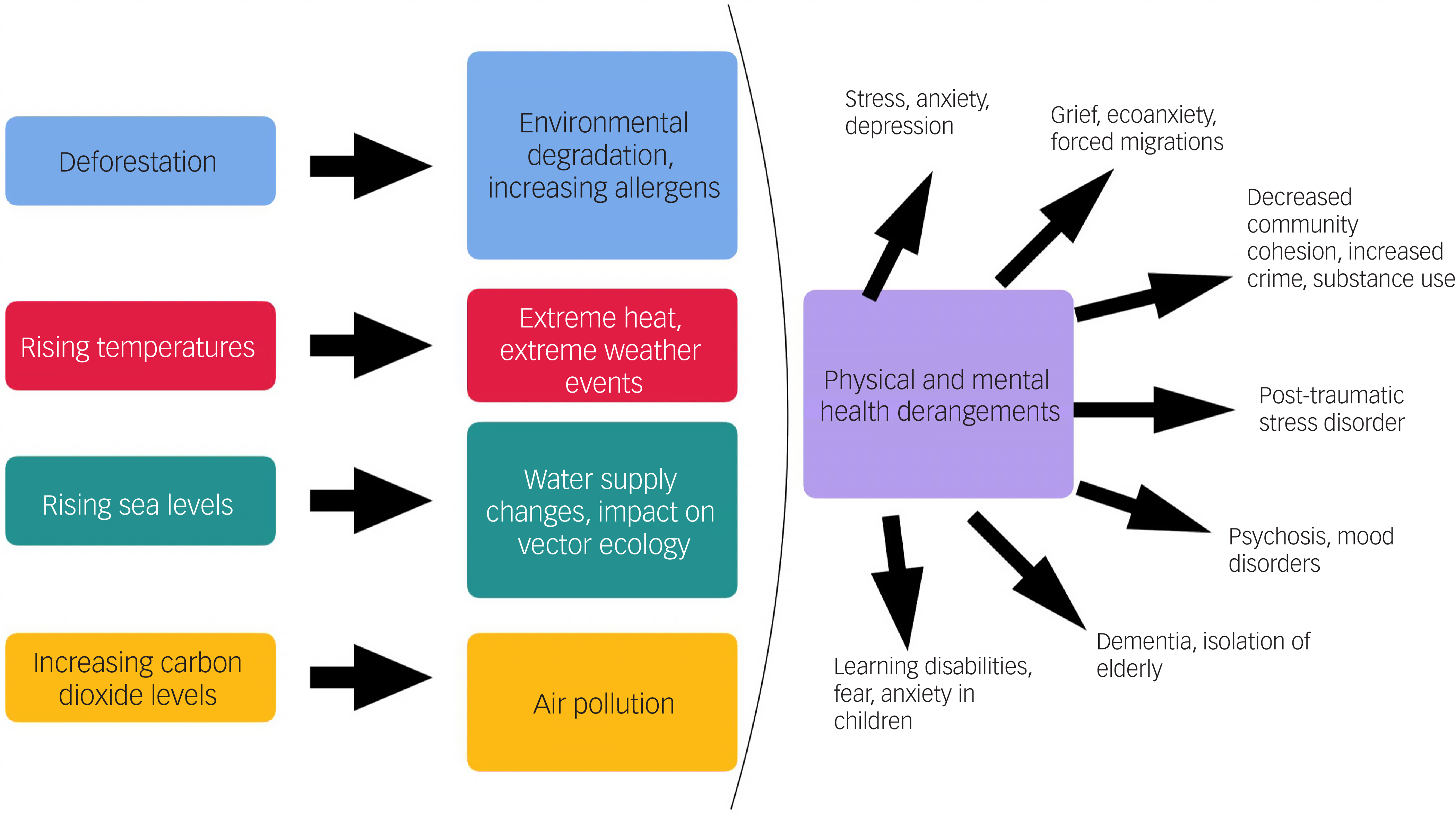
Figure 1 summarises the physical and mental health consequences of various forms of climate change. A causal pathway has been proposed, but the figure should be interpreted in the light of recent evidence by Radua et al. Reference Radua, De Prisco, Oliva, Fico, Vieta and Fusar-Poli13 Although 237 associations have been found and proposed, convincing evidence was found for only one (long-term exposure to solvents and risk of cognitive decline). Other associations with a high level of credibility included exposure to PM10 with post-partum depression, sulfur dioxide (SO2) with schizophrenia relapse, rising temperature with suicidality, cyclone exposure with PTSD, and CO/NOx emissions with dementia. Many countries are yet not considering mental health in their response to climate emergency. Reference Radua, De Prisco, Oliva, Fico, Vieta and Fusar-Poli13
Environmental and human consequences of global warming.
Suggested solutions
The climate is changing fast and there is a need to act faster. As outlined above, the acute and long-term repercussions of climate change have detrimental effects on mental health. Thus, individuals, families, health professionals, the government and the whole community need to work in unison to combat the climate crisis and prevent the world from having to grapple with the effects of the climate disasters.
Policy and governance
Climate control needs to be a key component in all government plans, emphasising health promotion with a specific emphasis on mental health. Climate considerations need to be amalgamated into mental health programmes. Global climate conferences and summits pave the way for countries to discuss strategies for climate control as well as keeping a check on the successful implementation of these strategies. The agenda of all participating countries after the United Nations General Assembly in September 2021 and the 2021 World Biodiversity Summit was to limit the global temperature increase to below 1.5°C. The Government of India’s National Action Plan on Climate Change aims to mitigate and reduce the effects of climate change. However, the efficacy of the programme needs to be monitored, especially in light of the mental well-being of the population. Reference Parry, Canziani, Palutikof, Van der Linden and Hanson16
In the UK, the Academy of Medical Royal Colleges is hosting the Choosing Wisely UK campaign to rationalise investigations, treatments and prescribing practices. Reference Malhotra, Maughan, Ansell, Lehman, Henderson and Gray17 Procuring medications and medical equipment contributes to about 60% of the National Health Service’s (NHS) total carbon footprint, and in 2021 the UK’s Royal College of Psychiatrists pledged to cut its carbon dioxide emissions significantly by 2040, in accordance with recommendations of the Lancet Commission on global mental health and sustainable development. 18,Reference Patel, Saxena, Lund, Thornicroft, Baingana and Bolton19 The College is urging NHS clinicians to embrace the Choosing Wisely strategy. For example, by starting at lowest possible doses of medication, with constant monitoring of efficacy and adherence and stopping or switching at the right time, psychiatrists could reduce chemical pollution (carbon emissions). 18
The Conference of the Parties, the supreme decision-making body of the UN Framework Convention on Climate Change, is taking initiatives with a special focus on the mental health effects of climate change, a component that was earlier ignored. It also supports allocating funds to the formation of low-carbon and climate-resilient cities in low- and middle-income countries and creating green urban spaces, which are likely to mitigate adverse consequences of climate change. Reference Parry, Canziani, Palutikof, Van der Linden and Hanson16 However, according to the Lancet Commission’s report, by 2018 only 3% of countries had pledged to include mental health in their climate action plans. Reference Patel, Saxena, Lund, Thornicroft, Baingana and Bolton19
Community and health systems
Cross-sectoral collaborative efforts of various organisations, such as special interest groups, are required to spread awareness of the impact of climate change on mental health and to sensitise populations to the wrong practices contributing to it. Some such groups have begun across the world in cities like Cairo, Manila, Cagliari, Brasilia, San Lorenzo, and also in Kolkata in India. Reference Anantapong, Moura, Udomratn, Persaud, Javed and Ramachandran20 The purpose is both to raise awareness and promote research into the effects of climate change on the mental health of the affected communities, and to create links with policymakers to focus on geopolitical factors related to physical and mental health.
Inclusion of mental health professionals in global climate discussions can help improve understanding of the psychological impact of the climate crisis. Creating awareness of the harmful impacts of climate-related events can mitigate the post-disaster psychological impact. Early assessment and intervention can help reduce mental health problems and build resilience during the aftermath. Local healthcare professionals such as doctors, paramedical staff and community health workers can protect and promote public health amid the climate crisis. They should be trained to identify psychological stresses, prioritising individuals with existing mental health problems but offering help to all affected individuals. Their training should be amalgamated into disaster preparedness programmes, with special focus on psychological first aid after disasters. 18
Individual- and family-level actions
Individuals and families can play their part. Measures like limiting the emission of greenhouse gases related to our daily usage of electricity, choosing climate-friendly products, waste reduction and recycling can be helpful. Planting trees and creating green spaces are essential, since forests have a positive effect on physical and mental wellbeing. Strategies promoting resilience can help in reducing in-patient and resource-intensive treatment, which is an important consideration in resource-limited settings like the Indian subcontinent. A special focus on strategies addressing the stress of climate-associated migration have been adopted by many countries. These include enhancing social networks, access to psychotherapy and online consultations, promoting health literacy, self-care and peer support, and supporting employment. Reference Brandt, Adorjan, Catthoor, Chkonia, Falkai and Fiorillo21 Another scoping review of Indian studies has highlighted the role of education in improving the coping skills of individuals in dealing with climate crisis. Reference Mangalamchery and Uvais22
Conclusion
Earth’s climate has changed drastically over the past few years, in large part owing to anthropogenic factors. The changes have had a detrimental effect on people’s physical and mental health and this has been widely discussed in recent literature. This paper addresses the impact of climate change on mental health in the highly vulnerable South Asian region. Extreme weather events are likely to increase in the region, especially because of its geographical vulnerabilities, high population density and socioeconomic difficulties. Hence, it is important for policymakers, health practitioners and researchers to address the lacunas and ensure proper implementation of policies and guidelines, awareness programmes and disaster preparedness protocols. Reference Mangalamchery and Uvais22
Better utilisation of the limited mental healthcare facilities available, especially during a disaster, is required. Mental healthcare needs to be transformed from reactive and post-incident to proactive measures to prevent the impact of changing climatic patterns and disasters on mental health at local, state, national and international level. Reference Heinz and Brandt1
Author contributions
R.K.C. prepared the initial draft of the paper, which was expanded by S.A.; R.K.C. and N.C. edited the draft and finalised the paper. The final paper was approved by all three authors.
Funding
This research received no specific grant from any funding agency, commercial or not-for-profit sectors.
Declaration of interest
R.K.C. is a member of the BJPsych International editorial board and did not take part in the review or decision-making process of this paper.

 Open access


eLetters
No eLetters have been published for this article.