





Impact Statement
This work advances the application of single-shot coherent Rayleigh–Brillouin scattering (CRBS) as a high-resolution, non-intrusive diagnostic for rarefied gas flows. By developing an efficient deterministic solver of the Boltzmann equation, we achieve accurate CRBS spectra within minutes, enabling systematic exploration of parameter space that was previously computationally prohibitive. The study reveals how intermolecular potentials and chirp rates fundamentally shape CRBS line profiles. The accompanying MATLAB codes allow researchers to readily interpret experimental spectra and extend CRBS diagnostics to complex gases. These contributions pave the way for real-time, high-fidelity flow characterisation in challenging environments, with potential applications spanning aerothermodynamics and plasma physics.
1. Introduction
Rayleigh–Brillouin scattering is a non-intrusive flow diagnostic technique, which is categoriesd into spontaneous Rayleigh–Brillouin scattering (SRBS) and coherent Rayleigh–Brillouin scattering (CRBS). In SRBS, incident photons are scattered by spontaneous thermal density and pressure fluctuations within a medium, producing sidebands around the central Rayleigh peak, known as the Brillouin doublet (Tenti, et al. 1974). The resulting spectral line shape reflects key thermodynamic and transport properties (such as viscosity, thermal conductivity, sound velocity and flow velocity), making SRBS a powerful tool in atmospheric sensing and gas thermometry (Ghaem-Maghami & May Reference Meijer, de Wijn, Peters, Dam and van de Water1980; Witschas et al. Reference Witschas, Lemmerz and Reitebuch2014; Gu et al. Reference Gu, Ubachs and van de Water2014, Reference Wu, White, Scanlon, Reese and Zhang2015), e.g. the Earth observation satellite ADM-Aeolus employs SRBS of ultraviolet laser light to directly measure global wind profiles from space. However, because the thermal fluctuation is spontaneous, the signal intensity is often weak. In CRBS, light is scattered by spatiotemporal density modulations generated through the interference of two laser pump beams, which induces an electrostrictive grating that, in the collisional regime, drives acoustic waves. Owing to the use of phase-matching conditions, CRBS achieves a signal-to-noise ratio that is orders of magnitude higher than that of SRBS, enabling precise measurements even in low-density or weakly scattering environments (Pan et al. Reference Pan, Shneider and Miles2002; Cornella et al. Reference Gu, Ubachs and van de Water2012; Meijer et al. Reference Meijer, de Wijn, Peters, Dam and van de Water2010; Shneider & Gimelshein Reference Wu, White, Scanlon, Reese and Zhang2013).
The CRBS spectrum depends on the frequency difference between the two pump lasers, or equivalently on the lattice velocity. To obtain the full line shape, the lattice velocity must be varied by stepwise tuning of one pump laser’s frequency. As a result, the diagnostic time can be of the order of minutes. Recently, the use of chirped pump lasers has enabled CRBS measurements of gaseous flows with temporal resolutions of the order of 100 ns (Gerakis et al. Reference Pan, Shneider and Miles2013; Suzuki et al. Reference Suzuki, Gerakis and Hara2024). This technological advance opens the door to real-time, non-intrusive characterisation of flow properties, even in rapidly evolving or transient environments. Such capability is particularly valuable for studying unsteady aerothermodynamic phenomena, shock-boundary layer interactions and combustion processes, as well as for plasma diagnostics, where traditional methods often lack the required temporal resolution or risk perturbing the system under investigation.
To accurately extract gas information, the CRBS spectrum must be calculated with high precision. Because the scattering wavelength is comparable to the mean free path of gas molecules, the Boltzmann equation, rather than the Navier–Stokes equations, should be used. However, since the Boltzmann equation is defined in a six-dimensional phase space and its collision operator involves a five-dimensional nonlinear integral, numerical solutions are computationally demanding. For instance, the spectrum has been obtained using the direct simulation Monte Carlo method (Bruno & Frezzotti Reference Meijer, de Wijn, Peters, Dam and van de Water2019; Suzuki et al. Reference Suzuki, Gerakis and Hara2024), which essentially solves the Boltzmann equation in a stochastic manner (Bird Reference Wu, Liu, Zhang and Reese1994). Unfortunately, simulating CRBS with a chirped laser requires roughly 3 days for a single run, even when using 32 processors on the Sherlock cluster at Stanford University (Suzuki et al. Reference Suzuki, Gerakis and Hara2024).
So far, the prevailing method for calculating the RBS spectrum has been the Tenti method (Tenti et al. Reference Tenti, Boley and Desai1974), in which the linearised Boltzmann collision operator is approximated using the first few eigenfunctions of Maxwellian molecules (where viscosity scales linearly with temperature). As a result, each RBS line shape can be obtained within one second. However, it performs less well when the intermolecular potential deviates from the Maxwellian type (Wu Reference Wu2022), e.g. the CRBS spectrum is sensitive to the intermolecular potential (Wu et al. Reference Wu, White, Scanlon, Reese and Zhang2014).
In addition to the influence of intermolecular potential, recent observation is that the CRBS spectrum becomes asymmetric when a fast chirp rate is applied (Suzuki et al. Reference Suzuki, Gerakis and Hara2024). However, because Monte Carlo simulations are highly time-consuming, the parameter space explored has been limited. In this paper, using the fast spectral method for solving the Boltzmann equation (Wu et al. Reference Wu, White, Scanlon, Reese and Zhang2013, Reference Wu, White, Scanlon, Reese and Zhang2015), we provide the Matlab code capable of calculating each line shape in approximately one minute, and systematically investigate how intermolecular potentials and chirp rates influence the CRBS line shape. Both the monatomic and polyatomic gases will be considered.
2. Boltzmann equation for monatomic gas
The chirped pump lasers generate an optical lattice that exerts a dipole force on the gas molecules (assuming the optical lattice moves in the $x_2$
direction) (Suzuki et al. Reference Suzuki, Gerakis and Hara2024),
$x_2$
direction) (Suzuki et al. Reference Suzuki, Gerakis and Hara2024),
 \begin{equation} F_2=\frac {I_0}{c\epsilon _0 \alpha k_L}\sin \left [k_Lx_2-\left (\omega _{\text{min}}t+\frac {\beta }{2}t^2\right )\right ], \end{equation}
where $I_0$
is the light intensity of the pump beam,
$I_0$
is the light intensity of the pump beam, $c$
is the light speed,
$c$
is the light speed, $\epsilon _0$
is the vacuum permittivity,
$\epsilon _0$
is the vacuum permittivity, $\alpha$
is the polarizability,
$\alpha$
is the polarizability, $k_L$
is the wave number of the optical lattice,
$k_L$
is the wave number of the optical lattice, $t$
is the time;
$t$
is the time; $\omega _{\text{min}}$
is the minimum laser frequency and the chirp rate is
$\omega _{\text{min}}$
is the minimum laser frequency and the chirp rate is
 \begin{equation} \beta =\frac {\omega _{\text{max}}-\omega _{\text{min}}}{\tau }, \end{equation}
with $\omega _{\text{max}}$
being the maximum laser frequency and
$\omega _{\text{max}}$
being the maximum laser frequency and $\tau$
the time duration during which the laser is linearly chirped.
$\tau$
the time duration during which the laser is linearly chirped.
In gas kinetic theory, the velocity distribution function $f(t,x_2,\boldsymbol{v})$
is introduced to describe the state of a gas, where
$f(t,x_2,\boldsymbol{v})$
is introduced to describe the state of a gas, where $\boldsymbol{v}=(v_1,v_2,v_3)$
is the molecular velocity. Macroscopic quantities are obtained as moments of the distribution function, e.g. the number density
$\boldsymbol{v}=(v_1,v_2,v_3)$
is the molecular velocity. Macroscopic quantities are obtained as moments of the distribution function, e.g. the number density $n$
, bulk velocity
$n$
, bulk velocity $\boldsymbol{u}$
, translational temperature
$\boldsymbol{u}$
, translational temperature $T_t$
, pressure tensor
$T_t$
, pressure tensor ${p}_{ij}$
and translational heat flux
${p}_{ij}$
and translational heat flux $\boldsymbol{q}_t$
are given by
$\boldsymbol{q}_t$
are given by $\left [n, n\boldsymbol{u}, \tfrac {3}{2}nk_BT_t, p_{ij}, \boldsymbol{q}_t \right ] = \int \left [1, \boldsymbol{v}, \tfrac {m}{2}c^2, mc_ic_j, \tfrac {m}{2}c^2\boldsymbol{c}\right ] f \,{\rm d}\boldsymbol{v}$
, where
$\left [n, n\boldsymbol{u}, \tfrac {3}{2}nk_BT_t, p_{ij}, \boldsymbol{q}_t \right ] = \int \left [1, \boldsymbol{v}, \tfrac {m}{2}c^2, mc_ic_j, \tfrac {m}{2}c^2\boldsymbol{c}\right ] f \,{\rm d}\boldsymbol{v}$
, where $k_B$
is the Boltzmann constant,
$k_B$
is the Boltzmann constant, $m$
is the molecular mass,
$m$
is the molecular mass, $\boldsymbol{c}=\boldsymbol{v}-\boldsymbol{u}$
is the thermal velocity and the subscripts
$\boldsymbol{c}=\boldsymbol{v}-\boldsymbol{u}$
is the thermal velocity and the subscripts $i,j=1,2$
or 3.
$i,j=1,2$
or 3.
The evolution of the distribution function is governed by the Boltzmann equation, where the terms on the left- and right-hand sides represent the streaming under the external acceleration and binary collisions of gas molecules, respectively:
 \begin{equation} \frac {\partial f}{\partial t} +v_2\frac {\partial f}{\partial x_2} +\frac {F_2}{m} \frac {\partial f}{\partial v_2} =\iint B(\theta ,v_r) [f(t,x_2,\boldsymbol{v}'_{\ast })f(t,x_2,\boldsymbol{v}')- f(t,x_2,\boldsymbol{v}_{\ast })f]\, \text{d}\boldsymbol{\Omega } \, \text{d}\boldsymbol{v}_\ast , \end{equation}
where $\boldsymbol v$
and
$\boldsymbol v$
and $\boldsymbol v_\ast$
are the pre-collision molecular velocities, while
$\boldsymbol v_\ast$
are the pre-collision molecular velocities, while $\boldsymbol v'$
and
$\boldsymbol v'$
and $\boldsymbol v'_{\ast }$
are the post-collision velocities; conservation of momentum and energy yield the relations
$\boldsymbol v'_{\ast }$
are the post-collision velocities; conservation of momentum and energy yield the relations $\boldsymbol{v}'=\boldsymbol{v}+(v_r\boldsymbol \Omega -\boldsymbol v_r)/{2}$
and
$\boldsymbol{v}'=\boldsymbol{v}+(v_r\boldsymbol \Omega -\boldsymbol v_r)/{2}$
and $\boldsymbol{v}'_\ast =\boldsymbol{v}_\ast -(v_r\boldsymbol \Omega -\boldsymbol v_r)/{2}$
, with
$\boldsymbol{v}'_\ast =\boldsymbol{v}_\ast -(v_r\boldsymbol \Omega -\boldsymbol v_r)/{2}$
, with $\boldsymbol v_r=\boldsymbol v-\boldsymbol v_\ast$
the relative collision velocity and
$\boldsymbol v_r=\boldsymbol v-\boldsymbol v_\ast$
the relative collision velocity and $\boldsymbol \Omega$
a unit vector pointing in the direction associated with the solid angle; the solid angle is the element of angular space that specifies the direction of the post-collision relative velocity. The deflection angle
$\boldsymbol \Omega$
a unit vector pointing in the direction associated with the solid angle; the solid angle is the element of angular space that specifies the direction of the post-collision relative velocity. The deflection angle $\theta$
satisfies
$\theta$
satisfies $\cos \theta =\boldsymbol \Omega \cdot \boldsymbol v_r/v_r$
.
$\cos \theta =\boldsymbol \Omega \cdot \boldsymbol v_r/v_r$
.
The collision kernel $B(\theta , v_r)$
is determined by the intermolecular potential. It is the product of the differential cross-section and relative collision speed
$B(\theta , v_r)$
is determined by the intermolecular potential. It is the product of the differential cross-section and relative collision speed $v_r$
, which is always positive. Here, a modelled collision kernel for the inverse power-law potential is employed (Wu et al. Reference Wu, White, Scanlon, Reese and Zhang2013):
$v_r$
, which is always positive. Here, a modelled collision kernel for the inverse power-law potential is employed (Wu et al. Reference Wu, White, Scanlon, Reese and Zhang2013):
 \begin{equation} B(\theta , v_r)=B_0(\omega )\times \sin ^{\frac {1-2\omega }{2}}(\theta ) \times {v}_r^{2(1-\omega )}, \end{equation}
where $\omega$
is the viscosity index, i.e. for a power-law potential, the viscosity scales with temperature as a power law with exponent
$\omega$
is the viscosity index, i.e. for a power-law potential, the viscosity scales with temperature as a power law with exponent $\omega$
. In the cases of Maxwellian and hard-sphere gases,
$\omega$
. In the cases of Maxwellian and hard-sphere gases, $\omega =1$
and 0.5, respectively. For other noble gases, the exponent satisfies
$\omega =1$
and 0.5, respectively. For other noble gases, the exponent satisfies $0.5\lt \omega \lt 1$
. For a Coulomb potential,
$0.5\lt \omega \lt 1$
. For a Coulomb potential, $\omega =2.5$
. However, due to Debye shielding, the effective viscosity index is reduced from this ideal value. Finally,
$\omega =2.5$
. However, due to Debye shielding, the effective viscosity index is reduced from this ideal value. Finally, $B_0(\omega )$
is a constant which will determine the gas viscosity. For example, for a hard-sphere gas of diameter
$B_0(\omega )$
is a constant which will determine the gas viscosity. For example, for a hard-sphere gas of diameter $\sigma$
, we have
$\sigma$
, we have $B_0 = \sigma ^2/4$
and according to the Chapman–Enskog expansion (Chapman & Cowling Reference Witschas, Lemmerz and Reitebuch1970), the viscosity is
$B_0 = \sigma ^2/4$
and according to the Chapman–Enskog expansion (Chapman & Cowling Reference Witschas, Lemmerz and Reitebuch1970), the viscosity is
 \begin{equation} \mu =1.016\frac {5\sqrt {mk_BT_t/\pi }}{16\sigma ^2}. \end{equation}
2.1. Linearised Boltzmann equation
It is convenient to introduce the following dimensionless variables:
 \begin{align} \begin{aligned} \tilde {x}_2&=\frac {x_2}{\lambda }, \quad (\tilde {\boldsymbol{v}}, \tilde {\boldsymbol{u}}, \tilde {\boldsymbol{c}})=\frac {(\boldsymbol{v},\boldsymbol{u},\boldsymbol{c})}{v_m}, \quad (\tilde {t},\tilde {\tau })=\frac {v_m}{\lambda }(t,\tau ), \quad \tilde {a}_2=\frac {\lambda }{v_m^2}\frac {F_2}{m}, \\[3pt] \tilde {\omega }_{\text{min}}&={\omega }_{\text{min}}\frac {\lambda }{v_m}, \quad \tilde {\beta }=\beta \frac {\lambda ^2}{v^2_m}, \quad \tilde {n}=\frac {n}{n_0}, \quad \tilde {f}=\frac {v_m^3}{n_0}f, \end{aligned} \end{align}
where $n_0$
is the average number density of gas molecules,
$n_0$
is the average number density of gas molecules, $\lambda =2\pi /k_L$
is the scattering wave length,
$\lambda =2\pi /k_L$
is the scattering wave length, $v_m=\sqrt {2k_BT_0/m}$
is the most probable speed at the reference temperature
$v_m=\sqrt {2k_BT_0/m}$
is the most probable speed at the reference temperature $T_0$
. For simplicity, the tilde will be removed.
$T_0$
. For simplicity, the tilde will be removed.
Since the normalised acceleration in CRBS is very small, the distribution function can be expressed as $f(t,x_2,\boldsymbol{v})=f_{eq}(\boldsymbol{v})+ 2({\pi {}I_0\alpha }/{c\epsilon _0k_BT_0}) h(t,x_2,\boldsymbol{v})$
, where
$f(t,x_2,\boldsymbol{v})=f_{eq}(\boldsymbol{v})+ 2({\pi {}I_0\alpha }/{c\epsilon _0k_BT_0}) h(t,x_2,\boldsymbol{v})$
, where $f_{eq}(\boldsymbol{v})=\pi ^{-3/2}\exp (-v^{2})$
is the global equilibrium distribution function. Furthermore, for the optical lattice (2.1), a Fourier transform can be applied in the
$f_{eq}(\boldsymbol{v})=\pi ^{-3/2}\exp (-v^{2})$
is the global equilibrium distribution function. Furthermore, for the optical lattice (2.1), a Fourier transform can be applied in the $x_2$
direction. As a result, the Boltzmann equation reduces to the following ordinary differential equation with respect to time (note that here we use the symbol
$x_2$
direction. As a result, the Boltzmann equation reduces to the following ordinary differential equation with respect to time (note that here we use the symbol $h(t,\boldsymbol{v})$
to represent the Fourier transform of
$h(t,\boldsymbol{v})$
to represent the Fourier transform of $h(t,x_2,\boldsymbol{v})$
):
$h(t,x_2,\boldsymbol{v})$
):
 \begin{equation} \frac {\partial {h}}{\partial t} +2\pi {i}v_2{h} -\exp \left [i\left (\omega _{\text{min}}t+\frac {\beta }{2}t^2\right )\right ]v_2f_{eq} =\underbrace {\mathcal{L}^+(h) - \nu _{eq}(\boldsymbol{v}){h}}_{\mathcal{L}(h)}, \end{equation}
where $i$
is the imaginary unit,
$i$
is the imaginary unit, $ \mathcal{L}^+(h)=\iint B' [f_{eq}(\boldsymbol{v}')h({\boldsymbol{v}}'_{\ast })+f_{eq}(\boldsymbol{v}'_\ast )h({\boldsymbol{v}}')-f_{eq}(\boldsymbol{v})h({\boldsymbol{v}}_\ast )]\,\text{d}\Omega \,\text{d}{\boldsymbol{v}}_\ast$
is the gain term of the linearised Boltzmann collision operator, with
$ \mathcal{L}^+(h)=\iint B' [f_{eq}(\boldsymbol{v}')h({\boldsymbol{v}}'_{\ast })+f_{eq}(\boldsymbol{v}'_\ast )h({\boldsymbol{v}}')-f_{eq}(\boldsymbol{v})h({\boldsymbol{v}}_\ast )]\,\text{d}\Omega \,\text{d}{\boldsymbol{v}}_\ast$
is the gain term of the linearised Boltzmann collision operator, with $B'=n_0\lambda {v^{1-2\omega }_m} B_0(\omega )\times \sin ^{\frac {1-2\omega }{2}}(\theta ) \times {v}_r^{2(1-\omega )}$
, and
$B'=n_0\lambda {v^{1-2\omega }_m} B_0(\omega )\times \sin ^{\frac {1-2\omega }{2}}(\theta ) \times {v}_r^{2(1-\omega )}$
, and
 \begin{equation} \nu _{eq}(\boldsymbol{v})=\iint {}B'f_{eq}(\boldsymbol{v}_{\ast }) \,\text{d}\Omega { \,\text{d}\boldsymbol{v}_\ast } \end{equation}
is the equilibrium collision frequency.
The constant $B_0(\omega )$
is determined by the shear viscosity via the equation
$B_0(\omega )$
is determined by the shear viscosity via the equation $\mu (T_0)={mv_m} \int h_\mu (v)v_1v_2\,\text{d}v$
, where
$\mu (T_0)={mv_m} \int h_\mu (v)v_1v_2\,\text{d}v$
, where $h_\mu (v)$
satisfies the integral equation
$h_\mu (v)$
satisfies the integral equation $\mathcal{L}(h_\mu )=-2f_{eq}v_1v_2$
. The fast spectral method and iterative scheme can be used to determine the constant
$\mathcal{L}(h_\mu )=-2f_{eq}v_1v_2$
. The fast spectral method and iterative scheme can be used to determine the constant $B_0(\omega )$
(Wu et al. Reference Wu, Liu, Zhang and Reese2015
b). This process is provided in the supplementary Matlab code.
$B_0(\omega )$
(Wu et al. Reference Wu, Liu, Zhang and Reese2015
b). This process is provided in the supplementary Matlab code.
2.2. Linearised Shakhov kinetic model
The Boltzmann collision operator is notoriously difficult to solve and is therefore often simplified through kinetic models, such as the Gross–Jackson model (Gross & Jackson Reference Gross and Jackson1959), the elliptic-statistic BGK model (Holway Reference Suzuki, Gerakis and Hara1966), the Shakhov model (Shakhov Reference Wu, White, Scanlon, Reese and Zhang1968), and the Tenti S6 and S7 models (Tenti et al. 1974; Pan et al. Reference Wu, White, Scanlon, Reese and Zhang2005). In the linearised case, the collision operators in these kinetic models can be expressed as linear combinations of the eigenfunctions of the Boltzmann equation for a Maxwellian gas (Wang-Chang & Uhlenbeck Reference Wang-Chang and Uhlenbeck1952), although the combination coefficients differ among models. In our monograph (Wu Reference Wu2022), we showed that, for a monatomic gas, Tenti’s S6 model is equivalent to the linearised Shakhov model, while Tenti’s S7 model corresponds to the Gross–Jackson model. Although the S7 model incorporates stress terms in the collision operator, both experimental and numerical studies have demonstrated that the S6 model provides higher accuracy (Pan et al. Reference Wu2004).
In the linearised Shakhov model, the linearised Boltzmann collision operator $\mathcal{L}$
in (2.7) is replaced by
$\mathcal{L}$
in (2.7) is replaced by
 \begin{equation} \mathcal{L}_s=\frac {\sqrt {\pi }}{2 {\textrm{Kn}}}\left \{ \left [\rho +2u_2v_2+T_t\left (v^2-\frac {3}{2}\right )+\frac {4q_{t2}v_2}{15}\left (c^2-\frac {5}{2}\right ) \right ]f_{eq} -h\right \}, \end{equation}
where Kn is the Knudsen number, defined as the ratio of the mean free path of gas molecules to the scattering wavelength (it should be noted that, in the CRBS community, the $y$
-parameter is often used (Tenti et al. 1974), which is related to the Knudsen number as
$y$
-parameter is often used (Tenti et al. 1974), which is related to the Knudsen number as $1/4\sqrt {\pi }{\textrm{Kn}}$
):
$1/4\sqrt {\pi }{\textrm{Kn}}$
):
 \begin{equation} {\textrm{Kn}}=\sqrt {\frac {\pi }{4}} \frac {\mu (T_0){v_m}}{n_0k_BT_0\lambda }. \end{equation}
Additionally, the macroscopic quantities deviating from their corresponding values in equilibrium state, such as the number density $\rho$
, bulk velocity
$\rho$
, bulk velocity $u_2$
, temperature
$u_2$
, temperature $T$
and translational heat flux
$T$
and translational heat flux $q_{t2}$
, can be calculated as
$q_{t2}$
, can be calculated as
 \begin{equation} [\rho ,u_2,T_t,q_{t2}]= \int \left [1,v_2,\frac {2}{3}\left (v^2-\frac {3}{2}\right ), v_2\left ({v^2}-\frac {5}{2}\right )\right ]{h}\,\text{d}\boldsymbol{v}, \end{equation}
which, on top of the normalisation (2.6), are further normalised by $2{\pi {}I_0\alpha }/{c\epsilon _0k_BT_0}$
.
$2{\pi {}I_0\alpha }/{c\epsilon _0k_BT_0}$
.
From the form of its collision operator, it is evident that the linearised Shakhov model does not capture the influence of the intermolecular potential. Running the supplementary Matlab code (by setting the collision type to 2 around the 14th line) confirms that the Shakhov model produces line shapes similar to those obtained from the Boltzmann equation for a Maxwellian gas.
3. CRBS spectra of monatomic gas
Three factors affect the CRBS line shape. First, it is influenced by the Knudsen number. Second, it is affected by the intermolecular potential, which is characterised by the viscosity index $\omega$
used in (2.4). Third, the line shape depends on the generation of the optical lattice, for example, the chirp rate
$\omega$
used in (2.4). Third, the line shape depends on the generation of the optical lattice, for example, the chirp rate $\beta$
in (2.1). In this section, these effects are investigated by solving the linearised Boltzmann equation deterministically, avoiding the computationally expensive stochastic direct simulation Monte Carlo method (Bruno & Frezzotti Reference Meijer, de Wijn, Peters, Dam and van de Water2019; Suzuki et al. Reference Suzuki, Gerakis and Hara2024).
$\beta$
in (2.1). In this section, these effects are investigated by solving the linearised Boltzmann equation deterministically, avoiding the computationally expensive stochastic direct simulation Monte Carlo method (Bruno & Frezzotti Reference Meijer, de Wijn, Peters, Dam and van de Water2019; Suzuki et al. Reference Suzuki, Gerakis and Hara2024).
3.1. Influence of intermolecular potential
We first consider the case of a chirp-free optical lattice. To obtain the CRBS line shape for a chirp-free pulse, pump beams of different frequencies are superimposed and applied continuously throughout the simulation. In this case, the linearised Boltzmann equation (2.7) is modified to include a new acceleration term (see the Appendix of Wu et al. (Reference Wu, White, Scanlon, Reese and Zhang2015)):
 \begin{equation} \frac {\partial {h}}{\partial t} +2\pi {i}v_2{h} -\frac {\sin (20\pi {t})}{t}v_2f_{eq} =\mathcal{L}(h). \end{equation}
The linearised Boltzmann collision operator $\mathcal{L}$
is efficiently solved using the fast spectral method (Wu et al. Reference Wu, White, Scanlon, Reese and Zhang2013, Reference Wu, White, Scanlon, Reese and Zhang2015), while the time-dependent ordinary differential equation is integrated by the second-order Heun’s scheme, with the initial condition
$\mathcal{L}$
is efficiently solved using the fast spectral method (Wu et al. Reference Wu, White, Scanlon, Reese and Zhang2013, Reference Wu, White, Scanlon, Reese and Zhang2015), while the time-dependent ordinary differential equation is integrated by the second-order Heun’s scheme, with the initial condition $h=0$
, a normalised time duration of
$h=0$
, a normalised time duration of $\tau = 30$
and time step
$\tau = 30$
and time step $0.002$
. During the simulation, the perturbed gas density
$0.002$
. During the simulation, the perturbed gas density $\rho (t)$
is recorded at each time step. After the simulation, a fast Fourier transform is applied to the time series of
$\rho (t)$
is recorded at each time step. After the simulation, a fast Fourier transform is applied to the time series of $\rho$
and the CRBS spectrum
$\rho$
and the CRBS spectrum $S$
is obtained as the squared magnitude of the Fourier transform, i.e.
$S$
is obtained as the squared magnitude of the Fourier transform, i.e.
 \begin{equation} S(\omega _a)=\left |\int \rho (t)\exp (-i\omega _a t)\,\text{d}t\right |^2, \end{equation}
where $\omega _a$
is the angular frequency. For a given set of the Knudsen number and viscosity index, each line shape can be computed in approximately one minute using the in-house MATLAB programme
$\omega _a$
is the angular frequency. For a given set of the Knudsen number and viscosity index, each line shape can be computed in approximately one minute using the in-house MATLAB programme $\text{CRBS}_{-}\text{monatomic}$
provided in the supplementary material.
$\text{CRBS}_{-}\text{monatomic}$
provided in the supplementary material.
Chirp-free CRBS spectra of a Maxwellian gas with $\omega = 1$
at different Knudsen numbers. In this and following figures, all spectra are normalised to their maximum magnitude.
$\omega = 1$
at different Knudsen numbers. In this and following figures, all spectra are normalised to their maximum magnitude.

Figure 1 shows the typical CRBS spectra of Maxwellian gas at different Knudsen numbers. When Kn = 0.01, the side Brillouin peaks dominate, while the central Rayleigh peak is almost negligible. The Brillouin peaks appear at the normalised angular frequency of $2\pi \sqrt {5/6}$
, corresponding to an optical lattice velocity equal to the sound speed of a monatomic gas. This indicates that the Brillouin peaks arise from the propagation of sound waves in the gas. As the Knudsen number increases, kinetic effects become significant. The Brillouin peaks broaden, while the Rayleigh peak grows in magnitude. The enhancement of the Rayleigh peak is attributed to the suppression of collective sound-wave propagation at higher Knudsen numbers, where random thermal motions dominate over coherent acoustic oscillations. When Kn increases beyond approximately 0.15, the Rayleigh and Brillouin peaks start to merge, and the spectrum takes on a bell-shaped profile, dominated by stronger Rayleigh scattering from purely diffusive density fluctuations rather than from well-defined sound waves. When
$2\pi \sqrt {5/6}$
, corresponding to an optical lattice velocity equal to the sound speed of a monatomic gas. This indicates that the Brillouin peaks arise from the propagation of sound waves in the gas. As the Knudsen number increases, kinetic effects become significant. The Brillouin peaks broaden, while the Rayleigh peak grows in magnitude. The enhancement of the Rayleigh peak is attributed to the suppression of collective sound-wave propagation at higher Knudsen numbers, where random thermal motions dominate over coherent acoustic oscillations. When Kn increases beyond approximately 0.15, the Rayleigh and Brillouin peaks start to merge, and the spectrum takes on a bell-shaped profile, dominated by stronger Rayleigh scattering from purely diffusive density fluctuations rather than from well-defined sound waves. When ${\textrm{Kn}} \gtrapprox 0.5$
, the CRBS line shape is close to Gaussian:
${\textrm{Kn}} \gtrapprox 0.5$
, the CRBS line shape is close to Gaussian:
 \begin{equation} S\approx \exp \left (-\frac {\omega _a^2}{4.84\pi ^2}\right )\!. \end{equation}
Now, we analyse the role of intermolecular potential. When the Knudsen number is small, the gas dynamics is in the hydrodynamic regime, determined entirely by the Navier–Stokes equation and the transport coefficients (viscosity and thermal conductivity). In this case, the intermolecular potential has no influence. Similarly, when the Knudsen number is large and the gas dynamics enters the free-molecular regime, the Boltzmann collision operator $\mathcal{L}$
vanishes, hence the influence of the intermolecular potential is absent, and the spectrum becomes Gaussian. Thus, the intermolecular potential only plays a role in the kinetic regime, see Figure 2. For example, when Kn = 0.09, as the viscosity index increases from 0.5 (hard-sphere gas) to 2.4 (representing a soft potential close to the Coulomb potentialFootnote
1
), the magnitude of the Rayleigh peak decreases. Moreover, the closer the viscosity index is to that of the Coulomb potential, the more rapidly the spectrum around zero frequency decreases.
$\mathcal{L}$
vanishes, hence the influence of the intermolecular potential is absent, and the spectrum becomes Gaussian. Thus, the intermolecular potential only plays a role in the kinetic regime, see Figure 2. For example, when Kn = 0.09, as the viscosity index increases from 0.5 (hard-sphere gas) to 2.4 (representing a soft potential close to the Coulomb potentialFootnote
1
), the magnitude of the Rayleigh peak decreases. Moreover, the closer the viscosity index is to that of the Coulomb potential, the more rapidly the spectrum around zero frequency decreases.
Comparisons of chirp-free CRBS spectra for different power-law intermolecular potentials.
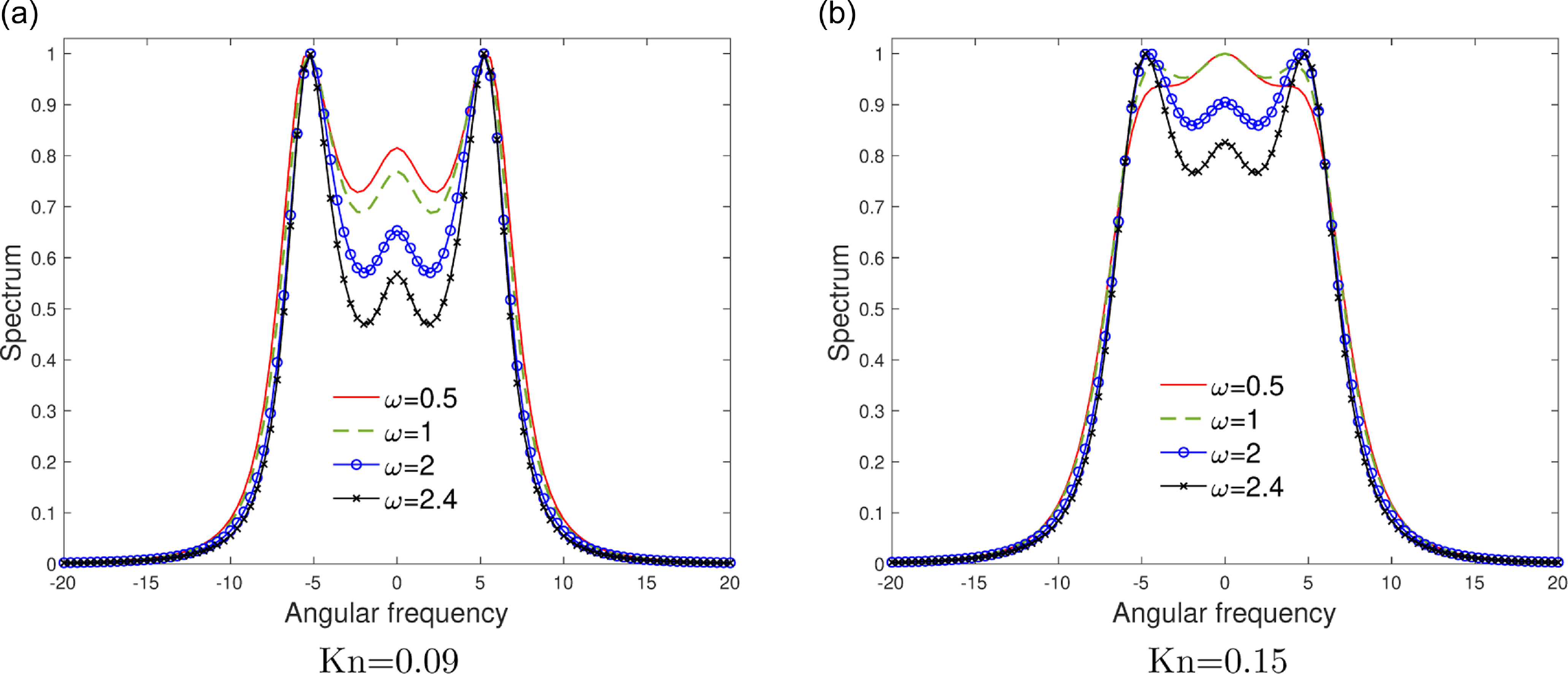
This phenomenon can be explained in terms of the collision frequency defined in (2.8). For Maxwellian molecules ( $\omega = 1$
), the collision kernel (2.4) is independent of the relative collision speed and, consequently, the equilibrium collision frequency (2.8) does not depend on the molecular velocity. In contrast, for a hard-sphere gas (
$\omega = 1$
), the collision kernel (2.4) is independent of the relative collision speed and, consequently, the equilibrium collision frequency (2.8) does not depend on the molecular velocity. In contrast, for a hard-sphere gas ( $\omega = 0.5$
), the equilibrium collision frequency increases with the molecular speed
$\omega = 0.5$
), the equilibrium collision frequency increases with the molecular speed $v$
, see figure 13 of Wu et al. (Reference Wu, White, Scanlon, Reese and Zhang2013). This implies that for
$v$
, see figure 13 of Wu et al. (Reference Wu, White, Scanlon, Reese and Zhang2013). This implies that for $v \approx 0$
, the collision frequency is lower than that of a Maxwellian gas, corresponding to an effectively larger Knudsen number (fewer collisions, larger viscosity and, hence, a larger Knudsen number). Since at
$v \approx 0$
, the collision frequency is lower than that of a Maxwellian gas, corresponding to an effectively larger Knudsen number (fewer collisions, larger viscosity and, hence, a larger Knudsen number). Since at ${\textrm{Kn}} \approx 0.09$
the magnitude of the Rayleigh peak increases with the Knudsen number (see Figure 1), the Rayleigh peak of the hard-sphere gas is higher than that of the Maxwellian gas, as shown in Figure 2a. By contrast, for a soft potential with
${\textrm{Kn}} \approx 0.09$
the magnitude of the Rayleigh peak increases with the Knudsen number (see Figure 1), the Rayleigh peak of the hard-sphere gas is higher than that of the Maxwellian gas, as shown in Figure 2a. By contrast, for a soft potential with $\omega \gt 1$
, the equilibrium collision frequency decreases with increasing molecular speed
$\omega \gt 1$
, the equilibrium collision frequency decreases with increasing molecular speed $v$
. Consequently, for
$v$
. Consequently, for $v \sim 0$
, the effective Knudsen number is smaller and the magnitude of Rayleigh peak is reduced.
$v \sim 0$
, the effective Knudsen number is smaller and the magnitude of Rayleigh peak is reduced.
3.2. Influence of chirp rate
Now, we solve the linearised Boltzmann equation (2.7) with the chirped optical lattice to investigate the effect of the chirp rate $\beta$
. We choose the normalised angular frequency range
$\beta$
. We choose the normalised angular frequency range $\omega _{\text{min}}=-8\pi$
and
$\omega _{\text{min}}=-8\pi$
and $\omega _{\text{max}}=8\pi$
, corresponding to lattice speeds in the range
$\omega _{\text{max}}=8\pi$
, corresponding to lattice speeds in the range $[-4v_m,4v_m]$
, which is sufficiently wide to cover the entire line shape. The chirp rate is controlled by the chirp duration
$[-4v_m,4v_m]$
, which is sufficiently wide to cover the entire line shape. The chirp rate is controlled by the chirp duration $\tau$
in (2.2), which is normalised by
$\tau$
in (2.2), which is normalised by $\lambda /v_m$
. The Maxwellian gas is considered.
$\lambda /v_m$
. The Maxwellian gas is considered.
Chirped CRBS spectra for Maxwell gas at different chirp duration $\tau$
.
$\tau$
.
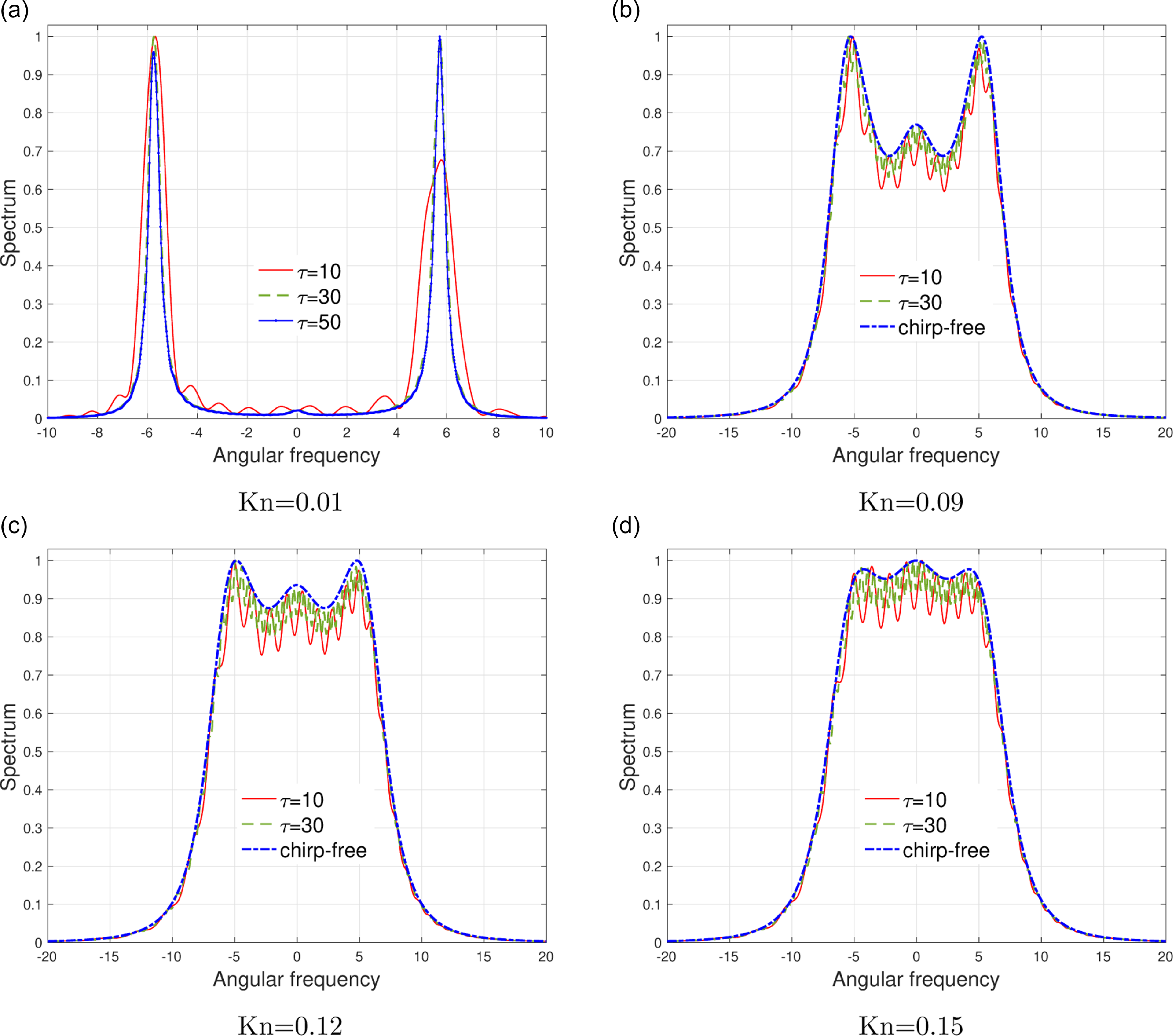
Figure 3a shows the CRBS spectra at three different chirp durations for Kn = 0.01. At a fast chirp rate ( $\tau = 10$
), the line shape becomes clearly asymmetric: the right Brillouin peak is significantly lower than the left one, consistent with the observations reported by Suzuki et al. (Reference Suzuki, Gerakis and Hara2024). Furthermore, we observe that the central Rayleigh peak develops fine ripples. When
$\tau = 10$
), the line shape becomes clearly asymmetric: the right Brillouin peak is significantly lower than the left one, consistent with the observations reported by Suzuki et al. (Reference Suzuki, Gerakis and Hara2024). Furthermore, we observe that the central Rayleigh peak develops fine ripples. When $\tau = 30$
, the CRBS spectrum regains symmetry and these ripples nearly vanish. At
$\tau = 30$
, the CRBS spectrum regains symmetry and these ripples nearly vanish. At $\tau = 50$
, however, a slight asymmetry reemerges, but now the right Brillouin peak becoming slightly higher than the left.
$\tau = 50$
, however, a slight asymmetry reemerges, but now the right Brillouin peak becoming slightly higher than the left.
Figure 3b shows the CRBS spectra at ${\textrm{Kn}} = 0.09$
. For the chirped laser, slight asymmetries are observed, with the right Brillouin peak appearing lower than the left. In addition, fine ripples emerge in the Rayleigh peak. As the Knudsen number increases further, the Rayleigh and Brillouin peaks begin to overlap, leading to a flattened line shape near the central frequency, as shown in Figures 3c and 3d. In this regime, the spectral asymmetry becomes less discernible, although the fine ripples persist. These results indicate that the pronounced spectral asymmetry originates from collisional effects of the gas molecules.
${\textrm{Kn}} = 0.09$
. For the chirped laser, slight asymmetries are observed, with the right Brillouin peak appearing lower than the left. In addition, fine ripples emerge in the Rayleigh peak. As the Knudsen number increases further, the Rayleigh and Brillouin peaks begin to overlap, leading to a flattened line shape near the central frequency, as shown in Figures 3c and 3d. In this regime, the spectral asymmetry becomes less discernible, although the fine ripples persist. These results indicate that the pronounced spectral asymmetry originates from collisional effects of the gas molecules.
In all cases, the oscillation amplitude of the fine ripples gradually decreases as the chirp duration increases (i.e. as the chirp rate decreases). However, the oscillation frequency tends to increase with the chirp duration. In fact, Figure 3 indicates that the oscillation period (i.e. the number of ripples) is approximately equal to the normalised chirp duration $\tau$
, independent of the Knudsen number. Thus, this behaviour cannot be attributed to collisional effects of the gas molecules. At sufficiently large values of
$\tau$
, independent of the Knudsen number. Thus, this behaviour cannot be attributed to collisional effects of the gas molecules. At sufficiently large values of $\tau$
, the spectrum eventually converges to the chirp-free case described in Figure 2a.
$\tau$
, the spectrum eventually converges to the chirp-free case described in Figure 2a.
4. CRBS of polyatomic gas
The case of a polyatomic gas is considerably more complex than that of a monatomic gas. This is because the governing kinetic equation – the Wang-Chang and Uhlenbeck equation (Wang-Chang & Uhlenbeck Reference Wang-Chang and Uhlenbeck1951), which generalises the Boltzmann equation to account for quantum energy levels associated with rotational and vibrational motions – is significantly more difficult to solve. This is why the simplified Tenti model (Tenti et al. Reference Tenti, Boley and Desai1974; Pan et al. Reference Wu, White, Scanlon, Reese and Zhang2005) is commonly employed to calculate the SRBS and CRBS spectra. Clearly, this model does not account for the general intermolecular potential, but only for Maxwellian potential where $\omega =1$
.
$\omega =1$
.
In this paper, we employ the kinetic model for non-vibrating polyatomic gases (Wu et al. Reference Wu, White, Scanlon, Reese and Zhang2015), in which translational motion is described by the Boltzmann collision operator, allowing the effects of the intermolecular potential to be captured. Only internal rotational motion is considered, since the scattering frequency in CRBS is sufficiently large that vibrational motion remains effectively frozen. In this case, in addition to the Knudsen number, viscosity index and chirp rate, the CRBS spectrum also depends on the rotational degrees of freedom $d_r$
, the rotational collision number
$d_r$
, the rotational collision number $Z$
, the translational Eucken factor
$Z$
, the translational Eucken factor $f_{t}$
and the rotational Eucken factor
$f_{t}$
and the rotational Eucken factor $f_{r}$
.
$f_{r}$
.
The rotational collision number $Z$
characterises the rate of energy exchange between rotational and translational modes, as described by the Landau–Teller equation:
$Z$
characterises the rate of energy exchange between rotational and translational modes, as described by the Landau–Teller equation:
 \begin{equation} \frac {\text{d}{T_t}}{\text{d} t}=-\frac {d_r}{3}\frac {T_t-T_r}{Z\mu (T_0)/n_0k_BT_0}, \end{equation}
where $T_r$
denotes the rotational temperature. Because thermal equilibrium with translational motion is reached only after a finite relaxation time, a polyatomic gas exhibits a bulk viscosity given by
$T_r$
denotes the rotational temperature. Because thermal equilibrium with translational motion is reached only after a finite relaxation time, a polyatomic gas exhibits a bulk viscosity given by ${\mu _b}=[{2d_r}/{3(d_r+3)}]Z\mu$
.
${\mu _b}=[{2d_r}/{3(d_r+3)}]Z\mu$
.
The study of molecular thermal conductivity is more complex than that of bulk viscosity, particularly in the context of Rayleigh–Brillouin scattering applications. The heat flux of a molecular gas consists of two contributions: one from the transfer of kinetic energy due to molecular translational motion and the other from the transfer of internal energy due to molecular diffusion. Historically, Eucken first expressed the relationship between the molecular thermal conductivity $\kappa$
and the molecular shear viscosity
$\kappa$
and the molecular shear viscosity $\mu$
as (Eucken Reference Wu, White, Scanlon, Reese and Zhang1913)
$\mu$
as (Eucken Reference Wu, White, Scanlon, Reese and Zhang1913)
 \begin{equation} \begin{aligned} \frac {\kappa m}{\mu k_B}=\frac {\kappa _{t} m}{\mu k_B}+\frac {\kappa _{r} m}{\mu k_B} +\frac {\kappa _{v} m}{\mu k_B} \equiv \frac {3}{2}f_{t}+\frac {d_r}{2}f_{r}+\frac {d_v}{2}f_{v}, \end{aligned} \end{equation}
where $d_v$
is the vibrational degrees of freedom,
$d_v$
is the vibrational degrees of freedom, $\kappa _{t}$
,
$\kappa _{t}$
, $\kappa _{r}$
and
$\kappa _{r}$
and $\kappa _{v}$
are the translational, rotational and vibrational components of the thermal conductivity of gas molecules, respectively, while
$\kappa _{v}$
are the translational, rotational and vibrational components of the thermal conductivity of gas molecules, respectively, while $f_{t}$
,
$f_{t}$
, $f_{r}$
and
$f_{r}$
and $f_v$
are the translational, rotational and vibrational Eucken factors, respectively. For monatomic gases,
$f_v$
are the translational, rotational and vibrational Eucken factors, respectively. For monatomic gases, $f_{t}$
is very close to
$f_{t}$
is very close to $5/2$
. However, for molecular gases, the values of
$5/2$
. However, for molecular gases, the values of $f_{t}$
,
$f_{t}$
, $f_{r}$
and
$f_{r}$
and $f_{v}$
are difficult to determine, since experiments measure only the total heat flux rather than its individual components.
$f_{v}$
are difficult to determine, since experiments measure only the total heat flux rather than its individual components.
Chirp-free CRBS spectra of polyatomic gas with different values of rotational collision number $Z$
, with rotational degrees of freedom
$Z$
, with rotational degrees of freedom $d_r=2$
, translational Eucken factor
$d_r=2$
, translational Eucken factor $f_t=2.4$
and rotational Eucken factor
$f_t=2.4$
and rotational Eucken factor $f_r=1.5$
.
$f_r=1.5$
.

Here, the following kinetic model proposed by Wu et al. (Reference Wu, Liu, Zhang and Reese2015, Reference Wu, Li, Liu and Ubachs2020) is employed:
 \begin{equation} \begin{aligned} \frac {\partial {h}}{\partial {t}}&+2\pi {i}v_2{h} -\exp \left [i\left (\omega _{\text{min}}t+\frac {\beta }{2}t^2\right )\right ]v_2f_{eq}=\mathcal{L}(h)\\ & +\sqrt {\frac {\pi }{4}}\frac {1}{\textrm{Kn}}\left [\frac {T-T_t}{Z}\left (v^2-\frac {3}{2}\right ) +\left (\frac {8}{15}-\frac {4}{3f_t}\right )q_{t2}v_2\left (v^2-\frac {5}{2}\right )\right ]{f_{eq}}, \\ \frac {\partial {h_2}}{\partial {t}}&+2\pi {i}v_2{h_2} -\left (1-\frac {d_r}{2}\right )\exp \left [i\left (\omega _{\text{min}}t+\frac {\beta }{2}t^2\right )\right ]v_2f_{eq} =\sqrt {\frac {\pi }{4}}\frac {1}{\textrm{Kn}}\left [\frac {d_r}{2}T_rf_{eq}-h_2\right ]\\ & + \frac {d_r}{2Z}\sqrt {\frac {\pi }{4}}\frac {1}{\textrm{Kn}}(T-T_r)f_{eq} +2\sqrt {\frac {\pi }{4}}\frac {1}{\textrm{Kn}}\frac {f_r-1}{f_r} q_{r2}v_2f_{eq}, \end{aligned} \end{equation}
where $T=(3T_t+d_rT_r)/(3+d_r)$
, the rotational temperature is
$T=(3T_t+d_rT_r)/(3+d_r)$
, the rotational temperature is $T_r=(2/d_r)\int {h_2}\,\text{d}\boldsymbol{v}$
and the rotational heat flux is
$T_r=(2/d_r)\int {h_2}\,\text{d}\boldsymbol{v}$
and the rotational heat flux is $q_{r2}=\int {v_2h_2}\,\text{d}\boldsymbol{v}$
. Here,
$q_{r2}=\int {v_2h_2}\,\text{d}\boldsymbol{v}$
. Here, $h$
represents the translational motion of the gas molecules, for which the collision operator is identical to the linearised Boltzmann collision operator for a monatomic gas, to account for the effects of intermolecular potential. In contrast,
$h$
represents the translational motion of the gas molecules, for which the collision operator is identical to the linearised Boltzmann collision operator for a monatomic gas, to account for the effects of intermolecular potential. In contrast, $h_2$
accounts for translational–rotational energy exchange and heat-flux relaxation, which are modelled using a relaxation-time approximation to recover the transport coefficients such as bulk viscosity and thermal conductivities.
$h_2$
accounts for translational–rotational energy exchange and heat-flux relaxation, which are modelled using a relaxation-time approximation to recover the transport coefficients such as bulk viscosity and thermal conductivities.
For a given set of the Knudsen number and viscosity index, each line shape can be computed in approximately one minute using the in-house MATLAB programme $\text{CRBS}_{-}\text{polyatomic}$
provided in the supplementary material. Figure 4 presents typical chirp-free CRBS spectra of a polyatomic gas with two rotational degrees of freedom, shown for both a Maxwellian gas and a soft potential with
$\text{CRBS}_{-}\text{polyatomic}$
provided in the supplementary material. Figure 4 presents typical chirp-free CRBS spectra of a polyatomic gas with two rotational degrees of freedom, shown for both a Maxwellian gas and a soft potential with $\omega = 2.4$
. For comparison, the corresponding spectra of a monatomic gas are also included. At Kn = 0.04, when the rotational collision number
$\omega = 2.4$
. For comparison, the corresponding spectra of a monatomic gas are also included. At Kn = 0.04, when the rotational collision number $Z$
is small, the rotational degrees of freedom are efficiently excited, leading to Brillouin peaks at an angular frequency of
$Z$
is small, the rotational degrees of freedom are efficiently excited, leading to Brillouin peaks at an angular frequency of $2\pi \sqrt {7/10}$
, which corresponds to the sound speed of a polyatomic gas with
$2\pi \sqrt {7/10}$
, which corresponds to the sound speed of a polyatomic gas with $d_r = 2$
. In contrast, when
$d_r = 2$
. In contrast, when $Z = 50$
, the exchange between translational and rotational energies becomes slow, and the rotational motion can effectively be regarded as frozen. In this limit, the dynamics of the polyatomic gas reduce to those of a monatomic gas and the Brillouin peak shifts to
$Z = 50$
, the exchange between translational and rotational energies becomes slow, and the rotational motion can effectively be regarded as frozen. In this limit, the dynamics of the polyatomic gas reduce to those of a monatomic gas and the Brillouin peak shifts to $2\pi \sqrt {5/6}$
. At Kn = 0.09, a small value of
$2\pi \sqrt {5/6}$
. At Kn = 0.09, a small value of $Z$
reduces the magnitude of the Rayleigh peaks and the line shape of the polyatomic gas rapidly approaches that of a monatomic gas at smaller
$Z$
reduces the magnitude of the Rayleigh peaks and the line shape of the polyatomic gas rapidly approaches that of a monatomic gas at smaller $Z$
. This occurs because translational collisions are weaker than in the case of Kn = 0.04, causing the rotational motion to freeze earlier.
$Z$
. This occurs because translational collisions are weaker than in the case of Kn = 0.04, causing the rotational motion to freeze earlier.
Figure 5 shows chirped CRBS spectra of a polyatomic Maxwell gas for different chirp durations. Similar to the monatomic case, a short chirp duration ( $\tau = 5$
) produces asymmetric spectra and pronounced ripples in the Rayleigh peak. As the chirp duration increases, both the degree of spectral asymmetry and the ripple amplitude decrease, while the ripple frequency increases.
$\tau = 5$
) produces asymmetric spectra and pronounced ripples in the Rayleigh peak. As the chirp duration increases, both the degree of spectral asymmetry and the ripple amplitude decrease, while the ripple frequency increases.
Chirped CRBS spectra for a polyatomic Maxwell gas at different chirp duration $\tau$
, when Kn = 0.09, the rotational degrees of freedom is
$\tau$
, when Kn = 0.09, the rotational degrees of freedom is $d_r=2$
, the rotational collision number is
$d_r=2$
, the rotational collision number is $Z=1$
, the translational Eucken factor is
$Z=1$
, the translational Eucken factor is $f_t=2.4$
and the rotational Eucken factor is
$f_t=2.4$
and the rotational Eucken factor is $f_r=1.5$
.
$f_r=1.5$
.

5. Conclusions
In this work, we developed a fast deterministic solver based on the linearised Boltzmann equation to compute CRBS spectra with high accuracy and efficiency. Each line shape can be obtained within approximately one minute, making systematic parametric studies feasible. Our analysis revealed that the CRBS spectrum is highly sensitive to the intermolecular potential in the kinetic regime, where the magnitude of the Rayleigh peak depends strongly on the viscosity index. In particular, when the Knudsen number is fixed, gases modelled by softer potentials exhibit lower Rayleigh peaks, whereas hard-sphere gases yield enhanced Rayleigh scattering compared with Maxwellian molecules. These trends were interpreted in terms of the velocity dependence of the collision frequency and the resulting effective Knudsen number. We further found that increasing the chirp rate produces asymmetric line shapes and fine oscillatory structures near the Rayleigh peak.
The present computational framework provides both physical insights and a practical tool for interpreting experimental data, paving the way for high-fidelity non-intrusive diagnostics of rarefied gas flows.
Supplementary material
The supplementary material for this article can be found at https://doi.org/10.1017/flo.2026.10041.
Declaration of interests
The authors declare no competing interests.
Data availability statement
The datasets generated and/or analysed during the current study are available from the corresponding author upon reasonable request. In addition, the MATLAB source codes are provided in the supplementary material.




 Open access

