


Introduction
Digital transformation has revolutionized global connectivity, bringing the power to unite people and ideas, and in this way, facilitating unprecedented levels of interconnection across the world. The evolution of technology in present times is breaking down borders and boundaries, enabling a seamless and interconnected global environment (Vial, Reference Vial2019). As a result, collaboration among employees in diverse locations and in real time has become significantly more streamlined, allowing tasks to be increasingly performed remotely (Kargina, Reference Kargina2023). Building on these developments, technological advancements have further facilitated the modularization of work, enhancing the coordination of different activities across various locations and contributing to a shift toward more fluid organizational models (Birkinshaw, Reference Birkinshaw2022). In digitally mediated environments, firms may increasingly rely on geographically distributed but organizationally bounded coordination mechanisms when managing international activities (Botella-Andreu, Pla-Barber & Rocafull, Reference Botella-Andreu, Pla-Barber and Rocafull2025). Such arrangements highlight how spatial distribution may expand access to locally embedded knowledge while simultaneously constraining integration and coordination across dispersed organizational units.
The physical dispersion of employees as well as members of teams is a reality that encourages analyzing the effects that these new situations are having on companies (Caligiuri, De Cieri, Minbaeva, Verbeke & Zimmermann, Reference Caligiuri, De Cieri, Minbaeva, Verbeke and Zimmermann2020; O’Leary & Mortensen, Reference O’Leary and Mortensen2010). Research on distance and proximity between teams has been a prolific area of study (O’Leary & Cummings, Reference O’Leary and Cummings2007). Specifically, investigations into physical distances reveal their impact on interactions, communication frequency, and friendships (Festinger, Reference Festinger1950; Monge, Rothman, Eisenberg, Miller & Kriste, Reference Monge, Rothman, Eisenberg, Miller and Kriste1985). At the same time, researchers in the field also point to the potential detrimental effects of team members being geographically dispersed, such as increased conflict (Mortensen & Hinds, Reference Mortensen and Hinds2001). In parallel, with the flourishing of communication technologies, teams become virtual to facilitate around-the-clock work and to allow the most qualified individuals to be assigned to a project team. As such dispersion increases, virtual teams (VTs) tend to experience even greater and more diverse conflict compared to collocated teams (CTs) (Wakefield, Leidner & Garrison, Reference Wakefield, Leidner and Garrison2008).
Extending this discussion to the executive level, top management teams (TMTs) represent a key team within organizations since strategic outcomes of an organization are driven by their decision-making (Hambrick & Mason, Reference Hambrick and Mason1984). Previous studies have provided a broad overview of the field on TMT structure (Hambrick & Cannella, Reference Hambrick and Cannella2004; Hambrick, Humphrey & Gupta, Reference Hambrick, Humphrey and Gupta2015; Li, Xin, Tsui & Hambrick, Reference Li, Xin, Tsui and Hambrick1999), composition (Carpenter, Geletkanycz & Sanders, Reference Carpenter, Geletkanycz and Sanders2004; Hambrick, Reference Hambrick1994), and diversity (Hambrick, Cho & Chen, Reference Hambrick, Cho and Chen1996; Lubatkin, Simsek, Ling & Veiga, Reference Lubatkin, Simsek, Ling and Veiga2006; Wiersema & Bantel, Reference Wiersema and Bantel1992). Accordingly, contributions to this line of thought consider the role of diversity and conflict as important drivers of team and firm performance (Diaz-Fernandez, Gonzalez-Rodriguez & Simonetti, Reference Diaz-Fernandez, Gonzalez-Rodriguez and Simonetti2020; Garcia-Granero, Fernandez-Mesa, Jansen & Vega-Jurado, Reference Garcia-Granero, Fernandez-Mesa, Jansen and Vega-Jurado2018). Nonetheless, despite the efforts that have been dedicated to demographic, cognitive and, recently, psychological profile diversity (Kristinsson, Candi & Saemundsson, Reference Kristinsson, Candi and Saemundsson2016; McHugh & Duane, Reference McHugh and Duane2025), few articles mention the challenges of TMT geographic dispersion as a characteristic of the team (Cannella, Park & Lee, Reference Cannella, Park and Lee2008). Considering the current environment, the impact of digitalization, and the need to form diverse teams, our work focuses on integrating the geographical dispersion of TMTs as a new central element to be considered. This focus is consistent with recent research guidelines that explicitly call for examining TMT member co-location versus geographic dispersion, and for assessing how such spatial configurations shape strategic choices and organizational outcomes (Cuypers, Patel, Ertug, Li & Cuypers, Reference Cuypers, Patel, Ertug, Li and Cuypers2022). However, despite this call, existing research on TMT spatial configurations remains fragmented across multiple literature streams and relies on heterogeneous conceptualizations of dispersion and virtuality and offers limited cumulative insights. This fragmentation underscores the need for a systematic synthesis of prior work.
This gap is particularly salient in multinational organizations, where the international distribution of subsidiaries and business units often results in TMTs operating across multiple locations. In such contexts, the geographic distribution of executives is not just a logistical feature but may shape how strategic decisions are formulated, interpreted, and implemented across organizational units. While spatial dispersion may expand access to geographically embedded expertise and local market knowledge, it may simultaneously constrain coordination capacity and alignment across organizational units. As such, executive spatial configuration may introduce competing strategic demands that influence both the integration of distributed knowledge and the consistent implementation of strategic initiatives across locations. However, insights regarding the drivers and implications of TMT spatial configurations are dispersed across studies focusing on geographically distributed collaboration more broadly, limiting cumulative understanding of how executive interaction unfolds across spatial boundaries.
To address this limitation, we conduct a systematic literature review that integrates spatial theory and the upper echelons perspective in order to examine the antecedents and organizational implications of TMT spatial configuration. By synthesizing insights from research on collocated, geographically dispersed, and virtual teams, this study conceptualizes executive spatial configuration as a structural condition that influences how top managers interpret environmental information, integrate geographically distributed expertise, and coordinate strategic initiatives across locations.
Against this background, our study makes several contributions to TMT literature. First, we provide a systematic synthesis of 51 studies examining the spatial dimensions of TMTs published up to 2025, thereby advancing understanding of how the geographic distribution of executives shapes strategic leadership processes. Second, we integrate insights from the dispersed team (DT) literature with upper echelons theory to identify the multilevel antecedents, mechanisms, and organizational outcomes associated with executive spatial configurations. Third, by conceptualizing spatial configuration as a design dimension of TMTs, we develop a framework capturing three spatial arrangements, collocation, dispersion, and virtuality, and their implications for decision formulation and implementation across geographically distributed organizational units.
Theoretical backgrounds
Spatial dimensions: definitions and types
The conceptualization of spatial dimensions has been a topic of research in the fields of physics, geology, geography, or even neurology. In the scope of business and economics, the vast literature is referred to the different locations of resources and capabilities within firms’ networks, such as multinational locations and operational activities (Yu & Cannella, Reference Yu and Cannella2007). In the field of international business, spatial dimensions are typically perceived as an inherent cost of international activities. This perception stems from the understanding that greater distances lead to increased communication costs and necessitate additional coordination efforts (Dunning, Reference Dunning2001). Consequently, conventional literature posits that spatial dimensions, synonymous with distance, introduce friction and complexity into international activities (Hutzschenreuter, Kleindienst & Lange, Reference Hutzschenreuter, Kleindienst and Lange2016; Vermeulen & Barkema, Reference Vermeulen and Barkema2002). More recently, economic geography perspectives emphasize the potential benefits of proximity and co-location, suggesting that physical arrangements may influence knowledge flows, collaboration, and decision-making (Castellani & Lavoratori, Reference Castellani and Lavoratori2020).
The term ‘spatial dimension’ refers to the physical location, distribution, and configuration of elements in a given space. In organizational contexts, this includes how individuals, teams, and resources are physically positioned and coordinated within a workspace. An explicit definition of spatial dimension can be found in O’Leary and Cummings (Reference O’Leary and Cummings2007, p.434), where it is defined as ‘the average spatial distance among team members’, and moreover defines the spatial configuration as ‘the number of sites at which members are located, their isolation from other members, and the balance between subgroups of members across sites’.
Considering these definitions, we can identify two main spatial dimensions depending on the position of the team members. Therefore, if members work at the same site, we could say that they are collocated (Cannella et al., Reference Cannella, Park and Lee2008), and if they work at different sites, we could say that they are dispersed (O’Leary & Cummings, Reference O’Leary and Cummings2007). Accordingly, we introduce these two dimensions: collocation and dispersion. Furthermore, digital transformation has impacted the spatial dimension of some teams, thus emerging a new type of team: VTs. Jarvenpaa and Leidner (Reference Jarvenpaa and Leidner1999, p.1) defined them as teams whose ‘members are separated by location and culture, challenged by a common collaborative project, and for whom the only economically and practically viable communication medium was asynchronous and synchronous computer-mediated communication’. Specifically, a team is considered virtual when ‘the members of the team are geographically dispersed and the team relies on technology-mediated communications rather than face-to-face interaction to accomplish their tasks’ (Gibson & Cohen, Reference Gibson and Cohen2003, p. 4).
Several studies argue that the distinction between the three dimensions is unrealistic (Kirkman, Rosen, Tesluk & Gibson, Reference Kirkman, Rosen, Tesluk and Gibson2004) since some CTs alternate face-to-face to virtual communication and moreover, globally DT s that use technology to communicate have regularly face-to-face meetings. Nevertheless, other studies (Cramton, Reference Cramton2001; Hinds & Bailey, Reference Hinds and Bailey2003; Maznevski & Chudoba, Reference Maznevski and Chudoba2000; O’Leary & Cummings, Reference O’Leary and Cummings2007) base their research on the main differences depending on the location of team members, accordingly if they are located at the same site (collocated), at different site (dispersed) or frequently use technology to communicate and rarely meet in-person (virtual).
Table 1 provides a conceptual overview of the terminology and definitions used to describe team spatial configurations in the broader literature. Its purpose is to clarify definitional heterogeneity and establish a common vocabulary for the review. Each row in Table 1 corresponds to a specific term used in the literature to describe team spatial configurations. The first column reports the term employed by authors, the second column provides its core definition as articulated or implied in the original studies, the third column identifies the typical context in which the term has been applied, and the last column lists representative studies using that terminology. Importantly, the table serves a definitional and classificatory purpose and does not synthesize empirical findings, which are derived exclusively from the systematic review presented in the findings section.
Conceptual overview of team spatial dimensions and terminology
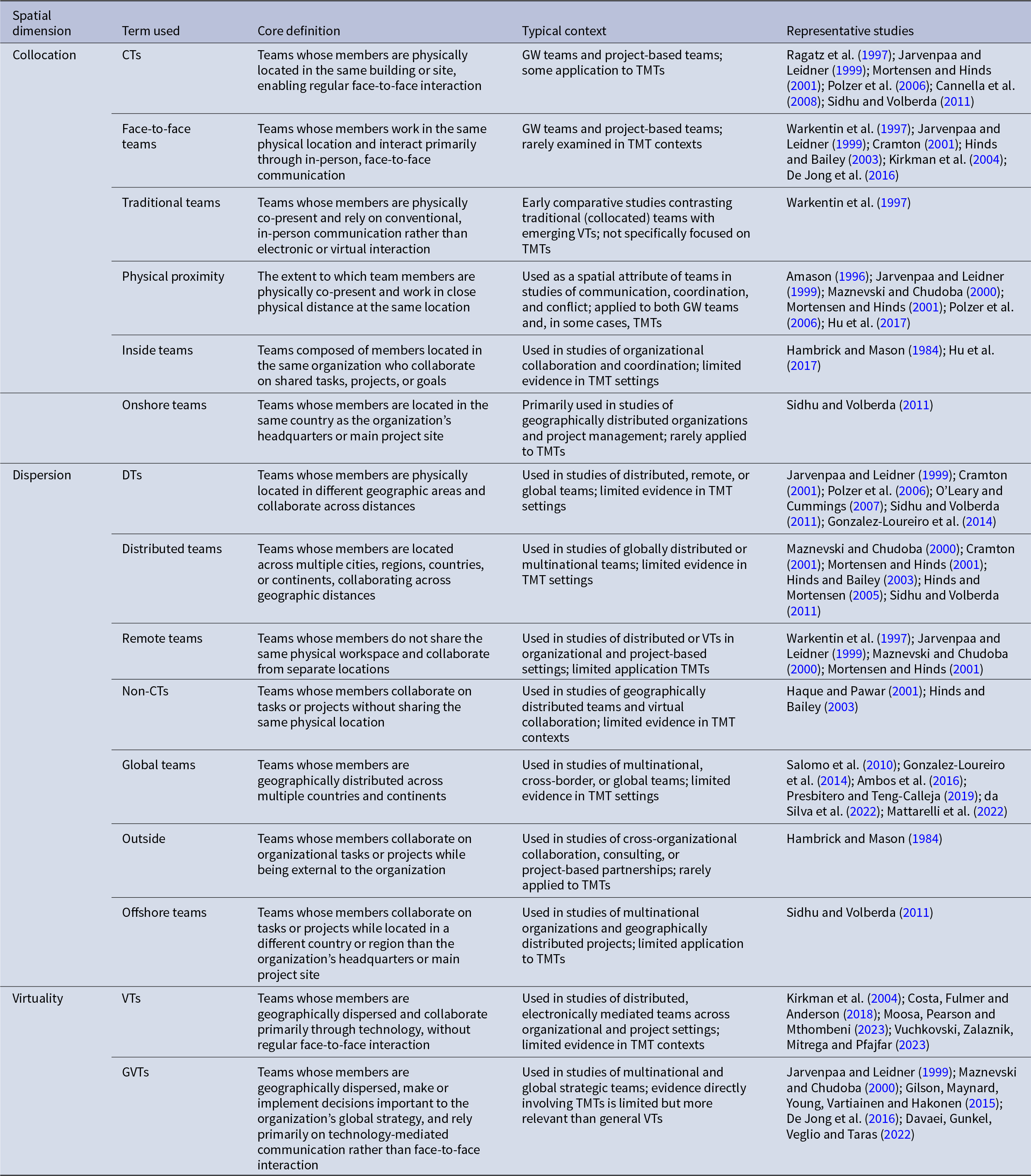
While these categories have been widely studied in general teams’ literature, their application to TMTs remains limited. Given that TMTs make strategic decisions with firm-level consequences, understanding how spatial configuration affects executive cognition, social processes, and strategic processes is crucial.
The following sections examine each dimension, highlighting potential mechanisms and gaps in the literature.
Collocation
Collocation occurs when team members work at the same physical address (Cannella et al., Reference Cannella, Park and Lee2008), can easily see what other members are doing, and in this way, can identify unrelated work processes and notice coordination problems (Hinds & Mortensen, Reference Hinds and Mortensen2005). Traditional teams are CTs that meet face-to-face (Kirkman et al., Reference Kirkman, Rosen, Tesluk and Gibson2004) having a significant number of casual encounters, unplanned conversations, and multiple interactions with diverse purposes (Choi, Reference Choi2025; Haque & Pawar, Reference Haque and Pawar2001; Hinds & Bailey, Reference Hinds and Bailey2003; Jarvenpaa & Leidner, Reference Jarvenpaa and Leidner1999; Lakemond & Berggren, Reference Lakemond and Berggren2006; Mortensen & Hinds, Reference Mortensen and Hinds2001; Polzer, Crisp, Jarvenpaa & Kim, Reference Polzer, Crisp, Jarvenpaa and Kim2006). Moreover, integration of suppliers is successful when members are co-located (Ragatz, Handfield & Scannell, Reference Ragatz, Handfield and Scannell1997). Consequently, collocation enables communication, interaction, and collaboration between members using in-person communication (Barczak, McDonough & Athanassiou, Reference Barczak, McDonough and Athanassiou2006; Breuer, Hueffmeier & Hertel, Reference Breuer, Hueffmeier and Hertel2016; Cramton, Reference Cramton2001; De Jong, Dirks & Gillespie, Reference De Jong, Dirks and Gillespie2016; Warkentin, Sayeed & Hightower, Reference Warkentin, Sayeed and Hightower1997). Ambos, Ambos, Eich and Puck (Reference Ambos, Ambos, Eich and Puck2016) argue that CTs are the ones whose members share a common physical space, physical proximity, working closely in the same location. Additionally, members of inside teams within an organization collaborate on tasks, projects, or goals (Hambrick & Mason, Reference Hambrick and Mason1984; Hu, Chen, Gu, Huang & Liu, Reference Hu, Chen, Gu, Huang and Liu2017). The term onshore refers to teams whose members work in the same country as the primary location of their employer’s headquarters or the main project site (Sidhu & Volberda, Reference Sidhu and Volberda2011).
Therefore, in operational or general teams, collocation is linked to faster coordination and more efficient problem-solving. In the context of TMTs, collocation may improve strategic alignment by facilitating managers to build shared mental models, increase mutual awareness, and rapidly identify coordination problems.
Although collocation seems beneficial for communication between members, its effect on strategic cognition or decision quality at the top level remains largely untested. Thus, an important void in the literature is understanding how managers’ interactions translate into better strategic decision-making compared to dispersed or virtual TMTs.
Dispersion
Dispersion is present when members are located at significant distances from one another, working in different cities or countries and are geographically distributed (Ambos et al., Reference Ambos, Ambos, Eich and Puck2016; Barczak et al., Reference Barczak, McDonough and Athanassiou2006; Cramton, Reference Cramton2001; da Silva, Mosquera & Soares, Reference da Silva, Mosquera and Soares2022; Gonzalez-Loureiro, Dabic & Puig, Reference Gonzalez-Loureiro, Dabic and Puig2014; Jarvenpaa & Leidner, Reference Jarvenpaa and Leidner1999; Muethel & Hoegl, Reference Muethel and Hoegl2010; O’Leary & Cummings, Reference O’Leary and Cummings2007; Polzer et al., Reference Polzer, Crisp, Jarvenpaa and Kim2006; Presbitero & Teng-Calleja, Reference Presbitero and Teng-Calleja2019; Sidhu & Volberda, Reference Sidhu and Volberda2011; Weng, Windeler, Maruping & Venkatesh, Reference Weng, Windeler, Maruping and Venkatesh2024). Moreover, they do not have access to rich visual and sensory data; they lack awareness of the events and actions taking place at remote locations, as well as of the activities of their teammates situated there (Hinds & Mortensen, Reference Hinds and Mortensen2005). When team members are not located in the same physical space and frequently communicate through technology, and work in different time zones or come from diverse cultural backgrounds, they must heavily depend on technological tools due to the distances involved. Distance and the reliance on mediating technologies are the two consistent factors across all distributed teams. Additionally, members of distributed teams often receive less incidental information about their remote colleagues (Hinds & Bailey, Reference Hinds and Bailey2003). Non-CT members work together on projects or tasks but are not physically located in the same place (Haque & Pawar, Reference Haque and Pawar2001). The term global teams refers to teams located across the globe (Ambos et al., Reference Ambos, Ambos, Eich and Puck2016; da Silva et al., Reference da Silva, Mosquera and Soares2022; Gonzalez-Loureiro et al., Reference Gonzalez-Loureiro, Dabic and Puig2014; Mattarelli, Bertolotti, Prencipe & Gupta, Reference Mattarelli, Bertolotti, Prencipe and Gupta2022; Presbitero & Teng-Calleja, Reference Presbitero and Teng-Calleja2019; Salomo, Keinschmidt & de Brentani, Reference Salomo, Keinschmidt and de Brentani2010). Hambrick and Mason (Reference Hambrick and Mason1984) mention in their work the outside teams regarding teams whose members operate outside the organization and collaborate on tasks, projects, or goals. Furthermore, offshore teams are the ones whose members collaborate on projects or tasks while being in a different country or region than the primary location of their employer’s headquarters or main project site (Sidhu & Volberda, Reference Sidhu and Volberda2011). In general teams, dispersion reduces access to informal information, weakens shared awareness, and requires explicit coordination mechanisms (Hinds & Bailey, Reference Hinds and Bailey2003). For TMTs, it could limit informal strategic discussions, reduce opportunities to create consensus and delay decision-making. Moreover, dispersed TMT members may bring diverse perspectives from their locations, therefore, improving strategic insights and global awareness. Furthermore, the transferability of findings from general teams to TMTs is not simple. Unlike operational teams, TMTs make complex decisions that require trust and commitment, which may not be fully captured through virtual or distant communication channels.
Virtuality
VTs refer to an electronically connected work group comprised of individuals with distinct skills, situated in distant locations, who collaborate using technology across geographical and temporal barriers to achieve crucial organizational objectives, without the benefit of face-to-face interaction (Cai, Reference Cai2023; Costa et al., Reference Costa, Fulmer and Anderson2018; Kargina, Reference Kargina2023; Kirkman et al., Reference Kirkman, Rosen, Tesluk and Gibson2004; Moosa et al., Reference Moosa, Pearson and Mthombeni2023; Schreiber, Van Dijk & Drory, Reference Schreiber, Van Dijk and Drory2025; Vuchkovski et al., Reference Vuchkovski, Zalaznik, Mitrega and Pfajfar2023; Weng et al., Reference Weng, Windeler, Maruping and Venkatesh2024). Virtuality allows geographically distributed teams to collaborate flexibly but generates challenges in building trust, coordination, and shared awareness.
In TMTs, virtuality may enable global strategic coordination, allowing executives to participate in decision-making without geographic constraints. Yet it may also hinder the formation of cohesive mental models and rapid strategic alignment, which are crucial for high-level decision-making. Literature currently lacks detailed studies on how virtual TMTs balance for reduced informal interactions, for example, through structured meetings, technology-mediated connections, or knowledge-sharing practices.
Accordingly, global virtual teams (GVTs) are teams whose members are responsible for making and/or implementing decisions important to the organization’s global strategy, use technology-supported communication substantially more than face-to-face communication; and work and live in different countries (Davaei et al., Reference Davaei, Gunkel, Veglio and Taras2022; De Jong et al., Reference De Jong, Dirks and Gillespie2016; Gilson et al., Reference Gilson, Maynard, Young, Vartiainen and Hakonen2015; Greimel, Kanbach & Chelaru, Reference Greimel, Kanbach and Chelaru2023; Handke, Costa, Hincapie & Johnson, Reference Handke, Costa, Hincapie and Johnson2025; Jarvenpaa & Leidner, Reference Jarvenpaa and Leidner1999; Maznevski & Chudoba, Reference Maznevski and Chudoba2000; Sinnemann & Weiss, Reference Sinnemann and Weiss2025; Tavoletti, Bernhard, Dong & Taras, Reference Tavoletti, Bernhard, Dong and Taras2023; Wong, Zhang, Cerne & Moe, Reference Wong, Zhang, Cerne and Moe2024).
While general and operational teams differ from TMTs in decision complexity and responsibility, the mechanisms observed in collocated, dispersed, or VTs, such as effects on coordination, trust, and shared awareness, provide a valuable conceptual starting point. By examining these mechanisms, we can generate testable hypotheses about how similar processes may influence strategic decision-making in TMTs, while explicitly accounting for the unique characteristics of top-level teams.
Method
A systematic literature review was carried out since this enables heterogeneous research methods to be analyzed and thus provides a more comprehensive understanding of the subject (Gaur & Kumar, Reference Gaur and Kumar2018). The review was conducted in accordance with the basic principles of systematic review – rigorous, informative, comprehensive, implicit, and reproducible (Codina, Reference Codina2020) thus ensuring the synthesis of the evidence and the methodological thoroughness of the research.
Our review targeted research centered on spatial dimensions of TMTs, entailing a database search to encompass all relevant studies in this area. In line with previous reviews (Cuypers et al., Reference Cuypers, Patel, Ertug, Li and Cuypers2022; Pla-Barber, Botella-Andreu & Villar, Reference Pla-Barber, Botella-Andreu and Villar2021), the review was conducted in three stages.
Stage 1: Inclusion criteria. To ensure rigor and scholarly quality, we limited our review to peer-reviewed studies published in journals indexed in the Web of Science Core Collection between 1984 and 2025, and written in English, directly or indirectly analyzing the spatial dimensions of TMTs. We selected Web of Science as the primary database because of its focus on scholarly journals, its objective journal selection criteria (e.g., impact, timeliness, and peer review), and its widespread use in academic research (Klang, Wallnöfer & Hacklin, Reference Klang, Wallnöfer and Hacklin2014).
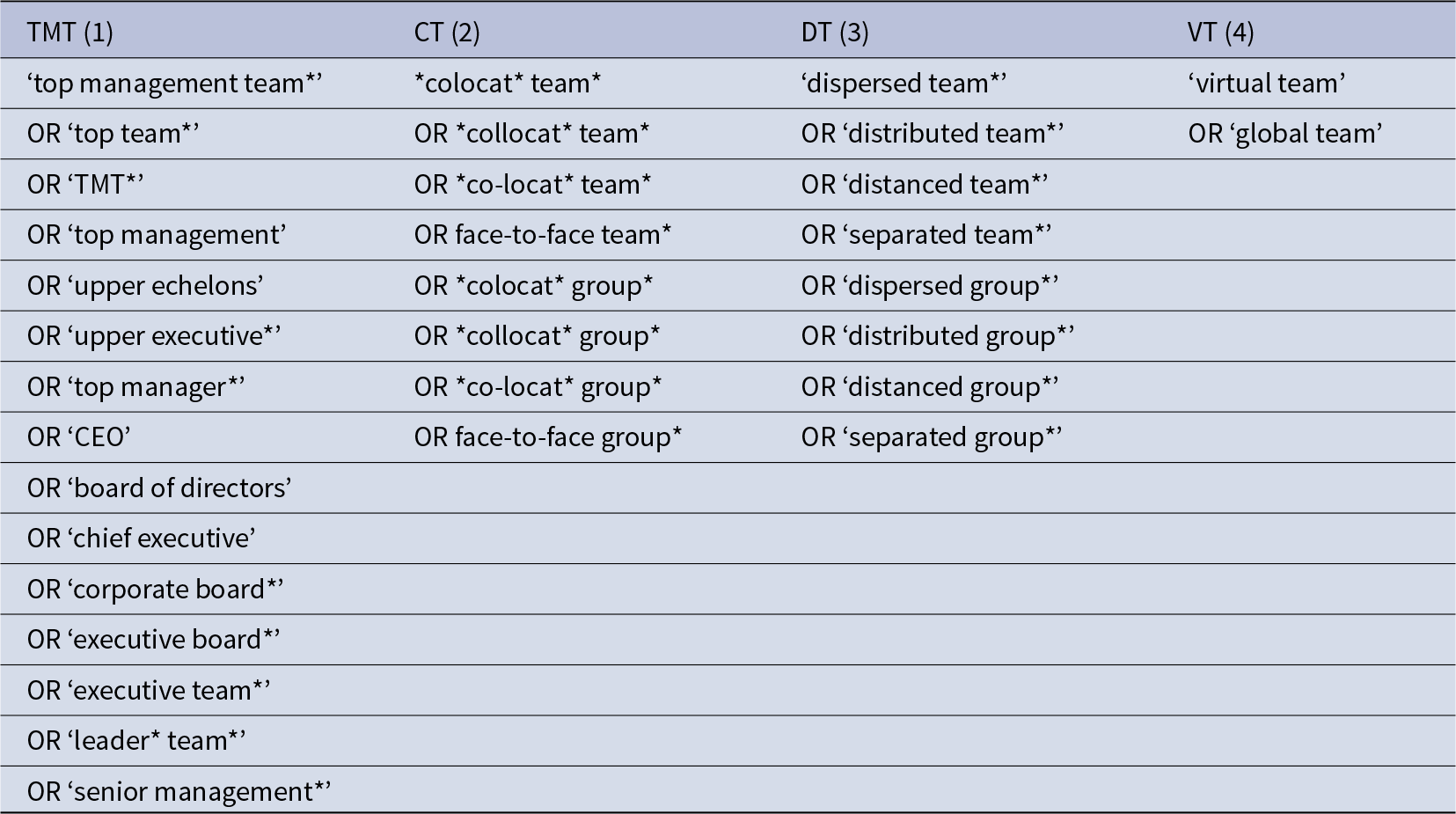
Stage 2: Database search. Articles were searched on the Web of Science Social Sciences Citation Index within the areas of business and economics to ensure that the studies are relevant to strategic and organizational team contexts, particularly TMTs. Search terms focused on three main topics related to spatial dimensions: CTs, DTs, and VTs, including variations of the terms ‘team’ and ‘group’ using truncation symbols and proximity operators. Articles were combined by linking TMT terms with each spatial dimension. Table 2 presents the exact search strings.
Searched topics
Stage 3: Screening and snowballing. After combining the articles included in each dimension and removing duplicates, 49 articles were identified. Titles, abstracts, and keywords were screened for relevance, excluding 10 articles that did not directly relate to TMT spatial dimensions. Excluded studies typically focused on topics such as dispersed information in product development or leadership emergence in multicultural teams, without analyzing spatial effects.
Snowballing was then applied using a backward (ancestry) approach to identify additional studies frequently cited or conceptually relevant to TMT spatial configurations, in order to ensure that no relevant articles were omitted from the initial database search (Wohlin, Reference Wohlin2014). This procedure is consistent with prior reviews in the TMT and team literature (e.g., Ponomareva et al., Reference Ponomareva, Uman, Bodolica and Wennberg2022) and resulted in the inclusion of 12 additional articles. Articles were included if they addressed TMT spatial dimensions (collocation, dispersion, or virtuality) and provided empirical or theoretical insights pertinent to upper echelons research. These studies were published in peer-reviewed management and organizational journals, including Academy of Management Journal (Amason, Reference Amason1996; Gilson et al., Reference Gilson, Maynard, Young, Vartiainen and Hakonen2015; Kirkman et al., Reference Kirkman, Rosen, Tesluk and Gibson2004), Academy of Management Review (Hambrick & Mason, Reference Hambrick and Mason1984), Organization Science (Cramton, Reference Cramton2001; Hinds & Mortensen, Reference Hinds and Mortensen2005; Jarvenpaa & Leidner, Reference Jarvenpaa and Leidner1999; Maznevski & Chudoba, Reference Maznevski and Chudoba2000; O’Leary & Cummings, Reference O’Leary and Cummings2007; Polzer et al., Reference Polzer, Crisp, Jarvenpaa and Kim2006), International Journal of Management Reviews (Taylor & Spicer, Reference Taylor and Spicer2007), and Decision Sciences (Warkentin et al., Reference Warkentin, Sayeed and Hightower1997). The articles were selected based on their conceptual relevance to our research and their prominence in the literature as indicated by citation frequency.
The final sample comprised 51 articles. Figure 1 presents the PRISMA flow diagram detailing identification, screening, eligibility assessment, and inclusion of studies. The reviewed articles span multiple disciplines, including management, operations, and psychology. While this disciplinary diversity reflects the multifaceted nature of research on TMTs, all studies were systematically evaluated and included based on their direct or indirect relevance to TMT spatial dimensions, ensuring coherence in the overall review.
Preferred reporting items for systematic reviews and meta-analysis (PRISMA) flow diagram.

Findings
Descriptive overview of the included studies
Table 3 provides a descriptive overview of the included studies. The final sample comprises 51 studies published between 1984 and 2025, reflecting more than four decades of research examining how the spatial location of team members shapes managerial and organizational outcomes. The temporal distribution of publications reveals a gradual expansion of interest in spatial configurations, with a relatively small number of foundational studies (n = 5) emerging during the 1980s and 1990s, followed by a steady increase in empirical work after the early 2000s. This growth coincides with advances in digital communication technologies and the globalization of organizational work structures, which have made geographically dispersed and virtual collaboration increasingly common (Gilson et al., Reference Gilson, Maynard, Young, Vartiainen and Hakonen2015; Greimel et al., Reference Greimel, Kanbach and Chelaru2023). A further concentration of studies (n = 18) appears in the period following the COVID-19 pandemic, reflecting the widespread adoption of remote and hybrid work arrangements and renewed attention to the managerial implications of virtual collaboration (Davaei et al., Reference Davaei, Gunkel, Veglio and Taras2022; Vuchkovski et al., Reference Vuchkovski, Zalaznik, Mitrega and Pfajfar2023).
Overview of the included studies (n = 51)

Across the reviewed studies, the level of analysis varies substantially, spanning individual, team, multilevel, and firm perspectives. The majority of studies adopt a team-level focus (n = 26), consistent with the central role of teams as coordination mechanisms in contemporary organizations (DeChurch, Mesmer-Magnus & Doty, Reference DeChurch, Mesmer-Magnus and Doty2013; Costa et al., Reference Costa, Fulmer and Anderson2018). However, a smaller subset of studies examines spatial configurations at the firm level (n = 3), particularly in research on TMTs, highlighting how executive location may influence strategic decision-making and organizational performance (Cannella et al., Reference Cannella, Park and Lee2008; Hambrick & Mason, Reference Hambrick and Mason1984). Multilevel approaches are also increasingly visible in more recent research (n = 17), reflecting growing recognition that spatial arrangements simultaneously shape individual perceptions, team dynamics, and organizational outcomes.
The reviewed literature encompasses several types of teams, each associated with distinct coordination challenges and strategic contexts. A significant portion of studies focuses on GVTs and DTs (n = 18), reflecting the prevalence of geographically distributed collaboration in multinational and knowledge-intensive environments (Jarvenpaa & Leidner, Reference Jarvenpaa and Leidner1999; Maznevski & Chudoba, Reference Maznevski and Chudoba2000). Other studies examine product development and innovation teams (PD and IT; n = 11), where spatial proximity is often linked to coordination speed and knowledge integration (Mattarelli et al., Reference Mattarelli, Bertolotti, Prencipe and Gupta2022; Ragatz et al., Reference Ragatz, Handfield and Scannell1997). Research on TMTs (n = 9) represents a smaller but theoretically significant stream, emphasizing the strategic consequences of executive location and the interaction between spatial configuration and upper echelons characteristics (Cannella et al., Reference Cannella, Park and Lee2008; Vuchkovski et al., Reference Vuchkovski, Zalaznik, Mitrega and Pfajfar2023). Finally, several studies investigate general work and specialized teams (GW and ST; n = 13) operating in routine organizational settings, where spatial dispersion influences communication patterns, trust formation, and coordination efficiency (Breuer et al., Reference Breuer, Hueffmeier and Hertel2016; Feitosa et al., Reference Feitosa, Grossman, Kramer and Salas2020; Warkentin et al., Reference Warkentin, Sayeed and Hightower1997).
The reviewed studies draw on a diverse set of theoretical perspectives to explain how spatial configurations influence team dynamics and organizational outcomes. Rather than relying on a single dominant framework, the literature reflects the coexistence of multiple theoretical lenses that address different mechanisms through which geographic distance and virtual interaction shape coordination, trust, conflict, and strategic decision-making.
As summarized in Table 4, the most frequently applied theoretical perspectives include social identity and faultline theories (n = 11) and organizational, systems, and contingency frameworks (n = 11), which conceptualize spatial configuration as either a social boundary (Ambos et al., Reference Ambos, Ambos, Eich and Puck2016; Polzer et al., Reference Polzer, Crisp, Jarvenpaa and Kim2006) or a structural design variable requiring alignment with organizational processes (Gilson et al., Reference Gilson, Maynard, Young, Vartiainen and Hakonen2015; Ragatz et al., Reference Ragatz, Handfield and Scannell1997). Other important streams of research focus on leadership adaptation (Taylor & Spicer, Reference Taylor and Spicer2007; Greimel et al., Reference Greimel, Kanbach and Chelaru2023; n = 7), conflict dynamics (Amason, Reference Amason1996; Hinds & Bailey, Reference Hinds and Bailey2003; n = 6), and trust and psychological states (Jarvenpaa & Leidner, Reference Jarvenpaa and Leidner1999; Breuer et al., Reference Breuer, Hueffmeier and Hertel2016; n = 6), highlighting the relational and behavioral challenges associated with distributed collaboration. A smaller but strategically significant subset of studies draws on strategic leadership and upper echelons theory (Hambrick & Mason, Reference Hambrick and Mason1984; Cannella et al., Reference Cannella, Park and Lee2008; n = 5), emphasizing the implications of executive location for strategic decision-making. Communication and media theories (Maznevski & Chudoba, Reference Maznevski and Chudoba2000; Weng et al., Reference Weng, Windeler, Maruping and Venkatesh2024; n = 5) further explain how communication technologies influence coordination and mutual understanding in dispersed settings.
Theoretical perspectives explaining executive spatial configuration
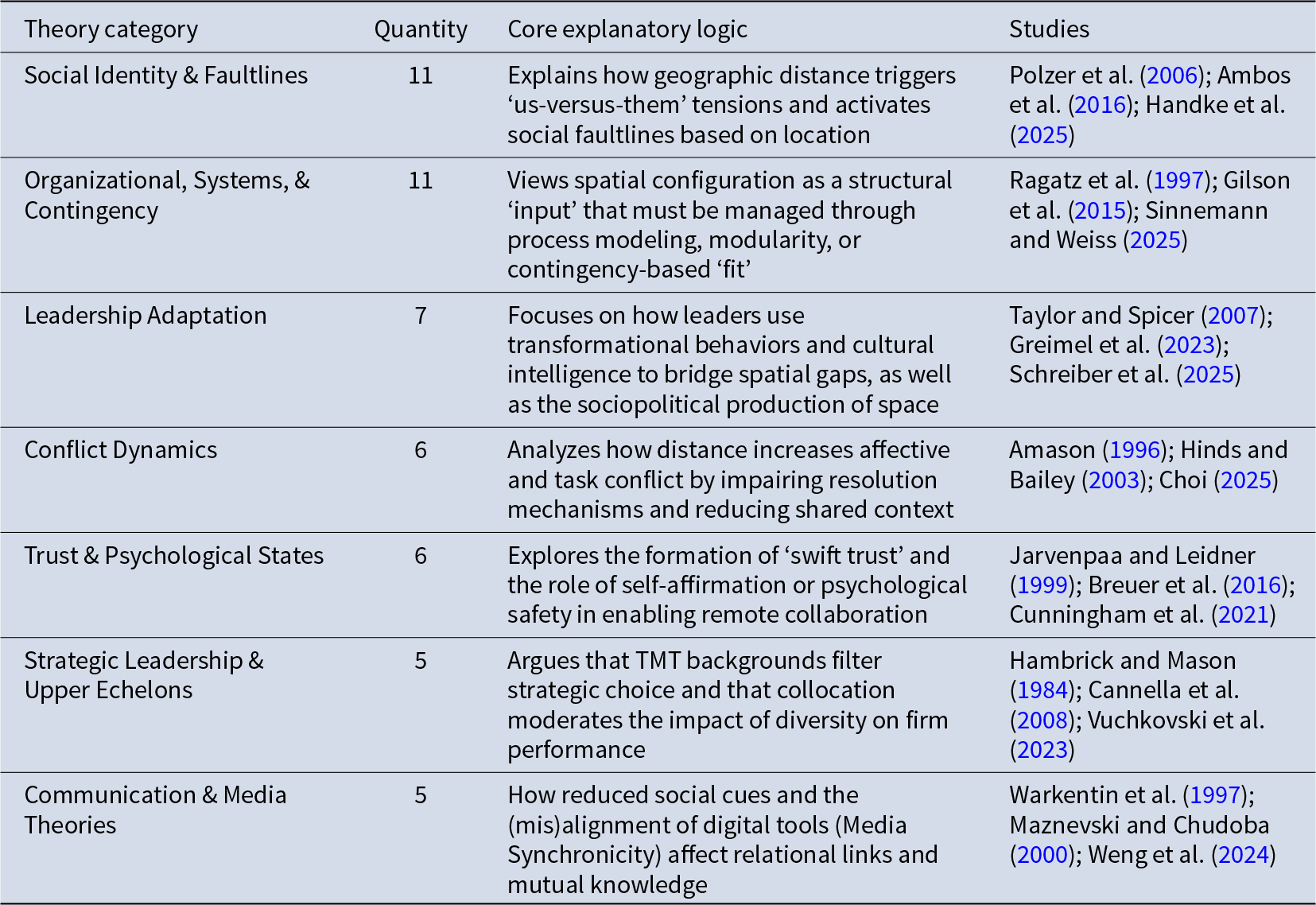
Overall, these theoretical perspectives suggest that spatial configuration affects organizational outcomes through multiple pathways, including social categorization, communication processes, leadership adaptation, and coordination mechanisms. The diversity of theoretical lenses underscores the need for an integrative framework capable of explaining how executive location shapes cognitive, social, and strategic processes at the top of the firm.
Methodologically, the field demonstrates substantial diversity in research designs and analytical approaches. Quantitative studies represent the largest share of the sample (n = 16), including survey-based analyses, archival panel data, and structural equation modeling techniques (Kirkman et al., Reference Kirkman, Rosen, Tesluk and Gibson2004; Xie et al., Reference Xie, Wang and Qi2015). Qualitative and mixed method designs also play an important role, particularly in research exploring complex coordination processes and organizational change (Mattarelli et al., Reference Mattarelli, Bertolotti, Prencipe and Gupta2022; Sidhu & Volberda, Reference Sidhu and Volberda2011). In addition, several meta-analyses and systematic literature reviews synthesize prior empirical findings, providing cumulative evidence on the effects of virtuality and dispersion on team performance and innovation (Breuer et al., Reference Breuer, Hueffmeier and Hertel2016; Sinnemann & Weiss, Reference Sinnemann and Weiss2025). Experimental studies are less common (n = 4) but offer valuable insights into causal mechanisms underlying communication and decision-making dynamics in distributed settings (Kuselias et al., Reference Kuselias, Agoglia and Wang2023; Warkentin et al., Reference Warkentin, Sayeed and Hightower1997). Together, the methodological diversity of the field reflects its evolving maturity and the complexity of studying spatially distributed collaboration.
Regarding the geographic context, empirical studies have been conducted across a wide range of regions, including North America, Europe, Asia, and global multicountry samples. A considerable number of studies rely on data from the USA (n = 15) or Western Europe (n = 12), consistent with the historical concentration of management research in these regions (Cannella et al., Reference Cannella, Park and Lee2008; Kirkman et al., Reference Kirkman, Rosen, Tesluk and Gibson2004). However, more recent research increasingly incorporates multinational and cross-national samples (n = 11), reflecting the global nature of distributed teamwork and the growing relevance of international collaboration (Davaei et al., Reference Davaei, Gunkel, Veglio and Taras2022; Tavoletti et al., Reference Tavoletti, Bernhard, Dong and Taras2023). This geographic diversification suggests that spatial configurations are no longer confined to specific institutional contexts but have become a widespread organizational phenomenon.
Finally, the reviewed studies address three primary spatial dimensions: collocation, geographic dispersion, and virtuality. Early research focused primarily on physical proximity and the benefits of collocation for communication and coordination (Ragatz et al., Reference Ragatz, Handfield and Scannell1997; Haque & Pawar, Reference Haque and Pawar2001; n = 14). Subsequent studies increasingly examined geographic dispersion as organizations sought to leverage distributed expertise and global resources (Mortensen & Hinds, Reference Mortensen and Hinds2001; Ambos et al., Reference Ambos, Ambos, Eich and Puck2016; n = 18). More recent research emphasizes virtuality configurations, highlighting the role of digital technologies in enabling collaboration across physical and temporal boundaries (Gilson et al., Reference Gilson, Maynard, Young, Vartiainen and Hakonen2015; Greimel et al., Reference Greimel, Kanbach and Chelaru2023; n = 19). Consequently, these spatial dimensions provide the structural foundation for understanding how the location of team members shapes cognitive, social, and strategic processes within organizations.
Antecedents of spatial configurations
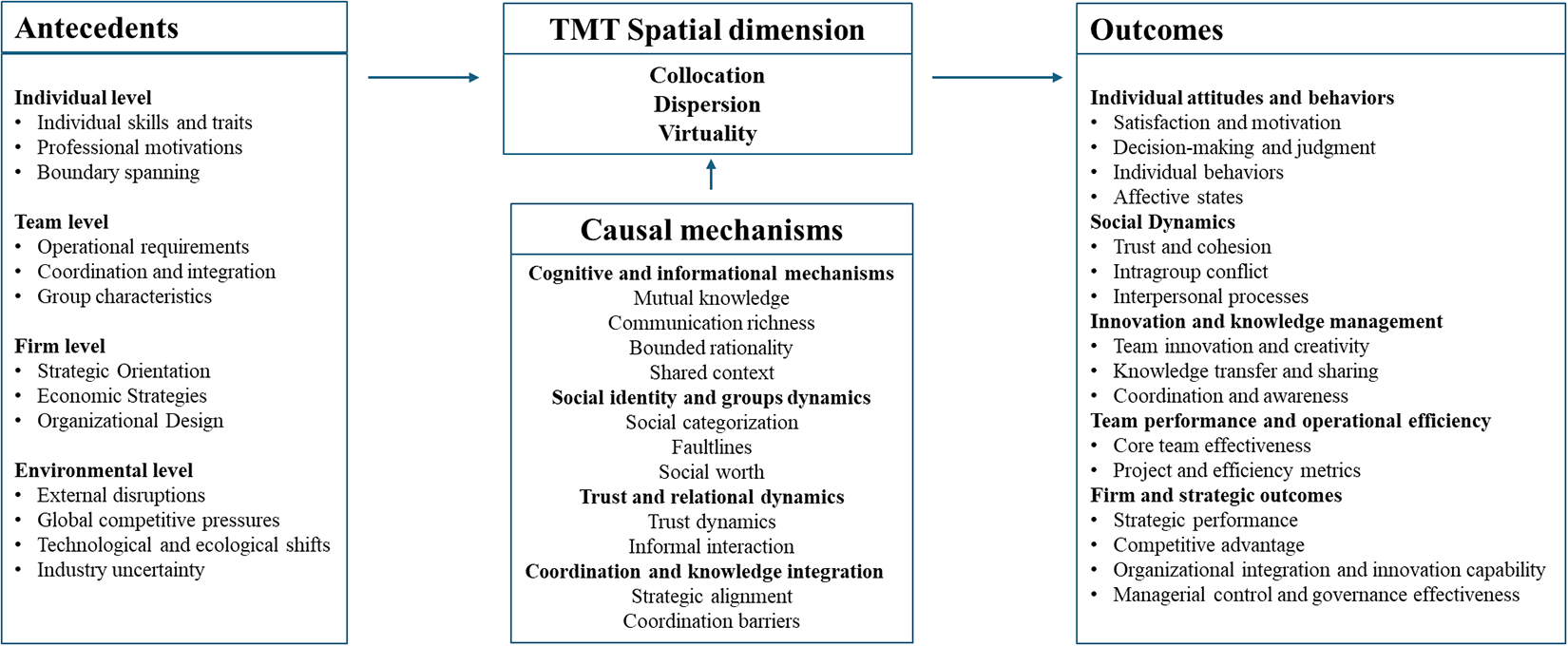
The spatial configuration of TMTs and organizational work arrangements does not emerge randomly but reflects a set of organizational, strategic, and environmental conditions that shape where team members are located and how they interact. According to the reviewed studies, spatial configurations such as collocation, geographic dispersion, and virtuality are consistently portrayed as organizational responses to underlying functional, strategic, and structural design choices (Gilson et al., Reference Gilson, Maynard, Young, Vartiainen and Hakonen2015; Maznevski & Chudoba, Reference Maznevski and Chudoba2000). These multilevel antecedents, individual, team, firm, and environmental, explain why organizations adopt particular spatial arrangements and provide the foundation for understanding how spatial configuration subsequently influences cognitive, social, and strategic processes (see Fig. 2).
Integrative framework of TMT spatial configuration.
Individual-level antecedents
At the individual level, spatial configurations are often shaped by the skills, motivations, and boundary-spanning roles of organizational members. Studies consistently show that individuals with specialized expertise, international experience, or cross-functional responsibilities are more likely to operate across geographic locations or organizational boundaries (Cannella et al., Reference Cannella, Park and Lee2008; Polzer et al., Reference Polzer, Crisp, Jarvenpaa and Kim2006).
Individual skills and traits represent a key driver of spatial dispersion, particularly in knowledge-intensive environments where expertise is scarce or geographically distributed. Organizations frequently locate specialists in different regions to access local knowledge, technical capabilities, or market-specific insights (Gilson et al., Reference Gilson, Maynard, Young, Vartiainen and Hakonen2015; Maznevski & Chudoba, Reference Maznevski and Chudoba2000). Professional motivations also play an important role in shaping spatial arrangements. Employees and executives may seek international assignments, remote work arrangements, or flexible work structures to achieve career development, autonomy, or work–life balance objectives, thereby influencing organizational decisions regarding relocation and distributed work design (Breuer et al., Reference Breuer, Hueffmeier and Hertel2016; Jarvenpaa & Leidner, Reference Jarvenpaa and Leidner1999).
A particularly important individual-level antecedent is boundary spanning, which refers to roles requiring interaction across organizational, functional, or geographic boundaries. Boundary-spanning responsibilities often necessitate distributed collaboration because individuals must coordinate activities, transfer knowledge, or represent organizational interests across locations (Ambos et al., Reference Ambos, Ambos, Eich and Puck2016; Greimel et al., Reference Greimel, Kanbach and Chelaru2023; Handke et al., Reference Handke, Costa, Hincapie and Johnson2025).
Team-level antecedents
At the team level, spatial configurations are primarily driven by operational requirements, coordination responsibilities, and group characteristics. These factors reflect the functional realities of teamwork and the need to align team structure with task demands.
Operational necessity represents one of the most direct drivers of spatial dispersion. Teams may be geographically distributed because tasks require local presence in multiple locations, continuous operations across time zones, or proximity to customers and partners (Barczak et al., Reference Barczak, McDonough and Athanassiou2006; Lakemond & Berggren, Reference Lakemond and Berggren2006). In such cases, dispersion emerges as a functional response to operational constraints rather than a strategic design decision (Choi, Reference Choi2025; Gilson et al., Reference Gilson, Maynard, Young, Vartiainen and Hakonen2015; Sinnemann & Weiss, Reference Sinnemann and Weiss2025). Coordination and integration requirements also shape spatial configurations by assigning responsibilities that require coordination across organizational units. For example, teams responsible for global product development, knowledge integration, or cross-border coordination are often distributed across locations to facilitate collaboration with multiple stakeholders (Ambos et al., Reference Ambos, Ambos, Eich and Puck2016; Ragatz et al., Reference Ragatz, Handfield and Scannell1997; Schreiber et al., Reference Schreiber, Van Dijk and Drory2025). Group characteristics further influence spatial arrangements by shaping how teams are structured and coordinated. Team size, diversity, functional specialization, and interdependence levels can determine whether collocation is feasible or whether distributed collaboration becomes necessary (Hinds & Bailey, Reference Hinds and Bailey2003; Polzer et al., Reference Polzer, Crisp, Jarvenpaa and Kim2006).
Firm-level antecedents
At the organizational level, spatial configurations are closely linked to strategic priorities, economic considerations, and structural design decisions. Firms adopt specific spatial arrangements to support their competitive strategies, manage costs, and coordinate activities across locations.
Strategic orientation represents a central firm-level antecedent influencing spatial configuration. Organizations pursuing international expansion, innovation leadership, or global integration often distribute teams across regions to access markets, knowledge, and resources (O’Leary & Cummings, Reference O’Leary and Cummings2007; Ragatz et al., Reference Ragatz, Handfield and Scannell1997; Vuchkovski et al., Reference Vuchkovski, Zalaznik, Mitrega and Pfajfar2023). In the case of TMTs, dispersion may also reflect strategic choices related to international governance structures and the need to balance global coordination with local responsiveness (Cannella et al., Reference Cannella, Park and Lee2008). Economic strategies also play a significant role in shaping spatial arrangements. Decisions related to cost reduction, resource allocation, and operational efficiency frequently lead organizations to locate activities in regions with lower labor costs, specialized infrastructure, or favorable regulatory environments (Gilson et al., Reference Gilson, Maynard, Young, Vartiainen and Hakonen2015; Warkentin et al., Reference Warkentin, Sayeed and Hightower1997). Organizational design provides the structural framework within which spatial configurations emerge. Choices regarding centralization, decentralization, reporting structures, and coordination mechanisms influence where decision-making authority is located and how communication flows across the organization (Maznevski & Chudoba, Reference Maznevski and Chudoba2000; Ragatz et al., Reference Ragatz, Handfield and Scannell1997; Schreiber et al., Reference Schreiber, Van Dijk and Drory2025; Sinnemann & Weiss, Reference Sinnemann and Weiss2025).
Environmental-level antecedents
Finally, spatial configurations are shaped by broader environmental conditions that constrain or enable organizational design choices. These contextual factors often operate beyond the direct control of the firm but exert significant influence on spatial arrangements.
External disruptions, such as technological change or global crises, can rapidly alter organizational work patterns and accelerate the adoption of remote or distributed collaboration (Gilson et al., Reference Gilson, Maynard, Young, Vartiainen and Hakonen2015). Global competitive pressures also drive spatial dispersion by requiring organizations to operate in multiple markets and respond to diverse customer demands. Firms competing in international industries frequently distribute teams across regions to maintain market presence and strategic flexibility (Ambos et al., Reference Ambos, Ambos, Eich and Puck2016). Technological and ecological shifts further influence spatial arrangements by enabling new forms of virtual collaboration and altering the feasibility of remote work. Advances in communication technologies have significantly reduced the coordination costs associated with geographic distance (Cunningham et al., Reference Cunningham, Gino, Cable and Staats2021; Handke et al., Reference Handke, Costa, Hincapie and Johnson2025; Jarvenpaa & Leidner, Reference Jarvenpaa and Leidner1999; Maznevski & Chudoba, Reference Maznevski and Chudoba2000).
Industry uncertainty represents another important environmental driver of spatial configuration. In dynamic or unpredictable environments, organizations may adopt flexible spatial arrangements to respond quickly to changing market conditions (Hinds & Bailey, Reference Hinds and Bailey2003).
Although these antecedents are observed across different types of teams, their implications become particularly consequential at the executive level. In TMTs, spatial configurations shape not only patterns of collaboration but also the structural conditions under which executives access information, integrate distributed expertise, and coordinate strategic decisions across organizational units. Consequently, understanding the drivers of executive spatial arrangements is critical for examining the mechanisms through which geographic location influences strategic leadership processes and firm-level outcomes.
Core causal mechanisms linking executive location to TMT processes
While much of the underlying evidence stems from research on teams in general, in TMTs, spatial configurations influence the cognitive and relational mechanisms through which executives interpret information, integrate knowledge across locations, and coordinate strategic decisions. Therefore, spatially induced variations in communication, trust, or subgroup dynamics become strategically consequential by shaping firm-level decision-making and implementation processes.
Beyond the structural conditions that give rise to spatial configurations, the reviewed studies consistently highlight a set of core causal mechanisms through which executive location influences team-level interaction and strategic outcomes. These mechanisms explain how collocation, geographic dispersion, or virtuality translate into differences in cognitive processing, social dynamics, trust formation, and coordination capacity within TMTs and other managerial groups. As illustrated in Figure 2, four primary mechanisms emerge across the literature: cognitive and informational constraints, social identity dynamics, relational trust processes, and coordination and knowledge integration challenges.
First, spatial configurations affect team functioning through cognitive and informational mechanisms that shape how executives perceive, interpret, and exchange information. Early upper echelons research emphasizes that managerial cognition is inherently bounded, such that strategic choices reflect selective interpretations of environmental stimuli filtered through executives’ experiences and contextual awareness (Hambrick & Mason, Reference Hambrick and Mason1984). When team members are geographically dispersed, the absence of shared context and reduced opportunities for spontaneous interaction can impair the development of mutual knowledge, leading to misinterpretations of silence, uneven information distribution, and attribution errors (Cramton, Reference Cramton2001). Similarly, distance and technology-mediated communication often reduce communication richness and hinder real-time problem-solving, thereby complicating information exchange and increasing coordination complexity in distributed teams (Hinds & Bailey, Reference Hinds and Bailey2003; O’Leary & Cummings, Reference O’Leary and Cummings2007). Among TMTs, these informational asymmetries may ultimately distort strategic decision-making processes by amplifying perceptual differences and limiting collective sensemaking (Cannella et al., Reference Cannella, Park and Lee2008).
Second, spatial arrangements activate social identity and group dynamics that influence interaction patterns within executive teams. Observable differences associated with geographic location frequently serve as salient social cues that trigger in-group and out-group categorization processes, reinforcing subgroup formation based on site affiliation (Ambos et al., Reference Ambos, Ambos, Eich and Puck2016). In DTs, these locational distinctions may evolve into social faultlines that divide members into relatively homogeneous subgroups, increasing the likelihood of affective conflict and reducing trust (Polzer et al., Reference Polzer, Crisp, Jarvenpaa and Kim2006). National or institutional diversity may further intensify these dynamics by activating divergent behavioral norms and value systems (Ayub & Jehn, Reference Ayub and Jehn2006), thereby shaping leadership influence and shared decision-making processes in virtual environments (Muethel & Hoegl, Reference Muethel and Hoegl2010). Such categorization processes are particularly consequential at the executive level, where strategic consensus and integrative judgment depend on effective collaboration across functional and geographic boundaries.
Third, spatial configuration influences trust and relational dynamics, which play a central role in enabling cooperation under conditions of uncertainty and limited face-to-face contact. In VTs, trust often emerges in a fragile and temporal form, commonly described as ‘swift trust’, which relies on proactive communication and action-oriented interaction rather than interpersonal familiarity (Jarvenpaa & Leidner, Reference Jarvenpaa and Leidner1999). However, reduced opportunities for informal interaction in dispersed or virtual settings may strain interpersonal relationships and undermine psychological safety among senior managers (Moosa et al., Reference Moosa, Pearson and Mthombeni2023). Meta-analytic evidence further suggests that trust becomes a more critical determinant of performance in technology-mediated environments, as it enables risk-taking behaviors such as information sharing, feedback seeking, and collaborative problem-solving despite spatial separation (Breuer et al., Reference Breuer, Hueffmeier and Hertel2016; De Jong et al., Reference De Jong, Dirks and Gillespie2016).
Finally, spatial dispersion generates coordination and knowledge integration challenges that directly affect strategic alignment and organizational learning. Distance reduces opportunities for synchronous communication and spontaneous interaction, impairing the ability of executives to develop shared understanding and align decision processes across locations (Maznevski & Chudoba, Reference Maznevski and Chudoba2000). In innovation and product development contexts, representational gaps between geographically separated units may create breakdowns in coordination practices and limit the effective integration of distributed expertise (Mattarelli et al., Reference Mattarelli, Bertolotti, Prencipe and Gupta2022). At the strategic level, high levels of dispersion can impede international information sharing and mutual learning unless supported by strong team integration mechanisms and active senior management involvement (Salomo et al., Reference Salomo, Keinschmidt and de Brentani2010). Consequently, spatial configuration shapes not only the quality of interpersonal interaction inside TMTs but also the firm’s capacity to synthesize knowledge and respond coherently to complex environmental demands.
Outcomes associated with spatial configurations
Although much of the empirical evidence reviewed in this study originates from research on teams in general, the outcomes discussed below are interpreted through an upper echelons lens. In TMTs, spatial configurations do not merely influence team functioning but shape executives’ ability to interpret information, integrate distributed knowledge, and govern organizational activities across geographically separated units. As such, spatially induced variations in interaction, trust, or coordination become strategically consequential by affecting decision implementation, organizational alignment, and firm-level performance.
The reviewed studies indicate that spatial configurations are associated with a broad set of outcomes emerging at the individual, team, and firm levels. Rather than exerting uniform performance effects, collocation, geographic dispersion, and virtuality influence how executives and team members evaluate situations, interact socially, integrate knowledge, and ultimately implement strategic decisions across organizational units. As presented in Figure 2, these outcomes can be grouped into five primary domains reflecting attitudinal, relational, innovative, operational, and governance-related consequences of spatial arrangements.
At the individual level, spatial configurations influence attitudes, judgments, and behavioral responses to collaborative work environments. Face-to-face interaction has been associated with higher communication effectiveness and member satisfaction compared to virtual collaboration, despite comparable task performance levels (Warkentin et al., Reference Warkentin, Sayeed and Hightower1997). Geographic dispersion may also affect individual decision-making processes by reducing conformity pressures and enabling more independent judgments among distributed decision-makers (Kuselias et al., Reference Kuselias, Agoglia and Wang2023). Conversely, high levels of virtuality may increase perceptions of conflict or encourage self-censorship behaviors in diverse teams, thereby negatively affecting individual performance assessments and affective states (Choi, Reference Choi2025). More broadly, limited opportunities for face-to-face interaction in virtual managerial teams may strain interpersonal relationships and reduce psychological safety, influencing motivation and engagement in collaborative work (Moosa et al., Reference Moosa, Pearson and Mthombeni2023).
Spatial configuration also has important implications for social dynamics, trust, and conflict in distributed teams. Failures to share contextual information across geographically separated locations may fracture relationships into hostile locational coalitions and reduce team cohesion (Cramton, Reference Cramton2001). Similarly, distributed teams frequently experience higher levels of task and affective conflict due to reduced shared understanding and impaired conflict resolution mechanisms in technology-mediated environments (Hinds & Bailey, Reference Hinds and Bailey2003; Mortensen & Hinds, Reference Mortensen and Hinds2001). Locational subgroup formation may further heighten interpersonal tensions and undermine trust when geographic faultlines become salient across partially CTs (Polzer et al., Reference Polzer, Crisp, Jarvenpaa and Kim2006). Nonetheless, shared team identity and leadership support may mitigate these negative effects by fostering relational integration and cooperative interaction across dispersed locations (Barczak et al., Reference Barczak, McDonough and Athanassiou2006).
A third set of outcomes relates to team innovation and creativity, knowledge transfer, and coordination awareness. Geographic proximity has been shown to facilitate the sharing of complex or tacit knowledge and enhance team-level creativity in inter-organizational innovation contexts (Hu et al., Reference Hu, Chen, Gu, Huang and Liu2017). By contrast, configurational imbalance and physical or psychological isolation in DTs may hinder informal knowledge sharing and impede information flows across organizational areas (Ambos et al., Reference Ambos, Ambos, Eich and Puck2016; Barczak et al., Reference Barczak, McDonough and Athanassiou2006). Representational gaps and conflicting coordination practices across sites may also contribute to reduced product architecture quality or project failure in distributed development programs (Mattarelli et al., Reference Mattarelli, Bertolotti, Prencipe and Gupta2022). These findings suggest that spatial configuration shapes localized knowledge recombination processes across teams, thereby influencing innovation outcomes at the project or group level.
Concerning team performance and operational efficiency, spatial arrangements influence core team effectiveness and project-level metrics such as development speed, coordination efficiency, and cost performance. Collocation improves cross-functional integration and facilitates the overlap of development activities, thereby improving product quality and reducing time-to-market (Haque & Pawar, Reference Haque and Pawar2001). Conversely, distance and reliance on asynchronous communication may reduce mutual awareness and increase coordination complexity, leading to performance inefficiencies in distributed teams (Hinds & Mortensen, Reference Hinds and Mortensen2005; O’Leary & Cummings, Reference O’Leary and Cummings2007). However, VT empowerment may compensate for reduced supervision in low face-to-face settings, improving process outcomes and customer satisfaction under certain conditions (Kirkman et al., Reference Kirkman, Rosen, Tesluk and Gibson2004).
Finally, spatial configurations affect firm-level and strategic outcomes, including strategic performance, competitive advantage, organizational integration and innovation capability, as well as managerial control and governance effectiveness. In TMTs, collocation has been found to positively moderate the relationship between functional diversity and firm performance by reducing coordination costs and facilitating interactional dynamics (Cannella et al., Reference Cannella, Park and Lee2008). The strategic grouping of dispersed human capital across locations may likewise enhance global competitiveness and support firm performance in multinational contexts (Gonzalez-Loureiro et al., Reference Gonzalez-Loureiro, Dabic and Puig2014). At the same time, high levels of dispersion may impede international information sharing and mutual learning unless supported by strong integration mechanisms, thereby constraining organizational integration and innovation capability (Salomo et al., Reference Salomo, Keinschmidt and de Brentani2010; Vuchkovski et al., Reference Vuchkovski, Zalaznik, Mitrega and Pfajfar2023). Importantly, spatial separation may also limit executives’ ability to monitor, influence, and align organizational behavior across geographically distributed units, affecting performance management effectiveness and the implementation of strategic decisions. Although such governance challenges often manifest through interaction patterns across TMTs, they ultimately reflect firm-level variations in managerial control and governance effectiveness across spatially dispersed organizational structures.
Collectively, the reviewed studies reveal that the spatial configuration of TMTs represents a structural condition that shapes how executives exercise strategic leadership across geographically distributed organizational units. While many of the observed mechanisms, such as variations in communication richness, trust formation, or subgroup dynamics, have been documented in the broader literature on DT or VT, our synthesis highlights that these dynamics acquire distinct theoretical significance when they occur within teams holding strategic authority. In TMTs, spatial configurations influence not only interpersonal interaction but also the cognitive and relational mechanisms through which executives interpret environmental information, integrate distributed expertise, and coordinate strategic decisions.
As a result, spatially induced variations in executive interaction affect not only team-level processes such as knowledge sharing or decision quality, but also firm-level outcomes, including organizational integration and innovation capability, governance effectiveness, and the implementation of strategic choices. Figure 2 synthesizes these relationships by integrating the multilevel antecedents, spatial dimensions, causal mechanisms, and outcomes associated with executive location, thereby providing a coherent framework for understanding how spatially distributed leadership shapes both the formulation and execution of strategy.
Discussion
Building on the integrative framework presented in Figure 2, this review advances understanding of how the spatial configuration of TMTs influences the formulation and implementation of strategic decisions across geographically distributed organizational units. While many of the mechanisms identified in the broader literature on CT, DT, and VT, such as variations in communication richness, trust formation, conflict dynamics, or coordination capacity, have been extensively examined in operational or project-based settings, our synthesis highlights that these dynamics acquire distinct theoretical significance when they emerge within teams holding strategic authority. In TMTs, spatial arrangements not only affect patterns of interpersonal interaction but also shape the cognitive, social, and relational conditions under which executives interpret environmental information, integrate geographically distributed expertise, and exercise influence over organizational behavior across locations. As a result, variations in executive spatial configuration become consequential for both the formulation of strategic choices and their subsequent implementation throughout the firm. To further develop these implications, the following sections examine (1) the executive processes through which spatial configurations translate into strategic outcomes, and (2) the inherent trade-offs that spatially distributed leadership introduces for strategic integration, coordination, and governance.
Executive processes linking spatial configuration to strategic outcomes
Building on the causal mechanisms outlined above, spatial configurations shape a range of executive cognitive, social, and strategic processes that influence how TMTs formulate and implement strategic decisions across geographically distributed organizational units. Rather than exerting direct effects on organizational outcomes, executive location affects how senior decision-makers interpret information, interact across spatial boundaries, and align strategic actions throughout the firm.
From a cognitive perspective, spatial dispersion influences how executives process information and develop shared interpretations of strategic issues. Reduced communication richness and limited opportunities for spontaneous interaction in geographically distributed settings may impair the development of mutual awareness and shared context (Cramton, Reference Cramton2001; O’Leary & Cummings, Reference O’Leary and Cummings2007). In TMTs, such informational constraints may hinder real-time strategic sensemaking and increase reliance on asynchronous communication, ultimately affecting how diverse viewpoints are integrated into collective decisions (Kuselias et al., Reference Kuselias, Agoglia and Wang2023). Similarly, failures to share contextual information across locations may result in divergent performance perceptions or attribution errors, reinforcing interpretive gaps that complicate consensus formation around strategic priorities (Tavoletti et al., Reference Tavoletti, Bernhard, Dong and Taras2023).
Spatial configuration also affects social interaction processes among executives by shaping patterns of conflict emergence, trust formation, and leadership influence. Geographic dispersion and technology-mediated communication may reduce familiarity and opportunities for informal interaction, thereby increasing the likelihood of task and affective conflict over time (Hinds & Bailey, Reference Hinds and Bailey2003). In executive teams, such relational strain may reduce willingness to share unique information or challenge dominant interpretations, ultimately constraining the collective evaluation of strategic alternatives (Moosa et al., Reference Moosa, Pearson and Mthombeni2023). Leadership behaviors likewise become more consequential under conditions of spatial separation, as executives must increasingly rely on digitally mediated interaction to motivate, influence, and maintain alignment across dispersed organizational units (Greimel et al., Reference Greimel, Kanbach and Chelaru2023).
Finally, spatial configurations shape strategic coordination processes associated with decision implementation and performance management across geographically distributed units. Distance may increase coordination complexity by limiting opportunities for synchronous interaction and reducing the emergence of shared interaction rhythms (Maznevski & Chudoba, Reference Maznevski and Chudoba2000). At the executive level, high levels of virtuality may formalize communication patterns and reduce informal influence channels, thereby affecting organizational learning and the consistent execution of strategic initiatives across sites (Vuchkovski et al., Reference Vuchkovski, Zalaznik, Mitrega and Pfajfar2023). In this sense, spatial configuration influences strategic leadership not only through decision formulation but also by shaping the processes through which those decisions are translated into coordinated organizational action.
Spatial configuration as a source of strategic leadership trade-offs
Based on the executive processes outlined above and the integrative framework presented in Figure 2, the findings suggest that executive spatial configuration introduces a sequence of inherent tensions that shape how TMTs formulate and implement strategic decisions across geographically distributed organizational units. While spatial dispersion may improve access to diverse knowledge and enhance responsiveness to local environments, these benefits simultaneously create coordination challenges that constrain real-time interaction and strategic alignment.
Importantly, these effects do not operate directly on organizational outcomes but unfold through the cognitive, social, and strategic processes by which executives interpret information, integrate geographically distributed expertise, and coordinate action across locations. As spatial configuration expands the informational reach of executive teams, tensions emerge across different stages of the strategic process, from the acquisition of geographically embedded knowledge to the integration of distributed perspectives in collective decision-making, and ultimately to the coordinated implementation of strategic initiatives across organizational units. In this sense, rather than exerting uniformly positive or negative effects, the spatial arrangement of executives gives rise to a progression of trade-offs that influence the firm’s ability to balance informational breadth, cross-unit integration, and centralized managerial control.
Knowledge breadth versus coordination costs
The first tension in this progression concerns the trade-off between knowledge breadth and coordination costs that emerges as TMTs expand their informational reach through spatial dispersion. Spatially distributed executive teams are often positioned to access a broader range of informational inputs and geographically embedded capabilities. The dispersion of managerial talent across locations may enhance global responsiveness and contribute to the development of competitive advantage by leveraging diverse contextual knowledge (Gonzalez-Loureiro et al., Reference Gonzalez-Loureiro, Dabic and Puig2014). At the same time, increased spatial separation may impede international information sharing and mutual learning processes, particularly when coordination relies on asynchronous communication or formalized interaction channels (Salomo et al., Reference Salomo, Keinschmidt and de Brentani2010). For TMTs, this trade-off arises between the strategic benefits of incorporating heterogeneous knowledge sources and the coordination costs associated with synthesizing distributed insights into unified organizational actions. Spatial configurations that enhance informational breadth may therefore simultaneously constrain the speed and coherence of strategic decision implementation.
Integration versus fragmentation
The second tension in this progression concerns the trade-off between internal coordination efficiency and cross-unit strategic integration that arises once geographically embedded inputs must be synthesized into collective strategic decisions. Spatial clustering among executives may facilitate the emergence of locally cohesive subgroups, allowing for clearer behavioral expectations, faster interaction, and more efficient coordination among geographically proximate units (Xie et al., Reference Xie, Wang and Qi2015). However, when spatial proximity aligns with functional or demographic differences, such clustering may simultaneously activate geographic faultlines at the executive team level, heightening intragroup conflict and reducing trust across spatially separated executive clusters (Ayub & Jehn, Reference Ayub and Jehn2006; Polzer et al., Reference Polzer, Crisp, Jarvenpaa and Kim2006). Similarly, extended collocation may enhance internal development speed and decision-making alignment in clustered groups while isolating them from broader organizational perspectives, thereby constraining cross-functional interaction and the integration of geographically embedded knowledge into strategic deliberations (Lakemond & Berggren, Reference Lakemond and Berggren2006). In dispersed settings, configurational imbalance may further reinforce spatial isolation and hinder knowledge sharing between organizational units (Ambos et al., Reference Ambos, Ambos, Eich and Puck2016). Across TMTs, this tension reflects the competing demands of achieving coordination efficiency within locally embedded executive subgroups while maintaining integrated strategic alignment across the organization as a whole.
Autonomy versus managerial control
The final tension in this sequence concerns the trade-off between decentralized managerial autonomy and centralized managerial control that emerges during the coordinated implementation of strategic initiatives across geographically distributed organizational units. Spatial dispersion may enable TMTs to influence geographically embedded expertise by positioning executives closer to dispersed units and markets, thereby fostering greater independence in judgment formation and localized responsiveness to environmental conditions (Kuselias et al., Reference Kuselias, Agoglia and Wang2023). However, this same spatial separation may constrain executives’ ability to exercise centralized managerial control across organizational units by limiting opportunities for synchronous interaction, real-time alignment, and performance monitoring in geographically distributed settings (Moosa et al., Reference Moosa, Pearson and Mthombeni2023). Reduced shared interaction rhythms and reliance on technology-mediated communication may hinder consensus formation and delay the coordinated implementation of strategic initiatives across locations (Hinds & Bailey, Reference Hinds and Bailey2003; Maznevski & Chudoba, Reference Maznevski and Chudoba2000). Among TMTs, this tension reflects the competing demands of encouraging decentralized initiative while maintaining the oversight and temporal coordination required for consistent execution of firm-wide strategic decisions.
Implications for research
The progression of trade-offs identified above suggests several important implications for future research on TMTs and strategic leadership. First, conceptualizing executive spatial configuration as a structural dimension of upper echelons extends existing theory beyond its traditional focus on compositional characteristics such as demographic diversity or functional background. While prior research has emphasized who executives are and what experiences they bring, our findings indicate that where executives are located, and how they interact across space, plays a critical role in shaping the processes through which strategic decisions are formulated and implemented. Future studies may therefore benefit from incorporating spatial configuration as a design variable that conditions executive sensemaking, knowledge integration, and managerial control in geographically distributed organizational contexts.
Second, the presence of sequential tensions, such as those between knowledge breadth and coordination costs, integration and fragmentation, or autonomy and managerial control, suggests that spatial configurations are unlikely to exert uniformly positive or negative effects on organizational outcomes. Rather than examining dispersion or virtuality as independent predictors of performance, future research should explore how these arrangements create competing strategic demands across different stages of the strategic process. In particular, examining how TMTs manage the balance between expanding informational reach, maintaining cross-unit integration, and exercising centralized managerial control may offer new insights into the dynamics of strategic consensus formation and the consistent execution of firm-wide initiatives across distributed organizational units.
Third, these findings highlight the need to view spatial configuration as a dynamic characteristic of executive collaboration. Emerging hybrid work arrangements, episodic collocation, and digitally mediated governance structures suggest that executive spatiality may vary across strategic stages, from environmental interpretation and resource allocation to decision implementation and performance monitoring. Future research could therefore investigate how temporal fluctuations in executive proximity influence alignment and coordination processes throughout the strategic decision-making cycle.
Implications for practice
The sequential progression of trade-offs identified above also carries important implications for managerial practice. Firms operating in geographically dispersed environments may need to recognize that executive spatial configuration is not just a logistical consideration but a design feature that shapes strategic leadership capacity across different stages of the strategic process. For instance, while dispersing members of TMTs may improve access to locally embedded knowledge and improve responsiveness to diverse market conditions, it may simultaneously increase coordination complexity and reduce opportunities for informal interaction essential for cross-unit integration and consensus building.
To address these tensions, organizations may consider designing interaction structures that balance informational breadth with alignment capacity. Periodic physical meetings or structured face-to-face interaction during periods of strategic uncertainty may help mitigate interpretive fragmentation and support shared understanding among dispersed executives. Similarly, investments in digital collaboration tools and performance management systems may develop the ability of spatially distributed leaders to monitor organizational behavior and coordinate decision implementation across locations.
Furthermore, recognizing the trade-off between executive autonomy and managerial control may allow firms to tailor leadership practices to the demands of different strategic contexts. Encouraging decentralized initiative in stable or locally responsive environments may be beneficial during early stages of interpretation and formulation, whereas greater spatial proximity or synchronous interaction may be required when implementing firm-wide strategic initiatives that demand consistent alignment across organizational units.
Limitations and future research agenda
While this review provides an integrative framework for understanding how executive spatial configuration shapes strategic leadership processes across geographically distributed organizational units, several limitations of the existing literature highlight important opportunities for future research. First, although the objective of this study was to examine the spatial configuration of TMTs, much of the empirical evidence reviewed originates from research on collocate, geographically dispersed, virtual, or project-based teams more broadly. Given the limited number of studies explicitly examining executive spatial arrangements, the present synthesis relies in part on insights derived from the broader team literature to identify cognitive, social, and coordination mechanisms associated with spatial separation. While these mechanisms are theoretically relevant when interpreted through an upper echelons lens, their implications for strategic leadership may differ when team members hold decision-making authority over firm-level outcomes. Future empirical work focusing directly on spatially distributed TMTs is therefore necessary to assess the boundary conditions of the relationships proposed in this review.
Moreover, the majority of studies conceptualize spatial configuration in relatively static terms, such as geographic dispersion or virtuality, without capturing potential temporal variation in executive proximity. The sequential progression of trade-offs identified in this review suggests that executive spatial configuration may influence different stages of the strategic process, from the acquisition of geographically embedded knowledge and its integration into collective decision-making to the coordinated implementation of firm-wide strategic initiatives. Future research may therefore benefit from adopting longitudinal or process-oriented designs capable of capturing how episodic collocation, hybrid leadership arrangements, or digitally mediated interaction structures shape executive alignment over time.
In particular, further attention is needed to examine how spatially distributed executives synthesize heterogeneous informational inputs into coherent strategic action without compromising cross-unit integration or managerial control. Investigating how communication structures, interaction rhythms, or digitally mediated coordination mechanisms influence the balance between informational reach and implementation consistency may offer new insights into the dynamics of strategic consensus formation and execution in globally distributed TMTs.
Finally, the reliance on secondary sources and archival or survey-based studies limits understanding of how informal interaction patterns, subgroup formation, or implicit influence processes unfold in spatially distributed executive teams. Future research employing network-based methodologies, behavioral process tracing, or digital communication data may therefore contribute to a more nuanced understanding of how spatial configuration shapes executive coordination, monitoring capacity, and implementation effectiveness across geographically dispersed organizational units.
Addressing these limitations may contribute to advancing a more dynamic understanding of executive spatial configuration as a structural dimension of strategic leadership in contemporary multinational firms.
Conclusion
As organizations increasingly operate across geographically dispersed and digitally connected environments, understanding how TMTs function across spatial boundaries has become a critical issue for both scholars and practitioners. This review provides an international perspective on upper echelons by examining how the spatial configuration of executive teams shapes the processes through which strategic decisions are formulated and implemented.
By synthesizing insights from research on collocated, geographically dispersed, and virtual teams, this study conceptualizes executive spatial configuration as a structural condition that influences how top managers interpret information, integrate geographically distributed expertise, and coordinate action across organizational units. The findings highlight that spatial arrangements do not exert uniformly positive or negative effects on strategic leadership but instead introduce inherent tensions, such as those between knowledge breadth and coordination costs, integration and fragmentation, or autonomy and managerial control, which unfold across different stages of the strategic process.
The framework developed in this review advances existing upper echelons research by shifting attention from compositional characteristics of executive teams toward the interactional conditions under which strategic decisions are formed and executed across locations. In doing so, it underscores that executive spatial configuration is not merely a logistical feature of collaboration but a design dimension that shapes the firm’s capacity to integrate knowledge, exercise managerial control, and implement strategic choices consistently throughout geographically dispersed organizational structures.
Overall, this study offers an integrative foundation for examining how spatially distributed leadership influences both the formulation and execution of strategy, thereby opening new avenues for future research on TMTs operating across geographic boundaries.
Acknowledgements
This work was supported by the Ministry of Science and Innovation (PID2021-124474OA-I00; PID2024-162716OB-I00), funded by MCIN/AEI/10.13039/501100011033/ and by FEDER, ‘a way of making Europe’, EU. We also acknowledge the support of Consellería de Educación, cultura, universidades y Empleo (CIACO/2023/43).
Conflict(s) of Interest
The author(s) declare none.
Declaration
During the preparation of this manuscript, the authors used ChatGPT (OpenAI, GPT–5, accessed between January and March 2026) to assist with wording refinement and organization of selected sections of the text. No AI tools were used for literature identification, screening, data extraction, analysis, or interpretation of findings. All intellectual content and theoretical contributions were developed by the authors, who take full responsibility for the final manuscript.
Isabel Gausi-Carot is Assistant Professor at the University of Valencia (Spain). Her research focus is on TMTs and international business. She teaches courses in strategic management and international business at the undergraduate and master’s levels. Before starting out in research and teaching, Professor Gausi-Carot worked as a top manager in several leading Spanish companies within a wide range of industries. She holds a degree in business and economics from the University of Valencia and a human resources management master from IE University (Madrid).
Ana Botella-Andreu has a degree in economics and a master’s in international business. In 2019, she obtained a PhD from the University of Valencia. Currently, she works as Associate Professor at the University of Valencia, where she teaches international business and strategic management. Her main research interests include global strategy, multinational corporations and subsidiary management, and multinational geographic location. She has published in journals including International Journal of Management Reviews, International Business Review, and Management International Review.
Ana García-Granero has a degree in economics and a master’s in strategic management. In June 2013, she obtained a PhD from the University of Valencia. She has been a researcher at INGENIO (CSIC-UPV) and Grenoble Ecole de Management (GEM). Currently, she works as Associate Professor at the University of Valencia, where she teaches courses related to strategic management and innovation. Her main research interests include TMTs, open innovation, and knowledge transfer. She has published in journals including Long Range Planning, Journal of Business Research, and European Management Journal.
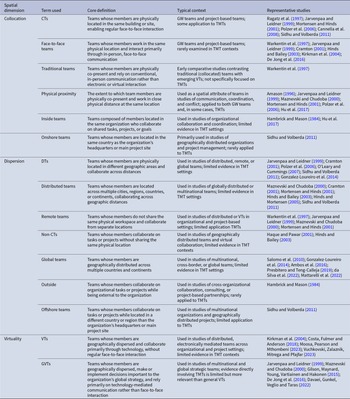
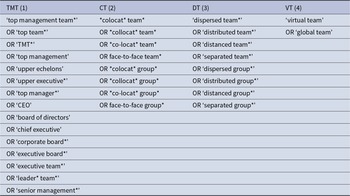
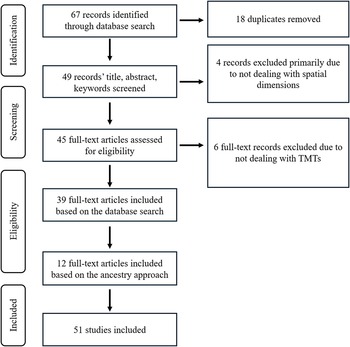

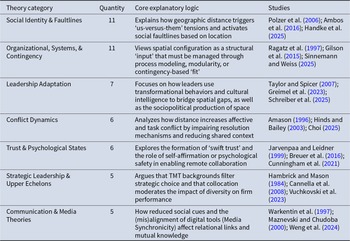
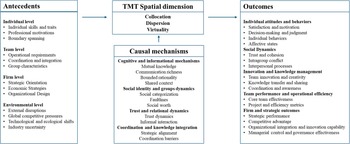

 Open access

