


On 22 May 2003 the United Nations called on its member states to help reconstruct Iraq and over 30 countries have contributed soldiers to the coalition. As of 21 November 2006, there were 3113 deaths of coalition soldiers from 19 nations (http://edition.cnn.com/SPECIALS/2003/iraq/forces.casualties). Concerns have been raised about the mental health costs for service personnel. Hoge et al, 2004 estimated that 12.9% of US soldiers involved in combat operations in Iraq had post-traumatic stress disorder (PTSD), which was higher than in a sample tested before their deployment (5%). Hotopf et al (Reference Hotopf, Hull and Fear2006) estimated a 4% incidence of PTSD among UK armed forces returning from Iraq, which was similar to a non-deployed sample. Hacker Hughes et al (Reference Hacker Hughes, Cameron and Eldridge2005) revealed a lower score for mental health problems after deployment, compared with before, for the UK Air Assault Brigade but the response rate was low.
These studies provide clues about the impact of deployment to Iraq, but two studies were cross-sectional and did not include the participants’ health status pre-deployment. This may lead to an overestimation of the effects of deployment on stress symptoms (Reference Hotopf and WesselyHotopf & Wessely, 2005; Reference Hedeker and GibbonsHedeker & Gibbons, 2006). Two recent prospective studies showed that PTSD was uncommon (< 3.2%) for UK armed forces (Reference Rona, Hooper and JonesRona et al, 2006) and PTSD symptoms increased modestly for US armed forces (Reference Vasterling, Proctor and AmorosoVasterling et al, 2006) after deployment. These prior cross-sectional and prospective studies investigated PTSD using questionnaires, but the DSM–IV diagnostic criteria for PTSD require that symptoms interfere in important ways with the individual's functioning, which is routinely checked in diagnostic interviews but not questionnaires. Failing to take this into account may result in overestimated rates of deployment-related PTSD (see Reference Regier, Kaelber and RaeRegier et al, 1998; Reference Frueh, Hamner and CahillFrueh et al, 2000; Reference Ismail, Kent and BrughaIsmail et al, 2002; Reference WesselyWessely, 2004; Reference McNallyMcNally, 2006). This was recently found in a re-analysis of PTSD among Vietnam veterans. In 1988 the estimated lifetime prevalence rate for PTSD was 30.9% and the current rate (11–12 years after the war) 15.2%. Dohrenwend et al (Reference Dohrenwend, Turner and Turse2006) consulted archival data and eliminated PTSD which was unrelated to war events and PTSD without impairment. This decreased estimates of lifetime and current (late 1980s) PTSD to 18.7 and 9.1% respectively, thereby confirming the suspicion of critics who believed the original rates to be implausibly high (Reference McNallyMcNally, 2007).
This paper reports a prospective study of deployment-related mental health problems in three Dutch infantry cohorts stationed in the Iraqi province of Al-Muthanna under British command. Mental health measures were collected before deployment, and 5 months and 15 months thereafter. We tested for individual changes in these variables over time as well as potential predictors for changes. To compare assessment methods, we established PTSD rates by questionnaire and clinical interview.
METHOD
Participants
About 6 weeks before their deployment, 481 Royal Netherlands Army troops were asked to participate in this study. They were from three infantry battalions that rotated successively in three deployment phases, each lasting about 4 months, designated Stabilisation Force Iraq (SFIR) 3, 4 and 5. These took place from 15 March 2004 to 15 March 2005. During this period, about 4990 Dutch soldiers were deployed to Iraq. They sustained two casualties. An Armoured Infantry Battalion was deployed on SFIR 3, and two battalions of the Air Assault Brigade were deployed on SFIR 4 and 5. Their main duties were to create and maintain stability and peace, and assist in reconstruction. At various sites, troops available during their preparation programme were told about the aim and general procedures of the study by their commanding officers. They met the principal investigator (I.M.E.) or research assistant a few days later, who gave full (oral and written) information about the study. Participation was voluntary without financial compensation. Participants were told that commanders would be informed only about pooled results. Two soldiers refused and 479 agreed to participate, including 214 SFIR 3 soldiers, 169 SFIR 4 soldiers and 96 SFIR 5 soldiers.
Procedures
About 5 months after their deployment, questionnaires about potentially traumatic events in Iraq and current mental health problems were administered. The Structured Clinical Interview for DSM–IV (SCID; Reference First, Spitzer and GibbonFirst et al, 1996) was then administered by a trained clinical psychologist (about 20 interviews were carried out by graduate students), who did not know the responses to the questionnaires. At about 15 months, measures for current problems were administered as well as the face-to-face SCID. At 5 months, most questionnaires were given to small groups at a base, and at 15 months 31% of questionnaires were sent by post. Non-response was partly a result of soldiers being on leave, attending a training course, or being posted to new units. The institutional review board of Maastricht University approved the study.
Measures
Symptoms of common mental health problems were measured with the 90-item Symptom Checklist (SCL–90; Reference Arrindell and EttemaArrindell & Ettema, 2003). Each item was rated on a 1 (not at all) to 5 (very much) scale. We focused on sub-scales of anxiety (10 items), depression (17 items), somatic complaints (12 items) and sleeping problems (3 items), and used the SCL–90 score for general distress. Prior life events were assessed with a 17-item checklist that included road accidents, sudden death of a loved one, fire and being robbed. A score was compiled of all endorsed items.
Events in Iraq were assessed with the 21-item Potentially Traumatizing Events Scale (Reference Litz, Orsillo and FriedmanLitz et al, 1997; Reference Maguen, Litz and WangMaguen et al, 2004), which is derived partly from the Combat Exposure Scale, and measures the frequency of exposure to war-zone-related stressors. The scale was adjusted for use in Iraq by deleting one item (patrolling areas where there were land mines) and adding two (being informed of a Dutch soldier who got killed and having injured civilians due to own action). For each item experienced, individuals rated how negative it was for them on a Likert scale. We calculated the number of reported events as well as the number of events appraised as moderate to extremely negative, and used both in the analyses.
Symptoms of PTSD were measured with the 17-item PTSD Symptom Scale (PSS), which has proven to be effective for screening for PTSD (Reference Foa, Riggs and DancuFoa et al, 1993; Reference Wohlfarth, van den Brink and WinkelWohlfarth et al, 2003; Reference Coffey, Gudmundsdottir and BeckCoffey et al, 2006). Each symptom was rated from 0 (not at all) to 3 (very much) for the past month. We used two case definitions for PTSD: a broad definition that follows diagnostic symptom criteria (a minimal number of symptoms had to be rated at least ‘some of the time’), and a stricter definition for which a cut-off score of 14 was used (Reference Coffey, Gudmundsdottir and BeckCoffey et al, 2006). Both scoring methods have been used previously. After completing the PSS, participants were asked to rate their distress and functional impairment in different areas of their lives (work, home, interpersonal relationships) on a 4-point scale (0 not at all, 3 very much). Self-reports of impairment were compared with SCID-based assessments which include the DSM–IV symptoms and questions about subjective distress and functional impairment caused by these symptoms.
Statistical analysis
Analyses were performed with SPSS (version 11.5) and HLM (version 5), both for Windows. Missing items were estimated by observed item means if no more than two items per scale were missing. Demographic variables were compared between the cohorts. We tested whether there were systematic differences between individuals who did or did not drop out on characteristics from earlier measurement occasions. The rates of potentially traumatic events were assessed and the mean scores on mental health scales before deployment and at 5 and 15 months were calculated. These variables were non-normally distributed and therefore statistical tests were based on robust standard errors (sandwich estimates; Reference WhiteWhite, 1982). A within-class hierarchical linear model was used to test whether the level of mental health symptoms varied across the three assessments for the three cohorts. The slopes of the time variables were allowed to vary across individuals, to test whether the variance components for the intercept and the regression slope for the time variables were significant. If these were significant, we sought to explain this variance by running separate between-cohort models to examine the effects of demographic and background factors (age, gender, partner status, education, temporary v. permanent contract, number of previous missions, previous life events, rank, cohort), number of potentially traumatic events in Iraq, and number of events rated as negative. The model was run again without non-significant predictors to reduce error. Rates of PTSD were calculated based on the questionnaire and SCID. We tested to what extent the PTSD rates were predicted by pre-deployment PTSD and general distress symptoms, prior life events, and number of events in Iraq by logistic regression analysis. Odds ratios with 95% confidence intervals were generated. All statistical tests of significance were two-tailed at the α=0.05 level.
RESULTS
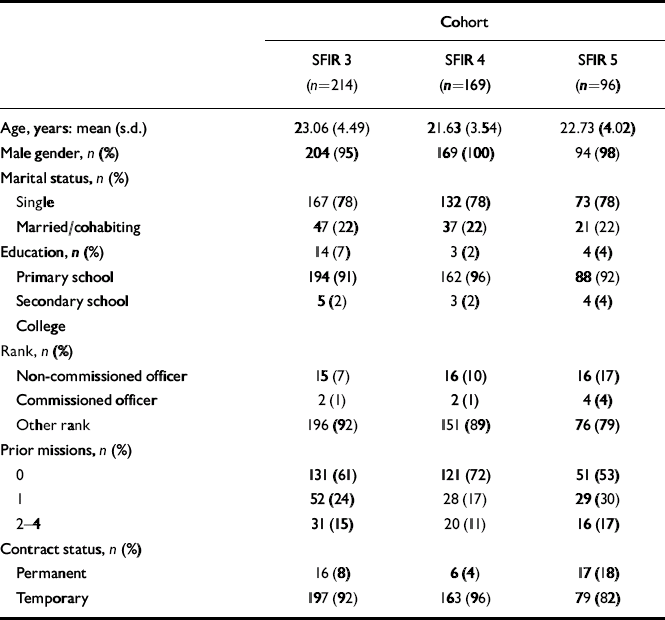
Table 1 shows the characteristics of the three cohorts. The SFIR 3 and 5 cohorts were older than SFIR 4 and had more prior deployments. The SFIR 5 cohort had more officers. About 5 months after deployment, 382 (80%) soldiers completed questionnaires and 339 (71%) took part in the SCID. At about 15 months, 331 soldiers (69%) completed questionnaires and 203 (42%) did the SCID. Given the low response rates, the SCID data at 15 months are not considered. Soldiers who did not complete questionnaires at 5 months had slightly more prior missions than those who did. There were no significant differences on other pre-deployment measures. Responders and non-responders at 15 months did not differ on variables assessed earlier. We therefore treated the drop-outs as occasions missing at random.
Characteristics of the three cohorts1
| Cohort | |||
|---|---|---|---|
| SFIR 3 (n=214) | SFIR 4 (n=169) | SFIR 5 (n=96) | |
| Age, years: mean (s.d.) | 23.06 (4.49) | 21.63 (3.54) | 22.73 (4.02) |
| Male gender, n (%) | 204 (95) | 169 (100) | 94 (98) |
| Marital status, n (%) | |||
| Single | 167 (78) | 132 (78) | 73 (78) |
| Married/cohabiting | 47 (22) | 37 (22) | 21 (22) |
| Education, n (%) | 14 (7) | 3 (2) | 4 (4) |
| Primary school | 194 (91) | 162 (96) | 88 (92) |
| Secondary school | 5 (2) | 3 (2) | 4 (4) |
| College | |||
| Rank, n (%) | |||
| Non-commissioned officer | 15 (7) | 16 (10) | 16 (17) |
| Commissioned officer | 2 (1) | 2 (1) | 4 (4) |
| Other rank | 196 (92) | 151 (89) | 76 (79) |
| Prior missions, n (%) | |||
| 0 | 131 (61) | 121 (72) | 51 (53) |
| 1 | 52 (24) | 28 (17) | 29 (30) |
| 2-4 | 31 (15) | 20 (11) | 16 (17) |
| Contract status, n (%) | |||
| Permanent | 16 (8) | 6 (4) | 17 (18) |
| Temporary | 197 (92) | 163 (96) | 79 (82) |
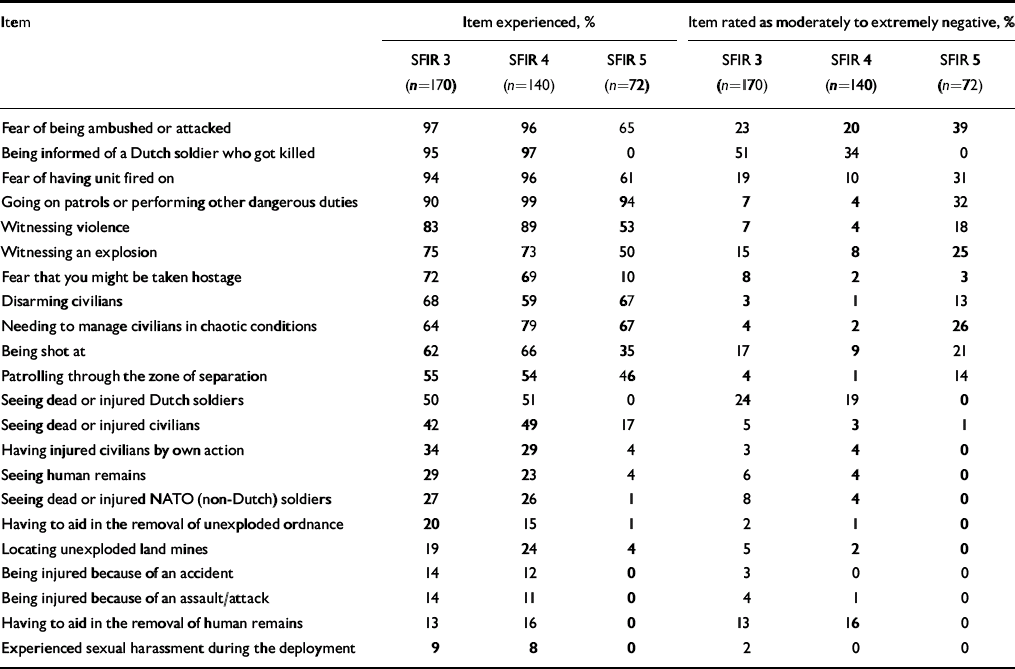
Table 2 shows that cohorts SFIR 3 and 4 reported more potentially traumatic events in Iraq than SFIR 5 (F(2, 370)=60.73, P < 0.001). The number of events rated as negative was higher for SFIR 3 and 5 than for SFIR 4 (χ2(2) = 14.65, P = 0.001).
Potentially traumatic events experienced by soldiers in Iraq.
| Item | Item experienced, % | Item rated as moderately to extremely negative, % | ||||
|---|---|---|---|---|---|---|
| SFIR 3 (n=170) | SFIR 4 (n=140) | SFIR 5 (n=72) | SFIR 3 (n=170) | SFIR 4 (n=140) | SFIR 5 (n=72) | |
| Fear of being ambushed or attacked | 97 | 96 | 65 | 23 | 20 | 39 |
| Being informed of a Dutch soldier who got killed | 95 | 97 | 0 | 51 | 34 | 0 |
| Fear of having unit fired on | 94 | 96 | 61 | 19 | 10 | 31 |
| Going on patrols or performing other dangerous duties | 90 | 99 | 94 | 7 | 4 | 32 |
| Witnessing violence | 83 | 89 | 53 | 7 | 4 | 18 |
| Witnessing an explosion | 75 | 73 | 50 | 15 | 8 | 25 |
| Fear that you might be taken hostage | 72 | 69 | 10 | 8 | 2 | 3 |
| Disarming civilians | 68 | 59 | 67 | 3 | 1 | 13 |
| Needing to manage civilians in chaotic conditions | 64 | 79 | 67 | 4 | 2 | 26 |
| Being shot at | 62 | 66 | 35 | 17 | 9 | 21 |
| Patrolling through the zone of separation | 55 | 54 | 46 | 4 | 1 | 14 |
| Seeing dead or injured Dutch soldiers | 50 | 51 | 0 | 24 | 19 | 0 |
| Seeing dead or injured civilians | 42 | 49 | 17 | 5 | 3 | 1 |
| Having injured civilians by own action | 34 | 29 | 4 | 3 | 4 | 0 |
| Seeing human remains | 29 | 23 | 4 | 6 | 4 | 0 |
| Seeing dead or injured NATO (non-Dutch) soldiers | 27 | 26 | 1 | 8 | 4 | 0 |
| Having to aid in the removal of unexploded ordnance | 20 | 15 | 1 | 2 | 1 | 0 |
| Locating unexploded land mines | 19 | 24 | 4 | 5 | 2 | 0 |
| Being injured because of an accident | 14 | 12 | 0 | 3 | 0 | 0 |
| Being injured because of an assault/attack | 14 | 11 | 0 | 4 | 1 | 0 |
| Having to aid in the removal of human remains | 13 | 16 | 0 | 13 | 16 | 0 |
| Experienced sexual harassment during the deployment | 9 | 8 | 0 | 2 | 0 | 0 |
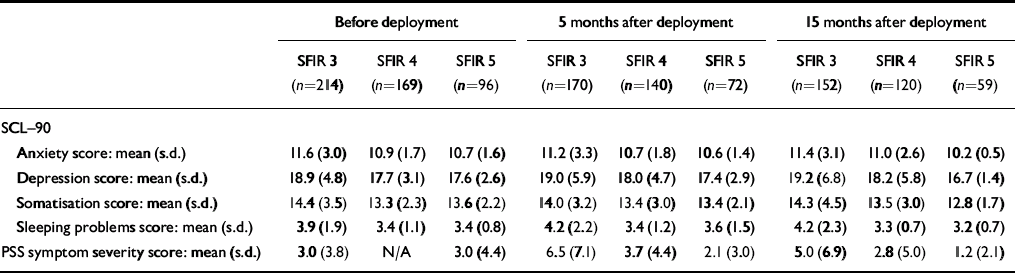
Table 3 indicates scores on mental health scales before and after deployment. The mean levels of anxiety, depression, somatic complaints, sleeping problems and general distress did not vary over time for the cohorts. The variance components for the intercept and the regression slope for the time variables were significant for all mental health scales, which means that individuals had different initial states as well as different rates of change. We sought to explain this variance. The final model for this analysis showed that prior life events and the SFIR 3 cohort (Armoured Infantry v. two Air Assault cohorts) were related to more pre-deployment symptoms. Although SFIR 3 was associated with pre-deployment symptoms, levels were still (very) low compared with norms for the civilian population (Reference Arrindell and EttemaArrindell & Ettema, 2003). The number of events in Iraq appraised as negative showed a strong linear relationship with slope estimates in somatic complaints and PTSD symptoms. The number of events experienced and the demographic and military characteristics were not significant (data not reported).
Scores on mental health scales for the three cohorts
| Before deployment | 5 months after deployment | 15 months after deployment | |||||||
|---|---|---|---|---|---|---|---|---|---|
| SFIR 3 (n=214) | SFIR 4 (n=169) | SFIR 5 (n=96) | SFIR 3 (n=170) | SFIR 4 (n=140) | SFIR 5 (n=72) | SFIR 3 (n=152) | SFIR 4 (n=120) | SFIR 5 (n=59) | |
| SCL—90 | |||||||||
| Anxiety score: mean (s.d.) | 11.6 (3.0) | 10.9 (1.7) | 10.7 (1.6) | 11.2 (3.3) | 10.7 (1.8) | 10.6 (1.4) | 11.4 (3.1) | 11.0 (2.6) | 10.2 (0.5) |
| Depression score: mean (s.d.) | 18.9 (4.8) | 17.7 (3.1) | 17.6 (2.6) | 19.0 (5.9) | 18.0 (4.7) | 17.4 (2.9) | 19.2 (6.8) | 18.2 (5.8) | 16.7 (1.4) |
| Somatisation score: mean (s.d.) | 14.4 (3.5) | 13.3 (2.3) | 13.6 (2.2) | 14.0 (3.2) | 13.4 (3.0) | 13.4 (2.1) | 14.3 (4.5) | 13.5 (3.0) | 12.8 (1.7) |
| Sleeping problems score: mean (s.d.) | 3.9 (1.9) | 3.4 (1.1) | 3.4 (0.8) | 4.2 (2.2) | 3.4 (1.2) | 3.6 (1.5) | 4.2 (2.3) | 3.3 (0.7) | 3.2 (0.7) |
| PSS symptom severity score: mean (s.d.) | 3.0 (3.8) | N/A | 3.0 (4.4) | 6.5 (7.1) | 3.7 (4.4) | 2.1 (3.0) | 5.0 (6.9) | 2.8 (5.0) | 1.2 (2.1) |
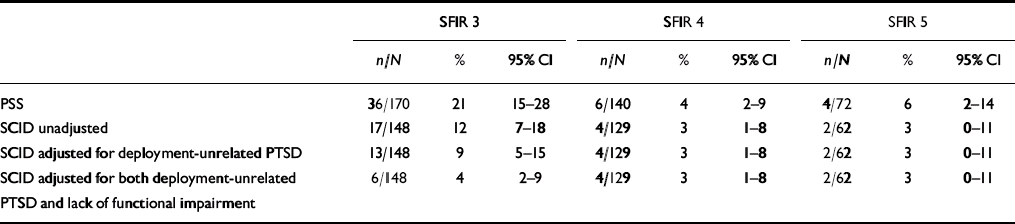
Table 4 shows that the PTSD estimates based on the questionnaire (PSS) 5 months after deployment were higher for the Armoured Infantry cohort compared with the other two cohorts. This difference disappeared after controlling for pre-deployment symptoms and reported harmful exposure in Iraq. Overall, the PTSD estimate was about 2 times higher than the unadjusted SCID rates. This was similar for participants who completed both the PSS and SCID: unadjusted PTSD rates were 41% lower than the PSS estimates. When using the stricter cut-off score, the questionnaire rates dropped (to 17, 4 and 0% respectively), but were still 1.5 times greater than the unadjusted SCID rates. A third of the ‘false-positives’ endorsed PTSD symptoms after stressful life events (e.g. social exclusion, viral infection, arguments with colleague, problems in relationship). On the basis of the SCID we were able to distinguish the current deployment-related rate of PTSD from PTSD with other origins (i.e. death of a relative and an earlier deployment) and PTSD with no more than slight impairment. This reduced the overall unadjusted SCID rates by about half. Soldiers with full PTSD reported significantly more functional impairment on the Likert scale than the others (U = 2611, P < 0.001). Only 2 out of 12 participants with full PTSD according to diagnostic interview marked at least ‘moderate’ impairment on the self-rated functional impairment Likert scale; 10 out of 12 with full PTSD reported at least ‘a little bit’ of impairment, but so did 68% of the false-positives. The PTSD rates were significantly associated with pre-deployment PTSD symptoms, earlier life events and the number of events on deployment rated as negative (data not reported).
Rates of post-traumatic disorder based on PSS questionnaire and SCID clinical interview.
| SFIR 3 | SFIR 4 | SFIR 5 | |||||||
|---|---|---|---|---|---|---|---|---|---|
| n/N | % | 95% CI | n/N | % | 95% CI | n/N | % | 95% CI | |
| PSS | 36/170 | 21 | 15-28 | 6/140 | 4 | 2-9 | 4/72 | 6 | 2-14 |
| SCID unadjusted | 17/148 | 12 | 7-18 | 4/129 | 3 | 1-8 | 2/62 | 3 | 0-11 |
| SCID adjusted for deployment-unrelated PTSD | 13/148 | 9 | 5-15 | 4/129 | 3 | 1-8 | 2/62 | 3 | 0-11 |
| SCID adjusted for both deployment-unrelated | 6/148 | 4 | 2-9 | 4/129 | 3 | 1-8 | 2/62 | 3 | 0-11 |
| PTSD and lack of functional impairment | |||||||||
DISCUSSION
Main findings
The main findings of the study were that (a) levels of general distress remained relatively stable from before to after deployment; (b) the Armoured Infantry cohort showed a higher PTSD estimate by questionnaire than the Air Assault Brigade cohorts owing to more pre-deployment symptoms and more reported harmful exposure in Iraq; (c) unadjusted PTSD rates from diagnostic interview were 41% lower than estimates from the questionnaire; (d) interview rates of PTSD were nearly halved after adjustment for PTSD which was unrelated to deployment and functional impairment; (e) a small minority of soldiers showed full-blown deployment-related PTSD.
The deployment-related rates of PTSD were much lower when the SCID was used as a diagnostic tool. The questionnaire could have led to inflated rates of symptoms because several individuals endorsed symptoms stemming from traumatic events which were unrelated to deployment (e.g. death of a relative), or from stressful but seemingly non-catastrophic events. Other studies have also linked non-traumatic life events to PTSD symptoms (see Reference McNallyMcNally, 2003). Moreover, PTSD questionnaires assess symptoms during the past month and fail to control for pre-existing stress and psychopathology. The PTSD arousal symptoms (e.g. difficulty sleeping, irritability, concentration problems) are not specific for the disorder, and may very well have been present before deployment (Reference Clark, Watson and MinekaClark et al, 1994).
Other studies
The questionnaire-based estimate of PTSD after deployment to Iraq has been documented in a few previous studies, but comparison is limited by differences in populations studied, sampling and response rates. Hoge et al (Reference Hoge, Castro and Messer2004) reported high levels of combat exposure in US infantry soldiers and used a broad symptom-based definition that resulted in a PTSD estimate of 18% 3–4 months after their return from Iraq. The PTSD estimate in our SFIR 3 (Armoured Infantry) cohort is similar (17–21%). Hotopf et al (Reference Hotopf, Hull and Fear2006) reported a rate of 4% in a random UK military sample that reported less trauma exposure. Hacker Hughes et al (Reference Hacker Hughes, Cameron and Eldridge2005) found that the PTSD estimate was 2% in a sample of the UK Air Assault Brigade. This is in the range we found for Air Assault Brigade cohorts (0–6%). For some, psychological symptoms may actually decrease, which has been shown previously in a UK study (Reference Hacker Hughes, Cameron and EldridgeHacker Hughes et al, 2005). The lack of change over time after deployment in our study is in line with other UK research (Reference Hotopf, Hull and FearHotopf et al, 2006), but not with the study of Hoge et al (Reference Hoge, Auchterlonie and Milliken2006) which suggested that rates of PTSD increase in the months after deployment. Various reasons have been proposed for the different outcomes of US and UK studies, including differences in trauma severity and healthcare systems (Reference Hotopf, Hull and FearHotopf et al, 2006).
Implications
Can the present findings be extrapolated to other types of trauma and civilian populations? We do not know whether our PTSD rates may be generalised to the military populations studied: although our response rates were exceptionally high, the convenience sampling method was less desirable than random sampling. However, there are no empirical or theoretical reasons to assume that the pattern of results would be different for different samples or populations. Population-level screening for PTSD is important to identify healthcare needs, and self-report measures such as the PSS have reasonable sensitivity and specificity (see Reference Coffey, Gudmundsdottir and BeckCoffey et al, 2006). However, when PTSD rates are low, as in the present cohort, it would be unwise to implement questionnaire-based screening (see also Reference Rona, Hooper and JonesRona et al, 2006). For clinical purposes, the rate of false-positives is less of a concern because the initial questionnaires can be followed by a comprehensive diagnostic interview. Such a two-step approach has been recommended to identify PTSD (Reference Shrout, Skodol, Dohrenwend, Barrett and RoseShrout et al, 1986). However, in epidemiological studies, the impact of traumatic events on mental health is often determined by merely examining whether or not participants meet symptom criteria for PTSD on a questionnaire. Our findings suggest that many people screened positive for PTSD may actually not have the disorder. Other studies have also shown that questionnaires provide higher estimates of ill health than clinical assessment: symptoms may signify disorder, but then again they might not (see Reference Frueh, Hamner and CahillFrueh et al, 2000; Reference WesselyWessely, 2004; Reference Hotopf and WesselyHotopf & Wessely, 2005). Healthcare needs might be much lower than expected on the basis of questionnaires.
A striking finding was that for 36.8% of soldiers showing the full PTSD symptom pattern on the SCID, symptoms did not produce more than slight impairment in their lives. This is in line with a re-analysis of PTSD among Vietnam veterans, in which individuals exposed to traumatic events and who experienced minimal symptoms for the diagnosis might very well have qualified as having PTSD despite living well-adjusted, productive lives (Reference Dohrenwend, Turner and TurseDohrenwend et al, 2006). It also fits well with a recent major re-analysis of two large US community surveys in which previously unused data on the clinical significance of symptoms were used to recalculate prevalence rates of mental disorder. Prevalence rates of any disorder were lowered by 17 and 32% (depending on the survey; Reference Narrow, Rae and RobinsNarrow et al, 2002). Hoge et al (Reference Hoge, Castro and Messer2004) also recalculated the PTSD rates after combat in Iraq on the basis of functional impairment or greater severity, and found that this decreased symptom-based PTSD rates by nearly 30% (from 18 to 12.9%). The DSM–IV classification system requires this functional impairment to differentiate symptoms from disorder, but population-based studies typically do not consider this criterion. Unfortunately, the system lacks objective criteria to determine impairment, and more work should be done to define when impairment becomes clinically significant.
Limitations
The present study does not provide information about the natural course of PTSD and functional impairment extending over 15 months. Despite considerable effort, the sample interviewed at follow-up was small, owing largely to the high turnover of personnel. This was also responsible for reduced sample sizes in previous studies (Reference Hotopf and WesselyHotopf & Wessely, 2005). Longitudinal evaluations of civilian populations suggest that PTSD symptoms decrease substantially within the first year, but little is known about the predictive validity of mild and sub-threshold forms of PTSD for soldiers on active duty. There is evidence from the National Comorbidity Study that a proportion of people with ‘mild’ mental disorders had worse clinical outcomes up to 10 years later (Reference Kessler, Merikangas and BerglundKessler et al, 2003). Similar longitudinal studies are needed for military populations. Some active soldiers may not experience functional impairment until they leave the military. If such predictive validity were found, the need for interventions might be considered on the basis of functional impairment as well as the risk of progression from a mild to a more severe disorder. This could have great public health importance. Clearly, these issues await future research.
There are some issues of sample size and power in our study. The use of a complex multilevel analysis and the presence of attrition is an obstacle for estimating power for the analysis method used. However, a one-way analysis of variance at the first measurement (before deployment) with a sample size of 479 achieves a power of 0.99 for medium effects and 0.48 for small effects. Analysis at 15 months with a sample size of 331 achieves a power of 0.98 for medium effects and 0.35 for small effects. The multilevel analysis should have at least this much power and the power to detect medium size effects should be very high. However, these results suggest that the study has only weak power for detecting small effects.
Future directions
Understanding PTSD from an epidemiological perspective is vital for estimating the likely need for healthcare services and information. This study shows that some individuals meet the PTSD symptom criteria but lead productive lives despite stress, and that some PTSD is triggered by causes unrelated to deployment. Not considering these aspects leads to inflated rates of deployment-related PTSD.
Acknowledgements
We thank Marieke van Baars and Lotte Bamelis for assistance with data collection, Erik Schouten for help with analyses, and the commanders and troops for their time and effort. This study was supported by a grant from the Veterans Institute (Doorn, The Netherlands) and an award by the Netherlands Organisation for Scientific Research to Iris M. Engelhard (Innovational Research Incentive VENI Scheme 016.045.106). We thank (representatives of) the Netherlands Ministry of Defense for their cooperation, and in particular the Afdeling Individuele Hulpverlening (AIH) and Col MD Kees Ijzerman.




eLetters
No eLetters have been published for this article.