

In recent decades, there has been a notable growth in theoretical discussions of community, collaborative, and co-creative archaeologies (e.g., Atalay Reference Atalay2012; Bollwerk et al. Reference Bollwerk, Connolly and McDavid2015; Colwell Reference Colwell2016; Marshall Reference Marshall2002). Within these writings, a consistent challenge has been the appropriate identification and understanding of stakeholder communities, with practitioners regularly reporting populations to be polysemous and diverse in meaning, composition, opinion, politics, and interests (e.g., Humphris and Bradshaw Reference Humphris and Bradshaw2017; Layton Reference Layton1989; Ozawa et al. Reference Ozawa, Colwell, Thompson, Nissley, Little, Shackel and Gates2018). Stakeholder theory (e.g., Matthews Reference Matthews, Castañeda and Matthews2008; Rico Reference Rico, Hillerdal, Karlström and Ojala2017; Shakour et al. Reference Shakour, Kuijt and Burke2019; Zimmerman and Branam Reference Zimmerman, Branam, Balme and Paterson2014) offers a framework for identifying the consequences of archaeological work in the world, as well as the institutional and individual actors who affect it. In this article, we argue that a key step in stakeholder analysis is understanding and harmonizing the goals of archaeological work to the social role of the institutions for which we work.
Specifically, we analyze the role of archaeological projects on college campuses to show that both the broader student body of an institution and a narrower set of interested and engaged students are among the stakeholder groups for this type of research (Christensen Reference Christensen2009:3; O'Gorman Reference O'Gorman, Skowronek and Lewis2010:243; Wilkie et al. Reference Wilkie, Christensen, Way, Skowronek and Lewis2010:227). Because a primary mission of colleges and universities is education, students on multiple demographic scales should be included in the research and communication of archaeology on their home campuses, wherever and whenever appropriate. Additionally, the interests, opinions, and knowledge of the broader student body should be considered in the design and dissemination of heritage work. It is not only archaeologists who should strive to include students as stakeholders in their campus heritage work—it is also the colleges and universities who frequently fund this archaeological work that must recognize their substantive obligations to students. Exactly how students are included must be structured by time and interest constraints, legal requirements, and ethical considerations. In order to highlight the benefits of student participation in campus heritage work, we present a case study from our home institution of Santa Clara University (SCU). We describe the results of an online survey of student interest in campus heritage and how the Community Heritage Lab at SCU, in response to these survey results, developed a student-focused community-based participatory research and public archaeology program.
STUDENT STAKEHOLDERS IN CAMPUS ARCHAEOLOGY
Students are perhaps the primary constituency of any school, with applications of stakeholder theory to higher education consistently analyzing their roles in their home institutions (Alves et al. Reference Alves, Mainardes and Raposo2010:163; Chapleo and Simms Reference Chapleo and Simms2010:15, 18). Although many other activities are vital to the operation of colleges and universities, the key ingredient that gives these organizations their identities and missions—not to mention frequently a significant amount of their operating revenue in the United States—is their role in educating people. This central position entitles interested students to be included, in some form, in the planning and execution of how knowledge about their home institutions will be produced and communicated. Additionally, students’ lives during and after college are heavily influenced by the cultural capital they gain through their attendance and degrees. Consequently, colleges and universities have a responsibility to curate their reputations carefully through appropriate and exemplary engagement with the world, such as ethical conduct in relationship to heritage resources (see Atalay et al. [Reference Atalay, Shannon and Swogger2016–2017], Lawler [Reference Lawler2010], and Stapp [Reference Stapp and Killion2008] for examples of negative publicity associated with institutions’ cultural resource practices).
Students’ college experiences are also deeply entwined with campus-based activities. Aspects of college life—from alumni associations to school pride to campus-wide social and sporting events—suggest a heritage sensibility within the experiences of many students. A number of studies have highlighted how people often feel a sense of connection to local archaeological remains and the past lives they represent, even in cases without lineal descent between local residents and the communities that produced the deposits (e.g., Byrne Reference Byrne, Harrison and Williamson2002; Harrison Reference Harrison2004; Hart and Chilton Reference Hart and Chilton2015; Wright Reference Wright2015). Additionally, engagement with the archaeological record is one way that people can foster these kinds of connection (Kowalczyk Reference Kowalczyk2016; Sgorous and Stirn Reference Sgouros and Stirn2016). Indeed, a number of campus archaeology case-studies have noted that student participants often feel a connection with those who lived at the same location in the past, even in cases when the archaeology is not focused on the history of the institution itself (e.g., Dufton et al. Reference Dufton, Gosner, Knodell and Steidl2019; Skibo and Hunter Reference Skibo and Hunter2011). This suggests that the broader student bodies of colleges and universities may indeed feel a stake in the history of their campuses.
The carefully planned inclusion of the general public in archaeological work and outreach activities can also have external impacts, such as the cultivation of useful constituencies (McManamon Reference McManamon1991), whether to prevent destruction of the archaeological record (Wright Reference Wright2015) or maintain opportunities within the discipline (Camp et al. Reference Camp, Hefner, Wolf and Goldstein2020; Klein et al. Reference Klein, Goldstein, Gangloff, Lees, Ryzewski, Styles and Wright2018). A key concept in stakeholder theory is that work must be assessed not just in its effects on organizations' members but also the common good (Bryson Reference Bryson2004:21). According to the U.S. Bureau of Labor Statistics (2019), over 69% of 2018 high school graduates enrolled in higher education courses in the fall of 2018. Campus archaeology, therefore, is one field that has the potential to educate large numbers of the general public about the practice of archaeology, especially when this labor and its results are integrated into a wider set of contexts—such as coursework, campus tours, public outreach, and interdisciplinary collaborations—that can reach much greater numbers of students (as well as faculty, staff, and visitors) than those who are actively involved in the field and lab archaeology.
In addition to archaeological work representing a portion of the function of institutions of higher education and, therefore, entitling students in general to some form of voluntary inclusion, a subset of interested and engaged students can also lay claim to stakeholder status in on-campus archaeology. Colleges and universities have a responsibility to provide educational opportunities, including research and real-world experiences beyond the classroom. Archaeology on campus is one area where these opportunities exist. Although not all students may be interested in this work, for those who are, campus archaeology offers a number of benefits discussed below that allow for greater access and more in-depth experiences than many other archaeological contexts.
SITUATING CAMPUS ARCHAEOLOGY
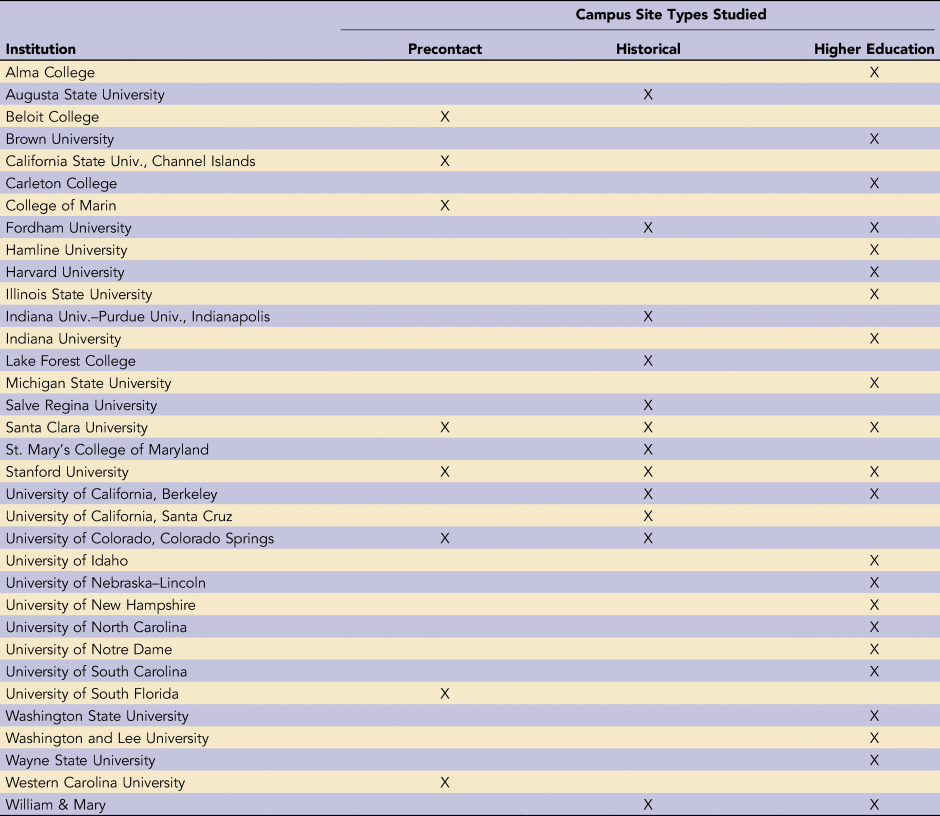
The results of campus-based archaeological research programs appear frequently in the literature, representing a range of institutions from highly selective private universities (Dufton et al. Reference Dufton, Gosner, Knodell and Steidl2019) to large public research universities (Lewis Reference Lewis, Skowronek and Lewis2010) to small liberal arts colleges (Landau Reference Landau2019). Our review of these reports revealed more than 30 campus archaeology programs with substantial student involvement (Table 1), and our anecdotal experiences suggested that a much larger number of schools have had such programs at one time or another. Many early on-campus archaeological projects focused squarely on the archaeology of academia itself (Skowronek and Lewis Reference Skowronek and Lewis2010; South and Steen Reference South and Steen1992), but a large proportion of campuses also exist atop remnants related to prior occupants or landscape uses. At many institutions in the United States, students regularly conduct archaeological excavations on their home campuses, revealing insights into the heritage of their institutions and local communities—past and present. These projects provide experience in archaeological field and laboratory methods at the same time that they stress the importance of community engagement.
U.S.-Based Institutions of Higher Education with Published Current or Recent Campus Archaeology Programs, Student Involvement, and Site Types.

On-campus archaeology projects typically fall into one of two categories: projects that are motivated by research or training interests and those that aid in the mitigation of the effects of institutional construction projects on archaeological resources. With regard to the former, recent publications have highlighted the educational benefits of such work for student participation and engagement (Dufton et al. Reference Dufton, Gosner, Knodell and Steidl2019; Landau Reference Landau2019). Harvard University, for example, has encouraged student participation in on-campus archaeological excavations for decades. In 2005, the Harvard Yard Archaeological Project began investigations into the university's earliest years, including its Indian College. These efforts have yielded a range of publications, but they have also provided students with ways to connect to the heritage of their alma mater—from fieldwork and laboratory experiences to in-person and virtual public outreach activities (Hodge Reference Hodge2013; Peabody Museum of Archaeology and Ethnology at Harvard University 2019; Stubbs et al. Reference Stubbs, Capone, Hodge, Loren, Skowronek and Lewis2010).
Other campus archaeology projects fill a more formal role in the process of mitigating the impacts of construction on cultural resources. Although academic archaeologists have expressed certain misgivings about the intermingling of these sometimes divergent objectives in the field of archaeology (Dixon Reference Dixon2000; Wilkie et al. Reference Wilkie, Christensen, Way, Skowronek and Lewis2010), there exist excellent examples of how students and faculty can participate in—or even lead—campus archaeology projects in the context of cultural resource management. At Michigan State University, students and faculty in the Campus Archaeology Program assist the university in mitigating the effects of planned development projects on campus heritage (MSU Campus Archaeology Program 2019). Depending on the regulatory environment and administrative priorities, these efforts can offer cost savings for the institution. The goals of construction and education, however, do not always align. Consequently, successful compliance- and mitigation-oriented campus archaeology programs are necessarily built on productive collaborations between archaeologists housed in academic departments and campus offices of operations or capital projects (Christensen Reference Christensen2009; Green and Fie Reference Green and Fie2017; Howey Reference Howey2015; Klein et al. Reference Klein, Goldstein, Gangloff, Lees, Ryzewski, Styles and Wright2018).
University administrators can be reluctant to allow students to be involved in campus archaeological work, and they can be openly hostile toward public archaeology in particular (White Reference White2004; Wilkie et al. Reference Wilkie, Christensen, Way, Skowronek and Lewis2010:238). This attitude seems to be especially prevalent at institutions with precontact Native American sites or more recent land uses that may lead to public relations challenges for the institution (Dixon Reference Dixon2000; Skowronek Reference Skowronek, Skowronek and Lewis2010). But, broadly speaking, the literature on campus archaeology suggests that administrators’ reluctance is more often rooted in legitimate concerns about safety, liability, the integration of fieldwork into construction schedules, and quality standards to meet legal mitigation requirements. These concerns may be compounded by ignorance about archaeology in general and the importance of outreach and accountability in the discipline today. Limiting the ability of students and other members of the interested public to see and understand the archaeology that occurs on college campuses, however, only serves to further entrench misunderstandings about the role of archaeology in contemporary society (Klein et al. Reference Klein, Goldstein, Gangloff, Lees, Ryzewski, Styles and Wright2018). In our view, campus-based archaeological projects offer a unique opportunity to educate a broad segment of the public about the importance of archaeology by engaging individuals in the heritage of the places where they live, work, and study.
Whether the archaeology is driven by research and pedagogical goals, or compliance and mitigation, involving students in campus-based projects has several benefits. Central among these is opening up field and laboratory opportunities to a broader and more diverse set of potential students (Dufton et al. Reference Dufton, Gosner, Knodell and Steidl2019:314). For instance, local options may be more accessible to students with mobility issues or medical concerns. Campus-based projects also offer opportunities for those who do not have the financial resources to enroll in field schools that require long-distance travel and room and board. Academic year programs can also provide savings to students by not requiring summer tuition (Christensen Reference Christensen2009:3; Wilkie et al. Reference Wilkie, Christensen, Way, Skowronek and Lewis2010:231–232). Additionally, conducting fieldwork on university or college campuses may help to limit the forms of sexual and identity-based misconduct that are all too common in field sciences such as archaeology (e.g., Nelson et al. Reference Nelson, Rutherford, Hinde and Clancy2017) because many colleges and universities have clearly articulated community codes of conduct and associated reporting mechanisms, well-developed infrastructures to deal with misconduct, and experienced professionals in charge of complaint processes.
Conducting archaeological investigations on campus also presents expanded opportunities for pedagogical experimentation. One emerging trend is to delegate certain decisions regarding research design to students, who can use their preexisting knowledge of the campus to generate research questions, choose excavation locations, and plan public outreach (Dufton et al. Reference Dufton, Gosner, Knodell and Steidl2019; Howey Reference Howey2015; Landau Reference Landau2019). Students are typically excited at the prospect of encountering items or places used by prior students at the institution, with whom they share a special bond, and this familiarity can offer opportunities for students to explore the importance of material culture in daily life (Dufton et al. Reference Dufton, Gosner, Knodell and Steidl2019:312; Galke Reference Galke2007:88; O'Gorman Reference O'Gorman, Skowronek and Lewis2010:245; Skibo and Hunter Reference Skibo and Hunter2011). In this way, campus archaeology involves more than just teaching techniques, but as is the case with archaeology more broadly, it invites reflection on the long-term histories of particular places. Indeed, campus-based projects have led to important explorations of race, gender, and other topics that have resonance far beyond the institutions themselves (e.g., Mullins Reference Mullins2006).
Campus archaeology also opens up new avenues for outreach, whether it is with students, employees, alumni, or members of the visiting public. In many instances, the “community” related to campus archaeological projects is the campus community itself, leading to new and innovative ways to imagine community-based archaeology (O'Gorman Reference O'Gorman, Skowronek and Lewis2010; Wilkie et al. Reference Wilkie, Christensen, Way, Skowronek and Lewis2010). Through the direct association with institutions of higher learning, moreover, campus archaeology can contribute to synergistic outreach opportunities through events such as campus-wide community days that offer high-impact experiences for students and positive publicity for the institution (Dufton et al. Reference Dufton, Gosner, Knodell and Steidl2019; Landau Reference Landau2019; White Reference White2004).
As applications of stakeholder theory to higher education highlight, these numerous benefits to students’ knowledge, critical thinking, practical skills, and affective material and historical connections to the places in which they live and work are all legitimate stakes that must be considered in organizational planning. Not only do colleges and universities have substantive obligations to students who would choose to engage in this work, but they can also derive a number of benefits—if handled appropriately—such as potential cost savings, improved community relations, and greater institutional reputation. Of course, the opposite may also be true with a lack of stakeholder engagement in campus archaeology work.
SANTA CLARA UNIVERSITY CAMPUS ARCHAEOLOGY
Campus History
Like all colleges and universities in North America, SCU sits on Native American land—in our case, the territory of the Tamien Ohlone, whose descendants today comprise various Ohlone communities and organizations, including the Muwekma Ohlone Tribe and the Ohlone Indian Tribe. The earliest deposits yet identified on campus date to roughly 2,500 years ago, although Indigenous people lived in the area for thousands of years before that (Skowronek and Pierce Reference Skowronek and Pierce2006).
The contemporary university also overlays Mission Santa Clara, which Franciscan missionaries operated from the 1780s (after having been moved from an earlier site) to the 1840s. Archaeologists have documented deposits related to multiple mission structures and colonial-era features (Panich Reference Panich2015; Skowronek and Wizorek Reference Skowronek and Wizorek1997). Perhaps the most significant are the remains of the mission's Native American neighborhood, or ranchería, which housed more than 1,000 Native individuals—representing diverse ethnolinguistic backgrounds—during most years. Excavations in this portion of campus have documented several features, ranging from the remnants of Native residences to domestic refuse deposits, which have yielded a wide range of artifacts and ecofacts (Allen Reference Allen2010; Panich et al. Reference Panich, Afaghani and Mathwich2014; Peelo et al. Reference Peelo, Hylkema, Ellison, Blount, Hylkema, Maher, Garlinghouse, McKenzie, D'Oro and Berge2018).
Santa Clara University (formerly Santa Clara College) is a Jesuit institution originally established in 1851 as the earliest operating institution of higher education in California, only a few years after the closing of Mission Santa Clara. Over the succeeding decades, the city of Santa Clara grew up around the fledgling college, which eventually expanded and incorporated previously developed city blocks into its campus. Today, the campus occupies 106 acres of land in the heart of the City of Santa Clara. Accordingly, archaeologists at SCU also regularly encounter American period (post-1850) features and deposits, ranging from single privies to entire industrial complexes, which date to the nineteenth and early twentieth centuries. Other features are related to the history of the institution itself, including deposits associated with an early dormitory and infirmary (Mathwich Reference Mathwich2012; Skowronek and Hylkema Reference Skowronek, Hylkema, Skowronek and Lewis2010). These more recent materials have received less attention than those related to Mission Santa Clara and its Indigenous inhabitants, but they are no less significant for the purposes of SCU campus archaeology.
The Institutional and Legal Context of Campus Archaeology Work
Unbeknownst to many of our students, archaeology is happening nearly year-round on our campus. This work is conducted as part of the environmental compliance for new campus buildings and other construction projects, and as such is outsourced to private consulting firms through University Operations, which oversees all earth-moving activities on the SCU campus. For the SCU campus, the California Environmental Quality Act (CEQA) is the most relevant legal statute. CEQA requires that all state and local agencies involved in development permitting require applicants to follow a set of protocols for analyzing and publicly reporting the potential environmental impacts of their work, as well as continuous monitoring of projects to both ensure compliance and intervene when unexpected impacts develop (California Natural Resources Agency 2019).
Although cultural resources have been included in CEQA since the 1970s, the way compliance has been interpreted by developers and government officials has changed through time (Praetzellis Reference Praetzellis2004). SCU is just one case of this, with no archaeological work on campus materials being done until 1981 when anthropology professor Mark Lynch led a team of undergraduate students in excavations underneath the Adobe Lodge, a historic building dating to 1822, in advance of its remodeling. Through time, this ad hoc arrangement was formalized into a research unit in the Department of Anthropology, a tenure-stream archaeology line focused on campus archaeology was developed, and a set of principles were negotiated with various Ohlone community organizations for how to treat human remains encountered during excavations (Skowronek Reference Skowronek and Skowronek2002:6–7).
By the 1990s, the demands of campus construction led to the hiring of a full-time staff member in both anthropology and operations. As time went on, the conflicting requirements of development timelines, mitigation needs, and academic work led to the creation of the Cultural Resources program in operations, which thereafter oversaw the supervision and implementation of all on-campus archaeology work. Today, Cultural Resources serves several roles for the university. It contracts and participates in all compliance archaeology and Native American monitoring on the SCU campus, serves as a repository for artifacts and other heritage materials, coordinates with contracted firms on report writing, and runs a variety of community outreach programs.
An unfortunate consequence of this history is that today, campus archaeology work is totally divorced from the academic mission of the university, in what we see as a significant misalignment with the university's obligations to its student stakeholders. Since the turn of the century, contract archaeology firms have conducted several multiyear projects on our campus, yielding significant datasets related to the Spanish colonial mission and the associated Native American residential areas, as well as early American period neighborhoods. Ironically, these collections have served as the basis for graduate student projects at other universities, in summer volunteer programs off campus at a California State Park, and for volunteer programs run by SCU's Cultural Resources staff. No SCU students or faculty, however, have been actively involved in this compliance-based campus archaeology during the past decade, nor have SCU collections been available for instruction at our own university.
In the fall of 2018, the Community Heritage Lab (CHL) was started within the Department of Anthropology to reintegrate campus archaeology into the SCU academic curriculum. CHL is housed in a historic mid-nineteenth-century structure, which contains storage space for field equipment and artifacts, a laboratory with a variety of specialized analytic equipment, and a teaching area for students to work with archaeological materials. The lab is intended to be a space used by faculty, staff, and students from across campus who are interested in the history of the university and its surroundings. It also serves to facilitate collaborations with various stakeholder groups, such as the descendants of the Native inhabitants of Mission Santa Clara (e.g., the Muwekma Ohlone Tribe and Ohlone Indian Tribe); descendants of Spanish, Mexican, and American settlers; members of the Catholic Church; and contemporary residents of the city of Santa Clara and the wider Silicon Valley. As such, the lab is premised on a sort of community-service archaeology by partnering with various SCU and non-SCU constituencies to take the resources and expertise available on campus and offer them to on- and off-campus stakeholders.
STUDENT PERSPECTIVES ON CAMPUS ARCHAEOLOGY
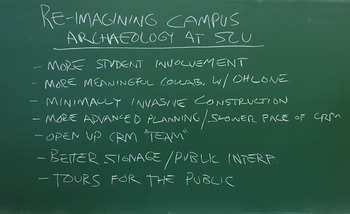
As faculty at SCU, we have long been aware of student interest in more transparency and engagement in the ways that our university conducts campus archaeology (Figure 1). Such sentiments, however, were always anecdotal in nature. Inspired by the attempts of several recent projects to integrate public opinion into the design of their archaeological programs (Horrom Reference Horrom2011; Humphris and Bradshaw Reference Humphris and Bradshaw2017; Kowalczyk Reference Kowalczyk2016), we sought to more systematically assess how SCU students view the archaeology and heritage of their campus in order to develop research, pedagogical, and public archaeology programs that include students as stakeholders. To that end, we conducted a survey of students consisting of 13 questions, including demographic information. The questions were tested with student researchers working in CHL, and they were revised to ensure that the vocabulary was familiar to undergraduates and that the questions used plain language to communicate clearly. The survey was administered online via Qualtrics in several courses, during the winter, spring, and fall quarters of 2019. Prior to deployment, the survey language and protocols were reviewed and revised in collaboration with the SCU Institutional Review Board, which ultimately granted an exemption.
Chalkboard notes with student suggestions for improving campus archaeology at SCU. From Panich's Introduction to Archaeology (ANTH 2) course, winter 2019.

The survey was administered to 11 undergraduate classes. Five were interdisciplinary courses that are required for all undergraduates across the various colleges of the university and six were anthropology-specific courses that serve both College of Arts and Sciences distribution requirements and the anthropology major. Only one of the 113 students enrolled in the interdisciplinary classes was an anthropology major or minor (0.9%), whereas 22 of the 122 (18%) students enrolled in the anthropology courses were majors or minors. This is compared to the student body as a whole, with 47 anthropology majors and minors out of 5,438 undergraduates (0.9%) (Office of the Registrar 2017). The survey was administered as an optional activity in the final 15 minutes of class periods. Surveys were completed by 215 students, with an overall response rate of 95% (91% for anthropology courses and 100% for interdisciplinary classes; see Supplemental Materials for the complete survey, distribution episodes, and results).
Because the survey was administered in courses, it was not a random sample. The enrollment structure, major and minor demographics, and high response rate, however, suggest that either the total sample or the two subsamples of different class types would be representative of campus opinion depending on context. In some cases, such as a student's personal connections to prominent populations and institutions in the history of Santa Clara, the total student population provided representative results for overall student attitudes on our campus. In other cases, such as preferred means of participating in the analysis of Santa Clara's heritage, the interdisciplinary sample provided a better representation of these attitudes. Importantly, both the anthropology and interdisciplinary samples provided independently useful information, not only about student interests but also how best to continue fostering an interest in and appreciation of heritage resources and activities among those students who have chosen to explore such topics in their coursework.
The survey was designed to assess two general domains. First, we wanted to capture baseline information about (1) how students relate to campus heritage, including whether or not they view themselves as having a personal connection to different groups associated with Santa Clara's cultural heritage; (2) what existing knowledge they have about different aspects of campus history and archaeology; and (3) how they have learned about campus heritage in the past. Second, we wanted to gauge students’ interest in learning more about specific components of campus history, so we included questions on how they might wish to become involved in and receive information about campus archaeology and heritage initiatives. Finally, we collected standard demographic information about respondents.
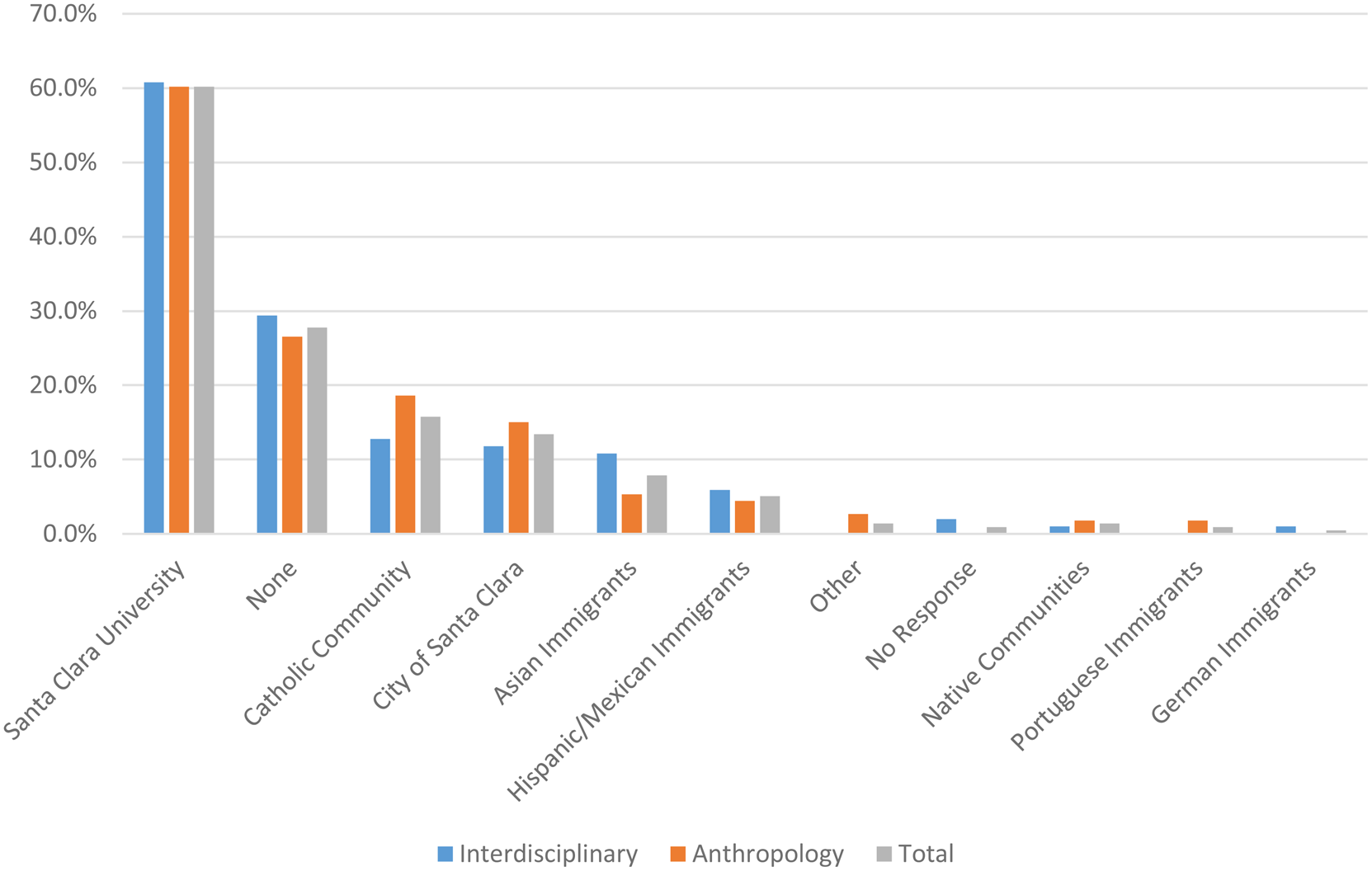
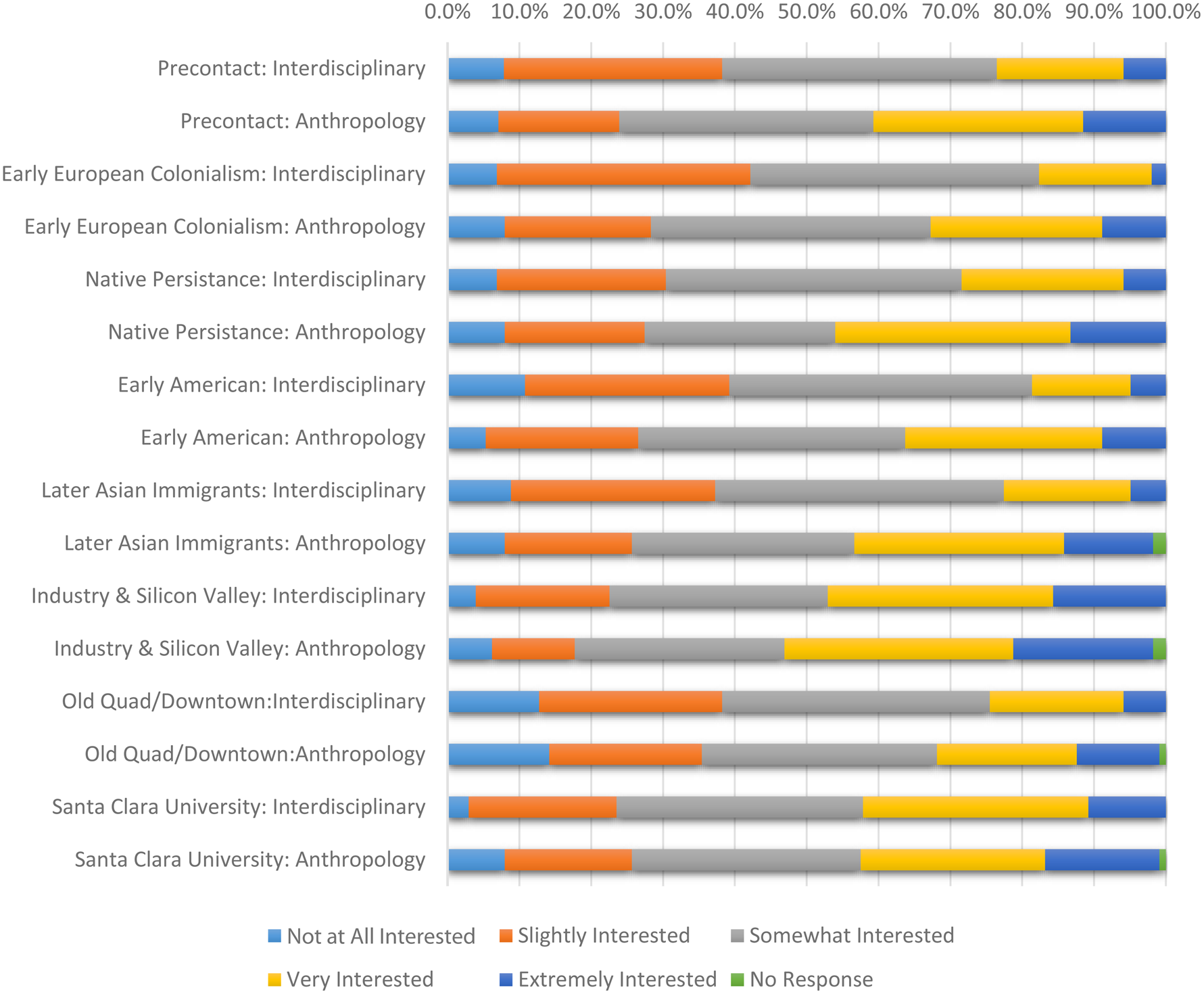
For the first domain, we found that 72% of respondents indicated that they had one or more personal connections to groups and/or institutions that have been historically associated with the SCU campus. The most prominent response by far was the university itself, which was indicated by 60% of the respondents, with 0.6% separating response rates for anthropology and interdisciplinary classes. This underscores the role of students as fundamental stakeholders in campus heritage—a clear majority self-define as having a personal connection to the campus community. Other potential connections had lower response rates (Figure 2). In line with these results, when asked to rate their interest in learning more about the histories of these same communities and institutions on a five-point Likert scale, 42% of both the anthropology and interdisciplinary course samples indicated that they were very interested or extremely interested in learning more about the history of Santa Clara University. The only response with a higher rate both overall and among interdisciplinary students was the history of industry and the origins of Silicon Valley, with 49% and 47% of students describing themselves as very interested or extremely interested, respectively. Other responses showed lower levels of interest. Intriguingly, especially in light of the centrality of Mission Santa Clara to the identity of SCU, the period of early European colonization had the lowest proportion (18%) of interdisciplinary students responding as very or extremely interested (Figure 3).
Percentage of interdisciplinary and anthropology students, as well as the total sample, reporting personal connections to prominent communities and institutions in the history of Santa Clara.

Likert scale responses comparing anthropology and interdisciplinary students’ ratings of their desire to learn about histories of specific communities and institutions associated with Santa Clara University and the surrounding area.

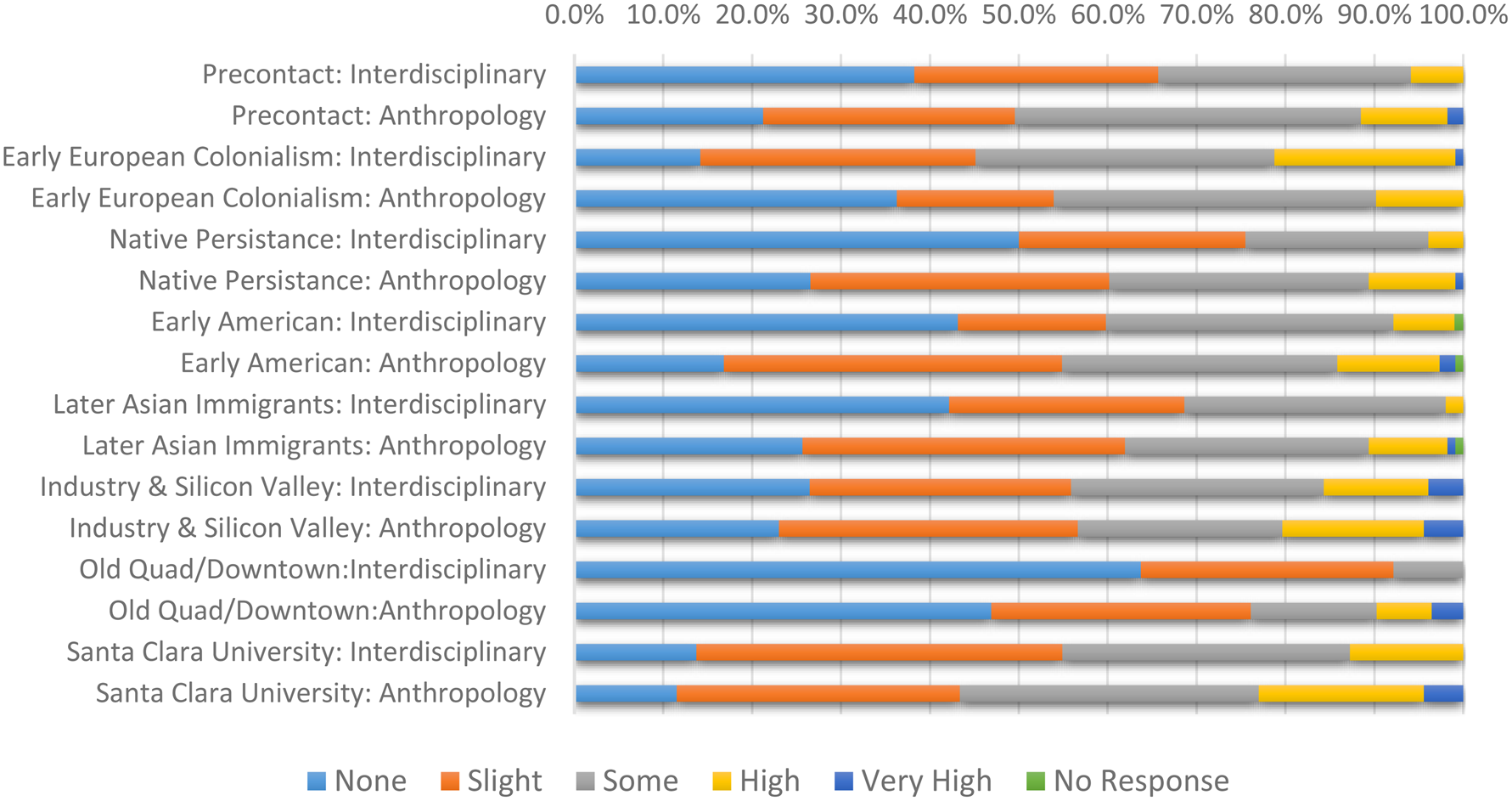
Even though students reported high levels of personal connections and interest in various local heritage topics, they also reported low levels of existing knowledge about the main historical periods and communities most closely associated with the university and surrounding area. For all categories in the complete sample, only between 5% and 18% (median: 10%) of respondents rated their existing knowledge as high or very high. In the interdisciplinary sample, knowledge across all categories was even lower—only between 0% and 16% (median: 6%) responded with high or very high. At the other end of the spectrum, approximately 13%–55% (median: 29%) of students in the total sample indicated that they had no knowledge of key historical groups or periods associated with Santa Clara as compared to 14%–64% (median: 40%) of students in the interdisciplinary classes (Figure 4).
Likert scale responses comparing anthropology and interdisciplinary students’ ratings of their knowledge of the histories of specific communities and institutions associated with Santa Clara University and the surrounding area.

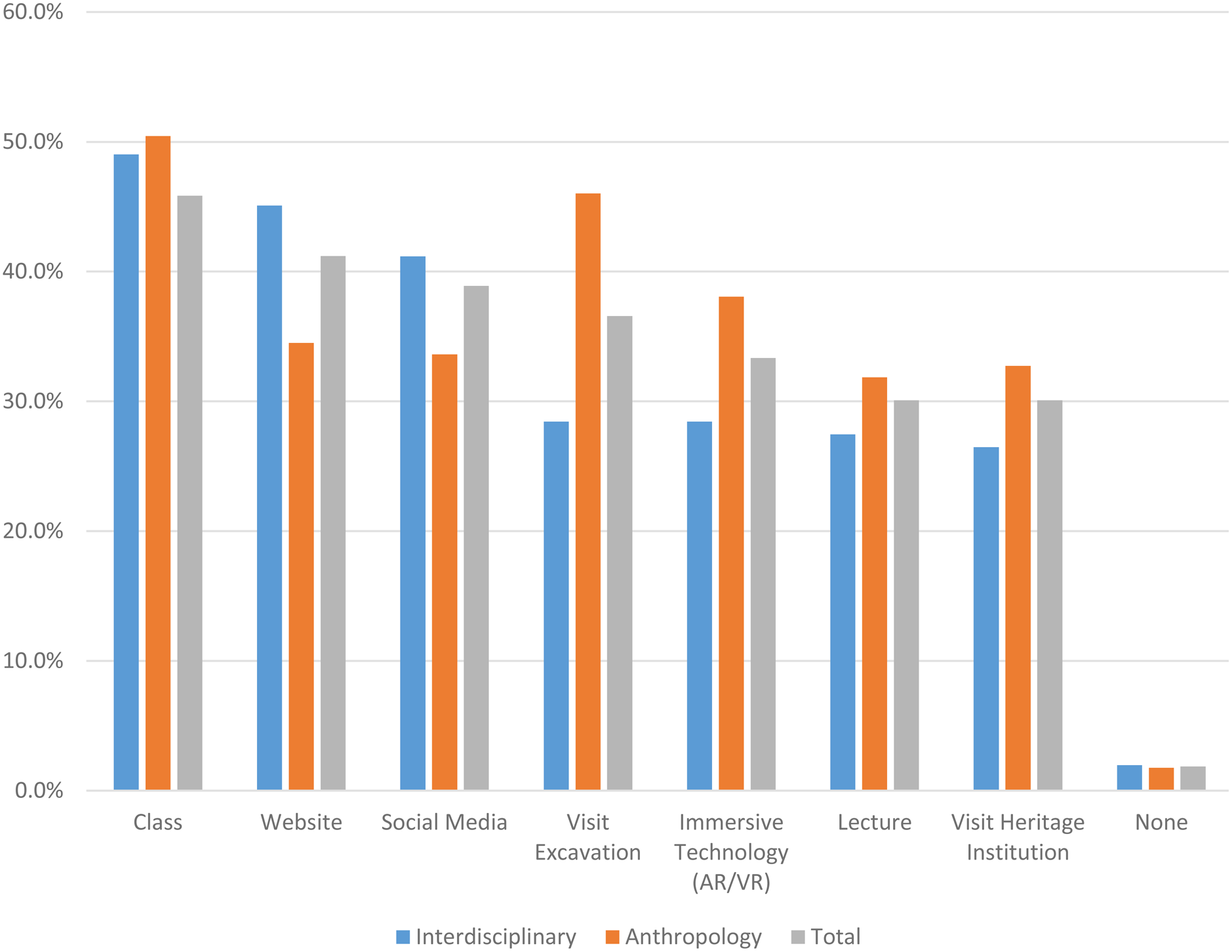
Our survey also produced a number of informative results about the means by which students would like to both learn about and participate in projects that examine local heritage. Students in interdisciplinary courses, who seem more representative of the campus population as a whole, responded with a wide range on preferred means of learning about SCU's heritage. Websites, social media, and coursework were the top choices. Various other methods, such as visiting heritage institutions and archaeological projects and having immersive experiences (e.g., augmented and virtual reality), also received substantial numbers of responses. Students in anthropology-focused classes most frequently listed coursework as a preferred means of learning about Santa Clara's past (Figure 5).
Percentage of interdisciplinary and anthropology students, as well as the total sample, reporting a desire to utilize various means to learn about Santa Clara's past.

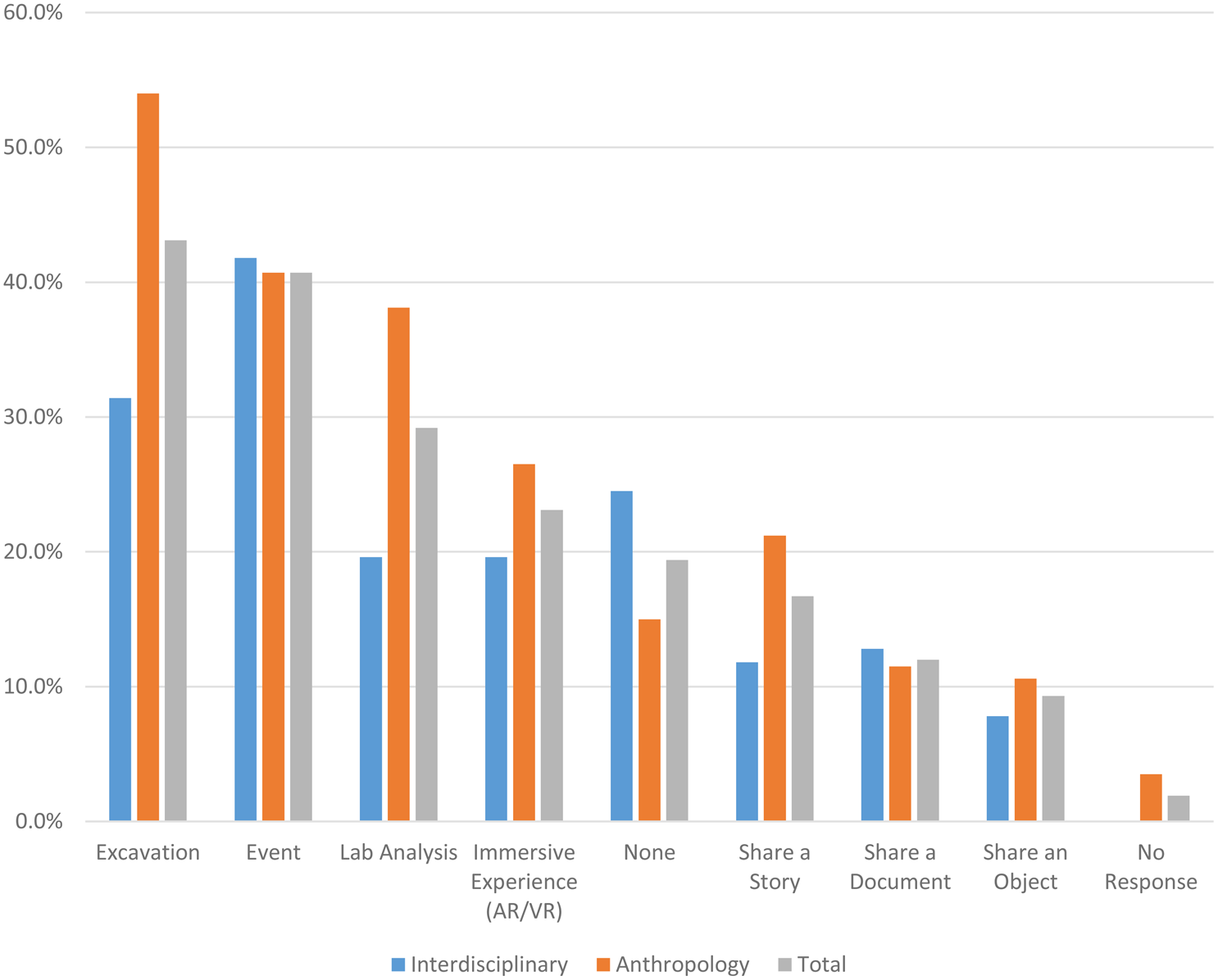
Students in interdisciplinary courses showed the greatest interest in participating in community events, as well as archaeological excavations, as a means of exploring Santa Clara's heritage. It was heartening that students enrolled in anthropology classes showed a substantially higher interest in participation in archaeological fieldwork and laboratory analysis as compared to interdisciplinary students (Figure 6). This may suggest that greater exposure to archaeology can increase interest and appreciation of heritage work and resources, especially considering that the vast majority of students in anthropology courses (82%) were non-anthropology majors.
Percentage of interdisciplinary and anthropology students, as well as the total sample, reporting a desire to participate in various means of exploring Santa Clara's past.

Our results regarding students’ interest in the history of their campus are similar to those presented by Horrom (Reference Horrom2011), who surveyed students at St. Mary's College of Maryland, which is located on the site of St. Mary's City, one of the nation's oldest European settlements. Whereas 34% of students surveyed there said that they knew “almost nothing” about the history of St. Mary's, an impressive 87% indicated that they were somewhat or very interested in learning more about historic sites on the St. Mary's College campus (Horrom Reference Horrom2011:220). By comparison, 75% of students at SCU indicated that they were somewhat, very, or extremely interested in the sites on their campus. The parallels in these results suggest that SCU students may not be unique. Rather, an interest in and connection to the material, cultural, and historical heritage of a central place in the daily experiences of students may be common—similar to such interests and connections found in the broader public (e.g., Wright Reference Wright2015).
These results from our survey show that (1) there is significant student interest in campus heritage, (2) there are a large variety of old and new media with which students would like to engage regarding campus heritage, and (3) material culture analysis methods, specifically, are among the most attractive means for explorations of campus heritage. This suggests that archaeologists are well positioned to provide the sorts of opportunities in which students are interested. In response to the results of this survey, we at the SCU Community Heritage Lab have begun to develop a public-facing campus heritage program dedicated to engaging students and raising the profile of archaeology at Santa Clara University.
VENUES FOR CAMPUS ARCHAEOLOGY
There are a variety of ways that students can interact with archaeological materials, including fieldwork, post-fieldwork laboratory analysis, research with repository collections, coursework, and public outreach and other community-based collaborations. Because of the institutional, legal, and infrastructural contexts at play on college campuses, it is not always possible for the broader student body—or even interested and/or experienced students—to participate consistently in all of these activities. Instead, negotiation and collaboration with stakeholders and administrators is required. Perhaps the greatest challenge for academic archaeologists in campus archaeology is designing research, teaching, and community-based programs that can accommodate the development demands of universities, while not contributing to the challenges archaeology faces—such as the curation crisis (e.g., Bauer-Clapp and Kirakosian Reference Bauer-Clapp and Kirakosian2017) and the ongoing harmful aspects of archaeology, especially in the settler colonial context of North America (Nicholas and Hollowell Reference Nicholas, Hollowell, Hamilakis and Duke2007). In this section, we describe CHL heritage programs to show how collaborative work with the wide range of stakeholders can both meet our obligations to students and be practiced in a responsible manner in regard to principles of archaeological ethics (e.g., Society for American Archaeology 1996; Vitelli and Colwell-Chanthaphonh Reference Vitelli and Colwell-Chanthaphonh2006).
Despite the positive responses from students who took our survey, at SCU we face two challenges in making the connection between student stakeholders and the heritage of their campus. The first is a constellation of institutional policies and priorities that make it nearly impossible for students to participate in campus archaeological excavations. The second is simply our geographical location in the heart of Silicon Valley, which exacerbates the national trend away from liberal arts and social science disciplines toward more vocationally oriented and ostensibly higher-paying fields (Stock Reference Stock2017). Although our engineering or business students, who make up nearly half of the undergraduate student body (Office of the Registrar 2017), may be interested in the history of their home campus, they often have limited ability to take courses outside of their major and frequently secure paid internships during the summer when most archaeological fieldwork takes place.
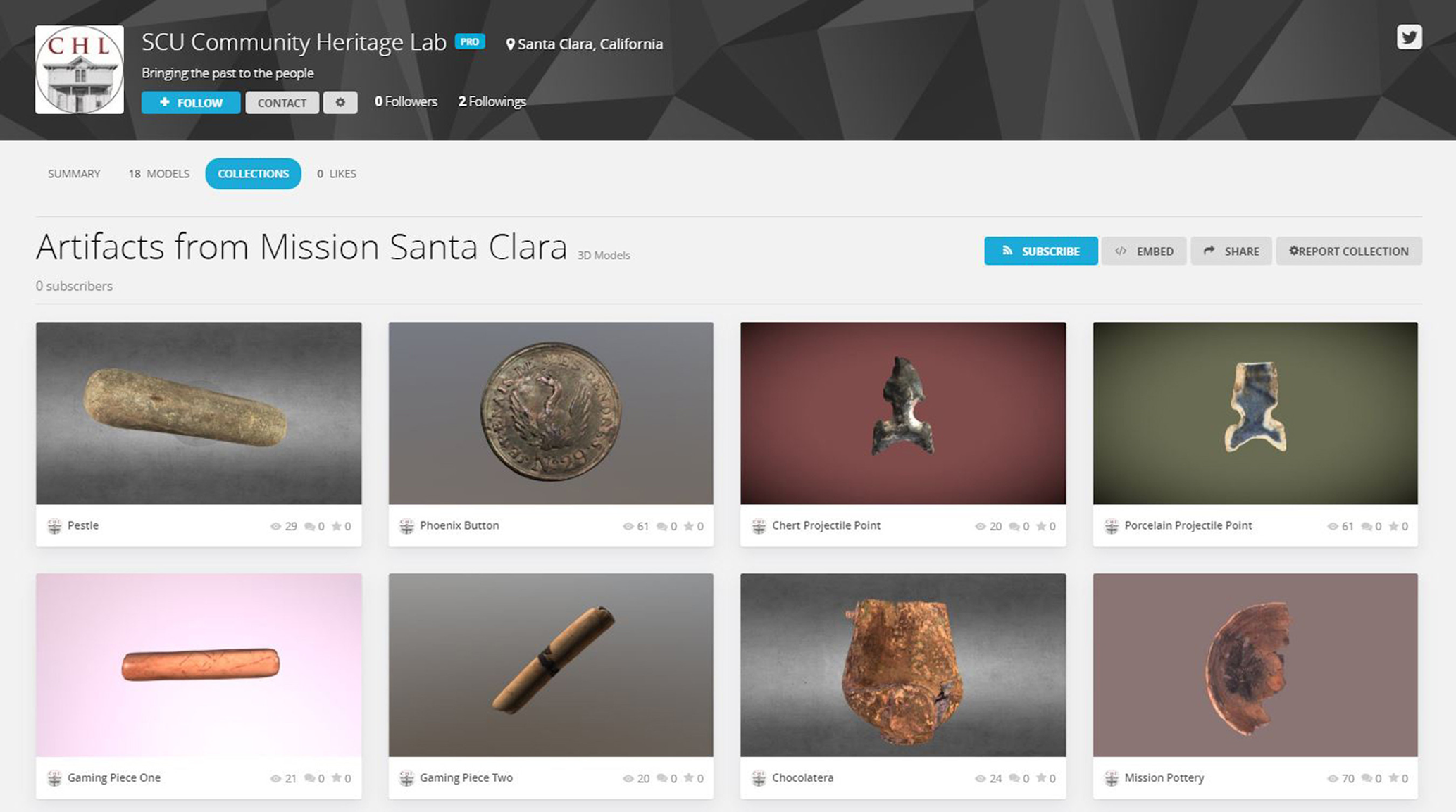
To adapt to these trends, we have used the results of our survey to develop a number of research and pedagogical programs through CHL. One area of interest is curricular offerings that highlight the archaeological and historical heritage of the SCU campus, given that coursework was a top-tier response for the preferred means of learning about Santa Clara's past among interdisciplinary students and the most frequently cited of all such options among anthropology students. For example, CHL affiliates from the Departments of Anthropology and English recently team-taught a course for 12 undergraduates titled “Virtual Santa Clara,” in which students analyzed historical narratives and public memory related to Mission Santa Clara. Students in this course examined archaeological materials from the Native ranchería, including a handful from the Cultural Resources Collections; met with a representative of local Ohlone communities; and created digital exhibits, including 3D modeling of artifacts, intended to move toward a more inclusive telling of campus history (Figure 7).
Screenshot of example 3D artifact models from Mission Santa Clara on the Santa Clara University Community Heritage Lab Sketchfab page.

In a second project, using previously excavated and analyzed artifacts housed at CHL, students and faculty from Departments of Anthropology, Art and Art History, and English are collaborating with representatives of the Muwekma Ohlone Tribe and the Ohlone Indian Tribe to create a heritage website using the open-source digital content management and presentation system Omeka. Over 100 students in four classes are producing digital assets under the guidance of community and faculty collaborators for this umbrella website overseen by CHL. The goal of this website is to integrate students into the knowledge production process, increase the public visibility of heritage on our campus, and develop student skills in community-based participatory research while ensuring rhetorical sovereignty (Lyons Reference Lyons2000) for descendant communities.
The complex history of the SCU campus and the various stakeholders connected to this history has presented challenges. Beyond the organizational barriers that exist in our own institution, we have had to secure both internal and external funding to compensate Ohlone stakeholders for input on course design and collaborations in asset production. Unfortunately, the time commitments that go into these sorts of curricular development activities are undervalued in instructional assessment for hiring, tenure, and promotion (Atalay Reference Atalay2019; Greenberg Reference Greenberg2019). With this financial support, however, it has been possible to substantively include not only Native Americans but also other lineal descendant, student, and residential community stakeholders in our work.
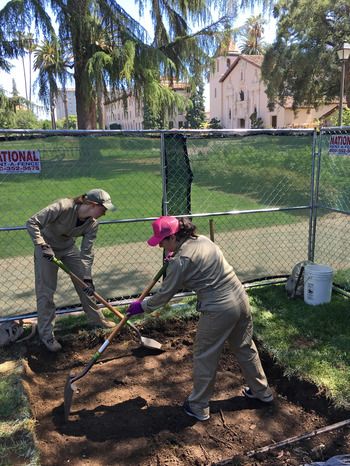
In addition to these new venues for campus archaeology utilizing curated artifacts, we remain committed to engaging students in the excavation and analysis of archaeological materials, especially given our students' interest in these opportunities as indicated in their survey responses. Despite limitations on the location and scope of ground-disturbing activities, we taught an archaeological field school on campus during the summer of 2019—the first time students had conducted excavations on the main SCU campus in well over a decade (Figure 8). The field school provided the opportunity to train seven students in field methods, laboratory analysis, historical research, and public outreach. By placing students front and center in the research process and the public presentation of findings, the field school attempted to align SCU's central educational mission with archaeological practices on our campus.
Commnity Heritage Lab students Brynn Lowry and Daniela Hernandez excavate on the campus of Santa Clara University, with Mission Santa Clara in the background.

Like our curricular development collaborations with local Indigenous community members, the ethical considerations and institutional context surrounding this field season required extensive negotiation and collaboration with various university entities. These negotiations necessitated the investment of time and money, but they also provided the many benefits of campus-based fieldwork described above. CHL offered the necessary infrastructure for campus archaeological work—including lab space, curatorial supplies, and a climate-controlled storage room—while also creating additional pedagogical benefits beyond the field season, as excavated materials became available for student research and instruction, without the same obstacles to using campus collections controlled by SCU Cultural Resources. For example, in the 2019–2020 academic year, seven student researchers are employed working with collections housed at CHL, and they are participating in community outreach.
A key aspect of the research design for the field school was an agreement between CHL and University Operations to select an excavation location that not only was safe and accessible but that would benefit the university's development plans by testing an area of campus where cultural resources may be impacted by future construction. This long-term planning allowed for operations to provide us with several possible areas for excavation to choose from, based on their potential in testing research questions of interest to local stakeholders. We were able to review historical documents and archaeological reports to select the site of a nineteenth-century general store located across the street from Santa Clara College (Sanborn Map 1887). Working with students, we developed a set of research questions about the consumption practices of early SCU students as compared to the descriptions of them in archival sources, as well asthe role played by local availability and changing tastes due to immigration, assimilation, and cultural hegemony in driving the sale of consumer goods.
Although it can be difficult to convince administrators of the potential benefits of investing in student-centered campus archaeology, the central importance of students as stakeholders in educational institutions is a powerful argument. Campus archaeology can create additional bureaucratic demands for the researcher. In our case, in order to implement our research program, we had to coordinate with Environmental Health and Safety, the Office of the General Counsel, the Equal Opportunity and Title IX Office, and the Office of Summer Session. These collaborations, however, also provided additional support and exposure. For example, the Summer Session Office invited us to present our work at new student orientations and train orientation leaders on the history of our campus.
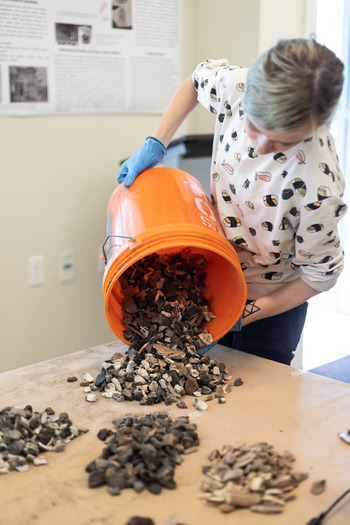
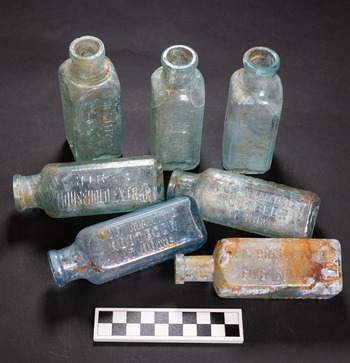
The design of the field school itself was tailored to student interests. They not only excavated and recorded archaeological materials but also analyzed, interpreted, reported, and developed digital resources to be used in the public communication of our findings. This included artifact analysis, a site report, the updating of site records for the California Office of Historic Preservation, and the production of digital images and 3D scans of artifacts (Figure 9). In addition to analyzing the artifacts we excavated, CHL developed a collaboration with two cultural resource management firms conducting mitigation work on materials from Mission Santa Clara and the early American period of Santa Clara at a site just north of the SCU campus. In this arrangement, which was worked out with the developer, city regulators, and Native American representatives, students analyzed artifacts from selected features excavated by the companies (Figure 10). This partnership provided students with useful experience and expanded our understandings of Santa Clara's past. Additionally, the permanent presence of CHL on our campus has allowed interested students to participate in multiple phases of this ongoing work, from analysis through report writing and submission, as well as revisiting previously cataloged materials with new research questions and analytic techniques.
Community Heritage Lab student Haliegh Nagle analyzing faunal remains from the Mission Santa Clara ranchería. (Photo courtesy of Haven Kato.)

Root beer extract bottles from the early American period in the city of Santa Clara. (Photo courtesy of Haven Kato.)

As part of our field school, we also involved students in various public outreach activities—from inviting passersby to visit our excavations by means of a simple sign to presenting our work and findings to community groups. For example, participants held an interactive presentation session on some of the American period artifacts they analyzed with a local advocacy group called Reclaiming Our Downtown, which is promoting the redevelopment of a central business district in Santa Clara. This presentation highlighted the benefits of public outreach, with the audience turning the tables on the students and treating them like a focus group for their revitalization initiative. That the community partners considered the meeting a success was reflected by the fact that they posted about it twice on their Facebook page, the central medium for organizing and communicating with the group (Reclaiming Our Downtown 2019).
DISCUSSION AND CONCLUSIONS
Although archaeology is taught at countless institutions of higher education across North America, archaeologists have only recently recognized students as fundamental stakeholders in the archaeology of their own campuses. Archaeologists and institutions that fund archaeology should, where appropriate, make public the archaeological work happening on campuses, offer opportunities for students to participate in the research process, and enable student engagement with archaeological materials. These individuals and organizations must also consider their substantive obligations to students in regard to how knowledge about campus and institutional histories are researched and communicated. Stakeholder theory is able to identify the ways that student bodies are impacted by archaeological work on college campuses and the obligations for opportunities to participate in heritage work that colleges and universities have with respect to a subset of interested and engaged students.
These obligations are highlighted by the results of our survey, which show that students would like to have such opportunities. We found that students have a strong interest in both working on and learning about issues of campus heritage. Students report compelling connections to the history of their university, as well as the people who previously occupied the physical spaces of their campus—findings that are in line with data from other institutions and locations. Our students at SCU also report that community events and archaeological work are the most attractive means of engaging with these topics and that their preferred ways of learning about the university's past are in classrooms and through digital media. Although many students report minimal knowledge about the history of the SCU campus, they also report high levels of interest in a variety of heritage topics.
A review of the campus archaeology literature and the outcomes of the projects we implemented through CHL in response to our survey results demonstrate a number of benefits in treating students as stakeholders in campus archaeology. These points may be useful for researchers and administrators involved with similar work at other colleges and universities. Even though we faced a number of administrative constraints in our work and even though our collaborative efforts require ongoing commitments of time and funding, CHL's reengagement with campus archaeology has greatly improved SCU student access to knowledge and skills. It has also helped cultivate meaningful personal connections to local places and communities. Legitimate health and safety concerns, quality controls, and development timelines, as well as ethical obligations to Indigenous descendant communities that must be prioritized, all structured how CHL's archaeology program could include student participation. With careful long-term planning and a variety of means of engagement—from research and outreach to hands-on learning in the classroom—we have been able to push our research and education program forward.
The foremost benefit to students from their inclusion in on-campus archaeological projects is the development of research skills and analytic frameworks that move beyond the classroom and focus on experiential learning. In line with curricula of schools like SCU that devote resources to the cultivation of responsible citizens, campus archaeology work helps expose students to tangible issues relating the past to their present. Additionally, when thinking about barriers to stakeholder participation, campus-based training programs provide enhanced access for students with financial or ability challenges and greater protections against misconduct. Lastly, institutions of higher education across the country rely on the enduring connections they make with their students. They have found endless ways to foster attachments to their organizations, such as sports and alumni associations. Archaeology, we argue, is yet another medium for enhancing these affective relationships.
There are other benefits to students, colleges and universities, and surrounding communities. Student-led community archaeology work in collaboration with off-campus stakeholders, such as residential and descendent communities, can help foster a greater sense of place in students and can humanize students to people outside of institutions of higher education. For example, in one of the more striking moments in the impromptu focus group on the redevelopment of downtown Santa Clara, one field school member gently guided questioning away from alcohol, noting that most students at SCU are not of drinking age and that all students have many more interests than simply going to bars. As local residents learned more about the lives of students and students learned more about the concerns of their neighbors, the conversation was enlivened. Such interactions are also a benefit to school administrators who must often serve as mediators between these two groups in times of conflict.
Another area where treating students as key stakeholders in campus archaeology benefits surrounding communities is built into the sorts of work that CHL conducts. It is predicated on a model of archaeology as public service. All of our work is developed in coordination with and/or in response to the wishes of the broader Silicon Valley community and the descendants of the people who produced the campus archaeological record. In this role, we have participated in neighborhood events, presented our work to interested organizations, and aided various local enterprises and associations. All of this work has included students at the fore, who perform the bulk of the labor and interact with their host communities. We have found that, in the minds of many people in Santa Clara, the students are the face of the university. Consequently, when the students are treated as vital stakeholders, leading our work and receiving the educational benefits of participation, these students are also connecting with local residents who too often see them from a distance as a nuisance or problem. This reframing of town-and-gown relations through heritage work helps non-SCU residents as much as it does the university.
Finally, we would argue that including students as stakeholders in campus archaeology helps to cultivate a large and influential constituency that, if included in archaeological work, can both passively appreciate and actively advocate for archaeology as a discipline. As our survey results showed, students have an interest in this work and their preferred means of exposure and engagement are, in fact, just the sorts of things that academics are positioned to deliver, from courses to campus-based fieldwork experiences. Furthermore, participation in this work seems to increase this interest and appreciation. Campus archaeology can cement the affective attachments between students and their college or university, and it can help bring students and local communities together. In addition, through the results of our work, we believe that one of the largest benefits of campus archaeology may be that it cultivates a broader appreciation for heritage resources more generally.
Acknowledgments
We thank all the students who have participated in this most recent iteration of campus archaeology at SCU. Kiersten Brady and Tess Rosenberg assisted with the design and implementation of the heritage survey. RJ Giese, Raymond Hartjen, Daniela Hernandez, Haven Kato, Brynn Lowry, Haliegh Nagle, and Hailey Zummo made up an excellent field school crew. Along with Kiersten, Tess, RJ, Raymond, and Daniela, Nora Fluetsch, Claudia Stefanescu, and Lucy Schmidt continue the analysis of archaeological materials housed at the Community Heritage Lab and our work with community partners. University Operations provided invaluable logistical support for our 2019 summer field school. We would also thank Michelle Bezanson, Fr. Michael Engh, Chris Shay, and Debbie Tahmassebi for their support of the Community Heritage Lab. Finally, thank you Sarah Herr and the editorial team at Advances, as well as the anonymous reviewers for their constructive comments. No permits were required for the fieldwork described in this article. The Sponsored Projects Office at Santa Clara University approved the design and consent procedures for the survey work reported in this article through an exempt review (Protocol ID: 19-01-1230). This work was partially funded by a Community Initiated Partnership Grant from the Critical Mission Studies University of California Multicampus Research Program Initiative, a fellowship from the Santa Clara University Center for the Arts and Humanities, a Teaching and Technology Innovation Grant from the Santa Clara University Faculty Collaborative for Teaching Innovation, and a Hackworth Grant from the Markkula Center for Applied Ethics at Santa Clara University.
Data Availability Statement
Survey data are included as Supplemental Materials for this article.
Supplemental Materials
For supplemental material accompanying this article, visit https://doi.org/10.1017/aap.2020.12.
Supplemental Text. Survey.
Supplemental Table. Survey Distribution Episodes (Sheet 1) and Survey Results (Sheet 2).