

1 Introduction
Standard scaling methods that use roll-call votes to estimate legislator ideology assume that a legislator will support a bill if and only if she prefers the proposal over the status quo. Although these measures have been used in hundreds of applied studies and have historically been quite reliable, they sometimes produce—especially in recent years—questionable measures of ideology. For example, based on her rhetoric and stated policy positions, Alexandria Ocasio-Cortez (AOC) is thought to be one of the most liberal members of Congress, but standard scaling methods estimate her to be a relatively moderate Democrat (Lewis Reference Lewis2022). Perhaps members don’t always vote in line with their ideology, as predicted by standard models.
In particular, members of the majority party in Congress sometimes appear to vote against bills that they ideologically prefer over the status quo. Perhaps they do this to express their frustration that the proposal was too moderate or to spurn their party leadership. Throughout this article, we refer to this phenomenon as protest voting. There could be many potential explanations for this phenomenon, and we do not take a strong position on this question. Although protest voting is an interesting phenomenon, the primary goal of this article is to account for non-ideological voting and generate better estimates of legislator ideology.
We introduce a model of legislative roll-call voting that allows for protest voting, and we estimate it for members serving in the U.S. House between 1889 and 2022. This allows us to assess the extent of protest voting in Congress and, more importantly, obtain better estimates of legislator ideology. To validate our estimates and to assess the extent to which previous inferences were biased by non-ideological voting, we compare our estimates of ideology to those arising from a conventional model.
Our protest-voting-adjusted ideology estimates better match qualitative observations of recent Congresses. In particular, we estimate that AOC and other members of the so-called Squad are the most liberal members of Congress while the standard model does not. Further validating our approach, our adjusted estimates are also more strongly correlated with non-roll-call-based estimates of ideology, even in pre-Squad years.
We then assess the prevalence and relevance of protest voting throughout the modern history of Congress. Although we detect some non-ideological voting in most Congresses, its implications for our estimates of ideology appear to have increased in recent decades. We further assess the implications of protest voting for our estimates of polarization and the extent to which polarization has increased over time. In general, polarization and the increases over time are even greater than previously thought, although there are some subtle, additional findings. For example, polarization was already increasing in the so-called textbook Congress, well before previous scholars first noticed it.
Next, we assess the implications of protest voting for estimates of responsiveness and the study of representation. Estimates of responsiveness are greater for our adjusted measure of ideology than for the standard measure, but the implications for the quality of representation are unclear.
Lastly, we assess the implications of protest voting for the estimated effect of ideology in elections. We find that the estimated electoral penalty associated with ideological extremism is even greater when we use our adjusted measure of ideology. We find no evidence that protest voting per se is rewarded at the ballot box. We also find that conditional on their ideology, members who engage in more protest voting appear to raise less money for their campaigns.
Although we find that it is typically not pivotal for legislative outcomes, protest voting is a substantively interesting phenomenon, and this article provides a method for estimating it. Perhaps more importantly, protest voting biases estimates of legislator ideology in ways that are relevant for answering other substantive questions. Therefore, future researchers may want to utilize our adjusted scores when studying the causes and effects of legislative ideology.
2 Related Literature
There is a large literature on the extent to which citizens engage in protest voting (Alvarez, Kiewiet, and Nunez Reference Alvarez, Kiewiet and Nunez2018). Less attention has been paid to the possibility that legislators vote insincerely. Classical models of roll-call voting assume that legislators have utility over the ideological location of policy, and they will vote for a bill when the proposed policy is closer to their ideal point than the status quo (Clinton, Jackman, and Rivers Reference Clinton, Jackman and Rivers2004).
Some studies have attempted to relax this assumption and allow other considerations to influence legislative behavior. For example, McCarty, Poole, and Rosenthal (Reference McCarty, Poole and Rosenthal2001) allow for party discipline by estimating a model with cutpoints for each party. Peress (Reference Peress2013) estimates a model that assumes that legislators will only cosponsor a bill that is close to their ideal point, regardless of the location of the status quo. Poole and Rosenthal (Reference Poole and Rosenthal1997, 155–157) estimate models with two cutpoints, allowing for the ideological ends to vote against the middle, and find little improvement in classification error. Duck-Mayr and Montgomery (Reference Duck-Mayr and Montgomery2023) estimate a model that similarly allows for a non-monotonic relationship between ideology and voting, and they find meaningful improvements in fit for the 116th Congress. Furthermore, Spenkuch, Montagnes, and Magleby (Reference Spenkuch, Montagnes and Magleby2018) find that the order of voting matters in the U.S. Senate, consistent with the possibility that legislators’ votes sometimes depend on whether they believe their vote is likely to be pivotal (cf. Zelizer Reference Zelizer2025).
Our motivation and approach are similar to those of Duck-Mayr and Montgomery (Reference Duck-Mayr and Montgomery2023). They flexibly allow for non-monotonic relationships between ideology and voting meaning that their model allows for roll calls on which members located at both ends of the ideological spectrum are predicted to vote together against those in the middle. In their setup, non-monotonicity can occur on any roll call and appear in many different forms, but each member’s propensity to vote yes or no is only a function of her ideal point and several bill-specific parameters.
Our model can produce similar non-monotonicities when it is the most ideologically extreme members who engage in protest voting. However, our model allows for heterogeneity in each member’s propensity to protest that is independent of her ideological position. Thus, our model allows for there to be, for example, some ideologically extreme members who frequently protest and others who do not. Furthermore, the conditions under which our model allows for non-monotonicities are narrower—arising only in situations in which members of the majority caucus vote against a large majority of their co-partisans.
While Duck-Mayr and Montgomery (Reference Duck-Mayr and Montgomery2023) allow non-monotonicity to occur in a wider range of contexts, our model is not a special case of theirs. By imposing more structure on the nature of protest voting, we can directly measure heterogeneity in the rate at which members engage in protest voting across members and the overall propensity for such votes to be cast which their model cannot. Our approach allows for the possibility that some ideological moderates engage in protest voting, and importantly, it allows for different legislators with equally extreme ideologies to differentially protest. For example, we can distinguish between House members like AOC and Barbara Lee who both have very liberal voting records, but the former has cast many protest votes, while the latter has not.
Furthermore, relative to that of Duck-Mayr and Montgomery (Reference Duck-Mayr and Montgomery2023), our approach is better suited to assess insincere voting because a non-monotonic relationship between ideology and voting is not necessarily inconsistent with sincere voting. For example, the NOMINATE model sometimes predicts a non-monotonic relationship between ideology and voting because extremists can sometimes be more indifferent between two options than those in the middle. In the Supplementary Material, we discuss the similarities and differences between our approach and that of Duck-Mayr and Montgomery (Reference Duck-Mayr and Montgomery2023) in more detail.
3 Model of Roll-Call Voting with Protest Voting
To analyze roll-call voting in the U.S. House of Representatives in the presence of protest voting, we extend the workhorse model of Clinton et al. (Reference Clinton, Jackman and Rivers2004) (hereafter CJR). In our extension, all votes cast by minority party members and all votes cast by majority party members on motions upon which fewer than 90% of majority-party members vote yea follow the same one-dimensional spatial model with quadratic utility and random shocks employed by CJR. In particular, the probability that legislator i votes yea on the jth rollcall when i is a member of the minority party or less than 90% of the majority members voted yea on motion j is simply
 $$ \begin{align*}\mathrm{Pr}(y_{ij} = 1) = \Lambda\left(\beta_j (x_i - \alpha_j) \right),\end{align*} $$
where $y_{ij}=1$
represents a yea vote,
$y_{ij}=1$
represents a yea vote, $\alpha _j$
and
$\alpha _j$
and $\beta _j$
are commonly referred to as the difficulty and discrimination parameters of motion j,
$\beta _j$
are commonly referred to as the difficulty and discrimination parameters of motion j, $x_i$
is the ith legislator’s ideal point, and
$x_i$
is the ith legislator’s ideal point, and $\Lambda $
is the standard logistic CDF. As in CJR, abstentions are treated as uninformative and the probability of voting nay (
$\Lambda $
is the standard logistic CDF. As in CJR, abstentions are treated as uninformative and the probability of voting nay ( $y_{ij}=0$
) is simply the complement of the probability of voting yea.
$y_{ij}=0$
) is simply the complement of the probability of voting yea.
We allow for the possibility of a protest vote when a member is in the majority party and when 90% or more of her caucus votes yea. In this situation, we suppose that
 $$ \begin{align*}\mathrm{Pr}(y_{i'j'} = 1) = (1 - \rho_{i'}) \Lambda\left(\beta_{j'} (\theta_{i'} - \alpha_{j'}) \right)\end{align*} $$
and
 $$ \begin{align*}\mathrm{Pr}(y_{i'j'} = 0) = \rho_{i'} + (1 - \rho_{i'}) \left(1 - \Lambda\left(\beta_{j'} (\theta_{i'} - \alpha_{j'}) \right)\right),\end{align*} $$
where the primes on i and j indicate that the vote by member i on motion j is subject to protest voting. We estimate for each member of the majority party a probability, $\rho _{i'}$
, that they will vote in protest against their party. In essence, we model the votes of majority-party members when their caucus is mostly cohesive as a mixture of protest and spatial votes. This reflects the fact that a nay vote could arise in this instance as either the result of a protest or as the result of ideology.Footnote 1 In other words, a protest vote occurs when a member (1) is in the majority party, (2) votes nay on a measure on which 90% or more of her caucus votes yea, and (3) has a spatial preference (including the random utility shock) for the yea alternative.
$\rho _{i'}$
, that they will vote in protest against their party. In essence, we model the votes of majority-party members when their caucus is mostly cohesive as a mixture of protest and spatial votes. This reflects the fact that a nay vote could arise in this instance as either the result of a protest or as the result of ideology.Footnote 1 In other words, a protest vote occurs when a member (1) is in the majority party, (2) votes nay on a measure on which 90% or more of her caucus votes yea, and (3) has a spatial preference (including the random utility shock) for the yea alternative.
Following Fowler et al. (Reference Fowler, Hill, Lewis, Tausanovitch, Vavreck and Warshaw2023), we estimate our model of spatial voting with protest votes via an EM algorithm (Dempster, Laird, and Rubin Reference Dempster, Laird and Rubin1977). In the algorithm, the maximization step involves applying a weighted version of the CJR model in which each vote is weighted by the posterior probability that it was not a protest vote given the current values of the parameters.Footnote 2 We fit the weighted CJR model using a new fast parallelized ML estimation routine that employs the L-BFGS optimizer (Liu and Nocedal Reference Liu and Nocedal1989) as first proposed for the CJR model by Peress (Reference Peress2022). The estimates of the propensity of each majority party member to protest vote are simple averages of the provisional estimates of the posterior probability that each potential protest vote was a protest. The posterior probability that each potential protest vote is a protest is then updated in the E-step via Bayes’ rule. The M-step and E-step are iterated until convergence.
One natural question is whether what we classify as protest voting is simply another dimension of ideology. At a conceptual level, this is certainly possible. Legislators might oppose a bill that their ideology on one dimension suggests they should like because their ideology on another dimension pushes them to oppose it. Furthermore, one could think of our model as a two-dimensional model in which the parameters are constrained in a way that only allows the second dimension to pick up what we call protest voting. Empirically, however, our subsequent results do not appear to be easily reconciled by higher-dimensional models that are not constrained in this way. In the Supplementary Material, we show that the first-dimension estimates of ideology from an n-dimensional model do not converge toward our estimates as n increases, nor can linear combinations of different dimensions recover our estimates. In other words, to the extent that we detect protest voting and measure its implications for estimates of ideology, these phenomena cannot be explained simply with more dimensions of ideology.
Our measures of protest voting are admittedly limited in that they only allow for members of the majority party to engage in this behavior. Our notion of protest voting involves members expressing displeasure with one’s party’s legislative agenda or leadership by voting against its policy proposals in instances when those proposals will nevertheless prevail and even though the proposed outcomes are preferred by the protesters to the status quo. As a theoretical and empirical matter, there are few opportunities for members of the minority party to engage in such behavior. The minority party has little opportunity to bring bills advancing its legislative agenda to the floor and even when given those opportunities they have little prospect for success. Thus, there are few chances for members of the minority party to protest against their party’s leadership by casting votes on the losing side against its agenda.
To assess the robustness of our estimates to these restrictions, we have implemented alternative versions of our model that allow for the possibility of protest voting in the minority party or that allow a yea vote to be a protest vote if 90% of one’s party voted nay. When we do this, we obtain estimates of ideology that are nearly identical to those from our baseline model. For example, if we focus on the 117th Congress and compare the estimated ideologies from our baseline model to those from either of these alternative models, the Spearman’s rank correlations are greater than 0.999. These results suggest that standard measures of ideology are likely more reliable for minority party members than they are for those in the majority.
Our conditions for a possible protest vote are also endogenous insofar as the vote choices of members of the majority party that we are modeling also determine whether each vote was subject to protest. Indeed, by our definition, it is not possible for more than 10% of the majority caucus to cast protest votes on the same roll call. However, given that the majority caucus of the House has well over 200 members, the fraction of all caucus members who vote for a motion is only very weakly conditioned on the vote of any one of its members. Moreover, defining protest votes as those in which a small number of members bolt from an otherwise united caucus to vote against an alternative that they sincerely prefer is simple and comports with our notion of what protest votes are.
Our threshold of 90% for majority-party cohesion is, of course, arbitrary. In choosing it, we sought to strike a balance between a threshold that would be too high to capture many situations in which protests of the sort we are interested in may happen and one so low as to potentially capture behavior that is not consistent with our phenomenon of interest. In particular, we set a high bar of 90% in order to demonstrate that the effect of accounting for protest voting on ideal point estimates is substantial even when additional situations in which protest votes may be occurring are ignored. We have re-estimated the model with different majority-party-cohesion thresholds, and we find no substantial differences in our results or conclusions for any threshold between 70% and 95%. See the Supplementary Material for more details.
We have also implemented an alternative version of our model with the Gaussian utility function used by NOMINATE, and in the Supplementary Material, we compare adjusted and unadjusted W-NOMINATE scores. Because the NOMINATE utility function has an easier time rationalizing a protest vote case by an ideological extremist, the differences between the adjusted and unadjusted scores are smaller, but even for NOMINATE, the adjusted scores are more correlated with CF scores, a non-roll-call-based measure of ideology.
4 Validating Our Estimates
One motivation for this project is that the members of the Squad—six outspoken, progressive, Democratic members of the U.S. House of Representatives—were surprisingly classified by standard roll-call models as relatively moderate Democrats in the 117th Congress. The explanation appears to be that the standard roll-call models are a poor summary of their behavior. They typically vote like extreme liberals, but they sometimes vote against moderate Democratic proposals, perhaps because they don’t believe the bills go far enough to the left and they want to express frustration with their party’s leaders.
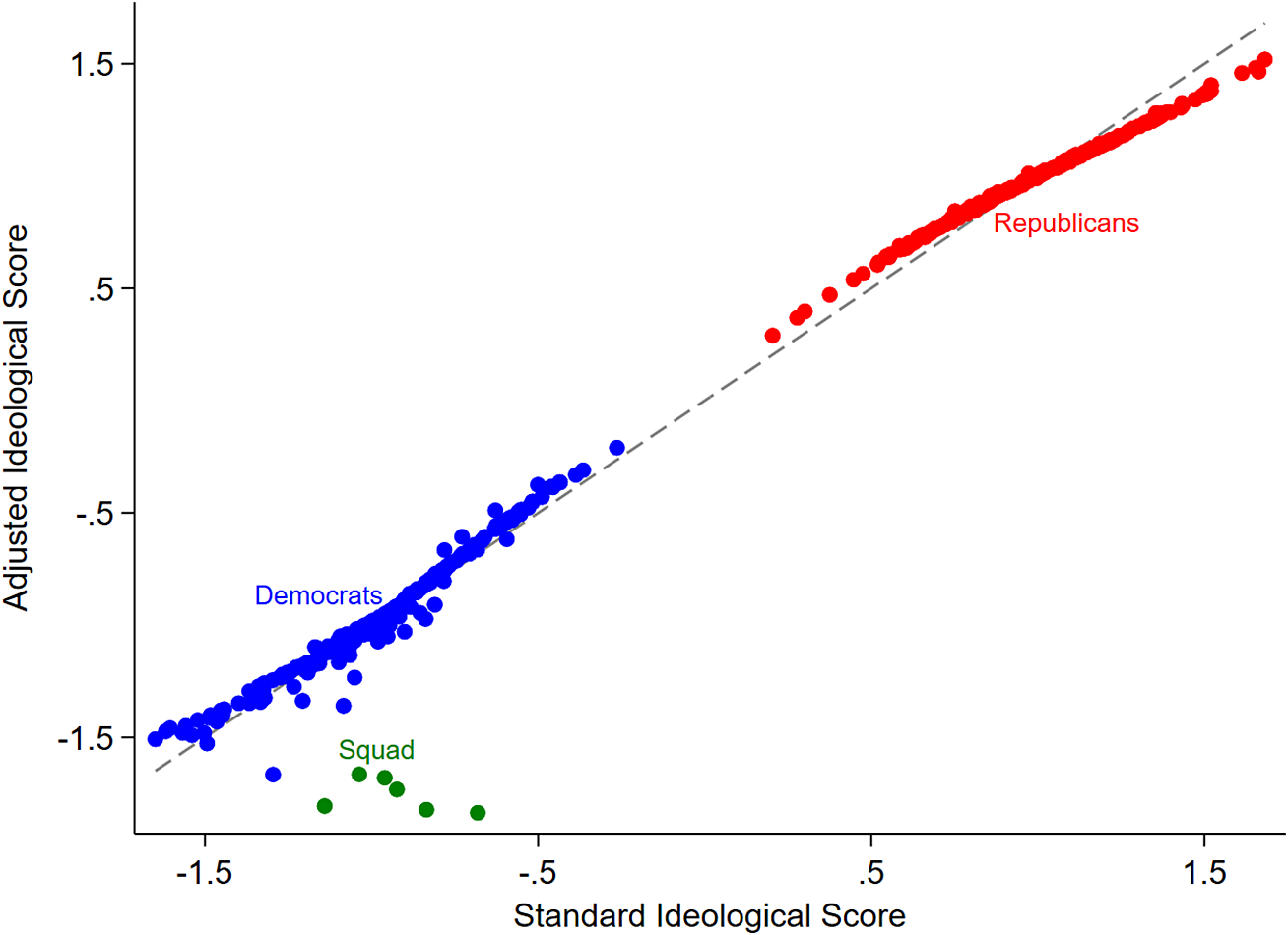
As an initial test of the face validity of our approach, Figure 1 shows that our model classifies the members of the Squad as the most liberal members of Congress. Specifically, the figure focuses on members of the U.S. House who served in the 117th Congress, plotting their ideological scores that arise from our model that accounts for protest voting against the scores arising from a standard IRT model. Both variables are rescaled so that the mean is 0 and the standard deviation is 1. Members of the Squad are shown in green, other Democrats are blue, and Republicans are red. We see that the ideological scores and rankings of most non-squad members hardly changed at all, but members of the Squad shift from being classified as moderate Democrats to the most liberal Democrats.
Estimated ideology in the 117th Congress.
Note: The figure shows estimates of ideology for each member of the U.S. House in the 117th Congress. The horizontal axis represents estimates from a standard IRT model, and the vertical axis represents our adjusted estimates from a model that allows for protest voting. Republicans are shown in red, non-squad Democrats are shown in blue, and members of the Squad are shown in green. The 45-degree line showing where the two measures are identical is in gray.

Specifically, the standard IRT model estimates that the members of the Squad range from the 56th to the 187th most liberal members of Congress, but our model that accounts for protest voting estimates that they are 6 of the 7 most liberal members of Congress. Interestingly, our model also estimates that Jesus “Chuy” Garcia, a non-squad Democrat, was the 6th most liberal member of the House in the 117th Congress, much more liberal than indicated by the standard model. Therefore, the kind of protest voting that we study is not limited to the Squad and has implications for measuring the ideology of other members.
Importantly, our model appears to be able to distinguish between different reasons members might not vote with their party. Members of the Squad sometimes vote against their party for reasons that would not be predicted by the standard model, and our model’s estimates line up with qualitative observations in those cases. But other Democrats like Jared Golden—estimated by both models to be the most moderate Democrat in the House in the 117th Congress—sometimes vote against their party for reasons consistent with their ideology. For example, Golden was the only Democrat to vote against a bill to expand background checks for gun purchases. His pattern of votes on other bills suggests that this vote was consistent with his ideology, so our model reasonably classifies this as an ideologically conservative vote rather than a protest vote.
Protest voting is not limited to the 117th Congress or to Democrats. At the beginning of the 118th Congress, a block of conservative Republicans in the House repeatedly voted against Kevin McCarthy in his bid to become Speaker of the House. Substantively, these votes are similar in spirit to the protest votes taken by the Squad when the Democrats were in power. Presumably, these conservatives did not prefer Hakeem Jeffries—the Democratic nominee for Speaker—over McCarthy, nor did they have a clear path to electing a different Speaker. Presumably, they repeatedly voted against McCarthy in order to signal their ideological extremism and their dissatisfaction with their party establishment.
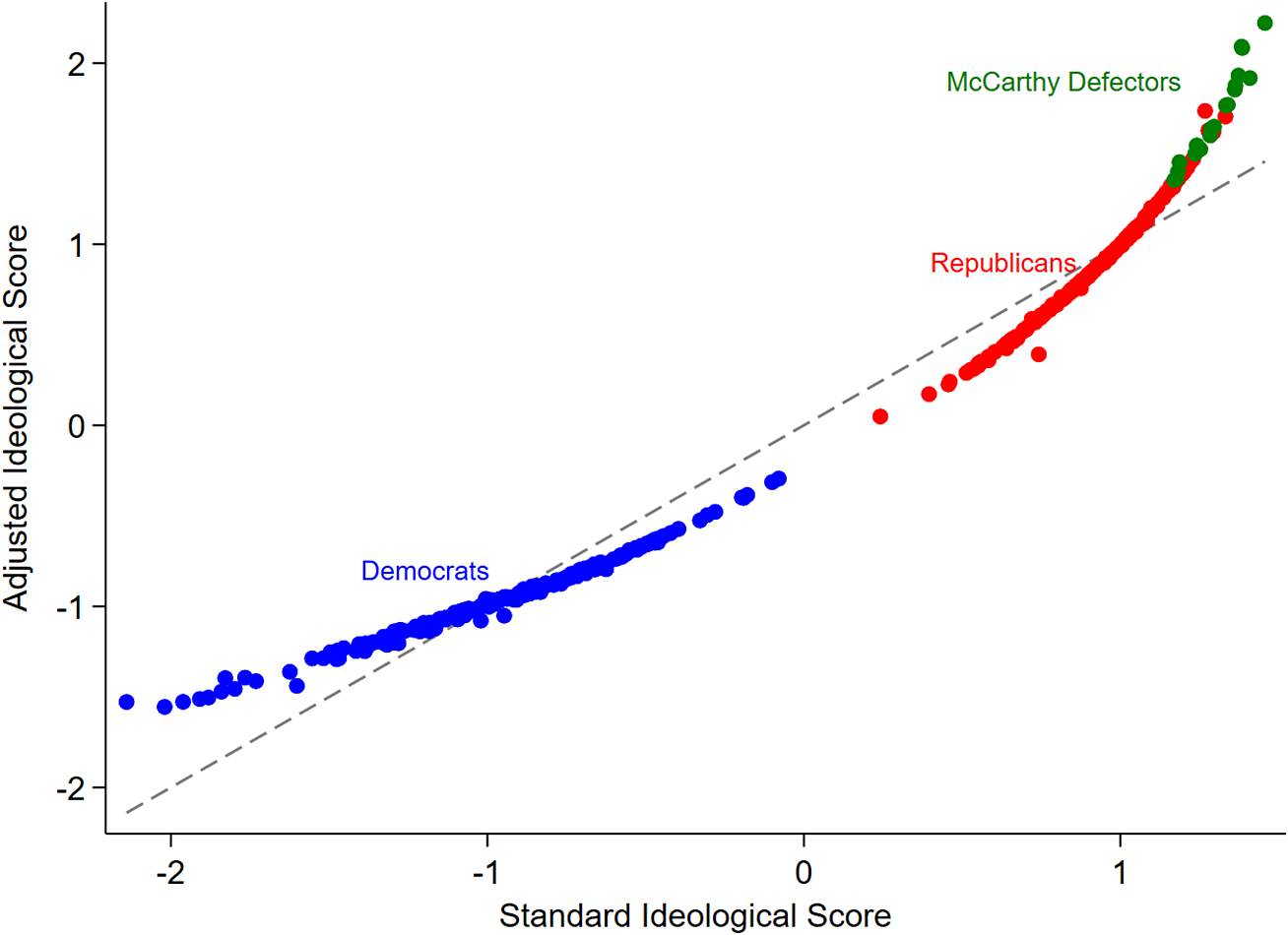
The House took 15 different votes for Speaker in the 118th Congress. If we code these Speaker votes as either for or against McCarthy, the votes for McCarthy will be implicitly classified as conservative votes by a standard IRT model, and the conservatives who defected from McCarthy will be scaled as more liberal than they really are. Figure 2 shows this with a scatterplot of adjusted and standard IRT scores from the 118th Congress. Democrats are shown in blue, Republicans who supported McCarthy are shown in red, and Republicans who defected from McCarthy are shown in green.
Estimated ideology in the 118th Congress.
Note: The figure shows estimates of ideology for each member of the U.S. House in the 118th Congress. The horizontal axis represents estimates from a standard IRT model, and the vertical axis represents our adjusted estimates from a model that allows for protest voting. Democrats are shown in blue, Republicans who supported McCarthy are shown in red, and Republicans who defected from McCarthy are shown in green. The 45-degree line showing where the two measures are identical is in gray.

Both approaches show that the Republicans who defected from McCarthy are relatively conservative Republicans, but the protest-voting-adjusted scores reveal them to be even more conservative. With the standard IRT estimates, ideology among Republicans is more compressed, and those who defected from McCarthy have ideological scores that are more similar to those of more mainstream Republicans.
To further validate our model and ideological estimates, we assess the extent to which they correlate with other measures. Many researchers utilize campaign finance-based measures of ideology (hereafter CF scores) because they can be estimated for candidates who have not served in a legislature (Bonica Reference Bonica2014). Previous studies find that roll-call-based estimates of ideology are only weakly correlated with CF scores within party, and researchers often interpret this as evidence that CF scores are not as reliable as roll-call-based estimates of ideology (Barber Reference Barber2022; Tausanovitch and Warshaw Reference Tausanovitch and Warshaw2017). However, some of the weak correspondence between these measures could be attributable to the extent to which protest voting biases roll-call-based estimates of ideology. If our model does a better job of estimating ideology than conventional models and if CF scores are picking up meaningful variation in ideology that is not reflected in the standard roll-call scores, then the correlation between CF scores and roll-call estimates should be higher for our adjusted estimates.
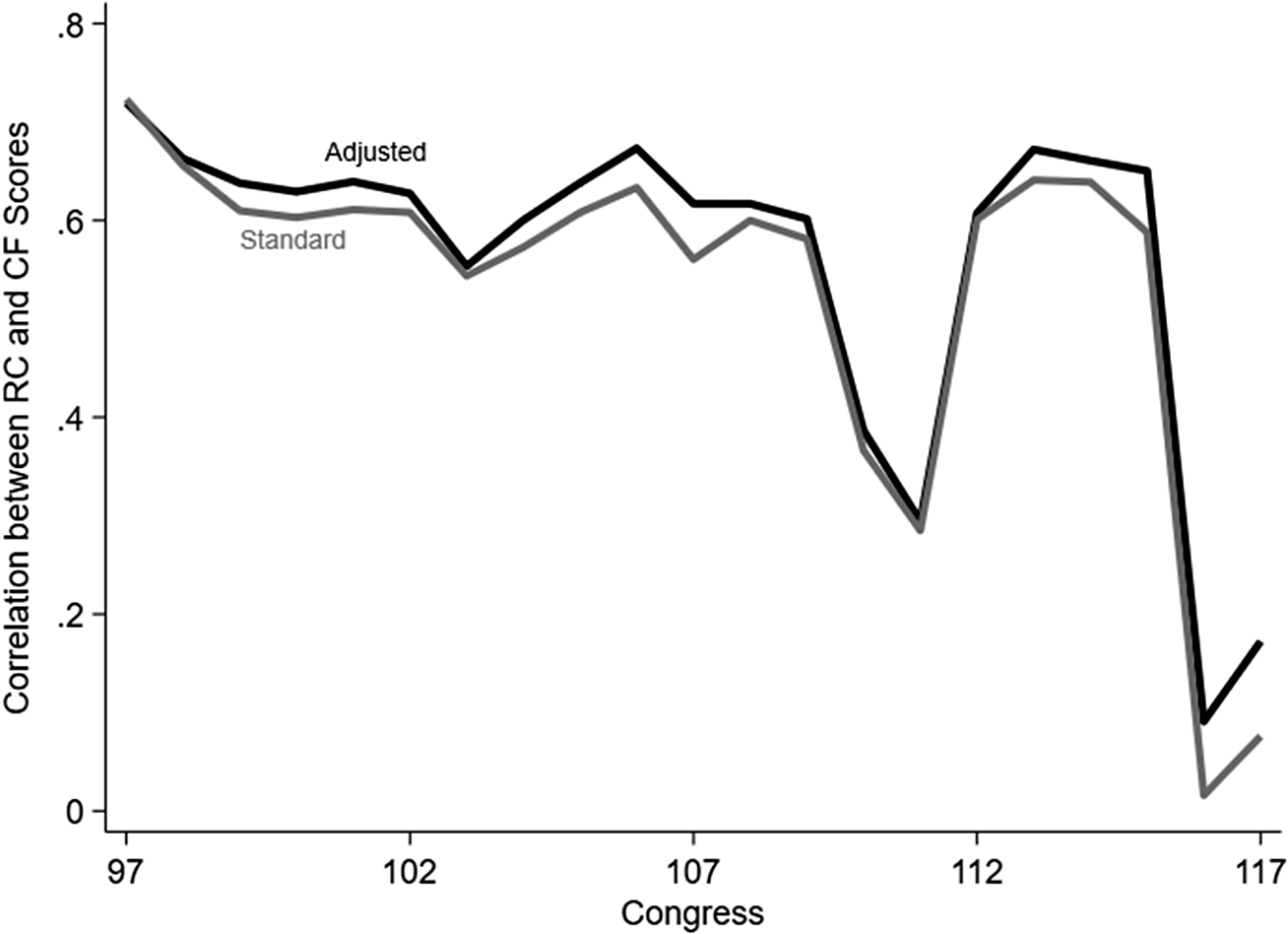
Figure 3 shows the correlations between CF scores and our roll-call-based scores of ideology for all Congresses for which CF scores are available. We utilize separate scores for each Congress, and we focus on the majority party because the literature typically focuses on within-party correlations and because the majority party is where there is likely to be a meaningful discrepancy between our estimates and those of a standard IRT model.
Correlation between roll-call and campaign-finance scores.
Note: The figure shows the correlation between roll-call and campaign-finance-based measures of ideology for members of the majority party in the U.S. House in each Congress. The correlations with conventional IRT estimates are shown in gray, and the correlations with our adjusted scores that allow for protest voting are shown in black.

In 20 of the 21 Congresses for which data are available, the correlation between CF scores and the roll-call-based scores is greater for our adjusted scores than for those arising from a standard IRT model. In some Congresses, the differences are substantively meaningful, suggesting that our adjusted scores do a better job measuring ideology than a standard model. These results also suggest that CF scores pick up genuine variation in ideology that is not captured by the standard roll-call scores.
Our adjusted scores particularly outperform the standard scores with the emergence of the Squad in the 116th and 117th Congresses, but even in previous Congresses, the adjusted measure consistently performs better. Although our model was largely motivated by our qualitative observations of the Squad, the kind of protest voting we study occurred before the Squad arrived in Congress, and by accounting for it, we can better estimate the ideologies of other members.
We have also measured the correlation between MC3-GGUM estimates of ideology by Duck-Mayr and Montgomery (Reference Duck-Mayr and Montgomery2023) and CF scores. For the 10 Congresses for which we have CF scores and MC3-GGUM estimates (107th–116th), the MC3-GGUM scores also outperform the standard estimates. The correlation between MC3-GGUM and CF scores is greater than the correlation between the standard IRT scores in 7 of 10 Congresses. However, our adjusted scores outperform the MC3-GGUM estimates. The correlation between our adjusted scores and CF scores is higher than that between MC3-GGUM and CF scores in 7 of 10 Congresses. Therefore, to the extent that both our approach and that of Duck-Mayr and Montgomery (Reference Duck-Mayr and Montgomery2023) correct estimates of ideology for non-ideological voting, our approach does so in a way that better correlates with non-roll-call-based estimates of ideology. See the Supplementary Material for more comparisons between our model and GGUM.
These analyses suggest that conventional roll-call estimates of ideology include a meaningful amount of noise and error due to non-ideological voting. Our model that allows for and accounts for these non-ideological protest votes produces estimates of legislator ideology that more closely match qualitative observations and also more closely align with other measures of ideology that are not based on roll-call votes.
5 Protest Voting over Time
Our model allows for the possibility that members of the majority party cast a non-ideological protest vote when 90% of their party has voted yea. We simultaneously estimate an ideological score for each member and the probability that each member cast an ideological vs. protest vote on each bill where such a protest vote was possible. This allows us to assess the prevalence of this kind of protest voting in addition to studying the implications it has for our estimates of ideology.
We have estimated our model separately for each Congress spanning the 51st through the 117th—that is, 1887–2022. Averaging across all bills during this period of study, our model allows for the possibility of a protest vote on 27.4% of all bills. When such a protest vote is possible, the average expected number of protest votes per bill is 3.0. On average, there are approximately 250 members from the majority party, which means that members of the majority engage in protest voting just over 1% of the time such a vote is possible. So protest voting is uncommon in the sense that less than 1 in 500 roll-call votes are protest votes. But in the aggregate, some amount of protest voting likely occurs on many bills.
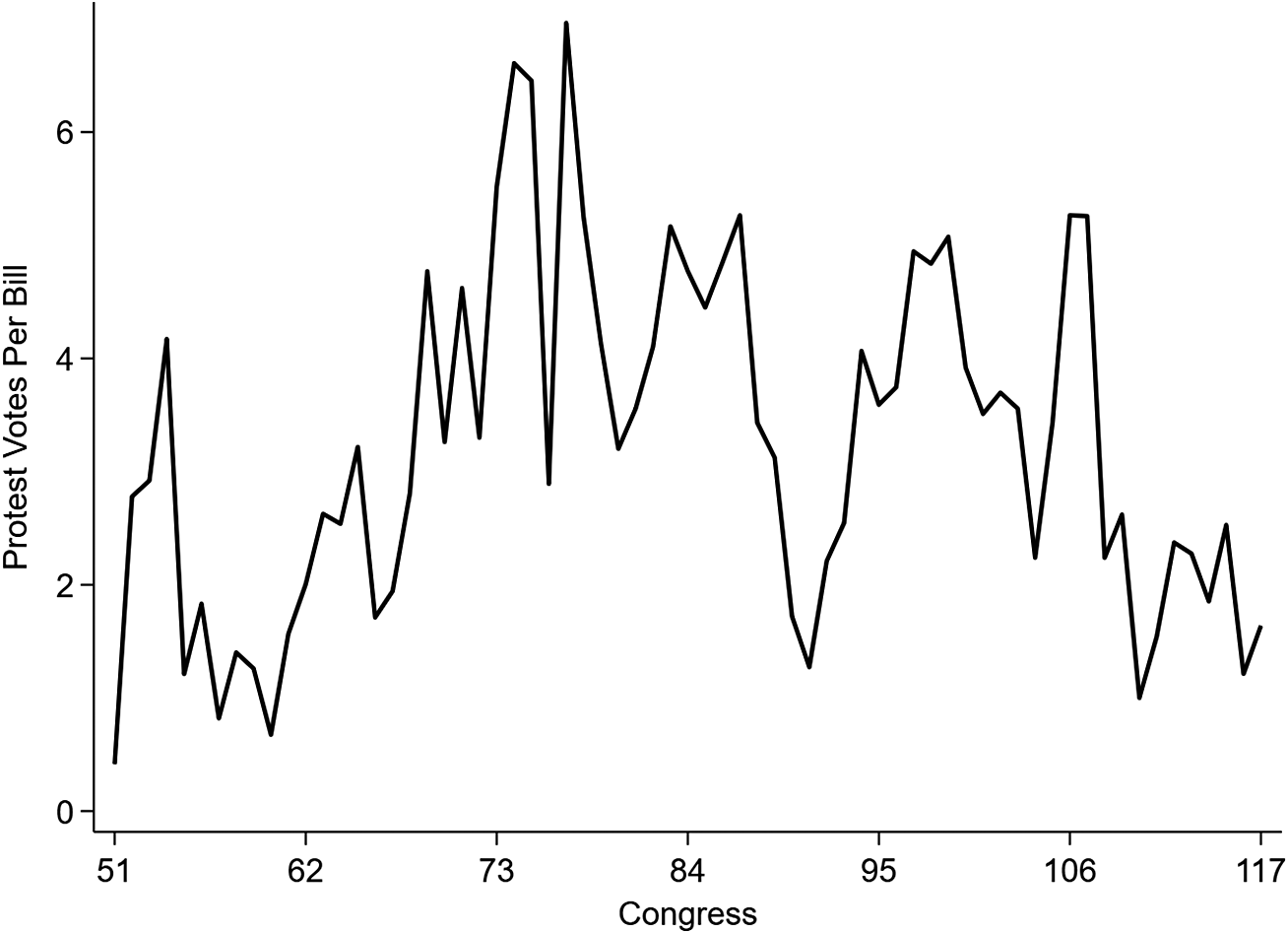
Figure 4 shows the estimated expected number of protest votes per bill when a protest vote is possible. We see that some meaningful amount of protest voting appears to have occurred in most Congress throughout the period of the modern two-party system.
Estimated number of protest votes per bill.
Note: The figure shows the estimated expected number of protest votes per bill by Congress when a protest vote is possible.

Interestingly, the most recent Congresses for which the Squad has been part of the majority have, on the whole, seen a less than normal amount of protest voting. The period with the greatest prevalence of protest voting was approximately the 73rd through 78th Congresses, 1933–1944. The general pattern in Figure 4 does not closely correspond with changes on polarization or party cohesion. Perhaps when polarization and party cohesion are high, there is less desire among members to cast a protest vote, and when polarization and party cohesion are low, there is less need or opportunity to do so. Protest voting is a rare but somewhat consistent phenomenon throughout the history of Congress.
We checked whether the estimated number of protest votes for a bill was ever pivotal for the outcome, and the answer was essentially no. There are only two cases in the history of Congress for which we estimate that protest votes changed the outcome of the vote—one in the 78th Congress and one in the 105th. This is consistent with the idea that these are largely expressive rather than instrumental votes.
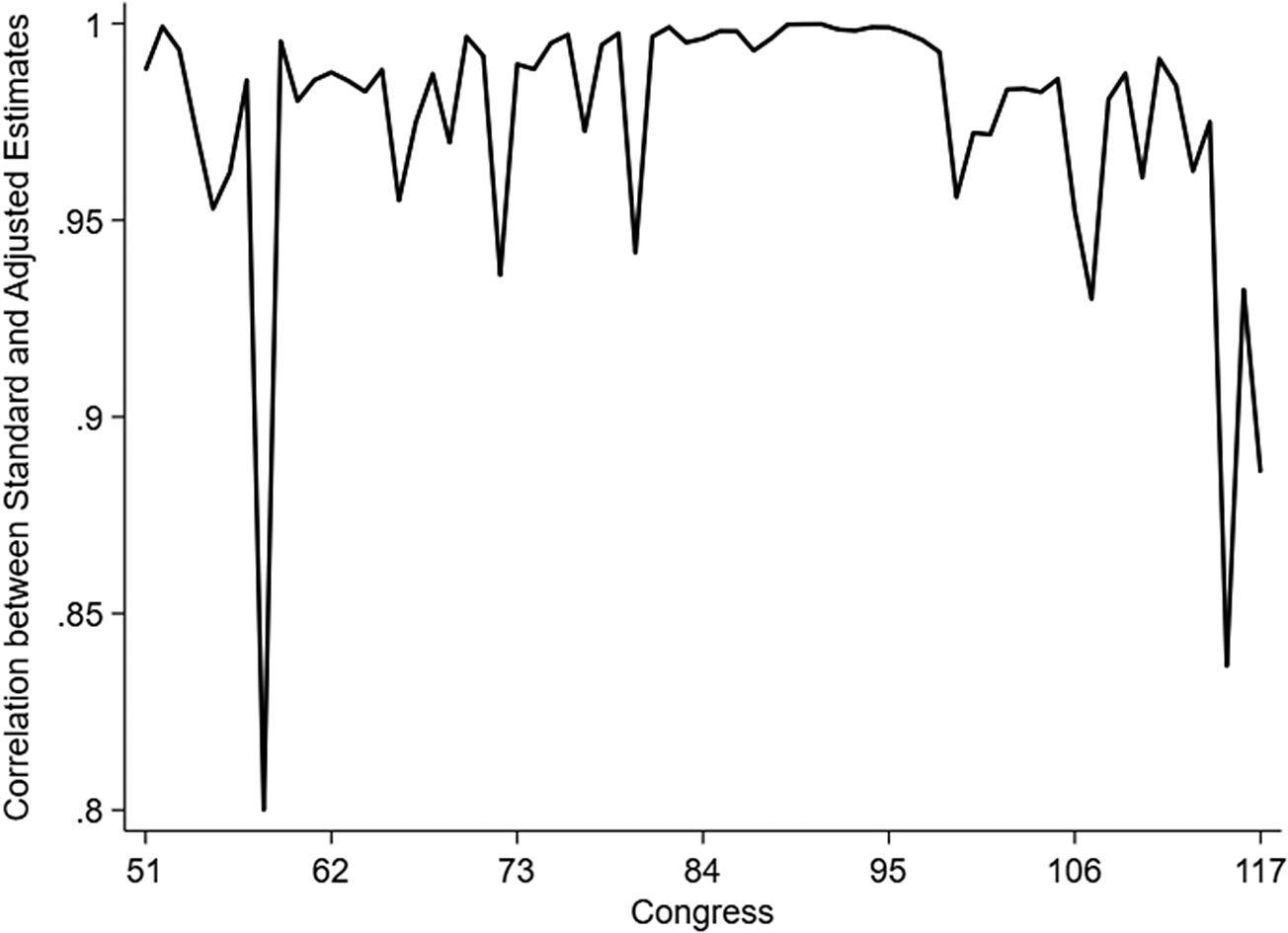
As we’ve seen in the case of the 117th Congress, protest voting need not be widespread for it to have important implications for our estimates of ideology. To assess these implications over time, Figure 5 shows the correlation between the standard and protest-voting-adjusted estimates of ideology for the majority party over time. Although most of the correlation coefficients are very high, to avoid wasted space and to highlight the differences over time, the vertical axis is scaled to range from 0.8 to 1.
Correlations between standard and adjusted estimates of ideology over time.
Note: The figure shows the correlation coefficient between a standard IRT estimate of ideology and our protest-voting-adjusted estimates for the majority party in the House of Representatives in each Congress.

In most Congresses, the correlation coefficients are close to 1, suggesting that whatever protest voting was occurring was not common enough or not correlated enough with ideology to meaningfully bias our estimates of legislator ideology. The 58th Congress (1903–1904) is a historical anomaly with a correlation coefficient as low as 0.80. There were 6 or 7 Republican members of the House at that time—let us call them the Fellows—whose adjusted ideology scores are notably more conservative than their standard ideology scores. The starkest case is Edward Butterfield Vreeland (NY)—or EBV—who is classified as the 95th most conservative member of the House by the standard model but is classified as the 2nd most conservative member in our model. However, unlike the Squad, the Fellows did not vote as a bloc and do not cluster together on our adjusted score. Their protest voting makes them appear more moderate than they are, but they are not all extremists.
One potential explanation for the unusualness of the 58th Congress was that this was when Joseph Cannon first rose to power as the Speaker of the House. When he did so, he sought unprecedented powers for himself, appointing himself as the chair of the Rules Committee, reserving the right to appoint members of other committees, and effectively quashing any debates, votes, and amendments of which he did not approve. The Fellows may have expressed their dissatisfaction with Cannon through protest voting, explaining why their adjusted and standard ideology estimates are so different.
We are not aware of evidence that the Fellows were closely associated with one another or caucused together, consistent with our finding that unlike the Squad, their scores do not cluster together. Some of the Fellows, such as Vreeland and Joseph W. Fordney (MI), were later allies of Cannon and did not participate in the 1910 insurgency against him, raising questions about why they appeared to engage in protest voting in the 58th Congress. Perhaps they changed their views about Cannon, or perhaps their apparent protest voting is explained by something else. But other Fellows, such as Francis W. Cushman (WA), were outspoken critics of Cannon, meaning that his roll-call record is consistent with his rhetoric and reputation.
Aside from the 58th Congress, the three most recent Congresses in our sample are the biggest outliers. Protest voting by Republicans in the 115th Congress and Democrats in the 116th and 117th caused conventional scaling methods to perform much worse than normal.
Interestingly, the so-called textbook Congress starting around the end of World War II was clearly the era of the highest correspondence between the two measures. Scaling methods were developed by scholars studying this era, so it’s no surprise that these scholars did not attempt to account for non-ideological voting. But starting in the 1980s, conventional scaling estimates appear to have done a poorer job measuring ideology, and this problem has worsened in recent Congresses.
6 Substantive Implications
In the Supplementary Material, we explore the implications of protest voting for several substantive debates in American politics. First, we show that estimates of congressional polarization and its changes over time are even greater when we utilize our adjusted measures of ideology. Next, we find that the correspondence between the partisan leanings of a district (as measured by presidential vote share) and the ideology of its representative is even stronger when using our adjusted measure. Then, we estimate the effect of ideological extremism on vote shares, and we find a more negative effect when using our adjusted measure. Our adjusted measure also better explains the declining effect of ideology over time. Finally, we assess the relationship between ideological extremism and fundraising. We find that extremists tend to outperform moderates in fundraising, although this relationship is weaker when using our adjusted measure. The explanation is that, controlling for ideology, members who engage in more protest voting appear to be worse fundraisers.
Details on these analyses and discussion of the results are available in the Supplementary Material. These analyses further validate our estimates and demonstrate that our adjusted estimates can help applied researchers generate new insights. However, for most applications, the differences between the estimates from the standard and adjusted models are substantively modest.
7 Discussion and Conclusion
The standard models of roll-call voting that historically did an excellent job explaining congressional voting and estimating the ideology of legislators are now performing worse because members of the majority sometimes vote against their party for non-ideological reasons. We find that this form of protest voting has existed to some extent throughout the history of Congress, but its implications for estimates of ideology have increased in recent years as ideological extremists have become particularly likely to engage in protest voting.
When we account for protest voting, we obtain better estimates of legislator ideology that have greater face validity and are more correlated with other measures of ideology. Our adjusted estimates suggest that congressional polarization and its increase over time are ever greater than previously thought, and the electoral penalty associated with ideological extremism is greater than previously thought. We also find no evidence that protest voting per se is associated with more votes or fundraising. So even if protest voting causes members to gain more public attention, it does not appear to translate into more votes.
Our analyses and results highlight the fact that congressional polarization need not go hand in hand with party discipline. Although observed polarization is often interpreted as evidence of party discipline, and although theories of party discipline assume that polarization and discipline causally reinforce one another (Aldrich Reference Aldrich1995; Rohde Reference Rohde1991), we see that ideological extremists, particularly in recent Congresses, sometimes vote against their party for non-ideological reasons. Furthermore, a lack of party discipline can lead standard scaling methods to underestimate extremism and polarization. Our study highlights the possibility of high polarization but low party discipline, something that standard scaling methods would likely miss.
The main goal of our article is to provide better estimates of legislator ideology that account for protest voting. If protest voting continues to be prevalent and consequential, future researchers will want to account for it when studying the causes and consequences of ideology and extremism. But we hope our measures and methods will also be interesting to researchers who want to study the phenomenon of protest voting, which may be substantively interesting in and of itself. Based on our belief that protest voting is likely the result of idiosyncratic differences in the preferences and goals of different members, we allow it to vary idiosyncratically across members, but we otherwise do not offer a new theory of protest voting. We welcome future work that attempts to better understand which members protest and when and why they do so.
Supplementary Material
For supplementary material accompanying this paper, please visit https://doi.org/10.1017/pan.2026.10037.
Data Availability Statement
Replication code for this article has been published in the Political Analysis Harvard Dataverse at https://doi.org/10.7910/DVN/HARTMV. (Fowler and Lewis Reference Fowler and Lewis2026).
Acknowledgements
We thank Chris Berry, Ethan Bueno de Mesquita, Alex Fouirnaies, Seth Hill, Dan Thompson, Chris Warshaw, Adam Zelizer, and seminar participants at the University of Chicago for helpful comments.
Author Biographies
Anthony Fowler (anthony.fowler@uchicago.edu) is the Sydney A. Stein, Jr. Professor in the Harris School of Public Policy at the University of Chicago. Jeffrey B. Lewis (jblewis@polisci.ucla.edu) is a Professor in the Department of Political Science at the University of California Los Angeles.




 Open access

