


In the decade following the Second World War, Britain and Canada launched major inquiries into the death penalty, and both governments enlisted the world’s reigning authority on the subject to advise them: Swedish-born American sociologist Thorsten Sellin (1896–1994). A pioneer quantitative analyst of capital punishment’s deterrent rationale, he was the first scholar to compare murder rates in jurisdictions that had abolished the death penalty with those where it remained in force. From his teaching post at the University of Pennsylvania, Sellin established an international profile, and this led the British Royal Commission on Capital Punishment in 1949 to request that he prepare a report and testify before the commissioners. Four years later, a Special Joint Committee of Canada’s Senate and House of Commons set out to study the death penalty, and it issued the same request. Sellin obliged and presented statistical evidence that the death penalty had no unique deterrent impact on murder rates. However, investigators in both countries also heard from criminal justice functionaries who voiced the opposing view based on experiential expertise, and their opinions, echoing public opinion, proved more persuasive. The final reports of the British and Canadian inquiries not only approved of capital punishment but also expressly disendorsed their criminological expert’s evidence, his methodology, and his interpretation of data.
The devaluation of Sellin’s expertise is discordant with established accounts of the status and commanding authority of modern scientific knowledge in the mid-twentieth century. Most studies of the decline of deference toward criminological expertise trace the upsurge of “populist punitiveness” to the post-1970s.Footnote 1 If Sellin had presented and explained his data on the death penalty fifty years later, the hostility he faced would be unsurprising to critics of penal populism. Yet, the denigration of his expertise in the 1950s is puzzling, since this was an era when the white, male, institutionally authorized expert’s social capital swelled.Footnote 2 Early Foucauldian and feminist scholarship has reinforced this chronology of the rise and the (welcome) fall of the expert in the late-twentieth-century.Footnote 3 The paternalism and elitism of past forms of expertise have come under fire in more recent scholarship, which seeks to make expertise more inclusive and consultative in order to counter popular impulses toward punitiveness.Footnote 4 Yet, each of these strands in penal historiography retains the conventional temporal divide—between the age of the expert (peaking in the heyday of the liberal welfare state) and the erosion of his authority in the era of neo-liberalism and law and order politics.Footnote 5
Sellin’s presentations of homicide and execution data before the British and Canadian inquiries, the questions he fielded, the responses he provided, and the evaluation of his contributions in the investigators’ final reports do not fit the established timeline of criminological expertise. Although the royal commission was manned by experts in their own right, most notably Leon Radzinowicz, then Director of the Department of Criminal Science at the University of Cambridge, the non-expert members of both inquiries challenged Sellin on the limitations of his data, and they dismissed his methods and the conclusions he drew. By contrast, they accepted with little question the opinions of police, prison wardens, justice officials, and retentionist members of the bench and bar—agents with “lived experience.” Drawing on literature that identifies multiple forms of criminological expertise and rejects the standard divide between accredited academic knowledge and vocational training, this paper argues that the British and Canadian inquiries operated through several logics of expertise, not the unitary one that prevails in accounts that assail it or attempt to revive it.Footnote 6
This case study of a modest methodologist, whose data undermined certainties over the death penalty’s deterrent potency, underscores the need to treat the caricature of the ascendant status of mid-twentieth-century expertise skeptically. Sellin, himself, acknowledged the limitations of his knowledge: caught between his abolitionist political convictions and his professional creed of objective, value-free social science, he expressed his research in a discourse of scholarly diffidence.Footnote 7 Unquestionably a leading character in the rise of the penal-welfare complex, Sellin anticipated it would be difficult to conquer the penal problem he identified, and he forecasted headwinds. Penal modernizers of the 1950s who called for the amelioration of punishment, including capital punishment, were no better able than Beccaria—or criminologists today—to convince retentionists that “deterrence operates through perceived risk of apprehension, not the severity of punishment.”Footnote 8
Criminological Expertise and the Sociology of Punishment
When The British Journal of Delinquency (BJD) published its first issue in 1950, trumpeting the exultant strains of penal modernity, the editors observed that the “services of the physician, the educational psychologist, the social worker, the sociologist and the statistician were found to be essential to accurate investigation.” To support that post-war advance, the journal aimed to promote “the modern tendency to apply a number of scientific disciplines to the elucidation of individual as well as of social problems in the modern era.”Footnote 9 One of the editors and the journal’s co-founder, Hermann Mannheim (1889–1974), was at that point the first reader in criminology in Britain (at the London School of Economics) and the author of Criminal Justice and Social Reconstruction.Footnote 10 Thorsten Sellin, who wrote the lead article in the BJD’s first issue, was a colleague of Mannheim’s, and he titled his piece: “A Note on Capital Executions in the United States.”Footnote 11
In the Anglo-American and Western European spheres, the rehabilitative ideal dominated after the Second World War, supported through a tight relationship between the academy, private foundations, and government.Footnote 12 Anti-Whiggish critiques of penal welfarism have attributed its rise to the influence of authorities, which Sellin and his confreres appeared to command. According to Garland, these “liberal elites and penological experts,” who extolled “social justice, prisoner welfare, and a reformative penology” held sway in the modern welfare state and its systems of control.Footnote 13 Although he notes that experts “argued among themselves and took up varying positions, some more logically coherent or scientifically sound and others more politically pragmatic,” they were intimately connected to the “control strategies” of modern penality that prevailed until the 1970s.Footnote 14 Ian Loader cautions against equating expert self-belief with political clout; yet, he, too, asserts that penal policy developed “on the basis of expert knowledge and opinion,” supported by and large by the “political class,” especially in the post-war decade.Footnote 15 The experts of the 1950s were more sanguine when it came to their capacity to shape penal policy, however. In the postwar era, they were frequently invited to put politicians “in touch with progressive social thought,” but they acknowledged that getting policy makers to act on expert advice was a different matter.Footnote 16
Self-defined penal experts of the twentieth century, Sellin included, traced their lineage to the philosophers who had condemned torture and the scope and methods of executions in pre-nineteenth-century Europe, which prevailed in pockets of humanity untouched by scientific rationality. This was the progressivist script that Foucault shredded in Discipline and Punish. Covering much of the same historical territory, he recast the penal system that all but replaced public torture and capital punishment as a disciplinary regime “authenticated by the ‘sciences’.” In his account, reformers such as Romilly did not bring about enlightened humanity; rather, they introduced the “authority of medicine, psychology [and] criminology” in the formation of “modern criminal justice.” These disciplinary discourses inscribed offences in the “field of objects of scientific knowledge,” enabling experts to endow “the mechanisms of legal punishment with a justifiable hold not only on offences, but on individuals.”Footnote 17 Although feminist and postcolonial scholars who criticize Foucault’s inattention to the gender and racial dimensions of the social problems and “problem” populations subject to expert knowledge have enriched the analysis of modern penality, they have not dethroned the centrality of (male, metropolitan) experts in the rise of penal-welfarism.Footnote 18
If, as Jasanoff argues, the expert was the “quintessential bridging figure of modernity,” does it follow that modern penality valued nothing but “scientific” expertise, even if we use scare quotes to qualify the term?Footnote 19 Loader’s informants—former high-ranking bureaucrats, penal reformers, and “academic criminologists”—recalled that they worked in a “closely networked world of colleagues and friends.” They were liberal elites who imagined themselves “Platonic guardians” who fostered “‘civilized values’” in the governance of crime.Footnote 20 Sellin was similar—a highly networked individual whose academic, philanthropic, and governmental affiliations, which solidified over the course of his career, boosted his capital in the penal field.Footnote 21 His national and international accolades and appointments conferred and confirmed his status—as he reported to the Social Science Research Council in the late 1930s on “culture conflict and crime,” as he advised the Swedish government on the drafting of its criminal code in the mid-1940s, as he took up the position as general secretary of the International Penal and Penitentiary Foundation in 1949 and accepted the British and Canadian governments’ requests for his expert analysis of the death penalty in the early 1950s.Footnote 22 Yet, these inquiries also exposed the extant “penal layer” of intentional pain and death, the retributive undercurrents in the penal welfare state over which criminal justice functionaries claimed superior authority.Footnote 23 A close reading of the submissions, presentations, questions, and responses in these inquiries reveals how parallel networks and alternative hierarchies of expert capital were brought into play as prison wardens, police chiefs, sheriffs, crown prosecutors, and judges—figures opposed to the rehabilitative ideal—outdid social scientific expertise.Footnote 24
Starting with a brief account of Sellin’s rise as an expert in the quantitative analysis of the death penalty and its capacity to deter homicide (the unsubstantiated claim its defenders clung to in the mid-twentieth century and revived after its abolition), I move to the British and Canadian inquiries to which Sellin submitted reports, provided tabulated data, and faced confronting questions. The minutes of evidence detail how the expert’s authority was challenged, and the final reports further undermined Sellin’s knowledge and insights. I end with a call for further work that tests the supposedly secure status of the expert at mid-century and challenges the notion that “learned men’s” capital was secure prior to the late-twentieth-century turn to punitiveness.
The Making of a Criminological Expert
In 1994, news of Thorsten Sellin’s death appeared in the New York Times under the headline “Criminology Expert Dies Aged 97.”Footnote 25 Johan Thorsten Sellin’s family migrated from Sweden in 1913, landing first in Canada and then relocating to the U.S., where Sellin earned his bachelor’s degree at a small college in Illinois. After his family moved to Philadelphia, possibly prompted by Sellin’s acceptance into the University of Pennsylvania’s graduate sociology program, he earned his master’s and doctoral degrees, coming of age as the social sciences gained a foothold in leading universities of the United States.Footnote 26 Although Sellin’s 1922 PhD dissertation concerned marriage and divorce law in Sweden, he turned to the field of crime, policing, and punishment research, which became his specialty over his six-decade career. Hired by his alma mater to teach in the department of sociology, his first publications traced the history of penal progress. Whether it was Filippo Franci, rescuer and reformer of delinquent boys in the seventeenth century, or the Aufseher-Aspiranten Institut for prison guard recruits in Hanover in the 1860s, Sellin sought to document what he termed a “rising humanitarianism, conscious of the dignity of human life and expressing itself in penal treatment in an emphasis on correction instead of on mere punishment.”Footnote 27
The use of quantitative methods to test claims that differed from this story of penal progress fulfilled that aim. In some respects, he followed the lead of an earlier hire of the University of Pennsylvania’s sociology department, W.E.B. Du Bois, who laid the groundwork for that approach in his 1897 “scientific study” of Philadelphia’s Black population.Footnote 28 Building on Du Bois’ approach, Sellin’s 1928 article, “The Negro Criminal: A Statistical Note,” debunked the theory that African Americans were criminally inclined. Starting with evidence of disproportionate rates of Black involvement in the criminal justice system, Sellin dismissed the prevailing assumption that whites were racially more law-abiding. Confident in his analysis of race-based differentials in arrests and prosecutions, he attributed higher imprisonment rates to the “differential treatment to which the Negro is subjected by our agencies of criminal justice [which] artificially increases his apparent criminality.”Footnote 29 Although Sellin further supported his finding by comparing arrest rates between jurisdictions and between northern and southern states, he cautioned that better and more complete data would reinforce the contribution the “quantitative method” could make. These methods and the comparative approach in his 1928 “Statistical Note” became through lines in Sellin’s research, as did his measured and cautious mode of interpretation.Footnote 30
The testing of racist hypotheses of criminality also spun off from Sellin’s earlier piece that evaluated the apparent spike in murder rates in the years following the Great War. In 1926, the Annals of the American Academy of Political and Social Sciences devoted a special issue to “Modern Crime—Its Prevention and Punishment,” and the editor, a professor in Sellin’s sociology department, likely invited Sellin to contribute.Footnote 31 Again, he chose a comparative approach to analyze the murder statistics he had compiled from eight European nations: four belligerent and four non-belligerent. In this piece, Sellin conceded that distinctions in official record keeping hampered cross-national comparisons, but he declared his data revealed contrasts in national trends between the pre-war, wartime, and post-war years. Because an “answer not based on a profound analysis was hypothetical,” Sellin could suggest, not state definitively, that recent elevations in murder rates were most likely due to “abnormal political, economic and social conditions born out of the war,” not an “alarming” decline in “moral and spiritual life.”Footnote 32 This judicious tone, cognizant of limited data, was Sellin’s trademark style; in addition, it befitted his recognition that social, economic, political and cultural factors, unamenable to quantitative analysis, exerted a profound influence on murder trends.Footnote 33 Whether rates of murder went up or down or remained stable, Sellin was convinced they had little to do with criminal law or penal sanctions.
In a short time, the young professor became a sought-after expert, hired to work nationally and abroad for governmental and non-governmental agencies. In 1930, the Social Science Research Council seconded Sellin to chair a committee on “delinquency,” where he worked with criminologist Edwin Sutherland.Footnote 34 Established in 1923 and funded by the Rockefeller Foundation, the Council enlisted experts in numerous disciplines to find effective means to ameliorate “social conflict and disorder.”Footnote 35 The United States Bureau of the Census hired Sellin as a consultant to develop uniform crime statistics and to explore the prospect of establishing a national institute of criminology and criminal justice. In 1946, he returned to Sweden at the invitation of the government to advise its Penal Code Commission on the drafting of a new penal code.Footnote 36 The country of Sellin’s birth had abolished the death penalty in 1921, but the invitation provided an opportunity for him to refine the nation’s “protective care” model of crime prevention and correctionalism.Footnote 37 As a well-respected scholar on penal regimes in abolitionist and retentionist jurisdictions in Europe and the U.S., Sellin perfectly fitted the model of expertise most valued by penal welfare regimes. Further confirmation came in the form of a letter he received in 1949 from the secretary of the British Royal Commission on Capital Punishment, requesting that he present his research on the death penalty.
Enlisting Expertise on Capital Punishment in Britain and Canada
The lead-up to the British government’s appointment of a royal commission was protracted and embroiled in party politics, and it exposed a deep divide between the House of Commons and the House of Lords.Footnote 38 When Labour formed government in 1945, opponents of the death penalty were energized, and the National Council for the Abolition of the Death Penalty believed that a majority of MPs would support abolition. In 1947, the government introduced a Criminal Justice Bill, which followed, in spirit, the correctionalist ethos of the Swedish “protective” code. In that vein, the bill included the abolition of the death penalty, but intense debate over that section split the parliamentary Labour party, including the Cabinet. The Home Secretary, James Chuter Ede, vowed the government would not pitchfork the death penalty’s abolition into a measure promoting penal reform. As a compromise, the government permitted a free vote on the bill, amended to include a five-year moratorium, knowing full well that the resolutely retentionist House of Lords would scupper the amendment to suspend the death penalty.Footnote 39 This was precisely what happened in mid-1948, when the Lords killed the clause, many of them referring to the need to follow public opinion.Footnote 40 The only bone the government threw to abolitionists after the parliamentary fracas was the government’s appointment in November 1948 of a Royal Commission on Capital Punishment.
Most analysts of abolition’s parliamentary defeat agree that punting the hot-button issue from the legislative arena to a time-wasting investigative committee with no power to implement policy was the Labour government’s ploy to appear tough on crime while appeasing its abolitionist backbenchers.Footnote 41 The Royal Commission’s limited terms of reference reinforce that impression. Originally, they included the consideration of the death penalty’s abolition, but the Cabinet restricted the commissioners to investigate whether “capital punishment for murder should be limited or modified, and if so, to what extent and by what means.”Footnote 42 Chaired by a supporter of the death penalty, senior public servant Sir Ernest Gowers, the Royal Commission appointed nine members, none of whom was a committed abolitionist.Footnote 43 Two women were appointed in April 1949, neither of them academics, and Radzinowicz was the sole criminologist. The commissioners were granted access to government resources to conduct their inquiry, including the Home Office’s historical data on murder and executions, and they were assigned to “inquire into and take account of the position in those countries whose experience and practice may throw light” on the matter in question of the death penalty’s scope and operation in the United Kingdom.Footnote 44 No one was better equipped than Sellin to assist the commission, and arrangements were made for him to submit a research report in advance of his appearance in February 1951.
In post-Confederation Canada, the first parliamentary campaigns to abolish the death penalty took place in the 1910s and mid-1920s, but these forays and subsequent ones came in the form of private member bills, unaligned with ruling or opposition parties.Footnote 45 One left-wing party, the Co-operative Commonwealth Federation (CCF), included opponents of capital punishment, but abolition was not on its official party platform when the Canadian government appointed a royal commission in January 1949 to overhaul the Criminal Code. In the sweep of modernizing impulses in the post-war period, the government set about to streamline and rationalize a code dating back to the late nineteenth century by weeding out “inconsistencies, legal anomalies, or defects,” particularly “archaisms” that had “aroused the most criticism.”Footnote 46 Canada had just removed infanticide from the offenses subject to the death penalty, and the royal commission on the criminal code advised the government to remove judicial discretion to sentence convicted rapists to death, a reform the revised code of 1955 incorporated.Footnote 47 But the Criminal Code commission advised that the prospect of abolishing the death penalty outright be scrutinized in a separate inquiry (along with corporal punishment and lotteries). The Minister of Justice agreed.
Three months after the British Royal Commission submitted its final report on capital punishment in 1953, Canada’s Liberal government announced the establishment of a Special Joint Committee of the Senate and the House of Commons to inquire into these three contentious policy issues and to present recommendations.Footnote 48 Although it lacked the powers of a royal commission, the joint committee had broader terms of reference, and seventeen MPs and senators—two of whom were abolitionists—comprised its members. In proposing the motion to the House of Commons, the Minister of Justice, Stuart Garson, reassured abolitionist MPs that the Canadian inquiry would, unlike Prime Minister Atlee’s commission, “have the power to recommend against capital punishment” and to appraise the “method of capital punishment” if it advised that the ultimate penalty be retained.Footnote 49 The joint committee’s first task was to order information on the death penalty’s administration from the Department of Justice and to determine whom it should call as witnesses. Having read the Gowers report, Garson was familiar with Sellin’s expertise, and the joint committee agreed he was the clear choice. The peripatetic scholar appeared before the joint committee, with updated statistics, in June 1954.
The Canadian inquiry diverted the death penalty from the floor of the House of Commons to the committee rooms and back offices, where joint committee members heard from and interviewed witnesses. Like the British government, Canada’s ruling Liberal party reduced abolitionist pressure while it placated retentionists, mindful that opinion polls in the early 1950s tracked substantial support for capital punishment as the mandatory punishment for murder. Equally, this maneuver communicated governmental commitment to analyze a significant question of law and policy in a temperate, rational forum, not the hurly burly of heated exchanges between politicians on opposing sides of the issue. The Liberal Minister of Justice’s motion for a joint committee was an example. It was wrong to “prejudge the matter,” Stuart Garson scolded his fellow MPs, since a committee could gather and study “evidence” unavailable to the members who had redrafted the Criminal Code.Footnote 50 Furthermore, the Canadian and British governments devoted considerable resources to both inquiries, which opened doors into never-before-disclosed historical records on murder and its punishment. They unveiled previously occult protocols surrounding the death penalty’s management. And they put on record a broad range of informants’ opinions and evidence. Neither government could predetermine the outcomes of these unprecedented investigations into “the awkward question capital punishment” in the post-war liberal state.Footnote 51
Articulating Expertise
The British and Canadian inquiries had the authority to determine the agencies, organizations, and individuals to call upon as witnesses, and the Gowers commission requested submissions in advance from just a handful of them, including Sellin. Before he appeared on 1 February 1951, thirty days into its deliberations, he sent a study titled “The Death Penalty and the Problem of Deterrence.” This subject technically fell outside the inquiry’s narrow terms of reference, but the commissioners decided any evidence in support of or opposition to the death penalty’s retention was relevant to their assignment to consider capital punishment’s possible restriction.Footnote 52 Beyond that, Sellin’s evidence was essential to interpret criminal justice data from other jurisdictions, some of which had abolished the death penalty. Did murder rates rise or fall in places where imprisonment had replaced capital punishment? Was murder more prevalent in retentionist or abolitionist countries? These were the questions Sellin’s submission answered, but he could not provide definitive answers owing to limitations of available data, which he openly acknowledged.
In a presentation of about eight thousand words, Sellin’s exegesis opened with a précis of the range of positions in favor of and against the death penalty, which he divided between “dogma” (beliefs based on faith) and “empirical or utilitarian” arguments, based on evidence. The latter approach was characteristic of “modern man, brought up in an era of scientific orientation.” Although his “scientific thoughtways” encouraged him to seek solutions based on “scientific facts and not on sentiments or emotions alone,” modern man’s feelings were often “so strong as to lead him away,” Sellin cautioned.Footnote 53 This was a major impediment to solving the problem of crime, and murder in particular. As a result, the expert insisted that the validity of evidence-based arguments concerning the death penalty could be tested, whereas absolutist beliefs—such as the notion that no alternative to capital punishment could deter murder—were unverifiable.
When Sellin turned to his cross-national evidence, he asserted the need to compare “reasonably similar cultures,” and he took pains to point out the limitations of the comparisons he could make, since they were based on different national approaches to recording murders known to police, murders prosecuted, and convictions for murder.Footnote 54 This was especially true of the U.S., where states determined criminal law; consequently, each had distinct death penalty histories and its own ways of record keeping. Yet, Sellin’s research on the U.S. revealed stark state differences in murder rates unconnected to the presence or absence of the death penalty. Without definitive evidence that capital punishment deterred murder, Sellin concluded that factors other than the death penalty explained higher or lower rates of murder in all of the U.S. and European countries he had studied, an argument he made first in 1926. Perforce, those influences were unquantifiable.
The analysis Sellin provided the royal commissioners effectively proved a negative: “The lack of evidence to show that the death penalty has a favorable or unfavorable effect on homicide rates is clear,” he asserted.Footnote 55 Nevertheless, he anticipated that “beliefs and sentiments,” stubbornly fixed in culture, would deter most readers of his memorandum from reaching the same conclusion. Sellin hoped that a shift in sentiments might, at some point, make the commissioners and the public more receptive, since history had shown that sentiments were ultimately more significant than facts. “This is what happened in the past” when capital punishment was removed for property crimes: “When a people no longer likes the death penalty for murderers it will be removed no matter what may happen to the homicide rate.”Footnote 56
By the time he appeared before the Canadian joint committee midway through 1954, the volume and utility of the data Sellin had at his disposal had increased, and his status in his field had grown significantly. When the committee’s chairman introduced the expert to his fellow parliamentarians, he praised Sellin as a man whose “accomplishments are so many and yet he is so modest.”Footnote 57 An appointee to the American Law Institute, Sellin had been selected to advise on the drafting of a model penal code, and in 1952, he had edited a special issue on capital punishment in the Annals of the American Academy of Political and Social Sciences, the journal he began to edit in 1929. In 1953, he was selected as the organizer and special rapporteur for the UN committee planning the 1955 world congress on penology. As the secretary of the International Penal Commission, Sellin was in a position to access supplementary trans-jurisdictional murder data to test the same proposition. This information made it possible to appraise whether the death penalty was, indeed, a unique deterrent to murder: if so, he told the joint committee, the number of murders in death penalty jurisdictions should be lower than in abolitionist ones.Footnote 58
Sellin could speak with greater confidence about his findings when he testified before the Canadian committee in 1954, more certain that support for the death penalty was dogmatic, not data driven. Referring to the New England states of the U.S., he showed how it was impossible to tell from homicide rates which states retained and which ones had abolished the death penalty.”Footnote 59 In addition, the fact that most abolitionist states and retentionist ones that had not conducted executions in the recent past bordered Canada suggested that factors aside from the death penalty were at play. This prompted Sellin to repeat his warning about the limits of his evidence: “I prepared the table purely for the purpose of showing you that the level of the homicide rate apparently is not a necessary determinant in the decision to keep or not to keep the death penalty.”Footnote 60 Just as he argued in his early article that contested suppositions of Blacks’ criminal propensities, Sellin insisted that politics, economics, and cultural and social factors, not some inherent deterrent effect of the death penalty, determined the number of homicides in any given jurisdiction.
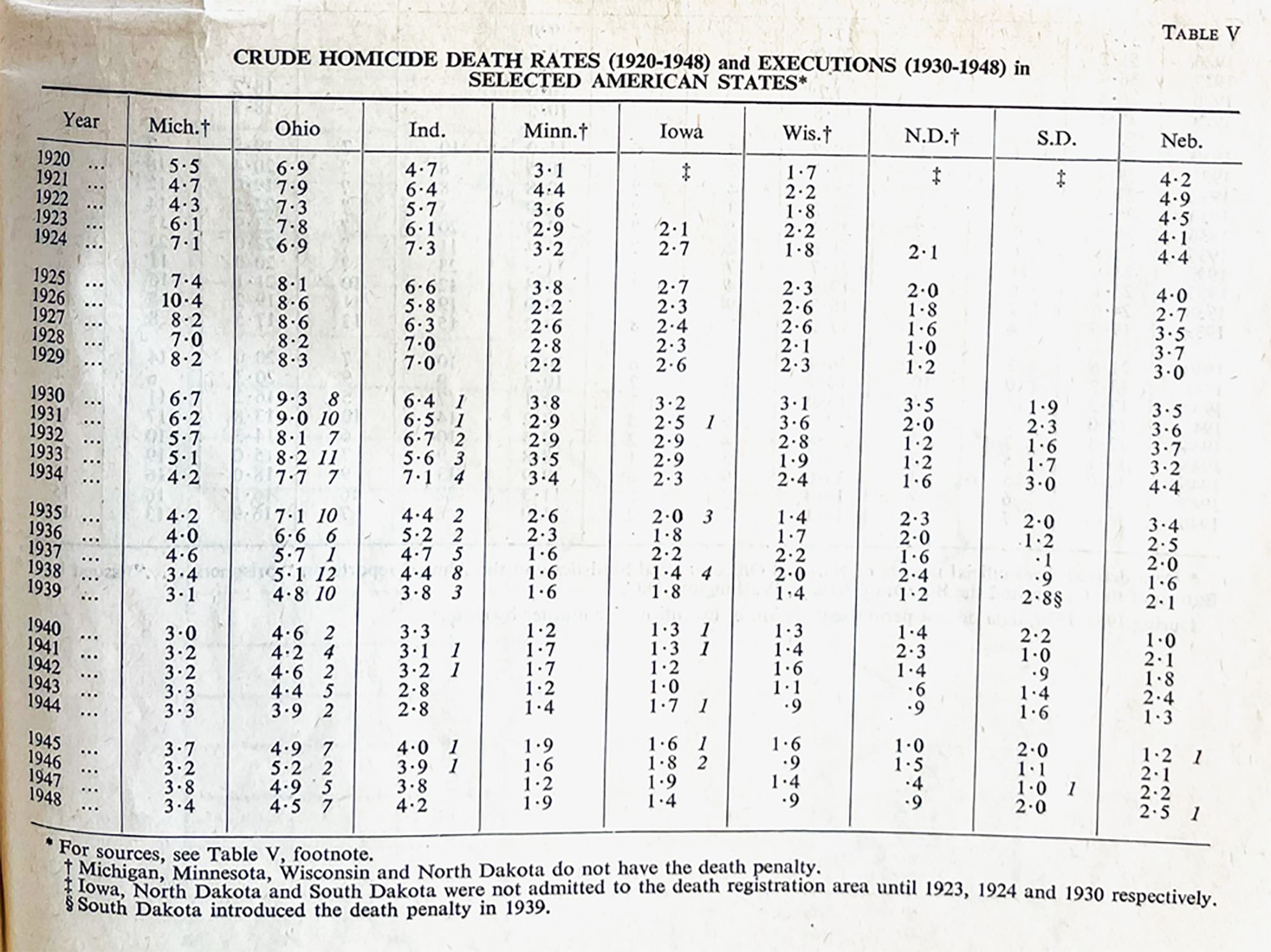
Sellin’s memorandum for the British Royal Commission included numerous tables and charts. Table V presents his comparison of homicide death rates in abolitionist versus retentionist states (with execution figures in italics).

Figure 1 Long description
The table presents data on crude homicide death rates and executions in selected American states from 1920 to 1948. It includes columns for Michigan, Ohio, Indiana, Minnesota, Iowa, Wisconsin, North Dakota, South Dakota, and Nebraska. Each row represents a year, with corresponding homicide death rates and execution figures. Abolitionist states like Michigan, Minnesota, Wisconsin, and North Dakota do not have the death penalty, while other states show varying rates of executions. Notable trends include fluctuations in homicide rates across different states and years, with some states showing higher rates of executions during certain periods. The table provides a comprehensive overview of homicide and execution trends in these states over nearly three decades.
The U.S. and Europe were the jurisdictions Sellin studied in detail, but his association with Canada’s leading penal researcher, C.W. Topping, a University of British Columbia sociologist, afforded him some familiarity with the status of capital punishment in that country. As the editor of the Annals, Sellin had invited the Canadian expert to contribute to his special issue. “The Death Penalty in Canada,” Topping’s contribution, followed his editor’s practice of framing his evidence in Beccarian terms: the certainty of punishment was more effective than its severity.Footnote 61 However, Topping’s emotive style came out when he appeared as a witness before the joint committee. Unlike Sellin, he was expressly moralistic: “Capital punishment, the deliberate killing of someone who might yield to treatment, is repugnant to those who believe in the new penology,” Topping proclaimed, and the death penalty was an “unchristian” punishment that categorically did “not deter murderers.”Footnote 62 By contrast, Sellin eschewed the use of such “dogmatic” claims and he retained his aloof scientific “thought style” when he responded to challenges from both inquiries over his sources and methods.Footnote 63
Testing Fact and Questioning Expertise
The Royal Commission and the Canadian joint committee were avowedly committed to gathering and studying factual evidence. The British commissioners, precluded from advising on the prospect of abolition, were appointed to examine the “evidence as to how far capital punishment has in fact that special efficacy which it is commonly believed to have.”Footnote 64 The joint committee members also vowed that they sought out “factual evidence,” not “expressions of opinion.”Footnote 65 Despite this, both inquiries ultimately favored police practitioners’ beliefs over academic experts’ facts, foremost Sellin’s. The concurrence of opinion between prosecutors, judges, high-ranking clerics, and police leadership—that the death penalty was the only appropriate punishment for murder—was unqualified and compelling. Although Sellin pronounced their opinions dogmatic, he was not surprised, since any given society’s decision for or against capital punishment was ultimately a “question of emotions and feelings and not of a rational approach to the question how to reduce or remove criminality.”Footnote 66 But the British and Canadian fact-seeking inquiries’ receptivity to experiential over academic expertise was not solely a matter of substance but of style—the unequivocal certainties of the police versus Sellin’s cautious academic explanations of his data and methods, plus his emotionally restrained responses to their questions. Brought together through government commissions, playing by the same rules of engagement, they clashed in their performance of professional expertise, and Sellin’s capital as a penal expert took a hit.Footnote 67
One of Sellin’s testiest questioners on the British royal commission was fellow academic Leon Radzinowicz, whose challenges shored up his own criminological expertise. Having recently been appointed the “Director of the first Department of Criminal Science in Britain,” he opened by accusing Sellin of misrepresenting retentionists, of whom Radzinowicz was one. No one thought that capital punishment could deter every type of murderer, and he objected to Sellin’s characterization of support for the death penalty as a “social belief,” not a “categorical principle.” Sellin responded that beliefs of any sort were untestable.Footnote 68 As far as he was concerned, to answer the fellow criminologist’s question about which types of murderers were likely or unlikely to be deterred by any sort of punishment was to invite speculation. Sellin’s retort was direct but measured: the “deterrent power of the death penalty” could only be tested statistically, and his evidence did not support that supposition.Footnote 69
Having reviewed several of Sellin’s supplementary tables, Radzinowicz peppered him with questions on his methodology and sources, asserting his own expertise. Sellin’s lack of data on murder rates by population concerned Radzinowicz: how could the commissioners evaluate fluctuations in murder rates without knowing the numbers of inhabitants in any jurisdiction? He also took issue with Sellin’s graphs, which recorded the number of murder convictions, not all homicides known to police. Consequently, his conclusion—that the presence or absence of the death penalty made no discernible impact on the murder rate—was “somewhat vitiated” by Sellin’s approach, not just the sparsity of his data, Radzinowicz charged. At three points in his questioning of Sellin, he pressed the witness to confirm that “these tables have a negative value only.” Sellin agreed. Although “one cannot have too much information and detail upon these matters in order to get a clear picture,” he observed, he stood by the value of his evidence and methods.Footnote 70
Radzinowicz’s challenge led to further probing by the chairman and several other commissioners. Professor G. A. Montgomery, a professor of Scots law at Edinburgh University, asked whether Sellin had reached the conclusion that capital punishment was no better a deterrent than its substitutes. A psychiatrist at the National Hospital for Nervous Diseases, Dr. Eliot Slater, repeatedly asked Sellin to concede there must be some sorts of homicidally inclined persons whom the death penalty deterred. The expert declined to take the bait: “I refuse to speculate upon possibilities for which I have no basis in data. I cannot therefore answer the question; it would merely be guessing.”Footnote 71 Needled to speculate, Sellin reiterated he could not “measure a problem which is not measurable in those terms.” However, Radzinowicz thought the problem lay with Sellin’s sources and analysis: “Criminal statistics are too crude an instrument to give a reply to these questions.” he insisted, adding that Sellin had provided “no clear-cut reply as to the deterrent effect of any given punishment.” Slater, who later declared himself an opponent of the death penalty, accused Radzinowicz of trying to force the witness to declare his data were “irrelevant. Surely we cannot go so far as that, can we?”Footnote 72 But the neurologist was equally frustrated over the connections between Sellin’s data and his analysis, finding them difficult to grasp.
Sellin acknowledged that his evidence was inconclusive but insisted this meant there was no conclusive data to support or disprove the death penalty’s impact on homicidal violence. By contrast, he told Radzinowicz that the impact of penal treatment as an alternative to capital punishment could be tested by its own objectives, even if he had not presented research on the subject. Thus, Sellin was content to offer the Royal Commission a null hypothesis without evidence of a better way to deter murder, let alone data to affirm a hypothesis. But the commissioners were discontented, and the Canadian joint committee would find themselves in a similar state when they encountered the same expert witness three years later.
Although Canadians concerned about the death penalty’s future, its retention or abolition, had the opportunity to read the Royal Commission’s report, published in 1953, few would likely have plunged fully into the 500-page tome in advance of Sellin’s appearance. Several members of the joint committee might have done so, since they quoted passages from it when they questioned him on his findings. Sellin appeared with updated and augmented data, but in Canada, he faced politicians who were more inclined than the royal commissioners to elevate the home truths of law enforcement agents over his academic expertise. Indeed, the committee allowed representatives of the police to appear twice—once to present their warnings about the possible consequences of abolishing capital punishment and a second time, after Sellin’s appearance, to reject the academic’s dismissal of the death penalty’s deterrent potency.
Several members of the joint committee were trained lawyers, but the majority of the MPs and senators resembled the individuals on the royal commission who were selected for their public and social service. The counsel to the committee introduced Sellin respectfully and invited the expert witness to explicate his latest “statement.”Footnote 73 Since his appearance before the royal commission in 1951 he had gathered homicide data for many more nations, provided by the UN’s Department of Economic and Social Affairs.Footnote 74 For the Canadian inquiry Sellin added charts on non-European countries, including El Salvador, Nepal and Venezuela, to his earlier analysis of abolitionist jurisdictions which had a lower homicide rate per 100,000 population than England and Wales.Footnote 75 Sellin had also used the International Penal and Penitentiary Commission’s survey of its member states’ management of prisoners serving commuted death sentences to meet Radzinowicz’s demand for data concerning life imprisonment as a substitute punishment. That study had found that convicted murderers created few management problems in prison and posed no “serious threat to the community” on release.Footnote 76 Finally, Sellin could draw on the special issue of the Annals he had edited in 1952, which comprised articles on the death penalty in numerous regions and countries, including “Australasia, Asia and Africa.”Footnote 77 None of the contributors had found evidence of capital punishment’s unique deterrent effect or any indication of abolition’s alleged criminogenic effect.
The supplementary data Sellin presented to the Canadian committee pleased its abolitionist members from the CCF, but his evidence irked pro-retentionist members who disputed his findings. On the contention that released prisoners serving commuted sentences posed neither a management nor a public safety problem, E. Davie Fulton, a Conservative MP and the future minister of justice, accused Sellin of making a “dangerous generalization.” Did he not skate over evidence that a substantial proportion of convicted murderers reoffended? Sellin informed the committee that most paroled or pardoned prisoners who were rearrested had committed property offenses, not homicides, but the MP shot back, accusing Sellin of being “dogmatic.” Rather than wobble over the treatment potential of murderers, Fulton taunted, there was no arguing with the fact that “you cannot be a recidivist if you are dead.”Footnote 78 Another member tried to use Sellin’s method against him—comparing the contiguous states of abolitionist Michigan and retentionist Canada—and he challenged the expert to explain why many more murders of law enforcement agents had occurred in Michigan during prohibition: was it not because gangsters feared execution in Canada? Sellin could provide no statistical response, only the fact that the problem of organized crime was greater in the U.S.Footnote 79
In Canada, as in Britain, Sellin’s foremost opponents were the police, who used their appearance before the joint committee to denigrate the professor’s use and interpretation of statistics. Abolishing the death penalty, they urged, would place law enforcement personnel at greater risk and produce an uptick in murders. In May of 1954, two weeks before Sellin appeared, the President of the Chief Constables Association, Walter H. Mulligan, declared, “There is no doubt in our minds that [the death penalty] does act as a deterrent.” He and his brother law enforcers added that they believed only “those who unquestionably deserve it” were executed. Thus, if Canada were to abolish the death penalty, “murder would be encouraged, or at least not so strongly discouraged, and society endangered.” But Mulligan’s “main objection” was that “abolition would adversely affect the personal safety of police officers in the daily discharge of their duties.”Footnote 80 The police association president also advised the committee that the number of police killings was undoubtedly higher in abolitionist jurisdictions than in retentionist ones, and he was untroubled by his lack of proof that this was so.
Several members referred to the prior testimony of police representatives in the course of questioning Sellin, since the chief had contradicted the professor’s interpretation of homicide data involving killings of law enforcement agents. Was it not the case that abolishing the death penalty would open Canada to American rates of police killings in abolitionist states? Sellin responded by dismissing such predictions as unverifiable “opinion.”Footnote 81 At that point, he had yet to analyze police killings in abolitionist versus retentionist states, so he set out to do so after he testified before the committee midway through 1954. In the interim, Canada’s police representatives requested a second appearance to counter Sellin’s memorandum and his testimony.
When they reappeared in 1955, the police spokesmen told the committee Sellin was wrong about capital punishment’s deterrent power, and they attacked the data and methods he used to reach his faulty conclusions. Chief Walter Mulligan reappeared with the secretary of the Canadian Association of Chiefs of Police and George Shea, and they presented two briefs. The latter man, involved in the policing of Canada’s railroads, admitted they had made a poor showing before the committee in 1954: “We did the best we could from our personal experience and first-hand knowledge. I admit that we were not able to give you any statistics that would mean anything.”Footnote 82 In the year since they had first testified, they had compiled their own data, based on records of the Federal Bureau of Investigation, and they claimed their briefs showed that the abolitionist state of Michigan had far more murders of police recorded over a five-year period than did Massachusetts, a retentionist state with a similar population. Mulligan strongly criticized Sellin’s evidence, and he warned the committee against accepting it without “queries or questions.” Shea’s dismissal of Sellin’s expertise was sarcastic and falsely modest: “I am totally unhampered by any learning in psychiatry, psychology, or sociology. All we know are the police facts and figures.”Footnote 83 What he urged was the committee’s recognition of law enforcers’ evidence over Sellin’s statistics.
The Final Report of Canada’s joint committee concluded that the facts about murder, claimed by Mulligan, were more persuasive than the international expert’s data on the death penalty. Leaders of law enforcement “impressed” the majority of the committee since the police unanimously supported retention. Their report recommended that Canada retain the death penalty, and this decision was based on the “experience of the officials supporting this view [which] indicated it was an effective deterrent to murder.”Footnote 84 Where it referred to Sellin’s evidence, the final report summarized his testimony about the limitations of available data, differences in the definition of murder between jurisdictions and the impossibility of calculating distinctions in “traditions and standards of law enforcement.” After considerable time and expense the Canadian committee reached the same conclusion as the British Royal Commission: “too much should not be read into the failure to find a correlation between the death penalty and homicide rates in statistical surveys.”Footnote 85 Ultimately, the Final Report landed on a dogmatic assertion: “Prima Facie the penalty of death is likely to have a stronger effect as a deterrent to normal human beings than any other form of punishment, and there is some evidence (though no convincing statistical evidence) that this is in fact so.”Footnote 86
The joint committee’s final report did not mention two significant matters that arose toward the end of their deliberations. First, Sellin submitted his follow-up report on police killings in the U.S., which differentiated between states that did and did not include the death penalty in their penal codes. The report he submitted in April 1955 showed “it was impossible to conclude that the states which have abolished the death penalty have thereby made the policeman’s lot more hazardous.”Footnote 87 This finding, Sellin advised the joint committee, was sufficient to reject the police witnesses’ advice on the possible impact of abolition, since it “lacks any factual basis.”Footnote 88 The second matter was the joint committee’s decision to delete one of the briefs the police submitted after they discovered they contained “inaccurately recorded statistical information.”Footnote 89 In the end, the accuracy of statistics from either party was as inconsequential to the Canadian inquiry as it was to the British royal commission. Both investigations found the “common-sense argument from human nature,” expressed by “all ranks of the police and of the prison service,” more persuasive.Footnote 90 Most jurists and clerics whom they had questioned agreed with law enforcement, but the vocational expertise of the police derived from their close knowledge of criminals and the dangers they posed to society. “We cannot treat lightly the considered and unanimous views of these experienced witnesses,” the joint committee’s final report closed.Footnote 91
Conclusion: Revising the History of Penal Expertise
The British and Canadian inquiries into the death penalty in the post-war decade responded to mounting concern that executing criminals diverged from the broader move toward the treatment model of correctionalism.Footnote 92 However, that tilt lacked a broad base in the mid-twentieth century, the pinnacle of penal welfarism. Its primary proponents were social scientists, progressive jurists, and medical and psychiatric professionals, as well as long-established prisoner welfare organizations. The final reports of the royal commission and the joint committee suggested modest reforms to the procedures and techniques surrounding the death penalty, despite experts’ warnings over the possibility of error in both respects, not to mention the lack of evidence of the death penalty’s unique deterrent effect—Sellin’s “negative” finding. In Britain and Canada, the question of public opinion was the principal basis on which investigators warned against the prospect of abolition in the mid 1950s.Footnote 93 Integral to that stated rationale was distrust over academic expertise and a reliance on common sense and experiential wisdom—the ‘lived’ expertise that came from vocational training, not university degrees.
Although the Canadian joint committee and the royal commission had distinct briefs, they both stated they were after facts. The chairman of the Canadian inquiry declared at the outset that members should not be “too concerned about opinions that people have because even cranks have opinions and they are not supported by any facts.”Footnote 94 Like the British royal commissioners, they were “most anxious to hear from those who can give us facts.”Footnote 95 Sellin, the unparalleled expert in the field, was the key scholarly informant chosen by both official inquiries. He gave the British and Canadian investigators what they asked for, but they rejected his evidence. More than that, they discounted the sources and methods Sellin used to arrive at his guarded conclusions. Contrasted with the solid endorsement of retentionism by law enforcement and their unwavering opinions, which could not be challenged empirically but which aligned with public opinion, the inquiries devalued their expert’s capital.
The dismissive treatment of Thorsten Sellin in these mid-twentieth-century inquiries into the death penalty unsettles the consensus that “nonformalized and nonacademic” approaches to social problems were supplanted after academic and “scientific” criminology took hold in the late nineteenth century.Footnote 96 In fact, many countries that adopted penal welfarism, including Britain and Canada, kept functionaries on staff to shackle, whip, and hang offenders. Accordingly, these governmental inquiries into the death penalty’s appropriateness solicited and valued competing forms of expertise at the highwater mark of correctionalism, not exclusively the expert knowledge Sellin possessed. Although these government-appointed studies supported a status quo approach to the death penalty—suggesting they fit Stoler’s definition of commissions of inquiry with preordained “solutions”—they were not simply a cynical political ploy or an intentional set-up.Footnote 97 The minutes of the royal commission and the joint committee indicate that law enforcement representatives were just as sure of their expertise as Loader’s elite guardians were of theirs in the mid-twentieth century. These men accrued “insider” capital expertise, accumulated through years of personal contact with criminal offenders.Footnote 98 They were certainly more confident penal authorities than Sellin, the meticulous quantitative criminologist, in asserting their conviction that the death penalty was the best tool to deter homicidal violence.
Because Britain and Canada went on to abolish the death penalty within two decades of these inquiries, it is tempting to fold them into a progressive story of enlightened opinion prevailing in the age of the expert.Footnote 99 Sellin’s evidence helped to convert retentionists, including Sir Ernest Gowers, whose memoir of his experience chairing the royal commission republished Sellin’s graphs and quoted his memorandum at length. Even Radzinowicz, who objected to Sellin’s ‘negative’ findings in 1951, ultimately supported abolition and acknowledged his fellow criminologist’s influence.Footnote 100 But rather than slot the opinions of retentionists “in the realm of emotion rather than reason,” as Gowers did and most abolitionists still do, a more expansive concept of the history of professional capital is needed to appraise the supposed heyday of the expert.Footnote 101 As Levin argues, “expertise as a frame and vocabulary implies exclusivity: calling someone an expert both presumes and also establishes that others are nonexperts.”Footnote 102 The challenge, then, is to inquire into how, and through what mechanisms, those exclusions have operated historically, rather than to presuppose what counted as expertise in specific contexts, including the apex of penal welfarism.
The turning points of penal policy have always commanded the greatest attention in penal historiography, and histories of the death penalty, both Foucault’s and the Whiggish accounts (including Sellin’s) he skewered, have contributed to that trend.Footnote 103 This approach persists in studies of abolition that attribute it to the triumph of human rights.Footnote 104 But the overlapping continuities and contradictions produced through clashing “penal templates” call for greater attention.Footnote 105 The noble story of an expanding humanitarian spirit, combined with the rationality of ‘modern man’—the version of history Sellin and the pantheon of mid-twentieth century criminologists wrote about and wrote themselves into—has been supplanted by critical accounts since the 1970s. Yet, the broad consensus on the centrality and power of institutional expertise in welfarist penal modernity is resilient, despite the fact that countries later in the “vanguard” of abolition retained corporal and capital punishment for as much as a century after they first invested in reformatories and borstals and psychiatric treatment centers.Footnote 106 Similarly, postwar governments that invited acclaimed experts and asked that they advise and direct rational reforms to deliver more effective, modern services also harkened to the advice of experts whose work brought them face to face with criminals. Even in the “age of the expert,” a highly credentialed authority, esteemed in the halls of academe and ensconced in national and international governing bodies, could be—and was—courted and rejected.
Acknowledgements
Earlier versions of this paper were presented at meetings of the Social Science History Association and the American Historical Association, where I benefited from comments from co-panelists. Conversations with Lorna Weir on expert capital were invaluable. Three anonymous reviewers caught errors, made excellent suggestions, and offered ways to refine the argument. Finally, I am grateful to the editor-in-chief for his support and insights.

 Open access

