

Introduction
Reference SharpeSharpe & Van Gelder (2006) present evidence that the numerous finger flutings in Rouffignac Cave were made by very young children, 2-5 years old. In this comment, the data are analysed statistically and it is concluded that the majority of the flutings were made by just a few children. Of the 50 measured flutings, 46 (92 per cent) were probably created by only two children. One of these was a girl 2-3 years of age. The other was either a boy aged 2-3 years or a girl aged 5-6 years. The four remaining flutings were made by 2 to 4 older children, 6-13 years old.
A striking bimodality
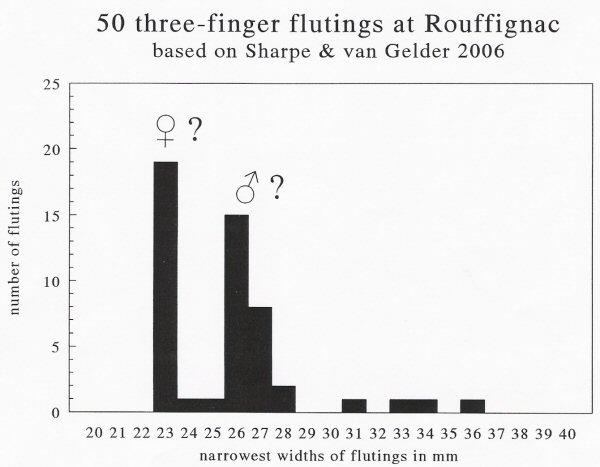
Widths of 50 three-finger flutings in Chamber A1 of Rouffignac Cave. Note the striking bimodality. (Based on Reference SharpeSharpe & Van Gelder 2006: Table 2).

Reference SharpeSharpe & Van Gelder (2006) present evidence for 'artistic' work by Upper Palaeolithic children in Rouffignac Cave. It concerns finger flutings, commonly known as 'macaronis', which can be found in many caves. At Rouffignac, thousands of such flutings occur in Chamber A1 (and elsewhere), cutting through a thin clay layer to reveal the white colour of the limestone beneath it.
The flutings were made with one or several fingers. Sharpe & Van Gelder discuss only three-finger flutings, which were produced by the three central fingers held close together. They measured the widths of 50 three-finger flutings (at their narrowest point) on the ceiling in Chamber A1 of the cave. These measurements were then compared with the widths of 135 three-finger flutings created experimentally by modern humans. Of these, 68 were made by females aged 2–55 years, and 67 by males aged 2–52 years.
Other authors had already remarked that many of the flutings in Rouffignac Cave could have been made by children. Sharpe & Van Gelder present experimental evidence for this, confirming that many of the flutings were indeed children's work, and moreover made by very young children, aged 2-5 years.
In my opinion, Sharpe & Van Gelder's case is convincing. However, there is definitely something strange about their data concerning the three-finger flutings at Rouffignac, as recorded in their Table 2; a bar graph based on their data is presented in Figure 1. It is clear to see that this frequency distribution is markedly bimodal. A first peak occurs at a width of 23mm (19 flutings), and a second at 26-27mm (23 flutings). The 'gap' between the two peaks amounts to only 2mm, but is very obvious nevertheless (with only one fluting per mm).
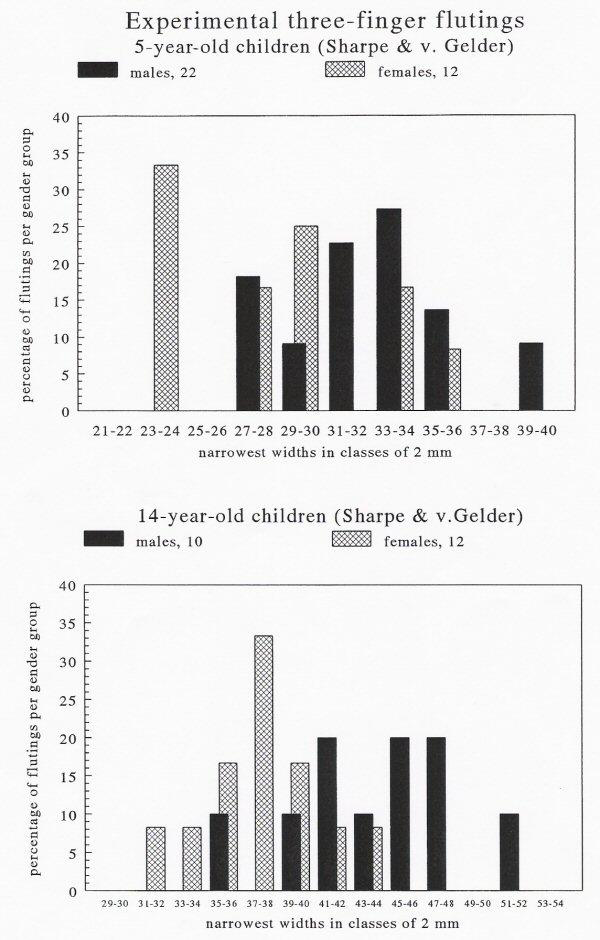
Widths of three-finger flutings made by modern 5-year-old (top) and 14-year-old children (bottom). It can be seen that the flutings made by girls are on average narrower than those made by boys. (Based on Sharpe & Van Gelder 2006: Table 1).

Instances of bimodality are in many cases quite instructive, and the possible origins of such a pattern should be discussed. Of course, one possibility is that the bimodal pattern is in fact nothing more than a fluke of chance. After all, the sample is not very large: 50 flutings in total. On the other hand, the peaks bordering the gap are relatively high: 19 and 15 flutings. The probability that such a pattern arises by chance when a sample is extracted from an essentially unimodal population must be very small. It would certainly be worthwhile to measure more three-finger flutings in Chamber A1 of Rouffignac, to investigate whether or not the bimodal pattern holds up, but for the time being we should assume that the observed bimodality is real. Implicit in this assumption is that the flutings recorded in the paper by Sharpe & Van Gelder were selected more or less randomly from the mass of flutings, also spatially (the paper gives no reason not to assume this). Accepting the reality of the bimodal pattern, the possibility comes to mind that the peak with the smaller widths (left) represents girls, and the one with larger widths (right) boys. Humans show sexual dimorphism, though it is relatively slight compared to other primates. The ratio of male to female body weight is c. 1.22 (Reference JohansonJohanson & Edgar 1996: 73); when it comes to single dimensions such as body length, the ratio is smaller, somewhere in the range of 1.05-1.15. The widths of the flutings in the right-hand peak in Figure 1 are on average about 1.15 times greater than those in the left peak. This ratio is in the order of magnitude that one would expect if the bimodality were caused by sexual dimorphism (as demonstrated below). If the two peaks indeed reflect sexual dimorphism, then the ages of the boys and girls when they created the flutings would have lain within very narrow time brackets. This is potentially very interesting, because if most of the flutings were made at a fairly precise moment in any child's life, a ritual of some kind is suggested. But can any of this be substantiated?
It is important to note that, though this hypothesis might explain the existence of two peaks, it does not explain the extreme sharpness of the bimodal pattern at Rouffignac. There will have been variation within each gender, even when all were of the same age, and the two distributions (for boys and girls) would overlap to such a degree that any bimodality in the combined frequency distribution would be very slight or even absent altogether. I shall return to this point later, after having discussed the question whether there indeed is any notable difference between boys and girls of the same age, in terms of width of finger flutings.
Boys and girls?
The hypothesis that the two peaks in Figure 1 might represent the two genders is not accepted by Sharpe & Van Gelder (ibid.: 944); they write about their experimental flutings: ‘... for this study, the fluting width measurements for females and males can be combined (there being no significant difference between them)’. However, inspection of the data in their Table 1 shows that there is a significant difference between modern boys and girls with respect to fluting width. I shall look at two age groups which are especially well-represented in the sample of Sharpe & Van Gelder: 5-year-old and 14-year-old children, who created 34 and 22 flutings, respectively.
Of the 34 flutings made by 5-year-old children, 22 were made by boys and 12 by girls. The width measurements, for boys and girls separately, are presented in a bar graph (Figure 2: top). Five-year-old boys produced three-finger flutings with an average width of 32.5 mm (Standard Deviation (SD) 3.5). The average width of the flutings made by 5-year-old girls is 28.2mm (SD 4.6). The ratio between the two, it will be noted, is 1.15. The difference in average fluting width between boys and girls is 4.3mm. This may not seem much, but it is highly significant, even though the samples are not very large. Student's t = 2.98, df = 32, resulting in: 0.005 < p (two-tailed) < 0.01.
The same is true for flutings by 14-year-old children, of which there are 10 by boys and 12 by girls (see Figure 2: bottom). Boys: average width is 43.7mm (SD 4.7); girls: average width is 37.8mm (SD 3.5). The ratio is 1.16. Here the difference in means is somewhat larger than with the 5-year-old children (as would be expected): 5.9mm. Student's t = 3.37, df = 20: 0.002 < p (two-tailed) < 0.005. In both cases, therefore, the difference between boys and girls is very significant indeed. As an aside: we are unfortunately not informed whether individual participants were allowed to make only one or several flutings in the experiment. If the latter was the case, there is a possibility that individual children dominated the observed picture.
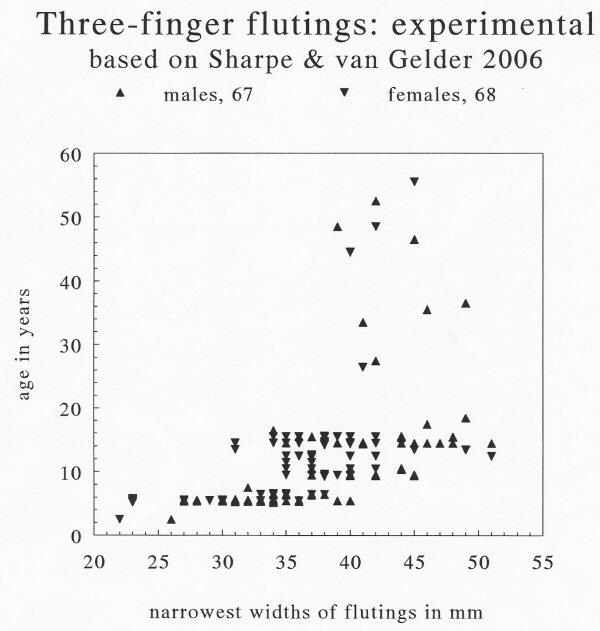
In order to optimally use the experimental data for the interpretation of the Palaeolithic flutings, a good approach is to do a regression analysis. In a scatter graph (Figure 3), the ages of the participants and the widths of the flutings they created are compared, to see if there is any correlation between these two variables. It can be observed, in the lower half of the diagram, that there is a clear, positive correlation for participants aged 2–18 years: the older, the greater the width of the flutings, on average. This is of course what one would expect. Above 18 years, however, there is no correlation; evidently, by that age human fingers have reached their adult size.
Scatter diagram of age against fluting width for all 135 experimental flutings recorded by Sharpe & Van Gelder (2006: Table 1). A positive correlation can be observed, especially for ages below 20 years.

It can also be noted in Figure 3 that no participant in the experiments with an age over 18 years made three-finger flutings with a width of less than 39mm. At Rouffignac, however, the broadest three-finger fluting has a width of 36mm (see Figure 1), which makes it quite clear that all the measured flutings at Rouffignac were made by children.
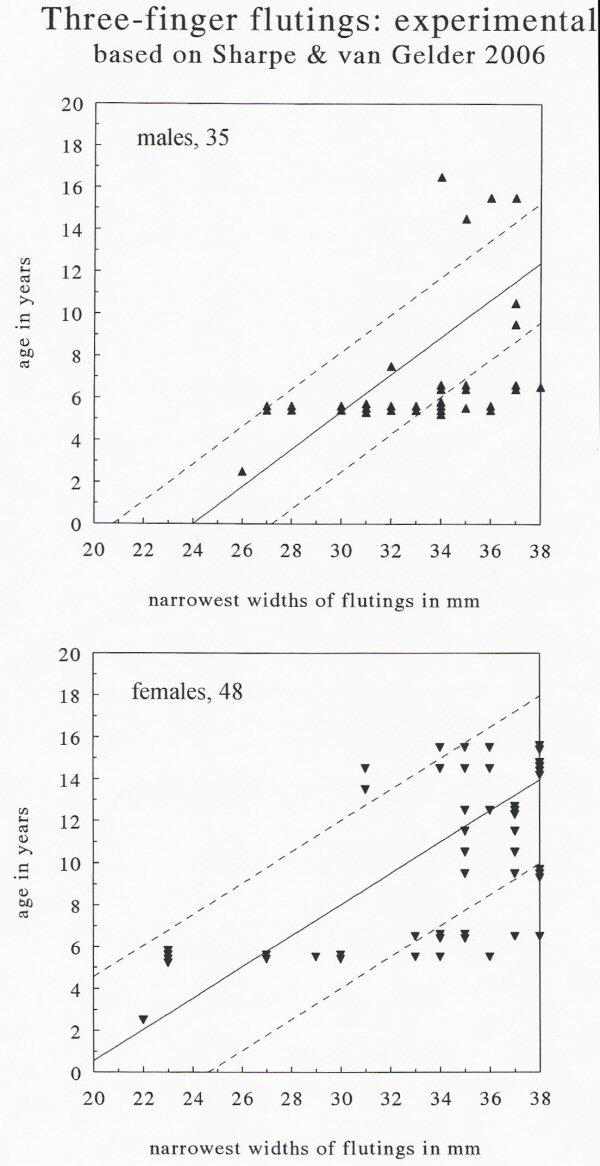
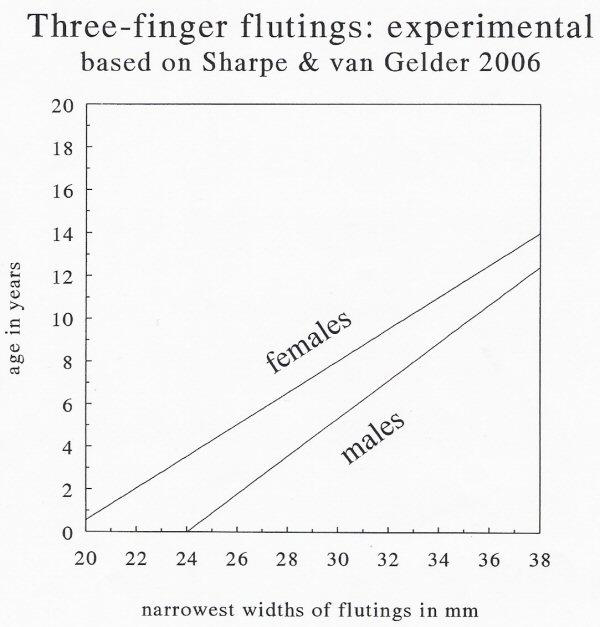
On the basis of the above findings, linear regression lines (age on width) were calculated for the experimental flutings with widths up to 38mm, for boys and girls separately (Figure 4). These lines give the best estimation of age on the basis of fluting width. It can be seen that the regression lines for boys and girls are clearly different (see Figure 5). For both boys and girls, the observed trends are significant in a statistical sense (two-tailed p's < 0.05). However, the correlation coefficients are not very high: 0.52 in the case of the boys, and 0.48 in the case of the girls, which means that the standard errors of the regression equations are relatively high (2.84 in the case of the boys, 3.50 in the case of the girls; they are indicated by broken lines in Figure 4). The regression equations are as follows. For the boys: Age = 0.885 x Width – 21.23; for the girls: Age = 0.745 x Width – 14.34. It should be noted here that in each case 0.5 was added to the age mentioned in Table 1 of Reference SharpeSharpe & Van Gelder (2006). This was done because an age of '5' can mean a real age anywhere between 5 and 6. (As an aside: the resolution of the data in Table 1 of Sharpe & Van Gelder would have been higher if the ages had been given with one decimal. Young children especially grow quite a lot in the course of one year; my daughter, for example, grew from 84 to 93.5cm between her second and third birthdays: an increase of 11.3 per cent).
Scatter diagrams of age against fluting width, plotted separately for modern boys (top) and girls (bottom). (Based on Sharpe & Van Gelder 2006: Table 1). Only flutings with a width up to 38mm were included. Linear regression lines of age on width are shown, with broken lines indicating one standard error.

The regression lines for age on fluting width for modern boys and girls (see Figure 4). It can be seen that these are noticeably different; the two regression equations can be found in the text.

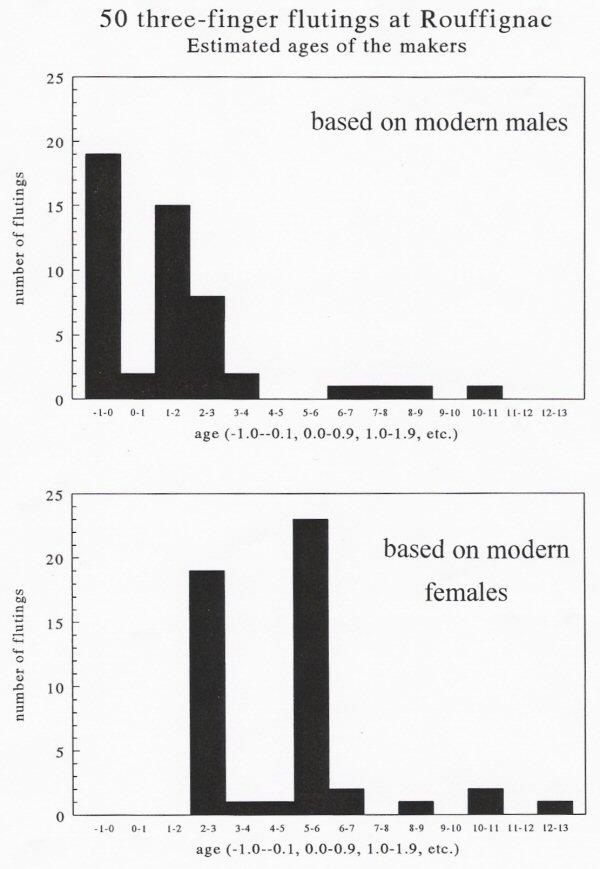
We will now use the regression equations for modern boys and girls for estimating the ages of the makers of the Palaeolithic flutings in Rouffignac Cave. If we use the equation for boys (Figure 6: top), the result is that the first peak consists of flutings done by foetal boys, -1 to 0 years old! This is clearly absurd, so we must conclude that the flutings within the first peak were most probably created by one or more girls about 2-3 years old (see Figure 6: bottom). (Of course, given the relatively large standard errors, flutings 23mm wide could have been made by boys aged 2, but it is much more likely that these flutings were girls' work: see figures 4 and 5). The conclusion that the flutings in the first peak were most probably not made by one or more small boys is underlined by an observation of Sharpe & Van Gelder (ibid.: 942): ‘It was very hard and frequently impossible to have many children younger than 2-3 years old make fluted lines. They seemed to lack the ability to understand the command and to hold and control their hands in an appropriate manner’.
The ages of the makers of the finger flutings at Rouffignac, as estimated on the basis of the regression analysis for modern children (Figure 5), calculated separately for boys (top) and girls (bottom). Obviously the flutings in the left peak can hardly have been made by boys, because their estimated age is below zero.

So we seem to have one or more girls of 2-3 years, who made the flutings represented by the left peak of Figure 1. Let us now look at the second peak. Basing ourselves on the regression equation for boys, the flutings in the second peak could have been done by one or more boys 1-3 years old (see Figure 6: top). However, the second-peak flutings could alternatively have been created by girls aged 5-6 years (see Figure 6: bottom). In principle, there is no way to decide between these two possibilities. Though the idea that most of the flutings at Rouffignac were made by children of both genders who were all around 2-3 years old at the time, may have a certain appeal, this is just one of the possibilities. It is a possibility, however, especially given the remarkable fact that the ratio between the average fluting widths of modern boys and girls, 1.15 to 1.16, matches that between those of the two peaks at Rouffignac: 1.15.
There are four flutings with greater widths (31-36mm), to the right of the second peak (see Figure 1). On the basis of the regression equations, these may have been created by two to four older children, each of whom produced one or two flutings. These children probably were aged 6-11 if they were boys, or 8-13 if they were girls (see Figure 6).
Just a few children?
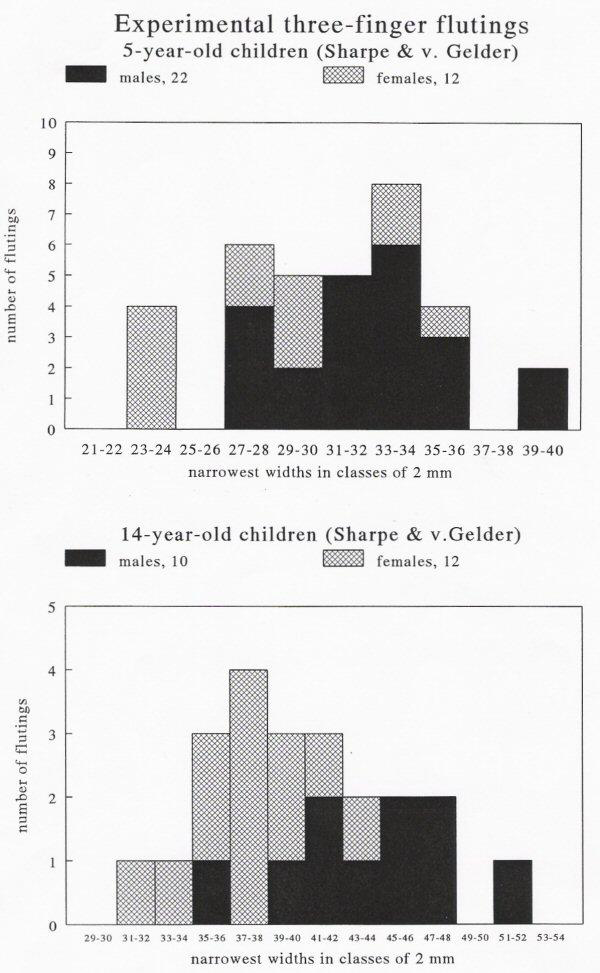
As noted above, the sharpness of the bimodal pattern in Figure 1 is striking. Though in the experimental sample of Sharpe & Van Gelder there is a difference in terms of fluting width between boys and girls of the same age, there is also variation, both among the boys and among the girls, and the two groups show a large overlap. This can clearly be seen in Figure 7, in which the fluting widths of 5-year-old and 14-year-old children are presented in a bar graph (classes of 2mm). Because of the overlap and the variation within each gender group, the combined graphs (boys + girls) are barely if at all bimodal. The very sharp bimodal pattern in Figure 1 would therefore not be expected if groups of children had produced the flutings within either of the two peaks, even if both groups consisted purely of one gender and if everybody had the same age. That could only have happened if the human population at Rouffignac was extremely homogeneous, without any variation among both the boys and the girls – as if they were all exact clones of each other. This seems rather improbable. The alternative explanation is that the flutings within each peak were all or mainly produced by only one individual. In fact I believe it is most probable that both peaks represent flutings made by only one child, as this seems to be the only realistic explanation for the sharpness of the bimodal pattern.
This leads to the conclusion that 46 of the 50 measured flutings at Rouffignac, that is 92 per cent, were probably made by just two children. One of these was a girl about 2-3 years old; the other was either a boy aged 2-3 years or a girl of 5-6 years. Two to four older children were responsible for the remaining four flutings. To summarise: it is conceivable that no more than four children were responsible for all the 50 measured flutings at Rouffignac.
These 50 measured flutings are only a small sample from a mass of thousands. If true, the above conclusion might imply tremendous activity by only a few children. In this connection one also has to realise that these children would have needed to be held aloft by adults all the time, because the ceiling was too high for small children to reach (Reference SharpeSharpe & Van Gelder 2006: 937, 945). Nevertheless, improbable though this may seem, the alternative ('clones') is even more so. And it may be noted that finger flutings can be made very quickly.
The conclusion that just a few children made the flutings at Rouffignac does not seem to support hypotheses suggesting that the flutings were made in the context of some ritual, unless it was a ritual involving only 2 or 3-year-old children. This is only one of the possibilities, however, and cannot be proven. If true, the few flutings by older children could perhaps be understood as 'demonstrations', to show the little ones what was expected of them. It would be interesting to study the spatial distribution of these wider flutings compared with that of the more numerous narrower ones. (It would also be nice to examine any differences between the distributions of the flutings in the two peaks.)
Rituals?
The finger-flutings at Rouffignac are not the only traces of young children in caves with Palaeolithic art. Finger flutings that were probably made by children have also been noted in other caves, for example at Peche-Merle and Altamira (Lorblanchet 1997: 219). Sharpe & Van Gelder (2006: 939) mention that no unambiguous patterns or images could be perceived by various researchers who inspected the macaroni mass of Chamber A1 in Rouffignac, though Reference Leroi-GourhanLeroi-Gourhan (1971: 297) saw ‘quelques figures’ mixed in. However, it should be noted that figurative art made by finger-fluting does exist, for example at Pech-Merle, Altamira, Gargas and La Baume-Latrone (e.g. Reference BreuilBreuil 1985). There is a cave in Spain (La Clotilde de Santa Isabel) which is decorated only by finger-fluting; some eight animal figures made in this way in La Clotilde are ‘... extrêmement naïfs d'exécution...’, according to Reference BreuilBreul (1985: 351). This fits in with Breuil's idea that finger flutings (and hand stencils) were made in the earliest phases of his developmental scheme of Palaeolithic art, and would therefore be expected to show a certain crudeness or 'primitiveness' (ibid.: 38). It now seems probable, however, that finger flutings were made during the whole of the Upper Palaeolithic. An alternative view - that they were in many cases produced by children – can now be offered, which would to a certain extent explain the naïveté noted by Breuil with respect to some figurative art made by fluting.
It has been suggested that finger flutings were made in the context of rituals, shamanistic or otherwise. Given the data of Sharpe & Van Gelder, however, this would imply that such rituals involved very young children, 2- 5 years old (or even mainly 2-3 years old), at least in Rouffignac. This seems to exclude puberty or initiation rites, because one would then expect traces of older children, as noted by Sharpe & Van Gelder (ibid.: 944). However, a youngster's weaning and/or naming, marking the passage from infancy to childhood, may also have been accompanied by ritual.
Bar graph showing the distribution of fluting widths of 5-year-old (top) and 14-year-old modern children (bottom) (based on Sharpe & Van Gelder 2006: Table 1). The flutings by boys and girls are stacked in the graph but shaded differently. It can be seen that there is a large overlap and also a great deal of variation within each gender group, preventing a clear bimodality in the combined frequency distributions.

Other phenomena which have been associated with ritualistic behaviour are hand and foot prints. Hand and foot prints made by children have been noted in many caves (see e.g. Reference RovelandRoveland 2000), and in some cases these prints were made by very young children. Reference ClottesClottes (1997: 31-32) mentions a handprint of a 5 to 6-year-old child in the cave floor at Fontanet. The most extreme example of this kind is mentioned by Sharpe & Van Gelder (ibid.: 937): a print of ‘... a baby's hand held by that of an adult while colour is blown over them’ at Gargas. (There exists a second handprint of a baby or toddler at Gargas; Reference GuthrieGuthrie 2005: 123). Handprints made by both young and older children are known from Gargas, and it is of interest to note that masses of 'macaronis' without any structure are also present at Gargas (Reference BreuilBreuil 1985: 248). A recent study of handprints can be found in Reference GuthrieGuthrie (2005). Although he mentions several handprints made by children younger than 5 years, most seem to have been created by older children or adolescents; his statistical analysis produced a mean estimated age of around 12 (ibid.: 124-25). Guthrie presents evidence that much of the figurative cave art too was produced by children or adolescents. Many footprints at e.g. Pech-Merle and Tuc d'Audoubert were made by children (see e.g. Reference GuthrieGuthrie 2005). Reference BahnBahn & Vertut (1997(1988): 10) write that ‘... it is possible that the finger-holes and heel-marks found around the clay bison of the Tuc d'Audoubert (Ariège) were made by children playing while the adult(s) made the figures’. At least some of the prints heel or foot prints at Tuc-d'Audoubert were made by a 3-year-old child (Reference ClottesClottes & Courtin 1995: 175); however, most derive from older children, 11-15 years old, who seem to have been walking in rows (see also Reference UckoUcko & Rosenfeld 1967), which has been taken as an indication for rituals. The footprints in the Réseau Clastres and the main cave at Niaux are quite famous; though most of these seem to have been made by older children (9–12 years), there are also footprints by young children (see illustration in: Reference BahnBahn & Vertut 1997: 10).
It seems possible that some kind of ritual was involved in the case of footprints of older children, as at Niaux and Tuc-d'Audoubert, especially if their distribution suggests that several children had been walking in single file. However, as far as I can see there are no strong reasons for postulating rituals to explain the traces left by very young children. Though there is a possibility that the finger flutings in Chamber A1 of Rouffignac Cave were mainly produced by children of both genders at a rather precise age (2-3 years), which might suggest some kind of ritual, there are also other ways to read the available evidence. The finger flutings could just as well have been made merely for fun by children of different ages. In any case, the measured flutings in Chamber A1 at Rouffignac seem to have been created by just a handful of children. If flutings were customarily made during a ritual at a certain age, one would expect traces of many more children. Presumably further research will shed more light on these issues.
Acknowledgements
Thanks are due to Lykke Johansen (Haren) for discussions about this paper and for practical help with the illustrations, and to Xandra Bardet (Groningen) for improving my English text and for several interesting comments of which I gladly made use.