


Bilingual children hear and speak each of their languages less often than their monolingual peers (e.g., Unsworth, Reference Unsworth2013). Reduced exposure to the target languages entails lower input frequencies (both types and tokens), which may result in smaller vocabularies in each language (Bialystok, Luk, Peets, & Yang, Reference Bialystok, Luk, Peets and Yang2010; Foursha-Stevenson & Nicoladis, Reference Foursha-Stevenson and Nicoladis2011), even though the total size of bilingual vocabularies is often larger than in monolinguals (Pearson, Fernández, & Oller, Reference Pearson, Fernández and Oller1993). Bilingual children may also acquire some grammatical phenomena, especially frequency-sensitive phenomena such as grammatical gender (Nicoladis & Marchak, Reference Nicoladis and Marchak2011), slower than their monolingual peers, particularly in a minority language that is not widely used in the community. In addition, bilingual children have to deal with two language systems, which may result in processing disadvantages and negative transfer (MacWhinney, Reference MacWhinney, Kroll and de Groot2005; Paradis, Reference Paradis2010a).
Superficially, language profiles of bilingual children may be very similar to language profiles of monolingual children with developmental language disorder (DLD), formerly known as specific language impairment (SLI). Children with DLD have language deficits in the absence of any hearing, intellectual, and emotional impairments or frank neurological damage (Leonard, Reference Leonard2014). Although grammatical morphology appears to be an area of particular difficulty (Bishop, Reference Bishop1994; Leonard, Reference Leonard2014), children with DLD have also been reported to display lexical deficits (Leonard & Deevy, Reference Leonard, Deevy, Verhoeven and Van Balkom2004) and deficits in discourse-pragmatic abilities (Norbury, Gemmel, & Paul, Reference Norbury, Gemmel and Paul2014).
There is a growing body of evidence that DLD is associated with impaired procedural learning (Ullman & Pierpont, Reference Ullman and Pierpont2005) and with processing deficits, including deficits in working memory (Ellis Weismer, Evans, & Hesketh, Reference Ellis Weismer, Evans and Hesketh1999) and processing speed (Windsor, Reference Windsor2002). Even though it is a matter of theoretical debate whether these processing difficulties are cause (Ellis Weismer & Evans, Reference Ellis Weismer and Evans2002; Leonard, Reference Leonard2014) or consequence (e.g., Rice, Reference Rice, Rice and Warren2004) of the impaired language representation in individuals with DLD, it is beyond the scope of this paper to resolve this theoretical controversy and to review different theories of DLD. In this paper, we take the processing accounts of DLD (Leonard, Reference Leonard2014) as a starting point and assume that children with DLD need more exposure to the target language in order to acquire the same language phenomena that typically developing (TD) children acquire with less input. For example, the experimental studies reported in Tomblin, Mainela-Arnold, and Zhang (Reference Tomblin, Mainela-Arnold and Zhang2007) and Evans, Saffran, and Robe-Torres (Reference Evans, Saffran and Robe-Torres2009) have demonstrated that children with DLD need at least twice as much input to learn patterns based on statistical information in the input. Hence, in the case of monolinguals with DLD the problem is not the actual amount of input received (as in bilingualism), but rather reduced intake, that is, the amount of input that can be effectively used for acquisition.
DIFFERENTIATING BILINGUALISM AND DLD
For child second language (L2) learners (early sequential bilinguals), who start learning their L2 after their native language (L1) system has been more or less established (after age 3), it has been noticed on numerous occasions that the effects of reduced input (due to external factors) are often difficult to differentiate from the effects of reduced intake in DLD (due to child-internal factors; e.g., Armon-Lotem & Walters, Reference Armon-Lotem, Walters, Guendouzi, Loncke and Williams2010; Blom, de Jong, Orgassa, Baker, & Weerman, Reference Blom, de Jong, Orgassa, Baker and Weerman2013; Blom & Paradis, Reference Blom and Paradis2013; Crago & Paradis, Reference Crago, Paradis, Levy and Schaeffer2003; Paradis, Reference Paradis1999, Reference Paradis2004, Reference Paradis2010b; Paradis & Crago, Reference Paradis and Crago2000; Paradis, Rice, Crago, & Marquis, Reference Paradis, Rice, Crago and Marquis2008; Vender, Garraffa, Sorace, & Guasti, Reference Vender, Garraffa, Sorace and Guasti2016). These apparent similarities may lead to misdiagnosis or underdiagnosis of L2 children for DLD (Grimm & Schulz, Reference Grimm and Schulz2014).
Much less is known about similarities and differences between the language of children with DLD and that of simultaneous bilinguals growing up with two first languages (2L1) from birth. Leonard (Reference Leonard2010) suggests that only child L2 learners should have language difficulties similar to those attested in DLD, because they have a poor representation of the target language. Simultaneous bilinguals, in contrast, are expected to have vocabulary gaps (due to reduced exposure), but no difficulty with morphosyntax. This claim is consistent with observations that in the majority language (spoken in the community and used for schooling) simultaneous bilinguals usually perform as well as their monolingual peers (e.g., Rodina & Westergaard, Reference Rodina, Westergaard, Siemund, Gogolin, Schulz and Davydova2013; Unsworth et al., Reference Unsworth, Argyri, Cornips, Hulk, Sorace and Tsimpli2014). Minority languages usually receive less attention in the literature, but there is evidence that bilinguals are likely to underperform in their weaker (nondominant) language, which is usually spoken by one of the parents and not maintained in the country of residence (e.g., Janssen, Reference Janssen2016; Rodina & Westergaard, Reference Rodina and Westergaard2017). Hence, there are reasons to assume that complex language domains that are problematic for individuals with DLD (due to reduced intake) may also be problematic for simultaneous bilinguals in their minority language (due to reduced input).
Research targeting this issue is rather scarce. In one study, Morgan, Restrepo, and Auza (Reference Morgan, Restrepo and Auza2013) compared production of Spanish morphology by Spanish–English bilinguals growing up in the English-dominant environment and Spanish monolinguals with DLD. The results revealed that the profiles of the two groups were very similar: both had problems with articles, clitics, subjunctives, and derivational morphemes. In another study, Tribushinina, Mak, Andreiushina, Dubinkina, and Sanders (Reference Tribushinina, Mak, Andreiushina, Dubinkina and Sanders2017) studied production of discourse connectives by Dutch–Russian simultaneous bilinguals growing up in the Netherlands and compared their performance to that of monolinguals with and without DLD. The results revealed that in the majority language (Dutch) bilinguals performed as well as TD monolinguals. In contrast, connective production in the minority language (Russian) was rather weak: based on error rates and error types bilingual children could not be distinguished from monolinguals with DLD.
Given the similarities between monolinguals with DLD and bilinguals, how can their language profiles be differentiated? One possibility is to focus on specific types of errors. Even though the loci of difficulty are often the same, error types may distinguish between TD bilinguals and children with DLD. For several different languages it has been noticed that children with DLD make more omission errors, whereas bilinguals are more likely to make substitution errors (e.g., Armon-Lotem, Reference Armon-Lotem2014; Crago & Paradis, Reference Crago, Paradis, Levy and Schaeffer2003). In addition, TD bilinguals are more likely to make overregularization errors such as bringed instead of brought compared to children with DLD (Blom & Paradis, Reference Blom and Paradis2013). This pattern is consistent with the view that children with DLD have impaired procedural learning abilities (Ullman & Pierpont, Reference Ullman and Pierpont2005) and therefore struggle with the acquisition of rule-based inflectional morphology (Ullmann, Reference Ullman2001, Reference Ullman2004). Bilingual children do not have this deficit and simply need more time to acquire the required number of types and tokens of regular and irregular verbs. Hence, reduced intake is more likely to affect regular morphology, whereas reduced input is more likely to affect irregular morphology.
The present paper will add to this line of research by comparing various aspects of adjective production by 4- to 6-year-old Russian-speaking monolinguals with DLD and Dutch–Russian simultaneous bilinguals acquiring Russian in a Dutch-dominant environment. Adjectives usually receive less attention in the literature compared to nouns and verbs. Nonetheless, the available research suggests that adjectives might be problematic for both bilingual children (Blom, Polišenska, & Weerman, Reference Blom, Polišenská and Weerman2008; Nicoladis, Reference Nicoladis2006; Nicoladis & Marchak, Reference Nicoladis and Marchak2011) and individuals with DLD (Bedore & Leonard, Reference Bedore and Leonard2001; Leonard, Salameh, & Hansson, Reference Leonard, Salameh and Hansson2001; Marshall & Van der Lely, Reference Marshall and Van der Lely2007; Tribushinina & Dubinkina, Reference Tribushinina and Dubinkina2012). Therefore, comparing adjective production in these two groups within one study might offer novel insights on the differential effects of bilingualism and DLD. Before turning to the current study, let us briefly review prior research on relative strengths and weaknesses in adjective production by the two populations and, based on this literature, formulate hypotheses regarding unique and shared effects of reduced input and reduced intake.
ADJECTIVE PRODUCTION IN BILINGUALISM AND DLD: RELATIVE STRENGTHS AND WEAKNESSES
Negative impact of reduced input: Lexical knowledge
As explained above, reduced exposure in a bilingual context primarily affects vocabulary size in each language, as lexicon acquisition is highly sensitive to frequency effects (Armon-Lotem, Reference Armon-Lotem2017; Bialystok et al., Reference Bialystok, Luk, Peets and Yang2010; Leonard, Reference Leonard2010; Pearson et al., Reference Pearson, Fernández and Oller1993). We can, therefore, assume that adjective vocabularies of bilingual children are smaller than those of TD monolinguals.
For DLD we expect fewer problems in the lexical domain. Tribushinina and Dubinkina (Reference Tribushinina and Dubinkina2012) assessed adjective production by 7- to 10-year-old Russian-speaking children with DLD using an antonym elicitation task. They found that even though children with DLD produced fewer lexical antonyms than their TD peers at age 7, the performance of the DLD group on the antonym production task was not significantly different from the TD group from age 8 onward. They conclude that lexical knowledge of adjectives does not seem to pose severe problems to children with DLD. These findings are compatible with Ullman and Pierpont's (Reference Ullman and Pierpont2005) declarative/procedural model of DLD. By this view, children with DLD have difficulty with procedural learning, but not with learning through declarative memory; and vocabulary learning is largely supported by declarative memory. This finding is also consonant with Leonard's (Reference Leonard2014) surface hypothesis predicting that children with DLD will have more difficulty with function words (of low phonological substance) than with content words due to processing deficits. Because adjectives are content words of sufficient phonetic substance, we do not expect severe problems with adjective lexicons. This said, the DLD group may perform slightly worse than the TD monolingual group, because impaired procedural learning may affect word finding in the flow of speech (Tomblin et al., Reference Tomblin, Mainela-Arnold and Zhang2007).
Negative impact of reduced intake: Semantics and inflectional morphology
DLD is likely to affect areas of language that are most sensitive to processing deficits and deficits in procedural learning. The most likely candidates are adjective semantics and inflectional morphology, since the acquisition of these aspects requires tracking statistical patterns in the input and making generalizations about meaning and form, respectively. Even though children with DLD may know a lot of content words, they are likely to have poorer semantic representations of adjectives in their mental lexicon (McGregor & Appel, Reference McGregor and Appel2002; Sheng & McGregor, Reference Sheng and McGregor2010). Moreover, as shown by Alt and Plante (Reference Alt and Plante2006), children with DLD have difficulty learning semantic attributes of objects (e.g., color), which is likely to affect the process of learning adjectival meanings. In order to make a mapping between adjectival form and meaning, a child has to inhibit the whole-object bias (Markman, Reference Markman1990) and focus specifically on a property such as color or size. Furthermore, the choice between different properties of an object is not always straightforward.
Prior research has demonstrated that children with DLD often make semantic substitutions (Andreau, Sant-Torrent, Olmos, & MacWhinney, Reference Andreau, Sanz-Torrent, Olmos and MacWhinney2011; McGregor, Reference McGregor1997; Tribushinina & Dubinkina, Reference Tribushinina and Dubinkina2012; Tribushinina et al., Reference Tribushinina, Mak, Andreiushina, Dubinkina and Sanders2017). For instance, an error analysis presented in Tribushinina and Dubinkina (Reference Tribushinina and Dubinkina2012) reveals that children with DLD often substitute hyponyms (e.g., “thin,” “narrow,” and “tall”) by hyperonyms (e.g., “small” and “big”), and sometimes provide synonyms instead of antonyms or antonyms to the wrong sense of the trigger word.
Processing deficits and impaired procedural learning are also known to affect the acquisition of rule-based morphology. Processing limitations negatively affect segmental analysis of speech and lead to faster decay of phonological traces. Slow form–function pairing leads to delays in the formation of morphological paradigms. Bound morphemes that are less phonologically salient are particularly vulnerable. It is no surprise then that children with DLD have difficulty acquiring adjective agreement (see below).
Another area of adjective morphology that is known to be affected by the disorder is inflectional degree morphology. Tribushinina and Dubinkina (Reference Tribushinina and Dubinkina2012) compared production of degree markers by 7- to 10-year-old Russian-speaking children with DLD and age-matched TD peers. The results revealed that children with DLD had difficulty producing morphological degree markers (e.g., comparatives and superlatives), they produced more unmarked (bare) forms than their TD peers, and overrelied on nonmorphological types of degree markers, such as degree modifiers (e.g., very tall and rather tall) and lexical switches (e.g., big > gigantic).
The acquisition of rule-based morphology by bilingual children is most likely to be unproblematic. Even with reduced exposure to the target language, TD bilinguals should be able to build inflectional categories (Armon-Lotem, Reference Armon-Lotem2017). The acquisition of morphological paradigms by bilinguals is facilitated if the target language is morphologically rich (as is the case with Russian). Bilingual children may make errors in the formation of degree forms (e.g., use incorrect comparatives), but unlike individuals with DLD, they are not likely to avoid morphological degree markers.
Converging effects: Adjective–noun agreement
An aspect of adjective use where the production profiles of bilinguals and children with DLD may look very similar, at least, on the surface, is gender agreement between adjectives and nouns. To the best of our knowledge, only one study thus far has directly compared adjective use by bilingual children and children with DLD. Orgassa and Weerman (Reference Orgassa and Weerman2008) report the results of a production experiment focusing on noun–determiner and adjective–noun gender agreement in monolingual Dutch-speaking children with DLD and child L2 learners of Dutch. Regarding noun–determiner agreement, the monolingual DLD participants performed better than unimpaired L2 children, “suggesting that the reduced intake in the L2 children has a more significant impact than the processing deficit in SLI” in the acquisition of grammatical gender (Orgassa & Weerman, Reference Orgassa and Weerman2008, p. 358). By contrast, there were no differences between the two groups in the domain of adjective–noun agreement; both groups often used incorrect adjective forms. This result suggests that, at least in Dutch, we cannot differentiate between child L2 learners and children with DLD in the domain of adjective agreement.
The finding that adjective agreement is a marked area of difficulty for both populations is supported by studies looking either at adjective use by bilinguals or at adjective production by children with DLD. However, these two sets of studies suggest that causes of gender agreement errors might be different in DLD and bilingualism.
Research on DLD reveals that adjective agreement with nouns tends to be more vulnerable than determiner–noun agreement (see Bedore & Leonard, Reference Bedore and Leonard2001, for Spanish; Leonard et al., Reference Leonard, Salameh and Hansson2001, for Swedish; Orgassa & Weerman, Reference Orgassa and Weerman2008, for Dutch; Rakhlin, Kornilov, & Grigorenko, Reference Rakhlin, Kornilov and Grigorenko2014, for Russian; Roulet-Amiot & Jacubowicz, Reference Roulet-Amiot and Jacubowicz2006, for French; Silveira, Reference Silveira2011, for Brazilian Portuguese). Notice in this connection that determiner–noun combinations can be retrieved via lemma look-up (lexical process relying on declarative memory system), whereas adjective agreement involves inflectional processes and relies heavily on procedural learning, which is an area of marked difficulty in DLD.
Bilinguals also make a lot of gender agreement errors, but in this case the problem seems to reside more in gender assignment (to the noun) than in the acquisition of the gender agreement rule (Blom et al., Reference Blom, Polišenská and Weerman2008; Nicoladis & Marchak, Reference Nicoladis and Marchak2011; Orgassa & Weerman, Reference Orgassa and Weerman2008; Rodina & Westergaard, Reference Rodina, Westergaard, Siemund, Gogolin, Schulz and Davydova2013; Unsworth et al., Reference Unsworth, Argyri, Cornips, Hulk, Sorace and Tsimpli2014). Put differently, bilinguals’ knowledge of noun gender is negatively affected by reduced exposure, which is a lexical rather than a morphological problem. Hence, bilinguals make more errors with determiner–noun agreement than with adjective–determiner agreement (Nicoladis & Marchak, Reference Nicoladis and Marchak2011), which is the opposite of what studies on DLD show (see above). In the same vein, Unsworth (Reference Unsworth2013) has found that Dutch–English 2L1 children living in the Netherlands are outperformed by monolingual Dutch children in adjective–noun agreement. However, when matched for cumulative length of exposure, the difference between monolinguals and bilinguals disappears, which demonstrates that gender agreement errors in the case of bilinguals are related to the effects of reduced input.
Specifically for Russian, Rodina and Westergaard (Reference Rodina and Westergaard2017) compared production of gender-marked adjectives in the minority language of 2L1 children (Russian in Norwegian–Russian bilinguals living in Norway). Bilingual children with two Russian parents (and hence more Russian input) performed as well as monolingual Russian children (almost at ceiling). In contrast, children with only one Russian parent performed significantly worse (about 59% correct). The most common error across the three groups was overuse of feminine adjectives with neuter nouns, that is, in cases where noun endings are unstressed and thus perceptually indistinguishable from feminine nouns (e.g., krasn-{oe}[әjә] solnc-{e}[ə] “red sun” vs. krasn-{aja}[əjə] jagod-{a}[ə] “red berry”). In addition, bilinguals with little exposure to Russian, but not the other two groups, tended to use (default) masculine forms across the board (cf. Janssen, Reference Janssen2016). Thus, the available research results suggest that the acquisition of noun gender is sensitive to reduced exposure to the target language, which also has ramifications for adjective–noun agreement.
Compensatory mechanisms in bilingualism
Negative effects of reduced exposure can be counterbalanced by cognitive and linguistic advantages of bilingualism. For instance, the famous “bilingual advantage” refers to the recurrent finding that bilinguals have enhanced executive functions. In particular, bilinguals are known to have an advantage in inhibitory control, which stems from the fact that they constantly have to suppress one of the languages when speaking the other language (Bialystok, Reference Bialystok1988, Reference Bialystok2010). As explained above, the acquisition of adjective semantics largely hinges on selective attention and inhibitory control, since adjective-property mapping involves suppression of the whole-object bias (Markman, Reference Markman1990) and selective attention to specific properties, such as color or texture. Yoshida, Tran, Benitez, and Kuwabara (Reference Yoshida, Tran, Benitez and Kuwabara2011) have demonstrated that bilingual advantage in attentional control is related to adjective learning. In their word-learning experiment bilingual 3-year-olds were able to suppress the whole-object bias and attend to the properties denoted by novel adjectives, whereas monolinguals performed at chance. In this study only attentional control was a significant predictor of adjective learning; vocabulary size was not. These results demonstrate that bilinguals may have an advantage in learning adjective semantics, even though their adjective vocabularies may be smaller than in monolinguals.
As far as linguistic advantages of bilingualism are concerned, bilingual children have knowledge of two language systems, and these two systems interact in a bilingual mind. If a particular category is acquired early in one of the languages (e.g., because it is more salient and/or transparent), a positive transfer to the other language is possible. This phenomenon is known as “bilingual bootstrapping” (Gawlitzek-Maiwald & Tracy, Reference Gawlitzek-Maiwald and Tracy1996). For instance, the system of degree marking in Dutch is much more transparent than in Russian and is also acquired much faster (Tribushinina, Reference Tribushinina, Köhnlein and Audring2015). Hence, Dutch–Russian bilinguals in the present study may have an advantage in the acquisition of degree morphology over Russian-speaking monolinguals. The positive transfer from the children's other language may work as a compensatory mechanism in the acquisition of adjective morphology in the context of reduced exposure.
THE PRESENT STUDY
Based on the literature review above, we can make the following predictions:
• Hypothesis 1 (greater effect of reduced input): Even though both bilinguals and monolinguals with DLD may have smaller adjective vocabularies compared to TD monolinguals, the size of adjective lexicons will be more affected by reduced exposure (in bilingualism) than by reduced intake (in DLD).
• Hypothesis 2 (greater effect of reduced intake): Children with DLD, unlike TD monolinguals and bilinguals, will have difficulty with morphological degree markers: they will overuse bare forms and overrely on noninflectional degree markers (e.g., degree adverbs, reduplication, and lexical switches).
• Hypothesis 3 (converging effects of reduced input and reduced intake): Both monolinguals with DLD and bilinguals will make more adjective–noun agreement errors than TD monolinguals. Because bare adjective forms cannot be used as meaningful words in Russian, it might be expected that errors of substitution (rather than omission) will be common in both groups.
• Hypothesis 4 (negative impact of reduced intake and compensatory mechanism in bilingualism): Children with DLD will make more semantic errors than TD monolinguals. In contrast, bilingual children may have an advantage in semantic aspects of adjective production.
These hypotheses were tested in an adjective production experiment following the procedures developed by Tribushinina and Dubinkina (Reference Tribushinina and Dubinkina2012) for school-aged Russian monolinguals. The experiment consisted of two tasks: antonym production and production of degree markers. These two tasks may reveal unique and shared error profiles of simultaneous bilinguals and monolinguals with DLD. As explained above, adjective vocabulary is expected to be a relative weakness of simultaneous bilinguals (Hypothesis 1), whereas production of degree markers should be negatively affected by reduced intake in DLD (Hypothesis 2). The former prediction was tested in an antonym production task, the latter in the degree production task. In addition, a series of error analyses were performed in order to test the prediction that adjective–noun agreement is problematic for both groups (Hypotheses 3), whereas semantic errors are an area of relative weakness in DLD and relative strength in bilingualism (Hypothesis 4).
Before presenting the methodology, it is necessary to briefly review the properties of Russian adjectives relevant to the present investigation.
Antonyms and degree markers in Russian
Across the world languages, most adjectives have morphologically related opposites (formal: informal; correct: incorrect), whereas the most frequently used antonyms are morphologically unrelated (e.g., high: low). Some adjectives have both types of antonyms and come in triplets rather than pairs (e.g., interesting vs. uninteresting/boring). If a child does not know the lexical antonym, she can in some cases resort to a morphological negation (Tribushinina & Dubinkina, Reference Tribushinina and Dubinkina2012). All of the adjectives used in the present experiment have lexical antonyms, but some of them may also have affixal opposites (e.g., krasivyj “beautiful” – strašnyj “ugly” – nekrasivyj “not pretty”).
Russian is very flexible with affixal opposites and even allows morphological negations of dimensional adjectives (nevysokij “not high” and neglubokij “not deep”). This said, the use of affixal negations is not unconstrained. For example, whereas positive-pole dimensional adjectives can be used with a negative prefix without any constraints (e.g., nevysokij “not high”), the use of negative-pole adjectives with the negative prefix (e.g., #nenizkij “not low”) is either impossible or only marginally possible in specific contexts (for details see Rakhilina, Reference Rakhilina2000, p. 135). There may also be semantic differences between lexical and morphological antonyms. For instance, nepolnyj “not full” (morphological antonym of polnyj “full”) means that a container is partly filled, but not to the brim, whereas its lexical counterpart pustoj “empty” suggests that the container is completely empty. Tribushinina and Dubinkina (Reference Tribushinina and Dubinkina2012) have shown that school-aged children with DLD have difficulty with such semantic subtleties of adjective production.
The Russian system of degree markers is complex and has a low degree of uniformity, since there are multiple forms competing for the same function (Table 1). For example, a high degree of the property can be expressed by means of various degree adverbs, adjective reduplication, suffixes and prefixes, or a combination of two or more different degree markers. The most commonly used suffixes are -ovat-/-evat- expressing mitigation (e.g., tjažel ovatyj “rather heavy”), -ušč-/-jušč denoting a high degree (e.g., bol'š uščij means “extremely large”), and -on'k-/-en'k- having a diminutive meaning (e.g., ton en'kij “thinnish”). Degree prefixes can be used as an additional intensifying or mitigating device in comparatives and reduplications. For instance, the prefix po– is used in comparatives to express a small difference in degree (e.g., posložnee “a bit more difficult”). The prefix pre– has an intensifying meaning and is usually attached to the second element of a reduplicated adjective (e.g., malen'kij- premalen'kij “extremely small”).
Adjectival degree markers in Russian (examples in parentheses)
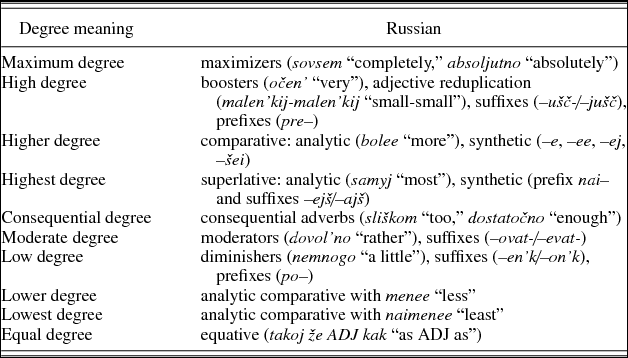
The acquisition of this complex system by bilinguals and monolinguals with DLD is theoretically interesting for several reasons. First, the system is complex and has a protracted time course even in typical monolingual development (Tribushinina, Reference Tribushinina, Köhnlein and Audring2015). Hence, the acquisition of this system by children with reduced input and reduced intake might shed more light on the differential effects of bilingualism and DLD. Second, degree markers are in principle optional (unlike, e.g., Russian agreement morphemes), which allows us to test the hypothesis that children with DLD are more likely to make errors of omission, whereas bilinguals are more likely to make substitution errors. Third, there is no one-to-one mapping between function (e.g., intensification) and form (e.g., prefix), since several different forms (or a combination of different forms) can be used for the same function. A speaker of Russian has a large inventory of degree markers at her disposal and has to select one or several degree markers out of a whole range of possibilities on each production occasion. There might be intriguing differences between populations in the preferences and actual choices made, and these preferences might be revealing about the underlying causes of apparently similar errors. For example, since children with DLD have difficulty with inflectional morphology, they may avoid using morphological degree markers and overrely on lexical and/or syntactic means of expressing degree. Thus, the central question is not how comparable the groups are on the production of, for instance, superlatives, but rather whether the choices they make reflect their unique or shared profile.
METHOD
Participants
Two hundred fifteen children participated in the experiment: 75 TD monolingual children (L1-TD), 74 monolingual children with DLD (L1-DLD), and 66 bilingual children (2L1). The children were divided over three age groups: 4-, 5- and 6-year-olds (see Table 2). A one-way analysis of variance reveals no significant age differences between groups, F (2, 213) = 0.52, p = .60.
The participants

Note: TD, typically developing. DLD, developmental language disorder.
The L1-TD group was recruited from two preschools in Saint Petersburg (Russia). These children were monolingual speakers of Russian. The teachers were asked to select the children based on the following criteria: normal motor, social–emotional, and cognitive development, as well as age-appropriate language skills.
The 2L1 participants were recruited from Russian weekend schools in Amsterdam, Amersfoort, Leiden, The Hague, and Hilversum (The Netherlands). These children were born in the Netherlands and raised bilingual from birth (in most cases by a Russian mother and a Dutch father). They all attended a regular Dutch primary school (from age 4 onward) and a Russian language school during the weekend. The children had no history of language impairment, as reported by teachers and parents.
The L1-DLD group was recruited through special preschool groups for children with DLD in the Kemerovo region (Russia). All children were monolingual speakers of Russian and had been independently diagnosed for DLD (in Russian, obščee nedorazvitie reči II-III urovnja) based on a clinical evaluation by a multidisciplinary committee consisting of a speech pathologist, a psychiatrist, a neurologist, a pediatrician, and a clinical psychologist (cf. Kornilov et al., Reference Kornilov, Lebedeva, Zhukova, Prikhoda, Korotaeva, Koposov and Grigorenko2016). For privacy reasons we were not granted access to the diagnostic results. Therefore, the teachers were asked to select participants based on the following set of criteria: (a) medium to high performance on a series of nonverbal IQ tests conducted by a preschool psychologist: Nonsense Pictures and Odd-One-Out (Nemov, Reference Nemov1995) for 4-year-olds; the Series Test (Venger, Vygodskajam, & Leongard, Reference Venger, Vygodskaja and Leongard1972), the Puzzle Test (Zabramnaja, Reference Zabramnaja1995), and the Fish Test (Venger & Kholmovskaja, Reference Venger and Kholmovskaja1978) for 5-year-olds; Non-Verbal Classification (Martsinkovkaja, Reference Martsinkovkaja2000), and Similarity Judgments and Finish the Picture (Djatchenko, Reference Djatchenko1997) for 6-year-olds; (b) no evidence of neurological impairment; (c) no severe visual or auditory problems (based on the yearly medical checks at preschool); (d) absence of any other known disorder, such as autism; (e) no severe phonological disorder; and (f) lower than expected language performance, operationalized as at least 2 SD below age-appropriate scores of receptive and expressive language on the Tsvetkova (Reference Tsvetkova1998) test.
Materials and procedure
The experiment consisted of two tasks: the antonym task and the degree task. The order of tasks was counterbalanced within each group to avoid possible order effects.
On the antonym task, children saw a picture and heard a description containing a trigger adjective, that is, the antonym of the target adjective (e.g., Posmotri, ėtot sljunjavčik čistyj “Look, this bib is clean”). After that the child was shown a second picture, which was identical to the first one except for the target property (e.g., a dirty bib). The child was invited to describe the second picture (e.g., A ėtot? “And this one?”). Notice that the trigger adjective already modeled the gender agreement pattern to be used in the response. For instance, the noun sljunjavčik “bib” is masculine and both the trigger adjective and the target antonym have the masculine form. In total, there were 15 masculine, 10 feminine, 3 neuter, and 2 plural head-nouns (there is no gender agreement in the plural). Thirty trigger adjectives used by Tribushinina and Dubinkina (Reference Tribushinina and Dubinkina2012) were also used in the present study.
A similar procedure was used in the degree task. A child was first shown a picture of an object (e.g., a stick), which was described by the experimenter (e.g., Posmotri, ėta palka dlinnaja “Look, this stick is long”). After that, the child saw a picture of a contrastive object (e.g., a shorter stick) and asked A ėta? “And this one?” After the child's response, an even shorter stick was presented, followed by two additional sticks incrementally decreasing in length. The child was each time invited to describe the new object; the same question was used throughout the trial (e.g., A ėta? “And this one?”). The five objects in a series were identical except for the target dimension. When a new object was added to the series, the previous objects remained on the screen, so that the participants could mark the degree relative to the whole set rather than only with respect to the most recently seen item.
It should be mentioned that this setup is not meant to elicit specific types of degree markers (e.g., only comparatives or only superlatives). For each stimulus in a set there is more than one possible degree marker or a combination of several degree markers (e.g., čut' pomen'še “a bit smaller” containing a degree adverb, a prefix, and a comparative form). This design was chosen in order to simulate a real communicative situation where a speaker of Russian always has more than one degree marker available and suitable in a given context. This setup allows us to pinpoint preferences of the three groups and establish which types of degree markers they use (if any) given the rich inventory provided by their language.
Ten stimulus adjectives were used in the degree task: uzkij “narrow,” bol'šoj “big,” tonkij “narrow,” vysokij “high,” dlinnyj “long,” širokij “wide,” malen'kij “small,” tolstyj “thick,” nizkij “low,” and korotkij “short.” In total, each participant had 40 opportunities to express degree (4 per adjective set).
All pictures were simple black-and-white drawings. The pictures were presented on a computer screen using a PowerPoint presentation. The child sat in front of the computer, and the experimenter sat next to the child. The children were tested individually in a quiet room in their preschool or weekend school. The responses were audio-recorded, transcribed, and coded.
Coding
The following categories were used to code responses on the antonym task:
1. Lexical antonym (e.g., čistyj “clean” > grjaznyj “dirty”)
2. Morphological antonym (e.g., krasivyj “pretty” > nekrasivyj “not pretty”)
3. Irrelevant (e.g., dobryj “kind” > letajet “is flying,” about a kind and an evil dragon)
In addition, each response was coded as either correct or incorrect. The following error types were identified:
1. Semantic errors: synonyms used instead of antonyms (e.g., nezakrytyj “not closed” in response to otkrytyj “open”); negative adjectives semantically inappropriate in a given context (e.g., nepolnyj “not full” used for an empty container)
2. Infelicitous negative adjectives: affixal negations resulting in nonexisting words (e.g., #neraznye “not different” instead of odinakovye “same”) or incorrect negations (e.g., net-xorošij “not good” instead of nexorošij “not good”)
3. Agreement errors: gender or number discord between an adjective and its head-noun (e.g., feminine adjective suxaja “dry-FEM” modifying the neuter noun beljë-NEUT “laundry”)
4. Derivation errors: e.g., #sušënoe “dried” instead of suxoe “dry” (about laundry)
If the response contained more than one error, each error was coded separately. For example, the response nepolnaja “not-full-FEM” as opposite of polnyj vagon “full-MASC (railway) carriage” contained an agreement error (feminine form used instead of the required masculine form) and a semantic error (nepolnyj cannot be used to describe an empty container).
The responses on the degree task were coded as follows:
1. No degree marking (e.g., nizkij “low”)
2. Morphological degree marker: comparative (e.g., niže “lower”), superlative (e.g., samyj nizkij “lowest”), prefix (e.g., poniže “a bit lower”), suffix (e.g., niz en'kij “a bit low”)
3. Syntactic degree markers: degree adverbs (e.g., očen' nizkij “very low”)
4. Lexical switches (e.g., from bol'šoj “big” to ogromnyj “huge”)
5. Adjective reduplication (e.g., nizkij-nizkij “very low”)
6. Irrelevant response (e.g., pušistyj “fluffy” as a response to a wider scarf)
If the child's response contained more than one degree marker, all degree markers were coded separately. For example, the phrase čut' pomen’še “a bit smaller” contains three different degree markers: a degree adverb (čut'), a degree prefix (po–), and a comparative form (men’še).
Finally, as in the antonym task, we performed an error analysis. Each response was coded as either correct or incorrect, and the errors were coded using the following coding scheme:
1. Semantic substitutions of the target adjective by antonyms (e.g., koroče “shorter” instead of dlinnee “longer”), hyperonyms (e.g., men'še “smaller” instead of uže “narrower”), hyponyms (e.g., tolšče “thicker” instead of bol'še “bigger”), and words denoting a different spatial dimension (e.g., tolstyj “thick” instead of širokij “wide”)
2. Errors in comparative/superlative formation (e.g., #malovee instead of men'še “smaller”)
3. Agreement errors (e.g., bol'šaja “big-FEM” with reference to a heart-NEUT)
4. Infelicitous negative adjective: affixal negations that can only be used under very specific syntactic or contextual constrains (e.g., nekorotkij “not short”)
5. Reduplication errors (e.g., #preogromnyj- preogromnyj “huge-huge”: extreme adjectives are not reduplicated, and the prefix pre– should be attached to the second element only)
6. Infelicitous degree markers (e.g., očen' bol'še “very bigger”)
If the response contained more than one error, each error was coded separately. For example, the response sovsem dlinnee “completely longer” with respect to a wider scarf was coded as having a semantic error (“long” instead of “wide”) and an infelicitous degree marker (sovsem is not compatible with comparatives).
The data were coded by the first author and by a trained research assistant. The agreement rate was 97.8% for the antonym task and 97.6% for the degree task. Disagreement was resolved by consensus.
Data analysis
To test Hypothesis 1, the data of the antonym task were analyzed by means of a logistic regression, using the lme4 package in R (Bates, Maechler, & Bolker, Reference Bates, Maechler and Bolker2013). A model was created that predicted the probability that a child would produce a lexical antonym on the basis of age (4-year-olds vs. 5-year-olds and 6-year-olds) and group (L1-TD vs. 2L1 and L1-DLD). Age was included as a factor rather than as a continuous variable due to the cross-sectional nature of data collection. We created a model in which both factors were included as main effects, and an interaction was included between group and age. Participant and stimulus were added as random factors. The model was used to test how the groups differed in the probability of producing a lexical antonym. Four-year-old L1-TD children were used as the baseline. A similar model was constructed to predict the probability that a child would produce a morphological negation.
The results from the degree task were analyzed to test Hypothesis 2. The bilingual group (2L1) and the monolingual group with DLD (L1-DLD) were compared with the TD monolingual group (L1-TD) in a linear regression model, using the lme4 package in R (Bates et al., Reference Bates, Maechler and Bolker2013). Linear models were also constructed to compare the frequencies of various kinds of degree markers across the groups of participants. The structure of the linear regression models was the same as that of the logistic regression models.
To test Hypotheses 3 and 4, the total number of errors and the frequencies of the different error types were analyzed for both the antonym and the degree tasks. The total number of errors was quite low across all groups for both tasks; therefore, age was excluded from this analysis. Logistic regressions were performed to compare the probabilities of using correct antonyms or degree markers (relative to the total number of responses) across the three groups. Irrelevant and unclear cases were excluded from analysis. For the comparison of total errors rates in the degree task, we also excluded all bare forms, because we were interested in the proportion of correct degree markers (relative to the total number of degree-marked responses). This analysis was needed because in each case degree could be marked by several different degree markers or a combination thereof. Group was used as a main effect in the analysis, and participant and either stimulus (for the analysis of the antonym task) or stimulus set (for the analysis of the degree task) were included as random factors.
In order to compare the probabilities of specific error types, logistic regression analyses were performed for the antonym task. Because in the degree task more than one error could be made per response, an additional linear regression analysis was used to compare the frequencies of errors between groups, first overall, and then for all different error types separately. In this analysis, errors in bare forms were also included, as these errors were quite common in the data. Again, group was used as a main effect in the analysis, and age was excluded from the analysis. Participant and stimulus (set) were included as random factors.
RESULTS
This section is structured as follows. We present the frequencies of lexical and morphological antonyms (testing Hypothesis 1), and then we report the frequencies of degree markers (testing Hypothesis 2). Finally, the results of the error analyses are presented for both the antonym task and the degree task (addressing Hypotheses 3 and 4).
Antonym production
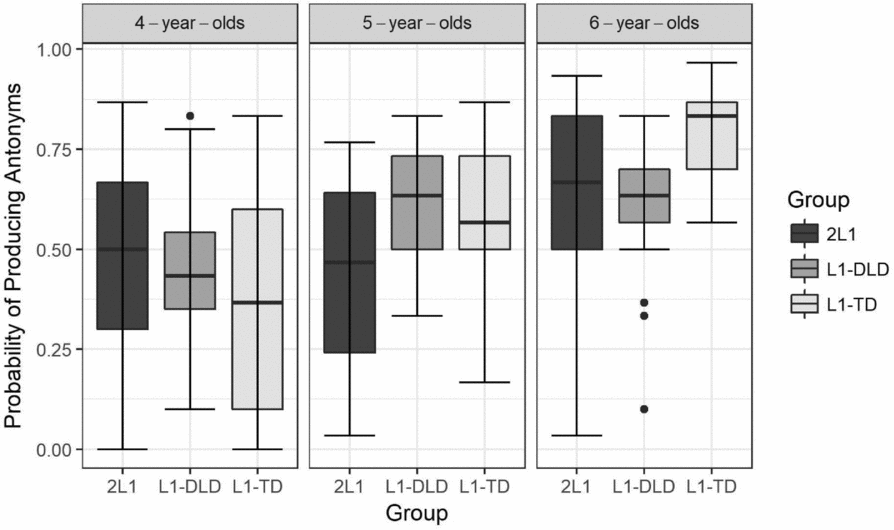
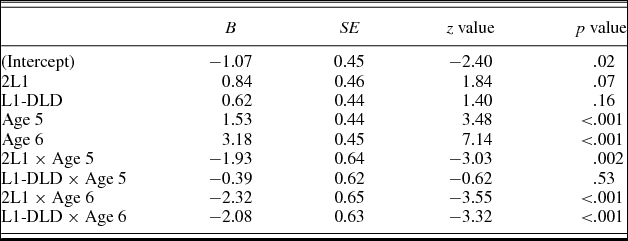
Figure 1 presents the probability of using lexical antonyms by group and age. The model coefficients are presented in Table 3.
Probability of using lexical antonyms, by group and age.
Coefficients of the comparisons between groups on the probability of using lexical antonyms
Note: 2L1, bilinguals. L1-DLD, monolinguals with developmental language disorder.
As can be seen in Table 3, at age 4 there were no significant differences between groups. Older L1-TD children (5- and 6-year-olds) produced more lexical antonyms than 4-year-olds. Significant interactions between 2L1 and age reveal that age differences in the probability of antonym use after age 4 were greater in the L1-TD group than in the 2L1 group. L1-DLD children did not differ from the L1-TD group in the pattern of antonym use at age 5, but showed a slower increase in the group of 6-year-olds.
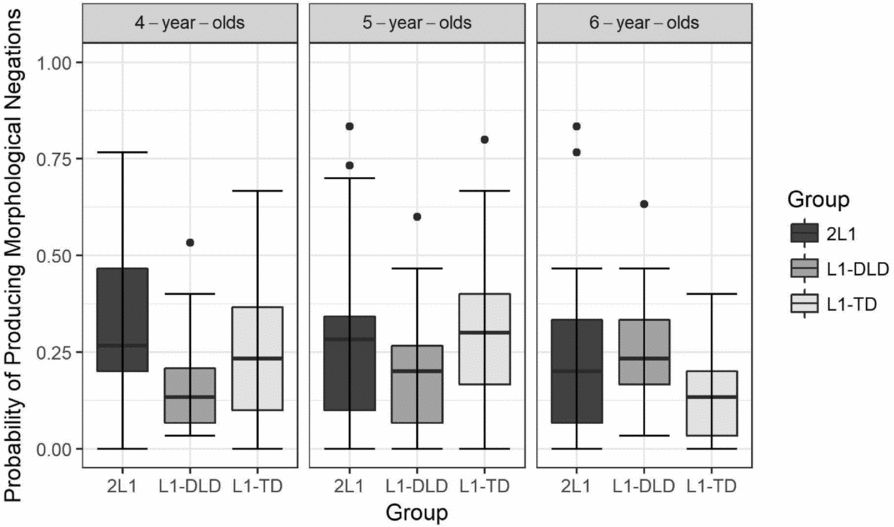
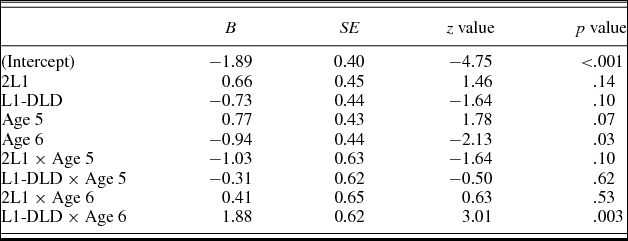
If children cannot produce a lexical antonym, they can use morphological negations as a compensatory strategy (see Figure 2). As can be seen in Table 4, at age 4 both 2L1 and L1-DLD children did not differ from L1-TD children in the probability of using morphological negations. Six-year-old L1-TD children used fewer morphological negations than L1-TD 4-year-olds. The decrease in the probability of the use of morphological negations after age 4 was similar in the 2L1 group. At age 6, L1-DLD children showed a relative increase in the probability of using morphological negations, as opposed to the decrease seen in the L1-TD group.
Probability of using morphological negations, by group and age.
Coefficients of the comparisons between groups on the probability of using morphological negations
Note: 2L1, bilinguals. L1-DLD, monolinguals with developmental language disorder.
Production of degree markers
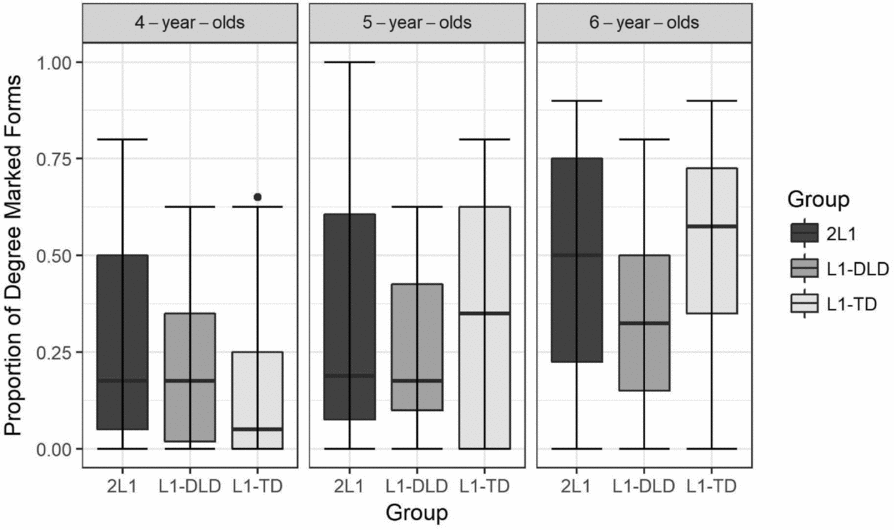
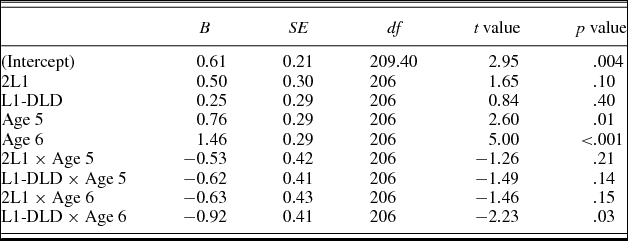
Figure 3 presents the proportion of degree-marked forms within the adjective sets, by group and age. As can be seen in Table 5, there were no differences between groups at age 4. Older L1-TD children produced more degree markers than L1-TD 4-year-olds. This difference was similar in 2L1 children, whereas the pattern in the L1-DLD group was different, as evidenced by the significant interaction at age 6. The increase in the use of degree markers in the L1-DLD group was smaller than in the L1-TD group.
Proportion of degree-marked forms, by group and age, per set (N = 4).
Coefficients of the comparisons between groups on the frequency of degree markers
Note: 2L1, bilinguals. L1-DLD, monolinguals with developmental language disorder.
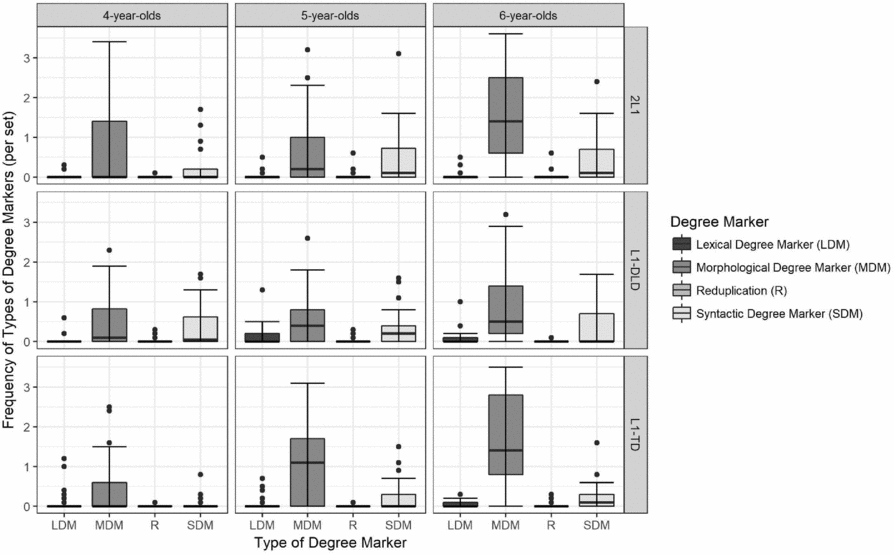
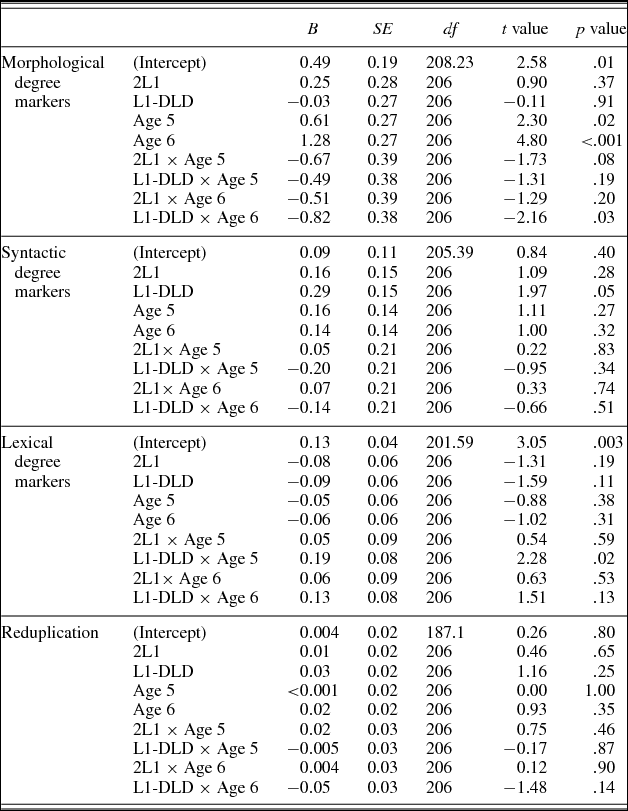
As far as frequencies of different types of degree markers are concerned, the analysis for morphological degree markers (comparatives, superlatives, suffixes, and prefixes) showed that there were no differences between 4-year-old L1-TD children and either 2L1 or L1-DLD children (see Figure 4 and Table 6). Five- and 6-year-old L1-TD children used more morphological degree markers than 4-year-old L1-TD children. This increase was similar in the 2L1 group. In contrast, age differences in the L1-DLD group were smaller, as evidenced by the significant interaction at age 6.
Frequencies of different types of degree markers, by group and age, per set (N = 4; both correct and incorrect markers included in this analysis).
Coefficients of the comparisons between groups on the frequencies of different types of degree markers
Note: 2L1, bilinguals. L1-DLD, monolinguals with developmental language disorder.
For the use of lexical degree markers, no difference between 2L1 and L1-DLD children and L1-TD children was found at age 4. For L1-TD children, there was no difference between age groups. The same pattern was found in 2L1 children. In contrast, in the L1-DLD group there was a relative increase in the use of lexical degree markers, as shown by the significant interaction at age 5 (but not at age 6).
Finally, there was no difference between 2L1 or L1-DLD children, and the L1-TD group at age 4 in the use of reduplication and syntactic degree markers. No difference in the use of reduplication and syntactic degree markers was found between age groups for L1-TD children. This was similar in 2L1 and L1-DLD children.
Error analysis
Antonym task
The probability of using correct antonyms was lower in the 2L1 group than in the L1-TD group (B = –0.63, SE = 0.28, z = –2.25, p = .02). L1-DLD children did not differ from L1-TD children in the probability of using correct antonyms (B = –0.27, SE = 0.27, z = –1.003, p = .32).
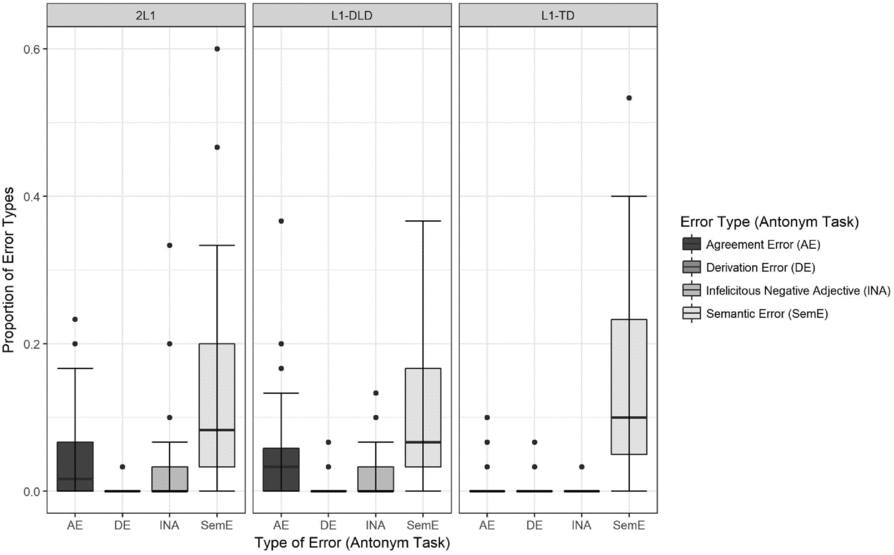
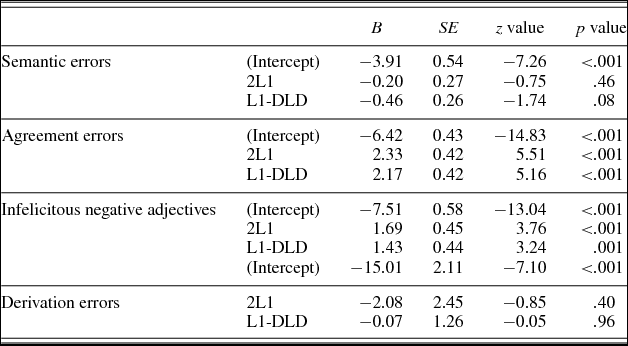
Figure 5 presents proportions of error types by group. Table 7 summarizes the parameter estimates for the probability of producing different error types. As shown in Table 7, there was no difference between L1-TD and 2L1/L1-DLD children in the probability of producing semantic errors or derivation errors. However, both 2L1 and L1-DLD children made more agreement errors and produced more infelicitous negative adjectives than the L1-TD group.
Proportions of error types on the antonym task, by group.
Parameter estimates for the probability of the production of semantic errors, agreement errors, infelicitous negative adjectives, and derivation errors (antonym task)
Note: 2L1, bilinguals. L1-DLD, monolinguals with developmental language disorder.
Degree task
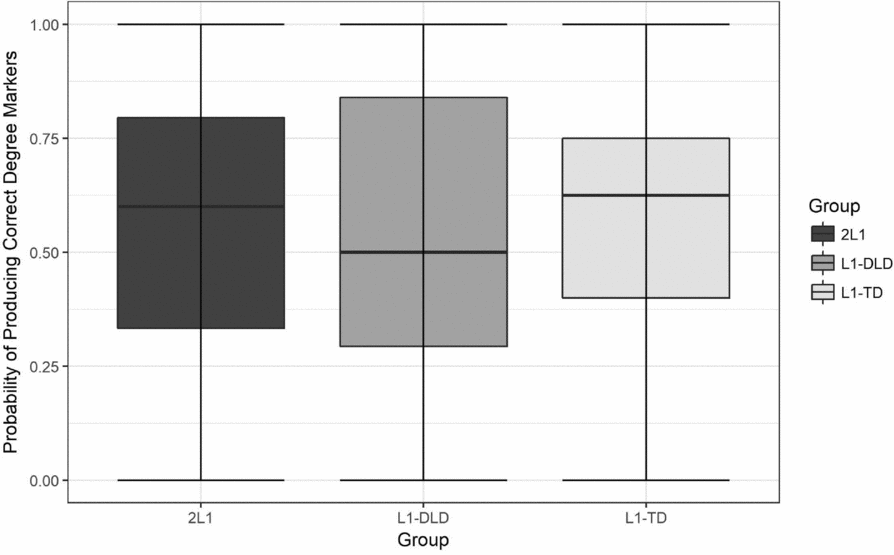
The probabilities of using correct degree markers are presented in Figure 6. The probability that children used correct degree markers did not differ between L1-TD and 2L1 children (B = –0.23, SE = 0.32, z = –0.72, p = .47). There was also no significant difference between L1-TD and L1-DLD children (B = −0.62, SE = 0.31, z = −1.95, p = .051).
Probability of using correct degree markers, by group, per set (N = 4).
The total error frequencies (including degree-marked and bare forms) did not differ between L1-TD and 2L1 children (B = 0.02, SE = 0.16, df = 212.00, t = 0.12, p = .90). Children in the L1-DLD group made significantly more errors than L1-TD children (B = 0.59, SE = 0.15, df = 212.00, t = 3.79, p < .001).
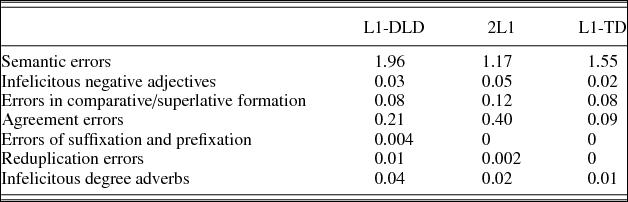
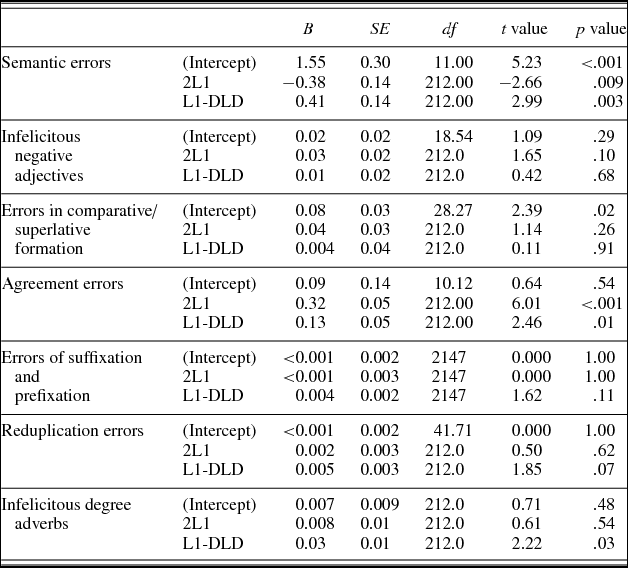
From the analyses for the different error types (see Tables 8 and 9), it can be concluded that there is no difference between L1-TD children, on the one hand, and 2L1 and L1-DLD children, on the other hand, for four out of seven error types (infelicitous negative adjectives, errors in comparative/superlative formation, errors of suffixation and prefixation, and reduplication errors). As far as semantic errors are concerned, 2L1 children outperformed L1-TD children, whereas L1-DLD children made more errors than L1-TD children. For agreement errors, both 2L1 and L1-DLD children made more errors than the L1-TD group. Finally, L1-DLD children made more errors with degree adverbs (e.g., očen' bol'še “very bigger”) than L1-TD children. 2L1 children did not differ from the L1-TD group in this respect.
Mean frequencies of different error types on the degree task, by group, per set (N = 4)
Note: L1-DLD, monolinguals with developmental language disorder. 2L1, bilinguals. L1-TD, typically developing monolinguals.
Coefficients of the comparisons between groups on the frequencies of different error types (degree task)
Note: 2L1, bilinguals. L1-DLD, monolinguals with developmental language disorder.
DISCUSSION
This study set out to compare the profiles of adjective use by monolingual Russian-speaking children with DLD and their bilingual peers acquiring Russian as a minority language in the dominant Dutch environment. The performance of both groups was compared to the baseline performance of age-matched TD monolingual children. Based on the processing theories of bilingualism and DLD, we predicted that reduced exposure (in bilingualism) and reduced intake (in DLD) may result in partly similar and partly different profiles of the two target groups. More specifically, we predicted that reduced exposure would have a greater impact on the size of adjective vocabularies (Hypothesis 1) and that reduced intake would negatively affect the acquisition of degree morphology (Hypothesis 2) and semantic properties of adjectives (Hypothesis 4). Finally, we expected that both bilinguals and monolinguals with DLD would make more adjective agreement errors than TD monolinguals (Hypothesis 3). In this section, we first discuss similarities and then differences between TD bilinguals and monolinguals with DLD.
Similarities between children with DLD and simultaneous bilinguals
As predicted, both bilinguals and monolinguals with DLD had difficulty with adjective agreement; based on the rate of (gender) agreement errors, we could not distinguish between the two groups. This result supports an earlier finding for L2 learners (Orgassa & Weerman, Reference Orgassa and Weerman2008) and extends it to simultaneous bilinguals. It is noteworthy that the trigger adjective in both tasks already modeled the correct agreement pattern; the same pattern was to be applied to the target adjectives. Even then bilinguals and children with DLD made adjective agreement errors. Nicoladis and Marchak (Reference Nicoladis and Marchak2011) used a similar task that modeled the target adjective form; and still, just like in our study, French–English bilinguals made more agreement errors than French-speaking monolinguals.
As explained above, the apparently similar errors may have different underlying causes in bilingualism and DLD. Even though we could not test this possibility based on the production data in this study, there is some indication in the literature that superficially similar errors may stem from two different sources. Earlier research has revealed that agreement errors in the speech of bilinguals are probably due to delays in the acquisition of noun gender, which is a lexical problem resulting from reduced exposure. Once bilingual children know the gender of the noun, they rarely make adjective agreement errors (Blom et al., Reference Blom, Polišenská and Weerman2008; Unsworth et al., Reference Unsworth, Argyri, Cornips, Hulk, Sorace and Tsimpli2014). In contrast, children with DLD seem to have more difficulty with the agreement process itself (e.g., Leonard et al., Reference Leonard, Salameh and Hansson2001; Roulet-Amiot & Jacubowcz, Reference Roulet-Amiot and Jacubowicz2006; Silveira, Reference Silveira2011).
We also predicted that the size of adjective vocabularies, operationalized here as performance on the antonym elicitation task, would be negatively affected by reduced input and, and to a lesser extent, by reduced intake. Regarding the effects of reduced input, there is a general consensus that a smaller vocabulary size is one of the most common consequences of reduced exposure in bilingualism. According to the processing account of DLD (Leonard, Reference Leonard2014), children with DLD should have more difficulty with inflectional morphemes than with content words (because the latter are more perceptually salient in the flow of speech), which means that adjective lexicons may be a relative strength in DLD. At the same time, the procedural learning deficit in DLD (Ullman & Pierpont, Reference Ullman and Pierpont2005) is likely to have a negative impact on word learning, as difficulties in statistical learning affect word-finding skills (Tomblin et al., Reference Tomblin, Mainela-Arnold and Zhang2007). Hence, we hypothesized that both bilinguals and children with DLD will perform worse than TD monolinguals on the antonym elicitation task, but monolinguals with DLD may still outperform bilinguals.
The results of the antonym task partly support this prediction. At age 4 there were no differences between the three groups in the rate of producing lexical antonyms. However, from age 5 onward, bilinguals lagged behind TD monolinguals. At age 4, Dutch–Russian bilinguals start primary school in their majority language (Dutch). From this age onward, their exposure to Russian becomes even more reduced and their proficiency in Dutch starts developing at a high pace. It is likely that the start of schooling in the majority language is an important factor in the vocabulary delay of the bilingual group observed at ages 5 and 6.
As predicted, the performance of the DLD group on the lexical task was below the baseline level of TD monolinguals, but only at age 6. Four- and 5-year-olds with DLD produced as many lexical antonyms as their TD monolingual peers. The delay in the DLD group was only found at age 6, that is, later than in the bilingual group, which supports our prediction that reduced exposure in bilingualism would have a greater impact on the development of adjective vocabularies than processing deficits in DLD.
The noteworthy finding that there were no differences between monolinguals with and without DLD at ages 4 and 5 replicates earlier research suggesting that in preschool and the early school years children with DLD may go through a phase of “illusionary recovery,” when they seem to catch up with their TD peers in relatively stable periods, but later fall behind again when confronted with increasingly complex language learning demands (see Nippold & Schwarz, Reference Nippold and Schwarz2002, for a review). This possibility is consistent with our finding that at age 6 (when children with DLD fall behind their TD peers in the production of lexical antonyms), they start using a compensatory strategy of producing more affixal opposites. In the same period, the rate of affixal opposites in the L1-TD group decreases, which might be an indicator of the next developmental stage: they start using more lexical antonyms. Hence, the DLD group seems to fall back in the phase when the L1-TD group goes through a new growth spurt in vocabulary development. However, in view of the cross-sectional data in this study, we cannot rule out the possibility that this pattern is due to individual differences between children in the three cohorts. A more rigorous longitudinal design would be needed to test the possibility of a temporary delay in the DLD group.
Another limitation of this study is that we only used an antonym elicitation task as a measure of adjective vocabularies. This means that we could not include adjectives that do not have lexical opposites. In addition, the task itself requires a certain degree of metalinguistic awareness and might therefore have been demanding for some children. Future research should consider using antonym elicitation tasks in tandem with other tasks assessing adjective vocabularies.
Differences between monolinguals with DLD and simultaneous bilinguals
This study has also revealed important differences between monolingual children with language impairment and simultaneous bilingual children. Two remarkable differences concern the rate of degree markers (morphological markers in particular) and the prevalence of semantic substitutions. These will be discussed in order.
Degree markers
As predicted, bilinguals did not differ from unimpaired monolinguals in the overall frequencies of degree markers and in the rate of acquisition, whereas monolinguals with DLD were more likely to use bare adjectives, without any form of degree marking. At age 6, L1-TD children marked adjectives for degree in half of the trials. At the same age, children with DLD marked adjectives for degree in only one third of the cases. This result replicates an earlier finding that Russian-speaking children with DLD use degree markers in 30% of cases at age 7 and reach the 50% level only between ages 9 and 10 (Tribushinina & Dubinkina, Reference Tribushinina and Dubinkina2012). As in the case of antonym production, the difference in the rate of degree marking only emerged in the group of 6-year-olds. At ages 4 and 5 there were no differences between groups, but between 5 and 6 years of age the growth was slower in the DLD group. This is again consistent with the idea of a period of illusionary recovery in the preschool years, after which 6-year-olds seem to fall back on both grammar and vocabulary (Nippold & Schwarz, Reference Nippold and Schwarz2002). This happens when TD monolinguals feature a growth spurt in their vocabulary and grammar (Tribushinina, Reference Tribushinina, Köhnlein and Audring2015). Yet again, future research using a longitudinal setup is warranted to test this conclusion in a more rigorous way.
As far as types of degree markers are concerned, we hypothesized that children with DLD would underuse morphological means of degree marking (due to their problems with inflectional morphology) and overrely on noninflectional degree markers (lexical markers, syntactic markers, and reduplication). This hypothesis has only partly been confirmed. The lower frequencies of degree markers in the DLD group are due to the underuse of morphological degree markers. This finding is consistent with the processing account of DLD (Leonard, Reference Leonard2014) and with the declarative/procedural model (Ullman & Pierpont, Reference Ullman and Pierpont2005), both positing that inflectional morphology is an area of particular difficulty in DLD. Further, in line with Hypothesis 2, the DLD group used more lexical degree markers (but only at age 5). However, contrary to our predictions, the DLD group did not overrely on syntactic degree markers (degree adverbs) or adjective reduplication at any of the ages studied.
Overall, the results of the degree task support the claim that errors of omission are more likely in DLD than in bilingualism (Armon-Lotem & Walters, Reference Armon-Lotem, Walters, Guendouzi, Loncke and Williams2010). In cases where omission is not possible (as in adjective–noun agreement in Russian, where bare forms are impossible), the two groups show very similar error profiles. However, in cases where children may choose between a bare form and an inflected form (e.g., positive vs. comparative adjectives), children with DLD more often use the bare (positive) form. It is possible that these children are aware of their difficulties with inflectional morphology and tend to select a “safer” option (bare form or lexical degree marker).
Given the complexity of the target system, it is remarkable that Dutch–Russian bilinguals with little exposure to Russian perform as well as their TD monolingual peers, as evidenced by the comparable rates of degree marking and similar error rates. As explained earlier, the acquisition of degree markers by Dutch–Russian bilinguals might be facilitated by their knowledge of Dutch. The Dutch system of degree markers is much more uniform; there are only two frequently used types of degree markers: comparative/superlative forms (suffixes –er and −st or analytical forms with meer/meest “more/most”) and degree adverbs (e.g., heel “very” and helemaal “completely”). Tribushinina (Reference Tribushinina, Köhnlein and Audring2015) compared production of degree markers by monolingual children acquiring Dutch and Russian and concluded that the Dutch system is acquired much faster. Dutch-speaking children have fewer degree-marking devices at their disposal, but start using degree markers earlier and at higher rates. Russian-speaking children have a much wider inventory to learn, but tend to use more unmarked adjective forms; they only catch up with their Dutch-speaking peers in the rate of degree marking by age 6.
The fact that the bilingual participants in this study also speak a language where children are used to marking degree at higher rates at a younger age may encourage them to look for means of expressing degree in the other language as well. It appears that reduced exposure to Russian is in this case compensated by bilingual bootstrapping from the children's other language. Similar manifestations of bilingual bootstrapping have been reported for the acquisition of auxiliaries (Gawlitzek-Maiwald & Tracy, Reference Gawlitzek-Maiwald and Tracy1996), prepositions (Armon-Lotem, Reference Armon-Lotem2010), and grammatical gender (Cornips & Hulk, Reference Cornips, Hulk, Lefebvre, White and Jourdan2006).
It should be noted that the degree task was designed in such a way that the participants could choose a form they felt most comfortable with. It could be a bare form or any kind of degree marking. The analysis of the proportions of adequately chosen degree markers revealed no differences between groups. However, this setup enabled us to trace preferences that are indicative of unique profiles of bilingual children and L1-DLD children compared to L1-TD children. The current experiment has demonstrated that children with DLD are less likely to choose morphological degree markers and overrely on lexical degree expressions instead. This design has also allowed us to test the prediction that, whenever possible, children with DLD will overuse bare forms, such as the positive degree form for adjectives. A possible disadvantage of this setup is that it does not allow us to study production of specific degree markers, such as comparatives or boosters. In order to compare the production of these specific types of degree markers, we would need an experiment designed in a more restricted way that would elicit only one type of degree markers. However, given the complexity of the Russian system of degree marking, where several different forms may express the same degree meaning, designing such an experiment for Russian would be a challenging enterprise. One possible solution would be focusing on comprehension rather than production of various types of degree markers.
Semantic errors
A second noteworthy difference between bilinguals and monolinguals with DLD is the prevalence of semantic errors. These are errors such as substitution of the target adjective by an adjective denoting a different dimension (e.g., dlinnyj “long” instead of širokij “wide”), substitution by hyperonym (e.g., bol'soj “big” instead of tolstyj “thick”), antonym (e.g., korotkij “short” instead of dlinnyj “long”), or near-synonym that is infelicitous with reference to a particular referent category (e.g., xudoj “gaunt” instead of tonkij “thin” with reference to a tree trunk). Even though semantic substitutions constituted the most frequent error type across all groups, children with DLD made these errors significantly more often than their unimpaired peers.
The finding that children with DLD have difficulty acquiring subtle semantic distinctions is not new (cf. Alt & Plante, Reference Alt and Plante2006; Andreau et al., Reference Andreau, Sanz-Torrent, Olmos and MacWhinney2011; McGregor & Appel, Reference McGregor and Appel2002; Sheng & McGregor, Reference Sheng and McGregor2010; Tribushinina & Dubinkina, Reference Tribushinina and Dubinkina2012; Tribushinina et al., Reference Tribushinina, Mak, Andreiushina, Dubinkina and Sanders2017). Processing limitations in DLD affect the amount and quality of linguistic information stored, and therefore result in poorer semantic representations. A novel finding yielded by the present study is that bilingual children with very limited exposure to and almost no schooling in Russian did not differ from the unimpaired monolinguals in the frequency of semantic substitutions (on the antonym task). On the degree task, the bilinguals even outperformed their TD monolingual peers. As explained at the outset of this paper, this relative strength of bilinguals in the domain of adjective semantics might be related to bilingual advantage in selective attention and inhibition, which play a key role in the acquisition of adjective semantics (Yoshida et al., Reference Yoshida, Tran, Benitez and Kuwabara2011). Bilingual children tend to have smaller vocabularies, especially when it comes to their weaker language. However, they may have cognitive advantages facilitating the acquisition of adjective meanings and creating solid semantic representations in their mental lexicon. As explained above, in order to map the adjective onto its meaning, the child has to inhibit the whole-object preference and focus selectively on properties. Furthermore, an adjective learner should be able to select the target property out of a whole range of properties in an object. It is then no wonder that enhanced selective attention and inhibitory control of bilingual children may play a facilitative role in the process of adjective acquisition. Bilinguals may be outperformed by monolinguals in vocabulary width, but not necessarily in vocabulary depth. Even though this interpretation of the results is compatible with the results reported by Yoshida et al. (Reference Yoshida, Tran, Benitez and Kuwabara2011), this possibility should be verified in a study where the ratio of semantic errors would be directly correlated with inhibitory control and selective attention. Alternatively, it is possible that the acquisition of semantic relations between adjectives was facilitated by the presence of similar distinctions in the majority language of the bilingual participants.
A result that seems to contradict the semantic advantage of bilingual children is the finding that bilinguals, like monolinguals with DLD, produced more infelicitous negative adjectives than TD monolinguals (on the antonym task). More specifically, they formed negative adjectives that are either impossible or rather odd in Russian, such as affixal negations of negative-pole dimensional terms (e.g., nekorotkij “not low”). As explained above, affixal negations of negative-pole adjectives are not entirely impossible, but their use is restricted by a number of discourse-semantic constraints. Apparently, bilingual preschoolers have not yet acquired the semantic and stylistic constraints for affixal negation. What is more, these semantic distinctions are not relevant in their majority language, as Dutch does not allow morphological negations of dimensional adjectives at all. Therefore, in this case, bilingual bootstrapping cannot work as a compensatory mechanism in the way that it seems to work in the acquisition of degree markers and paradigmatic semantic relations.
Conclusion
This study set out to determine unique and shared features of adjective use by Dutch–Russian bilinguals (dominant in Dutch) and Russian monolinguals with and without DLD. The main aim of this investigation was to pinpoint possible areas of strength that would distinguish bilinguals from monolinguals with DLD. Children with DLD and simultaneous bilinguals with little exposure to Russian shared several areas of difficulty. Both groups made significantly more adjective agreement errors and produced more infelicitous morphological negations than unimpaired monolingual children. Furthermore, both groups displayed a slower growth of adjective vocabularies compared to the TD monolingual group. This result indicates that both groups have smaller adjective vocabularies, the bilingual group due to reduced input in Russian and the DLD group due to reduced intake as a result of processing deficits. Reduced input in bilingualism appears to affect adjective vocabularies earlier than reduced intake in DLD.
This study has also identified two areas in which bilinguals perform similarly to unimpaired monolinguals and outperform the DLD group. First, Dutch–Russian bilinguals and TD monolinguals produce morphological degree markers at similar rates, whereas monolinguals with DLD avoid using morphological degree markers and overuse bare forms and lexical degree markers instead. Second, children with DLD make significantly more errors of semantic substitution, whereas bilinguals perform even better than TD monolinguals. Bilinguals know fewer adjectives, but their semantic representations are intact. We have tentatively proposed that bilingual advantage in inhibitory control may serve as a compensatory mechanism in the acquisition of adjective vocabularies by bilingual children with little exposure and limited schooling in the minority language. It is also possible that their advantage in the production of degree markers and acquisition of semantic relations is related to the mechanisms of bilingual bootstrapping: the acquisition of these categories in the minority language is facilitated by the acquisition of the same or similar categories in the majority language.
ACKNOWLEDGMENTS
We are very grateful to the anonymous reviewers and the associate editor for their helpful comments on the earlier versions of the manuscript. We also would like to thank all children, parents, and teachers who have participated in this study. Viktorija Golovkina kindly helped with data collection in Saint Petersburg and Elizaveta Andreiushina with data coding. This research was supported by Marie Curie International Research Staff Exchange Scheme Fellowship Grant 269173 within the 7th European Community Framework Programme and by the Netherlands Organization for Scientific Research Grant 275-70-029 (to E.T.).



