





1 Introduction
In this paper we will study three topics: T-duality for torus actions with fixed points, blow-ups of elliptic divisors and will apply those two to the study of generalized complex structures. While each one of these has a life on its own, the interplay between them makes them all the more interesting.
1.1 T-duality
T-duality is an equivalence between quantum field theories with very different properties. Its origins trace back to a paper by Sathiapalan [Reference Sathiapalan23] where it was noted that different compactifications with $S^1$
-symmetry were related by, among other things, inversion of the radius of the circles. This relation is frequently referred to as taking ‘dual circles’, ‘exchange of tangent and cotangent directions’ or ‘swap of winding and momentum’. The precise relationship between (local) T-dual Riemannian structures was first understood by Buscher in [Reference Buscher7] and was developed further by Roček and Verlinde in [Reference Roček and Verlinde22]. A global notion of T-duality was formulated in [Reference Bouwknegt, Evslin and Mathai3, Reference Bouwknegt, Hannabuss and Mathai4] as an equivalence between principal torus bundles. In [Reference Cavalcanti and Gualtieri8] it was observed that T-duality can be understood as an isomorphism of Courant algebroids, therefore formalizing the operation ‘exchange of tangent and cotangent directions’ and allowing for a systematic transport of geometric structures between T-dual spaces. Because this well established notion of T-duality only holds for principal torus bundles, we refer to it as principal T-duality.
$S^1$
-symmetry were related by, among other things, inversion of the radius of the circles. This relation is frequently referred to as taking ‘dual circles’, ‘exchange of tangent and cotangent directions’ or ‘swap of winding and momentum’. The precise relationship between (local) T-dual Riemannian structures was first understood by Buscher in [Reference Buscher7] and was developed further by Roček and Verlinde in [Reference Roček and Verlinde22]. A global notion of T-duality was formulated in [Reference Bouwknegt, Evslin and Mathai3, Reference Bouwknegt, Hannabuss and Mathai4] as an equivalence between principal torus bundles. In [Reference Cavalcanti and Gualtieri8] it was observed that T-duality can be understood as an isomorphism of Courant algebroids, therefore formalizing the operation ‘exchange of tangent and cotangent directions’ and allowing for a systematic transport of geometric structures between T-dual spaces. Because this well established notion of T-duality only holds for principal torus bundles, we refer to it as principal T-duality.
Once we move away from principal circle bundles and start considering circle actions with fixed points problems quickly pop up. Namely, the inversion of radii, a hallmark of T-duality, implies that every fixed point on one side is matched by an open end of a manifold on the T-dual side. Performing T-duality this way amounts to removing the fixed points and only considering the resulting open manifold where the action is free. For example, taking the 2-sphere with rotation along the z-axis, the dual becomes an open cylinder with an incomplete metric. Versions of this phenomenon appear in several different places, most notably, when trying to produce SYZ-mirrors of Fano varieties [Reference Auroux, Katzarkov and Orlov1, Reference Gross, Hacking and Keel13, Reference Hori and Vafa16]. Further, the strategy of ‘simply ignore fixed points’ may leave one with the impression that we are missing important behaviour that takes place ‘at infinity’.
More elaborate strategies that involve the geometry and nature of the fixed point set were considered by Bunke and Schick for actions with finite isotropy groups [Reference Bunke and Schick6], Mathai and Wu for general circle actions [Reference Mathai and Wu17] and further extended by Pande [Reference Pande21]. In all of these cases, topological results associated to T-duality were re-obtained, but the candidate for T-dual is often a singular space (orbi-spaces, stratified singular spaces or stacks). The issue of transfer of geometric structures (instead of topological) between T-dual spaces is not addressed because the techniques used are topological in nature and the candidate ‘true’ T-dual space may even have higher dimension than the original one.
The main goal of the current article is to develop a new, genuinely different, framework for T-duality, with the following properties:
-
○ allows for torus actions which locally decompose as standard rotations of the plane (we call such actions standard, see Definition 3.11),
-
○ is a duality between smooth spaces,
-
○ transports invariant geometric structures compatible with the torus action,
-
○ has the usual properties of T-duality such as isomorphism of twisted cohomology and Courant algebroids.
The new input that allows us to study these actions without compromising on compactness or smoothness of the T-dual are elliptic divisors and elliptic tangent bundles. An elliptic divisor is an ideal, $I_{\left | D \right |}$
, of smooth functions, and the elliptic tangent bundle is a Lie algebroid associated to an elliptic divisor. Standard torus actions have natural elliptic divisors associated to them and the key new insight is that the infinitesimal action behaves as a free action from the perspective of the corresponding elliptic tangent bundle.
$I_{\left | D \right |}$
, of smooth functions, and the elliptic tangent bundle is a Lie algebroid associated to an elliptic divisor. Standard torus actions have natural elliptic divisors associated to them and the key new insight is that the infinitesimal action behaves as a free action from the perspective of the corresponding elliptic tangent bundle.
As with principal T-duality, T-duality for these actions (Definition 5.6) will provide an isomorphism of Courant algebroids, but now using the elliptic tangent bundle:
Theorem 5.13. Let $M,\hat {M}$
be manifolds with standard
$M,\hat {M}$
be manifolds with standard $T^k$
actions and let
$T^k$
actions and let $\mathcal {A}_{\left | D \right |} \rightarrow M, \mathcal {A}_{\left | \hat {D} \right |} \rightarrow \hat {M}$
denote the induced elliptic tangent bundles. Let
$\mathcal {A}_{\left | D \right |} \rightarrow M, \mathcal {A}_{\left | \hat {D} \right |} \rightarrow \hat {M}$
denote the induced elliptic tangent bundles. Let $H \in \Omega ^3_{T^k}(\mathcal {A}_{\left | D \right |}),\hat {H} \in \Omega ^3_{T^k}(\mathcal {A}_{\left | \hat {D} \right |})$
be closed invariant forms. If
$H \in \Omega ^3_{T^k}(\mathcal {A}_{\left | D \right |}),\hat {H} \in \Omega ^3_{T^k}(\mathcal {A}_{\left | \hat {D} \right |})$
be closed invariant forms. If $(M,H)$
and
$(M,H)$
and $(\hat {M},\hat {H})$
are T-dual then there exists an isomorphism of Courant algebroids:
$(\hat {M},\hat {H})$
are T-dual then there exists an isomorphism of Courant algebroids:
 $$ \begin{align} (\mathcal{A}_{\left| D \right|}\oplus \mathcal{A}_{\left| D \right|}^*)/T^k \overset{\simeq}{\longrightarrow} (\mathcal{A}_{\left| \hat{D} \right|} \oplus \mathcal{A}_{\left| \hat{D} \right|}^*)/T^k. \end{align} $$
This isomorphism of Courant algebroids allows us to transport geometric structures which are invariant under the torus action between on $\mathcal {A}_{\left | D \right |}$
over M and
$\mathcal {A}_{\left | D \right |}$
over M and $\mathcal {A}_{\left | \hat {D} \right |}$
over
$\mathcal {A}_{\left | \hat {D} \right |}$
over $\hat {M}$
. As we will see later, this has implications for T-duality of complex manifolds as well as further special classes of generalized complex manifolds.
$\hat {M}$
. As we will see later, this has implications for T-duality of complex manifolds as well as further special classes of generalized complex manifolds.
Already in the case of principal torus bundles, T-duals may not exist [Reference Bouwknegt, Hannabuss and Mathai4]. In that case, the proof of existence is constructive and involves choices of connections and a switch between the Chern class of the torus bundle with a collection of cohomology classes determined by the background 3-form. To carry out a similar construction of T-duals for torus actions with fixed points, one first needs to develop the theory of connections and curvature for those actions.
1.1.1 Torus actions and connections
An integral part of this paper is the classification of torus actions on manifolds. For principal torus actions, the relevant datum is its characteristic class. For general torus actions, this question is studied by Haefliger and Salem in [Reference Haefliger and Salem15]. They show that the action is classified by its local model and a class in $\check {H}^2(M;\mathbb {Z}^k)$
. The class in
$\check {H}^2(M;\mathbb {Z}^k)$
. The class in $\check {H}^2(M;\mathbb {Z}^k)$
has a geometric interpretation: it is the obstruction to finding a global cross-section for the quotient map
$\check {H}^2(M;\mathbb {Z}^k)$
has a geometric interpretation: it is the obstruction to finding a global cross-section for the quotient map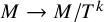 $M \to M/T^k$
.
$M \to M/T^k$
.
Although the class of [Reference Haefliger and Salem15] resembles a Chern class, no connection approach exists. In this article we will show that one may use the elliptic tangent bundle to give a definition of connections for standard $T^k$
-actions. The curvature of these connections then induces the class of Haefliger-Salem in the following way (see Proposition 3.24 for a precise statement):
$T^k$
-actions. The curvature of these connections then induces the class of Haefliger-Salem in the following way (see Proposition 3.24 for a precise statement):
Proposition. Let $M, M'$
be manifolds endowed with standard
$M, M'$
be manifolds endowed with standard $T^k$
-actions and common orbits space B for which the torus actions are locally equivalent. Let
$T^k$
-actions and common orbits space B for which the torus actions are locally equivalent. Let $\Theta ,\Theta '$
be elliptic connection one-forms on M respectively
$\Theta ,\Theta '$
be elliptic connection one-forms on M respectively $M'$
. Then the class
$M'$
. Then the class $[d\Theta -d\Theta '] \in H^2(A_{\partial B};\mathfrak {t}^k)$
(the logarithmic cohomology of the base with values in the Lie algebra of
$[d\Theta -d\Theta '] \in H^2(A_{\partial B};\mathfrak {t}^k)$
(the logarithmic cohomology of the base with values in the Lie algebra of $T^k$
) is representable by a smooth form, and descends to the Haefliger-Salem class of
$T^k$
) is representable by a smooth form, and descends to the Haefliger-Salem class of $M'$
in
$M'$
in $\check {H}^2(B;\mathfrak {t}^k)$
.
$\check {H}^2(B;\mathfrak {t}^k)$
.
With the notions of connection and curvature at hand we can move on to produce a construction of a T-duals, therefore establishing conditions that ensure their existence (c.f. Theorem 5.8). The T-dual we construct has a $T^k$
-action which is locally equivalent to the original one. Yet we also observe that there are other T-duals to
$T^k$
-action which is locally equivalent to the original one. Yet we also observe that there are other T-duals to $(M,H)$
which do not satisfy this property, hence the fixed point set gives rise to a new source of non-uniqueness of T-duals.
$(M,H)$
which do not satisfy this property, hence the fixed point set gives rise to a new source of non-uniqueness of T-duals.
1.2 Blow-ups
Blow-ups come from complex/algebraic geometry as a method to resolve singularities, but have encountered applications in the study other geometric structures specially as a way to construct new examples [Reference McDuff18, Reference Fino and Tomassini12, Reference Bailey, Cavalcanti and Duran2].
The minimum amount of data needed to construct canonically the blow-up of a space at a point is a holomorphic ideal for that point [Reference Bailey, Cavalcanti and Duran2]. As it is, holomorphic ideals, $\mathcal {I}_D$
, are the heart and soul of complex log tangent bundles. Further, there is a close connection between complex log and elliptic tangent bundles: complex log tangent bundles are in correspondence with elliptic tangent bundles together with coorientations [Reference Cavalcanti and Gualtieri9]. So, after a finite set of choices, there is a canonical blow-up construction for manifolds with elliptic divisors. Not only that but the blow-up itself inherits canonically an elliptic divisor and in many ways the blow-up manifold is indistinguishable from the original one (see Theorem 6.9 for a precise statement).
$\mathcal {I}_D$
, are the heart and soul of complex log tangent bundles. Further, there is a close connection between complex log and elliptic tangent bundles: complex log tangent bundles are in correspondence with elliptic tangent bundles together with coorientations [Reference Cavalcanti and Gualtieri9]. So, after a finite set of choices, there is a canonical blow-up construction for manifolds with elliptic divisors. Not only that but the blow-up itself inherits canonically an elliptic divisor and in many ways the blow-up manifold is indistinguishable from the original one (see Theorem 6.9 for a precise statement).
Theorem. Let $I_{\left | D \right |}$
be an elliptic divisor, and let
$I_{\left | D \right |}$
be an elliptic divisor, and let $\mathcal {A}_{\left | D \right |}$
be the associated elliptic tangent bundle. Let
$\mathcal {A}_{\left | D \right |}$
be the associated elliptic tangent bundle. Let $Y \subset D$
be a submanifold compatible with D in a suitable sense. Then after a choice of coorientations there is a canonical blow-up
$Y \subset D$
be a submanifold compatible with D in a suitable sense. Then after a choice of coorientations there is a canonical blow-up $\tilde {M}$
of M along Y and there exists a natural elliptic divisor
$\tilde {M}$
of M along Y and there exists a natural elliptic divisor $I_{\left | \tilde {D} \right |}$
on
$I_{\left | \tilde {D} \right |}$
on $\tilde {M}$
such that the blow-down map
$\tilde {M}$
such that the blow-down map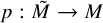 $p : \tilde {M} \rightarrow M$
provides a Lie algebroid submersion
$p : \tilde {M} \rightarrow M$
provides a Lie algebroid submersion
 $$ \begin{align*} p : \mathcal{A}_{\left| \tilde{D} \right|} \rightarrow \mathcal{A}_{\left| D \right|}. \end{align*} $$
This means in particular that any structure on $\mathcal {A}_{|D|}$
can be pulled back to
$\mathcal {A}_{|D|}$
can be pulled back to $\tilde {\mathcal {A}}_{|\tilde {D}|}$
.
$\tilde {\mathcal {A}}_{|\tilde {D}|}$
.
When M comes equipped with a torus action and $Y = \lbrace * \rbrace $
is a fixed point of this action, the blow-up
$Y = \lbrace * \rbrace $
is a fixed point of this action, the blow-up $\tilde {M}$
naturally inherits a torus action and we can compare the constructions of T-duality and blow-up:
$\tilde {M}$
naturally inherits a torus action and we can compare the constructions of T-duality and blow-up:
Proposition 6.15. T-duality and blowing up commute.
This procedure will allow us to construct many examples of T-dual manifolds and transport geometric structures between them.
1.3 Generalized complex structures
As an illustration of how to transport structures between T-dual spaces, we will study how generalized complex structures behave in this framework. The easy result here is that Theorem 5.13 allows us to transport invariant structures between $\mathcal {A}_{\left | D \right |}\oplus \mathcal {A}_{\left | D \right |}^*$
and
$\mathcal {A}_{\left | D \right |}\oplus \mathcal {A}_{\left | D \right |}^*$
and $\mathcal {A}_{\left | \hat {D} \right |}\oplus \mathcal {A}_{\left | \hat {D} \right |}^*$
, which is directly analogous to what happens with principal T-duality. The new insight here is that this transport in some cases may happen in disguise and associated to a lifting question.
$\mathcal {A}_{\left | \hat {D} \right |}\oplus \mathcal {A}_{\left | \hat {D} \right |}^*$
, which is directly analogous to what happens with principal T-duality. The new insight here is that this transport in some cases may happen in disguise and associated to a lifting question.
One interesting phenomenon we encounter is the following: Given a manifold with elliptic divisor $(M,\mathcal {I}_{|D|})$
and a generalized complex structure
$(M,\mathcal {I}_{|D|})$
and a generalized complex structure $\mathcal {J}$
on M, under favourable conditions we can lift
$\mathcal {J}$
on M, under favourable conditions we can lift $\mathcal {J}$
canonically to a generalized complex structure
$\mathcal {J}$
canonically to a generalized complex structure $\mathcal {J}_{\mathcal {A}}$
on
$\mathcal {J}_{\mathcal {A}}$
on $\mathcal {A}_{\left | D \right |}$
. In some cases, this switch can be subtle enough that goes unnoticed. For example, if
$\mathcal {A}_{\left | D \right |}$
. In some cases, this switch can be subtle enough that goes unnoticed. For example, if $(M,I)$
is a complex manifold and
$(M,I)$
is a complex manifold and $\mathcal {I}_{|D|}$
is the elliptic divisor associated to a complex hypersurface
$\mathcal {I}_{|D|}$
is the elliptic divisor associated to a complex hypersurface $D \subset M$
, then I lifts to a complex structure on
$D \subset M$
, then I lifts to a complex structure on $\mathcal {A}_{\left | D \right |}$
. At the other extreme, the type of structure that lifts to a symplectic structure on the elliptic tangent bundle is a stable generalized complex structure on M [Reference Cavalcanti and Gualtieri9, Reference Cavalcanti, Klaasse and Witte10] and this switch is very visible because stable structures would normally be recognized as singular symplectic structures on M.
$\mathcal {A}_{\left | D \right |}$
. At the other extreme, the type of structure that lifts to a symplectic structure on the elliptic tangent bundle is a stable generalized complex structure on M [Reference Cavalcanti and Gualtieri9, Reference Cavalcanti, Klaasse and Witte10] and this switch is very visible because stable structures would normally be recognized as singular symplectic structures on M.
Pairing this remark with the framework we developed for T-duality, we produce examples with the following characteristics: we look for a manifold with a torus action compatible elliptic divisor $(M,\mathcal {I}_{|D|})$
together with a generalized complex structure
$(M,\mathcal {I}_{|D|})$
together with a generalized complex structure $\mathcal {J}$
on M such that
$\mathcal {J}$
on M such that $\mathcal {J}$
lifts to a generalized complex structure,
$\mathcal {J}$
lifts to a generalized complex structure, $\mathcal {J}_{\mathcal {A}_{\left | D \right |}}$
on
$\mathcal {J}_{\mathcal {A}_{\left | D \right |}}$
on $\mathcal {A}_{\left | D \right |}$
. We then transport
$\mathcal {A}_{\left | D \right |}$
. We then transport $\mathcal {J}_{\mathcal {A}_{\left | D \right |}}$
to a generalized complex structure
$\mathcal {J}_{\mathcal {A}_{\left | D \right |}}$
to a generalized complex structure $\hat {\mathcal {J}}_{\mathcal {A}_{\left | D \right |}}$
on
$\hat {\mathcal {J}}_{\mathcal {A}_{\left | D \right |}}$
on $\mathcal {A}_{\left | \hat {D} \right |}$
via T-duality and study when
$\mathcal {A}_{\left | \hat {D} \right |}$
via T-duality and study when $\hat {\mathcal {J}}_{\mathcal {A}_{\left | D \right |}}$
is itself a lift of a generalized complex structure
$\hat {\mathcal {J}}_{\mathcal {A}_{\left | D \right |}}$
is itself a lift of a generalized complex structure $\hat {\mathcal {J}}$
on
$\hat {\mathcal {J}}$
on $\hat {M}$
. When this happens, it makes sense to call
$\hat {M}$
. When this happens, it makes sense to call $\hat {\mathcal {J}}$
the structure T-dual to
$\hat {\mathcal {J}}$
the structure T-dual to $\mathcal {J}$
. We also notice that the condition that a structure can be lifted to
$\mathcal {J}$
. We also notice that the condition that a structure can be lifted to $\mathcal {A}_{\left | D \right |}$
is a very restrictive one and therefore examples satisfying all the hypotheses above are rare. Yet, once one example is found, we can use the theory of blow-ups within generalized complex geometry [Reference Bailey, Cavalcanti and Duran2] to produce infinite families of T-dual structures satisfying the lifting conditions described above.
$\mathcal {A}_{\left | D \right |}$
is a very restrictive one and therefore examples satisfying all the hypotheses above are rare. Yet, once one example is found, we can use the theory of blow-ups within generalized complex geometry [Reference Bailey, Cavalcanti and Duran2] to produce infinite families of T-dual structures satisfying the lifting conditions described above.
Stable generalized complex structures can be viewed as symplectic structures on $\mathcal {A}_{\left | D \right |}$
, and can hence be transported in this manner. There is however an intriguing difference with T-duality for principal torus actions: A generalized complex structure on M which lifts to
$\mathcal {A}_{\left | D \right |}$
, and can hence be transported in this manner. There is however an intriguing difference with T-duality for principal torus actions: A generalized complex structure on M which lifts to $\mathcal {A}_{\left | D \right |}$
will always induce a generalized complex structure on the T-dual Lie algebroid
$\mathcal {A}_{\left | D \right |}$
will always induce a generalized complex structure on the T-dual Lie algebroid $\mathcal {A}_{\left | \hat {D} \right |} \rightarrow \hat {M}$
, however it might not induce a generalized complex structure on
$\mathcal {A}_{\left | \hat {D} \right |} \rightarrow \hat {M}$
, however it might not induce a generalized complex structure on $\hat {M}$
. We will, for instance, encounter complex structures on the elliptic tangent bundle on manifolds which are not almost complex.
$\hat {M}$
. We will, for instance, encounter complex structures on the elliptic tangent bundle on manifolds which are not almost complex.
1.4 Organization of the paper
This paper is organized as follows. In Section 2 we will recall the notions of elliptic divisors, and their associated Lie algebroids. Furthermore, we recall how stable generalized complex structures can be viewed as symplectic structures on Lie algebroids. More generally, we discuss lifting generalized complex structures to Lie algebroids. In Section 3 we recall the classification of torus actions by Haefliger-Salem. Afterwards we introduce the notion of a connection for a standard torus action, and show how these can be used to understand this classification. In Section 4 we study singular fibre products, which we will encounter in the description of T-duality. In Section 5 we introduce the notion of non-principal T-duality, using the Lie algebroids from Section 2. In Section 6 we show that the elliptic tangent bundle interacts very well with (generalized) complex blow-ups, and show that T-dualizing commutes with blowing-up. Finally, in Section 7 we discuss concrete examples.
2 Divisors and Lie algebroids; generalized complex structures and their lifts
As we mentioned in the introduction, the main objective of this paper is to extend T-duality to torus actions with fixed points without giving up on compactness of the spaces involved. The object that will allow us to accomplish this task are Lie algebroids, specifically Lie algebroids associated to divisors as introduced in [Reference Cavalcanti and Gualtieri9, Reference Cavalcanti, Klaasse and Witte10]. Not only will these allow us to lift torus actions, but also we will arrive at the very natural problem of lifting geometric structures from the underlying manifold to the Lie algebroid.
In this section, we take the first step towards our goal and recall the theory of divisors and Lie algebroids (for more details, see [Reference Cavalcanti and Gualtieri9, Reference Cavalcanti, Klaasse and Witte10]). We also introduce several relevant geometric structures, including generalized complex structures, and their lifts to these Lie algebroids.
To fix notation, we recall:
Definition 2.1. A Lie algebroid $A \rightarrow M$
consists of a vector bundle A over M, together with a Lie bracket
$A \rightarrow M$
consists of a vector bundle A over M, together with a Lie bracket $[\cdot ,\cdot ]$
on
$[\cdot ,\cdot ]$
on $\Gamma (\mathcal {A})$
, a vector bundle map
$\Gamma (\mathcal {A})$
, a vector bundle map $\rho : \mathcal {A} \rightarrow TM$
(called the anchor) such that the following Leibniz identity is satisfied:
$\rho : \mathcal {A} \rightarrow TM$
(called the anchor) such that the following Leibniz identity is satisfied:
 $$ \begin{align*} [v,fw] = f[v,w] + \mathcal{L}_{\rho(v)}(f)w, \quad \text{for all } v,w \in \Gamma(\mathcal{A}). \end{align*} $$
2.1 Divisors
Inspired by divisors in algebraic geometry, we will make use of the following notion to deal with singularities of geometric structures:
Definition 2.2. A real (resp. complex) divisor on M is a locally principal ideal $I \subset C^{\infty }(M;\mathbb {R} )$
(respectively
$I \subset C^{\infty }(M;\mathbb {R} )$
(respectively $C^{\infty }(M;\mathbb {C} ))$
which is locally generated by functions with a nowhere dense zero-set.
$C^{\infty }(M;\mathbb {C} ))$
which is locally generated by functions with a nowhere dense zero-set.
Definition 2.3. Let $(M,I_M)$
and
$(M,I_M)$
and $(N,I_N)$
be manifolds together with divisors. A smooth map
$(N,I_N)$
be manifolds together with divisors. A smooth map $\varphi : M \rightarrow N$
is a morphism of divisors if
$\varphi : M \rightarrow N$
is a morphism of divisors if $\varphi ^*I_N = I_M$
. It is said to be a diffeomorphism of divisors if
$\varphi ^*I_N = I_M$
. It is said to be a diffeomorphism of divisors if $\varphi $
is moreover a diffeomorphism.
$\varphi $
is moreover a diffeomorphism.
We will encounter three types of divisors in this article:
Definition 2.4. Let $M^n$
be a smooth manifold.
$M^n$
be a smooth manifold.
-
○ A real log divisor on M is a real divisor, $I_Z$
, such that for each
$p \in M$
there are coordinates
$(x_1,\ldots ,x_n)\colon U \to \mathbb {R} ^n$
centred at p and an integer k such that
$$ \begin{align*} I_Z|_U = \left\langle x_1\cdot \ldots \cdot x_k \right\rangle. \end{align*} $$
$I_Z$
, such that for each
$p \in M$
there are coordinates
$(x_1,\ldots ,x_n)\colon U \to \mathbb {R} ^n$
centred at p and an integer k such that
$$ \begin{align*} I_Z|_U = \left\langle x_1\cdot \ldots \cdot x_k \right\rangle. \end{align*} $$
-
○ A complex log divisor on M is a complex divisor
$I_D$
, such that for each
$p \in M$
there are coordinates
$(z_1,\ldots ,z_k,x_{2k+1},\ldots ,x_n)\colon U \to \mathbb {C} ^k \times \mathbb {R} ^{n-2k}$
centred at p such that
$$ \begin{align*} I_{D}|_U = \left\langle z_1\cdot \ldots \cdot z_k \right\rangle. \end{align*} $$
-
○ An elliptic divisor on M is a real divisor
$I_{\left | D \right |}$
, such that for each
$p \in M$
there are coordinates
$(x_1,\ldots ,x_n)\colon U \to \mathbb {R} ^n$
centred at p and an integer k such that with
$$ \begin{align*} I_{\left| D \right|}|_U = \left\langle r_1^2\cdot \ldots \cdot r_k^2 \right\rangle, \end{align*} $$
$r_i^2 = x_{2i-1}^2 + x_{2i}^2$
.








In these three cases, the number k is the multiplicity of p. The vanishing set of the ideal is called the vanishing locus. We call each of these divisors smooth if their vanishing locus is an embedded smooth submanifold, that is, if the multiplicity of each point is either $0$
or
$0$
or $1$
.
$1$
.
In general, the vanishing locus is only (the image of) an immersed submanifold with transverse intersections, and is naturally stratified by the multiplicity of its points. It is convenient to introduce some notation to refer to the different strata of the vanishing locus, so if we let, say, D, denote the vanishing locus of any of the divisors above, the set of points with multiplicity at least k will be denoted by $D(k)$
and the set of points with multiplicity precisely k will be denoted by
$D(k)$
and the set of points with multiplicity precisely k will be denoted by $D[k]$
. Each of the
$D[k]$
. Each of the $D(k)$
is itself an immersed submanifold, and hence we may speak of:
$D(k)$
is itself an immersed submanifold, and hence we may speak of:
Definition 2.5. Let $I_{\left | D \right |}$
be an elliptic divisor, and let
$I_{\left | D \right |}$
be an elliptic divisor, and let $\iota : N \rightarrow D(k)$
be an immersion. The image of a connected component of N is called an irreducible component of
$\iota : N \rightarrow D(k)$
be an immersion. The image of a connected component of N is called an irreducible component of $D(k)$
.
$D(k)$
.
Given a complex log divisor $I_D$
, one may consider its associated elliptic divisor defined by the condition
$I_D$
, one may consider its associated elliptic divisor defined by the condition $I_{\left | D \right |}\otimes \mathbb {C} = I_D \otimes \overline {I}_D$
. In this case,
$I_{\left | D \right |}\otimes \mathbb {C} = I_D \otimes \overline {I}_D$
. In this case, $D[1]$
is automatically co-oriented by the differential of any local generator of
$D[1]$
is automatically co-oriented by the differential of any local generator of $I_D$
. Conversely, given an elliptic divisor
$I_D$
. Conversely, given an elliptic divisor $I_{\left | D \right |}$
for which
$I_{\left | D \right |}$
for which $D[1]$
is co-oriented, there exists a unique complex log divisor
$D[1]$
is co-oriented, there exists a unique complex log divisor $I_{D}$
inducing
$I_{D}$
inducing $I_{\left | D \right |}$
and the given co-orientation.
$I_{\left | D \right |}$
and the given co-orientation.
2.2 Lie algebroids and residue maps
Using the Serre-Swann theorem, one may show that vector fields preserving the divisors from Definition 2.4 define vector bundles and the natural identification of sections of these vector bundles with vector fields makes these vector bundles into Lie algebroids:
Definition 2.6. Let M be a manifold, and $I_Z,I_D,I_{\left | D \right |}$
a real log, complex log, respectively elliptic divisor on M. Vector fields preserving these ideals define Lie algebroids:
$I_Z,I_D,I_{\left | D \right |}$
a real log, complex log, respectively elliptic divisor on M. Vector fields preserving these ideals define Lie algebroids:
-
○
$\mathcal {A}_Z \rightarrow TM$
, the real log-tangent bundle. -
○
$\mathcal {A}_D \rightarrow T_{\mathbb {C} }M$
, the complex log-tangent bundle. -
○
$\mathcal {A}_{\left | D \right |} \rightarrow TM$
, the elliptic tangent bundle.


As the divisors under consideration have local normal forms, so do have the associated Lie algebroids:
Remark 2.7. In the coordinates of Definition 2.4, we have:
-
○
$\Gamma (\mathcal {A}_Z) = \left \langle x_1\partial _{x_1},\ldots ,x_k\partial _{x_k},\partial _{x_{k+1}},\ldots ,\partial _{x_n} \right \rangle $
. -
○
$\Gamma (\mathcal {A}_D) = \left \langle z_1\partial _{z_1},\partial _{\overline {z}_1},\ldots ,z_k\partial _{z_k},\partial _{\overline {z}_k},\partial _{x_{2k+1}},\ldots ,\partial _{x_n} \right \rangle $
. -
○
$\Gamma (\mathcal {A}_{\left | D \right |}) = \left \langle r_1\partial _{r_1},\partial _{\theta _1},\ldots ,r_k\partial _{r_k},\partial _{\theta _k},\partial _{x_{2k+1}},\ldots ,\partial _{x_n} \right \rangle $
,



with $r_i\partial _{r_i} = x_{2i-1}\partial _{x_{2i-1}}+x_{2i}\partial _{x_{2i}}$
and
$r_i\partial _{r_i} = x_{2i-1}\partial _{x_{2i-1}}+x_{2i}\partial _{x_{2i}}$
and $\partial _{\theta _i} = x_{2i-1}\partial _{x_{2i}} - x_{2i}\partial _{x_{2i-1}}$
.
$\partial _{\theta _i} = x_{2i-1}\partial _{x_{2i}} - x_{2i}\partial _{x_{2i-1}}$
.
For each of the Lie algebroids above, we obtain a corresponding Lie algebroid de Rham complex on the exterior power of the dual vector bundle. The relation between complex and elliptic tangent bundles translates into the existence of maps between their corresponding de Rham complexes. Indeed, given a complex log divisor, $I_D$
, and associated elliptic divisor,
$I_D$
, and associated elliptic divisor, $I_{\left | D \right |}$
, taking the imaginary part of a complex log form is a map
$I_{\left | D \right |}$
, taking the imaginary part of a complex log form is a map $\Im ^* \colon (\Omega ^{\bullet }(\mathcal {A}_D),d_{\mathcal {A}_D}) \rightarrow (\Omega ^{\bullet }(\mathcal {A}_{\left | D \right |}),d_{\mathcal {A}_{\left | D \right |}})$
.
$\Im ^* \colon (\Omega ^{\bullet }(\mathcal {A}_D),d_{\mathcal {A}_D}) \rightarrow (\Omega ^{\bullet }(\mathcal {A}_{\left | D \right |}),d_{\mathcal {A}_{\left | D \right |}})$
.
There are several residue maps associated to these Lie algebroids, obtained by taking the coefficients of certain singular generators. We quickly recall the ones we need in this article. Given a smooth elliptic divisor, with D co-orientable, it is explained in [Reference Cavalcanti and Gualtieri9] that there are residue maps:
 $$ \begin{align*} \operatorname{\mathrm{Res}}_q : (\Omega^{\bullet}(\mathcal{A}_{\left| D \right|}),d_{\mathcal{A}_{\left| D \right|}}) \rightarrow (\Omega^{\bullet-2}(D),d), \qquad \alpha &\mapsto \iota_D^*(\iota_{r\partial_r\wedge\partial_{\theta}}\alpha)\\ \operatorname{\mathrm{Res}}_r : (\Omega^{\bullet}(\mathcal{A}_{\left| D \right|}),d_{\mathcal{A}_{\left| D \right|}}) \rightarrow (\Omega^{\bullet-1}(S^1ND),d), \qquad \alpha & \mapsto \iota_{r\partial_r}\alpha, \end{align*} $$
where for $\operatorname {\mathrm {Res}}_r$
,
$\operatorname {\mathrm {Res}}_r$
, $S^1ND$
is the sphere bundle of the normal bundle of D and the Lie algebroid 1-form dual to
$S^1ND$
is the sphere bundle of the normal bundle of D and the Lie algebroid 1-form dual to $\partial _\theta $
is interpreted as fiberwise volume form on the bundle
$\partial _\theta $
is interpreted as fiberwise volume form on the bundle $S^1ND \to D$
.
$S^1ND \to D$
.
Let $I_{\left | D \right |}$
be a general elliptic divisor with
$I_{\left | D \right |}$
be a general elliptic divisor with $D[1]$
co-orientable. The inclusion
$D[1]$
co-orientable. The inclusion $\iota _{M\backslash D(2)} : M\backslash D(2) \rightarrow M$
, pulls the elliptic divisor
$\iota _{M\backslash D(2)} : M\backslash D(2) \rightarrow M$
, pulls the elliptic divisor $I_{\left | D \right |}$
back to a smooth elliptic divisor with vanishing locus
$I_{\left | D \right |}$
back to a smooth elliptic divisor with vanishing locus $D[1]$
. Hence we may define residue maps by composition:
$D[1]$
. Hence we may define residue maps by composition:
 $$ \begin{align*} \operatorname{\mathrm{Res}}_q : \Omega^{\bullet}(\mathcal{A}_{\left| D \right|}) \rightarrow \Omega^{\bullet-2}(D[1]), \qquad \alpha &\mapsto \iota_{D[1]}^*(\iota_{r\partial_r\wedge\partial_{\theta}}(\iota_{M\backslash D(2)}^*\alpha))\\ \operatorname{\mathrm{Res}}_r : \Omega^{\bullet}(\mathcal{A}_{\left| D \right|}) \rightarrow \Omega^{\bullet-1}(S^1ND[1]), \qquad \alpha & \mapsto \iota_{r\partial_r}(\iota^*_{M\backslash D(2)}\alpha), \end{align*} $$
where $S^1ND[1]$
is the sphere bundle of the normal bundle of
$S^1ND[1]$
is the sphere bundle of the normal bundle of $D[1]$
. There exists several higher order residue maps, however defining these very quickly becomes a combinatorial task. As we are mainly interested in two-forms, we will define:
$D[1]$
. There exists several higher order residue maps, however defining these very quickly becomes a combinatorial task. As we are mainly interested in two-forms, we will define:
Definition 2.8. Let $I_{\left | D \right |}$
be an elliptic divisor,
$I_{\left | D \right |}$
be an elliptic divisor, $\omega \in \Omega ^2(\mathcal {A}_{\left | D \right |})$
and let
$\omega \in \Omega ^2(\mathcal {A}_{\left | D \right |})$
and let $p \in D[2]$
. Using the coordinates from Remark 2.7 we define
$p \in D[2]$
. Using the coordinates from Remark 2.7 we define
 $$ \begin{align*} \operatorname{\mathrm{Res}}_{r_ir_j}\omega(p) = \omega_p(r_i\partial_{r_i},r_j\partial_{r_j}), \quad \operatorname{\mathrm{Res}}_{r_i\theta_j}\omega(p) = \omega_p(r_i\partial_{r_i},\partial_{\theta_j}), \quad \operatorname{\mathrm{Res}}_{\theta_i\theta_j}(\omega)(p) = \omega_p(\partial_{\theta_i},\partial_{\theta_j}). \end{align*} $$
Note that these residues are only well-defined up to sign. Similarly, one may define residue maps for the real log tangent bundle. If $I_Z$
is a smooth real log divisor, we may define
$I_Z$
is a smooth real log divisor, we may define
 $$ \begin{align*} \operatorname{\mathrm{Res}} : \Omega^{\bullet}(\mathcal{A}_Z) \rightarrow \Omega^{\bullet-1}(Z), \quad \alpha \mapsto \iota^*_Z(\iota_{x\partial_x}\alpha). \end{align*} $$
Again, for a general real log divisor we may define $\operatorname {\mathrm {Res}}^1 : \Omega ^{\bullet }(\mathcal {A}_Z) \rightarrow \Omega ^{\bullet -1}(Z[1])$
by precomposing with the pullback
$\operatorname {\mathrm {Res}}^1 : \Omega ^{\bullet }(\mathcal {A}_Z) \rightarrow \Omega ^{\bullet -1}(Z[1])$
by precomposing with the pullback $M\backslash D(2) \hookrightarrow M$
. The higher residues are again somewhat involved to define. For two-forms we define:
$M\backslash D(2) \hookrightarrow M$
. The higher residues are again somewhat involved to define. For two-forms we define:
 $$ \begin{align} \operatorname{\mathrm{Res}}^2_{x_ix_j}(\omega)(p) = \omega_p(x_i\partial_{x_i},x_j\partial_{x_j}), \quad p \in Z[2]. \end{align} $$
2.3 Generalized complex structures
In this section we recall the definition of generalized complex structures and focus our attention on the class of stable generalized complex structures called stable. We will recall that these structures are in correspondence with symplectic structures on the elliptic tangent bundle.
Given a manifold M, we form $\mathbb {T}M = TM \oplus T^*M$
. This bundle is endowed with the natural symmetric pairing given by evaluation of forms on vectors.
$\mathbb {T}M = TM \oplus T^*M$
. This bundle is endowed with the natural symmetric pairing given by evaluation of forms on vectors.
Definition 2.9. A generalized complex structure on a manifold M, is a pair $(\mathbb {J},H)$
, where
$(\mathbb {J},H)$
, where $H \in \Omega ^3(M)$
is a closed real 3-form and
$H \in \Omega ^3(M)$
is a closed real 3-form and $\mathbb {J}$
is a complex structure on
$\mathbb {J}$
is a complex structure on $\mathbb {T}M$
orthogonal with respect to the natural pairing and whose
$\mathbb {T}M$
orthogonal with respect to the natural pairing and whose $+i$
-eigenbundle,
$+i$
-eigenbundle, $L \subset \mathbb {T}_{\mathbb {C}} M$
is involutive with respect to the Courant–Dorfmann bracket:
$L \subset \mathbb {T}_{\mathbb {C}} M$
is involutive with respect to the Courant–Dorfmann bracket:
 $$ \begin{align*} [\![ X+\xi, Y + \eta ]\!]_H = [X,Y] + \mathcal{L}_X\eta - \iota_Yd\xi + \iota_X\iota_YH, \quad X+ \xi,Y + \eta \in \mathbb{T}M. \end{align*} $$
Given a generalized complex structure one may decompose it as a block matrix with respect to the splitting of $\mathbb {T}M$
. The skew-symmetry of
$\mathbb {T}M$
. The skew-symmetry of $\mathbb {J}$
ensures this decomposition is of the form
$\mathbb {J}$
ensures this decomposition is of the form
 $$ \begin{align*} \mathbb{J} = \begin{pmatrix} J & \pi_{\mathbb{J}}^{\sharp} \\ \sigma^{\flat} & -J^*, \end{pmatrix}, \qquad J \in \text{End}(TM), \sigma \in \Omega^2(M), \pi_{\mathbb{J}} \in \mathfrak{X}^2(M). \end{align*} $$
The bivector $\pi _{\mathbb {J}}$
is Poisson. Two generalized complex structures
$\pi _{\mathbb {J}}$
is Poisson. Two generalized complex structures $(\mathbb {J}_1,H_1),(\mathbb {J}_2,H_2)$
are said to be gauge equivalent, if there exists a two-form
$(\mathbb {J}_1,H_1),(\mathbb {J}_2,H_2)$
are said to be gauge equivalent, if there exists a two-form $B \in \Omega ^2(M)$
such that
$B \in \Omega ^2(M)$
such that $dB = H_1-H_2$
and
$dB = H_1-H_2$
and
 $$ \begin{align*} \mathbb{J}_2 = \begin{pmatrix} 1 & 0 \\ B^{\flat} & 1 \end{pmatrix} \mathbb{J}_1 \begin{pmatrix} 1 & 0 \\ -B^{\flat} & 1 \end{pmatrix}. \end{align*} $$
If two generalized complex structures $\mathbb {J}_1,\mathbb {J}_2$
are gauge equivalent, then
$\mathbb {J}_1,\mathbb {J}_2$
are gauge equivalent, then $\pi _{\mathbb {J}_1} = \pi _{\mathbb {J}_2}$
.
$\pi _{\mathbb {J}_1} = \pi _{\mathbb {J}_2}$
.
The Clifford action of $X + \xi \in \mathbb {T}_{\mathbb {C} }M$
on
$X + \xi \in \mathbb {T}_{\mathbb {C} }M$
on $\rho \in \wedge ^nT_{\mathbb {C} }M$
is defined via
$\rho \in \wedge ^nT_{\mathbb {C} }M$
is defined via $(X+\xi ) \cdot \rho = \iota _X \rho + \xi \wedge \rho $
. Given a generalized complex structure, one may define its canonical bundle
$(X+\xi ) \cdot \rho = \iota _X \rho + \xi \wedge \rho $
. Given a generalized complex structure, one may define its canonical bundle $K \subset \wedge ^{\mathrm {top}}T_{\mathbb {C} }M$
via
$K \subset \wedge ^{\mathrm {top}}T_{\mathbb {C} }M$
via
 $$ \begin{align*} L = \lbrace u \in \mathbb{T}_{\mathbb{C}}M : u\cdot K = 0 \rbrace. \end{align*} $$
The dual bundle $K^*$
has a natural section s, called the anticanonical section which is defined via
$K^*$
has a natural section s, called the anticanonical section which is defined via $s : \Gamma (K) \rightarrow C^{\infty }(M;\mathbb {C} ), \rho \mapsto \rho _0$
.
$s : \Gamma (K) \rightarrow C^{\infty }(M;\mathbb {C} ), \rho \mapsto \rho _0$
.
Definition 2.10. A generalized complex structure $(\mathbb {J},H)$
on M is called stable if
$(\mathbb {J},H)$
on M is called stable if $s(\Gamma (K)) \subset C^{\infty }(M;\mathbb {C} )$
defines a complex log divisor.
$s(\Gamma (K)) \subset C^{\infty }(M;\mathbb {C} )$
defines a complex log divisor.
Example 2.11. Let $(M,J,\pi )$
be a holomorphic Poisson manifold with
$(M,J,\pi )$
be a holomorphic Poisson manifold with $\pi = \pi _R + i \pi _I$
and denote by
$\pi = \pi _R + i \pi _I$
and denote by $\pi _I^\sharp \colon T^*M \to TM$
the map associated to
$\pi _I^\sharp \colon T^*M \to TM$
the map associated to $\pi _I$
. Then
$\pi _I$
. Then
 $$\begin{align*}\mathbb{J}_{J,\pi} := \begin{pmatrix} -J &4 \pi_I^{\sharp} \\ 0 & J^* \end{pmatrix} \end{align*}$$
defines a generalized complex structure. If furthermore $\wedge ^n\pi (\Gamma (\wedge ^{\mathrm {top}}(T^*M)) \subset C^{\infty }(M;\mathbb {C} )$
defines a complex log divisor,
$\wedge ^n\pi (\Gamma (\wedge ^{\mathrm {top}}(T^*M)) \subset C^{\infty }(M;\mathbb {C} )$
defines a complex log divisor, $\mathbb {J}_{J,\pi }$
defines a stable generalized complex structure. Holomorphic Poisson structures with these properties are called log symplectic.
$\mathbb {J}_{J,\pi }$
defines a stable generalized complex structure. Holomorphic Poisson structures with these properties are called log symplectic.
These generalized complex structures can be described as symplectic structures on Lie algebroids:
Theorem 2.12 [Reference Cavalcanti, Klaasse and Witte10]
There is a one-to-one correspondence between gauge equivalence classes $[(\mathbb {J},H)]$
of stable generalized complex structures on M and symplectic forms
$[(\mathbb {J},H)]$
of stable generalized complex structures on M and symplectic forms $\omega \in \Omega ^2(\mathcal {A}_{\left | D \right |})$
on the elliptic tangent bundle with
$\omega \in \Omega ^2(\mathcal {A}_{\left | D \right |})$
on the elliptic tangent bundle with $D[1]$
co-orientable and satisfying the following equations:
$D[1]$
co-orientable and satisfying the following equations:
-
○
$\operatorname {\mathrm {Res}}^q(\omega ) = 0$
-
○
$\operatorname {\mathrm {Res}}_{r_i\theta _j}\omega = \operatorname {\mathrm {Res}}_{\theta _ir_j}\omega $
-
○
$\operatorname {\mathrm {Res}}_{r_ir_j}\omega = -\operatorname {\mathrm {Res}}_{\theta _i\theta _j}\omega $



Given $(\mathbb {J},H)$
, the associated
$(\mathbb {J},H)$
, the associated $\omega \in \Omega ^2(\mathcal {A}_{\left | D \right |})$
is given by
$\omega \in \Omega ^2(\mathcal {A}_{\left | D \right |})$
is given by $\pi _{\mathbb {J}}^{-1}$
.
$\pi _{\mathbb {J}}^{-1}$
.
2.4 Lifting generalized complex structures
Lifting Poisson structures to Lie algebroids is a well-established field of study. However, lifts of generalized complex and Dirac structures to Lie algebroids have not yet received much attention. As we will see, the questions of which structures lift to Lie algebroids and which structures descend from Lie algebroids arise naturally. Before we delve into the details of the theory of lifting, it can be useful to see a few examples that illustrate the issue.
Example 2.13. Consider $\mathbb {C} ^2$
with elliptic divisor
$\mathbb {C} ^2$
with elliptic divisor $I_{|D|} = \langle |z_1|^2|z_2|^2\rangle $
. Then using polar coordinates,
$I_{|D|} = \langle |z_1|^2|z_2|^2\rangle $
. Then using polar coordinates, $z_j = r_je^{i\theta _j}$
, the elliptic tangent bundle has a global frame given by
$z_j = r_je^{i\theta _j}$
, the elliptic tangent bundle has a global frame given by
 $$\begin{align*}\{r_1\partial_{r_1}, \partial_{\theta_1},r_2\partial_{r_2}, \partial_{\theta_2}\}.\end{align*}$$
If we endow $\mathbb {C} ^2$
with the Poisson structure
$\mathbb {C} ^2$
with the Poisson structure
 $$\begin{align*}\pi = \Im(z_1z_2\partial_{z_1}\wedge\partial_{z_2}) = r_1\partial_{r_1}\wedge\partial_{\theta_2} - r_2\partial_{r_2}\wedge \partial_{\theta_1},\end{align*}$$
we see that the last expression makes sense as a nondegenerate bivector $\pi _{\mathcal {A}_{|D|}}$
on
$\pi _{\mathcal {A}_{|D|}}$
on $\mathcal {A}_{|D|}$
, which we view as a lift of
$\mathcal {A}_{|D|}$
, which we view as a lift of $\pi $
to
$\pi $
to $\mathcal {A}_{|D|}$
as it satisfies the equation
$\mathcal {A}_{|D|}$
as it satisfies the equation
 $$\begin{align*}\rho(\pi_{\mathcal{A}_{|D|}}) = \pi.\end{align*}$$
Similarly, the standard complex structure on $\mathbb {C} ^2$
, defined by
$\mathbb {C} ^2$
, defined by $I \partial _{x_i} = \partial _{y_i}$
satisfies
$I \partial _{x_i} = \partial _{y_i}$
satisfies $I r_i \partial _{r_i} = \partial _{\theta _i}$
. Therefore we can regard the latter as a bundle map
$I r_i \partial _{r_i} = \partial _{\theta _i}$
. Therefore we can regard the latter as a bundle map $I_{\mathcal {A}_{\left | D \right |}}\colon \mathcal {A}_{\left | D \right |}\to \mathcal {A}_{\left | D \right |}$
satisfying
$I_{\mathcal {A}_{\left | D \right |}}\colon \mathcal {A}_{\left | D \right |}\to \mathcal {A}_{\left | D \right |}$
satisfying
 $$\begin{align*}\rho \circ I_{\mathcal{A}_{\left| D \right|}} = I \circ \rho.\end{align*}$$
This makes $I_{\mathcal {A}_{\left | D \right |}}$
a lift of I to
$I_{\mathcal {A}_{\left | D \right |}}$
a lift of I to $\mathcal {A}_{\left | D \right |}$
.
$\mathcal {A}_{\left | D \right |}$
.
2.4.1 Severa class
Let us first shortly study Courant algebroids where we replace the role of the tangent bundle by a general Lie algebroid. Given any Lie algebroid $\mathcal {A}$
and
$\mathcal {A}$
and $H \in \Omega ^3(\mathcal {A})$
closed one may define the standard
$H \in \Omega ^3(\mathcal {A})$
closed one may define the standard $\mathcal {A}$
-Courant algebroid, in the usual manner. We set
$\mathcal {A}$
-Courant algebroid, in the usual manner. We set $\mathbb {A} = \mathcal {A}\oplus \mathcal {A}^*$
and for
$\mathbb {A} = \mathcal {A}\oplus \mathcal {A}^*$
and for $X+\xi ,Y+\eta \in \Gamma (\mathcal {A}\oplus \mathcal {A}^*)$
.
$X+\xi ,Y+\eta \in \Gamma (\mathcal {A}\oplus \mathcal {A}^*)$
.
 $$ \begin{align*} \left\langle X+\xi,Y+ \eta \right\rangle &= \frac{1}{2}(\eta(X) + \xi(Y)),\\ [\![ X+\xi,Y+\eta ]\!]_H &= [X,Y] + \mathcal{L}_X\eta - \iota_Yd\xi +\iota_X\iota_YH. \end{align*} $$
This notion, which is a particular case of a Lie bialgebroid, can be axiomatised as follows:
Definition 2.14. An exact $\boldsymbol {\mathcal {A}}$
-Courant algebroid is a vector bundle extension
$\boldsymbol {\mathcal {A}}$
-Courant algebroid is a vector bundle extension
 $$ \begin{align} 0 \rightarrow \mathcal{A}^* \overset{\pi^*}{\rightarrow} \mathbb{A} \overset{\pi}{\rightarrow} \mathcal{A} \rightarrow 0, \end{align} $$
together with a non-degenerate pairing $\left \langle \cdot ,\cdot \right \rangle $
on
$\left \langle \cdot ,\cdot \right \rangle $
on $\mathbb {A}$
, and a bracket
$\mathbb {A}$
, and a bracket $[\![ \cdot ,\cdot ]\!]$
on
$[\![ \cdot ,\cdot ]\!]$
on $\Gamma (\mathbb {A})$
satisfying:
$\Gamma (\mathbb {A})$
satisfying:
-
○
$[\![ e_1,[\![ e_2,e_3 ]\!] ]\!] = [\![ [\![ e_1,e_2 ]\!],e_3 ]\!] + [\![ e_2,[\![ e_1,e_3 ]\!] ]\!]$
-
○
$\pi ([\![ e_1,e_2 ]\!]) = [\pi (e_1),\pi (e_2)]_{\mathcal {A}}$
-
○
$[\![ e_1,fe_2 ]\!] = f[\![ e_1,e_2 ]\!] + \mathcal {L}_{\rho (\pi (e_1))}(f)e_2$
-
○
$\mathcal {L}_{\rho (\pi (e_1))}(\left \langle e_2,e_3 \right \rangle ) = \left \langle [\![ e_1,e_2 ]\!],e_3 \right \rangle + \left \langle e_2,[\![ e_1,e_3 ]\!] \right \rangle $
-
○
$[\![ e_1,e_1 ]\!] = \pi ^*d_{\mathcal {A}}\left \langle e_1,e_1 \right \rangle $
.




Given an exact $\mathcal {A}$
-Courant algebroid, the composition
$\mathcal {A}$
-Courant algebroid, the composition $\rho \hspace {0.1 mm} \circ \hspace {0.1 mm} \pi : \mathbb {A} \rightarrow TM$
together with
$\rho \hspace {0.1 mm} \circ \hspace {0.1 mm} \pi : \mathbb {A} \rightarrow TM$
together with $\left \langle \cdot ,\cdot \right \rangle $
and
$\left \langle \cdot ,\cdot \right \rangle $
and $[\![ \cdot ,\cdot ]\!]$
will give
$[\![ \cdot ,\cdot ]\!]$
will give $\mathbb {A}$
the structure of a non-exact Courant algebroid.
$\mathbb {A}$
the structure of a non-exact Courant algebroid.
Just as for ordinary exact Courant algebroids, isotropic splittings $s : \mathcal {A} \rightarrow \mathbb {A}$
of (2.2) are classified by closed three-forms
$s : \mathcal {A} \rightarrow \mathbb {A}$
of (2.2) are classified by closed three-forms $H \in \Omega ^3(\mathcal {A})$
appearing as the curvature
$H \in \Omega ^3(\mathcal {A})$
appearing as the curvature
 $$ \begin{align*} \iota_X\iota_YH = s^*[s(X),s(Y)]. \end{align*} $$
The difference between two splittings $s-s'$
, defines a two-form
$s-s'$
, defines a two-form $B \in \Omega ^2(\mathcal {A})$
via
$B \in \Omega ^2(\mathcal {A})$
via $(s-s')(X) = \iota _XB$
. Consequently
$(s-s')(X) = \iota _XB$
. Consequently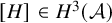 $[H] \in H^3(\mathcal {A})$
is independent of the isotropic splitting and determines the
$[H] \in H^3(\mathcal {A})$
is independent of the isotropic splitting and determines the $\mathcal {A}$
-Courant algebroid structure completely. Hence, this cohomology class is the natural extension of the Severa-class of exact Courant algebroids.
$\mathcal {A}$
-Courant algebroid structure completely. Hence, this cohomology class is the natural extension of the Severa-class of exact Courant algebroids.
2.4.2 Lifting Dirac structures
The answer to the question on how to lift structures takes different forms depending on what one is trying to lift. Here we will focus on Dirac and generalized complex structures, whose definitions on $\mathbb {A}$
is completely analogous to the definition on
$\mathbb {A}$
is completely analogous to the definition on $\mathbb {T}M$
:
$\mathbb {T}M$
:
Definition 2.15. Let $\mathcal {A} \rightarrow M$
be a Lie algebroid. An
$\mathcal {A} \rightarrow M$
be a Lie algebroid. An $\boldsymbol {\mathcal {A}}$
-Dirac structure is a subbundle
$\boldsymbol {\mathcal {A}}$
-Dirac structure is a subbundle $E_{\mathcal {A}} \subset \mathbb {A}$
together with a three-form
$E_{\mathcal {A}} \subset \mathbb {A}$
together with a three-form $H \in \Omega ^3_{\mathrm {cl}}(\mathcal {A})$
, such that
$H \in \Omega ^3_{\mathrm {cl}}(\mathcal {A})$
, such that $E_{\mathcal {A}}$
is isotropic with respect to the pairing and involutive with respect to the bracket on
$E_{\mathcal {A}}$
is isotropic with respect to the pairing and involutive with respect to the bracket on $\mathbb {A}$
.
$\mathbb {A}$
.
An $\boldsymbol{\mathcal{A}}$
-generalized complex structure is a pair
$\boldsymbol{\mathcal{A}}$
-generalized complex structure is a pair $(\mathcal {J}_{\mathcal {A}},H_{\mathcal {A}})$
where
$(\mathcal {J}_{\mathcal {A}},H_{\mathcal {A}})$
where $H_{\mathcal {A}} \in \Omega ^3_{\mathrm {cl}}(\mathcal {A})$
and
$H_{\mathcal {A}} \in \Omega ^3_{\mathrm {cl}}(\mathcal {A})$
and $\mathcal {J}_{\mathcal {A}}$
is an orthogonal complex structure
$\mathcal {J}_{\mathcal {A}}$
is an orthogonal complex structure $\mathcal {J}_{\mathcal {A}}$
on
$\mathcal {J}_{\mathcal {A}}$
on $\mathbb {A}$
for which
$\mathbb {A}$
for which $\mathbb {A}^{1,0}$
, the
$\mathbb {A}^{1,0}$
, the $+i$
-eigenbundle, defines an
$+i$
-eigenbundle, defines an $\mathbb {A}_{\mathbb {C} }$
-Dirac structure.
$\mathbb {A}_{\mathbb {C} }$
-Dirac structure.
Definition 2.16. Let $\mathcal {A} \rightarrow M$
be a Lie algebroid. An
$\mathcal {A} \rightarrow M$
be a Lie algebroid. An $\mathcal {A}$
-Dirac structure
$\mathcal {A}$
-Dirac structure $(E_{\mathcal {A}},H_{\mathcal {A}})$
is a lift of a Dirac structure
$(E_{\mathcal {A}},H_{\mathcal {A}})$
is a lift of a Dirac structure $(E,H)$
on M if
$(E,H)$
on M if $H_{\mathcal {A}} = \rho ^*H$
and
$H_{\mathcal {A}} = \rho ^*H$
and $\mathfrak {F}_{\rho }(E_{\mathcal {A}}) = E$
.
$\mathfrak {F}_{\rho }(E_{\mathcal {A}}) = E$
.
Here $\mathfrak {F}_{\rho }$
denotes the Dirac pushforward via the anchor map.
$\mathfrak {F}_{\rho }$
denotes the Dirac pushforward via the anchor map.
This notion matches the notion of a lift of a Poisson structure, when that is considered as a Dirac structure. Indeed, given a Lie algebroid $\mathcal {A} \rightarrow M$
, a Poisson structure
$\mathcal {A} \rightarrow M$
, a Poisson structure $\pi _{\mathcal {A}}\in \Gamma (\wedge ^2\mathcal {A})$
(that is
$\pi _{\mathcal {A}}\in \Gamma (\wedge ^2\mathcal {A})$
(that is $[\pi _{\mathcal {A}},\pi _{\mathcal {A}}] =0$
) and a Poisson structure
$[\pi _{\mathcal {A}},\pi _{\mathcal {A}}] =0$
) and a Poisson structure $\pi \in \mathfrak {X}^2(M)$
one can readily see that
$\pi \in \mathfrak {X}^2(M)$
one can readily see that $\rho _*\pi _{\mathcal {A}} = \pi $
if and only if
$\rho _*\pi _{\mathcal {A}} = \pi $
if and only if $E_{\pi _{\mathcal {A}}} = \mathrm {graph}(\pi _{\mathcal {A}}) \subset \mathbb {A}$
is a lift of
$E_{\pi _{\mathcal {A}}} = \mathrm {graph}(\pi _{\mathcal {A}}) \subset \mathbb {A}$
is a lift of $E_{\pi } = \mathrm {graph}(\pi )$
.
$E_{\pi } = \mathrm {graph}(\pi )$
.
For generalized complex structures, however, working only with the push-forward map is too restrictive, so the notion of lift requires some tweaking.
Definition 2.17. Let $\rho \colon \mathcal {A} \to TM$
be a Lie algebroid over M
$\rho \colon \mathcal {A} \to TM$
be a Lie algebroid over M
-
○
$\tilde X+ \tilde \xi \in \mathbb {A}$
is related to
$X + \xi \in \mathbb {T}M$
if
$\rho (\tilde X) = X$
and
$\rho ^*\xi = \tilde \xi $
. -
○ A generalized complex structure
$(\mathcal {J}_{\mathcal {A}},H_{\mathcal {A}})$
on
$\mathbb {A}$
is a lift of a generalized complex structure
$(\mathcal {J},H)$
on M if whenever
$\tilde X+ \tilde \xi \in \mathbb {A}$
is related to
$X + \xi \in \mathbb {T}M$
,
$\mathcal {J}_{\mathcal {A}} (\tilde X+ \tilde \xi )$
is related to
$\mathcal {J} (X + \xi )$
.







Example 2.18. In the situation above, if $J \colon TM \rightarrow TM$
and
$J \colon TM \rightarrow TM$
and $J_{\mathcal {A}} \colon \mathcal {A} \to \mathcal {A}$
are complex structures we can promote them to generalized complex structures and ask when
$J_{\mathcal {A}} \colon \mathcal {A} \to \mathcal {A}$
are complex structures we can promote them to generalized complex structures and ask when $J_{\mathcal {A}}$
is a lift of J. It turns out this happens if and only if the following diagram commutes
$J_{\mathcal {A}}$
is a lift of J. It turns out this happens if and only if the following diagram commutes

which agrees with what one would like to call the lift of a complex structure.
Remark 2.19. In this paper we will work with Lie algebroids $\mathcal {A}$
for which the locus U where
$\mathcal {A}$
for which the locus U where $\rho \colon \mathcal {A} \to TM$
is an isomorphism of vector bundles is dense in M. In this case, we see that
$\rho \colon \mathcal {A} \to TM$
is an isomorphism of vector bundles is dense in M. In this case, we see that $\mathcal {J}_{\mathcal {A}}$
is a lift of
$\mathcal {J}_{\mathcal {A}}$
is a lift of $\mathcal {J}$
on U if and only if
$\mathcal {J}$
on U if and only if $\mathcal {J}_{\mathcal {A}}|_U= (\rho |_U) \hspace {0.1 mm} \circ \hspace {0.1 mm} \mathcal {J}\hspace {0.1 mm} \circ \hspace {0.1 mm} (\rho |_U)^{-1}$
. If that holds, by continuity
$\mathcal {J}_{\mathcal {A}}|_U= (\rho |_U) \hspace {0.1 mm} \circ \hspace {0.1 mm} \mathcal {J}\hspace {0.1 mm} \circ \hspace {0.1 mm} (\rho |_U)^{-1}$
. If that holds, by continuity $\mathcal {J}_{\mathcal {A}}$
is related to
$\mathcal {J}_{\mathcal {A}}$
is related to $\mathcal {J}$
in all of M. Therefore we see that the question of whether
$\mathcal {J}$
in all of M. Therefore we see that the question of whether $\mathcal {J}$
admits a lift to a Lie algebroid with dense isomorphism locus becomes the question of existence of a smooth extension of
$\mathcal {J}$
admits a lift to a Lie algebroid with dense isomorphism locus becomes the question of existence of a smooth extension of $(\rho |_U) \hspace {0.1 mm} \circ \hspace {0.1 mm} \mathcal {J}\hspace {0.1 mm} \circ \hspace {0.1 mm} (\rho |_U)^{-1}$
beyond the isomorphism locus.
$(\rho |_U) \hspace {0.1 mm} \circ \hspace {0.1 mm} \mathcal {J}\hspace {0.1 mm} \circ \hspace {0.1 mm} (\rho |_U)^{-1}$
beyond the isomorphism locus.
Example 2.20. It is also good to keep in mind that there are (generalized) complex structures on Lie algebroids, which do not arise as lifts of structures on M. Consider, for example, the elliptic tangent bundle $\mathcal {A}_{\left | D \right |}$
on
$\mathcal {A}_{\left | D \right |}$
on $\mathbb {C} ^2$
, associated to the ideal
$\mathbb {C} ^2$
, associated to the ideal $\left \langle r_1^2r_2^2 \right \rangle $
. The following defines a complex structure on
$\left \langle r_1^2r_2^2 \right \rangle $
. The following defines a complex structure on $\mathcal {A}_{\left | D \right |}$
:
$\mathcal {A}_{\left | D \right |}$
:
 $$ \begin{align*} z_1\partial_{z_1} \mapsto z_2\partial_{z_2},& \quad \overline{z_1}\partial_{\overline{z_1}} \mapsto \overline{z_2}\partial_{\overline{z_2}},\\ z_2\partial_{z_2} \mapsto -z_1\partial_{z_1},& \quad \overline{z_2}\partial_{\overline{z_2}} \mapsto -\overline{z_1}\partial_{\overline{z_1}}. \end{align*} $$
However, the induced complex structure on $\mathbb {C} ^2\setminus D$
does not extend over D, as we have, for example,
$\mathbb {C} ^2\setminus D$
does not extend over D, as we have, for example,
 $$ \begin{align*} \partial_{z_1} \mapsto \frac{z_2}{z_1} \partial_{z_2}. \\[-24pt]\end{align*} $$
3 Classification of torus actions and connections
Having introduced the geometric structures of interest last section, now we move on to study manifolds with the relevant torus actions. We begin this section by recalling the classification of certain torus actions by Haefliger and Salem in [Reference Haefliger and Salem15]. The relevant cohomology class for this classification is $\check {H}^2(B;\mathbb {Z} ^n)$
, where B is the quotient space of the torus action. Although the Haefliger–Salem class greatly resembles the Chern class of a principal
$\check {H}^2(B;\mathbb {Z} ^n)$
, where B is the quotient space of the torus action. Although the Haefliger–Salem class greatly resembles the Chern class of a principal $S^1$
-bundle, no such description exists at the moment in terms of connections and curvature. We will use the elliptic tangent bundle to provide a connection point of view on this class.
$S^1$
-bundle, no such description exists at the moment in terms of connections and curvature. We will use the elliptic tangent bundle to provide a connection point of view on this class.
3.1 Haefliger–Salem classification
The first ingredient of the classification is the following result:
Theorem 3.1 (Theorem 3.1 in [Reference Haefliger and Salem15])
Let M be a manifold with a $T^k$
-action, and let
$T^k$
-action, and let $\pi \colon M \rightarrow B$
denote the quotient map. Any diffeomorphism
$\pi \colon M \rightarrow B$
denote the quotient map. Any diffeomorphism $h\colon M \to M$
commuting with the action of
$h\colon M \to M$
commuting with the action of $T^k$
and preserving all orbits is of the form
$T^k$
and preserving all orbits is of the form $h(x) = f(\pi (x))\cdot x$
, where
$h(x) = f(\pi (x))\cdot x$
, where $f \in C^{\infty }(B;T^k)$
.
$f \in C^{\infty }(B;T^k)$
.
Here we say that $f \in C^{\infty }(B)$
if
$f \in C^{\infty }(B)$
if $\pi ^*f$
is smooth on M. Similarly, we define
$\pi ^*f$
is smooth on M. Similarly, we define $\Omega ^{\bullet }(B)$
to correspond to the basic forms on M:
$\Omega ^{\bullet }(B)$
to correspond to the basic forms on M:
 $$\begin{align*}\Omega^{\bullet}_{\mathrm{bas}}(M)=\{\xi \in \Omega^\bullet(M)\colon \iota_X \xi = \mathcal{L}_X \xi =0, \text{ for all infinitesimal generators } X \} \end{align*}$$
Remark 3.2. The discussion in [Reference Haefliger and Salem15] concerns itself with the more general setting in which M is also allowed to be an orbifold. As our case of interest is when the total space is a smooth manifold we will immediately restrict to that case.
Definition 3.3. Let $M,M'$
be two manifolds endowed with
$M,M'$
be two manifolds endowed with $T^k$
-actions with common orbit space B and let
$T^k$
-actions with common orbit space B and let $\pi : M \rightarrow B,\pi ' : M' \rightarrow B$
denote the quotient maps. Then M and
$\pi : M \rightarrow B,\pi ' : M' \rightarrow B$
denote the quotient maps. Then M and $M'$
are said to be locally equivalent if each point in B has a neighbourhood U such that there exists a
$M'$
are said to be locally equivalent if each point in B has a neighbourhood U such that there exists a $T^k$
-equivariant diffeomorphism from
$T^k$
-equivariant diffeomorphism from $\pi ^{-1}(U)$
to
$\pi ^{-1}(U)$
to $\pi {\prime }^{-1}(U)$
, covering the identity on B.
$\pi {\prime }^{-1}(U)$
, covering the identity on B.
When fixing an effective $T^k$
-action on a manifold M it is possible to classify all other such actions which are locally equivalent to M:
$T^k$
-action on a manifold M it is possible to classify all other such actions which are locally equivalent to M:
Proposition 3.4 (Proposition 4.2 in [Reference Haefliger and Salem15])
Let $\pi : M \rightarrow B$
be a manifold endowed with an effective torus action. The equivalence classes of manifolds endowed with torus actions locally equivalent to that on M form a torsor for
$\pi : M \rightarrow B$
be a manifold endowed with an effective torus action. The equivalence classes of manifolds endowed with torus actions locally equivalent to that on M form a torsor for $\check {H}^2(B;\mathbb {Z}^k)$
.
$\check {H}^2(B;\mathbb {Z}^k)$
.
Since we will need to get our hands on the cohomology classes prescribed by the proposition, we give a sketch of the proof. Notice that there is no preferred manifold endowed with a torus action locally equivalent to that of M and the class in question measures how different from M another such manifold is.
Proof. Let $\pi ' : M' \rightarrow B$
be a manifold endowed with a locally equivalent torus action. Therefore, there exists a cover
$\pi ' : M' \rightarrow B$
be a manifold endowed with a locally equivalent torus action. Therefore, there exists a cover $\mathcal {U} = \lbrace U_i \rbrace _{i\in I}$
of B together with equivariant diffeomorphisms
$\mathcal {U} = \lbrace U_i \rbrace _{i\in I}$
of B together with equivariant diffeomorphisms $h_i : \pi ^{-1}(U_i) \rightarrow \pi {\prime }^{-1}(U_i)$
. The transition maps
$h_i : \pi ^{-1}(U_i) \rightarrow \pi {\prime }^{-1}(U_i)$
. The transition maps $h_j^{-1} \hspace {0.1 mm} \circ \hspace {0.1 mm} h_i : \pi ^{-1}(U_i \cap U_j) \rightarrow \pi ^{-1}(U_i \cap U_j)$
satisfy the assumptions of Theorem 3.1 and therefore there exists
$h_j^{-1} \hspace {0.1 mm} \circ \hspace {0.1 mm} h_i : \pi ^{-1}(U_i \cap U_j) \rightarrow \pi ^{-1}(U_i \cap U_j)$
satisfy the assumptions of Theorem 3.1 and therefore there exists $f_{ji} \in C^{\infty }(U_i \cap U_j;T^k)$
such that
$f_{ji} \in C^{\infty }(U_i \cap U_j;T^k)$
such that $h_j^{-1}\hspace {0.1 mm} \circ \hspace {0.1 mm} h_i(x) = f_{ji}(\pi (x))\cdot x$
. These functions combine to give a cocycle
$h_j^{-1}\hspace {0.1 mm} \circ \hspace {0.1 mm} h_i(x) = f_{ji}(\pi (x))\cdot x$
. These functions combine to give a cocycle $\lbrace f_{ji} \rbrace \in \check {C}^1(\mathcal {U};\mathcal {T}^k)$
, where
$\lbrace f_{ji} \rbrace \in \check {C}^1(\mathcal {U};\mathcal {T}^k)$
, where $\mathcal {T}^k$
is the sheaf of smooth functions with values in
$\mathcal {T}^k$
is the sheaf of smooth functions with values in $T^k$
. Using the exponential sequence one obtains the desired class in
$T^k$
. Using the exponential sequence one obtains the desired class in $\check {H}^2(\mathcal {U};\mathbb {Z}^k)$
.
$\check {H}^2(\mathcal {U};\mathbb {Z}^k)$
.
Conversely, given a class in $\check {H}^2(\mathcal {U};\mathbb {Z}^k)$
, one uses again the exponential sequence to obtain a cocyle
$\check {H}^2(\mathcal {U};\mathbb {Z}^k)$
, one uses again the exponential sequence to obtain a cocyle $\lbrace f_{ji} \rbrace \in \check {C}^1(\mathcal {U};\mathcal {T}^k)$
. Using this cocycle one may glue the disjoint unions of the
$\lbrace f_{ji} \rbrace \in \check {C}^1(\mathcal {U};\mathcal {T}^k)$
. Using this cocycle one may glue the disjoint unions of the $\pi ^{-1}(U_i)$
to obtain a manifold
$\pi ^{-1}(U_i)$
to obtain a manifold $M'$
endowed with a locally equivalent torus action. One readily checks that cohomologous cocycles result in equivalent
$M'$
endowed with a locally equivalent torus action. One readily checks that cohomologous cocycles result in equivalent $T^k$
manifolds.
$T^k$
manifolds.
Definition 3.5. Let $\pi : M \rightarrow B$
be a manifold endowed with an effective torus action with connected isotropy groups, and
$\pi : M \rightarrow B$
be a manifold endowed with an effective torus action with connected isotropy groups, and $\pi ' : M' \rightarrow B$
be a locally equivalent action. We will refer to the corresponding class in
$\pi ' : M' \rightarrow B$
be a locally equivalent action. We will refer to the corresponding class in $\check {H}^2(B,\mathbb {Z}^k)$
as the Haefliger-Salem class of
$\check {H}^2(B,\mathbb {Z}^k)$
as the Haefliger-Salem class of $M'$
with respect to M.
$M'$
with respect to M.
Remark 3.6. A key difference with the classification of principal torus bundles in terms of their Chern class, is that the classification in Proposition 3.4 is affine in nature. Given a base B, there is no canonical torus actions playing the role $B \times T^k$
has in the principal case.
$B \times T^k$
has in the principal case.
Remark 3.7. Note that the results in [Reference Haefliger and Salem15] are about orbifolds, but as we assume that M is a smooth manifold, any locally equivalent spaces will be smooth manifolds as well.
3.2 Torus actions, divisors and connections
We will lift torus actions to the elliptic tangent bundle in such a way that the associated infinitesimal action becomes free. The required notion we need is the following:
Definition 3.8. A $T^k$
action and an elliptic divisor,
$T^k$
action and an elliptic divisor, $I_{\left | D \right |}$
on a manifold M are compatible if
$I_{\left | D \right |}$
on a manifold M are compatible if
-
○ the action is effective,
-
○ the isotropy group of each point is connected,
-
○ the points with non-trivial isotropy are contained in D,
-
○ the action preserves the ideal
$I_{\left | D \right |}$
.

These assumptions allow us to lift to the elliptic tangent bundle:
Proposition 3.9. Let $I_{\left | D \right |}$
be an elliptic divisor compatible with a
$I_{\left | D \right |}$
be an elliptic divisor compatible with a $T^k$
-action on M. Then there exists an injective Lie algebroid homomorphism
$T^k$
-action on M. Then there exists an injective Lie algebroid homomorphism $\tilde {a} : \mathfrak {t}^k \rightarrow \mathcal {A}_{\left | D \right |}$
such that the following diagram commutes:
$\tilde {a} : \mathfrak {t}^k \rightarrow \mathcal {A}_{\left | D \right |}$
such that the following diagram commutes:

where $a\colon \mathfrak {t}^k \to TM$
is the infinitesimal
$a\colon \mathfrak {t}^k \to TM$
is the infinitesimal $T^k$
-action on M.
$T^k$
-action on M.
Proof. The existence of the Lie algebroid map is a local statement, so we can work in neighbourhoods of points.
Given a point p where the action is free, there are two possibilities, either $p\not \in D$
or
$p\not \in D$
or $p\in D$
. In the first case,
$p\in D$
. In the first case, $\mathcal {A}$
isomorphic to
$\mathcal {A}$
isomorphic to $TM$
via the anchor map in a neighbourhood of p and the action has a unique lift to
$TM$
via the anchor map in a neighbourhood of p and the action has a unique lift to $\mathcal {A}_{\left | D \right |}$
. If
$\mathcal {A}_{\left | D \right |}$
. If $p \in D$
, because the action preserves the ideal
$p \in D$
, because the action preserves the ideal $\mathcal {A}_{\left | D \right |}$
, then the orbit of p lies within the same stratum as p, say
$\mathcal {A}_{\left | D \right |}$
, then the orbit of p lies within the same stratum as p, say $D[i]$
and because the action is free, we get a rank k subbundle
$D[i]$
and because the action is free, we get a rank k subbundle $a(\mathfrak {t}^k) \subset TD[i] \hookrightarrow \mathcal {A}_{|D|}$
, and therefore a has a lift, which is unique by continuity.
$a(\mathfrak {t}^k) \subset TD[i] \hookrightarrow \mathcal {A}_{|D|}$
, and therefore a has a lift, which is unique by continuity.
Given a point where the action has nontrivial isotropy, say $T^l\subset T^k$
, we can split
$T^l\subset T^k$
, we can split $T^k = T^l \times T^{k-l}$
. By the previous argument the action of
$T^k = T^l \times T^{k-l}$
. By the previous argument the action of $T^{k-l}$
lifts to
$T^{k-l}$
lifts to $\mathcal {A}_{|D|}$
and the lift is made of a subspace that maps injectively to
$\mathcal {A}_{|D|}$
and the lift is made of a subspace that maps injectively to $TM$
via the anchor. Now we focus on the action of
$TM$
via the anchor. Now we focus on the action of $T^l$
. Since p is fixed by the action of
$T^l$
. Since p is fixed by the action of $T^l$
and the action is effective we can linearise it and assume that, in appropriate coordinates (with values in
$T^l$
and the action is effective we can linearise it and assume that, in appropriate coordinates (with values in $\mathbb {C} ^m \times \mathbb {R} ^{n-2m}$
), the action is given by
$\mathbb {C} ^m \times \mathbb {R} ^{n-2m}$
), the action is given by
 $$\begin{align*}(\theta_1,\dots, \theta_l)\cdot (z_1,\dots, z_m,x_1,\dots, x_{n-2m}) \mapsto (e^{i(\sum_j a_{1,j}\theta_j)}z_1,\dots, e^{i(\sum_j a_{m,j}\theta_j)}z_m,x_1,\dots,x_{n-2m}), \end{align*}$$
where $m \geq l$
and the matrix
$m \geq l$
and the matrix $A = (a_{i,j})_{ij}$
has integral coefficients. Because all isotropy groups are connected A has an
$A = (a_{i,j})_{ij}$
has integral coefficients. Because all isotropy groups are connected A has an $l\times l$
submatrix with determinant
$l\times l$
submatrix with determinant $\pm 1$
.
$\pm 1$
.
Suppose f is a local generator of the elliptic divisor $I_{\left | D \right |}$
. Since D has codimension 2, the locus where f is nonzero is connected and hence we may take f to be non-negative, vanishing only at D. Since f is non-negative, by taking its average over the
$I_{\left | D \right |}$
. Since D has codimension 2, the locus where f is nonzero is connected and hence we may take f to be non-negative, vanishing only at D. Since f is non-negative, by taking its average over the $T^l$
action, we obtain another nonnegative generator of the ideal, still denoted by f, which is invariant under the
$T^l$
action, we obtain another nonnegative generator of the ideal, still denoted by f, which is invariant under the $T^l$
action. The invariant polynomials of the
$T^l$
action. The invariant polynomials of the $T^l$
-action are generated by
$T^l$
-action are generated by $(r_1^2,\ldots ,r_m^2,x_1,\ldots ,x_{n-2m})$
, and hence a result by Schwarz [Reference Schwarz24] implies that f must be of the form
$(r_1^2,\ldots ,r_m^2,x_1,\ldots ,x_{n-2m})$
, and hence a result by Schwarz [Reference Schwarz24] implies that f must be of the form $f = g(r_1^2,\ldots ,r_m^2,x_1,\ldots ,x_{n-2m})$
, for some smooth g. Because f has this form, it is immediate that the vector fields
$f = g(r_1^2,\ldots ,r_m^2,x_1,\ldots ,x_{n-2m})$
, for some smooth g. Because f has this form, it is immediate that the vector fields $\partial _{\vartheta _1},\ldots ,\partial _{\vartheta _m}$
preserve the ideal generated by f, where we use polar coordinates for
$\partial _{\vartheta _1},\ldots ,\partial _{\vartheta _m}$
preserve the ideal generated by f, where we use polar coordinates for $z_i$
:
$z_i$
: $z_i = r_i e^{i\vartheta _i}$
. Hence
$z_i = r_i e^{i\vartheta _i}$
. Hence $\partial _{\vartheta _i}$
give rise to (non-vanishing) elements of
$\partial _{\vartheta _i}$
give rise to (non-vanishing) elements of $\mathcal {A}_{\left | D \right |}$
. Because the vector fields generating the
$\mathcal {A}_{\left | D \right |}$
. Because the vector fields generating the $T^k$
-action are given by
$T^k$
-action are given by $A(\partial _{\theta _1}),\ldots ,A(\partial _{\theta _l}) \in \text { span }\langle \partial _{\vartheta _1},\ldots ,\partial _{\vartheta _m}\rangle $
, and A has maximal rank, we see that these vector fields span a rank l-subspace of
$A(\partial _{\theta _1}),\ldots ,A(\partial _{\theta _l}) \in \text { span }\langle \partial _{\vartheta _1},\ldots ,\partial _{\vartheta _m}\rangle $
, and A has maximal rank, we see that these vector fields span a rank l-subspace of $\mathcal {A}_{\left | D \right |}$
which over D are in the kernel of the anchor map and hence are independent from the generators corresponding to the
$\mathcal {A}_{\left | D \right |}$
which over D are in the kernel of the anchor map and hence are independent from the generators corresponding to the $T^{k-l}$
action.
$T^{k-l}$
action.
Studying general torus actions goes beyond the scope of this article. For instance, one problem which occurs is that there is too much freedom in choosing a compatible elliptic divisor:
Example 3.10. Consider $\mathbb {C} ^2$
, endowed with the
$\mathbb {C} ^2$
, endowed with the $S^1$
-action
$S^1$
-action $\theta _1\cdot (z_1,z_2) = (e^{i\theta _1}z_1,z_2)$
and the compatible elliptic divisor generated by
$\theta _1\cdot (z_1,z_2) = (e^{i\theta _1}z_1,z_2)$
and the compatible elliptic divisor generated by $\left | z_1 \right |{}^2\left | z_2 \right |{}^2$
. Using coordinates
$\left | z_1 \right |{}^2\left | z_2 \right |{}^2$
. Using coordinates $(t,z_2)$
for the quotient space
$(t,z_2)$
for the quotient space $B = \mathbb {R} _{\geq 0} \times \mathbb {C} $
, we have that B inherits a quotient divisor
$B = \mathbb {R} _{\geq 0} \times \mathbb {C} $
, we have that B inherits a quotient divisor $I_{\operatorname {\mathrm {red}}} = \left \langle t\left | z_2 \right |{}^2 \right \rangle $
. Which is a mixture between an elliptic and real log divisor. More generally, for a
$I_{\operatorname {\mathrm {red}}} = \left \langle t\left | z_2 \right |{}^2 \right \rangle $
. Which is a mixture between an elliptic and real log divisor. More generally, for a $T^k$
-action on
$T^k$
-action on $\mathbb {C} ^n$
the induced divisor on the base can have any kind of mixture between elliptic and real log divisors.
$\mathbb {C} ^n$
the induced divisor on the base can have any kind of mixture between elliptic and real log divisors.
We restrict ourselves to a very well-behaved class of singular torus actions, but still interesting enough to allow for many examples:
Definition 3.11. We say that a $T^k$
-action on a manifold
$T^k$
-action on a manifold $M^{n}$
is standard if each orbit has a neighbourhood U such that
$M^{n}$
is standard if each orbit has a neighbourhood U such that
 $$ \begin{align*} U \simeq T^{k-l} \times \mathbb{C}^l \times \mathbb{R}^m \qquad\text{ for some } k,l,m \text{ such that } k+l+m=n, \end{align*} $$
in which the action is given by
 $$ \begin{align*} (e^{i\theta_1},\ldots,e^{i\theta_k})&\cdot (\varphi_1,\ldots,\varphi_{k-l}, z_1,\ldots,z_l,x_1,\ldots, x_m) \\&= (e^{i\theta_1}\varphi_1,\ldots,e^{i\theta_{k-l}}\varphi_{k-l},e^{i\theta_{k-l+1}}z_1,\ldots,e^{i\theta_k}z_l,x_1,\ldots, x_m), \end{align*} $$
possibly after changing the generators of $T^k$
.
$T^k$
.
For general $T^k$
-actions, deriving conditions when they are standard is not simple. However, for full torus actions one can show the following:
$T^k$
-actions, deriving conditions when they are standard is not simple. However, for full torus actions one can show the following:
Lemma 3.12 ([Reference Cavalcanti, Klaasse and Witte11], Proposition 6.1)
A $T^n$
-action on a manifold
$T^n$
-action on a manifold $M^{2n}$
which is effective and has connected isotropy groups is standard.
$M^{2n}$
which is effective and has connected isotropy groups is standard.
The local normal form of a standard $T^k$
-action immediately implies the following:
$T^k$
-action immediately implies the following:
Proposition 3.13. Let $\pi : M \rightarrow B:= M/T^k$
be a manifold endowed with a standard
$\pi : M \rightarrow B:= M/T^k$
be a manifold endowed with a standard $T^k$
-action. Then
$T^k$
-action. Then
-
○ B is a manifold with corners.
-
○ The action is compatible with the elliptic divisor
$I_{\left | D \right |} : = \pi ^*I_{\partial B}$
. -
○
$\pi $
induces a Lie algebroid submersion
$\mathcal {A}_{\left | D \right |} \rightarrow \mathcal {A}_{\partial B}$
.



In particular there is a canonical compatible elliptic divisor associated to a standard $T^k$
-action. Therefore, in what follows when given a standard
$T^k$
-action. Therefore, in what follows when given a standard $T^k$
-action on M,
$T^k$
-action on M, $I_{\left | D \right |}$
will always denote the canonical associated elliptic divisor.
$I_{\left | D \right |}$
will always denote the canonical associated elliptic divisor.
Example 3.14. Consider $S^n \subset \mathbb {R} ^{n+1}$
, and the circle action given by rotating the first two coordinates. This action is standard with quotient space diffeomorphic to
$S^n \subset \mathbb {R} ^{n+1}$
, and the circle action given by rotating the first two coordinates. This action is standard with quotient space diffeomorphic to $D^{n-1}$
and elliptic divisor generated by
$D^{n-1}$
and elliptic divisor generated by $x_1^2+x_2^2$
.
$x_1^2+x_2^2$
.
Thanks to Proposition 3.9 and 3.13 a standard $T^k$
-action lifts to the associated Lie algebroid and so does the quotient map. Therefore, we obtain a diagram as follows:
$T^k$
-action lifts to the associated Lie algebroid and so does the quotient map. Therefore, we obtain a diagram as follows:

Hence, we obtain a short exact sequence of vector bundles over M:
 $$ \begin{align*} 0 \rightarrow \ker d\tilde{\pi} \rightarrow \mathcal{A}_{\left| D \right|} \rightarrow \pi^*\mathcal{A}_{\partial_B} \rightarrow 0 \end{align*} $$
We may quotient by $T^k$
, to obtain the sequence of vector bundles over B:
$T^k$
, to obtain the sequence of vector bundles over B:
 $$ \begin{align*} 0 \rightarrow B \times \mathfrak{t}^k \rightarrow \mathcal{A}_{\left| D \right|}/T^k \rightarrow \mathcal{A}_{\partial_B} \rightarrow 0 \end{align*} $$
One may think of this sequence as an $\mathcal {A}_{\left | D \right |}$
version of the Atiyah sequence for principal bundles. With this in mind, vector bundle splittings of this sequence give rise to the notion of connections for the
$\mathcal {A}_{\left | D \right |}$
version of the Atiyah sequence for principal bundles. With this in mind, vector bundle splittings of this sequence give rise to the notion of connections for the $T^k$
-action on M. Concretely, in terms of differential forms we have:
$T^k$
-action on M. Concretely, in terms of differential forms we have:
Definition 3.15. Let M be a manifold endowed with a $T^k$
action,
$T^k$
action, $m\colon T^k\times M \to M$
, and let
$m\colon T^k\times M \to M$
, and let $I_{\left | D \right |}$
be a compatible elliptic divisor. A connection-one form on M is a Lie algebroid one-form
$I_{\left | D \right |}$
be a compatible elliptic divisor. A connection-one form on M is a Lie algebroid one-form $\Theta \in \Omega ^1(\mathcal {A}_{\left | D \right |};\mathfrak {t}^k)$
such that
$\Theta \in \Omega ^1(\mathcal {A}_{\left | D \right |};\mathfrak {t}^k)$
such that
-
○
$m_{\lambda }^*\Theta = \Theta $
for all
$\lambda \in T^k$
(where
$m_\lambda = m(\lambda ,\cdot )$
) -
○
$\iota _{a(v)}\Theta = v$
, for all
$v \in \mathfrak {t}^k$
.


3.2.1 Complex line bundles
Let $L \rightarrow M$
be a complex line bundle. Then
$L \rightarrow M$
be a complex line bundle. Then $\Gamma (L^{1,0*}) \subset C^{\infty }(L;\mathbb {C} )$
naturally defines a smooth complex log divisor. The associated elliptic divisor
$\Gamma (L^{1,0*}) \subset C^{\infty }(L;\mathbb {C} )$
naturally defines a smooth complex log divisor. The associated elliptic divisor $I_{\left | D \right |}$
is naturally compatible with the standard
$I_{\left | D \right |}$
is naturally compatible with the standard $S^1$
-action on L.
$S^1$
-action on L.
Connections for the $S^1$
-action arise from linear connections on L:
$S^1$
-action arise from linear connections on L:
Lemma 3.16. Let $\nabla $
be a complex linear connection on a complex line bundle
$\nabla $
be a complex linear connection on a complex line bundle $L \rightarrow M$
, and let
$L \rightarrow M$
, and let $\zeta \in \Omega ^1(L\backslash M;\mathbb {C} )$
denote the corresponding connection one-form on the associated
$\zeta \in \Omega ^1(L\backslash M;\mathbb {C} )$
denote the corresponding connection one-form on the associated $\mathbb {C} ^*$
-bundle. Then
$\mathbb {C} ^*$
-bundle. Then $\zeta $
extends over the zero-section as a complex logarithmic form, and
$\zeta $
extends over the zero-section as a complex logarithmic form, and $\Theta := \Im (\zeta ) \in \Omega ^2(\mathcal {A}_{\left | D \right |})$
defines a connection one-form for the associated
$\Theta := \Im (\zeta ) \in \Omega ^2(\mathcal {A}_{\left | D \right |})$
defines a connection one-form for the associated $S^1$
-action
$S^1$
-action
Proof. Let $z_{\alpha } : L|_{U_{\alpha }} \rightarrow \mathbb {C} $
be local fibre coordinates of L. Write
$z_{\alpha } : L|_{U_{\alpha }} \rightarrow \mathbb {C} $
be local fibre coordinates of L. Write $z_{\alpha } = r_{\alpha }e^{i\theta _{\alpha }}$
, and consider the complex log forms
$z_{\alpha } = r_{\alpha }e^{i\theta _{\alpha }}$
, and consider the complex log forms $d\log z_{\alpha } = d\log r_{\alpha } + i d\theta _{\alpha }$
. If
$d\log z_{\alpha } = d\log r_{\alpha } + i d\theta _{\alpha }$
. If $z_{\alpha } = g^{\beta }_{\alpha }z_{\beta }$
, with
$z_{\alpha } = g^{\beta }_{\alpha }z_{\beta }$
, with $g^{\alpha }_{\beta }$
transition functions, we find that
$g^{\alpha }_{\beta }$
transition functions, we find that $d\log z_{\alpha } - d\log z_{\beta } = d\log g^{\alpha }_{\beta }$
. Given a complex linear connection
$d\log z_{\alpha } - d\log z_{\beta } = d\log g^{\alpha }_{\beta }$
. Given a complex linear connection $\nabla $
on L, we may consider the corresponding connection one-forms
$\nabla $
on L, we may consider the corresponding connection one-forms $\xi _{\alpha } \in \Omega ^1(U_{\alpha };\mathbb {C} )$
, which satisfy
$\xi _{\alpha } \in \Omega ^1(U_{\alpha };\mathbb {C} )$
, which satisfy $\xi _{\alpha }-\xi _{\beta } = d\log g^{\alpha }_{\beta }$
. We conclude that
$\xi _{\alpha }-\xi _{\beta } = d\log g^{\alpha }_{\beta }$
. We conclude that $\zeta := d\log z_{\alpha } + \xi _{\alpha }$
defines a global complex logarithmic form
$\zeta := d\log z_{\alpha } + \xi _{\alpha }$
defines a global complex logarithmic form
If we let $K = K_1 + iK_2$
denote the curvature of the connection
$K = K_1 + iK_2$
denote the curvature of the connection $\nabla $
on L, we find that
$\nabla $
on L, we find that $d\Theta = K_2$
is actually a smooth form.
$d\Theta = K_2$
is actually a smooth form.
Remark 3.17. The form $\Theta $
, restricted to the complement of the zero-section, also goes by the name of the global angular form. The above discussion shows that the global angular form can be extended over the zero-section as an elliptic differential form.
$\Theta $
, restricted to the complement of the zero-section, also goes by the name of the global angular form. The above discussion shows that the global angular form can be extended over the zero-section as an elliptic differential form.
3.3 Smoothness of the curvature
Given a standard $T^k$
-action and a corresponding connection one-form
$T^k$
-action and a corresponding connection one-form $\Theta \in \Omega ^1(\mathcal {A}_{\left | D \right |};\mathfrak {t}^k)$
, the curvature,
$\Theta \in \Omega ^1(\mathcal {A}_{\left | D \right |};\mathfrak {t}^k)$
, the curvature, $d\Theta $
, is basic and descends to a form in
$d\Theta $
, is basic and descends to a form in $\Omega ^2(\mathcal {A}_{\partial B};\mathfrak {t}^k)$
. We saw for complex line bundles that there are connections for which the curvature was in fact a smooth form. This is a general phenomenon for standard torus actions. To prove this, we need to understand the cohomology of the log-tangent bundle on the base. Below we use the residue maps introduced in Definition 2.8 and the discussion thereafter.
$\Omega ^2(\mathcal {A}_{\partial B};\mathfrak {t}^k)$
. We saw for complex line bundles that there are connections for which the curvature was in fact a smooth form. This is a general phenomenon for standard torus actions. To prove this, we need to understand the cohomology of the log-tangent bundle on the base. Below we use the residue maps introduced in Definition 2.8 and the discussion thereafter.
Proposition 3.18 (Theorem 29 in [Reference Miranda and Scott19],7.24 in [Reference Gualtieri, Li, Pelayo and Ratiu14])
Let $(M,I_Z)$
be a manifold endowed with real log divisor. Then there exists an isomorphism
$(M,I_Z)$
be a manifold endowed with real log divisor. Then there exists an isomorphism
 $$ \begin{align} H^{\bullet}(\mathcal{A}_Z) \simeq H^{\bullet}(M) \oplus H^{\bullet-1}(Z[1]) \oplus H^{\bullet-2}(Z[2]) \oplus \cdots, \end{align} $$
where $Z[n]$
denotes the intersection stratification of Z. The maps
$Z[n]$
denotes the intersection stratification of Z. The maps $H^{\bullet }(\mathcal {A}_Z) \rightarrow H^{\bullet -i}(Z[i])$
are induced by the residue maps
$H^{\bullet }(\mathcal {A}_Z) \rightarrow H^{\bullet -i}(Z[i])$
are induced by the residue maps $\operatorname {\mathrm {Res}}^i$
, and the map
$\operatorname {\mathrm {Res}}^i$
, and the map $H^{\bullet }(M) \rightarrow H^{\bullet }(\mathcal {A}_Z)$
is the pullback via the anchor.
$H^{\bullet }(M) \rightarrow H^{\bullet }(\mathcal {A}_Z)$
is the pullback via the anchor.
Using (3.1) we see that we can associate a well-defined smooth cohomology class to a class in $H^{\bullet }(\mathcal {A}_Z)$
. Explicitly we may also phrase this as follows:
$H^{\bullet }(\mathcal {A}_Z)$
. Explicitly we may also phrase this as follows:
Lemma 3.19. Let $(M,Z)$
be a manifold endowed with a immersed hypersurface, with self-transverse intersections. Let
$(M,Z)$
be a manifold endowed with a immersed hypersurface, with self-transverse intersections. Let $\alpha \in \Omega ^{\bullet }(M)$
be such that
$\alpha \in \Omega ^{\bullet }(M)$
be such that $[\rho ^*\alpha ] = 0 \in H^{\bullet }(\mathcal {A}_Z)$
. Then
$[\rho ^*\alpha ] = 0 \in H^{\bullet }(\mathcal {A}_Z)$
. Then $[\alpha ] = 0 \in H^{\bullet }(M)$
.
$[\alpha ] = 0 \in H^{\bullet }(M)$
.
Recall from Lemma 3.13 that the quotient map of a standard $T^k$
-action induces a Lie algebroid submersion
$T^k$
-action induces a Lie algebroid submersion $\pi : \mathcal {A}_{\left | D \right |} \rightarrow \mathcal {A}_{\partial B}$
. This map is compatible with the residues in the following manner.
$\pi : \mathcal {A}_{\left | D \right |} \rightarrow \mathcal {A}_{\partial B}$
. This map is compatible with the residues in the following manner.
Lemma 3.20. Let $\pi : M \rightarrow B$
be endowed with a standard
$\pi : M \rightarrow B$
be endowed with a standard $T^k$
-action. Then for
$T^k$
-action. Then for $i = 1,2$
the following diagram commutes:
$i = 1,2$
the following diagram commutes:

As $D[2]$
is a discrete set of points,
$D[2]$
is a discrete set of points, $\operatorname {\mathrm {Res}}^2_r\omega $
is defined to be
$\operatorname {\mathrm {Res}}^2_r\omega $
is defined to be $\operatorname {\mathrm {Res}}_{r_1r_2}(\omega )(p)$
. A similar result holds for higher order residues, but is more involved to state.
$\operatorname {\mathrm {Res}}_{r_1r_2}(\omega )(p)$
. A similar result holds for higher order residues, but is more involved to state.
Using the description of the cohomlogy of $\mathcal {A}_{\partial B}$
, we can show that the curvature of a connection,
$\mathcal {A}_{\partial B}$
, we can show that the curvature of a connection, $d\Theta $
, is cohomologically smooth:
$d\Theta $
, is cohomologically smooth:
Lemma 3.21. Let M be endowed with a standard $T^k$
-action and let
$T^k$
-action and let $\Theta \in \Omega ^1(\mathcal {A}_{\left | D \right |};\mathfrak {t}^k)$
be a connection-one form with curvature
$\Theta \in \Omega ^1(\mathcal {A}_{\left | D \right |};\mathfrak {t}^k)$
be a connection-one form with curvature $K \in \Omega ^2(\mathcal {A}_{\partial B},\mathfrak {t}^k)$
. Then there exists a smooth form
$K \in \Omega ^2(\mathcal {A}_{\partial B},\mathfrak {t}^k)$
. Then there exists a smooth form $\tilde {K} \in \Omega ^2(B,\mathfrak {t}^k)$
with
$\tilde {K} \in \Omega ^2(B,\mathfrak {t}^k)$
with $[\rho ^*\tilde {K}] = [K] \in H^2(\mathcal {A}_{\partial _B};\mathfrak {t}^k)$
.
$[\rho ^*\tilde {K}] = [K] \in H^2(\mathcal {A}_{\partial _B};\mathfrak {t}^k)$
.
Proof. Using (3.1) we have to show that the residues $\operatorname {\mathrm {Res}}^i$
of K vanish. By rank reasons
$\operatorname {\mathrm {Res}}^i$
of K vanish. By rank reasons $\operatorname {\mathrm {Res}}^i$
vanishes for
$\operatorname {\mathrm {Res}}^i$
vanishes for $i\geq 3$
. We have that
$i\geq 3$
. We have that $p^*\operatorname {\mathrm {Res}}^1(K) = \operatorname {\mathrm {Res}}^1_r(d\Theta ) = d \operatorname {\mathrm {Res}}^1_r(\Theta )$
. By
$p^*\operatorname {\mathrm {Res}}^1(K) = \operatorname {\mathrm {Res}}^1_r(d\Theta ) = d \operatorname {\mathrm {Res}}^1_r(\Theta )$
. By $T^k$
-invariance of
$T^k$
-invariance of $\Theta $
we must have that
$\Theta $
we must have that $\operatorname {\mathrm {Res}}^1_r(\Theta )$
is
$\operatorname {\mathrm {Res}}^1_r(\Theta )$
is $T^k$
-invariant as well, and thus of the form
$T^k$
-invariant as well, and thus of the form $p^*f$
, with
$p^*f$
, with $f \in C^{\infty }(B)$
. Therefore
$f \in C^{\infty }(B)$
. Therefore $p^*\operatorname {\mathrm {Res}}^1(K) = p^*df$
, and we conclude that
$p^*\operatorname {\mathrm {Res}}^1(K) = p^*df$
, and we conclude that $\operatorname {\mathrm {Res}}^1(K)$
is exact. We also have that
$\operatorname {\mathrm {Res}}^1(K)$
is exact. We also have that $p^*\operatorname {\mathrm {Res}}^2(K) = \operatorname {\mathrm {Res}}^2_r(d\Theta )$
, but the latter is necessarily zero by smoothness of the coefficient functions of elliptic one-forms. We conclude that all the residues of
$p^*\operatorname {\mathrm {Res}}^2(K) = \operatorname {\mathrm {Res}}^2_r(d\Theta )$
, but the latter is necessarily zero by smoothness of the coefficient functions of elliptic one-forms. We conclude that all the residues of $[K]$
vanish, as these are precisely the maps
$[K]$
vanish, as these are precisely the maps $H^{\bullet }(\mathcal {A}_{\partial B}) \rightarrow H^{\bullet -i}(\partial B[i])$
in Equation (3.1), we conclude that
$H^{\bullet }(\mathcal {A}_{\partial B}) \rightarrow H^{\bullet -i}(\partial B[i])$
in Equation (3.1), we conclude that $[K] = [\rho ^*\tilde {K}]$
, for some smooth
$[K] = [\rho ^*\tilde {K}]$
, for some smooth $\tilde {K} \in \Omega ^2(B;\mathfrak {t}^k)$
.
$\tilde {K} \in \Omega ^2(B;\mathfrak {t}^k)$
.
The following example shows that Lemma 3.21 is not a given when the elliptic divisor and action are independent:
Example 3.22. Let M be a manifold endowed with a smooth elliptic divisor $I_{\left | D \right |}$
, with D co-orientable, and consider the trivial
$I_{\left | D \right |}$
, with D co-orientable, and consider the trivial $S^1$
-bundle,
$S^1$
-bundle, $\pi : M \times S^1 \rightarrow M$
. The elliptic divisor is trivially compatible with the
$\pi : M \times S^1 \rightarrow M$
. The elliptic divisor is trivially compatible with the $S^1$
-action, and hence we can choose a connection one-form for this action. Any such form will be given by
$S^1$
-action, and hence we can choose a connection one-form for this action. Any such form will be given by $\Theta = \alpha + d\theta $
, with
$\Theta = \alpha + d\theta $
, with $\alpha \in \Omega ^1(\mathcal {A}_{\left | D \right |})$
and
$\alpha \in \Omega ^1(\mathcal {A}_{\left | D \right |})$
and $d\theta \in \Omega ^1(S^1)$
.
$d\theta \in \Omega ^1(S^1)$
.
We may pick $\alpha = 0$
, and then the curvature of
$\alpha = 0$
, and then the curvature of $\Theta $
simply vanishes. However, we may change
$\Theta $
simply vanishes. However, we may change $\alpha $
in such a manner that
$\alpha $
in such a manner that $d\Theta $
remains smooth but is no longer exact as an element in
$d\Theta $
remains smooth but is no longer exact as an element in $H^2(M)$
, contradicting the conclusion of Lemma 3.21.
$H^2(M)$
, contradicting the conclusion of Lemma 3.21.
The construction goes as follows: Consider a metric on a tubular neighbourhood $\mathcal {U}$
of D in M, and let
$\mathcal {U}$
of D in M, and let $r^2 : \mathcal {U} \rightarrow \mathbb {R} $
denote the associated squared distance function. Let
$r^2 : \mathcal {U} \rightarrow \mathbb {R} $
denote the associated squared distance function. Let $\Theta _M \in \Omega ^1(\mathcal {A}_{\left | D \right |})$
be a connection one-form on
$\Theta _M \in \Omega ^1(\mathcal {A}_{\left | D \right |})$
be a connection one-form on $\mathcal {U}$
, obtained as in Lemma 3.16 by viewing
$\mathcal {U}$
, obtained as in Lemma 3.16 by viewing $\mathcal {U}$
as an (open) in a complex line bundle.
$\mathcal {U}$
as an (open) in a complex line bundle.
Let $f : \mathbb {R} \rightarrow \mathbb {R} $
be a smooth function with
$f : \mathbb {R} \rightarrow \mathbb {R} $
be a smooth function with $\mathrm {supp} f \subset [-1,1]$
, and
$\mathrm {supp} f \subset [-1,1]$
, and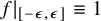 $f|_{[-\epsilon ,\epsilon ]} \equiv 1$
for some
$f|_{[-\epsilon ,\epsilon ]} \equiv 1$
for some $\varepsilon < 1$
. Define an elliptic form
$\varepsilon < 1$
. Define an elliptic form $\alpha = f(r^2)\Theta _M$
. The cohomology class
$\alpha = f(r^2)\Theta _M$
. The cohomology class $d\alpha $
is concentrated in
$d\alpha $
is concentrated in $\mathcal {U}$
, where it is precisely the curvature of the normal bundle of D. Consequently, we see that
$\mathcal {U}$
, where it is precisely the curvature of the normal bundle of D. Consequently, we see that $\Theta = \alpha + d\theta $
has smooth curvature, which is not cohomologous to zero.
$\Theta = \alpha + d\theta $
has smooth curvature, which is not cohomologous to zero.
3.3.1 Local description of connection one-forms
For future reference we recall the local description for connection one-forms on principal bundles:
Proposition 3.23. Let $\pi : P \rightarrow B$
be a principal G-bundle, and let
$\pi : P \rightarrow B$
be a principal G-bundle, and let $h_i : \pi ^{-1}(U_i) \rightarrow U_i \times G$
be local trivializations for
$h_i : \pi ^{-1}(U_i) \rightarrow U_i \times G$
be local trivializations for $i=1,2$
. Let
$i=1,2$
. Let $\Theta \in \Omega ^1(P;\mathfrak {g})$
be a connection one-form on P. Then
$\Theta \in \Omega ^1(P;\mathfrak {g})$
be a connection one-form on P. Then
 $$ \begin{align*} (h_i^{-1})*\Theta = \omega_{\mathrm{MC}} + \pi^*\alpha_i, \end{align*} $$
with $\omega _{\mathrm {MC}} \in \Omega ^1(G;\mathfrak {g})$
the Maurer-Cartan form, and
$\omega _{\mathrm {MC}} \in \Omega ^1(G;\mathfrak {g})$
the Maurer-Cartan form, and $\alpha _i \in \Omega ^1(U_i;\mathfrak {g})$
. Moreover, if we let
$\alpha _i \in \Omega ^1(U_i;\mathfrak {g})$
. Moreover, if we let $f_{ji} \in C^{\infty }(U_i\cap U_j;G)$
be the transition functions given by
$f_{ji} \in C^{\infty }(U_i\cap U_j;G)$
be the transition functions given by $h_j^{-1} \hspace {0.1 mm} \circ \hspace {0.1 mm} h_i(x,g) = (x,f_{ji}(x)\cdot g)$
, we have
$h_j^{-1} \hspace {0.1 mm} \circ \hspace {0.1 mm} h_i(x,g) = (x,f_{ji}(x)\cdot g)$
, we have
 $$ \begin{align*} \alpha_i - \mathrm{Ad}^*_{f_{ji}}\alpha_j = \pi^*d\log f_{ji}. \end{align*} $$
3.4 Cech–de Rham isomorphism
To continue, we need to recall a basic version of the Čech-de Rham isomorphism.
Let M be endowed with a proper group action by some group G. Let $\Omega ^n_{\operatorname {\mathrm {bas}}}$
denote the sheaf of basic differential forms and let
$\Omega ^n_{\operatorname {\mathrm {bas}}}$
denote the sheaf of basic differential forms and let $Z^n_{\mathrm {bas}}$
denote the sheaf of closed basic differential forms. Both are sheaves of
$Z^n_{\mathrm {bas}}$
denote the sheaf of closed basic differential forms. Both are sheaves of $C^{\infty }(M)_{\mathrm {bas}}$
-modules and fit into the short exact sequence
$C^{\infty }(M)_{\mathrm {bas}}$
-modules and fit into the short exact sequence
 $$ \begin{align} 0 \rightarrow Z^n_{\mathrm{bas}} \rightarrow \Omega^{n}_{\operatorname{\mathrm{bas}}} \rightarrow Z^{n+1}_{\mathrm{bas}} \rightarrow 0. \end{align} $$
Consider the basic Čech cocycle groups $C_{\operatorname {\mathrm {bas}}}^k(\mathcal {U},\mathcal {F})$
, for which the maps
$C_{\operatorname {\mathrm {bas}}}^k(\mathcal {U},\mathcal {F})$
, for which the maps $U_{i_1\ldots i_k} \rightarrow \mathcal {F}$
are invariant with respect to the G-action on
$U_{i_1\ldots i_k} \rightarrow \mathcal {F}$
are invariant with respect to the G-action on $U_{i_1\ldots i_k}$
.
$U_{i_1\ldots i_k}$
.
By existence of a G-invariant partition of unity on M, the sheaves $\Omega ^n_{\mathrm {bas}}$
are fine, and hence
$\Omega ^n_{\mathrm {bas}}$
are fine, and hence $H^i_{\operatorname {\mathrm {bas}}}(M,\Omega ^n_{\mathrm {bas}}) = \lbrace 0 \rbrace $
for all
$H^i_{\operatorname {\mathrm {bas}}}(M,\Omega ^n_{\mathrm {bas}}) = \lbrace 0 \rbrace $
for all $i \geq 1$
. Therefore the connecting morphism of the above exact sequence induces an isomorphism
$i \geq 1$
. Therefore the connecting morphism of the above exact sequence induces an isomorphism $H^i_{\operatorname {\mathrm {bas}}}(M,Z^{n+1}_{\mathrm {bas}}) \rightarrow H^i_{\operatorname {\mathrm {bas}}}(M,Z^n_{\mathrm {bas}})$
. Applying this consecutively, one obtains the isomorphism between
$H^i_{\operatorname {\mathrm {bas}}}(M,Z^{n+1}_{\mathrm {bas}}) \rightarrow H^i_{\operatorname {\mathrm {bas}}}(M,Z^n_{\mathrm {bas}})$
. Applying this consecutively, one obtains the isomorphism between $H^{i+1}_{\operatorname {\mathrm {bas}}}(M,\mathbb {R} ) \rightarrow H^1_{\operatorname {\mathrm {bas}}}(M,Z^i_{\operatorname {\mathrm {bas}}})$
. As the latter corresponds to
$H^{i+1}_{\operatorname {\mathrm {bas}}}(M,\mathbb {R} ) \rightarrow H^1_{\operatorname {\mathrm {bas}}}(M,Z^i_{\operatorname {\mathrm {bas}}})$
. As the latter corresponds to $H^{i+1}_{dR,\operatorname {\mathrm {bas}}}(M)$
one obtains the desired isomorphism.
$H^{i+1}_{dR,\operatorname {\mathrm {bas}}}(M)$
one obtains the desired isomorphism.
We also consider a basic version of the exponential sequence:
 $$ \begin{align} 0 \rightarrow \mathbb{Z}^n \rightarrow C^{\infty}_{\mathrm{bas}}(M;\mathbb{R}^n) \rightarrow C^{\infty}_{\operatorname{\mathrm{bas}}}(M;T^n) \rightarrow 0. \end{align} $$
The long exact sequence will induce an isomorphism $\check {H}^1_{\operatorname {\mathrm {bas}}}(M,C^{\infty }_{\operatorname {\mathrm {bas}}}(M;T^n)) \rightarrow \check {H}^2_{\mathrm {bas}}(M;\mathbb {Z}^n)$
. Combining this with the Čech-de Rham isomorphism we obtain a map to
$\check {H}^1_{\operatorname {\mathrm {bas}}}(M,C^{\infty }_{\operatorname {\mathrm {bas}}}(M;T^n)) \rightarrow \check {H}^2_{\mathrm {bas}}(M;\mathbb {Z}^n)$
. Combining this with the Čech-de Rham isomorphism we obtain a map to $H^2_{\mathrm {bas}}(M;\mathbb {Z}^n)$
.
$H^2_{\mathrm {bas}}(M;\mathbb {Z}^n)$
.
3.5 Connection approach to Haefliger-Salem class
We now have all the theory in place to compare the curvature of a connection for a standard $T^k$
-action with the Haefliger-Salem class:
$T^k$
-action with the Haefliger-Salem class:
Proposition 3.24. Let $\pi : M \rightarrow B$
be a manifold endowed with a standard
$\pi : M \rightarrow B$
be a manifold endowed with a standard $T^k$
-action and let
$T^k$
-action and let ${\pi ' : M' \rightarrow B}$
be a manifold endowed with a locally equivalent action. Let
${\pi ' : M' \rightarrow B}$
be a manifold endowed with a locally equivalent action. Let $\Theta ,\Theta '$
be connection one-forms on M respectively
$\Theta ,\Theta '$
be connection one-forms on M respectively $M'$
. Then
$M'$
. Then $[d\Theta -d\Theta '] \in H^2(A_{\partial B};\mathfrak {t}^k)$
is representable by a smooth form, and descends to the Haefliger-Salem class of
$[d\Theta -d\Theta '] \in H^2(A_{\partial B};\mathfrak {t}^k)$
is representable by a smooth form, and descends to the Haefliger-Salem class of $M'$
in
$M'$
in $\check {H}^2(B;\mathfrak {t}^k)$
.
$\check {H}^2(B;\mathfrak {t}^k)$
.
Proof. Let $I_{\left | D \right |},I_{\left | D' \right |}$
denote the induced elliptic divisors on M respectively
$I_{\left | D \right |},I_{\left | D' \right |}$
denote the induced elliptic divisors on M respectively $M'$
. By Lemma 3.21, we have that both
$M'$
. By Lemma 3.21, we have that both $[d\Theta ]$
and
$[d\Theta ]$
and $[d\Theta ']$
are representable by smooth forms, therefore we can modify
$[d\Theta ']$
are representable by smooth forms, therefore we can modify $\Theta $
and
$\Theta $
and $\Theta '$
such that
$\Theta '$
such that $d\Theta $
and
$d\Theta $
and $d\Theta '$
are smooth forms. We will still denote the modified connections by
$d\Theta '$
are smooth forms. We will still denote the modified connections by $\Theta $
and
$\Theta $
and $\Theta '$
.
$\Theta '$
.
Let $\mathcal {U} = \lbrace U_i \rbrace $
be an open cover of B, together with equivariant diffeomorphism
$\mathcal {U} = \lbrace U_i \rbrace $
be an open cover of B, together with equivariant diffeomorphism $h_i : \pi ^{-1}(U_i) \rightarrow \pi {\prime }^{-1}(U_i)$
provided by the fact that the actions on M and
$h_i : \pi ^{-1}(U_i) \rightarrow \pi {\prime }^{-1}(U_i)$
provided by the fact that the actions on M and $M'$
are locally equivalent. Furthermore, assume that over
$M'$
are locally equivalent. Furthermore, assume that over $U_i\backslash \partial B$
both
$U_i\backslash \partial B$
both $\pi $
and
$\pi $
and $\pi '$
are trivialisable as principal
$\pi '$
are trivialisable as principal $T^k$
-bundles.
$T^k$
-bundles.
Because the $h_i$
are equivariant, they are morphisms of divisors, and hence we may consider
$h_i$
are equivariant, they are morphisms of divisors, and hence we may consider $h_i^*\Theta ' \in \Omega ^1(\mathcal {A}_{\left | D \right |}|_{\pi ^{-1}(U_i)};\mathfrak {t}^k)$
. One readily shows that
$h_i^*\Theta ' \in \Omega ^1(\mathcal {A}_{\left | D \right |}|_{\pi ^{-1}(U_i)};\mathfrak {t}^k)$
. One readily shows that $h_i^*\Theta '$
is a connection on
$h_i^*\Theta '$
is a connection on $\pi ^{-1}(U_i)$
and thus
$\pi ^{-1}(U_i)$
and thus $\eta _i := \Theta -h_i^*\Theta ' \in \Omega ^1_{\operatorname {\mathrm {bas}}}(\mathcal {A}_{\left | D \right |}|_{\pi ^{-1}(U_i)};\mathfrak {t}^k)$
is a basic form.
$\eta _i := \Theta -h_i^*\Theta ' \in \Omega ^1_{\operatorname {\mathrm {bas}}}(\mathcal {A}_{\left | D \right |}|_{\pi ^{-1}(U_i)};\mathfrak {t}^k)$
is a basic form.
Let $f_{ji} \in C^{\infty }(U_i\cap U_j;T^k)$
be the transition functions given by
$f_{ji} \in C^{\infty }(U_i\cap U_j;T^k)$
be the transition functions given by $h_j\hspace {0.1 mm} \circ \hspace {0.1 mm} h_i(x) =(x,f_{ji}(x))$
. By Lemma 3.23,
$h_j\hspace {0.1 mm} \circ \hspace {0.1 mm} h_i(x) =(x,f_{ji}(x))$
. By Lemma 3.23, $\eta _i - \eta _j = h_i^*\Theta ' - h_j^*\Theta '$
coincides with
$\eta _i - \eta _j = h_i^*\Theta ' - h_j^*\Theta '$
coincides with $\pi ^*d\log f_{ji}$
on
$\pi ^*d\log f_{ji}$
on $\pi ^{-1}((U_i \cap U_j)\backslash \partial B)$
. By density, we have that
$\pi ^{-1}((U_i \cap U_j)\backslash \partial B)$
. By density, we have that $\eta _i - \eta _j = \pi ^*d\log f_{ji}$
on the entirety of
$\eta _i - \eta _j = \pi ^*d\log f_{ji}$
on the entirety of $\pi ^{-1}(U_i\cap U_j)$
. As the
$\pi ^{-1}(U_i\cap U_j)$
. As the $\eta _i$
are closed, we conclude that
$\eta _i$
are closed, we conclude that $\lbrace \eta _i-\eta _j \rbrace _{ij}$
defines a cocycle in
$\lbrace \eta _i-\eta _j \rbrace _{ij}$
defines a cocycle in $\check {C}^1_{\mathrm {bas}}(M,Z^1_{\operatorname {\mathrm {bas}}})$
.
$\check {C}^1_{\mathrm {bas}}(M,Z^1_{\operatorname {\mathrm {bas}}})$
.
The Haefliger-Salem class is defined by applying the exponential sequence to the class $\lbrace f_{ji} \rbrace $
in
$\lbrace f_{ji} \rbrace $
in $\check {H}^1(\mathcal {U};\mathcal {T}^k)$
. Inspecting the Čech-de Rham isomorphism, we conclude that this class corresponds to the class defined by
$\check {H}^1(\mathcal {U};\mathcal {T}^k)$
. Inspecting the Čech-de Rham isomorphism, we conclude that this class corresponds to the class defined by $\lbrace \eta _i-\eta _j \rbrace _{ij}$
. We are left to show that
$\lbrace \eta _i-\eta _j \rbrace _{ij}$
. We are left to show that $\lbrace \eta _i -\eta _j \rbrace _{ij} \in \check {H}^1(\mathcal {U},Z^1_{\operatorname {\mathrm {bas}}})$
corresponds to
$\lbrace \eta _i -\eta _j \rbrace _{ij} \in \check {H}^1(\mathcal {U},Z^1_{\operatorname {\mathrm {bas}}})$
corresponds to $[d\Theta - d\Theta ']$
. By exactness of (3.2), we know that there exists a refinement
$[d\Theta - d\Theta ']$
. By exactness of (3.2), we know that there exists a refinement $\tilde {\mathcal {U}} = \lbrace \tilde {U}_i \rbrace $
of
$\tilde {\mathcal {U}} = \lbrace \tilde {U}_i \rbrace $
of $\mathcal {U}$
and
$\mathcal {U}$
and $\tilde {\eta _i} \in \Omega ^1_{\operatorname {\mathrm {bas}}}(\pi ^{-1}(\tilde {U}_i));\mathfrak {t})$
such that
$\tilde {\eta _i} \in \Omega ^1_{\operatorname {\mathrm {bas}}}(\pi ^{-1}(\tilde {U}_i));\mathfrak {t})$
such that $\tilde {\eta }_i - \tilde {\eta }_j = \eta _i - \eta _j$
. The class in
$\tilde {\eta }_i - \tilde {\eta }_j = \eta _i - \eta _j$
. The class in $H^2_{dR,\operatorname {\mathrm {bas}}}(M,\mathfrak {t}^k)$
corresponding to
$H^2_{dR,\operatorname {\mathrm {bas}}}(M,\mathfrak {t}^k)$
corresponding to $\lbrace \eta _i-\eta _j \rbrace _{ij}$
is given by
$\lbrace \eta _i-\eta _j \rbrace _{ij}$
is given by $d\tilde {\eta }_i$
.
$d\tilde {\eta }_i$
.
Note that $\tilde {\eta }_i -\eta _i = \tilde {\eta }_j - \eta _j$
, and hence these forms glue to give a globally defined form
$\tilde {\eta }_i -\eta _i = \tilde {\eta }_j - \eta _j$
, and hence these forms glue to give a globally defined form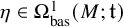 $\eta \in \Omega ^1_{\operatorname {\mathrm {bas}}}(M;\mathfrak {t})$
. Because
$\eta \in \Omega ^1_{\operatorname {\mathrm {bas}}}(M;\mathfrak {t})$
. Because $d\eta = d\tilde {\eta }_i -d\eta _i$
, and
$d\eta = d\tilde {\eta }_i -d\eta _i$
, and $d\eta _i = d\Theta - h_i^*d\Theta '$
, we have that
$d\eta _i = d\Theta - h_i^*d\Theta '$
, we have that $d\eta $
is smooth. Hence, by Lemma 3.19 we have that
$d\eta $
is smooth. Hence, by Lemma 3.19 we have that $d\eta $
is exact in
$d\eta $
is exact in $H^2(B;\mathfrak {t}^k)$
. Consequently
$H^2(B;\mathfrak {t}^k)$
. Consequently $[d\tilde {\eta }_i] = [d\eta _i] \in H^2(B;\mathfrak {t}^k)$
. But as
$[d\tilde {\eta }_i] = [d\eta _i] \in H^2(B;\mathfrak {t}^k)$
. But as $d\eta _i = d\Theta - h_i^*d\Theta '$
, we conclude that the class in
$d\eta _i = d\Theta - h_i^*d\Theta '$
, we conclude that the class in $H^2_{dR,\operatorname {\mathrm {bas}}}(M,\mathfrak {t}^k)$
corresponding to
$H^2_{dR,\operatorname {\mathrm {bas}}}(M,\mathfrak {t}^k)$
corresponding to $\lbrace \eta _i-\eta _j \rbrace _{ij}$
is given by
$\lbrace \eta _i-\eta _j \rbrace _{ij}$
is given by $d\Theta - d\Theta '$
, which finishes the proof.
$d\Theta - d\Theta '$
, which finishes the proof.
The description of the Haefliger-Salem class in terms of connections has the following consequence:
Lemma 3.25. Let $\pi : M \rightarrow B$
be a standard
$\pi : M \rightarrow B$
be a standard $T^k$
-action. Then there exists a locally equivalent action
$T^k$
-action. Then there exists a locally equivalent action $\pi ' : M' \rightarrow B$
which admits a flat connection.
$\pi ' : M' \rightarrow B$
which admits a flat connection.
Proof. Let $\Theta $
be a connection on M, with integral curvature. By Proposition 3.4 the class
$\Theta $
be a connection on M, with integral curvature. By Proposition 3.4 the class $[d\Theta ] \in H^2(B;\mathbb {Z} ^k)$
corresponds to a locally equivalent torus action
$[d\Theta ] \in H^2(B;\mathbb {Z} ^k)$
corresponds to a locally equivalent torus action $M' \rightarrow B$
. Given a connection
$M' \rightarrow B$
. Given a connection $\Theta '$
on
$\Theta '$
on $M'$
, we have by Proposition 3.24 that
$M'$
, we have by Proposition 3.24 that $[d\Theta - d\Theta ']$
defines the Haefliger-Salem class of
$[d\Theta - d\Theta ']$
defines the Haefliger-Salem class of $M'$
. But as this class is given by
$M'$
. But as this class is given by $[d\Theta ]$
, we conclude that
$[d\Theta ]$
, we conclude that $[d\Theta '] = 0$
which finishes the proof.
$[d\Theta '] = 0$
which finishes the proof.
The importance of this lemma is that in the classification of standard $T^k$
-actions, it is now possible to pick as a reference an action
$T^k$
-actions, it is now possible to pick as a reference an action $M_0 \rightarrow B$
with a flat connection. Using this reference, and a locally equivalent action
$M_0 \rightarrow B$
with a flat connection. Using this reference, and a locally equivalent action $M' \rightarrow B$
, we find that the Haefliger-Salem class of
$M' \rightarrow B$
, we find that the Haefliger-Salem class of $M_0$
with respect to
$M_0$
with respect to $M'$
is given exactly by
$M'$
is given exactly by $[d\Theta ']$
for some connection
$[d\Theta ']$
for some connection $\Theta '$
on
$\Theta '$
on $M'$
.
$M'$
.
Definition 3.26. Let $M \rightarrow B$
be a standard
$M \rightarrow B$
be a standard $T^k$
-action. The locally equivalent action
$T^k$
-action. The locally equivalent action $M_0 \rightarrow B$
which admits a flat connection is called the reference action.
$M_0 \rightarrow B$
which admits a flat connection is called the reference action.
When $M \rightarrow B$
is a principal
$M \rightarrow B$
is a principal $T^k$
-action, the reference action is simply the trivial bundle
$T^k$
-action, the reference action is simply the trivial bundle $B \times T^k$
. Contrary to in the principal case, there might be several non locally equivalent standard
$B \times T^k$
. Contrary to in the principal case, there might be several non locally equivalent standard $T^k$
-actions over the same base with flat connections. We will see examples of this in Section 5.2.1.
$T^k$
-actions over the same base with flat connections. We will see examples of this in Section 5.2.1.
4 The singular differential geometry of the correspondence space
Let $M \rightarrow B,\hat {M} \rightarrow B$
be manifolds endowed with standard torus actions. The fibre-product
$M \rightarrow B,\hat {M} \rightarrow B$
be manifolds endowed with standard torus actions. The fibre-product $M \times _B \hat {M} \subset M\times \hat {M}$
fails to be a smooth submanifold. This space plays an important role in T-duality, and therefore we will shortly study notions for smooth objects on this space.
$M \times _B \hat {M} \subset M\times \hat {M}$
fails to be a smooth submanifold. This space plays an important role in T-duality, and therefore we will shortly study notions for smooth objects on this space.
Let us start with the simplest example:
Example 4.1. Let $M,\hat {M}$
both denote
$M,\hat {M}$
both denote $\mathbb {C} $
endowed with the standard
$\mathbb {C} $
endowed with the standard $S^1$
-action, and
$S^1$
-action, and $B = \mathbb {R} _{\geq 0}$
the quotient. Then
$B = \mathbb {R} _{\geq 0}$
the quotient. Then
 $$ \begin{align*} M\times_B \hat{M} = \lbrace (z,\tilde{z}) : \left| z \right| = \left| \tilde{z} \right| \rbrace, \end{align*} $$
and hence we may consider singular coordinates $(r,\theta ,\hat {\theta }) \in \mathbb {R} _{\geq 0} \times T^2$
. These coordinates are well-defined except at
$(r,\theta ,\hat {\theta }) \in \mathbb {R} _{\geq 0} \times T^2$
. These coordinates are well-defined except at $r = 0$
. We see that
$r = 0$
. We see that $M\times _B \hat {M}$
is a cone over a torus.
$M\times _B \hat {M}$
is a cone over a torus.
The space $\mathbb {C} \times _{\mathbb {R} _{\geq 0}} \mathbb {C} $
will serve as local model for the spaces we want to consider, so we will describe smoothness in terms of it:
$\mathbb {C} \times _{\mathbb {R} _{\geq 0}} \mathbb {C} $
will serve as local model for the spaces we want to consider, so we will describe smoothness in terms of it:
Definition 4.2. A function $f : \mathbb {C} \times _{\mathbb {R} _{\geq 0}} \mathbb {C} \rightarrow \mathbb {R} $
is smooth, if it is the restriction of a smooth function
$f : \mathbb {C} \times _{\mathbb {R} _{\geq 0}} \mathbb {C} \rightarrow \mathbb {R} $
is smooth, if it is the restriction of a smooth function $\tilde {f} \in C^{\infty }(\mathbb {C} \times \mathbb {C} )$
.
$\tilde {f} \in C^{\infty }(\mathbb {C} \times \mathbb {C} )$
.
Definition 4.3. A map $\Phi : \mathbb {C} \times _{\mathbb {R} _{\geq 0}} \mathbb {C} \rightarrow \mathbb {C} \times _{\mathbb {R} _{\geq 0}} \mathbb {C} $
is said to be smooth, if for every
$\Phi : \mathbb {C} \times _{\mathbb {R} _{\geq 0}} \mathbb {C} \rightarrow \mathbb {C} \times _{\mathbb {R} _{\geq 0}} \mathbb {C} $
is said to be smooth, if for every $f \in C^{\infty }(\mathbb {C} \times _{\mathbb {R} _{\geq 0}} \mathbb {C} )$
,
$f \in C^{\infty }(\mathbb {C} \times _{\mathbb {R} _{\geq 0}} \mathbb {C} )$
, $f\hspace {0.1 mm} \circ \hspace {0.1 mm} \Phi $
is smooth.
$f\hspace {0.1 mm} \circ \hspace {0.1 mm} \Phi $
is smooth.
Taking products, we can talk about smooth maps and diffeomorphisms of $(\mathbb {C} \times _{\mathbb {R} _{\geq 0}} \times \mathbb {C} )^l \times \mathbb {R} ^k$
, and charts and atlases of this form. From the local form of standard
$(\mathbb {C} \times _{\mathbb {R} _{\geq 0}} \times \mathbb {C} )^l \times \mathbb {R} ^k$
, and charts and atlases of this form. From the local form of standard $T^k$
-actions it immediately follows that:
$T^k$
-actions it immediately follows that:
Lemma 4.4. Let $M,\hat {M}$
be ndimensional manifolds with standard
$M,\hat {M}$
be ndimensional manifolds with standard $T^k$
-actions over the same base B. Then
$T^k$
-actions over the same base B. Then $M\times _B\hat {M}$
admits an atlas of coordinate charts of the form
$M\times _B\hat {M}$
admits an atlas of coordinate charts of the form $(\mathbb {C} \times _{\mathbb {R} _{\geq 0}} \times \mathbb {C} )^l \times \mathbb {R} ^{n+k-3l}$
.
$(\mathbb {C} \times _{\mathbb {R} _{\geq 0}} \times \mathbb {C} )^l \times \mathbb {R} ^{n+k-3l}$
.
Let $p \in M\times _B \hat {M}$
be such that
$p \in M\times _B \hat {M}$
be such that $\pi (p) \in \partial B[l]$
(that is, the isotropy of the
$\pi (p) \in \partial B[l]$
(that is, the isotropy of the $T^{2k}$
-action at p is
$T^{2k}$
-action at p is $T^{2l}$
). Such a point then has singular coordinates.
$T^{2l}$
). Such a point then has singular coordinates.
 $$ \begin{align} (r_1,\ldots,r_l,\theta_1,\ldots,\theta_l,\hat{\theta}_1,\ldots,\hat{\theta}_l,\psi_1,\ldots,\psi_{k-l},\hat{\psi}_1,\ldots,\hat{\psi}_{k-l},x_1,\ldots,x_{n-k-l}). \end{align} $$
Here the $\lbrace r_i \rbrace $
are one set of radial coordinates on
$\lbrace r_i \rbrace $
are one set of radial coordinates on $\mathbb {C} ^l$
, where
$\mathbb {C} ^l$
, where $\lbrace \theta _i \rbrace ,\lbrace \hat {\theta }_i \rbrace $
are two sets of polar coordinates on
$\lbrace \theta _i \rbrace ,\lbrace \hat {\theta }_i \rbrace $
are two sets of polar coordinates on $\mathbb {C} ^l$
. The
$\mathbb {C} ^l$
. The $\lbrace \psi _i \rbrace $
and
$\lbrace \psi _i \rbrace $
and $\lbrace \hat {\psi }_i \rbrace $
are honest coordinates on
$\lbrace \hat {\psi }_i \rbrace $
are honest coordinates on $T^{k-l}$
and the
$T^{k-l}$
and the $\lbrace x_i \rbrace $
are coordinates on
$\lbrace x_i \rbrace $
are coordinates on $\mathbb {R} ^{n-k-l}$
.
$\mathbb {R} ^{n-k-l}$
.
Remark 4.5 (Induced divisor)
Let $M,\hat {M}$
be manifolds endowed with standard
$M,\hat {M}$
be manifolds endowed with standard $T^k$
-actions and same base B and let
$T^k$
-actions and same base B and let $I_{\left | D \right |}$
and
$I_{\left | D \right |}$
and $I_{\left | \hat {D} \right |}$
denote the corresponding elliptic divisors. Then the restriction of
$I_{\left | \hat {D} \right |}$
denote the corresponding elliptic divisors. Then the restriction of $I_{\left | D \right |}$
and
$I_{\left | D \right |}$
and $I_{\left | \hat {D} \right |}$
to
$I_{\left | \hat {D} \right |}$
to $M\times _B \hat {M}$
coincides. In the coordinates of (4.1) the induced elliptic divisor on
$M\times _B \hat {M}$
coincides. In the coordinates of (4.1) the induced elliptic divisor on $M\times _B \hat {M}$
is given by
$M\times _B \hat {M}$
is given by $\left \langle r_1,\ldots ,r_l \right \rangle $
.
$\left \langle r_1,\ldots ,r_l \right \rangle $
.
Rather than trying to find a notion of tangent bundle for $M \times _B \hat {M}$
, we use the ambient ellipitc tangent bundle on
$M \times _B \hat {M}$
, we use the ambient ellipitc tangent bundle on $M \times \hat {M}$
to define a Lie algebroid over
$M \times \hat {M}$
to define a Lie algebroid over $M \times _B \hat {M}$
.
$M \times _B \hat {M}$
.
The first observation is that the way $M \times _B \hat {M}$
sits inside the smooth manifold
$M \times _B \hat {M}$
sits inside the smooth manifold $M \times \hat {M}$
is compatible with the Lie algebroid
$M \times \hat {M}$
is compatible with the Lie algebroid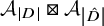 $\mathcal {A}_{\left | D \right |} \boxtimes \mathcal {A}_{\left | \hat {D} \right |}$
in the following manner:
$\mathcal {A}_{\left | D \right |} \boxtimes \mathcal {A}_{\left | \hat {D} \right |}$
in the following manner:
Definition 4.6. Let $\mathcal {A} \rightarrow M$
be a Lie algebroid and
$\mathcal {A} \rightarrow M$
be a Lie algebroid and $N \subset M$
a subset, and let
$N \subset M$
a subset, and let $\Gamma _N(\mathcal {A})$
denote the sections of
$\Gamma _N(\mathcal {A})$
denote the sections of $\mathcal {A}$
tangent to N. Then N is adapted to
$\mathcal {A}$
tangent to N. Then N is adapted to $\mathcal {A}$
if
$\mathcal {A}$
if $\operatorname {\mathrm {Sing}}(N) \subseteq \lbrace x\in M : \rho _x \text { is not of full rank} \rbrace $
and the pull-back sheaf
$\operatorname {\mathrm {Sing}}(N) \subseteq \lbrace x\in M : \rho _x \text { is not of full rank} \rbrace $
and the pull-back sheaf $\iota ^*_N\Gamma _N(\mathcal {A})$
is locally free over
$\iota ^*_N\Gamma _N(\mathcal {A})$
is locally free over $\iota ^*_NC^{\infty }(M)$
.
$\iota ^*_NC^{\infty }(M)$
.
As $\iota ^*_N\Gamma (\mathcal {A})$
is locally free, we may view it as a topological vector bundle over N. By declaring sections to be smooth if they are restrictions of smooth sections of
$\iota ^*_N\Gamma (\mathcal {A})$
is locally free, we may view it as a topological vector bundle over N. By declaring sections to be smooth if they are restrictions of smooth sections of $\mathcal {A}$
, we can view
$\mathcal {A}$
, we can view $\mathcal {A}$
as a smooth Lie algebroid over N.
$\mathcal {A}$
as a smooth Lie algebroid over N.
Example 4.7. A subspace $N \subset M$
is adapted to
$N \subset M$
is adapted to $TM$
if and only if it is an embedded submanifold. In this case the pull-back sheaf is simply given by vector fields on N.
$TM$
if and only if it is an embedded submanifold. In this case the pull-back sheaf is simply given by vector fields on N.
The rationale behind this definition is as follows. We allow subspaces to have singularities, but they need to occur precisely when the anchor of $\mathcal {A}$
is not an isomorphism.
$\mathcal {A}$
is not an isomorphism.
Example 4.8. Let $M = \mathbb {R} ^2$
, and let
$M = \mathbb {R} ^2$
, and let $\mathcal {A}$
be the Lie algebroid generated by
$\mathcal {A}$
be the Lie algebroid generated by $x\partial _x$
and
$x\partial _x$
and $y\partial _y$
. Let N denote the union of the diagonal and anti-diagonal. If
$y\partial _y$
. Let N denote the union of the diagonal and anti-diagonal. If $X = fx\partial _x + gy\partial _y$
is tangent to the diagonal, it implies it must preserve the ideal generated by
$X = fx\partial _x + gy\partial _y$
is tangent to the diagonal, it implies it must preserve the ideal generated by $x-y$
. Therefore,
$x-y$
. Therefore, $X = f(x\partial _x + y\partial _y)$
. As these vector fields are also tangent to the anti-diagonal we conclude that N is an
$X = f(x\partial _x + y\partial _y)$
. As these vector fields are also tangent to the anti-diagonal we conclude that N is an $\mathcal {A}$
-adepted subspace, and the restricted Lie algebroid is generated by
$\mathcal {A}$
-adepted subspace, and the restricted Lie algebroid is generated by $x\partial _x + y\partial _y$
From the local form of standard $T^k$
-actions, we immediately obtain the following:
$T^k$
-actions, we immediately obtain the following:
Lemma 4.9. Let $M,\hat {M}$
be standard
$M,\hat {M}$
be standard $T^k$
-actions over the same base B. Then
$T^k$
-actions over the same base B. Then $M \times _B \hat {M}$
is an
$M \times _B \hat {M}$
is an $\mathcal {A}_{\left | D \right |} \boxtimes \mathcal {A}_{\left | \hat {D} \right |}$
-adapted subspace.
$\mathcal {A}_{\left | D \right |} \boxtimes \mathcal {A}_{\left | \hat {D} \right |}$
-adapted subspace.
We denote the induced Lie algebroid on $M \times _B \hat {M}$
by
$M \times _B \hat {M}$
by $\mathcal {A}_{\left | D \right |} \times _B \mathcal {A}_{\left | \hat {D} \right |}$
.
$\mathcal {A}_{\left | D \right |} \times _B \mathcal {A}_{\left | \hat {D} \right |}$
.
5 Non-principal T-duality
Using the Lie algebroids from Section 2 we will extend the notions of T-duality to standard torus actions. To prove the existence of T-duals we will use the classification of torus actions, and the connection point of view thereof, as described in Section 3. Moreover, we will stress the differences with T-duality for principal torus bundles; in particular the new source of topology change arising from the singularities of the torus action.
5.1 T-duality
In this subsection we will recall the notions of T-duality for principal torus actions. We will be brief and refer to [Reference Bouwknegt, Evslin and Mathai3] and [Reference Cavalcanti and Gualtieri8] for more details.
Definition 5.1. Let M and $\hat {M}$
be principal
$\hat {M}$
be principal $T^k$
-bundles with base B and let
$T^k$
-bundles with base B and let $H \in \Omega ^3_{T^k}(M),\hat {H} \in \Omega ^3_{T^k}(\hat {M})$
be
$H \in \Omega ^3_{T^k}(M),\hat {H} \in \Omega ^3_{T^k}(\hat {M})$
be $T^k$
-invariant closed three-forms. Consider the fibre-product,
$T^k$
-invariant closed three-forms. Consider the fibre-product, $M\times _B \hat {M}$
, and the following diagram:
$M\times _B \hat {M}$
, and the following diagram:

We say that $(M,H)$
and
$(M,H)$
and $(\hat {M},\hat {H})$
are T-dual if there exists a
$(\hat {M},\hat {H})$
are T-dual if there exists a $T^{2k}$
-invariant two-form
$T^{2k}$
-invariant two-form $F \in \Omega ^2_{T^{2k}}(M\times _B\hat {M})$
such that
$F \in \Omega ^2_{T^{2k}}(M\times _B\hat {M})$
such that
 $$ \begin{align*} dF = p^*H - \hat{p}^*\hat{H}, \end{align*} $$
and the restriction
 $$ \begin{align*} F : \mathfrak{t}_M \times \mathfrak{t}_{\hat{M}} \rightarrow \mathbb{R}, \end{align*} $$
where $\mathfrak {t}_M,\mathfrak {t}_{\hat {M}}$
denotes the tangent space to the fibres of p,
$\mathfrak {t}_M,\mathfrak {t}_{\hat {M}}$
denotes the tangent space to the fibres of p, $\hat {p}$
respectively, is non-degenerate. We call
$\hat {p}$
respectively, is non-degenerate. We call $M \times _B \hat {M}$
the correspondence space.
$M \times _B \hat {M}$
the correspondence space.
T-duals always exist, provided the three-form is integral:
Theorem 5.2 [Reference Bouwknegt, Evslin and Mathai3]
Let $M \rightarrow B$
be a principal
$M \rightarrow B$
be a principal $T^k$
-bundle, and
$T^k$
-bundle, and $H \in \Omega ^3_{T^k}(M)$
with integral cohomology class. Then there exists a principal
$H \in \Omega ^3_{T^k}(M)$
with integral cohomology class. Then there exists a principal $T^k$
-bundle,
$T^k$
-bundle, $\hat {M}$
T-dual to M.
$\hat {M}$
T-dual to M.
T-dual spaces have isomorphic complexes of invariant differential forms:
Theorem 5.3 [Reference Bouwknegt, Evslin and Mathai3]
Let $(M,H)$
and
$(M,H)$
and $(\hat {M},\hat {H})$
be T-dual with
$(\hat {M},\hat {H})$
be T-dual with $dF = p^*H -\tilde {p}^*\hat {H}$
. Then
$dF = p^*H -\tilde {p}^*\hat {H}$
. Then
 $$ \begin{align*} \tau :(\Omega^{\bullet}_{T^k}(M),d_H) \rightarrow (\Omega^{\bullet}_{T^k}(\hat{M}),d_{\hat{H}}), \quad \rho \mapsto \int_{T^k}e^F \wedge p^*\rho, \end{align*} $$
is an isomorphism of cochain complexes. Here the integral is over the fibres of $\tilde {p}$
.
$\tilde {p}$
.
5.2 Courant algebroids
T-duality induces an isomorphism of invariant sections of the standard Courant algebroid:
Theorem 5.4 [Reference Cavalcanti and Gualtieri8]
If $(M,H)$
and
$(M,H)$
and $(\hat {M},\hat {H})$
are T-dual, then there is an isomorphism of Courant algebroids
$(\hat {M},\hat {H})$
are T-dual, then there is an isomorphism of Courant algebroids
 $$ \begin{align*} \varphi : (TM \oplus T^*M)/T^k \rightarrow (T\hat{M} \oplus T^*\hat{M})/T^k, \end{align*} $$
such that $\tau (v\cdot \rho ) = \varphi (v) \cdot \tau (\rho )$
, for all
$\tau (v\cdot \rho ) = \varphi (v) \cdot \tau (\rho )$
, for all $v\in (TM \oplus T^*M)/T^k$
and
$v\in (TM \oplus T^*M)/T^k$
and $\rho \in \Omega ^{\bullet }(M)$
.
$\rho \in \Omega ^{\bullet }(M)$
.
The strength of this description is that it immediately allows one to transport structures:
Theorem 5.5 [Reference Cavalcanti and Gualtieri8]
Let $(M,H)$
and
$(M,H)$
and $(\hat {M},\hat {H})$
be T-dual spaces. Then any Dirac, generalized complex, generalized Kähler or SKT structure on M which is invariant under the torus action is transformed via
$(\hat {M},\hat {H})$
be T-dual spaces. Then any Dirac, generalized complex, generalized Kähler or SKT structure on M which is invariant under the torus action is transformed via $\varphi $
into a structure of the same kind on
$\varphi $
into a structure of the same kind on $\hat {M}$
.
$\hat {M}$
.
We are now ready to introduce the notion of T-duality for standard torus actions:
Definition 5.6. Let $M,\hat {M}$
be two manifolds endowed with standard
$M,\hat {M}$
be two manifolds endowed with standard $T^k$
-actions over the same base B and let
$T^k$
-actions over the same base B and let $I_{\left | D \right |},I_{\left | \hat {D} \right |}$
be the induced elliptic divisors. Furthermore, suppose we are given
$I_{\left | D \right |},I_{\left | \hat {D} \right |}$
be the induced elliptic divisors. Furthermore, suppose we are given $H \in \Omega ^3_{\mathrm {cl}}(\mathcal {A}_{\left | D \right |}), \hat {H} \in \Omega ^3_{\mathrm {cl}}(\mathcal {A}_{\left | \hat {D} \right |})$
closed and
$H \in \Omega ^3_{\mathrm {cl}}(\mathcal {A}_{\left | D \right |}), \hat {H} \in \Omega ^3_{\mathrm {cl}}(\mathcal {A}_{\left | \hat {D} \right |})$
closed and $T^k$
-invariant. We consider the following diagram:
$T^k$
-invariant. We consider the following diagram:

We say that $(M,H)$
and
$(M,H)$
and $(\hat {M},\hat {H})$
are T-dual if there exists a
$(\hat {M},\hat {H})$
are T-dual if there exists a $T^{2k}$
-invariant two-form
$T^{2k}$
-invariant two-form $F \in \Omega ^2(\mathcal {A}_{\left | D \right |} \times _B \mathcal {A}_{\left | \hat {D} \right |})$
such that
$F \in \Omega ^2(\mathcal {A}_{\left | D \right |} \times _B \mathcal {A}_{\left | \hat {D} \right |})$
such that $p^*H-\hat {p}^*\hat {H} = dF$
and
$p^*H-\hat {p}^*\hat {H} = dF$
and
 $$ \begin{align} F : \mathfrak{t}_{M} \otimes \mathfrak{t}_{\hat{M}} \rightarrow \mathbb{R}, \end{align} $$
is non-degenerate.
Let us expand on this definition. First $\mathcal {A}_{\left | D \right |}\times _B \mathcal {A}_{\left | \hat {D} \right |}$
is the Lie algebroid induced by viewing
$\mathcal {A}_{\left | D \right |}\times _B \mathcal {A}_{\left | \hat {D} \right |}$
is the Lie algebroid induced by viewing $M \times _B \hat {M}$
as an
$M \times _B \hat {M}$
as an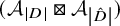 $(\mathcal {A}_{\left | D \right |}\boxtimes \mathcal {A}_{\left | \hat {D} \right |})$
-adapted subspace of
$(\mathcal {A}_{\left | D \right |}\boxtimes \mathcal {A}_{\left | \hat {D} \right |})$
-adapted subspace of $M \times \hat {M}$
. The two-form F is a form for this Lie algebroid, and can in practice be thought of as the restriction of a two-form
$M \times \hat {M}$
. The two-form F is a form for this Lie algebroid, and can in practice be thought of as the restriction of a two-form $\tilde {F} \in \Omega ^2(\mathcal {A}_{\left | D \right |}\boxtimes \mathcal {A}_{\left | \hat {D} \right |})$
. Here
$\tilde {F} \in \Omega ^2(\mathcal {A}_{\left | D \right |}\boxtimes \mathcal {A}_{\left | \hat {D} \right |})$
. Here $\mathfrak {t}_{M_i}$
denotes the kernel of the Lie algebroid submersion
$\mathfrak {t}_{M_i}$
denotes the kernel of the Lie algebroid submersion $\mathcal {A}_{\left | D \right |}\times _B \mathcal {A}_{\left | \hat {D} \right |} \rightarrow \mathcal {A}_{\left | D_i \right |}$
induced by
$\mathcal {A}_{\left | D \right |}\times _B \mathcal {A}_{\left | \hat {D} \right |} \rightarrow \mathcal {A}_{\left | D_i \right |}$
induced by $p_i$
.
$p_i$
.
Example 5.7. Consdier $\mathbb {C} $
with the standard
$\mathbb {C} $
with the standard $S^1$
-action, and
$S^1$
-action, and $H = 0$
. Then
$H = 0$
. Then $F = d\theta _1 \wedge d\theta _2$
provides a T-dual from
$F = d\theta _1 \wedge d\theta _2$
provides a T-dual from $(\mathbb {C} ,0)$
to itself.
$(\mathbb {C} ,0)$
to itself.
A connection one-form $\Theta \in \Omega ^1(\mathcal {A}_{\left | D \right |};\mathfrak {t})$
induces an isomorphism
$\Theta \in \Omega ^1(\mathcal {A}_{\left | D \right |};\mathfrak {t})$
induces an isomorphism $\mathcal {A}_{\left | D \right |}/S^1 \simeq \mathfrak {t} \oplus \mathcal {A}_{\partial B}$
, therefore, we obtain a decomposition
$\mathcal {A}_{\left | D \right |}/S^1 \simeq \mathfrak {t} \oplus \mathcal {A}_{\partial B}$
, therefore, we obtain a decomposition
 $$ \begin{align*} \Omega^3_{T^k}(\mathcal{A}_{\left| D \right|}) = \sum_{i=0}^3\Omega^i(\mathcal{A}_{\partial B},\wedge^{3-i}\mathfrak{t}^*). \end{align*} $$
The T-duality conditions forces the component of H in $\Omega ^0(\mathcal {A}_{\partial B};\wedge ^3 t^*)$
to vanish, and the component in
$\Omega ^0(\mathcal {A}_{\partial B};\wedge ^3 t^*)$
to vanish, and the component in $\Omega ^1(\mathcal {A}_{\partial B};\wedge ^2 t^*)$
to be exact. When considering geometric structures (up to gauge equivalence), it is the cohomology class
$\Omega ^1(\mathcal {A}_{\partial B};\wedge ^2 t^*)$
to be exact. When considering geometric structures (up to gauge equivalence), it is the cohomology class $[H]$
, rather than the form itself, which is of importance. Hence we can impose that we consider H which only have two terms in this decomposition:
$[H]$
, rather than the form itself, which is of importance. Hence we can impose that we consider H which only have two terms in this decomposition:
 $$ \begin{align} H = \left\langle \hat{c},\Theta \right\rangle + h, \end{align} $$
for some $\hat {c} \in \Omega ^2(\mathcal {A}_{\partial B};\mathfrak {t}^*)$
and
$\hat {c} \in \Omega ^2(\mathcal {A}_{\partial B};\mathfrak {t}^*)$
and $h \in \Omega ^3(\mathcal {A}_{\partial B})$
. Using this decomposition, and the relation of the curvature with the Haefliger-Salem class, we can now address the question of existence of T-duals.
$h \in \Omega ^3(\mathcal {A}_{\partial B})$
. Using this decomposition, and the relation of the curvature with the Haefliger-Salem class, we can now address the question of existence of T-duals.
Theorem 5.8. Let $M \rightarrow B$
be a manifold endowed with a standard
$M \rightarrow B$
be a manifold endowed with a standard $T^k$
and an invariant closed three-form
$T^k$
and an invariant closed three-form $H \in \Omega ^3(\mathcal {A}_{\left | D \right |})$
. If
$H \in \Omega ^3(\mathcal {A}_{\left | D \right |})$
. If $[\hat {c}]$
as in Equation (5.2) defines a class in
$[\hat {c}]$
as in Equation (5.2) defines a class in $H^2(B;\mathbb {Z}^k)$
, then there exists a T-dual
$H^2(B;\mathbb {Z}^k)$
, then there exists a T-dual $\hat {M} \rightarrow B$
.
$\hat {M} \rightarrow B$
.
Proof. Let $M_0 \rightarrow B$
, be the reference torus action of M. Using Proposition 3.4, with respect to
$M_0 \rightarrow B$
, be the reference torus action of M. Using Proposition 3.4, with respect to $M_0$
and
$M_0$
and $\hat {M}$
, the class
$\hat {M}$
, the class $[\hat {c}] \in H^2(B;\mathbb {Z} ^k)$
corresponds to a manifold
$[\hat {c}] \in H^2(B;\mathbb {Z} ^k)$
corresponds to a manifold $\hat {M} \rightarrow B$
endowed with a locally equivalent action. Moreover, there exists a connection
$\hat {M} \rightarrow B$
endowed with a locally equivalent action. Moreover, there exists a connection $\hat {\Theta } \in \Omega ^1(\mathcal {A}_{\left | \hat {D} \right |};\mathfrak {t}^k)$
for which
$\hat {\Theta } \in \Omega ^1(\mathcal {A}_{\left | \hat {D} \right |};\mathfrak {t}^k)$
for which $d\hat {\Theta } = \hat {c}$
. Now define
$d\hat {\Theta } = \hat {c}$
. Now define
 $$ \begin{align*} \hat{H} = \left\langle c,\hat{\Theta} \right\rangle+h \in \Omega^3(\mathcal{A}_{\left| \hat{D} \right|}), \end{align*} $$
with $c = d\Theta $
, for some connection
$c = d\Theta $
, for some connection $\Theta \in \Omega ^1(M;\mathfrak {t}^k)$
. Now
$\Theta \in \Omega ^1(M;\mathfrak {t}^k)$
. Now $(M,H)$
and
$(M,H)$
and $(\hat {M},\hat {H})$
are T-dual because
$(\hat {M},\hat {H})$
are T-dual because
 $$ \begin{align*} p^*H-\tilde{p}^*\hat{H} = \left\langle \hat{c},\Theta \right\rangle - \left\langle c,\hat{\Theta} \right\rangle = \left\langle d\hat{\Theta},\Theta \right\rangle - \left\langle d\Theta,\hat{\Theta} \right\rangle = - d\left\langle \Theta,\hat{\Theta} \right\rangle, \end{align*} $$
and as $\Theta $
and
$\Theta $
and $\hat {\Theta }$
are connection-one-forms, we obtain that
$\hat {\Theta }$
are connection-one-forms, we obtain that $F =- \left \langle \Theta ,\hat {\Theta } \right \rangle $
satisfies the requirements of T-duality.
$F =- \left \langle \Theta ,\hat {\Theta } \right \rangle $
satisfies the requirements of T-duality.
Remark 5.9. Note that it might be preferable to put a direct condition on H, rather than the $[\hat {c}]$
in the decomposition. However, this will also impose further conditions on the h term which are not strictly necessary. Still, in practice we will assume that H is smooth and defines an integral cohomology class, which implies the assumptions in Theorem 5.8
$[\hat {c}]$
in the decomposition. However, this will also impose further conditions on the h term which are not strictly necessary. Still, in practice we will assume that H is smooth and defines an integral cohomology class, which implies the assumptions in Theorem 5.8
Remark 5.10 (Non-uniqueness)
This proposition provides the existence of T-duals, but these are by no means unique. Already in the case without fixed points, the construction does not take any torsion of the torus bundle into account. But also changing the specific F used may change the topology of the resulting T-dual, see also Bunke-Schick [Reference Bunke and Schick5]. Now the non uniqueness goes even further: because we made use of the classification of Haefliger-Salem, any T-dual produced using Proposition 5.8 will necessarily be locally equivalent to M. However, that needn’t be the case as we will see momentarily.
5.2.1 Topology change from singularities
The singularities of the torus actions provide a new source of topology change for T-duals:
Proposition 5.11. Let $M,\hat {M}$
be manifolds with standard
$M,\hat {M}$
be manifolds with standard $T^k$
-actions over the same contractible base B. Then
$T^k$
-actions over the same contractible base B. Then $(M,H=0)$
and
$(M,H=0)$
and $(\hat {M},\hat {H}=0)$
are T-dual.
$(\hat {M},\hat {H}=0)$
are T-dual.
Proof. Because the base of M and $\hat {M}$
is contractible there exists flat connections
$\hat {M}$
is contractible there exists flat connections $\Theta ,\hat {\Theta }$
on M respectively
$\Theta ,\hat {\Theta }$
on M respectively $\hat {M}$
. Then, as in the proof of Proposition 5.8 (the restriction of)
$\hat {M}$
. Then, as in the proof of Proposition 5.8 (the restriction of) $F = -\left \langle \Theta ,\hat {\Theta } \right \rangle $
provides a T-dual between
$F = -\left \langle \Theta ,\hat {\Theta } \right \rangle $
provides a T-dual between $(M,0)$
and
$(M,0)$
and $(\hat {M},0)$
.
$(\hat {M},0)$
.
In [Reference Orlik and Raymond20] a classification of four-manifolds with effective $T^2$
-actions and connected isotropy groups appears. All such manifolds are of the following form:
$T^2$
-actions and connected isotropy groups appears. All such manifolds are of the following form:
-
○
$\#n (S^2\times S^2)$
,
$n \in \mathbb {N}$
-
○
$\#n (\mathbb {C} P^2) \# m(\overline {\mathbb {C} P^2})$
,
$n,m \in \mathbb {N}$
-
○
$S^4$


All of these manifolds have a contractible base, so we conclude by the above Theorem that if two have the same base they are T-dual. The only invariant of the base is the number of corners, which can be read of from the Euler characteristic of the total space. For instance $2\mathbb {C}P^2,\mathbb {C}P^2\# \overline {\mathbb {C} P^2}$
and
$2\mathbb {C}P^2,\mathbb {C}P^2\# \overline {\mathbb {C} P^2}$
and $S^2\times S^2$
are all T-dual. The common base of these manifolds is contractible, and hence the actions are necessarily not locally equivalent. For if the actions were locally equivalent, Theorem 3.1 would imply that these spaces are all diffeomorphic.
$S^2\times S^2$
are all T-dual. The common base of these manifolds is contractible, and hence the actions are necessarily not locally equivalent. For if the actions were locally equivalent, Theorem 3.1 would imply that these spaces are all diffeomorphic.
Just as in principal T-duality, we obtain an isomorphism of differential complexes. The proof is omitted as it is identical with only the minor change that instead of developing the operation of push-forward/fiber integration we use the equivalent operation of ‘interior product with a top degree multi-vector field’ which is readily understood in the Lie algebroid context.
Proposition 5.12. Let $M,\hat {M}$
be manifolds endowed with standard
$M,\hat {M}$
be manifolds endowed with standard $T^k$
-actions over the same base B. Let
$T^k$
-actions over the same base B. Let $H \in \Omega ^3_{\mathrm {cl}}(\mathcal {A}_{\left | D \right |}),\hat {H} \in \Omega ^3_{\mathrm {cl}}(\mathcal {A}_{\left | \hat {D} \right |})$
, and let
$H \in \Omega ^3_{\mathrm {cl}}(\mathcal {A}_{\left | D \right |}),\hat {H} \in \Omega ^3_{\mathrm {cl}}(\mathcal {A}_{\left | \hat {D} \right |})$
, and let $F \in \Omega ^2(\mathcal {A}_{\left | D \right |} \times _B \mathcal {A}_{\left | \hat {D} \right |})$
provide a T-dual. Then
$F \in \Omega ^2(\mathcal {A}_{\left | D \right |} \times _B \mathcal {A}_{\left | \hat {D} \right |})$
provide a T-dual. Then
 $$ \begin{align} \tau : \Omega^{\bullet}_{T^k}(\mathcal{A}_{\left| D \right|}) \rightarrow \Omega^{\bullet}_{T^k}(\mathcal{A}_{\left| \hat{D} \right|}), \quad \tau(\rho) = \iota_{X_1\wedge \cdots \wedge X_n} (e^F\wedge \rho), \end{align} $$
is an isomorphism of differential complexes $(\Omega ^{\bullet }_{T^k}(M;\mathcal {A}_{\left | D \right |}),d_{H})$
and
$(\Omega ^{\bullet }_{T^k}(M;\mathcal {A}_{\left | D \right |}),d_{H})$
and $(\Omega ^{\bullet }_{T^k}(\hat {M};\mathcal {A}_{\left | \hat {D} \right |}),d_{\hat {H}})$
. Here
$(\Omega ^{\bullet }_{T^k}(\hat {M};\mathcal {A}_{\left | \hat {D} \right |}),d_{\hat {H}})$
. Here $X_1,\ldots ,X_n \in \Gamma (\mathcal {A}_{\left | D \right |})$
are the infinitesimal generators of the torus action on M.
$X_1,\ldots ,X_n \in \Gamma (\mathcal {A}_{\left | D \right |})$
are the infinitesimal generators of the torus action on M.
Moreover, we may consider the standard $\mathcal {A}_{\left | D \right |}$
-Courant algebroid,
$\mathcal {A}_{\left | D \right |}$
-Courant algebroid,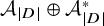 $\mathcal {A}_{\left | D \right |} \oplus \mathcal {A}_{\left | D \right |}^*$
, and obtain Theorem 5.4 in our setting. Again, the proof is identical to the principal case and thus omitted.
$\mathcal {A}_{\left | D \right |} \oplus \mathcal {A}_{\left | D \right |}^*$
, and obtain Theorem 5.4 in our setting. Again, the proof is identical to the principal case and thus omitted.
Theorem 5.13. Let $M,\hat {M}$
be manifolds endowed with standard
$M,\hat {M}$
be manifolds endowed with standard $T^k$
-actions over the same base B. Let
$T^k$
-actions over the same base B. Let $H \in \Omega ^3_{\mathrm { cl}}(\mathcal {A}_{\left | D \right |}),\hat {H} \in \Omega ^3_{\mathrm {cl}}(\mathcal {A}_{\left | \hat {D} \right |})$
, and assume that
$H \in \Omega ^3_{\mathrm { cl}}(\mathcal {A}_{\left | D \right |}),\hat {H} \in \Omega ^3_{\mathrm {cl}}(\mathcal {A}_{\left | \hat {D} \right |})$
, and assume that $(M,H)$
and
$(M,H)$
and $(\hat {M},\hat {H})$
are T-dual. Then there is an isomorphism between Courant algebroids
$(\hat {M},\hat {H})$
are T-dual. Then there is an isomorphism between Courant algebroids $(\mathcal {A}_{\left | D \right |} \oplus \mathcal {A}_{\left | \hat {D} \right |}^*)/T^k \rightarrow M$
and
$(\mathcal {A}_{\left | D \right |} \oplus \mathcal {A}_{\left | \hat {D} \right |}^*)/T^k \rightarrow M$
and $(\mathcal {A}_{\left | D \right |} \oplus \mathcal {A}_{\left | \hat {D} \right |}^*)/T^k \rightarrow \hat {M}$
.
$(\mathcal {A}_{\left | D \right |} \oplus \mathcal {A}_{\left | \hat {D} \right |}^*)/T^k \rightarrow \hat {M}$
.
Using this isomorphism we are able to transport geometric structures on $\mathcal {A}_{\left | D \right |} \rightarrow M$
to geometric structures on
$\mathcal {A}_{\left | D \right |} \rightarrow M$
to geometric structures on $\mathcal {A}_{\left | \hat {D} \right |} \rightarrow \hat {M}$
:
$\mathcal {A}_{\left | \hat {D} \right |} \rightarrow \hat {M}$
:
Theorem 5.14. Let $(M,H)$
and
$(M,H)$
and $(\hat {M},\hat {H})$
be T-dual. Then any Dirac, generalized complex or SKT structure on
$(\hat {M},\hat {H})$
be T-dual. Then any Dirac, generalized complex or SKT structure on $\mathcal {A}_{\left | D \right |} \rightarrow M$
invariant under the torus action will be transported to a structure of the same kind on
$\mathcal {A}_{\left | D \right |} \rightarrow M$
invariant under the torus action will be transported to a structure of the same kind on $\mathcal {A}_{\left | D \right |} \rightarrow \hat {M}$
.
$\mathcal {A}_{\left | D \right |} \rightarrow \hat {M}$
.
However, there is one key difference compared to the case of principal T-duality. Given a $T^k$
-invariant generalized complex structure on M which lifts to a generalized complex structure on
$T^k$
-invariant generalized complex structure on M which lifts to a generalized complex structure on $\mathcal {A}_{\left | D \right |} \rightarrow M$
, we can transport it to a generalized complex structure on
$\mathcal {A}_{\left | D \right |} \rightarrow M$
, we can transport it to a generalized complex structure on $\mathcal {A}_{\left | \hat {D} \right |} \rightarrow \hat {M}$
. However, a prior there is no guarantee that it again descends to a generalized complex structure on M. We illustrate this phenomenon by the following examples:
$\mathcal {A}_{\left | \hat {D} \right |} \rightarrow \hat {M}$
. However, a prior there is no guarantee that it again descends to a generalized complex structure on M. We illustrate this phenomenon by the following examples:
Example 5.15 (
$\mathbb {\mathbb {C} }$
)

Consider $M = \mathbb {C} $
with the standard
$M = \mathbb {C} $
with the standard $S^1$
-action, and endow it with the elliptic symplectic form
$S^1$
-action, and endow it with the elliptic symplectic form $d\log r \wedge d\theta = \frac {dx \wedge dy}{x^2+y^2}$
. If we let
$d\log r \wedge d\theta = \frac {dx \wedge dy}{x^2+y^2}$
. If we let $\hat {M} = \mathbb {C} $
denote another another copy of
$\hat {M} = \mathbb {C} $
denote another another copy of $\mathbb {C} $
, we have that
$\mathbb {C} $
, we have that $F= d\theta \wedge d\hat {\theta }$
provides a T-dual. Under this T-duality, the elliptic symplectic structures
$F= d\theta \wedge d\hat {\theta }$
provides a T-dual. Under this T-duality, the elliptic symplectic structures $e^{id\log r \wedge d\theta }$
is send to spinor
$e^{id\log r \wedge d\theta }$
is send to spinor $d\log \hat {z}$
. This spinor corresponds to the complex structure on
$d\log \hat {z}$
. This spinor corresponds to the complex structure on $\mathcal {A}_{\left | D \right |} = \lbrace r\partial _r,\partial _{\theta } \rbrace $
defined by
$\mathcal {A}_{\left | D \right |} = \lbrace r\partial _r,\partial _{\theta } \rbrace $
defined by $r\partial _r \mapsto \partial _{\theta }$
. It is immediate to see that this complex structure is a lift of the standard complex structure on
$r\partial _r \mapsto \partial _{\theta }$
. It is immediate to see that this complex structure is a lift of the standard complex structure on $\mathbb {C} $
. Hence we conclude that the elliptic symplectic form, which is not a generalized complex structure, is T-dual to the standard complex structure.
$\mathbb {C} $
. Hence we conclude that the elliptic symplectic form, which is not a generalized complex structure, is T-dual to the standard complex structure.
The next example will illustrate that T-duality for standard torus actions is very sensitive to the specific $F \in \Omega ^2(\mathcal {A}_{\left | D \right |} \times _B \mathcal {A}_{\left | \hat {D} \right |})$
chosen:
$F \in \Omega ^2(\mathcal {A}_{\left | D \right |} \times _B \mathcal {A}_{\left | \hat {D} \right |})$
chosen:
Example 5.16 (
$\mathbb {\mathbb {C} }^2$
)

Consider $M = \mathbb {C} ^2$
with coordinates
$M = \mathbb {C} ^2$
with coordinates $(z_1,z_2)$
and
$(z_1,z_2)$
and $\hat {M} = \mathbb {C} ^2$
with coordinates
$\hat {M} = \mathbb {C} ^2$
with coordinates $(\hat {z}_1,\hat {z}_2)$
. Endow both with the standard
$(\hat {z}_1,\hat {z}_2)$
. Endow both with the standard $T^2$
-action. There are ample choices for a T-duality between
$T^2$
-action. There are ample choices for a T-duality between $(M,0)$
and
$(M,0)$
and $(\hat {M},0)$
. Indeed, any of the following two-forms will suffice:
$(\hat {M},0)$
. Indeed, any of the following two-forms will suffice:
-
○
$F_{1,\pm } = d\theta _1 \wedge d\hat {\theta }_1 \pm d\theta _2 \wedge d\hat {\theta }_2$
. -
○
$F_{2,\pm } = -d\theta _1 \wedge d\hat {\theta }_2 \pm d\theta _2 \wedge d\hat {\theta }_1$
.


Although each of these forms satisfy the conditions necessary of T-duality, the behaviour with respect to specific generalized complex structures is quite different.
We consider the stable generalized complex structure given by $\rho = z_1z_2 + dz_1 \wedge dz_2$
. The corresponding elliptic symplectic form is
$\rho = z_1z_2 + dz_1 \wedge dz_2$
. The corresponding elliptic symplectic form is $\omega = d\log r_1 \wedge d\theta _2 + d\theta _1 \wedge d\log r_2$
with spinor
$\omega = d\log r_1 \wedge d\theta _2 + d\theta _1 \wedge d\log r_2$
with spinor $\rho = 1 + id\log r_1 \wedge d\theta _2 + id\theta _1 \wedge d\log r_2 - d\log r_1 \wedge d\theta _1 \wedge d\log r_2 \wedge d\theta _2$
.
$\rho = 1 + id\log r_1 \wedge d\theta _2 + id\theta _1 \wedge d\log r_2 - d\log r_1 \wedge d\theta _1 \wedge d\log r_2 \wedge d\theta _2$
.
By Theorem 5.14 we know that T-duality with any of these forms will provide generalized complex structures on the elliptic tangent bundle. However, a direct computation will show that only $F_{2,+}$
provides a generalized complex structure on M. In that case we have that the T-dual generalized complex structure is given by:
$F_{2,+}$
provides a generalized complex structure on M. In that case we have that the T-dual generalized complex structure is given by:
 $$ \begin{align*} \rho_{2,+} = d\log z_1 \wedge d\log z_2. \end{align*} $$
One immediately checks that $\rho _{2,+}$
is a lift of the standard complex structure on
$\rho _{2,+}$
is a lift of the standard complex structure on $\mathbb {C} $
. In conclusion, this elliptic symplectic structure on
$\mathbb {C} $
. In conclusion, this elliptic symplectic structure on $\mathbb {C} ^2$
is T-dual to the standard complex structure on
$\mathbb {C} ^2$
is T-dual to the standard complex structure on $\mathbb {C}^2$
.
$\mathbb {C}^2$
.
The story for the real part of $\rho $
is quite different. Consider the elliptic symplectic form
$\rho $
is quite different. Consider the elliptic symplectic form $\omega = d\log r_1 \wedge d\log r_2 - d\theta _1 \wedge d\theta _2$
, with spinor
$\omega = d\log r_1 \wedge d\log r_2 - d\theta _1 \wedge d\theta _2$
, with spinor
 $$ \begin{align*} \rho = 1 + i d\log r_1 \wedge d\log r_2 - id\theta_1 \wedge d\theta_2 + d\theta_1 \wedge d\theta_2 \wedge d\log r_1 \wedge d\log r_2. \end{align*} $$
Again, one can perform a direct computation showing that only $F_{1,-}$
will provide a generalized complex structure on M. In that case the T-dual is given by:
$F_{1,-}$
will provide a generalized complex structure on M. In that case the T-dual is given by:
 $$ \begin{align*} -ie^{-i(d\log r_1 \wedge d\log r_2 + d\hat{\theta}_1 \wedge d\hat{\theta_2})} \end{align*} $$
In conclusion we see that $\rho $
is T-dual to itself.
$\rho $
is T-dual to itself.
6 Blow-ups
In this section we will study the interaction between elliptic geometry and blow-ups. We will work with the formalism of generalized complex blow-ups introduced in [Reference Bailey, Cavalcanti and Duran2]. We will show that blow-ups of submanifolds of the degeneracy locus of an elliptic divisor induce Lie algebroid submersions between the respective elliptic tangent bundles. Torus actions are preserved by blow-ups at fixed points, and hence we may consider the relation with T-duality. We will show that T-duality and blowing up commutes.
6.1 Blow-ups in generalized complex geometry
The contents of this subsection appear in [Reference Bailey, Cavalcanti and Duran2], we recall them for completeness.
As we do not assume any holomorphicity of our manifolds, more data is necessary in constructing a blow-up:
Definition 6.1 [Reference Bailey, Cavalcanti and Duran2]
Let $M^n$
be a smooth manifold, and let Y be a closed embedded submanifold of codimension
$M^n$
be a smooth manifold, and let Y be a closed embedded submanifold of codimension $2l$
. A holomorphic ideal for Y is a sheaf of ideals
$2l$
. A holomorphic ideal for Y is a sheaf of ideals $I_Y \subset C^{\infty }(M;\mathbb {C} )$
such that:
$I_Y \subset C^{\infty }(M;\mathbb {C} )$
such that:
-
○
$I_Y|_{M\backslash Y} = C^{\infty }(M;\mathbb {C} )|_{M\backslash Y}$
. -
○ For every
$y \in Y$
, there is a neighbourhood U with coordinates
$z_1,\ldots ,z_l,x_{2l+1},\ldots ,x_n : U \rightarrow \mathbb {C} ^l\times \mathbb {R} ^{n-2l}$
such that
$Y \cap U = \lbrace z_1=\ldots =z_l = 0 \rbrace $
and
$I_Y|_U = \left \langle z_1,\ldots , z_l \right \rangle $
.




As shown in [Reference Bailey, Cavalcanti and Duran2], a submanifold Y admits a holomorphic ideal if and only if the normal bundle $NY$
admits a complex structure.
$NY$
admits a complex structure.
Theorem 6.2 [Reference Bailey, Cavalcanti and Duran2]
Given a submanifold Y and a holomorphic ideal $I_Y$
, there exists a, unique up to isomorphism, manifold
$I_Y$
, there exists a, unique up to isomorphism, manifold $\tilde {M}$
together with a map
$\tilde {M}$
together with a map $p : \tilde {M} \rightarrow M$
such that
$p : \tilde {M} \rightarrow M$
such that $p^*I_Y$
is a divisor satisfying the following universal property: For any smooth map
$p^*I_Y$
is a divisor satisfying the following universal property: For any smooth map $f : X \rightarrow M$
, such that
$f : X \rightarrow M$
, such that $f^*I_Y$
is a divisor, there exists a unique
$f^*I_Y$
is a divisor, there exists a unique $\tilde {f} : X \rightarrow \tilde {M}$
such that the following diagram commutes:
$\tilde {f} : X \rightarrow \tilde {M}$
such that the following diagram commutes:

We call $\tilde {M}$
the blow-up of
$\tilde {M}$
the blow-up of $\boldsymbol{I}_{\boldsymbol{Y}}$
in
$\boldsymbol{I}_{\boldsymbol{Y}}$
in $\boldsymbol{M}$
, and
$\boldsymbol{M}$
, and $p : \tilde {M} \rightarrow M$
the blow-down map. The natural manifolds one can blow-up in generalized complex geometry are the following:
$p : \tilde {M} \rightarrow M$
the blow-down map. The natural manifolds one can blow-up in generalized complex geometry are the following:
Definition 6.3 [Reference Bailey, Cavalcanti and Duran2]
Let $(M,\mathbb {J},H)$
be a generalized complex manifold. A submanifold Y is called generalized Poisson if
$(M,\mathbb {J},H)$
be a generalized complex manifold. A submanifold Y is called generalized Poisson if
 $$ \begin{align*} \mathbb{J} N^*Y = N^*Y. \end{align*} $$
An immediate consequence of this definition is that Y is a Poisson submanifold of the underlying Poisson structure $\pi _{\mathbb {J}}$
. Moreover, if Q is a holomorphic Poisson submanifold and
$\pi _{\mathbb {J}}$
. Moreover, if Q is a holomorphic Poisson submanifold and $\mathbb {J}_{Q}$
is the associated generalized complex structure, a submanifold Y is a generalized Poisson submanifold if and only if it is a holomorphic Poisson submanifold.
$\mathbb {J}_{Q}$
is the associated generalized complex structure, a submanifold Y is a generalized Poisson submanifold if and only if it is a holomorphic Poisson submanifold.
By definition, the generalized complex structure induces a complex structure on the normal bundle of a generalized Poisson submanifold. Hence:
Lemma 6.4 [Reference Bailey, Cavalcanti and Duran2]
Let $(M,\mathbb {J},H)$
be a generalized complex manifold and Y a generalized Poisson submanifold. Then there exist a canonical holomorphic ideal
$(M,\mathbb {J},H)$
be a generalized complex manifold and Y a generalized Poisson submanifold. Then there exist a canonical holomorphic ideal $I_Y$
for Y for which the induced complex structure on
$I_Y$
for Y for which the induced complex structure on $NY$
coincides with the one induced by
$NY$
coincides with the one induced by $\mathbb {J}$
.
$\mathbb {J}$
.
Given that a generalized Poisson submanifold gives rise to a holomorphic ideal, and hence a canonical blow-up, the next step is to determine when the generalized complex structure lifts to the blow-up. For this we need the following notion:
Definition 6.5. A Lie algebra $\mathfrak {g}$
is said to be degenerate if the map
$\mathfrak {g}$
is said to be degenerate if the map $\Lambda ^3(\mathfrak {g}) \rightarrow \mathrm {Sym}^2(\mathfrak {g})$
 $$ \begin{align*} x\wedge y \wedge z \mapsto [x,y] \wedge z, \end{align*} $$
vanishes.
Given a generalized Poisson submanifold $Y \subset (M,\mathbb {J})$
, it is in particular a Poisson submanifold and hence one obtains a fibre-wise Lie algebra structure on
$Y \subset (M,\mathbb {J})$
, it is in particular a Poisson submanifold and hence one obtains a fibre-wise Lie algebra structure on $N^*Y$
. This Lie algebra structure captures whether the generalized complex structure lifts to the blow-up:
$N^*Y$
. This Lie algebra structure captures whether the generalized complex structure lifts to the blow-up:
Theorem 6.6 [Reference Bailey, Cavalcanti and Duran2]
Let $(M,\mathbb {J},H)$
be a generalized complex manifold and Y a generalized Poisson submanifold. Then there exists a generalized complex structure
$(M,\mathbb {J},H)$
be a generalized complex manifold and Y a generalized Poisson submanifold. Then there exists a generalized complex structure $\tilde {\mathbb {J}}$
on the blow-up
$\tilde {\mathbb {J}}$
on the blow-up $p : \tilde {M} \rightarrow M$
, with respect to the canonical holomorphic ideal
$p : \tilde {M} \rightarrow M$
, with respect to the canonical holomorphic ideal $I_Y$
, for which p is a generalized holomorphic map, if and only if the Lie algebra structure on
$I_Y$
, for which p is a generalized holomorphic map, if and only if the Lie algebra structure on $N^*Y$
is degenerate.
$N^*Y$
is degenerate.
We may blow-up components of the degeneracy locus of a stable generalized complex structure:
Lemma 6.7. Let $(M,\mathbb {J})$
be a stable generalized complex manifold, and let
$(M,\mathbb {J})$
be a stable generalized complex manifold, and let $Y \subset D(l)$
be an irreducible component. Then Y is a generalized Poisson submanifold for which the fibre-wise Lie algebra structure on
$Y \subset D(l)$
be an irreducible component. Then Y is a generalized Poisson submanifold for which the fibre-wise Lie algebra structure on $N^*Y$
is trivial.
$N^*Y$
is trivial.
Proof. First we note that Y is a union of symplectic leaves of the underlying Poisson structure $\pi _{\mathbb {J}}$
, and hence a Poisson submanifold. For every
$\pi _{\mathbb {J}}$
, and hence a Poisson submanifold. For every $p \in Y$
, there exists a neighbourhood U, with a complex structure and a holomorphic Poisson structure Q inducing the generalized complex structure (up to gauge equivalence). We have that
$p \in Y$
, there exists a neighbourhood U, with a complex structure and a holomorphic Poisson structure Q inducing the generalized complex structure (up to gauge equivalence). We have that $Y \cap U$
, can be written as the zero-set of some of the complex coordinates, and hence it is a complex submanifold of U. Therefore,
$Y \cap U$
, can be written as the zero-set of some of the complex coordinates, and hence it is a complex submanifold of U. Therefore, $Y \cap U$
is a holomorphic Poisson submanifold with respect to the holomorphic Poisson structure Q, and consequently a generalized Poisson submanifold of
$Y \cap U$
is a holomorphic Poisson submanifold with respect to the holomorphic Poisson structure Q, and consequently a generalized Poisson submanifold of $\mathbb {J}$
on U. As being a generalized Poisson submanifold is a point-wise condition, this shows that Y is a generalized Poisson submanifold of M.
$\mathbb {J}$
on U. As being a generalized Poisson submanifold is a point-wise condition, this shows that Y is a generalized Poisson submanifold of M.
Using a tubular neighbourhood of Y, we may transport $\pi _{\mathbb {J}}$
to a Poisson structure on
$\pi _{\mathbb {J}}$
to a Poisson structure on $NY$
which we will still denote in the same fashion. The Lie algebra structure on
$NY$
which we will still denote in the same fashion. The Lie algebra structure on $N^*Y$
is then defined by
$N^*Y$
is then defined by
 $$ \begin{align*} [s,t] := \pi_{\mathbb{J}}(d\hat{s},d\hat{t}), \text{for } s,t \in \Gamma(N^*Y), \end{align*} $$
where $\hat {s},\hat {t}$
denotes the fibre-wise linear function associated to the section. Or,
$\hat {s},\hat {t}$
denotes the fibre-wise linear function associated to the section. Or, $[s,t] = \pi ^{\sharp }_{\mathbb {J}}(d\hat {s})(d\hat {t})$
.
$[s,t] = \pi ^{\sharp }_{\mathbb {J}}(d\hat {s})(d\hat {t})$
.
Because $\pi _{\mathbb {J}}$
is an elliptic symplectic structure it lifts to an element of
$\pi _{\mathbb {J}}$
is an elliptic symplectic structure it lifts to an element of $\Gamma (\wedge ^2\mathcal {A}_{\left | D \right |})$
. In particular, this shows that the image of
$\Gamma (\wedge ^2\mathcal {A}_{\left | D \right |})$
. In particular, this shows that the image of $\pi _{\mathbb {J}}^{\sharp }$
lands in
$\pi _{\mathbb {J}}^{\sharp }$
lands in $\mathcal {A}_{\left | D \right |}$
. But as Y is contained in a stratum of the divisor D, this in particular implies that
$\mathcal {A}_{\left | D \right |}$
. But as Y is contained in a stratum of the divisor D, this in particular implies that $\operatorname {\mathrm {Im}} \pi _{\mathbb {J}}^{\sharp } \cap NY = \lbrace 0 \rbrace $
. This shows that the Lie algebra structure on
$\operatorname {\mathrm {Im}} \pi _{\mathbb {J}}^{\sharp } \cap NY = \lbrace 0 \rbrace $
. This shows that the Lie algebra structure on $N^*Y$
is trivial.
$N^*Y$
is trivial.
We conclude that irreducible components of the degeneracy locus of a stable generalized complex structure may be blown-up in a generalized complex fashion.
6.2 Blowing up for the elliptic tangent bundle
There is yet another explanation why one can blow up irreducible components of the degeneracy locus of a stable generalized complex structure. Namely, the elliptic tangent bundle is very well-behaved under blow-ups. To state a result independent of a generalized complex structure, we need that the holomorphic ideal is adapted to the elliptic ideal:
Definition 6.8. Let $M^n$
be endowed with an elliptic divisor
$M^n$
be endowed with an elliptic divisor $I_{\left | D \right |}$
, and
$I_{\left | D \right |}$
, and $Y^{n-2l}$
a closed embedded submanifold. We say that a holomorphic ideal
$Y^{n-2l}$
a closed embedded submanifold. We say that a holomorphic ideal $I_Y$
for Y is adapted to
$I_Y$
for Y is adapted to $I_{\left | D \right |}$
if there exists local coordinates
$I_{\left | D \right |}$
if there exists local coordinates $z_1,\ldots ,z_k,x_{2k+1},\ldots ,x_{n-2k}$
for which
$z_1,\ldots ,z_k,x_{2k+1},\ldots ,x_{n-2k}$
for which $z_1,\ldots ,z_l$
are as in Definition 6.1 and
$z_1,\ldots ,z_l$
are as in Definition 6.1 and $I_{\left | D \right |}|_U = \left \langle \left | z_1 \right |{}^2\cdot \ldots \cdot \left | z_k \right |{}^2 \right \rangle $
.
$I_{\left | D \right |}|_U = \left \langle \left | z_1 \right |{}^2\cdot \ldots \cdot \left | z_k \right |{}^2 \right \rangle $
.
Note that this definition in particular implies that $Y \subset D$
. Given such a holomorphic ideal, we may blow-up the elliptic divisor to obtain:
$Y \subset D$
. Given such a holomorphic ideal, we may blow-up the elliptic divisor to obtain:
Theorem 6.9. Let $(M,I_{\left | D \right |})$
be a manifold endowed with an elliptic divisor, and let
$(M,I_{\left | D \right |})$
be a manifold endowed with an elliptic divisor, and let $Y \subset D(k)$
be an irreducible component. Assume that we are given a holomorphic ideal
$Y \subset D(k)$
be an irreducible component. Assume that we are given a holomorphic ideal $I_Y$
for Y adapted to
$I_Y$
for Y adapted to $I_{\left | D \right |}$
. Then there exists an elliptic ideal
$I_{\left | D \right |}$
. Then there exists an elliptic ideal $I_{\left | \tilde {D} \right |}$
on the blow-up
$I_{\left | \tilde {D} \right |}$
on the blow-up $\tilde {M}$
such that the blow-down map induces a fibre-wise isomorphism:
$\tilde {M}$
such that the blow-down map induces a fibre-wise isomorphism:
 $$ \begin{align*} p_* : (\mathcal{A}_{\left| \tilde{D} \right|})_x \overset{\simeq}{\longrightarrow} (\mathcal{A}_{\left| D \right|})_{p(x)}, \end{align*} $$
for all $x \in \tilde {M}$
.
$x \in \tilde {M}$
.
Proof. To study the blow-down map we need to use local coordinates describing it. Given $l\geq k$
let
$l\geq k$
let $x \in Y \cap D[l]$
, let
$x \in Y \cap D[l]$
, let $U = \mathbb {C} ^l \times \mathbb {R} ^m$
be a local chart with coordinates
$U = \mathbb {C} ^l \times \mathbb {R} ^m$
be a local chart with coordinates $(z_1,\ldots ,z_l,x_1,\ldots ,x_m)$
, with the
$(z_1,\ldots ,z_l,x_1,\ldots ,x_m)$
, with the $z_i$
as in Definition 6.1. Let
$z_i$
as in Definition 6.1. Let $\tilde {U} = \tilde {\mathbb {C} }^l \times \mathbb {R} ^m$
, and
$\tilde {U} = \tilde {\mathbb {C} }^l \times \mathbb {R} ^m$
, and $p = (p',\text {Id}) : \tilde {U} \rightarrow U$
be the blow-down map. The manifold
$p = (p',\text {Id}) : \tilde {U} \rightarrow U$
be the blow-down map. The manifold $\tilde {\mathbb {C} }^l$
has a cover of l-coordinate charts given by
$\tilde {\mathbb {C} }^l$
has a cover of l-coordinate charts given by
 $$ \begin{align*} (v_1,\ldots,v_{i-1},z_i,v_{i+1},\ldots,v_l) &\leftrightarrow (z_i \cdot (v_1,\ldots,v_{i-1},1,v_{i+1},\ldots,v_l),\\ &[v_1:\ldots:v_{i-1}:1:v_{i+1}:\ldots:v_l]). \end{align*} $$
In these coordinate charts the blow-down map is given by
 $$ \begin{align*} p' : (v_1,\ldots,v_{i-1},z_i,v_{i+1},\ldots,v_l) &\mapsto (z_iv_1,\ldots,z_iv_{i-1},z_i,z_iv_{i+1},\ldots,z_iv_l). \end{align*} $$
With these coordinates at hand, we can consider the local form of $p^*I_{\left | D \right |}$
. Note that this does not provide an elliptic divisor yet, however
$p^*I_{\left | D \right |}$
. Note that this does not provide an elliptic divisor yet, however $I_{\left | D \right |} := \sqrt {p^*I_{\left | D \right |}}$
does. Because a vector field preserves
$I_{\left | D \right |} := \sqrt {p^*I_{\left | D \right |}}$
does. Because a vector field preserves $p^*I_{\left | D \right |}$
if and only if it preserves
$p^*I_{\left | D \right |}$
if and only if it preserves $\sqrt {p^*I_{\left | D \right |}}$
we find that the blow-down map induces a Lie algebroid map
$\sqrt {p^*I_{\left | D \right |}}$
we find that the blow-down map induces a Lie algebroid map $p_* : \mathcal {A}_{\left | \tilde {D} \right |} \rightarrow \mathcal {A}_{\left | D \right |}$
.
$p_* : \mathcal {A}_{\left | \tilde {D} \right |} \rightarrow \mathcal {A}_{\left | D \right |}$
.
To check that the blow-down map p induces a fibre-wise isomorphism, it suffices to show that it pulls-back a volume element $(\mathcal {A}_{\left | D \right |})_{p(x)}$
to a volume element of
$(\mathcal {A}_{\left | D \right |})_{p(x)}$
to a volume element of $(\mathcal {A}_{\left | \tilde {D} \right |})_x$
. In the above coordinates, the following would define a local volume form on
$(\mathcal {A}_{\left | \tilde {D} \right |})_x$
. In the above coordinates, the following would define a local volume form on $(\mathcal {A}_{\left | D \right |})_x$
:
$(\mathcal {A}_{\left | D \right |})_x$
:
 $$ \begin{align*} \Omega = d\log r_1 \wedge d\theta_1 \wedge \cdots \wedge d\log r_l \wedge d\theta_l \wedge dx_1 \wedge \cdots \wedge dx_m. \end{align*} $$
Therefore
 $$ \begin{align*} p^*\Omega = d\log \tilde{r}_1 \wedge d\hat{\theta}_1 \cdots \wedge d\log \tilde{r}_l \wedge d\hat{\theta}_l \wedge d\log r_{l+1} \wedge d\theta_{l+1} \wedge \cdots d\log r_k \wedge d\theta_k \wedge dx_1 \wedge \cdots dx_m, \end{align*} $$
where the $(\tilde {r}_j,\hat {\theta }_j)$
are the polar coordinates corresponding to
$(\tilde {r}_j,\hat {\theta }_j)$
are the polar coordinates corresponding to $(v_1,\ldots ,v_{i-1},z_i,v_{i+1},\ldots ,v_l)$
. We conclude that p indeed induces the fibrewise isomorphism as required.
$(v_1,\ldots ,v_{i-1},z_i,v_{i+1},\ldots ,v_l)$
. We conclude that p indeed induces the fibrewise isomorphism as required.
Example 6.10 (Blowing up points)
Let M be an orientable manifold and let $Y = \lbrace p \rbrace $
be a point. Then we can always find complex coordinates around p,
$Y = \lbrace p \rbrace $
be a point. Then we can always find complex coordinates around p, $z_1,\ldots ,z_l$
, such that
$z_1,\ldots ,z_l$
, such that $I_Y = \left \langle z_1,\ldots ,z_l \right \rangle $
is a holomorphic ideal. The topology of the blow-up will depend on the parity of l, and whether the coordinates
$I_Y = \left \langle z_1,\ldots ,z_l \right \rangle $
is a holomorphic ideal. The topology of the blow-up will depend on the parity of l, and whether the coordinates $z_1,\ldots ,z_l$
are orientation preserving. If l is odd, the blow-up will be
$z_1,\ldots ,z_l$
are orientation preserving. If l is odd, the blow-up will be $M\# \mathbb {C}P^l$
, if l is even it will be
$M\# \mathbb {C}P^l$
, if l is even it will be $M\# \overline {\mathbb {C}P^l}$
if the coordinates are oriented and
$M\# \overline {\mathbb {C}P^l}$
if the coordinates are oriented and $M\#\mathbb {C}P^l$
if they are not.
$M\#\mathbb {C}P^l$
if they are not.
Example 6.11 (Global normal crossing)
Let $I_{\left | D \right |}$
be a global normal crossing divisor, and let
$I_{\left | D \right |}$
be a global normal crossing divisor, and let $Y \subset D(l)$
be an irreducible component. We have that Y must then necessarily be of the form
$Y \subset D(l)$
be an irreducible component. We have that Y must then necessarily be of the form $D_1\cap \cdots \cap D_l$
, for some of the components of D. If
$D_1\cap \cdots \cap D_l$
, for some of the components of D. If $D[1]$
is co-orientable, it follows that each
$D[1]$
is co-orientable, it follows that each $D_i$
is co-orientable as well, and one can show that there exists a complex structure on
$D_i$
is co-orientable as well, and one can show that there exists a complex structure on $ND_i$
, inducing the elliptic divisor (see [Reference Cavalcanti, Klaasse and Witte10]). Combining these complex structures to a complex structure on
$ND_i$
, inducing the elliptic divisor (see [Reference Cavalcanti, Klaasse and Witte10]). Combining these complex structures to a complex structure on $NY$
, gives a holomorphic ideal for Y which is compatible with
$NY$
, gives a holomorphic ideal for Y which is compatible with $I_{\left | D \right |}$
.
$I_{\left | D \right |}$
.
Given a generalized complex structure on any of the Lie algebroids $\mathcal {A}_{\left | D \right |}$
may lift it to a structure of the same kind on the blown-up Lie algebroid. But similarly as for T-duality, it might happen that said structure does not descend to give a generalized complex structure on
$\mathcal {A}_{\left | D \right |}$
may lift it to a structure of the same kind on the blown-up Lie algebroid. But similarly as for T-duality, it might happen that said structure does not descend to give a generalized complex structure on $\tilde {M}$
. However, when the holomorphic ideal is induced by the generalized complex structure, this will always be the case:
$\tilde {M}$
. However, when the holomorphic ideal is induced by the generalized complex structure, this will always be the case:
Lemma 6.12. Let $(M,\mathbb {J})$
be a stable generalized complex manifold, and let
$(M,\mathbb {J})$
be a stable generalized complex manifold, and let $Y \subset D(k)$
be an irreducible component. Let
$Y \subset D(k)$
be an irreducible component. Let $\omega \in \Omega ^2(\mathcal {A}_{\left | D \right |})$
denote the elliptic symplectic structure corresponding to
$\omega \in \Omega ^2(\mathcal {A}_{\left | D \right |})$
denote the elliptic symplectic structure corresponding to $\mathbb {J}$
. Let
$\mathbb {J}$
. Let $I_Y$
be the canonical holomorphic ideal for Y. Then this ideal is adapted to
$I_Y$
be the canonical holomorphic ideal for Y. Then this ideal is adapted to $I_{\left | D \right |}$
, and the blow-up
$I_{\left | D \right |}$
, and the blow-up $p^*\omega $
will correspond to the generalized complex blow-up of
$p^*\omega $
will correspond to the generalized complex blow-up of $\mathbb {J}$
as in Lemma 6.7.
$\mathbb {J}$
as in Lemma 6.7.
We conclude that the point of view of blowing-up using the elliptic tangent bundle results in the same blow-up as in [Reference Bailey, Cavalcanti and Duran2]. However, Theorem 6.9 can be used in a larger context: for instance, elliptic symplectic forms not corresponding to generalized complex structures may be blown-up using this result.
6.2.1 Complex structures on the blow-up
Let $(M,I_{\left | D \right |})$
is a manifold endowed with an elliptic divisor, and
$(M,I_{\left | D \right |})$
is a manifold endowed with an elliptic divisor, and $\mathbb {J}$
is a generalized complex structure on M, which lifts to
$\mathbb {J}$
is a generalized complex structure on M, which lifts to $\mathcal {A}_{\left | D \right |}$
. As pointed out before, if we are given
$\mathcal {A}_{\left | D \right |}$
. As pointed out before, if we are given $Y \subset D(k)$
an irreducible component, and
$Y \subset D(k)$
an irreducible component, and $I_Y$
a holomorphic ideal, then the blow-up of
$I_Y$
a holomorphic ideal, then the blow-up of $\mathbb {J}$
induces a generalized complex structure on
$\mathbb {J}$
induces a generalized complex structure on $\mathcal {A}_{\left | \tilde {D} \right |}$
, however this needn’t descend to a generalized complex structure on
$\mathcal {A}_{\left | \tilde {D} \right |}$
, however this needn’t descend to a generalized complex structure on $\tilde {M}$
. The following example shows this can already happen with complex structures:
$\tilde {M}$
. The following example shows this can already happen with complex structures:
Example 6.13 (Complex structures on
$n\mathbb {C}P^2 \# m\overline {\mathbb {C}P^2}$
)

Consider the standard complex structure J on $\mathbb {C}P^2$
, and
$\mathbb {C}P^2$
, and $\mathcal {O}(3)$
and the section s corresponding to the polynomial
$\mathcal {O}(3)$
and the section s corresponding to the polynomial $z_0z_1z_2$
. Then
$z_0z_1z_2$
. Then $I_D := s^*(\Gamma (\mathcal {O}(3))) \subset C^{\infty }(\mathbb {C}P^2,\mathbb {C} )$
defines a complex log divisor with degeneracy locus
$I_D := s^*(\Gamma (\mathcal {O}(3))) \subset C^{\infty }(\mathbb {C}P^2,\mathbb {C} )$
defines a complex log divisor with degeneracy locus $D = \lbrace [0:z_1:z_2] \rbrace \cup \lbrace [z_0:0:z_2] \rbrace \cup \lbrace [z_0:z_1:0] \rbrace $
, and let
$D = \lbrace [0:z_1:z_2] \rbrace \cup \lbrace [z_0:0:z_2] \rbrace \cup \lbrace [z_0:z_1:0] \rbrace $
, and let $I_{\left | D \right |}$
be the associated elliptic divisor. As D is a complex submanifold of
$I_{\left | D \right |}$
be the associated elliptic divisor. As D is a complex submanifold of $\mathbb {C}P^2$
, J will preserve the log tangent bundle
$\mathbb {C}P^2$
, J will preserve the log tangent bundle $A_D$
, and consequently induce a complex structure
$A_D$
, and consequently induce a complex structure $J_{\mathcal {A}_{\left | D \right |}}$
on
$J_{\mathcal {A}_{\left | D \right |}}$
on $\mathcal {A}_{\left | D \right |} \rightarrow \mathbb {C} P^2$
.
$\mathcal {A}_{\left | D \right |} \rightarrow \mathbb {C} P^2$
.
We may also consider $\overline {\mathbb {C} P^2}$
, with the same elliptic divisor
$\overline {\mathbb {C} P^2}$
, with the same elliptic divisor $I_{\left | D \right |}$
. Although this is not an almost complex manifold, it does admit a complex structure on
$I_{\left | D \right |}$
. Although this is not an almost complex manifold, it does admit a complex structure on $\mathcal {A}_{\left | D \right |}$
. Indeed, one may show that in affine coordinates
$\mathcal {A}_{\left | D \right |}$
. Indeed, one may show that in affine coordinates $(w_1,w_2)$
, the spinor
$(w_1,w_2)$
, the spinor $\rho = d\log w_1 \wedge d\log \overline {w}_2$
gives rise to a global complex structure on
$\rho = d\log w_1 \wedge d\log \overline {w}_2$
gives rise to a global complex structure on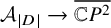 $\mathcal {A}_{\left | D \right |} \rightarrow \overline {\mathbb {C} P^2}$
.
$\mathcal {A}_{\left | D \right |} \rightarrow \overline {\mathbb {C} P^2}$
.
Now, let $Y = \lbrace \mathrm {pt} \rbrace \subset \mathbb {C} P^2$
be any of the vertices of D, and pick a holomorphic ideal for Y. As described in Example 6.10, the corresponding total space will be either
$Y = \lbrace \mathrm {pt} \rbrace \subset \mathbb {C} P^2$
be any of the vertices of D, and pick a holomorphic ideal for Y. As described in Example 6.10, the corresponding total space will be either $\mathbb {C} P^2\# \mathbb {C} P^2$
or
$\mathbb {C} P^2\# \mathbb {C} P^2$
or $\mathbb {C} P^2 \# \overline {\mathbb {C} P^2}$
. In either case, we obtain a complex structure
$\mathbb {C} P^2 \# \overline {\mathbb {C} P^2}$
. In either case, we obtain a complex structure $J_{\mathcal {A}_{\left | \tilde {D} \right |}}$
on the blown-up Lie algebroid
$J_{\mathcal {A}_{\left | \tilde {D} \right |}}$
on the blown-up Lie algebroid $\mathcal {A}_{\left | \tilde {D} \right |}$
.
$\mathcal {A}_{\left | \tilde {D} \right |}$
.
On $\mathbb {C} P^2 \# \overline {\mathbb {C} P^2}$
, the blow-up coincides with the usual complex blow-up and
$\mathbb {C} P^2 \# \overline {\mathbb {C} P^2}$
, the blow-up coincides with the usual complex blow-up and $J_{\mathcal {A}_{\left | \tilde {D} \right |}}$
is simply a lift of the complex structure on
$J_{\mathcal {A}_{\left | \tilde {D} \right |}}$
is simply a lift of the complex structure on $\mathbb {C} P^2 \# \overline {\mathbb {C} P^2}$
. However,
$\mathbb {C} P^2 \# \overline {\mathbb {C} P^2}$
. However, $\mathbb {C} P^2\# \mathbb {C} P^2$
is not even an almost complex manifold, and hence the induced complex structure on
$\mathbb {C} P^2\# \mathbb {C} P^2$
is not even an almost complex manifold, and hence the induced complex structure on $J_{\mathcal {A}_{\left | \tilde {D} \right |}}$
does not descend to a (generalized) complex structure on
$J_{\mathcal {A}_{\left | \tilde {D} \right |}}$
does not descend to a (generalized) complex structure on $\mathbb {C} P^2\# \mathbb {C} P^2$
. Continuing inductively, we obtain complex structures on elliptic tangent bundles over
$\mathbb {C} P^2\# \mathbb {C} P^2$
. Continuing inductively, we obtain complex structures on elliptic tangent bundles over $n \mathbb {C} P^2 \#m \mathbb {C} P^2$
, for all
$n \mathbb {C} P^2 \#m \mathbb {C} P^2$
, for all $n,m \in \mathbb {N}$
.
$n,m \in \mathbb {N}$
.
6.3 T-duality and blow-up
We now study how T-duality interacts with blow-ups. First we recall that toric actions are preserved under blow-ups:
Lemma 6.14. If $M^{2n}$
admits a standard
$M^{2n}$
admits a standard $T^n$
action with quotient map
$T^n$
action with quotient map $\pi \colon M \to B$
, and
$\pi \colon M \to B$
, and $x \in M$
is a fixed point, let
$x \in M$
is a fixed point, let $\tilde {M}$
be either blow up of M at p, that is
$\tilde {M}$
be either blow up of M at p, that is $\tilde {M} = M\#\mathbb {C} P^n$
or
$\tilde {M} = M\#\mathbb {C} P^n$
or $M\#\overline {\mathbb {C} P^n}$
, with blow-down map
$M\#\overline {\mathbb {C} P^n}$
, with blow-down map $q\colon \tilde {M} \to M$
. Then
$q\colon \tilde {M} \to M$
. Then $\tilde {M}$
admits a standard
$\tilde {M}$
admits a standard $T^n$
-action for which the q is equivariant, and the orbit space on
$T^n$
-action for which the q is equivariant, and the orbit space on $\tilde {M}$
is
$\tilde {M}$
is $\tilde {B}$
, the real blow-up of B at
$\tilde {B}$
, the real blow-up of B at $\pi (x)$
. These maps are related by the following diagram
$\pi (x)$
. These maps are related by the following diagram

The fact that the blow-down map induces a fibre-wise isomorphism between elliptic tangent bundles immediately implies the following:
Proposition 6.15 (T-duality commutes with blow-up)
Let $M^{2n}$
and
$M^{2n}$
and $\hat {M}^{2n}$
be endowed with standard
$\hat {M}^{2n}$
be endowed with standard $T^n$
-actions over the same base B, and let
$T^n$
-actions over the same base B, and let $I_{\left | D \right |},I_{\left | \hat {D} \right |}$
denote the induced elliptic divisors. Let
$I_{\left | D \right |},I_{\left | \hat {D} \right |}$
denote the induced elliptic divisors. Let $H \in \Omega ^3_{\mathrm {cl}}(\mathcal {A}_{\left | D \right |}), \hat {H} \in \Omega ^3_{\mathrm {cl}}(\mathcal {A}_{\left | \hat {D} \right |})$
, and
$H \in \Omega ^3_{\mathrm {cl}}(\mathcal {A}_{\left | D \right |}), \hat {H} \in \Omega ^3_{\mathrm {cl}}(\mathcal {A}_{\left | \hat {D} \right |})$
, and $F\in \Omega ^2(\mathcal {A}_{\left | D \right |} \times _B \mathcal {A}_{\left | \hat {D} \right |})$
provide a T-dual between
$F\in \Omega ^2(\mathcal {A}_{\left | D \right |} \times _B \mathcal {A}_{\left | \hat {D} \right |})$
provide a T-dual between $(M,H)$
and
$(M,H)$
and $(\hat {M},\hat {H})$
.
$(\hat {M},\hat {H})$
.
Let $x\in M, \hat {x} \in \hat {M}$
be fixed points for the action with
$x\in M, \hat {x} \in \hat {M}$
be fixed points for the action with $\pi (x) = \hat {\pi }(\hat {x})$
, and let
$\pi (x) = \hat {\pi }(\hat {x})$
, and let $\tilde {M}$
and
$\tilde {M}$
and $\tilde {\hat {M}}$
denote either blow-up of M and
$\tilde {\hat {M}}$
denote either blow-up of M and $\hat {M}$
. Let
$\hat {M}$
. Let $q : \tilde {M} \rightarrow M$
,
$q : \tilde {M} \rightarrow M$
, $\hat {q} : \tilde {\hat {M}} \rightarrow \hat {M}$
denote the blow-down maps. Then we have a canonical T-duality between the blow-ups:
$\hat {q} : \tilde {\hat {M}} \rightarrow \hat {M}$
denote the blow-down maps. Then we have a canonical T-duality between the blow-ups:

Consequently, the following diagram commutes:

Proof. By Theorem 6.9 q and $\hat {q}$
induce fibre-wise isomorphisms between elliptic tangent bundles. Let
$\hat {q}$
induce fibre-wise isomorphisms between elliptic tangent bundles. Let $Q : \tilde {M}\times _{\tilde {B}} \tilde {\hat {M}} \rightarrow M \times _B \hat {M}$
denote the induced map between the correspondence spaces. Consequently Q induces a fibre-wise isomorphism between the elliptic tangent bundles on the correspondence spaces. Therefore
$Q : \tilde {M}\times _{\tilde {B}} \tilde {\hat {M}} \rightarrow M \times _B \hat {M}$
denote the induced map between the correspondence spaces. Consequently Q induces a fibre-wise isomorphism between the elliptic tangent bundles on the correspondence spaces. Therefore $Q^*F$
will satisfy the equation for T-duality.
$Q^*F$
will satisfy the equation for T-duality.
Corollary 6.16. Let $(M,H)$
,
$(M,H)$
, $(\hat {M},\hat {H})$
be as in the setting of Proposition 6.15, and assume there is a generalized complex structure
$(\hat {M},\hat {H})$
be as in the setting of Proposition 6.15, and assume there is a generalized complex structure $\mathbb {J}$
on
$\mathbb {J}$
on $(M,H)$
T-dual to a generalized complex structure
$(M,H)$
T-dual to a generalized complex structure $\hat {\mathbb {J}}$
on
$\hat {\mathbb {J}}$
on $(\hat {M},\hat {H})$
. Then the T-duality from the previous proposition 6.15 sends
$(\hat {M},\hat {H})$
. Then the T-duality from the previous proposition 6.15 sends $\tilde {\mathbb {J}}$
, to
$\tilde {\mathbb {J}}$
, to $\hat {\tilde {\mathbb {J}}}$
.
$\hat {\tilde {\mathbb {J}}}$
.
Proof. As $\tilde {\hat {M}}\backslash E \simeq \hat {M}\ \lbrace \hat {x} \rbrace $
, we have that the T-dual of
$\tilde {\hat {M}}\backslash E \simeq \hat {M}\ \lbrace \hat {x} \rbrace $
, we have that the T-dual of $\tilde {\mathbb {J}}$
coincides with
$\tilde {\mathbb {J}}$
coincides with $\hat {\tilde {\mathbb {J}}}$
outside of E. By continuity they must coincide over the entirety of
$\hat {\tilde {\mathbb {J}}}$
outside of E. By continuity they must coincide over the entirety of $\tilde {M}_2$
.
$\tilde {M}_2$
.
7 Examples
In this final section we will provide explicit examples of T-dual geometric structures on manifolds endowed with standard torus actions. We will define some basic examples, and use these to produce more examples by blowing up.
7.1 Basic examples
We start by considering simple examples of generalized complex structures. The analysis heavily depends on the local description in Example 5.16. So recall from there that any of the following two-forms:
-
○
$F_{1,\pm } = d\theta _1 \wedge d\hat {\theta }_1 \pm d\theta _2 \wedge d\hat {\theta }_2$
. -
○
$F_{2,\pm } = -d\theta _1 \wedge d\hat {\theta }_2 \pm d\theta _2 \wedge d\hat {\theta }_1$
.


provides a T-duality from $(\mathbb {C} ,0)$
to itself.
$(\mathbb {C} ,0)$
to itself.
Example 7.1 (
$S^1\times S^3$
)

Let $T^2$
act on
$T^2$
act on $S^3 \subset \mathbb {C} ^2$
, and extend the action trivially to an action on
$S^3 \subset \mathbb {C} ^2$
, and extend the action trivially to an action on $S^1\times S^3$
. The quotient space B is an annulus. Viewing
$S^1\times S^3$
. The quotient space B is an annulus. Viewing $S^1\times S^3$
as the Hopf surface
$S^1\times S^3$
as the Hopf surface $(\mathbb {C} ^2\backslash \lbrace 0 \rbrace )/\mathbb {Z}$
, the stable generalized complex structure
$(\mathbb {C} ^2\backslash \lbrace 0 \rbrace )/\mathbb {Z}$
, the stable generalized complex structure $\tilde {\rho } = z_1z_2 + dz_1 \wedge dz_2$
on
$\tilde {\rho } = z_1z_2 + dz_1 \wedge dz_2$
on $\mathbb {C} ^2\backslash \lbrace 0 \rbrace $
descends to a stable generalized complex structure
$\mathbb {C} ^2\backslash \lbrace 0 \rbrace $
descends to a stable generalized complex structure $\rho $
on
$\rho $
on $S^1\times S^3$
. All the two forms
$S^1\times S^3$
. All the two forms $F_{i,\pm }$
are
$F_{i,\pm }$
are $\mathbb {Z}$
-invariant and thus descend to two-forms on
$\mathbb {Z}$
-invariant and thus descend to two-forms on $S^1\times S^3$
. Therefore, as in Example 5.16, we obtain that T-duality induced by the two-form
$S^1\times S^3$
. Therefore, as in Example 5.16, we obtain that T-duality induced by the two-form $F_{2,+}$
sends
$F_{2,+}$
sends $\rho $
to the standard complex structure on
$\rho $
to the standard complex structure on $S^1\times S^3$
.
$S^1\times S^3$
.
If we instead consider the generalized complex structure induced by $\tilde {\rho }_2 = z_1z_2 + idz_1 \wedge dz_2$
, and use the two-form induced by
$\tilde {\rho }_2 = z_1z_2 + idz_1 \wedge dz_2$
, and use the two-form induced by $F_{1,-}$
, we find that
$F_{1,-}$
, we find that $\rho _2$
is T-dual to itself.
$\rho _2$
is T-dual to itself.
Example 7.2 (
$\mathbb {C}P^2$
)

We consider $\mathbb {C}P^2$
in the usual fashion as
$\mathbb {C}P^2$
in the usual fashion as $(\mathbb {C} ^3\backslash \lbrace 0 \rbrace )/\mathbb {C} $
with torus action
$(\mathbb {C} ^3\backslash \lbrace 0 \rbrace )/\mathbb {C} $
with torus action $(\lambda _1,\lambda _2)\cdot [z_0:z_1:z_2] = [e^{i\lambda _1}z_0:e^{i\lambda _2}z_1:z_2]$
. Consider the complex log forms
$(\lambda _1,\lambda _2)\cdot [z_0:z_1:z_2] = [e^{i\lambda _1}z_0:e^{i\lambda _2}z_1:z_2]$
. Consider the complex log forms $\tilde {\zeta _1} = d\log z_0 - d\log z_2$
and
$\tilde {\zeta _1} = d\log z_0 - d\log z_2$
and $\tilde {\zeta _2} = d\log z_1 - d\log z_2$
. As these are basic with respect to the
$\tilde {\zeta _2} = d\log z_1 - d\log z_2$
. As these are basic with respect to the $\mathbb {C} ^*$
-action, they descend to complex log forms
$\mathbb {C} ^*$
-action, they descend to complex log forms $\zeta _1,\zeta _2$
. We let
$\zeta _1,\zeta _2$
. We let $\Theta _1 = \Im ^* \zeta _1,\Theta _2 = \Im ^* \zeta _2$
denote the imaginary parts. Then
$\Theta _1 = \Im ^* \zeta _1,\Theta _2 = \Im ^* \zeta _2$
denote the imaginary parts. Then $(\Theta _1,\Theta _2)$
provides a connection-one form for the
$(\Theta _1,\Theta _2)$
provides a connection-one form for the $T^2$
-action on
$T^2$
-action on $\mathbb {C} P^2$
.
$\mathbb {C} P^2$
.
Consider another copy of $\mathbb {C}P^2$
, and denote the same connection one-form by
$\mathbb {C}P^2$
, and denote the same connection one-form by $(\hat {\Theta }_1,\hat {\Theta }_2)$
. Similarly to Example 5.16 we now have that any of the following two-forms provides a self T-dual for
$(\hat {\Theta }_1,\hat {\Theta }_2)$
. Similarly to Example 5.16 we now have that any of the following two-forms provides a self T-dual for $(\mathbb {C} P^2,0)$
.
$(\mathbb {C} P^2,0)$
.
 $$ \begin{align*} F_{1,\pm} &= \Theta_1 \wedge \hat{\Theta}_1 \pm \Theta_2 \wedge \hat{\Theta}_2,\\ F_{2,\pm} &= - \Theta_1 \wedge \hat{\Theta}_2 \pm \Theta_2 \wedge \hat{\Theta}_1. \end{align*} $$
We will now spell out the effect of T-duality on the generalized complex structures on $\mathbb {C} P^2$
for the 2-forms
$\mathbb {C} P^2$
for the 2-forms $F_{2,+}$
and
$F_{2,+}$
and $F_{1,-}$
.
$F_{1,-}$
.
Consider the holomorphic Poisson structure $\tilde {\pi } = z_0z_1\partial _{z_0}\wedge \partial _{z_1}$
. Because this is
$\tilde {\pi } = z_0z_1\partial _{z_0}\wedge \partial _{z_1}$
. Because this is $\mathbb {C} ^*$
-invariant it induces a holomorphic Poisson structure
$\mathbb {C} ^*$
-invariant it induces a holomorphic Poisson structure $\pi $
on
$\pi $
on $\mathbb {C} P^2$
, which is moreover log symplectic. One can show, as in Example 5.16, that
$\mathbb {C} P^2$
, which is moreover log symplectic. One can show, as in Example 5.16, that $F_{2,+}$
provides a T-dual between the corresponding stable generalized complex structure and the standard complex structure on
$F_{2,+}$
provides a T-dual between the corresponding stable generalized complex structure and the standard complex structure on $\mathbb {C} P^2$
. Similarly, consider the holomorphic Poisson structure
$\mathbb {C} P^2$
. Similarly, consider the holomorphic Poisson structure $\tilde {\pi _2} = iz_0z_1\partial _{z_0}\wedge \partial _{z_1}$
, and the induced generalized complex structure
$\tilde {\pi _2} = iz_0z_1\partial _{z_0}\wedge \partial _{z_1}$
, and the induced generalized complex structure $\rho _2$
. Then
$\rho _2$
. Then $F_{1,-}$
, as in Example 5.16, will provide a T-dual between
$F_{1,-}$
, as in Example 5.16, will provide a T-dual between $\rho _2$
and itself.
$\rho _2$
and itself.
Example 7.3 (
$S^2\times S^2$
)

Identify $M = S^2\times S^2$
with
$M = S^2\times S^2$
with $\mathbb {C}P^1 \times \mathbb {C}P^1$
, and consider the torus action given by
$\mathbb {C}P^1 \times \mathbb {C}P^1$
, and consider the torus action given by $(\lambda _1,\lambda _2)\cdot ([z_0:z_1],[w_0:w_1]) = ([e^{i\lambda _1}z_0:z_1],[e^{i\lambda _2}w_0:w_1])$
. Let
$(\lambda _1,\lambda _2)\cdot ([z_0:z_1],[w_0:w_1]) = ([e^{i\lambda _1}z_0:z_1],[e^{i\lambda _2}w_0:w_1])$
. Let $\tilde {\zeta }_1 = d\log z_0 - d\log z_1$
and
$\tilde {\zeta }_1 = d\log z_0 - d\log z_1$
and $\tilde {\zeta }_2 = d\log w_0 - d\log w_1$
be complex log-forms on
$\tilde {\zeta }_2 = d\log w_0 - d\log w_1$
be complex log-forms on $(\mathbb {C} ^2\backslash \lbrace 0 \rbrace )^2$
. As these are basic they induce complex log-forms
$(\mathbb {C} ^2\backslash \lbrace 0 \rbrace )^2$
. As these are basic they induce complex log-forms $\zeta _1,\zeta _2$
on M, and we may consider their imaginary parts
$\zeta _1,\zeta _2$
on M, and we may consider their imaginary parts $\Theta _1 = \Im ^*\zeta _1,\Theta _2 = \Im ^*\zeta _2$
. The form
$\Theta _1 = \Im ^*\zeta _1,\Theta _2 = \Im ^*\zeta _2$
. The form $(\Theta _1,\Theta _2) \in \Omega ^2(\mathcal {A}_{\left | D \right |};\mathfrak {t}^2)$
provides a connection one-form for the torus action on M. Let
$(\Theta _1,\Theta _2) \in \Omega ^2(\mathcal {A}_{\left | D \right |};\mathfrak {t}^2)$
provides a connection one-form for the torus action on M. Let $\hat {M}$
denote another copy of
$\hat {M}$
denote another copy of $S^2\times S^2$
, and consider the same connection one-form
$S^2\times S^2$
, and consider the same connection one-form $(\hat {\Theta }_1,\hat {\Theta }_2)$
. As in the previous example, the form
$(\hat {\Theta }_1,\hat {\Theta }_2)$
. As in the previous example, the form $F = -\Theta _1 \wedge \hat {\Theta }_2 + \Theta _2 \wedge \hat {\Theta _1}$
provides a self T-dual on
$F = -\Theta _1 \wedge \hat {\Theta }_2 + \Theta _2 \wedge \hat {\Theta _1}$
provides a self T-dual on $(M,0)$
.
$(M,0)$
.
In affine coordinates $t = z_0/z_1, s = w_0/w_1$
we consider the holomorphic Poisson structure
$t = z_0/z_1, s = w_0/w_1$
we consider the holomorphic Poisson structure ${\pi = tw\partial _t\partial _w}$
. In any other set of affine coordinates, this Poisson structure has the same form and hence defines a global holomorphic Poisson structure on M, which is moreover log symplectic. As in the previous example, the corresponding stable generalized complex structure is T-dual to the standard complex structure on
${\pi = tw\partial _t\partial _w}$
. In any other set of affine coordinates, this Poisson structure has the same form and hence defines a global holomorphic Poisson structure on M, which is moreover log symplectic. As in the previous example, the corresponding stable generalized complex structure is T-dual to the standard complex structure on $S^2\times S^2$
. And the stable generalized complex structure associated to
$S^2\times S^2$
. And the stable generalized complex structure associated to $\pi = itw\partial _t\partial _w$
is T-dual to itself via
$\pi = itw\partial _t\partial _w$
is T-dual to itself via $F = \Theta _1 \wedge \hat {\Theta }_1 - \Theta _2 \wedge \hat {\Theta }_2$
.
$F = \Theta _1 \wedge \hat {\Theta }_1 - \Theta _2 \wedge \hat {\Theta }_2$
.
We may now blow-up $\mathbb {C}P^2$
to obtain more examples of stable generalized complex structures, which are T-dual:
$\mathbb {C}P^2$
to obtain more examples of stable generalized complex structures, which are T-dual:
Example 7.4 (
$n\mathbb {C}P^2 \# m \overline {\mathbb {C}P}^2$
)

Let $\tilde {\pi }_1 = z_0z_1\partial _{z_0}\wedge \partial _{z_1}$
, and
$\tilde {\pi }_1 = z_0z_1\partial _{z_0}\wedge \partial _{z_1}$
, and $\tilde {\pi }_2 = iz_0z_1\partial _{z_0}\wedge \partial _{z_1}$
be holomorphic Poisson structures on
$\tilde {\pi }_2 = iz_0z_1\partial _{z_0}\wedge \partial _{z_1}$
be holomorphic Poisson structures on $\mathbb {C} ^3\backslash \lbrace 0 \rbrace $
, and
$\mathbb {C} ^3\backslash \lbrace 0 \rbrace $
, and $\rho _1,\rho _2$
the induced stable generalized complex structures on
$\rho _1,\rho _2$
the induced stable generalized complex structures on $\mathbb {C}P^2$
, as in Example 7.2. We may perform consecutive blow-ups of either of these structures, to obtain families of generalized complex structures
$\mathbb {C}P^2$
, as in Example 7.2. We may perform consecutive blow-ups of either of these structures, to obtain families of generalized complex structures $\rho _{1,n,m},\rho _{2,n,m}$
on
$\rho _{1,n,m},\rho _{2,n,m}$
on $\mathcal {A}_{\left | D \right |} \rightarrow n \# \mathbb {C} P^2 \# m \overline {\mathbb {C} P^2}$
. One readily shows that these generalized complex structures on
$\mathcal {A}_{\left | D \right |} \rightarrow n \# \mathbb {C} P^2 \# m \overline {\mathbb {C} P^2}$
. One readily shows that these generalized complex structures on $\mathcal {A}_{\left | D \right |}$
induce generalized complex structures on
$\mathcal {A}_{\left | D \right |}$
induce generalized complex structures on $n \# \mathbb {C} P^2 m \# \overline {\mathbb {C} P^2}$
if and only if n is odd.
$n \# \mathbb {C} P^2 m \# \overline {\mathbb {C} P^2}$
if and only if n is odd.
We have seen in Example 7.2 that $\rho _1$
can be made T-dual to the standard complex structure, and
$\rho _1$
can be made T-dual to the standard complex structure, and $\rho _2$
dual to itself. By Proposition 6.15 it then follows that each
$\rho _2$
dual to itself. By Proposition 6.15 it then follows that each $\rho _{2,n,m}$
is T-dual to itself, and
$\rho _{2,n,m}$
is T-dual to itself, and $\rho _{1,n,m}$
is T-dual to the complex structures on
$\rho _{1,n,m}$
is T-dual to the complex structures on $\mathcal {A}_{\left | D \right |}$
described in Example 6.13.
$\mathcal {A}_{\left | D \right |}$
described in Example 6.13.
Remark 7.5. We obtained the families $\rho _{2,n,m}$
also in Theorem 7.5 in [Reference Cavalcanti, Klaasse and Witte10] via a connected sum procedure. But not the families
$\rho _{2,n,m}$
also in Theorem 7.5 in [Reference Cavalcanti, Klaasse and Witte10] via a connected sum procedure. But not the families $\rho _{1,n,m}$
. This is of relevance, as we see that their behaviour under T-duality is very different.
$\rho _{1,n,m}$
. This is of relevance, as we see that their behaviour under T-duality is very different.
Example 7.6 (
$n\mathbb {C}P^{2k}\# m \overline {\mathbb {C} P}^{2k}$
)

The previous example is in no way restrictive to four dimensions. One may as easily start with the Poisson structure $z_0z_1 \partial _{z_0} \wedge \partial _{z_1} + \cdots + z_{2(k-1)}z_{2k}\partial _{z_{2k-1}}\wedge \partial _{z_{2k}}$
on
$z_0z_1 \partial _{z_0} \wedge \partial _{z_1} + \cdots + z_{2(k-1)}z_{2k}\partial _{z_{2k-1}}\wedge \partial _{z_{2k}}$
on $\mathbb {C} ^{2k+1}$
, and repeat the above to obtain T-dual generalized complex structures on
$\mathbb {C} ^{2k+1}$
, and repeat the above to obtain T-dual generalized complex structures on $n\mathbb {C}P^{2k}$
. After blowing up at fixed points one again obtains many families of T-dual generalized complex structures on
$n\mathbb {C}P^{2k}$
. After blowing up at fixed points one again obtains many families of T-dual generalized complex structures on $n \# \mathbb {C} P^{2k} \# m \overline {\mathbb {C} P^{2k}}$
7.2 Non-zero residue elliptic symplectic structures
Another class of structures which behave well with respect to T-duality are elliptic symplectic forms with non-zero elliptic residue. These structures admit a $\mathbb {C} ^*$
-invariant normal form:
$\mathbb {C} ^*$
-invariant normal form:
Lemma 7.7 [Reference Witte25]
Let $(M,I_{\left | D \right |})$
be a manifold with a smooth elliptic divisor, and let
$(M,I_{\left | D \right |})$
be a manifold with a smooth elliptic divisor, and let $\omega \in \Omega ^2(\mathcal {A}_{\left | D \right |})$
be an elliptic symplectic form with
$\omega \in \Omega ^2(\mathcal {A}_{\left | D \right |})$
be an elliptic symplectic form with $\lambda := \operatorname {\mathrm {Res}}_q(\omega ) \neq 0$
. Then there exists a canonical flat connection on
$\lambda := \operatorname {\mathrm {Res}}_q(\omega ) \neq 0$
. Then there exists a canonical flat connection on $\nu _D$
and a tubular neighbourhood of D such that
$\nu _D$
and a tubular neighbourhood of D such that
 $$ \begin{align} \omega = \lambda\rho \wedge \Theta + p^*\omega_D. \end{align} $$
Here $\rho ,\Theta $
are the connection-one forms corresponding to the flat connection, as defined in 3.16 and
$\rho ,\Theta $
are the connection-one forms corresponding to the flat connection, as defined in 3.16 and $\omega _D = \iota ^*_D\omega \in \Omega ^2(D)$
.
$\omega _D = \iota ^*_D\omega \in \Omega ^2(D)$
.
Conversely, given any complex line bundle $L \rightarrow D$
,
$L \rightarrow D$
, $\nabla $
a flat connection on L,
$\nabla $
a flat connection on L, $\lambda \neq 0$
and
$\lambda \neq 0$
and $\omega _D \in \Omega ^2(D)$
symplectic, (7.1) defines an elliptic symplectic form on L.
$\omega _D \in \Omega ^2(D)$
symplectic, (7.1) defines an elliptic symplectic form on L.
The form $\omega $
is
$\omega $
is $S^1$
-invariant, and hence we can consider its T-dual. It will appear via the following lemma:
$S^1$
-invariant, and hence we can consider its T-dual. It will appear via the following lemma:
Lemma 7.8. Let $(M,J)$
be a generalized complex manifold, and
$(M,J)$
be a generalized complex manifold, and $L \rightarrow M$
a complex vector bundle, endowed with a flat connection
$L \rightarrow M$
a complex vector bundle, endowed with a flat connection $\nabla $
. Then
$\nabla $
. Then $\mathrm {tot}(L)$
inherits a natural generalized complex structure.
$\mathrm {tot}(L)$
inherits a natural generalized complex structure.
Proof. Choose a set of trivializations with constant transition functions. On each trivialization use the product of the generalized complex structure on the base and the complex structure of the fiber. Since the transition functions are constant these structures defined on trivializations glue together to give a global structure on the total space of L.
Lemma 7.9. Given $(D,\omega _D)$
a symplectic manifold,
$(D,\omega _D)$
a symplectic manifold, $p :L \rightarrow M$
a complex line bundle with flat connection
$p :L \rightarrow M$
a complex line bundle with flat connection $\nabla $
, and
$\nabla $
, and $\lambda \in \mathbb {R} \setminus \lbrace 0 \rbrace $
then
$\lambda \in \mathbb {R} \setminus \lbrace 0 \rbrace $
then $\omega $
as in (7.1) is T-dual to the type 1 generalized complex structure induced by Lemma 7.8
$\omega $
as in (7.1) is T-dual to the type 1 generalized complex structure induced by Lemma 7.8
Proof. Let $\hat {\Theta }$
denote the same connection one-form, on another copy of
$\hat {\Theta }$
denote the same connection one-form, on another copy of $L \rightarrow M$
. Then
$L \rightarrow M$
. Then $F = \Theta \wedge \hat {\Theta }$
provides the desired T-dual. We have that, using
$F = \Theta \wedge \hat {\Theta }$
provides the desired T-dual. We have that, using $\tau $
from Proposition 5.12 that
$\tau $
from Proposition 5.12 that
 $$ \begin{align*} \tau(e^{i\omega}) = i\lambda(\rho + i\Theta) \wedge e^{i\omega_D}. \end{align*} $$
Locally, this corresponds to the spinor given by $i\lambda dz \wedge e^{i\omega _D}$
, which is precisely the generalized complex structure from Lemma 7.8.
$i\lambda dz \wedge e^{i\omega _D}$
, which is precisely the generalized complex structure from Lemma 7.8.
Remark 7.10. Given a smooth elliptic divisor $I_{\left | D \right |}$
, elliptic symplectic forms with zero elliptic residue have a similar
$I_{\left | D \right |}$
, elliptic symplectic forms with zero elliptic residue have a similar $S^1$
-invariant normal form as in (7.1). Unfortunately, the corresponding T-dual generalized complex structure on
$S^1$
-invariant normal form as in (7.1). Unfortunately, the corresponding T-dual generalized complex structure on $\mathcal {A}_{\left | D \right |}$
does not descend to a generalized complex structure on M.
$\mathcal {A}_{\left | D \right |}$
does not descend to a generalized complex structure on M.
Acknowledgments
The second author was supported by the NWO through the UGC Graduate Programme (Netherlands), and through the FWO and FNRS under EOS project G0H4518N, and FWO Project G083118N (Belgium). The authors would like to thank Maarten Mol and Álvaro del Pino for useful discussions. The authors are grateful to the organizers of the workshop ‘Generalized Geometry in Interaction’, Madrid 2022, where a preliminary version of this article was presented.


 Open access

