

The… basic goal of the Republican Party is… making vigorous use of the legitimate machinery of government to achieve their goals.
Antonin Scalia, Reference Scalia1981Footnote 1
The arrival of a new conservative administration in Washington, DC, is commonly equated with the “rolling back” of the federal government. Yet as Donald Trump’s tenure confirms, his presidential administration harbors few anxieties about a strong State, contentedly wielding the institutional power of the American presidency to secure his pledge to “Make America Great Again.” Because his administration has used executive power so aggressively, most scholars and pundits place Trump outside the tradition of American conservative thought, and many regard him as a disruptive force inside conservatism’s institutional vessel, the Republican Party. We disagree. We argue that the association of conservative Republicanism and retrenchment elides a critical change in the relationship between party politics and executive power, which Donald Trump is determinedly nurturing.Footnote 2
Partisanship in the United States is no longer a struggle over the size of the State. It is a struggle for the services of national administrative power. Despite rhetorical appeals to “limited government,” since the late 1960s conservatives have sought national administrative power as ardently as liberals. Trump has tapped into the conservative affirmation of State power several decades in the making. His administrative aggrandizement extends this trend in American politics. Consequently, while liberals seek to build administrative capacity to design and implement social welfare policies, conservatives have sought to redeploy and extend that power in pursuit of their own partisan goals: enhancing national defense, homeland security, border-protection, and local policing; and establishing more market-oriented policies in education, climate change, and government service.Footnote 3
From this perspective, the Trump administration is achieving long-term conservative objectives. Much of Trump’s campaign rhetoric and his governing tactics emphasize his desire to dismantle many institutions and programs, to bring about the “deconstruction of the administrative state,” as his former chief strategist, Steve Bannon, once touted. In celebrating the State’s demise, Trump perpetuates the symbolic attack against administrative government, which has been the hallmark of conservative rhetoric for a century. Yet Trump’s presidency is likely to be consequential for American politics not because he will denigrate national administration, but rather, because he will reconstruct its fiscal, administrative, and human resources to augment his vision of a strong American State. Trump has endeavored forcefully to advance a conservative statism.
The American State first gained legitimacy with the New Deal in the 1930s under Franklin D. Roosevelt and during the Cold War. Contested by conservative Democrats and Republicans as an existential threat to constitutional government, national enforcement gained acceptance on the right as liberalism expanded throughout the 1960s. Goldwater’s Reference Goldwater1964 campaign summoned a messianic conservatism, rooted in the all-encompassing struggle against communism. Goldwater’s crusade pioneered a conservative movement, but it was Nixon’s presidency that first advanced an alternative form of administrative power. Since Nixon, self-styled conservative administrations have sought to redeploy rather than dismantle or roll back State power. With “redeployment,” conservative presidents sustain State activity, but in service to the new administration’s ideology.
To understand contemporary power and America’s partisan rancor, scholars must assess the State as an aspect of the enduring liberal-conservative struggle. We offer redeployment as a new framework, one that sheds light on the ascent of Donald Trump, but does not treat him as a novel or ephemeral phenomenon. His presidency marks the culmination of developments in the battle between liberals and conservatives to seize and command national administrative power.
This contest to control the administrative state, forged during the New Deal and the Great Society, has not yielded a Weberian State. The redeployment framework points to the tendency of both liberals and conservatives to rely on executive discretion. We contend that the election and first term of Donald Trump dramatically confirms that executive power is the vanguard of an enervating contest between liberal and conservative policy demands, which weakens the system of checks and balances, diminishes the integrity of decentralizing constitutional institutions like Congress and the states, and erodes citizens’ trust in the competence and fairness of the national government.
The Persistent American State
Given Republicans’ rhetorical attack on government, it is not surprising that scholars and public commentators equate conservatism and anti-statism. “In this present crisis, government is not the solution to our problem,” Reagan declaimed in his first inaugural address, “government is the problem.”Footnote 4 However, key indicators of State activity suggest that such rhetorical tropes disguise an enduring commitment to national administration.Footnote 5 Limited State retrenchment across multiple administrations and periods of unified Republican governance exposes a discrepancy between conservative rhetoric and conservative governance.
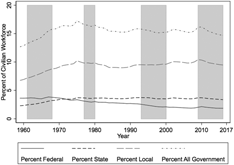
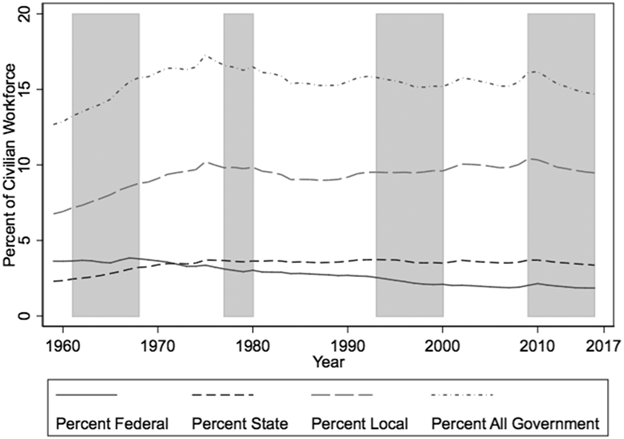
The conservative promise to retrench fails with an uncontentious measurement of State size—the number of people working for the State. Regardless of the president’s party, the number of employees working at all levels of government since the 1960s has gradually risen (figure 1). As a percent of the total American workforce, the federal civil service has declined since the late 1960s, but gains in local and state employment offset these reductions (figure 2). The growth of state and local government is particularly noteworthy because it has often been in response to the increased number of demands liberals and conservatives alike have placed on subnational governments.Footnote 6 The pattern of growth and decline do not fit neatly with partisan changes in governing authority.Footnote 7
Total federal, state, and local employment, presidential administrations shaded
Note: Total federal, state, and local government employment figures are tabulated by the U.S. Bureau of Labor Statistics, “Establishment Survey,” NAICS Series 999000. Federal employment excludes U.S. Postal Service; local and state government employment excludes hospital and education employees. Data retrieved from FRED, Federal Reserve Bank of St. Louis; https://fred.stlouisfed.org/. All dollar amounts are pegged to their corresponding calendar year, and are not seasonally adjusted. Retrieved April 11, 2017.

Percent federal, state and local government of total workforce, Democratic administrations shaded
Note: Total federal, state, and local government employment figures are tabulated by the U.S. Bureau of Labor Statistics, “Current Employment Statistics, Establishment Survey,” CES Series 9091000000. Federal employment includes U.S. Postal Service, civilian and military employees of the Department of Defense; local and state government employment include hospital and education employees. Total workforce is calculated by U.S. Bureau of Labor Statistics, “Current Population Survey,” Series CE160V. Data retrieved from FRED, Federal Reserve Bank of St. Louis; https://fred.stlouisfed.org/. Retrieved May 15, 2017.
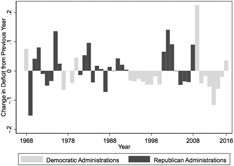
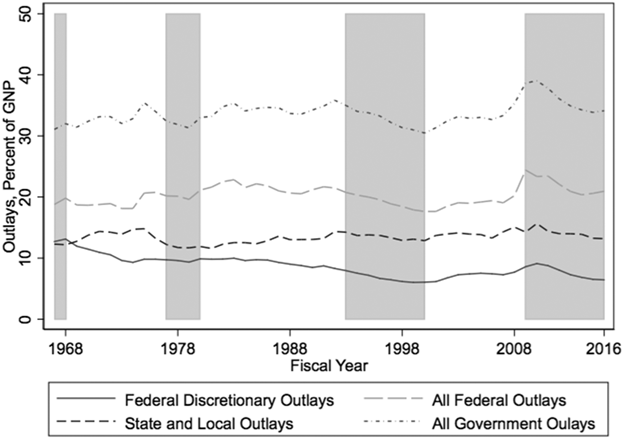
The State also projects power through the expansion or redistribution of program funding. A similar pattern emerges. The trajectory of government spending has plainly been insulated from periodic transfers in partisan power (figure 3). Even at the height of the Reagan “Revolution,” total government spending at all levels represented 34.07% of GNP (FY1984, the lowest percentage for Reagan). In 2016, local, state, and federal outlays composed 34.12% of GNP. Finally, each administration has contributed to the federal debt and no discernible differences arise across nearly fifty years of Republican and Democratic governance. Figure 4 documents the year-to-year change in the federal deficit, as a percent of discretionary expenditures. In 2009, Obama’s first year in office, the discretionary deficit was 22.5 percentage points greater than it was in 2008. Yet Republican administrations, including Reagan in 1982 and 1983, also oversaw annual increases in the federal deficit. In fact, of the ten fiscal years where the deficit grew the largest, Republican presidents were at the helm for eight.Footnote 8
Total government outlays, federal, state, and local, Democratic administrations shaded
Note: Federal Outlays include intergovernmental transfers, while state and local outlays exclude receipts coming from the federal government; intergovernmental transfers are only included in the calculation once. Discretionary outlays and GNP estimates are calculated by the Congressional Budget Office, “Historical Budget Data.” Data are reported by the Congressional Budget Office, “Historical Budget Data,” January 2017 estimates. (https://www.cbo.gov/about/products/budget-economic-data#2). State and local expenditure data are compiled by the U.S. Bureau of Economic Analysis, “State and Local Government Current Expenditures,” Series ASLEXPND. Data retrieved from FRED, Federal Reserve Bank of St. Louis; https://fred.stlouisfed.org/. All dollar amounts are pegged to their corresponding calendar year, and are not seasonally adjusted. Retrieved April 11, 2017.
Change in federal deficit from previous year, as a percent of federal discretionary expenditures
Note: A negative change indicates that, when compared to the previous year, the fiscal year deficit was less, when taken as a percentage of federal expenditures; a positive change indicates that the deficit grew when compared to the previous year. Discretionary outlays as a percent of government revenues calculated by the Congressional Budget Office, “Historical Budget Data.” Data are reported by the Congressional Budget Office, “Historical Budget Data,” January 2017 estimates (https://www.cbo.gov/about/products/budget-economic-data#2).

These trends are surprising, not least because this stable pattern coincides with fierce partisan and ideological polarization, often portrayed by scholars as conflict over whether to expand or roll back State power.Footnote 9 We argue that these figures represent, at least in part, the emergence of a conservative statism, rooted in the joining of centralized administration and partisanship. Republicans no less than Democrats have engaged in executive aggrandizement, exploiting personnel, revenues, and regulatory authority—both at the federal and subnational levels—to achieve their objectives.
This is not to suggest that the conservative attack on and decline of trust in government is unimportant. In fact, both liberals and conservatives have frequently denigrated government since the 1960s even as they continue to rely on it. In Hugh Heclo’s account, even as they lambast government, Republicans and Democrats, liberals and conservatives have become “policy-minded.” Despite the easily mobilized fear of centralized power in American political culture, Heclo argues that the fierce, enduring battles over civil rights and the Vietnam War gave rise to a novel animus to public authority. During the Sixties, “the emphasis shifted from traditional suspicion of power” to a defiance of all authority. The coexistence of distrust in institutions and a willingness to use institutional power has led each side to clash, not only on principle but also to deny the legitimacy of the opposition.Footnote 10 The redeployment of State power has thus become a disruptive and fractured endeavor with liberals and conservatives simultaneously championing selective instruments of State power, while disparaging its whole.
Conceptually the relationship between partisan rancor and conflict about national administrative power is obscured by the perennial confounding of government and the State. If those concepts are untangled, it makes more sense why the State can endure, even when political leaders curry favor by deprecating governing institutions. The emergence of ideological conflict pitting programmatic objectives against institutional balance sheds light on the wayward path of what scholars theorize as a “policy state.”Footnote 11 Most expansively, Karen Orren and Stephen Skowronek argue that with the demise of rights and structure that constrained government activism, “the Constitution’s intricate division of labor has come to operate over time less as a containment structure than as an opportunity structure.” Correspondingly officials in all branches and levels of government now act as “policy entrepreneurs, advancing programs to secure their positions and enhance their power.”Footnote 12 The scale of policy demands has eroded faith in traditional constitutional norms, the “violence of faction” that James Madison feared and hoped the framers had proscribed. By the 2000s, Orren and Skowronek argue, faith in expertise and neutral competence had succumbed to raw and disruptive conflict about the legitimacy of the policy state itself: one side defends the problem-solving ethos of the policy state; the other, invoking first principles and limited government, “rejects the primacy of policy, with its insatiable plea ‘to do something.’”Footnote 13
In contrast, we identify a merging of executive power and partisanship that has aroused a battle for the services of the policy state. The keenest defenders of the policy state are “locked in the Democratic Party”; but the policy state has many defenders on the right and within the Republican Party.Footnote 14 Self-styled conservatives have developed constitutional arguments and political strategies that presuppose recasting national administrative power in their own image.
The Origins of Conservative State-Building
America’s national State emerged from a series of high-stake struggles over domestic and foreign policy, animated by a contest over what it means to be American. As manifest in the 2016 presidential election, partisan conflict is steeped in disagreement over patriotism, joined to competing conceptions of national identity.Footnote 15 These contests over American identity have historical roots but they have become a routine part of politics in the United States. The legislative creation of civil rights and the expansion of national administrative power in the mid-twentieth century created a new arena for contesting and deploying State power. Consequently, it is more clearly the case now than ever before that the political conflict over the service and management of governing institutions takes on more significance than pressure politics or rent-seeking by various interest groups. As the modern presidency has come to anchor both national administrative power and the symbolic significance of the American creed itself, both liberals and conservatives have embraced an expansive notion of State power—so long as State power is used on behalf of those who are legitimately perceived members of the national community.
The idea of a “State” therefore cuts more deeply than suggested by Max Weber’s definition of “a human community that (successfully) claims the monopoly of the legitimate use of physical force within a given territory.”Footnote 16 Beyond the powers of government, the State represents a centralizing ambition to cultivate, or impose, a vision of citizenship.Footnote 17 In Randolph Bourne’s words, the State is a “concept of power” that comes alive in defense of or in conflict with an ideal of how such foundational values of Americanism as “free and enlightened” are to be interpreted and enforced. It is symbolized not by the Declaration and the Constitution but rather in rallying emblems such as the flag and Uncle Sam. A key mobilizing force is patriotism, a concept at once centralizing and conflictual.Footnote 18
The development of the modern American State during the Great Depression and World War II, therefore, involved not just the creation of new programs and administrative agencies but a new public philosophy. In his iconic 1941 State of the Union address, FDR argued that America’s traditional freedoms like speech and religion needed to be supplemented by two new “essential human freedoms”: “freedom from want” and “freedom from fear.” This was not mere rhetoric. “Freedom from fear” was embodied by the national security state in the fight against global communism, while “freedom from want” took institutional form in domestic programs like Social Security, the cornerstone of the welfare state. These commitments, the charter of the modern American state, were not subject to partisanship, but to “enlightened administration”—to the creation of an executive-centered administrative state that would supplant limited constitutional government and the decentralized party politics that accommodated it. Tempered by economic crisis and total war, American politics was endued with pragmatic policymaking.Footnote 19 The enactment of the 1939 Executive Reorganization Act, which created the White House Office (the West Wing) and strengthened the president’s control over the expanding administrative core, is the organic statute of the New Deal political order.
The consolidation of executive power under Franklin Roosevelt was contested; nonetheless, the rise of an executive-centered administrative state reflected a fragile consensus that for a time obscured partisan conflict over national administrative power. Beginning in the Progressive era, reformers collectively scorned the political practices and institutions built during the nineteenth century, which were dominated by local issues and a spoils system that supported a highly-decentralized “state of courts and parties” as Skowronek terms it.Footnote 20 Following World War II, many conservatives and liberals alike celebrated Roosevelt’s vision of a new American State. Partisan politics reached a low ebb as citizens held high trust in government, and majorities of both parties largely agreed about the direction of domestic and foreign policy, so long as national programs did not disturb a racialized political order with partial civil rights.
Dwight Eisenhower, the first Republican president elected during the New Deal regime, for a time epitomized the bipartisan legitimacy that underpinned the liberal political order. Two years after his 1952 campaign victory he worked with the Congress to pass an expansion of Social Security, thereby rendering America’s nascent welfare state more inclusive.Footnote 21 More telling of a bipartisan commitment to the fledgling national state was the creation of a national highway system, first proposed in 1944, which Eisenhower celebrated as “the biggest peacetime construction project ever undertaken by the United States or any other country.”Footnote 22 Against the powerful strain of isolationism in the Republican Party, Eisenhower also retained Roosevelt and Truman’s commitment to liberal internationalist institutions like NATO, the United Nations, and global financial institutions.
Although Eisenhower’s two terms in office bestowed a measure of bipartisan legitimacy on the liberal State, many GOP loyalists and Democratic conservatives detested his “modern Republicanism.” Old Guard stalwarts such as Robert A. Taft—“Mr. Republican”—as Melvyn Leffler has observed, “seemed little concerned with conditions abroad; their intent was to crush communism at home, besmear the New Deal, and thwart the activist state.”Footnote 23 Western conservatives, fueled by the population boom in the Sunbelt states, rallied around a libertarian creed that denounced federal intervention in land management, business regulation, and civil rights enforcement. Southern Democrats feared that Roosevelt’s Reference Roosevelt1941 order to prohibit racial segregation in war industries was the opening wedge of an assault on Jim Crow, a fear confirmed by Harry Truman’s decision to integrate the armed services and issue an amicus curia in support of the NAACP’s suit against forced segregation in education. Republicans made deep inroads into the South throughout the 1950s, challenging the dominance of one-party rule and enhancing the prospects of a vote-rich, multi-region party.
Barry Goldwater’s Reference Goldwater1964 nomination neither resolved the intra-party conflict, nor set the Republican Party on a single ideological course. To be sure, Goldwater’s campaign galvanized an anti-establishment insurgency that denigrated Eisenhower’s efforts to build a more accommodating Republican Party. In 1964, however, most Republicans still scorned the modern presidency as the vanguard of New Deal liberalism. By 2016, a conservatism remade by Southern influence and social activists mobilized by the Christian Right and Tea Party, embraced a “unitary executive” as an essential instrument of national renewal. Trump’s provocative claim at the Republican national convention, “I alone can fix it,” did not come out of nowhere. It marked the culmination of developments that began to take institutional form during the Nixon administration.
The Liberal State and Freedom from Want
The election of John F. Kennedy in 1960 and his pursuit of a New Frontier appeared to sanctify the pragmatic administration governing the welfare and national-security states. Addressing a White House Conference on National Economic Issues in May 1962, Kennedy declared:
Most of us are conditioned for many years to have a political viewpoint—Republican or Democratic—liberal, conservative, moderate. [But] most of the problems or at least many of them that we now face are administrative problems. They are very sophisticated judgments which do not lend themselves to the great sort of ‘passionate movements’ which have stirred the country so often in the past.Footnote 24
Reifying these developments, Harvard sociologist Daniel Bell heralded the “end of ideology.”Footnote 25 But civil rights leaders, anti-war protesters, and the woman’s liberation movement rejected the working arrangements of the New Deal State for its egregious accommodation of racism, sexism, corporate greed, and the imperialism it pursued under the banner of protecting global freedom. Inured to America’s simmering racial divisions and inequalities, neither Kennedy nor Bell foresaw the powerful social movements that would soon pressure the presidency to abandon incremental reform and throw American politics “off center.”
“Sixties Civics”—combining distrust of the government and a passion to expand its responsibilities—envisaged the American State as a multicultural society whose government would actively protect the rights of women, immigrants, African Americans, and promote free society abroad through free trade, diplomacy, and a commitment to human rights, not imperialsim.Footnote 26 This ideal manifested itself most fully in the social causes championed by Johnson’s Great Society. The attempt to realize the Great Society exposed the liberal State’s central fault lines, and with violent upheaval in Vietnam and in the nation’s urban core, the pragmatic center that buttressed the New Deal disintegrated. The 1960s left many social and anti-war activists feeling alienated from the “establishment”; but they remained active in government during the 1970s through “public interest” groups, dedicated to remaking rather than dismantling adminstrative politics. Celebrating “participatory democracy,” these public lobbyists gained access to the regulatory process, opened up the courts to further litagation, and democratized Congressional proecudures, with the consequence that programmatic liberalism was extended to affirmative action, environmental and consumer protection, and education.Footnote 27 As Paul Pierson argues, these policies gave rise to an activist and polarized State centered on “a range of profoundly contentious issues . . . The character of these issues made compromise difficult, and created incentives for polarizing forms of mobilization.”Footnote 28
The “new” liberals also transformed the presidential selection process, affirming E.E Schattschneider’s insight that “new policies create new politics.”Footnote 29 Between the late 1960s and early 1970s, the old local and state party-based convention system of presidential nomination was upended by a system of direct primaries and open caucuses. The new plebiscitary system exposed the rear guard of the New Deal establishment to the insurgent campaign of South Dakota’s antiwar Senator George McGovern, the Democratic presidential candidate in 1972. Accepting the nomination, he stood before a convention infused with the moral fervor of the civil rights and antiwar movements and heralded a new liberal State: “It is the time for this land to become again a witness to the world for what is just and noble in human affairs. It is time to live more with faith and less with fear.”Footnote 30 Although Richard Nixon defeated McGovern in a landslide election, McGovern’s vision ultimately came to fruition after decades of civil rights reform and massive demographic shifts matured into a electorally viable progressive coalition. The centrist politics of Jimmy Carter and Bill Clinton, which prevailed for a time in the wake of McGovern’s electoral disaster, ultimately gave way to the election of the country’s first African American president. As important as economic issues were to Barack Obama’s 2008 insurgent campaign, he defeated his more establishment rivals, most notably Senator Hillary Clinton, by mobilizing what Jesse Jackson called a “rainbow colation” of minorities, millennials and educated professionals, especially single women.Footnote 31
The Conservative State and Freedom from Fear
With his call for a more militant conservatism during the 1964 campaign, Arizona Senator Barry Goldwater advanced the contemporary conservative movement’s rightward shift. Fellow crusaders rejected Roosevelt’s new freedoms as protending a “hellish tyranny” that would destroy self-reliance at home and compromise with freedom’s enemies abroad. As the Republican presidential candidate, Goldwater rejected pragmatism in apocalyptic terms: “I would remind you that extremism in the defense of liberty is no vice.” “And let me remind you also,” Goldwater intoned, “that moderation in the pursuit of justice is no virtue.”Footnote 32
It fell to Nixon to tie the conservative anti-communist crusade to the powers of the modern presidency. Goldwater’s bestseller, The Conscience of a Conservative, argued that communism had to be defeated, not by the further aggrandizement of executive power, but by recovering a sense of American exceptionalism. NATO and the U.N. both drained American resources and abetted presidential unilateralism—an institution mollified by its ambitions to seek “peace” and “negotiate” with the “Soviet menace.”Footnote 33 Goldwater recycled the conservative argument that associated presidentialism with the diminishment of liberty. In a speech on the “Return to Liberty,” given several months after World War II, Senator Taft upbraided a complacent Congress for delegating to the president carte blanche authority to negotiate tariffs, control the State Department, and confer with other countries through the U.N.’s Security Council. “Almost the only restraint upon him today is the power of the purse,” Taft remarked in 1946. “Unlimited delegation of discretion to the President,” he warned, “in all foreign affairs can easily lead to a complete absence of freedom at home.”Footnote 34
Such faith in limited constitutional government had faded considerably by the time Nixon took office. The modern presidency was inextricably linked with the quagmire in Vietnam, which severely tested the nation’s resolve. Invoking the scholar who coined the phrase “constitutional dictatorship” during the 1968 campaign, Nixon dismissed the traditional conservative view that foreign policy, no less than domestic affairs, should be constitutionally constrained. “The tasks confronting the next President abroad are among the most complex and difficult ever faced,” he argued in a 1968 radio address, “And, as Professor Clinton Rossiter has observed, ‘Leadership in foreign affairs flows today from the President—or it does not flow at all’.”Footnote 35 Upon entering office, Nixon reorganized rather than curtained the executive aggrandizement of the Johnson years.Footnote 36 He further centralized foreign policy-making in the National Security Council and ordered covert bombing raids in Cambodia and Laos. Even the flashpoint of the Watergate scandal—the firing of special prosecutor Archibald Cox—was defended as a measure to prevent the president looking weak in the eyes of Soviet leader Leonid Brezhnev.
Just as communism posed an international threat to freedom, so the failure of public officials to keep the streets safe prepared the way for tyranny at home. To conservatives, urban crime and rioting during the “long hot summers” of the 1960s demonstrated the false promise of government assistance, and a loss of faith in the rule of law. “Security from domestic violence, no less than from foreign aggression,” Goldwater warned , “is the most elementary and fundamental purpose of any government,” a condition of citizens’ loyalty.Footnote 37 Goldwater thus preached the gospel of law and order that would become a rallying cry for conservatives’ redeployment of State power.
As with foreign policy it was Nixon, not Goldwater, who sutured the promise of law and order to State power. Goldwater viewed domestic unrest as a disease of heighted expectations; the welfare state denigrated the human spirit and created a legacy of government dependence inimical to free society. In contrast, Nixon prescribed conservative management of social welfare policy: “The next President must unite America . . . and bring its people together once again in peace and mutual respect . . . . This requires leadership that believes in law, and has the courage to enforce it.”Footnote 38 Nixon, the first president who presumed to speak for the “silent majority,” summoned both Democrats and Republicans who believed the rule of law to join him in restoring the balance between “the peace forces” and the “criminal forces” in the country. Speaking before the 1968 Republican convention in Miami, Florida, he told the nation:
Let those who have the responsibility to enforce our laws and our judges who have the responsibility to interpret them be dedicated to the great principles of civil rights.
But let them also recognize that the first civil right of every American is to be free from domestic violence, and that right must be guaranteed in this country.Footnote 39
Nixon secured his pledge through an administrative reconfiguration of inherited domestic commitments. To the surprise of many, he did not immediately dispense with LBJ’s signature Model Cities program, but rather reconstituted it to give business interests greater influence over the deployment of federal funds while diminishing the role of poverty advocates in urban planning. Moreover, he transformed the Budget Bureau into the Office of Management and Budget, adding a cadre of presidentially appointed assistant directors of policy who stood between the OMB director and the bureau’s civil servants. Consequently, the OMB became a key instrument in the presidency’s planning for new programs, administering old ones, and setting the public agenda. Finally, mirroring his empowerment of National Security Council, Nixon established a Domestic Policy Council to centralize policymaking in the White House. Nixon’s commitment to politicizing the executive branch doubled the White House’s full-time staff of 203 under Johnson to 522 comparable employees.Footnote 40 Although Nixon’s efforts during his second term to further consolidate presidential power by overhauling executive departments and agencies were thwarted by a Democratic Congress and Watergate, his efforts to deploy conservative administrators in a revamped structure that would be more responsive to the expanded White House Office paved the way for Reagan’s conservative administrative presidency. As Bert Rockman has observed, “it was the Nixon presidency, particularly in the aborted second term, that became celebrated for its deployment of the [administrative presidency],” but “the Reagan Presidency intended to perfect the strategy and to do it from the beginning.”Footnote 41
Goldwater and Nixon thus laid the groundwork for a conservative State. As Goldwater’s nomination and campaign showed, conservative activists scorned the social welfare policies of the Great Society. Viewing populist insurgency as a force that could disrupt the liberal political order, conservatives sought to install policies that would remedy the New Deal State’s failure to uphold private property, protect “family” values, or defeat communism. Consequently the frame of partisanship was transformed by the late 1960s, setting the stage for a battle over the direction of the national State. Nixon coupled that insurgency to the promise of presidential power—an institution originally designed to protect and extend the vision of programmatic, liberal State. Ideologically, he believed, the modern presidency could be a two-edged sword. He foretold that
the days of a passive presidency belong to a simpler past. Let me be very clear about this: The next president must take an activist view of his office. He must articulate the nation’s values, define its goals and marshal its will. Under a Nixon Administration, the presidency will be deeply involved in the entire sweep of America’s public concerns.Footnote 42
Executive-Centered Partisanship
The waning of the traditional decentralized party system has had the two-fold effect of nationalizing policy debate and centering that debate on the ends the newly empowered national State should serve. Throughout the 1970s, party politics lost much of its local focus. As activists emphasized the national consequences of Congressional races, House Speaker Tip O’Neill’s famous observation that “all politics is local” had lost much of its meaning. By the end of Ronald Reagan’s two terms, the parties’ national emphasis had further enhanced the power of the president, as Democrats and Republicans came to depend on presidents and presidential candidates to raise funds, mobilize grassroots support, articulate the party’s message, and advance party programs.Footnote 43 Consequently, the dimension of conflict that divided Democrats and Republicans during the New Deal—whether to expand or roll back the state—was displaced by a struggle for the resources and powers of the national adminstrative state.
Each party now laid claim to a particular aspect of the New Deal State: conservatives embraced the mantra of freedom from fear and the national security state, liberals celebrated the promise of freedom from want and the welfare state. But the terrorist attacks of September 11, 2001, and the subsequent “war on terrorism” brought the foreign and domestic executive closer than they had ever been before, blurring though not eliminating the distinction. Democrats neither ignore public anxieties nor are Republicans indifferent to the individual’s insecurities. The terrorist attacks fostered a permanent condition of crisis that posed novel threats to civil liberties and the rule of law.Footnote 44 A marginal term, “homeland security”, became ubiquitous. As a result, Republicans have accepted this state of perpetual war. George W. Bush exploited his party’s ideology and organization to extend the conservative administrative state into a preventative war against terrorist states, or the “axis of evil.” Obama’s adoption of a “surge” strategy in Afghanistan in 2009 and use of covert drone strikes reveals resemblance rather than contrast with his predecessor. Yet the partisan rancor over Obama’s refusal to define his objectives as a War on Terror and the enemy as “Radical Islamic Terrorism” indicates that the Democrats took a different approach and strategy to national and homeland security—multilateralism and diplomacy over brinkmanship, and surgical strikes rather than massive troop deployments. The partisan conflict over homeland security that reached a fevered pitch in the 2016 election shows that the wounds festering since the 1960s have become all-encompassing, even for a self-styled political outsider.
The Dimensions of Redeployment
The idea that recent party politics is a conflict about the “policy state” builds onto a prodigious scholarly literature about American State development – one that delineates the numerous stems of expanded activism including regulations, spending, revenue raising, rule standardizing, and State building through war mobilization.Footnote 45 An array of adjectives describe the dimensions of federal activism since the middle of the twentieth century.Footnote 46 However, the redeployment thesis, with its analytical claim that both modern parties seek to harness the State to their ends, proffers an explanation for how the policy state affects partisanship. Redeployment, although animated by polarizing cultural conflicts, is a political strategy most suited to the particularities of presidential management. Regulation writing, grant administration, budget planning, personnel selection, and rhetorical prowess are consequential forms of power in the modern American State. As former Nixon aide Richard Nathan recognized, “operations is policy.”Footnote 47
Mobilizing the Base through Redeployment
The legacy of social movements in the 1960s is one source of redeployment. Social movements, including but not limited to feminism, environmentalists, welfare rights advocates, and the LGBTQ community, spawned public interest groups during the 1970s and developed institutional partnerships with bureaucratic agencies, Congressional Committees, and the Courts over the next four decades.Footnote 48 Institutionalized partnerships between social movements and the State sit outside the textbook policymaking process of Congressional deliberation and the creation of new law. By the late 1970s, administration and presidential pronouncement had become the new battle grounds of social movement reform. When a former community organizer sat in the White House, social activists pressured Obama to use State power on behalf of marginalized groups—voices representing those who had not yet become full members of the American community.
Conservative social movements also strategically depend on State power. Conservative anti-liberalism evolved from an attack on the administrative state to a strategy that involved the creation of parallel institutions to redeploy the levers of national power. Rather than eliminate Social Security, conservatives settled on a plan that would tie it to market forces. Rather than restrain an activist federal court, conservative legal advocates established the Federalist Society and equivalents to pursue judicial rulings that would abet business, Christian conservatives, and expansive executive power in defense and homeland security.Footnote 49 Inside the White House, Ronald Reagan used the Office of Public Liaison effectively to tie the president’s political fortunes to the emergent but powerful forces of anti-abortion, “family values” conservative activists. George W. Bush, in a range of decisions on abortion access, stem-cell research, and LGBTQ-rights, sought to harness the grassroots base and sustain their energy.
Camouflaged Redeployment
Seeking to reconcile distrust of government and ambition to deploy it, executive partisan mobilization over the past fifty years has coincided with efforts to blur the public/private distinction.Footnote 50 The use of State power to subsidize markets and private associations is not new. As William Novak argues, “the long tradition of public underwriting of property, contract and enterprise in law,” should induce skepticism about the conventional thinking that the American State is “somehow retreating . . . to a . . . pattern of privatization, deregulation, and laissez-faire.”Footnote 51
Starting with the Reagan “Revolution,” policy makers devised ways to remake the administrative state through privatization and outsourcing.Footnote 52 Contracts comprise a measure of State presence often overlooked—what John Dilulio labels the “federal bureaucracy by proxy.” The federal government, he notes, spends as much on defense contractors alone as it does on the entire Federal government’s civilian workforce. And that number is on the rise: between 2000 and 2010, federal spending on all service contracts (defense and domestic) more than doubled.Footnote 53 Rhetoric aside, the Reagan presidency’s “privatization” of public policy is a telling example of how conservative administrations have used State resources accumulated during the New Deal and Great Society for the augmentation of national security. Significantly, privatization peaked during the presidency of self-styled Reagan heir George W. Bush. The wars in Iraq and Afghanistan and the use of contractors like Blackwater to provide essential war-time functions further blurred the lines between public and private, to challenge classic definitions of State authority and its monopoly on the use of violence.
Contracts and privatization schemes sprawl from defense spending into a vast “delegated welfare state.”Footnote 54 Much can be learned about State redeployment from Kimberly Morgan and Andrea Campbell’s study of how a 2003 amendment to the Medicare Modernization Act made prescription drug benefits part of Medicare. Costing more than $50 billion annually, the George W. Bush administration viewed the Medicare drug benefit as a first step in persuading the public to privatize Medicare.Footnote 55 It delegated delivery of the program to competing, private insurance companies to enhance their power. The policy was designed this way to hide the visibility of government activism. Delegation to private actors subtly redeploys State power to recast rather than dismantle this social program. Bush’s effort to “reform” Social Security during his second term had a similar aim. Private accounts, White House experts argued, would give each American a better return on their contributions. Yet those experts downplayed the fact that the federal government would still “force people to save, restrict the investment choices they would make, and regulate the pace at which they could withdraw their money at retirement.”Footnote 56 The plan foundered after Democrats won control of Congress in the 2006 midterms—indeed, Republican members of Congress, remembering Reagan’s embarrassing failure to reform the “third rail” of American politics, showed little interest in taking on this cause. But Bush’s effort to overhaul Social Security as the principal domestic achievement of his second term signifies how redeployment has become an important strategy to Republican presidents in their attack on liberal entitlements.
Suzanne Mettler identifies “submerged” State activity that does not rely on contracting, but which drastically redistributes government largesse through tax exemptions to citizens on a range of programs: retirement savings, college loan interest, mortgage interest payments, and employer-provided health contributions. Such “tax expenditures” are implemented unobtrusively to put them outside the purview of State activity for many voters. They create a barrier in voters’ perceptions between submerged measures such as mortgage tax relief versus visible income assistance and housing-benefit type schemes, mirrored in an overlapping racial dichotomy between these submerged state (primarily white consumed) and visible state (primarily associated by white voters with African Americans) activities.Footnote 57
Delegating to the fifty states has been another tactic used since the Nixon administration to camouflage the deployment of national administrative power. Re-classifying federal grants from categorical into block grants enhances states’ discretion about how to use this income. Over time this shift has been accompanied by increasing autonomy to states as to what sorts of conditions they attach to the expenditure of federally sourced funds—as for instance the major welfare reform that the Clinton White House and a Republican-controlled Congress enacted in 1996, replacing cash payments for low-income households with temporary, strict work requirement based assistance.
Institutional Trajectories and Redeployment.
The expansion and consolidation of core State functions such as revenue raising, regulation, and spending create the policy and legal framework for State activity.Footnote 58 Since presidents shoulder many pre-existing commitments, both parties find common cause in using variegated forms of power to privilege their vision of the State. Consequently, Democrats and Republicans have been complicit in the weakening of constitutional restraints on administrative power. The joining of executive prerogative and partisanship fuels State action that rarely retrenches.
Take taxing and revenue raising powers: The federal income tax became permanent under the New Deal as Roosevelt’s 1942 Revenue Act enlarged the income tax base to 42.6 million by 1945, from the mere 3.9 million paid in 1939.Footnote 59 Since then, neither party has been very successful in bringing taxing and spending into line. This lack of fiscal discipline is partly attributed to partisan jousting between one party wedded to entitlements and the other unalterably opposed to paying for them. This was evident during the Reagan years when income tax levels were reduced while the administration’s effort to cut back certain features of Social Security failed. But in line with the redeployment imperative, instead of engaging a sustained battle to roll back the federal government, the Reagan administration and its conservative allies resorted to deficit spending to sustain the State’s capacious activities, notably enhanced defense spending. Most striking was the George W. Bush administration after September 11, 2001. With his party in control of both the House and Senate, Bush simultaneously pursued an aggressive “supply side economics”—passing the largest tax cuts in history in 2001 and 2003—and an increase in the national government’s programmatic responsibilities: the expansion of Medicare in a way that attended to conservative objectives; the creation of a new department of government, Homeland Security, which Republicans sought to make their signature commitment; and consistent with this ambition, the launching of wars in Afghanistan and Iraq.
America’s separation of powers and the constitutional role accorded Congress to appropriate money should curb the fiscal irresponsibility that partisan combat over State power encourages. But these nominally formal rules fail to capture the working arrangements of the modern American State. Increased federal spending has gone hand-in-hand with the delegation of authority to the executive branch.Footnote 60 As the Weidenbaum Center has documented, since the 1970s the amount of money the federal government spends on writing and enforcing regulations has skyrocketed, even when adjusted for inflation.Footnote 61 Over $69 billion will be spent in FY 2018 on administering the administrative state; in 1968, the federal government spent just $1.1 billion (in current dollars). Despite measures intended to circumscribe the discretion of administrative agencies and departments such as the 1946 Administrative Procedures Act and the 1974 Budget and Impoundment Control Act, executive control and deployment of the American State continues to evade Congressional control.Footnote 62 To write of a vulnerable State that is prey to conservative leaders’ intent on weakening administrative power misunderstands the rise of executive-centered action, which both conservatives and liberals have embraced.
Donald Trump and the Redeployment of the American State
Our central point is that alternative visions of the state, joined to executive-centered partisanship, animate contemporary American politics. Beyond its distributional effects, redeployment opens up possibilities for partisan control and contestation. Trump, despite his relative inexperience, recognizes the importance and relishes the exercise of partisan administration.
Like Obama, Trump has relied heavily on executive administration. Faced with divided government for the last six years of his presidency, Obama depended on unilateral action to achieve programmatic reform and to galvanize Democratic voters. His actions on the environment, criminal justice reform, and women’s equality appealled to voters who had been clammoring for the transformation of liberalism since the Great Society. Obama’s administrative presidency also brought new voters into the rainbow coalition. For example, in February 2011, the White House order to the Justice Department to stop defending the Defense of Marriage Act, which barred federal recognition of same-sex marriage, sealed the White House’s partisan alliance with LGBTQ voters. Likewise, the Obama administration secured the overwhelming support of Latino Americans by providing deportation relief and work authorizations for more than five million undocumented immigrats. Defying Congressional Republicans’ opposition to undocumented immigration, these actions aggravated partisan tensions that reverberated through the rancorous 2016 election, with Obama’s would-be successor, Hillary Clinton, promising to uphold deportation relief and Trump threatening to rescind it.
For all the novel features of Trump’s presidency, his agreessive use of administrative powers nevertheless fits squarely within developments nearly a half -entury in the making that have joined presidential prerogative, partisan polarization, and social activism. In order to “erase Obama’s legacy,” Trump has nourished his own partnerships with right-leaning activists who previous presidents and congressional leaders have courted. His plebiscitary politics, forming a direct link with the conservative base, is a harsher, more unfiltered version of the partisanship than Reagan, Bush, and Obama pursued.Footnote 63
Redeployment as Mobilization
Placing himself at the head of a “movement” dedicated to “Making America Great Again,” President Trump’s administration envisages a renewed conservative offensive that has been battling for control of the State since the Nixon administration. Despite Republican control of both house of Congress, Trump resorted to administrative aggrandizement immediately. His early redeployment measures included executive actions that would temporarily ban migration from several predominantly Muslim countries that sheltered “radical Islamic terrorists,” begin building a wall on the Mexican border, strip federal grant money from “sanctuary” states and cities that harbor undocumented immigrants and often refuse to cooperate with federal authorities, and—on his first day in office—directing federal agencies “to waive, defer, grant exemptions from or delay the implementation of any provision or requirement of the Act that would impose a fiscal burden.”Footnote 64 Since Reagan, presidents have made extensive use of such waivers to redeploy State power, albeit not without recrimination from the Congress and states.
Trump’s America First populist message has created a visceral relationship with his base. The rhetorical tone is harsh. Democrats and Republicans have clashed since the 1980s over whether government programs should be “color blind” or designed to assist minority groups that have suffered from the deleterious effects of racial injustice.Footnote 65 Trump’s campaign displaced the conservative emphasis on freedom with the atavistic fears of authoritarian nationalism. He and his strategists view him as the steward of a “coalition of restoration,” comprised of blue-collar, evangelical, and non-urban whites, who are frightened and resentful about demographic change and the forging of a State that is hostile to “traditional” values.Footnote 66
Denouncing conservative internationalism as a catastrophe, Trump’s America First program distances America from its traditional allies, while cosying up with Russian President Vladimir Putin’s authoritarian ambitions. Trump’s unforgiving position on immigration, trade, and national security has not won over Washington, but it resonates with the GOP’s base. A March 2018 NBC News/Wall Street poll found that 59% of registered Republican voters considered themselves more a supporter of Trump than the Republican Party. Confirming the executive-centered character of contemporary partisanship, a Quinnipiac University poll revealed that 58% of the Republican voters supported Trump’s imposition of tariffs on steel and aluminum—a powerful demonstration of how Trump had transformed Republican loyalists’ position on trade policy during the 2016 campaign.Footnote 67
Trump has thus sought to consolidate the Republican Party’s conservative base whose foot soldiers demand government support for their social causes. Both the sectarian Christian Right, which Reagan and George W. Bush made a core constituency of the Republican Party, and the anti-Obama Tea Party, courted by conservative stalwarts like Ted Cruz (R-TX) and Senator Marco Rubio (R-FL), mobilized deep anti-liberalism to support “traditional” values.
Law and order remains a primordial commitment of conservative State ambitions. As the Trump campaign acknowledged, their candidate's acceptance speech for the Republican nomination was inspired by Richard Nixon’s clarion call in 1968. Appealing to his supporters’ anxities over terrorism, illegal immigration, and protests from the Black Lives Matter movemement, Trump roared, “In this race for the White House, I am the law-and-order candidate.”Footnote 68 Trump’s choice for Attorney General, Jeff Sessions, affirmed the administration’s commitment to federal activism in pursuit of a law-abiding citizenry. The Trump adminstration has rescinded executive actions that regulated state and local policing: the Department of Justice has curtailed the use of consent decrees, which the Obama administration levied to invesitgate complaints over police misconduct and discrimination;Footnote 69 Attorney General Sessions rescinded an Obama-era order to proscribe the use of for-profit prisons; and by executive decree, Trump overturned an Obama decision to prevent the sale of military-grade weapons and equipment to state and local police departments.Footnote 70
Trump’s “Hidden Hand” Administration
President Trump once denounced the Obama administration’s “major power grabs of authority.” But Trump has not only overturned Obama-era actions, he has redeployed administrative power to serve conservative objectives. Restricting restroom accessibility for transgender students, rescinding Title IX guidance for colleges and universities, and removing protections for government contractors does not reduce the States’s presence. By the stroke of the presidential pen, some groups lost while others gained.
Trump also has taken action in the states, most of which are controlled by Republicans, to redeploy resources for conservative objectives. Complementing conservatives’ remaking of welfare policy, the Trump administration has issued waivers for Medicaid work-requirement rules. After the Republican Congress failed to repeal and replace Obamacare, Trump resorted to an administrative approach to recast a centerpiece of the Affordable Care Act: the extension of Medicaid benefits to those with annual incomes below 138 percent of the federal poverty level. Almost one year after taking office, the Trump administration informed each state’s Medicaid office of a new demonstration project, encouraged by Republican Governors’ demands. With the permission of the Centers for Medicare and Medicaid (CMS), states may rescind the Medicaid benefits of able-bodied adults if they are not seeking work or demonstrating active “community engagement.” At the time of this writing, three states have received approval, ten more states have waiver applications pending, and Kentucky’s plan is being finalized after a brief legal battle. These administrative changes to the Affordable Care Act have encouraged Republicans in the 17 States that had previously oppossed Medicaid expansion to do so. But with a waiver from CMS, state officials now have the opportunity to remake health care for the poor into a more conservative program—to redeploy the most redistributive feature of “Obamacare” through administrative fiat.Footnote 71
President Trump and the Republican Party aim to redeploy State power even in public education, disrupting what seemed to be a consensus forged during the Obama presidency to restore policymaking authority to the States. After Congress enacted No Child Left Behind (NCLB) in 2002 with bipartisan support (Senator Ted Kennedy was co-sponsor), the White House gained authority to impose requirements on K–12 public schools. Even though NCLB’s legal authority expired in 2007, Obama’s Department of Education (DOEd)—through a combination of waivers, regulations, and an innovative grant program (Race to the Top)—encouaged new reforms, such as the expansion of charter schools and data-driven teacher evalautions, without Congressional approval. Although Congress attempted to reassert its authority and restore local and state control under the 2015 Every Student Suceeds Act, the Trump administration has sought to redeploy the executive power that grew out of an unprecendeted federal intervention in public education.Footnote 72
DOEd Secretary Betsy DeVos has long championed local control of public schools, but once in power, she did not hesitate to take administrative measures that encouraged market-driven education reforms such as charter schools and vouchers.Footnote 73 She thus weakened the authority of some department divisions, while retooling and empowering others. Not surprisingly, DOEd‘s Office of Civil Rights has lost much of the independent regulatory authority it built for itself over the last decade. Trump issued an executive order in April that called for a review of the department’s regulations and guidance documents;Footnote 74 four months later, DeVos rescinded the Obama-era “dear colleague letter” that universities and colleges used to adjudicate Title IX complaints.Footnote 75 While DeVos has curbed the Office of Civil Rights’ authority, she has creatively used the department’s student loan division to support for-profit colleges and universities, and to protect student loan providers. By rewriting the gainful employment regulations and contracting with private collection agencies to more aggressively recoup student loan debt, the Department has not been weakened; rather, it has been retooled to provide State support for market-driven education providers.Footnote 76 The commitment to “privatize” public education motivated the Trump administration’s proposal, announced in June 2018, to merge the DOEd and Department of Labor and to create a new Department of Education and the Workforce. The Education Department’s mandate to enforce federal civil rights in schools would be further diminished if such a plan was implemented, and DeVos’s objective to treat schools as places that train future workers embellished.
Redeploying Inherited Legacies
President Trump campaigned on a promise to “drain the swamp” and dismantle the federal bureaucracy. The imposition of a hiring freeze just three days after his Inauguration would appear to epitomize the conservative emphasis on retrenchment. Yet this hiring freeze exempted all military personnel and gave broad discretion to exempt any job construed as having a national security purpose.Footnote 77 This emphasis on national security fit a pattern of partisan redeployment. Just a few weeks after the freeze, for example, the Trump administration released its annual budgetary requests to Congress. Although budgets are symbolic until approved by Congress, Trump’s requests signal how his priorities serve conservatives’ adminstrative ambition. Had his budget plan been enacted, government spending would have grown considerably. The EPA, State Deparmtnent, and the Agriculture Department would have faced steep cuts, but federal resources would have been transferred to fund new operations in Veterans Affairs ($4.4 billion), Homeland Security ($2.8 bilion), and Defense ($52 bilion).Footnote 78 In the end, the total size of the federal government, redeployed to serve conservative objectives, would in fact grow.
Trump did not get his budget, but the tax “reform” bill enacted along strict party lines at the end of 2017 will raise the deficit by at least one-and-a-half trillion dollars, thus marking a continuation of conservatives’ sacrifice of budget austerity for the opportunity to deploy administrative power as a partisan tool. Since the federal government started collecting income taxes, individuals have been allowed to deduct what they pay in state and local taxes (SALT). This deduction allowed state and local governments to tap additional revenue sources and provide more generous public services without burdening individuals in their communities. By limiting SALT deductions, the Trump-sponsored tax reform targets those living in states and cities with higher tax rates, property values, and costs of living—the very places that voted for Trump’s opponent in the 2016 election. Democratic governor of New York Andrew Cuomo noticed that California, New York, New Jersey, Massachusetts, and Illinois, are the new battlegrounds in America’s “economic civil war.”Footnote 79
After Septmeber 11 and the severe financial crisis of 2007–2009, conservative statists fixated on the potential threats posed by “radical Islamic terrorism” and illegal immigration. As with Homeland Security, Democrats have been far from indifferent to the border wars of the twenty-first century. During his first term, Obama tightened border security in an effort to encourage bipartisan reform of the nation’s immigration laws; immigration rights activists labelled him the “Deporter-in-Chief.” Lacking Republican support, Obama took dramatic administrative action in June 2012 to protect “Dreamers”—those undocumented immigrants who came to the United States as children—from deportation. Two years later, as Republicans took control of the Senate, Obama extended similar protections to parents of permanent residents and citizens.
Predictably, these programs became the source of sharp partisan conflict in the courts and the 2016 election campaign. Trump’s decision to suspend the Deferred Action for Childhood Arrivals (DACA) program, following his rescission of the more expansive Deferred Action for Parents of Americans (DAPA) initiative, did not just placate his conservative base. It was part of a calculated strategy that allowed him to appear simultaneously tough on immigration and in favor of any legislative corrective that emerged from a Republican-controlled Congress. By choosing to delay DACA’s rescission, Trump forced his fellow partisans to come up with a legislative solution, which proved to be impractical in a fractious Congress, or share in the White House’s blame for targeting children and families.Footnote 80
DACA was justified as an appropriate exercise of “prosecutorial discretion” and was quickly dispatched with the same administrative audacity. Consequently, both liberals and conservatives have embraced executive fiat as a means to resolve the polarizing problem of undocumented immigration. Indeed, executive-centered partisanship reared its head in the legislative machinations that followed Trump’s rescission of Obama’s executive actions. Amid Congressional efforts to avoid a budgetary impasse that would shut down the government, Republican leaders, such as Speaker Paul Ryan and Senate leader Mitch McConnell, denounced Democrats’ insistence that legal protection of Dreamers be part of any spending deal. GOP lawmakers thus chose to firmly align with the conservative posture on immigration that Trump sounded to rally the base in the 2016 campaign.
This strategic choice might prove costly. As the 2018 midterm elections approached, the Trump administration pursued harsh tactics such as a no tolerance border policy, which resulted in parents seeking asylum being separated from their children. Less visibly, the Department of Homeland Security took measures to more closely scrutinize applications from U.S. citizens and legal residents to sponsor the immigration of relatives to the United States, thus frustrating attempts to reunify families that the Trump administration dismisses as “chain migration.” These policies solidified the president’s base, but subjected Republican congressional leaders to battles over the national identity that divided their ranks and polarized the nation.
Conclusion
We advance two propositions. First, we explain why despite electoral shifts between conservatives and liberals in Washington, DC, the national State endures. Some of this stability reflects the path dependency of a sprawling, complex policy state. Yet especially since the Nixon presidency, national administration has been roiled by a polarized struggle between bitter adversaries who adhere to different visions of the State. Both conservatives and liberals redeploy the State’s activities as opposed to retrenching them.
This thesis underlines the need to differentiate government and State in the analysis of U.S. politics. Many scholars characterize the American State as a laggard that provides inadequate protection for the social welfare of its citizens. However, as Theda Skocpol, the foremost scholar of American political development, argues, the century-long efforts “to protect soldiers and mothers” gave rise to a sui generis American version of the State in the twentieth century, one that did not challenge fundamentally the liberal norms that sustained a stable constitutional democracy in the United States.Footnote 81 Similarly, Ira Katznelson contends that political conflicts in the United States did not veer toward socialism or right wing populism but, rather engaged the country in a contest “less over whether to have a liberal regime, and more about what kind of liberalism to have.”Footnote 82 But by the late decades of the twentieth century this struggle about “what kind of liberalism” had been displaced by one between liberal and conservative views of State power. Progressives learned early in the twentieth century that the battle for control of the American State can be raw and disruptive. Seizing the opportunity to redeploy State power is the contemporary form of this disruptive motif.
Second, we have shown why and how the development of American politics since the 1960s created the basis for the redeployment agenda. The trajectories of conservative versus liberal statism created distinct, competing agendas for public policy premised on using, not dismantling, the post-New Deal and Great Society State’s power and resources. Outside the sphere of high-pitched rhetoric, there is no longer a struggle between statism and limited constitutional government, but a clash between liberals and conservatives deploying administrative power in an effort to overcome fear or want. Tuesday, November 8, 2016, is the upshot—the remarkable vista of a conservative Republican and a liberal Democrat vying to win voter support for agendas to control the resources and services of the American State. There may be some, especially in the conservative intelligentsia, who are reticent to concede that Trump’s America First vision has imbued Republican partisanship. In the final analysis, however, there is no denying that these “principled” conservatives are in the minority. Ninety percent of Republicans reported voting for Trump and despite predictions that Trump’s pledge to expand, rather than roll back, national administrative power would weaken his support among Republicans, Trump’s support among the party faithful has been steadfast.Footnote 83
In urging scholars to reframe the relationship between partisanship and State power, we add new grounds for refuting the influential median voter theory, which looks analytically vapid against contemporary polarization, as Achen and Bartels witheringly document.Footnote 84 Moreover, the standard view of Daniel Carpenter and others about the bureaucratic autonomy of key civil servants, derived from specialization and political networks, as the pillars of a “policy state” needs revisiting.Footnote 85 The increasing consolidation of policy responsibility in the White House Office as well as the partisan and politicized shape of the federal government’s senior appointments since the Nixon years—the rolling back of the New Deal Ramspeck reformsFootnote 86—are a visible corollary of the State in perpetual redeployment.Footnote 87 It is an ineluctable implication of the “unitary executive” since presidents want to appoint civil servants who will deploy State resources in their preferred way.
Recent developments have focused scholars’ and pundits’ attention on the decline of constitutional norms and the rule of law. Such a perspective needs to be married with an account of the political consequences that followed from institutional trajectories initiated over fifty years ago. The battles for the core of the American State have led to the emergence of a more viscerally partisan politics. Donald Trump’s ascension, as unexpected as it has been, is comprehensible in this new institutional context.