


Introduction
Subsidiarity has become a leitmotif of the development of the European human rights system. When the reform process of the European Court of Human Rights (ECtHR or Court) and European Convention on Human Rights (ECHR or Convention) was initiated in Interlaken, Switzerland, in 2010, the main strategy for securing a sustainable future for the court was the idea of subsidiarity. Some 15 years later, it has become the most frequently used term in this ongoing process of reform. The push towards granting subsidiarity a more prominent role in the Convention system was above all triggered by a sense of crisis in the form of both the docket crisis of the Court and in the pushback from some member states. The Interlaken Declaration of 2010 saw the docket crisis as the main problem.Footnote 1 The plan prescribed by the Interlaken Declaration was for proximate national institutions to play a greater role in monitoring and implementing the ECHR, and thereby ultimately reduce the caseload of the Court. At the same time, there was a simmering political criticism of the system, which started boiling over already during the preparation of the 2012 Brighton Declaration. Particularly in the first leaked draft, the argument for more subsidiarity was made in close connection with a political critique of the ECtHR. The wording in the final Declaration was eventually more moderate, but at the heart of the Brighton Declaration was a call for striking a different balance between national autonomy and European supervision.Footnote 2 Subsequent declarations have followed these two different pathways, notably the 2018 Copenhagen Declaration.Footnote 3
The ECtHR has itself been an active participant in these transformations. A striking development concerning the Court over the past decade is the development of a new doctrine of subsidiarity, which has been presented as even democracy-enhancing.Footnote 4 The way in which the new doctrine supposedly enhances democracy results from a subtle interplay between the development and maintenance of common human rights norms at the community level and the relative autonomy of the member state institutions to implement and develop those norms at the national level. More practically, it seems that the ECtHR is more likely to grant deference to national laws and practices related to issues protected under the Convention if they have been carefully prepared in a transparent, inclusive and democratic manner and with a clear view to balancing, in good faith, obligations under the ECHR and the case law of the Court with the political objectives.Footnote 5 The doctrine, thus, seeks to marry procedural and substantial elements in the adjudication of the ECHR in a way that privileges democratic processes in the member states. Moreover, the new doctrine clearly attempts to carve out a solution to the inherent complexity of, on the one hand, respecting constitutional democracy and its particular legitimacy and, on the other, protecting individual rights, notably those of minorities, in a counter-majoritarian way that nevertheless benefits democracy in the member states.Footnote 6
The origins of this new doctrine, and Strasbourg’s new emphasis on subsidiarity more generally, are, however, not clear-cut. As already suggested, the call for subsidiarity had clearly multiple backgrounds and motivations, and the message sent to the Court was, at best, mixed.Footnote 7 For many member states, the goal of reform was simply to solve the organisational problem of too many cases reaching Strasbourg. For others, however, the goal was to strike a new and different balance that empowered national institutions in the European system of human rights. To further complicate matters, striking such a different balance was seen by some as a real political issue of national reassertion and parliamentary democracy, while others saw it as mainly a legal tool for transforming the ECtHR into more of a constitutional court in order to develop a better organisational balance in the system.Footnote 8 As a result, the academic analysis of what the new subsidiarity doctrine has done to the European human rights system and democracy is anything but in unison. Some see these developments as evidence of possible increased deference to the member states, a differentiated approach to member states in terms of rule of law capacity and good faith, a new form of communication, a new tool to be used when the Court is in doubt or seeks to advance new interpretations, as well as many other objectives.Footnote 9
These conflicting literatures provide, albeit indirectly, a fundamental insight, namely that it is difficult to reduce subsidiarity to a single meaning and objective.Footnote 10 The central argument advanced in this article is that subsidiarity has multiple meanings and objectives, ranging from organisational matters to carving out legal principles to questions of democracy and democratic involvement. In other words, subsidiarity is a composite notion, and one that speaks to more concerns. Moreover, these different organisational, legal and democratic concerns do not necessarily work in tandem. While the recent ECtHR doctrine of democratic enhancement via subsidiarity claims to kill several birds with one stone, it is not evident how the different objectives and rationales of organisation, law and democracy are reconciled within the doctrine or other related doctrines such as the margin of appreciation. Hence, to understand the role of subsidiarity in the ECtHR’s interface with democracy in contemporary Europe, we need to first unpack the different workings of subsidiarity in multilevel legal governance and then analyse how each of them possibly contributes to democracy or other matters in the context of the ECtHR.
The article is structured as follows. The article first unpacks, at a more general conceptual level, what a subsidiary is, arguing that it has its origins in attempts to reduce organisational complexity but has also become a tool with specific legal and democratic aspirations. Using mostly international law examples, the article highlights this in the context of multilevel governance systems such as the European Union (EU), the ECHR system and others to pinpoint how subsidiarity only in part concerns democracy. Second, and building on this conceptual and organisational analysis, the article investigates how the different forms of subsidiarity operate in practice in the context of the ECHR. It tracks the development of subsidiarity in the context of reforms of the system and uses some statistical measurements to observe what kind of subsidiarity is most prevalent in the case law of the Court.
The three dimensions of subsidiarity: Organisational, legal and democratic
In this part, we first examine the interface of organisational complexity and subsidiarity, then the legal conceptualisation and critique of subsidiarity and, finally, the possible relationship between subsidiarity and democracy. The aim is to conceptually identify the idea of subsidiarity and its distinct rationales. This then provides a conceptual framework for the subsequent analysis of the ECtHR’s new subsidiarity doctrine.
Subsidiarity as an organisational tool and principle
As organisations become larger and more complex, the need for balancing and legitimising power and authority between their different sub-units inevitably arises. Ancient empires like the Roman Empire already faced this challenge and developed a complex legal framework of delegation to and semi-autonomy of the provinces.Footnote 11 Although not a new problem, contemporary processes of globalisation have greatly intensified the need to devise organisational solutions that not only distribute power in multilevel organisational structures but also ensure involvement and legitimacy. Contemporary multilevel governance, in other words, is not only legal-functionalFootnote 12 but also legal-political.Footnote 13 And as international institutions exercise increased political and legal authority, the question is what institutional and organisational solutions are developed – and can be developed – to both legitimise and effectuate the power and authority of such complex multilevel governance systems.
Subsidiarity has, in some ways, become the go-to idea when international organisations are viewed as centralising power to the possible detriment of states, citizens and ultimately democracy. For example, when the European Community transformed into the European Union and was provided with wider supranational powers, subsidiarity was explicitly written into the 1992 Maastricht Treaty. The new Art. 3b was meant to ensure that unless powers were exclusively conferred on the EU, decisions should be ‘taken as closely as possible to the citizen’ (preamble). Similarly, when some member states pushed back against the growing power of the European Court of Human Rights (ECtHR), an additional protocol was drafted, which added subsidiarity to the preamble of the Convention (Protocol No. 15, 2013 – in force 2021) to cement subsidiarity as an overarching governance principle of the system.Footnote 14.
Outside of Europe, we find somewhat comparable examples, although scholarship is limited.Footnote 15 In Latin America, for instance, several governments sought to introduce subsidiarity to rebalance the power of the Inter-American Court of Human Rights (IACtHR).Footnote 16 Yet, the actual solution developed by the IACtHR has been a different one, namely conventionality control, implying that domestic institutions in their practices are obliged to consider the American Convention and the jurisprudence of the IACtHR to ensure implementation.Footnote 17 This doctrine resembles somewhat what the European system has termed ‘shared responsibility’ since the Interlaken Declaration (2010), yet in the Inter-American variant, it is more clearly articulated as a legal doctrine. The European notion of ‘shared responsibility’ in terms as conventionality control à la Strasbourgoise is above all seeking to better the implementation of the Convention in domestic processes via organisational means.
The African Court of Human and Peoples Rights (AFCtHPR) has also been met by subsidiarity demands from member states, for example, Tanzania and other member states. Yet, the outcome has not been the development of a notion of subsidiarity but rather sovereignty craving and contestation.Footnote 18 From a purely organisational perspective, the situation is marked by the lack of an organisational tool to balance these conflicting interests and, thus, allowing power politics to take hold with significant institutional consequences. More specifically, five member states have withdrawn their acceptance of individual petitions or petitions by NGOs before the Court, most recently Tunesia in 2025. Comparatively, the recent turn to subsidiarity in the context of the ECtHR was also in part a response to the sovereignty craving of some member states. The same can be said about the notion of subsidiarity in the Maastricht Treaty. In all these instances, subsidiarity has been deployed as a tool to reconfigure the interfaces of central and decentral units of highly complex organisations to safeguard international institutions.
This problem of balancing power between ‘centre’ and ‘provinces’ – the member states – is, however, not limited to international law and organisations. We find, for example, a comparable notion of subsidiarity in the social teachings of the Catholic Church.Footnote 19 Modern-day corporations are also concerned with both subsidiarity and proximity as a means for ensuring knowledge-sharing and organisational involvement.Footnote 20 Conceptually closer to the mentioned international law examples, when states started consolidating as centralised governance units in Europe, particularly from the medieval period, balancing the power of the central ruler with the existing structures of local level powers was central to the configuration of the new state structures.Footnote 21 Likewise, comparable processes of federating states triggered the development of notions of subsidiarity, sometimes simply referred to as ‘federalism’, for balancing federal and state-level power and influence. In contemporary nation-states, balancing state-level and municipal-level decision-making is viewed as important for democratic involvement and justice and involves forms of subsidiarity, even if a different terminology is used.
Viewed from an organisational perspective, subsidiarity is – or claims to be – the glue that holds complex multilevel organisations together, as this section has shown. It provides both procedural and substantive elements for balancing power and ensuring involvement, legitimacy and efficacy. It is invariably infused with a notion of proximity in terms of a presumption that decisions, particularly far-reaching decisions, ought to be made as close as possible to those subject to these decisions, which inevitably collides with the need to coordinate at higher levels to realize collective goals. This, in some ways, unresolvable tension has greatly impacted the legal notion of subsidiarity and, more broadly, its possibility as a legal principle. We address this in the next subsection. However, to recap this section, from an organisational perspective, this tension is less problematic in the sense that subsidiarity works mainly as a principle of balancing power, yet without necessarily fully delegating that power to specific units and stipulating when and why the higher level should be activated. In that sense, it comes across as mostly a flexible tool with organisational aims in terms of solidifying or safeguarding institutions. More critically, the concept is born with an indeterminacy and multifacetedness that produces both modularity and uncertainty. In principle, however, this can be solved by law, as we see in some federal constitutional systems.Footnote 22
Subsidiarity as a legal principle
While subsidiarity has obvious roots in organisational considerations, in many modern international organisations it has also been inserted as a legal principle, either implicitly or explicitly, to tackle organisational or democracy-related issues. Across different multilevel organisations, subsidiarity appears as a peculiar legal and sometimes semi-legal tool of governance that does not always aim at fully fixing the location of power but emphasizes procedural aspects of organisations to realize their goals. This seems to be the case in supranational organisations as different as the Catholic Church and the EU.
The problems arising from the soft legal solution are particularly articulated in EU law literature. The inclusion of subsidiarity in the 1992 Maastricht Treaty indisputably triggered an interest in a concept that seemingly had gone out of favour among jurists.Footnote 23 However, most jurists were quick to denounce subsidiarity as a symbolic gesture to satisfy Euro-sceptics – ‘the word that saved the Maastricht Treaty’Footnote 24 – or as a concept of uncertain legal implications, one lawyer dubbing it ‘the wrong idea, in the wrong place, at the wrong time’.Footnote 25 Another prominent legal academic suggested viewing subsidiarity as a ‘solution concept’ rather than an ‘achievement concept’ in the sense that it is ‘defined by the solution it seeks rather than by the results it achieves’.Footnote 26 All this seems to suggest that subsidiarity operates mostly at a symbolic level, at least in the EU context. Generally, most of the EU law literature has in common that it criticises subsidiarity for being mainly an organisational tool put in place to achieve political and sometimes merely symbolic ends, but dressed up in a legal gown. In other words, the organisational rationale discussed in the previous section of subsidiarity is recognised, but this does not by default translate into good law according to legal scholarship.
In the same strand of scholarship, we also find a significant number of studies that have scrutinized the changing subsidiarity provisions of the EU, demonstrating the problems they pose both in terms of delegation and legal uncertainty as to when and where to apply these provisions.Footnote 27 Focusing on the role of the Court of Justice of the European Union (CJEU), studies have shown that subsidiarity in the EU is not systematically applied, and its application does not necessarily trigger specific legal outcomes, creating legal uncertainty.Footnote 28 Moreover, as regards the place of subsidiarity in legislative processes, the same literature argues that subsidiarity risks producing complex jigsaw puzzles of regulations consisting of many different national solutions and thus producing more diversity than unity when realizing collective goals.
Although generally highly critical of the practical operationality of EU subsidiarity, the same literature tends to accept that subsidiarity has nevertheless managed to project ‘a commitment to democracy’ and ‘a principle about the functioning of democracy, even if it is not a principle of democracy’.Footnote 29 The overall point is, thus, that subsidiarity, as created in the EU, has helped put emphasis on more proximate decision-making but produced uncertainty as to the location of legal authority. What is particularly apparent from this literature is that subsidiarity does not work all that well with basic principles of legal organisation in terms of delegation, clear distribution of powers, checks and balances and so forth. Rather than being a clear-cut public law principle of delegation, in the EU context, it comes across as a peculiar mode of legal governance, sometimes with democratic aspirations in terms of involvement, legitimacy and ultimately efficacy, and other times mostly oriented towards organisational ends.
The criticism found in EU law scholarship is both significant and sustained, yet the idea of subsidiarity has lived on in both subsequent EU treaties, as well as in many other international and national arrangements, such as the ECtHR/ECHR, and has developed new legal and political forms and practices across different organisations and geographies. It may still be a poor legal principle in practice and mostly a tool of organisation as most EU law studies tend to suggest, but this does not per definition preclude that it could be conceptually sound as a legal concept outside of the EU law context.
In the context of the ECtHR, subsidiarity operates in at least two forms as a legal principle. Generally, the ECHR prescribes a process towards greater unity among the member states, yet balances it with considerations related to subsidiarity, although the term is not found in the foundational documents and was only added via Protocol No. 15. However, in the original Convention, as well as the current one, member states have the primary responsibility to protect the rights enshrined in the Convention (Articles 1 and 13). The Court is then monitoring that they fulfil that role (Article 19), but only after claimants have exhausted local remedies (Article 35(1)) and have brought the case before the Court. This implies in practice that most of the work must be done by member state institutions, including the work of finding appropriate domestic solutions to the broadly defined rights listed in the ECHR and further articulated in the case law of the Court.
In addition, the Court (and Commission) has developed the doctrine of margin of appreciation as a device to designate when and where local judgements should be subject to centralised review and the intensity of that review. While the first form of subsidiarity described above relates to the architecture of the system and admissibility, the second form – the doctrine of the margin of appreciation – seeks to balance member state autonomy and common judicial oversight. In practice, however, the two ideas are often conflated in the jurisprudence of the ECtHR. This is also pointed out in the scholarship on the margin of appreciation, which overall has been very critical of the notion, arguing that it, in practice, serves all kinds of different ends, ranging from finding a reflective equilibrium to balancing European unity and member state diversity.Footnote 30 In other words, it mixes and matches the two ideas of subsidiarity and margin of appreciation into a single notion of subsidiarity with multiple meanings.
An exception to this critique of subsidiarity as being a fuzzy concept is a recent study of the ECtHR’s doctrine of subsidiarity, which makes the case for subsidiarity being conceptually sound. Zysset and Çali argue that in European human rights law, subsidiarity concerns a limited interface between member states and the Court in reviewing the state implementation of the Convention through the appeals by individuals. ‘The principle of subsidiarity offers normative guidance in allocating authority in the performance of that reviewing function’ (my emphasis).Footnote 31 While this is not saying too much, the authors specify the normative criteria helping that analysis: (1) the lower level should have priority in the review, and (2) the higher level of review should be activated if the lower level is not providing a satisfactory review of the case.Footnote 32 However, as the authors suggest, the criteria for when the higher level is triggered rest on a set of normative criteria, which are informed by considerations related to democracy and the rule of law. Thereby, we move immediately towards the third understanding of subsidiarity, namely its interface with democracy, which is discussed below.
Importantly, it can be argued that the performance of the described review can also be informed by considerations of a more organisational nature, for example, docket control and feasibility, as discussed in the previous subsection. Both options – democracy and organisational maintenance – follow from the ways in which subsidiarity is embedded in the legal construction of the ECHR. Nevertheless, the two co-working constructions of subsidiarity – the more structural one through the architecture of the system and the more operational one through the doctrine of the margin of appreciation – embed subsidiarity in the overall system in a legally articulate way. I would argue that the legal framework of subsidiarity in the ECHR is normatively flexible and can support both organisational and democratic aims.
To wrap up this section, the general legal critique of subsidiarity points to its vagueness regarding the delegation and distribution of power within multilevel organisations, as well as the associated lack of legal certainty and predictability. Moreover, according to the EU law literature, subsidiarity risks producing an unintended legal pluralism and uncertainty that is in tension with centralised objectives of such regimes. None of this, however, undermines it as a legal concept in the specific ECHR context, as it is possible to legally conceptualise subsidiarity, as argued by Zysset and Çali, although their model seems to turn subsidiarity into mostly a question of admissibility. To put more flesh on the bones of subsidiarity, we quickly move from the strictly legal to its deep interface with democracy, or its interface with organisational ideas. The legal concept of subsidiarity can, thus, stand alone, but it then becomes a rather thin concept. Conversely, it is when it seeks clear organisational or democratic objectives that it gains weight and clarity as a legal concept.
Subsidiarity and democracy
Scholars coming from political theory have attempted to delineate subsidiarity, mostly focusing on the principled and conceptual dimensions of subsidiarity as it links to different political philosophies.Footnote 33 This line of scholarship has produced a literature that, overall, is rather sceptical about the potential usage of subsidiarity in multilevel international governance structures. Nevertheless, subsidiarity might still have some basic democratic elements or aspirations, as also acknowledged in this otherwise predominantly critical literature. In the following, we briefly explore those elements and aspirations.
In the context of multilevel organisations, subsidiarity typically implies an emphasis on the first-level engagement, in our situation, the national level, before the subsidium, the international or European level, sets in. This is what Andreas Føllesdal calls ‘a rebuttable presumption for the local’.Footnote 34 However, as he further points out, this means that the centralised authority has the burden to demonstrate why a matter should be taken care of at the central level rather than at the local level. This general idea of subsidiarity is, thus, in support of notions of local or proximate decision-making, be they democratic or not. But as pointed out by legal scholars, it is not always a clear delegation of competences between the two levels – it is precisely a presumption for the local that must be operationalised somehow. Moreover, as recent scholarship has argued, it is not even evident that the public shares this preference for the local in decision-making.Footnote 35 That is a relevant but different matter that must be set aside here, even if it adds to the overall fragility of the idea of subsidiarity in contemporary governance.
In the context of multilevel legal governance systems like the EU or the ECHR system, the preference for the local implies the actions of domestic courts and parliaments vis-à-vis the centralised powers – in our case, supranational courts. In the ECHR context, this is operationalised procedurally in Art 35 and the rule of the exhaustion of domestic remedies. With some exceptions, such as interstate suits, cases will therefore only reach the Court if they have been treated by domestic institutions first. In the EU context, the preliminary reference procedure likewise makes the domestic courts the starting point for EU law litigation. Domestic courts will only involve the CJEU if the interpretation of EU law matters is not clear according to the acte claire doctrine.Footnote 36
Subsidiarity is also linked to practical capacity and the differences between domestic and central institutions. Since the landmark Handyside judgement, the ECtHR has on multiple occasions stated that ‘State authorities are in principle in a better position than the international judge’ to assess or balance local requirements and conditions.Footnote 37 This can be read as a pragmatic assessment of local authorities’ better knowledge and access to information and speaks to subsidiarity in more organisational terms. However, in more recent years, the Court has gone further and emphasised the importance of the democratic legitimacy of local authorities: ‘Through their democratic legitimation, the national authorities are, as the Court has held on many occasions, in principle better placed than an international court to evaluate local needs and conditions’ (my emphasis).Footnote 38
The presumption of the local in this variant immediately links democracy to subsidiarity, distinguishing between judicial decision-making by non-elected judges and democratically legitimised decision-making by local political authorities such as parliaments. We immediately observe the differences between democratic and pragmatic-meritocratic rationales and the legitimacy at stake here. While parliaments have a direct democratic legitimation, domestic courts’ main legitimation compared to international courts is that they are ‘better placed’: they possess, in principle, more knowledge of local circumstances and conditions for making factually and legally better decisions. Thus, the point that the ECtHR is making regarding national judiciaries has, in practice, more to do with organisational ordering and pragmatism than democracy.
To view domestic courts as having democratic legitimation would require that they are regarded as part of the broader democratic framework of the state in which they are one of the branches of government. What courts more readily possess in terms of a normative value is their adherence to the rule of law. Thus, a subsidiarity argument in favour of lifting a matter to the higher or central level of courts would be the lack of adherence to the rule of law at the local level judiciaries. Rule of law can obviously not be equated with democracy – it is first and foremost older than democracy – yet it is an essential component of the democratic exercise of power in constitutional democracies, notably in the actions of the executive. Some would claim that the rule of law also in itself contains broader democratic values, for example, the independence of courts within the separation of powers. From that perspective, judicial independence is a necessary component of the democratic exercise of power in constitutional democracies. If that premise is accepted, we are obviously dealing with a more indirect form of democratic legitimation than that of parliaments, whose members are elected by the public.
A different way of looking at the interface of subsidiarity and democracy is to take a more contractual view in terms of delegation. If we take the case of the ECtHR, the system was set up, at least in principle, by well-functioning democracies. While empirically this was neither the case at the outset nor at the post-Cold War enlargement,Footnote 39 the system starts with delegation from liberal democratic states. That democratic premise – true or not – cannot be set aside by the Court since it would violate the system’s starting point, its basic norm, as well as the objectives of the Convention.Footnote 40 This takes us to the most difficult part of the interface of subsidiarity and democracy, and the one that has gained most political attention and salience: When can the Court set aside democratically processed decisions which have been adhered to by local courts observing the rule of law, yet nevertheless are in conflict with centralised norms?
Legal internationalists would maintain that the norms of the international treaty prevail as the democratically legitimised government has subscribed to them as long as the central court does not trespass on the delegated competence broadly conceived. A different perspective would come from advocates of parliamentary sovereignty who would prioritise the actions of parliament since they, in their perspective, possess a particular democratic legitimacy that courts cannot set aside. It is this precise clash between international commitments and national political procedures that the new ECtHR doctrine of democracy-enhancing subsidiarity seeks to resolve.Footnote 41 It introduces ways of scrutinising the democratic quality of the legislative process as an element in the assessment of the level of deference to national political decisions. We will return to that below.
To summarise this section, there is clearly a connection between subsidiarity and democracy, particularly when we look at the interface between national parliaments and international courts. It comes in two forms at least. The first is the acknowledgement, by, for instance, the ECtHR, that some national institutions have a ‘democratic legitimation’ that it does not itself possess. Regarding domestic courts, the same is not true. The rule of law legitimation of domestic courts does not, as such, make them more legitimate than the central court since it also adheres to the rule of law. Conversely, if the domestic courts fail to live up to the rule of law, it must be an argument in favour of lifting the matter to the higher-level court. A second variant of the subsidiarity and democracy interface focuses on delegation. The principals – the member states – are in principle genuine democracies, a fact the agent – the ECtHR – must always consider and respect in its decision-making. Therefore, it is necessary to devise procedures related to subsidiarity that seek to acknowledge and respect democratic decisions without compromising the norms enshrined in the ECHR. Some would argue that this is precisely what the margin of appreciation does. It helps strike a fair balance between European judicial oversight and domestic decision-making, including political decision-making, using both procedural and substantive elements to safeguard a form of separation of powers.Footnote 42
Law and subsidiarity in the European human rights system: Between organisational and democratic concerns
Based on the analysis in the preceding sections, we can either conclude that subsidiarity as a stand-alone legal principle is somewhat thin or, on the contrary, that the legal dimension of subsidiarity is highly central for realising other values and giving them substance, for example, organisational or democratic aims. Standing alone as a legal concept, subsidiarity remains for the most part uncertain and ambiguous or very thin, because without the connection to broader aims, it does not clearly distribute power and allocate authority. This is also precisely the critique of subsidiarity as an international public law concept of constitutional ordering that we find in the EU law literature. However, when we scrutinise subsidiarity in the context of the ECHR, we observe two clear interfaces that help realise the idea of subsidiarity, namely legal-organisational subsidiarity and legal-democratic subsidiarity. In the following, rather than exploring subsidiarity as a stand-alone legal principle, we use these two interfaces as the analytical framework for understanding the place of subsidiarity in the ECtHR/ECHR legal order and, ultimately, its possible democracy-enhancing role. To do so, we combine the theoretical explorations with socio-legal empirics on the recent development of the ECHR system and some basic descriptive statistics on the Court’s case law.
Legal-organisational complexity and subsidiarity in an enlarging human rights system
As argued in the previous section, from an organisational perspective, subsidiarity is a tool for holding together complex multilevel organisations through procedural and substantive means in order to balance power and ensure involvement, legitimacy and efficacy. It has an in-built tension between centralised and decentralised governance that is replicated in its articulation as a legal concept, which in the ECHR is mostly the doctrine of the margin of appreciation. Subsidiarity is often fused with a presumption for proximity to the subjects of the decision-making, but it nevertheless refrains from fully delegating power and instead makes subsidiarity a more flexible legal tool for organisational aims. All this is, however, modified by the legal construction of subsidiarity in the ECHR system through the rule of exhaustion of domestic remedies, where Art. 35 provides a firm requirement that cases should start at the domestic level, even when applicants question the actual existence of a local remedy.Footnote 43 That provision ensures that local institutions almost always have a first say.Footnote 44
If we apply this combined legal-organisational framework to understand the recent changes to the ECHR system, we can observe how subsidiarity gained traction as a response to growing organisational complexity. Significant organisational reengineering started as a response to the enlargement of the Council of Europe throughout the 1990s. The organisation not only grew bigger but also grew in complexity with the enlargement. A whole series of new member states were admitted, which in many cases imported new forms of structural human rights problems into the system: first, Central European states, then former Soviet satellite states and finally states emerging from the collapse of Yugoslavia. The result was eventually an organisation of 47 member states and a population of about 830 million under the jurisdiction of the Court. It has since dropped to 46 member states by the exit of Russia in March 2022, although the backlog of legitimate Russian cases still forms a very significant part of the overall caseload of the Court.
Further changes were added to the growing organisational complexity. The profound institutional change triggered by the coming into force of Additional Protocol No. 11, which closed the European Commission of Human Rights and made the ECtHR the single institution of the system, risked clogging the system. In practical terms, Protocol No 11 fully judicialized the system and left it without an in-between institution with more legal-political or diplomatic resources to control which cases went before the Court. Now the Court was tasked with that as well. The organisational chart might have been simplified by these changes, but the burden and complexity of the Court’s role in the system – and organisation – was significantly increased.
A third element adding to the organisational complexity was the simultaneous processes of incorporating the ECHR into the domestic legal orders of the member states. By this, the domestic institutions – legal and political – started having more pronounced roles in interpreting the Convention. Having an increased number of active and fully legitimate interpreters of the Convention obviously created a new complexity in terms of authority. It, however, also added to the number of cases being argued in ECHR terms and eventually eligible for appeals to the community level of the ECtHR. Statistics on the evolution of the caseload of the Court show a clear boom in the number of cases going towards Strasbourg post Protocol No. 11.Footnote 45
Subsidiarity was then (re)introduced in a moment of crisis in the ECHR system via Additional Protocol No. 15 and more generally throughout the Interlaken reform process.Footnote 46 As described in the Introduction, the combined pressure from the perceived docket crisis and a growing political critique from some member states led to viewing subsidiarity as the ‘solution concept’. The concept that could kill two birds with one stone: Growing organisational problems and political pushback against the system.
From this brief outline of recent major changes to the ECHR system, it is clear that a key objective of the reforms has been to hold the evermore complex organisation together, considering the growing caseload while smoothening political critique. The way this has been done has been mainly through technocratic reforms in terms of the whole series of additional protocols since Protocol No. 11 and up to Protocol No. 15, all of which have attempted to rationalise the operation of the Court and the broader organisation.Footnote 47 The renewed and more explicit focus on subsidiarity emerged through these reforms as an overarching leitmotiv. Thus, even though subsidiarity has been baked into the construction of the European human rights system since its beginnings, subsidiarity as a more distinct legal-linguistic category is, in fact, more recent. Although subsidiarity features centrally in the system through art. 35 and the doctrine of margin of appreciation, the complex job it does has only recently been articulated as ‘subsidiarity’.
These observations are supported by a recent report on subsidiarity published by the Council of Europe.Footnote 48 In the report, all evocations of subsidiarity in the case law of the ECtHR are counted in the period 2000–2024. Checking for expressions of subsidiarity in the total data set of 26.775 judgements (all judgements from 2000 to 2024), the report finds that subsidiary was rarely evoked before the Interlaken Conference, and it then increases somewhat. The increase is, however, not directly attributable to the insertion of subsidiarity in Declarations and eventually Protocol No. 15. Protocol No. 15 was adopted and opened for signature on 24 June 2013 and came into force on 1 August 2021. From adoption and before coming into force, subsidiarity as stipulated in Art. 1 of Protocol No. 15 was cited in only five judgements and decisions. In the subsequent period, from the coming into force and until 31 December 2024, it was cited 17 times in judgments and seven times in decisions. Hence, it was very rarely cited, even after Protocol No. 15 came into force.Footnote 49
The report then measures developments in the occurrence of the margin of appreciation in the case law. While there are significantly more occurrences, it finds that ‘The overall trends that have already been identified are here amplified since the growths and contractions are mostly overlapping in the two datasets [subsidiarity and margin of appreciation]. Overall, we see a peak around 2014/2015 and then a beginning decrease since 2020, which continues until the end of the period under scrutiny. The frequency towards the end of the period is close to the median of the first period [2000–2010].’Footnote 50
All this suggests that subsidiarity broadly perceived boomed at the height of the reform process and was responding to the various organisational and political complexities the system was facing. What is apparent is that subsidiarity entered the Convention system as a means of organising an increased complexity, both in terms of more communication between different levels and contestation over the location of authority. In that sense, subsidiarity in the ECtHR resembles, to an almost surprising extent, the parallel process at the EU level and comes across as predominantly an organisational idea and tool, which was (re)launched at the moment of organisational and political crisis. Of course, this statistical demonstration, building on the Council of Europe data, is not full evidence that organisational aims are at the heart of the boom of subsidiarity. The other possible explanation is a growing connection between subsidiarity and democracy to which we now turn.
Legal-democratic subsidiarity in an enlarging human rights system
While our analysis so far suggests that subsidiarity is mostly about organisational complexity, subsidiarity also connects to democracy (and the rule of law) in several ways, as already discussed. The legal concept of subsidiarity is, as argued, given more substance if it connects to organisational matters or questions of democracy. In the section “The three dimensions of subsidiarity: Organisational, legal and democratic”, we concluded that there is a particular connection between subsidiarity and democracy in the context of the interface of national parliaments and international courts. This is articulated in two ways in the ECtHR jurisprudence. The first is that some national political institutions have a ‘democratic legitimation’ that the ECtHR does not have. Domestic courts do, however, not possess that legitimation, but if they fail to live up to the rule of law, it is an argument in favour of lifting the matter up to the ECtHR. The second variant concerns questions of delegation related to the subsidiarity-democracy interface. Because the delegating member states in principle are democracies, the delegee – the ECtHR – must ensure procedures that respect democratic decisions without compromising the norms enshrined in the ECHR.
The procedural subsidiarity doctrine recently introduced by the ECtHR, and outlined in the introduction to this article, is an attempt to develop such procedures. In a nutshell, the doctrine will give more leeway to member states’ democratic institutions if they can demonstrate two elements. First, that the decision is a result of a democratic process that has involved relevant stakeholders and, second, that the process has considered the relevant ECtHR caselaw. If these elements are in place, and if the decision is in the area of qualified rights, the Court will possibly grant the member state more margin.Footnote 51 The application of the doctrine further requires that the member state can handle this role in good faith – a key threshold in the context of democratic backsliding in several member states. While backsliding does not come in one generally agreed-upon definition, for the purpose of this analysis, democratic backsliding is understood as the incremental weakening of the institutions, rights and norms that sustain liberal democratic governance, and typically carried out by elected incumbents through formal legal or quasi-legal means.Footnote 52
Scholars of the EU have cautiously argued that ‘judicial tools alone will not suffice to stop democratic backsliding and grave, persistent violations of the EU’s fundamental values by a national government. If the Union is to have any hope of reining in such attacks on its core values, heads of government and other EU leaders must back up any judicial sanctions by intervening politically and exerting social pressure or imposing sanctions’.Footnote 53 In a nutshell, the argument is that political and social pressure is needed, and even more so when the democratic deterioration is severe. The ECtHR and its host organisation, the Council of Europe, cannot match the legal, political and economic leverage of the combined institutions of the EU in terms of the Court of Justice of the EU and the European Parliament and Commission. In the Council of Europe context, the main institution is the Court, which is complemented by the Committee of Ministers for compliance issues.
Reflecting this weaker institutional configuration, the outlined procedural subsidiarity doctrine also appears to support democracy through a ‘carrot rather than stick’ logic, rewarding rights-compliant institutional behaviour with greater judicial deference. This can be formulated as the hypothesis that higher levels of democratic quality, as concerns the application of the ECHR, are expected to be associated with greater ECtHR deference under the doctrine of procedural subsidiarity. This we can test empirically by exploring the statistical occurrence and distribution of references to procedural subsidiarity in the case law of the Court.
The first question is how prevalent this new doctrine is at all. In other words, whether the possibly democracy-enhancing doctrine has grown in importance over the past years. To respond to that question, we can trace the evolution of the doctrine over the past decade. The leading case in this regard is Animal Defenders International v. UK (appl. no. 48876/08, delivered on 22 April 2013).Footnote 54 The case is generally seen as the key case in establishing how the quality of national legislative decision-making processes is a procedural criterion for defining the level of deference to be afforded to States. More specifically, the case concerned the ban on paid political advertisement and freedom of expression under ECHR Art. 10. The ban was viewed as a general measure by the Grand Chamber’s slim majority (9–8) and it had to undergo a test involving three elements: (1) ‘the Court must primarily assess the legislative choices underlying it’; (2) ‘the quality of the parliamentary and judicial review of the necessity of the measure is of particular importance in this respect’; and (3)‘the risk of abuse if a general measure were to be relaxed’ (para 108). While all this must be within the margin of appreciation afforded and undergo a proportionality test, the result is unquestionably a proceduralisation of the assessment in the sense that well-balanced political choices and reviews are less likely to be overruled by the Court in Strasbourg.
Animal Defenders has in the period from 22 April 2013 to 31 December 2024 been cited 64 times by other cases also pertaining to subsidiarity, and it continues to be cited as a reference in questions related to the examination of the quality of national legislative decision-making processes for affording deference to states.Footnote 55 To benchmark the number of citations, we can compare briefly to two other cases, which are related, namely Axel Springer AG v. Germany [GC] (app. no. 39954/08, delivered on 7 February 2012), and Von Hannover v. Germany (No. 2) (app. no. 40660/08, delivered on 7 February 2012). Like Animal Defenders, both cases were delivered at the early stages of the Interlaken process and around the time of the Brighton Declaration (2012). These cases concern the related issue of the impact of the quality of national judicial decision-making processes on the level of deference afforded to member states. Since the cases were delivered and until 31 December 2024, Axel Springer AG v. Germany has been cited 105 times and Von Hannover v. Germany (No. 2) 108 times.Footnote 56 From this very basic statistical assessment, neither the Animal Defenders line of cases nor the Axel Springer and Von Hannover lines seems to make up a substantial part of the total number of subsidiarity cases during the period. At their highest point in terms of citations, they together account for a little under 20 percent of the total subsidiarity cases, which, from the date of the first of the cases (Von Hannover – 7 February 2012), is a total of 2.219 subsidiarity cases.Footnote 57 Also, it does not appear that any of the cases have significantly picked up in statistical importance over time.
These basic statistics help us approximate the portion of allegedly democracy-enhancing subsidiarity cases vis-à-vis the overall trend towards subsidiarity in the case law of the Court. The obvious conclusion is that the potentially democracy-enhancing cases are not very frequent across the total subsidiarity case law. The leading case for the turn towards procedural democracy-enhancing subsidiarity, Animal Defenders, has an average of around 3 percent of the total data set of subsidiarity cases of its period. It is perhaps not surprising, considering that the well-performing rule of law member states generally account for a small percentage of the total caseload of the Court.Footnote 58 Of course, from a qualitative and doctrinal perspective, there might still be important developments occurring in these numerically few cases. Coming back to Animal Defenders, we can also explore possible developments in this doctrine in subsequent cases.
Out of the 64 cases citing to Animal Defenders, the arguably most important case is the case of M.A. v Denmark [GC] (6697/18), which was delivered by the Grand Chamber on 9 July 2021, less than a month before Protocol No. 15 came into force. The case is interesting because it more clearly lays out the doctrine as to the quality of national legislative decision-making processes, and that in the politically charged area of immigration law. Compared to Animal Defenders International v. UK, the doctrine is more sharply articulated in M.A. v Denmark. In fact, it is the clearest articulation of the doctrine that we have found. This suggests that the doctrine has indeed evolved over time and perhaps matured around 2021 when it was brought before the Grand Chamber. However, statistically speaking, there is no increase in cases citing to this doctrine, and it remains a niche part of the Court’s overall subsidiarity case law.
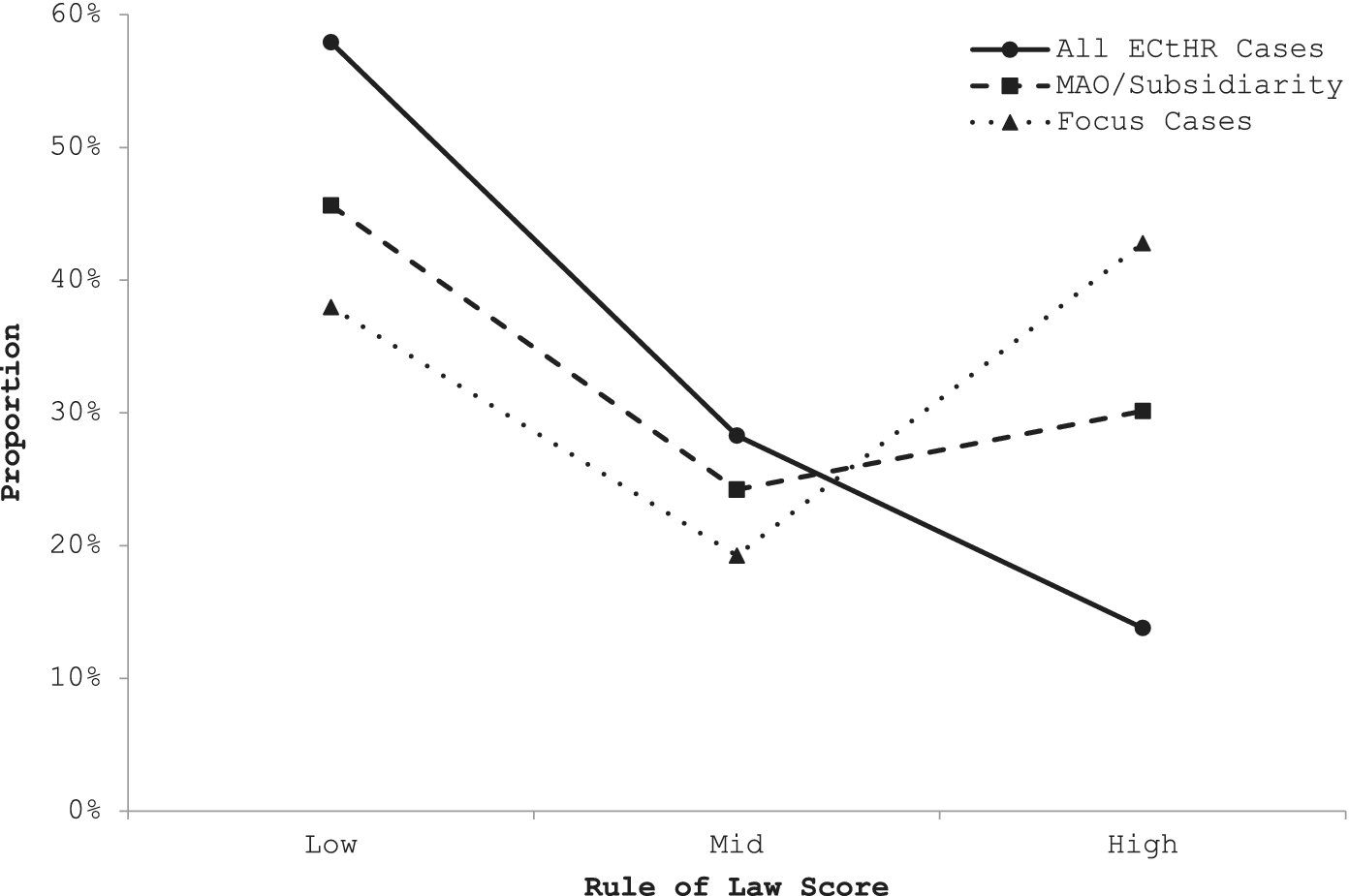
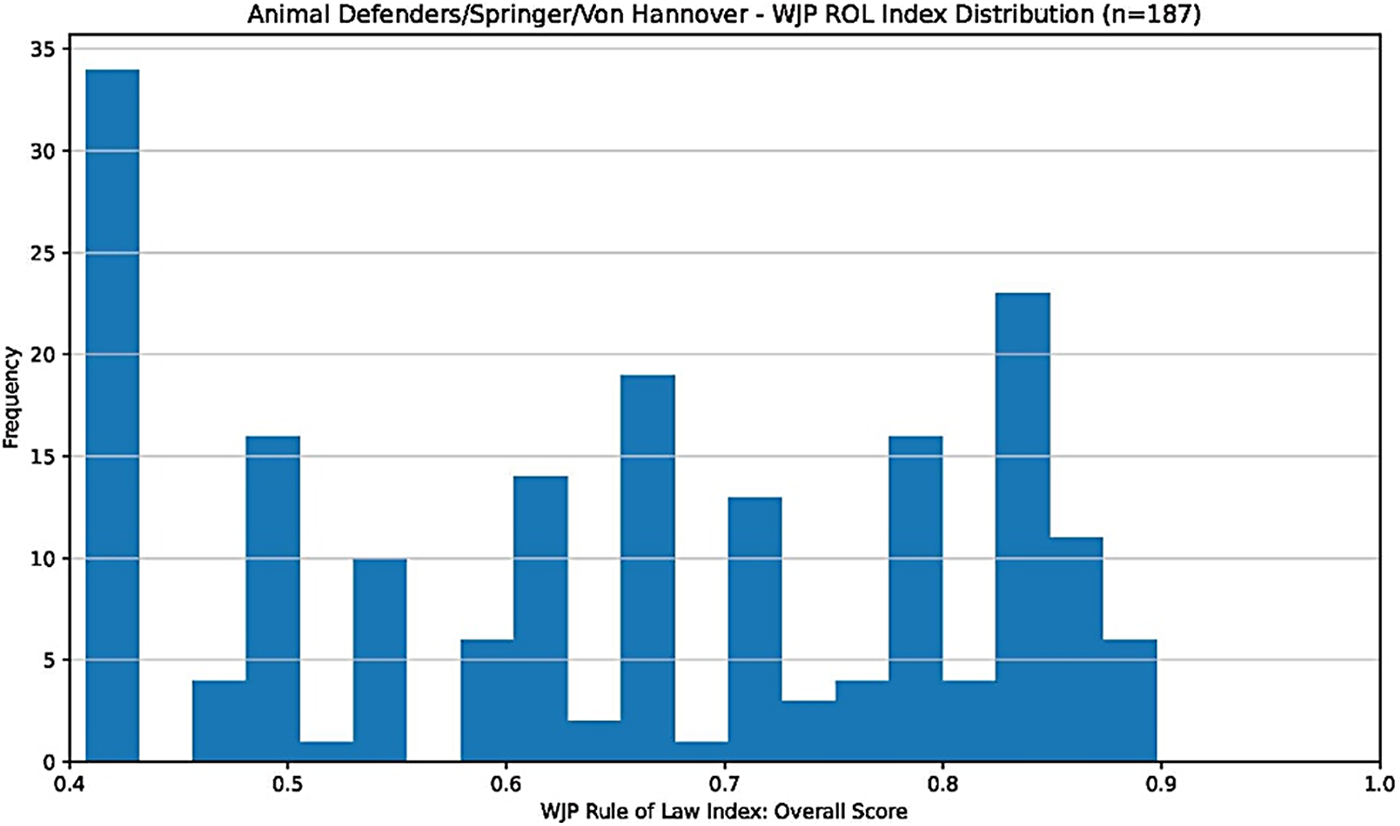
We can also explore the distribution of the doctrine across the member states. We know from previous research that the divide among Council of Europe member states is not an East–West one but rather one of rule of law performance.Footnote 59 More specifically, subsidiarity in terms of the Court affording the member states some deference seems mostly applied in the context of statistically speaking well-functioning rule of law countries and democracies. If we assess the distribution of the cases citing the three cases in focus (Animal Defenders, Axel Springer AG and Von Hannover (No. 2)) according to the rule of law score of the member state in question, we find a very clear overrepresentation of well-functioning rule of law countries (most of them also EU countries). More specifically, in Figure 1 below, we analyse all ECtHR judgments from 2012 to 2025 and explore them in multiple dimensions vis-à-vis the rule of law score of the member states. The rule of law score of the member states is based on the reporting of the WJP Rule of Law Index, where we use the latest scores for each member state.Footnote 60 We further group the rule of law scores into three broad categories: Low, Mid and High rule of law scores.Footnote 61 This is visible on the x-axis. The y-axis depicts the proportion of cases regarding three measurements. The full line in the graph shows the proportion of the total caseload (n = 34534) of the period in relation to the rule of law score. The striped line then shows the proportion of cases, which mentions ‘margin of appreciation’ or ‘subsidiarity’ in some form in their text (MAO/Subsidiarity Cases), a total of 2349 cases for the period. The dotted line then shows the proportion of cases that cite the three cases in focus (Animal Defenders, Axel Springer AG and Von Hannover (No. 2)) in the ‘subsidiarity and MAO’ dataset (n = 187),Footnote 62 considering differences in rule of law score (Low, Mid and High).
Rule of law score and distribution of cases.

Figure 1. Long description
The Y-axis is labeled proportion and ranges from 0 percent to 60 percent in increments of 10. The X-axis is labeled Rule of Law Score with three categorical points: Low, Mid, and High.
Three data series are plotted:
1. All E C t H R Cases (solid line with circles): Starts at approximately 58 percent at Low, drops sharply to 28 percent at Mid, and continues to decline to 14 percent at High.
2. M A O forward slash Subsidiarity (dashed line with squares): Starts at 46 percent at Low, drops to 24 percent at Mid, and rises slightly to 30 percent at High.
3. Focus Cases (dotted line with triangles): Starts at 38 percent at Low, drops to its lowest point of 19 percent at Mid, and rises sharply to its peak of 43 percent at High.
The graph shows that while all cases are most frequent in Low rule of law environments, Focus Cases show a unique significant increase in the High rule of law category compared to the other two groups.
We can first observe that a low score on the rule of law corresponds with a higher proportion of the total case law. When we move to the striped line, we find that most cases are still found among the lower-scoring rule of law countries, but not as clearly as in the overall ECtHR caseload. High-scoring rule of law countries account for a substantial share. When we move to our focus cases, we find that the high rule of law scoring member states stand out with a share of around 43 percent. This suggests that the focus cases are significantly more prevalent in the jurisprudence regarding the member states with a high rule of law score.Footnote 63 It is important to underline that the graph only depicts statistical occurrences of the focus cases and not whether they have actually been applied to assess legal and political procedures in the specific case. It is also likely that they appear in many cases stemming from low rule of law scoring member states, where the findings are that the institutions in question do not live up to the requirements of these doctrines.
The overall findings are perhaps not overly surprising, considering the requirements the doctrine of procedural subsidiarity stipulates. In practice, the doctrine will be mostly applicable to well-functioning democracies that can document the various stages of the politico-legal process and make a legitimate claim that they have gone through all the stages in good faith.Footnote 64 Moreover, the Court must be able to trust those institutions in their submissions. This leaves it as a doctrine mainly targeted at a subset of member states that can demonstrate such good democratic standing and faith in a plausible way. As stipulated by the then-President of the Court, Robert Spano, the doctrine applies mainly to well-functioning democracies.Footnote 65 Conversely, and perhaps surprisingly to some, the democracy-enhancing doctrine has little, if any, application to member states that are backsliding democracies as they fall outside of its scope. In that sense, the alleged democracy-enhancing doctrine speaks mostly to well-functioning democracies.
Conclusion
This article has argued that subsidiarity is a composite notion that needs to be unpacked to locate its actual space and place regarding democracy. In the first part of the article, it was generally concluded that subsidiarity as a legal principle needs to connect to other values of the ECHR system to become a relevant governance tool. However, subsidiarity remains somewhat of an elusive concept in multilevel international governance. I argued that this is due to the fact that the concept, at least as an international law concept, does not seek to fully distribute power and allocate authority. It is a concept that helps allocate authority and power through a complex balancing test that can seek legal, organisational or democratic aims, or combinations thereof. At the end of the day, it is a tool to help the Court balance the many considerations of both legal, organisational and democratic nature that are part and parcel of the operation of European human rights.
In the second part of the article, we explored the place of legal-organisational and legal-democratic subsidiarity in the development of the ECHR and ECtHR. The overall finding is that subsidiarity, for the most part, is oriented towards more organisational ends with regard to realising the Convention. Subsidiarity cases directly related to democracy are relatively rare, partly because the test that the Court has developed in this regard is strict. In practice, this means that mostly well-functioning democracies fall within its ambit. This has the implication that the new allegedly democracy-enhancing doctrine has, in practice, little to offer regarding less well-functioning democracies or backsliding democracies. Alternatively, one could argue, more positively, that because it sets the bar high, it thereby underlines that subsidiarity in terms of democracy or rule of law is not an option when democracies are not functioning well.
Competing interests
No competing interests.
Appendix 1. Histograms of the distribution of cases and the rule of law score
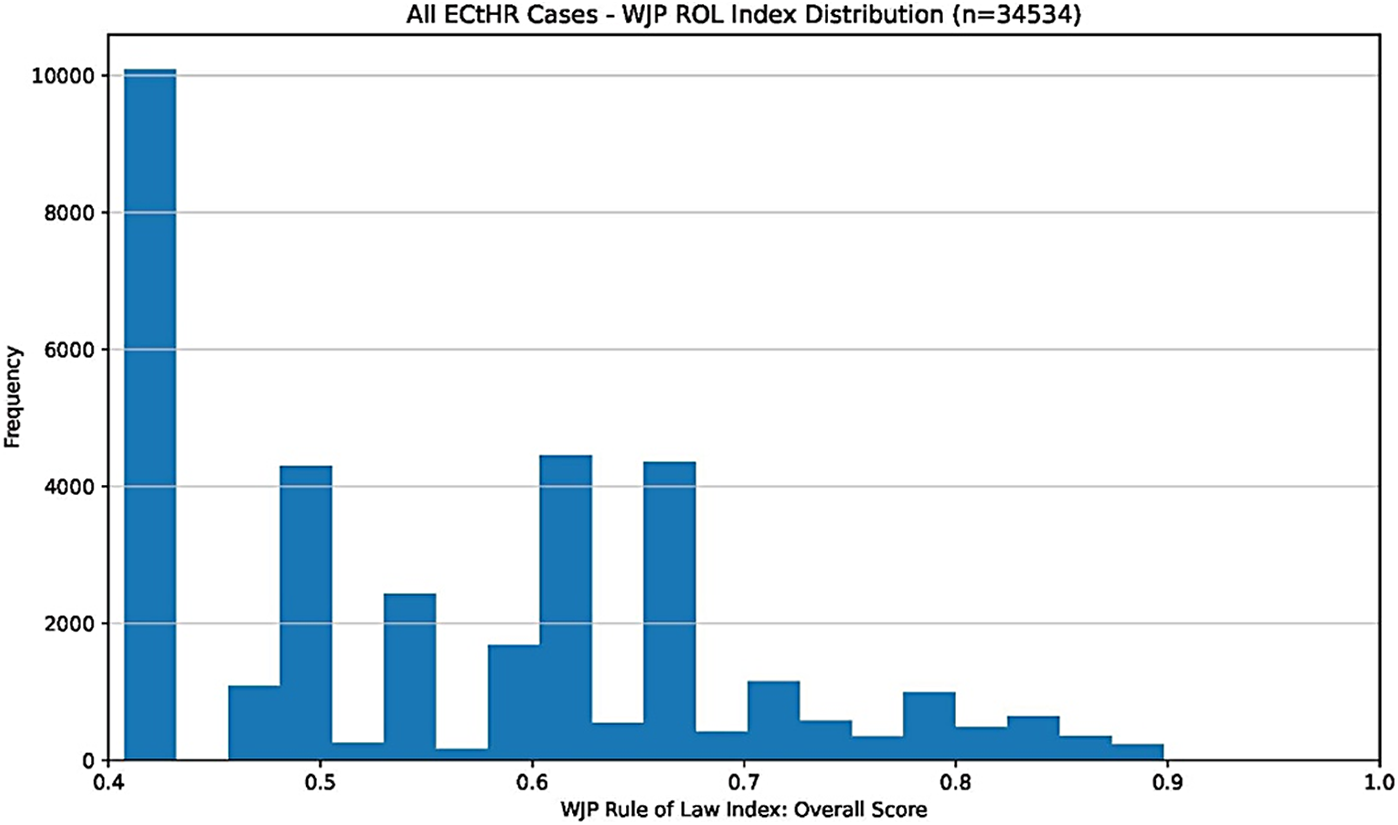
All cases distributed according to rule of law index.
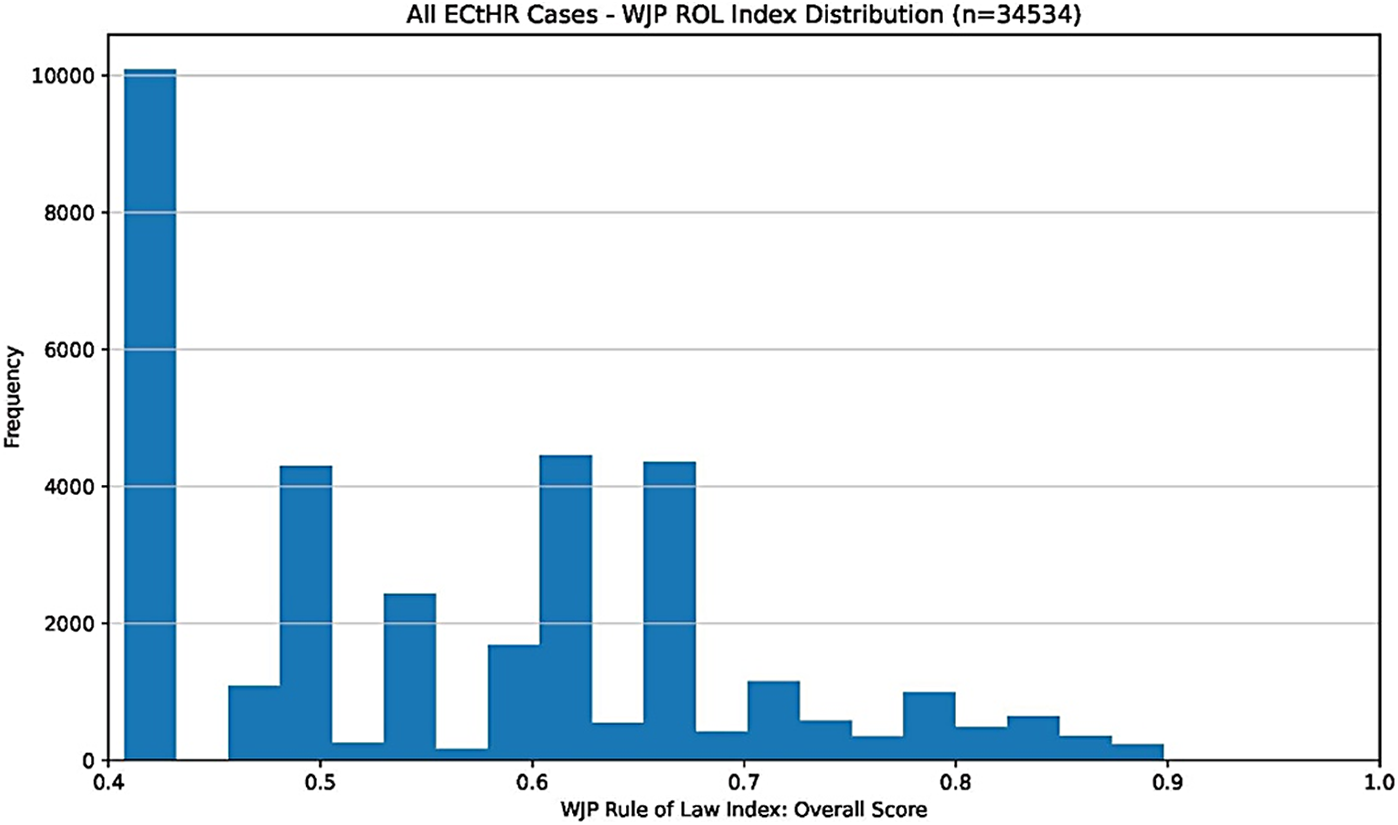
Figure A1. Long description
The histogram is titled All E C t H R Cases - W J P R O L Index Distribution (n equals 34534).
* The X-axis is labeled W J P Rule of Law Index: Overall Score, ranging from 0.4 to 1.0 in increments of 0.1.
* The Y-axis is labeled Frequency, ranging from 0 to 10000 in increments of 2000, with horizontal grid lines at each interval.
Data distribution from left to right:
* The highest peak is at the far left, between 0.40 and 0.43, reaching over 10000 on the frequency scale.
* A secondary cluster of peaks occurs between 0.48 and 0.68. Within this range, there are three notable peaks: one at approximately 0.50 (frequency ~4300), one at 0.61 (frequency ~4500), and one at 0.66 (frequency ~4400).
* Between these peaks are lower frequency troughs, such as at 0.52 and 0.57.
* From 0.70 to 0.90, the frequency shows a steady downward trend with minor fluctuations, eventually tapering off to near zero as the score approaches 0.90.
* There is no data visible between 0.90 and 1.0.
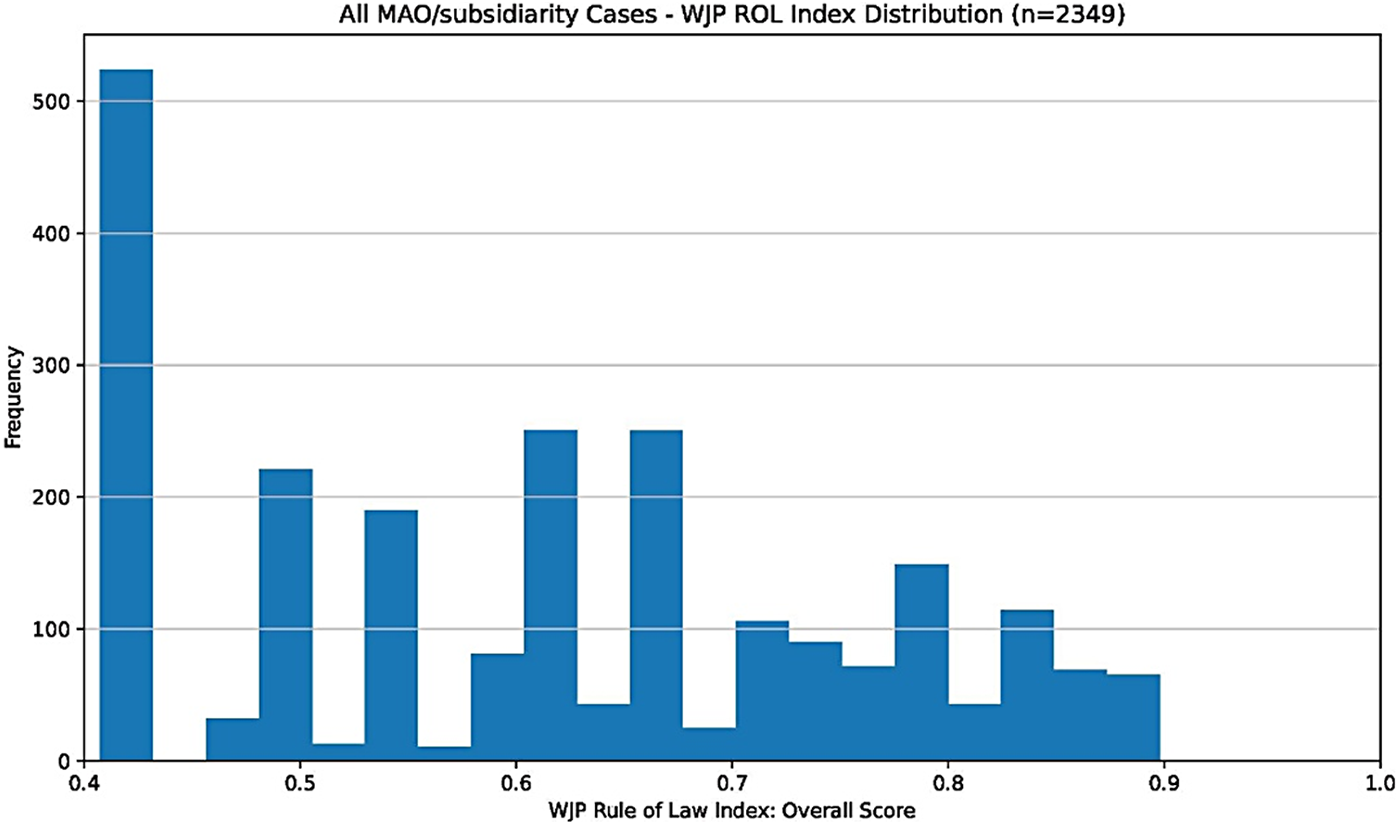
MAO/Subsidiarity cases distributed according to rule of law index.

Figure A2. Long description
The histogram is titled All M A O forward slash subsidiarity Cases - W J P R O L Index Distribution (n equals 2349).
* The y-axis is labeled Frequency and ranges from 0 to 500 with horizontal grid lines every 100 units.
* The x-axis is labeled W J P Rule of Law Index: Overall Score and ranges from 0.4 to 1.0.
Data distribution from left to right:
* The highest frequency bar is at the far left, centered around 0.42, reaching over 500.
* A secondary cluster of bars appears between 0.48 and 0.55, with peaks around 220 and 190.
* A third cluster occurs between 0.6 and 0.68, with two prominent bars reaching approximately 250.
* From 0.7 to 0.9, the frequency generally trends downward with smaller peaks, including one at 0.8 reaching 150.
* There is no data shown between 0.9 and 1.0.
Focus cases distributed according to rule of law index.

Figure A3. Long description
The histogram is titled Animal Defenders forward slash Springer forward slash Von Hannover - W J P R O L Index Distribution (n=187).
* The y-axis is labeled Frequency and ranges from 0 to 35 with increments of 5.
* The x-axis is labeled W J P Rule of Law Index: Overall Score and ranges from 0.4 to 1.0 with increments of 0.1.
Data distribution from left to right:
* The highest peak occurs at the far left, between 0.4 and 0.43, with a frequency of 34.
* A secondary cluster appears between 0.45 and 0.55, with peaks at 16 and 10.
* A central cluster spans 0.58 to 0.73, with a prominent peak of 19 at approximately 0.66.
* A final cluster on the right spans 0.75 to 0.9, featuring a significant peak of 23 at approximately 0.84 and a smaller peak of 16 at 0.78.
* There is no data shown between 0.9 and 1.0.

 Open access

